Category: AI Computing

  • Build and Optimize Your AI Workstation for Peak Performance 2026

    Build and Optimize Your AI Workstation for Peak Performance 2026

    It’s 2026, and artificial intelligence (AI) is no longer just a buzzword. It’s a tool that many businesses, big and small, use every day. From making special pictures to writing new ideas, AI helps teams get more done. But here’s the thing: for your team to really shine with AI, the computer they use needs to be up to the task. Having the right "optimum tech" or a powerful "pc setup" is super important.

    When your computer can handle AI tasks right on your desk, it changes a lot. First, it helps you work much faster. Instead of waiting for things to load or process on a faraway server, your ideas can come to life in moments. This quickness means your team can try out new things and fix problems much quicker. Think of it like drawing. If your pencil moves slowly, you can’t sketch as many ideas. A fast computer is like a super-fast pencil for AI.

    This speed also helps save money. When you run AI tasks on your own computer, you don’t have to pay for expensive cloud services as often. For small to medium businesses (SMBs), this can make a big difference in costs. Plus, when developers and creators have powerful tools that work smoothly, they are happier and get more done. It boosts their productivity and keeps them focused on creating, not waiting.

    For example, to run even a small AI model, you need a computer with at least 16GB of system memory (RAM) and a graphics card with 8GB of its own memory (VRAM). For bigger tasks, you’ll need 24GB or more VRAM and maybe 64GB to 128GB of system RAM [1, 2]. Picking the right parts for your pc setup is key to making sure your AI efforts pay off.

    Screenshot of the AI Tools News Today website, a resource for businesses seeking insights on AI-ready computer configurations.

    In this guide, we’ll walk you through how to build an AI workstation that balances great performance with a smart budget. You’ll get an easy-to-follow checklist and recommendations for hardware that will keep your team at the top of their game without breaking the bank.

    Do you want to stay updated on the latest AI trends and tools that can help your business thrive?
    Get clear daily AI updates from The Deep View Newsletter.

    Choosing the right parts for your computer is a big step in getting your team ready for AI tasks.

    A person intently planning and making strategic decisions regarding optimal hardware choices for an AI workstation.

    Think of these parts like the different players on a sports team. Each one has a special job that helps the whole team win. For AI, you need a strong CPU (the "brain"), a powerful GPU (the "muscle"), lots of RAM (the "short-term memory"), and fast storage (the "long-term memory"). Getting the right optimum tech in your pc setup means your AI projects will run smoothly and quickly.

    Graphics Card (GPU) is Key

    The most important part for most AI tasks is the Graphics Processing Unit, or GPU. It’s like the main engine for AI. GPUs are very good at doing many calculations at once, which is exactly what training AI models and using them (called "inference") needs.

    • Training small models or fine-tuning: If you’re working with smaller AI models, or just tweaking existing ones, a GPU with about 8GB to 16GB of its own memory (VRAM) is often enough. For example, running a 7-billion parameter AI model comfortably needs 16GB of VRAM Local AI Hardware Requirements (2026): Complete Guide.
    • Larger AI models: For bigger jobs, like training large language models or working with complex image AI, you’ll need much more VRAM. A graphics card with 24GB or even 32GB of VRAM is much better. Some of the best consumer-grade cards in 2026, like the NVIDIA RTX 4090, offer 24GB VRAM, which is great for many tasks Best AI PC Builds for Running Local LLMs in 2026 – Newegg.
    Screenshot of the Newegg homepage, a prominent online retailer for computer hardware components relevant to AI PC builds.

    You might wonder about consumer GPUs (made for gamers) versus professional GPUs (made for serious work). Consumer GPUs, like the RTX series, offer great performance for their price, especially if you’re building a budget-friendly AI workstation. Professional cards are more expensive but offer more VRAM and special features for huge projects. For most small and medium businesses, a powerful consumer GPU can be a very smart choice for your AI pc setup.

    Central Processing Unit (CPU) and System Memory (RAM)

    While the GPU does the heavy lifting for AI math, the CPU is still very important. It handles everything else, like getting your data ready for the GPU (data preprocessing), running the operating system, and managing other programs. A CPU with many "cores" (the parts that do work) helps a lot with these tasks. It keeps the data flowing smoothly to the GPU so your graphics card isn’t waiting around.

    For system memory, or RAM, you need a good amount too. It holds all the data that your CPU and GPU are working on at that moment. For basic AI tasks, 32GB of RAM is a good start in 2026. But for more serious work, like if your GPU doesn’t have enough VRAM and needs to use some of the system RAM (called "CPU offloading"), 64GB or even 128GB of RAM is much better How Much RAM for Local AI in 2026? Memory Guide. This makes sure everything runs quickly without slowing down.

    Fast Storage for Data

    Finally, don’t forget storage. AI models and the data they learn from can be very large. You need fast storage, like NVMe SSDs, to quickly load and save these files. Slow storage can make your whole system feel sluggish, even if you have a powerful GPU and lots of RAM. Having 2TB or more of fast NVMe storage is often recommended for serious AI work Best PC for AI, Machine Learning & Data Science (2026) | CORSAIR.

    Smart Choices for Your Budget

    Building an AI workstation is about finding the right balance. You want enough power without spending too much.
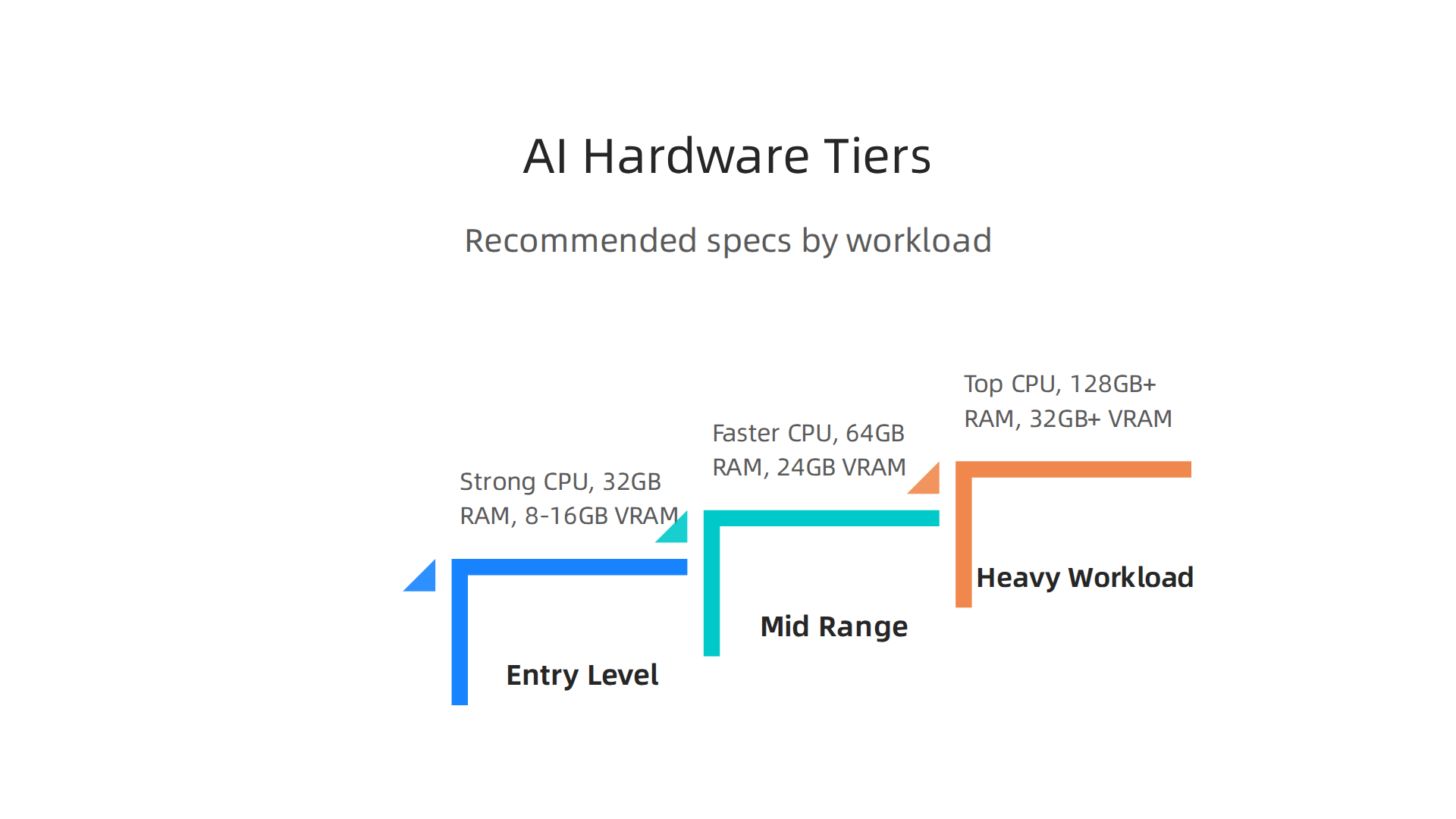
    An infographic illustrating recommended hardware specifications for entry-level, mid-range, and heavy AI workloads.

    • For entry-level AI: A strong CPU, 32GB of RAM, and a consumer GPU with 8-16GB VRAM, along with a fast 1TB NVMe SSD, can get you started.
    • For mid-range tasks: Upgrade to a faster CPU with more cores, 64GB of RAM, and a GPU with 24GB VRAM.
    • For heavy AI workloads: Consider a top-tier CPU, 128GB+ of RAM, and a GPU with 32GB+ VRAM (or even two GPUs), plus multiple large, fast NVMe drives.

    You can often save money by looking into options like used PC parts for AI or even finding a used gaming PC for AI that you can upgrade. This smart approach to building your pc setup means you can get the optimum tech you need without stretching your budget too thin.

    Choosing the right computer parts is just the first step for AI work. Think of it this way: even the fastest race car needs a good driver and the right fuel to win. For your AI pc setup, the "driver" is the software that makes everything run. Getting this software stack right is key to having the most optimum tech and smooth performance. It makes sure your powerful GPU can actually do its job well.

    Understanding the AI Software Stack

    The software stack for AI has different layers, much like a sandwich. Each layer needs to work with the ones above and below it.
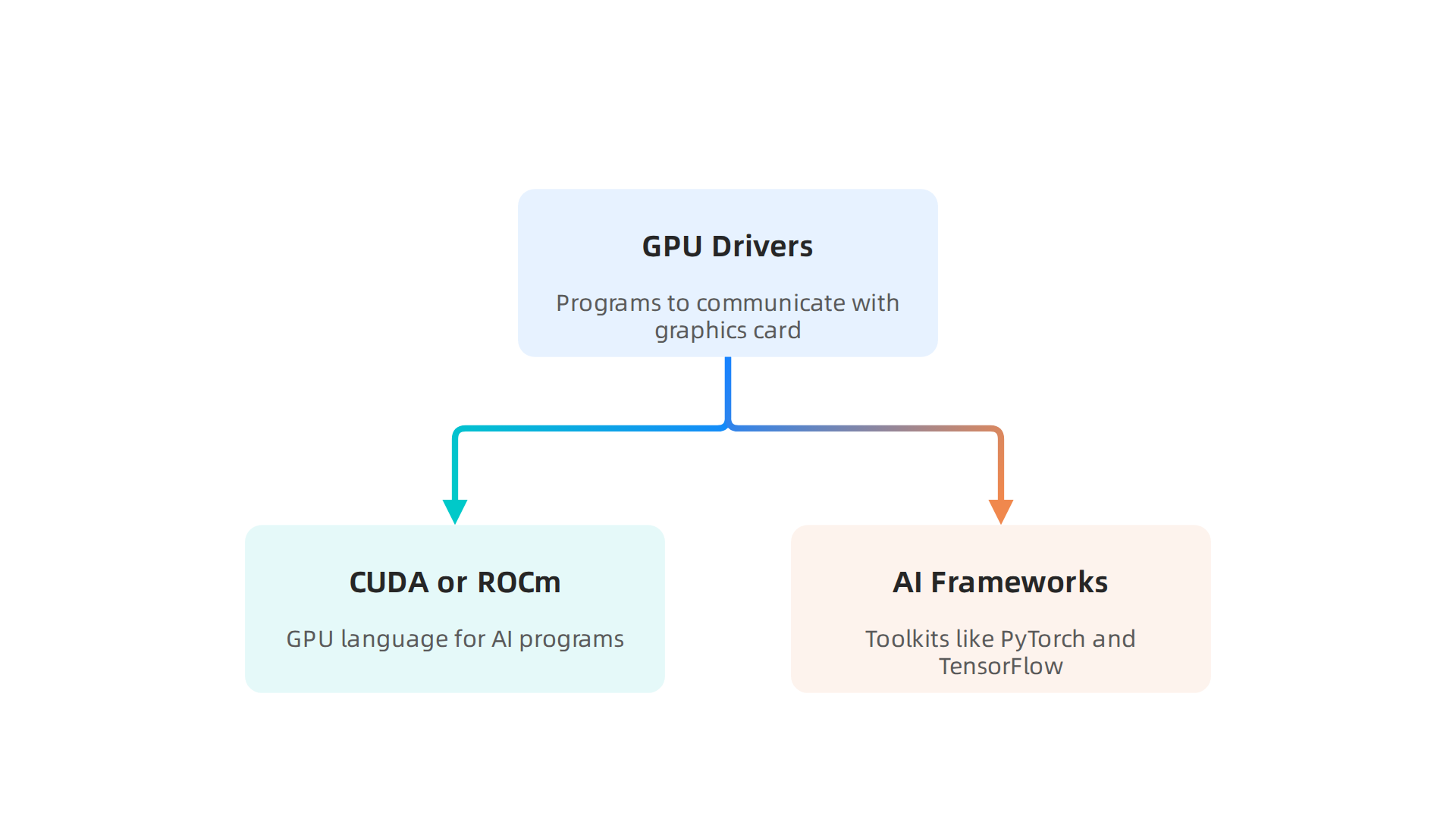
    An infographic illustrating the hierarchical layers of the AI software stack, from GPU drivers to AI frameworks.

    1. GPU Drivers: These are special programs that let your operating system (like Windows or Linux) talk to your graphics card. Without the right driver, your GPU can’t do much.
    2. CUDA or ROCm (The GPU Language): This is the magic layer that lets AI programs tell your GPU what to do.

    Screenshot of the NVIDIA homepage, highlighting their leadership in GPU technology and AI computing solutions.

    *   **ROCm** is AMD's answer, and it works with AMD GPUs. It has gotten much better in 2026, with more official support for consumer cards like the RX 7900 XTX [AMD ROCm vs CUDA for Local AI [2026 Compared]](https://www.kunalganglani.com/blog/amd-rocm-vs-cuda-local-ai-open-source-guide). However, CUDA often still performs 10% to 30% better than ROCm [ROCm vs CUDA: GPU Computing Comparison (July 2026)](https://www.thundercompute.com/blog/rocm-vs-cuda-gpu-computing).
    
    1. AI Frameworks: These are the big toolkits that AI developers use, like PyTorch and TensorFlow. They use CUDA or ROCm to send tasks to the GPU.

    Avoiding Software Conflicts

    The tricky part is making sure all these layers are compatible. For example, a new version of PyTorch might need a specific version of CUDA, which in turn needs a certain NVIDIA driver. If these versions don’t match, your AI programs might crash or run very slowly. AMD’s ROCm also has detailed compatibility lists, showing which versions work with different GPUs and operating systems ROCm 7.14.0 compatibility matrix – ROCm Documentation.

    It’s a good idea to always check the "compatibility matrix" for your chosen CUDA or ROCm version and your AI frameworks. This small step can save you a lot of headaches. Staying on top of updates and new releases in the world of AI technology is essential for any business.

    Boosting Performance Without New Hardware

    Even with your current pc setup, you can make your AI tasks run faster by tuning your software.

    • Mixed Precision Training: This is a smart trick where your AI model uses smaller, simpler numbers for some calculations. This speeds up training and saves GPU memory (VRAM). It’s like doing some math with rough estimates instead of always exact numbers, which is often good enough for AI and much faster. Many modern AI frameworks support this.
    • Memory Management: Being careful about how your programs use VRAM and system RAM can make a big difference. Closing other programs, reducing the "batch size" (how many pieces of data the GPU processes at once), or optimizing your code to use less memory can lead to faster training and inference.
    • Software Updates: Keeping your GPU drivers, CUDA/ROCm, and AI frameworks updated to compatible versions can often bring performance improvements and new features. It’s like getting a tune-up for your car.

    By focusing on these software aspects, you can squeeze out more performance from your existing hardware, ensuring you truly have the optimum tech for your AI projects. If you’re looking to understand more about choosing the best systems, check out our guide on how to choose AI ready business computers in 2026.

    Staying informed about the latest developments in AI tools and compatible software can also help you make smart choices. It ensures your software stack remains efficient and powerful.

    Get clear daily AI updates from The AI Newsletter Worth Reading.

    Okay, your powerful AI graphics card needs to crunch huge amounts of data. But if that data can’t get to the GPU fast enough, it’s like having a super-fast car stuck in traffic. That’s why memory, storage, and how your computer moves data around (called I/O) are just as important for a truly optimum tech setup.

    A person focused on a screen displaying complex charts and data, representing efforts to analyze and optimize data flow.

    We need to prevent any slow-downs, or "bottlenecks," that stop your AI projects from running smoothly.

    Making Sure Your AI Data Flows Fast

    When you train an AI model, it needs to read huge collections of information, called datasets. It also saves its progress often, creating "checkpoints." If these files are slow to load or save, your GPU will sit idle, waiting for data. That’s wasted time and power.

    1. Dataset Formats:
    The way your data is stored matters. Some formats, like TFRecord for TensorFlow or Arrow for PyTorch, are made to be read very quickly. They pack data efficiently and can be streamed to the GPU without much fuss. Using these formats can speed up your AI work a lot.

    2. Smart Storage Choices (Storage Tiers):
    Think of your storage as different lanes on a highway.

    • NVMe SSDs: These are the fastest lanes. They’re like rocket ships for data. For AI work, your active datasets and checkpoints should be on NVMe (Non-Volatile Memory Express) drives. These plug right into your motherboard and are much faster than older SSDs. Making sure your NVMe drive is running at its full speed, like PCIe Gen4 x16, is important to avoid a data jam Local AI Performance & Optimization (2026 Admin Guide).
    • SATA SSDs: These are still fast, like a regular highway. Good for less critical data or older projects.
    • HDDs (Hard Disk Drives): These are the slowest, like a country road. They’re good for storing really large amounts of archived data that you don’t need to access often.

    Having the right storage for the right job means your pc setup has the optimum tech for speed.

    3. Moving Data Smartly (I/O Strategies):
    Getting data from your storage to your GPU involves many parts, including your computer’s brain (CPU) and its operating system.

    • Operating System Tuning: Even the operating system (like Linux) can be tweaked to help. Special settings in the "kernel" (the core of the OS) can help data flow better. For example, using larger memory pages, called "Transparent Huge Pages," can make things faster Linux Kernel & OS Optimization for AI/ML Workloads in 2026. Some tools can even use AI to automatically fine-tune your Linux kernel for better performance Tuning the Linux kernel with AI brings significant performance.
    • Caching: Your computer can temporarily store frequently used data in a faster memory area, called a cache. This is like putting your favorite tools right next to you instead of walking to the shed every time. For large datasets, smart caching helps a lot.
    • RAID: This is a way to combine several hard drives to act like one. You can set it up for extra speed (reading and writing across multiple drives at once) or for safety (if one drive fails, your data is still safe on others). For AI, a RAID setup focused on speed can be helpful for very demanding projects.

    Practical Steps for a Better PC Setup

    To make sure your pc setup is ready for heavy AI work in 2026:

    • Invest in NVMe: Make sure your main drives for AI datasets and checkpoints are NVMe SSDs.
    • Check PCIe Lanes: In your computer’s settings (BIOS), make sure your GPU and NVMe drives are using all their available speed lanes, especially for PCIe Gen4 x16.
    • Optimize Your OS: If you’re using Linux, look into tools and settings for kernel tuning. For example, setting vm.swappiness to 0 can stop your computer from using slower storage as "fake" RAM, which is good if you have enough actual RAM Linux OS & Kernel Tuning – GPU Cluster Knowledge Base. You can also dedicate specific CPU cores and memory to your AI tasks.
    • Data Organization: Store your most important, actively used AI datasets on the fastest NVMe drives. Move older or less used data to slower, cheaper storage like larger HDDs.

    By paying attention to these details, you’re not just buying powerful parts; you’re building a truly efficient machine. This helps define technology that works for you, ensuring your AI work runs faster and smoother. If you are interested in seeing how operating systems are evolving to integrate AI, you can read about Integrating Artificial Intelligence into Operating Systems.

    After making sure your powerful AI graphics card gets data quickly, the next step is to look at how your computer’s main brain, the operating system (OS), and its core, the kernel, work. Getting these right is key for truly stable and optimum tech performance when doing AI tasks. Without proper settings, even the best hardware can slow down.

    OS-Level Settings for AI

    Think of your operating system as the boss of your computer. It decides who gets to use the CPU, memory, and other resources. For AI, you want your important AI programs to get priority.

    • CPU Scheduling: Your CPU has to manage many tasks at once. "CPU scheduling" is how it decides which task runs when. For AI, we want AI training or inference tasks to run smoothly without other programs hogging the CPU. You can often tweak settings in Linux to give your AI jobs more CPU time. Using special groups called "cgroups" helps you set aside CPU cores and memory just for your AI programs, keeping them separate from other tasks Beyond the GPU: Linux Kernel & OS Optimization for AI/ML Workloads in 2026.
    • Kernel Tuning: The kernel is the very heart of the OS. It manages everything. For AI, certain kernel settings can boost speed. For example, some tools can use AI itself to automatically find the best kernel settings for your system, leading to better performance Tuning the Linux kernel with AI brings significant performance. This kind of smart tuning can really make your pc setup shine.

    Containerization for AI Work

    Making sure your AI work can be repeated exactly the same way every time is super important. That’s where containers come in.

    • What are Containers? Imagine a small, self-contained box that holds everything your AI program needs to run: the code, its tools, and all its settings. This box is a container. Docker is a popular tool for making and running these containers.
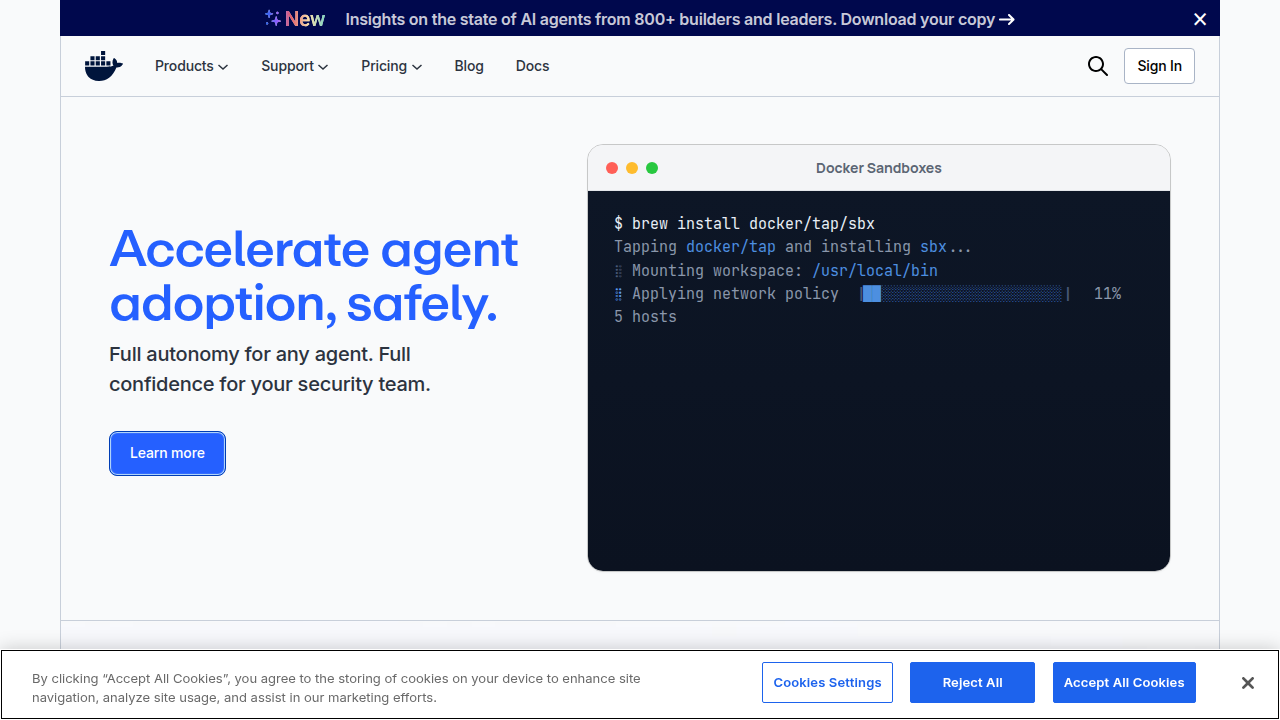
    Screenshot of the Docker homepage, showcasing the platform for containerizing and managing applications, including AI workloads.

    • Why They Help AI:
      • Reproducible: Because everything is bundled, your AI model will run the same way on your computer as it does on a friend’s computer, or on a big server farm. This means fewer "it works on my machine" problems.
      • Consistent: Containers help keep your different AI projects separate. One project’s tools won’t mess with another’s.
      • Easy to Move: You can easily move your containerized AI projects from one machine to another. This is great for sharing your work or moving to bigger computers if your AI needs more power.

    Containers vs. Virtual Machines vs. Bare Metal

    When setting up your AI environment, you have choices for how isolated your programs are.
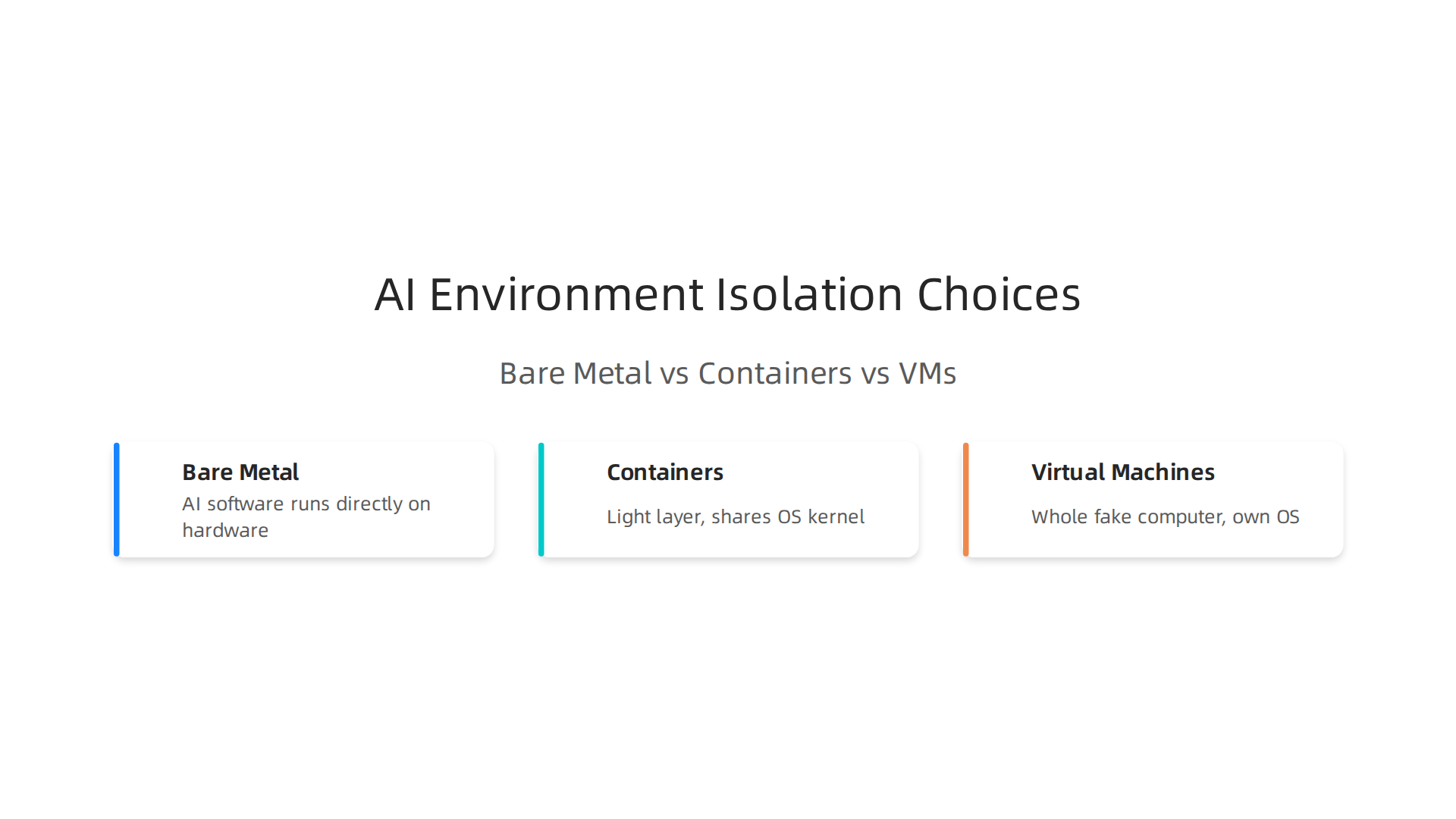
    An infographic comparing Bare Metal, Containers, and Virtual Machines for AI project deployment and isolation.

    • Bare Metal: This means your AI software runs directly on your computer’s hardware, with only the operating system in between. It’s the fastest way to run things because there’s no extra layer slowing it down. This gives you the maximum optimum tech speed. However, it can be harder to manage many different projects or quickly switch between environments.
    • Containers: As we talked about, containers add a light layer on top of your OS. They give you a good balance of speed and flexibility. They’re much faster than VMs because they share the OS kernel with the host machine.
    • Virtual Machines (VMs): A VM creates a whole fake computer inside your real computer, with its own OS. This offers the best isolation and security. You can run Windows on a Linux machine, for example. But VMs are slower than containers or bare metal because they have more layers to go through. They’re useful if you need to run AI on a very different operating system or need strict isolation.

    For most AI tasks in 2026, especially for local development on your pc setup, containers are a great middle ground. They offer solid performance and the flexibility to manage many projects. For the absolute fastest training or inference, bare metal is often preferred, but it needs more careful manual setup and management.

    To stay on top of all the new ways operating systems and other technology are evolving with AI, it helps to keep learning.

    For clear, daily AI updates that help you make sense of the fast-moving world of AI and technology, consider subscribing to The AI Newsletter Worth Reading.

    After setting up your computer’s brain and packaging your AI programs in containers, you might think you’re ready to go. But wait! How do you know if your setup is truly performing at its best? This is where measuring things becomes super important. You need to look at tooling, profiling, and observability to measure before you optimize.

    Think of it like tuning a car. You don’t just change parts; you first check what’s wrong with special tools. For your AI pc setup, you need similar checks to find out if anything is slowing it down.

    Tooling, profiling, and observability: measure before you optimize

    "Profiling" simply means watching your AI program as it runs to see which parts are fast and which are slow. This helps you find the weak spots that keep your computer from reaching its optimum tech potential. You need to keep an eye on a few key things:

    • CPU Usage: This shows how hard your computer’s main brain is working. Is it busy doing AI tasks, or is something else taking up its time?
    • GPU Usage: Your graphics card is like the powerhouse for AI. You want to make sure it’s working hard on your AI calculations and not just sitting idle.
    • Memory Usage: This includes both your computer’s main memory (RAM) and the special memory on your graphics card (VRAM). If you run out of memory, everything slows down.
    • Input/Output (I/O): This checks how fast data moves around your system. If your computer can’t get data to the GPU fast enough, your AI will wait, even if the GPU is powerful.

    Watching these numbers helps you see exactly where to make changes. For example, tools like the PyTorch Profiler can show you a detailed timeline of what your AI model is doing, frame by frame, to spot bottlenecks in its operation Profiling in PyTorch (Part 1): A Beginner’s Guide to torch. …. This kind of detailed view helps you understand the inner workings of your AI tasks.

    A Simple Plan for Better Performance

    To make sure your AI runs as fast as it can, follow these steps:

    1. Measure First: Before changing anything, measure how well your AI is performing right now. Note down the CPU, GPU, memory, and I/O numbers. Many useful technology tools exist for this Best Machine Learning Profiling Software.
    2. Change One Thing: Make just one small change to your settings, code, or hardware.
    3. Measure Again: Run your AI program and measure its performance again. Compare the new numbers to the old ones to see if your change helped or hurt.
    4. Repeat: Keep doing this cycle. Each time, you’ll learn more about what makes your specific AI work faster.

    This way, you’re not just guessing what might help. You’re using real numbers to guide your choices, making your performance checks "reproducible." This means you can do the same test multiple times and get the same results, confirming your improvements. It’s how experts ensure their pc setup is always top-notch for AI. For more tips on setting up your computer for AI, check out how to choose AI-ready business computers in 2026.

    Keeping track of these details is part of "observability." It’s about having a clear picture of what’s happening inside your system at all times. This helps you react quickly if problems come up and ensures your AI projects stay on track. Learning about new tools and trends can also help you keep your systems updated; you can even build a tech radar to track AI trends and tools in 2026.

    After you know how well your AI is running, the next big question is where it should run. Should your AI tasks stay on your own computer, known as your local pc setup? Or should you send them to the cloud, which is like using super powerful computers far away over the internet? This choice is called using "hybrid workflows," and it’s key to getting the most out of your optimum tech.

    A person thoughtfully considering options, symbolizing the decision-making process for hybrid AI workflows (local vs. cloud).

    Hybrid workflows: when to offload to cloud or keep work local

    Think of it like deciding where to do your cooking. You can cook at home (local) or order from a restaurant (cloud). Both have good and bad points. For AI, picking the right place helps you save money, finish tasks faster, and keep your information safe. Businesses in 2026 often use a mix of both. This blend of local and cloud resources for AI is often called a hybrid AI architecture Hybrid AI Architecture: 6-Criterion Decision Matrix (2026).

    Here’s how you can decide:
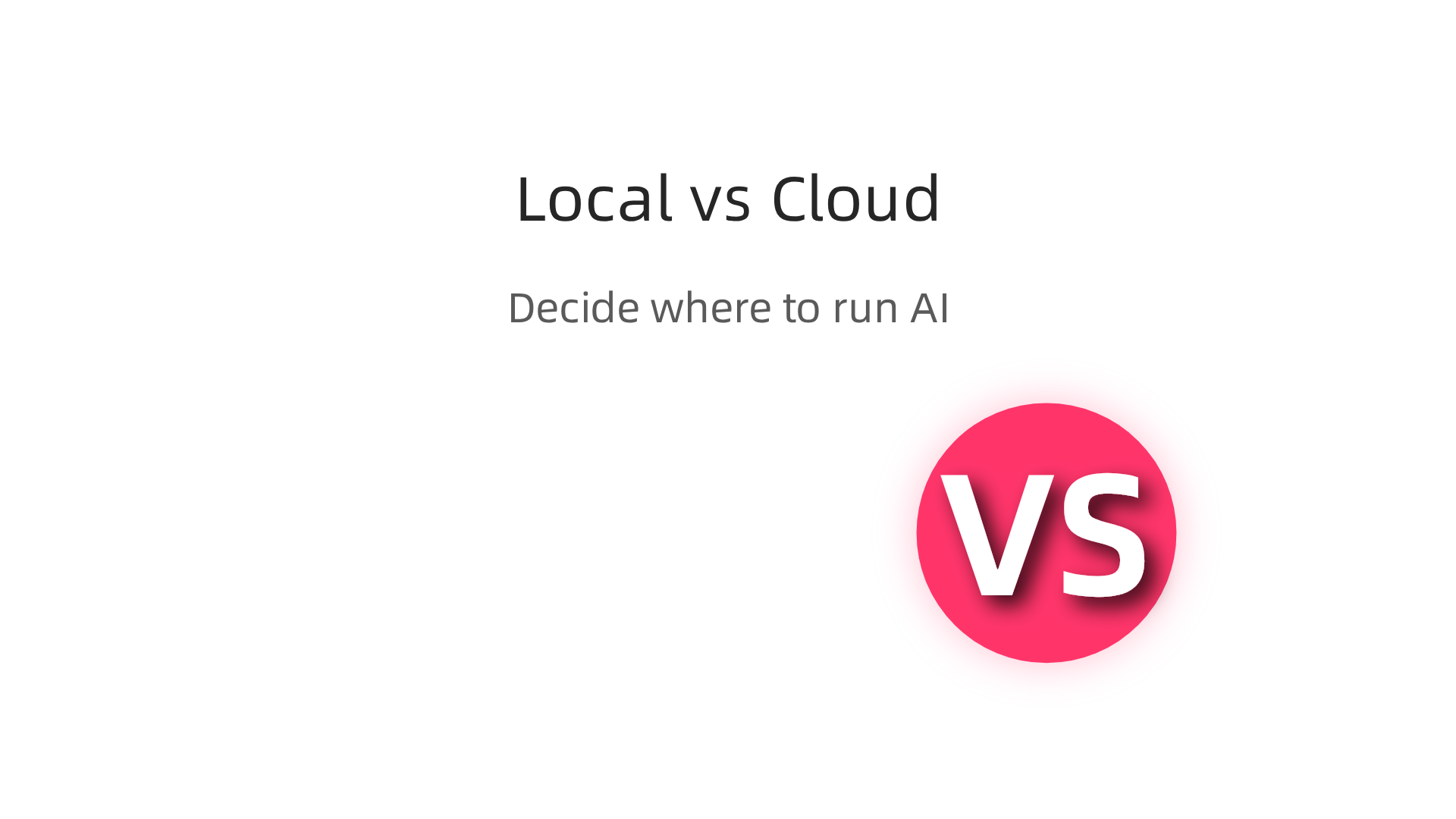
    An infographic outlining key factors to consider when deciding between local and cloud resources for AI workloads.

    • Data Security: If your AI works with very private or secret information, it’s often best to keep it on your local pc setup. This way, you have full control over your data. Many businesses choose local models for sensitive data Local AI vs Cloud AI in 2026: When to Run Models on Your Own ….
    • Cost: Running AI in the cloud can be like paying-as-you-go. You only pay for what you use. Setting up a powerful local computer for AI can cost a lot of money upfront, like buying all your own kitchen tools. But for many tasks, local can be cheaper in the long run Designing Hybrid Cloud‑Local LLMs: A 2026 Architecture ….
    • Speed and Time: For some fast, small jobs, your local computer might be quicker because there’s no internet delay. But for huge jobs that need a lot of computing power, the cloud can finish them much faster by using many computers at once On-Premise vs Cloud AI Deployment: A Decision ….
    • Growing Bigger (Scalability): The cloud makes it easy to handle much more work when you need to, and then shrink back down later. Your local computer has a fixed amount of power.

    Many people choose a mix, which is called a "hybrid approach." For example, you might use your local machine for everyday tasks or for data that needs to stay private. Then, for really hard problems or when you need a lot of power, you send those tasks to the cloud. This smart way of working helps you get the best of both worlds, leading to optimum tech performance.

    To set up these hybrid workflows, you can:

    1. Sort Your Work: Look at all your AI tasks and decide which ones need to stay local (due to privacy or cost) and which ones can go to the cloud (for speed or big jobs). You can classify tasks by how complex they are or how sensitive their data is Hybrid AI Strategy Guide — Achieving 50% Cost Reduction with ….
    2. Use Smart Routing: Set up your system to automatically send tasks to the right place. Simple or sensitive tasks stay local, while more complex tasks go to the cloud. This creates a "tiered inference architecture" that routes requests efficiently Local-First AI Agents: Hybrid Cloud-Edge Architectures for ….
    3. Use Tools that Help: There are tools that can help you manage where your AI runs, making it easier to switch between local and cloud.

    Choosing the right approach for your AI setup is a big part of mastering technology in 2026. For more ideas on finding the right tools, check out how to choose AI for business tools that deliver real results in 2026.

    Staying updated on these new ways of working is very important.

    Get clear daily AI updates from The Deep View Newsletter. The AI Newsletter Worth Reading

    Summary

    This guide explains how to build and optimize an AI workstation that balances performance and budget so teams can run local AI smoothly in 2026. It covers hardware essentials — why GPUs (VRAM), CPUs, system RAM and NVMe storage matter — and gives concrete spec ranges for entry, mid and heavy workloads. The article also walks through software considerations like drivers, CUDA vs ROCm, AI frameworks and containerization, plus OS and kernel tuning to avoid slowdowns. You’ll learn practical performance boosts such as mixed precision, memory management, and I/O strategies, how to measure bottlenecks with profiling tools, and when hybrid cloud workflows make sense. By the end you’ll know which parts to pick, how to tune the stack, and cost-saving options like used parts or hybrid routing to get optimum tech without overspending.

  • How to Choose AI-Ready Business Computers in 2026

    How to Choose AI-Ready Business Computers in 2026

    Artificial intelligence (AI) is changing how businesses work in 2026. From making tasks easier to helping with big decisions, AI is everywhere. Because of this, picking the right computer for your business is more important than ever. You need laptops and PCs that can handle AI tasks well, not just today, but for a long time to come. This is where "AI-readiness" truly matters.

    Many businesses make a common mistake. They often buy new computers based on exciting marketing words or big numbers on a spec sheet. But sometimes, what sounds great on paper doesn’t work so well in the real world. A computer might be advertised as "AI-ready," but that can mean different things. It’s like buying a car that says "fast" without knowing if it’s fast for city driving or only on a race track. For businesses, this mistake can lead to wasted money and slower work.

    Actually, there are different kinds of AI work, also called "workloads." In 2026, many companies are focused on what is called "inference." This is when an AI model that has already been taught uses what it learned to make predictions or answer questions. Think of it as the AI doing its job after it’s finished school. Inference tasks often need quick bursts of power, but they are not as heavy as "training" tasks, where the AI is learning from scratch AI training vs inference: the 2026 economics split. Experts like Deloitte say that by 2026, inference workloads will make up about two-thirds of all AI computing

    Explore Deloitte's insights on technology trends and AI computing forecasts for businesses.

    More compute for AI, not less. This means what a business needs in a laptop might be different from what a big AI lab needs.

    So, when you are looking at business laptops or PCs, like different thinkpad models, you shouldn’t just look at the highest numbers. You need to think about how the computer will perform day after day. Does it offer good, steady performance for the kind of AI tasks your team actually does? Is it easy for your IT team to set up and keep running? For example, a Lenovo ThinkPad X Series might be perfect for one business, while another might need a different setup entirely. Understanding these details helps you get a better return on your investment.

    Staying on top of all the new AI tools and computer tech can be tricky.


    Get clear daily AI updates from The AI Newsletter Worth Reading.


    Understand Your AI Workloads: Inference, Fine-Tuning, and Local Tooling

    It’s true that keeping up with all the new AI tools and computer technology can feel like a lot.

    A team actively engaged in learning new technological concepts and tools.

    But to pick the best computers for your business, you need to know exactly what kind of AI work your team will do.

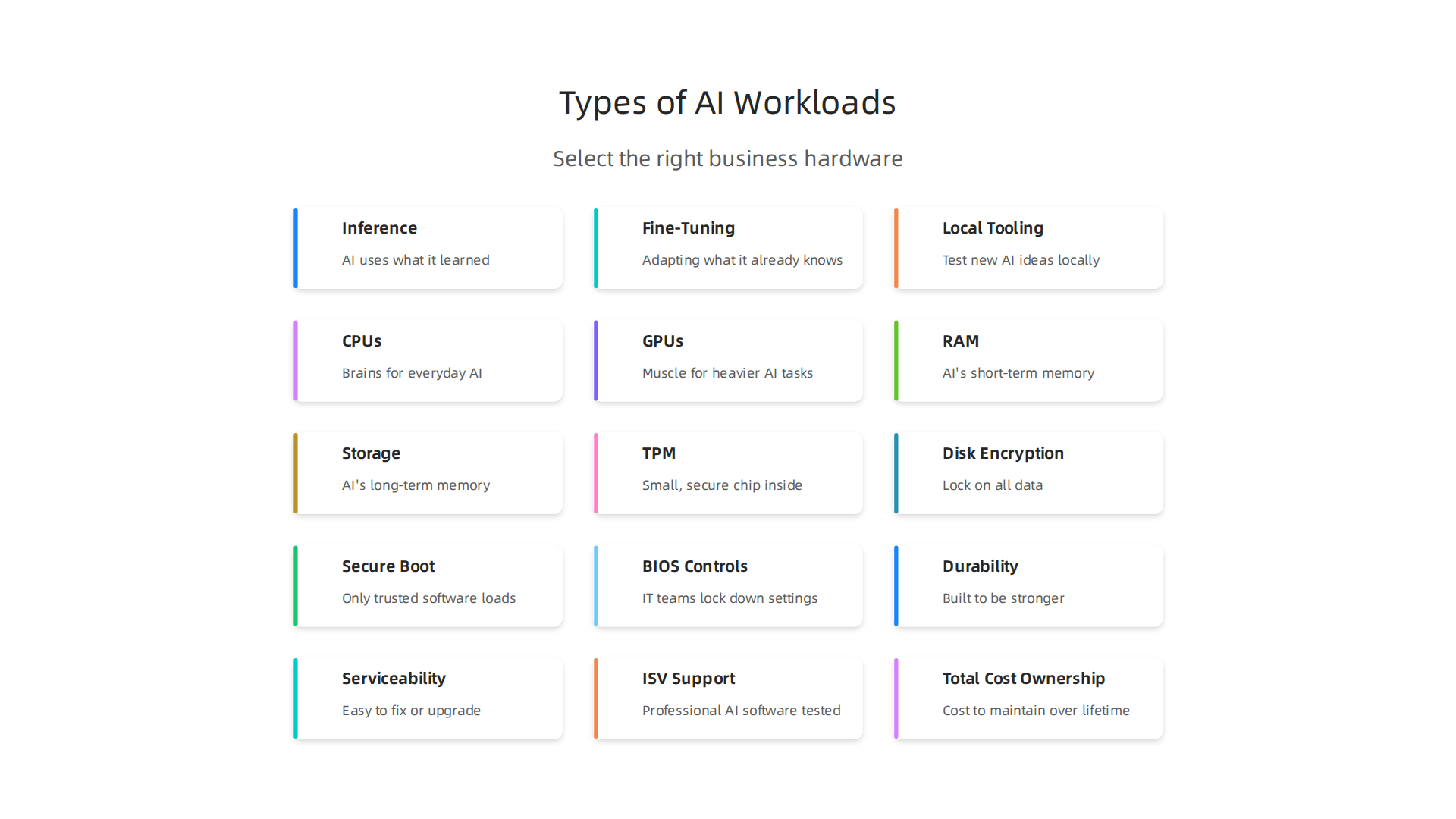
    Understanding different AI workloads helps in selecting the right business hardware.

    It’s not just about "AI" in general; it’s about the specific tasks, also called "workloads."

    We already talked about inference, which is when an AI uses what it learned to give answers or make predictions. This needs quick power bursts. But there are other important types of AI work too:

    • Fine-Tuning: Imagine you have a very smart AI model, like a big brain that knows a lot about everything. Fine-tuning is like teaching that smart brain a special new skill, using a smaller set of your own company’s information. It’s not learning from scratch, but adapting what it already knows to your exact needs. This kind of work needs more computer power than just inference, especially good memory and a strong graphics processor (GPU) 5 types of AI workloads and how to deploy them. Fine-tuning tasks often involve reading large amounts of data and doing many quick calculations.
    • Local Tooling/Experimentation: Sometimes, your team might want to test new AI ideas or use smaller AI tools right on their own computers. This is like having a small AI lab on a laptop. For these tasks, you need a computer that can handle the work quickly without relying on the internet or a big cloud service. A computer with a good built-in GPU and enough memory will help these local AI tools run smoothly.

    Different companies have different needs. A study found that businesses are using AI for many different things, not just one type of workload AI Workload Priorities Diversify as Enterprises Push Compute Beyond Training. This means there’s no single "best" computer.

    Matching Workloads to Computer Needs

    When you look at different thinkpad models or other business PCs, think about these things:

    • Latency (Speed): How fast does your AI need to give answers? For quick customer service chatbots, you need very low latency. Inference tasks often need fast responses.
    • Memory (RAM): How much information does your AI need to hold in its active "brain" at once? Fine-tuning and local experimentation can use a lot of memory.
    • Local GPU vs. Cloud Hybrid: Do you need a powerful graphics card right inside the computer (a local GPU) for heavy work, or can your computer send tasks to bigger, more powerful computers over the internet (cloud hybrid)? Many daily inference tasks can run well on laptops with newer AI-ready chips, while more intense fine-tuning might need a stronger local GPU or a mix of local and cloud power. For example, a dedicated ibuypower pc with a strong GPU might be great for local AI model experimentation, while a portable lenovo thinkpad x series or a lenovo thinkpad t14 gen 2 could handle most on-device inference tasks just fine. If you’re considering a more budget-friendly approach to local AI computing, looking into a used gaming pc for ai might be an option.

    To pick the right computer, you also need to know about the parts inside it.

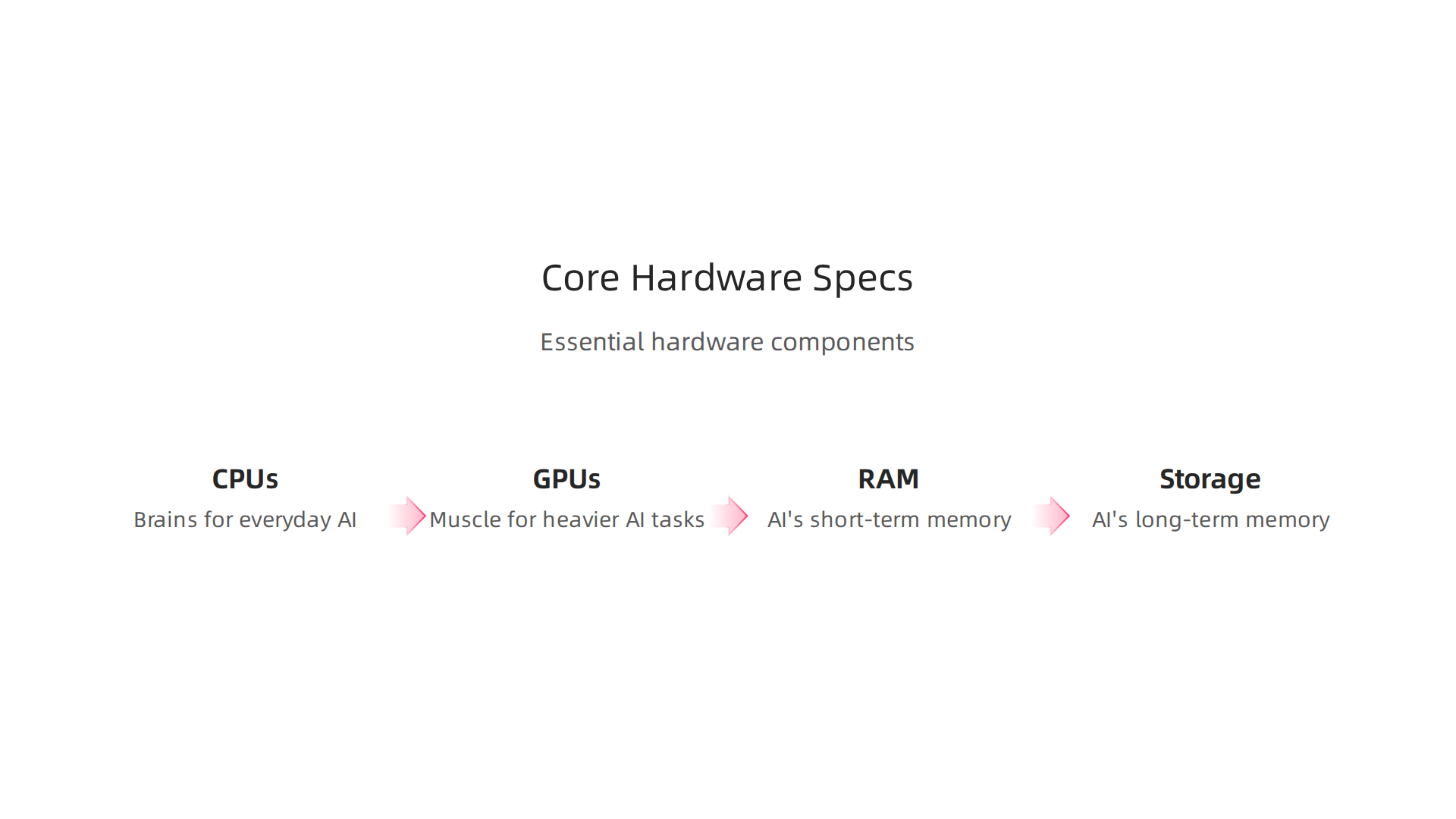
    Essential hardware components and their roles in various AI tasks.

    These parts are called hardware specs. Think of them as the engine and other important bits of a car. Each part helps with different kinds of AI work.

    CPUs: The Brains for Everyday AI

    The CPU, or Central Processing Unit, is like the main brain of your computer. For AI, how powerful your CPU needs to be depends on the task.

    • CPU Cores: CPUs have "cores," which are like mini-brains working together. More cores can help with tasks that need many things done at once.
    • Single-Thread Performance: This means how fast one of those mini-brains can work on its own. For quick AI tasks like simple searches or small actions (often called inference), fast single-thread performance is very important. Many newer thinkpad models have CPUs that are great for this kind of quick, on-the-spot AI work.
    • Platform Memory Bandwidth: This is about how fast the CPU can get information from the computer’s memory (RAM). Good bandwidth helps the CPU keep working smoothly without waiting for data. For light AI use and small learning tasks, a strong CPU is key, as it often handles many calculations that lead to the AI’s answer. Benchmarks like Cinebench help show how well a CPU performs for rendering and multi-threaded tasks, which can be similar to some AI workloads How to Use and Interpret Cinebench 2026 Results. For a deeper look into CPU performance for AI, you can explore comparisons like CPU Vs GPU In 2026: Key Differences, Use Cases, And Tips.

    GPUs: The Muscle for Heavier AI Tasks

    The GPU, or Graphics Processing Unit, is like the muscle of your computer, especially for AI. It’s really good at doing many math problems at the same time, which is exactly what AI needs for training and fine-tuning.

    • Integrated vs. Discrete GPUs:
      • Integrated GPUs are built right into the main CPU chip. They share memory with the CPU and are good for lighter AI tasks, like running a simple AI chatbot on your lenovo thinkpad x series.
      • Discrete GPUs are separate, more powerful chips with their own dedicated memory (VRAM). These are found in powerful laptops or desktop computers, like an ibuypower pc, and are much better for heavy AI work.
    • Dedicated VRAM (Video RAM): This is super important for AI. VRAM is special memory just for the GPU. The more VRAM a GPU has, the bigger and more complex AI models it can handle directly on the computer. For tasks like fine-tuning a large AI model or doing a lot of local experimentation, you’ll want a GPU with plenty of VRAM. A good example of understanding which laptop graphics card is best for various AI tasks can be found in resources like Understanding the Best Laptop Graphics Card 2026.

    RAM: The AI’s Short-Term Memory

    RAM (Random Access Memory) is where your computer keeps information that it’s actively using right now. For AI, having enough RAM is super important.

    • Holding Large Models: If you’re working with big AI models or lots of data at once, you need a lot of RAM. Fine-tuning, for example, often needs 16GB, 32GB, or even 64GB of RAM to hold the AI model and the data it’s learning from.
    • Speed Matters: The speed of your RAM also makes a difference. Faster RAM means the CPU and GPU can get the information they need more quickly. This leads to smoother and faster AI processing.

    Storage: The AI’s Long-Term Memory

    Storage is where your computer saves everything permanently, like programs and all your AI data.

    • SSD vs. HDD:
      • SSDs (Solid State Drives) are much faster than older HDDs (Hard Disk Drives). For AI, you definitely want an SSD. It allows the computer to load large AI models and datasets quickly, which speeds up both training and inference.
      • Capacity: AI models and data sets can be huge. Make sure your computer has enough storage space, usually 512GB or 1TB (terabyte) or more for serious AI work. Fast storage is crucial for AI workloads, as models can quickly read and write large files during training or fine-tuning AI Workloads Storage Architecture.

    Choosing the right mix of these hardware parts will make sure your AI tasks run smoothly. When looking at different lenovo thinkpad t14 gen 2 models or other laptops, remember to match these specs to the AI work you plan to do. For businesses exploring powerful local setups, sometimes even checking out Gaming PC Deals 2026 How AI Hardware Makes Mid-Range Systems Outperform can offer surprising value. If you’re considering MacBooks for AI, you might find valuable insights in this guide to Picking the Best MacBooks for AI for Your 2026 Projects.

    Once you know what computer parts are best for AI, there’s another big thing for businesses to think about: how safe and easy those computers are to handle. This is super important when a company buys many computers for its team, especially for sensitive AI work. Features like strong security, being able to manage many devices at once, and easy setup help save money and keep everything running smoothly.

    Security Features: Keeping AI Safe

    For businesses, especially those dealing with important AI projects, security is key.

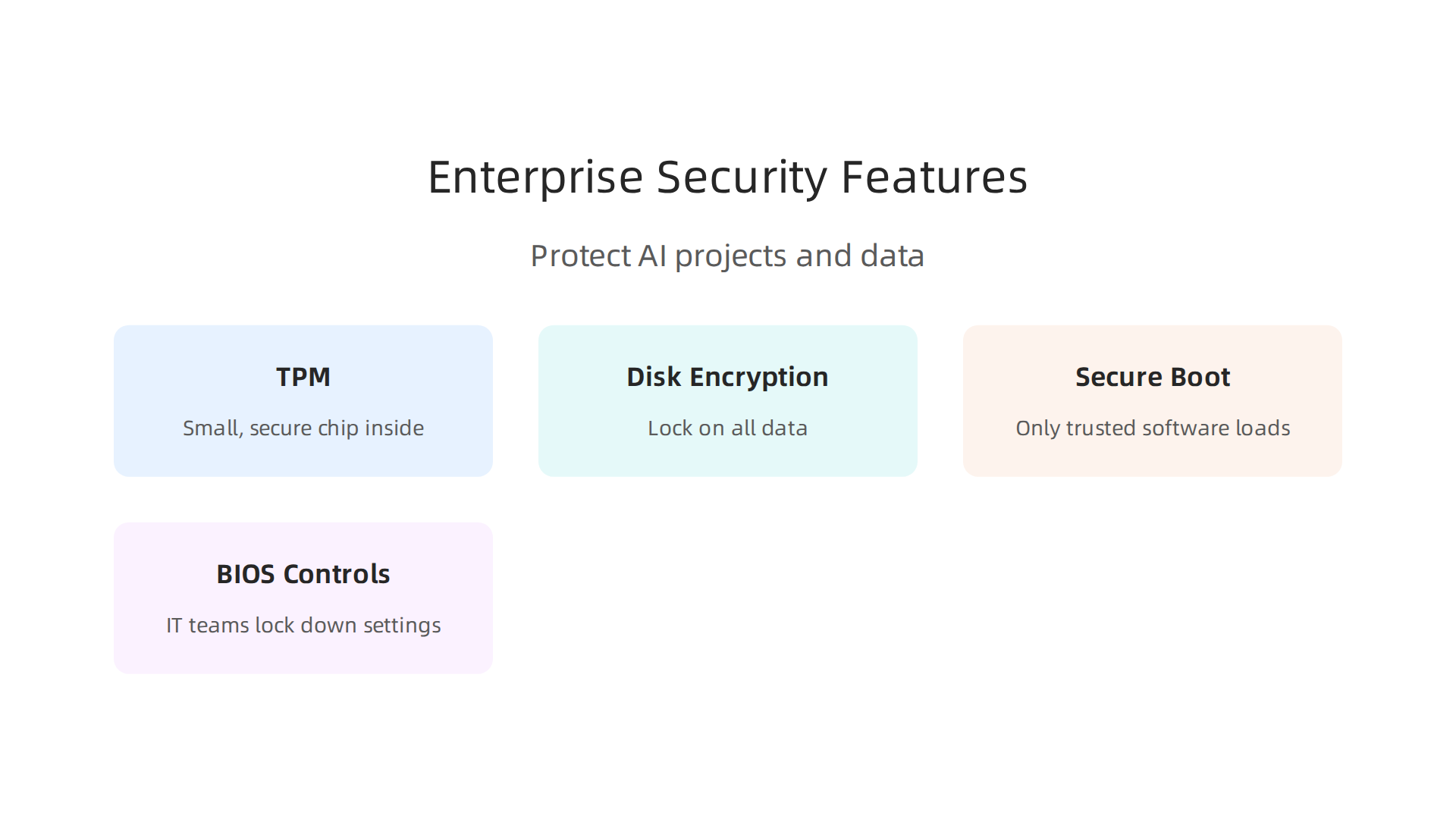
    Key security features critical for protecting business AI projects and data.

    Good thinkpad models and other business laptops come with special tools to keep your data and AI models safe.

    • Trusted Platform Module (TPM): This is a small, secure chip inside the computer. It helps make sure your computer starts up safely and that no one has changed its important software. It also helps with things like disk encryption. Many security checklists for 2026 say you need TPM for high-risk users Endpoint Security Hardening in 2026: A Practical Checklist for ….
    • Disk Encryption: Imagine putting a lock on all the data on your computer’s hard drive. That’s what disk encryption does. If a laptop like a lenovo thinkpad x series gets lost or stolen, your important AI data stays private because it’s scrambled and locked.
    • Secure Boot: This feature helps protect your computer when it first turns on. It makes sure that only trusted software loads. This stops bad software from hijacking your computer right from the start. Keeping Secure Boot enabled is a key part of protecting endpoints Guidance for Managing UEFI Secure Boot. In 2026, many companies are updating how they manage Secure Boot to keep up with new threats Secure Boot Certificate Rollout 2026: Critical Update for Windows Devices.
    • BIOS Controls: The BIOS is like the computer’s basic instruction book. Business-focused machines give IT teams special controls here. They can lock down settings to make sure users can’t change important security features, which helps keep all computers on the network just as safe.

    Manageability and Fleet Deployment: Easy for IT

    When a company has many AI-ready computers, like a fleet of lenovo thinkpad t14 gen 2 laptops, managing them all can be a big job. This is where manageability features really shine.

    • Remote Management: IT teams need to set up, update, and fix computers without being right next to them. Tools for remote management let them do this from afar. This means they can get new AI-capable computers ready quickly and push out important security updates to everyone at once.
    • Driver Updates and MDM: Keeping drivers (small programs that help hardware work) up to date is crucial for AI. Business computers often work well with special software called Mobile Device Management (MDM). MDM helps IT teams easily manage all devices, including making sure all drivers are current and secure. For anyone looking to select the right technologies to help their business grow, understanding these management systems is key Unlock Growth by Selecting the Right Smart Technologies in 2026.

    These features help businesses reduce their Total Cost of Ownership (TCO). This means they spend less money over time because their IT teams can work more efficiently. Instead of manually fixing each computer, they can manage many thinkpad x series laptops at once, saving time and money. For businesses trying to use AI to grow, picking computers with these enterprise features is a smart move.

    Even with the best parts, how a computer handles heat is super important for AI work. When a computer runs hard, it gets hot. If it gets too hot, it has to slow down to protect itself. This slowing down is called "throttling," and it can really mess up AI tasks that need to run fast for a long time.

    Short Tests vs. Long Work

    Many computer tests, called benchmarks, only show how fast a computer can go for a few seconds. They are like a quick sprint. But AI work is more like a marathon. It needs the computer to stay fast for many minutes or even hours.

    If a thinkpad models laptop or a powerful desktop like an ibuypower pc can’t keep itself cool during these long tasks, its great parts won’t perform their best. The computer will get hot, slow down, and your AI projects will take much longer to finish. This is why "sustained throughput" matters. It means the computer can keep up its speed over a long time, not just for a quick burst.

    What to Look For to Avoid Slowdowns

    When picking a computer for AI, especially models like the lenovo thinkpad x series or lenovo thinkpad t14 gen 2, here are some things to check:

    • Good Cooling Design: Look for computers that have big fans, many vents, or even special liquid cooling systems. These designs help move heat away from the important parts so they can keep working at full speed.
    • Vendor Thermal Profiles: Check what the company that makes the computer says about its cooling. Some computer brands let you pick different "thermal profiles" or modes. These can make the fans spin faster to keep things cooler, even if it means a bit more noise.
    • Independent Stress Tests: Don’t just trust the company’s numbers. Look for reviews from other websites or experts who test computers. They often run special "stress tests" that push the computer hard for a long time. These tests will show if a computer can keep its speed up or if it starts to slow down because of heat.
    • Reviews for Gaming PCs: Many gaming computers need good cooling for long play sessions. You can often learn a lot about a laptop’s cooling abilities by reading reviews focused on gaming performance, as AI tasks can be just as demanding. For budget-friendly options, consider a used gaming PC for AI to get strong cooling and graphics power.

    By looking into these details, you can pick a computer that won’t surprise you with slowdowns when you need it most.

    After thinking about how to keep your computer cool, it’s also important to pick the right type of machine from the start. Not all computers are made the same, especially when we talk about business needs. This is where different thinkpad models and other business computers come in. They are built with different things in mind, like how tough they are or how easy they are to fix.

    ThinkPad Models and Comparable Business Lines: Matching Features to Use Cases

    Choosing a computer for AI is not just about raw power. It’s also about how reliable it is, how long it will last, and if it can work well with the special software you use. Business laptops, like the various thinkpad models, are often designed with these practical needs in mind.

    Here are some key things that make business laptops different and why they matter for AI:

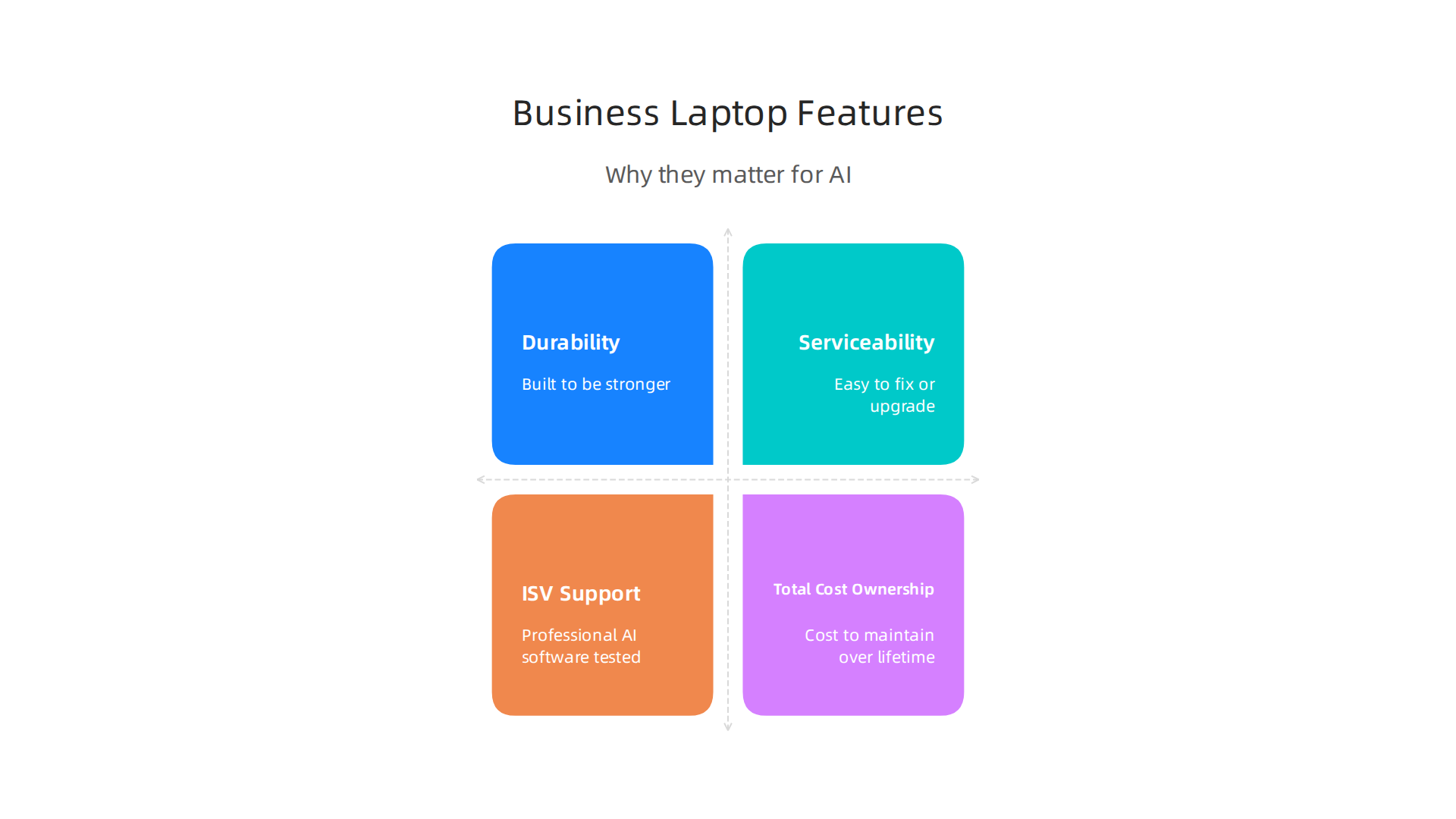
    Important features of business laptops relevant for AI work beyond raw power.

    • Durability (How Tough It Is): Business laptops are often built to be stronger. They can handle being carried around and opened many times. This is important for AI users who might take their laptop to different places. A strong laptop means fewer broken parts and less time away from your important AI projects.
    • Serviceability (How Easy to Fix): When something breaks, how easy is it to get fixed or upgraded? Business laptops are usually made so that IT teams can swap out parts like memory or storage more easily. This helps keep costs down over time. Keeping track of your business hardware lifecycle is key, as companies often refresh power-user laptops every 2 to 3 years to meet high demands, according to experts in 2026 Enterprise IT Hardware Refresh Cycles: 2026 Guide.
    • ISV Support (Software Works Right): ISV stands for "Independent Software Vendor." This means that companies making professional AI software have tested their programs on certain business laptops. When a laptop has ISV support, it’s more likely your specialized AI tools will run smoothly without unexpected problems.
    • Total Cost of Ownership (TCO): When buying a computer for business, the sticker price is just the start. You also need to think about how much it will cost to maintain, fix, and update it over its lifetime. Studies show the purchase price is only a small part of the total cost Enterprise Laptop Manufacturer Selection Guide. This is where good durability and serviceability save money.

    Picking the Right Laptop for Your AI Work

    To make a good choice, think about how you will use the computer. Here’s a simple guide to help match different business laptop families to common AI jobs:

    • Road Warrior (Someone Who Travels a Lot): If you are always on the go, you need a light laptop with a long battery life. Models like the lenovo thinkpad x series are perfect for this. They are thin, easy to carry, and reliable.
    • Data Scientist (Needs Lots of Power): For heavy AI tasks that need strong processing and lots of memory, you might look at more powerful thinkpad models, such as the lenovo thinkpad t14 gen 2 or other laptops in the T-series. These often have better cooling and can handle more demanding work. For even more power, a dedicated desktop like an ibuypower pc might be considered.
    • Developer Workstation (Building AI Tools): Similar to a data scientist, a developer needs top-notch performance. They might also need many ports to connect extra screens or devices. High-end ThinkPads or powerful custom desktops are good fits here.
    • Hybrid Worker (Mix of Home and Office): If you work both at home and in an office, you need a laptop that’s good for both. A balanced option like the lenovo thinkpad t14 gen 2 gives you good power for AI tasks while being easy to move around.

    Making smart choices about your AI hardware helps you unlock growth by selecting the right smart technologies in 2026. Stay ahead with daily AI and technology insights by signing up for The AI Newsletter Worth Reading.

    Connectivity, Expandability, and Peripherals: Building an AI-Ready Workstation

    Beyond choosing the right core computer, like a powerful thinkpad models laptop, how you connect it to other things is just as important for serious AI work. This means looking at ports, extra graphics cards, docking stations, and how your computer talks to the internet and stores files. These parts help make sure your AI tasks run smoothly and you can work without frustrating slowdowns.

    Ports: Your Computer’s Connection Points

    Modern laptops, including many lenovo thinkpad x series or the lenovo thinkpad t14 gen 2, come with different types of ports. For AI, you will want ports that are fast and versatile.

    • Thunderbolt or USB4: These are very important. They let you connect to many devices at once through a single cable. You can plug in fast external storage, multiple screens, and even an external GPU.
    • Ethernet: While Wi-Fi is common, a wired Ethernet connection is much faster and more stable. This is key for downloading large AI datasets or sending results to the cloud without interruptions.
    • Other USB Ports: Having a mix of USB-A and USB-C ports allows you to connect all your devices, from keyboards and mice to external hard drives.

    External GPU Enclosures (eGPUs): More Graphics Power

    Sometimes, even a strong laptop might not have enough graphics power for very demanding AI tasks. This is where an external GPU enclosure comes in. It’s a box that holds a desktop graphics card and connects to your laptop, usually through a Thunderbolt port. This can give your laptop a big boost in AI processing, making it almost as powerful as a desktop computer like an ibuypower pc.

    However, it’s good to know that using an eGPU can mean a small loss in performance. For instance, connecting an external GPU through Thunderbolt 4 might mean your graphics card works 15% to 30% slower than if it were inside a desktop computer My 1-Year Review of Using an External GPU (eGPU) with a Thin …. Newer connections like Thunderbolt 5 can reduce this loss to about 5% to 15% The best eGPU enclosures for Linux in 2026, from TB5 to …. For best results, it’s often better to use an external screen with your eGPU setup instead of your laptop’s built-in screen, as this can improve performance

    Explore community insights and guides on external GPU setups for enhanced performance.

    eGPU Performance: Internal vs. External Display. If you’re looking for extra power on a budget, sometimes even a used gaming PC for AI can offer a strong GPU.

    Docking Strategies: One Cable Does It All

    A docking station is a hub that connects to your laptop with one cable and lets you plug in all your other devices: monitors, keyboard, mouse, Ethernet, and external drives. This is super helpful if you move your laptop between different workspaces, making it easy to set up your full AI workstation quickly.

    Storage Tiers and Backup: Keeping Your Data Safe

    AI work often involves huge amounts of data. Having the right storage is crucial.

    • NVMe SSDs: These are the fastest storage drives, perfect for your operating system and active AI projects that need quick access to data.
    • SATA SSDs: Still very fast, but a bit slower than NVMe. Good for storing larger datasets that you don’t need to access constantly.
    • External Hard Drives: Useful for long-term storage or backups.

    Always have a backup plan for your important AI experiments and data. Losing your work due to a broken drive can set your projects back significantly. Make sure you regularly copy your data to another drive or a cloud service. This way, your local experiments are safe and you can always go back to a previous version if needed.

    After figuring out the best ways to connect your AI workstation, it’s time to think about the money side of things. For teams, buying computers like different thinkpad models for AI isn’t just about picking the fastest machine. It’s also about smart spending, making sure those computers last, and getting good value for your money. This is especially true when you’re looking at a fleet of lenovo thinkpad x series laptops or even powerful desktop ibuypower pc setups for your whole team.

    Budgeting for Your AI Team

    When you buy computers for a team, you usually think about two main ways to spend money:

    • Capital Expenses (Capex): This is when you buy something outright, like a new lenovo thinkpad t14 gen 2 laptop or an external GPU. It’s a big, one-time payment. This kind of spending is often seen as an investment that adds value over time.
    • Operating Expenses (Opex): These are the ongoing costs, like paying for software licenses each month, cloud services, or even repair services. These are smaller, regular payments that keep things running.

    Choosing between Capex and Opex depends on your team’s needs and how your company likes to manage money. For example, buying powerful workstations (Capex) might cost more upfront, but it could save you money in monthly cloud fees (Opex) if your team does a lot of AI work locally.

    Warranty and Service Tiers

    For businesses, a good warranty is super important. If a computer breaks down, you need to fix it fast so your team can keep working. Most manufacturers offer different warranty plans:

    • Standard Warranty: Covers basic repairs for a certain time, usually a year.
    • Extended Warranty: Gives you coverage for a longer period, like three or five years.
    • On-Site Service: This means a technician comes to your office to fix the computer, which saves time compared to sending it in.
    • Accidental Damage Protection: Covers things like spills or drops, which can be a lifesaver in a busy workplace.

    A better warranty can mean less downtime for your team, which keeps your AI projects on track.

    Expected Lifecycle of AI Machines

    How long should an AI-ready computer last? For simple office tasks, a computer might be good for five years or more. But for demanding AI work, new technologies come out quickly. A machine that’s great today might not be fast enough in three years.

    You can check how powerful a computer is using special tests called benchmarks. These tests measure how well a CPU, GPU, and NPU perform with AI tasks, giving you a good idea of its capabilities today and how long it might remain competitive Laptop AI Benchmarks 2026 — NPU TOPS & LLM tokens/sec. Paying attention to thermal management is also key to ensuring your laptops stay fast over time Why Laptop Cooling Matters More Than Ever in 2026.

    Return on Investment (ROI) Checklist for AI Tools

    Measuring ROI means looking at how much value you get back from your investment.

    Professionals analyzing financial data to determine return on investment for business decisions.

    For AI-capable computers, here’s a simple checklist:

    • Productivity Gains: How much faster can your team complete AI tasks? If a better computer cuts down project time by 20%, that’s a big win.
    • Software Licensing Costs: Factor in the price of AI software and tools. Sometimes, free or open-source tools can lower your Opex.
    • Cloud vs. Local Costs: This is a big one. Running AI models on your own powerful computers (local) means less money spent on cloud services. But if your team only needs AI power sometimes, cloud services can be cheaper. A general idea is that a gaming laptop can be 54% less costly than a desktop for similar performance, which might affect the cloud vs. local calculation too Gaming Laptop vs Desktop 2026: 54% Gap, $919 Entry.
    • Training and Learning: If your team learns how to use these powerful machines better, they become more efficient.

    By carefully planning your budget and thinking about ROI, you can make sure your team has the best tools for AI work without overspending. It helps to choose the right AI tools for business that deliver real results. For more details on smart spending, check out tips on tech for less AI operations cut costs without cutting corners in 2026. Also, understanding how to choose AI for business tools that deliver real results in 2026 can help ensure your investments pay off.

    Summary

    As AI becomes central to everyday business work in 2026, choosing the right laptops and desktops requires more than trusting marketing labels like