Category: AI History

  • When Did AI Become Popular The 2023 Breakthrough and Its 2026 Relevance

    When Did AI Become Popular The 2023 Breakthrough and Its 2026 Relevance

    Why the question ‘When did AI become popular?’ still matters in 2026

    Artificial intelligence, or AI, feels like it’s everywhere in 2026, doesn’t it? From helping us write emails to suggesting what movies to watch, AI applications touch so much of our daily lives. You might even hear about powerful tools like Tencent AI changing big businesses. But with all this new tech popping up so fast, many people are asking: when did AI become popular? It’s a simple question, but the answer is a bit tricky, and it still matters a lot for how we think about the future.

    The truth is, AI isn’t really new. The idea of machines thinking for themselves goes way back. The actual term "artificial intelligence" was first used at a special meeting at Dartmouth in 1956.
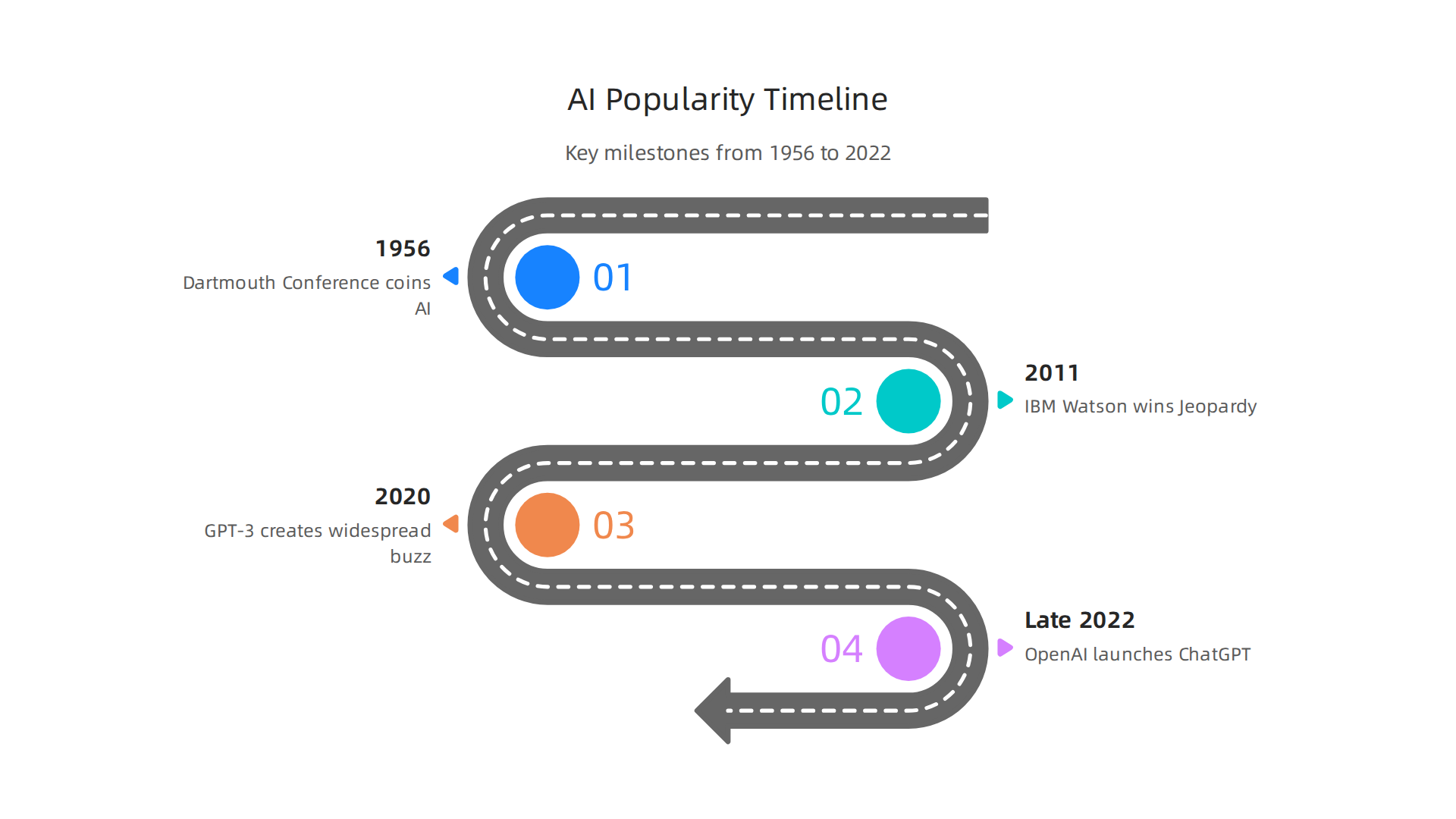
    An infographic illustrating significant historical milestones in the journey of AI from academic concept to mainstream technology.

    Many people see this Dartmouth Conference as the very beginning of AI as a field of study [1, 2]. So, in a way, AI has been around for a long, long time.

    However, its journey from university labs to everyday use has been anything but a straight line. For many years, AI was mostly for scientists and big companies. It had its ups and downs, with times of great excitement followed by "AI winters" where interest and funding went down [3]. This long history makes it hard to pinpoint exactly when AI shifted from being something only experts knew about to something everyone talks about.

    Actually, the biggest change happened much more recently. While some AI tools started getting noticed in the 2010s, like when IBM’s Watson won on Jeopardy! in 2011 [4, 5], 2023 was a big turning point when AI truly went mainstream for most people [6]. This huge boom was partly thanks to new tools like ChatGPT, which became very popular very quickly in late 2022 [7]. Suddenly, advanced AI was easy for anyone to try.

    This rapid change can be confusing for business leaders, creators, and even everyday users.

    People engaged in an animated discussion, representing the widespread conversation and occasional confusion surrounding new technology like AI.

    It’s hard to keep up! That’s why understanding the full story of AI’s rise is so important. This article will help you make sense of it all. We will look at the major steps AI has taken through history and explain how it has changed society, from discussions about AI policy to worries about AI replacing jobs. We will also highlight practical business applications, showing you how smart use of AI can help your company grow in 2026.

    Staying informed about the fast-moving world of AI is key. If you want clear, daily updates on AI and technology, consider subscribing to The AI Newsletter Worth Reading to get insights straight to your inbox. This kind of knowledge helps you make better choices, whether you’re looking for new tools to boost productivity or thinking about the bigger picture of AI’s impact on our world. You can also explore our guide on how to choose AI for business tools that deliver real results to find solutions for your specific needs.

    Early Origins: Foundational Research and the Pre-Popularity Era

    The idea of machines that can think for themselves might seem very modern, but its true beginnings are much older. To understand when AI became popular, we have to look back at the smart people who first dreamed it up. The year 1956 is often called the official start for artificial intelligence as a field of study. This was when a special meeting, known as the Dartmouth Summer Research Project on Artificial Intelligence, happened. At this important event, key thinkers like John McCarthy, Marvin Minsky, Nathaniel Rochester, and Claude Shannon came together. It was McCarthy who first used the phrase "artificial intelligence," giving the new field its name [1]. This meeting set the stage for all the AI applications we see today.

    Before this big meeting, other important ideas were already brewing. A British mathematician named Alan Turing, for example, thought about machine intelligence as far back as the 1940s. In 1950, he proposed what we now call the Turing Test. This was a way to figure out if a machine could "think" like a human [2]. Such early ideas were like tiny seeds planted for the huge AI tree we have in 2026. If you want to dive deeper into the very start, you can explore more about when was artificial intelligence made.

    For many years after the Dartmouth conference, AI stayed mostly in university labs. It was a specialized topic for scientists and researchers. There were big challenges that kept it from becoming popular with everyone. Things like limited computer power meant that even simple AI programs needed huge machines to run. There wasn’t a lot of data for these programs to learn from, either. Because of these limits, AI work was hard and expensive. It mostly involved solving very specific, small problems. Think of it like building tiny models instead of a full city.

    This meant that even though the ideas were exciting, practical AI applications for everyday people or businesses were still far off. The field went through periods of big excitement followed by times when interest and money dried up. These quiet times are sometimes called "AI winters." During these winters, it wasn’t clear if AI would ever deliver on its big promises. This long, slow journey from an academic idea to a worldwide phenomenon makes the question "when did AI become popular" so interesting and complex.

    Citations:
    [1] AI TURNS FIFTY: REVISITING ITS ORIGINS
    [2] The History of AI: A Timeline of Artificial Intelligence – Coursera

    The first booms and AI winters: cycles of hype and slowdown

    Even with the challenges of early AI, there were times when people got very excited about its possibilities. These were like springtimes for AI, where lots of new money and interest flowed in. They showed glimpses of when AI might become popular.

    One of the first big "booms" happened in the late 1960s and early 1970s. Researchers were making programs that could solve simple math problems or understand some written words. People thought machines would soon be thinking just like humans. Governments and big companies put money into AI research. It felt like anything was possible, and new AI applications were just around the corner.

    However, the computers back then were still very slow and could not hold much information. The smart programs only worked for very specific, small tasks. They could not handle real-world problems that were messy and complex. This led to the first "AI winter" in the mid-1970s. Money for research dried up, and people became disappointed because AI had promised too much too soon. It was a tough time for those working in the field.

    But AI did not disappear. It had another boost in the 1980s, thanks to "expert systems." These were AI programs designed to act like human experts in a very narrow field, such as diagnosing diseases or helping find oil. Companies started to use these smart AI for business to solve practical problems. This renewed excitement made people wonder if this was truly when AI would become popular.

    Sadly, this boom did not last either. Expert systems were very expensive to build and update. They only worked well for their specific tasks and could not learn new things easily. As a result, the second "AI winter" arrived in the late 1980s and early 1990s. Funding for AI projects dropped again, and many companies stopped their AI work. The American Association for Artificial Intelligence (AAAI) even warned about this incoming "AI Winter" where money and interest would decrease significantly What is the history of artificial intelligence (AI)?.

    These cycles of big hopes followed by quiet times taught researchers important lessons. They learned that real progress takes time, and that making big promises before the technology is ready can hurt the field. Each "winter" forced AI scientists to rethink their methods and set more realistic goals, slowly building the foundation for the incredible AI we see in 2026.

    A person looking thoughtful and contemplative, symbolizing the periods of reflection and re-evaluation during AI's 'winters'.

    When AI entered mainstream public consciousness: key inflection points

    The lessons learned during the "AI winters" helped scientists build a stronger foundation. This careful work finally paved the way for artificial intelligence to truly grab the public’s attention and become popular. People started to see how AI could do amazing things, not just in labs but in everyday life. So, when did AI become popular in a big way? It was a journey with some very important stops.

    One of the first big moments that made people sit up and notice was in 2011. This is when IBM’s Watson AI played and won against human champions on the TV show Jeopardy! This was a huge deal because Watson could understand complex questions, dig through lots of information, and give smart answers. It showed the world that AI could handle language and facts in a way never seen before, going beyond simple math problems and truly popularizing data-driven AI The History of Artificial Intelligence.

    Fast forward to the 2020s, and AI started to make even bigger waves. In 2020, GPT-3, a very advanced language model, created a lot of buzz. It showed how AI could write text that seemed very human-like The History of AI: A Timeline of Artificial Intelligence. But the real breakthrough, the moment when AI went truly mainstream, happened in late 2022. This was when OpenAI launched ChatGPT. This clever chatbot could respond to text questions in incredibly human ways, quickly gathering 100 million users in just two months When Did AI Become Popular? A Complete Timeline. This event, along with AI art winning competitions, truly kickstarted the current AI boom and made everyone ask, "When did AI become popular?" The answer, for most people, points to 2023 as the year AI went fully mainstream
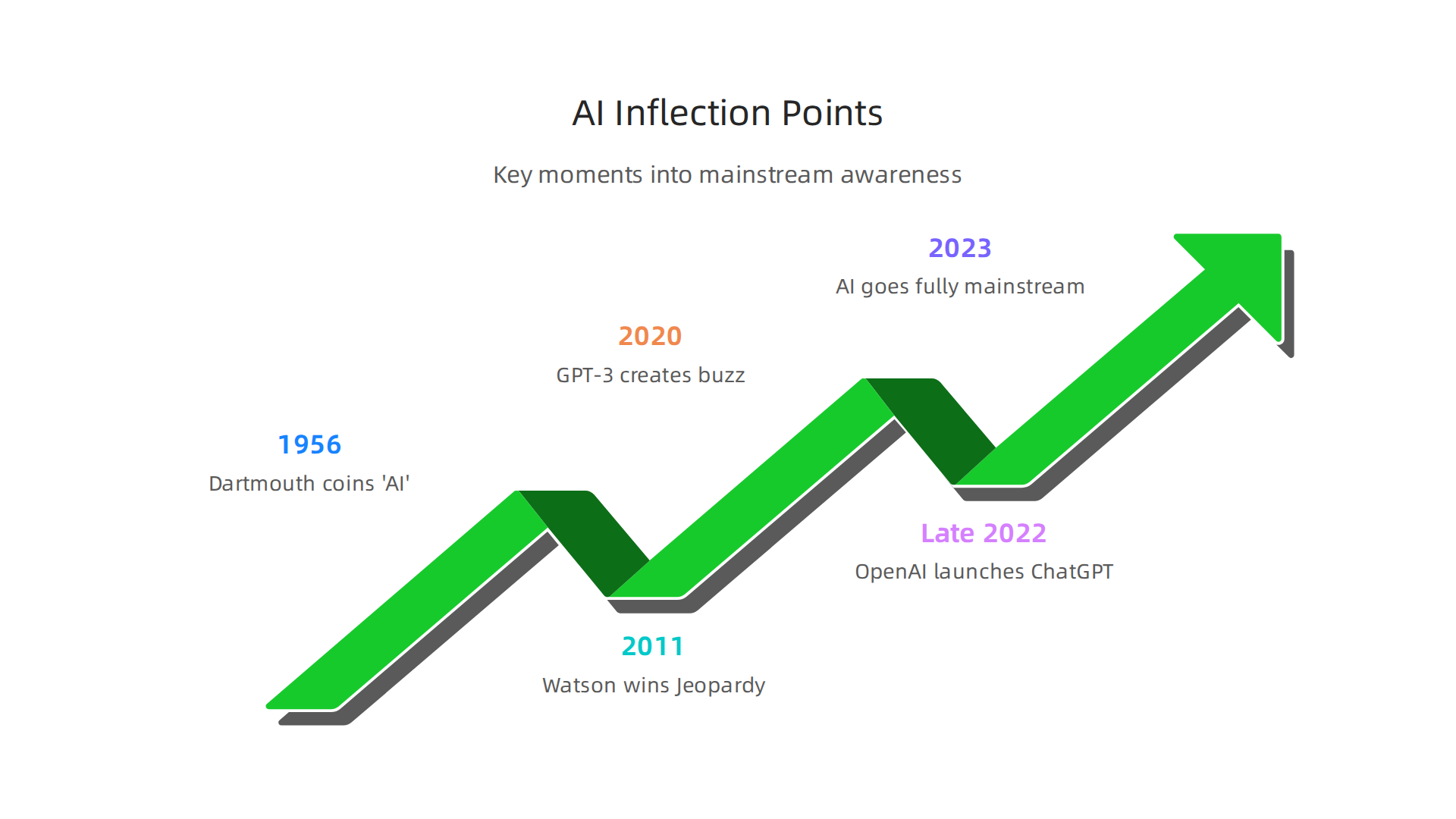
    Infographic showing key moments that propelled AI into public awareness, from IBM Watson to ChatGPT.

    When did Artificial Intelligence become Popular?.

    These new, easy-to-use AI applications changed everything. Suddenly, people could interact directly with AI and see its power for themselves. This led to a huge increase in media attention, with news coverage often focusing on new products and breakthroughs UK media coverage of artificial intelligence dominated by industry and industry sources. People began to talk more about topics like how AI applications might change their jobs. Discussions about preparing for what jobs will AI replace became common. Also, big questions about AI policy and ethical use of AI started to fill headlines.

    In 2026, AI is no longer a niche topic for scientists. It is part of our daily conversations, from the latest Tencent AI developments to personal AI assistants. This widespread awareness means more people are looking for clear, daily updates on the rapidly changing AI landscape.

    Get clear daily AI updates from The AI Newsletter Worth Reading.

    Societal impacts: jobs, ethics, and policy responses

    The moment AI became popular also brought about big discussions about its effect on our daily lives. When people started seeing powerful AI applications like ChatGPT in 2022 and 2023, it changed how we think about jobs, fairness, and how governments should make rules for this new technology.

    AI and the Future of Work

    One of the biggest worries many people have is about ai replacing jobs. It’s true that AI can do many tasks that humans used to do. For example, some reports in 2026 suggest that AI could cause about 92 million jobs to change or even disappear by 2030 globally, mainly by automating tasks that are easy to repeat The Multifaceted Impact of Artificial Intelligence on Global Labor. This can make people, especially those with fewer skills, worry about their job security.

    However, it’s not all bad news. While some jobs might change, AI also creates new kinds of jobs. Experts believe that AI-related trends could help create 11 million new jobs The debate on AI and jobs. For example, we need people to build, maintain, and train AI systems, or to create new ai applications that help businesses grow. The World Bank’s 2026 report also highlights the promise of AI for many sectors World Development Report 2026: The Promise of Artificial. So, the talk is less about AI completely taking over and more about how jobs will change and what new skills people will need.

    Ethical Questions and AI Policy

    Beyond jobs, the rise of AI has also brought up important questions about ethics. This means thinking about what is right and wrong when we use AI.

    A diverse group of professionals collaborating in a meeting, discussing ethical considerations and policy responses to technological advancements.

    For example, how do we make sure AI systems are fair and don’t make unfair decisions? How do we protect people’s privacy when AI uses so much data?

    These questions are very important for ai policy. Different countries and even different parts of the same country are looking at ways to create rules for AI. Some want to move fast to make sure AI benefits everyone, while others are more careful, wanting to prevent harm first. These rules can cover things like how AI is built, how it’s used in healthcare, or even in self-driving cars. Companies like Tencent AI and others are already working within these new and changing guidelines. Making these policies is a big challenge because AI changes so quickly.

    The quick pace of change in AI also means that new AI applications are popping up everywhere. Since when did AI become popular in the early 2020s, businesses quickly learned that this technology could do more than just make people worry about jobs or create new AI policy rules. It could actually change how whole industries work. Let’s look at some key areas where AI is making a big difference in 2026.

    Healthcare: A Fast-Changing Field

    Healthcare is one of the fastest areas to adopt AI. We’ve seen a big jump in how much AI is used here, going from 38% in 2024 to 67% in 2026.
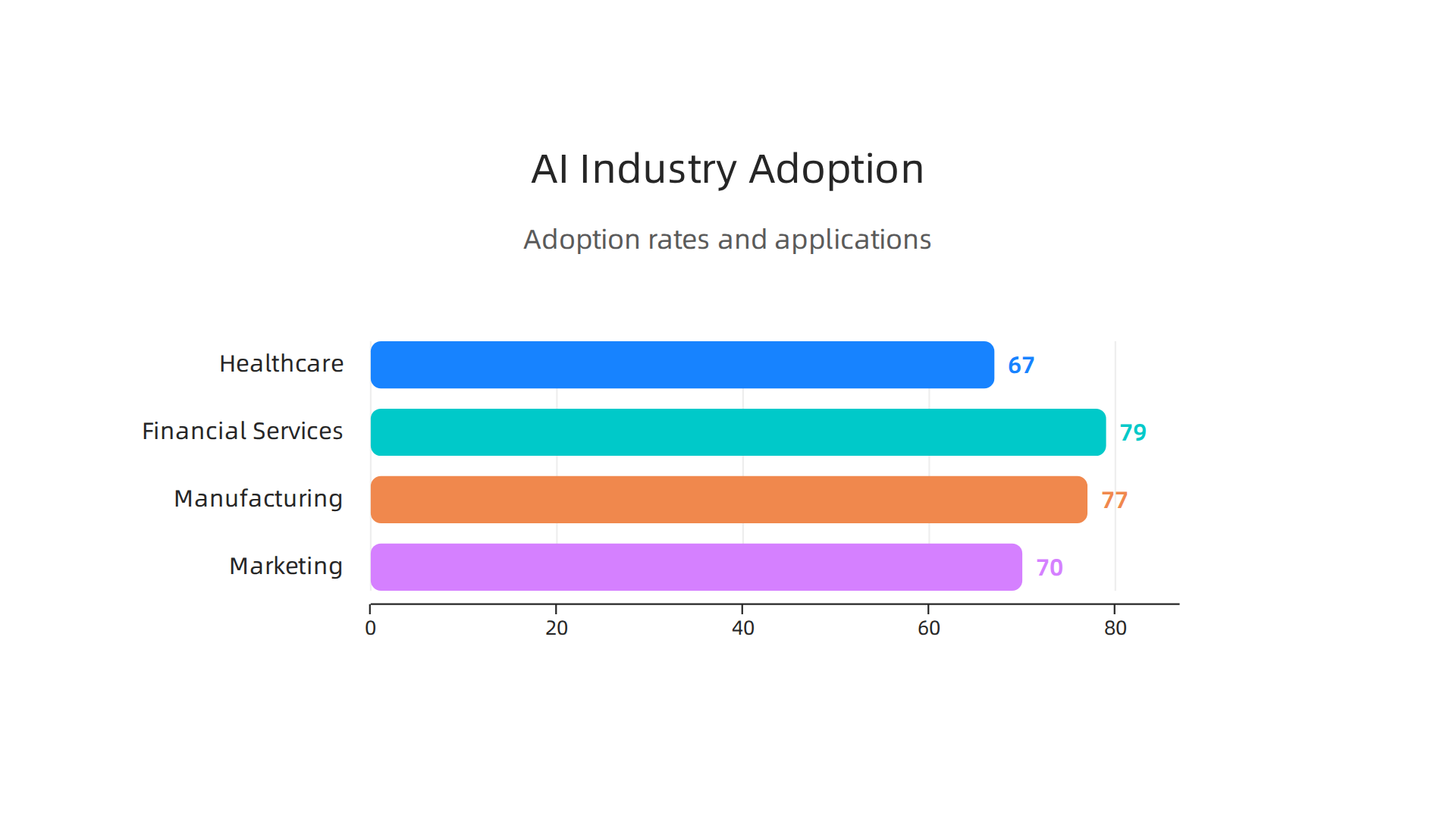
    An infographic displaying the adoption rates and key applications of AI across various industries in 2026.

    This big change is thanks to new breakthroughs and clearer rules about how AI can be used in medical care AI Adoption Statistics by Industry 2026.

    AI helps doctors and hospitals in many ways. It helps with making clinical decisions, looking at medical images like X-rays, and even finding new medicines. For example, 61% of medical tech experts use AI for medical imaging, and 57% of drug companies use it to discover new drugs AI Use Cases and Key Statistics and Trends for 2026. These AI applications show a clear return on investment (ROI) by making healthcare better and faster.

    Money Matters: AI in Financial Services

    The finance world is another big user of AI. Banks and insurance companies are using AI a lot, with adoption rates as high as 79% AI Adoption Statistics 2026: Business & Enterprise Data. They use it to spot fraud, decide who gets a loan, and help with trading on the stock market. AI is really good at looking through lots of numbers quickly to find patterns that humans might miss. This helps financial services run more smoothly and keep customers’ money safe. The industry sees high returns from using these smart tools, setting standards for how much AI is used and how well it works 2026 Industry AI Adoption Report: Benchmarks by Sector.

    Building Things: AI in Manufacturing

    Manufacturing is also getting a big boost from AI. While it might have started a bit slower, AI is now very important for making sure factories run well. In 2026, many manufacturers are using AI for things like checking machine parts before they break, which is called predictive maintenance, and making sure products are made perfectly every time. About 77% of manufacturing companies use AI [AI Adoption Rate by Sector Globally 2024-2025 – Inforia — AI]. This helps them avoid costly problems and make better products.

    Marketing and Other Industries

    AI is also changing how businesses talk to their customers. In marketing, AI helps create content, understand what customers want by looking at data, and make sure products are seen by the right people. About 70% of businesses are actively using AI in their daily work, and many see that AI helps them make more money and lower costs How AI Is Driving Revenue, Cutting Costs and Boosting Productivity ….

    Overall, the fast growth of AI since when did AI become popular has shown that these tools can bring real value. Most businesses are now past the "just trying it out" stage and are seeing clear benefits. This means if you’re looking for ways to use smart tools in your business, now is a great time to learn how to choose AI for business tools that deliver real results in 2026.

    If you’re looking to bring smart tools into your business, the next logical step is figuring out how to pick the right ones and put them to use. This isn’t always easy, as many businesses found out since artificial intelligence became popular. It’s not just about buying new software; it’s about changing how you work. That’s why having a good plan to evaluate and adopt AI applications is so important in 2026.

    How Businesses Evaluate and Adopt AI Today: Frameworks and Practical Steps

    Adopting AI needs a clear roadmap, especially for smaller businesses and larger company teams.

    A dynamic business team collaboratively planning strategies on a whiteboard, embodying the structured approach to AI adoption.

    It helps to think of it like building something new: you wouldn’t start without a blueprint, right? A good framework helps you avoid common pitfalls and make sure your AI efforts truly help your business grow. Many companies, including those large businesses using tencent ai, follow certain steps to make sure AI works for them.

    Here’s a simple checklist for bringing AI into your business:
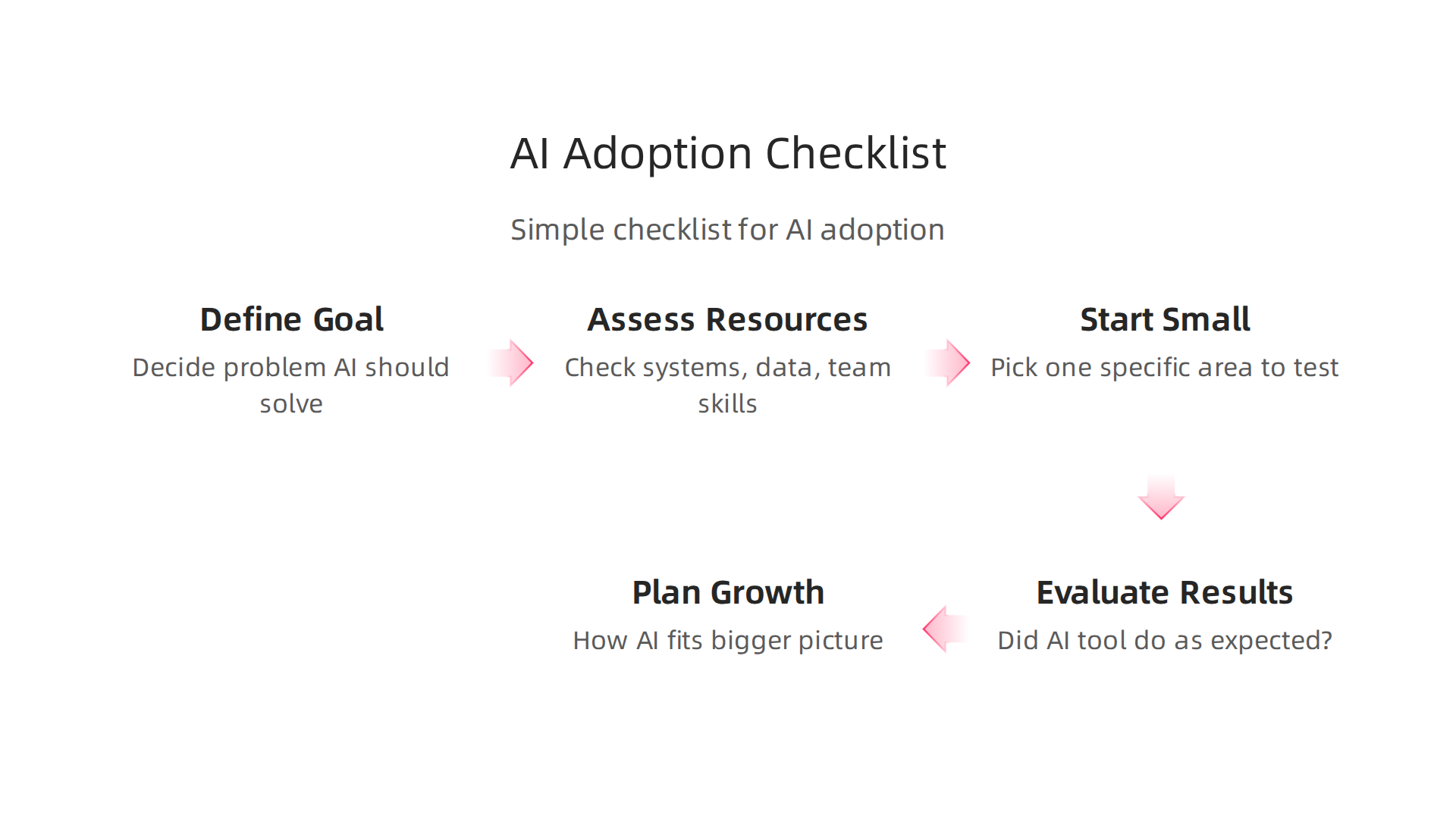
    Infographic outlining practical steps businesses should follow to successfully evaluate and adopt AI tools.

    • 1. Know What You Want to Achieve: Before anything else, decide what problem AI should solve or what goal it should help you reach. Do you want to save money, make customers happier, or create new products? Be very clear about the results you expect, like reducing customer wait times by a certain percentage. This is key for measuring success later on The AI Adoption Playbook: 2026 Edition.
    • 2. Look at What You Have: Check your current systems, data, and the skills of your team. Do you have good quality data for AI to learn from? Can your existing software connect with new AI tools? Do your employees need training? Understanding your starting point helps you pick the right tools and prepare your team.
    • 3. Start Small with a Pilot Project: Don’t try to change everything at once. Pick one specific area to test an AI tool. For example, maybe you start with an AI tool to help answer common customer questions. This lets you see how the AI works in real life and fix any issues without affecting your whole business. Experts suggest starting with internal tasks that can show quick wins The 2026 AI Adoption Playbook for Business Leaders.
    • 4. Check the Results and Learn: After your pilot, look closely at the numbers. Did the AI tool do what you expected? Did it save money or time? What worked well, and what didn’t? Use what you learn to make things better and decide if you should use the AI tool more widely.
    • 5. Plan for Growth and Connections: If the pilot was a success, think about how to use the AI tool in more parts of your business. This often means making sure it works smoothly with all your other systems. Having a plan for how AI will fit into your company’s bigger picture is important for long-term success AI Adoption in Business: Complete 2026 Strategy Guide.

    To dive deeper into making smart AI choices, consider reading our guide on Smart AI for Business: Your 2026 Guide to Successful Adoption.

    Overcoming Common Hurdles in AI Adoption

    Even with a good plan, businesses often run into common problems when adopting AI:

    • Budget Concerns: AI tools can cost money. To deal with this, focus on tools that promise a clear return on investment (ROI). Starting small (as in step 3 above) also helps manage costs.
    • Lack of Skills: Many teams might not have the right skills to work with AI. You can solve this by offering training to your current employees or hiring new people with AI knowledge. It’s also important to think about what jobs will AI replace, and how to help your team learn new skills instead. While some jobs might change, AI often creates new opportunities for skilled workers The debate on AI and jobs – European Parliament.
    • Integration Challenges: Getting new AI systems to talk to your older software can be tricky. Look for AI tools that are made to work with other systems easily.
    • Understanding AI Policy: As AI becomes more common, new rules and guidelines are being set. Businesses need to understand these rules to make sure they use AI safely and ethically. This helps build trust and avoids problems later on.

    By thoughtfully following these steps and addressing potential problems head-on, businesses of all sizes can make the most of AI in 2026.

    Staying informed about these fast-moving changes is critical. Get clear daily AI updates from The AI Newsletter Worth Reading.

    Summary

    This article explains why asking

  • When Was Artificial Intelligence Made The 1956 Workshop That Started It All

    When Was Artificial Intelligence Made The 1956 Workshop That Started It All

    Introduction

    You probably use artificial intelligence every day. Maybe you ask ChatGPT to draft an email, let Grammarly polish your writing, or rely on a smart assistant to manage your calendar. AI is now a mainstream business tool, and in 2026, it feels like it has been around forever.

    But here is the thing: many people get the history wrong. They think AI is a recent invention, something that popped up when ChatGPT launched. The truth goes back much further. So, when was artificial intelligence made?

    The answer is 1956. That summer, a group of scientists gathered at Dartmouth College for a workshop that is now called the official birthplace of AI. A research paper from the time proposed a two-month study on making machines think. That event, known as the Dartmouth Summer Research Project on Artificial Intelligence, gave the field its name and set the stage for everything that followed.

    Understanding the real origins of AI matters for anyone who uses it at work.

    A person in a professional setting thoughtfully reflecting on the historical journey and impact of artificial intelligence.

    When you know where the technology came from, you can spot hype, make smarter adoption decisions, and see how far we have come. You also appreciate how the early theories connect to the computer systems technology powering today’s tools.

    This article traces AI’s journey from that summer camp in New Hampshire to the practical ai work applications you rely on now. We will look at the key milestones, the slow periods, and the breakthroughs that made AI a household name. By the end, you will know exactly when artificial intelligence was made and why it took so long to reach your desk.

    When Was Artificial Intelligence Made? The Definitive Origin Story

    So when was artificial intelligence made? The exact answer is the summer of 1956. That is when a small group of scientists gathered at Dartmouth College in Hanover, New Hampshire for a workshop that changed the world. The event was called the Dartmouth Summer Research Project on Artificial Intelligence, and it is widely considered the official birthplace of the field.

    The idea started with a proposal. John McCarthy, a young mathematician, wrote a paper suggesting a two month study on making machines think. The original proposal asked for ten people to spend the summer working on what he called "artificial intelligence." That phrase stuck. Before 1956, no one had used the term. After 1956, the field had a name and a mission.

    The workshop ran from June 18 to about August 17. About 20 people attended at different times. Among them were some of the biggest names in early computing: Alan Turing, Marvin Minsky, and Claude Shannon. Turing had already written about machine intelligence years earlier, but this was the first time everyone sat together to talk about it as a real project.

    A diverse group of professionals collaborating and discussing ideas around a whiteboard, reminiscent of early AI research workshops.

    During that summer, the group worked on early programs that could solve logic problems and prove mathematical theorems. One of the first was the Logic Theorist, which could prove theorems from Principia Mathematica. It was a huge step. The Computer History Museum notes that this workshop set the stage for decades of research.

    If you want to see a quick visual recap, there is a short video about the Dartmouth Conference that shows how it all started. And for a deeper look at how those early ideas connect to the tools you use today, check out our guide to top AI websites professionals trust for real news and tools.

    The answer to "when was artificial intelligence made" is clear: 1956. But the story did not stop there. What came next were some quiet years, some big failures, and eventually the breakthroughs that brought AI to your desk.

    Core AI Principles: How Machines Learn, Reason, and Act

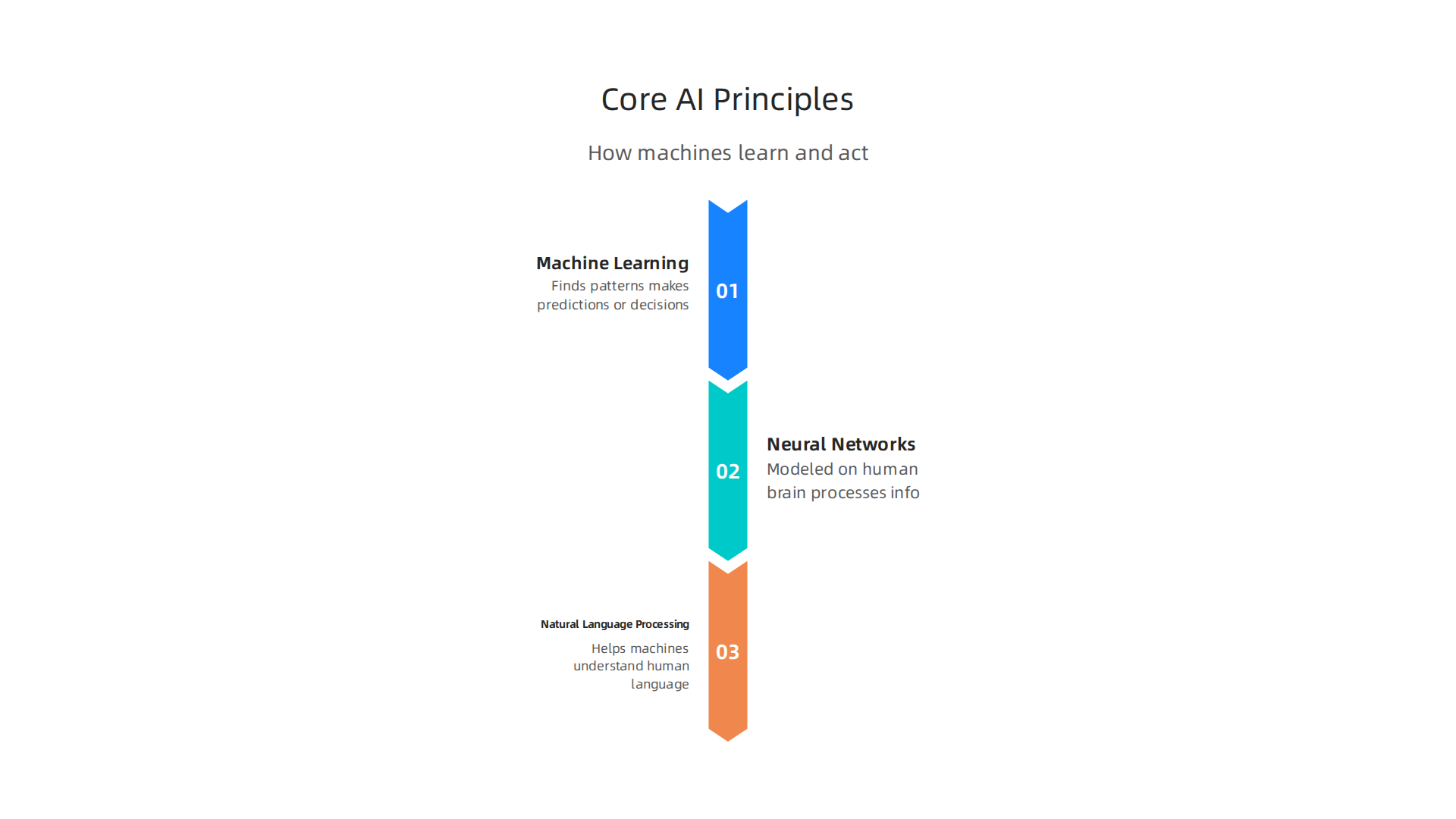
    The summer of 1956 gave AI its name, but what came next was the real work. Researchers had to figure out how to make machines learn and think. Today, three core technologies power almost every AI tool you use: machine learning, neural networks, and natural language processing.

    An infographic illustrating the three fundamental technologies — Machine Learning, Neural Networks, and Natural Language Processing — that underpin modern artificial intelligence applications.

    Understanding these building blocks helps you judge whether an AI is actually useful for your work.

    Machine learning is the engine behind most modern AI. Instead of giving a computer strict rules, you feed it lots of examples. The system uses algorithms to find patterns in the data, then makes predictions or decisions on its own. This is how your email filters out spam, how Netflix suggests shows, and how your phone recognizes your face. As one article explains, machine learning focuses on creating predictive systems from data Lumenalta. The quality of the training data matters a lot. If you give the algorithm bad examples, it learns bad habits. That is why companies invest heavily in clean, labeled datasets.

    Neural networks take machine learning a step further. They are modeled loosely on the human brain, with layers of connected nodes that process information. Each layer detects different features. In a photo recognition system, the first layer might detect edges, the next one shapes, and the final layer puts it all together to identify a cat or a dog. Neural networks are the reason AI can now write essays, compose music, and generate art. They are the technology that makes the idea of co-intelligence: living and working with ai a real possibility. When you use a tool like ChatGPT, you are interacting with a massive neural network trained on huge amounts of text.

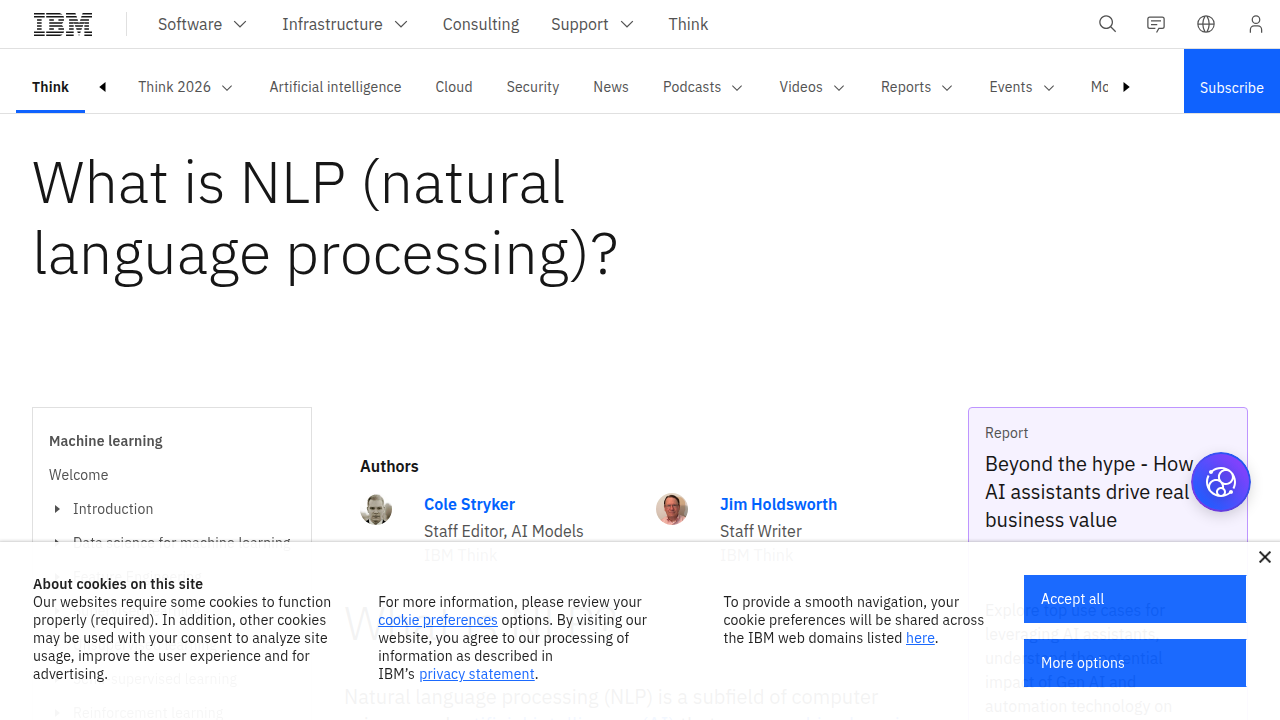
    Then there is natural language processing or NLP. This is the field that helps machines understand and generate human language. It combines computational linguistics with machine learning to break down words, sentences, and grammar. As IBM puts it, NLP enables computers to recognize, understand, and generate text and speech

    A screenshot from IBM's website, providing an overview and definition of Natural Language Processing (NLP), a core AI technology.

    IBM. Another easy guide from Splunk notes that NLP involves teaching machines to understand, analyze, and generate natural language Splunk. When you ask your smart speaker a question or use a chatbot to get customer support, NLP is doing the heavy lifting. It also powers tools that help you write content that sounds human.

    These three technologies often work together. Machine learning trains the model, neural networks give it the power to handle complex tasks, and NLP handles the language side. That is why modern AI can do things like summarize a long report, translate a conversation in real time, or write a draft email. Understanding these basics helps you evaluate which AI tools are worth your time. For a closer look at how these principles play out in real world writing, check out our article on how undetectable AI helps you write content that sounds human and gets results. And if you want to stay on top of the latest tools and news, our list of top AI websites professionals trust for real news and tools is a great place to start.

    Now you know the engine. Next, we will look at the quiet periods and the big breakthroughs that turned these ideas into the AI you use every day.

    Key Milestones in AI Development: A Timeline from 1950 to 2026

    So when was artificial intelligence made? If you look for a single birthday, most experts point to the summer of 1956. That is when a group of researchers gathered at Dartmouth College for a workshop that officially launched the field. John McCarthy coined the term "artificial intelligence" there, and the event is called the Dartmouth Summer Research Project on Artificial Intelligence. It is widely considered the birthplace of AI Wikipedia. A proposal for the project stated they wanted to figure out how to make machines use language, form concepts, and solve problems Stanford PDF. That simple goal set everything in motion.

    But the road from 1956 to today was bumpy. AI has gone through periods of huge excitement, called AI summers, and periods of disappointment, called AI winters. Funding dried up more than once when early promises fell short. Still, key breakthroughs kept pushing the field forward.

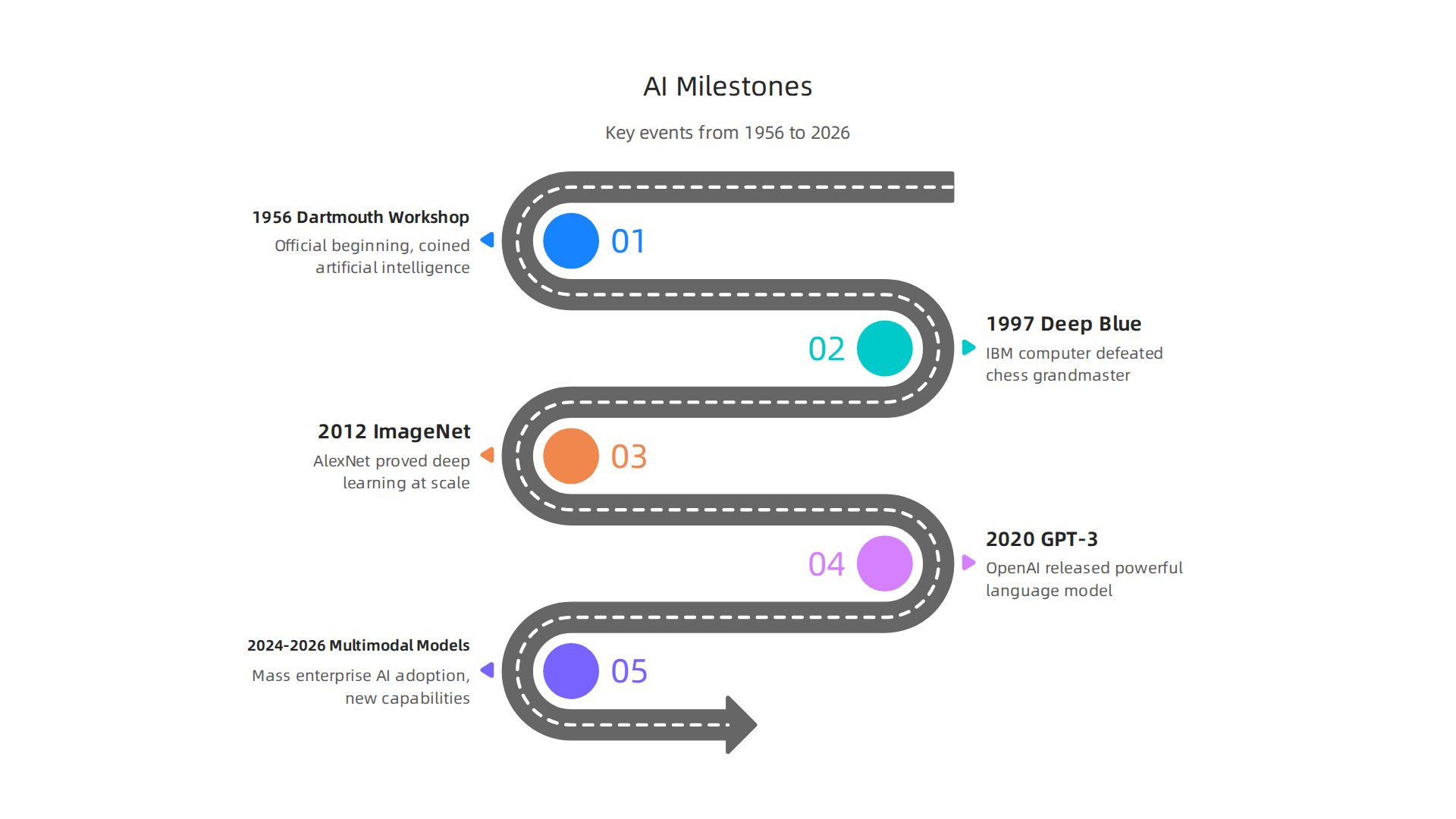
    Here are the milestones that changed everything:

    A visual timeline detailing the most significant milestones in AI development, from the 1956 Dartmouth Workshop to multimodal models and mass adoption in 2026.

    1956 – The Dartmouth Workshop. This was the official beginning. The eight week gathering at Dartmouth College brought together the brightest minds in computer science. It is the answer to the question when was artificial intelligence made. The Computer History Museum notes that the workshop sparked a whole new field of research Computer History Museum.

    1997 – Deep Blue beats a world champion. IBM’s Deep Blue defeated chess grandmaster Garry Kasparov. It was a huge moment because it showed a machine could beat a human at a complex game using brute force calculation.

    2012 – ImageNet changes everything. A neural network called AlexNet won a major image recognition contest. It crushed the competition and proved that deep learning could work at scale. This breakthrough led to the AI boom we are still riding.

    2020 – GPT-3 goes public. OpenAI released GPT-3, a language model that could write essays, answer questions, and even code. It showed how powerful neural networks had become. This is the type of technology that makes co-intelligence living and working with ai a reality for millions of people.

    2024 to 2026 – Multimodal models and mass adoption. AI models now handle text, images, audio, and video all at once. Tools like ChatGPT can see, hear, and speak. In 2026, enterprise AI adoption has soared. According to a recent report, 65% of organizations now use generative AI in at least one business function MedhaCloud. Worker access to AI rose by 50% in 2025 alone

    A screenshot from Deloitte's report on the state of AI in the enterprise, discussing adoption rates and future trends in AI.

    Deloitte. The global enterprise AI market is projected to reach over $550 billion by 2035 Research Nester.

    Understanding this timeline helps you see why AI feels so powerful right now. We are in the middle of a new AI summer, and the tools keep getting better. If you want to stay on top of the latest tools and news, our list of top AI websites professionals trust for real news and tools is a great place to start.

    AI at Work: Real-World Applications Transforming Business Operations

    Knowing when was artificial intelligence made gives you the historical foundation. But the more pressing question in 2026 is: how is AI actually working for businesses right now? The answer is that it has moved from futuristic hype to everyday tooling.

    A team celebrating a successful project completion, symbolizing the positive impact and adoption of AI tools in modern business operations.

    And the numbers prove it.

    According to recent data, 65% of organizations now use generative AI in at least one business function MedhaCloud. That is double the rate from just a year earlier. Worker access to AI tools rose by 50% in 2025 alone Deloitte. But what does that actually look like at the desk level?

    Let me break down the most common ways AI is reshaping business operations today.

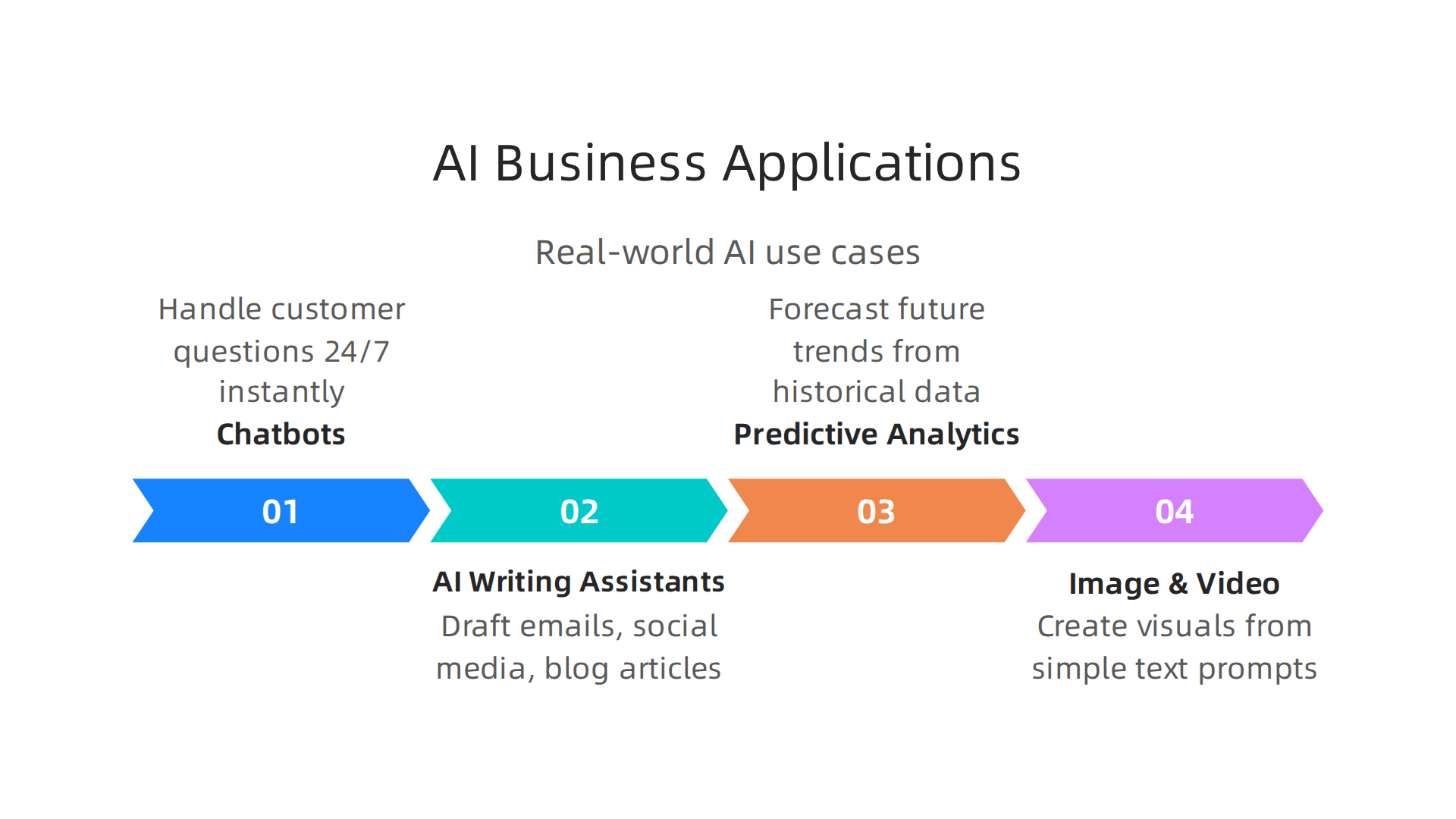
    An infographic showcasing real-world AI applications that are transforming business operations, including customer service, content creation, and predictive analytics.

    Chatbots and Customer Service

    This is probably the most visible use. AI powered chatbots handle customer questions 24/7 without needing a human on standby. They use natural language processing (NLP) to understand what people are asking and respond in real time. IBM explains that NLP allows computers to recognize, understand, and generate text and speech IBM. For a small business, that means fewer support tickets and faster response times. A chatbot can answer common questions about hours, pricing, or order status instantly.

    AI Writing Assistants

    Creating content is one of the biggest time sinks for any business. AI writing tools now help draft emails, social media posts, blog articles, and even ad copy. You give them a topic and a tone, and they produce a solid first draft in seconds. This is where co-intelligence living and working with ai becomes real. You are not replacing the writer. You are speeding up the rough work so the human can focus on strategy and polish. If you want to explore how to keep that human touch, our guide on how undetectable AI helps you write content that sounds human can help you strike the right balance.

    Predictive Analytics

    This is the behind the scenes magic. AI looks at historical data to predict future trends. A retailer can forecast which products will sell out next month. A marketing team can predict which email subject lines will get more opens. It takes the guesswork out of decision making. The Amazon Web Services team highlights that small businesses can use AI for customer engagement through personalized marketing campaigns AWS. That kind of computer systems technology used to be reserved for big corporations. Now any business can tap into it.

    Image and Video Generation

    AI can now create images, edit videos, and generate product mockups from simple text prompts. Marketers use it to create social media visuals without hiring a designer. Ecommerce stores generate multiple product variations for A/B testing. It saves both time and money.

    How to Get Started

    The key is not to adopt every tool at once. Start with one use case. Maybe a chatbot for customer service or an AI writing assistant for your blog. The SBE Council found that the average small business already uses a median of five AI tools, and they plan on adding more SBE Council. That shows momentum. But the smartest approach is to pick the tool that solves your biggest pain point first.

    If you want to stay ahead of the curve and learn which tools actually deliver ROI, check out our curated list of top AI websites professionals trust for real news and tools. It is a great starting point for finding the right solutions for your business.

    A Practical Framework for Choosing and Adopting AI Tools

    Knowing when was artificial intelligence made helps you appreciate how fast we got here. But in 2026, the real challenge is not understanding the history. It is figuring out which tools actually work for your business. The excitement around AI is real, but jumping in without a plan can waste time and money.

    Here is the truth. A January 2025 survey by Boston Consulting Group found that 74% of organizations struggle to scale AI value, with data as the primary obstacle OneAdvanced. And a separate report shows that 68% of small businesses use AI regularly, but most have no formal strategy Digital Applied. That is a recipe for frustration.

    So let me give you a simple framework to avoid those traps.

    A person in a focused setting, outlining a strategic plan on a whiteboard, reflecting the careful approach needed for AI tool adoption.

    Step 1: Start with the Problem, Not the Tool

    This is the most common mistake. People hear about a hot new AI tool and sign up before asking what problem they want to solve. Instead, take a step back. List your biggest time drains. Is it customer support? Writing content? Data analysis? Only then should you look for a tool that fits. This problem first approach is the core of effective computer systems technology adoption. It keeps you focused on outcomes instead of features.

    Step 2: Evaluate the Right Criteria

    Not all AI tools are created equal. When you compare options, use these five criteria:

    A table-style infographic outlining essential criteria for evaluating AI tools, such as cost, integration ease, and data privacy, to ensure effective adoption.

    Criteria Why It Matters
    Cost Does it fit your budget, including hidden fees?
    Integration ease Does it work with your current software stack?
    Data privacy How does the vendor handle your sensitive information?
    Scalability Can it grow as your business grows?
    Vendor support Is there reliable help when something breaks?

    The SBE Council notes that the average small business uses a median of five AI tools and plans to add more SBE Council. That means integration becomes critical. You do not want six tools that do not talk to each other.

    These considerations are especially important for SMBs that lack dedicated IT teams. A thoughtful evaluation upfront saves headaches later Consltek.

    Step 3: Run a Low-Risk Pilot

    Do not roll out a new AI tool across your entire company at once. Pick one small team or one process. Run a pilot for 30 days. Measure the impact. Did response times improve? Did output quality go up? Did your team actually enjoy using it?

    A pilot gives you real data before you commit more resources. It also lets your team learn the tool without pressure. This phased approach is exactly how most successful organizations adopt AI in 2026.

    Bringing It All Together

    When was artificial intelligence made matters for context. But what matters more is how you adopt it today. Start with the problem. Evaluate carefully. Pilot first. That is how you move from experimenting to getting real results.

    If you want to dive deeper into how to keep your content human while using AI, check out our guide on human or AI creativity and what the data says about collaboration in 2026. It pairs perfectly with this framework.

    Overcoming AI Adoption Challenges: Expert Tips for SMBs

    Even with a solid framework, you will hit roadblocks. In 2026, the four biggest challenges SMBs face are information overload, tool selection, budget limits, and a lack of technical skills. But these are not impossible to fix. Here is how to overcome each one.

    Challenge 1: Information Overload

    Every day there is a new AI tool to try. It is easy to feel lost. The best fix? Start with free trials. Pick one or two tools that match your biggest need and test them for a month. For example, AWS highlights six practical AI use cases for small businesses, including content creation and customer support chatbots AWS. Focus on one use case at a time.

    Also, lean on community reviews. Sites like G2 or Capterra have real user ratings. They cut through the noise faster than vendor marketing.

    Challenge 2: Tool Selection

    With hundreds of options, how do you pick? Use the five criteria from our earlier framework. But add one more step. Ask your team what they actually need. A tool that works for a marketing agency might be overkill for a local shop.

    The SBE Council reports that the average small business uses five AI tools and plans to add more SBE Council. That means you need tools that play well together. Check for integration ease first.

    Challenge 3: Budget Constraints

    AI does not have to be expensive. Many great tools offer free tiers or low-cost plans. Start with one tool that solves a clear problem. Track your time saved or revenue gained. That data will help you decide if the paid version is worth it.

    Measuring ROI is key. The JPMorgan Chase Institute notes that AI tools promise productivity gains through task automation and better decision making JPMorgan Chase Institute. So before you implement, record your current metrics. After 30 days, compare them. You might be surprised at the improvement.

    Challenge 4: Lack of Technical Skills

    You do not need a computer science degree to use AI. Most tools are designed for non-technical users. Still, investing in a little training goes a long way. Platforms like LinkedIn Learning and many tool vendors offer free tutorials.

    One practical tip: start with a tool that helps you write content that sounds human. If you are unsure where to begin, check out our guide on how undetectable AI helps you write content that sounds human and gets results. It walks you through the setup without any coding needed.

    Your Next Move

    The biggest mistake is waiting for the perfect setup. Instead, start small. Pick one challenge, one tool, and one metric. Track your results. Adjust as you go. That is how real adoption happens in 2026.

    The Future of AI: What Professionals Should Prepare For (2026 and Beyond)

    You have tackled the challenges and started using AI today. But what comes next? Knowing where AI is heading helps you stay ahead instead of playing catch up.

    Here is the thing. The question "when was artificial intelligence made" goes back to the 1950s. But the AI we use in 2026 barely looks like those early experiments. The pace of change is staggering. And professionals who understand the trends will have a clear advantage.

    The Four Big Trends Shaping 2026

    According to experts at IBM, we are moving into an era of agentic AI and multimodal systems IBM. What does that mean for you?

    1. Multimodal AI: Tools that process text, images, audio, and video together. Instead of working with separate tools, you ask one AI and it understands everything. This saves time and gives better results.

    2. Autonomous agents: These are AI tools that complete multi-step tasks on their own. You give them a goal and they figure out the steps. Microsoft calls this shift making AI a true partner rather than just a tool Microsoft.

    3. AI regulation: Governments are creating rules for how AI can be used. The conversation around google ai principles and responsible development is becoming central to business strategy. Info-Tech Research Group notes that foundational AI principles are rewriting organizational DNA Info-Tech.

    4. Edge AI: Processing happens on your device instead of the cloud. Faster responses, better privacy, and lower costs. This is a game changer for ai work in environments with spotty internet.

    Human-AI Collaboration Is the Real Goal

    Here is the shift that matters most. The future is not about AI replacing people. It is about co-intelligence: living and working with ai in a way that amplifies human skills.

    PwC predicts that more companies will adopt enterprise-wide AI strategies led by senior leadership PwC. That means your role changes from "doing the work" to "directing the AI that does the work."

    This human-AI partnership is already reshaping computer systems technology careers. Want a deeper look at how creativity and AI work together? Check out our analysis of human or AI creativity and what the data says about collaboration in 2026.

    Continuous Learning Is Your Safety Net

    The single most important skill in 2026 is adaptability. Stanford AI experts predict we will see continued rapid evolution across every sector Stanford HAI. Tools you learn today might look different in six months.

    That does not mean you should wait. It means you should build a habit of learning. Spend 15 minutes a week reading about new AI developments. Test one new tool per quarter. Ask yourself: how can this make my work better?

    The professionals who thrive in 2026 and beyond are not the ones with the most technical skill. They are the ones who stay curious, stay flexible, and stay focused on what AI can do for people.

    Summary

    Artificial intelligence traces back to a specific moment: the Dartmouth Summer Research Project on Artificial Intelligence in 1956, when John McCarthy and other researchers coined the term and set a research agenda. This article explains that origin, outlines the three core technologies—machine learning, neural networks, and natural language processing—that power modern systems, and walks through key milestones from Deep Blue to GPT-3 and multimodal models. It then shifts to practical guidance for businesses, describing common workplace applications (chatbots, writing assistants, predictive analytics, image/video generation) and a simple, problem-first framework to evaluate, pilot, and scale tools. The piece highlights common SMB obstacles—information overload, budget limits, tool selection, and skill gaps—and offers concrete fixes like 30-day pilots and ROI tracking. Finally, it looks ahead to trends such as multimodal AI, autonomous agents, edge processing, and the growing need for continuous learning and responsible AI governance. After reading, you’ll understand AI’s true origin, how the technology works, which business use cases deliver value, and how to adopt AI safely and strategically.