
Here is the reality of 2026. The number of AI tools available grows so fast that keeping up feels like a full-time job. Every week, a new platform launches. A new feature drops. A new competitor grabs headlines. It is easy to feel overwhelmed.
But here is the other side of that coin. If you jump on every new tool without a clear plan, you waste your budget and your team’s time. If you ignore the changes completely, you risk losing your competitive edge.
The data proves how fast this shift is happening. Recent reports show that nearly 9 in 10 organizations now use AI in at least one business function. The question is no longer if you should use AI. It is how you adopt the right future tools for your specific needs.
This article gives you a practical framework for doing just that. We will look at the top AI platforms, evaluate what works, and build a roadmap you can actually follow.

Think of it as your guide on how to choose AI for business tools that deliver real results.
Staying informed is half the battle. If you want clear, daily updates on the tools that actually matter, check out The Deep View Newsletter.
It saves you the scrolling so you can focus on building.
The Evolving Landscape of Future Tools in 2026
So what does this landscape actually look like today? The numbers tell a clear story. According to recent research, 88% of organizations now use AI regularly in at least one business function. That is up dramatically from just a few years ago. The market for these future tools keeps expanding fast, with billions of dollars flowing into new AI platforms every quarter.
Here is the challenge though. New tools pop up almost every single week. One week a startup launches a writing assistant. The next week a giant releases an AI that handles customer service. It is noisy out there. Separating the truly useful top ai tools from the hype gets harder by the day.
This is why understanding macro trends matters. When you know where the market is heading, you can spot which ai platforms have staying power. And that makes picking your next tool much easier. If you want a deeper look at how to evaluate your options, read our practical guide on how to choose AI for business tools that deliver real results. It walks through the exact steps to filter out the noise.
The first step in any smart adoption plan is knowing what is actually changing around you. So let’s look at the key trends driving the industry forward, starting with the rise of agentic AI.
Key Trends Defining the Next Generation of Tools
Agentic AI is just one piece of the puzzle. Three major trends are actually reshaping the landscape of future tools in 2026, and they all point in the same direction: away from one-size-fits-all solutions and toward smarter, more specialized systems.
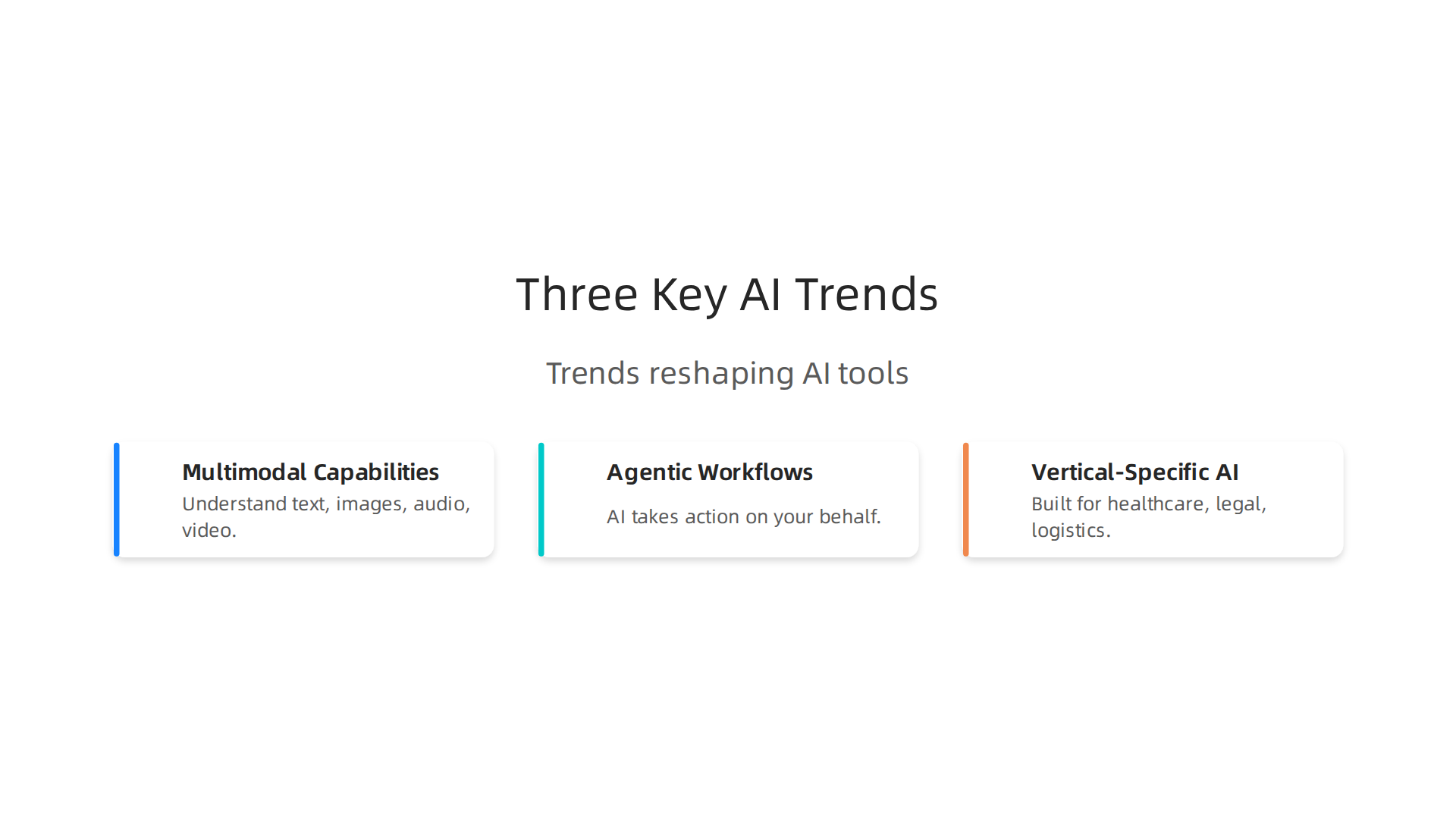
First, multimodal capabilities are becoming standard. Modern ai platforms can now understand text, images, audio, and video all at once. This means a single tool can analyze a video meeting, summarize the transcript, and generate a follow-up email without you switching apps.
Second, agentic workflows let AI take action on your behalf. Instead of just answering questions, these systems can complete multi-step tasks like booking travel or managing customer support tickets. In fact, projections suggest that by 2028 roughly 15% of daily business decisions could be made by agentic AI, according to the latest 83 AI statistics to boost your growth in 2026.
If you want to dive deeper into how these assistants work today, check out this guide on ai virtual assistants for businesses.
Third, vertical-specific AI tools are taking over. Rather than generic chatbots, we now see AI built specifically for healthcare, legal, logistics, and more. These specialized tools deliver far better results because they understand industry language and workflows.
Keeping up with these fast-moving trends can feel overwhelming. That is why staying informed matters. Grab The AI Newsletter Worth Reading to get clear daily updates on exactly which tools and trends deserve your attention.
Why a Strategic Approach to Adoption Is Non-Negotiable
Staying informed is only half the battle. Without a strategic approach, even the most powerful future tools can become a liability. Many teams jump into new AI platforms without a plan. That leads to tool fragmentation, data silos, and a pile of unused licenses that waste money.
A smarter path ties every tool selection back to your real business objectives. When you know exactly what problem you are solving, you choose better tools and get higher returns.

In fact, recent global data shows that over 75% of organizations now use AI in at least one business function, and the ones with a formal adoption strategy report much higher satisfaction with their investments according to the AI Adoption Statistics (2026) report.
Instead of picking tools one by one, build a simple checklist. Ask: Does this tool solve a specific goal? Can it integrate with what we already use? Will it scale? For a step-by-step process, check out this guide on how to choose AI for business tools that deliver real results. That kind of discipline turns a pile of shiny tech into a real competitive edge.
A 5-Part Framework for Strategic Adoption of Future Tools
A clear framework turns uncertainty into a repeatable process. The best teams in 2026 follow five phases: Discovery, Pilot, Evaluate, Scale, and Optimize.
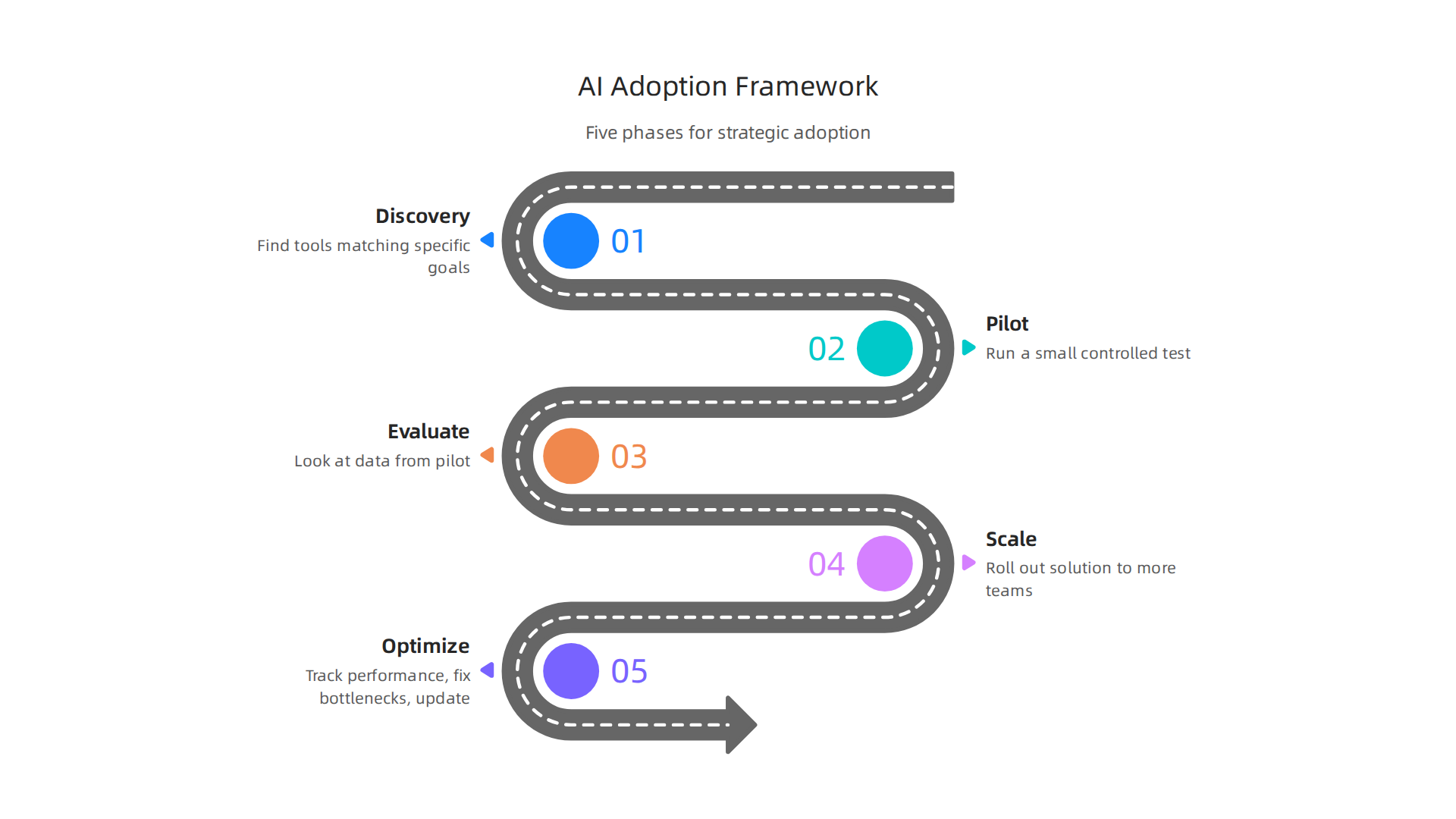
This proven model comes from real-world setups. For example, a complete guide to building an AI adoption framework for 2026 uses a similar phased approach to reduce risk.
Here is how each phase works in plain terms:
- Discovery – Find the right top AI tools and ai platforms that match your specific business goals. Skip the hype and focus on real needs.
- Pilot – Run a small, controlled test with one team or one process. Keep the scope tight so you can measure results clearly.
- Evaluate – Look at the data from your pilot. Did it save time? Cut costs? Improve quality? Decide if it deserves more investment.
- Scale – Roll out the winning solution to more teams. Connect it with your existing systems. Train people so they actually use it.
- Optimize – Keep improving. Track performance, fix bottlenecks, and update the tool as your needs change. This is where you get long-term value.
This cycle keeps you from jumping between shiny milestone technologies without a plan. A report on enterprise AI adoption shows that companies using structured frameworks report higher success rates. For more on how to find the right options in the first phase, check out this AI tool discovery guide.
To stay ahead of the curve with the latest best practices, consider subscribing to [The AI Newsletter Worth Reading]. It delivers clear daily updates so you never miss a key insight.
Phase 1: Discovery and Business Alignment
Discovery is not about grabbing the flashiest new tool on the market. It starts with a clear look at your actual business needs. Ask yourself: what problem are we really trying to solve?
Map those needs to the capabilities of available future tools and ai platforms. This keeps you from chasing hype. A complete guide to building an AI adoption framework shows that alignment with business goals is the foundation of any successful rollout.
Next, bring key stakeholders into the conversation early. When leaders from different teams agree on priorities, you get buy-in from day one. This prevents resistance later.
The goal of this phase is simple: create a shortlist of candidate top ai tools based on your prioritized requirements. You are not buying anything yet. You are just narrowing the field. For a deeper look at how to evaluate options, see this guide on how to choose AI for business tools.
Phase 2: Pilot and Proof of Value
Once you have a shortlist of future tools, pick one or two top candidates for a small test. This is not a full rollout. It is a controlled experiment.
Set a firm timebox between 60 and 90 days. That gives you enough time to see real results without burning budget on something that does not work.
Define your success metrics before the pilot starts. What does winning look like? Maybe it is hours saved per week or a percentage increase in output. Write those numbers down. Measure them honestly.

IBM points out that many teams stumble when moving from pilots to full adoption because they skip this measurement step. Reading about the biggest AI adoption challenges for 2026 helps you avoid those same mistakes.
Collect real feedback from the people using the tool every day. They will catch problems the sales demo never showed you. Combine that feedback with your metrics to decide if the pilot passed or failed.
For a deeper look at comparing platforms during this phase, check this enterprise AI platforms guide. Staying current with these evaluations is easier when you have a steady source of daily updates. That is why many teams rely on The AI Newsletter Worth Reading to keep their pilot decisions informed by the latest breakthroughs.
Phase 3: Integration, Scaling, and Governance
Your pilot proved the tool works. Now the hard part begins. You need to weave those future tools into the systems your team uses every day. That means connecting the AI to your existing data sources, CRM, and workflow tools. Without that deep integration, you will end up with a powerful tool that nobody actually uses.
As you scale, governance becomes just as important as performance. You need clear rules about who can access the AI, what data it can touch, and how decisions get reviewed. This enterprise AI adoption framework from the G2 Learn Hub walks through how to set those guardrails without slowing down progress.
Continuous monitoring completes the picture. Track your success metrics over time. Watch for drift in output quality. Keep talking to the people using the tool daily so you catch problems early.
Wondering how to pick scalable tools from the start? This guide on how to choose AI for business tools that deliver real results will help you avoid common scaling traps.
Critical Criteria for Evaluating Future Tools
Not every future tool deserves a spot on your tech stack. The trick is knowing what to look for before you get excited by a demo. Focus on five core criteria: functionality, ease of integration, data privacy, scalability, and cost.
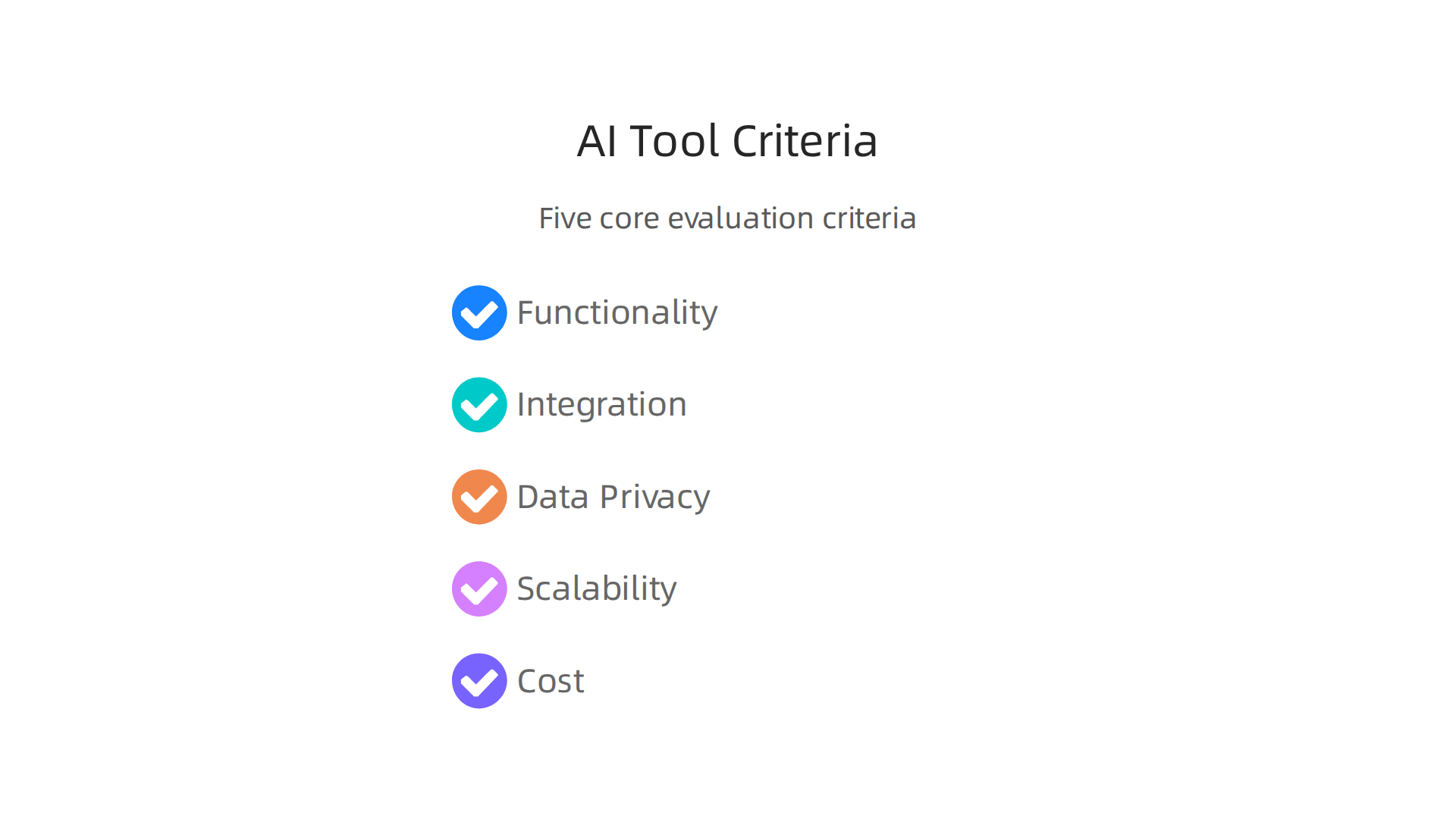
Start with functionality. Does the tool actually solve the problem you identified in your pilot? Then check integration. Will it connect to your CRM, data warehouse, and daily workflow tools without a ton of custom work? Data privacy matters more than ever in 2026. Make sure the vendor follows your compliance requirements. Scalability means the tool can grow with your team without breaking the bank. And cost should include more than the subscription fee, like training, maintenance, and hidden infrastructure charges.
The trick is weighting each criterion by your business priorities. A tool that scores high on functionality but low on privacy may not be the right fit for a regulated industry. Using a simple scoring matrix helps remove bias from the decision. This guide to evaluating AI tools from Purdue University lists criteria like accessibility, accuracy, and ethical implications that you can adapt to your own matrix.
Want a deeper look at how top platforms compare? This overview of enterprise AI platforms 2026 top providers and how to choose the right one can help you narrow the field.
To stay on top of new future tools and evaluation methods all year long, subscribe to The AI Newsletter Worth Reading for daily updates that cut through the noise.
Technical Capabilities and Integration Readiness
High level criteria give you the big picture, but two areas can make or break your choice of future tools: technical capabilities and integration readiness.
Start with technical capabilities. Look at model accuracy for your specific use case. Latency matters if you need real time answers. Check API support and how easy it is to customize the model to your data. For example, the best AI evaluation tools for production systems recommend tracking task specific metrics like accuracy and latency.
Next, integration readiness. Does the tool connect to your CRM, ERP, or data warehouse with minimal custom code? Many top AI platforms offer pre built connectors, but you should verify before committing.
Data readiness is often the hidden bottleneck. Tools expect clean data in a specific format. Make sure your data volume and quality meet the minimum requirements. Without that, even the most capable tool will stumble.
For a practical framework, check out this guide to choose AI for business tools that covers these exact considerations.
Vendor Stability, Support, and Ecosystem
Beyond technical fit and data readiness, the long-term value of future tools depends on the vendor behind them. You want a partner, not just a product.
First, check vendor stability. Look at the company’s financial health, user base size, and product roadmap. A tool from a stable vendor is less likely to disappear next year. According to an article from Forbes titled 10 Considerations When Evaluating An AI Tool, you should study the provider carefully.
Next, evaluate support quality. Are response times fast? Is documentation clear? An active community can also save you when you are stuck.
Finally, look at the ecosystem. Does the tool have strong integration partners and third-party support? A wide API ecosystem means you can connect it to your existing stack. For a deeper look at choosing a reliable platform, check out this guide on enterprise AI platforms 2026 top providers.
Get clear daily AI updates from The Deep View Newsletter. Subscribe to The AI Newsletter Worth Reading and stay ahead with daily insights.
Common Pitfalls in Adopting Future Tools and How to Avoid Them
Even when you pick a stable vendor, the hardest part is still ahead. Many teams jump into future tools without a clear use case. They buy a shiny AI platform and then ask, "What should we do with it?" That backward approach often leads to wasted money and zero results.
Another common mistake is underestimating change management. If your people don’t understand why the tool matters, they won’t use it. A successful rollout needs training, clear communication, and patience.
Ignoring data readiness is another big pitfall. Your AI is only as good as the data you feed it. Messy, incomplete, or siloed data will give you unreliable outputs. According to a guide on avoiding costly AI adoption mistakes, poor data quality is one of the top reasons AI projects fail.
The good news? Awareness is half the battle. When you know these traps exist, you can plan around them. Start with a specific problem, prepare your data, and bring your team along for the ride. For a step-by-step framework on picking tools that actually fit your business, check out this practical guide on how to choose AI for business tools.
Overcoming Analysis Paralysis and FOMO
Even with that framework in hand, the sheer number of options can still freeze you in place. Decision paralysis is real. You stare at dozens of AI platforms, afraid to choose the wrong one. Then FOMO kicks in, the fear of missing out. It pushes you to buy the hottest new tool before you even know if it fits your needs. Rushed or delayed decisions both lead to wasted time and money. In fact, decision paralysis is one of the common barriers to AI adoption that many businesses face.
Here are three simple tactics to break the cycle. First, set a firm evaluation time limit. Give yourself two weeks to compare tools and make a call. Second, use a simple decision framework. Score each option on fit, cost, and ease of use. Third, consult a few trusted sources instead of chasing every headline. A great way to stay informed without overwhelm is to subscribe to The AI Newsletter Worth Reading.
These small habits help you move forward with confidence. For more on structured evaluation, also check out this guide to enterprise AI platforms and how to choose the right one.
Change Management and User Adoption
Picking the right tool is only half the battle. The real challenge comes next: getting your team to actually use it. User adoption is the most critical factor for tool success. Even the best future tools fail if nobody adopts them.
So how do you drive adoption? Start by communicating the value clearly. Explain how the tool makes their work easier, not harder. Provide hands-on training so people feel confident. Also, identify champions within your team who can model usage and help others. Many teams overlook these steps, which is one of the costly AI adoption mistakes in business.
Resistance often comes from the fear of job displacement. The key is to reframe AI as augmentation, not replacement. Show your team that these tools handle tedious tasks so they can focus on more meaningful work. For a deeper look at evaluation, read how to choose AI for business tools that actually get used.
Real-World Success Stories: Strategic Adoption in Action
Theory helps, but nothing beats seeing results from real teams. Here are two examples of strategic adoption that paid off.
Case Study 1: More Content, Same Team
A mid-size marketing agency wanted to scale content production without hiring more people. They used a structured adoption framework to select a generative AI content tool. By starting small, training thoroughly, and iterating based on feedback, they boosted content output by 30%. The team produced more without burning out.
Case Study 2: Faster Operations, Fewer Bottlenecks
An enterprise operations team adopted an AI workflow automation platform. They picked one slow process, automated it, and proved the value. Process time dropped by 50%. That success opened the door for more automation across the organization.
What Made Them Succeed
Both teams shared three success factors: executive sponsorship from leadership, an iterative rollout instead of a full launch, and continuous training for the whole team.

These patterns match what enterprise AI adoption trends show across industries.
These case studies prove that future tools deliver real value when you focus on people first. For more on choosing the right technology, check out this guide to enterprise AI platforms for 2026.
Want to keep learning about the latest AI breakthroughs? Subscribe to The AI Newsletter Worth Reading for daily updates on top AI tools and milestone technologies.
Case Study: How a Mid-Size Marketing Agency Modernized Workflows
Let’s unpack how that mid-size agency achieved its results. The team managed content for multiple client accounts, each with different brand voices and formatting rules. They needed a scalable solution without hiring more people.
They adopted a clear 5-phase framework to evaluate future tools.
- Discovery: The team scanned for top AI tools and shortlisted three candidates suited to their workflow.
- Pilot: They ran a controlled test with one tool on a single client account to measure real performance.
- Rollout & Training: After proving the concept, they trained the whole team on the chosen AI platform.
The payoff came fast. Content production sped up by 30%, and editorial costs dropped by 20%. This matches what many organizations see with structured adoption. In fact, 85% of SMBs already using AI expect measurable returns. For a deeper look at finding the right starting point, explore this guide on AI tool discovery for business.
This case study proves that future tools do not have to be complicated to deliver real, measurable value.
Case Study: Enterprise Adoption of AI for Operations
Now let’s look at how a large enterprise tackled similar problems at a bigger scale. This company handled thousands of manual data entries and approval workflows every week. Employees spent hours on repetitive tasks that slowed down key processes.
The leadership team decided to pilot an AI-powered workflow automation tool. After a six-week trial on one department, the results were clear. They rolled it out across the organization.
The outcomes speak for themselves. Process cycle time dropped by 50%. User satisfaction hit 95% in the first quarter alone. These numbers reflect a wider trend: according to The State of AI in the Enterprise 2026 report, improving productivity and efficiency remain the top benefits organizations report from AI adoption. For a closer look at picking the right system, check out this guide on enterprise AI platforms 2026.
If you want to stay ahead of these kinds of breakthroughs, The AI Newsletter Worth Reading delivers clear daily updates on tools and trends that actually matter.
Both the marketing agency and this enterprise prove that future tools can transform teams of any size when the adoption strategy is right.
Summary
This article gives a practical, step-by-step framework for choosing and adopting AI tools that actually deliver business value in 2026. It explains the fast-changing landscape—multimodal models, agentic workflows, and vertical-specific platforms—and why a strategic approach prevents wasted budgets and tool sprawl. You’ll learn a five-phase process (Discovery, Pilot, Evaluate, Scale, Optimize) with concrete guidance on pilot timing, success metrics, integration readiness, vendor stability, and governance. The piece also highlights common pitfalls like poor data readiness, decision paralysis, and weak change management, and shows how real teams achieved measurable gains by following the framework. After reading, you’ll be able to shortlist suitable AI platforms, run controlled pilots, evaluate results objectively, and scale safely while keeping users and data governance front and center.