Tag: ai adoption

  • Unlock Business Growth with U.S. Tech Solutions and AI in 2026

    Unlock Business Growth with U.S. Tech Solutions and AI in 2026

    Why U.S. tech solutions and AI initiatives matter now

    The world of Artificial Intelligence (AI) is moving very, very fast in 2026. Every day, it seems like there’s a new tool or idea. For businesses in the U.S., this means big chances to grow and do things better. It also means it can be hard to keep up. Reports show that U.S. private AI investment reached $285.9 billion in 2025, showing just how much money is pouring into this area The 2026 AI Index Report | Stanford HAI. Many companies are already using AI, with about 18 percent of firms having adopted it by late 2025 Monitoring AI Adoption in the U.S. Economy.

    This speedy change creates a challenge. There’s so much information out there about new AI tools and us tech solutions that it’s easy to feel lost.

    A business leader feeling overwhelmed by the rapid pace of AI innovation and numerous new tools.

    How do you pick the right tools for your team? How do you know what will actually help your business, instead of just adding more work? It’s a real problem for professionals, creators, and business leaders trying to make smart choices. You want to use these powerful tools, but you need clear steps to follow.

    That’s exactly why this article is here. We want to cut through the noise and give you helpful, simple advice. This guide will help you understand how to pick, use, and grow with AI tools. You’ll learn practical steps to find the best AI for business tools that deliver real results in 2026. We’ll also show you how to choose trusted resources and build confidence in your AI choices.

    In a world full of new information every single day, it can be tough to know what’s truly important. If you want to keep up with the latest in AI and technology without feeling overwhelmed, we have a great resource for you. Get clear daily AI updates from The AI Newsletter Worth Reading.

    1. U.S. market overview: demand, sectors, and spending patterns

    As AI keeps growing faster than ever in 2026, U.S. businesses are eagerly looking for new ways to use this powerful technology. More and more companies understand that AI is not just a passing trend; it’s a key part of how they will work and grow. Reports show that a lot of people in the U.S. are already using AI in their daily lives. Over 60% of adults in the U.S. use AI at least a few times a week, and about 31% use it almost all the time or several times a day Public Opinion. This shows a big demand for good AI tools and us tech solutions.

    This demand isn’t just in a few big cities. AI use is spreading all over the United States, reaching many different areas.

    A diverse team collaborating, symbolizing AI's widespread adoption across various regions and industries.

    This means that businesses in all kinds of places are starting to explore what AI can do for them AI Diffusion in the United States.

    Which industries are spending the most?

    Many types of businesses are putting a lot of money into AI. Some of the top industries that are investing heavily include:
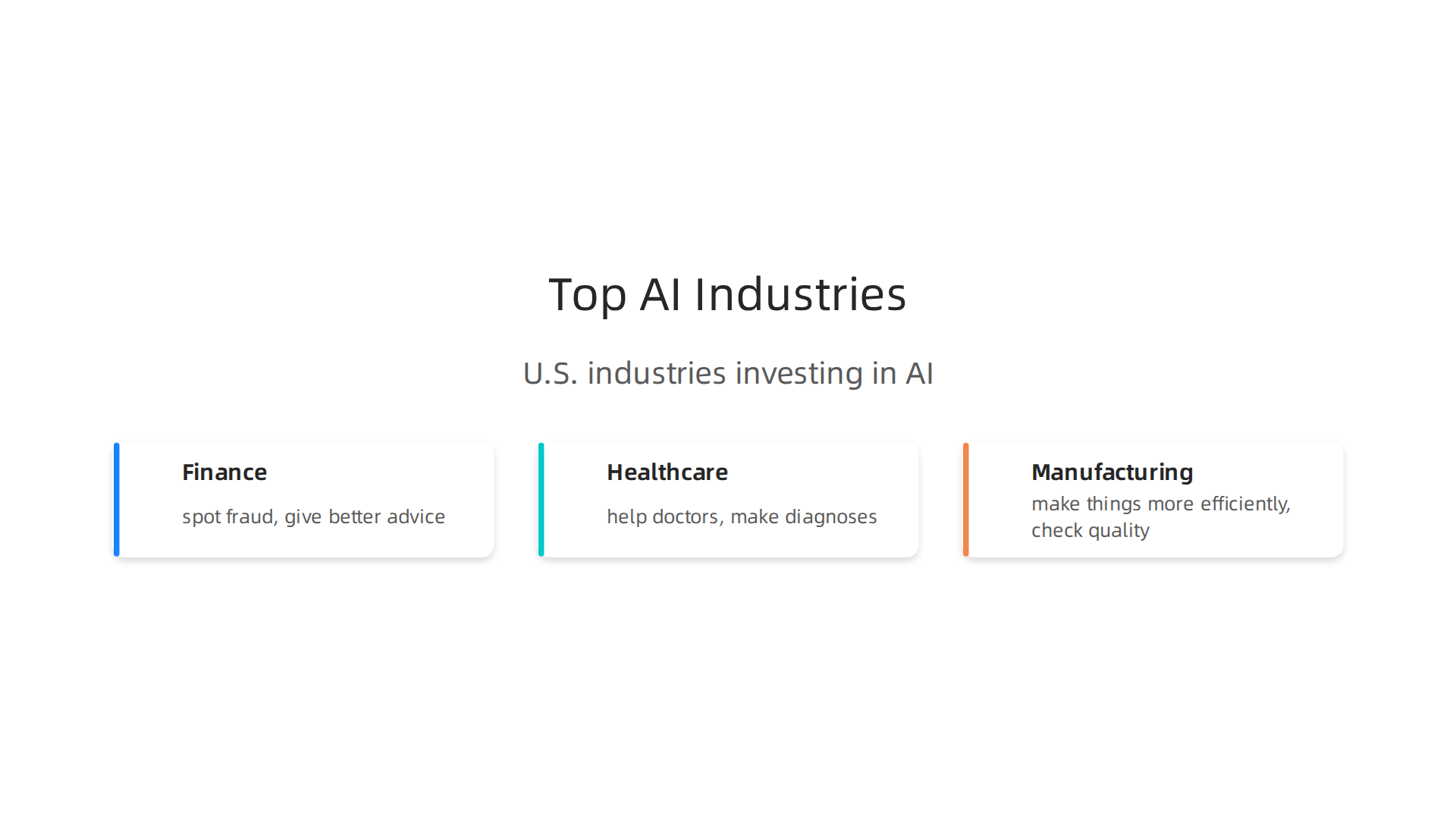
    A visual breakdown of key U.S. industries heavily investing in AI and their primary applications.

    • Finance: Banks and other money-related companies use AI to spot fraud, give better advice, and help customers.
    • Healthcare: Hospitals and clinics use AI to help doctors, make diagnoses, and manage patient care.
    • Manufacturing: Factories use AI to make things more efficiently, check quality, and keep machines running smoothly.

    Companies across the U.S. are planning to spend even more on AI this year. On average, organizations expect to spend around $207 million on AI in the next 12 months. This is almost double what they spent last year AI Quarterly Pulse Survey – Q1 2026 – KPMG International. It’s clear that AI is a big budget item for many businesses.

    How businesses buy AI tools

    The way companies buy AI solutions often depends on their size.

    • Big Companies (Enterprise Teams): These large businesses, like those you might find on a big tech campus, often need very powerful and complex AI systems. They might spend millions of dollars. They look for big AI platforms that can be built into many different parts of their work. They want solutions that offer strong security, can handle huge amounts of data, and connect with all their existing software. For them, finding the right enterprise AI platforms 2026 is a big decision. Many choose to work with specialized AI solution providers in the USA who can build custom tools just for them. These big players are also keen to identify AI leadership in the market.

    • Small and Medium Businesses (SMBs): Smaller companies usually have less money to spend. They look for simpler, more affordable us tech solutions that can solve one or two clear problems quickly. They want tools that are easy to use and show a clear benefit fast. For example, a small marketing agency might look for an [innotech website] tool that helps automate their social media posts. The cost of these tools can vary, but many choose options like ChatGPT Enterprise, which can cost about $60 per user each month AI Software Pricing 2026: 18 Tools Compared (Real Costs). They want practical AI tech products for their team that will help them save time and money without being too complicated.

    The way companies buy AI tools changes depending on their size and what they need. Now, let’s look at the different kinds of leading us tech solutions and the companies that make them. Understanding these categories can help any business pick the right AI tools for their team.

    Different types of AI solution providers

    The world of AI solutions is full of many different kinds of vendors. Each one focuses on a certain part of the AI journey.
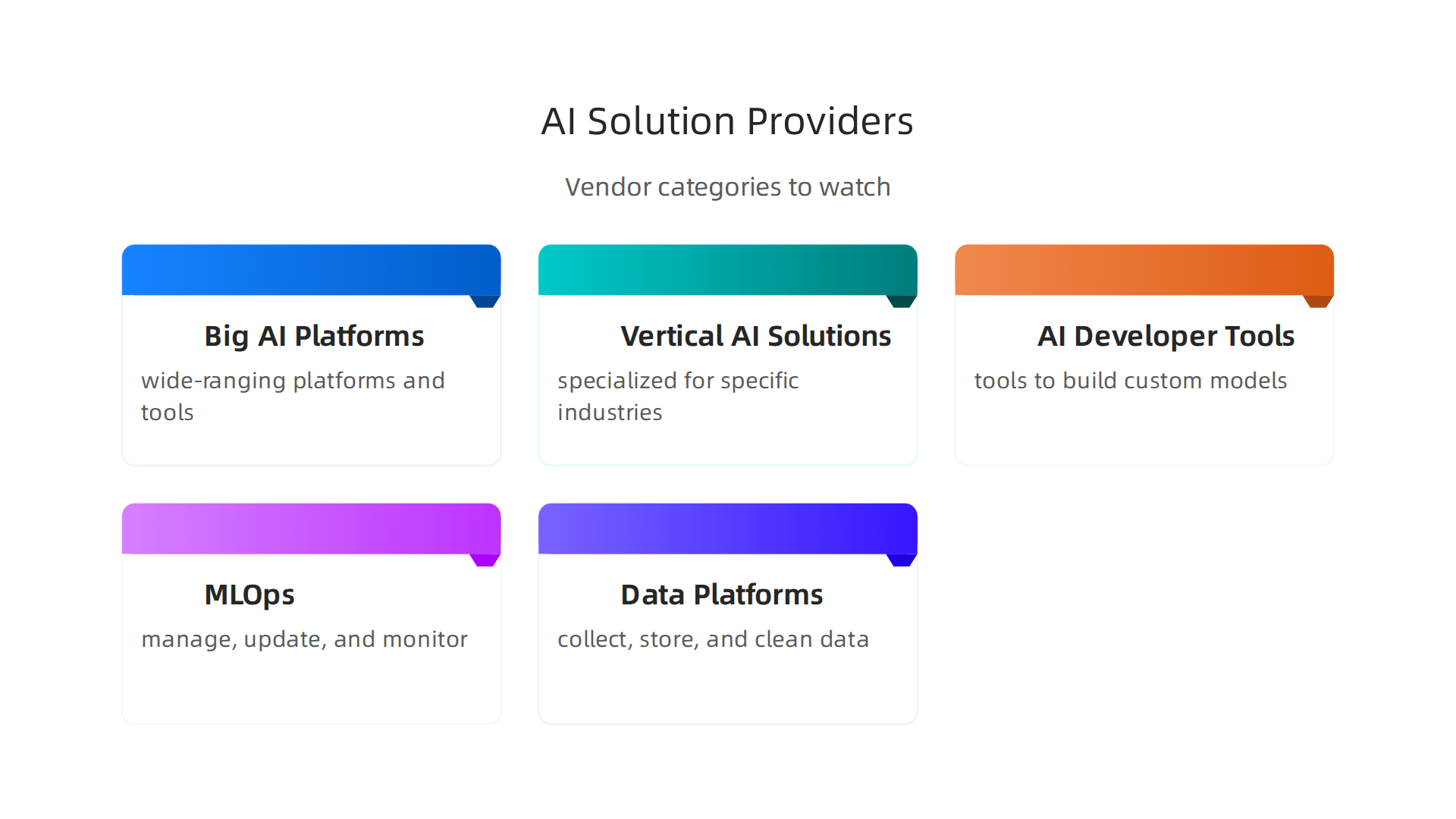
    Understanding the diverse landscape of AI solution providers, from platforms to specialized tools.

    • Big AI Platforms: These are like the big stores that sell everything. Companies such as Microsoft, Google, AWS, and IBM offer wide-ranging AI platforms. These platforms provide many tools in one place, from building AI models to running them and keeping them safe. They are usually chosen by larger businesses because they can handle huge tasks and need a lot of setup. For example, some platforms are known for being very safe and meeting important rules How to Evaluate Enterprise AI Platforms for Security and Compliance. These big platforms often aim to offer complete enterprise AI solutions that cover many business needs.

    • Vertical AI Solutions: These are specialized tools made for one specific job or industry. Think of AI that is just for healthcare to help doctors, or AI for marketing to create better ads. These solutions are often easier to use and faster to set up because they are designed for a clear purpose. A small business might find an [innotech website] tool for automating customer service much more useful than a huge, general AI platform. These focused us tech solutions help businesses get quick results for their unique problems.

    • AI Developer Tools: These tools are for people who know how to code and want to build their own custom AI programs. They give developers the building blocks to create new AI features or deeply connect AI with existing software. These tools are important for companies that want something truly unique or need to make AI work in a very specific way.

    • MLOps (Machine Learning Operations): Once an AI model is built, it needs to be managed, updated, and monitored. MLOps tools help with this. They make sure AI models keep working well, learn from new data, and don’t cause problems. These tools are key for companies that use many AI models or rely on AI for critical tasks. An AI implementation roadmap often includes plans for MLOps from pilot to production, showing its importance in making sure AI solutions work in the real world Your AI Implementation Roadmap: Guide for 2026 Success.

    • Data Platforms: AI needs good data to learn and work well. Data platforms help businesses collect, store, clean, and get their data ready for AI. Without clean, organized data, even the best AI tools won’t perform correctly. These platforms are the foundation for any successful AI project.

    How to pick the right AI solution

    Choosing the right AI vendor means looking at what your business needs and what your team can handle.

    • For small and medium businesses (SMBs): If you’re an SMB, you’ll likely want a vertical AI solution or a simpler platform that solves a clear business problem. Look for tools that are easy to use, don’t cost too much, and offer clear benefits, like a tool for improving your website or managing tasks. You might also want to explore solutions that offer clear plans for how to get started with AI quickly, like a 90-day plan for custom AI automation Custom AI Automation Roadmap for SMB Teams (30-60-90 Days). It’s about finding practical [us tech solutions] that fit your budget and don’t require a lot of technical know-how.

    • For larger companies (Enterprise Teams): Big companies need solutions that can handle large amounts of data, work with many existing systems, and offer strong security. They might use a mix of big AI platforms for core tasks and specialized tools for certain departments. They often need help moving their AI ideas from small tests to full use across the company Enterprise AI in 2026: Navigating the Shift from Pilots to …. When looking at bigger projects, companies might even consider academic partnerships, perhaps with a place like Dartmouth AI, to explore new ideas or complex challenges. Finding out how to evaluate AI companies to unlock business growth in 2026 is a critical step for larger organizations.

    No matter your business size, choosing the best AI solutions means carefully looking at your goals, your data, and what your team is ready for. It’s not just about the newest tech, but about finding tools that truly help you work better and grow.

    Stay on top of the latest AI trends and tools.
    Get clear daily AI updates from The AI Newsletter Worth Reading.## 2. Leading U.S. tech solutions and vendor categories to watch

    The way companies buy AI tools changes depending on their size and what they need. Now, let’s look at the different kinds of leading us tech solutions and the companies that make them. Understanding these categories can help any business pick the right AI tools for their team.

    Different types of AI solution providers

    The world of AI solutions is full of many different kinds of vendors. Each one focuses on a certain part of the AI journey.

    • Big AI Platforms: These are like the big stores that sell everything. Companies such as Microsoft, Google, AWS, and IBM offer wide-ranging AI platforms. These platforms provide many tools in one place, from building AI models to running them and keeping them safe. They are usually chosen by larger businesses because they can handle huge tasks and need a lot of setup. For example, some platforms are known for being very safe and meeting important rules How to Evaluate Enterprise AI Platforms for Security and Compliance. These big platforms often aim to offer complete enterprise AI vendor comparison solutions that cover many business needs.

    • Vertical AI Solutions: These are specialized tools made for one specific job or industry. Think of AI that is just for healthcare to help doctors, or AI for marketing to create better ads. These solutions are often easier to use and faster to set up because they are designed for a clear purpose. A small business might find an innotech website tool for automating customer service much more useful than a huge, general AI platform. These focused us tech solutions help businesses get quick results for their unique problems.

    • AI Developer Tools: These tools are for people who know how to code and want to build their own custom AI programs. They give developers the building blocks to create new AI features or deeply connect AI with existing software. These tools are important for companies that want something truly unique or need to make AI work in a very specific way.

    • MLOps (Machine Learning Operations): Once an AI model is built, it needs to be managed, updated, and monitored. MLOps tools help with this. They make sure AI models keep working well, learn from new data, and don’t cause problems. These tools are key for companies that use many AI models or rely on AI for critical tasks. An AI implementation roadmap often includes plans for MLOps from pilot to production, showing its importance in making sure AI solutions work in the real world Your AI Implementation Roadmap: Guide for 2026 Success.

    • Data Platforms: AI needs good data to learn and work well. Data platforms help businesses collect, store, clean, and get their data ready for AI. Without clean, organized data, even the best AI tools won’t perform correctly. These platforms are the foundation for any successful AI project.

    How to pick the right AI solution

    Choosing the right AI vendor means looking at what your business needs and what your team can handle.

    • For small and medium businesses (SMBs): If you’re an SMB, you’ll likely want a vertical AI solution or a simpler platform that solves a clear business problem. Look for tools that are easy to use, don’t cost too much, and offer clear benefits, like a tool for improving your website or managing tasks. You might also want to explore solutions that offer clear plans for how to get started with AI quickly, like a Custom AI Automation Roadmap for SMB Teams (30-60-90 Days). It’s about finding practical [us tech solutions] that fit your budget and don’t require a lot of technical know-how.

    • For larger companies (Enterprise Teams): Big companies need solutions that can handle large amounts of data, work with many existing systems, and offer strong security. They might use a mix of big AI platforms for core tasks and specialized tools for certain departments. They often need help moving their AI ideas from small tests to full use across the company Enterprise AI in 2026: Navigating the Shift from Pilots to …. When looking at bigger projects, companies might even consider academic partnerships, perhaps with a place like Dartmouth AI, to explore new ideas or complex challenges. Finding out how to evaluate AI companies to unlock business growth in 2026 is a critical step for larger organizations.

    No matter your business size, choosing the best AI solutions means carefully looking at your goals, your data, and what your team is ready for. It’s not just about the newest tech, but about finding tools that truly help you work better and grow.

    Stay on top of the latest AI trends and tools.
    Get clear daily AI updates from The AI Newsletter Worth Reading.

    3. Implementation strategies: from pilot to production

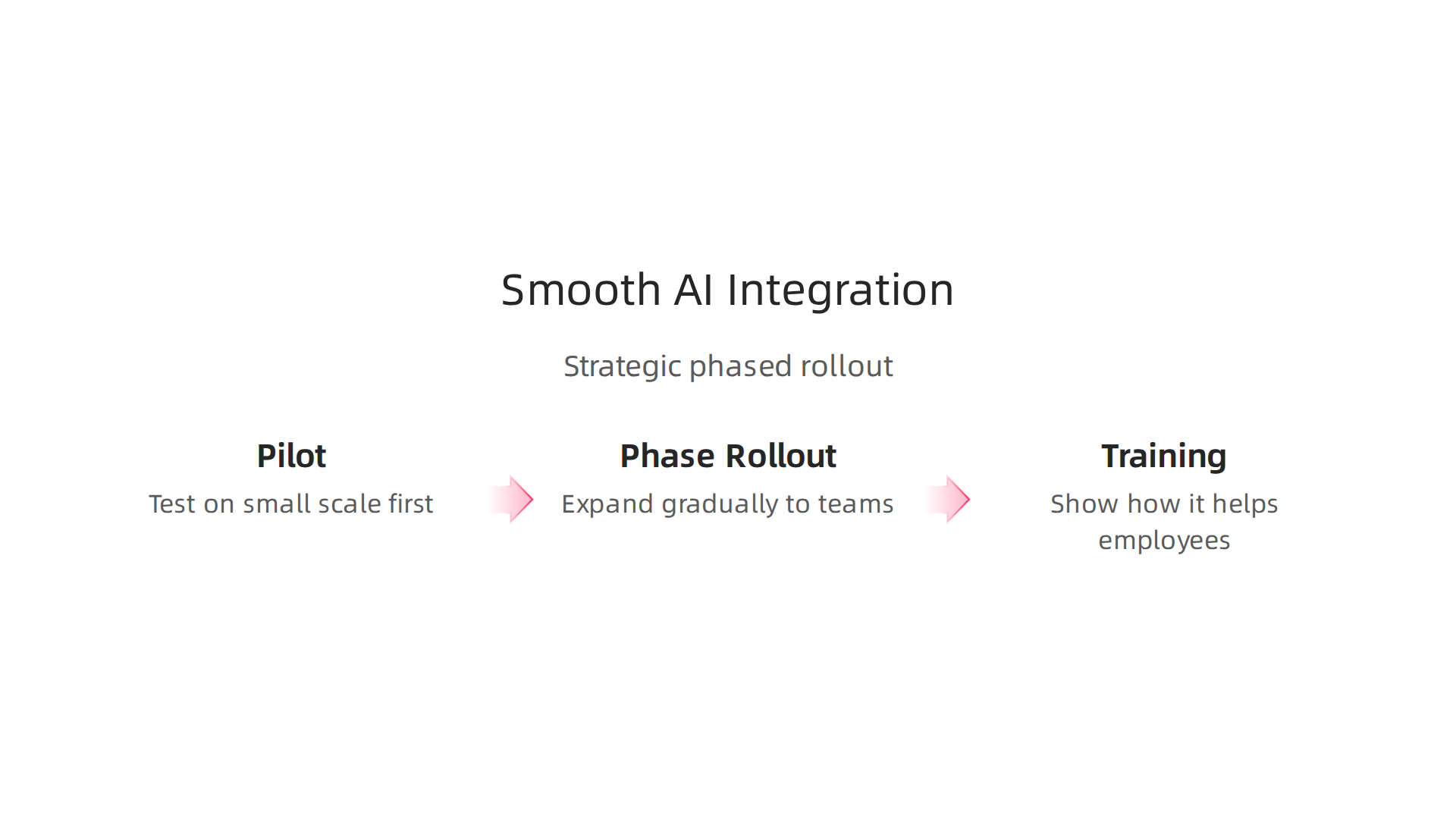
    Picking the right AI tools is just the first step. The real challenge is making them work well in your business. This means moving from a small test, called a pilot, to full, everyday use. For any business, especially those with fewer resources, a clear plan is key to putting new us tech solutions into action.

    Starting with a smart pilot project

    When you begin with AI, don’t try to change everything at once. Instead, pick one small, clear problem to solve. This is your pilot project.
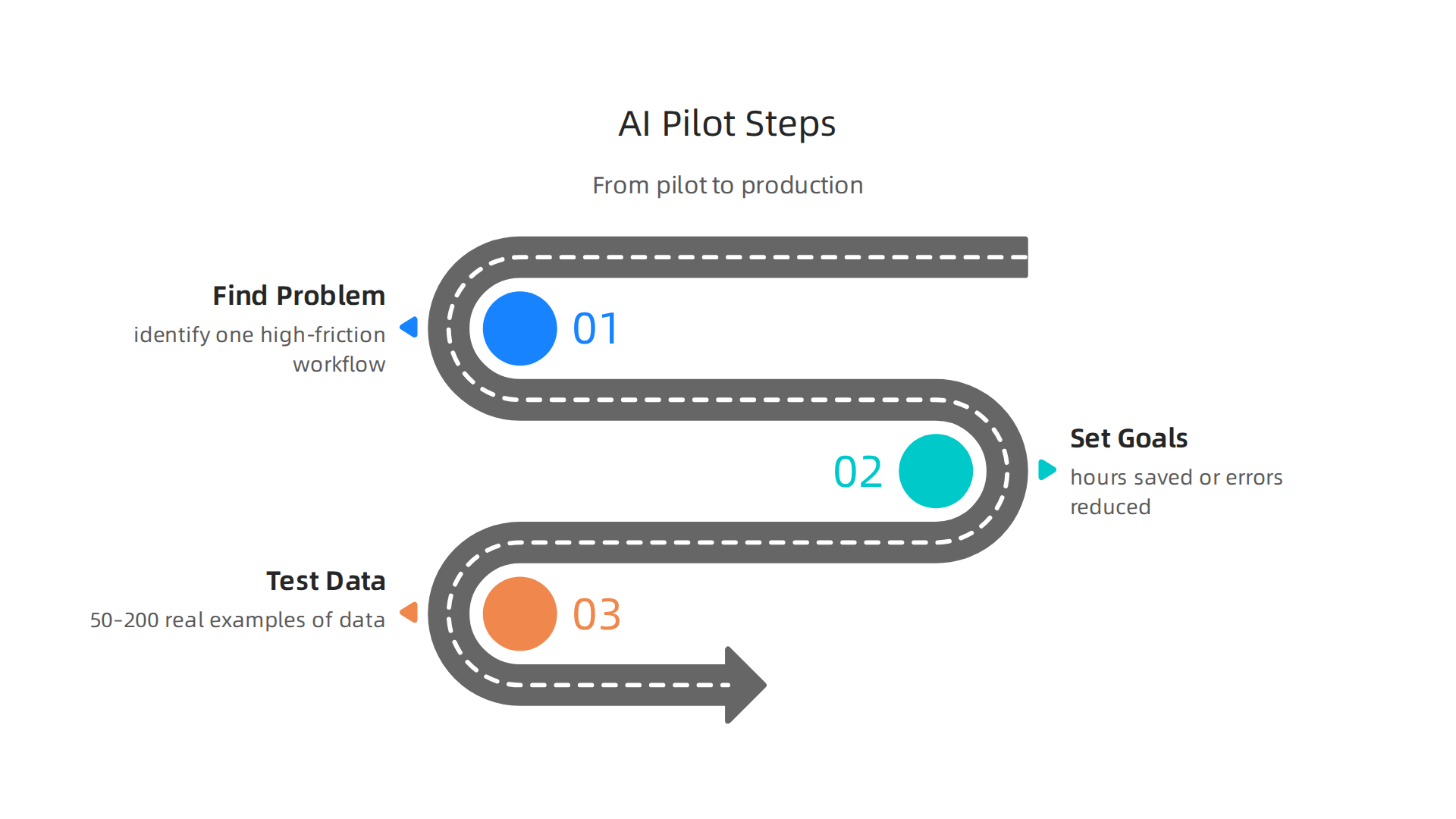
    Key steps for initiating a successful AI pilot project within your business.

    • Find a clear problem: Look for a work task that takes a lot of time or has many steps. It should be a task that you can easily track and measure. You need to "identify one high-friction workflow with clear ownership" to make sure it’s manageable.
    • Set clear goals: Before you start, know what success looks like. Instead of just saying "use AI," think about "hours saved" or "errors reduced." These clear goals help you prove the AI is actually helping AI Implementation Strategy: From Pilot to Production in 2026.
    • Test with real data: Use a small amount of your own real information to see how the AI performs. For small to medium businesses (SMBs), testing with "50–200 real examples of your own data" can show if the AI works as expected AI Adoption Roadmap for SMBs: 90 Days (2026). Many businesses find a 90-day plan helpful to get these first steps done Your 90-Day AI Roadmap: How Small Businesses Can Start Smart ….

    Moving from pilot to full use

    Once your pilot shows good results, it’s time to think bigger. Moving AI from a small test to a full part of your business means careful steps.

    A team celebrating a successful project, reflecting the achievement of moving an AI pilot to full production.

    • Plan for changes: This shift means looking at your technology setup (infrastructure), how your data moves (data pipelines), and how you manage the AI tools every day (MLOps). You also need to think about new rules and how your team will work with the AI. This journey needs "organizational change" to really take hold.
    • Roll out slowly: Don’t turn on the AI for everyone at once. You might use methods like "canary deployment," where you first give the AI tool to a small group of users. If it works well, you slowly give it to more people Ai Model Development And…. This helps you catch problems early.
    • Get leadership on board: To make sure AI projects succeed, both business and technology leaders need to support it. This means "securing commitment from both business and IT leadership" and agreeing on what success looks like Enterprise AI in 2026: Navigating the Shift from Pilots to ….

    Key people and working together

    Making AI work is a team effort.

    • Assign owners: Every AI project needs someone to be in charge. This "human owner" makes sure the AI runs smoothly and oversees its steps AI Implementation Roadmap for SMBs: Phasing the Rollout.
    • Train your team: Your employees will be using these new tools, so they need proper training. Providing "structured AI training for leadership and operational teams" helps everyone understand and use the AI effectively The AI Transformation Playbook for UK and European ….
    • Work with partners: Sometimes, you’ll need help from outside experts. Working with vendors who specialize in Mastering Specialized AI Tools can make a big difference. They can offer insights and support to help you deploy your chosen us tech solutions. Knowing how to find trusted sources for AI tool discovery 2026 can also speed up your progress.

    By taking these careful steps, from a small pilot to a full-scale rollout, businesses can successfully bring AI into their daily work. It’s about being smart and planned, rather than just jumping into the newest technology.

    Stay on top of the latest AI trends and tools. Get clear daily AI updates from The AI Newsletter Worth Reading.

    4. How to evaluate and compare AI tools: KPIs, security, and ROI

    After learning how to start with AI, the next big step is picking the right tools. It’s not enough to just pick the newest or most popular option. You need to know how to truly check if an AI tool is a good fit for your business. This means having a clear way to measure its worth, how safe it is, and if it will give you good results for your money.

    Your AI Tool Checklist

    To pick the best us tech solutions, you can use a simple checklist. This helps you compare different tools fairly.

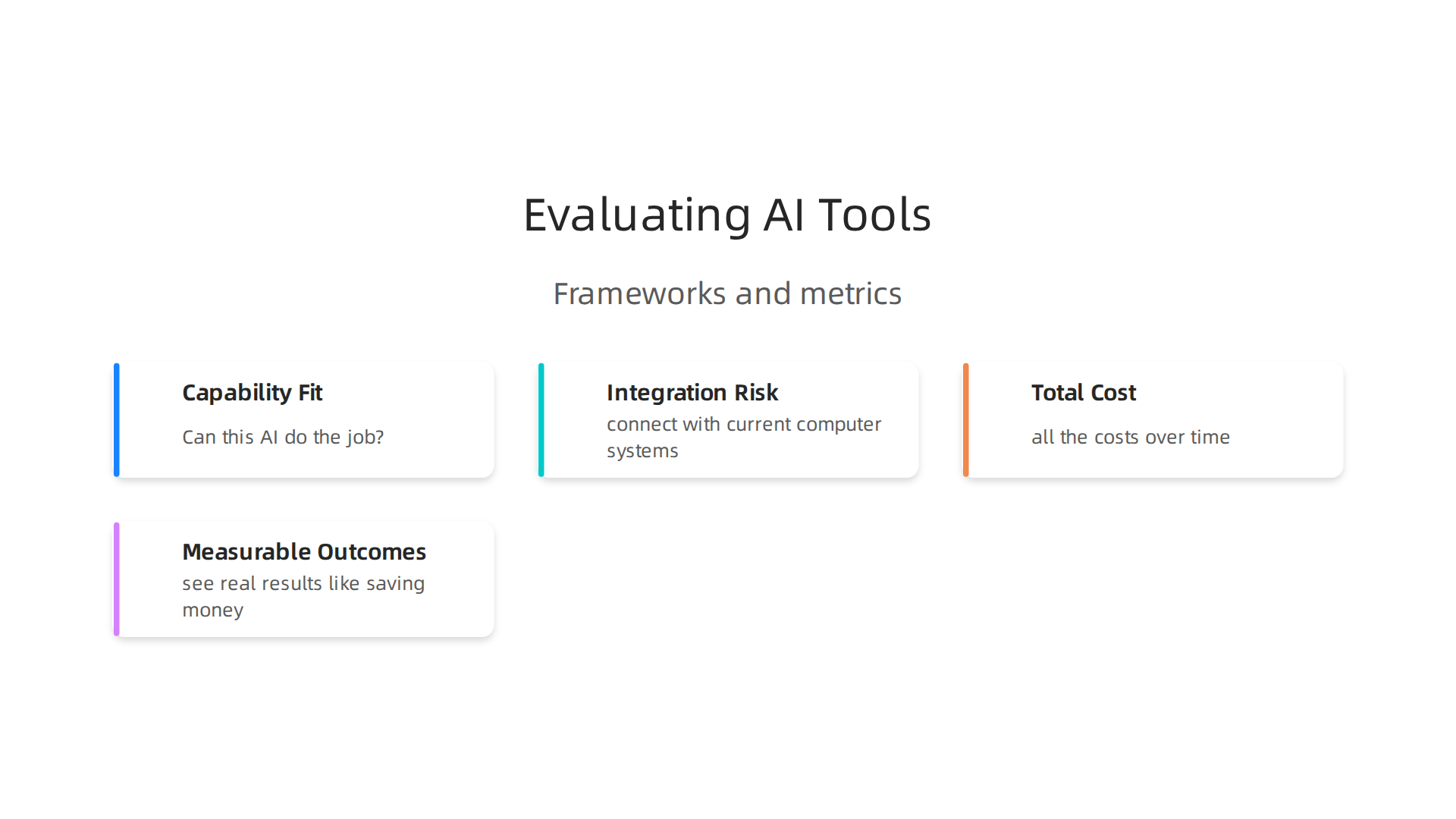
    • How Well Does It Work? (Functionality and KPIs)

      • First, does the AI tool do what you need it to do? For example, if it’s supposed to write emails, how good are those emails?
      • How fast is it? Does it complete tasks quickly or does it make you wait? This is like its speed.
      • How often does it get things right? You want a high "task success rate," which means it achieves the goal most of the time. Experts suggest looking at things like latency, cost, and safety when judging AI agents How to Evaluate AI Agents: Latency, Cost, Safety, ROI.
      • The goal is to choose how to choose AI for business tools that deliver real results for your company.
    • Is It Safe and Private? (Security and Compliance)

      • AI tools often handle important company information. You must ask: "Is my data safe with this tool?"
      • Does the tool follow rules for keeping data private? This is super important, especially if your business has special guidelines to follow. The National Institute of Standards and Technology (NIST) has an AI Risk Management Framework to help make AI trustworthy.
      • Can you see what the AI tool is doing? This is called "auditability." It means you can check its work and make sure it’s doing things correctly and without mistakes. Make sure to check for things like detailed audit logging when looking at different AI platforms How to Evaluate Enterprise AI Platforms for Security and Compliance.
    • What About the Money? (Total Cost of Ownership and ROI)

      • The price tag of an AI tool is just the start. Think about the "Total Cost of Ownership." This includes the first price, how much it costs to set up, and how much you pay to keep it running over time.
      • Will the tool save you money or help you make more money? This is your Return on Investment (ROI). Many businesses look for a good ROI from their AI tools, especially in areas like marketing. You want a tool that gives you more value than what you spend on it.
      • Different platforms have different costs. Some popular ones like Microsoft Azure AI and Google Cloud AI use a "pay-as-you-go" system based on how much you use them Enterprise AI Platforms Guide 2026: Compare Top Solutions. Understanding how to get real ROI from AI marketing cloud or other tools is vital.

    Shortlisting and Testing Vendors

    Once you have your checklist, you can start comparing different AI tools and the companies that make them. Think of it like making a shopping list. You’ll want to evaluate AI companies to unlock business growth in 2026. This is called shortlisting. You can use templates to score each tool against your needs. This helps you figure out which ones are best to try.

    After you’ve shortlisted a few top choices, you can run small pilot projects with them. This is the best way to see how they work in your actual business. It lets you test out a few different us tech solutions, from big names to smaller innovators, before you pick the one that fits just right. Looking at things like "Decision Framework" can help you in this process Decision Framework.

    5. Scaling adoption: change management, governance, and measuring impact

    So, you’ve tried out new AI tools and found some that work well in a small test. That’s great! But the real challenge is making these tools work for everyone in your company. This means rolling them out widely, helping people get used to them, setting clear rules, and checking if they truly help your business grow. Moving from a small test (a pilot) to full use needs careful planning. Experts point out that a big step here is dealing with "organizational change" to make sure everyone is ready for AI Your AI Implementation Roadmap: Guide for 2026 Success.

    Making the Switch Easy for Everyone (Change Management)

    When you bring in new technology like AI, people might feel unsure or even worried. It’s like learning a new way to do things. Helping your team understand why the AI is useful, how it works, and how it will help them do their jobs better is called change management.

    • Talk it Out: Share clear information about the new AI. Explain what it does and what it doesn’t do.
    • Teach Them Well: Provide good training so everyone knows how to use the tools. Make it easy for them to ask questions and get help. Starting with structured training for all teams is a smart move for an AI transformation The AI Transformation Playbook for UK and European ….
    • Show the Benefits: Highlight how the AI will make tasks simpler or save time. This helps people feel excited about the change instead of worried.

    This smooth transition helps your company adopt smart AI for business more successfully.

    Setting the Rules for AI (Governance)

    As AI becomes a bigger part of your business, you need clear rules about how it’s used. This is called governance. It’s about making sure AI is used safely, fairly, and in a way that helps your company reach its goals.

    • Who’s in Charge? Decide who will be responsible for overseeing the AI tools. Who makes sure they are used correctly?
    • Fair Play: Make sure the AI tools are not used in ways that are unfair or that cause problems. This means checking for things like bias in the AI’s decisions.
    • Clear Guidelines: Create simple guidelines for how teams should use AI in their daily work. This helps keep things organized and safe.
    • Operating Model: Think about how your whole company works with AI. This might mean changing how teams talk to each other and how projects get money. Building a new "operating model" helps businesses grow with AI Rewiring the enterprise operating model for AI scale – Deloitte.

    It’s also important to activate good governance when moving from AI pilots to full production Your AI Implementation Roadmap: Guide for 2026 Success.

    Knowing if AI is Really Helping (Measuring Impact)

    After you’ve rolled out AI to more people, you need to keep checking if it’s truly making a difference. This means looking at the numbers and seeing the real impact.

    • Track the Right Things: Don’t just count how many times someone uses an AI tool. Instead, measure things like "hours saved," "mistakes reduced," or "more sales." These are the real signs of success AI Implementation Strategy: From Pilot to Production in 2026.
    • Compare Results: A good way to measure is by testing. You can run "A/B tests" where some people use the AI and others don’t, then compare their results. Or, try a "canary deployment," where you give the AI to a small group first and watch how it performs before giving it to everyone Ai Model Development And….
    • Get More Support: When you can show how much the AI is helping, it’s easier to get more money and support to keep using it and find new ways it can benefit your business. Start small, prove it works, and then grow AI Adoption Roadmap for SMBs: 90 Days (2026). This is how many us tech solutions become central to business operations.

    To stay on top of the latest strategies for AI adoption and impact measurement, consider subscribing to The AI Newsletter Worth Reading for daily updates.

    6. Regulatory and ethical considerations for U.S. deployments

    After setting up rules for how your company uses AI, it’s also important to think about the bigger picture: the laws and guidelines set by the government. In the U.S., these rules are still growing, but they are very important for any business using us tech solutions. They help make sure AI is used in a fair, safe, and private way.

    Key U.S. Guidance Areas to Watch

    As of 2026, there isn’t one big federal law that covers all AI use in the United States. However, many states have already put their own AI laws in place, and companies must follow them today. This means that if your business operates in different states, you need to be aware of various rules State AI Laws Take Hold as Federal Preemption Stalls.

    Here’s what businesses need to keep an eye on:

    Practical Steps for Teams

    To make sure your AI tools are used responsibly and follow all the rules, here are some things your team can do:

    • Understand the Laws: Keep up with new federal and state laws that affect AI, especially those related to data privacy and fairness. An innotech website or specific legal news sources can help you stay current.
    • Use Frameworks: Follow guides like the NIST AI Risk Management Framework. This framework helps you align AI development and use with privacy laws and intellectual property rights Artificial Intelligence Risk Management Framework: Generative ….
    • Check for Bias: Make sure your AI tools are fair and don’t make unfair decisions. This is a big part of ethical AI.
    • Be Clear: If your company uses AI to interact with customers, be open about it. Let people know when they are talking to an AI.
    • Get Training: Teach your team about ethical AI use and how to follow privacy rules. Understanding these details is key to mastering the AI future standard 2026.
    • Review Regularly: The world of AI rules is changing fast. Make sure you check your AI practices often to match new laws and best practices. Even big names like Dartmouth AI researchers keep up with these changes.

    Summary

    This article explains why U.S. tech solutions and AI matter for businesses in 2026 and gives a practical playbook for choosing, testing, and scaling AI. It reviews market demand, sector spending patterns, and how procurement differs for SMBs versus enterprise teams. You’ll get a clear breakdown of vendor types—big platforms, vertical solutions, developer tools, MLOps, and data platforms—and how each fits different needs. The guide shows how to run a focused pilot (50–200 real examples, 90-day plans), move to production with canary rollouts and MLOps, and assign human owners and training. It also offers a checklist to evaluate tools by functionality, security, and total cost of ownership, plus governance and impact-measurement advice. Finally, it covers the evolving U.S. regulatory landscape, ethical safeguards, and practical steps to keep AI deployments compliant and effective.


  • Top 10 Technology Trends Business Leaders Must Adopt in 2026

    Top 10 Technology Trends Business Leaders Must Adopt in 2026

    Why the ‘Top 10 Technology Trends’ Matter for Business Leaders in 2026

    It feels like every day brings news of a new tool or breakthrough. For business leaders in 2026, keeping up with all these changes can be a real headache.

    A business leader thoughtfully considering future strategies amidst rapid technological changes.

    You hear about so many new things, it’s hard to know what’s truly important for your business and what’s just hype. This flood of information makes it tough to decide where to put your time and money. It’s especially tricky with how fast technology moves these days, constantly reshaping our future.

    Think about Artificial Intelligence (AI). Just a short time ago, it was a new idea for many businesses. Now, in 2026, AI is a big part of how many companies work. For example, about 72% of large businesses are already using AI in some way, running at least one AI program in their daily work routines.

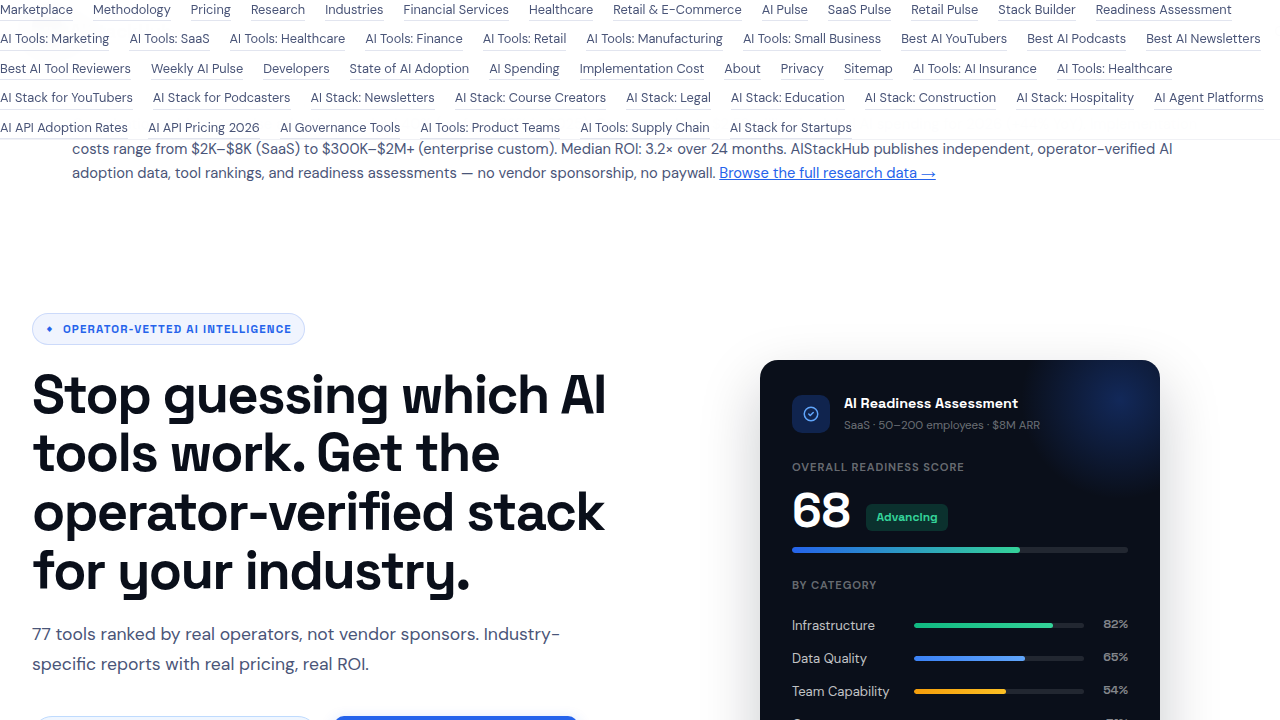
    A platform tracking the state of AI adoption across industries and company sizes.

    This shows how quickly things can change, and how important it is to keep an eye on the State of AI Adoption 2026: Rates by Industry & Company Size.

    This speedy tech adoption curve means leaders need to be smart about picking which innovations to focus on. It’s not just about knowing what the top 10 technology trends are, but also understanding why they matter to your specific business and how to use them well. Trying to figure this out alone, sifting through endless articles and reports about AI startups and other new technologies, can feel like a full-time job.

    This guide is here to help. We’ll cut through the noise to show you the most important top 10 technology trends for businesses in 2026. You’ll get clear, easy-to-understand explanations, real-world examples of how these trends can help your company, and simple steps to start using them. Our goal is to make sure you have the knowledge to make smart choices, stay ahead of the game, and build a smart future for your business.

    To stay on top of daily updates without feeling overwhelmed, consider subscribing to The AI Newsletter Worth Reading.

    Generative AI and LLMs: Practical Use Cases and Implementation Steps

    One of the most exciting parts of the current tech adoption curve is Generative AI and Large Language Models, often called LLMs. These are computer programs that can create new things, like text, images, or even computer code. Think of them as very smart assistants that can understand what you ask for and then make something completely new based on your request. In 2026, many businesses are already seeing big benefits from using them.

    Actually, about 79% of organizations now use Generative AI in some way, showing how quickly this tech has grown since 2024 Generative AI Adoption Statistics 2026: Enterprise Data. This makes Generative AI one of the most important top 10 technology trends for business leaders today.

    Here are some ways businesses are using Generative AI right now:

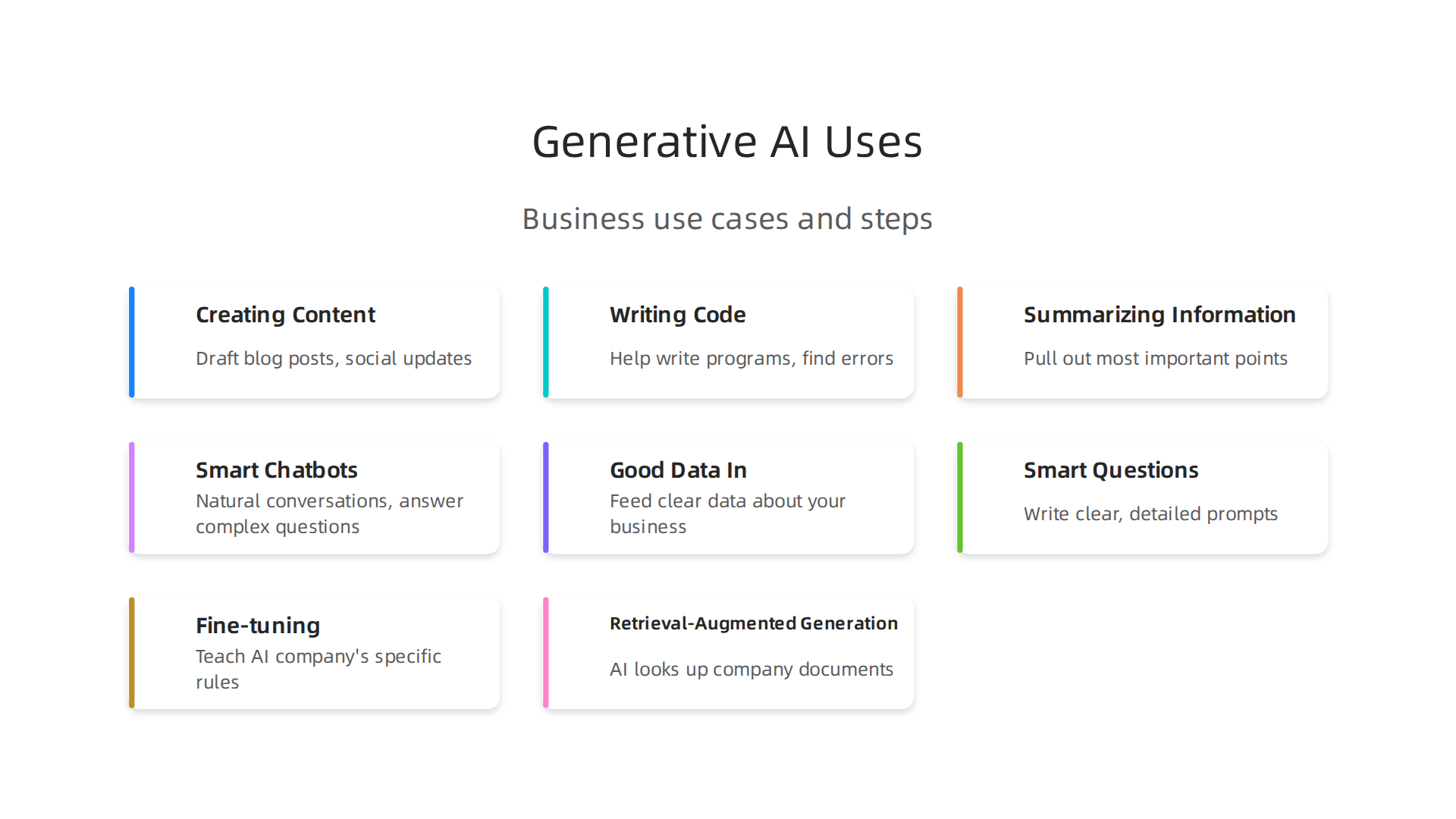
    Key ways businesses are applying Generative AI today for content, code, and customer service.

    • Creating Content: Need a blog post, social media update, or even ideas for an ad? Generative AI can quickly draft these things, saving a lot of time for marketing teams. This helps businesses keep up with the constant need for new content.
    • Writing Code: For software developers, AI can help write parts of programs or find errors. This makes coding faster and easier, speeding up how quickly new tools and apps can be made.
    • Summarizing Information: Imagine having to read long reports or many customer reviews. Generative AI can quickly go through tons of text and pull out the most important points. This helps leaders make faster decisions without getting lost in details.
    • Smart Chatbots: These aren’t like the old, simple chatbots. Today’s AI chatbots can have more natural conversations with customers, answer complex questions, and even help solve problems. This improves customer service and can save money on support staff.

    The quickest way businesses see money back (ROI) from Generative AI is by making daily tasks faster and reducing costs. For example, using AI to write first drafts of content or answer common customer questions can free up your team to focus on bigger, more complex jobs.

    How to Use Generative AI in Your Business

    Bringing Generative AI into your company doesn’t have to be hard, but there are a few things to keep in mind:

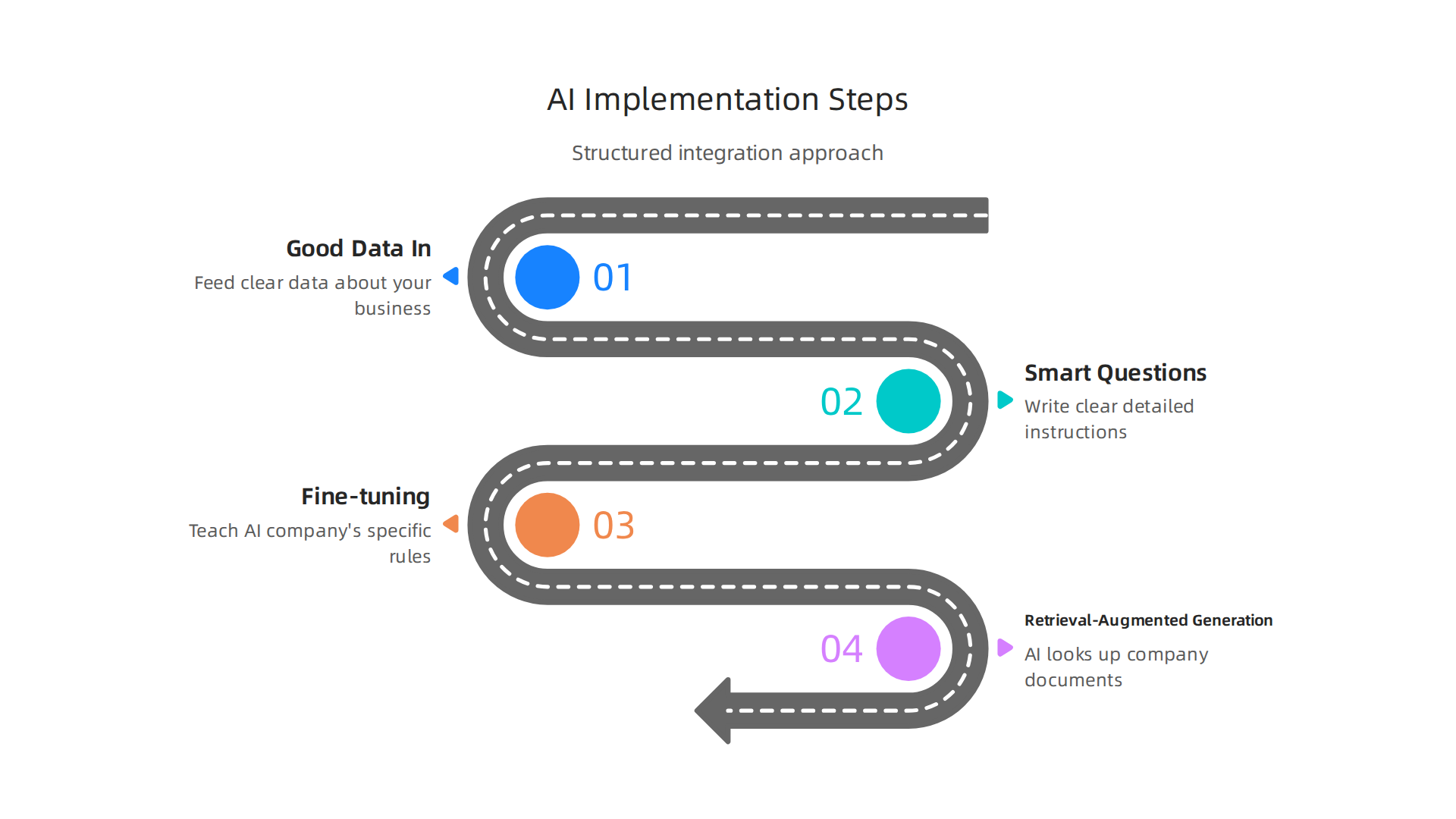
    A structured approach to successfully integrate Generative AI into business operations.

    1. Good Data In: The AI learns from information. If you feed it good, clear data about your business, it will give you better results. Think about the kind of text or examples you want it to learn from.
    2. Smart Questions (Prompts): How you ask the AI to do something is very important. Writing clear, detailed instructions, called "prompts," helps the AI understand exactly what you want it to create.
    3. Making it Smarter:
      • Fine-tuning: This is like teaching the AI about your company’s specific way of speaking or special rules. You give it more examples that are just like your business, so it learns to sound like you.
      • Retrieval-Augmented Generation (RAG): This is a fancy way of saying the AI can look up information from your own company documents before answering. So, when a customer asks a question, the AI can check your company’s knowledge base to give the most accurate, up-to-date answer. This helps it not "make things up" and use your real business data.

    By focusing on these steps, businesses can start using Generative AI to build a smart future. If you’re looking for the right tools, it’s wise to learn how to choose AI for business tools that deliver real results in 2026.

    The world of Generative AI is always moving forward. Beyond making content or code, some AI models are built to be very flexible and smart, forming the base for many different uses. These are called Foundation Models.

    Foundation Models: The Smart Base

    Think of a Foundation Model as a giant, all-purpose brain. It’s trained on a huge amount of different information, like text, images, and code from the internet. This makes it good at many tasks right out of the box. Instead of building a new AI for every little job, businesses can take one of these powerful base models and teach it a few more things specific to their needs. This helps companies, including ai startups, quickly adapt AI for their unique goals. These models are a big reason why AI is one of the top 10 technology trends in 2026. You can even find market research reports that go deep into Foundation AI Models Market Research Report 2026.

    Multimodal AI: Understanding More Than Just Words

    While many AI models mainly work with text, Multimodal AI can understand and create using many types of data at once. This includes text, pictures, sounds, and even videos. For example, a multimodal AI could look at a picture, listen to a description of it, and then write a story about what it sees and hears. This makes AI much more helpful and natural to interact with A Survey on Multimodal Foundation Models: Architectures, Training Paradigms, and Emerging Applications. It’s a huge step in the tech adoption curve because it means AI can handle more real-world situations.

    Personalization at Scale

    One of the biggest uses for these advanced AIs is making things personal for everyone.

    A person experiencing a highly personalized interaction, enabled by advanced AI models.

    Imagine an online store that knows exactly what you like, or a learning app that customizes lessons just for you. This is "personalization at scale," meaning it can be done for millions of people.

    Here’s how these models help make experiences truly personal:

    • Fine-tuning: Like we talked about before, fine-tuning teaches a general AI model your company’s special way of doing things. For personalization, you’d fine-tune it with data about your customers’ preferences, so it learns to serve them better.
    • Adapters: These are like small, extra layers added to a Foundation Model. They let you tweak the model for specific tasks or users without having to retrain the whole giant model. It’s faster and uses less computing power.
    • Embeddings: This is a smart trick where all kinds of data (text, images, user actions) are turned into simple lists of numbers. When two lists of numbers are close, it means the data they represent is similar. So, if a user’s "embedding" is close to an item’s "embedding," the AI knows that user will likely enjoy that item. This helps recommend things, search for information, and personalize experiences very quickly.

    Being Smart About Privacy and Pitfalls

    When making things personal, businesses must be very careful with customer information. Protecting privacy and using data ethically is key. It’s also important to make sure the AI doesn’t create unfair experiences because of how it was trained. Careful data handling and constant checks help avoid these common problems as we move towards a smart future.

    Want to stay ahead of these rapid changes in AI? Get the latest insights directly in your inbox.

    The AI Newsletter Worth Reading

    Learning about these new ways AI can personalize experiences is crucial for businesses. It’s all about making sure the new technology works well for everyone. To see how these tools can transform your online presence, explore how to build a futuristic website 2026 AI personalization offers.

    Moving from making things personal for each person, AI is also changing how businesses get work done. It’s not just about tailoring experiences; it’s about making whole work processes faster and smarter. This is where AI-augmented automation and hyperautomation come in.

    AI-Augmented Automation and Hyperautomation: From RPA to End-to-End Process Intelligence

    In the past, many businesses used something called Robotic Process Automation, or RPA. Think of RPA as a simple robot that does the same easy tasks over and over again, like copying data from one spreadsheet to another. It was good for basic, repeatable work.

    But now, AI has changed the game. We’re seeing a shift from simple RPA to much smarter systems. This is called "hyperautomation." With hyperautomation, AI doesn’t just do tasks; it also helps decide what tasks need doing and how best to do them. It uses AI to learn from how work is done, find problems, and even suggest better ways. This big change makes it possible for businesses to automate many more parts of their work, not just small, easy steps. In fact, AI can automate up to 70% of everyday work tasks in 2026, marking a big leap forward in how we get things done How 2026 AI Could Automate Up to 70% of Everyday Work.

    This idea of AI looking at whole workflows is called "end-to-end process intelligence." It means AI can see the big picture of how a company works, from start to finish. It helps find bottlenecks or slow spots and makes the entire process smoother. This is one of the top 10 technology trends because it helps businesses save time and money. For example, AI can help with customer support by answering common questions or with handling invoices by checking all the details quickly. Businesses are using AI in many ways, from finance to customer service, to make things work better AI Automation Use Cases 2026: 40 Proven Business.

    To figure out where AI automation can help your business, you need a plan. Here’s a simple roadmap:

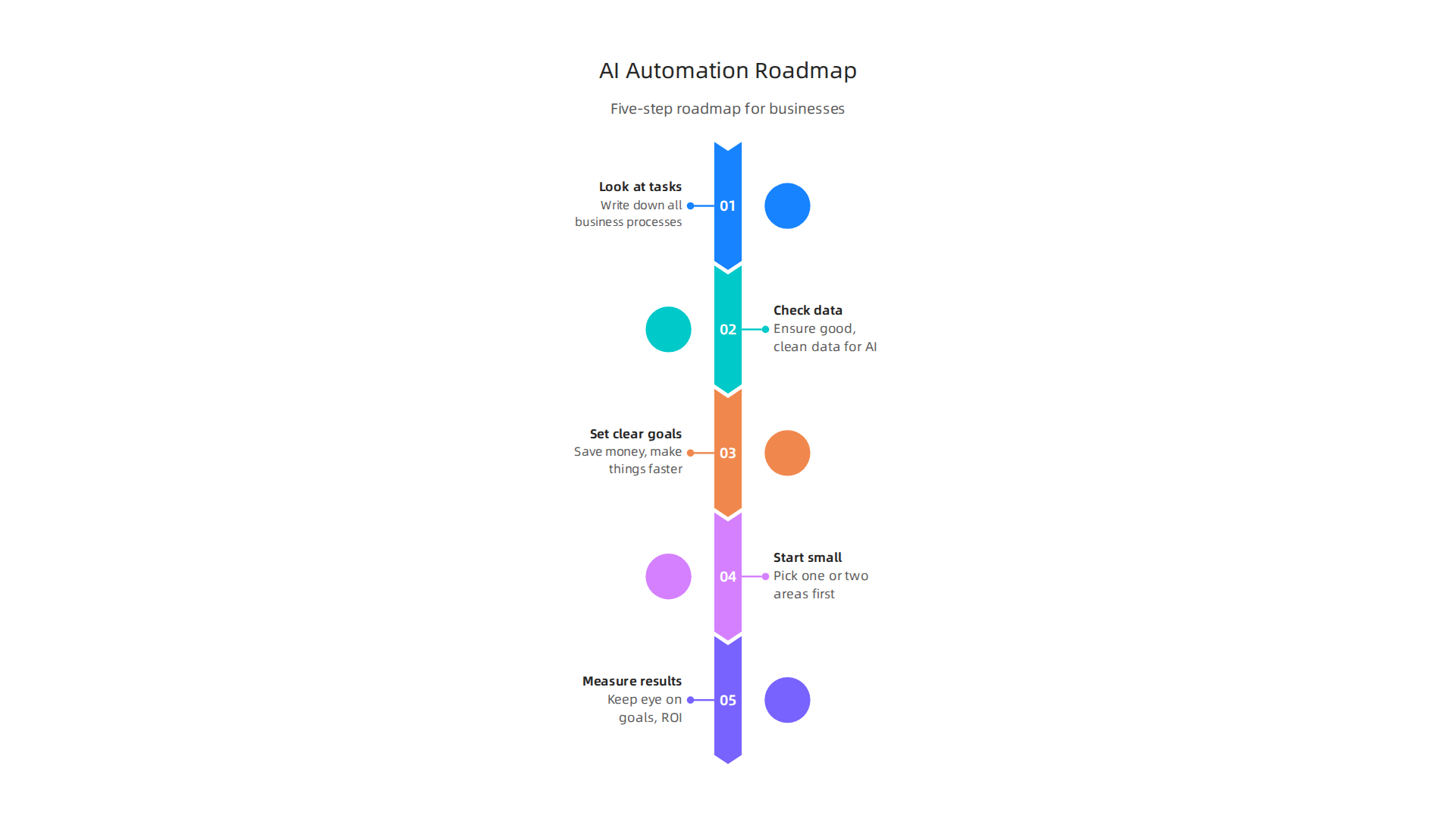
    A five-step roadmap for businesses to effectively implement AI automation.

    1. Look at your tasks: First, write down all the steps in your business processes. What jobs take a lot of time? Which ones are repetitive?
    2. Check your data: AI learns from data. Make sure you have good, clean data for the AI to use.
    3. Set clear goals: What do you want to achieve? Do you want to save money, make things faster, or improve how customers feel?
    4. Start small: Pick one or two areas to automate first. See how it works before doing more.
    5. Measure results: Keep an eye on your goals. Is the AI actually saving you money or time? Many companies are finding good returns on their AI investments Guide to Artificial Intelligence Automation Solutions 2026.

    Choosing the right tools for this kind of automation is also key. To learn more about software that can help, check out our guide on how to choose marketing automation software in 2026. You might also want to explore different Enterprise AI Platforms 2026 to find the best fit for your company.

    Moving from making things personal for each person, AI is also changing how businesses get work done. It’s not just about tailoring experiences; it’s about making whole work processes faster and smarter. This is where AI-augmented automation and hyperautomation come in.

    In the past, many businesses used something called Robotic Process Automation, or RPA. Think of RPA as a simple robot that does the same easy tasks over and over again, like copying data from one spreadsheet to another. It was good for basic, repeatable work.

    But now, AI has changed the game. We’re seeing a shift from simple RPA to much smarter systems. This is called "hyperautomation." With hyperautomation, AI doesn’t just do tasks; it also helps decide what tasks need doing and how best to do them. It uses AI to learn from how work is done, find problems, and even suggest better ways. This big change makes it possible for businesses to automate many more parts of their work, not just small, easy steps. In fact, AI can automate up to 70% of everyday work tasks in 2026, marking a big leap forward in how we get things done How 2026 AI Could Automate Up to 70% of Everyday Work.

    This idea of AI looking at whole workflows is called "end-to-end process intelligence." It means AI can see the big picture of how a company works, from start to finish. It helps find bottlenecks or slow spots and makes the entire process smoother. This is one of the top 10 technology trends because it helps businesses save time and money. For example, AI can help with customer support by answering common questions or with handling invoices by checking all the details quickly. Businesses are using AI in many ways, from finance to customer service, to make things work better AI Automation Use Cases 2026: 40 Proven Business.

    To figure out where AI automation can help your business, you need a plan. Here’s a simple roadmap:

    1. Look at your tasks: First, write down all the steps in your business processes. What jobs take a lot of time? Which ones are repetitive?
    2. Check your data: AI learns from data. Make sure you have good, clean data for the AI to use.
    3. Set clear goals: What do you want to achieve? Do you want to save money, make things faster, or improve how customers feel?
    4. Start small: Pick one or two areas to automate first. See how it works before doing more.
    5. Measure results: Keep an eye on your goals. Is the AI actually saving you money or time? Many companies are finding good returns on their AI investments Guide to Artificial Intelligence Automation Solutions 2026.

    Choosing the right tools for this kind of automation is also key. To learn more about software that can help, check out our guide on how to choose marketing automation software in 2026. You might also want to explore different Enterprise AI Platforms 2026 to find the best fit for your company.

    Edge AI and IoT: Real-Time Inference and Distributed Intelligence

    Now, let’s look at another important shift in the world of AI: Edge AI. While big cloud computers do amazing things, sometimes you need AI to work right where the action is. This is where Edge AI comes in, putting smart tech directly into devices and machines. It’s a huge step in the tech adoption curve for many companies.

    Edge AI means that AI calculations happen on the device itself, or very close to it, instead of sending all the data to a faraway cloud server. Think of a smart camera in a factory that can spot a problem instantly, or a sensor in a store that understands what’s happening without sending videos to a central hub. This is sometimes called "distributed intelligence" because the smarts are spread out.

    Why is this a big deal?

    • Speed (Low Latency): When data doesn’t have to travel far, AI can make decisions super fast. This "real-time inference" is critical for things like self-driving cars or quickly sorting items on an assembly line. Processing data locally means responses can be nearly instant, sometimes under 50 milliseconds

    A learning hub explaining the concept and benefits of Edge AI for real-time processing.

    What is Edge AI? | Azion.

    • Privacy: Keeping data on the device or local network means sensitive information doesn’t need to be sent over the internet to a cloud server. This is a big plus for privacy in places like retail stores or hospitals Edge AI Explained 2026: Running ML Models on Tiny Devices.
    • Cost: Sending lots of data to the cloud can be expensive. Edge AI reduces this cost by only sending small pieces of information or summaries, saving money on bandwidth.
    • Works Anywhere: Edge AI can even work when there’s no internet connection, which is great for remote locations or times when the network is down.

    This technology is a game-changer for industries like manufacturing, where machines need to react instantly to changes, or in logistics, for tracking goods efficiently. In retail, Edge AI helps with things like managing inventory or understanding customer flows in real-time. For a truly smart future, we’ll see more ai startups focusing on these on-device solutions.

    To get started with Edge AI, businesses need to think about suitable hardware, like special chips that can run AI models directly on devices. They also need to balance how much power these devices use with how well they perform. This approach is one of the top 10 technology trends that will define how we interact with technology in 2026.

    If you want to keep up with these kinds of daily changes in AI and technology, you’ll love The AI Newsletter Worth Reading.

    AI for Security, Privacy, and Trust: Defending Models and Data

    As AI gets smarter and works closer to us, like with Edge AI devices, we also need to think about keeping it safe and trustworthy. This is a big challenge and one of the top 10 technology trends for 2026. Just like you’d lock your front door, businesses must protect their AI systems and the data they use. Failing to do so can cause serious problems, from data leaks to incorrect decisions by the AI.

    One major worry is "model security." This means making sure the AI itself isn’t tricked or broken.

    • Poisoning Attacks: Imagine someone feeding bad or false information to an AI while it’s learning. This "poisoning" can make the AI learn wrong things, leading to bad decisions later.
    • Prompt Injection: This is like giving a smart AI a tricky question to make it do something it shouldn’t, like share private information or follow wrong instructions.

    These kinds of attacks are real. In fact, many companies have already faced issues. A report found that 65% of organizations had at least one cybersecurity problem in the past year because of AI agents on their networks. Also, about one in four harmful computer breaches are now caused by AI, costing companies a lot of money on average [IBM Study: One in Four Malicious Breaches are AI-Enabled …].

    Then there’s "data privacy." AI needs lots of data to work, but much of that data can be private or sensitive. Businesses need to make sure this information stays safe. Studies show that data leaks are the most common problem with AI security incidents. For example, 61% of problems involving AI agents meant sensitive data was exposed [AI Agent Security Incidents Hit 65% of Firms in 2026]. This is why protecting sensitive data is so important. Also, "Shadow AI," which is when employees use AI tools without company approval, has caused data leaks in nearly 9 out of 10 organizations in the past year [Artificial Intelligence Report 2026]. This highlights a big concern about businesses not knowing about or controlling all the AI tools being used.

    To build a truly smart future with AI, businesses need to put secure practices first. Here’s a simple checklist to help keep AI models and data safe:

    • Understand your AI: Know exactly what data your AI uses and how it makes decisions.
    • Protect your data: Make sure all data used by AI is secured with strong passwords and other safety measures. Use methods to hide or scramble sensitive data whenever possible to boost privacy [Key AI Data Privacy Statistics to Know in 2026].
    • Watch for sneaky attacks: Keep an eye out for odd behavior that might signal prompt injection or model poisoning attempts.
    • Control AI use: Make sure employees only use approved AI tools and understand the rules. Many AI security incidents are linked to using AI without proper checks [2026 AI Data Crisis: Protect Your Sensitive Information Now].
    • Regular checks: Just like checking your car’s oil, regularly review your AI systems for weaknesses.
    • Have a plan: Know what to do if an AI security problem happens, so you can fix it quickly.
    • Stay updated: The world of AI changes fast. Keep learning about new risks and ways to protect your systems.

    Making sure AI is secure, private, and trustworthy is a key part of the tech adoption curve for any company hoping to succeed with AI in 2026. This focus on safety helps build trust and makes sure AI works for us in good ways. Businesses can also get help by looking at guides for mastering the AI future standard.

    After we talk about keeping AI safe from attacks and protecting private data, the next big step is to make sure we use AI in a good, fair, and responsible way. This is called "Responsible AI and Governance." It’s one of the top 10 technology trends for 2026 because it helps businesses manage the risks of AI and follow the rules.

    Think of AI governance as setting up a clear set of guidelines for how your company uses AI. It’s about having policies in place, understanding the risks of your AI models, and making sure you follow all the necessary laws. This helps build a smart future where AI can be trusted.

    What is AI Governance?

    AI governance means putting rules in place to oversee your AI systems.

    A diverse team discussing and establishing guidelines for responsible AI governance and compliance.

    It helps you keep track of what AI you’re using, how risky it is, and if it’s doing what it’s supposed to.

    • Model Inventories: This is like a list or a map of all the AI tools your company uses. It helps you know exactly what AI is running, where it is, and what it does. This way, no AI is used without anyone knowing, which can help prevent problems like those from "Shadow AI" mentioned earlier.
    • Risk Tiers: Not all AI is equally risky. An AI that helps you choose music is very different from an AI that helps doctors make health choices. Risk tiers help you rate each AI tool based on how much harm it could cause if it goes wrong. This helps you put more attention on the most important ones.
    • Audit Trails: These are like a detailed diary of your AI’s actions. They record how and why an AI made a certain decision. If something goes wrong, an audit trail helps you understand what happened, much like tracking steps in a recipe.

    These governance structures should grow with your business and how many rules or laws you need to follow. For instance, a big company in healthcare will need much stricter rules than a small local shop. Actually, when businesses don’t have good AI governance, it can lead to bigger problems and costs, as shown by some reports [IBM 2026 Breach Report: AI Governance Failures Drive …].

    Simple Steps for Small Teams and AI Startups

    You might think that AI governance is only for big companies, but even ai startups and small teams need to start somewhere. You don’t need a huge budget or a lot of staff to begin. Here are some easy steps:

    • Start Small: Don’t try to build a perfect system all at once. Pick one or two AI tools you use often and focus on them first.
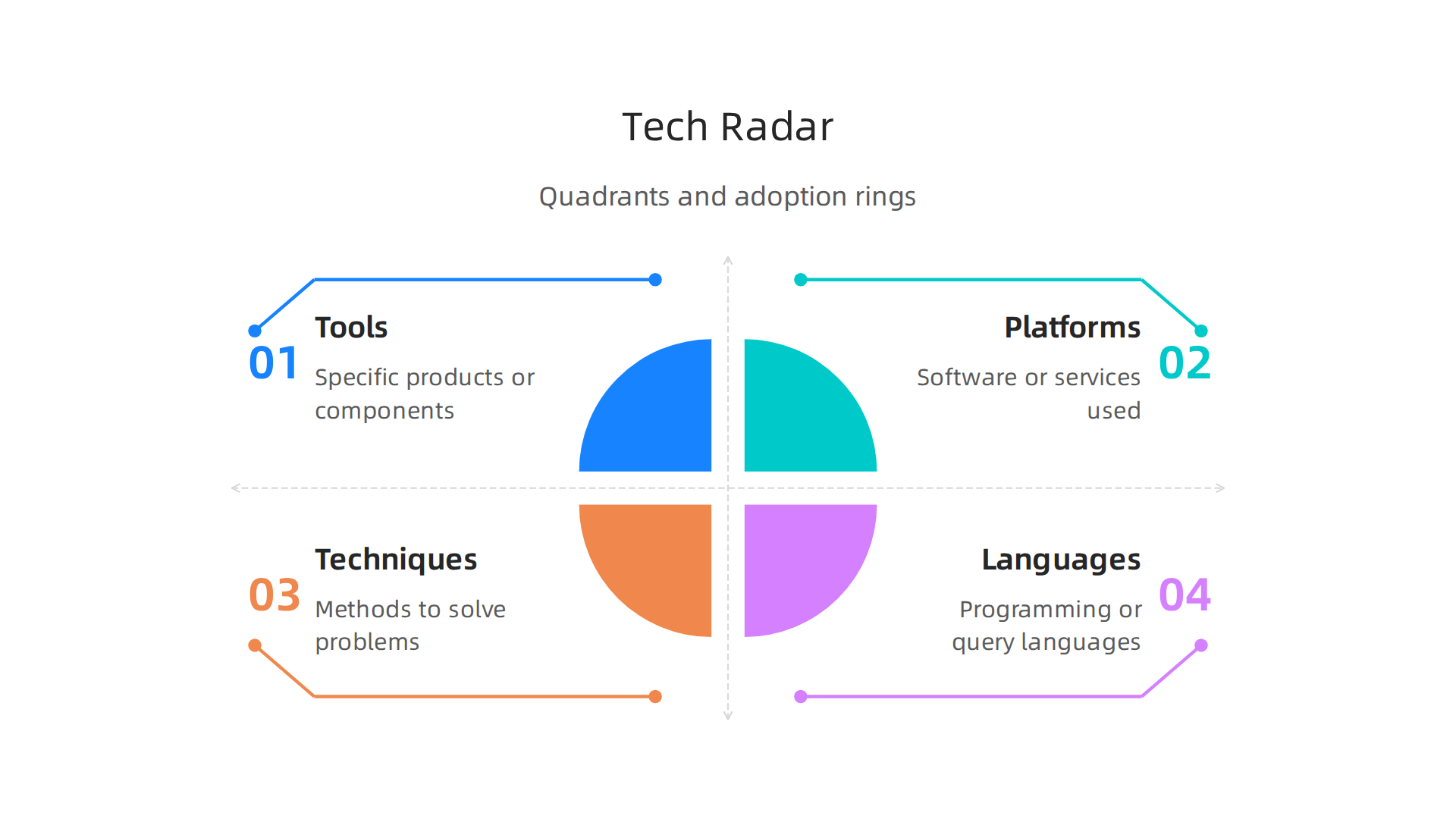
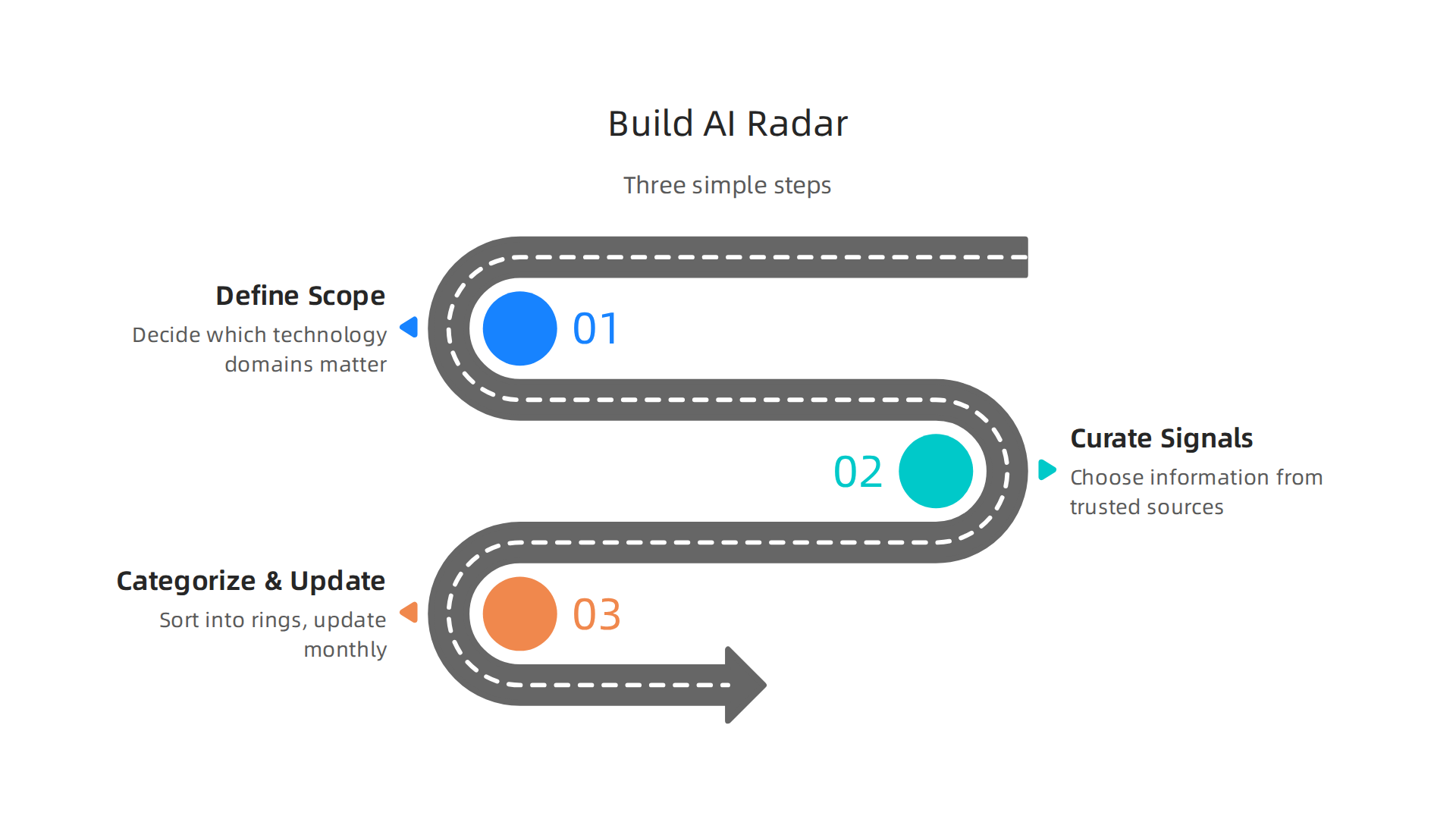
    • List Your AI Tools: Make a simple list of all the AI applications your team uses. Write down what each tool does and who is in charge of it. This is your basic model inventory. If you want to dive deeper into tracking tools, you can learn how to build a tech radar to track AI trends and tools in 2026.
    • Think About the Risks: For each tool, ask simple questions. What could go wrong if this AI makes a mistake? Could it accidentally share private info? The answers help you understand its risk level.
    • Keep Simple Records: For important AI decisions, jot down why the AI was used, what it did, and if the outcome was good or bad. This creates a basic audit trail.
    • Stay Informed: The world of AI is changing fast, and new rules for AI are coming out all the time. Keeping up with the latest trends helps you adjust your own rules. This is key to staying ahead on the tech adoption curve.

    By taking these steps, even small teams can make sure their AI use is responsible and trustworthy. It’s about being smart and thoughtful with these powerful tools.


    Get clear daily AI updates directly in your inbox.
    The AI Newsletter Worth Reading

    After putting rules in place for AI, the next step for businesses is to pick the right AI tools and plan how to use them. This means thinking about which AI products to buy or even build yourself, which is a big part of the top 10 technology trends for 2026. It’s about choosing tools that help you create a smart future for your company.

    AI-Native Product Strategies and Vendor Evaluation: Choosing the Right Tools

    When you’re ready to bring AI into your business, you need a smart plan. You’ll either buy AI tools from other companies (vendors) or create your own.

    Two business professionals engaged in a deep discussion to make strategic decisions about AI tool adoption.

    This choice depends on a few important things.

    Deciding to Build or Buy AI Tools

    • Cost: Making your own AI tools can be very expensive at first because you need to hire experts and buy special equipment. Buying ready-made tools often costs less to start.
    • Data Gravity: Think about where your important company data lives. If your data needs to stay super private or respond very quickly, you might want AI that works "at the edge." This means the AI processes data right where it is, like on your own devices or in your local office, instead of sending it all to the cloud. This helps with privacy and speed. For example, edge AI can offer much stronger privacy because data doesn’t leave your local network [The Edge AI Breakthrough: How Local Processing Is …]. It also leads to very low delays, or "latency," meaning decisions happen super fast [Edge AI Explained 2026: Running ML Models on Tiny Devices].
    • Extensibility: This is about how easily an AI tool can connect and work with other tools you already use. If you buy a tool, make sure it can talk to your existing systems. If you build it, make sure it can grow and link up with new things in the future.

    For many companies, especially ai startups, buying a ready-made solution is often the easier first step. You can always grow into building custom tools later as your needs change and you climb the tech adoption curve. To help you make these choices, it’s wise to explore how to choose AI for business tools that deliver real results in 2026.

    Testing and Growing Your AI Use

    Once you pick an AI tool, you don’t just use it everywhere all at once. You test it first.

    • Pilots: This is like a small trial run. You use the AI tool in a tiny part of your business to see how it works.
    • Proof-of-Value: After the pilot, you look at the results. Did the AI really help? Did it save time or money? Did it make things better for customers? You need clear ways to measure if the AI is actually useful.
    • Scaling to Production: If the pilot goes well and shows real value, then you can slowly start using the AI tool more widely across your company. This means putting it into "production." You’ll want to keep an eye on how well it’s working by using clear measurements, often called Key Performance Indicators (KPIs), to make sure it keeps helping your business grow. If you’re looking for broader strategies, learning how to evaluate AI companies to unlock business growth in 2026 can guide your choices.

    Summary

    This article explains why the top technology trends of 2026 matter for business leaders and how to turn them into practical advantage. It walks through Generative AI and LLM use cases, foundation and multimodal models, personalization at scale, AI-augmented automation and hyperautomation, and Edge AI for low-latency, private inference. The guide also covers critical risks—model poisoning, prompt injection, data leaks—and gives a simple security and governance checklist to manage those risks. Readers learn how to decide whether to buy or build AI tools, how to run pilots, and how to measure value so adoption scales safely. By the end you’ll have clear steps to prioritize trends, protect data, choose vendors or in-house paths, and start delivering measurable ROI from AI initiatives.

  • Roper Technologies AI Strategy Practical Roadmap for Business

    Roper Technologies AI Strategy Practical Roadmap for Business

    Why Roper Technologies’ AI strategy matters for product teams, operators, and buyers

    In today’s fast-moving world, understanding how big tech companies use new ideas like Artificial Intelligence (AI) is very important. One company that stands out is Roper Technologies. Unlike many other tech companies that focus on just one kind of product, Roper Technologies owns many different businesses. These businesses make all sorts of software and tools for many industries, like healthcare, education, and water management.

    Roper Technologies isn’t just about owning many businesses; it’s about making them better. In 2026, Roper has been putting a lot of effort into using AI across all its parts. This approach has led to new AI-powered products and helped the company grow its earnings significantly. For example, they’ve shared how their businesses are shipping AI products and speeding up how they use AI. They also talked about how they are committed to Embracing AI for Growth. This makes their way of handling AI very important to study.

    Because Roper Technologies works in so many different areas, its AI strategy can teach us a lot. It shows how AI can be used to improve many kinds of products and services. If you are part of a product team, run a business, or buy technology, you will gain valuable knowledge from seeing how Roper builds and uses AI.

    A professional leads a discussion, helping a team understand complex AI strategies.

    This article will help you understand:

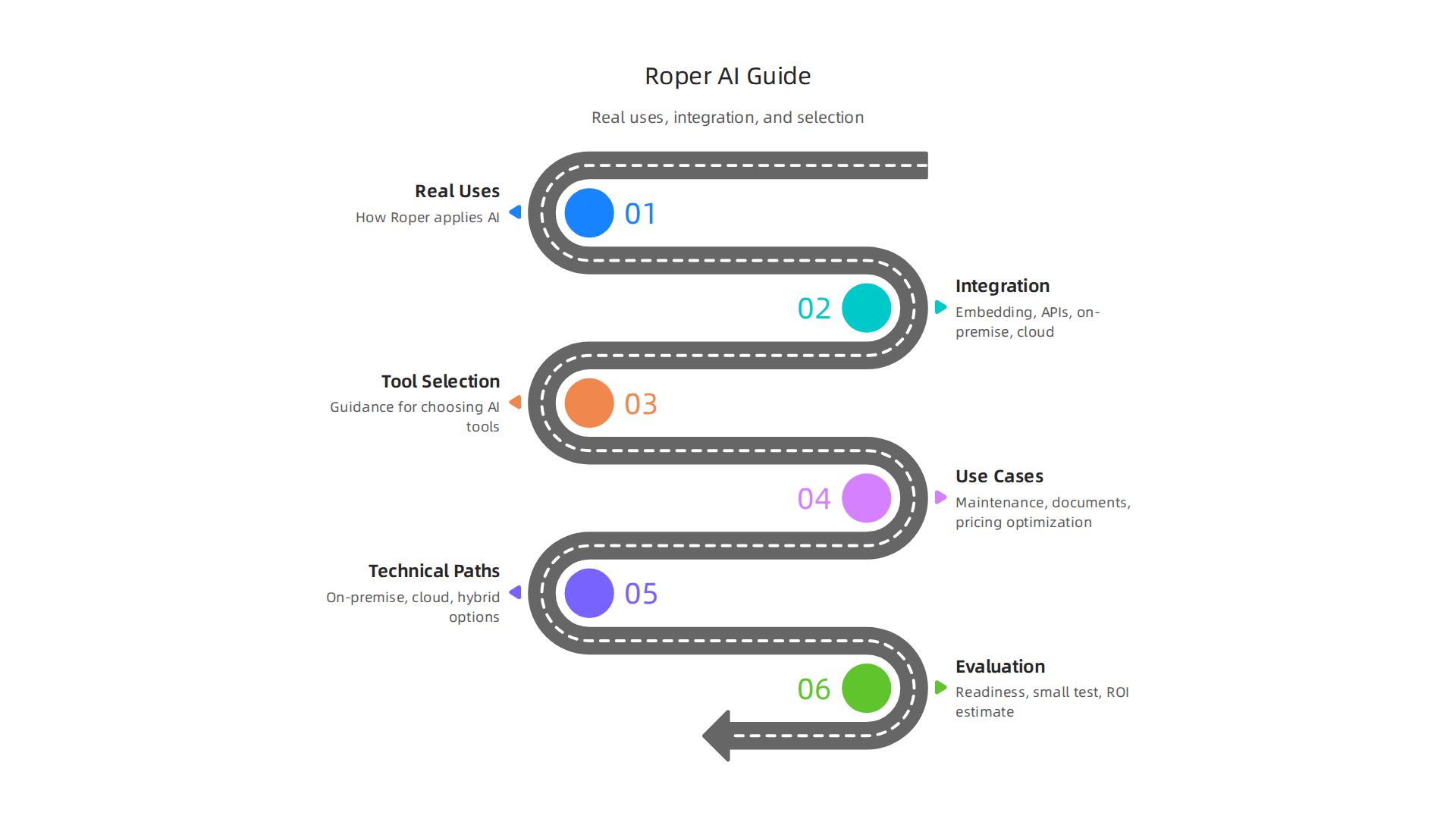
    Key insights from this article: real-world AI uses, integration methods, and tool selection guidance.

    • Real-world uses for AI: We will look at how Roper’s many businesses are actually putting AI to work every day. You’ll see different examples of AI in action.
    • How to add AI to your own work: We will explore how different parts of Roper’s businesses bring AI into their systems. This can help you think about how to add AI to your own company’s products, whether you are looking at tools like those from Infineon Technologies or iRhythm Technologies.
    • How to pick the best AI tools: It’s hard to know which AI solutions are right for your business. We will share ideas on how to pick the best AI tools that truly help you, just like if you were thinking about using something like Pathway AI. You can also learn more about How to Choose AI for Business Tools That Deliver Real Results in 2026.

    By looking closely at Roper’s steps in AI, we hope to give you clear ideas and tips you can use right away.

    To stay on top of the latest AI trends and how they impact businesses, make sure you’re reading the best information.

    The AI Newsletter Worth Reading

    Roper Technologies is a unique kind of company. It’s not just one big business, but rather a family of many smaller, specialized tech companies. These businesses create special software and products for very specific industries. Think about areas like healthcare systems, education tools, water meters, and even software for managing freight. Each of these smaller businesses is a leader in its own field.

    In 2026, Roper Technologies shared that its revenue went up by 11% to $2.10 billion in the first quarter, showing strong growth across its many parts. The company’s unique structure is important for understanding how it uses AI. Roper grows by buying other successful companies. Once a company joins Roper, it usually keeps running mostly on its own. This is called a "decentralized" model. This way, each business can focus on what it does best.

    This decentralized approach means that how quickly and easily AI is added depends on each separate business within Roper. For example, a software company that handles a lot of data, like those in logistics, might adopt AI very fast. We have seen how Roper’s businesses are already "shipping AI products" and speeding up how they use AI across their wide range of offerings, according to their first quarter financial results Roper Technologies announces first quarter financial results.

    Because Roper Technologies lets its businesses run largely on their own, the AI efforts might look different from one unit to another. Management has made it clear that Roper’s strategy is built on smart acquisitions and improving AI abilities across the board Management says Roper Technologies (ROP) Strategy …. This helps ensure that AI solutions are tailored to the specific needs of each product or service. So, whether a business is making tools similar to Infineon Technologies or iRhythm Technologies, or even an advanced analytics solution like Pathway AI, the goal is to make sure AI truly fits and improves their specific work. This flexible way of adopting AI helps these many businesses grow and adapt to new changes, making the overall innovation line 2026 how businesses adopt AI for growth easier to manage.

    Roper Technologies isn’t just letting its businesses figure out AI on their own. The company has a clear plan to add AI through smart purchases and by making its products better. This shows how serious Roper Technologies is about using AI to grow.

    One big step was when Roper Technologies agreed to buy CentralReach for about $1.65 billion in 2025. CentralReach makes software for businesses that help people with special needs. By bringing such a company into the Roper family, Roper helps it keep growing and improve its software with new technologies. Another important move was the plan to acquire Subsplash, an AI engagement platform, also in 2025. This shows Roper is directly bringing in companies that specialize in AI.

    Beyond buying new companies, Roper also helps its existing businesses add AI to their products. For example, DAT Freight & Analytics, one of Roper’s businesses, has rolled out new AI tools. Its DAT One mobile app now has AI-powered Load Recommendations. This helps truck drivers and logistics companies make better choices. These kinds of updates show that the different parts of Roper Technologies are really putting AI to work in practical ways.

    In fact, the CEO of Roper Technologies, Neil Hunn, said in 2026 that the company’s businesses were already "shipping AI products." He also noted that Roper’s AI abilities have grown, and they are moving faster to use AI in their offerings Roper Technologies raises 2026 profit forecast as AI demand boosts software sales. This means they are not just talking about AI, but actually making it a part of what they do every day. This ongoing effort helps Roper’s many different tech companies deliver better services and products to their customers.

    Mini-case: a recent Roper acquisition and its AI implications

    Roper Technologies made a big move in 2025 by buying CentralReach for about $1.65 billion. This company makes special software that helps businesses support people with special needs Roper Technologies signs agreement to acquire CentralReach for $1.65bn. This purchase is important for Roper Technologies because it shows how they plan to add AI to their products.

    For CentralReach, AI can make a huge difference. Imagine AI helping therapists make even better, more personal plans for each person. Or, AI could help by looking at lots of data to find new and faster ways to give support. This means CentralReach’s software will become smarter and more helpful, fitting right into Roper’s bigger plan to boost all its tech companies with AI. Adding AI can help these services innovate and grow their offerings how businesses adopt AI for growth. Roper sees its businesses like CentralReach as key places to keep shipping out those new AI products, as mentioned by the company’s management in 2026 Management says Roper Technologies (ROP) Strategy ….

    Roper Technologies isn’t just looking at AI for one company like CentralReach. They see many ways AI can help all their different businesses. Imagine AI making machines run better or helping with office work. Here are some clear examples of how AI can add real value across Roper’s portfolio.

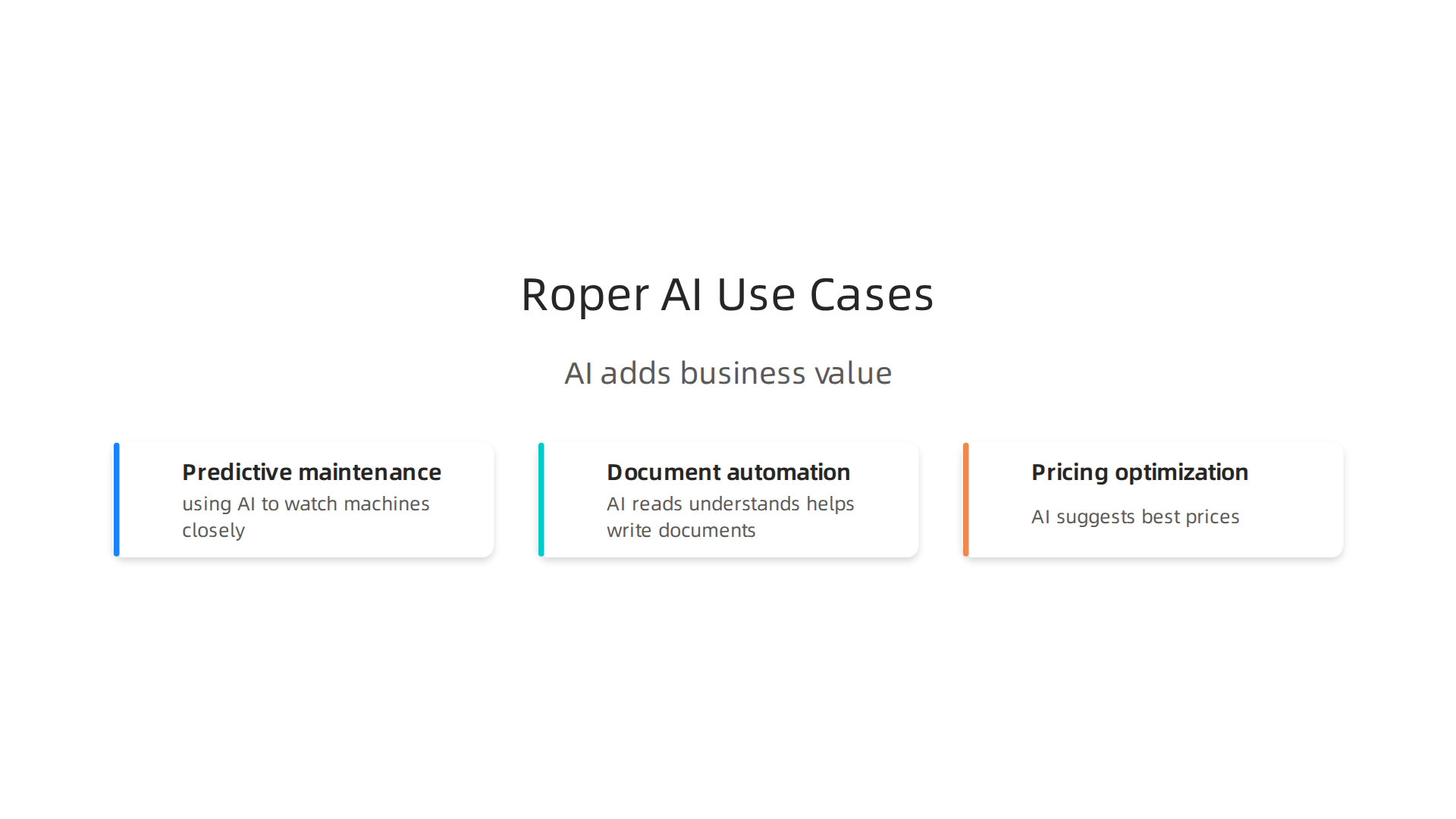
    AI brings significant value to Roper's diverse businesses through predictive maintenance, document automation, and pricing optimization.

    A team collaborates, brainstorming innovative solutions to challenges on a whiteboard.

    Practical use cases: where AI can add value across Roper’s portfolio

    One big area where AI can help is called predictive maintenance. This means using AI to watch machines closely and guess when they might break down. Instead of waiting for a machine to stop working or fixing it on a set schedule, AI tells you exactly when it needs attention. For Roper’s industrial tech companies, like those making sensors or controls, this is a huge deal. By using predictive maintenance, businesses can cut down on unexpected machine stops by 30% to 50% and save a lot on repair costs Industrial AI Statistics 2026: ROI, Adoption & Downtime Data. This can lead to a big return on investment, sometimes 300% or more, according to what we’re seeing in 2026 20 AI Use Cases in Manufacturing With Real ROI (2026). The main goal here is to keep things running smoothly, measure how much downtime is saved, and track how much less money is spent on maintenance.

    Another useful area for AI is making office work easier, often called document automation or data analysis. Many of Roper’s software businesses, including those in healthcare or information technology, deal with lots of papers and data. AI can read these documents, understand what’s important, and even help write new ones. This means less manual work and fewer mistakes. For example, AI can help CentralReach process client information faster or help other tech companies in Roper’s family quickly sort through customer feedback. Businesses using AI for things like support automation or legal review are seeing clear returns, making tasks quicker and more accurate Generative AI Enterprise ROI 2026: Use Cases & Numbers. The main goal is to speed up tasks and reduce errors, using numbers like processing time and error rates to show success. When you want to find the right AI tools to help your business, it’s good to know how to choose AI for business tools that deliver real results in 2026.

    AI can also help with pricing. For many of Roper’s software and service businesses, figuring out the best price for products or services can be tricky. AI can look at tons of data like past sales, what competitors are doing, and how customers react. Then, it can suggest the best prices to make more sales and earn more money. This is called pricing optimization. The goal is to boost how much money the company makes and improve its profit margins. By using AI in these smart ways, Roper Technologies can help its different companies grow and become even stronger. Staying updated on these trends is key.

    Get clear daily AI updates from The AI Newsletter Worth Reading.

    Now, let’s talk about how Roper Technologies can set up these smart AI systems for its many businesses. It’s like building different kinds of houses for different needs. These ways of setting things up are called "architectures" and "integration patterns." They decide where the AI lives and how it connects to other tools.

    Technical pathways: architectures and integration patterns Roper teams might use

    When thinking about where AI will run, there are three main types of places:

    1. On-premise: This means the AI tools and data stay right on the company’s own computers and servers, inside their own buildings. It’s like keeping all your important files in your own house. This is good for very private information or when speed is super important and the data shouldn’t travel far.
    2. Cloud: This means the AI tools and data live on big computers owned by another company, like Google or Amazon, that you access over the internet. It’s like renting storage space in a huge, shared building. This is great for handling lots of data and tasks that grow or shrink often, because it’s flexible and can be cheaper for big jobs.
    3. Hybrid: This is a mix of both on-premise and cloud. Some AI runs on the company’s own machines, and some runs in the cloud. Many companies, especially big tech companies like Roper Technologies, use a hybrid approach in 2026. This is because some information is too sensitive to leave the company’s own computers, while other tasks need the power and flexibility of the cloud Hybrid AI Architecture: 6-Criterion Decision Matrix (2026). For example, very important customer data might stay on-premise, while AI that helps with general market research might run in the cloud. Experts say that a hybrid setup is often the best choice for many organizations to run AI Best US Cloud Providers 2026: AI First, Hybrid, and Edge Compute.

    The reason for choosing a hybrid model is clear in 2026: most smart AI products need to run in different places. The cloud can handle big bursts of computer work, while on-premise systems keep very private data safe. Smaller, quick tasks can even run on devices right where the action happens, sometimes called "edge" computing The Strategic Guide to Cloud, On-Prem, and Edge …. This mix helps Roper’s various tech companies, from those dealing with sensitive health data to others handling factory sensors, use AI in the best way.

    Next, let’s look at how AI fits into what’s already there. This is called "integration patterns." Roper’s companies already have many software programs and systems. They don’t want to throw everything out. Instead, they want to add AI to what they already use.

    • Embedding Models: This means putting the AI directly inside existing software. For example, the AI that predicts when a machine might break down can be built right into the software that controls the machine. This makes the existing software smarter without needing a whole new system.
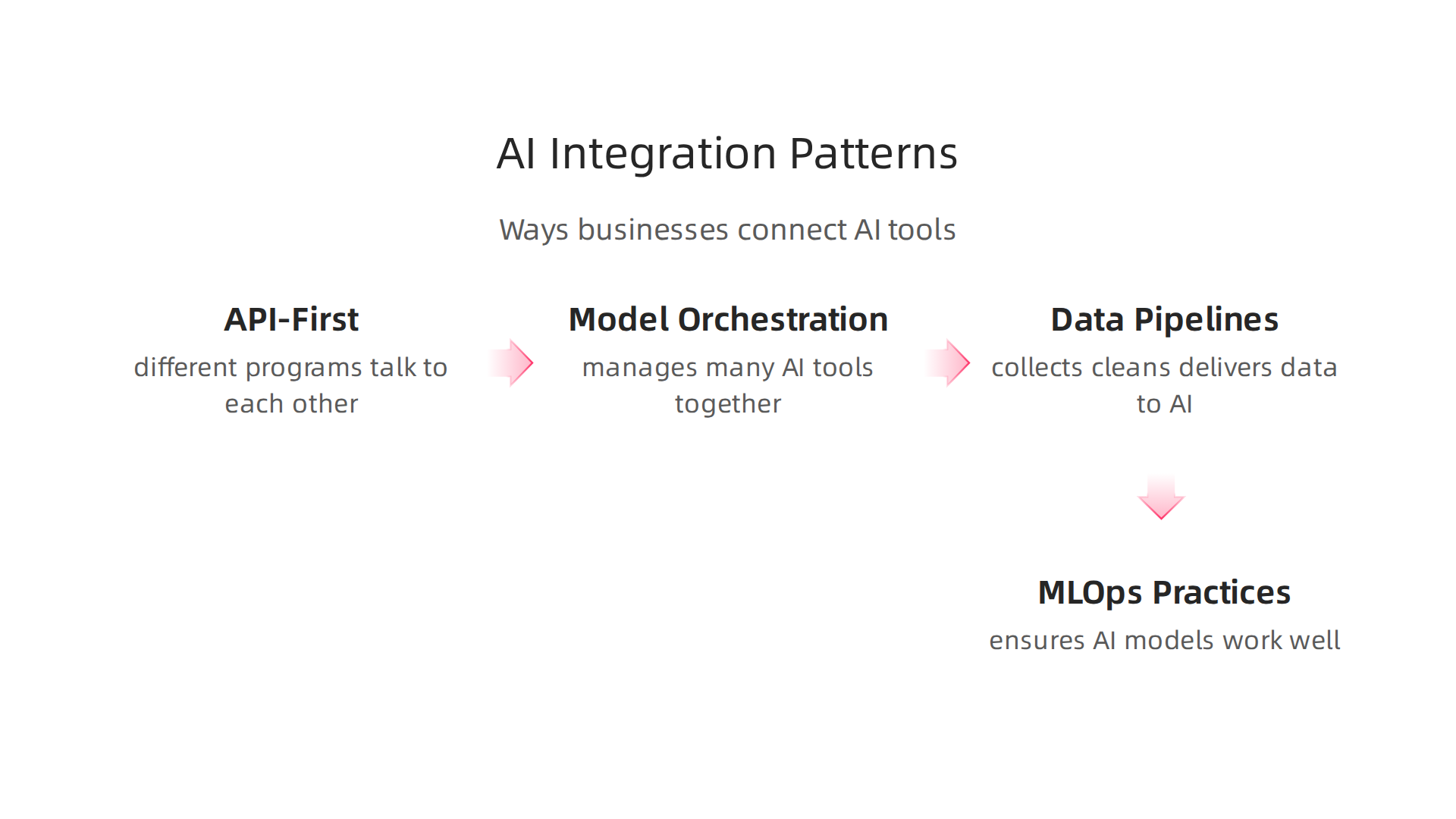
    • APIs (Application Programming Interfaces): Think of APIs as special doorways that allow different computer programs to talk to each other. An AI program might have an API that lets Roper’s older systems ask it questions and get answers. This is a common way to connect new AI features to older systems without a lot of trouble. Using "microservices architectures" is a popular way to make these connections strong and flexible in 2026 Top Enterprise AI Integration Solutions for 2026 – What is Antelope 7?.

    These ways of setting up and connecting AI are important for Roper Technologies. They help make sure that each of their businesses, whether it’s a software company or an industrial tech firm, can use AI effectively to solve its unique problems. It’s about finding the right technical pathways for each situation to make sure AI adds real value. Learning more about how identify AI leadership discover top tech companies for business in 2026 can offer more insights into how different companies manage these complex technical decisions.

    Putting new AI tools into a company like Roper Technologies is not just about choosing the right setup. It’s also about being very careful. Just like building a strong house, you need to think about rules, safety, and making sure everything works right. For companies like Roper that are quickly bringing in new AI tools across their many businesses, these concerns are even bigger. For example, Roper Technologies saw a big jump in AI innovation across its various parts in early 2026, which makes good rules even more important Roper Technologies investor relations material.

    Risks, compliance, and governance: what buyers and partners should watch for

    When any business, big or small, buys or partners with AI tools, they must think about three main things: risks, following rules (compliance), and how they manage everything (governance).

    Executives discuss important regulations and compliance issues in a formal meeting.

    Following the Rules (Compliance and Regulations)

    Different types of businesses have different rules. For example, a Roper company that works with health information must follow strict rules about keeping patient data private. This is called data privacy. If AI systems handle this data, they must also follow these rules. In other industries, like making factory tools, the AI might need to be extra safe to avoid accidents. This means thinking about how the AI could make mistakes and hurt people or cause damage.

    As more tech companies use AI, governments are making new rules about how AI should be used fairly and openly. Roper’s many businesses, including those like Infineon Technologies or iRhythm Technologies, need to keep up with these changes to avoid problems.

    Watching Over AI (Vendor Governance and Model Risk Management)

    When Roper Technologies uses AI tools from other companies, they need to check on those companies very carefully. This is called "vendor governance." It means asking:

    • Is the AI provider trustworthy?
    • Do they keep data safe?
    • How do they ensure their AI is fair and doesn’t make bad decisions?

    This also includes "model risk management." This is about making sure the AI models themselves work as they should. Sometimes, an AI might seem to work well, but it could have hidden problems that show up later. It’s important to test these models over and over.

    Being Able to Check (Auditability)

    Lastly, it’s very important that companies can "audit" their AI. This means being able to look back and see how an AI made a certain decision. If an AI gives advice or takes action, you should be able to understand why. For example, if an AI in a hospital helps a doctor, the doctor needs to know how the AI came to its conclusion. This helps build trust and fix problems if the AI makes a mistake.

    For any business, picking the right AI solutions also means picking partners who understand these important points. Learning how to choose the right enterprise AI platforms 2026 and trusted tools can help companies like Roper make smart decisions. This makes sure that AI brings good results without causing new problems.

    Checklist: Key Questions to Include in RFPs for AI-Enabled Features

    To make smart choices about AI, companies need to ask the right questions upfront. This is often done through a "Request for Proposal" or RFP. An RFP is like a detailed questionnaire sent to different AI providers to see how well they can meet a company’s needs. It helps businesses like Roper Technologies pick the best partners. Think of it as a playbook for buying AI, especially in 2026, when so many new tools are coming out The 2026 Enterprise AI Procurement Playbook: RFPs, Vendors ….

    Here are some important questions to include in an RFP:

    How the AI Thinks (Explainability)

    It’s important to know how an AI makes its decisions. If an AI suggests something, you should understand why. For example, if an AI helps a doctor, the doctor needs to know how the AI got its answer. This means asking:

    • "Can you show us how your AI comes up with its answers?"
    • "If the AI makes a mistake, how can we trace back what happened?"
    • "How often do you test your AI to make sure it’s fair and accurate?"

    Keeping Data Safe (Data Handling)

    Data privacy is a big deal, especially for companies working with sensitive information, like iRhythm Technologies in healthcare. When you use an AI tool, you give it your company’s data. So, you must ask:

    • "Where will our data be stored?"
    • "Will our data be used to train your AI for other customers?" (Many companies want a "zero-training" promise for their data AI Agent Procurement Checklist 2026: 60 Questions Before You).
    • "Who will have access to our data?"
    • "What steps do you take to protect our data from hackers?"

    How Well It Works (Service Level Agreements, or SLAs)

    You need to know that the AI will work reliably. SLAs are like promises about how good the service will be. For tech companies like Infineon Technologies that rely on precision, these details are key. Ask about:

    • "How often might the AI system be down for maintenance?"
    • "If the AI breaks, how quickly will you fix it?"
    • "How fast will the AI give us answers or perform tasks?"

    Prioritizing Your Questions

    Not all questions are equally important for every business. Companies like Roper Technologies should think about what matters most to their specific operations. For a company handling patient data, data privacy questions will be at the top of the list. For a business like Pathway AI using AI in manufacturing, questions about uptime and performance might be more critical. The goal is to focus on questions that deal with the biggest risks and have the largest impact on your business. Learning how to choose AI for business tools that deliver real results in 2026 helps ensure that you focus on what truly matters.

    How to evaluate Roper (or a Roper-backed solution) for your use case: a step-by-step framework

    After asking the right questions with an RFP, the next big step is to properly evaluate the AI solutions you are considering. This is especially true if you are looking at tools from large tech companies like Roper Technologies, or solutions backed by them. To make sure you pick the best fit for your business in 2026, here is a simple plan.

    A four-step framework for evaluating AI solutions: readiness check, small test, integration costs, and ROI estimation.

    1. Check Your Company’s Readiness

    Before bringing in any new AI, you need to know if your company is ready.

    A person diligently reviews documents, possibly evaluating proposals or reports.

    This means looking at a few things:

    • Data: Do you have enough good data for the AI to learn from? Is it clean and easy to use?
    • People: Do your employees have the skills to work with AI tools? Do they understand how AI will help them?
    • Systems: Can the new AI easily connect with your existing computer systems?

    Companies like iRhythm Technologies, which handle lots of sensitive patient data, must ensure their systems are ready for secure data sharing with new AI tools.

    2. Run a Small Test (Proof-of-Concept)

    Don’t buy a big AI system right away. Instead, try it out on a small scale. This is called a proof-of-concept or pilot project.

    • Pick a small problem: Choose one clear problem the AI can help solve. For instance, Pathway AI in manufacturing might test AI to predict when one machine will break down.
    • Use templates: Many vendors offer templates for these pilots. These help you set up the test, figure out what to measure, and understand how the AI will work.
    • Watch closely: During the test, check how well the AI performs. Does it save time? Does it make things more accurate? This helps you understand its real value.

    3. Figure Out Integration Costs

    Connecting a new AI tool to your current systems can sometimes cost a lot. You need to know:

    • Setup fees: What does it cost to get the AI up and running?
    • Compatibility: Will the AI work smoothly with your other software? Modern AI solutions often use a mix of cloud and on-premise setups to fit different company needs, especially for regulated data The Strategic Guide to Cloud, On-Prem, and Edge …. Many solutions today use what’s called a hybrid architecture, combining different types of computing environments to make sure everything works together well and securely Hybrid Cloud and AI: The New Enterprise Architecture.

    4. Estimate How Much Money You’ll Make or Save (ROI)

    Return on Investment (ROI) is about whether the AI will pay for itself and then some. For Infineon Technologies, this means looking at how AI can cut costs or improve products.

    • Focus on high-value tasks: AI works best for things like predicting when machines need fixing (called predictive maintenance) or checking product quality with computer vision. These often show big returns. For example, AI-driven predictive maintenance can lead to a 30% to 50% drop in machine downtime and a 300% to 500% ROI in manufacturing AI in Manufacturing: Use Cases, Benefits, and ROI (2026 …).
    • Set clear goals: Before you start, decide what success looks like. Will it be fewer broken machines, faster work, or happier customers? Identifying high-impact use cases where AI can quickly deliver measurable wins is crucial for scaling AI in manufacturing Scale and grow with AI for manufacturing.
    • Measure everything: Keep track of the improvements. This will show you the true value of the AI solution.

    Learning how to choose AI for business tools that deliver real results will guide you to the right solutions for your company.

    To stay on top of all the latest AI developments and make the best decisions for your business, consider getting regular updates. Get clear daily AI updates from The AI Newsletter Worth Reading.

    Procurement and vendor strategy: negotiating contracts, SLAs, and support for AI features

    After you have learned how to choose AI for business tools that deliver real results, the next big step is getting the right deal. This means talking to vendors, like large tech companies such as Roper Technologies, about contracts. A good contract protects your business and makes sure the AI solution works well for a long time. Here are the important parts to think about:

    1. Who Owns the Data?
    When you use AI, it often needs a lot of your company’s data. You need to be very clear in the contract about who owns this data. Will the AI vendor use your data to make their AI better for other customers? For companies like iRhythm Technologies that deal with very private patient information, this is super important. Make sure your data stays yours and is handled safely.

    2. How Will the AI Model Be Updated?
    AI models are always changing and getting better. You need to know how often the vendor will update the AI you are using. Will they fix problems quickly? Will new features be added for free, or will you pay extra? This is key for staying competitive, especially if you rely on AI for core tasks like Infineon Technologies might for product quality checks.

    3. What Are the Performance Guarantees (SLAs)?
    Service Level Agreements, or SLAs, are promises about how well the AI will work. This includes things like:

    • Uptime: How often will the AI be available and not broken?
    • Speed: How fast will it give you answers or results?
    • Accuracy: How correct will its predictions or actions be?

    Make sure these promises are in writing. For a company using Pathway AI for critical tasks like predicting machine failures, clear performance rules are a must.

    4. What Support and Training Will You Get?
    Bringing in new AI means your team might need help learning how to use it. Ask about:

    • Training: Will the vendor teach your employees how to use the AI tools?
    • Technical Support: What happens if something goes wrong? Who do you call, and how fast will they help?
    • Ongoing Help: Will they offer advice on how to use the AI for new problems down the road?

    A strong support plan ensures your investment in AI keeps paying off. When picking an AI vendor, remember that many solutions today use a mix of cloud, on-premise, and edge setups to fit different company needs, creating a complex The Enterprise AI Stack in 2026: The Reference Architecture that requires careful consideration in contracting. Also, look for vendors that offer robust integration support, as smooth connection with your existing systems is vital for success in 2026 Top Enterprise AI Integration Solutions for 2026 – What is Antelope 7?.

    These points help you set up good agreements with tech companies for your AI needs. Understanding these parts of the contract is just as important as choosing the right AI platform itself. For deeper insights into selecting powerful AI solutions, learn more about Enterprise AI Platforms 2026: Top Providers and How to Choose the Right One.

    Summary

    This article explains why Roper Technologies’ 2026 push into AI matters for product teams, operators, and buyers by showing how a decentralized portfolio company can adopt and scale AI in practical ways. It covers Roper’s acquisition-driven strategy, examples of shipped AI features (like DAT’s Load Recommendations), and a recent CentralReach purchase that illustrates domain-specific AI opportunities. You’ll learn common high-value use cases—predictive maintenance, document automation, and pricing optimization—plus the technical choices (on‑premise, cloud, hybrid) and integration patterns (embedded models, APIs) that work best. The piece also outlines procurement tactics: RFP questions, pilot testing, SLA and contract priorities, and how to estimate ROI. Finally, it highlights governance, auditability, and compliance risks buyers must manage when selecting vendor AI solutions. After reading, you’ll have a clear checklist and evaluation framework to test, buy, and govern AI for your own products or purchasing decisions.

  • The Innovation Line 2026: How Businesses Adopt AI for Growth

    The Innovation Line 2026: How Businesses Adopt AI for Growth

    Why the ‘Innovation Line’ Matters Now

    In 2026, it feels like artificial intelligence (AI) is everywhere. Most businesses, around 88% in fact, are now using AI in some part of their work

    Explore Ventionteams to learn about AI adoption statistics and industry reports.

    AI Adoption Statistics Q1 2026: All Figures – Vention. We’re seeing AI help with everything from writing new content to creating computer code. The money spent on AI is also growing very fast, expected to hit over $2 trillion this year and keep climbing State of AI 2026 – AI Market Size, Investment, and Industry Data. It’s clear that AI is no longer a small experiment; it’s a huge part of how businesses run.

    But with all this growth, there’s a big question: how do companies actually make these new AI tools work well for them? This is where the idea of the "innovation line" comes in. Think of the innovation line as the point where new ideas and advanced technologies, like AI, turn into real, helpful tools that bring good results for a business. It’s about moving from just trying out new AI to using it in a way that truly changes things for the better, making work easier or helping the company grow.

    Leaders in companies today face many hurdles when trying to cross this innovation line. One big problem is simply too much information. There are so many AI tools and new updates every day that it’s hard to know what’s useful. It’s like trying to drink from a firehose!

    Navigating the overwhelming landscape of AI tools and information requires careful decision-making.

    Then comes the challenge of picking the right tools from endless choices. How do you know which AI platform is best for your specific needs? Companies often worry about whether a new AI system will fit with their old systems, like at a big tech place such as the Comcast Technology Center. They also wonder if the money they spend on AI will actually bring them more money back, known as return on investment (ROI). Choosing the right tools is key to making sure your investment pays off. If you’re wondering how to pick smart tools, you can learn more about how to choose AI for business tools that deliver real results.

    It’s a lot to keep up with, and making the right choices means staying informed.

    Ready to cut through the noise and get daily insights that matter? Get clear daily AI updates from The AI Newsletter Worth Reading.

    Now, let’s look at the bigger picture to understand the "innovation line" in 2026. The world of AI is changing fast, and some big trends are shaping how businesses use new technology to grow.

    Major Trends Reshaping the Innovation Line

    First, we see the commoditization of tooling. This simply means that many basic AI tools and features are now very common and easy to get. They are no longer special or expensive. It’s like how everyone has access to good basic software today. This makes it easier for many companies to start using AI, but it also means that just having an AI tool isn’t enough to stand out.

    Second, there’s a big move towards platform consolidation. Instead of using many different small AI tools for different tasks, businesses are looking for bigger platforms that can do it all. Companies like Viant Technology, for example, might prefer one large system that handles many AI jobs at once. This helps connect different parts of a business better and makes managing AI easier. You can think of it like going to a Micro Center PC builder to get all your computer parts in one go, instead of buying each piece from a different store. Picking the right major platform is a growing challenge. If you’re looking for solutions for your business, exploring enterprise AI platforms 2026 top providers and how to choose the right one can be a smart next step.

    Third, companies now have rising expectations for measurable ROI. This means businesses don’t just want to try AI; they want to see clear proof that it’s actually saving money or making more money. Leaders are expecting AI to deliver real, "transformative impact" on their work, and they want numbers to show for it

    Deloitte's insights on applied artificial intelligence, including reports on the state of AI in the enterprise.

    The State of AI in the Enterprise – 2026 AI report. It’s not enough to say "AI makes us more efficient"; you need to show how much more efficient. Learning how to get real ROI from AI marketing cloud in 2026 is a great example of this trend.

    Shifts in Buying Behavior

    These trends also change how businesses buy new AI tools. Because AI platforms are more mature, buyers are more careful. They take longer to decide, ask more questions about how a tool will actually help their company, and want to see proven results. They are less likely to buy something just because it’s new and shiny. This shift means that AI providers need to clearly show the value and benefits of their tools to help companies cross the innovation line.

    Now, let’s dive deeper into the actual building blocks that define the innovation line in 2026. After seeing how businesses are changing their buying habits, it’s helpful to understand the main kinds of technology that are driving all this AI growth. These are called "technology clusters," and they are like different parts of a big machine working together.

    Key Technology Clusters Driving the Innovation Line

    To help companies like Viant Technology or even smaller businesses cross the innovation line, we can look at four key technology clusters.

    The four main technology clusters that underpin and drive AI innovation today.

    These clusters help shape what AI tools are available and how they are used.

    1. Infrastructure: This is the basic foundation, like the roads and power grids for AI. It includes things like powerful computer chips, data centers (big buildings full of computers), and cloud services. These are the engines that make AI possible. Since 2022, industries building this AI foundation, like semiconductors and cloud services, have added a lot of money to the economy, showing just how fast the demand for AI infrastructure is growing The high-growth industries reshaping the global economy …. The market for cluster computing, which is a big part of this, is also growing rapidly, expected to reach $63.21 billion in 2026 Cluster Computing Market Analysis Report 2026 – EIN Presswire.

    2. Foundation Models: Think of these as the huge, smart brains of AI. These models are trained on massive amounts of data and can do many different tasks, like writing text, creating images, or understanding speech. Many smaller, more specific AI tools are built on top of these big foundation models. It’s like having a very smart general-purpose engine that you can then adapt for different kinds of cars.

    3. Developer Platforms: These are like toolkits that help people build new AI solutions without having to start from scratch. They provide ways to easily use and customize foundation models. For example, a developer platform might offer tools to help a company use an existing AI brain to create a new customer service chatbot. This speeds up how quickly new AI ideas can become real products.

    4. Verticalized AI: This means AI tools that are made for a very specific job or industry. Instead of general AI, these are tailored. For example, AI for healthcare might help doctors read X-rays, or AI for manufacturing might help control robots on a factory floor. Companies like those near the Comcast Technology Center are often looking for these specialized solutions.

    These clusters work together to form a big ecosystem of vendors, which are the companies selling these AI tools. Buyers now have many choices, and it can be hard to pick the best fit. Understanding these layers helps businesses make smart decisions. To make sure you pick the right tools that truly help your company, it’s important to learn how to choose AI for business tools that deliver real results in 2026.

    Staying on top of these fast changes can feel like a lot.

    Get clear daily AI updates from The AI Newsletter Worth Reading.

    Staying on top of these fast changes can feel like a lot. But to truly cross the innovation line and keep up with new AI developments, we need to look at the very foundation: the hardware.

    AI Infrastructure & Chips — Why Hardware Still Matters

    Even in 2026, with all the smart AI software around, special computer parts, or "chips," are still super important. Think of them as the powerful engines that make AI possible. These are not just any old chips; they are specialized hardware like GPUs (Graphics Processing Units) and TPUs (Tensor Processing Units) that are made to handle the huge math problems AI models need to solve. These advanced chips are what let companies like Viant Technology use the newest, most complex AI models. For example, some chips are now built to support the new age of AI inference, making AI tools work faster and better 10 top AI hardware and chip-making companies in 2026.

    These powerful chips need a place to live, which is where cloud infrastructure comes in. Cloud infrastructure means having access to these supercomputers over the internet, without needing to own them yourself. This setup is key for running next-gen AI models. When the hardware and cloud services are good, it helps lower the everyday costs of using AI for businesses. This means more companies can afford to bring AI into their work.

    The price and availability of this strong hardware also decide who wins in the AI world.

    Senior leaders in a strategic meeting, discussing the critical role of infrastructure in AI success.

    If a company can get these chips and cloud services easily and at a good price, they can make their AI tools better and cheaper. This makes them more competitive. For customers, it means they can adopt AI solutions more easily, helping them move faster towards their own innovation line. It also affects how much it costs for you to set up your own AI-ready computer, and there are even ways to find Gaming PC Deals 2026 How AI Hardware Makes Mid-Range Systems Outperform. Strong hardware also makes AI operations more efficient, helping businesses cut costs without cutting corners in 2026.

    Moving from the powerful hardware, we now look at the smart software that makes AI truly useful: the foundation models and platforms. Think of these as the brains and operating systems for AI. In 2026, we see many companies creating these big AI models. These models are like super-smart tools that can understand language, create images, and even solve complex problems.

    The world of foundation models is growing fast. Different companies are making their models special in unique ways. Some focus on being very good at writing text, while others are better at making designs or helping with science. This means businesses have many choices. The rise of "AI foundation" industries, which include things like semiconductors, cloud services, and AI software, has added a lot of money to the global economy The high-growth industries reshaping the global economy. Also, the total money invested in AI around the world is expected to reach $500 billion in 2026, showing how important this area is The 5 Sectors That Will Shape Global Growth in 2026.

    For businesses, choosing the right AI software is a big decision on their path to the innovation line. They can pick:

    • Managed Platforms: These are like ready-to-use AI services. Companies like Viant Technology or those working with the Comcast Technology Center might find these helpful because everything is set up for them. They just plug in their data and go.
    • Open Models: These models are more flexible. Businesses can take them and change them to fit their exact needs. It’s like building your own computer with a Micro Center PC Builder, where you choose all the parts.
    • Hybrid Deployments: Many companies use a mix of both. They might use a managed platform for common tasks but fine-tune open models for their special projects.

    Picking the right platform is key for businesses to get real results from AI. If you’re looking for more details on how to choose, check out this guide on enterprise AI platforms 2026 top providers and how to choose the right one. Understanding these software layers helps businesses truly cross the innovation line and stay ahead.

    If you want to keep up with all the latest in AI and technology, there’s a great way to do it.


    Stay Ahead of the AI Curve

    Get clear daily AI updates and never miss a beat.

    The AI Newsletter Worth Reading

    Now that you know about different AI software options, the next big step is figuring out how to pick the right one. It’s not just about what an AI can do, but what it should do for your business and how you measure its success. Companies that truly cross the innovation line use smart ways to check if AI technologies are a good fit.

    Practical Ways to Evaluate AI

    Businesses in 2026 use special ways, called frameworks, to look at new AI tools.

    Key frameworks and considerations for businesses evaluating new AI technologies.

    These frameworks help them decide if an AI will actually help them grow and make things better.

    • Capability Fit: This simply means, "Can this AI do the job we need it to do?" Does it solve a specific problem or make a process easier? For example, if you need an AI to write reports, you check if it can write good reports that match your style.
    • Integration Risk: How easy will it be to connect this new AI with our current computer systems? Businesses like Viant Technology or those at the Comcast Technology Center already have many systems. They want an AI that can work smoothly with what they have, not cause big headaches. If it’s too hard to link up, it might not be worth it.
    • Total Cost of Ownership: This is more than just the price tag. It includes all the costs over time. Think about how much it will cost to set up the AI, train your team to use it, keep it running, and update it later. This helps companies understand the real long-term expense.
    • Measurable Outcomes: Most importantly, how will we know if the AI is actually helping? Businesses need to see real results, like saving money, making tasks faster, or improving customer happiness.

    How Companies Measure Success

    To make sure an AI is worth the investment, companies use what are called Key Performance Indicators (KPIs) and follow strict steps before buying.

    • Defining Success Early: Before even trying an AI, businesses set clear goals. They ask, "What specific problems are we trying to solve?" or "What improvements do we expect to see?" This helps them know what to measure later MLOps workflow: from definition to production-ready pipelines.
    • Tracking Performance: Once an AI is in use, companies watch how well it works. They might track things like:
      • Accuracy: Is the AI giving correct answers or doing tasks correctly?
      • Speed: Is the AI making things faster?
      • Cost Savings: Is it reducing expenses?
      • User Satisfaction: Are employees or customers happier with the results?
      • Some businesses even automate the tracking of model quality to spot when an AI starts to perform poorly, prompting them to retrain it MLOps: Continuous delivery and automation pipelines in machine learning.
    • Procurement Checkpoints: Before a company signs a deal, they go through a checklist. This might include testing the AI with a small group, making sure it meets security rules, and checking how easy it is for people to use. They want to avoid surprises and ensure the AI will truly help them get ahead of the innovation line.

    Understanding these evaluation methods helps businesses big and small choose AI tools that deliver real value and not just hype. If you’re looking for more guidance on selecting the right tools, explore how to find trusted tech sources that deliver real business results in 2026 to stay informed.

    After picking the right AI and knowing how to check if it’s working, the next big step is putting it into action. This means smoothly bringing new AI tools into your business’s daily operations. Companies that truly stay ahead of the innovation line need smart ways to connect AI with their existing systems and make sure their teams are ready.

    How AI Tools Connect to Your Business

    Putting AI to work means carefully adding it to your company’s systems. There are a few main ways businesses do this in 2026:

    Strategies for integrating AI tools smoothly into existing business operations.

    • API-First Approach: Think of an API (Application Programming Interface) as a special messenger. It lets different computer programs talk to each other easily. With an API-first approach, the AI tool is built so it can easily send and receive information from your other apps. This is great for companies like Viant Technology or even smaller businesses that want new AI tools to work well with their current setup without big changes.
    • Model Orchestration: When you have many AI tools working together for a bigger job, you need something to manage them. This is like a conductor leading an orchestra. Model orchestration makes sure each AI model does its part at the right time. This helps complex tasks run smoothly, especially for large companies with many moving parts.
    • Data Pipelines: AI needs a lot of data to learn and work. A data pipeline is like a path that collects, cleans, and delivers data to the AI. It makes sure the AI always has the fresh, correct information it needs. Setting these up properly is key for any AI to be effective.

    • MLOps Practices for Production: MLOps (Machine Learning Operations) is a set of best practices to make sure AI models work well not just in testing, but also when they are actually being used by customers or employees. It’s about keeping AI models up-to-date, checking their performance, and fixing problems quickly. Good MLOps helps companies like Comcast Technology Center manage many AI tools reliably. For example, consistently tracking how well AI models perform in the real world is a core part of MLOps, often leading to retraining them with new data to keep them accurate MLOps Best Practices That Actually Work in Production. This helps make sure the AI delivers results day after day.

    Getting Your Team Ready for AI

    Bringing AI into a business isn’t just about technology; it’s also about people. For successful AI adoption, companies need to think about their teams and what new skills they might need.

    • New Skills: Employees might need training on how to use new AI tools or how to work alongside AI assistants.

    A team actively collaborating, perhaps during an AI implementation training session or problem-solving meeting.

    This could mean learning how to ask AI the right questions or how to check the AI’s work.

    • Changing Roles: Some job roles might change as AI takes over certain tasks. This gives people a chance to focus on more creative or complex work that AI can’t do. Investing in training helps everyone grow with the new technology.
    • Rules and Safety: As AI becomes more common, rules about its safe and fair use are also growing. For instance, in 2026, many regulations like the EU AI Act are becoming fully active, requiring businesses to be transparent and make sure humans can oversee high-impact AI systems AI Governance, Risk & Compliance: Trends & Challenges 2026. This means businesses need people who understand these rules to keep everything compliant.

    To help your business choose the right AI tools that truly deliver results, it’s important to stay informed. Many companies are exploring how to implement AI and looking for proven strategies.

    Learning about new AI trends and tools is a big part of staying ahead.

    Get Clear Daily AI Updates

    Stay informed with the latest in AI and technology. Get clear daily AI updates from The AI Newsletter Worth Reading.

    Understanding how AI fits into your business and making sure your team is ready are important steps to fully use the power of AI. If you’re looking for more details on picking suitable tools, read our guide on how to choose AI for business tools that deliver real results.

    Staying ahead in AI means more than just finding new tools; it’s also about understanding the important rules and possible risks that come with them. In 2026, navigating the innovation line responsibly is key for any business using AI. This means paying close attention to new laws, ethical ideas, and how to manage risks.

    Regulatory and Compliance Pressures

    Governments around the world are creating new rules for AI. These rules are shaping how companies build and use AI tools. For example, the EU AI Act is now fully active, making businesses follow strict guidelines, especially for AI systems that could have a big impact. This means companies need to be transparent about how their AI works and make sure humans are still in charge of important decisions EU AI Act & AI Governance Profile 2026.

    Not only is Europe setting standards, but countries like South Korea also have their own AI laws, and in the US, federal agencies are adopting new frameworks for AI governance Governing AI in 2026. Businesses must understand these different rules because they affect how AI tools are offered by vendors and how companies control their own AI use. Falling behind on these rules can cause big problems.

    Ethical and Risk Management Considerations

    Beyond legal rules, businesses also need to think about the right way to use AI. This includes several key areas:

    • Data Governance: This means making sure the data used by AI is collected fairly, kept private, and used correctly. Companies must also protect data from being misused or "poisoned" with bad information OCC Report Signals AI Governance Guidance Is on the ….
    • Model Risk: AI models can sometimes make mistakes or be biased. Managing model risk means checking AI systems often to make sure they are fair, accurate, and don’t cause harm. For industries like finance, there are even updated rules for how to manage these risks New Model Risk Management Rules: What They Mean ….
    • Transparency Expectations: People want to know how AI makes decisions. This means companies need to be able to explain why an AI tool gave a certain answer. This is especially true for high-risk AI, where human oversight is a must Why AI Governance Must Pivot from Policy to Operations in 2026.

    To stay on the right side of the innovation line, businesses must put strong practices in place for these ethical and risk concerns. This helps ensure AI is used safely and fairly for everyone. Choosing the right AI tools that fit these standards is a big step for any company. You can learn more about how to make these smart choices by reading our guide on how to choose AI for business tools that deliver real results in 2026.

    After understanding the rules and right ways to use AI, the next big step is choosing the right tools and making sure they actually help your business grow. This means looking closely at who sells the tools, what they offer, and how you can see real money coming back from your investment. For any business trying to stay on the innovation line in 2026, smart buying choices are just as important as knowing the law.

    Purchasing, Vendor Selection, and Measuring ROI

    When you pick AI tools, you’re not just buying software; you’re choosing a partner for your business’s future. It’s important to look at a few key things:

    • What’s their plan? Check the vendor’s roadmap. Does their AI tool have a clear plan for getting better and adding new features that match what your business needs later on? You want a tool that grows with you.
    • How good is their help? Strong customer support is a must. If something goes wrong or you have questions, you need to know you can get help easily.
    • How do you pay? Look at the pricing models. Some tools are a one-time cost, others are monthly, and some charge based on how much you use them. Make sure the costs fit your budget and what you expect to gain.
    • Does it play well with others? Think about how the new AI tool will work with the systems you already have. An easy integration ecosystem means less headaches and more value. For specialized needs, some might even seek solutions that power large data systems, perhaps using viant technology principles, or hardware solutions that might come from a place like a micro center pc builder for custom AI workstations. You can find out more about choosing big AI platforms that fit your needs by reading about Enterprise AI Platforms 2026 Top Providers And How To Choose The Right One.

    Now, let’s talk about how to know if your AI investment is actually paying off. This is called measuring Return on Investment, or ROI.

    Building Your Business Case and Measuring Results

    Before buying any AI tool, you need a strong reason, or "business case," for why you need it. This helps you figure out what success looks like. Many companies are already seeing big impacts from AI. For example, worker access to AI grew by 50% in 2025, and twice as many leaders reported truly changing results from AI compared to the year before The State of AI in the Enterprise – 2026 AI report. Global spending on AI is expected to hit over $2 trillion in 2026, showing just how much businesses are investing State of AI 2026 – AI Market Size, Investment, and Industry Data.

    • Short-term ROI: This means looking for quick wins. Can the AI tool save time on small tasks? Does it help your team finish projects faster? Even small gains in efficiency add up quickly.
    • Long-term ROI: This looks at the bigger picture. How will the AI tool help your business grow over months and years? Will it help you find new customers, create better products, or cut down on major costs? As companies move past just trying out AI, measuring its impact becomes key to showing its value AI Adoption Trends: 2024-2026 Data.

    By carefully selecting vendors and always checking the results, businesses can make sure their AI investments truly move them forward along the innovation line. This careful approach helps avoid wasted money and makes sure AI brings real benefits.

    Want to keep up with the fast-moving world of AI?
    Stay informed and make smarter choices for your business.

    The AI Newsletter Worth Reading

    Summary

    This article explains the

  • Build a Tech Radar to Track AI Trends and Tools in 2026

    Build a Tech Radar to Track AI Trends and Tools in 2026

    Introduction

    The world of artificial intelligence moves at a breathtaking pace. Every week brings a new model, a fresh capability, or a surprising shift in what machines can do. For professionals and business leaders, keeping up feels less like a choice and more like a survival skill.

    Actually, the numbers back that up. According to the 2026 Artificial Intelligence Index Report from Stanford, generative AI reached nearly 53 percent population-level adoption within just three years. That is faster than the personal computer or the internet. The 2026 State of AI Agents Report shows organizations expect AI agents to spread well beyond engineering and IT in the next 12 months. The message is clear. AI is not coming. It is already here.

    Here is the challenge. With so many announcements, product launches, and trend pieces flying around, it is easy to get lost in the noise.

    A person looking thoughtfully at multiple data sources, symbolizing information overload.

    You might feel overwhelmed trying to separate real breakthroughs from hype. That is where the idea of a tech radar comes in.

    A tech radar is a structured way to monitor, filter, and prioritize emerging technologies. Instead of reacting to every headline, you build a system that helps you spot the signals that actually matter for your work. This is especially valuable in 2026, when the gap between early adopters and everyone else keeps growing wider.

    In this article, we will walk through a practical framework for building your own tech radar. You will learn how to cut through the noise, identify the most impactful AI trends, and stay ahead of the curve without burning out. Whether you are exploring the artificial intelligence series for the first time or trying to understand the different types of ai and llm ai models, this guide will give you a clear path forward. For ongoing updates, you might also want to check out our guide on AI tool discovery for 2026, which covers how to find trusted tech sources that deliver real business results. And if you want daily AI insights delivered straight to your inbox, consider The AI Newsletter Worth Reading.

    What is a Tech Radar and Why It Matters

    So what exactly is a tech radar? Think of it like a weather radar for technology. Instead of tracking storms, you track emerging tools, platforms, and practices. A tech radar gives you a clear picture of what matters right now and what might matter next year.

    The idea started with Thoughtworks. Their team created a simple visual tool to help engineers decide which technologies to use, which to try out, and which to set aside. Today, that same approach is used by organizations of all sizes to get a handle on the fast-moving AI landscape. You can explore their latest snapshot on the ThoughtWorks Technology Radar page.

    Most tech radars use a simple layout. Four quadrants group technologies into categories like Tools, Platforms, Techniques, and Languages. Around those quadrants sit four rings that show how ready each technology is. The rings are usually named Adopt, Trial, Assess, and Hold.

    Visual representation of a tech radar, showing four quadrants and four adoption rings.

    This structure helps you see at a glance where each piece of technology fits and what you should do with it. A great overview of this setup is available in the guide on how to create a tech radar from OneUptime.

    Why does this matter so much in 2026? Because the number of AI tools and models keeps exploding. Without a system, you spend hours chasing shiny objects. With a tech radar, you and your team agree on what deserves attention.

    A team of diverse professionals collaborating around a whiteboard, discussing strategy and making decisions.

    You stop wasting energy on tools that do not fit your goals. You focus on the ones that will actually move the needle.

    A tech radar also forces honest conversations. When your team looks at a new LLM or a different type of AI tool, you discuss where it belongs on the radar. Should you adopt it now or just assess it? That discussion alone saves months of wasted effort. For a deeper look at how this framework came to be and how to build one yourself, check out the technology radar definition and guide from ITONICS.

    Here is the bottom line. A tech radar turns noise into clarity. It helps you navigate the artificial intelligence series of updates without drowning in them. And when you couple that clarity with smart tool choices, you stay ahead. If you are still unsure about picking the right tools for your business, take a look at our guide on how to choose AI for business tools that deliver real results.

    Key AI Trends Shaping 2026

    With your tech radar ready, it is time to look at the actual trends you will want to track. The AI world is moving faster than ever, and knowing what is real versus what is just hype makes all the difference. Here are three key shifts defining 2026.

    An overview of the three major AI trends influencing the landscape in 2026.

    Generative AI has grown up. We are past the era of simple text and image generators. Multimodal models that handle text, images, audio, and video all at once are now the standard. The latest data shows generative AI adoption hit nearly 53% of the US population within three years, according to the Stanford AI Index Report 2026. That is faster than personal computers ever were. For your tech radar, this means every tool you evaluate likely includes generative features. The question is no longer if it uses AI, but how well it combines multiple types of input.

    Agentic AI is the next big wave. Instead of just generating content, AI agents can now act on your behalf. These autonomous systems book meetings, write code, manage customer inquiries, and even run parts of a business. The 2026 State of AI Agents Report found that organizations expect these agents to expand beyond IT into research, reporting, and other departments. If you have not yet placed agentic tools on your radar, this is the year to move them from Assess to Trial. For a real world example, check out our look at the Galaxy AI 2026 agentic assistant for business and content creation.

    Edge AI and small language models make AI more accessible. Not every task needs a giant model running in the cloud. Small language models that run on your phone, laptop, or even a sensor are becoming incredibly capable. This shift means AI is no longer just for companies with big budgets and data centers. It works offline, protects privacy, and costs less. The IBM trends overview for 2026 highlights how these compact models are opening up new use cases across industries. For your tech radar, pay attention to tools labeled "small" or "edge." They often deliver 80% of the value at 20% of the cost.

    So where do you start? Your tech radar should have at least one entry in each of these three categories. Keep multimodal generative tools in Adopt if they already work for your team. Put agentic platforms in Trial to test them on a small project. And place edge or small language models in Assess so you understand their limits before committing.

    These trends will shape how you build, buy, and use AI this year. Staying on top of them is not optional if you want to stay competitive. And if you want a steady stream of clear, daily updates on exactly these developments, we recommend you check out The AI Newsletter Worth Reading. It cuts through the noise so you can focus on what actually matters for your business.

    How to Build Your Own AI Tech Radar

    Now that you know the key trends shaping 2026, you need a system to keep track of them all. Building your own AI tech radar gives you a repeatable process for deciding which tools and platforms to adopt, trial, assess, or hold.

    A professional outlining a plan or strategy with notes, demonstrating focus and organization.

    Here is how to do it in three simple steps.

    A step-by-step guide on how to construct a personal AI tech radar.

    Step 1: Define your radar scope. Before you start tracking anything, decide which technology domains actually matter to your business. Are you focused on content creation tools? Automation platforms? Data analytics? Limit your radar to two or three areas. A focused radar beats a scattered one every time. The goal is to avoid information overload, not add to it. When you define your scope clearly, you give yourself permission to ignore the rest. For a deeper understanding of how to set up the framework, read this guide on building a technology radar that walks through scope and purpose.

    Step 2: Curate signals from trusted sources. You cannot track everything, so choose where you get your information carefully. Look for analyst reports, industry newsletters, and active communities where practitioners share what is actually working. Social media is noisy. Stick to sources that prove their value over time. For a practical approach to finding reliable AI sources that deliver real business results, check out our AI tool discovery 2026 guide. Bookmark two or three sources and check them weekly. That is enough to stay current without burning out.

    Step 3: Categorize and update regularly. Once you have a list of technologies, sort them into four rings. Adopt means use it freely for new projects. Trial means test it on a small scale. Assess means study it but do not commit yet. Hold means wait or avoid. The popular framework uses these tech radar Adopt Trial Assess Hold categories to standardize decisions across your team. Update your radar every month. Remove tools that never leave the Assess ring. Move tools from Trial to Adopt when they prove themselves. A stale radar is worthless.

    That is it. Three steps. You can set this up in an afternoon using a simple spreadsheet or a shared document. The hard part is sticking with the process. But once you do, your tech radar becomes your single source of truth for every AI decision you make this year.

    Top AI Tools to Watch in 2026

    Once your tech radar framework is ready, you need to fill it with the right candidates. Here is a look at the top AI tools to watch in 2026, grouped by how businesses are actually using them.

    Text Generation and Coding. The biggest category remains text generation. Tools like ChatGPT, Claude, and Gemini lead the pack for drafting content, brainstorming ideas, and handling customer support. On the coding side, GitHub Copilot and similar assistants have become standard for developers. These tools fall squarely into the Adopt or Trial rings of your radar depending on your team size. For a full list of options, check out this roundup of the Top 14 AI Tools for Businesses in 2026.

    Image, Video, and Data. Image and video generation tools have also matured. Midjourney and Runway ML remain strong choices for creative work. Data analysis tools like HubSpot AI and Salesforce Einstein are helping teams make sense of customer data faster. A good tech radar helps you compare these different types of AI side by side. You can learn more about how HubSpot AI streamlines business operations if marketing and sales tools are in your scope.

    Evaluating for Your Radar. The key is picking tools that offer strong ROI and fit into your existing stack. A tool that requires a massive overhaul of your workflow might belong in the Hold or Assess ring. A tool that plugs in easily and saves time immediately is a candidate for Trial or Adopt. Staying on top of all these new releases is a full time job. That is why we recommend subscribing to a trusted source that curates the best tools for you. The AI Newsletter Worth Reading delivers clear daily updates so you never miss a tool worth adding to your tech radar.

    Populating your radar with strong candidates in each category gives you a clear view of where to invest your time and budget in 2026. Update your list as new tools emerge and old ones fall behind.

    Evaluating AI Tools for Your Business

    So you have a list of promising AI tools. Now comes the harder part: figuring out which ones are worth your time and money.

    A person meticulously examining documents or data, representing careful evaluation and decision-making.

    How do you know if a tool is a good fit for your team? You need a set of clear evaluation criteria.

    Think of it like test-driving a car before you buy it. You would not sign a contract without checking the engine, the comfort, and the price. The same goes for AI tools. Here are the five main criteria to use when scoring each candidate on your tech radar.

    Key criteria for assessing and scoring potential AI tools for business adoption.

    Accuracy. Does the tool give correct results most of the time? For an LLM AI chatbot helping with customer support, you need reliable answers. For a code generator like GitHub Copilot, the code should compile and run without major bugs. Test with real examples from your work.

    Ease of use. Can your team learn the tool quickly? A steep learning curve can kill adoption. Ask a few team members to try it out. If they get frustrated in the first hour, the tool might belong in the Hold ring.

    Integration. Does it play well with your existing software? Tools that connect with your CRM, project management app, or data warehouse save you from manual data entry. Check for pre-built integrations or an API. A tool that requires a custom setup might be too heavy for a quick trial.

    Cost. Look beyond the monthly subscription. Factor in training time, potential productivity dips, and any extra infrastructure you need. Calculate the total cost of ownership. For small to medium businesses, a free tier or reasonable per-seat pricing often makes sense.

    Scalability. Will the tool still work when your team grows or data volume increases? An AI tool that handles 100 users might break at 500. Ask the vendor about performance under load and look for case studies from companies your size.

    Running a formal proof of concept is the best way to test these criteria. Instead of buying a full license upfront, start with a trial period. Give a small team a real project to complete. Measure the time saved, the quality of output, and any friction points. This hands-on approach reveals issues that marketing pages never show.

    A good way to structure this is to follow a step-by-step evaluation process, similar to how companies build a tech radar for technology management. Define your scoring system, test each tool against your real use cases, and then assign it to a ring: Adopt, Trial, Assess, or Hold.

    One common dilemma is choosing between a general-purpose AI tool and a specialized one. General-purpose tools like ChatGPT or Claude handle many tasks but may lack depth. Specialized tools for legal, medical, or design work often deliver higher accuracy in their niche. The trade-off comes down to flexibility versus precision. If you need a tool that does one thing extremely well, go specialized. If you want a Swiss Army knife that your whole team can use, go general. A clear guide to choosing AI for business tools can help you weigh these options.

    Your tech radar is only as useful as the data you put into it. Take the time to evaluate each tool honestly. Update your scores as you learn more. The goal is to make informed decisions that save your business time and money, not to chase every shiny new release.

    The ROI of Early AI Adoption

    So you have placed a few tools on your tech radar. You have run trials, scored them against your criteria, and moved some into the Adopt ring. Now comes the moment of truth: What kind of return can you expect from all this effort?

    The data from 2026 is encouraging. According to The ROI of Gen AI and Agents 2026 report, 92 percent of early adopters report positive returns on their generative AI projects. Senior executives expect up to a 47 percent return on agentic investments within the next 12 months. Those numbers make a strong case for moving forward.

    But ROI is not automatic. It depends on two things: thoughtful integration and change management. If you plug an AI tool into a broken process, you just get a faster broken process. You need to clean up the workflow first. And your team needs time to learn the new tool without pressure. Rush this step, and your returns will suffer.

    Here are the three key metrics to track as you measure your tech radar investments.

    Time saved. This is the easiest win to measure. Pick a task your team does regularly. Time how long it takes before the AI tool, then measure again after adoption. A customer support team using an LLM AI chatbot might cut email response time from three hours to 45 minutes. That time adds up fast across the whole team.

    Revenue impact. Does the AI tool help you sell more or keep customers longer? For sales teams, an assistant that surfaces customer data during calls can boost close rates. For marketers, tools that help publish content faster with better targeting drive more qualified leads. Track the dollar value directly.

    Revenue impact. Does the AI tool help you sell more or keep customers longer? For sales teams, an assistant that surfaces customer data during calls can boost close rates. For marketers, tools that help publish content faster with better targeting drive more qualified leads. Track the dollar value directly.

    Customer satisfaction improvement. Faster responses, fewer errors, and personalized recommendations all improve the customer experience. Happier customers spend more and stay longer. Check your satisfaction scores before and after adoption to see the real difference.

    Your tech radar gives you a framework to track these metrics over time. When the numbers prove a tool is working, you move it deeper into Adopt. When a tool underperforms, you shift it to Hold without second guessing yourself.

    Early adoption carries some risk. But the 2026 numbers show that most businesses come out ahead. The key is to start small, measure everything, and adjust as you go. For a deeper look at applying these metrics in marketing, check out this guide on how to get real ROI from AI marketing cloud in 2026.

    Staying current with AI developments helps you make smarter choices for your tech radar. The AI Newsletter Worth Reading delivers clear daily updates that keep you informed without the noise.

    Common Pitfalls in AI Tool Selection

    Even when you understand the ROI story, picking the right tools off your tech radar can still trip you up. The 2026 data shows ai adoption is moving fast. But speed without caution leads to costly mistakes. Here are three traps that catch even smart teams.

    Information overload leads to analysis paralysis. With hundreds of AI tools launching every month, it is easy to get stuck comparing features that do not matter. You read reviews, watch demos, and subscribe to newsletters until your inbox is full. But you never actually pick one. The 2026 Stanford HAI AI Index Report shows artificial intelligence adoption has hit nearly 53 percent at the population level. That flood of options is real. To avoid paralysis, limit your research window. Give yourself two weeks to explore, then pick the top two candidates for a trial. Your tech radar is meant to speed up decisions, not slow them down.

    Over-reliance on hype without proof of concept. A tool gets buzz on social media. A competitor talks about it in a case study. But buzz is not a business case. The 2026 Virtuous Nonprofit AI Adoption Report found that while 79 percent of organizations saw small to moderate improvements from AI, only 7 percent reported major improvements. High expectations do not always match reality. Before you move any tool into the Adopt ring, run a small pilot. Test it on a real task with your data and your team. Let the results speak louder than the marketing.

    Neglecting data privacy, security, and compliance requirements. This is the one that comes back to bite you. You focus on features and price, but you forget to check where your data goes. Some LLM AI tools send prompts to external servers. Some store your customer information without clear consent. If you work in a regulated industry like healthcare or finance, a quick deployment can turn into a legal headache. Always review the vendor’s data handling policy before you sign. If the tool cannot meet your compliance standards, shift it to Hold no matter how shiny it looks.

    These pitfalls are avoidable. With a clear process and a honest look at your own needs, your tech radar stays useful. For a deeper guide on filtering the noise, check out this walkthrough on how to choose AI for business tools that deliver real results.

    Summary

    This article explains how to create and use an AI tech radar to cut through the noise of rapid AI development and make smarter technology decisions in 2026. It defines the tech radar framework (quadrants and the Adopt/Trial/Assess/Hold rings), highlights three major trends to prioritize—multimodal generative AI, agentic AI, and edge/small models—and offers a three-step process to build your own radar: set scope, curate trusted signals, and categorize/update regularly. You’ll also get practical guidance on evaluating tools with five concrete criteria (accuracy, ease of use, integration, cost, scalability), how to run trials and proofs of concept, and which metrics to track for ROI. The piece covers top tool categories to watch, common selection pitfalls like hype and privacy oversights, and how to turn the radar into a repeatable decision system your team can use month after month. After reading, you’ll know how to populate a focused radar, run meaningful pilots, measure outcomes, and avoid costly mistakes when adopting AI.

  • AI Inbound Marketing A Practical Framework for Better Personas Content and ROI

    AI Inbound Marketing A Practical Framework for Better Personas Content and ROI

    Introduction: Why AI Is No Longer Optional for Inbound Marketers

    Think about your inbound marketing strategy for a moment. Are you still writing blog posts by hand and guessing what your audience wants? If so, you are already behind.

    Inbound marketing has changed completely. The days of creating content and hoping it finds the right people are over. In 2026, the numbers tell a clear story. According to the latest research, a powerful 87% of marketers now use generative AI in at least one recurring workflow. That is up from just 51% two years ago. In other words, most of your competitors are already using AI to create content, personalize emails, and understand their audience better. They are not guessing anymore. They are using data.

    Here is the real truth. Marketers who ignore AI risk losing more than just time. They risk losing customers. Teams that use AI report higher revenue growth and better conversion rates. A recent survey found that 77% of marketing teams now use AI tools for at least one core function, and these teams see real results. Personalization engines powered by AI deliver strong returns on investment. If you want your inbound marketing to work in 2026, AI needs to be part of your plan.

    Marketers strategize to integrate AI into their inbound marketing plans.

    That is where this guide comes in. We are going to walk through a practical framework that helps you integrate AI into your inbound marketing planning and execution. No confusing jargon. Just real steps you can take.

    If you want to stay ahead of the curve, start by getting clear daily updates on what actually works. Check out The AI Newsletter Worth Reading to keep your finger on the pulse of AI trends that matter for marketers.

    But first, let us understand why traditional inbound marketing needs a serious upgrade in 2026.

    1. The 2026 Inbound Marketing Landscape: Data, AI, and the New Rules

    Let us start with the biggest change. Inbound marketing used to be about picking the right keywords and writing blog posts that ranked in Google. That worked for a while. But in 2026, that playbook is outdated.

    Here is the thing. AI has completely shifted how inbound marketing works.

    Understand how AI is reshaping inbound marketing strategies and execution in 2026.

    Instead of manually guessing what your audience wants, AI now gives you predictive audience insights. It looks at behavior patterns, past purchases, and real-time signals to tell you exactly what to create and who to target. This is not future talk. It is happening now. According to the latest AI adoption data, 71% of businesses that use AI in marketing and sales report actual revenue gains. That is a big number. It means AI is not just a cool tool. It is directly helping companies bring in more money.

    The old way of doing inbound marketing meant writing content by hand, optimizing it for one search engine, and hoping for the best. Today, AI helps you build a complete social media marketing strategy at the same time. It can draft posts, suggest the best times to publish, and even adjust your messaging for different platforms. You get to act like a marketing consultant with a whole team of assistants, even if you are working alone.

    Generative AI has also made content creation possible at a much larger scale. You can now produce blog articles, email sequences, and ad copy faster than ever before. But here is the catch. You still need human oversight. AI can write a first draft in seconds, but it cannot capture your brand voice or check for accuracy on its own. Tools like YesChat AI help marketers generate content quickly, but human review ensures the message stays on brand and builds trust.

    YesChat AI assists marketers in rapidly generating content for various needs.

    Now, none of this works without good data. The foundation of effective AI-driven inbound marketing is data quality and first-party data. That means collecting information directly from your audience through forms, surveys, and website behavior. When your data is clean and accurate, AI tools can give you better predictions and personalization. If your data is messy, AI will only make the mess bigger. That is why investing in your data strategy is the first step before adding any new AI tool to your workflow.

    To get the most out of your AI tools, you need to understand how to measure results. A good place to start is learning how to get real ROI from AI marketing cloud solutions, which can help you track what is actually working.

    In short, the rules of inbound marketing have changed. The winners in 2026 are the marketers who combine AI’s speed and smarts with human creativity and clean data.

    2. Supercharging Buyer Personas: AI for Deep Audience Understanding

    You probably already have buyer personas. Maybe you created them last year. Or the year before. But here is the truth. Most of those personas are already out of date. In fact, 40 to 60 percent of buyer personas get abandoned within six months. That is a huge waste of time and effort. The old way of building a persona once and hoping it lasts just does not work anymore. People change. Markets change. What your customers needed six months ago is not what they need today.

    That is where AI changes everything. Instead of building a static persona and forgetting about it, AI helps you create dynamic buyer personas that update in real time. These personas are not based on guesses. They are built from actual data. Social media conversations, survey responses, CRM notes, website behavior. AI pulls it all together and finds patterns a human alone would miss.

    For example, tools like Delve AI can take your raw research data and generate detailed personas in minutes.

    Delve AI's platform for generating detailed buyer personas from research data.

    You get demographics, goals, pain points, and communication preferences. But the real power is in how AI keeps those personas current. Social listening and sentiment analysis tools track what people are saying about your brand and your industry right now. If your audience suddenly shifts priorities, your persona shifts too.

    Predictive modeling takes this even further. It analyzes past buying behavior to identify which customer segments are most likely to convert. Instead of guessing who to target with your next campaign, AI tells you. You can then tailor your messaging specifically for those high-value groups.

    Creating these AI-driven personas is easier than you think. Start by collecting your best data:

    A simple process for building dynamic, data-backed buyer personas using AI.

    interview transcripts, sales call notes, survey exports, and CRM data. Then use an AI tool to process it all. For example, how online market research surveys powered by AI deliver better insights can help you gather and analyze the raw material for your personas. The goal is not a perfect persona in six weeks. It is a usable one in sixty minutes that you revisit and refine regularly.

    When your inbound marketing strategy is built on deep, real-time audience understanding, every piece of content and every campaign hits harder.

    A marketing team collaborates to gain deeper customer insights.

    You stop creating for imaginary people and start speaking directly to real ones.

    A person focused on writing, channeling creativity for targeted content.

    To stay on top of the latest AI tools and techniques for audience research, subscribe to The AI Newsletter Worth Reading. It delivers clear daily AI updates from The Deep View Newsletter straight to your inbox.

    3. AI-Driven Content Strategy: From Planning to Personalization

    Once you understand your audience deeply, the next step is creating content that actually speaks to them. This is where AI transforms your inbound marketing from guesswork into a precision process. Instead of writing content and hoping it lands, you can plan, create, and personalize with confidence.

    AI helps you find content gaps you would never spot on your own. It scans what your competitors are writing, what questions your audience is asking, and what topics get the most engagement. Tools like the content gap analysis tools reviewed on SlateHQ can show you exactly where your site is missing important information. You can then fill those gaps with content that connects with your ideal audience.

    Generative AI tools make the actual writing faster too. But here is the key. You do not want generic robot content. You want content that keeps your brand voice and feels real to your readers. Modern AI writing tools let you set your tone, style, and preferred vocabulary upfront. They can draft blog posts, social media captions, email sequences, and landing pages in minutes. You still review and edit, but the heavy lifting is done.

    Personalization takes this even further. Imagine a website that changes its homepage based on who is visiting. A returning customer sees different offers than a first-time visitor. A person in the research phase sees educational content, while someone ready to buy sees pricing and case studies. That is what AI personalization engines do. They tailor every piece of content in real time based on user behavior, past interactions, and even their current stage in the buying journey.

    The best part? All of this works together to strengthen your inbound marketing results. When your content strategy is driven by real audience data, every blog post, video, and social update has a better chance of being seen, read, and acted upon.

    To get the most out of AI for your own planning, start by using a tool that analyzes your current content against competitors.

    A framework for planning, creating, and personalizing content with AI.

    Your goal is to identify topics your audience cares about that you have not covered yet. Then use a generative AI tool to create content that fills those gaps, while keeping your brand voice consistent. Finally, set up a personalization engine on your site so that each visitor gets content that feels like it was written just for them.

    As you build out this system, you will want a process for choosing the right tools. Our guide on how to choose AI for business tools outlines what to look for when building your content tech stack.

    When your inbound marketing strategy includes AI-driven planning, creation, and personalization, you stop shouting into the void. You start having real conversations with the people who matter most to your business.

    4. Automating the Inbound Flywheel: AI for Multi-Channel Execution

    Planning and personalizing content is only half the battle. You also need to get that content in front of the right people at the right time across every channel they use. AI makes this possible without your team working overtime.

    An inbound marketing flywheel works best when every channel pulls in the same direction. Your email campaigns, social media posts, and paid ads should all tell the same story. AI tools can orchestrate this across platforms. They take your content calendar and automatically schedule posts for each channel. They adjust the message format for each platform while keeping your brand voice consistent.

    Before you automate distribution, you need content that fills gaps your audience actually cares about. That is where AI-driven analysis helps you find opportunities other brands miss. Tools covered in the best content gap analysis tools for 2026 on Single Grain show you exactly what topics will connect with your audience. Once you have that content, AI automation spins it across your channels seamlessly.

    Smart scheduling is one thing. But AI also learns when your audience is most likely to engage. It studies past open rates, click patterns, and conversion times. Then it picks the best send times for each segment. This is much better than guessing or using a one-size-fits-all schedule.

    A/B testing becomes automatic too. Instead of running tests manually and waiting weeks for results, AI runs multiple variations at once. It compares subject lines, images, calls to action, and even send times. When it finds a winner, it shifts more traffic to that version in real time. Your campaigns keep getting better without extra work.

    Maybe the biggest shift is how AI nurtures leads around the clock. Chatbots and conversational AI tools handle the first contact with website visitors. They answer questions, qualify leads, and pass hot prospects to your sales team. They never sleep. Your inbound marketing engine never stops running.

    All of this works together to keep your flywheel spinning. Content gets created, personalized, and delivered across channels automatically. Leads get nurtured even when your team is offline. And every interaction helps the AI learn more about what works.

    If you are building out this kind of system, you might want to check out how HubSpot AI streamlines your business operations across marketing, sales, and service.

    HubSpot's integrated AI tools for streamlining marketing, sales, and service operations.

    It covers how one platform can unify your multi-channel inbound efforts.

    You do not need a huge budget. Even smaller AI tools can automate scheduling, run A/B tests, and power a basic chatbot. The key is to start with one channel, get it running smoothly, and then expand.

    To stay current with the latest AI tools that power inbound marketing, get clear daily AI updates from The Deep View Newsletter.

    By letting AI handle the execution, your team can focus on strategy, creativity, and relationship building. That is where the real inbound marketing magic happens.

    5. Measuring What Matters: AI-Powered Analytics for Inbound ROI

    All that effort you put into automating your inbound flywheel means nothing if you can’t tell what’s actually working. Old school analytics often gives you a muddy picture. You might see that email brought in a sale, but what about the blog post, social media share, and ad that led the customer to your email in the first place?

    AI powered analytics changes that completely. It looks at every single touchpoint a customer touches before they buy. Instead of guessing or using simple rules, machine learning models assign credit where it really belongs.

    Let’s talk about attribution. Most marketers still rely on last click or first click models. Those are simple but they miss the bigger story. A customer might see your Instagram ad, read three blog posts, click a retargeting ad, and then finally convert from an email. Last click gives all credit to email. First click gives all credit to Instagram. Neither tells you the truth about what your whole marketing mix actually did.

    AI attribution models solve this by analyzing actual customer paths. They use algorithms like Markov chains and Shapley value models to calculate each channel’s real contribution to conversions. This is explained well in an AI attribution modeling guide from Digital Applied. It shows how these models go beyond simple rules to give you a clear picture of what drives inbound marketing success.

    Predictive analytics takes this even further. AI can forecast which leads are most likely to convert based on past behavior. It scores leads automatically so your sales team knows who to call first. It can also predict customer lifetime value. That means you know which customers are worth spending more to acquire. You stop wasting money on channels that bring in low value leads and double down on the ones that bring in your best customers.

    Real time dashboards let you make changes fast. Instead of waiting for monthly reports, you see performance as it happens. If one channel starts to drop off, you can shift budget immediately. If a new social media post is driving huge engagement, you can boost it right away. AI powered dashboards learn what metrics matter most for your specific business and highlight them.

    This is a huge shift for anyone using inbound marketing. You no longer have to guess which channels really deserve your budget. The data shows you. And when you know exactly where your ROI comes from, you can pour more fuel on what works and cut what doesn’t.

    For more on how to build a measurement system that actually delivers returns, check out this guide on maximizing AI marketing cloud ROI. It walks through setting up the right analytics stack for your team.

    When you combine AI automation with AI analytics, your inbound marketing becomes a self improving system. It creates content, delivers it, measures results, and learns from those results to do better next time.

    A marketing team celebrates successful results driven by AI-powered strategies.

    That is the real power of modern inbound.

    6. Overcoming AI Implementation Hurdles: Data, Skills, and Change Management

    Getting your inbound marketing to run on AI sounds great on paper. But in practice, most teams hit real roadblocks. The data isn’t clean. People don’t know how to use the tools. And some team members are not excited about changing their workflow.

    The truth is, the technology itself is rarely the problem. The problem is the foundation underneath it. Let’s look at the biggest hurdles and how to beat them.

    Common challenges in adopting AI for marketing and how to address them.

    Fix your data first

    AI systems only work with good data. If your data is scattered across different platforms, full of duplicates, or just plain wrong, your AI will produce bad results. That is not a technology problem. It is a data problem.

    According to the 2026 marketing data report from Supermetrics, 52% of marketers do not own their data strategy. And 40% struggle to prove ROI across channels. The report says you cannot outrun a bad data foundation. Clean, connected data is the base for everything else.

    Start by mapping where your data lives. Connect your CRM, email platform, analytics tools, and ad accounts into one system. Clean up old records. Set rules for how data is entered. When your data is solid, your AI will actually help you.

    Build skills across your team

    Another big barrier is lack of AI know-how. Only 6% of marketers have fully embedded AI into their workflows according to the same report. That is a huge gap.

    Your team needs training, not just tool access. They need to understand what AI can and cannot do. They need to practice writing good prompts, checking outputs for accuracy, and knowing when to trust the results.

    The marketing AI adoption challenges report from Exaalgia highlights that poor training and low AI literacy are among the top reasons projects fail. Teams get access to fancy tools but have no idea how to use them in their daily work.

    Set aside time for learning. Start with one or two tools. Create shared prompt templates and review checklists. Let people experiment in low risk areas first. When people see how AI saves them time, resistance drops fast.

    Roll out in phases with clear goals

    Trying to implement AI everywhere at once is a recipe for chaos. You need a phased rollout with clear KPIs.

    Pick one process to improve first. Maybe it is email personalization or social media scheduling. Set a clear metric for success like open rates or time saved. Run a pilot with a small team. Measure the results. Then expand.

    The key is to anchor every AI tool to a specific business challenge. Do not adopt AI just because everyone else is doing it. Adopt it because it solves a real problem in your inbound marketing workflow.

    Organizational resistance is real. According to a LinkedIn article on overcoming barriers to AI adoption, some team members worry AI will replace their creativity or even their job. The solution is to normalize exploration. Show them AI is a tool to amplify their work, not replace it.

    Embed AI conversations into your regular planning meetings. Let people co develop guidelines. When the team owns the process, adoption happens naturally.

    Stay ahead of the curve

    AI is changing fast. To keep up, you need a steady stream of clear, practical updates. That is where The AI Newsletter Worth Reading comes in. It delivers daily insights you can actually use, so you never fall behind on the tools that drive your inbound marketing.

    If you want a deeper look at how to choose the right tools for your team, check out this guide on picking the best AI for business use. It walks through the evaluation criteria that actually matter.

    Summary

    This article explains why integrating AI into inbound marketing is no longer optional and lays out a practical framework for doing it well. It covers the 2026 landscape where predictive insights, generative content, and personalization engines have replaced guesswork, and it shows how clean first‑party data is the foundation of any successful AI program. You’ll learn how AI creates dynamic buyer personas, finds content gaps, speeds content production while preserving brand voice, and automates multi‑channel execution including smart scheduling and chatbots. The guide also explains AI‑powered measurement—attribution, predictive scoring, and real‑time dashboards—so you can see real ROI. Finally, it walks through common implementation hurdles (data, skills, change management) and recommends phased pilots, team training, and clear KPIs so you can adopt AI without chaos. Read it to get a step‑by‑step approach that combines AI’s speed with human oversight to improve conversions and revenue.

  • AI Tool Discovery 2026 How to Find Trusted Tech Sources That Deliver Real Business Results

    AI Tool Discovery 2026 How to Find Trusted Tech Sources That Deliver Real Business Results

    Introduction: Navigating the AI Information Landscape

    If you feel like you are drowning in AI news every day, you are not alone. The numbers alone tell a big story. The global artificial intelligence market is expected to reach over $539 billion in 2026, and it shows no signs of slowing down. According to the latest Artificial Intelligence Market Size & Share Report, 2026-2033, the market is projected to exceed $3.4 trillion by 2033. That is massive growth, and it brings a huge wave of new tools, models, and updates every single week.

    This fast pace is exciting, but it creates a real problem. How do you separate the signal from the noise? Finding a single, reliable tech source that cuts through the hype is harder than ever.

    Amidst the constant influx of AI news, finding a reliable source requires careful navigation and clear strategy.

    Business professionals need trusted tech hubs to discover, evaluate, and implement AI tools that actually solve real problems. Without a clear strategy, it is easy to waste time and money on solutions that do not deliver. The State of AI 2026 report highlights that while AI investments are at record highs, the biggest challenges remain finding the right tools and the right expertise to use them well.

    That is exactly why this guide exists. We built a curated roadmap of the best industry resources, practical evaluation frameworks, and simple implementation strategies that work in the 2026 landscape. We have already done the hard work of finding the top AI websites professionals trust for real news and tools. Whether you are evaluating enterprise-grade infrastructure from providers like Rackspace Technology or exploring the latest generative AI applications, having a clear framework saves time and money. We also offer a comprehensive guide to identifying AI leadership and top tech companies to help you benchmark what excellence looks like.

    We cover everything from understanding what makes a good synonym for tech in today’s business environment to mastering advanced technology trends that actually drive results. For daily updates that cut through the clutter without overwhelming your inbox, you can get started with The AI Newsletter Worth Reading. It delivers clear, practical AI insights straight to you. Let us cut through the clutter together and find the signals that matter most for your work.

    The State of AI in 2026: Key Trends and Market Data

    The numbers coming out of 2026 are clear. AI is not a trend anymore. It is the backbone of modern business. The pace of change this year is staggering, and the data from multiple sources paints a detailed picture of where things stand right now.

    According to the global AI market report from Fortune Business Insights, the global artificial intelligence market reached $375.93 billion in 2026 and is projected to grow to nearly $2.5 trillion by 2034. That is a compound annual growth rate of 26.6%. Meanwhile, NVIDIA’s State of AI report for 2026 gives another perspective. It cites Gartner estimates that total worldwide AI spending will exceed $2 trillion in 2026, with companies pouring money into infrastructure, software, and talent at record levels.

    Three major trends define the 2026 AI landscape.

    Understanding the three defining trends of the 2026 AI landscape is crucial for strategic business decisions.

    First, agentic AI is rising fast. These are AI systems that can act independently to complete complex, multi-step tasks. The NVIDIA report shows that telecommunications leads agentic AI adoption at 48%, followed closely by retail and consumer packaged goods at 47%. Second, multimodal models that process text, images, audio, and video are becoming the standard. Organizations now expect their AI tools to handle multiple types of input seamlessly. Third, companies are shifting toward industry-specific AI solutions rather than generic, one-size-fits-all tools. Banking, healthcare, manufacturing, and retail all have specialized needs, and vendors are delivering on that.

    Adoption rates are climbing across every sector. The Deloitte State of AI in the Enterprise 2026 report reveals that worker access to AI grew by 50% in 2025. It also finds that 58% of companies now use physical AI in at least a limited way, a number expected to reach 80% within two years. On the generative AI front, the Stanford HAI 2026 AI Index Report shows organizational adoption hitting 88%. North America leads globally, with 70% of organizations actively using AI. Across all industries, 86% of companies report that their AI budgets will increase in 2026, and 62% cite data analytics as their top AI workload.

    What does all of this mean for you? With so much activity, having a clear strategy for selecting the right tools and partners is more critical than ever. One way to stay ahead is to understand how top companies are deploying AI in real-world scenarios. For more insights, check out our look at AI and human creativity in 2026 and what the data says about collaboration.

    The state of AI in 2026 is one of rapid growth and concrete impact. Knowing these trends and data points helps you make smarter decisions about where to focus your time and investment. The next step is learning how to evaluate the tools that are flooding the market.

    Top Tech Sources for AI Tool Discovery: Curated Platforms and Repositories

    With thousands of new AI tools launching every month, finding the right one for your needs can feel like looking for a needle in a haystack.

    Discovering the right AI tools efficiently can be challenging, but structured methods simplify the process.

    You need a reliable tech source to cut through the noise. The good news? Several well-structured platforms already do the hard work for you. Knowing where to look saves hours of random searching and helps you focus on tools that actually deliver value.

    Curated Platforms That Save Time

    General review sites like G2 and Capterra are great starting points for any software purchase. They offer user ratings, feature comparisons, and real feedback from people who have used the tools. But for AI-specific discovery, specialized directories are even faster. According to the top AI directories for 2026 roundup, the most effective platforms include Product Hunt for launch-day buzz, There’s An AI For That (TAAFT) for long-term organic discovery, and Futurepedia for niche categorization. These tech hubs organize thousands of tools by use case, pricing, and popularity so you can compare options side by side without clicking through dozens of tabs.

    Another comprehensive resource is the RankmyAI tools directory ranking, which lists the top 100 AI directories based on overall performance. If you want a broader view, directories like AI Tools Directory and AI Tools Haven catalog over 1,200 human-tested tools across 34 categories. Using these platforms as your primary discovery method dramatically reduces the time it takes to find a viable solution.

    Community-Driven Repositories Offer Real-World Insights

    Curated directories are polished, but they can miss the unfiltered truth. That is where community-driven sources shine. Reddit threads, especially in subreddits like r/ChatGPTPro, are filled with honest discussions about what works and what does not. One popular Reddit thread from 2026 breaks down the best AI tools by category, covering AI agents, writing assistants, coding tools, and more. These recommendations come from real users who share their daily workflows, including the frustrations and workarounds that reviews often leave out.

    GitHub awesome lists are another goldmine. A quick search for "awesome AI tools" on GitHub reveals curated repositories maintained by the developer community. These lists are updated frequently and often include links to source code, documentation, and community ratings. They are especially valuable if you want to explore open-source alternatives or see how tools are built under the hood.

    Building Your Scanning Routine

    The most efficient approach combines both curated and community sources. Here is a simple routine you can start today:

    A routine combining newsletters, directories, and community insights helps in efficient AI tool discovery.

    • Daily (5 minutes): Skim one or two AI newsletters that summarize the biggest launches and trends. This keeps you informed without information overload. Consider subscribing to The AI Newsletter Worth Reading for clear daily AI updates.
    • Weekly (15 minutes): Visit one of the top AI directories like TAAFT or Futurepedia. Browse new listings in your area of interest. Filter by recent additions or highest rated.
    • Monthly (30 minutes): Dive into Reddit threads and GitHub awesome lists. Read user experiences and test a couple of tools yourself.

    For a more structured overview of the best websites to follow, check out our guide to the 10 top AI websites professionals trust for real news and tools. It rounds up the most trusted sources across different categories.

    Building a reliable scanning routine gives you a competitive edge. You stop chasing every shiny new launch and start focusing on tools that actually solve your problems. The platforms and communities above are your most effective tech source for staying ahead in the fast-moving AI landscape.

    How to Evaluate AI Tools: Criteria for Business Fit and ROI

    Finding a shiny new AI tool is exciting. But getting real value from it? That takes more than gut feeling. You need a clear way to judge whether a tool fits your business and actually delivers a return on investment. Without a structured approach, you risk wasting time and money on a tech source that looks good in demos but fails in practice.

    The Five Pillars of Smart AI Evaluation

    There are five core areas to check before you commit to any AI tool.

    The five core pillars—Functionality, Integration, Scalability, Security, and Cost—guide smart AI tool evaluation.

    Think of them as your evaluation checklist.

    Functionality: Does the tool do what you actually need? Test it on your real tasks, not just the demo examples. Look for accuracy, speed, and consistency. Many enterprise AI evaluation platforms help you score outputs against quality dimensions like faithfulness and relevance. According to the Enterprise AI Platform Guide: The Best of 2026, business users should prioritize platforms that handle complex unstructured data with high accuracy and provide visibility into how decisions are made.

    Integration: Can this tool plug into the systems you already use? If it cannot connect to your CRM, database, or document storage, you will create more work, not less. Good tools offer pre-built connectors and support open standards like MCP (Model Context Protocol). The best enterprise AI platforms make it easy to access both structured data in databases and unstructured data in documents without custom development.

    Scalability: What happens when your workload doubles or triples? Some tools work fine for a single user but slow down under team use. Check uptime guarantees, pricing tiers, and how the platform handles growth. Tools that offer consumption-based pricing give you flexibility as demand changes.

    Security: If you handle customer data or sensitive business information, security is non-negotiable. Look for SOC 2, ISO 27001, HIPAA, or GDPR compliance. Ask about data residency and whether you can run the tool inside your own virtual private cloud. Enterprise-grade governance features let you monitor agent behavior and audit decisions.

    Cost: Price is more than the subscription fee. Consider setup time, training costs, and how much human oversight you will still need. A cheap tool that requires constant babysitting is often more expensive than a premium one that runs reliably. Track AI usage across departments to spot underused subscriptions and allocate costs fairly to the teams that benefit.

    Build a Simple Scoring Rubric

    A scoring rubric helps you compare tools side by side without bias. Here is a straightforward way to build one.

    Criterion Weight (1–5) Score per tool (1–5) Weighted Score
    Functionality 5 ? ?
    Integration 4 ? ?
    Scalability 3 ? ?
    Security 5 ? ?
    Cost 3 ? ?
    Total 20 ? / 100

    Assign a weight to each criterion based on what matters most for your business. For example, a healthcare startup might set security at 5 and cost at 2. A bootstrapped solo founder might flip that. Then score each tool from 1 to 5 in every category. Multiply the score by the weight to get the weighted score. Add them all up for a total out of 100. This simple table takes the emotion out of the decision.

    Real-World Success Factors

    One real-world example comes from Microsoft’s open-source framework called ASSERT (Adaptive Spec-driven Scoring for Evaluation and Regression Testing). It lets teams turn written requirements into executable tests. Instead of guessing whether an AI agent is performing well, your business team can define what "good" looks like in plain language, and the system checks automatically. This approach removes guesswork and ties evaluation directly to business outcomes.

    Another key factor is the enterprise AI maturity gap. Many organizations treat AI as a collection of experiments. High-maturity organizations reverse that. They define two to five enterprise-level AI objectives, like margin improvement or cycle-time reduction, and map every AI initiative directly to measurable KPIs. This ensures every tool you evaluate connects back to a real business goal.

    Your Next Step

    Once you have your rubric and your list of potential tools, you are ready to make a smart choice. But evaluation does not stop at purchase. Keep checking performance over time and adjust your scoring as your needs shift.

    For a deeper look at getting real value from AI investments, check out our guide on how to get real ROI from AI marketing cloud in 2026. It walks through practical examples of tracking returns and avoiding common pitfalls.

    When you evaluate AI tools the right way, every decision becomes clearer. You stop crossing your fingers and start investing in tech sources that truly move your business forward.

    Implementing AI Solutions: Strategies for Smooth Integration

    Once you have selected the right tech source for your needs, the real work begins. Dropping a new tool into your daily operations without a plan is a recipe for confusion and wasted time. Smart integration happens through careful steps

    Successful AI implementation involves strategic phasing, starting with pilots and investing in change management.

    that protect your team and your budget.

    Successful AI implementation relies on meticulous planning and strong team collaboration during the integration phase.

    Start with a Pilot, Not a Full Rollout

    The most successful organizations test new AI tools on a small scale before committing to a company-wide launch. Pick one specific workflow where the tool can prove its value. Set a clear timeline, usually 90 days, and measure results against a baseline. This approach keeps disruption low and gives you real data before you invest more.

    According to the SMB AI Adoption Guide: Use Cases, Costs, Roadmap, companies should select one high-impact, low-risk pilot and establish clear baseline metrics before expanding. This phased method helps you catch problems early and build confidence with your team.

    Phase Your Rollout Strategically

    After a successful pilot, roll out the tool in stages. Start with one department or team that handles the chosen workflow. Let them use the tech source for a few weeks. Gather feedback. Fix any issues. Then expand to the next group.

    This gradual approach prevents the chaos of a big bang launch. It also lets you adjust the tool based on real user experience before it reaches everyone. You can refine training materials, update permissions, and fix integration gaps one step at a time.

    Invest in Change Management and Training

    The best advanced technology in the world fails if people do not use it. Your team needs to understand why the new tool matters and how it helps them personally. Make training short and role-based. Focus on practical examples that relate to each person’s daily tasks.

    Show employees how the tool can save them time on tedious work. Let them discover wins on their own when possible. A good rule is to treat training as part of the integration budget, not an afterthought. When people see how the tech source makes their job easier, adoption happens naturally.

    If you are looking into AI assistants for your team, you can read more about practical applications in our guide on AI virtual assistants for businesses.

    Watch Out for Common Pitfalls

    Two big traps catch many businesses during AI integration: data silos and vendor lock-in.

    Data silos happen when the new tool cannot talk to your existing systems. Customer data in one platform, sales numbers in another, and AI outputs in a third create a mess. Fix this by checking integration options before you commit. Confirm connectors for your CRM, finance tools, and document storage. Test permissions end to end during the pilot.

    Vendor lock-in means you become so dependent on one provider that switching becomes painful. Avoid this by choosing tools that support open standards like MCP. Keep your data portable. And always have a plan B for critical workflows.

    Another common mistake is over-automating too fast. Start with assistive use, meaning the AI helps your team complete tasks. Only move to full automation after you trust the outputs completely.

    Keep Improving Over Time

    Integration is not a one-and-done task. Review performance and cost each month. Listen to what your team says about the tool. Update your scoring rubric as your needs change. The best tech source for your business today might not be the best one next year.

    Staying on top of AI trends and best practices helps you make smarter decisions. A daily dose of curated updates can save you hours of research time. Check out The AI Newsletter Worth Reading for clear daily AI updates that keep you informed without the noise.

    When you approach integration with patience and structure, your AI investment pays off. You avoid costly mistakes and build a foundation that grows with your business.

    Staying Ahead: Communities, Newsletters, and Continuous Learning

    The world of advanced technology moves fast. The tools you choose today could be outdated in a year. That is why staying ahead is not a one-time task. It is a habit. The best way to keep your skills sharp and your decisions smart is to plug into the right communities, read the right newsletters, and never stop learning.

    Staying updated in the fast-paced AI world demands continuous learning through various resources and communities.

    Join AI-Focused Communities

    Learning from others who use the same advanced technology daily is one of the fastest ways to get better. Communities like Hugging Face and AI subreddits are full of people sharing real experiences. They post what worked, what broke, and what they wish they had known.

    These spaces are also great for asking specific questions about your tech source. When you run into a problem, someone has probably solved it before. Engaging in these communities helps you avoid mistakes and find shortcuts you would never discover alone.

    According to the 2026 Small Business AI Outlook Report, many successful teams encourage employees to try AI tools for personal tasks first. That builds confidence. Communities take this further by letting people share those wins and lessons openly.

    Subscribe to Curated Newsletters

    With so much information flying around, you need a filter. Curated newsletters save you hours of research time by sending only the most important updates to your inbox. The best ones are edited by people who know what matters for business users.

    A great example is the list of top newsletters highlighted in the Top 12 AI Newsletters to Follow in 2026 guide. Newsletters like TLDR AI and The Batch from DeepLearning.AI deliver daily or weekly digests that cut through the noise. They cover new releases, research breakthroughs, and practical tips you can use right away.

    For a focused selection of newsletters that help you track the latest in AI tools and trends, check out our roundup of top interactive AI newsletters to follow in 2026. It lists the best options by role and reading style.

    Invest in Certifications and Online Courses

    Reading updates is helpful, but structured learning takes your knowledge deeper. Certifications and online courses give you a foundation that makes every newsletter and community post more useful.

    The SMB AI Revolution guide emphasizes that establishing a solid data foundation comes before any AI pilot. Courses on data governance, prompt engineering, or AI security help you build that foundation. Many platforms offer free or low-cost certifications that fit around your schedule.

    Set aside a small amount of time each week for learning. Watch a course module. Earn a certificate. Read one deep-dive article. Over time, these small actions compound into real expertise.

    When you combine community engagement, curated newsletters, and continuous learning, you turn your tech source investment into lasting knowledge. You stop reacting to changes and start staying ahead of them. That is how smart businesses keep their edge in 2026.

    Future Outlook: What’s Next for AI in Business

    Looking ahead, the path for AI in business is clear. The numbers tell a dramatic story. The global artificial intelligence market is projected to grow from about $375.93 billion in 2026 to around $2,480.05 billion by 2034, according to the Artificial Intelligence Market Global Report 2034. That is a compound annual growth rate of over 26%. This is not a slow trend. It is a wave.

    What Technologies Are Coming Next

    The most exciting shift in 2026 is the rise of autonomous agents. These are AI systems that do not just answer questions. They take action. They can book meetings, manage workflows, and run entire processes without constant human input. The State of AI in the Enterprise 2026 report from Deloitte shows that agentic AI usage is set to rise sharply in the next two years. Some industries like telecommunications already have 48% adoption of agentic AI.

    Real-time multimodal AI is another big leap. This means AI that can see, hear, and understand video, images, and text all at once. For your tech source strategy, this will change how you interact with customers, analyze data, and automate tasks.

    How Regulation Will Shape Things

    Rules are catching up to the technology. The EU AI Act is already changing which tools are available in Europe. The United States is developing its own guidelines. These regulations will affect what your business can do with AI and how you deploy it. The 2026 AI Index Report from Stanford HAI highlights that governance platforms are now a top strategic technology priority for companies. That means staying informed about compliance is just as important as picking the right tool.

    How to Prepare Your Business

    The smartest move you can make is to build a flexible foundation. Choose a tech source that can adapt to new regulations and new capabilities. Start small with pilot projects using autonomous agents. Watch how multimodal AI changes your industry. And keep learning.

    The future will not wait for businesses that hesitate. The companies that succeed will be the ones that integrate AI into their core operations today. If you want to get a head start on understanding how AI virtual assistants can transform your daily workflows, explore our guide on AI virtual assistants for businesses.

    For daily insights on these fast-moving trends, consider subscribing to The AI Newsletter Worth Reading. It delivers clear updates straight to your inbox so you never miss a shift.

    Summary

    This guide helps busy professionals cut through the noise of a rapidly expanding AI market by offering a curated roadmap for discovery, evaluation, and implementation. It explains where to find reliable AI tools—combining curated directories and community repositories—and gives a practical scanning routine you can use daily, weekly, and monthly. The article lays out a five‑pillar evaluation framework (functionality, integration, scalability, security, cost) and a simple scoring rubric to compare options objectively. It also describes how to run 90‑day pilots, phase rollouts, and invest in role‑based training to boost adoption while avoiding data silos and vendor lock‑in. The guide highlights the importance of ongoing learning via communities and newsletters and previews near‑term shifts like agentic and multimodal AI. After reading, you’ll know where to look for tools, how to score them against business goals, and how to integrate AI in a way that delivers measurable value.

  • When Was Artificial Intelligence Made The 1956 Workshop That Started It All

    When Was Artificial Intelligence Made The 1956 Workshop That Started It All

    Introduction

    You probably use artificial intelligence every day. Maybe you ask ChatGPT to draft an email, let Grammarly polish your writing, or rely on a smart assistant to manage your calendar. AI is now a mainstream business tool, and in 2026, it feels like it has been around forever.

    But here is the thing: many people get the history wrong. They think AI is a recent invention, something that popped up when ChatGPT launched. The truth goes back much further. So, when was artificial intelligence made?

    The answer is 1956. That summer, a group of scientists gathered at Dartmouth College for a workshop that is now called the official birthplace of AI. A research paper from the time proposed a two-month study on making machines think. That event, known as the Dartmouth Summer Research Project on Artificial Intelligence, gave the field its name and set the stage for everything that followed.

    Understanding the real origins of AI matters for anyone who uses it at work.

    A person in a professional setting thoughtfully reflecting on the historical journey and impact of artificial intelligence.

    When you know where the technology came from, you can spot hype, make smarter adoption decisions, and see how far we have come. You also appreciate how the early theories connect to the computer systems technology powering today’s tools.

    This article traces AI’s journey from that summer camp in New Hampshire to the practical ai work applications you rely on now. We will look at the key milestones, the slow periods, and the breakthroughs that made AI a household name. By the end, you will know exactly when artificial intelligence was made and why it took so long to reach your desk.

    When Was Artificial Intelligence Made? The Definitive Origin Story

    So when was artificial intelligence made? The exact answer is the summer of 1956. That is when a small group of scientists gathered at Dartmouth College in Hanover, New Hampshire for a workshop that changed the world. The event was called the Dartmouth Summer Research Project on Artificial Intelligence, and it is widely considered the official birthplace of the field.

    The idea started with a proposal. John McCarthy, a young mathematician, wrote a paper suggesting a two month study on making machines think. The original proposal asked for ten people to spend the summer working on what he called "artificial intelligence." That phrase stuck. Before 1956, no one had used the term. After 1956, the field had a name and a mission.

    The workshop ran from June 18 to about August 17. About 20 people attended at different times. Among them were some of the biggest names in early computing: Alan Turing, Marvin Minsky, and Claude Shannon. Turing had already written about machine intelligence years earlier, but this was the first time everyone sat together to talk about it as a real project.

    A diverse group of professionals collaborating and discussing ideas around a whiteboard, reminiscent of early AI research workshops.

    During that summer, the group worked on early programs that could solve logic problems and prove mathematical theorems. One of the first was the Logic Theorist, which could prove theorems from Principia Mathematica. It was a huge step. The Computer History Museum notes that this workshop set the stage for decades of research.

    If you want to see a quick visual recap, there is a short video about the Dartmouth Conference that shows how it all started. And for a deeper look at how those early ideas connect to the tools you use today, check out our guide to top AI websites professionals trust for real news and tools.

    The answer to "when was artificial intelligence made" is clear: 1956. But the story did not stop there. What came next were some quiet years, some big failures, and eventually the breakthroughs that brought AI to your desk.

    Core AI Principles: How Machines Learn, Reason, and Act

    The summer of 1956 gave AI its name, but what came next was the real work. Researchers had to figure out how to make machines learn and think. Today, three core technologies power almost every AI tool you use: machine learning, neural networks, and natural language processing.

    An infographic illustrating the three fundamental technologies — Machine Learning, Neural Networks, and Natural Language Processing — that underpin modern artificial intelligence applications.

    Understanding these building blocks helps you judge whether an AI is actually useful for your work.

    Machine learning is the engine behind most modern AI. Instead of giving a computer strict rules, you feed it lots of examples. The system uses algorithms to find patterns in the data, then makes predictions or decisions on its own. This is how your email filters out spam, how Netflix suggests shows, and how your phone recognizes your face. As one article explains, machine learning focuses on creating predictive systems from data Lumenalta. The quality of the training data matters a lot. If you give the algorithm bad examples, it learns bad habits. That is why companies invest heavily in clean, labeled datasets.

    Neural networks take machine learning a step further. They are modeled loosely on the human brain, with layers of connected nodes that process information. Each layer detects different features. In a photo recognition system, the first layer might detect edges, the next one shapes, and the final layer puts it all together to identify a cat or a dog. Neural networks are the reason AI can now write essays, compose music, and generate art. They are the technology that makes the idea of co-intelligence: living and working with ai a real possibility. When you use a tool like ChatGPT, you are interacting with a massive neural network trained on huge amounts of text.

    Then there is natural language processing or NLP. This is the field that helps machines understand and generate human language. It combines computational linguistics with machine learning to break down words, sentences, and grammar. As IBM puts it, NLP enables computers to recognize, understand, and generate text and speech

    A screenshot from IBM's website, providing an overview and definition of Natural Language Processing (NLP), a core AI technology.

    IBM. Another easy guide from Splunk notes that NLP involves teaching machines to understand, analyze, and generate natural language Splunk. When you ask your smart speaker a question or use a chatbot to get customer support, NLP is doing the heavy lifting. It also powers tools that help you write content that sounds human.

    These three technologies often work together. Machine learning trains the model, neural networks give it the power to handle complex tasks, and NLP handles the language side. That is why modern AI can do things like summarize a long report, translate a conversation in real time, or write a draft email. Understanding these basics helps you evaluate which AI tools are worth your time. For a closer look at how these principles play out in real world writing, check out our article on how undetectable AI helps you write content that sounds human and gets results. And if you want to stay on top of the latest tools and news, our list of top AI websites professionals trust for real news and tools is a great place to start.

    Now you know the engine. Next, we will look at the quiet periods and the big breakthroughs that turned these ideas into the AI you use every day.

    Key Milestones in AI Development: A Timeline from 1950 to 2026

    So when was artificial intelligence made? If you look for a single birthday, most experts point to the summer of 1956. That is when a group of researchers gathered at Dartmouth College for a workshop that officially launched the field. John McCarthy coined the term "artificial intelligence" there, and the event is called the Dartmouth Summer Research Project on Artificial Intelligence. It is widely considered the birthplace of AI Wikipedia. A proposal for the project stated they wanted to figure out how to make machines use language, form concepts, and solve problems Stanford PDF. That simple goal set everything in motion.

    But the road from 1956 to today was bumpy. AI has gone through periods of huge excitement, called AI summers, and periods of disappointment, called AI winters. Funding dried up more than once when early promises fell short. Still, key breakthroughs kept pushing the field forward.

    Here are the milestones that changed everything:

    A visual timeline detailing the most significant milestones in AI development, from the 1956 Dartmouth Workshop to multimodal models and mass adoption in 2026.

    1956 – The Dartmouth Workshop. This was the official beginning. The eight week gathering at Dartmouth College brought together the brightest minds in computer science. It is the answer to the question when was artificial intelligence made. The Computer History Museum notes that the workshop sparked a whole new field of research Computer History Museum.

    1997 – Deep Blue beats a world champion. IBM’s Deep Blue defeated chess grandmaster Garry Kasparov. It was a huge moment because it showed a machine could beat a human at a complex game using brute force calculation.

    2012 – ImageNet changes everything. A neural network called AlexNet won a major image recognition contest. It crushed the competition and proved that deep learning could work at scale. This breakthrough led to the AI boom we are still riding.

    2020 – GPT-3 goes public. OpenAI released GPT-3, a language model that could write essays, answer questions, and even code. It showed how powerful neural networks had become. This is the type of technology that makes co-intelligence living and working with ai a reality for millions of people.

    2024 to 2026 – Multimodal models and mass adoption. AI models now handle text, images, audio, and video all at once. Tools like ChatGPT can see, hear, and speak. In 2026, enterprise AI adoption has soared. According to a recent report, 65% of organizations now use generative AI in at least one business function MedhaCloud. Worker access to AI rose by 50% in 2025 alone

    A screenshot from Deloitte's report on the state of AI in the enterprise, discussing adoption rates and future trends in AI.

    Deloitte. The global enterprise AI market is projected to reach over $550 billion by 2035 Research Nester.

    Understanding this timeline helps you see why AI feels so powerful right now. We are in the middle of a new AI summer, and the tools keep getting better. If you want to stay on top of the latest tools and news, our list of top AI websites professionals trust for real news and tools is a great place to start.

    AI at Work: Real-World Applications Transforming Business Operations

    Knowing when was artificial intelligence made gives you the historical foundation. But the more pressing question in 2026 is: how is AI actually working for businesses right now? The answer is that it has moved from futuristic hype to everyday tooling.

    A team celebrating a successful project completion, symbolizing the positive impact and adoption of AI tools in modern business operations.

    And the numbers prove it.

    According to recent data, 65% of organizations now use generative AI in at least one business function MedhaCloud. That is double the rate from just a year earlier. Worker access to AI tools rose by 50% in 2025 alone Deloitte. But what does that actually look like at the desk level?

    Let me break down the most common ways AI is reshaping business operations today.

    An infographic showcasing real-world AI applications that are transforming business operations, including customer service, content creation, and predictive analytics.

    Chatbots and Customer Service

    This is probably the most visible use. AI powered chatbots handle customer questions 24/7 without needing a human on standby. They use natural language processing (NLP) to understand what people are asking and respond in real time. IBM explains that NLP allows computers to recognize, understand, and generate text and speech IBM. For a small business, that means fewer support tickets and faster response times. A chatbot can answer common questions about hours, pricing, or order status instantly.

    AI Writing Assistants

    Creating content is one of the biggest time sinks for any business. AI writing tools now help draft emails, social media posts, blog articles, and even ad copy. You give them a topic and a tone, and they produce a solid first draft in seconds. This is where co-intelligence living and working with ai becomes real. You are not replacing the writer. You are speeding up the rough work so the human can focus on strategy and polish. If you want to explore how to keep that human touch, our guide on how undetectable AI helps you write content that sounds human can help you strike the right balance.

    Predictive Analytics

    This is the behind the scenes magic. AI looks at historical data to predict future trends. A retailer can forecast which products will sell out next month. A marketing team can predict which email subject lines will get more opens. It takes the guesswork out of decision making. The Amazon Web Services team highlights that small businesses can use AI for customer engagement through personalized marketing campaigns AWS. That kind of computer systems technology used to be reserved for big corporations. Now any business can tap into it.

    Image and Video Generation

    AI can now create images, edit videos, and generate product mockups from simple text prompts. Marketers use it to create social media visuals without hiring a designer. Ecommerce stores generate multiple product variations for A/B testing. It saves both time and money.

    How to Get Started

    The key is not to adopt every tool at once. Start with one use case. Maybe a chatbot for customer service or an AI writing assistant for your blog. The SBE Council found that the average small business already uses a median of five AI tools, and they plan on adding more SBE Council. That shows momentum. But the smartest approach is to pick the tool that solves your biggest pain point first.

    If you want to stay ahead of the curve and learn which tools actually deliver ROI, check out our curated list of top AI websites professionals trust for real news and tools. It is a great starting point for finding the right solutions for your business.

    A Practical Framework for Choosing and Adopting AI Tools

    Knowing when was artificial intelligence made helps you appreciate how fast we got here. But in 2026, the real challenge is not understanding the history. It is figuring out which tools actually work for your business. The excitement around AI is real, but jumping in without a plan can waste time and money.

    Here is the truth. A January 2025 survey by Boston Consulting Group found that 74% of organizations struggle to scale AI value, with data as the primary obstacle OneAdvanced. And a separate report shows that 68% of small businesses use AI regularly, but most have no formal strategy Digital Applied. That is a recipe for frustration.

    So let me give you a simple framework to avoid those traps.

    A person in a focused setting, outlining a strategic plan on a whiteboard, reflecting the careful approach needed for AI tool adoption.

    Step 1: Start with the Problem, Not the Tool

    This is the most common mistake. People hear about a hot new AI tool and sign up before asking what problem they want to solve. Instead, take a step back. List your biggest time drains. Is it customer support? Writing content? Data analysis? Only then should you look for a tool that fits. This problem first approach is the core of effective computer systems technology adoption. It keeps you focused on outcomes instead of features.

    Step 2: Evaluate the Right Criteria

    Not all AI tools are created equal. When you compare options, use these five criteria:

    A table-style infographic outlining essential criteria for evaluating AI tools, such as cost, integration ease, and data privacy, to ensure effective adoption.

    Criteria Why It Matters
    Cost Does it fit your budget, including hidden fees?
    Integration ease Does it work with your current software stack?
    Data privacy How does the vendor handle your sensitive information?
    Scalability Can it grow as your business grows?
    Vendor support Is there reliable help when something breaks?

    The SBE Council notes that the average small business uses a median of five AI tools and plans to add more SBE Council. That means integration becomes critical. You do not want six tools that do not talk to each other.

    These considerations are especially important for SMBs that lack dedicated IT teams. A thoughtful evaluation upfront saves headaches later Consltek.

    Step 3: Run a Low-Risk Pilot

    Do not roll out a new AI tool across your entire company at once. Pick one small team or one process. Run a pilot for 30 days. Measure the impact. Did response times improve? Did output quality go up? Did your team actually enjoy using it?

    A pilot gives you real data before you commit more resources. It also lets your team learn the tool without pressure. This phased approach is exactly how most successful organizations adopt AI in 2026.

    Bringing It All Together

    When was artificial intelligence made matters for context. But what matters more is how you adopt it today. Start with the problem. Evaluate carefully. Pilot first. That is how you move from experimenting to getting real results.

    If you want to dive deeper into how to keep your content human while using AI, check out our guide on human or AI creativity and what the data says about collaboration in 2026. It pairs perfectly with this framework.

    Overcoming AI Adoption Challenges: Expert Tips for SMBs

    Even with a solid framework, you will hit roadblocks. In 2026, the four biggest challenges SMBs face are information overload, tool selection, budget limits, and a lack of technical skills. But these are not impossible to fix. Here is how to overcome each one.

    Challenge 1: Information Overload

    Every day there is a new AI tool to try. It is easy to feel lost. The best fix? Start with free trials. Pick one or two tools that match your biggest need and test them for a month. For example, AWS highlights six practical AI use cases for small businesses, including content creation and customer support chatbots AWS. Focus on one use case at a time.

    Also, lean on community reviews. Sites like G2 or Capterra have real user ratings. They cut through the noise faster than vendor marketing.

    Challenge 2: Tool Selection

    With hundreds of options, how do you pick? Use the five criteria from our earlier framework. But add one more step. Ask your team what they actually need. A tool that works for a marketing agency might be overkill for a local shop.

    The SBE Council reports that the average small business uses five AI tools and plans to add more SBE Council. That means you need tools that play well together. Check for integration ease first.

    Challenge 3: Budget Constraints

    AI does not have to be expensive. Many great tools offer free tiers or low-cost plans. Start with one tool that solves a clear problem. Track your time saved or revenue gained. That data will help you decide if the paid version is worth it.
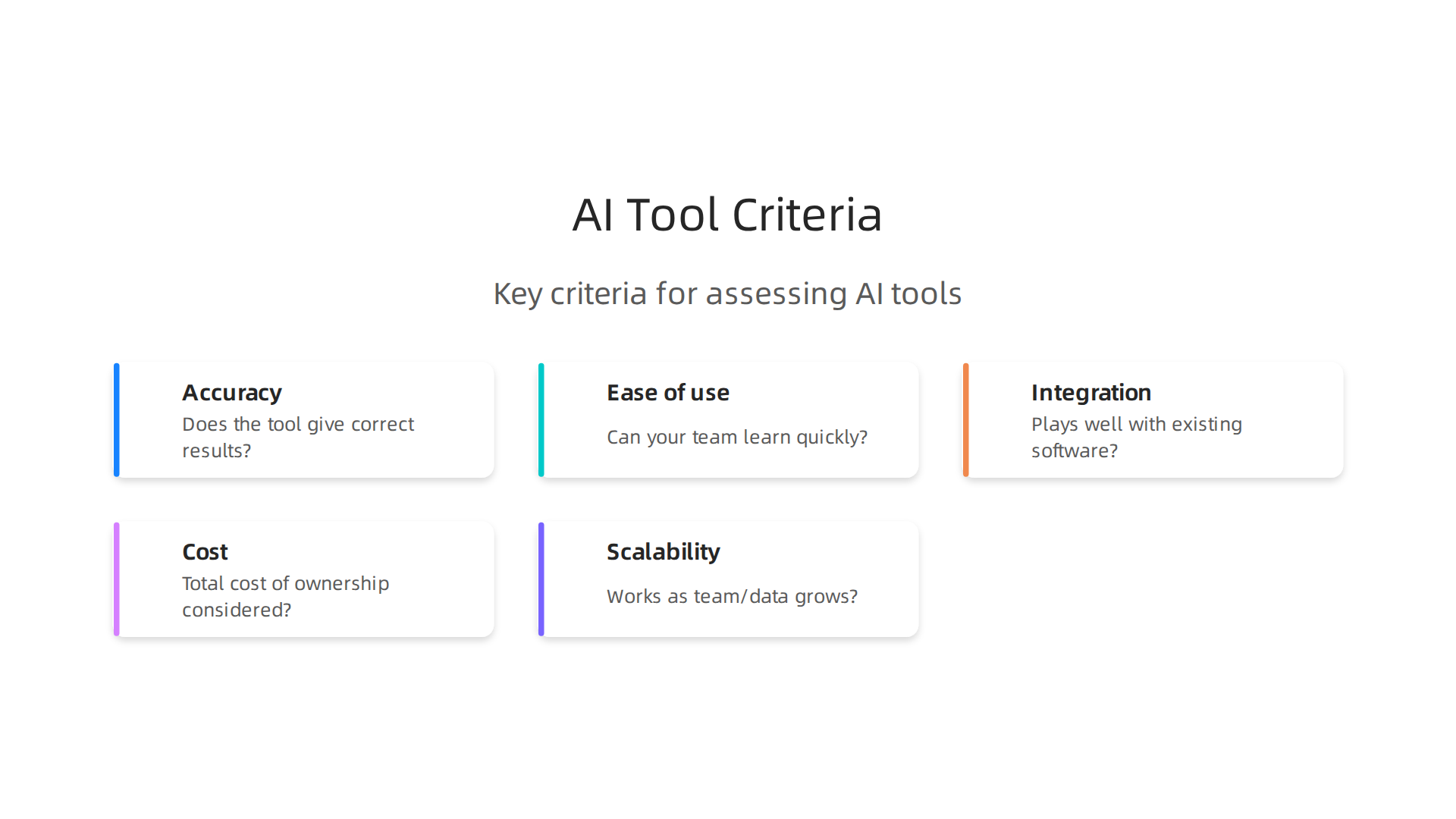
    Measuring ROI is key. The JPMorgan Chase Institute notes that AI tools promise productivity gains through task automation and better decision making JPMorgan Chase Institute. So before you implement, record your current metrics. After 30 days, compare them. You might be surprised at the improvement.

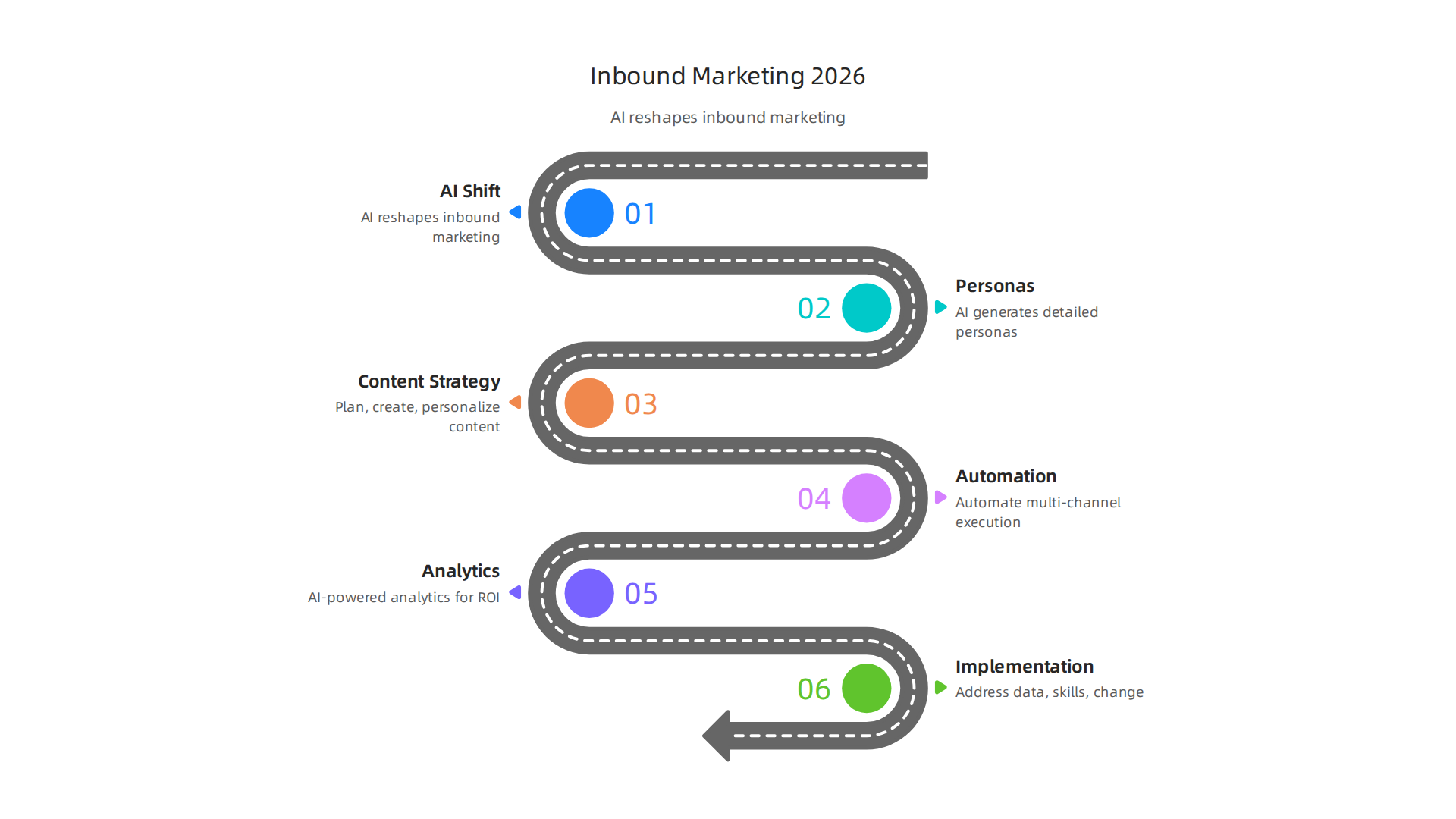
    Challenge 4: Lack of Technical Skills

    You do not need a computer science degree to use AI. Most tools are designed for non-technical users. Still, investing in a little training goes a long way. Platforms like LinkedIn Learning and many tool vendors offer free tutorials.

    One practical tip: start with a tool that helps you write content that sounds human. If you are unsure where to begin, check out our guide on how undetectable AI helps you write content that sounds human and gets results. It walks you through the setup without any coding needed.

    Your Next Move

    The biggest mistake is waiting for the perfect setup. Instead, start small. Pick one challenge, one tool, and one metric. Track your results. Adjust as you go. That is how real adoption happens in 2026.

    The Future of AI: What Professionals Should Prepare For (2026 and Beyond)

    You have tackled the challenges and started using AI today. But what comes next? Knowing where AI is heading helps you stay ahead instead of playing catch up.

    Here is the thing. The question "when was artificial intelligence made" goes back to the 1950s. But the AI we use in 2026 barely looks like those early experiments. The pace of change is staggering. And professionals who understand the trends will have a clear advantage.

    The Four Big Trends Shaping 2026

    According to experts at IBM, we are moving into an era of agentic AI and multimodal systems IBM. What does that mean for you?

    1. Multimodal AI: Tools that process text, images, audio, and video together. Instead of working with separate tools, you ask one AI and it understands everything. This saves time and gives better results.

    2. Autonomous agents: These are AI tools that complete multi-step tasks on their own. You give them a goal and they figure out the steps. Microsoft calls this shift making AI a true partner rather than just a tool Microsoft.

    3. AI regulation: Governments are creating rules for how AI can be used. The conversation around google ai principles and responsible development is becoming central to business strategy. Info-Tech Research Group notes that foundational AI principles are rewriting organizational DNA Info-Tech.

    4. Edge AI: Processing happens on your device instead of the cloud. Faster responses, better privacy, and lower costs. This is a game changer for ai work in environments with spotty internet.

    Human-AI Collaboration Is the Real Goal

    Here is the shift that matters most. The future is not about AI replacing people. It is about co-intelligence: living and working with ai in a way that amplifies human skills.

    PwC predicts that more companies will adopt enterprise-wide AI strategies led by senior leadership PwC. That means your role changes from "doing the work" to "directing the AI that does the work."

    This human-AI partnership is already reshaping computer systems technology careers. Want a deeper look at how creativity and AI work together? Check out our analysis of human or AI creativity and what the data says about collaboration in 2026.

    Continuous Learning Is Your Safety Net

    The single most important skill in 2026 is adaptability. Stanford AI experts predict we will see continued rapid evolution across every sector Stanford HAI. Tools you learn today might look different in six months.

    That does not mean you should wait. It means you should build a habit of learning. Spend 15 minutes a week reading about new AI developments. Test one new tool per quarter. Ask yourself: how can this make my work better?

    The professionals who thrive in 2026 and beyond are not the ones with the most technical skill. They are the ones who stay curious, stay flexible, and stay focused on what AI can do for people.

    Summary

    Artificial intelligence traces back to a specific moment: the Dartmouth Summer Research Project on Artificial Intelligence in 1956, when John McCarthy and other researchers coined the term and set a research agenda. This article explains that origin, outlines the three core technologies—machine learning, neural networks, and natural language processing—that power modern systems, and walks through key milestones from Deep Blue to GPT-3 and multimodal models. It then shifts to practical guidance for businesses, describing common workplace applications (chatbots, writing assistants, predictive analytics, image/video generation) and a simple, problem-first framework to evaluate, pilot, and scale tools. The piece highlights common SMB obstacles—information overload, budget limits, tool selection, and skill gaps—and offers concrete fixes like 30-day pilots and ROI tracking. Finally, it looks ahead to trends such as multimodal AI, autonomous agents, edge processing, and the growing need for continuous learning and responsible AI governance. After reading, you’ll understand AI’s true origin, how the technology works, which business use cases deliver value, and how to adopt AI safely and strategically.