Tag: ai implementation

  • Mastering AI For Marketing Services In 2026

    Mastering AI For Marketing Services In 2026

    In 2026, artificial intelligence (AI) is changing everything, especially in the world of marketing. What started as a new trend is now a must-have tool for any business offering marketing services. It’s no longer enough to just be curious about AI. Now, marketing teams need a clear plan to use AI wisely.

    Businesses need to move from just looking at AI to having a real strategy for it.

    A marketing team collaborates to outline a clear AI strategy, moving beyond simple curiosity to defined goals.

    Without a good plan, companies might miss out on big chances to grow or make things better. Experts agree that business leaders need smart ways to find new opportunities, pick the best ideas for using AI, test them out carefully, see what works, and then use those good ideas on a larger scale. This helps turn early tries with AI into real wins for the business From AI pilots to performance: 3 things leaders need to unlock.

    This guide is here to help you get a handle on AI for your marketing services. We will give you easy-to-understand ways to think about AI. You’ll learn about how to pick the right AI tools and how to measure if they are truly helping your business. We will show you real examples of how AI can help with many tasks. This includes making better content, putting together impressive AI for presentations, and even having an intelligent AI virtual assistants for businesses to support your team.

    You’ll find practical ways to test new AI tools, checklists to help you choose the best options, and tips on how to see if your AI efforts are really paying off. Our goal is to make sure you can use AI to make your marketing smarter, faster, and more effective.

    To stay on top of the latest AI trends and how they impact business, consider subscribing:
    The AI Newsletter Worth Reading

    Before you pick any AI tools for your team, it’s super important to have a clear plan. Think of it like going on a trip. You wouldn’t just grab a map and start driving without knowing where you want to go, right? The same goes for using AI in your marketing services. In 2026, simply getting AI tools isn’t enough. You need a smart way to use them to reach your business goals.

    Your AI plan should directly match what your marketing services are trying to do. For example, if you want to get more new customers (called lead generation), AI could help find people who are most likely to buy from you. If your goal is to keep current customers happy and loyal (retention), AI might help you send them special messages they will love. Or, if you need to make lots of new ads or content quickly, AI can help scale your creative output. Having a clear vision like this is a key step to building a good AI strategy for marketing, as experts say you need to define the main results you want to achieve How do I build an AI strategy for marketing?.

    To figure out which AI ideas to try first, you can use a simple plan. Ask yourself three things about each AI idea:
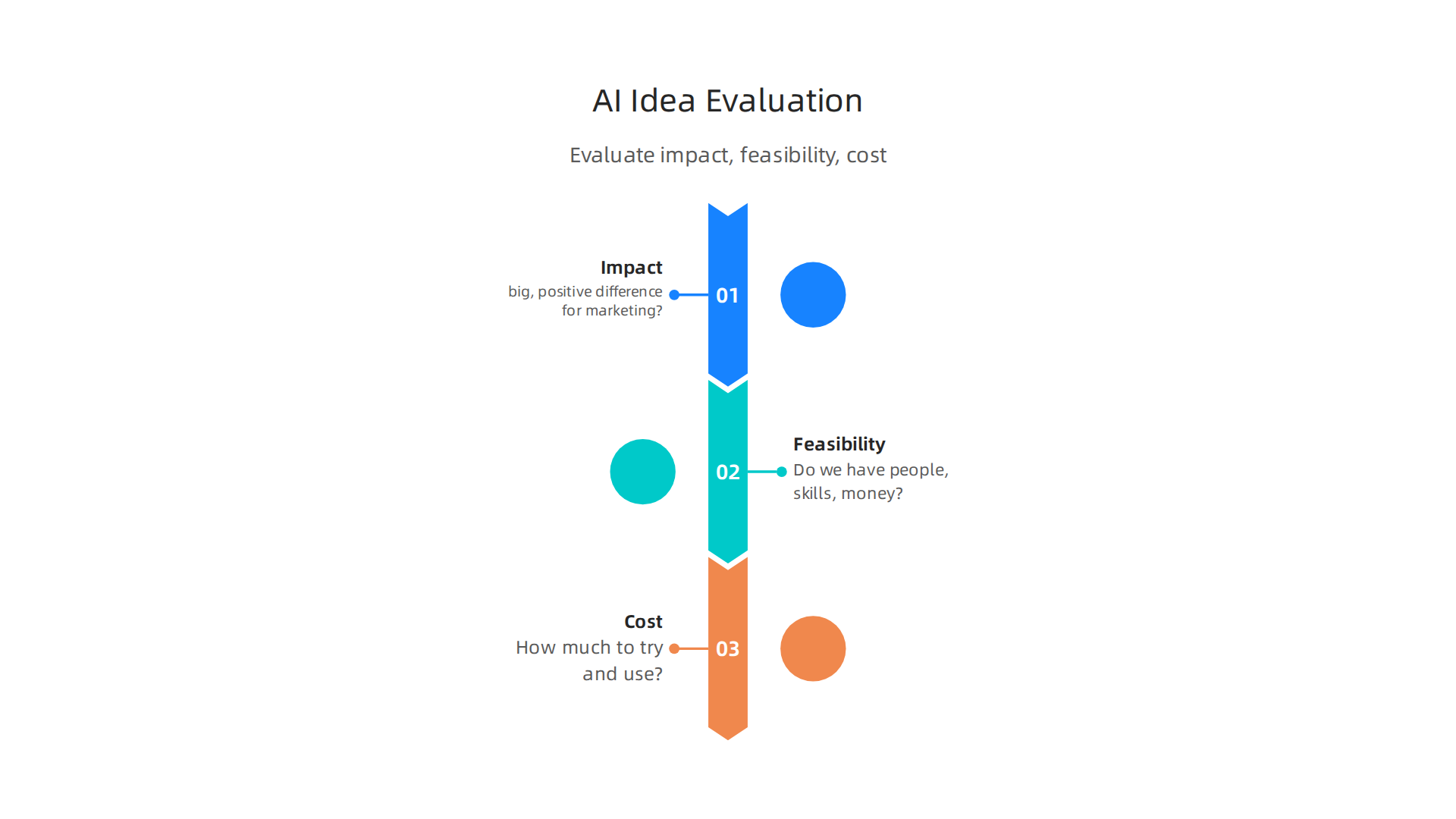
    Evaluate potential AI initiatives by considering their impact, feasibility, and cost.

    • Impact: Will this AI idea truly make a big, positive difference for our marketing services?
    • Feasibility: Can we actually do this right now? Do we have the people, skills, and money needed to make it happen?
    • Cost: How much will it cost to try out and use this AI tool?
      By thinking about these three points, you can choose the best projects that will bring the most value without costing too much or being too hard to set up. To learn more about selecting the right technology, consider reading our guide on how to pick AI tools for business to drive growth in 2026.

    A big mistake many teams make is picking AI tools before they know what they want to achieve. This is like buying a fancy hammer without knowing if you need to build a house or fix a leaky faucet. When you choose tools first, you might end up with expensive software that doesn’t really help your marketing services goals. This can lead to wasted money and time. Reports from 2026 show that while many businesses are using AI, a lot of them aren’t truly seeing big improvements in their work because they lack a clear plan State of Marketing in an AI-Driven World: 2026 Adobe Report. In fact, one report found that only 41% of marketers can clearly show how AI is helping them make more money Report: The State of AI in Marketing 2026. By setting your strategy first, you make sure that every AI tool you choose works towards your real business needs.

    Now that you have a clear plan for what you want your marketing services to achieve, the next step is to look closely at your current ways of doing things. This helps you find the best spots where AI can make a real difference. Think of it as looking under the hood of your marketing car to see which parts could run better with a little AI tune-up.

    To do this, you need to audit your marketing processes. This means checking out everything your team does, from making ads to talking with customers. Where are the tasks that take a lot of time? Where do you wish you had more help or better insights? These are often the places where AI can fit in perfectly.

    Many marketing teams in 2026 are finding big wins with AI in a few key areas:
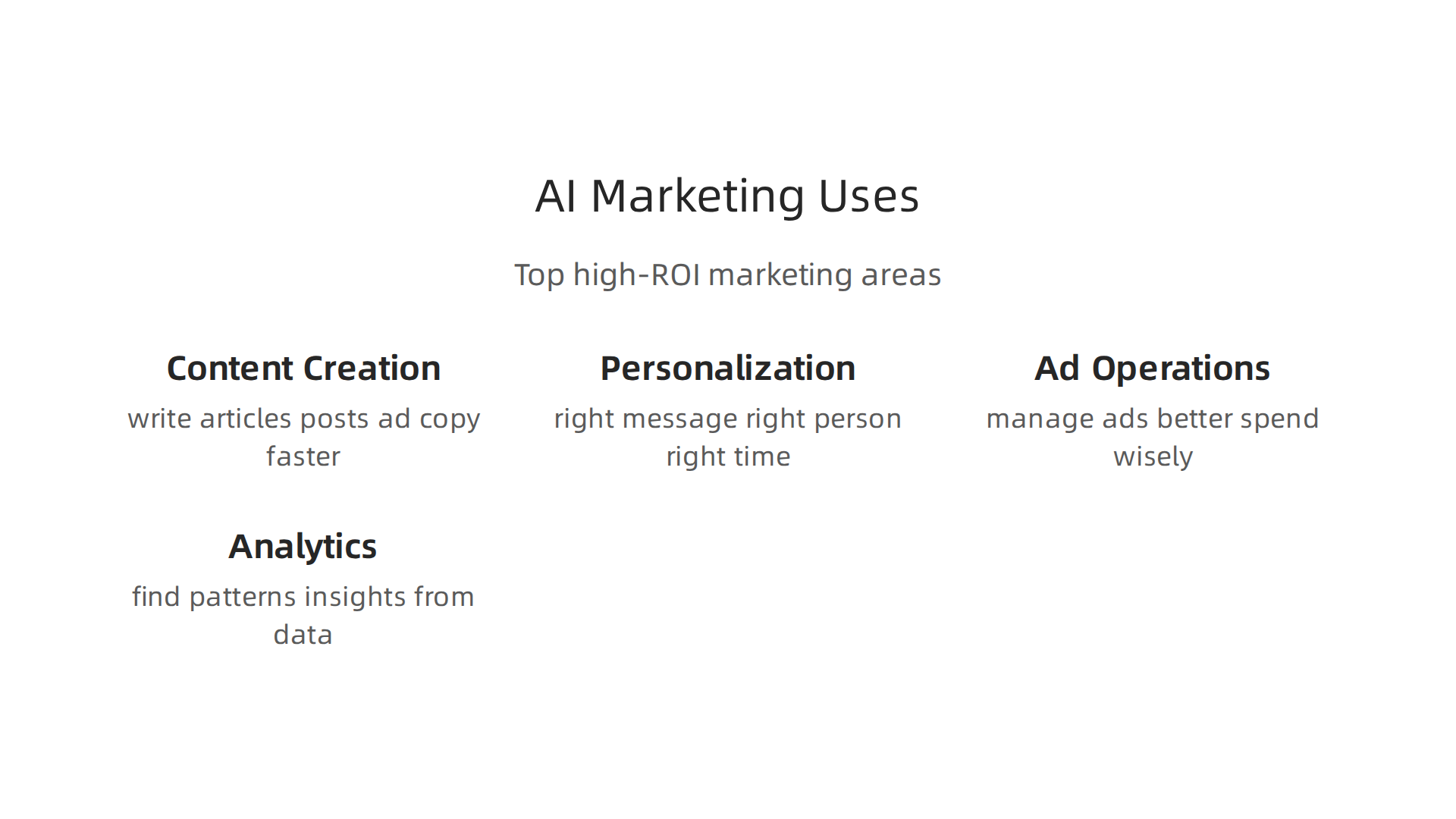
    Explore the top areas where AI is delivering significant value for marketing teams.

    • Content Creation: This is still the top use case for AI. AI can help write articles, social media posts, or ad copy much faster. This means your team can create more content without getting swamped. Reports show that content creation is used by 78% of teams, making it the most common way to use AI in marketing State of AI Marketing 2026 | Enterprise AI Adoption Report.
    • Personalization: AI can help you send the right message to the right person at the right time. This makes customers feel special and more likely to buy.
    • Ad Operations (Ad Ops): AI can manage your ads better by figuring out who to show them to and when, which helps you spend your ad money wisely.
    • Analytics: AI can look at huge amounts of data and find patterns or insights that humans might miss. This helps you understand what’s working and what’s not in your marketing campaigns. It’s like having a super-smart marketing assistant.

    When you’re looking at different ideas for using AI, you should score each one based on three things:

    • Potential Impact (ROI): How much positive change or money will this AI idea bring in? Will it truly help your marketing services grow or save costs? Teams focused on ROI see much better results from their AI efforts, with 83% of marketing teams reporting clear gains from generative AI AI Marketing Stats for 2026: ROI & Benchmarks.
    • Data Readiness: Do you have the right kind of data that the AI tool needs to work well? If not, how hard will it be to get that data ready?
    • Integration Complexity: How easy or hard will it be to connect this new AI tool with the other tools and systems you already use?

    Sometimes it’s better to start with a "narrow pilot." This means trying out an AI tool for a small, specific task with a small team. For example, you might use AI to just help with writing headlines for your emails. If that works well, then you can think about a "platform-wide rollout," which means using AI across many different tasks and teams in your marketing services. Starting small helps you learn and fix problems before doing something big.

    To learn more about how marketing pros choose AI tools for their work, check out our guide on how marketing specialists choose AI tools for marketing and drive ROI.

    For daily updates on how AI is changing marketing and business, you’ll want to stay informed.
    Get clear daily AI updates from The AI Newsletter Worth Reading.

    Choosing the right AI tools for your marketing services is a big step after you know where AI can help most.

    A professional carefully evaluates different AI tools and vendors to make an informed decision.

    It’s like picking the best helper for your team. You want to make sure the tool can actually do the job well. To do this, you need a good checklist.

    What to Look For in AI Tools

    When you’re looking at different AI tools, keep these things in mind:
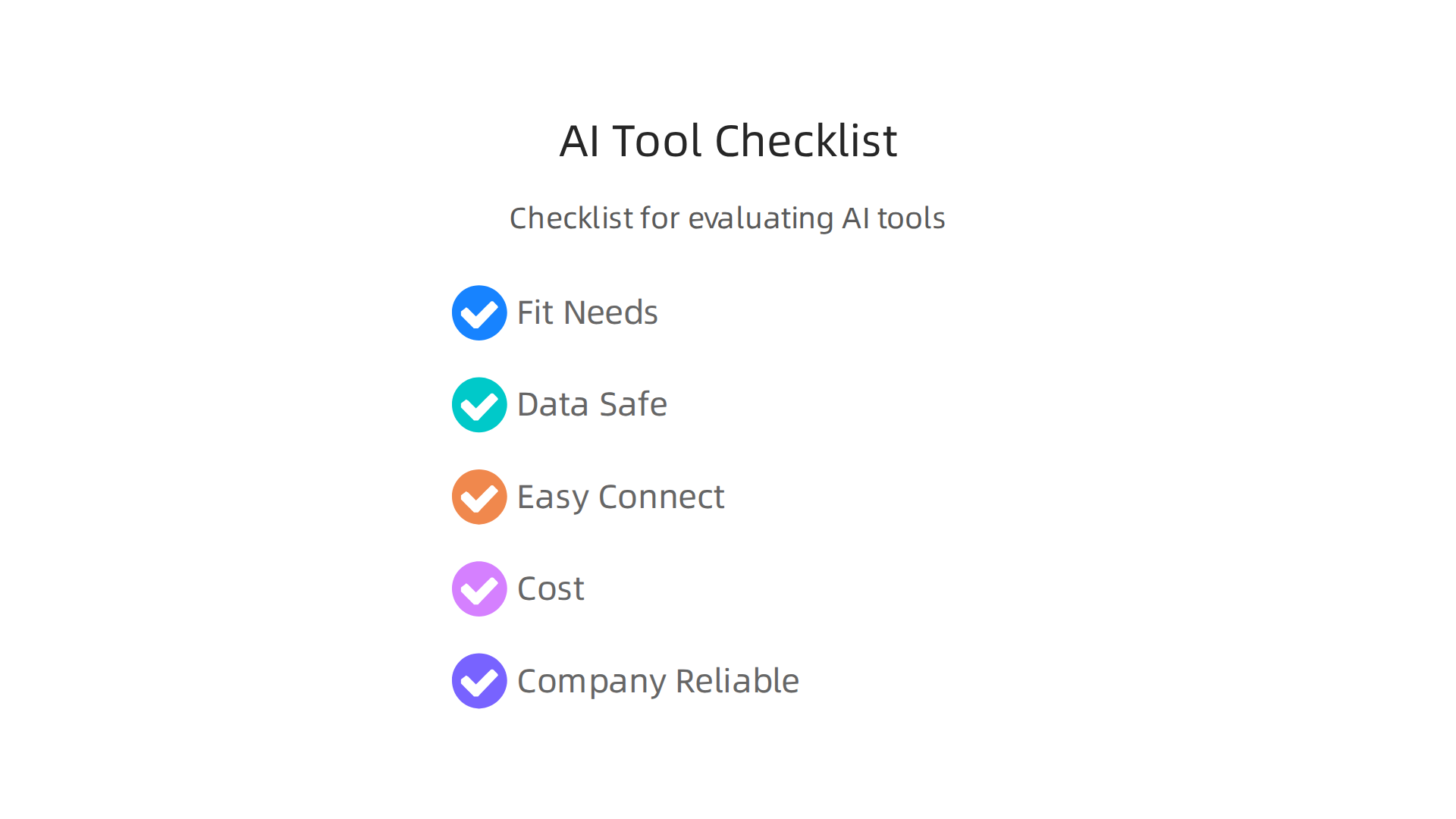
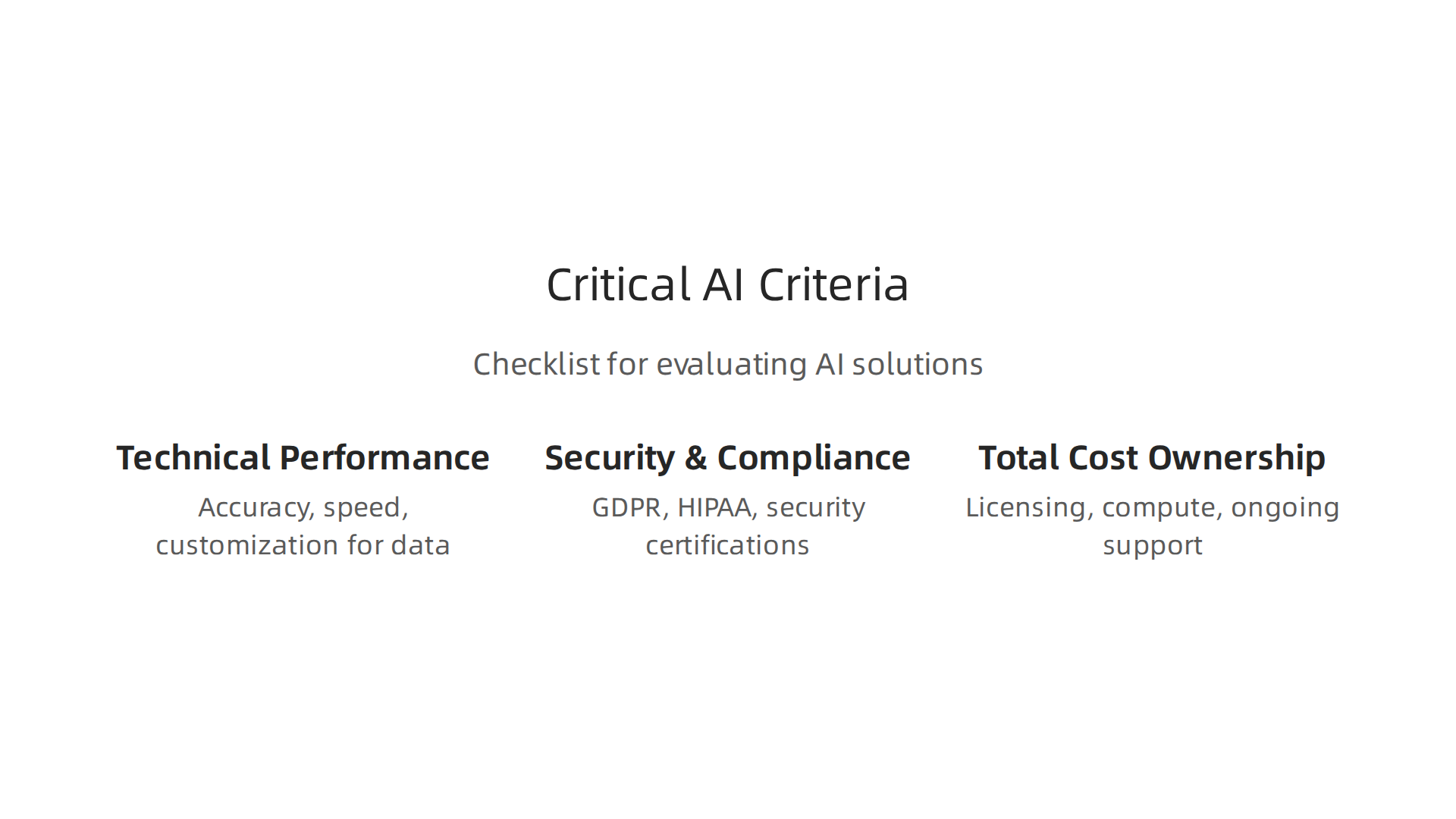
    Checklist for evaluating AI tools, focusing on needs fit, data safety, integration, cost, and company reliability.

    • Does it fit your needs? The AI tool must be able to do the specific tasks you need. If you want AI to help write social media posts, the tool should be good at that. Don’t pick a tool that does many things poorly when you need one thing done perfectly. You want a tool that truly boosts your marketing services.
    • Is your data safe? AI tools often need to use your company’s data. You must be sure that the tool and the company that made it will keep your information private and secure. This is very important for trust and legal reasons.
    • How easy is it to connect? Think about your current marketing tools. Will the new AI tool easily work with them? Or will it be a headache to link everything up? An AI tool that connects smoothly with your existing setup makes life much easier.
    • What does it cost? Understand how the AI tool charges you. Is it a monthly fee, or do you pay based on how much you use it? Make sure the cost makes sense for your budget and the value you expect to get. Tools that offer clear pricing help you manage your money better.
    • Is the company reliable? Look at the company behind the AI tool. Have they been around for a while? Do they update their tools often? A strong, reliable company means you’ll get good support and that the tool will keep getting better. A template for evaluating technology vendors can help you score different options to ensure they meet your business needs and values R E S P O N S I B L E A I T E M P L A T E.

    Testing AI Tools in Real Life

    Once you have a few tools in mind, it’s a good idea to test them. This is called a "Proof of Concept" (POC) or a "pilot."

    • Try them side-by-side: Don’t just pick one tool. Try out two or three tools at the same time for the same small task. For example, have Tool A and Tool B both write headlines for your next email campaign. See which one does better. This helps you compare them fairly.
    • Focus on how they work, not just features: It’s not just about what a tool can do, but how well it actually works for your team every day. Does it save time? Is it easy to use? Does it fit into your team’s workflow without causing problems? This helps you find the best fit for your marketing services. A good way to compare is by using a scorecard for different criteria, making sure you look at things like how deep the AI’s capabilities are and how well it fits your specific marketing needs How to Evaluate B2B AI Marketing Vendors: 12 Questions … – Tofu HQ.

    By carefully checking these things, you can choose AI tools that truly help your marketing efforts grow. If you want a more general guide on how to make smart choices for your business, you can read more about how to pick AI tools for business to drive growth in 2026. This careful process makes sure you’re getting a real marketing assistant, not just a fancy gadget.

    After testing AI tools with a small "Proof of Concept," the next big step is to make them a regular part of your marketing services. This means moving from a small test to full "production." It’s like moving from trying out a recipe to cooking it for all your customers every day. You need a clear plan to do this right.

    Getting AI Tools Ready for Daily Marketing

    Putting AI into your daily work for your marketing services needs careful steps.

    • Set up the Data Flow: Your AI tools need good data to work. Think about how your company’s information will safely get to the AI tool. This involves setting up "data pipelines," which are like highways for your data. You also need to make sure the data is clean and correct. If the data is bad, the AI’s results will be bad too. For marketing leaders, a good approach to data governance is key when using AI systems Snowflake’s Agentic Enterprise Framework Puts Data ….
    • Keep Testing and Improving: Even after a pilot program, you should keep testing the AI. As your marketing needs change, the AI tools might need to learn new things or be adjusted. This helps ensure the AI continues to perform its best for your team.
    • Rollout Slowly: Don’t just give the AI tool to everyone at once. Start with a small group, get their feedback, and then slowly bring more people on board. This "rollout cadence" helps everyone get used to the new tools without too much stress. It also lets you fix small problems before they become big ones.

    Teamwork and Rules for AI Success

    Making AI a permanent part of your marketing services means more than just turning on a new tool. It needs good teamwork and clear rules.

    • Assign Clear Roles: While marketing teams often lead the charge in adopting AI, they need help from others. Your IT team can help with security, your legal team can make sure you follow privacy rules, and data experts can check for fairness. Having everyone work together helps make sure the AI is used responsibly. In fact, setting up strong governance that includes different departments is important for using AI in a way that truly helps the business What governance structures support responsible AI?.
    • Create AI Rules (Governance): Just like you have rules for how your team works, you need rules for how your AI works. This is called "AI governance." It helps make sure the AI tools are used fairly, correctly, and ethically. For example, the European Data Protection Board updated its rules in 2026 to make sure AI agents follow data privacy principles at every step AI Agents and Data Privacy: A 2026 Compliance Guide – MTM Blog.
    • Watch for Bias and Protect Privacy: AI tools learn from data, and sometimes that data can have unfair patterns, or "bias." You need to look for this bias and work to fix it, perhaps by using fair data generation techniques Mitigating bias in artificial intelligence: Fair data generation via …. Also, always make sure the AI tool handles customer data with the highest privacy standards, especially in 2026, when data privacy rules are stricter than ever. Staying up-to-date on compliance is a must.

    By taking these steps, you make sure your AI tools don’t just work in a test, but truly become a strong marketing assistant for your business. This careful planning helps your marketing services grow and adapt for the future.

    If you want to keep learning about how AI impacts your business and marketing, you’ll find helpful insights in "The AI Newsletter Worth Reading." Get clear daily AI updates from The Deep View Newsletter.

    5) Measure What Matters: KPIs, Attribution, and ROI for AI-Driven Marketing

    Once AI tools are part of your daily marketing services, it’s super important to know if they are actually helping.

    A professional focuses intently on data and reports, measuring the impact of marketing initiatives.

    You need to measure their success. This means looking at certain numbers, understanding how AI causes good changes, and checking if you are getting a good return on your money.

    Picking the Right Numbers to Watch

    Before you even start using AI for your marketing, you need to know what you want to improve. These are called Key Performance Indicators, or KPIs. They are like scores that show how well your marketing is doing. For AI-driven marketing, you might look at things like:

    • How many new customers you get.
    • How many people click on your ads.
    • How much money each customer spends over time (this is called customer lifetime value, or LTV).
    • How much it costs to get a new customer (this is called customer acquisition cost, or CAC).

    It’s a good idea to know what these numbers were before you used AI. This way, you can see if the AI is making them better. Experts say you should set clear goals and measure your starting point before adding AI to your marketing efforts How do I measure the ROI of AI marketing investments?. This helps you tell a real story about how AI helps your marketing services.

    Knowing What Changes Are Due to AI

    When you use AI, many things might change. How do you know for sure that AI is the reason for a boost in sales or leads? This is where "attribution" and "experimentation" come in.

    • Attribution means figuring out which part of your marketing efforts gets credit for a result. With AI, you want to give the AI the right amount of credit.
    • Experimentation is like running a science test. You can split your audience into two groups: one that gets the AI-powered marketing (the "test" group) and one that doesn’t (the "control" group). By comparing these groups, you can see the true extra help, or "incremental lift," that AI brings. Methods like A/B tests help you find the real impact of your AI tools 2026 Marketing Playbook: Proven AI & Attribution Strategies. Companies that use smart attribution methods can see much better returns on their marketing money Marketing Attribution Statistics (2026): 54+ Data Points on ….

    To really dive deep into how AI can boost your sales and leads, learning about these measurement methods is key. You can find more helpful advice on how marketing specialists choose AI tools to drive ROI.

    Figuring Out Your Return on Investment (ROI)

    ROI means how much money you get back for the money you spent. For AI in marketing, it’s about seeing if the AI tools are worth their cost. A simple way to think about it is:

    ROI = (Extra Money Made + Money Saved − Total Cost of AI) ÷ Total Cost of AI

    Measuring AI’s ROI in marketing is not just a single number; it’s a process of setting a baseline, running tests, and then seeing the extra lift AI provides How Directors Measure AI ROI in Ad Campaigns | Pixis. Many companies are already seeing great results. In fact, about 60% of companies that have changed how they measure AI are getting two to three times their money back, or even more Report: The State of AI in Marketing 2026 – Jasper. This shows that with careful planning and measurement, AI can be a powerful marketing assistant.

    When you measure what matters, you make sure your AI investments are truly helping your marketing services grow and succeed. For further reading on this topic, consider learning more about how to get real ROI from AI marketing cloud.

    6) Data Governance, Privacy, and Ethical Considerations for Marketing Services

    After seeing how artificial intelligence (AI) can help your marketing services grow and succeed, it’s just as important to talk about how to use it wisely and fairly.
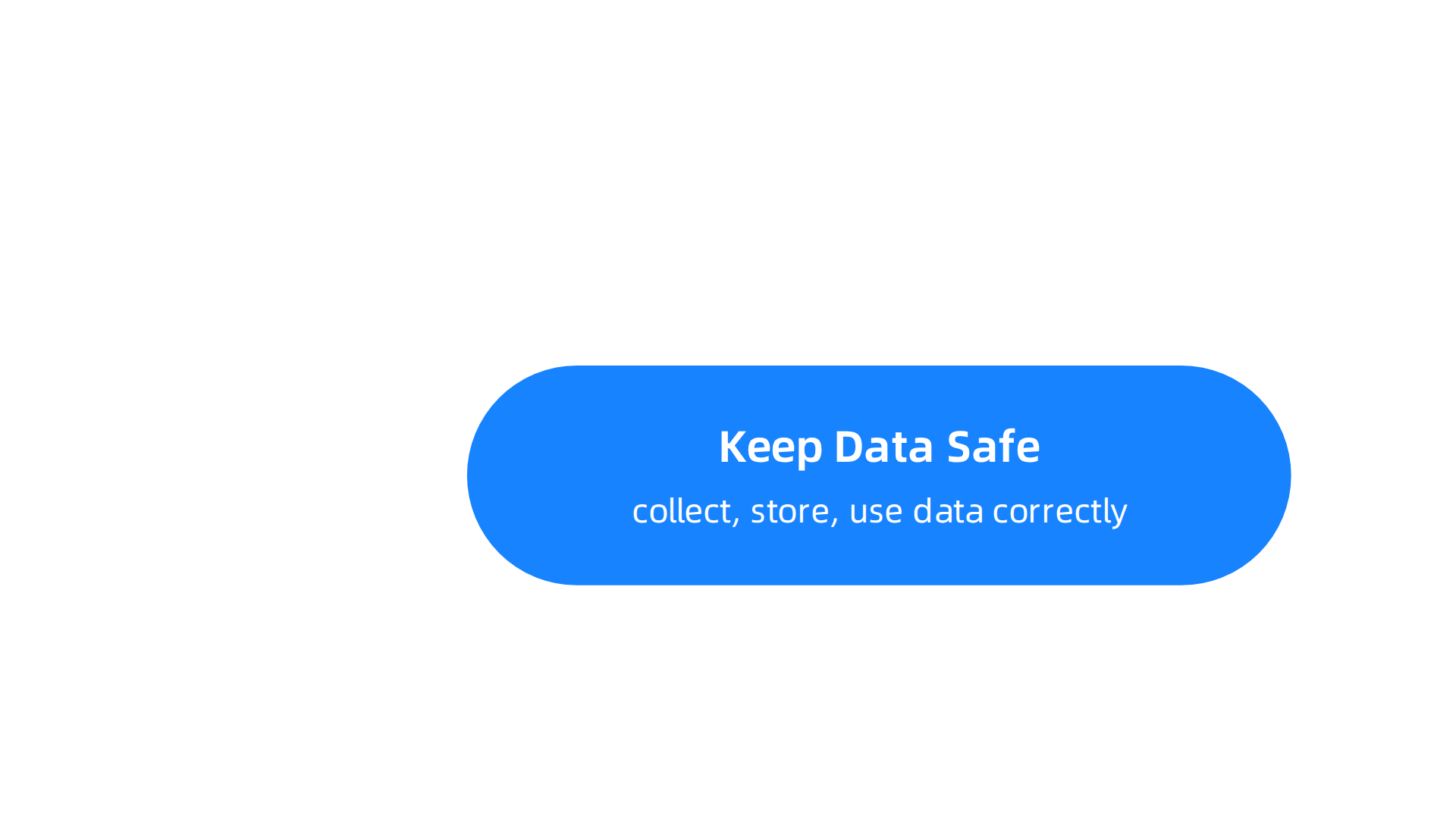
    Key ethical considerations for AI in marketing: data safety, fairness, and transparency.

    This means looking closely at how you handle data, respect people’s privacy, and make sure your AI systems are ethical. It’s not just about making money; it’s about building trust and following the rules in 2026.

    Keeping Data Safe and Private with AI

    When you use AI for marketing services, you’re often dealing with lots of customer information. "Data governance" is like having a clear set of rules for how you collect, store, and use this data. It makes sure your data is correct, kept safe, and used in a way that follows the law. Experts agree that your AI plan and your data rules must go hand-in-hand Snowflake’s Agentic Enterprise Framework Puts Data Governance at the Center of Marketing.

    In 2026, privacy is a big deal. New guidelines, like those from the European Data Protection Board, tell us that when AI agents process personal information, we must only collect the data we truly need and only use it for the reasons we said we would AI Agents and Data Privacy: A 2026 Compliance Guide. This is called "data minimization" and "purpose limitation." To help with this, you should do special checks, sometimes called "privacy impact assessments," before using AI systems that handle personal data. These assessments help ensure you’re using AI responsibly and protecting people’s privacy Privacy as the Foundation of Responsible AI Governance. It’s a key part of the larger topic of mastering the AI future standard 2026.

    Making AI Fair and Unbiased

    AI learns from the data it’s given. If that data has unfair patterns or gaps, the AI can learn those same biases and make unfair decisions. For instance, an AI for marketing services might unfairly target certain groups or miss others, just because of old data.

    To make sure your AI is fair, you need to:

    • Find Bias: Look closely at the data you feed your AI and the results it gives. You want to spot any unfair patterns. Learning to understand how an AI model works is important for finding these biases Systematic literature review on bias mitigation in generative AI.
    • Fix Bias: Take steps to reduce any bias you find. This can mean changing the data, adjusting the AI’s learning process, or fixing the results it gives. These steps can happen before, during, or after the AI does its work Bias mitigation in generative AI.

    It’s about making sure your AI acts like a fair and helpful marketing assistant, not one that carries old prejudices.

    Being Clear and Keeping Records

    For ethical AI, it’s also important to be clear about how your AI makes decisions. This is called "transparency." It means you should be able to explain, in simple terms, why your AI chose one thing over another.

    You also need good records. Keeping detailed notes about your AI systems helps you show how they work, what data they use, and why they make certain choices. This is very helpful if you ever need to have an audit or review. Having different teams involved, like marketing, legal, and IT, can help ensure everyone is on the same page and that your AI systems are both effective and responsible. This kind of teamwork is vital for a good strategic guide to marketing AI agents and their ethical deployment.

    Staying informed about the newest AI practices, including ethical guidelines, is important for any business leader.

    Get clear daily AI updates and stay ahead of the curve. The AI Newsletter Worth Reading will keep you in the know.

    Summary

    This article explains how marketing teams should move from experimenting with AI to running a clear, business-focused AI strategy that drives measurable results. It covers how to set goals that align AI initiatives with marketing KPIs, how to audit current processes to find high-impact use cases (content, personalization, ad ops, analytics), and a simple prioritization framework based on impact, feasibility, and cost. You’ll learn how to run narrow pilots, evaluate and compare tools with a vendor checklist, and prepare data pipelines and rollout plans for production. The guide also details governance needs—privacy, bias mitigation, and cross-functional roles—and shows how to measure AI success through attribution, experimentation, and ROI calculations. After reading, you’ll be able to pick the right pilot projects, test tools sensibly, and scale AI in marketing while protecting data and proving value.


  • Unlock Business Growth with U.S. Tech Solutions and AI in 2026

    Unlock Business Growth with U.S. Tech Solutions and AI in 2026

    Why U.S. tech solutions and AI initiatives matter now

    The world of Artificial Intelligence (AI) is moving very, very fast in 2026. Every day, it seems like there’s a new tool or idea. For businesses in the U.S., this means big chances to grow and do things better. It also means it can be hard to keep up. Reports show that U.S. private AI investment reached $285.9 billion in 2025, showing just how much money is pouring into this area The 2026 AI Index Report | Stanford HAI. Many companies are already using AI, with about 18 percent of firms having adopted it by late 2025 Monitoring AI Adoption in the U.S. Economy.

    This speedy change creates a challenge. There’s so much information out there about new AI tools and us tech solutions that it’s easy to feel lost.

    A business leader feeling overwhelmed by the rapid pace of AI innovation and numerous new tools.

    How do you pick the right tools for your team? How do you know what will actually help your business, instead of just adding more work? It’s a real problem for professionals, creators, and business leaders trying to make smart choices. You want to use these powerful tools, but you need clear steps to follow.

    That’s exactly why this article is here. We want to cut through the noise and give you helpful, simple advice. This guide will help you understand how to pick, use, and grow with AI tools. You’ll learn practical steps to find the best AI for business tools that deliver real results in 2026. We’ll also show you how to choose trusted resources and build confidence in your AI choices.

    In a world full of new information every single day, it can be tough to know what’s truly important. If you want to keep up with the latest in AI and technology without feeling overwhelmed, we have a great resource for you. Get clear daily AI updates from The AI Newsletter Worth Reading.

    1. U.S. market overview: demand, sectors, and spending patterns

    As AI keeps growing faster than ever in 2026, U.S. businesses are eagerly looking for new ways to use this powerful technology. More and more companies understand that AI is not just a passing trend; it’s a key part of how they will work and grow. Reports show that a lot of people in the U.S. are already using AI in their daily lives. Over 60% of adults in the U.S. use AI at least a few times a week, and about 31% use it almost all the time or several times a day Public Opinion. This shows a big demand for good AI tools and us tech solutions.

    This demand isn’t just in a few big cities. AI use is spreading all over the United States, reaching many different areas.

    A diverse team collaborating, symbolizing AI's widespread adoption across various regions and industries.

    This means that businesses in all kinds of places are starting to explore what AI can do for them AI Diffusion in the United States.

    Which industries are spending the most?

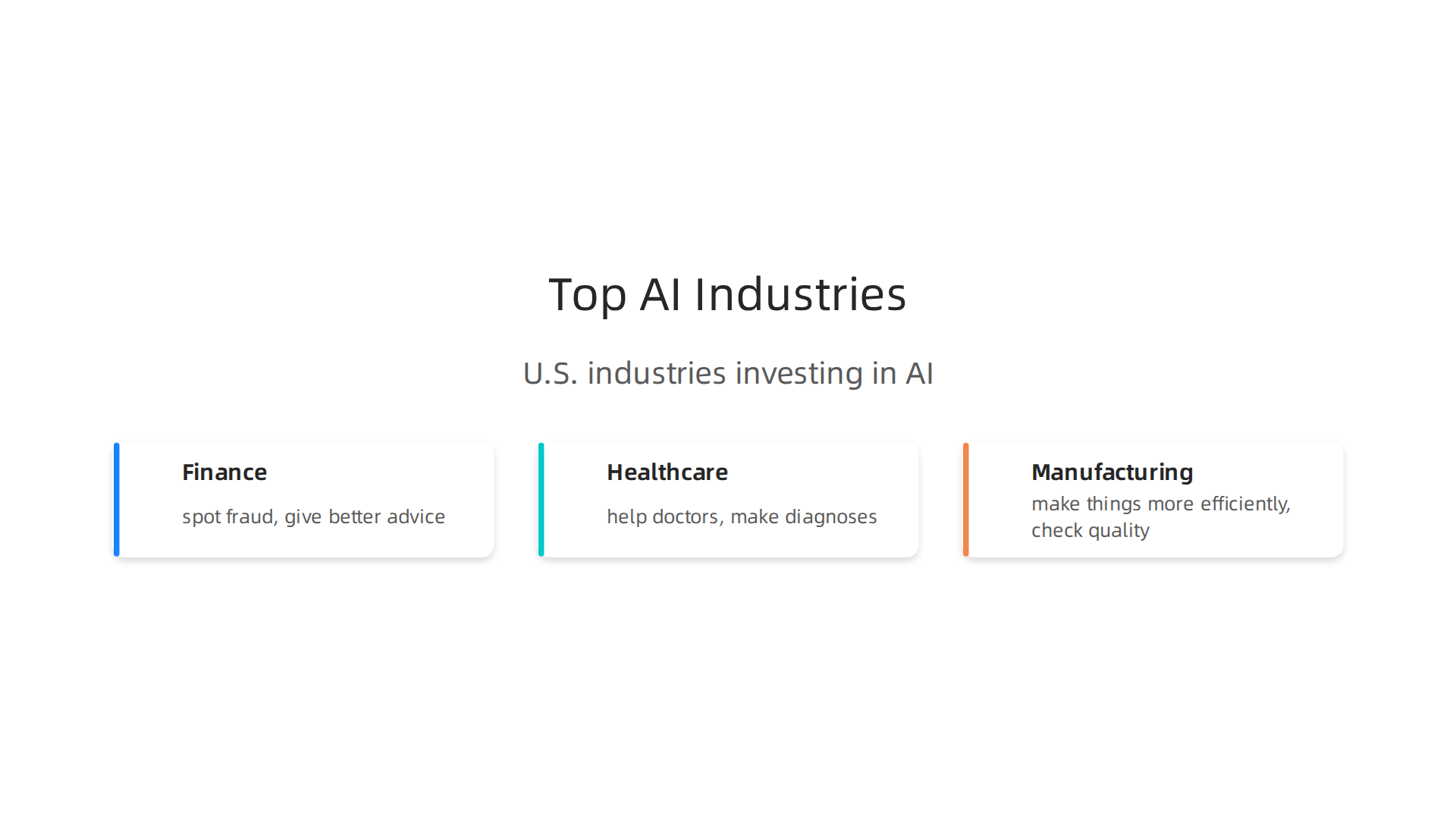
    Many types of businesses are putting a lot of money into AI. Some of the top industries that are investing heavily include:

    A visual breakdown of key U.S. industries heavily investing in AI and their primary applications.

    • Finance: Banks and other money-related companies use AI to spot fraud, give better advice, and help customers.
    • Healthcare: Hospitals and clinics use AI to help doctors, make diagnoses, and manage patient care.
    • Manufacturing: Factories use AI to make things more efficiently, check quality, and keep machines running smoothly.

    Companies across the U.S. are planning to spend even more on AI this year. On average, organizations expect to spend around $207 million on AI in the next 12 months. This is almost double what they spent last year AI Quarterly Pulse Survey – Q1 2026 – KPMG International. It’s clear that AI is a big budget item for many businesses.

    How businesses buy AI tools

    The way companies buy AI solutions often depends on their size.

    • Big Companies (Enterprise Teams): These large businesses, like those you might find on a big tech campus, often need very powerful and complex AI systems. They might spend millions of dollars. They look for big AI platforms that can be built into many different parts of their work. They want solutions that offer strong security, can handle huge amounts of data, and connect with all their existing software. For them, finding the right enterprise AI platforms 2026 is a big decision. Many choose to work with specialized AI solution providers in the USA who can build custom tools just for them. These big players are also keen to identify AI leadership in the market.

    • Small and Medium Businesses (SMBs): Smaller companies usually have less money to spend. They look for simpler, more affordable us tech solutions that can solve one or two clear problems quickly. They want tools that are easy to use and show a clear benefit fast. For example, a small marketing agency might look for an [innotech website] tool that helps automate their social media posts. The cost of these tools can vary, but many choose options like ChatGPT Enterprise, which can cost about $60 per user each month AI Software Pricing 2026: 18 Tools Compared (Real Costs). They want practical AI tech products for their team that will help them save time and money without being too complicated.

    The way companies buy AI tools changes depending on their size and what they need. Now, let’s look at the different kinds of leading us tech solutions and the companies that make them. Understanding these categories can help any business pick the right AI tools for their team.

    Different types of AI solution providers

    The world of AI solutions is full of many different kinds of vendors. Each one focuses on a certain part of the AI journey.

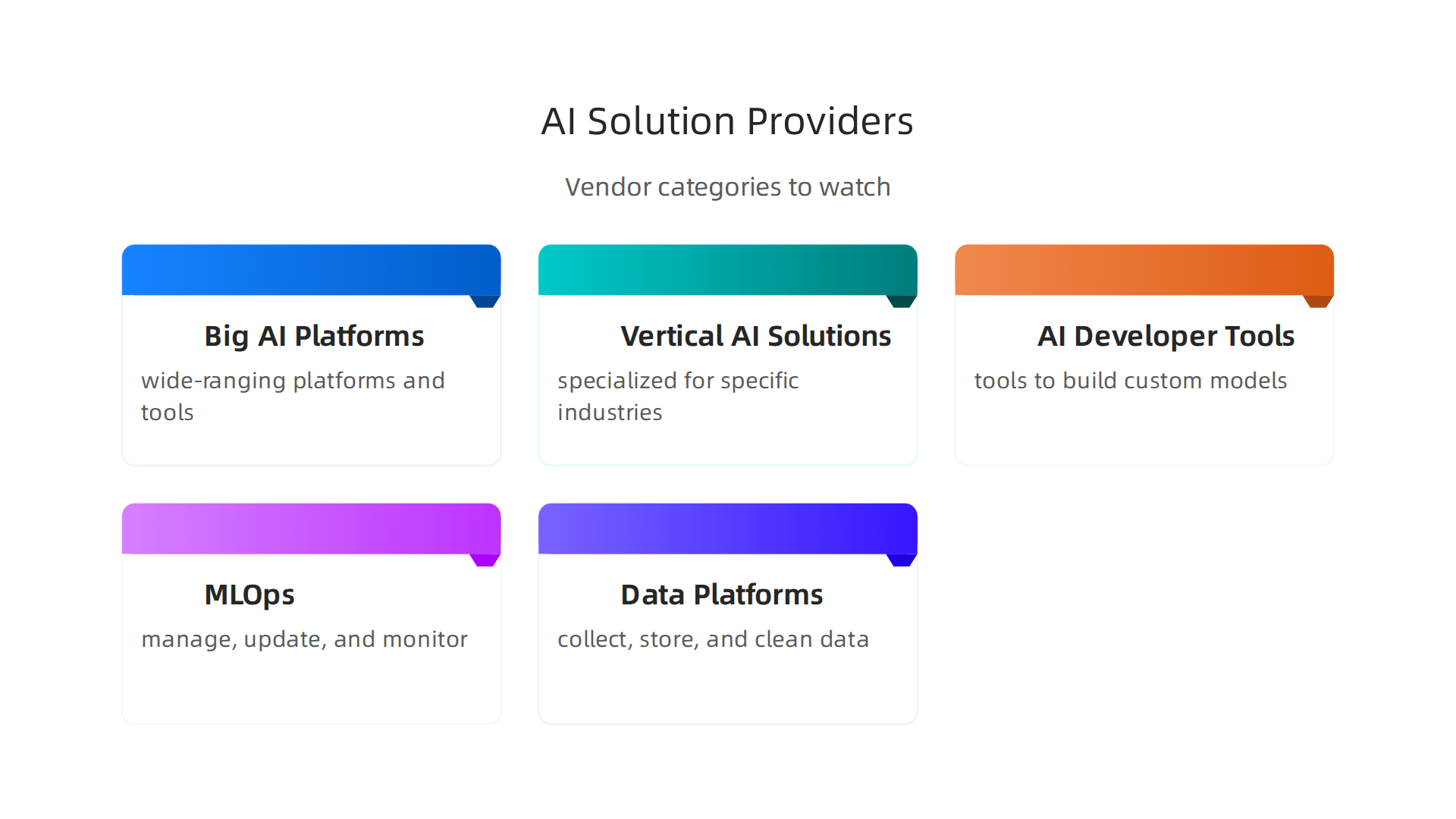
    Understanding the diverse landscape of AI solution providers, from platforms to specialized tools.

    • Big AI Platforms: These are like the big stores that sell everything. Companies such as Microsoft, Google, AWS, and IBM offer wide-ranging AI platforms. These platforms provide many tools in one place, from building AI models to running them and keeping them safe. They are usually chosen by larger businesses because they can handle huge tasks and need a lot of setup. For example, some platforms are known for being very safe and meeting important rules How to Evaluate Enterprise AI Platforms for Security and Compliance. These big platforms often aim to offer complete enterprise AI solutions that cover many business needs.

    • Vertical AI Solutions: These are specialized tools made for one specific job or industry. Think of AI that is just for healthcare to help doctors, or AI for marketing to create better ads. These solutions are often easier to use and faster to set up because they are designed for a clear purpose. A small business might find an [innotech website] tool for automating customer service much more useful than a huge, general AI platform. These focused us tech solutions help businesses get quick results for their unique problems.

    • AI Developer Tools: These tools are for people who know how to code and want to build their own custom AI programs. They give developers the building blocks to create new AI features or deeply connect AI with existing software. These tools are important for companies that want something truly unique or need to make AI work in a very specific way.

    • MLOps (Machine Learning Operations): Once an AI model is built, it needs to be managed, updated, and monitored. MLOps tools help with this. They make sure AI models keep working well, learn from new data, and don’t cause problems. These tools are key for companies that use many AI models or rely on AI for critical tasks. An AI implementation roadmap often includes plans for MLOps from pilot to production, showing its importance in making sure AI solutions work in the real world Your AI Implementation Roadmap: Guide for 2026 Success.

    • Data Platforms: AI needs good data to learn and work well. Data platforms help businesses collect, store, clean, and get their data ready for AI. Without clean, organized data, even the best AI tools won’t perform correctly. These platforms are the foundation for any successful AI project.

    How to pick the right AI solution

    Choosing the right AI vendor means looking at what your business needs and what your team can handle.

    • For small and medium businesses (SMBs): If you’re an SMB, you’ll likely want a vertical AI solution or a simpler platform that solves a clear business problem. Look for tools that are easy to use, don’t cost too much, and offer clear benefits, like a tool for improving your website or managing tasks. You might also want to explore solutions that offer clear plans for how to get started with AI quickly, like a 90-day plan for custom AI automation Custom AI Automation Roadmap for SMB Teams (30-60-90 Days). It’s about finding practical [us tech solutions] that fit your budget and don’t require a lot of technical know-how.

    • For larger companies (Enterprise Teams): Big companies need solutions that can handle large amounts of data, work with many existing systems, and offer strong security. They might use a mix of big AI platforms for core tasks and specialized tools for certain departments. They often need help moving their AI ideas from small tests to full use across the company Enterprise AI in 2026: Navigating the Shift from Pilots to …. When looking at bigger projects, companies might even consider academic partnerships, perhaps with a place like Dartmouth AI, to explore new ideas or complex challenges. Finding out how to evaluate AI companies to unlock business growth in 2026 is a critical step for larger organizations.

    No matter your business size, choosing the best AI solutions means carefully looking at your goals, your data, and what your team is ready for. It’s not just about the newest tech, but about finding tools that truly help you work better and grow.

    Stay on top of the latest AI trends and tools.
    Get clear daily AI updates from The AI Newsletter Worth Reading.## 2. Leading U.S. tech solutions and vendor categories to watch

    The way companies buy AI tools changes depending on their size and what they need. Now, let’s look at the different kinds of leading us tech solutions and the companies that make them. Understanding these categories can help any business pick the right AI tools for their team.

    Different types of AI solution providers

    The world of AI solutions is full of many different kinds of vendors. Each one focuses on a certain part of the AI journey.

    • Big AI Platforms: These are like the big stores that sell everything. Companies such as Microsoft, Google, AWS, and IBM offer wide-ranging AI platforms. These platforms provide many tools in one place, from building AI models to running them and keeping them safe. They are usually chosen by larger businesses because they can handle huge tasks and need a lot of setup. For example, some platforms are known for being very safe and meeting important rules How to Evaluate Enterprise AI Platforms for Security and Compliance. These big platforms often aim to offer complete enterprise AI vendor comparison solutions that cover many business needs.

    • Vertical AI Solutions: These are specialized tools made for one specific job or industry. Think of AI that is just for healthcare to help doctors, or AI for marketing to create better ads. These solutions are often easier to use and faster to set up because they are designed for a clear purpose. A small business might find an innotech website tool for automating customer service much more useful than a huge, general AI platform. These focused us tech solutions help businesses get quick results for their unique problems.

    • AI Developer Tools: These tools are for people who know how to code and want to build their own custom AI programs. They give developers the building blocks to create new AI features or deeply connect AI with existing software. These tools are important for companies that want something truly unique or need to make AI work in a very specific way.

    • MLOps (Machine Learning Operations): Once an AI model is built, it needs to be managed, updated, and monitored. MLOps tools help with this. They make sure AI models keep working well, learn from new data, and don’t cause problems. These tools are key for companies that use many AI models or rely on AI for critical tasks. An AI implementation roadmap often includes plans for MLOps from pilot to production, showing its importance in making sure AI solutions work in the real world Your AI Implementation Roadmap: Guide for 2026 Success.

    • Data Platforms: AI needs good data to learn and work well. Data platforms help businesses collect, store, clean, and get their data ready for AI. Without clean, organized data, even the best AI tools won’t perform correctly. These platforms are the foundation for any successful AI project.

    How to pick the right AI solution

    Choosing the right AI vendor means looking at what your business needs and what your team can handle.

    • For small and medium businesses (SMBs): If you’re an SMB, you’ll likely want a vertical AI solution or a simpler platform that solves a clear business problem. Look for tools that are easy to use, don’t cost too much, and offer clear benefits, like a tool for improving your website or managing tasks. You might also want to explore solutions that offer clear plans for how to get started with AI quickly, like a Custom AI Automation Roadmap for SMB Teams (30-60-90 Days). It’s about finding practical [us tech solutions] that fit your budget and don’t require a lot of technical know-how.

    • For larger companies (Enterprise Teams): Big companies need solutions that can handle large amounts of data, work with many existing systems, and offer strong security. They might use a mix of big AI platforms for core tasks and specialized tools for certain departments. They often need help moving their AI ideas from small tests to full use across the company Enterprise AI in 2026: Navigating the Shift from Pilots to …. When looking at bigger projects, companies might even consider academic partnerships, perhaps with a place like Dartmouth AI, to explore new ideas or complex challenges. Finding out how to evaluate AI companies to unlock business growth in 2026 is a critical step for larger organizations.

    No matter your business size, choosing the best AI solutions means carefully looking at your goals, your data, and what your team is ready for. It’s not just about the newest tech, but about finding tools that truly help you work better and grow.

    Stay on top of the latest AI trends and tools.
    Get clear daily AI updates from The AI Newsletter Worth Reading.

    3. Implementation strategies: from pilot to production

    Picking the right AI tools is just the first step. The real challenge is making them work well in your business. This means moving from a small test, called a pilot, to full, everyday use. For any business, especially those with fewer resources, a clear plan is key to putting new us tech solutions into action.

    Starting with a smart pilot project

    When you begin with AI, don’t try to change everything at once. Instead, pick one small, clear problem to solve. This is your pilot project.

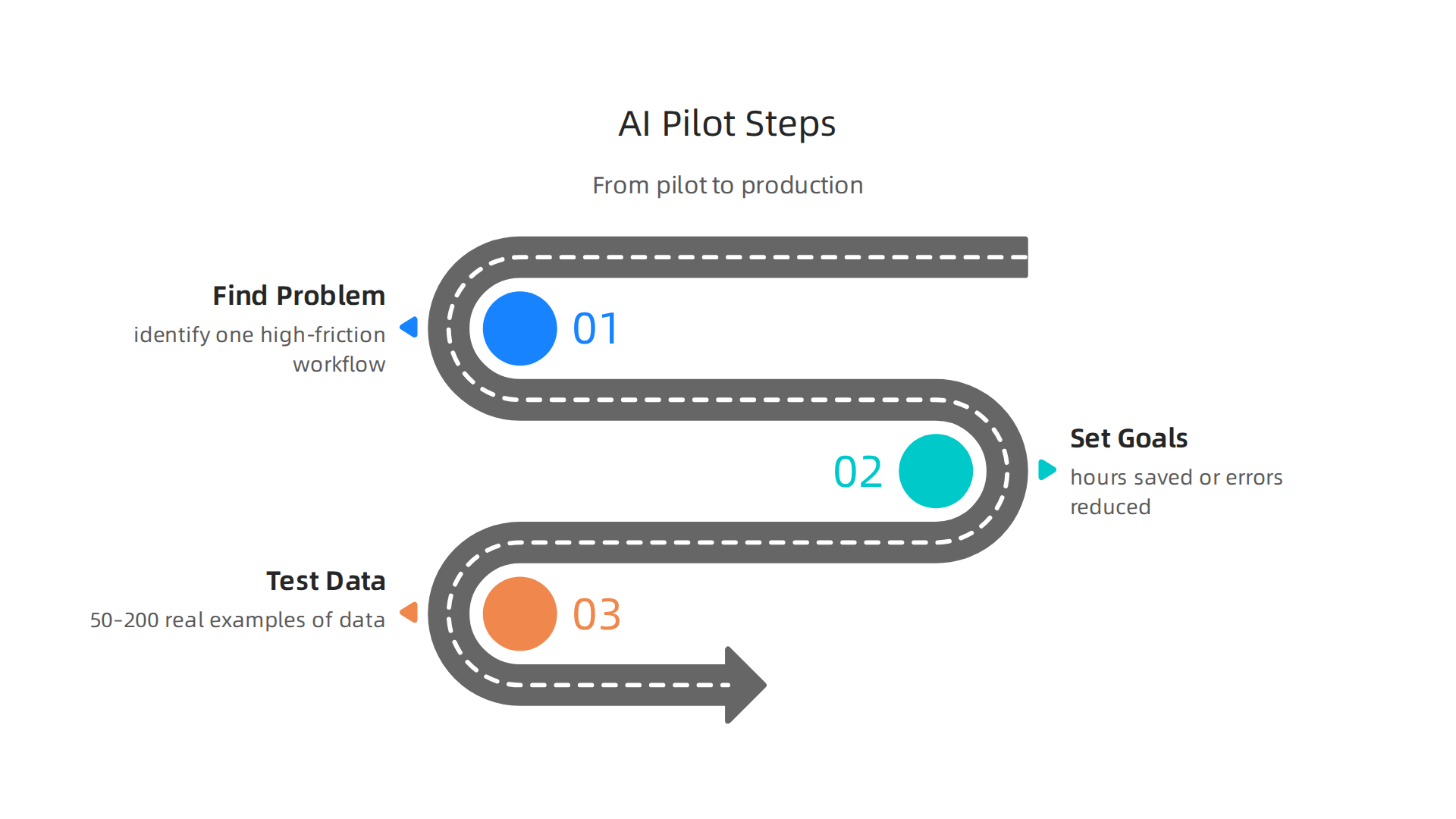
    Key steps for initiating a successful AI pilot project within your business.

    • Find a clear problem: Look for a work task that takes a lot of time or has many steps. It should be a task that you can easily track and measure. You need to "identify one high-friction workflow with clear ownership" to make sure it’s manageable.
    • Set clear goals: Before you start, know what success looks like. Instead of just saying "use AI," think about "hours saved" or "errors reduced." These clear goals help you prove the AI is actually helping AI Implementation Strategy: From Pilot to Production in 2026.
    • Test with real data: Use a small amount of your own real information to see how the AI performs. For small to medium businesses (SMBs), testing with "50–200 real examples of your own data" can show if the AI works as expected AI Adoption Roadmap for SMBs: 90 Days (2026). Many businesses find a 90-day plan helpful to get these first steps done Your 90-Day AI Roadmap: How Small Businesses Can Start Smart ….

    Moving from pilot to full use

    Once your pilot shows good results, it’s time to think bigger. Moving AI from a small test to a full part of your business means careful steps.

    A team celebrating a successful project, reflecting the achievement of moving an AI pilot to full production.

    • Plan for changes: This shift means looking at your technology setup (infrastructure), how your data moves (data pipelines), and how you manage the AI tools every day (MLOps). You also need to think about new rules and how your team will work with the AI. This journey needs "organizational change" to really take hold.
    • Roll out slowly: Don’t turn on the AI for everyone at once. You might use methods like "canary deployment," where you first give the AI tool to a small group of users. If it works well, you slowly give it to more people Ai Model Development And…. This helps you catch problems early.
    • Get leadership on board: To make sure AI projects succeed, both business and technology leaders need to support it. This means "securing commitment from both business and IT leadership" and agreeing on what success looks like Enterprise AI in 2026: Navigating the Shift from Pilots to ….

    Key people and working together

    Making AI work is a team effort.

    • Assign owners: Every AI project needs someone to be in charge. This "human owner" makes sure the AI runs smoothly and oversees its steps AI Implementation Roadmap for SMBs: Phasing the Rollout.
    • Train your team: Your employees will be using these new tools, so they need proper training. Providing "structured AI training for leadership and operational teams" helps everyone understand and use the AI effectively The AI Transformation Playbook for UK and European ….
    • Work with partners: Sometimes, you’ll need help from outside experts. Working with vendors who specialize in Mastering Specialized AI Tools can make a big difference. They can offer insights and support to help you deploy your chosen us tech solutions. Knowing how to find trusted sources for AI tool discovery 2026 can also speed up your progress.

    By taking these careful steps, from a small pilot to a full-scale rollout, businesses can successfully bring AI into their daily work. It’s about being smart and planned, rather than just jumping into the newest technology.

    Stay on top of the latest AI trends and tools. Get clear daily AI updates from The AI Newsletter Worth Reading.

    4. How to evaluate and compare AI tools: KPIs, security, and ROI

    After learning how to start with AI, the next big step is picking the right tools. It’s not enough to just pick the newest or most popular option. You need to know how to truly check if an AI tool is a good fit for your business. This means having a clear way to measure its worth, how safe it is, and if it will give you good results for your money.

    Your AI Tool Checklist

    To pick the best us tech solutions, you can use a simple checklist. This helps you compare different tools fairly.

    • How Well Does It Work? (Functionality and KPIs)

      • First, does the AI tool do what you need it to do? For example, if it’s supposed to write emails, how good are those emails?
      • How fast is it? Does it complete tasks quickly or does it make you wait? This is like its speed.
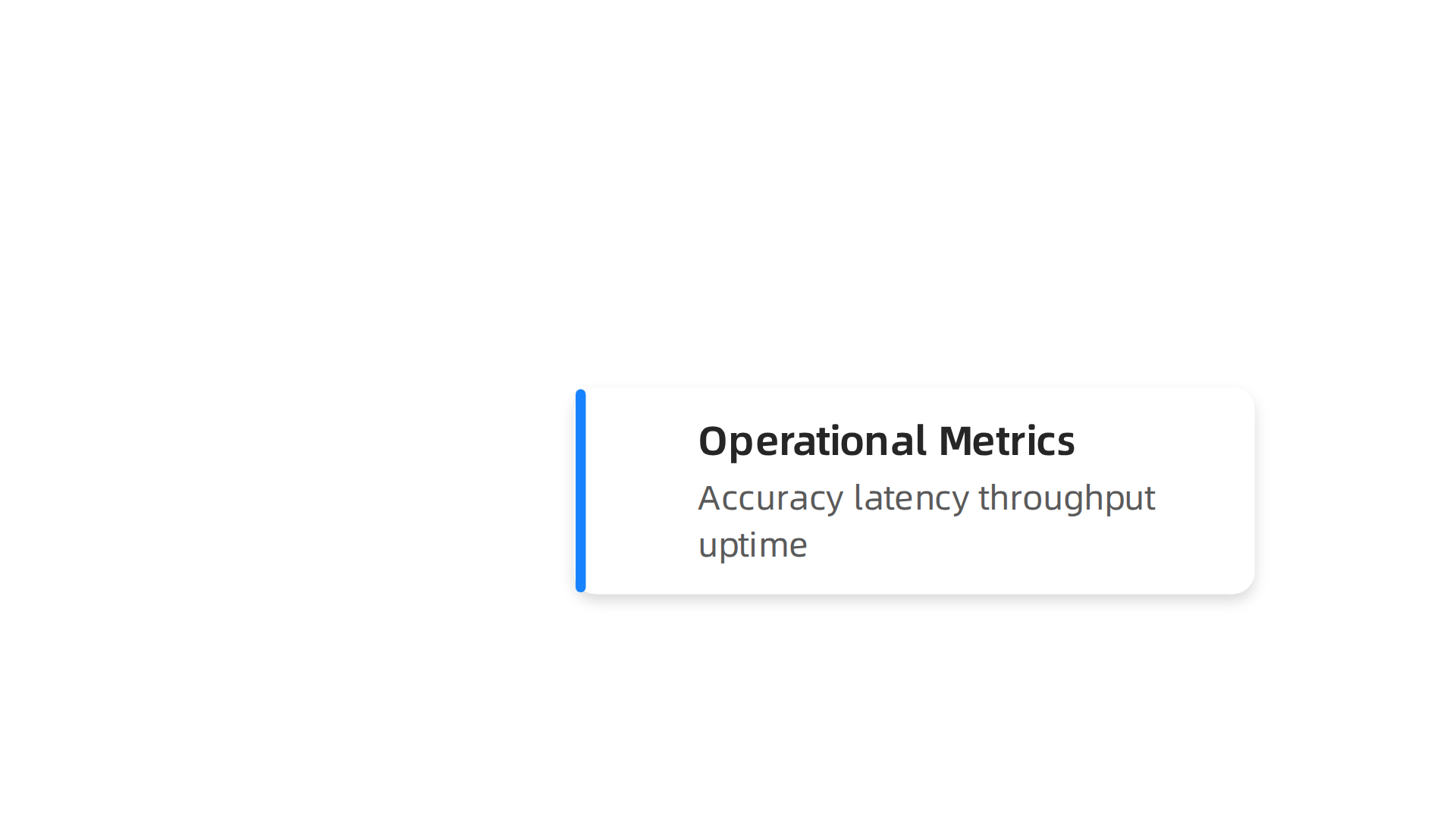
      • How often does it get things right? You want a high "task success rate," which means it achieves the goal most of the time. Experts suggest looking at things like latency, cost, and safety when judging AI agents How to Evaluate AI Agents: Latency, Cost, Safety, ROI.
      • The goal is to choose how to choose AI for business tools that deliver real results for your company.
    • Is It Safe and Private? (Security and Compliance)

      • AI tools often handle important company information. You must ask: "Is my data safe with this tool?"
      • Does the tool follow rules for keeping data private? This is super important, especially if your business has special guidelines to follow. The National Institute of Standards and Technology (NIST) has an AI Risk Management Framework to help make AI trustworthy.
      • Can you see what the AI tool is doing? This is called "auditability." It means you can check its work and make sure it’s doing things correctly and without mistakes. Make sure to check for things like detailed audit logging when looking at different AI platforms How to Evaluate Enterprise AI Platforms for Security and Compliance.
    • What About the Money? (Total Cost of Ownership and ROI)

      • The price tag of an AI tool is just the start. Think about the "Total Cost of Ownership." This includes the first price, how much it costs to set up, and how much you pay to keep it running over time.
      • Will the tool save you money or help you make more money? This is your Return on Investment (ROI). Many businesses look for a good ROI from their AI tools, especially in areas like marketing. You want a tool that gives you more value than what you spend on it.
      • Different platforms have different costs. Some popular ones like Microsoft Azure AI and Google Cloud AI use a "pay-as-you-go" system based on how much you use them Enterprise AI Platforms Guide 2026: Compare Top Solutions. Understanding how to get real ROI from AI marketing cloud or other tools is vital.

    Shortlisting and Testing Vendors

    Once you have your checklist, you can start comparing different AI tools and the companies that make them. Think of it like making a shopping list. You’ll want to evaluate AI companies to unlock business growth in 2026. This is called shortlisting. You can use templates to score each tool against your needs. This helps you figure out which ones are best to try.

    After you’ve shortlisted a few top choices, you can run small pilot projects with them. This is the best way to see how they work in your actual business. It lets you test out a few different us tech solutions, from big names to smaller innovators, before you pick the one that fits just right. Looking at things like "Decision Framework" can help you in this process Decision Framework.

    5. Scaling adoption: change management, governance, and measuring impact

    So, you’ve tried out new AI tools and found some that work well in a small test. That’s great! But the real challenge is making these tools work for everyone in your company. This means rolling them out widely, helping people get used to them, setting clear rules, and checking if they truly help your business grow. Moving from a small test (a pilot) to full use needs careful planning. Experts point out that a big step here is dealing with "organizational change" to make sure everyone is ready for AI Your AI Implementation Roadmap: Guide for 2026 Success.

    Making the Switch Easy for Everyone (Change Management)

    When you bring in new technology like AI, people might feel unsure or even worried. It’s like learning a new way to do things. Helping your team understand why the AI is useful, how it works, and how it will help them do their jobs better is called change management.

    • Talk it Out: Share clear information about the new AI. Explain what it does and what it doesn’t do.
    • Teach Them Well: Provide good training so everyone knows how to use the tools. Make it easy for them to ask questions and get help. Starting with structured training for all teams is a smart move for an AI transformation The AI Transformation Playbook for UK and European ….
    • Show the Benefits: Highlight how the AI will make tasks simpler or save time. This helps people feel excited about the change instead of worried.

    This smooth transition helps your company adopt smart AI for business more successfully.

    Setting the Rules for AI (Governance)

    As AI becomes a bigger part of your business, you need clear rules about how it’s used. This is called governance. It’s about making sure AI is used safely, fairly, and in a way that helps your company reach its goals.

    • Who’s in Charge? Decide who will be responsible for overseeing the AI tools. Who makes sure they are used correctly?
    • Fair Play: Make sure the AI tools are not used in ways that are unfair or that cause problems. This means checking for things like bias in the AI’s decisions.
    • Clear Guidelines: Create simple guidelines for how teams should use AI in their daily work. This helps keep things organized and safe.
    • Operating Model: Think about how your whole company works with AI. This might mean changing how teams talk to each other and how projects get money. Building a new "operating model" helps businesses grow with AI Rewiring the enterprise operating model for AI scale – Deloitte.

    It’s also important to activate good governance when moving from AI pilots to full production Your AI Implementation Roadmap: Guide for 2026 Success.

    Knowing if AI is Really Helping (Measuring Impact)

    After you’ve rolled out AI to more people, you need to keep checking if it’s truly making a difference. This means looking at the numbers and seeing the real impact.

    • Track the Right Things: Don’t just count how many times someone uses an AI tool. Instead, measure things like "hours saved," "mistakes reduced," or "more sales." These are the real signs of success AI Implementation Strategy: From Pilot to Production in 2026.
    • Compare Results: A good way to measure is by testing. You can run "A/B tests" where some people use the AI and others don’t, then compare their results. Or, try a "canary deployment," where you give the AI to a small group first and watch how it performs before giving it to everyone Ai Model Development And….
    • Get More Support: When you can show how much the AI is helping, it’s easier to get more money and support to keep using it and find new ways it can benefit your business. Start small, prove it works, and then grow AI Adoption Roadmap for SMBs: 90 Days (2026). This is how many us tech solutions become central to business operations.

    To stay on top of the latest strategies for AI adoption and impact measurement, consider subscribing to The AI Newsletter Worth Reading for daily updates.

    6. Regulatory and ethical considerations for U.S. deployments

    After setting up rules for how your company uses AI, it’s also important to think about the bigger picture: the laws and guidelines set by the government. In the U.S., these rules are still growing, but they are very important for any business using us tech solutions. They help make sure AI is used in a fair, safe, and private way.

    Key U.S. Guidance Areas to Watch

    As of 2026, there isn’t one big federal law that covers all AI use in the United States. However, many states have already put their own AI laws in place, and companies must follow them today. This means that if your business operates in different states, you need to be aware of various rules State AI Laws Take Hold as Federal Preemption Stalls.

    Here’s what businesses need to keep an eye on:

    Practical Steps for Teams

    To make sure your AI tools are used responsibly and follow all the rules, here are some things your team can do:

    • Understand the Laws: Keep up with new federal and state laws that affect AI, especially those related to data privacy and fairness. An innotech website or specific legal news sources can help you stay current.
    • Use Frameworks: Follow guides like the NIST AI Risk Management Framework. This framework helps you align AI development and use with privacy laws and intellectual property rights Artificial Intelligence Risk Management Framework: Generative ….
    • Check for Bias: Make sure your AI tools are fair and don’t make unfair decisions. This is a big part of ethical AI.
    • Be Clear: If your company uses AI to interact with customers, be open about it. Let people know when they are talking to an AI.
    • Get Training: Teach your team about ethical AI use and how to follow privacy rules. Understanding these details is key to mastering the AI future standard 2026.
    • Review Regularly: The world of AI rules is changing fast. Make sure you check your AI practices often to match new laws and best practices. Even big names like Dartmouth AI researchers keep up with these changes.

    Summary

    This article explains why U.S. tech solutions and AI matter for businesses in 2026 and gives a practical playbook for choosing, testing, and scaling AI. It reviews market demand, sector spending patterns, and how procurement differs for SMBs versus enterprise teams. You’ll get a clear breakdown of vendor types—big platforms, vertical solutions, developer tools, MLOps, and data platforms—and how each fits different needs. The guide shows how to run a focused pilot (50–200 real examples, 90-day plans), move to production with canary rollouts and MLOps, and assign human owners and training. It also offers a checklist to evaluate tools by functionality, security, and total cost of ownership, plus governance and impact-measurement advice. Finally, it covers the evolving U.S. regulatory landscape, ethical safeguards, and practical steps to keep AI deployments compliant and effective.

  • Roper Technologies AI Strategy Practical Roadmap for Business

    Roper Technologies AI Strategy Practical Roadmap for Business

    Why Roper Technologies’ AI strategy matters for product teams, operators, and buyers

    In today’s fast-moving world, understanding how big tech companies use new ideas like Artificial Intelligence (AI) is very important. One company that stands out is Roper Technologies. Unlike many other tech companies that focus on just one kind of product, Roper Technologies owns many different businesses. These businesses make all sorts of software and tools for many industries, like healthcare, education, and water management.

    Roper Technologies isn’t just about owning many businesses; it’s about making them better. In 2026, Roper has been putting a lot of effort into using AI across all its parts. This approach has led to new AI-powered products and helped the company grow its earnings significantly. For example, they’ve shared how their businesses are shipping AI products and speeding up how they use AI. They also talked about how they are committed to Embracing AI for Growth. This makes their way of handling AI very important to study.

    Because Roper Technologies works in so many different areas, its AI strategy can teach us a lot. It shows how AI can be used to improve many kinds of products and services. If you are part of a product team, run a business, or buy technology, you will gain valuable knowledge from seeing how Roper builds and uses AI.

    A professional leads a discussion, helping a team understand complex AI strategies.

    This article will help you understand:

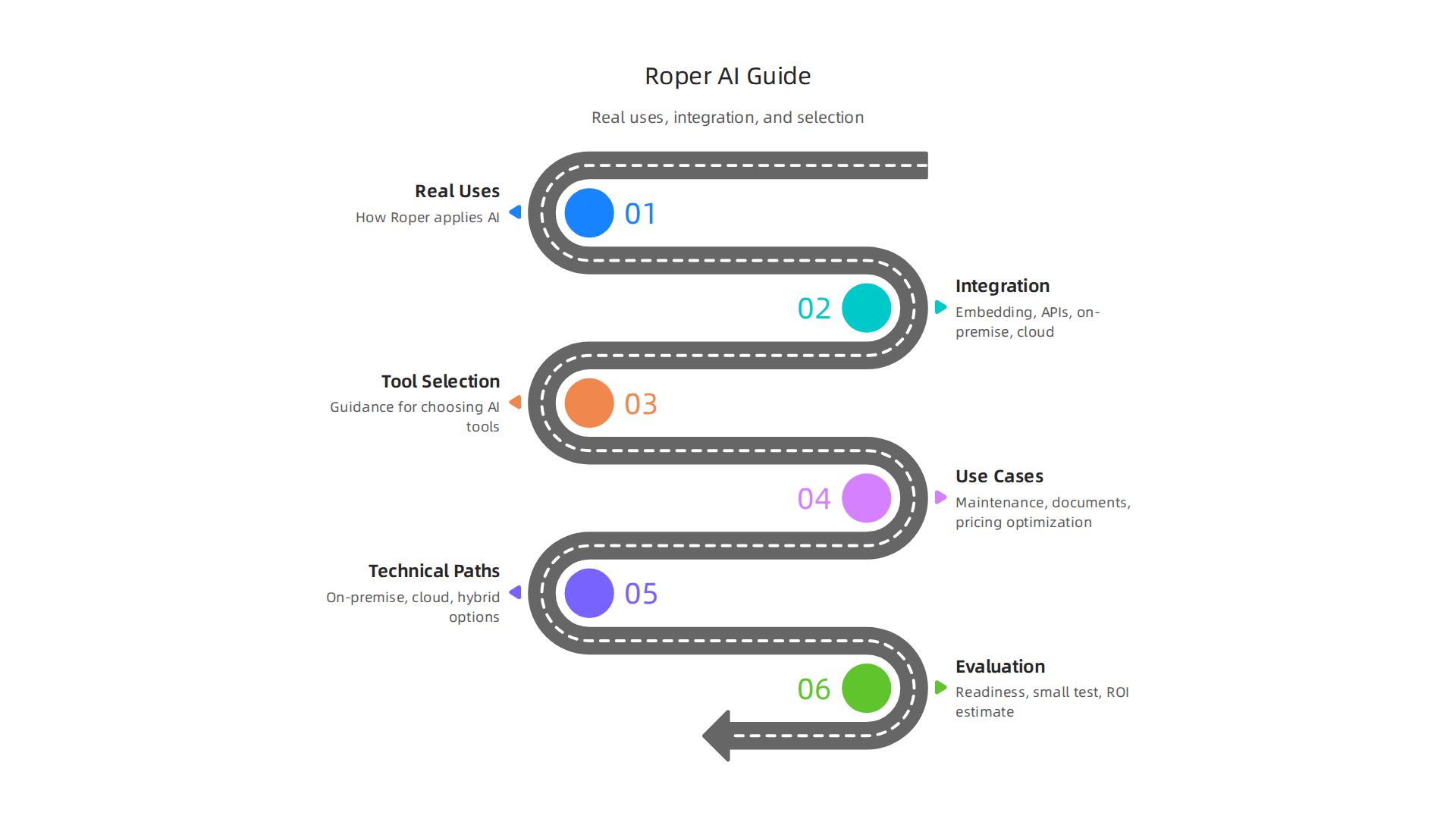
    Key insights from this article: real-world AI uses, integration methods, and tool selection guidance.

    • Real-world uses for AI: We will look at how Roper’s many businesses are actually putting AI to work every day. You’ll see different examples of AI in action.
    • How to add AI to your own work: We will explore how different parts of Roper’s businesses bring AI into their systems. This can help you think about how to add AI to your own company’s products, whether you are looking at tools like those from Infineon Technologies or iRhythm Technologies.
    • How to pick the best AI tools: It’s hard to know which AI solutions are right for your business. We will share ideas on how to pick the best AI tools that truly help you, just like if you were thinking about using something like Pathway AI. You can also learn more about How to Choose AI for Business Tools That Deliver Real Results in 2026.

    By looking closely at Roper’s steps in AI, we hope to give you clear ideas and tips you can use right away.

    To stay on top of the latest AI trends and how they impact businesses, make sure you’re reading the best information.

    The AI Newsletter Worth Reading

    Roper Technologies is a unique kind of company. It’s not just one big business, but rather a family of many smaller, specialized tech companies. These businesses create special software and products for very specific industries. Think about areas like healthcare systems, education tools, water meters, and even software for managing freight. Each of these smaller businesses is a leader in its own field.

    In 2026, Roper Technologies shared that its revenue went up by 11% to $2.10 billion in the first quarter, showing strong growth across its many parts. The company’s unique structure is important for understanding how it uses AI. Roper grows by buying other successful companies. Once a company joins Roper, it usually keeps running mostly on its own. This is called a "decentralized" model. This way, each business can focus on what it does best.

    This decentralized approach means that how quickly and easily AI is added depends on each separate business within Roper. For example, a software company that handles a lot of data, like those in logistics, might adopt AI very fast. We have seen how Roper’s businesses are already "shipping AI products" and speeding up how they use AI across their wide range of offerings, according to their first quarter financial results Roper Technologies announces first quarter financial results.

    Because Roper Technologies lets its businesses run largely on their own, the AI efforts might look different from one unit to another. Management has made it clear that Roper’s strategy is built on smart acquisitions and improving AI abilities across the board Management says Roper Technologies (ROP) Strategy …. This helps ensure that AI solutions are tailored to the specific needs of each product or service. So, whether a business is making tools similar to Infineon Technologies or iRhythm Technologies, or even an advanced analytics solution like Pathway AI, the goal is to make sure AI truly fits and improves their specific work. This flexible way of adopting AI helps these many businesses grow and adapt to new changes, making the overall innovation line 2026 how businesses adopt AI for growth easier to manage.

    Roper Technologies isn’t just letting its businesses figure out AI on their own. The company has a clear plan to add AI through smart purchases and by making its products better. This shows how serious Roper Technologies is about using AI to grow.

    One big step was when Roper Technologies agreed to buy CentralReach for about $1.65 billion in 2025. CentralReach makes software for businesses that help people with special needs. By bringing such a company into the Roper family, Roper helps it keep growing and improve its software with new technologies. Another important move was the plan to acquire Subsplash, an AI engagement platform, also in 2025. This shows Roper is directly bringing in companies that specialize in AI.

    Beyond buying new companies, Roper also helps its existing businesses add AI to their products. For example, DAT Freight & Analytics, one of Roper’s businesses, has rolled out new AI tools. Its DAT One mobile app now has AI-powered Load Recommendations. This helps truck drivers and logistics companies make better choices. These kinds of updates show that the different parts of Roper Technologies are really putting AI to work in practical ways.

    In fact, the CEO of Roper Technologies, Neil Hunn, said in 2026 that the company’s businesses were already "shipping AI products." He also noted that Roper’s AI abilities have grown, and they are moving faster to use AI in their offerings Roper Technologies raises 2026 profit forecast as AI demand boosts software sales. This means they are not just talking about AI, but actually making it a part of what they do every day. This ongoing effort helps Roper’s many different tech companies deliver better services and products to their customers.

    Mini-case: a recent Roper acquisition and its AI implications

    Roper Technologies made a big move in 2025 by buying CentralReach for about $1.65 billion. This company makes special software that helps businesses support people with special needs Roper Technologies signs agreement to acquire CentralReach for $1.65bn. This purchase is important for Roper Technologies because it shows how they plan to add AI to their products.

    For CentralReach, AI can make a huge difference. Imagine AI helping therapists make even better, more personal plans for each person. Or, AI could help by looking at lots of data to find new and faster ways to give support. This means CentralReach’s software will become smarter and more helpful, fitting right into Roper’s bigger plan to boost all its tech companies with AI. Adding AI can help these services innovate and grow their offerings how businesses adopt AI for growth. Roper sees its businesses like CentralReach as key places to keep shipping out those new AI products, as mentioned by the company’s management in 2026 Management says Roper Technologies (ROP) Strategy ….

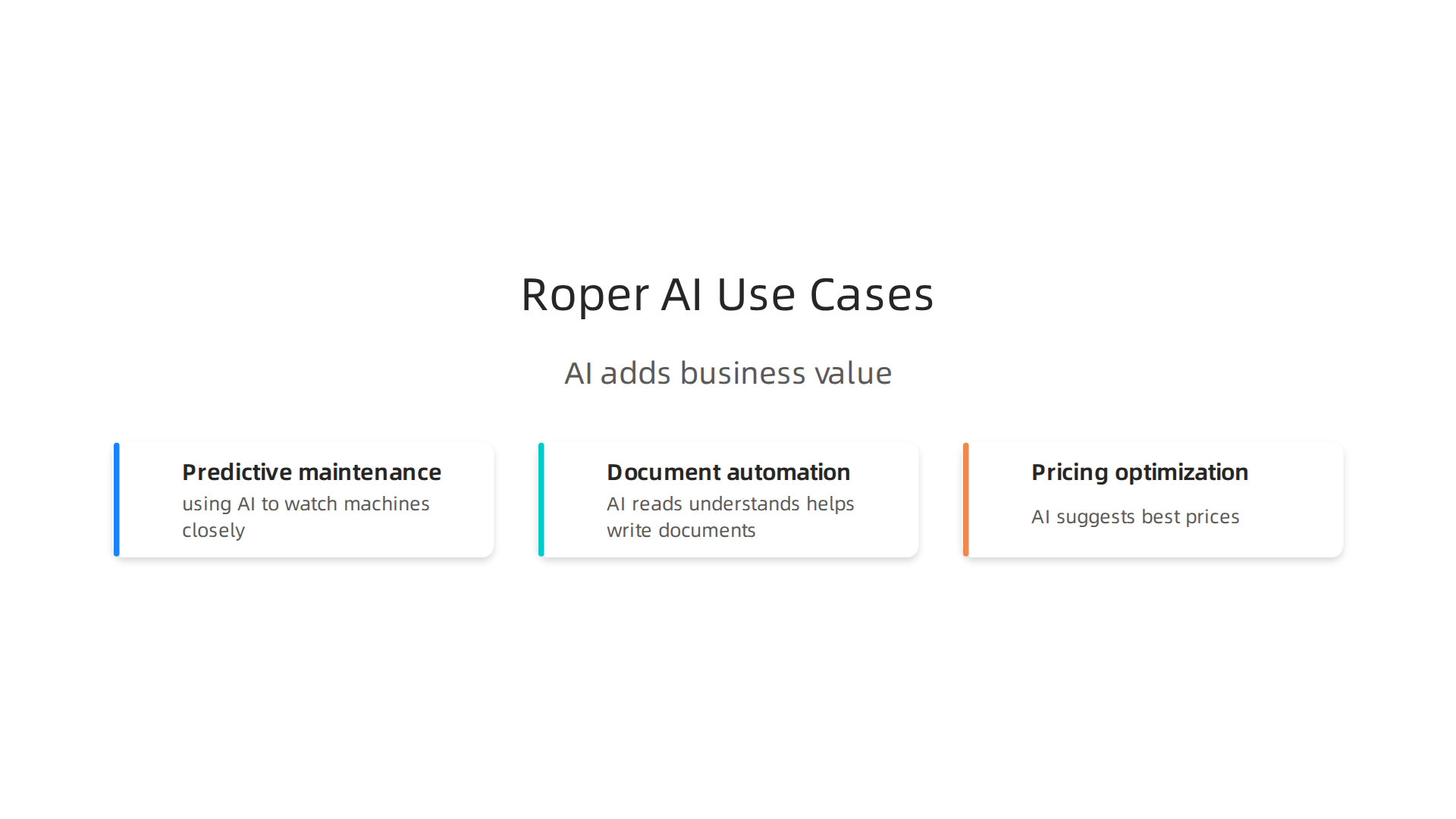
    Roper Technologies isn’t just looking at AI for one company like CentralReach. They see many ways AI can help all their different businesses. Imagine AI making machines run better or helping with office work. Here are some clear examples of how AI can add real value across Roper’s portfolio.

    AI brings significant value to Roper's diverse businesses through predictive maintenance, document automation, and pricing optimization.

    A team collaborates, brainstorming innovative solutions to challenges on a whiteboard.

    Practical use cases: where AI can add value across Roper’s portfolio

    One big area where AI can help is called predictive maintenance. This means using AI to watch machines closely and guess when they might break down. Instead of waiting for a machine to stop working or fixing it on a set schedule, AI tells you exactly when it needs attention. For Roper’s industrial tech companies, like those making sensors or controls, this is a huge deal. By using predictive maintenance, businesses can cut down on unexpected machine stops by 30% to 50% and save a lot on repair costs Industrial AI Statistics 2026: ROI, Adoption & Downtime Data. This can lead to a big return on investment, sometimes 300% or more, according to what we’re seeing in 2026 20 AI Use Cases in Manufacturing With Real ROI (2026). The main goal here is to keep things running smoothly, measure how much downtime is saved, and track how much less money is spent on maintenance.

    Another useful area for AI is making office work easier, often called document automation or data analysis. Many of Roper’s software businesses, including those in healthcare or information technology, deal with lots of papers and data. AI can read these documents, understand what’s important, and even help write new ones. This means less manual work and fewer mistakes. For example, AI can help CentralReach process client information faster or help other tech companies in Roper’s family quickly sort through customer feedback. Businesses using AI for things like support automation or legal review are seeing clear returns, making tasks quicker and more accurate Generative AI Enterprise ROI 2026: Use Cases & Numbers. The main goal is to speed up tasks and reduce errors, using numbers like processing time and error rates to show success. When you want to find the right AI tools to help your business, it’s good to know how to choose AI for business tools that deliver real results in 2026.

    AI can also help with pricing. For many of Roper’s software and service businesses, figuring out the best price for products or services can be tricky. AI can look at tons of data like past sales, what competitors are doing, and how customers react. Then, it can suggest the best prices to make more sales and earn more money. This is called pricing optimization. The goal is to boost how much money the company makes and improve its profit margins. By using AI in these smart ways, Roper Technologies can help its different companies grow and become even stronger. Staying updated on these trends is key.

    Get clear daily AI updates from The AI Newsletter Worth Reading.

    Now, let’s talk about how Roper Technologies can set up these smart AI systems for its many businesses. It’s like building different kinds of houses for different needs. These ways of setting things up are called "architectures" and "integration patterns." They decide where the AI lives and how it connects to other tools.

    Technical pathways: architectures and integration patterns Roper teams might use

    When thinking about where AI will run, there are three main types of places:

    1. On-premise: This means the AI tools and data stay right on the company’s own computers and servers, inside their own buildings. It’s like keeping all your important files in your own house. This is good for very private information or when speed is super important and the data shouldn’t travel far.
    2. Cloud: This means the AI tools and data live on big computers owned by another company, like Google or Amazon, that you access over the internet. It’s like renting storage space in a huge, shared building. This is great for handling lots of data and tasks that grow or shrink often, because it’s flexible and can be cheaper for big jobs.
    3. Hybrid: This is a mix of both on-premise and cloud. Some AI runs on the company’s own machines, and some runs in the cloud. Many companies, especially big tech companies like Roper Technologies, use a hybrid approach in 2026. This is because some information is too sensitive to leave the company’s own computers, while other tasks need the power and flexibility of the cloud Hybrid AI Architecture: 6-Criterion Decision Matrix (2026). For example, very important customer data might stay on-premise, while AI that helps with general market research might run in the cloud. Experts say that a hybrid setup is often the best choice for many organizations to run AI Best US Cloud Providers 2026: AI First, Hybrid, and Edge Compute.

    The reason for choosing a hybrid model is clear in 2026: most smart AI products need to run in different places. The cloud can handle big bursts of computer work, while on-premise systems keep very private data safe. Smaller, quick tasks can even run on devices right where the action happens, sometimes called "edge" computing The Strategic Guide to Cloud, On-Prem, and Edge …. This mix helps Roper’s various tech companies, from those dealing with sensitive health data to others handling factory sensors, use AI in the best way.

    Next, let’s look at how AI fits into what’s already there. This is called "integration patterns." Roper’s companies already have many software programs and systems. They don’t want to throw everything out. Instead, they want to add AI to what they already use.

    • Embedding Models: This means putting the AI directly inside existing software. For example, the AI that predicts when a machine might break down can be built right into the software that controls the machine. This makes the existing software smarter without needing a whole new system.
    • APIs (Application Programming Interfaces): Think of APIs as special doorways that allow different computer programs to talk to each other. An AI program might have an API that lets Roper’s older systems ask it questions and get answers. This is a common way to connect new AI features to older systems without a lot of trouble. Using "microservices architectures" is a popular way to make these connections strong and flexible in 2026 Top Enterprise AI Integration Solutions for 2026 – What is Antelope 7?.

    These ways of setting up and connecting AI are important for Roper Technologies. They help make sure that each of their businesses, whether it’s a software company or an industrial tech firm, can use AI effectively to solve its unique problems. It’s about finding the right technical pathways for each situation to make sure AI adds real value. Learning more about how identify AI leadership discover top tech companies for business in 2026 can offer more insights into how different companies manage these complex technical decisions.
    Putting new AI tools into a company like Roper Technologies is not just about choosing the right setup. It’s also about being very careful. Just like building a strong house, you need to think about rules, safety, and making sure everything works right. For companies like Roper that are quickly bringing in new AI tools across their many businesses, these concerns are even bigger. For example, Roper Technologies saw a big jump in AI innovation across its various parts in early 2026, which makes good rules even more important Roper Technologies investor relations material.

    Risks, compliance, and governance: what buyers and partners should watch for

    When any business, big or small, buys or partners with AI tools, they must think about three main things: risks, following rules (compliance), and how they manage everything (governance).

    Executives discuss important regulations and compliance issues in a formal meeting.

    Following the Rules (Compliance and Regulations)

    Different types of businesses have different rules. For example, a Roper company that works with health information must follow strict rules about keeping patient data private. This is called data privacy. If AI systems handle this data, they must also follow these rules. In other industries, like making factory tools, the AI might need to be extra safe to avoid accidents. This means thinking about how the AI could make mistakes and hurt people or cause damage.

    As more tech companies use AI, governments are making new rules about how AI should be used fairly and openly. Roper’s many businesses, including those like Infineon Technologies or iRhythm Technologies, need to keep up with these changes to avoid problems.

    Watching Over AI (Vendor Governance and Model Risk Management)

    When Roper Technologies uses AI tools from other companies, they need to check on those companies very carefully. This is called "vendor governance." It means asking:

    • Is the AI provider trustworthy?
    • Do they keep data safe?
    • How do they ensure their AI is fair and doesn’t make bad decisions?

    This also includes "model risk management." This is about making sure the AI models themselves work as they should. Sometimes, an AI might seem to work well, but it could have hidden problems that show up later. It’s important to test these models over and over.

    Being Able to Check (Auditability)

    Lastly, it’s very important that companies can "audit" their AI. This means being able to look back and see how an AI made a certain decision. If an AI gives advice or takes action, you should be able to understand why. For example, if an AI in a hospital helps a doctor, the doctor needs to know how the AI came to its conclusion. This helps build trust and fix problems if the AI makes a mistake.

    For any business, picking the right AI solutions also means picking partners who understand these important points. Learning how to choose the right enterprise AI platforms 2026 and trusted tools can help companies like Roper make smart decisions. This makes sure that AI brings good results without causing new problems.

    Checklist: Key Questions to Include in RFPs for AI-Enabled Features

    To make smart choices about AI, companies need to ask the right questions upfront. This is often done through a "Request for Proposal" or RFP. An RFP is like a detailed questionnaire sent to different AI providers to see how well they can meet a company’s needs. It helps businesses like Roper Technologies pick the best partners. Think of it as a playbook for buying AI, especially in 2026, when so many new tools are coming out The 2026 Enterprise AI Procurement Playbook: RFPs, Vendors ….

    Here are some important questions to include in an RFP:

    How the AI Thinks (Explainability)

    It’s important to know how an AI makes its decisions. If an AI suggests something, you should understand why. For example, if an AI helps a doctor, the doctor needs to know how the AI got its answer. This means asking:

    • "Can you show us how your AI comes up with its answers?"
    • "If the AI makes a mistake, how can we trace back what happened?"
    • "How often do you test your AI to make sure it’s fair and accurate?"

    Keeping Data Safe (Data Handling)

    Data privacy is a big deal, especially for companies working with sensitive information, like iRhythm Technologies in healthcare. When you use an AI tool, you give it your company’s data. So, you must ask:

    • "Where will our data be stored?"
    • "Will our data be used to train your AI for other customers?" (Many companies want a "zero-training" promise for their data AI Agent Procurement Checklist 2026: 60 Questions Before You).
    • "Who will have access to our data?"
    • "What steps do you take to protect our data from hackers?"

    How Well It Works (Service Level Agreements, or SLAs)

    You need to know that the AI will work reliably. SLAs are like promises about how good the service will be. For tech companies like Infineon Technologies that rely on precision, these details are key. Ask about:

    • "How often might the AI system be down for maintenance?"
    • "If the AI breaks, how quickly will you fix it?"
    • "How fast will the AI give us answers or perform tasks?"

    Prioritizing Your Questions

    Not all questions are equally important for every business. Companies like Roper Technologies should think about what matters most to their specific operations. For a company handling patient data, data privacy questions will be at the top of the list. For a business like Pathway AI using AI in manufacturing, questions about uptime and performance might be more critical. The goal is to focus on questions that deal with the biggest risks and have the largest impact on your business. Learning how to choose AI for business tools that deliver real results in 2026 helps ensure that you focus on what truly matters.

    How to evaluate Roper (or a Roper-backed solution) for your use case: a step-by-step framework

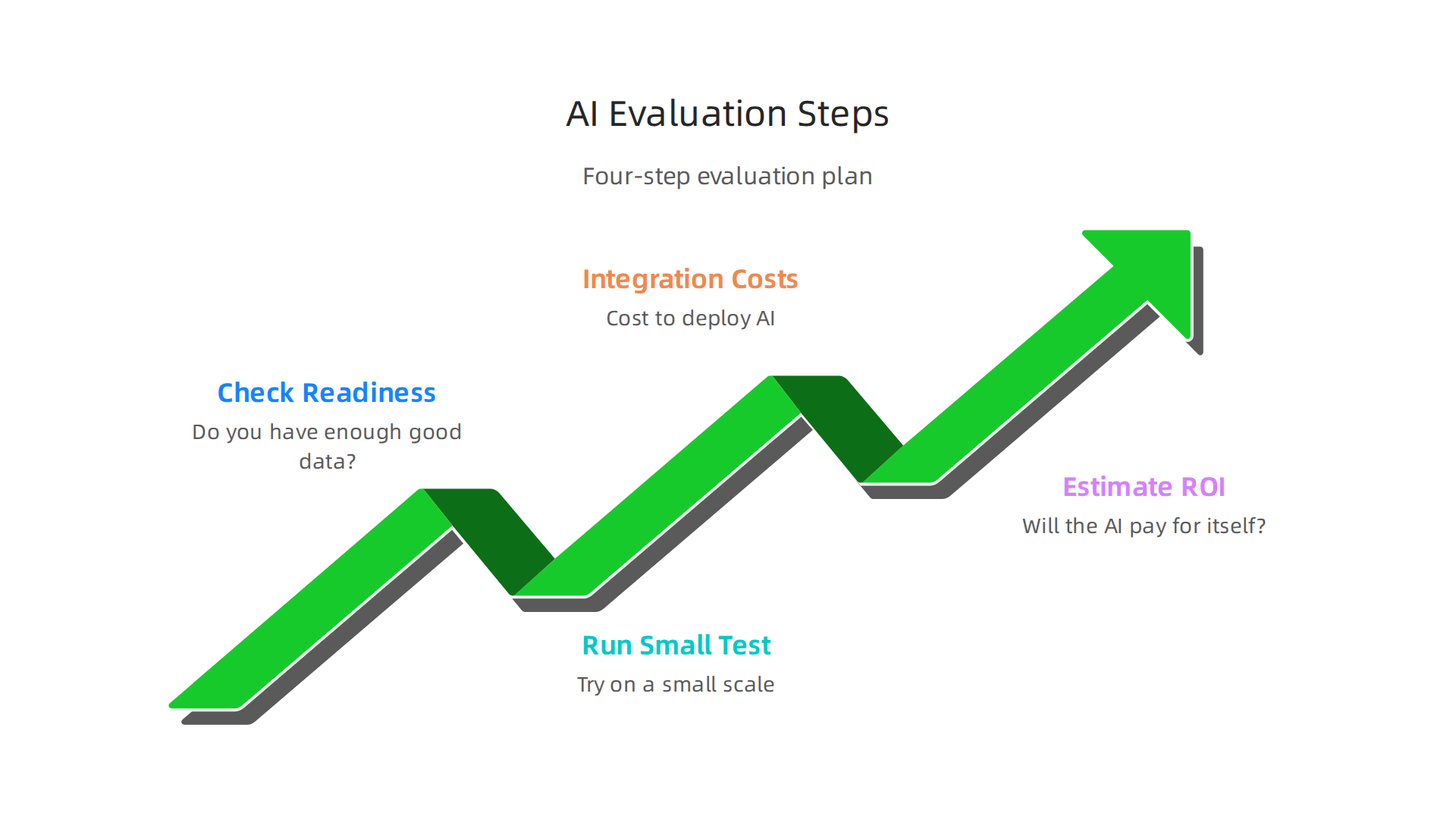
    After asking the right questions with an RFP, the next big step is to properly evaluate the AI solutions you are considering. This is especially true if you are looking at tools from large tech companies like Roper Technologies, or solutions backed by them. To make sure you pick the best fit for your business in 2026, here is a simple plan.

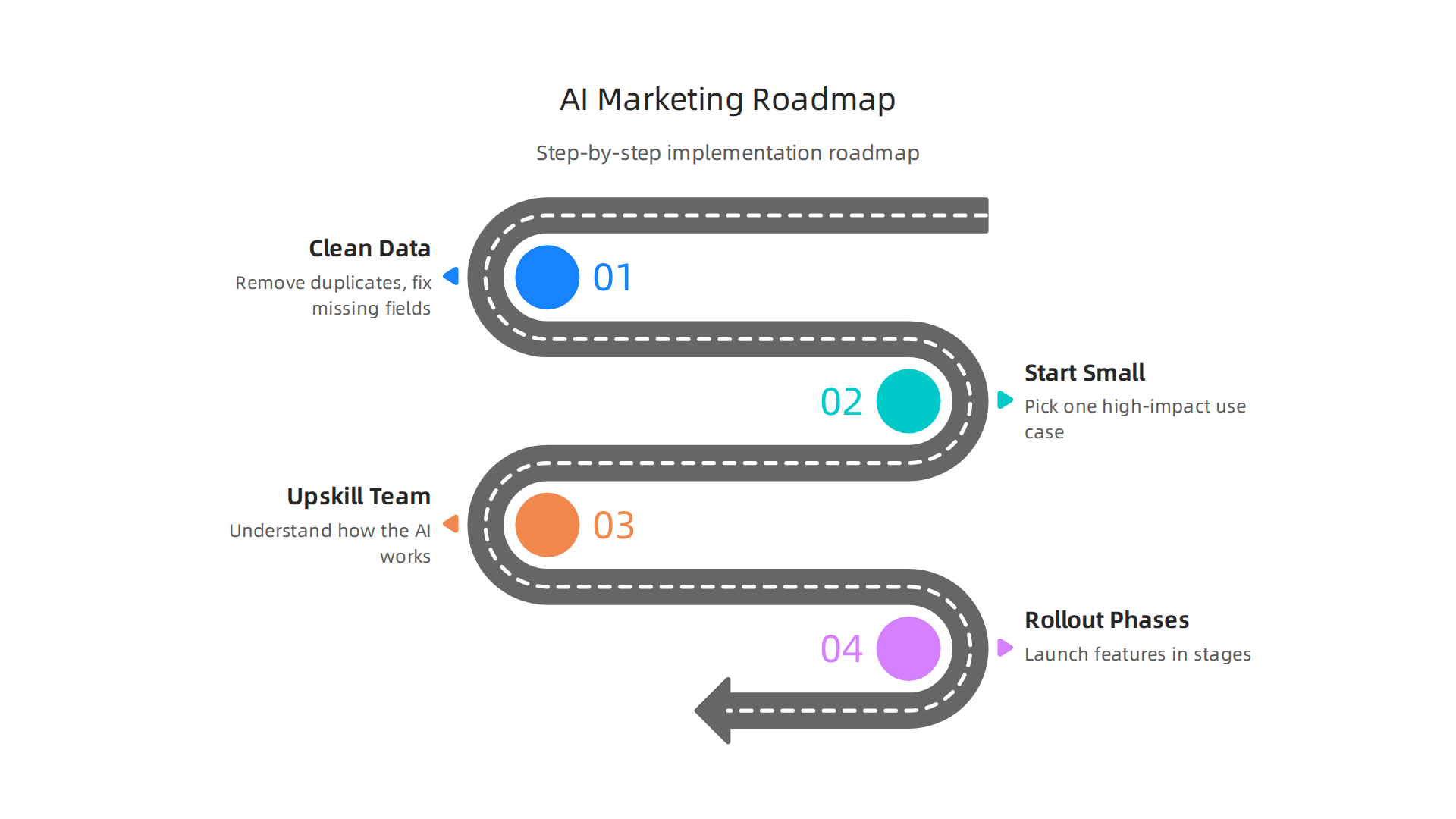
    A four-step framework for evaluating AI solutions: readiness check, small test, integration costs, and ROI estimation.

    1. Check Your Company’s Readiness

    Before bringing in any new AI, you need to know if your company is ready.

    A person diligently reviews documents, possibly evaluating proposals or reports.

    This means looking at a few things:

    • Data: Do you have enough good data for the AI to learn from? Is it clean and easy to use?
    • People: Do your employees have the skills to work with AI tools? Do they understand how AI will help them?
    • Systems: Can the new AI easily connect with your existing computer systems?

    Companies like iRhythm Technologies, which handle lots of sensitive patient data, must ensure their systems are ready for secure data sharing with new AI tools.

    2. Run a Small Test (Proof-of-Concept)

    Don’t buy a big AI system right away. Instead, try it out on a small scale. This is called a proof-of-concept or pilot project.

    • Pick a small problem: Choose one clear problem the AI can help solve. For instance, Pathway AI in manufacturing might test AI to predict when one machine will break down.
    • Use templates: Many vendors offer templates for these pilots. These help you set up the test, figure out what to measure, and understand how the AI will work.
    • Watch closely: During the test, check how well the AI performs. Does it save time? Does it make things more accurate? This helps you understand its real value.
    3. Figure Out Integration Costs

    Connecting a new AI tool to your current systems can sometimes cost a lot. You need to know:

    • Setup fees: What does it cost to get the AI up and running?
    • Compatibility: Will the AI work smoothly with your other software? Modern AI solutions often use a mix of cloud and on-premise setups to fit different company needs, especially for regulated data The Strategic Guide to Cloud, On-Prem, and Edge …. Many solutions today use what’s called a hybrid architecture, combining different types of computing environments to make sure everything works together well and securely Hybrid Cloud and AI: The New Enterprise Architecture.

    4. Estimate How Much Money You’ll Make or Save (ROI)

    Return on Investment (ROI) is about whether the AI will pay for itself and then some. For Infineon Technologies, this means looking at how AI can cut costs or improve products.

    • Focus on high-value tasks: AI works best for things like predicting when machines need fixing (called predictive maintenance) or checking product quality with computer vision. These often show big returns. For example, AI-driven predictive maintenance can lead to a 30% to 50% drop in machine downtime and a 300% to 500% ROI in manufacturing AI in Manufacturing: Use Cases, Benefits, and ROI (2026 …).
    • Set clear goals: Before you start, decide what success looks like. Will it be fewer broken machines, faster work, or happier customers? Identifying high-impact use cases where AI can quickly deliver measurable wins is crucial for scaling AI in manufacturing Scale and grow with AI for manufacturing.
    • Measure everything: Keep track of the improvements. This will show you the true value of the AI solution.

    Learning how to choose AI for business tools that deliver real results will guide you to the right solutions for your company.

    To stay on top of all the latest AI developments and make the best decisions for your business, consider getting regular updates. Get clear daily AI updates from The AI Newsletter Worth Reading.

    Procurement and vendor strategy: negotiating contracts, SLAs, and support for AI features

    After you have learned how to choose AI for business tools that deliver real results, the next big step is getting the right deal. This means talking to vendors, like large tech companies such as Roper Technologies, about contracts. A good contract protects your business and makes sure the AI solution works well for a long time. Here are the important parts to think about:

    1. Who Owns the Data?
    When you use AI, it often needs a lot of your company’s data. You need to be very clear in the contract about who owns this data. Will the AI vendor use your data to make their AI better for other customers? For companies like iRhythm Technologies that deal with very private patient information, this is super important. Make sure your data stays yours and is handled safely.

    2. How Will the AI Model Be Updated?
    AI models are always changing and getting better. You need to know how often the vendor will update the AI you are using. Will they fix problems quickly? Will new features be added for free, or will you pay extra? This is key for staying competitive, especially if you rely on AI for core tasks like Infineon Technologies might for product quality checks.

    3. What Are the Performance Guarantees (SLAs)?
    Service Level Agreements, or SLAs, are promises about how well the AI will work. This includes things like:

    • Uptime: How often will the AI be available and not broken?
    • Speed: How fast will it give you answers or results?
    • Accuracy: How correct will its predictions or actions be?

    Make sure these promises are in writing. For a company using Pathway AI for critical tasks like predicting machine failures, clear performance rules are a must.

    4. What Support and Training Will You Get?
    Bringing in new AI means your team might need help learning how to use it. Ask about:

    • Training: Will the vendor teach your employees how to use the AI tools?
    • Technical Support: What happens if something goes wrong? Who do you call, and how fast will they help?
    • Ongoing Help: Will they offer advice on how to use the AI for new problems down the road?

    A strong support plan ensures your investment in AI keeps paying off. When picking an AI vendor, remember that many solutions today use a mix of cloud, on-premise, and edge setups to fit different company needs, creating a complex The Enterprise AI Stack in 2026: The Reference Architecture that requires careful consideration in contracting. Also, look for vendors that offer robust integration support, as smooth connection with your existing systems is vital for success in 2026 Top Enterprise AI Integration Solutions for 2026 – What is Antelope 7?.

    These points help you set up good agreements with tech companies for your AI needs. Understanding these parts of the contract is just as important as choosing the right AI platform itself. For deeper insights into selecting powerful AI solutions, learn more about Enterprise AI Platforms 2026: Top Providers and How to Choose the Right One.

    Summary

    This article explains why Roper Technologies’ 2026 push into AI matters for product teams, operators, and buyers by showing how a decentralized portfolio company can adopt and scale AI in practical ways. It covers Roper’s acquisition-driven strategy, examples of shipped AI features (like DAT’s Load Recommendations), and a recent CentralReach purchase that illustrates domain-specific AI opportunities. You’ll learn common high-value use cases—predictive maintenance, document automation, and pricing optimization—plus the technical choices (on‑premise, cloud, hybrid) and integration patterns (embedded models, APIs) that work best. The piece also outlines procurement tactics: RFP questions, pilot testing, SLA and contract priorities, and how to estimate ROI. Finally, it highlights governance, auditability, and compliance risks buyers must manage when selecting vendor AI solutions. After reading, you’ll have a clear checklist and evaluation framework to test, buy, and govern AI for your own products or purchasing decisions.

  • Enterprise AI Platforms 2026 Top Providers and How to Choose the Right One

    Enterprise AI Platforms 2026 Top Providers and How to Choose the Right One

    Introduction

    The enterprise AI market is growing faster than almost anyone predicted. In 2026 alone, the US Enterprise AI market is expected to hit USD 10.4 billion, with projections showing it could reach USD 42.3 billion by 2031 according to recent US Enterprise AI market insights 2026 to 2031. That is a growth rate of over 32% every single year.

    But here is the real problem. With so many new us tech solutions launching every week, decision makers are drowning in options.

    Decision makers facing a deluge of enterprise AI solutions, seeking clarity amidst numerous choices.

    How do you tell the difference between a tool that actually delivers and one that just sounds good on paper? How do you cut through the noise from every new abbott tech, every fresh innotech website, and every bold claim from the biggest ai companies?

    This article is built to solve exactly that.

    We have put together an expert curated overview of the leading enterprise AI platforms available in 2026. You will learn the right criteria for choosing tools that fit your actual business needs. And you will walk away with practical strategies for implementing AI the right way, without wasting time or money.

    If you want to stay ahead of the curve without drowning in daily hype, check out our guide on how to find trusted AI tool sources to get a head start on filtering what matters.

    And if you want clear, daily updates on what is actually working in AI right now, The AI Newsletter Worth Reading delivers straightforward insights straight to your inbox. No fluff. Just what you need to know.

    The Enterprise AI Landscape in 2026

    So who are the main players driving this massive shift? A wave of us tech solutions providers is racing to offer integrated enterprise AI platforms that touch every part of business operations. From big names like Google and Microsoft to newer players at every abbott tech and innotech website, the competition is fierce. The key drivers behind this boom are clear: cloud infrastructure is mature enough to handle huge workloads, data is more available than ever, and companies across every industry are demanding automation to cut costs and speed up work.

    But it is not all smooth sailing. Many organizations still face real hurdles. Data privacy concerns keep compliance teams up at night. A persistent shortage of AI talent makes it hard to build the right teams. And getting new tools to work with existing systems is a technical headache. According to the latest analysis of the United States Businesses and Enterprise AI market, these exact challenges are the top barriers slowing adoption for many firms.

    If you are trying to make sense of this crowded field, our guide on how to choose AI for business tools that deliver real results walks through exactly what to look for.

    Market Size and Growth Drivers

    The numbers are hard to ignore. US tech solutions providers are leading this expansion, with the domestic enterprise AI market hitting $10.4 billion in 2026 and expected to nearly quadruple by 2031, according to the US Enterprise AI: Strategic Market Insights to $42.3B (2031) report. Globally, the enterprise AI market is on track to exceed $60 billion this year, fuelled by rapid adoption of cloud AI services and generative AI tools. Industry-specific solutions are also accelerating growth, with companies like Abbott Tech and those listed on InnoTech’s website tailoring AI for sectors such as healthcare and finance. Importantly, small and mid-size businesses are jumping in as well, using affordable platforms to compete with larger firms. For a closer look at which leading AI companies are shaping this space, check out our guide to identify AI leadership. And to keep up with the rapid pace of change, Get clear daily AI updates from The Deep View Newsletter by subscribing to The AI Newsletter Worth Reading.

    Key Challenges Facing Enterprises

    Despite the rapid growth, scaling AI across an organization is not easy. Three major roadblocks keep cropping up for most enterprises, especially for us tech solutions providers trying to stay competitive.

    An infographic illustrating the primary challenges enterprises face when adopting AI solutions in 2026.

    First, data quality and governance remain top hurdles. Many companies struggle to clean, organize, and secure the data needed to train effective models. Privacy concerns only add to the complexity. Second, there is a serious lack of in-house AI talent. This forces many businesses to rely on external consultants and third-party platforms, which can slow progress and increase costs. As one report on enterprise AI adoption challenges notes, talent shortages and integration complexities are persistent issues.

    Third, measuring return on investment and integrating AI with existing legacy systems are common pain points. Without clear metrics, it is hard to justify continued spending. For practical guidance on navigating these obstacles, look at how to choose AI for business tools that deliver real results.

    Top US Tech Solutions Providers

    Despite these roadblocks, the US has a rich ecosystem of providers spanning three key layers.

    Cloud hyperscalers like AWS, Azure, and Google Cloud dominate the AI infrastructure layer. They provide the compute power and foundational tools enterprises need to build and deploy at scale. According to the latest AI Company Rankings 2026, their cloud AI revenue alone runs into the tens of billions.

    Next, specialized AI companies including OpenAI, Anthropic, and Scale AI push the frontier with cutting-edge models and APIs. These labs are the main drivers of quick progress in general-purpose intelligence.

    Finally, vertical-specific US tech solutions providers are gaining strong traction in healthcare, finance, and manufacturing. Palantir, for example, focuses on high-assurance analytics for government and defense clients. You can dive deeper into this area with our look at Palantir Technologies 2026 growth products and impact on business strategy.

    To keep up with who is leading the race and which tools actually work, you need a steady stream of clear, daily updates. Subscribe to The AI Newsletter Worth Reading to stay ahead of the curve.

    Cloud Giants: AWS, Azure, Google Cloud

    Starting with the biggest players, three cloud providers power most enterprise AI today.

    Screenshot of the Amazon Web Services (AWS) homepage, a leading cloud AI provider.

    AWS offers the widest range of AI and machine learning services, from Bedrock for foundation models to SageMaker for custom training. It also builds its own Trainium chips to handle AI workloads more efficiently. Azure stands out because it plugs directly into Microsoft’s enterprise ecosystem. Tools like Copilot and Dynamics 365 already have AI built in, making adoption faster for companies already using Microsoft products. Google Cloud runs on AI-native infrastructure with its TPU chips and the Vertex AI platform, which helps businesses build, deploy, and scale models securely. According to the Forbes 2026 AI 50 List, these three hyperscalers collectively generate tens of billions in AI revenue each year. Each giant offers a different path into AI, so your choice often depends on where your existing tech stack lives.

    If you are still weighing options, our guide on how to choose AI for business tools can help you match providers to your specific needs.

    Specialized AI Platforms

    Beyond the big cloud providers, specialized companies are changing how businesses use AI.

    Screenshot of the OpenAI homepage, a prominent specialized AI platform.

    OpenAI leads with its GPT models, powering tools from chatbots to automation workflows. Anthropic focuses on safe, enterprise-grade AI with its Claude models. According to the Enterprise AI Companies: Landscape Breakdown in 2026 analysis, these two firms alone have raised over $120 billion combined. Scale AI helps companies label training data and test model performance, which is critical for getting accurate results. Hugging Face and other open-source platforms let teams experiment and deploy models without getting locked into one vendor. Many of these AI companies offer APIs that plug directly into existing workflows. For businesses exploring us tech solutions like Abbott Tech or building an innotech website for their operations, these platforms provide flexible starting points. Keeping up with this fast-moving space is tough, but The AI Newsletter Worth Reading delivers clear daily updates. If you need help sorting through your options, our guide can help you find trusted tech sources.

    Selecting the Right Enterprise AI Solution

    With so many AI companies offering powerful tools, picking the right one for your business can feel overwhelming. Your choice needs to match your actual use cases, fit your existing tech stack, and meet compliance rules.

    A team collaborates, discussing and planning the strategic selection of an enterprise AI solution.

    That’s where a structured evaluation really helps.

    Start by defining clear success criteria that tie directly to business goals. Build an evaluation framework to compare providers on security, scalability, and total cost of ownership. According to the Enterprise AI Solutions: Buyer’s Guide for 2026, you should check for model provenance, integration ease, and data privacy posture. These details separate enterprise-grade options from experimental tools.

    Next, run a proof-of-concept (POC) before committing to a full rollout. A small test on real data will reveal whether the solution works smoothly in your environment. It also helps you spot hidden issues like vendor lock-in, unexpected fees, or performance gaps that benchmarks don’t show.

    For businesses building a custom approach like an innotech website or exploring us tech solutions from providers like Abbott Tech, this careful selection process is the difference between a smart investment and a costly mistake. To dig deeper into comparing your options, read our practical guide on how to choose AI for business tools.

    Critical Evaluation Criteria

    Now it’s time to look at what really matters when comparing options. You need a clear checklist.

    An infographic outlining the essential criteria for evaluating enterprise AI solutions.

    Start with technical performance. How accurate is the model? How fast does it respond? Can you customize it for your specific data? These questions separate real solutions from hype. The Guide to Enterprise AI Solutions Evaluation recommends testing with your own data to check quality and relevance.

    Next comes security and compliance. If you handle sensitive data, you need to check for GDPR, HIPAA, and security certifications. Many ai companies offer strong features, but not all meet enterprise compliance rules. As you compare us tech solutions from providers like Abbott Tech, verify their data handling policies upfront.

    Finally, look at total cost of ownership (TCO). This includes licensing fees, compute costs, and ongoing support. A tool that seems cheap upfront can get expensive fast. For a deeper look at sorting through options, read our AI tool discovery guide for 2026.

    Building the right evaluation criteria now saves you from costly mistakes later. And if you want to stay ahead of fast-changing AI trends, check out The AI Newsletter Worth Reading for daily updates you can actually use.

    Comparing Leading Platforms

    So how do you choose between cloud AI services, specialized APIs, and open-source options? Each has a clear sweet spot.

    Cloud AI services from major providers offer broad capabilities and fast deployment. They work great for standard use cases like customer service chatbots or document processing. Specialized APIs, like those from ai companies focused on specific tasks, deliver higher accuracy for narrow jobs such as code generation or sentiment analysis. Open-source models give you full control and lower long-term costs, but you handle deployment and maintenance yourself. For a deeper breakdown of how these options stack up, check out the Top 10 Enterprise AI Platforms in 2026 rankings.

    Pricing models vary just as much. You will see pay-per-token for cloud APIs, flat subscriptions for specialized tools, and consumption-based pricing that scales with usage. Open-source skips licensing fees but includes compute and hosting costs.

    The right fit depends on your use case. Data analysis and code generation often work best with cloud or open-source options. For customer-facing applications, specialized APIs from an innotech website or abbott tech might give you better accuracy out of the box.

    If you are still unsure which direction fits your team, read our guide on how to choose AI for business tools that deliver real results. It walks you through matching platform type to your specific workflow.

    Implementation and Integration Strategies

    Choosing the right platform is only half the battle. The real work begins when you need to integrate AI into your existing systems and workflows. Many us tech solutions providers now offer pre-built connectors, but connecting AI tools to your ERP, CRM, and data warehouses remains a challenge.

    To make it work, start small. Pick a low-risk, high-impact use case that can show results quickly. This builds internal momentum and wins buy-in from stakeholders. According to best practices from 2026, successful enterprise AI adoption depends on a clear phased execution plan covering pilot, scale-up, and monitoring phases. You can read more about structuring your approach in the Enterprise AI Roadmap: The Complete 2026 Guide.

    Assign clear ownership from day one. Someone needs to own the implementation, monitor performance, and manage changes as AI models evolve. Also, plan for change management. Your team needs training and support to trust and use the new tools.

    For a broader look at building confidence in your AI tool choices, explore our guide on AI tool discovery for finding trusted tech sources that deliver real business results.

    And if you want to stay ahead of the curve with practical daily updates, consider subscribing to The AI Newsletter Worth Reading for clear daily AI insights.

    Best Practices for Deployment

    Once you have your integration plan ready, focus on how you actually roll out the technology. A phased approach is the safest path. Start with a small pilot to test the waters, then scale what works, and keep optimizing based on real feedback.

    A project manager oversees different phases of AI deployment, ensuring a smooth transition.

    This method is widely recommended by experts in 2026. You can read more about this in the article on 5 AI priorities every enterprise must get right in 2026.

    Bring together a cross-functional team from day one. You need people from IT, data science, and the business side all working together. This ensures the tool solves real problems, not just technical ones.

    Also, invest in MLOps and governance from the start. Set up systems to track model performance, catch errors, and manage data access. This keeps your AI safe and reliable as it grows. For more guidance on building the right team, check out our article on choosing AI for business tools that deliver real results.

    For US tech solutions providers and leading AI companies, these practices are essential. Whether you are an abbott tech firm or exploring an innotech website for ideas, following a structured deployment plan will save you time and money.

    Overcoming Common Integration Hurdles

    Even with a solid deployment plan, you will still face real-world blockers. Two of the biggest are data silos and old legacy systems. Your data often lives in separate places that do not talk to each other. That is a major problem for AI. According to recent research on 2026 AI trends for enterprises, integrating data from different sources is a key challenge. The fix usually involves APIs and middleware. These tools create bridges between your new AI and your old infrastructure. They let data flow smoothly without ripping out everything you already have.

    Another big hurdle is people. Change management and employee training are critical. Your team needs to understand how to work with AI, not around it. If people do not trust or know how to use the new tools, the project stalls. For example, using a platform like HubSpot AI streamlining business operations can show your team how AI saves time across departments.

    For us tech solutions providers and leading AI companies, investing in both the technical fix and the human side pays off. Want to keep learning about the latest tools and strategies? The AI Newsletter Worth Reading delivers clear daily updates to help you stay ahead.

    Measuring ROI and Business Impact

    Clear numbers are what justify AI spending.

    A business leader reviews data, assessing the return on investment and impact of AI initiatives.

    In 2026, the focus has moved beyond time saved. A study from Forbes on AI ROI measurement found that only 12% of CEOs see big returns. The winning group tracks direct financial gains. They look at revenue growth, cost cuts, and productivity improvements with real data.

    Common levers include lower labor costs, faster customer response times, and fewer errors. For us tech solutions providers, tracking these numbers matters most. Companies like Abbott Tech and other leading AI companies use dashboards that measure cost per successful outcome, not just API calls. Setting baselines before deployment is key. You need to know your starting point.

    If you want a practical example of how to measure marketing impact, check out this guide on AI inbound marketing ROI. It shows how to connect AI use to real revenue.

    Even an Innotech website can benefit from these simple measurement frameworks. The bottom line: measure early, measure often, and tie every AI dollar to a business result.

    Key Metrics for AI Investments

    To get real value from your AI spending, you need to track the right numbers.

    An infographic outlining the key metrics for measuring the value and ROI of AI investments.

    Smart us tech solutions teams look at three main categories.

    Operational metrics tell you how well the system runs. These include accuracy, latency, throughput, and uptime. If your AI is slow or often wrong, nothing else matters.

    Business metrics connect AI to your bottom line. Think cost savings, revenue lift, and customer satisfaction (NPS). According to the IBM guide to maximizing AI ROI, organizations that focus on hard financial KPIs see better returns.

    Adoption metrics show if people actually use the tools. Track user engagement and the number of workflows automated. Even an innotech website can benefit from measuring how often teams interact with AI features.

    Many ai companies like Abbott Tech use dashboards that combine all three. If you want a practical framework for evaluating tools, check out this guide on how to choose AI tools that deliver real results.

    The key is to pick a few metrics and measure them from day one. Keep it simple, but be consistent.

    Want to stay ahead of the latest AI trends and measurement strategies? The AI Newsletter Worth Reading delivers clear daily updates straight to your inbox.

    Case Studies and Real-World Results

    So the metrics are clear. But what does AI success actually look like in the real world? Here are two examples that show how us tech solutions teams are getting real returns.

    One financial firm used AI for fraud detection. They cut false positives by 40%. That meant fewer wasted hours for their team and a better customer experience. A large manufacturer used predictive maintenance on their factory equipment. They reduced downtime by 30%. That saved millions in lost production time.

    These examples share common patterns. The teams started with clear baselines. They measured cost per outcome, not just tool usage. And they focused on direct financial impact. According to the Enterprise AI ROI metrics for 2026 guide, organizations that track revenue and cost per worker instead of just time saved see much higher returns.

    For more on turning AI investments into measurable wins, check out this practical guide on getting real ROI from AI marketing cloud.

    Future Trends and Preparing for 2027

    The case studies show what’s working now. But the best us tech solutions teams are already looking ahead. Three big shifts are coming fast.

    First, new AI types are emerging. Multimodal AI handles text, images, and voice together. Edge AI runs on local devices instead of the cloud. Agentic systems act on their own to finish complex tasks. Companies like Abbott Tech and other leading ai companies are already testing these capabilities. Browse any innotech website and you will see these trends taking shape.

    Second, regulations are changing. The EU AI Act and new US executive orders will shape which tools vendors can offer. That directly affects your choices as a buyer.

    Third, build a flexible strategy now. The us tech solutions that win in 2027 will be the ones that started adapting today.

    Infrastructure decisions made now determine your future position. The architectures you choose today scale directly into the advanced systems coming next, according to the enterprise AI convergence with 2027 scenarios analysis.

    For a broader look at what is coming, check out the top AI trends defining 2027.

    If you want to navigate this fast-changing landscape, read this practical guide on how to choose AI for business tools that deliver real results. Then subscribe to The AI Newsletter Worth Reading. Get clear daily AI updates from The Deep View Newsletter.

    Emerging Technologies

    Three emerging technologies are defining the next wave of us tech solutions in 2026.

    Agentic AI acts on its own to complete complex multi step tasks. These systems plan logistics, negotiate with vendors, and update inventory without human help. The Enterprise AI market growth projections show 83 percent of organizations plan to deploy AI agents soon. Abbott Tech and other leading ai companies are already refining these autonomous agents.

    Edge AI keeps processing local. By running on phones, cameras, and sensors instead of distant servers, it delivers instant responses and stronger privacy. Factories and medical devices benefit most from this approach.

    Generative AI has evolved beyond simple text. It now creates full videos, writes production code, and accelerates scientific discovery work. Browse any innotech website and you will see these capabilities powering new products.

    To keep up, learn how to identify AI leadership and top tech companies in this fast-changing market.

    Building an AI-Ready Organization

    Building an AI-ready organization is the foundation of any successful US tech solutions strategy for 2026. Technology alone won’t cut it. Your people, processes, and data must catch up.

    First, upskill your team and hire AI-savvy talent. As AI handles routine tasks, your people need to move into oversight roles. The Enterprise AI Convergence vision stresses that human roles shift from doing the work to managing AI agents. Train early to avoid a skills gap.

    Second, create a center of excellence (CoE) for AI governance. This team sets standards, reviews tools, and keeps AI ethical across your company. It prevents chaos and ensures real results. Not sure where to begin? Learn how to choose AI for business tools to get on track.

    Third, build a data-first culture. Clean, organized data pipelines are essential. Without good data, even the best AI will stumble. Prioritize data quality before rolling out new systems.

    Stay ahead by staying informed. The AI Newsletter Worth Reading delivers clear daily updates so you never miss a beat.

    Summary

    This article gives an expert overview of the enterprise AI landscape in 2026 and a practical playbook for choosing and deploying tools that actually deliver business value. It summarizes market size and growth drivers, highlights the main vendor categories (cloud hyperscalers, specialized AI providers, and vertical players), and explains persistent adoption hurdles like data quality, talent shortages, and legacy integration. You’ll get a structured evaluation checklist, guidance on running proof-of-concepts, and a phased rollout approach that emphasizes measurement, governance, and change management. The piece also lists the metrics that matter for ROI, shares real case studies, and outlines emerging trends—agentic, edge, and multimodal AI—that will affect future strategy. After reading, you’ll know how to compare platforms, run low-risk pilots, set KPIs tied to financial outcomes, and build the organizational practices needed to scale AI successfully.

  • How to Get Real ROI from AI Marketing Cloud in 2026

    How to Get Real ROI from AI Marketing Cloud in 2026

    Introduction

    Feeling lost in the flood of marketing cloud options in 2026? You are not alone.

    A person feeling overwhelmed by complex choices, reflecting the challenge of selecting marketing cloud options.

    The marketing cloud platform market is growing fast, with estimates showing it could hit $32.88 billion by 2033 Grand View Research. At the same time, AI is reshaping the game entirely. The AI-in-marketing market is already around $47 billion in 2026 Soku.ai. And major players like Salesforce are rebuilding their marketing cloud for the age of AI SalesforceBen.

    SalesforceBen offers insights and news on Salesforce products, including their AI-powered marketing cloud.

    But here is the thing. Most marketers struggle to cut through all the hype. You hear buzzwords like “agentic” and “predictive intelligence,” but what actually works? A recent survey found that 63% of marketers are already using generative AI Salesforce Marketing Statistics. Yet many still feel unsure about which platform will deliver real results for their business.

    That is where this guide comes in. We will give you a simple, structured framework to evaluate, implement, and get the most out of an AI-powered marketing cloud. No fluff. Just practical steps that help you make smart choices.

    Staying on top of these changes is tough. That is why we recommend the The Deep View Newsletter for clear daily AI updates that keep you informed without the noise. And if you are still figuring out where to find reliable tech news, check out our list of 10 top AI websites professionals trust for real insights.

    Let us start by looking at what a marketing cloud really is and why it matters in 2026.

    What Is a Marketing Cloud? The AI-Enhanced Foundation

    Let me paint a picture. You wake up, check your email campaign stats in one tool, jump to social media scheduling in another, then open your ad manager for PPC data, and finally pull up Google Analytics for web traffic. By the time you have connected all the dots, it is lunchtime.

    That is the old way. A marketing cloud changes everything by pulling email, social, ads, analytics, customer data, and more into a single unified platform. Instead of jumping between dashboards, you see the full picture in one place.

    What makes a marketing cloud different in 2026?

    The global marketing cloud platform market was worth $15.86 billion in 2025 and is expected to reach $32.88 billion by 2033 Grand View Research. At the same time, the AI in marketing market sits around $47 billion in 2026 and keeps climbing Soku.ai. Those numbers tell you one thing: marketing clouds are not just getting bigger. They are getting smarter.

    Today, a modern marketing cloud uses AI to orchestrate customer journeys across every channel. It learns from behavior, predicts what someone will do next, and personalizes messages at scale. Major players like Salesforce are rebuilding their marketing cloud around agentic AI, meaning the platform can act on its own to trigger the right message at the perfect moment SalesforceBen. That is a huge leap from the old batch-and-blast email days.

    How this helps small businesses and teams

    If you run a small business, a good marketing cloud acts as your digital marketing platform for small businesses. It handles everything from email nurture sequences to ad retargeting, all without needing a room full of specialists. And if you are involved in affiliate programs, many platforms now include affiliate tracking and management right inside the cloud. So you can run what is affiliate marketing campaigns alongside your other channels without extra software.

    But here is the challenge: how do you pick the right one? You need the right tech choice tools to compare features, pricing, and AI capabilities. That is where having a trusted source for AI updates really helps. For a no-nonsense daily digest on all the tech tools shaping marketing, we recommend the The Deep View Newsletter.

    The Deep View Newsletter provides daily AI updates for marketing professionals.

    It cuts through the noise and gives you practical insights you can use.

    And if you want to see how the biggest players compare, check out our roundup of 10 top AI websites professionals trust for real news and tools to sharpen your research.

    Now that you understand the AI-enhanced foundation of a marketing cloud, let us walk through the exact criteria you should use to evaluate and choose the best platform for your business.

    How AI Is Reshaping Marketing Cloud Capabilities in 2026

    So now you know what a marketing cloud is and why it matters. But the old marketing cloud from a few years ago? It is almost nothing like what you see today. AI has completely changed the game. In 2026, a modern marketing cloud is less of a tool you control and more of a smart system that works alongside you.

    A team collaborating, symbolizing the partnership between marketers and AI-powered systems.

    Predictive segmentation and real-time personalization

    One of the biggest upgrades is how AI handles customer data. Instead of manually building segments based on simple rules like "opened email last week," AI looks at thousands of data points. It predicts who is most likely to buy, who is about to churn, and what message will work best for each person. This is what Salesforce calls using AI to unify and analyze your data so you learn more about customer preferences Salesforce.

    Salesforce is a leading CRM provider, integrating AI into its marketing cloud solutions.

    That predictive power lets you send the right offer at the exact right moment, without guessing.

    Real-time personalization is another leap. As someone visits your site, the marketing cloud can adjust the next email, ad, or push notification based on what they just did. It is not batch processing anymore. It is instant. According to the Perficient team, Salesforce Marketing Cloud now uses AI tools to deliver real-time personalization and even autonomous agents that boost marketing ROI Perficient. That means less manual work and better results.

    Automated content generation and embedded AI

    AI also writes content now. Leading marketing clouds use natural language processing to generate subject lines, email body copy, social posts, and even ad headlines. You give it a few keywords and a tone, and the platform drafts multiple variations for you to test. Some platforms also include computer vision, so they can analyze images and suggest which visuals will perform best.

    These features are now built right into the core platform. For example, Salesforce Marketing Cloud includes tools like interactive email forms and data extensions, but the real magic in 2026 is how AI powers every step of the journey igmGuru. You do not need separate AI tools plugged in. It is already there.

    The big 2026 trend: agentic AI workflows

    Here is where things get really interesting. In 2026, the biggest shift is toward agentic AI. That means the marketing cloud does not just suggest actions. It takes them on its own. Campaigns can adjust themselves without you touching a thing. If a certain email subject line is underperforming, the AI swaps it for a better one. If a customer is stuck in a journey step, the system triggers a new path.

    Salesforce calls this Agentforce Marketing. The whole ecosystem is being rebuilt around this idea. As the SalesforceBen team explains, the platform follows an agentic path where AI acts independently to deliver the best experience SalesforceBen. Deloitte also notes that Salesforce’s 2026 evolution enhances core CRM with AI-driven automation and real-time data intelligence, creating unified agentic workflows Deloitte Digital. That is a huge time saver for small teams.

    If you want to stay on top of these rapid changes, getting a clear daily briefing helps. Many marketers turn to a newsletter that cuts through the hype and delivers practical AI updates. You can start with something like the The Deep View Newsletter to get actionable insights on AI tools and trends every morning.

    Now that you see how AI is reshaping marketing clouds, the next step is figuring out which platform fits your needs. We will walk through that next.

    Essential AI Features to Look for in a Marketing Cloud Platform

    So which platform is right for you? Not all marketing cloud platforms are built the same in 2026. Some are just fancy email senders. Others are smart systems that work like a co-pilot. Before you pick one, check for these three must-have features.

    Key AI capabilities that distinguish modern marketing cloud platforms in 2026.

    Predictive analytics, audience intelligence, and journey orchestration

    First, look for predictive analytics. The best platforms use AI to study your customer data and spot patterns you might miss. They predict who will buy next, who might leave, and what offer they need to see. This is what Salesforce calls using AI to unify and analyze your data so you learn more about customer preferences Salesforce. Without this, you are just guessing.

    Second, audience intelligence matters. The platform should automatically group your customers based on behavior, not just basic rules. It should tag people in real time as they browse, click, or ignore your messages.

    Third, journey orchestration. Do not settle for a tool that only builds simple email flows. You need a platform that triggers different paths based on what each person does. If someone stops engaging, the AI should switch to a new message or offer without you doing anything. That is where agentic AI truly shines. As the SalesforceBen team explains, the platform now follows an agentic path where AI acts independently to deliver the best experience SalesforceBen.

    Data privacy and compliance are non-negotiable

    In 2026, you cannot ignore privacy. Every marketing cloud you consider must include data masking and consent management features. That means the system automatically hides sensitive data and respects each customer’s opt-in choices. If a platform struggles with this, skip it. You do not want legal trouble down the road.

    Integration ability with your existing tech stack

    Finally, check how well the platform connects to your current tools. Does it work with your CRM, your ecommerce store, and your analytics software? A marketing cloud is only useful if it talks to everything else you use. If it requires a ton of custom coding to connect, that is a red flag. Choose a platform that plays nice with your stack.

    Comparing features across many tools can feel overwhelming. To help you stay informed and spot the best options, many professionals turn to reliable sources. For a great starting point, check out this list of 10 top AI websites professionals trust for real news and tools. It will point you to the right resources.

    And if you want a daily briefing that cuts through all the noise, the The Deep View Newsletter delivers practical AI updates every morning. It is a simple way to stay sharp while you shop for your next platform.

    Comparing Top Marketing Cloud Providers: AI Edition

    Now you know what to look for. But how do the big players actually compare in 2026? Here is a quick breakdown of the three main options and who they work best for.

    A comparison of top marketing cloud providers, highlighting their AI strengths and ideal use cases.

    The quick comparison table

    Provider AI Strength Best For Pricing Range
    Salesforce Marketing Cloud Agentic journey orchestration, predictive scoring Large enterprises with complex funnels High, but scalable
    Adobe Experience Cloud Deep personalization across web, email, ads Brands that need consistent multi-channel experiences High, with enterprise licensing
    HubSpot Simple AI tools for small teams, low learning curve Small to mid-size businesses that want all-in-one Mid-range, free tier available

    Salesforce Marketing Cloud: The AI power player

    Salesforce continues to lead the enterprise space. Their agentic AI features mean the system can act on its own, adjusting journeys without waiting for your team. Predictive analytics, real-time segmentation, and deep CRM integration make it a strong choice if you already use Salesforce. But the cost is high, and you often need help from a certified partner. In fact, many businesses turn to top Salesforce Marketing Cloud partners for implementation and support Cyntexa. If you have the budget and the team, this is the most advanced option.

    Adobe Experience Cloud: Personalization at scale

    Adobe is the best fit if you care about delivering the right content across every touchpoint. Its AI engine analyzes customer behavior across email, web, social, and ads. Then it personalizes everything in real time. Adobe works well for companies that already use its other products like Adobe Analytics or Adobe Commerce. But be warned: setup is complex, and pricing is not transparent. Smaller businesses might find it too much.

    HubSpot: Simple and affordable

    HubSpot is the go-to for small to mid-size businesses. Its AI features are not as deep as Salesforce or Adobe, but they are much easier to use. You get predictive lead scoring, smart email sends, and basic journey automation right out of the box. HubSpot integrates with hundreds of tools, so you do not need a developer to connect everything. For a digital marketing platform for small businesses, it is often the smartest starting point. And if you later outgrow it, you can migrate to a bigger system.

    How to pick the right one for you

    Think about these three things:

    • Your team size: Small teams love HubSpot. Big teams need Salesforce or Adobe.
    • Your budget: HubSpot has a free tier and clear plans. The other two require a bigger investment.
    • Your existing tech: If you already use Salesforce CRM or Adobe products, stick with that family.

    The best marketing cloud is the one you can actually use. Do not buy a Ferrari if you only need a reliable sedan. And do not settle for a bicycle if you are trying to win a race.

    Still unsure which tool fits your use case? Many professionals start by exploring curated lists of tech choice tools to understand what others in their industry use. For example, this guide to top AI marketing tools in 2026 breaks down real pricing and honest limitations Marketing Mary.

    And for a visual walkthrough, you can watch a comparison of top marketing automation systems on YouTube YouTube.

    One more thing: do not forget to check how each platform handles privacy. Compliance features like data masking and consent management vary a lot between these providers. Make sure yours matches your local laws.

    The quickest way to stay ahead in this fast-changing space is to keep learning. If you want a daily dose of practical AI updates delivered each morning, the The Deep View Newsletter gives you fresh insights without the noise. It is one of the best ways to keep your tech choices sharp in 2026.

    Implementing AI in Your Marketing Cloud: A Step-by-Step Roadmap

    You picked your marketing cloud. Good. But here is the thing. Choosing the platform is only half the battle. Actually making AI work inside it is where most people get stuck. If you skip the setup steps, your fancy new tool will just sit there. Or worse, it will give you bad results.

    So let us walk through a simple roadmap that works in 2026.

    A step-by-step roadmap for successfully implementing AI features in your marketing cloud platform.

    Follow these steps, and you will avoid the common traps that waste time and money.

    Step 1: Clean your data first

    AI is only as smart as the data you give it. Garbage in, garbage out. Before you turn on any AI feature, you need to clean your customer data. Remove duplicates. Fix missing fields. Standardize how you record names, emails, and purchase history. This is boring work, but it is the most important step. Many cloud providers like DigitalOcean emphasize data readiness as a foundation for AI success DigitalOcean. If your data is messy, your AI will make wrong predictions.

    Step 2: Start with one high-impact use case

    Do not try to automate everything at once. Pick one thing that will give you a quick win. Predictive lead scoring is a great start. It helps your sales team focus on the people most likely to buy. Your marketing cloud already has this feature built in. Turn it on for one audience segment. See how it performs. Then expand. The best AI marketing tools in 2026 all suggest starting small and scaling up The Smarketers. If you try to do too much too fast, you will overwhelm your team and your system.

    Step 3: Upskill your team

    Your people need to understand how the AI works and what it can do. Run training sessions. Show them real examples. Let them play in a sandbox environment. A common mistake is buying a powerful tool and assuming everyone will figure it out on their own. That never works. If you use Salesforce, many businesses hire certified partners early on to guide the team through the learning curve Cyntexa. But even without a partner, you can start with free courses and tutorials. The key is to build confidence before pushing new features live. For ongoing learning, our curated list of top AI websites professionals trust is a great starting point for your team.

    Step 4: Roll out in phases

    Launch your AI features in stages. For example, start with email personalization for one segment. Once that runs smoothly, add behavior-based triggers. Then add predictive scoring. Then add full journey automation. Each phase gives you a chance to fix issues without breaking everything. Over-customization is a real trap. Some teams try to configure every possible setting and end up with a system nobody can manage. Keep it simple at first. You can always add complexity later.

    Common pitfalls to avoid

    Change management matters. Your team might resist new AI tools if they feel threatened or confused. Explain how AI helps them work better, not replaces them. Also, watch out for over-customization. Stick to the core features before building custom integrations. And never skip the data cleanup. It will come back to haunt you.

    Keep learning as you go

    The AI landscape shifts fast. The tools you use today might look different next year. That is why staying informed matters. A daily newsletter like The Deep View gives you clear updates without the hype. It is a simple way to keep your skills sharp and your tech choices smart. If you want to stay ahead in 2026, make learning a habit The Deep View Newsletter.

    Implementation takes time. But if you follow this roadmap, you will get real results from your marketing cloud. And you will avoid the frustration that comes with rushing in.

    Measuring ROI of AI-Powered Marketing Cloud Investments

    So you followed the roadmap. Your marketing cloud is live with AI features. Good. Now comes the question everyone asks but few answer well. Is it actually working?

    A person reviewing charts and data, focused on measuring the success and ROI of initiatives.

    Here is the thing. Most businesses spend big on AI but never track whether it pays off. A 2026 study found that only 19% of content marketers track AI-specific KPIs Digital Applied. That means 81% are flying blind. Do not be one of them.

    Track the right metrics

    Measuring ROI from your marketing cloud comes down to three main numbers. First, look at your conversion rate lift. Is your AI helping more people buy? Second, watch your cost per acquisition or CPA. Good AI should lower this over time. Third, track time saved across your team. When AI handles personalization and segmentation, your people can focus on bigger strategy work The Hovi.

    Attribution is more than just sales

    Do not only look at direct revenue. AI also creates operational efficiencies. Your attribution model should capture both hard savings like lower ad spend and soft gains like faster reporting and better audience insights Kanerika. When you add those up, the real ROI is often much higher than it first appears.

    Use benchmarks to check yourself

    What is a good click rate or conversion rate? It depends on your industry. But you can use public benchmarks to set realistic goals for your digital marketing platform for small businesses or enterprise. For example, AI product recommendations lift email click rates to an average of 3.75%. Top performers see even higher numbers Klaviyo. Compare your results to these standards. If you fall short, adjust your strategy.

    Keep learning and improving

    ROI tracking is not a one-time task. The tools and benchmarks shift every few months. That is why it helps to stay connected to trustworthy sources for updates on tech choice tools and industry shifts. Our curated list of AI websites professionals trust is a solid starting point.

    For daily updates on the specific metrics that drive real ROI, without all the hype, many professionals rely on The Deep View Newsletter. It cuts through the noise so you can focus on what actually moves the needle for your business.

    Data Privacy and Compliance in AI Marketing Clouds

    Professionals discussing data security, highlighting the importance of privacy and compliance.

    All that data your marketing cloud collects? It comes with serious rules. And those rules are getting stricter every year.

    In 2026, you have to juggle regulations like the GDPR in Europe, the CCPA in California, and a growing list of AI-specific laws popping up worldwide. These laws set hard limits on how you can collect, store, and use customer data.

    Here is the challenge. Your AI marketing cloud needs data to work. But it also needs permission to use that data. That is where built-in privacy controls come in.

    A good digital marketing platform for small businesses now includes features like consent tokens and data anonymization. Consent tokens track who said yes to what. Data anonymization strips away personal details so you can still analyze patterns without risking someone’s privacy.

    Look for tech choice tools inside your marketing cloud that handle these tasks automatically. You do not want to be the person manually checking if every email address has permission.

    The real cost of ignoring compliance

    Non-compliance is not just a legal headache. It can destroy your business.

    Fines from regulators can run into the millions. But the hidden cost is worse. When customers find out you mishandled their data, they leave. Trust is hard to build and easy to lose.

    That is why staying on top of the latest regulations matters so much. The rules change fast. One of the smartest things you can do is follow reliable sources that track these shifts for you.

    For a solid starting point, check out this list of AI websites professionals trust for real updates on tech tools and compliance news.

    And if you want daily summaries on the privacy and compliance changes that actually affect your marketing cloud, many business owners rely on The Deep View Newsletter. It helps you stay informed without drowning in noise.

    Compliance is not exciting. But it keeps your business running. Build it into your AI marketing cloud from day one and you will save yourself a world of pain later.

    Future-Proofing Your Marketing Strategy with AI and Marketing Cloud

    Getting compliance right is your foundation. But a strong foundation only matters if you build something lasting on top of it. The real question is this. Is your marketing cloud ready for what is coming next?

    The pace of change in 2026 is faster than ever. Gartner predicts that by 2027, a huge 80% of enterprise marketers will use generative AI every single day. But here is the catch. Only those who keep a close eye on strategy and oversight will actually see a good return on that investment.

    So what is coming next?

    The three major shifts defining the future of AI-powered marketing cloud strategies.

    The big three shifts on the horizon

    First, we have autonomous agents. These are AI systems that do not just suggest actions. They take actions. Imagine an AI in your marketing cloud that spots a drop in email engagement, automatically adjusts the send time, rewrites the subject line, and triggers a new test campaign without you lifting a finger. Google Cloud’s latest AI agent trends report for 2026 shows this is moving from experimental to essential for businesses that want to scale.

    Second is the real-time data fabric. Your digital marketing platform for small businesses should not have to wait hours or days to process data. A data fabric connects every customer touchpoint instantly. It gives you a complete picture of your audience the moment they act, which makes your campaigns faster and more relevant.

    Third is hyper-personalization. We are past the era of just "Hi {{first_name}}." AI now studies past behavior, current context, and predicted future needs to create one-to-one messages at scale. The 2026 AI marketing trends analysis from Improvado confirms that personalization depth is now the top driver of customer loyalty.

    Why flexibility and learning matter most

    Here is the thing. No one knows exactly what the next big breakthrough will be. That is why locking yourself into a rigid stack is dangerous. You need a marketing cloud that works with modern tech choice tools and adapts as new platforms emerge.

    Building a culture of continuous learning matters just as much. The teams that win are the ones that experiment early. If you are curious about what an AI agent actually looks like in practice, check out our review of the Galaxy AI 2026 agentic assistant for business and content creation. And if you want to see how blending human intuition with machine speed creates better results, take a look at our breakdown of human or AI creativity.

    Early adopters are pulling ahead

    The data is clear on this one. Companies testing agentic workflows today are building a serious lead. According to Salesforce trends for 2026 and the Dotdigital marketing predictions, the brands that treat AI as a core team member rather than just a tool are seeing faster campaign launches and higher customer satisfaction.

    According to WSI World’s marketing predictions, "Search Everywhere" optimization and privacy-first data strategies are becoming non-negotiable for staying visible.

    How to stay ahead without burnout

    The hardest part of future-proofing is simply keeping up. Trends shift fast. New tools launch every week. You do not have time to chase every single headline.

    Want to stop guessing and start knowing what is next? The Deep View Newsletter delivers the day’s most important AI and tech updates straight to your inbox. It is the easiest way to stay ahead of the curve without the noise.

    The future of marketing belongs to the curious. Stay flexible. Keep learning. And let your marketing cloud do the heavy lifting.

    Summary

    This guide explains how AI has transformed marketing clouds in 2026 and gives a practical framework for choosing, implementing, and measuring an AI-powered marketing platform. It starts by defining a modern marketing cloud and highlights key AI capabilities—predictive segmentation, real-time personalization, automated content generation, and agentic workflows—that make platforms smarter and more autonomous. The article lays out the essential features to vet (predictive analytics, audience intelligence, journey orchestration, privacy controls, and integration ability), compares major vendors (Salesforce, Adobe, HubSpot) by use case and budget, and provides a step-by-step rollout plan focused on data cleanup, single high-impact pilots, team upskilling, and phased launches. It also shows how to track ROI with the right metrics, why compliance must be built in, and what trends (autonomous agents, real-time data fabric, hyper-personalization) will shape the next wave. Readers finish with concrete actions: what to check before buying, how to get quick wins, how to measure impact, and where to keep learning to avoid costly mistakes.

  • Human or AI Creativity What the Data Says About Collaboration in 2026

    Human or AI Creativity What the Data Says About Collaboration in 2026

    Introduction

    Let’s be real. The AI noise in 2026 is deafening. Every day, a new tool pops up claiming to be a creative genius. You might find yourself wondering if it’s all just ai slop or if there’s real substance behind the hype. Maybe you’ve even muttered, i hate artificial intelligence after scrolling through another messy ai overview. You are not alone.

    The real question isn’t just about frustration. It’s deeper. It’s the human or ai question. Can a machine ever match natural intelligence? Recent research from 2026 shows this year is a true turning point in how we understand human creativity versus machine creativity (How AI Is Transforming Creativity in 2026). Some researchers argue that creativity is our defining human trait (Is AI more creative than us? – CORDIS). Yet the pressure to use AI is everywhere.

    If you are a marketer, founder, or operator, you are caught in the middle. You feel the pressure to adopt AI, but the information overload is real.

    Navigating the complex landscape of AI adoption requires clear strategy amidst information overload.

    How do you find the right tools without wasting time and money? You need clarity, not more hype. You need to know if the investment will actually pay off.

    This article gives you exactly that clarity. We are not here to push an agenda. We are taking an evidence-based look at where natural intelligence and AI overlap and where they diverge. You will get actionable frameworks to make the human or ai decision easier for your specific workflow. Grounded in the latest studies on collaborative creative processes and computer-generated creativity, we will show you how to get the best of both worlds. For a broader look at cutting through the noise, check out our curated list of 10 top AI websites professionals trust for real news and tools.

    Screenshot of the AI Tools News Today homepage, a resource for AI professionals.

    Ready to stop guessing and start building a smarter workflow? The key is staying informed without getting overwhelmed. For clear, daily AI updates that cut through the ai slop, you can Subscribe Free to The Deep View Newsletter. It is the simplest way to keep your skills sharp and your strategy sound in 2026.

    Defining Creativity: Can AI Ever Be Truly Creative?

    To answer the human or ai question properly, we need to start with a basic definition. What does creativity actually mean? Researchers usually describe it in two parts: originality and usefulness.

    An infographic illustrating the essential components of creativity, distinguishing human intent from AI mimicry.

    A creative idea must be new and valuable at the same time (Has AI Surpassed Humans in Creative Idea Generation? A Meta-Analysis).

    That sounds simple enough. But here is where the trouble starts. AI can certainly generate new-looking outputs. Give it a prompt and it will spit out text, images, or code you have never seen before. Yet there is a missing ingredient. Intent.

    Think about it this way. When you create something, you pull from your own life. You have memories, emotions, and experiences that shape your choices.

    A person deeply immersed in thought, reflecting the intrinsic human element in the creative process.

    A machine has none of that. It only has training data. So when AI writes a poem or designs a logo, it is really just remixing existing patterns. The result might look original on the surface, but it lacks the deeper meaning that comes from real human experience.

    This is not just a philosophical argument. Research from 2026 shows that generative AI models perform poorly in creative tasks when they are deprived of human guidance (Human creativity still surpasses "creative" generative AI). The output can be technically correct. But it often feels hollow. That is because natural intelligence brings something to the table that algorithms cannot copy: intentionality. You create with purpose. A machine creates because it was told to.

    Some experts argue that creativity is a defining human trait, something that separates us from machines entirely (Is AI more creative than us? – CORDIS). And they have a point. When you browse an ai overview that just feels off, or you mutter i hate artificial intelligence after yet another robotic email, you are sensing that missing spark.

    Here is the real shift happening in 2026. Generative models have gotten incredibly good at mimicking creativity (How AI Is Transforming Creativity in 2026). They can produce work that looks and sounds human. But mimicry is not the same as true creation. The ai slop you see across the internet is proof of that. It looks right but feels empty.

    So where does that leave you? AI is an amazing tool for generating raw material fast. It can help you overcome creative blocks and explore ideas quickly. But the meaning, the context, the real spark… that still comes from you. Studies continue to show that human creativity matters just as much today as it ever did (Neag School Researcher Finds That Human Creativity Still Matters).

    The human or ai choice is not about picking a winner. It is about knowing when to let the machine assist and when to trust your own natural instincts. To explore more tools that can support your creative workflow, check out our list of 10 top AI websites professionals trust for real news and tools. And if you want clear, daily insights to help you make smarter choices, Get Free Updates from The Deep View Newsletter.

    What the Numbers Say: Productivity and Quality Metrics

    So we know creativity needs human intent. But what do the actual numbers say about working alongside AI? The data from 2026 is pretty clear. AI boosts speed. But the quality picture is more complicated than you might expect.

    Let us start with the good news. The 2026 SHRM report found that more than two-thirds of workers reported improvements in creativity (70%), efficiency (87%), and overall work quality (75%) when using AI tools

    Data-backed insights on how AI tools are improving creativity, efficiency, and overall work quality for professionals.

    (SHRM State of AI in HR 2026). That is a huge jump. Similarly, a METR survey of technical workers showed that AI helped them get more done faster, especially in research and software engineering (METR Early-2026 AI Impact Survey). The OECD also reviewed experimental research and found clear productivity gains across many creative tasks (OECD Effects of GenAI on Productivity). Speed is not the only benefit. The NVIDIA State of AI report showed that companies using AI saw measurable revenue growth and cost reductions (NVIDIA State of AI Report 2026). The Microsoft Work Trend Index found that people felt more creative when AI handled the boring parts (Microsoft Work Trend Index 2026).

    Here is the thing though. Speed does not always mean better. A study from Florida International University found something important: how you make something matters to your audience (FIU AI Reputation Study). When people found out a creator used AI, they judged the work more harshly. The work felt less authentic.

    A person critically reviewing work, highlighting the nuanced human perception of AI-generated content authenticity.

    That is the trade off nobody talks about. You can pump out content faster than ever before. But if it feels like ai slop, your reputation takes a hit. The Adobe Digital Trends report shows that brands are struggling with this exact problem: customers want personalization but they also want human touch (Adobe Digital Trends 2026).

    Quality metrics reveal another layer. The Stanford AI Index Report shows that top AI models keep getting better at matching human output (Stanford HAI AI Index 2026). But better matching does not mean better strategy. AI can write a blog post in seconds. It can design a logo in minutes. Yet the most effective marketing and content still needs strategic depth. That is where human judgment wins. An ai overview might summarize facts correctly. But it will miss the emotional thread that connects with real people.

    So what does this mean for you? The numbers show AI is a powerful tool for raw output. Use it to speed up research, generate drafts, and handle repetitive tasks. But do not hand over the creative controls completely. Your audience can tell the difference. They value authenticity. That is why the human or ai question is so important right now. You need to decide when to let the machine take over and when to step in with your own thinking.

    If you are looking for ways to boost your productivity without losing your human edge, check out our list of best startup gadgets in 2026 that actually deliver results. And to keep up with the latest shifts in AI and creativity, Subscribe Free to The Deep View Newsletter for clear daily updates.

    Real-World Applications: Where AI Augments and Where Humans Lead

    The numbers we just looked at paint a clear picture. But you might be wondering what this looks like in your actual day-to-day work. Let’s walk through some real examples from 2026.

    In marketing, teams are using AI to handle the heavy data lifting. A tool might analyze thousands of customer comments to spot patterns in what people want. That is something AI does better than any human could. It can process huge amounts of information in seconds. The PLOS One study found that the real question is whether AI should focus on digging deeper into existing ideas or exploring new creative directions (PLOS One study on AI strategy). The answer depends on your goal. If you want to refine a campaign, let AI exploit existing patterns. If you need a fresh concept, push AI to explore.

    But here is where human leadership steps in. Only you can decide which pattern matters. Only you can feel whether a message hits the right emotional note. Research shows that the most effective outputs come from iterative human refinement (The Hybrid Creative Era). AI generates drafts. You shape them into something that connects.

    In product design, the same pattern plays out. AI can generate hundreds of layout options in minutes. It can suggest color schemes and content placement based on user behavior data (AI and Creative Collaboration). That is huge for speed. But the final call on brand identity, ethics, and user trust still belongs to you. Cambridge research shows that creativity improves when human-machine workflows guide feedback and iteration deliberately (Why human-machine teams need deliberate design). You design the process. AI executes the repetitive parts.

    Software development tells a similar story. AI can spot bugs, suggest code completions, and even write boilerplate functions. That frees up developers to focus on architecture, user experience, and strategic decisions. The Mindbreeze analysis of the 2026 collaborative era shows that humans focus on high-value thinking while AI handles intensive data analysis (The New Collaborative Era).

    Screenshot of the Mindbreeze homepage, a company focused on collaborative AI solutions.

    This is the augmentation model, not full automation.

    Think of it this way: AI is like a super-fast assistant. It can research, draft, and iterate at speeds you cannot match. But it lacks natural intelligence. It cannot read a room. It does not grasp cultural nuance. It will never feel the weight of a brand’s reputation. That is why the human or ai question is not about choosing sides. It is about knowing when to hand off and when to step up.

    If you want to stay ahead of these shifts, you need reliable sources. Check out our list of best startup gadgets in 2026 that actually deliver results for tools that support this kind of collaboration.

    And to get clear daily updates on how AI is changing your industry, Subscribe Free to The Deep View Newsletter. It cuts through the noise so you can focus on what matters.

    Cutting Through the Noise: A Framework for Selecting the Right AI Tools

    By now, you probably see how powerful the human or ai combination can be. But here is the problem: in 2026, there are hundreds of AI tools claiming to boost creativity, write better, and save time. How do you pick the right one without drowning in ads, hype, and what some people call "ai slop"?

    I hear you. The information overload is real. A 2026 SHRM report showed that 87% of professionals reported efficiency gains from AI tools, but many also struggled with too many options (SHRM State of AI in HR 2026). You do not need another list of shiny tools. You need a simple framework to sort through them.

    Here is a decision matrix that works. It compares tool categories based on what matters most for creative and analytical work.

    An infographic summarizing different AI tool categories and their primary benefits for creative and analytical tasks.

    Use it as your cheat sheet.

    Tool Category Best For Output Quality Customization Data Privacy Learning Curve Integration Ease Cost
    AI Writing Assistants (e.g., draft emails, blog posts, social copy) High-volume content, brainstorming Good for drafts, needs human polish Medium (tone/style tweaks) Varies (check policies) Low High (works with many platforms) Free to $30/mo
    AI Image Generators (e.g., design concepts, product mockups) Visual ideation, rapid prototyping Great for inspiration, less for final assets High (prompts, style controls) Medium (some train on your data) Medium Medium (often requires plugins) Free to $50/mo
    AI Code Tools (e.g., snippets, debugging, boilerplate) Speeding up development, reducing errors High for repetitive code, needs review Low (mostly standardized) High (enterprise tools secure code) Low to Medium High (IDE integrations) Free to $40/mo
    AI Analytics & Research (e.g., customer insights, trend spotting) Data crunching, pattern detection Very high for analysis, low for creative Medium (filter and segment) High (often anonymized) Medium Medium (needs data uploads) $20–$200/mo

    Now, how do you use this? Start by asking what kind of creativity you need. For example, if you need to generate twenty headlines, an AI writing assistant does that fast. But that FIU study in 2026 found that how you make the work matters to your reputation (FIU research on reputation and AI). So do not hit "publish" without adding your own judgment.

    Think about the human or ai split this way: AI handles volume and speed. Natural intelligence handles taste, ethics, and nuance. If you find yourself thinking "i hate artificial intelligence" after a bad tool experience, it is often because the tool was applied to the wrong task. This framework helps you avoid that frustration.

    Before you pick any tool, run it through these five criteria:

    1. Output quality – Does it meet your standard, or does it produce generic results?
    2. Customization – Can you shape it to your brand voice or project needs?
    3. Data privacy – Does it keep your information safe? The Stanford 2026 AI Index showed many tools still lag on transparency (Stanford HAI AI Index 2026).
    4. Learning curve – Will you and your team actually use it beyond the first week?
    5. Integration ease – Does it plug into your existing workflow (e.g., Slack, Adobe, VS Code)?

    The OECD research on generative AI confirmed that productivity gains come from deliberate human-machine collaboration, not just buying the latest tool (OECD on AI productivity). You design the process. The tool executes part of it.

    If you want a shortcut to finding tools that professionals actually trust, check out our curated list of 10 top AI websites professionals trust for real news and tools. It will save you hours of searching.

    And because the AI landscape shifts so fast, you need a daily filter. Get Free Updates from The Deep View Newsletter. It cuts through the noise so you can focus on the tools and strategies that actually work.

    Overcoming Implementation Hurdles: Budget, Skills, and ROI

    So you have a framework for picking the right tools. But here is where many people get stuck. You are ready to move forward, but real-world roadblocks show up. Budget is tight. Your team does not have deep AI skills. And your boss wants to see proof that the investment pays off.

    A team actively collaborating, symbolizing problem-solving and strategic planning to overcome AI implementation hurdles.

    You are not alone. In 2026, small businesses report struggling with technology as they try to scale their AI efforts (BizTech Magazine). The same challenges show up in departments inside big companies too.

    Let me walk you through three common hurdles and how to get past them.

    Hurdle 1: Limited Budget

    You do not need a huge budget to start. Many powerful AI tools offer free tiers or low-cost plans. The key is to start small. Pick one workflow that eats up time and test a free tool there.

    For example, if your team spends hours writing social media captions, try a free AI writing assistant. See if it saves time before you pay for a subscription. A 2026 report from the U.S. Chamber of Commerce found that 57% of small businesses believe AI tools help them save time and reduce costs (U.S. Chamber of Commerce). Start with the free options and level up only when you see real value.

    Hurdle 2: Lack of AI Literacy

    Almost everyone has tried ChatGPT by now. But casual use is not the same as knowing how to apply AI strategically. A 2026 study on AI adoption challenges found that insufficient skills and expertise remain a top barrier (Naviant).

    The fix is simple: designate an internal champion. Pick one person on your team who is curious about AI. Give them time to learn and experiment. They can then train others. This approach costs nothing but builds real skills over time.

    Hurdle 3: Measuring ROI

    How do you prove that a $30 per month AI tool is worth it? Track one thing at first. Maybe it is time saved on a repetitive task. Maybe it is more content published per week. A JP Morgan Chase study showed that the diversification of AI tools and decreasing costs have enabled small business adoption (JP Morgan Chase Institute). You just need one clear win to build confidence.

    Start with a pilot project that lasts 30 days. Measure before and after. If you see a clear improvement, expand slowly.

    If you want a shortcut to finding tools that professionals actually trust, check out our curated list of 10 top AI websites professionals trust for real news and tools. It will save you hours of searching.

    And because the AI landscape shifts so fast, you need a daily filter. Get Free Updates from The Deep View Newsletter. It cuts through the noise so you can focus on the tools and strategies that actually work.

    The Road Ahead: Workflow and Collaboration Trends for 2026

    You have tackled the budget. You have built some skills. You have even measured your first win. So what comes next? The way we work with AI is changing fast, and 2026 is the year things get real. Let me walk you through the biggest shifts in workflow and collaboration you will see in the next 12 to 24 months.

    Rise of AI Agents in Daily Work

    By 2026, up to 40% of enterprise applications could include task-specific AI agents (Gleecus). These are not simple chatbots. They can handle multi-step processes like drafting emails, scheduling meetings, and even analyzing data. You will start to see these agents working alongside your team, not just sitting in a chat window.

    But here is the catch. A 2026 workforce report from Gloat found that 95% of AI pilots fail (Gloat).

    Screenshot of the Gloat homepage, a platform for talent marketplace and workforce agility.

    Why? Because teams throw AI at problems without redesigning workflows. The winning approach is to start with clear tasks and let the agent handle the repetitive parts while humans keep the strategic decisions.

    New Roles Are Emerging

    You have probably heard titles like prompt engineer before. But in 2026, we are seeing more specialized roles like AI orchestrator and prompt strategist. Skills in roles that use AI are evolving 66% faster than in less exposed positions (Glocomms). That means the people who learn to direct AI effectively will earn more and have more job security.

    An AI orchestrator does not write code. They design how humans and AI work together.

    A leader facilitating a discussion, symbolizing the emerging role of an 'AI orchestrator' in human-AI workflows.

    A prompt strategist knows how to get good outputs from models, avoiding the generic junk people call "ai slop." These roles keep the human brain in charge while letting the machine do the heavy lifting.

    Keeping Human Oversight Front and Center

    Some people say "i hate artificial intelligence" because they have seen bad results: wrong answers, tone deaf content, or boring copy. That frustration comes from a lack of human oversight. The best human AI collaboration keeps a person in the loop. You should always review AI outputs before they go public. Think of AI as a junior assistant, not a final decision maker.

    The goal is to strengthen natural intelligence, not replace it. Tools like AI overview can help you quickly scan data, but your judgment decides what matters. That balance is what separates successful teams from failed pilots.

    How to Stay Ahead

    The fastest way to keep up with these shifts is to read and learn every day. Instead of hunting through scattered news, rely on one trusted source. Our guide to 10 top AI websites professionals trust for real news and tools gives you a shortcut to the best resources. Bookmark it and check back often.

    And if you want a daily filter that cuts through the hype, Get Free Updates from The Deep View Newsletter. It lands in your inbox with one clear takeaway each day. No fluff, just practical insights on the human or AI question that matters for your business.

    The next two years will change how you collaborate with machines. Keep your team curious, keep humans in charge, and you will build workflows that actually work.

    Summary

    This article examines the