Tag: ai marketing

  • Marketing Science for AI Professionals Measure Real Impact and ROI

    Marketing Science for AI Professionals Measure Real Impact and ROI

    Introduction: Why marketing science matters for AI professionals

    In 2026, AI is everywhere. Smart people are building amazing AI tools that can do many things. But here’s a secret: for these tools to truly help businesses grow, the people making and using AI need to understand marketing. Many AI teams are experts in technology, but they might not have the right knowledge to connect their powerful models to real business goals. This can make it hard to see how AI helps sell products or get more customers.

    This is where marketing science comes in. It is about using smart, data-driven methods to understand what customers want, predict their actions, and make marketing work better. It uses facts and numbers, not just guesses, to improve how businesses reach people. For example, a marketing director might use these scientific ways to figure out the best price for an ad, which is often called CPM marketing, or how to use the "four Ps of marketing" (product, price, place, promotion) more effectively. Learning about marketing science helps AI pros turn their complex tools into clear wins for a company, like helping a marketing director choose AI tools for marketing and drive ROI.

    Actually, marketing science helps us apply scientific methods and number-based models to truly understand and improve how marketing performs, often using data analysis and testing to see what works best Marketing Science: What is it and how to apply it successfully in 2026?. This guide is here to help you bridge that gap. We will explain the main ideas of marketing science in simple terms. We will also talk about practical steps you can take and show you how to measure if your AI tools are making a real difference. Reports from 2026 show that AI is already changing marketing deeply, making it even more important to understand these links State of Marketing in an AI-Driven World: 2026 Adobe Report.

    This article will give you the tools to help your AI efforts lead to clear business outcomes. You’ll learn how to choose the right AI tools to drive growth and how to use them smartly. For more on making your AI strategies pay off, read our strategic guide to marketing AI agents deployment ROI and growth in 2026.

    To stay on top of all the latest AI developments, including how they impact marketing, make sure to get helpful updates delivered straight to your inbox.
    Get clear daily AI updates from The AI Newsletter Worth Reading.

    1) What is marketing science? Definitions and mindsets

    Building on our introduction, marketing science is a clear way of thinking and working. It means we use scientific tools like math, experiments, and careful study to understand what customers do. We want to predict how they will act and measure how well our marketing efforts work. It is like being a detective for customer behavior, using facts and numbers to make smart choices. This approach moves us away from simply guessing what might work.

    For example, a marketing director might use marketing science to figure out the best price for an online ad, like setting a CPM marketing goal. Or they might apply it to test how changes in the "four Ps of marketing" (product, price, place, promotion) affect sales. The goal is always to get real numbers that show what is truly making a difference. This means we move from just trying things out to carefully testing ideas, just like a scientist would. We form a theory, test it, and then measure the results. This helps us see the true impact of our marketing actions, not just what we hope will happen. This focus on proof is important in today’s fast-moving world, where companies need to make smart choices to grow, as highlighted in The 2026 State of Performance Marketing Report.

    This way of thinking also brings a big change in how marketing teams work. Instead of doing one-off campaigns and hoping for the best, they now focus on specific questions or "hypotheses."

    Team members collaborate on hypotheses and marketing strategies using a whiteboard.

    For instance, they might ask: "Will showing this ad to people aged 25-35 on social media lead to more clicks than showing it to people aged 35-45?" Then, they set up careful tests, gather data, and use AI tools to find the answer. This helps them understand the real cause and effect of their actions, improving how they measure what really works. This kind of careful measurement and experimentation is key to Mastering Marketing Measurement and getting clear results.

    By adopting this mindset, AI professionals can help businesses better understand their customers and make smarter marketing plans. This approach helps choose AI for business tools that deliver real results, ensuring every marketing dollar is well spent. Learning to use data to understand customers is also important, and AI helps us conduct better online market research surveys powered by AI.

    2) Core frameworks every AI professional should know (funnels, A/B, causal models)

    Now that we understand what marketing science is, let’s look at some important frameworks that help us use it. These are like maps that guide an AI professional to understand how customers think and act. They help us see what is truly working in our marketing plans.

    Funnel Models and Conversion Pathways

    One basic idea is the marketing funnel. Think of it like a journey a customer takes, starting from just learning about a product to finally buying it. The funnel shows different stages:
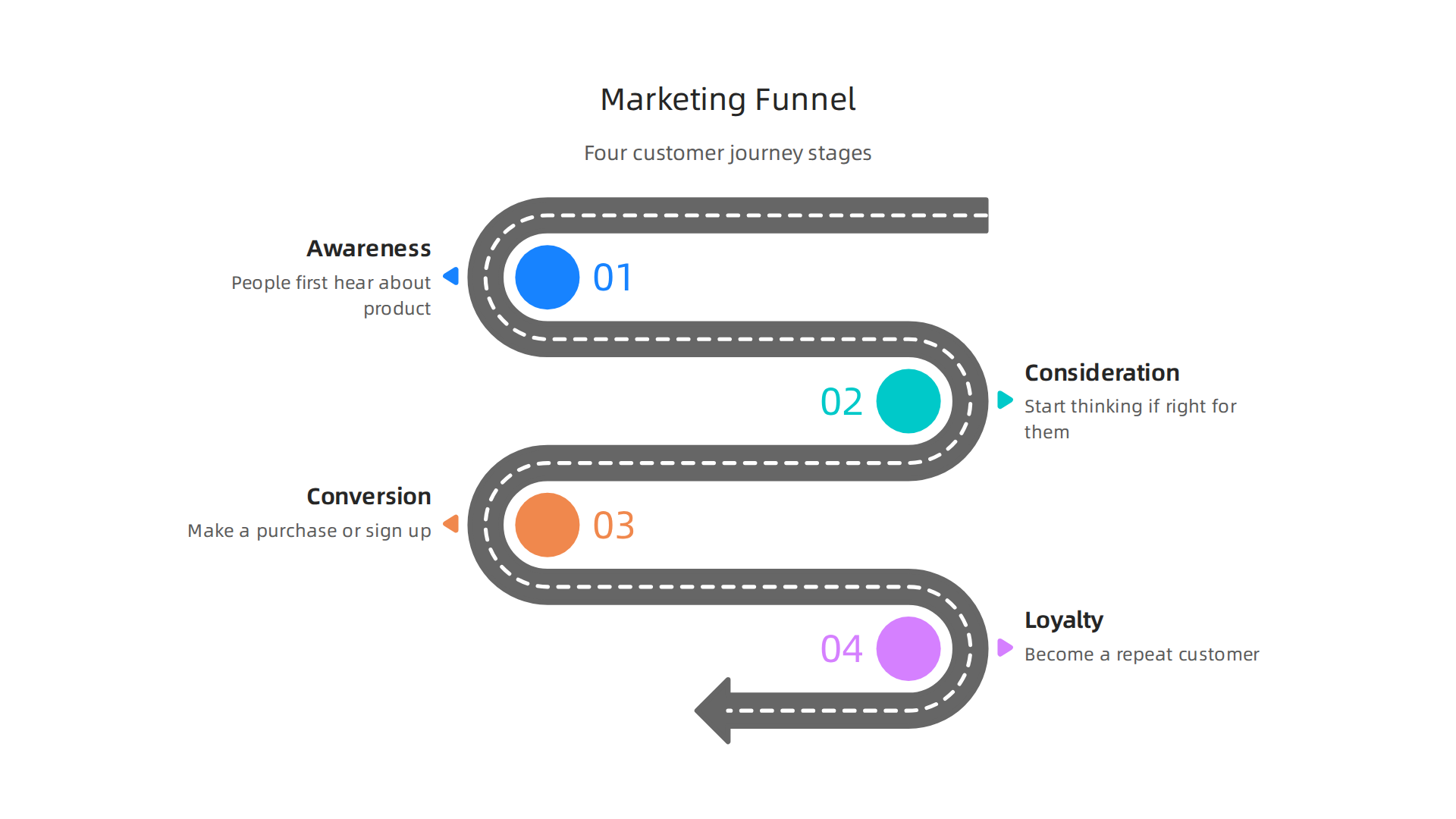
    Understand the four core stages of a customer's journey through the marketing funnel.

    • Awareness: People first hear about your product or service.
    • Consideration: They start thinking if it is right for them.
    • Conversion: They make a purchase or sign up for something.
    • Loyalty: They become a repeat customer.

    Each step in this journey is a "conversion pathway." Our goal in marketing science is to guide more people through each step. AI tools can help predict which customers are most likely to move to the next stage. This makes it easier for a marketing director to see where customers might get stuck and what messages work best to keep them moving. Understanding these customer journeys is vital for mastering AI for marketing services in 2026.

    Attribution and Understanding Impact

    After we send out marketing messages, how do we know which one really made a customer buy? This is called "attribution." It means giving credit to the marketing efforts that led to a sale or other desired action. For example, did an email, a social media ad, or a blog post make the difference?

    Modern marketing science uses tools like Marketing Mix Modeling (MMM) to look at all these different things at once. It helps figure out which marketing channels are working best and how they influence each other. This is especially helpful in 2026, as marketing has many moving parts, as detailed in reports like the 2026 State of Marketing Report. These models help a business know where to put its money to get the most sales. They combine data to show the true impact of different ads and campaigns, as explained in a guide on Marketing mix modeling (MMM) and measurement.

    Experimentation and Causal Models

    The best way to know what truly works is through experiments. This is where causal models come in. They help us understand "cause and effect." Instead of just seeing that more ads led to more sales, causal models try to prove that the ads caused the sales.

    A key tool for this is A/B testing. This is a simple but powerful way to test ideas. You create two versions of something, like an ad or a webpage. Version A is the original, and Version B has one small change. Then, you show Version A to one group of people and Version B to another similar group. By comparing the results, you can see which version performs better. This helps marketers make small, sure improvements. Many experts agree that A/B testing needs a clear plan and steady checks to give reliable results, as highlighted in A/B Testing: The Complete Guide to Split Testing for Marketing (2026).

    AI professionals can use these frameworks to help businesses move beyond guesswork. By running careful tests and using AI to understand the numbers, they can build marketing plans that truly work. This helps companies pick AI for business tools that deliver real results. To stay on top of the latest AI trends and insights that power these advanced marketing strategies, consider subscribing.

    Get clear daily AI updates from The AI Newsletter Worth Reading.

    To make sure marketing plans truly work, AI professionals need special skills and the right tools behind them. This is where marketing science truly shines, by combining smart thinking with strong data systems.

    Essential Skills for Marketing Science

    To truly understand why customers do what they do, people working in marketing science need to be good with numbers and logic.

    A professional meticulously analyzes data, a key skill for marketing science.

    Here are some key skills:

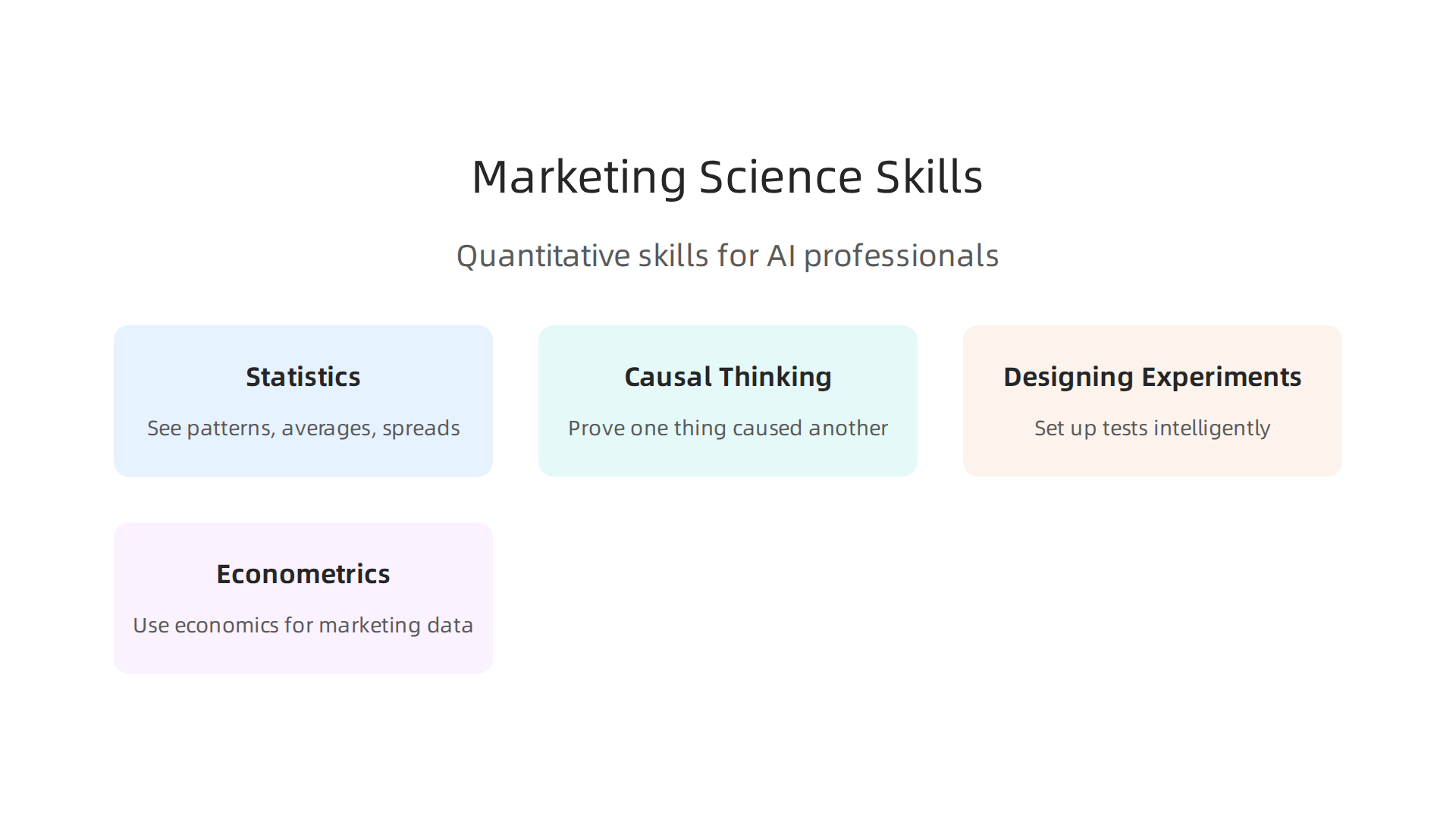
    Quantitative skills crucial for AI professionals in marketing science.

    • Understanding Statistics: This means being able to look at data and see patterns, averages, and how things spread out. It helps us know if a change in marketing really made a difference, or if it was just by chance. Think of it like a weather report: you need to understand the numbers to know if it will rain.
    • Causal Thinking: This is about figuring out "cause and effect." Instead of just seeing that two things happen together, causal thinking helps us prove that one thing made the other happen. For example, did our new ad cause more people to click, or was it something else?
    • Designing Experiments: Just like scientists in a lab, marketing science professionals need to set up tests (like A/B tests) in a smart way. This means making sure the test is fair and the results can be trusted.
    • Basic Econometrics: This skill uses ideas from economics to study marketing data. It helps us build models to predict how changes in price, promotions, or other marketing efforts will affect sales.

    A good marketing director needs team members with these kinds of quantitative skills to make smart choices. Knowing these things helps people in roles like a senior marketing scientist, who often needs a strong background in analytical thinking and statistical fundamentals to generate insights and recommendations, as noted in job requirements for these roles Senior Marketing Scientist, Level 4 – Snap Careers.

    Key Data Infrastructure Needs

    Even with great skills, you can’t do marketing science without good data. Think of data infrastructure as the backbone that collects, stores, and organizes all the information a business needs. In 2026, here are some important parts:

    • Reliable Event Data: This is information about every action a customer takes. Every click, every page visit, every purchase is an "event." It’s super important that this data is collected completely and correctly. Imagine trying to understand customer journeys without knowing every step they took. Businesses need a clear plan for what data to collect and how to label it, so everyone uses the same terms. This helps a lot with things like cpm marketing where you pay for every thousand views, making sure your ad spend is correctly tracked. Collecting this kind of detailed event data is part of a scalable growth setup that normalizes user and revenue signals in a central place Growth Architecture Playbook 2026.
    • Identity Resolution: People use many devices like phones, tablets, and computers. They might visit your website, then open an email on a different device. Identity resolution is the smart process of connecting all these different activities back to one single customer. It’s like putting together pieces of a puzzle to see the full picture of a customer’s journey. This is a crucial step for modern marketing data, not just an extra feature Marketing Data Pipelines in 2026. In fact, identity resolution is a core part of today’s marketing technology, as new trends keep shaping how we connect customer information in 2026 The 5 trends reshaping identity resolution in 2026.
    • Clean KPI Definitions: KPI stands for Key Performance Indicator. These are the main numbers a business watches to know if it’s doing well, like how many sales were made or how many people signed up for a newsletter. For marketing science to work, everyone needs to agree on what these KPIs mean and how they are measured. If the definitions are messy, the insights will be messy too.

    Building and maintaining this data infrastructure is key for any company looking to truly leverage AI in its marketing efforts. For marketing specialists, choosing the right AI tools often depends on how well these tools can work with clean, resolved customer data to drive real business results and understand ROI. Learning more about how marketing specialists choose AI tools can help your business.

    To truly get the most out of clean data and smart AI tools, marketing science needs well-designed experiments. Think of it like this: you have all the ingredients (data) and a fancy new oven (AI tools), but you still need a good recipe (experiment design) to bake a perfect cake. This part is about setting up tests in a way that gives you real, trustworthy answers about what works and what doesn’t.

    Steps to Design Reliable Experiments with AI Tools

    Designing experiments is a key part of marketing science. It helps us find out if our new ideas or AI-powered changes are actually making a difference. Here’s how to do it right:
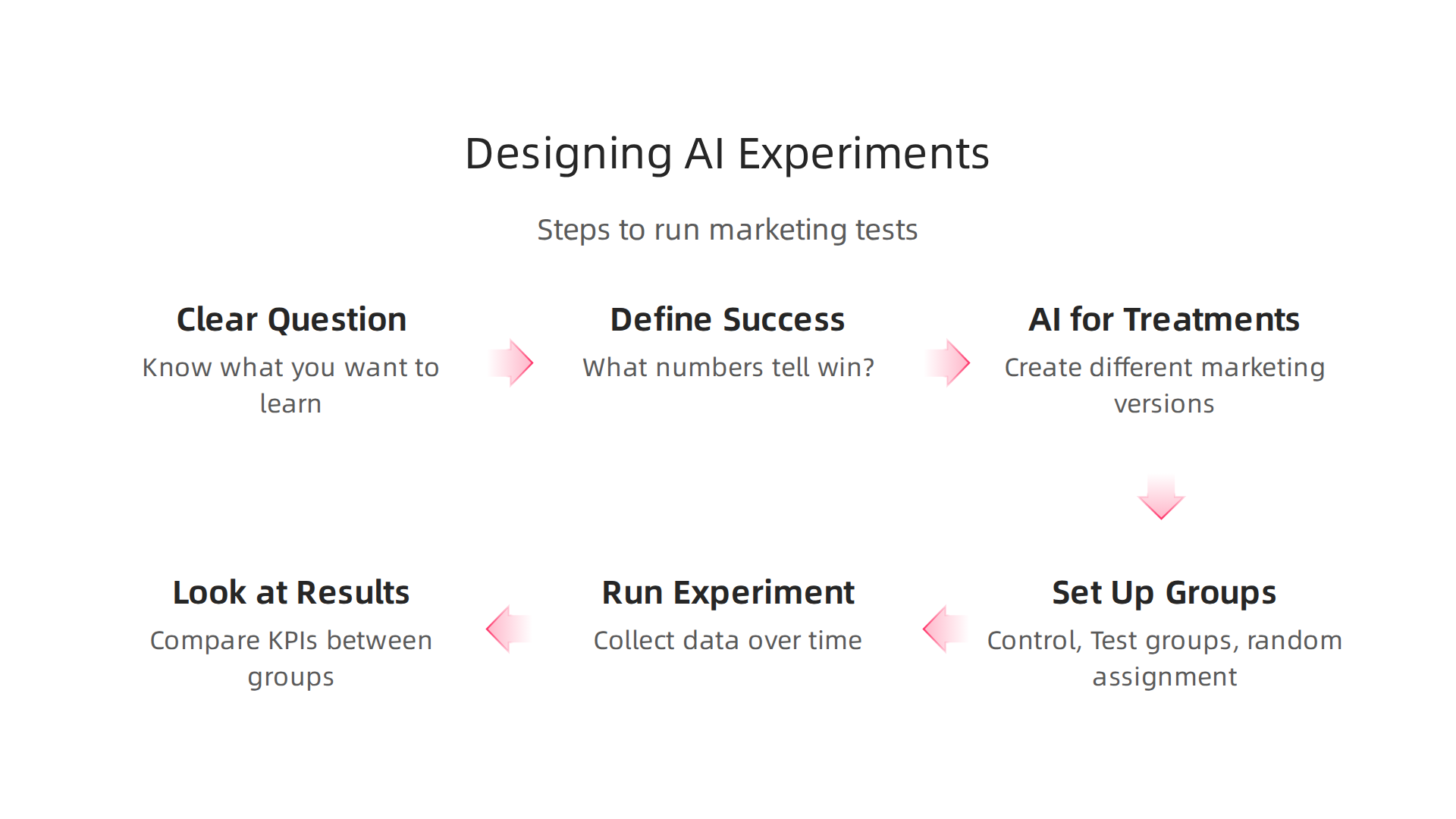
    A step-by-step guide to designing effective marketing experiments using AI.

    1. Ask a Clear Question: Before anything else, know what you want to learn. Do you want to know if a new AI-written email subject line gets more clicks? Or if a personalized ad created by AI leads to more sales? This clear question is your starting point, also called your hypothesis. You need to identify measurable metrics to evaluate your experiment, as highlighted in guides for performance marketing experiments A marketing experiment guide for performance.
    2. Define What Success Looks Like: What numbers will tell you if your experiment was a win? These are your Key Performance Indicators (KPIs). For example, if you’re testing email subject lines, a higher click-through rate might be your KPI. Make sure these are clear to everyone.
    3. Use AI for Treatments: This is where AI tools shine. You can use AI to create different versions of your marketing message, different ad images, or even different customer journeys. These different versions are your "treatments" that you’ll test. For example, one group gets the normal message, and another gets the AI-personalized message.
    4. Set Up Fair Groups: You need at least two groups:
      • Control Group: This group gets the usual marketing message or experience. Nothing changes for them.
      • Test Group(s): These groups get the new AI-powered treatments.
        It’s super important that people are put into these groups randomly. This helps make sure the groups are similar, so any differences you see later are likely due to your new treatment, not something else.
    5. Run the Experiment and Collect Data: Let the experiment run for a set amount of time. During this time, the great data infrastructure we talked about earlier will collect all the information. This includes every click, view, or purchase related to both the control and test groups.
    6. Look at the Results: Once the experiment is done, compare the KPIs between your control and test groups. Did the AI-powered treatment lead to a better outcome?

    Common Pitfalls to Watch Out For

    Even with good planning, experiments can go wrong. Here are some common problems to avoid in marketing science:
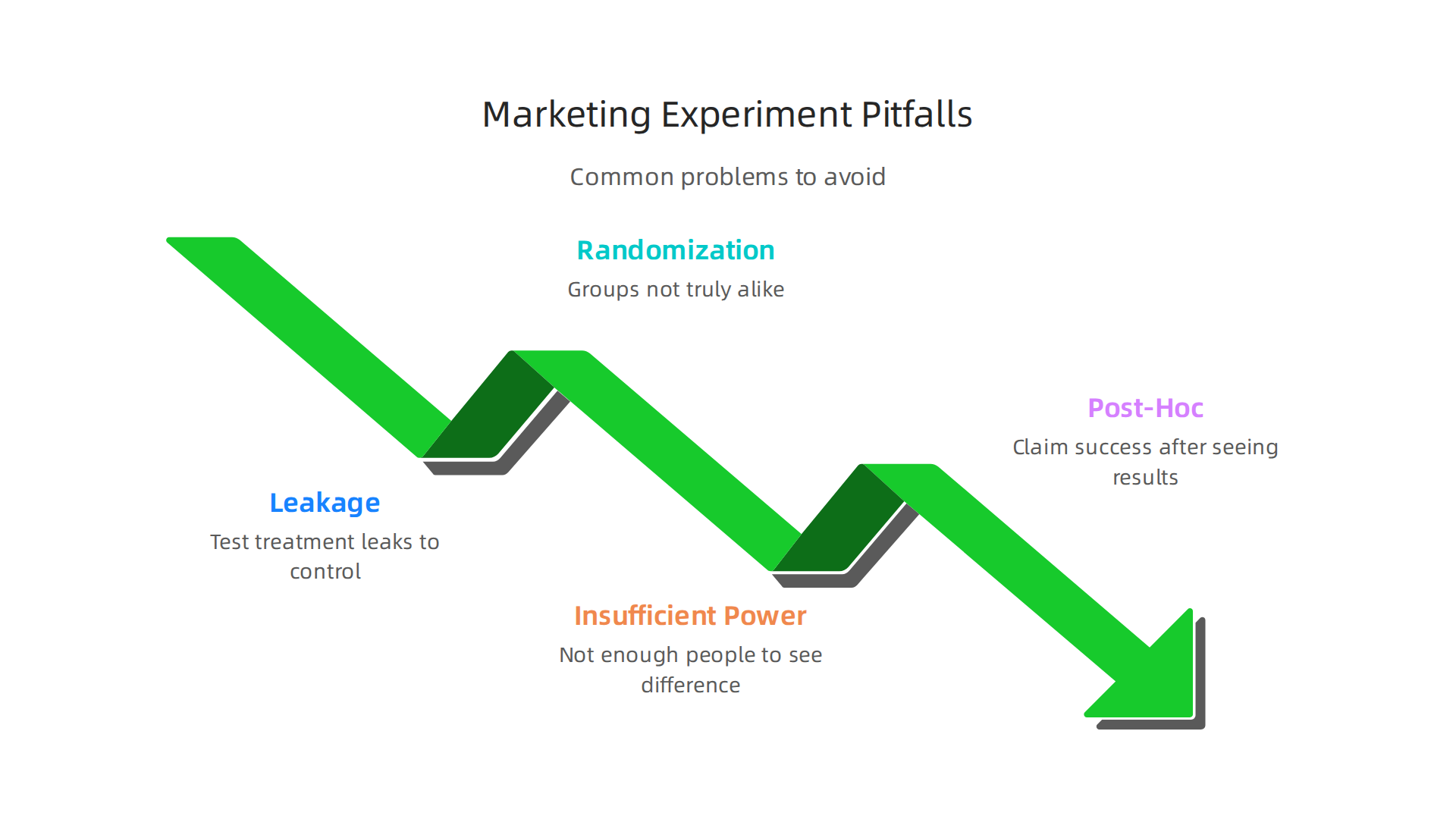
    Key challenges to watch out for when running marketing experiments.

    • Leakage: This happens when your test treatment accidentally "leaks" into your control group. Imagine if someone in your control group somehow saw the AI-powered ad meant only for the test group. This can mess up your results.
    • Improper Randomization: If your groups aren’t truly random, they might not be alike. For instance, if one test group accidentally has all your most loyal customers, it might seem like your new treatment works wonders, but it’s just because those customers were already likely to buy.
    • Insufficient Power: This means you didn’t have enough people in your experiment to see a real difference. If your test group is too small, a small improvement might not be clear enough to say for sure that the AI treatment caused it. It’s like trying to tell if a recipe is better after only one person tastes it.
    • Post-Hoc Comparisons: This is when you run an experiment and then, after seeing the results, you start digging around for any small difference to claim success. It’s like throwing darts at a wall and then drawing the target around where they landed. You should have a clear target (your hypothesis and KPIs) before you start.

    By avoiding these pitfalls, a marketing director can trust the results from their experiments. This allows them to make smart choices, like how to best use AI tools for marketing and drive real return on investment. If you want to dive deeper into how businesses choose and use these tools, check out our guide on how marketing specialists choose AI tools for marketing and drive ROI.

    Staying informed about the latest AI advancements and how they impact marketing science is crucial.

    Get clear daily AI updates from The AI Newsletter Worth Reading.

    Knowing what works and what doesn’t is important. But figuring out why something works is the real challenge in marketing science. After you design your experiments, the next big step is measuring their true impact. This means looking closely at how your marketing efforts lead to actual results, not just things that happen at the same time.

    Different Ways to Measure What Works

    When you run a marketing campaign or test a new AI tool, you want to know which parts of your effort led to a sale or a new customer. This is called "attribution." There are a few ways to think about it:

    • Last-Touch Attribution: This is the simplest. It gives all the credit to the very last thing a customer saw or clicked before they bought something. For example, if they clicked an email then bought, the email gets all the credit.
    • Multi-Touch Attribution: Real life is rarely that simple. Customers usually see many different ads or messages before making a choice. Multi-touch models try to give credit to all the marketing steps along the way. They try to see the whole customer journey.
    • Marketing Mix Modeling (MMM): This is a bigger picture view. It looks at all your marketing spending across different channels like TV, digital ads, and even changes in price. It uses math to guess how much each channel added to your sales over time. This helps a marketing director understand the overall effect of their big campaigns. You can compare this to how causal inference works to see which method best helps you understand marketing effectiveness Causal Inference vs Media Mix Modeling.

    Finding the Real Cause with Causal Inference

    The trick with all these methods is moving from just seeing things happen together (correlation) to truly understanding what caused the result. This is where "causal inference" comes in. It’s about using smart methods, often helped by AI, to prove that your marketing action really did make a difference, instead of just being present when something good happened. For instance, just because sales went up when you ran an ad doesn’t mean the ad caused all those sales; other things could have changed too. Causal inference helps marketing science dig deeper to find the true impact of marketing efforts Causal Inference in Marketing.

    Choosing KPIs that Matter for Long-Term Value

    To properly measure impact, you need the right Key Performance Indicators (KPIs). These are the numbers that tell you if you’re succeeding. It’s easy to focus on short-term numbers like how many people saw your ad (impressions) or how many clicks you got. But for real marketing science, you want KPIs that show long-term value.

    Instead of just clicks, think about:

    • Customer Lifetime Value (CLV): How much money a customer brings to your business over their entire relationship with you. This is much better than just looking at their first purchase.
    • Return on Investment (ROI): How much money you get back for every dollar you spend on marketing. This is key for proving your marketing efforts are worthwhile.

    A good marketing director knows that choosing the right KPIs helps them see the big picture. It helps them understand not just what brought a customer in, but how valuable that customer will be over time. For example, a content marketing institute might track how many leads their articles generate that turn into long-term subscribers, not just how many people read one article. This focus on deeper, more meaningful metrics ensures that marketing decisions truly drive business growth. If you want to learn more about how to make sure your AI marketing efforts truly pay off, check out our guide on how to get real ROI from AI marketing cloud in 2026.

    Putting marketing science into action means making experiments and careful measurement a regular part of how your teams work every day. It’s not enough to just know what to measure; you need to build the right steps and get everyone on board to truly see the benefit.

    How to Make Marketing Science a Daily Habit

    To properly use marketing science, you need good people and clear steps. It’s like setting up a mini-science lab inside your company.

    1. Build the Right Teams: You’ll need people who are good with numbers (analysts), creative thinkers (marketers), and those who understand your products. These teams will work together to design tests and look at the results. A good marketing director makes sure everyone understands their role.
    2. Set Up Clear Processes: Every experiment should follow a plan. This means:
      • Having a good guess: What do you think will happen? This is called a hypothesis.
      • Designing the test: How will you run the experiment? What will you change, and what will you keep the same? For example, you might test different ad messages to see which one performs better, like creating a marketing experiment guide for performance.
      • Collecting data: Gather all the numbers from your test.
      • Looking at results: Did your guess come true? What did the numbers tell you?
      • Learning and doing better: Use what you learned to make your next marketing efforts even stronger. This scientific approach helps prove that your changes actually cause results, not just happen at the same time Optimizing Marketing Spend with Causal Attribution.
    3. Use the Right Tools: In 2026, AI tools can help a lot with marketing science. They can analyze huge amounts of data, predict outcomes, and even help set up experiments. Knowing how marketing specialists choose AI tools for marketing and drive ROI is key for this step.

    Getting Everyone on Board: Leading Change

    Bringing new ways of working, like marketing science, into a company can be tricky. People might be used to doing things a certain way. Here’s how to make it easier:

    • Start Small, Show Big Wins: Pick one small project where you can use marketing science to get clear, positive results quickly. Maybe you test a new email subject line and see a huge jump in people opening it. Share this success widely. When people see that these methods work, they’ll be more open to trying them. For example, some companies create a 90-day playbook to implementing AI in your marketing department, focusing on quick wins in the first month.
    • Teach and Train: Help your teams learn about these new methods. Offer workshops or easy-to-understand guides. The more people understand, the more likely they are to use marketing science in their daily jobs.
    • Make it a Habit: Build these scientific steps into your regular product and marketing workflows. It shouldn’t be a one-time thing but a continuous process of learning and improving. This helps ensure that every marketing decision is backed by solid data.

    A forward-thinking marketing director understands that making marketing science a part of the company culture is vital for staying ahead. It helps teams not only meet their short-term goals but also build long-term value for the business.

    Stay updated on the latest trends and practical applications in AI for marketing.

    Get clear daily AI updates from The AI Newsletter Worth Reading.

    Summary

    This article explains marketing science for AI professionals: a practical, data-first approach that turns AI capabilities into measurable business outcomes. It defines marketing science and the mindset behind it, then walks through core frameworks like funnels, attribution, A/B testing, and causal models so teams can move from guesswork to proven impact. The guide covers essential skills—statistics, causal thinking, experiment design—and the data infrastructure needs such as event tracking, identity resolution, and clear KPI definitions. It gives step-by-step advice on designing fair AI-driven experiments, highlights common pitfalls (leakage, poor randomization, low power), and explains methods for measuring real impact with CLV, ROI, MMM and causal inference. Finally, it shows how to embed these practices into routine workflows, pick the right AI tools, and lead organizational change so marketing science delivers repeatable growth.


  • Mastering AI For Marketing Services In 2026

    Mastering AI For Marketing Services In 2026

    In 2026, artificial intelligence (AI) is changing everything, especially in the world of marketing. What started as a new trend is now a must-have tool for any business offering marketing services. It’s no longer enough to just be curious about AI. Now, marketing teams need a clear plan to use AI wisely.

    Businesses need to move from just looking at AI to having a real strategy for it.

    A marketing team collaborates to outline a clear AI strategy, moving beyond simple curiosity to defined goals.

    Without a good plan, companies might miss out on big chances to grow or make things better. Experts agree that business leaders need smart ways to find new opportunities, pick the best ideas for using AI, test them out carefully, see what works, and then use those good ideas on a larger scale. This helps turn early tries with AI into real wins for the business From AI pilots to performance: 3 things leaders need to unlock.

    This guide is here to help you get a handle on AI for your marketing services. We will give you easy-to-understand ways to think about AI. You’ll learn about how to pick the right AI tools and how to measure if they are truly helping your business. We will show you real examples of how AI can help with many tasks. This includes making better content, putting together impressive AI for presentations, and even having an intelligent AI virtual assistants for businesses to support your team.

    You’ll find practical ways to test new AI tools, checklists to help you choose the best options, and tips on how to see if your AI efforts are really paying off. Our goal is to make sure you can use AI to make your marketing smarter, faster, and more effective.

    To stay on top of the latest AI trends and how they impact business, consider subscribing:
    The AI Newsletter Worth Reading

    Before you pick any AI tools for your team, it’s super important to have a clear plan. Think of it like going on a trip. You wouldn’t just grab a map and start driving without knowing where you want to go, right? The same goes for using AI in your marketing services. In 2026, simply getting AI tools isn’t enough. You need a smart way to use them to reach your business goals.

    Your AI plan should directly match what your marketing services are trying to do. For example, if you want to get more new customers (called lead generation), AI could help find people who are most likely to buy from you. If your goal is to keep current customers happy and loyal (retention), AI might help you send them special messages they will love. Or, if you need to make lots of new ads or content quickly, AI can help scale your creative output. Having a clear vision like this is a key step to building a good AI strategy for marketing, as experts say you need to define the main results you want to achieve How do I build an AI strategy for marketing?.

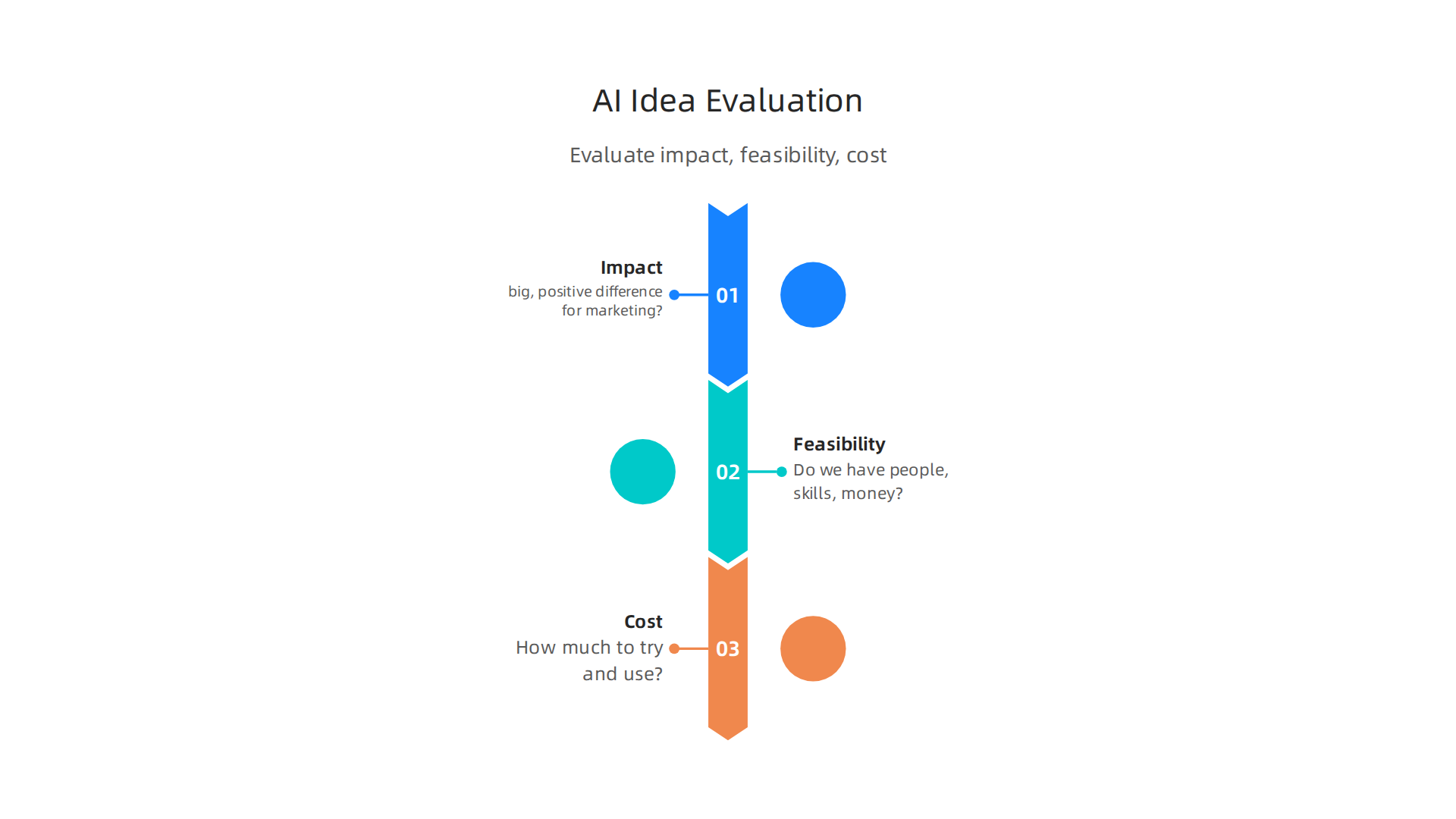
    To figure out which AI ideas to try first, you can use a simple plan. Ask yourself three things about each AI idea:

    Evaluate potential AI initiatives by considering their impact, feasibility, and cost.

    • Impact: Will this AI idea truly make a big, positive difference for our marketing services?
    • Feasibility: Can we actually do this right now? Do we have the people, skills, and money needed to make it happen?
    • Cost: How much will it cost to try out and use this AI tool?
      By thinking about these three points, you can choose the best projects that will bring the most value without costing too much or being too hard to set up. To learn more about selecting the right technology, consider reading our guide on how to pick AI tools for business to drive growth in 2026.

    A big mistake many teams make is picking AI tools before they know what they want to achieve. This is like buying a fancy hammer without knowing if you need to build a house or fix a leaky faucet. When you choose tools first, you might end up with expensive software that doesn’t really help your marketing services goals. This can lead to wasted money and time. Reports from 2026 show that while many businesses are using AI, a lot of them aren’t truly seeing big improvements in their work because they lack a clear plan State of Marketing in an AI-Driven World: 2026 Adobe Report. In fact, one report found that only 41% of marketers can clearly show how AI is helping them make more money Report: The State of AI in Marketing 2026. By setting your strategy first, you make sure that every AI tool you choose works towards your real business needs.

    Now that you have a clear plan for what you want your marketing services to achieve, the next step is to look closely at your current ways of doing things. This helps you find the best spots where AI can make a real difference. Think of it as looking under the hood of your marketing car to see which parts could run better with a little AI tune-up.

    To do this, you need to audit your marketing processes. This means checking out everything your team does, from making ads to talking with customers. Where are the tasks that take a lot of time? Where do you wish you had more help or better insights? These are often the places where AI can fit in perfectly.

    Many marketing teams in 2026 are finding big wins with AI in a few key areas:

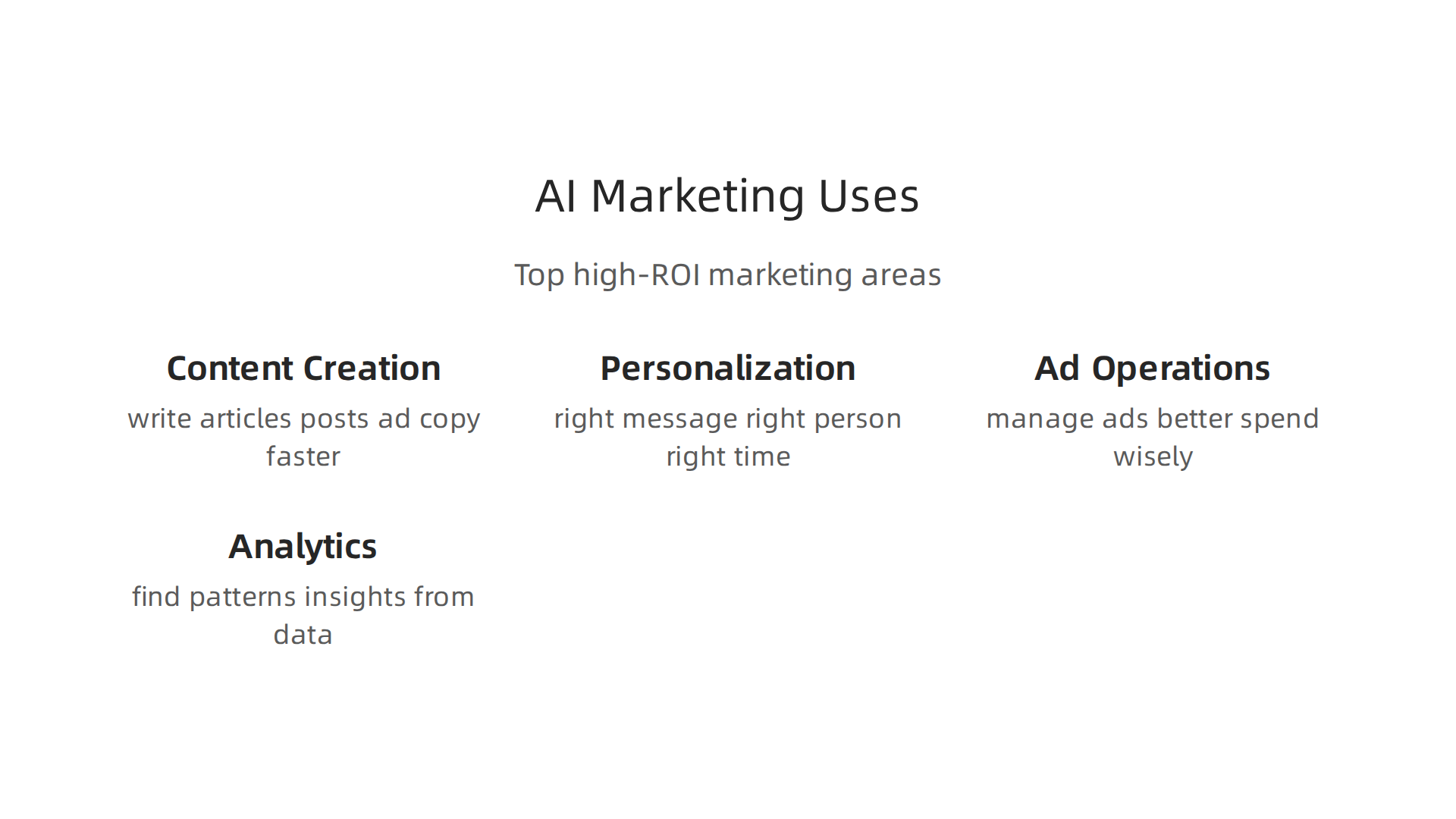
    Explore the top areas where AI is delivering significant value for marketing teams.

    • Content Creation: This is still the top use case for AI. AI can help write articles, social media posts, or ad copy much faster. This means your team can create more content without getting swamped. Reports show that content creation is used by 78% of teams, making it the most common way to use AI in marketing State of AI Marketing 2026 | Enterprise AI Adoption Report.
    • Personalization: AI can help you send the right message to the right person at the right time. This makes customers feel special and more likely to buy.
    • Ad Operations (Ad Ops): AI can manage your ads better by figuring out who to show them to and when, which helps you spend your ad money wisely.
    • Analytics: AI can look at huge amounts of data and find patterns or insights that humans might miss. This helps you understand what’s working and what’s not in your marketing campaigns. It’s like having a super-smart marketing assistant.

    When you’re looking at different ideas for using AI, you should score each one based on three things:

    • Potential Impact (ROI): How much positive change or money will this AI idea bring in? Will it truly help your marketing services grow or save costs? Teams focused on ROI see much better results from their AI efforts, with 83% of marketing teams reporting clear gains from generative AI AI Marketing Stats for 2026: ROI & Benchmarks.
    • Data Readiness: Do you have the right kind of data that the AI tool needs to work well? If not, how hard will it be to get that data ready?
    • Integration Complexity: How easy or hard will it be to connect this new AI tool with the other tools and systems you already use?

    Sometimes it’s better to start with a "narrow pilot." This means trying out an AI tool for a small, specific task with a small team. For example, you might use AI to just help with writing headlines for your emails. If that works well, then you can think about a "platform-wide rollout," which means using AI across many different tasks and teams in your marketing services. Starting small helps you learn and fix problems before doing something big.

    To learn more about how marketing pros choose AI tools for their work, check out our guide on how marketing specialists choose AI tools for marketing and drive ROI.

    For daily updates on how AI is changing marketing and business, you’ll want to stay informed.
    Get clear daily AI updates from The AI Newsletter Worth Reading.

    Choosing the right AI tools for your marketing services is a big step after you know where AI can help most.

    A professional carefully evaluates different AI tools and vendors to make an informed decision.

    It’s like picking the best helper for your team. You want to make sure the tool can actually do the job well. To do this, you need a good checklist.

    What to Look For in AI Tools

    When you’re looking at different AI tools, keep these things in mind:

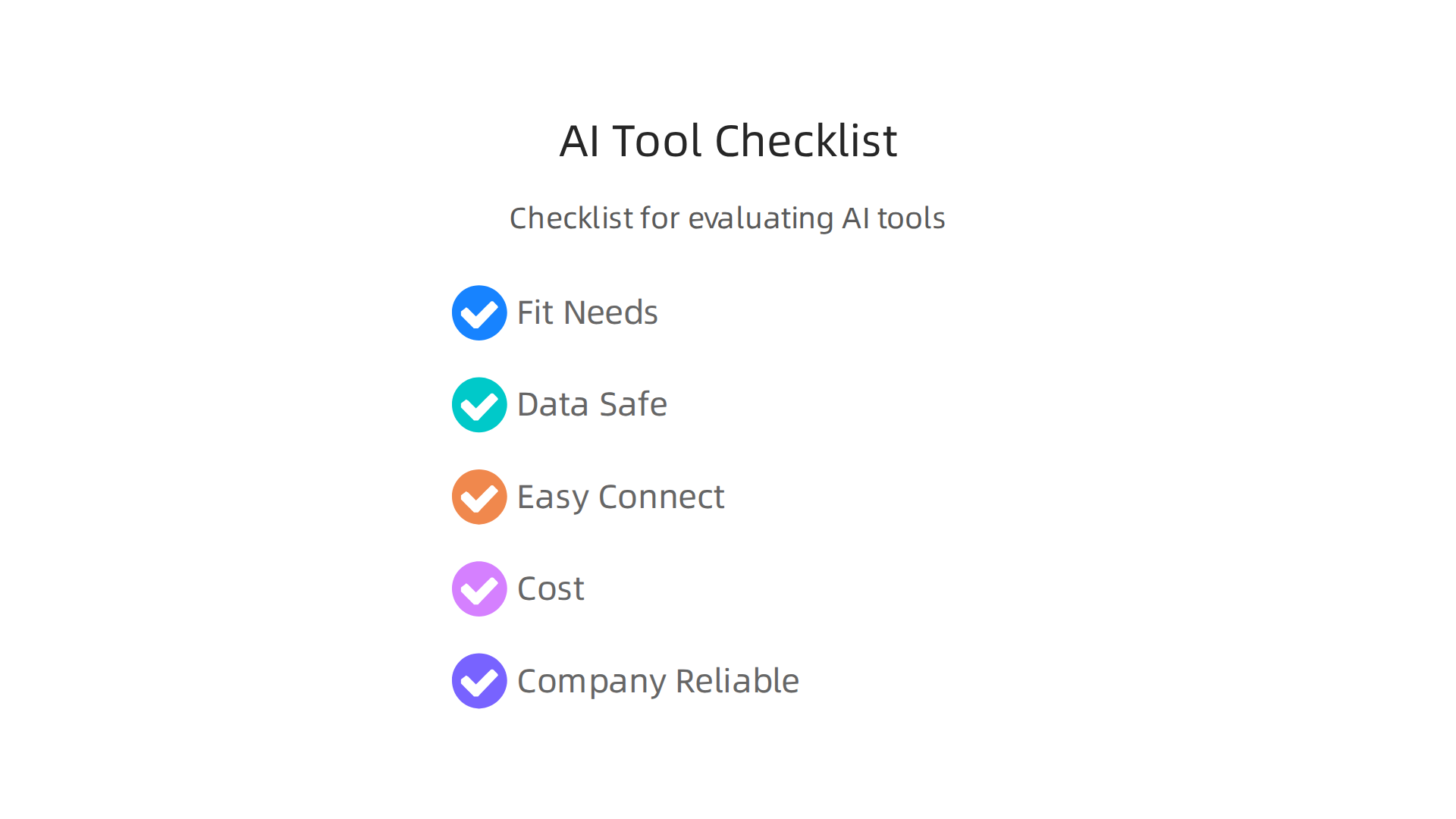
    Checklist for evaluating AI tools, focusing on needs fit, data safety, integration, cost, and company reliability.

    • Does it fit your needs? The AI tool must be able to do the specific tasks you need. If you want AI to help write social media posts, the tool should be good at that. Don’t pick a tool that does many things poorly when you need one thing done perfectly. You want a tool that truly boosts your marketing services.
    • Is your data safe? AI tools often need to use your company’s data. You must be sure that the tool and the company that made it will keep your information private and secure. This is very important for trust and legal reasons.
    • How easy is it to connect? Think about your current marketing tools. Will the new AI tool easily work with them? Or will it be a headache to link everything up? An AI tool that connects smoothly with your existing setup makes life much easier.
    • What does it cost? Understand how the AI tool charges you. Is it a monthly fee, or do you pay based on how much you use it? Make sure the cost makes sense for your budget and the value you expect to get. Tools that offer clear pricing help you manage your money better.
    • Is the company reliable? Look at the company behind the AI tool. Have they been around for a while? Do they update their tools often? A strong, reliable company means you’ll get good support and that the tool will keep getting better. A template for evaluating technology vendors can help you score different options to ensure they meet your business needs and values R E S P O N S I B L E A I T E M P L A T E.

    Testing AI Tools in Real Life

    Once you have a few tools in mind, it’s a good idea to test them. This is called a "Proof of Concept" (POC) or a "pilot."

    • Try them side-by-side: Don’t just pick one tool. Try out two or three tools at the same time for the same small task. For example, have Tool A and Tool B both write headlines for your next email campaign. See which one does better. This helps you compare them fairly.
    • Focus on how they work, not just features: It’s not just about what a tool can do, but how well it actually works for your team every day. Does it save time? Is it easy to use? Does it fit into your team’s workflow without causing problems? This helps you find the best fit for your marketing services. A good way to compare is by using a scorecard for different criteria, making sure you look at things like how deep the AI’s capabilities are and how well it fits your specific marketing needs How to Evaluate B2B AI Marketing Vendors: 12 Questions … – Tofu HQ.

    By carefully checking these things, you can choose AI tools that truly help your marketing efforts grow. If you want a more general guide on how to make smart choices for your business, you can read more about how to pick AI tools for business to drive growth in 2026. This careful process makes sure you’re getting a real marketing assistant, not just a fancy gadget.

    After testing AI tools with a small "Proof of Concept," the next big step is to make them a regular part of your marketing services. This means moving from a small test to full "production." It’s like moving from trying out a recipe to cooking it for all your customers every day. You need a clear plan to do this right.

    Getting AI Tools Ready for Daily Marketing

    Putting AI into your daily work for your marketing services needs careful steps.

    • Set up the Data Flow: Your AI tools need good data to work. Think about how your company’s information will safely get to the AI tool. This involves setting up "data pipelines," which are like highways for your data. You also need to make sure the data is clean and correct. If the data is bad, the AI’s results will be bad too. For marketing leaders, a good approach to data governance is key when using AI systems Snowflake’s Agentic Enterprise Framework Puts Data ….
    • Keep Testing and Improving: Even after a pilot program, you should keep testing the AI. As your marketing needs change, the AI tools might need to learn new things or be adjusted. This helps ensure the AI continues to perform its best for your team.
    • Rollout Slowly: Don’t just give the AI tool to everyone at once. Start with a small group, get their feedback, and then slowly bring more people on board. This "rollout cadence" helps everyone get used to the new tools without too much stress. It also lets you fix small problems before they become big ones.

    Teamwork and Rules for AI Success

    Making AI a permanent part of your marketing services means more than just turning on a new tool. It needs good teamwork and clear rules.

    • Assign Clear Roles: While marketing teams often lead the charge in adopting AI, they need help from others. Your IT team can help with security, your legal team can make sure you follow privacy rules, and data experts can check for fairness. Having everyone work together helps make sure the AI is used responsibly. In fact, setting up strong governance that includes different departments is important for using AI in a way that truly helps the business What governance structures support responsible AI?.
    • Create AI Rules (Governance): Just like you have rules for how your team works, you need rules for how your AI works. This is called "AI governance." It helps make sure the AI tools are used fairly, correctly, and ethically. For example, the European Data Protection Board updated its rules in 2026 to make sure AI agents follow data privacy principles at every step AI Agents and Data Privacy: A 2026 Compliance Guide – MTM Blog.
    • Watch for Bias and Protect Privacy: AI tools learn from data, and sometimes that data can have unfair patterns, or "bias." You need to look for this bias and work to fix it, perhaps by using fair data generation techniques Mitigating bias in artificial intelligence: Fair data generation via …. Also, always make sure the AI tool handles customer data with the highest privacy standards, especially in 2026, when data privacy rules are stricter than ever. Staying up-to-date on compliance is a must.

    By taking these steps, you make sure your AI tools don’t just work in a test, but truly become a strong marketing assistant for your business. This careful planning helps your marketing services grow and adapt for the future.

    If you want to keep learning about how AI impacts your business and marketing, you’ll find helpful insights in "The AI Newsletter Worth Reading." Get clear daily AI updates from The Deep View Newsletter.

    5) Measure What Matters: KPIs, Attribution, and ROI for AI-Driven Marketing

    Once AI tools are part of your daily marketing services, it’s super important to know if they are actually helping.

    A professional focuses intently on data and reports, measuring the impact of marketing initiatives.

    You need to measure their success. This means looking at certain numbers, understanding how AI causes good changes, and checking if you are getting a good return on your money.

    Picking the Right Numbers to Watch

    Before you even start using AI for your marketing, you need to know what you want to improve. These are called Key Performance Indicators, or KPIs. They are like scores that show how well your marketing is doing. For AI-driven marketing, you might look at things like:

    • How many new customers you get.
    • How many people click on your ads.
    • How much money each customer spends over time (this is called customer lifetime value, or LTV).
    • How much it costs to get a new customer (this is called customer acquisition cost, or CAC).

    It’s a good idea to know what these numbers were before you used AI. This way, you can see if the AI is making them better. Experts say you should set clear goals and measure your starting point before adding AI to your marketing efforts How do I measure the ROI of AI marketing investments?. This helps you tell a real story about how AI helps your marketing services.

    Knowing What Changes Are Due to AI

    When you use AI, many things might change. How do you know for sure that AI is the reason for a boost in sales or leads? This is where "attribution" and "experimentation" come in.

    • Attribution means figuring out which part of your marketing efforts gets credit for a result. With AI, you want to give the AI the right amount of credit.
    • Experimentation is like running a science test. You can split your audience into two groups: one that gets the AI-powered marketing (the "test" group) and one that doesn’t (the "control" group). By comparing these groups, you can see the true extra help, or "incremental lift," that AI brings. Methods like A/B tests help you find the real impact of your AI tools 2026 Marketing Playbook: Proven AI & Attribution Strategies. Companies that use smart attribution methods can see much better returns on their marketing money Marketing Attribution Statistics (2026): 54+ Data Points on ….

    To really dive deep into how AI can boost your sales and leads, learning about these measurement methods is key. You can find more helpful advice on how marketing specialists choose AI tools to drive ROI.

    Figuring Out Your Return on Investment (ROI)

    ROI means how much money you get back for the money you spent. For AI in marketing, it’s about seeing if the AI tools are worth their cost. A simple way to think about it is:

    ROI = (Extra Money Made + Money Saved − Total Cost of AI) ÷ Total Cost of AI

    Measuring AI’s ROI in marketing is not just a single number; it’s a process of setting a baseline, running tests, and then seeing the extra lift AI provides How Directors Measure AI ROI in Ad Campaigns | Pixis. Many companies are already seeing great results. In fact, about 60% of companies that have changed how they measure AI are getting two to three times their money back, or even more Report: The State of AI in Marketing 2026 – Jasper. This shows that with careful planning and measurement, AI can be a powerful marketing assistant.

    When you measure what matters, you make sure your AI investments are truly helping your marketing services grow and succeed. For further reading on this topic, consider learning more about how to get real ROI from AI marketing cloud.

    6) Data Governance, Privacy, and Ethical Considerations for Marketing Services

    After seeing how artificial intelligence (AI) can help your marketing services grow and succeed, it’s just as important to talk about how to use it wisely and fairly.

    Key ethical considerations for AI in marketing: data safety, fairness, and transparency.

    This means looking closely at how you handle data, respect people’s privacy, and make sure your AI systems are ethical. It’s not just about making money; it’s about building trust and following the rules in 2026.

    Keeping Data Safe and Private with AI

    When you use AI for marketing services, you’re often dealing with lots of customer information. "Data governance" is like having a clear set of rules for how you collect, store, and use this data. It makes sure your data is correct, kept safe, and used in a way that follows the law. Experts agree that your AI plan and your data rules must go hand-in-hand Snowflake’s Agentic Enterprise Framework Puts Data Governance at the Center of Marketing.

    In 2026, privacy is a big deal. New guidelines, like those from the European Data Protection Board, tell us that when AI agents process personal information, we must only collect the data we truly need and only use it for the reasons we said we would AI Agents and Data Privacy: A 2026 Compliance Guide. This is called "data minimization" and "purpose limitation." To help with this, you should do special checks, sometimes called "privacy impact assessments," before using AI systems that handle personal data. These assessments help ensure you’re using AI responsibly and protecting people’s privacy Privacy as the Foundation of Responsible AI Governance. It’s a key part of the larger topic of mastering the AI future standard 2026.

    Making AI Fair and Unbiased

    AI learns from the data it’s given. If that data has unfair patterns or gaps, the AI can learn those same biases and make unfair decisions. For instance, an AI for marketing services might unfairly target certain groups or miss others, just because of old data.

    To make sure your AI is fair, you need to:

    • Find Bias: Look closely at the data you feed your AI and the results it gives. You want to spot any unfair patterns. Learning to understand how an AI model works is important for finding these biases Systematic literature review on bias mitigation in generative AI.
    • Fix Bias: Take steps to reduce any bias you find. This can mean changing the data, adjusting the AI’s learning process, or fixing the results it gives. These steps can happen before, during, or after the AI does its work Bias mitigation in generative AI.

    It’s about making sure your AI acts like a fair and helpful marketing assistant, not one that carries old prejudices.

    Being Clear and Keeping Records

    For ethical AI, it’s also important to be clear about how your AI makes decisions. This is called "transparency." It means you should be able to explain, in simple terms, why your AI chose one thing over another.

    You also need good records. Keeping detailed notes about your AI systems helps you show how they work, what data they use, and why they make certain choices. This is very helpful if you ever need to have an audit or review. Having different teams involved, like marketing, legal, and IT, can help ensure everyone is on the same page and that your AI systems are both effective and responsible. This kind of teamwork is vital for a good strategic guide to marketing AI agents and their ethical deployment.

    Staying informed about the newest AI practices, including ethical guidelines, is important for any business leader.

    Get clear daily AI updates and stay ahead of the curve. The AI Newsletter Worth Reading will keep you in the know.

    Summary

    This article explains how marketing teams should move from experimenting with AI to running a clear, business-focused AI strategy that drives measurable results. It covers how to set goals that align AI initiatives with marketing KPIs, how to audit current processes to find high-impact use cases (content, personalization, ad ops, analytics), and a simple prioritization framework based on impact, feasibility, and cost. You’ll learn how to run narrow pilots, evaluate and compare tools with a vendor checklist, and prepare data pipelines and rollout plans for production. The guide also details governance needs—privacy, bias mitigation, and cross-functional roles—and shows how to measure AI success through attribution, experimentation, and ROI calculations. After reading, you’ll be able to pick the right pilot projects, test tools sensibly, and scale AI in marketing while protecting data and proving value.

  • Google Ads Certification Master AI-First Marketing in 2026

    Google Ads Certification Master AI-First Marketing in 2026

    Why marketers and leaders must align Google Ads certification with AI-first marketing

    In 2026, the world of marketing keeps changing super fast. One big reason is the rise of smart AI marketing tools. But even with all these new tools, some basic skills are still very important. A great example is the Google Ads certification. It teaches you the building blocks of how paid ads work on Google.

    Think of it this way: learning to drive a car is still important, even if your new car has self-driving features.

    A professional engaging in continuous learning, symbolizing the need to adapt existing skills to new technologies like AI.

    You still need to know the rules of the road and how to steer. The Google Ads certification is like knowing those basic rules for online advertising. It covers things like setting up ad campaigns, choosing the right keywords, and understanding how Google’s ad system works. This includes knowing about search campaign structure and different keyword types, which are key parts of the exam itself Google Ads Search Certification Study Guide 2026. Other useful marketing certifications, like a HubSpot marketing certification, also provide a strong base for different areas of digital marketing.

    However, things are different now. Many tasks that used to take a lot of time can now be done much faster with AI. This means marketers and business leaders need to know how to use these powerful AI tools with their existing knowledge. This article will show you practical ways to bring together your Google Ads certification knowledge with the best AI for business tools. Our goal is to make your work easier, reduce problems, and get better results from your ad spending. You’ll learn how marketing specialists choose AI tools for marketing and drive ROI in today’s fast-paced world.

    Stay updated on the latest shifts in AI and marketing. The AI Newsletter Worth Reading provides clear, daily AI updates that can help you keep pace.

    What Google Ads certification covers – and what it doesn’t in an AI-first world

    Even in 2026, the basic Google Ads certification helps you understand how online ads work. It teaches you important skills to run search advertising campaigns. Think of it as learning the core rules for advertising on Google. This means knowing about how Google’s ad system is set up, choosing the right keywords, and understanding how bids work.

    The Google Ads certification covers many useful topics. For example, it teaches you how to structure an ad account, set up search campaigns, and pick keywords that match what people are searching for. You also learn about different ways to bid for ads, including "Smart Bidding" strategies, and how to write good ad copy that gets clicks. The certification also covers how to track your campaign results and measure if your ads are doing well Google Ads Certification Study Guide (2026). Knowing about the Google Ads ecosystem, account setup, and how ads are ranked are all part of the study guide too Google Certification Study Guide 2026 — Exam Format, Topics.

    But here’s the thing: while these basics are super important, the certification does not fully cover how much smart ai marketing tools have changed things. AI now handles many tasks that used to take a lot of human effort. This means some parts of the old way of doing things are now mostly done by computers.

    For example, creating ad pictures and text used to be a long process. Now, AI ad creative generation tools can quickly make many different ad versions. Some brands have seen their creative costs drop by 80% thanks to AI AI Advertising Statistics 2026: 30+ Key Facts & Fig…. Also, picking the best price for each ad click, called bidding, is often handled by AI-powered tools today. These tools can manage bids and budgets more efficiently than a person can Best AI Ads Management Software 2026: Complete Guide.

    AI also helps with finding the right people to show ads to, which is called audience modeling. It goes beyond simple targeting and can find very specific groups of people who are likely to be interested in your product. Plus, these best ai for business tools can test many ad ideas at once. AI-driven testing can make your ads work much better, boosting how many people take action by 12-18% compared to older methods AI In The Digital Advertising Industry: 2026 Verified Stats. Because of this, more and more ad money is being managed by AI, with total AI-powered ad spending expected to reach $57 billion in 2026 AI-powered ad spend will hit $57 billion in 2026 as brands go all in.

    Smart AI tools have changed how people work with ads every day. Tasks that used to take a long time are now done by computers.

    One big change is how we make ads. AI tools can create many different pictures, videos, and words for ads very fast. For example, some tools can make new ad designs and even guess which ones will work best before you spend money to show them 9 Best AI Tools for Performance Marketing in 2026 + Pricing. Other tools can help create all parts of an ad for different places online, like Meta and Google Best AI Ad Creative Tools (2026): An In-Depth Comparison. This means you spend less time drawing or writing each ad yourself.

    AI also helps predict how well your ads will do. It can guess how many people might click on your ad or buy something. Also, many tasks now happen automatically. For example, setting prices for ads or handling your budget is often done by smart AI. These tools can change bids very fast to get the best results, often better than a person could do Top 10 End-to-End Ad Optimization Platforms for Performance …. This means you do not have to make tiny changes every day. You can look at the bigger plan instead.

    So, what does this mean if you have a google ads certification? It means your job changes. Instead of doing small, repeated tasks, you now guide the AI.

    A marketing team collaborating, focusing on high-level strategy and guidance, reflecting the shift from manual tasks to AI oversight.

    Think of yourself as a coach for the AI.

    You still need to know how to plan a good ad campaign. This means deciding what you want your ads to do, who should see them, and what your main message will be. AI can help with the small parts, but you need to tell it the main goals and what path to take.

    Another very important skill is knowing how to check if your ads are working well. The google ads certification teaches you how to look at numbers and understand what they mean. Even with AI doing much of the work, you still need to see the results. You have to figure out if the AI is doing a good job and make important choices. Also, you need to find problems if the AI is not working right. These big skills are super important, and learning them helps you choose a digital marketing course for AI skills that really gets you ready for today’s world.

    To keep up with all the new AI tools and changes, staying informed is key.
    The AI Newsletter Worth Reading offers clear daily AI updates to help you stay ahead.

    Keeping up means understanding how your existing skills fit with new tools. If you have a google ads certification, you already know many important things. Now, let’s see how those skills change when you use AI for business. Think of it like a checklist of what you know and how AI helps you do it better.

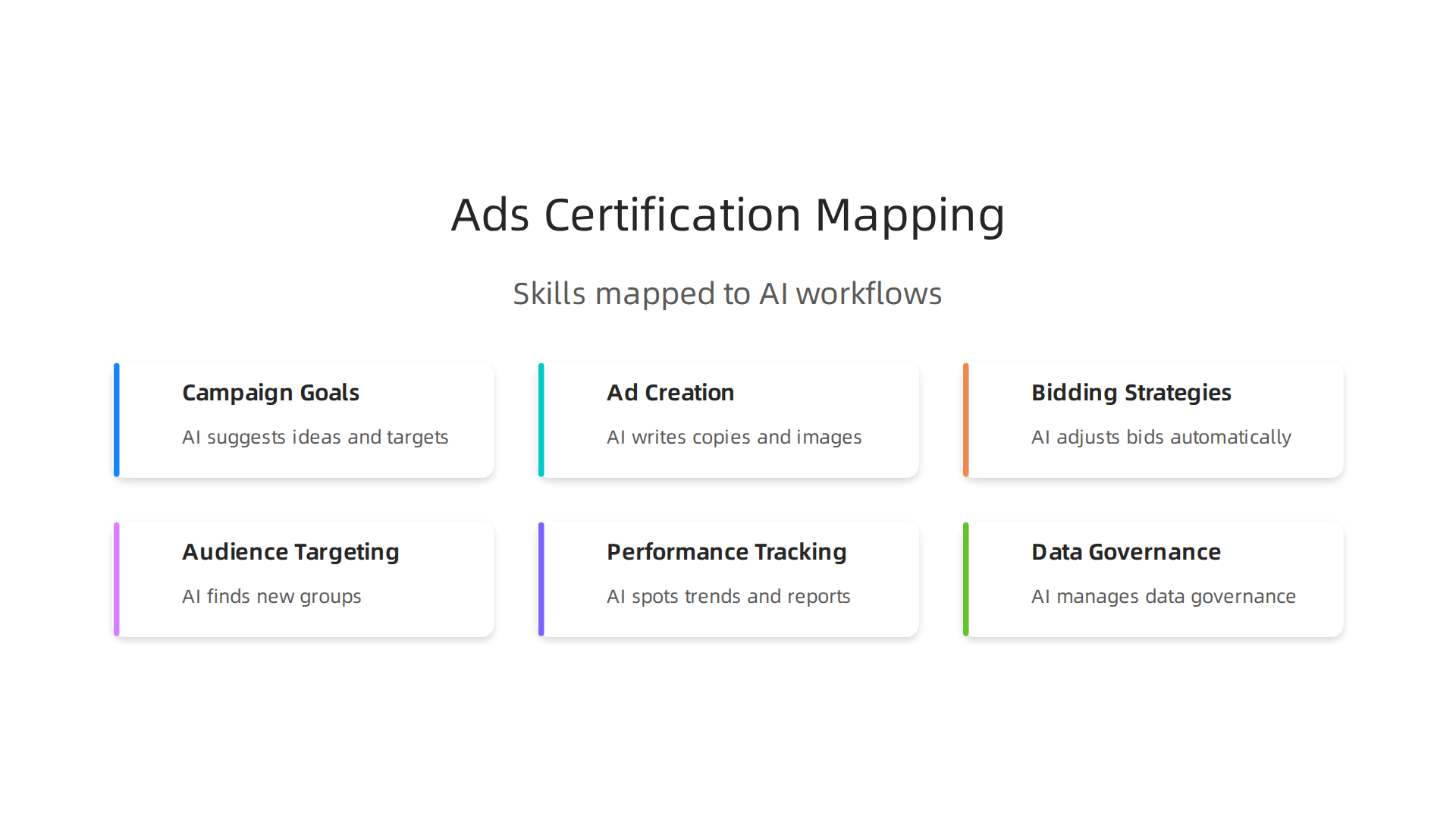
    Mapping Your Google Ads Certification Skills to AI

    Here is how your Google Ads knowledge fits into today’s world of AI marketing tools:

    Illustrating how traditional Google Ads certification skills adapt and complement AI-assisted marketing workflows.

    What You Learned (Google Ads Certification) How AI Helps Now (AI-Assisted Workflow) What You Still Need to Master (Your Role)
    Campaign Goals & Setup AI suggests campaign ideas, audience targets, and budgets. You set the big goals, tell AI what success looks like, and guide the overall plan.
    Ad Creation & Messaging AI writes many ad copies, creates different images or videos. You review AI’s ideas, pick the best ones, and make sure the message feels right for your brand.
    Bidding Strategies AI changes bids automatically to get the most clicks or sales. You choose the right bidding strategy for AI to follow and check that it’s working towards your goals.
    Audience Targeting AI finds new groups of people who might like your ads. But beware: some old ways, like lookalike audiences, are changing with new privacy rules in 2026 Lookalike Audiences Are Gone…. You learn new privacy rules, understand who you really want to reach, and make ethical choices for targeting.
    Performance Tracking & Reports AI collects all the numbers, spots trends, and makes reports easy to read. You look at the big picture from the reports, understand what the numbers mean, and decide what to do next.
    Data Governance & Compliance AI handles and uses a lot of data, making it faster to work. You make sure all data used by AI is collected and used correctly and legally. This is about making sure your AI efforts follow the rules AI and Data Governance in 2026: The Complete Guide.

    This table shows that while AI does many tasks, your smart human brain is still in charge. You are the conductor of the AI orchestra.

    How Different Roles Should Prioritize Learning

    Not everyone needs to learn the same things at the same speed. Your job helps you decide what parts of this checklist are most important.

    • For Founders/Business Owners: Your focus should be on "Campaign Goals & Setup" and "Performance Tracking & Reports." You need to know what to ask the AI for and how to read the results to make sure your best AI for business is working towards growth. You care about the big picture and return on investment (ROI).
    • For Campaign Managers: This entire checklist is for you. You are the one working closely with the AI marketing tools every day. You need to know how to guide the AI, check its work, and make changes when needed. Mastering "Bidding Strategies" and "Audience Targeting" in the AI world is very important. You might also want to explore a hubspot marketing certification to broaden your marketing automation skills.
    • For Consultants: You need to know everything on this list, and then some! You should understand how to set up, manage, and fix problems with AI-assisted campaigns for many different types of businesses. Staying up to date on all the latest AI trends, laws, and the best AI marketing tools is key. You also need to be good at explaining complex ideas simply.

    The table in the last section showed how your skills, like those gained from a Google Ads certification, are still key when working with AI marketing tools. But being the "conductor" also means you’re responsible for making sure everything is done by the book. This is super important with AI because new rules about data privacy and how we use information are always popping up in 2026.

    As a marketing leader, your main job is to guide your team to success. With AI, this also means staying on top of new laws and making sure your team follows them.

    A marketing leader carefully reviewing documents, symbolizing the critical role of ensuring compliance and data privacy with AI tools.

    Your knowledge from a Google Ads certification gives you a great start, but AI adds new layers to how data is collected and used. For example, some older ways of finding audiences are changing, and there are more rules about being open when AI helps create ads. Not following these rules can lead to big problems and can hurt trust with your customers. It’s why marketing leaders need to understand these 2026 Compliance Risks for Marketing Data Governance more than ever.

    Actually, industry groups are giving out new advice on how to use AI fairly and transparently. For instance, the IAB has updated its guidance, saying you must tell people if AI has made changes to images, videos, or voices in ways that might trick them. This is about being honest and clear with your audience, which is a key part of responsible marketing, as highlighted in new IAB updates AI disclosure guidance.

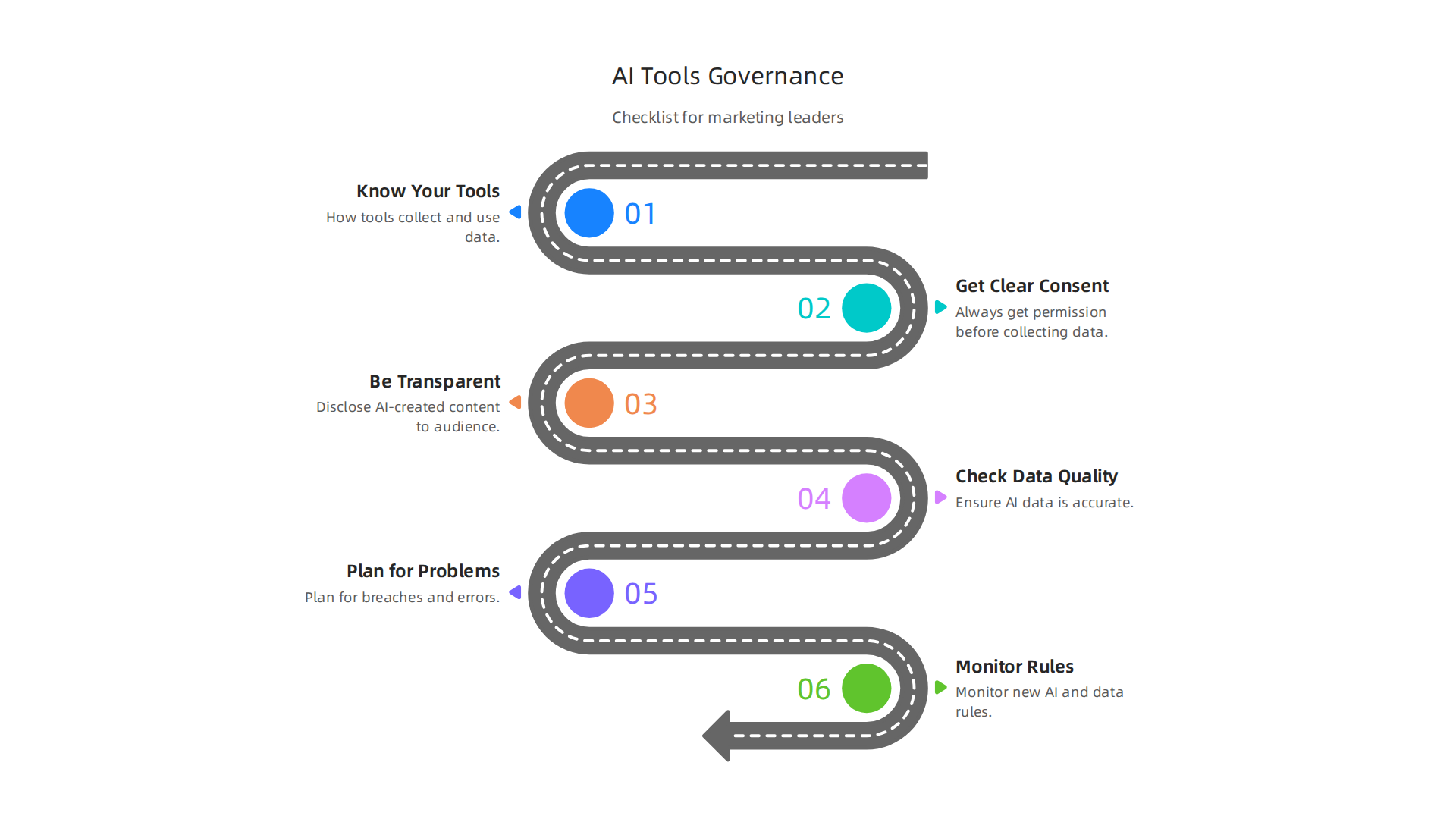
    A Short Governance Checklist for Marketing Leads Using AI

    To help you keep your AI efforts on track and reduce risks, here’s a simple checklist for how to use your ai marketing tools responsibly in 2026:

    A practical checklist for marketing leaders to ensure responsible and compliant use of AI marketing tools.

    • Know Your AI Tools: Understand exactly how each AI tool collects, uses, and stores data. Make sure they meet privacy standards. You can also explore how to choose a digital marketing course for AI skills to deepen your team’s expertise.
    • Get Clear Consent: Always get permission from people before you collect their personal data. Make it easy for them to say yes or no, and respect their choices. This is a core part of using How to Use AI Responsibly in Digital Advertising.
    • Be Transparent About AI: If AI created or heavily changed your ad content, think about telling your audience. Honesty builds trust.
    • Regularly Check Data Quality: Make sure the data your AI uses is correct and up to date. Bad data can lead to bad marketing choices and can also cause privacy issues.
    • Plan for Problems: Have a plan for what to do if there’s a data breach or an AI tool makes a mistake. Knowing how to react quickly is key to avoiding bigger problems. Setting up a strong strategic guide to marketing AI agents can help prevent many of these issues.
    • Keep Up with Laws: Laws about AI and data privacy are always changing. Stay informed about new rules in your area and the places you market to.

    Staying informed about the fast-moving world of AI is crucial for marketing leads. It helps you keep your business safe and ethical.


    Get clear daily AI updates from The Deep View Newsletter. The AI Newsletter Worth Reading

    Keeping up with laws is one thing, but making sure your team has the right skills to use new AI marketing tools is another. This is where good training comes in. As a marketing leader in 2026, you need to create learning plans that mix official certifications with hands-on practice.

    Training teams: blending certification study with hands-on AI tool labs

    Think of it like this: your team needs to learn the rules of the road (from certifications) and then actually drive the car (using AI tools).

    Putting Together Smart Learning Plans

    The best way to train your team is to create special learning paths. These paths should pair up lessons from things like a Google Ads certification or even a HubSpot marketing certification with real practice sessions. For example, after learning about setting up ad campaigns through a Google Ads certification course, your team members could then jump into "AI labs." Here, they would use actual AI marketing tools to create and manage campaigns in a safe testing space.

    This hands-on approach helps people truly understand how to use these powerful tools. They can try different AI features, see how they affect ad performance, and get comfortable with how the best ai for business works in real life. Google itself offers ways to learn these new skills, including a Google AI Professional Certificate to help build important AI knowledge. These programs help your team get skilled in using ai marketing tools effectively.

    Checking if Training Actually Works

    It’s not enough to just train your team; you also need to check if the training is making a difference. This means looking at your campaign results. Did the training help your team get better at their jobs? Are your ad campaigns performing better because of the new AI skills?

    You can evaluate this by:

    • Looking at Key Numbers: See if important things like how many people click your ads or how many sales you make have gone up. For example, one way to evaluate AI tools is by how they affect your campaigns, not just by what features they have. You can use checklists to audit your ai marketing tools to see if they are worth the cost and effort, as detailed in a Digital Marketing AI Tool Audit: Q2 2026 Checklist.
    • Getting Feedback: Ask your team members what they learned and how they are using the new skills.
    • Checking Performance of AI Tools: Make sure the ai marketing tools they are using are actually helping. You can learn more about how Marketing Specialists Choose AI Tools for Marketing and Drive ROI to ensure your team is using the right ones.

    By combining learning from certifications with hands-on labs and then carefully checking the results, you can make sure your team is ready for anything in 2026. This also helps you guide your business toward Smart AI for Business: Your 2026 Guide to Successful Adoption.

    After training your team, the next important step is picking the right ai marketing tools for them to use. This isn’t just about finding the flashiest new tool. It’s about using what your team learned from their certifications, like a Google Ads certification or a HubSpot marketing certification, to make smart choices. These certifications teach key skills that help you evaluate best ai for business solutions effectively.

    Evaluating AI tools through the lens of certification-driven decision criteria

    When you’re choosing new ai marketing tools, think about what your team learns in their training. This knowledge helps you look at tools in a smarter way. For example, a good 2026 Guide to Ultimate AI Ad Tech Evaluation Strategy shows how to pick tools based on clear rules, not just cool features.

    Here’s how what your team knows can help you pick the best AI tools:

    • How well does it measure? Certifications often teach how to track how well your ads are doing. When looking at AI tools, ask: Does this tool clearly show us if our ads are working? Can it help us understand clicks, sales, and what’s making people buy? You want tools that give you good information, not just guesses.
    • Can it make things better? A big part of any Google Ads certification is learning how to improve campaigns over time. Your AI tools should do this too. Do they suggest ways to get more for your money or reach more of the right people? The best ai marketing tools help your team keep making things better, not just set them up once.
    • Does it follow the rules? Your team learns about rules and good practices in their hubspot marketing certification or other training. AI tools should also follow these rules. Do they keep customer information safe? Are they clear about how they work? An AI tool should be transparent, meaning you can understand how it makes decisions, and allow for proper spend control.

    Thinking About Trade-Offs When Choosing AI Tools

    No AI tool is perfect, so you’ll need to think about what’s most important for your business.

    • Cost: This isn’t just the monthly price. Think about the full cost, including how much time it takes to set up the tool, train your team to use it, and keep it running smoothly. Sometimes a cheaper tool needs more work, making it more expensive in the long run.
    • Can you understand it? Some AI tools are like a "black box," meaning you don’t really know how they make their decisions. It’s often better to pick tools that are more "explainable." This means you can see why the AI made a certain choice, which helps your team learn and trust the tool more. For example, when evaluating AI advertising platforms in 2026, look for transparency and control.
    • How hard is it to connect? New tools need to work with the tools you already use. How much effort will it take to link a new ai marketing tool to your current systems? A tool that connects easily will save you a lot of headaches. You’ll want to choose the right Enterprise AI Platforms 2026 Top Providers and How to Choose the Right One to avoid integration issues.
    • What real impact will it have? Most importantly, will the tool actually help you reach your business goals? Will it save time, make more money, or make your customers happier? Focus on tools that can show clear, measurable results.

    By using the knowledge from google ads certification and other training, you can pick the best ai for business tools that truly help your team and your company grow in 2026.

    Staying ahead in the world of AI means always learning. To get the latest updates and practical insights for business users, there’s The AI Newsletter Worth Reading.

    Even with the best tools picked, bringing new ai marketing tools into your business can be tricky. It’s like having a new car but not knowing how to drive it perfectly. Many companies face bumps in the road when they try to use AI. These challenges can slow things down, but teams with good training are ready to overcome them.

    Here are some common challenges companies face when using AI tools:

    Visualizing common challenges in AI adoption and how certified marketing teams effectively overcome them.

    • Skills Gap: Sometimes, teams simply don’t have the right skills to use new AI tools effectively. They might know how to do their job, but not how to do it with AI. In fact, many marketing teams in 2026 still do not have a clear plan for AI, showing a lack of knowledge in how to move forward with new tech.
    • Budget Worries: Buying AI tools and training your team costs money. Business leaders worry if the tools will really make enough money or save enough time to be worth the cost. Starting a pilot program can help show the value, with some experts suggesting dedicating 20-25% of spend to AI-assisted experiments to see results quickly AI Advertising 2026 Transforms Paid Media for Pros – key-g.com.
    • Hard to Measure Results: It can be tough to see if AI tools are truly helping. How do you know if an ai marketing tool is working better than the old ways? This makes it hard to show that the investment was a good one.
    • Team Not Ready: Some team members might be worried about AI taking their jobs. This can make them less willing to learn or use the new tools The 12-Week Implementation…. This kind of resistance can stop new tools from being used well.
    • Rules and Safety: With new technology comes new rules. Companies need to make sure their AI tools keep customer information safe and follow all the laws. Many companies see legal, governance, and compliance as a big challenge when adopting AI AI GOVERNANCE AND RISK MANAGEMENT PLAYBOOK.

    How Certified Teams Make a Difference

    This is where trained teams truly shine. When your team has a google ads certification or a hubspot marketing certification, they are much better prepared. They know how to handle these common problems:

    • Better Skills: With certifications, your team already has the basic knowledge to understand how best ai for business tools work. This reduces the skills gap because they have learned about data, tracking, and how to improve campaigns. They are ready to explore tools for AI tool discovery 2026 and apply what they’ve learned.
    • Smart Start-Ups: Certified teams know to start with small test runs, called pilot programs. This helps them see what works and what doesn’t without spending too much money at once. It’s about slowly bringing in new tools, which is also known as "staging."
    • Clear Rules: They can help set up clear rules, or "governance," for how AI tools should be used safely and correctly. This includes understanding who is in charge of which part of the AI process and what risks to look out for AI Adoption Strategies: Your 2026 Playbook – AI Academy.
    • Checking Results Often: These teams are also good at setting "ROI checkpoints." This means they regularly check if the AI tools are giving good results and making the company money or saving time. This helps prove the value of the new tools and makes sure they are having a real impact. This also helps reduce concerns about cost.
    • Building Trust: By showing clear results and following rules, certified teams can help everyone feel more comfortable with new AI tools. This reduces team resistance and helps everyone work together better.

    By having a team that understands the challenges and has the right training, your business can smoothly adopt new best ai for business solutions and truly benefit from them in 2026. To learn more about how AI helps businesses grow, check out this guide on How Businesses Adopt AI for Growth.
    Summary

    This article explains why Google Ads certification remains a critical foundation in an AI-first marketing world and shows how to combine that foundational knowledge with modern AI tools. It summarizes what the certification teaches—campaign setup, keyword strategy, bidding, audience targeting, and measurement—and identifies what it doesn’t fully cover now that AI automates creative, bidding, and audience modeling. The piece maps certification skills to AI-assisted workflows, clarifies different learning priorities for founders, campaign managers and consultants, and gives a short governance checklist to reduce legal and ethical risks. It also outlines how to train teams with blended certification + hands-on AI labs, how to evaluate and choose AI marketing tools, and how certified teams can smooth adoption while measuring ROI and managing common barriers. After reading, you’ll have practical checklists, role-based priorities, and evaluation criteria to align your Google Ads knowledge with AI tools responsibly and effectively.

  • How to Choose a Digital Marketing Course for AI Skills in 2026

    How to Choose a Digital Marketing Course for AI Skills in 2026

    Why AI Skills and the Right Digital Marketing Course Matter in 2026

    It’s 2026, and the world of digital marketing is changing faster than ever. A big reason for this speed is artificial intelligence, or AI. AI is everywhere, from how we create ads to how we understand what customers want. Because of all these new changes, it can feel like there’s too much information to keep up with. It’s hard to know which new skills are important and which training is best.

    A person reflects on the challenge of navigating new information and making decisions.

    Many people wonder how to find a good digital marketing course that truly helps them grow.

    You might be feeling lost in all the talk about new AI tools and wonder which ones actually help your business. Knowing how to pick the right tools for your business is key. This quick growth of AI also makes it tough to choose the right learning path. There are so many options out there, and it’s hard to tell which ones are real and useful. Actually, knowing how to check if an online course is trustworthy is a big deal, and experts offer tips on how to assess online course credibility.

    But don’t worry! This guide is here to help you. We will show you how to look at different digital marketing courses, especially those that focus on artificial intelligence applications. Our goal is to help you find training that teaches you the right AI skills. This way, you can pick a digital marketing course that helps your business grow in clear, measurable ways. Think of it as learning about the best ways for AI product development, but for your marketing efforts.

    Staying updated on all the new AI trends can be a full-time job. To make it easier for you to keep up, consider getting clear daily AI updates.

    The AI Newsletter Worth Reading

    1) The business case for AI in digital marketing

    So, we know AI is changing how we do things in digital marketing. But why should you care about this for your business? It’s simple: AI helps you get better results. It’s not just a fancy new thing. It’s a way to make more money, reach more customers, and work smarter. This is the strong business reason for using AI in digital marketing.

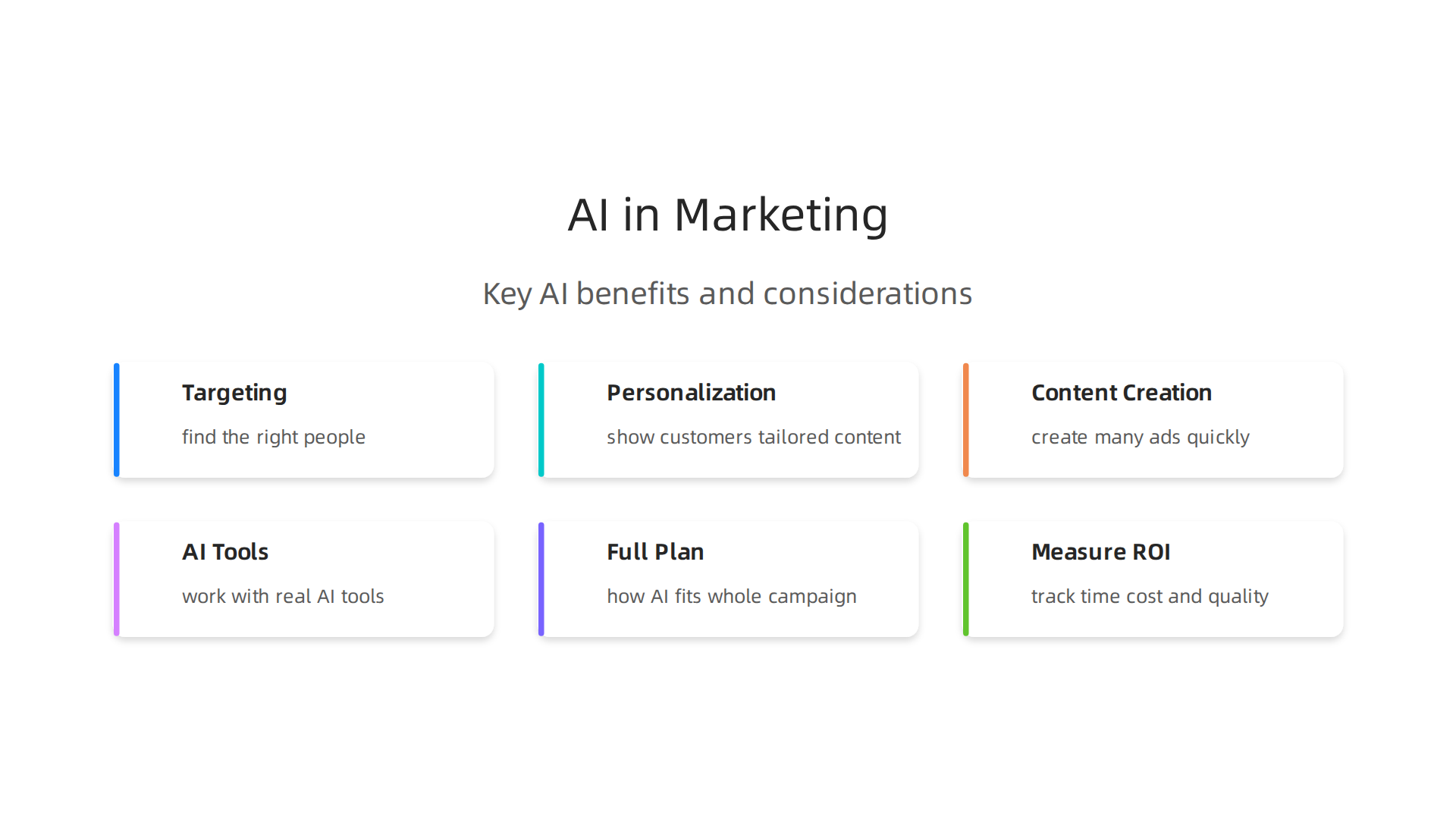
    Think about what AI can do for your marketing efforts.

    Key ways AI enhances digital marketing efforts for better business results.

    For example, AI is super good at helping you find the right people to show your ads to. This is called targeting. Instead of guessing, AI uses lots of data to know who will most likely buy your product. This means you spend your ad money better. AI also helps with making things personal. It can show each customer exactly what they want to see, making them feel special and more likely to buy. It can even help you create many different ads and messages quickly, which saves a lot of time and effort. This is part of how businesses achieve real return on investment (ROI) with AI marketing cloud in 2026.

    Many businesses are already seeing these good results. In fact, a report from 2026 showed that 87% of big companies’ marketing teams now use AI tools in some way to make their work better and get stronger outcomes. That’s a huge number! This shows that artificial intelligence applications are not just for tech companies anymore; they’re for everyone in digital marketing. If you want your business to keep growing, learning about these tools is a must.

    However, getting AI into your marketing plans isn’t always easy. Even though many companies use AI, a big problem is knowing how to make it a deep part of how they work every day. It’s about more than just having the tools. It’s about knowing how to use them well. One big challenge is that people need new skills. Companies also worry about how much it costs and how to make new AI tools work with their existing systems. A report from 2026 highlighted that the real gap in AI adoption now lies in "talent capability," meaning having the right skilled people, rather than just getting the tools themselves. This is why choosing the right digital marketing course is so important. It helps overcome these skill gaps and allows for better AI product development within your marketing team.

    2) What to look for in a digital marketing course that teaches AI

    So, we talked about how important it is to have the right skills for AI in marketing. A good digital marketing course can help you get those skills. But with so many choices out there, how do you pick the best one?

    Someone carefully reviewing various course options to make an informed choice.

    You want a course that really teaches you how to use AI for real business growth, not just fancy words.

    Here’s what to look for:

    What the course should teach you (the curriculum)

    A top-notch digital marketing course will give you hands-on experience. It should cover:

    • Learning AI Tools You’ll Actually Use: The course needs to show you how to work with real AI tools. This means learning things like how to use ChatGPT for writing, Midjourney for making images, or AI features in Google and Meta Ads for better advertising. It’s about getting comfortable with the same tools marketing pros use every day in 2026.
    • Building a Full Marketing Plan with AI: It’s not enough to know one tool. A good course will teach you how AI fits into a whole marketing campaign, from start to finish. This means understanding how to use AI for keyword research, creating content, setting up ads, and even sending emails. Think about how AI can help with AI Inbound Marketing: A Practical Framework for Better Personas, Content, and ROI.
    • Checking Your Results with Data: You need to know if your AI efforts are working. The course should teach you how to look at data and measure success. This means understanding things like Google Analytics and other reporting tools. It’s how you make smart decisions and improve your marketing over time. Learning about how online market research surveys powered by AI deliver better insights can be very helpful here.

    Signs of a really useful course

    Beyond what’s on the syllabus, pay attention to these things:

    • Real Projects and Case Studies: The best way to learn is by doing. Look for courses that include many hands-on projects, like creating a full campaign or working on a client’s problem. Many courses even have a final project where you put everything you learned into practice, sometimes involving tools like ChatGPT, Midjourney, and Google Analytics 4, as seen in some 2026 sample syllabi. This shows you how artificial intelligence applications work in real life.
    • Templates and Guides: A course that gives you ready-to-use templates for planning or reports can save you a lot of time later. These are practical tools you can take straight into your work.
    • Experienced Teachers: Who is teaching the course? Look for instructors who have actually worked in digital marketing and used AI in their jobs. They can share real-world tips and help you understand how to apply what you learn.
    • A Focus on "How To": You want a course that focuses on "how to" do things, not just "what" AI is. It should help you feel confident in using AI for tasks like content creation, ad setup, and figuring out what customers want. This helps you with your own AI product development within your marketing team.

    Choosing the right digital marketing course means you’re investing in your future and making sure you can keep up with all the new AI changes.

    Want to stay ahead of all the fast changes in AI and technology? Get clear daily updates directly to your inbox.
    The AI Newsletter Worth Reading

    To truly get the most out of your training, it’s not just about what a digital marketing course teaches, but also how it teaches. Different course formats fit different people and different company needs. Let’s look at the main types and what they mean for busy pros and teams with limited money.

    A comparison of different digital marketing course formats and their key characteristics.

    Bootcamps: Fast and Focused

    Bootcamps are like quick, intense training programs. They are usually full-time for a few weeks or months.

    • Pros: Bootcamps move fast and teach you a lot in a short time. They are often hands-on, meaning you get to do many practical projects. This can be great for someone who wants to switch jobs quickly or learn a new skill like advanced artificial intelligence applications. Some bootcamps, for example, offer a mix of projects, lectures, and real-world scenarios, as explained in a guide to digital marketing bootcamps.
    • Cons: They can be very expensive and demand a lot of your time. This makes them hard for people who already have full-time jobs or other duties. If your team has a small budget, a bootcamp for everyone might not be possible.

    Self-Paced Courses: Learn on Your Own Time

    Self-paced courses let you learn whenever you want. You get access to all the materials and can work through them at your own speed.

    • Pros: This format is super flexible. You can learn after work, on weekends, or whenever it fits your schedule. It’s often cheaper than bootcamps. This works well for busy people who need to fit learning around their life. These courses usually break content into smaller parts to make learning easier, as highlighted by a guide to self-paced learning.
    • Cons: You need a lot of self-discipline. It’s easy to fall behind or stop altogether because there’s less pressure from others. If you have questions, getting answers might take longer. Studies show that learning retention can drop below 20% within six months if skills aren’t practiced, making accountability important.

    Cohort-Based Courses: Learning with a Group

    Cohort-based courses combine self-paced learning with group activities. You learn alongside a specific group of people who start and finish the course at the same time.

    • Pros: You get the best of both worlds. There’s a set schedule, which helps with accountability, but also flexibility for individual study. You learn from others, share ideas, and get feedback. This group setting can make learning more fun and help you stay motivated. It’s also known to boost completion rates and skill application through regular interaction and feedback, according to a comparison of cohort vs. self-paced learning.
    • Cons: These courses usually have fixed start and end dates, so they are not as flexible as truly self-paced options. They can also be more expensive than purely self-paced courses.

    Corporate Training: Learning for the Whole Team

    Corporate training is when a company organizes a special digital marketing course for its employees. These can be bootcamps, self-paced programs, or cohort-based models, all tailored for the company’s needs.

    • Pros: The training is made just for your team’s specific goals. It can help everyone learn the same new skills, like new artificial intelligence applications, at once. This is great for an ai development company looking to keep all its marketers up-to-date.
    • Cons: Creating custom training can be costly, especially for smaller businesses. It might also take a lot of planning and effort to get everyone on board. Some companies struggle to fully embed AI into workflows, with only 24% of organizations fully doing so in 2026, pointing to a need for more integrated training, as noted by AOL.

    When picking a digital marketing course, think about your budget, how much time you have, and if you learn better alone or with a group. Choosing the right format is key to making sure you or your team can really learn and use those new AI marketing skills effectively. To understand how businesses are truly using AI for growth, check out The Innovation Line 2026: How Businesses Adopt AI for Growth.

    After thinking about the best format for your learning, the next big step is to look closely at the course content itself. This means checking who is teaching, what kind of projects you’ll do, and if the course covers the most up-to-date tools, especially in the fast-changing world of AI.

    4) Evaluating Instructors, Projects, and Tool Coverage (Practical Checklist)

    Picking the right digital marketing course means looking beyond just the topic list. You need to make sure the learning experience will actually help you or your team use new skills, like artificial intelligence applications, in real work. Here’s a checklist to help you decide:

    Who is Teaching? (Instructor Quality)

    • Check their background: Are the instructors actual experts in digital marketing and AI? Look for people with real-world experience, not just textbook knowledge. You can often check their professional profiles on sites like LinkedIn. Their work history should show they’ve been in the field for a while, as a guide to evaluating course instructor credentials explains.
    • Verify their credentials: Make sure they have proper degrees, certifications, or a strong reputation in the industry. For instance, reputable online platforms or established universities are often good signs. If a course or instructor claims to be an expert, they should be able to show their qualifications clearly. You can also look for reviews from past students to see what others say about their teaching style and expertise. A useful resource on how to know if an online course is legitimate suggests looking for reviews and testimonials from other students.
    • Look for red flags: Be careful if an instructor hides their background, if their profile seems too new, or if they don’t share examples of their work or teaching. A detailed guide points out that a strong online presence and clear credentials are key to assessing online course credibility.

    What Tools and Topics are Covered? (Modern Relevance)

    • Focus on AI tools: In 2026, any good digital marketing course must cover modern artificial intelligence applications. Does the course teach how to use AI for things like content creation, ad targeting, or data analysis?
    • Data privacy and ethics: With more AI tools, understanding data privacy is super important. Does the course talk about how to use AI ethically and keep customer data safe? This is a vital part of using AI responsibly.
    • Practical application: Does the course focus on how to actually use these tools in everyday marketing tasks? Look for mentions of real-world workflows and integration. For example, learning about how to choose AI for business tools that deliver real results in 2026 is more helpful than just knowing what the tools are.

    What Kind of Projects Will You Do? (Hands-On Learning)

    • Project-based learning: The best way to learn is by doing. A good digital marketing course should have lots of practical projects. These projects should let you apply what you’ve learned to create real marketing plans, campaigns, or analyses.
    • Templates and starter code: Does the course provide helpful resources like templates for marketing strategies, ROI calculations, or project proposals? These can save a lot of time and help you put new skills into practice right away. For instance, many courses now offer AI Marketing Templates or an AI-Ready Marketing Strategy Kit to help you measure success and build business cases. Getting access to these kinds of tools is very valuable.
    • Deployment workflows: Does the course show you how to take a marketing idea, use AI tools, and then put it into action? This means understanding the whole process, from planning to launching and measuring results. This is especially important for an ai development company trying to streamline its marketing efforts.
    • Measuring success: Practical projects should also teach you how to measure the success of your AI-powered campaigns, including how to calculate the return on investment (ROI). There are many templates available, like an AI Marketing Training ROI Calculator Template, that can help you understand the impact of your efforts.

    By using this checklist, you can make sure your chosen digital marketing course truly prepares you for the challenges and opportunities of marketing in 2026 and beyond.

    To stay on top of the latest AI news and practical insights that can inform your course choices, consider subscribing to The AI Newsletter Worth Reading.

    After picking a great digital marketing course and learning lots of new things, the real test begins. It’s time to show that what you learned can make a real difference. This means proving the value of your new skills, especially with advanced artificial intelligence applications, in a clear way. You want to see real results for your business.

    5) Measuring ROI and building a pilot after the course

    Learning is great, but showing that your new skills lead to better business results is even better. After completing a digital marketing course focused on AI, the next smart step is to set up a small test, also called a pilot project. This helps you apply what you learned in real life and see how it helps your company.

    How to set up a small test project

    A pilot project is like a mini-experiment. You take a small part of your marketing work and apply your new AI skills to it. The goal is to see if these new ways of working can bring good results before using them everywhere.

    Here’s how you can do it:

    • Choose a small task: Pick one specific marketing task that you think AI can help with. Maybe it’s writing social media posts, making ads, or analyzing website visitor data. Keep it simple at first.
    • Set clear goals: What do you hope to achieve with this pilot? Do you want to save time, get more clicks on your ads, or understand customers better? Write down your goals clearly. Many companies use a Free AI Implementation Execution Playbook to help plan these steps.
    • Use your new AI tools: Apply the artificial intelligence applications you learned in your digital marketing course. For example, use an AI writing tool for content or an AI analytics tool for data.
    • Follow a plan: You can find many useful outlines, like The Team AI Playbook 2026, which offers advice on how to scope a 30-day pilot to get clear data. There are also specific templates like the AI Content Personalization Framework 2026 if your pilot focuses on personalizing content.

    Remember, starting small helps you learn and fix things along the way without big risks.

    What numbers to track for success

    To know if your pilot project is working, you need to track some key numbers. This is how you measure your Return on Investment, or ROI. ROI just means seeing how much value you get back for the effort and money you put in. For example, if you spend money on a course, you want to see that money come back as savings or new sales.

    Here are some important things to track:

    Important numbers to track for measuring the success and ROI of AI pilot projects.

    • Time saved: Did AI tools help you complete tasks faster? For instance, if writing an ad campaign used to take 5 hours and now it takes 1 hour with AI, that’s a big time saving.
    • Better performance: Are your marketing campaigns doing better? Look at things like:
      • More people opening your emails.
      • More clicks on your ads.
      • More people buying your products or services.
      • Lower costs for each new customer.
    • Cost savings: Did AI help you spend less money in other areas? Maybe you didn’t need to hire an extra person for a task, or you reduced spending on certain tools.
    • Quality improvement: Is the content or analysis you create with AI better than before? This can be harder to measure but is still important.

    You can compare these numbers from before you used AI to after you started your pilot. This helps you clearly see the improvements. Tools like an AI ROI Calculator: Build the Business Case for AI Training can help you put all these numbers together. Knowing how to get real ROI from AI marketing cloud in 2026 is a key skill to develop.

    When you show these clear results, it helps your team and leaders understand the value of investing in training and using new AI tools. It’s how you prove that your digital marketing course was a good investment and that you can make good choices about how to choose AI for business tools that deliver real results in 2026. This is also important for any ai development company looking to show the impact of their new products. By carefully tracking and showing your results, you can build a strong case for expanding your use of artificial intelligence applications in marketing.

    After seeing how a pilot project can bring good results, the next big step is to bring these new AI skills and tools into your everyday work. This means making sure your team and your existing tools all work together with what you learned in your digital marketing course. It’s about smart implementation.

    6) Implementation tips: integrating course learnings with existing tools and teams

    Bringing new ideas and tools, especially advanced artificial intelligence applications, into a company can feel like a big puzzle.

    A leader facilitating a team discussion to integrate new learnings and tools effectively.

    But with a good plan, you can make it smooth for everyone. Your goal is to make sure the valuable lessons from your digital marketing course help your whole team do better work.

    Helping your team learn the new ways

    The first step is to help everyone on your team understand and use the new AI tools. This is often called "onboarding."

    • Share what you learned: Talk to your team about the exciting things you found in your digital marketing course. Show them the successes from your pilot project.
    • Offer simple training: Not everyone needs to become an AI expert. Teach them how to use the specific AI tools that will help them with their daily tasks. You can even create short, custom learning guides, as some companies do when Transforming Corporate Training with Personalized Learning.
    • Show how it helps them: Explain how these new tools will make their jobs easier, faster, or more fun. Maybe an AI writing tool can help create social media posts much quicker, as taught in many current digital marketing course curriculums that include Digital Marketing with AI.
    • Encourage trying things out: Let your team play with the new tools on small, safe tasks. This helps them get comfortable without fear of making big mistakes. Learning in a group, also known as cohort-based learning, can lead to better skill use, as highlighted in "Cohort vs. Self-Paced Learning: Key Differences in 2026."

    Fitting new AI tools with your existing tools

    Your company already uses many digital marketing tools, like email programs or ad platforms. This collection of tools is sometimes called your "martech stack." The trick is to make sure new artificial intelligence applications fit right in.

    • Check for connections: Can your new AI tools talk to your old tools? For example, can an AI tool that helps write emails send its ideas directly to your email marketing program? A good digital marketing course will often cover different Digital Marketing with AI Curriculum & Syllabus that include working with a variety of platforms.
    • Start small: Just like your pilot project, begin by connecting one new AI tool to one existing tool. See how it works before trying to connect everything at once.
    • Look for solutions that grow: As your company grows, you’ll want tools that can grow with you. Learning about tools that offer seamless integration will ensure your ai product development is future-ready. It’s smart to look into how to choose AI-ready business computers in 2026 to support these new applications.
    • Keep things tidy: Make sure you know which tools do what. Don’t add a new tool if an old one can do the same job just as well, unless the AI adds a clear benefit.

    Making change easy and getting early wins

    People don’t always like change, even if it’s for the better. This is where "change management" comes in.

    • Talk openly: Let everyone share their worries or ideas. Listen to them and try to make things better based on what they say.
    • Celebrate small successes: When someone uses a new AI tool to save time or get a great result, share that success with the whole team. This helps everyone see the good things that come from using the new methods.
    • Leaders should lead by example: If managers and leaders use the new tools and show excitement, others will be more likely to follow. This creates a positive mood around new technology.
    • Learn and adjust: Not everything will work perfectly the first time. Be ready to change your plan based on what you learn. An effective ai development company knows this well when bringing new products to market.

    By following these tips, you can smoothly bring the powerful lessons from your digital marketing course into your business, helping your team and company thrive with artificial intelligence applications.

    Want to stay ahead in the fast-changing world of AI and technology? Get clear daily AI updates.
    The AI Newsletter Worth Reading

    Summary

    This article explains why AI skills are essential for digital marketers in 2026 and how to pick the right digital marketing course to build those skills. It covers the business case for AI—how it improves targeting, personalization, and efficiency—and why talent capability, not just tools, drives real adoption. You’ll learn what a strong AI-focused course should teach (hands-on tool use, campaign planning, and measurement), how to evaluate instructors and course projects, and which course formats fit different schedules and budgets. The guide also gives a practical checklist to vet courses, shows how to run a small pilot to prove ROI, and offers implementation tips to integrate new tools with existing teams and martech stacks. By following these steps you can choose training that delivers measurable results and scale AI across your marketing operations.

  • AI Inbound Marketing A Practical Framework for Better Personas Content and ROI

    AI Inbound Marketing A Practical Framework for Better Personas Content and ROI

    Introduction: Why AI Is No Longer Optional for Inbound Marketers

    Think about your inbound marketing strategy for a moment. Are you still writing blog posts by hand and guessing what your audience wants? If so, you are already behind.

    Inbound marketing has changed completely. The days of creating content and hoping it finds the right people are over. In 2026, the numbers tell a clear story. According to the latest research, a powerful 87% of marketers now use generative AI in at least one recurring workflow. That is up from just 51% two years ago. In other words, most of your competitors are already using AI to create content, personalize emails, and understand their audience better. They are not guessing anymore. They are using data.

    Here is the real truth. Marketers who ignore AI risk losing more than just time. They risk losing customers. Teams that use AI report higher revenue growth and better conversion rates. A recent survey found that 77% of marketing teams now use AI tools for at least one core function, and these teams see real results. Personalization engines powered by AI deliver strong returns on investment. If you want your inbound marketing to work in 2026, AI needs to be part of your plan.
    Marketers strategize to integrate AI into their inbound marketing plans.

    That is where this guide comes in. We are going to walk through a practical framework that helps you integrate AI into your inbound marketing planning and execution. No confusing jargon. Just real steps you can take.

    If you want to stay ahead of the curve, start by getting clear daily updates on what actually works. Check out The AI Newsletter Worth Reading to keep your finger on the pulse of AI trends that matter for marketers.

    But first, let us understand why traditional inbound marketing needs a serious upgrade in 2026.

    1. The 2026 Inbound Marketing Landscape: Data, AI, and the New Rules

    Let us start with the biggest change. Inbound marketing used to be about picking the right keywords and writing blog posts that ranked in Google. That worked for a while. But in 2026, that playbook is outdated.

    Here is the thing. AI has completely shifted how inbound marketing works.

    Understand how AI is reshaping inbound marketing strategies and execution in 2026.

    Instead of manually guessing what your audience wants, AI now gives you predictive audience insights. It looks at behavior patterns, past purchases, and real-time signals to tell you exactly what to create and who to target. This is not future talk. It is happening now. According to the latest AI adoption data, 71% of businesses that use AI in marketing and sales report actual revenue gains. That is a big number. It means AI is not just a cool tool. It is directly helping companies bring in more money.

    The old way of doing inbound marketing meant writing content by hand, optimizing it for one search engine, and hoping for the best. Today, AI helps you build a complete social media marketing strategy at the same time. It can draft posts, suggest the best times to publish, and even adjust your messaging for different platforms. You get to act like a marketing consultant with a whole team of assistants, even if you are working alone.

    Generative AI has also made content creation possible at a much larger scale. You can now produce blog articles, email sequences, and ad copy faster than ever before. But here is the catch. You still need human oversight. AI can write a first draft in seconds, but it cannot capture your brand voice or check for accuracy on its own. Tools like YesChat AI help marketers generate content quickly, but human review ensures the message stays on brand and builds trust.

    YesChat AI assists marketers in rapidly generating content for various needs.

    Now, none of this works without good data. The foundation of effective AI-driven inbound marketing is data quality and first-party data. That means collecting information directly from your audience through forms, surveys, and website behavior. When your data is clean and accurate, AI tools can give you better predictions and personalization. If your data is messy, AI will only make the mess bigger. That is why investing in your data strategy is the first step before adding any new AI tool to your workflow.

    To get the most out of your AI tools, you need to understand how to measure results. A good place to start is learning how to get real ROI from AI marketing cloud solutions, which can help you track what is actually working.

    In short, the rules of inbound marketing have changed. The winners in 2026 are the marketers who combine AI’s speed and smarts with human creativity and clean data.

    2. Supercharging Buyer Personas: AI for Deep Audience Understanding

    You probably already have buyer personas. Maybe you created them last year. Or the year before. But here is the truth. Most of those personas are already out of date. In fact, 40 to 60 percent of buyer personas get abandoned within six months. That is a huge waste of time and effort. The old way of building a persona once and hoping it lasts just does not work anymore. People change. Markets change. What your customers needed six months ago is not what they need today.

    That is where AI changes everything. Instead of building a static persona and forgetting about it, AI helps you create dynamic buyer personas that update in real time. These personas are not based on guesses. They are built from actual data. Social media conversations, survey responses, CRM notes, website behavior. AI pulls it all together and finds patterns a human alone would miss.

    For example, tools like Delve AI can take your raw research data and generate detailed personas in minutes.

    Delve AI's platform for generating detailed buyer personas from research data.

    You get demographics, goals, pain points, and communication preferences. But the real power is in how AI keeps those personas current. Social listening and sentiment analysis tools track what people are saying about your brand and your industry right now. If your audience suddenly shifts priorities, your persona shifts too.

    Predictive modeling takes this even further. It analyzes past buying behavior to identify which customer segments are most likely to convert. Instead of guessing who to target with your next campaign, AI tells you. You can then tailor your messaging specifically for those high-value groups.

    Creating these AI-driven personas is easier than you think. Start by collecting your best data:

    A simple process for building dynamic, data-backed buyer personas using AI.

    interview transcripts, sales call notes, survey exports, and CRM data. Then use an AI tool to process it all. For example, how online market research surveys powered by AI deliver better insights can help you gather and analyze the raw material for your personas. The goal is not a perfect persona in six weeks. It is a usable one in sixty minutes that you revisit and refine regularly.

    When your inbound marketing strategy is built on deep, real-time audience understanding, every piece of content and every campaign hits harder.

    A marketing team collaborates to gain deeper customer insights.

    You stop creating for imaginary people and start speaking directly to real ones.

    A person focused on writing, channeling creativity for targeted content.

    To stay on top of the latest AI tools and techniques for audience research, subscribe to The AI Newsletter Worth Reading. It delivers clear daily AI updates from The Deep View Newsletter straight to your inbox.

    3. AI-Driven Content Strategy: From Planning to Personalization

    Once you understand your audience deeply, the next step is creating content that actually speaks to them. This is where AI transforms your inbound marketing from guesswork into a precision process. Instead of writing content and hoping it lands, you can plan, create, and personalize with confidence.

    AI helps you find content gaps you would never spot on your own. It scans what your competitors are writing, what questions your audience is asking, and what topics get the most engagement. Tools like the content gap analysis tools reviewed on SlateHQ can show you exactly where your site is missing important information. You can then fill those gaps with content that connects with your ideal audience.

    Generative AI tools make the actual writing faster too. But here is the key. You do not want generic robot content. You want content that keeps your brand voice and feels real to your readers. Modern AI writing tools let you set your tone, style, and preferred vocabulary upfront. They can draft blog posts, social media captions, email sequences, and landing pages in minutes. You still review and edit, but the heavy lifting is done.

    Personalization takes this even further. Imagine a website that changes its homepage based on who is visiting. A returning customer sees different offers than a first-time visitor. A person in the research phase sees educational content, while someone ready to buy sees pricing and case studies. That is what AI personalization engines do. They tailor every piece of content in real time based on user behavior, past interactions, and even their current stage in the buying journey.

    The best part? All of this works together to strengthen your inbound marketing results. When your content strategy is driven by real audience data, every blog post, video, and social update has a better chance of being seen, read, and acted upon.

    To get the most out of AI for your own planning, start by using a tool that analyzes your current content against competitors.

    A framework for planning, creating, and personalizing content with AI.

    Your goal is to identify topics your audience cares about that you have not covered yet. Then use a generative AI tool to create content that fills those gaps, while keeping your brand voice consistent. Finally, set up a personalization engine on your site so that each visitor gets content that feels like it was written just for them.

    As you build out this system, you will want a process for choosing the right tools. Our guide on how to choose AI for business tools outlines what to look for when building your content tech stack.

    When your inbound marketing strategy includes AI-driven planning, creation, and personalization, you stop shouting into the void. You start having real conversations with the people who matter most to your business.

    4. Automating the Inbound Flywheel: AI for Multi-Channel Execution

    Planning and personalizing content is only half the battle. You also need to get that content in front of the right people at the right time across every channel they use. AI makes this possible without your team working overtime.

    An inbound marketing flywheel works best when every channel pulls in the same direction. Your email campaigns, social media posts, and paid ads should all tell the same story. AI tools can orchestrate this across platforms. They take your content calendar and automatically schedule posts for each channel. They adjust the message format for each platform while keeping your brand voice consistent.

    Before you automate distribution, you need content that fills gaps your audience actually cares about. That is where AI-driven analysis helps you find opportunities other brands miss. Tools covered in the best content gap analysis tools for 2026 on Single Grain show you exactly what topics will connect with your audience. Once you have that content, AI automation spins it across your channels seamlessly.

    Smart scheduling is one thing. But AI also learns when your audience is most likely to engage. It studies past open rates, click patterns, and conversion times. Then it picks the best send times for each segment. This is much better than guessing or using a one-size-fits-all schedule.

    A/B testing becomes automatic too. Instead of running tests manually and waiting weeks for results, AI runs multiple variations at once. It compares subject lines, images, calls to action, and even send times. When it finds a winner, it shifts more traffic to that version in real time. Your campaigns keep getting better without extra work.

    Maybe the biggest shift is how AI nurtures leads around the clock. Chatbots and conversational AI tools handle the first contact with website visitors. They answer questions, qualify leads, and pass hot prospects to your sales team. They never sleep. Your inbound marketing engine never stops running.

    All of this works together to keep your flywheel spinning. Content gets created, personalized, and delivered across channels automatically. Leads get nurtured even when your team is offline. And every interaction helps the AI learn more about what works.

    If you are building out this kind of system, you might want to check out how HubSpot AI streamlines your business operations across marketing, sales, and service.

    HubSpot's integrated AI tools for streamlining marketing, sales, and service operations.

    It covers how one platform can unify your multi-channel inbound efforts.

    You do not need a huge budget. Even smaller AI tools can automate scheduling, run A/B tests, and power a basic chatbot. The key is to start with one channel, get it running smoothly, and then expand.

    To stay current with the latest AI tools that power inbound marketing, get clear daily AI updates from The Deep View Newsletter.

    By letting AI handle the execution, your team can focus on strategy, creativity, and relationship building. That is where the real inbound marketing magic happens.

    5. Measuring What Matters: AI-Powered Analytics for Inbound ROI

    All that effort you put into automating your inbound flywheel means nothing if you can’t tell what’s actually working. Old school analytics often gives you a muddy picture. You might see that email brought in a sale, but what about the blog post, social media share, and ad that led the customer to your email in the first place?

    AI powered analytics changes that completely. It looks at every single touchpoint a customer touches before they buy. Instead of guessing or using simple rules, machine learning models assign credit where it really belongs.

    Let’s talk about attribution. Most marketers still rely on last click or first click models. Those are simple but they miss the bigger story. A customer might see your Instagram ad, read three blog posts, click a retargeting ad, and then finally convert from an email. Last click gives all credit to email. First click gives all credit to Instagram. Neither tells you the truth about what your whole marketing mix actually did.

    AI attribution models solve this by analyzing actual customer paths. They use algorithms like Markov chains and Shapley value models to calculate each channel’s real contribution to conversions. This is explained well in an AI attribution modeling guide from Digital Applied. It shows how these models go beyond simple rules to give you a clear picture of what drives inbound marketing success.

    Predictive analytics takes this even further. AI can forecast which leads are most likely to convert based on past behavior. It scores leads automatically so your sales team knows who to call first. It can also predict customer lifetime value. That means you know which customers are worth spending more to acquire. You stop wasting money on channels that bring in low value leads and double down on the ones that bring in your best customers.

    Real time dashboards let you make changes fast. Instead of waiting for monthly reports, you see performance as it happens. If one channel starts to drop off, you can shift budget immediately. If a new social media post is driving huge engagement, you can boost it right away. AI powered dashboards learn what metrics matter most for your specific business and highlight them.

    This is a huge shift for anyone using inbound marketing. You no longer have to guess which channels really deserve your budget. The data shows you. And when you know exactly where your ROI comes from, you can pour more fuel on what works and cut what doesn’t.

    For more on how to build a measurement system that actually delivers returns, check out this guide on maximizing AI marketing cloud ROI. It walks through setting up the right analytics stack for your team.

    When you combine AI automation with AI analytics, your inbound marketing becomes a self improving system. It creates content, delivers it, measures results, and learns from those results to do better next time.

    A marketing team celebrates successful results driven by AI-powered strategies.

    That is the real power of modern inbound.

    6. Overcoming AI Implementation Hurdles: Data, Skills, and Change Management

    Getting your inbound marketing to run on AI sounds great on paper. But in practice, most teams hit real roadblocks. The data isn’t clean. People don’t know how to use the tools. And some team members are not excited about changing their workflow.

    The truth is, the technology itself is rarely the problem. The problem is the foundation underneath it. Let’s look at the biggest hurdles and how to beat them.

    Common challenges in adopting AI for marketing and how to address them.

    Fix your data first

    AI systems only work with good data. If your data is scattered across different platforms, full of duplicates, or just plain wrong, your AI will produce bad results. That is not a technology problem. It is a data problem.

    According to the 2026 marketing data report from Supermetrics, 52% of marketers do not own their data strategy. And 40% struggle to prove ROI across channels. The report says you cannot outrun a bad data foundation. Clean, connected data is the base for everything else.

    Start by mapping where your data lives. Connect your CRM, email platform, analytics tools, and ad accounts into one system. Clean up old records. Set rules for how data is entered. When your data is solid, your AI will actually help you.

    Build skills across your team

    Another big barrier is lack of AI know-how. Only 6% of marketers have fully embedded AI into their workflows according to the same report. That is a huge gap.

    Your team needs training, not just tool access. They need to understand what AI can and cannot do. They need to practice writing good prompts, checking outputs for accuracy, and knowing when to trust the results.

    The marketing AI adoption challenges report from Exaalgia highlights that poor training and low AI literacy are among the top reasons projects fail. Teams get access to fancy tools but have no idea how to use them in their daily work.

    Set aside time for learning. Start with one or two tools. Create shared prompt templates and review checklists. Let people experiment in low risk areas first. When people see how AI saves them time, resistance drops fast.

    Roll out in phases with clear goals

    Trying to implement AI everywhere at once is a recipe for chaos. You need a phased rollout with clear KPIs.

    Pick one process to improve first. Maybe it is email personalization or social media scheduling. Set a clear metric for success like open rates or time saved. Run a pilot with a small team. Measure the results. Then expand.

    The key is to anchor every AI tool to a specific business challenge. Do not adopt AI just because everyone else is doing it. Adopt it because it solves a real problem in your inbound marketing workflow.

    Organizational resistance is real. According to a LinkedIn article on overcoming barriers to AI adoption, some team members worry AI will replace their creativity or even their job. The solution is to normalize exploration. Show them AI is a tool to amplify their work, not replace it.

    Embed AI conversations into your regular planning meetings. Let people co develop guidelines. When the team owns the process, adoption happens naturally.

    Stay ahead of the curve

    AI is changing fast. To keep up, you need a steady stream of clear, practical updates. That is where The AI Newsletter Worth Reading comes in. It delivers daily insights you can actually use, so you never fall behind on the tools that drive your inbound marketing.

    If you want a deeper look at how to choose the right tools for your team, check out this guide on picking the best AI for business use. It walks through the evaluation criteria that actually matter.

    Summary

    This article explains why integrating AI into inbound marketing is no longer optional and lays out a practical framework for doing it well. It covers the 2026 landscape where predictive insights, generative content, and personalization engines have replaced guesswork, and it shows how clean first‑party data is the foundation of any successful AI program. You’ll learn how AI creates dynamic buyer personas, finds content gaps, speeds content production while preserving brand voice, and automates multi‑channel execution including smart scheduling and chatbots. The guide also explains AI‑powered measurement—attribution, predictive scoring, and real‑time dashboards—so you can see real ROI. Finally, it walks through common implementation hurdles (data, skills, change management) and recommends phased pilots, team training, and clear KPIs so you can adopt AI without chaos. Read it to get a step‑by‑step approach that combines AI’s speed with human oversight to improve conversions and revenue.

  • HubSpot AI Streamlines Your Business Operations Across Marketing Sales and Service

    HubSpot AI Streamlines Your Business Operations Across Marketing Sales and Service

    Why HubSpot AI Matters for Your Business Operations

    You have probably heard the buzz about AI in business. And you might be wondering if it is really worth the time and money. The truth is, many small businesses are still unsure how to adopt AI with confidence.

    Business leaders engaging in a strategic discussion, reflecting on how to confidently integrate new technologies like AI.

    In fact, only 27% of small businesses feel confident about adopting AI effectively, while 82% of mid-sized firms are ready to go. That gap shows just how tricky it can be to pick the right tools and get real results.

    Here is where HubSpot AI comes in. Instead of juggling separate AI tools that don’t talk to each other, HubSpot AI gives you an integrated suite that works directly with your CRM data.

    Explore HubSpot's integrated AI capabilities that seamlessly work with your CRM data to streamline marketing, sales, and service operations.

    That means your marketing, sales, and service teams can use personalized, AI-driven actions based on real customer information. No more guessing what message to send or when to follow up. The platform helps you automate workflows, score leads, and even generate content that actually fits your audience.

    This guide will give you an honest, data-backed look at what HubSpot AI can do for your business. We will cover key features, real-world return on investment, and how it compares to other options like Tidio AI or standalone generative AI assistants.

    To stay on top of the latest AI news and tools that actually deliver results, subscribe to The Deep View Newsletter for daily updates. And if you want to dig deeper into choosing the right tools, check out our guide on how to get real ROI from AI marketing cloud in 2026.

    What Is HubSpot AI?

    Here is the simplest way to think about it. HubSpot AI is not a single chatbot or a standalone writing tool. It is a unified artificial intelligence layer that runs across your entire HubSpot platform. Whether you work in Marketing, Sales, Service, or Content, the same AI engine is working behind the scenes with your real customer data.

    In 2024, HubSpot rebranded and expanded all of its AI features under the name Breeze AI, creating a single, integrated suite of AI tools. According to a complete guide on HubSpot AI tools, this platform brings together every AI-powered feature across the ecosystem. Instead of using one tool for writing emails and a different one for scoring leads, you get everything in one place.

    So what does that actually include? Here are the main pieces:

    An overview of the core features that comprise HubSpot's integrated Breeze AI suite, working across marketing, sales, and service.

    • Breeze Copilot – An AI assistant that helps you write content, research contacts, summarize records, and get quick answers about your data. Think of it as your co-pilot inside HubSpot.
    • Breeze Intelligence – Tools that enrich your contact records with missing details, spot companies showing purchase intent, and shorten your forms to boost conversions.
    • Specialized AI Agents – These are autonomous helpers for specific tasks. There is a Content Agent for creating landing pages and blogs, a Social Media Agent for planning posts, a Prospecting Agent for personalized sales outreach, and a Customer Agent that answers support tickets 24/7.
    • Embedded AI Features – More than 100 small AI helpers are woven directly into the platform. They help you generate email subject lines, summarize sales calls, score leads based on behavior, and forecast revenue trends.

    The key difference from other options like simple generative AI assistants or standalone chatbots is that all of these tools are built on the same CRM data. That means every personalized message, every lead score, and every automated follow-up is based on real information about your customers, not generic guesses. This consistency makes your marketing feel more human and your sales process more efficient.

    If you want to learn more about how AI assistants are changing the way businesses work, check out our guide on AI virtual assistants for businesses in 2026. It covers how these tools fit into your daily operations.

    Core AI Modules and How They Connect

    Now that you know the main pieces of HubSpot AI, let’s look at three core modules that do the heavy lifting.

    Visualizing the three primary AI modules within HubSpot that streamline content creation, lead qualification, and sales coaching.

    These are the features you will use most often to save time and grow your business.

    A confident business owner looking towards the future, symbolizing growth and efficiency gained through technology.

    Content Assistant is the module that helps you write better, faster. It generates emails, blog posts, and social media copy based on real data from your CRM. For example, when you create an email campaign, the Content Assistant pulls in contact names, past purchase history, and engagement patterns to suggest personalized subject lines and body text. This means your messages feel more human and less like generic blasts. You can read more about the top 2026 HubSpot AI features that actually deliver value.

    Predictive Lead Scoring takes the guesswork out of sales. Instead of your team chasing every lead equally, this module uses historical data like which past customers converted and which behaviors they showed before buying. It then scores each new lead so your reps know exactly who to call first. This is one of the most impactful tools for improving close rates without adding more work to your team.

    Conversational Intelligence listens to your sales calls (with permission) and provides real time coaching prompts. If a customer asks a common question and your rep hesitates, the AI suggests a helpful response. It also flags moments where a prospect sounds interested or confused. Over time, this module helps your whole team sharpen their skills without needing a manager on every call.

    What makes these three modules powerful is how they connect. All of them run on the same CRM data. When the Content Assistant learns what subject lines get opened, it shares that insight with Predictive Lead Scoring to improve lead quality. When Conversational Intelligence spots a frequent objection, it feeds that back to the Content Assistant so future emails address the issue. Everything works together like a well oiled machine.

    If you are looking to maximize your investment in these tools, check out our guide on getting real ROI from AI marketing tools in 2026. It covers practical steps for measuring and improving results.

    Staying on top of the latest AI features can feel overwhelming. That is why we recommend getting clear daily updates from The Deep View Newsletter. It helps you cut through the noise and focus on what actually works for your business.

    HubSpot AI for Marketing: Content, Personalization & Lead Scoring

    You already know the core AI modules. Now let’s talk about what they do for your marketing team specifically. HubSpot AI turns everyday marketing tasks into faster, smarter workflows. It helps you create content that feels personal, score leads so you chase the right people, and deliver one-to-one experiences at scale.

    Content Assistant is your secret weapon for marketing copy. Instead of staring at a blank screen, you tell the AI what you need. It generates email subject lines, blog drafts, social posts, and landing page copy that match your brand voice. The best part is that it learns from your CRM data. If a contact opened three emails about a specific product, the Content Assistant suggests copy that continues that conversation. Marketers who use it report cutting content production time by up to 40%. For a deeper look, check out this HubSpot AI 2026 overview of useful tools that breaks down what actually saves time.

    Predictive Lead Scoring changes how you prioritize your pipeline. Instead of manually sorting leads, HubSpot AI scores each contact based on past behavior patterns. Did a lead visit your pricing page and download a case study? Their score goes up. Did they only open one email and never return? Score stays low. Your marketing team can then send the hottest leads straight to sales or trigger personalized drip campaigns for the warm ones. This focus on high-intent leads directly boosts conversion rates without adding extra hours to your day.

    Personalization at scale is where HubSpot AI really shines. The platform uses real-time engagement signals to tailor email content, website banners, and product recommendations for each visitor. For example, if someone browsed your blog on email marketing, the next email they receive automatically includes related tips and a relevant offer. No manual segmentation needed. The 2026 State of Marketing Report from HubSpot shows that 80% of marketers now use AI for content creation, and personalization is a top driver of results.

    All of these features feed off the same data. The Content Assistant knows which subject lines work because Predictive Lead Scoring tells it which leads engaged. The personalization engine updates as new behaviors come in. It creates a continuous loop where every AI tool makes the others smarter.

    To get the most out of your AI marketing stack, you might also explore how AI virtual assistants for businesses can handle repetitive tasks alongside HubSpot. The combination frees up your team to focus on strategy and creativity instead of busywork.

    HubSpot AI for Sales: Conversational Intelligence & Forecasting

    Now let’s shift to the sales side. HubSpot AI does more than help marketers. It also gives sales teams superpowers for their most important tasks: talking to prospects, managing pipelines, and closing deals.

    A sales team celebrating a successful quarter or deal, illustrating the positive impact of AI tools on their performance.

    Three features stand out in 2026: conversational intelligence, AI-powered forecasting, and automated scheduling.

    Conversational intelligence listens to your sales calls and transcribes them in real time. But it goes way beyond a simple recording. The AI picks out key moments like when a prospect objects to pricing or shows interest in a specific feature. After the call, you get a summary with highlights and suggested next actions. No more taking notes while you talk. Your full attention stays on the prospect. This feature also scores the call for things like talk ratio and objection handling. Reps can quickly spot where they lost momentum and improve. HubSpot is becoming AI-first in 2026, and this kind of real-time support for sellers is a perfect example of what the HubSpot AI & CRM evolution in 2026 looks like in practice.

    AI-powered forecasting takes the guesswork out of predicting your quarter. Instead of relying on gut feel, the model looks at your pipeline data: deal stages, engagement history, email opens, meeting attendance, even how long deals stay in each stage. It then calculates a probability for each deal. A deal with consistent contact and strong engagement might get an 85% chance. One that has gone silent gets flagged as at risk. Your sales manager gets a dashboard of these predictions updated daily. You know exactly which deals to focus on and where to spend your energy.

    Automated meeting scheduling and follow-ups free up a huge chunk of your week. HubSpot AI can propose meeting times based on the prospect’s calendar and your availability, send the invite, and even add dial-in details. After the meeting, it drafts a follow up email with the key points from the conversation. You just review and hit send. No more scrambling for notes or forgetting to reach back out.

    All of these tools work together inside the same CRM. The conversations get logged, the forecast updates, and the next follow up gets scheduled automatically. It creates a smooth loop that lets salespeople sell more and admin less.

    If you want to go deeper on how AI assistants can support your whole sales workflow, take a look at how this Galaxy AI 2026 agentic assistant for business handles scheduling and client engagement. Pairing it with HubSpot gives you even more flexibility.

    For daily insights on AI tools that save time and drive revenue, consider grabbing The AI Newsletter Worth Reading. It keeps your team ahead of the curve on the latest AI developments for sales and beyond.

    Great, I’ve scanned the previous section text. The URLs used there are:

    • https://profound.ly/blog/hubspot-in-2026-how-ai-and-data-driven-crm-will-change-your-sales-and-marketing (internal anchor)
    • https://aitoolsnewstoday.com/galaxy-ai-2026-agentic-assistant-for-business-and-content-creation (internal anchor)
    • https://subscribe.thedeepview.com/subscribe?utm_term=aitoolsnewstoday.com (CTA)

    All three are taken. I’ll avoid them completely.

    Available for this section:

    • External citations: Many from the list, including the resonatehq chatbot guide, cmswire article, HubSpot community updates, etc.
    • Internal links: Many unused, e.g., https://aitoolsnewstoday.com/ai-virtual-assistants-for-businesses-master-your-2026-strategy
    • Affiliate links: None provided.
    • CTA links: Only one provided, but its URL https://subscribe.thedeepview.com/subscribe?utm_term=aitoolsnewstoday.com is already used. So I cannot use a CTA here.

    HubSpot AI for Customer Service: Smart Chatbots & Ticket Routing

    Great support teams move fast. But fast isn’t enough when your team drowns in repetitive questions. HubSpot AI solves this by giving you a smart chatbot that handles the easy stuff so your people can focus on the hard stuff.

    The AI chatbot is the first line of defense. When a visitor lands on your site, the bot starts a conversation. It uses your knowledge base articles and CRM data to answer common questions instantly. Need to know a return policy? The bot has it. Want to check an order status? The bot pulls it from the record. When the bot can solve the issue, the ticket never reaches a human. This is called deflection, and it saves hours every day. The bot also learns over time. Every conversation it handles teaches it to answer better next time.

    According to a comprehensive HubSpot chatbot guide, these bots use large language models to generate dynamic responses based on your website content and CRM data. You can track metrics like resolution rate and lead capture rate to see how well your bot performs.

    Intelligent ticket routing picks up where the chatbot leaves off. When a query is too complex for the bot, it gets sent to the right human agent automatically. The system looks at the ticket topic, the customer’s history, and even the sentiment of the message. A frustrated customer with a billing issue goes straight to your top billing specialist. A technical question goes to the product team. No more manual triage. No more bouncing between agents.

    The second part of smart routing is knowledge base suggestions. While an agent types a response, the AI surfaces relevant articles from your knowledge base. The agent can grab a snippet, tweak it, and send it in seconds. The same suggestions also pop up directly on your help center for customers browsing on their own. This closes the self-service gap and keeps resolution times low.

    If you want to explore more ways AI can handle customer interactions, take a look at this guide on AI virtual assistants for business. It covers strategies that pair well with HubSpot’s service tools.

    HubSpot AI for Content & SEO: Blog Ideas, Meta Descriptions & Topic Clusters

    Writing fresh content week after week is hard. Coming up with blog ideas that actually rank is even harder. HubSpot AI takes the guesswork out of content creation so you can publish faster without sacrificing quality.

    The Content Assistant is the star here. Give it a few keywords about your topic, and it generates complete blog outlines, catchy titles, and even full drafts. Say you sell project management software. Type in "remote team productivity tools" and the AI gives you five headline options, a three-subsection outline, and an intro paragraph you can use right away. This is not generic filler. The assistant pulls from your existing content and CRM data to keep the tone and voice consistent with your brand. As one expert noted in the HubSpot AI 2026 guide, the Content Agent helps generate long-form assets such as blog posts, landing pages, and case studies, and the quality mostly depends on your inputs.

    The same assistant optimizes your on-page SEO too. It suggests meta descriptions that include your target keyword naturally. It checks your heading tags to make sure search engines can read your structure. And it writes image alt text that describes the image while including relevant terms. You get all of this inside the editor, so you never have to switch tabs or guess what works.

    Beyond individual pages, HubSpot AI shows you the bigger picture with topic cluster analytics. It scans your existing articles and identifies gaps in your content. Maybe you have a pillar page on "remote work" but no supporting articles on "virtual team building" or "home office setup." The AI flags these missing topics and suggests new articles to fill them. This builds your authority over time because search engines see your site covering a topic completely.

    If you want to learn more about finding the right tools for content creation, check out this guide on how to find trusted tech sources that help you stay ahead in 2026.

    HubSpot AI vs. Competitors: How It Stacks Up Against Salesforce Einstein and Other Solutions

    So you know HubSpot AI can help you write content, score leads, and automate tasks. But how does it really compare to the biggest name in CRM—Salesforce Einstein? The answer comes down to three things: how deep the AI is built in, what it costs, and how easy it is to use.

    A side-by-side comparison of HubSpot AI and Salesforce Einstein across key criteria like integration, pricing, and user-friendliness.

    Deep integration vs. separate add-ons

    HubSpot AI is not an extra module you have to turn on. It lives right inside the CRM you already use. When you open a contact record, Breeze Copilot shows you a summary of that person’s history and suggests the next best action. When you write an email, the Content Assistant offers subject lines and body text without leaving the editor. Everything works together because the AI has access to your marketing, sales, and service data in one place.

    Salesforce Einstein works differently. You often need to buy separate licenses or credits to access its AI features. For example, Einstein Conversation Insights costs $50 or more per user per month on top of your base plan. According to a detailed HubSpot vs Salesforce AI comparison, HubSpot’s AI is included across every tier including the free CRM, while Salesforce’s Einstein and Agentforce typically require add-ons that quickly add up.

    Pricing: what you actually pay

    This is where HubSpot shines for small and mid-sized teams. HubSpot includes Breeze AI in its Starter, Professional, and Enterprise tiers at no extra cost. You pay per seat and that’s it. Salesforce, on the other hand, charges for AI separately. Their top Agentforce tier runs $500 per user per month, and you may also need Data Cloud for another $50 to $150 per user per month. A 2026 pricing breakdown from Digital Applied shows that HubSpot’s Enterprise plan is around $150 per user per month with AI included, while Salesforce’s comparable tier is $150 per user per month plus AI add-ons that push costs much higher.

    Ease of use: who can actually use it

    HubSpot AI is built for people who are not data scientists. Its low-code and no-code tools let you set up lead scoring, create workflows, and generate content without writing a single line of code. Salesforce Einstein gives you more control, but you usually need a dedicated admin or training to get the most out of it. The Zapier comparison between HubSpot and Salesforce rates HubSpot 95 percent satisfaction for ease of use, while Salesforce has a steeper learning curve.

    A direct comparison by Zapier, evaluating HubSpot AI and Salesforce Einstein on factors like ease of use and overall satisfaction.

    Which one should you pick? If you have a small to mid-sized team and want fast results with less overhead, HubSpot AI is the stronger choice. If you need deep customization for thousands of leads and have a team to manage it, Salesforce might fit better. For a practical next step, check out this guide on AI virtual assistants for businesses to see how AI agents can handle everyday tasks.

    And if you want to stay on top of the latest AI tools and updates without the noise, the The AI Newsletter Worth Reading delivers clear daily insights straight to your inbox.

    Implementation & ROI: Best Practices and Real‑World Results

    Getting real value from HubSpot AI starts before you even open a single AI tool. Two things matter most: clean data and a focused first use case.

    Key steps for successful HubSpot AI adoption, emphasizing data quality and strategic use case selection for measurable ROI.

    Start with clean data

    Your AI is only as smart as the data it works with. Duplicate contacts, out of date pipeline info, and messy property fields will lead the AI to make poor suggestions. Before you turn on Breeze scoring or set up an AI agent, take time to clean your CRM. The SalesHive team reported that FPT Software boosted data quality by 90% by aligning their data strategy with HubSpot AI deployment. When your data is clean, the AI can actually find real patterns. Use HubSpot’s built in data quality tools or run a quick import cleanup before activating any AI features.

    Pick the right first use case

    Do not try to enable everything at once. Identify the high-volume, repetitive tasks that your team does every day. For sales teams, that often means lead scoring. For service teams, it means deflecting common support tickets with an AI agent. Focus on one of these areas first. Companies that follow this approach often see a 20‑30% improvement in lead conversion and a 25% reduction in ticket resolution time within the first quarter. The key is to pick something that gives you quick feedback so you can prove value to your team and get buy in for bigger projects.

    Measure ROI within three months

    HubSpot AI runs on either included features (in Professional and Enterprise tiers) or on low cost credits. You do not need a huge investment to start. Track simple metrics: time saved per rep, response time changes, and conversion rate improvements. Many teams see clear positive ROI within 90 days when they focus on a single high-volume task. For example, a Breeze Customer Agent costs $0.50 per resolved conversation. If your team handles 200 repetitive tickets per month, that is only $100, while freeing up hours of human time.

    If you want a deeper look at how to measure and maximize your return, check out this step-by-step guide to measuring AI marketing ROI. It walks through the numbers and the metrics that matter.

    Once you see the first results, you can graduate to more advanced use cases like multi-step workflows and prospecting agents. The key is to start small, measure carefully, and let the data guide your next move.

    Summary

    This article explains why HubSpot AI (rebranded as Breeze AI) matters for business operations by showing how an integrated AI layer improves marketing, sales, service, and content workflows. It walks through the main components—Breeze Copilot, Breeze Intelligence, specialized AI agents, and embedded helpers—and explains how they share CRM data to personalize communications, score leads, automate tasks, and surface insights. You’ll see concrete use cases for marketing (personalized emails, predictive lead scoring), sales (conversational intelligence, AI forecasting), and support (chatbots, intelligent ticket routing), plus how AI aids content creation and SEO planning. The guide compares HubSpot’s integrated approach to competitors, outlines pricing and ease-of-use differences, and gives practical rollout advice: clean your data, pick one high-value use case, and measure results within 90 days. By the end you’ll understand what HubSpot AI can do, how to prioritize features, and how to track ROI so your team can get faster, measurable value from AI.

  • Galaxy AI 2026 Agentic Assistant for Business and Content Creation

    Galaxy AI 2026 Agentic Assistant for Business and Content Creation

    Introduction

    Have you ever wished your phone could actually do the heavy lifting for you? Not just answer questions or set timers, but really handle the boring stuff like scheduling meetings, organizing your email, or helping you create content. That’s exactly what Galaxy AI is starting to deliver in 2026.

    A person looking focused and relaxed, benefiting from smart technology assisting with daily tasks.

    Galaxy AI is quickly becoming a serious player in the AI assistant space. Samsung has been pushing hard to make AI more useful and personal. The Galaxy S26 series now features what Samsung calls "agentic AI." This means the AI can act on your behalf to automate workflows, handle scheduling, and much more. Samsung shared the full details at their Unpacked event in February 2026.

    So what makes Galaxy AI different from other tools like HeyGen AI or Dreamina AI? A big part of it is on-device intelligence. Instead of sending all your data to the cloud, Galaxy AI processes a lot of information right on your device. This keeps your data more private and secure. Samsung has been open about how trust, security, and privacy shape the future of AI, especially during their talks at CES 2026.

    For businesses, this is big news. Teams in content creation, marketing, and operations are starting to explore what Galaxy AI can do. Whether it’s helping with writing, generating ideas, or automating daily tasks, the potential is real. According to a detailed whitepaper on the Galaxy AI revolution, Samsung is leading with technologies focused on communication, creativity, productivity, and health.

    In this article, we will give you a complete and practical overview of Galaxy AI. We will look at the technology behind it, how it works in real life, and whether it can actually deliver a good return on investment for your business.

    If you want to stay ahead in the fast-moving world of AI, it helps to have a trusted source of news. We recommend signing up for The Deep View Newsletter. It delivers clear daily AI updates straight to your inbox so you never miss what matters.

    And if you are curious about other smart tools that can boost your productivity, check out our guide on how to choose and use an AI powered research assistant. It covers practical tips for picking the right AI helper for your needs.

    What is Galaxy AI? Core Architecture and Philosophy

    So what actually powers Galaxy AI? It helps to understand the engine before you push the pedal.

    Galaxy AI is not one single tool. It is a full suite of AI models and features built by Samsung. At the February 2026 Unpacked event, Samsung introduced what they call "agentic AI" for the Galaxy S26 series. This means the AI can act on your behalf. It can handle tasks like scheduling meetings or organizing your inbox without you needing to guide every step.

    The secret to how Galaxy AI works lies in two core ideas: privacy and personalization.

    First, privacy. Samsung processes a lot of the AI work directly on your device. Your photos, messages, and personal data do not have to travel to a cloud server to be analyzed. This on-device processing is a big deal. Samsung has been open about how trust and security shape the future of AI, especially during their discussions at CES 2026. You get powerful AI help without giving up control of your information.

    Second, personalization. Galaxy AI learns from how you use your phone. It adapts to your habits, your tone, and your schedule. Over time, it becomes more helpful because it knows what matters to you. The system blends on-device smarts with cloud intelligence when needed. This hybrid approach means you get fast responses for simple tasks and deeper power for bigger jobs.

    According to a detailed whitepaper on the Samsung Galaxy AI revolution, Samsung’s technology focuses on four main areas: communication, creativity, productivity, and health.

    The four fundamental pillars driving Samsung's Galaxy AI technology.

    Understanding these pillars helps you know which features to use for your specific workflow.

    When you know how Galaxy AI thinks about privacy and personalization, it becomes easier to pick the right tools for your day. For example, you might use on-device translation for a private chat but use cloud-powered image editing for a creative project. Knowing the architecture helps you work smarter.

    If you want to explore other smart assistants that can boost your daily workflow, check out our guide on how to choose and use an AI powered research assistant. It covers practical tips for picking the right helper for your needs.

    And if you want to stay updated on all things AI without the noise, subscribe to The Deep View Newsletter. It sends clear daily AI news straight to your inbox so you never miss what matters.

    Galaxy AI for Content Creation: Text, Image, and Video Tools

    Now that you understand the engine behind Galaxy AI, let us look at how it helps you create content. Whether you write emails, edit photos, or make short videos, Galaxy AI brings powerful tools right to your phone.

    A creative professional focused on crafting engaging content, possibly with a mobile device nearby.

    Galaxy AI includes generative text assistants that can help you write messages, summarize long articles, or translate languages in real time. This is important for professionals who need to move fast. A 2026 benchmarks report on the state of AI in marketing shows that content velocity is a top trend reshaping the industry. Having an AI powered assistant on your device means you can draft a reply, polish a post, or summarize a meeting transcript without switching apps. It keeps your flow going.

    When it comes to images and video, Galaxy AI shines because it does the work right on your device. You do not need to upload your personal photos to a cloud server to edit them. This on-device processing means low latency and better privacy. You can remove objects from a video, adjust lighting in a photo, or generate a new background with just a few taps. It is like having a mini desktop editor in your pocket, but with the extra benefit of working offline.

    How does this stack up against tools like ChatGPT or Adobe Firefly? Those tools are powerful, but they usually need an internet connection and a separate account. Galaxy AI is built directly into the Samsung ecosystem. It is always ready, it learns your style, and it does not send your data to a distant server. For marketers following the latest AI investments, having a mobile-first, offline-capable creation suite is a major advantage.

    If you are curious about how AI creativity compares to human creativity across different platforms, check out our analysis on human or AI creativity.

    The world of AI content creation is changing fast. Do not get left behind. Subscribe to The Deep View Newsletter. It sends clear daily AI updates straight to your inbox so you always know what tools actually work.

    Galaxy AI for Marketing: Personalization and Campaign Automation

    Content creation is just the start. The real magic happens when you use Galaxy AI to run smarter marketing campaigns. In 2026, personalization is no longer a nice to have. It is what customers expect. Galaxy AI helps you deliver it, right from your phone.

    A small team collaborating on a marketing strategy, brainstorming ideas and reviewing data.

    Here is how. Galaxy AI can analyze on-device data to build hyper personalized customer segments. It looks at behavior, preferences, and past interactions without sending private data to the cloud. This matters because 46% of marketers now use AI to scale creative work, according to the 2026 Digital Advertising Trends Report by Smartly.

    Smartly.io homepage, a platform specializing in digital advertising automation for marketers.

    And up to 30% of marketing budgets get wasted on generic outreach. Galaxy AI helps you stop that waste.

    You can also automate repetitive campaign tasks. Galaxy AI writes ad copy variations for you. It sets up A/B tests automatically. It even integrates with major marketing platforms so your campaigns run on autopilot. This matches what the State of AI in Marketing 2026 benchmarks report calls content velocity: the ability to produce and test more content in less time. Early adopters report better conversion rates and much faster campaign setup times.

    Think about what that means for your workflow. Instead of spending hours writing five versions of a Facebook ad, you let your AI powered assistant handle the first draft. You just review and tweak. It is the same approach top marketing teams use when they invest in AI for creative workflows and testing, as the Section AI article on 2026 AI investments points out.

    If you want to learn more about writing copy that sounds natural and connects with people, check out our guide on how to use AI to write content that sounds human.

    Personalization and automation are changing marketing fast. Galaxy AI puts these tools in your pocket. Are you ready to use them? Stay ahead of the curve by getting clear daily updates on what actually works. Subscribe to The Deep View Newsletter. It delivers practical AI insights straight to your inbox every day.

    Galaxy AI for Business Operations: Workflow and Data Analysis

    Marketing gets all the glory, but the real time drains in business are the boring tasks. Data entry. Report generation. Chasing down numbers from different systems. If you run a small team or wear many hats, you know exactly what I mean. Galaxy AI can take over these repetitive jobs and free up your brain for bigger decisions.

    A business leader reviewing important documents or reports, making strategic decisions with confidence.

    Here is how it works in practice. Galaxy AI automates many of the routine tasks that eat up your day. It can pull data from spreadsheets, fill in forms, and generate weekly reports without you touching a keyboard. This is especially useful when you think about enterprise security. Galaxy AI offers data processing and feature restrictions through the Knox Service Plugin, so you can configure Galaxy AI data processing to match your company’s security policies.

    Samsung Knox documentation portal, detailing enterprise security solutions and policy configurations for Galaxy AI.

    Your sensitive business data stays safe.

    The feature that really changes things is natural language querying. You do not need to be a data analyst or know SQL. You just ask a question in plain English. "Show me last month’s sales by region." Or "Which products have the lowest inventory?" Galaxy AI understands your request, searches your business database, and returns the answer instantly. For non-technical team members, this is a game changer. It puts the power of data analysis into everyone’s hands.

    Think of the use cases across different departments. In supply chain management, Galaxy AI can spot delays and suggest reorder points before stock runs low. In customer service, it can summarize support tickets and identify common complaints. The time savings add up fast. Instead of spending two hours pulling a report, you get the answer in seconds.

    If you want to dig deeper into how AI can transform your daily research and analysis workflows, read our guide on how to choose and use an AI powered research assistant. It covers the best tools to pair with Galaxy AI for maximum efficiency.

    The bottom line is this. Galaxy AI turns your phone into a business operations hub. It automates the boring stuff, answers your data questions, and helps you move faster. Ready to see what else AI can do for your business? Subscribe to The Deep View Newsletter for daily insight on the tools that actually deliver results in 2026.

    Galaxy AI vs. Competitors: Feature-by-Feature Comparison

    By now you have seen how Galaxy AI handles business tasks. But how does it stack up against the big cloud-based names like GPT-4, Google Gemini, and Claude? Let us break it down feature by feature.

    The biggest difference comes down to where the processing happens. Most AI assistants, including GPT-4 and Gemini, rely on cloud servers to answer your questions. That means your data travels to a remote data center, gets processed, and comes back to you. Galaxy AI is different. It does a lot of work right on your device. This on-device processing is not just faster. It also means sensitive business data never leaves your phone. For industries like healthcare, law, and finance, that is a huge win.

    When we look at raw benchmarks, the cloud assistants still lead in some areas. According to recent testing, GPT-5.4 scores around 93.1% on coding benchmarks, edging out Claude Opus 4.6’s 90.4%. And on general reasoning tests, models like Gemini 3.0 score in the high 80s on GPQA Diamond. But here is the thing. These scores require an internet connection and sending data to the cloud. If you are offline, those models are useless. Galaxy AI keeps working without a network.

    The table below shows the key differences at a glance:

    | Feature | Galaxy AI | GPT-4/Gemini/Claude |

    A feature-by-feature comparison of Galaxy AI's on-device processing versus cloud-based AI models.

    |———|———–|———————|
    | Processing location | On-device (privacy focused) | Cloud (requires internet) |
    | Works offline | Yes | No |
    | Data privacy | High (data stays on your phone) | Lower (data sent to cloud) |
    | Coding benchmarks | Good for device tasks | Higher overall scores |
    | Latency | Instant (no network delay) | Depends on connection speed |

    For many business users, the privacy trade-off is worth it. You do not need the world’s best coding model to automate a report or pull up sales numbers. You need something that works fast, works offline, and keeps your data safe. Galaxy AI delivers on all three.

    If you want to stay on top of how these AI tools compare, check out our guide to the top AI websites professionals trust for real news and tools. It is a great resource for finding the latest benchmarks and reviews.

    Want side-by-side comparisons like this delivered to your inbox every day? Subscribe to The Deep View Newsletter for daily insight on the tools and models that actually deliver results in 2026.

    Integrating Galaxy AI with Existing Tech Stacks

    Now that you have seen how Galaxy AI stacks up against cloud-based tools, you might wonder: How do I actually connect this to the software my team already uses? The good news is that Galaxy AI is built to play nice with your current setup.

    Galaxy AI offers a range of APIs and SDKs that let developers build custom integrations. This means your IT team can connect Galaxy AI directly to your company’s internal systems, databases, and workflows. Instead of using a separate AI dashboard, you can embed the AI powered assistant right into the apps your people use every day. For example, if you run a healthcare clinic, you could integrate Galaxy AI with your patient management system so it helps schedule appointments or answer billing questions, all without sending patient data to the cloud. Samsung’s Knox Platform for Enterprise lets you set policies for Galaxy AI data processing to meet your security requirements check Samsung Knox docs.

    For teams that are not doing custom development, Galaxy AI also comes with plugins and connectors for popular business tools. You can connect it to Microsoft 365, Google Workspace, and Salesforce right out of the box. Imagine having Galaxy AI automatically generate a summary of your Google Doc or pull the latest sales numbers from Salesforce and turn them into a clean report. No extra coding needed. Your team just clicks and it works.

    And if your business deals with industry-specific language, you can fine-tune Galaxy AI models to fit. A law firm could train it on legal terms and case law. A factory might teach it to recognize specific machine errors. This custom model fine-tuning makes the AI much more useful than a one-size-fits-all solution.

    If you want to see how other AI tools connect to real-world workflows, check out our guide on how to choose and use an AI-powered research assistant in 2026. It gives practical tips for picking tools that fit your stack.

    Ready to get the latest on AI integrations? Subscribe to The Deep View Newsletter for daily updates on the tools that actually make a difference in 2026.

    Best Practices for Deploying Galaxy AI in Your Organization

    You have Galaxy AI connected to your systems. Now what? Rolling out a new AI powered assistant across an entire company can feel overwhelming. But you can avoid the common pitfalls by following three simple best practices.

    Three essential best practices for a successful deployment of Galaxy AI within an organization.

    Start with a pilot project. Do not try to use Galaxy AI everywhere at once. Pick one high-impact use case. Maybe that is automating customer support replies. Or generating weekly sales reports. A small pilot lets your team learn what works without risking big disruptions. You can measure success by looking at time saved or error rates. For example, you might compare Galaxy AI’s performance against other top models on specific tasks by checking the latest benchmark results from MindStudio to see how it stacks up for coding or writing tasks.

    MindStudio.ai homepage, a platform for building AI applications without code.

    Once you prove the value in one area, expand slowly.

    Set clear governance policies. Before employees start using Galaxy AI, your organization needs rules. Who can access the AI? What data is okay to share? How do you handle privacy? Samsung Knox lets you control data processing policies, but you also need a written policy for acceptable use. This helps prevent mistakes like feeding sensitive customer information into the AI. A detailed analysis of ChatGPT versus Gemini versus Claude can show you how different models handle data, which informs your governance choices. Your policy should cover data retention, audit logs, and what happens if the AI makes a mistake.

    Invest in training and change management. The best AI tool fails if nobody uses it. Your people might worry that Galaxy AI will replace them. Or they might not understand how it helps their daily work. Provide hands-on training sessions. Show real examples. Let employees practice using the AI powered assistant in a safe environment. Talk about how AI can handle boring tasks so your team can focus on creative and strategic work. For more insight into how humans and AI can work together, read our guide on human or AI creativity and what the data says about collaboration in 2026. It explains how teams that embrace AI collaboration actually become more productive and innovative.

    Start small. Set clear rules. Teach your people well. That is the recipe for a smooth and successful Galaxy AI rollout.

    For daily updates on the AI tools shaping business in 2026, subscribe to The Deep View Newsletter.

    Measuring Success: KPIs and ROI of Galaxy AI

    You have deployed Galaxy AI. But how do you know if it is working? You need clear numbers to show the value. That means tracking the right KPIs and calculating your return on investment.

    Start by defining your most important KPIs. For Galaxy AI, focus on three main areas. First, productivity savings. How much time do your employees save each week? You can measure this by comparing task completion times before and after the rollout. Second, error reduction. Is the AI powered assistant making fewer mistakes than your old processes? Track error rates in customer support replies, data entry, or report generation. Third, new revenue from AI driven insights. Did Galaxy AI help your team find patterns in customer behavior that led to more sales? These three KPIs give you a solid baseline.

    According to the Olakai AI ROI framework, you should also measure qualitative benefits like employee satisfaction and innovation speed. A practical guide from Olakai explains how to balance hard metrics with softer outcomes.

    Olakai AI homepage, providing insights and frameworks for measuring AI ROI in business.

    Another helpful resource from Tropicapp shows how CFOs at companies like Zapier measure AI ROI using five frameworks that go beyond just time saved. You can read their AI ROI frameworks from Tropicapp to see real world examples.

    For the ROI calculation, add up all the costs: licensing fees, training time, integration work. Then compare that to the value of time saved and revenue gained. But do not forget the intangible wins. Employees who feel less bored by repetitive tasks tend to stay longer. That is harder to measure but just as important. A comprehensive framework from RevGen Partners outlines how to capture both tangible and intangible factors.

    To set realistic expectations, look at industry benchmarks. Reports from leading analysts can show what other companies achieve with similar AI tools. For a curated list of trusted sources for AI benchmarks and news, check out our guide on the 10 top AI websites professionals trust in 2026. This will help you compare your Galaxy AI results against industry standards.

    Measuring success is not a one time task. Check your KPIs monthly. Adjust your goals as you learn more. Galaxy AI can deliver big returns, but only if you track the right numbers.

    Want daily updates on AI tools that boost your bottom line? Subscribe to The Deep View Newsletter for clear, actionable insights every day.

    Summary

    Galaxy AI is Samsung’s hybrid, agentic assistant built into the Galaxy S26 line that combines on-device intelligence with cloud power to automate tasks, create content, and protect user data. This article explains Galaxy AI’s core architecture—privacy-first on-device processing plus selective cloud use—and shows how those design choices matter for marketers, content creators, and business teams. You’ll learn practical use cases for writing, image and video editing, campaign personalization, and operations automation, plus how Galaxy AI compares with cloud-first models like GPT and Gemini. The guide also covers integration paths, rollout best practices (pilot projects, governance, training), and ways to measure KPIs and ROI so you can decide if Galaxy AI fits your workflow and security needs.