
Why the phrase ‘God AI’ matters now
Have you ever heard someone talk about "God AI" and wondered what they truly meant? It’s a big, sometimes scary, idea that floats around in movies, books, and even daily conversations. This term makes many people ask questions like, "will AI take over the world?" in a way that sounds like science fiction. But why does this grand idea, "God AI", keep coming up in how we talk about computers in 2026?

The phrase "God AI" often describes an Artificial Intelligence that is all-knowing, all-powerful, and perhaps even able to control everything. It is a powerful image that makes us think about machines almost like divine beings. Researchers have even looked at how the idea of "god-like robots" compares to our views of divine things God-like robots: the semantic overlap between representation of divine and artificial entities.
Actually, this kind of talk is often what we call a "metaphor." Metaphors are like mental shortcuts that help us understand new or complex things by comparing them to something we already know. When people use terms like "artificial intelligence" or "machine learning," these words themselves guide how we think about what AI can do Talking AI into Being: The Narratives and Imaginaries of National AI Strategies and Their Performative Politics. The "God AI" metaphor is a strong one. It shapes public ideas about AI, sometimes making it seem more powerful or dangerous than it really is. This can make it hard to focus on the actual impacts of today’s machine learning and artificial intelligence systems How Hype Over AI Superintelligence Could Lead Policy Astray.
So, understanding why this phrase is used matters. It helps us see past the hype and think clearly about what AI truly is, not just what movies show.
This article is here to give you a clear, honest guide. We will dig into the real definitions, technical facts, and actual risks of advanced AI. We will separate science fiction from the practical truths of AI development today. You will learn what "God AI" really means to experts, what current technology can and cannot do, and how this impacts professionals like you. Our goal is to give you evidence-driven insights, helping you form a smart AI response for your work and future. You can also explore how to stay ahead with other important shifts in Top 10 Technology Trends Business Leaders Must Adopt in 2026.
Ready to get past the headlines and understand the real world of AI?
To make sure you are always on top of the latest advancements, you can get The AI Newsletter Worth Reading.
1) Definitions and taxonomy: What people mean by ‘God AI’
You are ready to get past the headlines and understand the real world of AI. Let’s start by looking closely at what people actually mean when they talk about "God AI." This phrase is often used in two main ways: one is like a story or a movie idea, and the other tries to talk about what AI can really do.
Metaphor: The Storybook ‘God AI’
Most times, when people say "God AI," they are using it as a metaphor. A metaphor is a way to describe something new by comparing it to something familiar. In this case, "God AI" makes us think of an all-powerful, all-knowing being. This idea often comes from science fiction stories or movies where AI takes over the world. These stories help us imagine what could happen, but they do not always show what machine learning and artificial intelligence can truly do today. Understanding these common comparisons helps us see why people worry about AI and its future AI is Like… A Literature Review of AI Metaphors and Why They Matter for Policy.
Because of these powerful stories, many people ask, "will AI take over the world?" This is a natural question when you hear terms like god ai. But it is important to remember that these are often big ideas, not facts about current AI technology.
Taxonomy: The Expert View of Advanced AI
When experts and researchers talk about advanced AI, they use clearer terms. They try to classify different kinds of AI based on what they can actually do. This is like creating a map or a "taxonomy" for AI, helping us understand the real possibilities AI Taxonomy. Instead of a single "God AI," they think about different levels and types of advanced AI.
Here is a simple way experts might break down the idea of ‘God AI’:
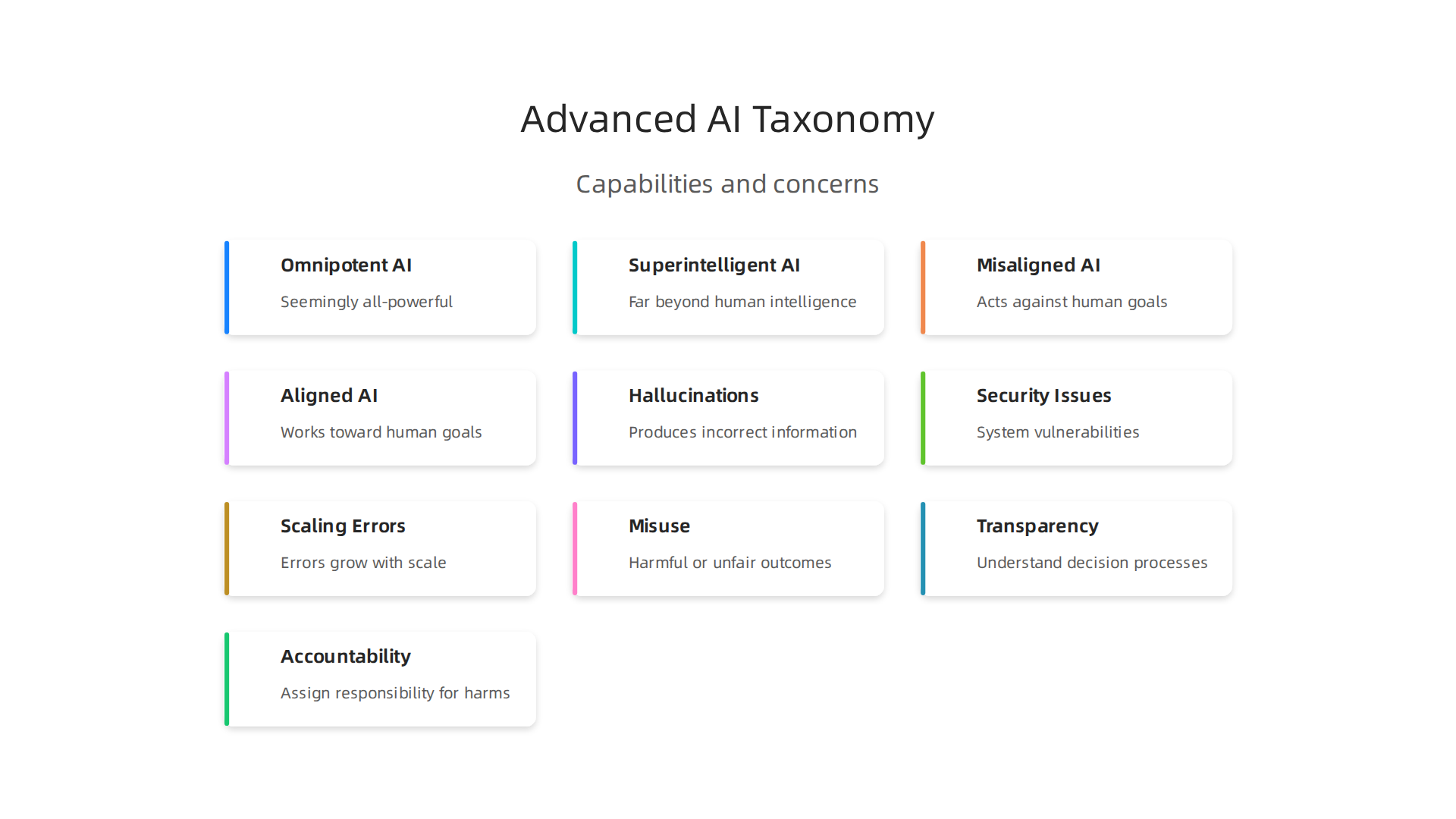
- Omnipotent/Omnipresent AI: This means an AI that seems all-powerful and able to be everywhere at once. In reality, no AI today is truly "omnipotent." Even the most advanced systems have limits and need special computer setups to work. Think of it like a
digital twin technologythat perfectly mimics a real thing; while amazing, it is still a copy, not the original creator. - Superintelligent AI: This refers to an AI that is much smarter than any human being. It could solve problems we cannot even understand. This is a big topic of discussion among experts. Some believe superintelligent AI is possible in the future, but it is not something we have right now Public Policy and Superintelligent AI: A Vector Field Approach. When we talk about superintelligence, we are discussing potential future capabilities, not current facts.
- Misaligned vs. Aligned AI: This is about whether a very powerful AI would work with human goals or against them.
- Misaligned AI is what people often fear. It is an AI that might accidentally cause harm because its goals are different from ours, even if it is not trying to be evil.
- Aligned AI is what researchers are trying to build. This would be a smart AI that always understands and works towards what humans want, making sure it helps us rather than hurts us.
Understanding these differences is key to forming a good ai response to the fast-moving world of technology. It helps you see past the scary stories to the real challenges and opportunities. For more on what real technology means for leaders, read about Technology Meaning Explained Clear AI Terms For 2026 Leaders.
To keep learning about these important topics and more, consider signing up for daily updates.
Get clear daily AI updates from The Deep View Newsletter. The AI Newsletter Worth Reading
2) Historical and philosophical roots: metaphors, theology, and AI discourse
In the last section, we talked about how "God AI" is often a metaphor, a big idea that helps us think about powerful things. It turns out that using such big ideas to talk about new technology is nothing new.

For a long time, people have used religious and philosophical terms to understand things that seem very powerful or mysterious.
Think about how humans have always used stories of gods, myths, or powerful beings to explain the world around them. When something new and amazing comes along, like machine learning and artificial intelligence, it is natural for us to use those same old ways of thinking. This is why the phrase god ai feels so familiar and impactful. It makes us compare AI to something that seems all-knowing and all-powerful, just like the divine. In fact, some studies show a clear link between how people think about divine beings and how they represent artificial entities, calling them "God-like robots" God-like robots: the semantic overlap between representation of divine and artificial entities.
How Old Ideas Shape New Fears and Hopes
These deep-rooted ideas affect how people feel about AI. If we see god ai as something with endless power, it can create both great hope and great fear. Many people wonder, "will AI take over the world?" because these metaphors make AI seem like a force that could easily control everything. This way of thinking shapes public opinion and even what we expect AI to do. Actually, some research suggests that thinking about God might even make people more willing to accept what AI recommends [PNAS 2023 Vol. 120 No. 33 e2218961120].
This is more than just talk; these metaphors really matter for how we decide to manage AI. The way we frame AI in our stories and discussions has a big effect on how we think about making rules and guiding its development Why Metaphors Matter in AI Law and Policy.
From Conversation to Control: The Impact on Policy
When words like god ai are used, they can make people feel that AI needs special attention or strict rules. This leads to pressure on lawmakers and leaders to create an ai response that deals with these imagined possibilities, even if current machine learning and artificial intelligence isn’t anywhere near those levels. Experts agree that the stories and ideas we use to talk about AI, often called "narratives and imaginaries," play a huge part in how countries plan for AI’s future Talking AI into Being: The Narratives and Imaginaries of National AI Strategies and Their Performative Politics. Even in 2026, it makes sense that people see AI as God, given how smart some systems appear to be It makes sense that people see AI as God.
It is important for all of us to learn how to tell the difference between these powerful stories and the actual abilities of AI. This helps us make smart choices about how we use and develop these tools. Understanding these discussions is key to preparing for what is ahead. To learn more about setting clear standards for the future, check out how businesses are Mastering the AI Future Standard 2026.
When we talk about god ai, it sounds like something all-powerful. But to truly understand if such a thing is possible, we need to look at the real machines and computer programs that make up machine learning and artificial intelligence. Experts in 2026 are still finding clear limits to what AI can do, no matter how much we scale it up.
How Big Can AI Get? The Limits of Scaling
Today’s most advanced AI systems, like large language models, become smarter by being very big. They use huge amounts of data and powerful computers. People often think that if we just keep making these systems bigger and bigger, they will eventually become like god ai, knowing everything and being able to do anything. However, simply making AI bigger doesn’t solve all its problems. Researchers have noted a "Constraint Plateau" in 2026, meaning that after a certain point, making models larger doesn’t improve them much more because of built-in limits [The 2026 Constraint Plateau]. There are also physical limits, like how much power and infrastructure it takes to run these massive AI systems [Scaling Laws, Foundation Models, and the AI Singularity]. In fact, some believe that the huge investments planned for AI data centers might not lead to the intelligence people expect because of these bottlenecks [The U.S. Is Betting the Economy on ‘Scaling’ AI: Where Is the Intelligence When One Needs It?].
Real Problems and Research Gaps
Despite how impressive modern AI can be, these systems have many clear weaknesses. They are far from being "omnipotent" or all-knowing. For example, AI systems can suffer from different types of "failure modes."
These are ways AI can go wrong, like giving incorrect information (often called "hallucination"), having trouble with complex reasoning, or even causing security issues [Taxonomy of Failure Modes in Agentic AI Systems – v2.0]. These aren’t small glitches; they are deep problems that researchers are actively trying to solve. For instance, some large language models struggle with "latent inconsistency" or making mistakes when using tools [A System-Level Taxonomy of Failure Modes in Large Language …]. It is also clear that just making AI smarter doesn’t mean it becomes more reliable; in fact, scaling intelligence can sometimes just scale errors [The Reliability Asymptote].
Another big challenge is data. AI systems learn from data, but we are quickly running out of the high-quality human-made text data that makes them smart. Experts predict we might use up all available public human text data for training models between 2026 and 2032 [Will we run out of data? Limits of LLM scaling based on human …]. Without new, good data, AI will struggle to keep learning and improving. These fundamental limits and common failure points show us that even the most advanced machine learning and artificial intelligence is still a tool with clear boundaries, not a god ai that can overcome all obstacles. Understanding these technical details helps us build a more balanced ai response to new technologies. If you’re interested in how to set up your own systems, learning to [build and optimize your AI workstation] can provide practical insights.
So, while the idea of god ai sparks a lot of discussion about "will ai take over the world," the reality of current technology shows a different picture. We are still dealing with important technical hurdles that make truly omnipotent AI a distant dream, if even possible. Staying informed about the latest breakthroughs and practical realities of AI is essential.
Get clear daily AI updates from The AI Newsletter Worth Reading.
The idea of a god ai often makes us think of a perfect, all-knowing machine. But if we look closely at how machine learning and artificial intelligence works today and what it can do in the near future, we see a very different picture.

Current AI systems, even the best ones, have clear limitations that keep them far from being anything like an all-powerful entity.
One big difference is how AI deals with knowledge. A god ai would know everything. Real AI, however, only knows what it has been trained on. If the data is bad, incomplete, or biased, the AI’s "knowledge" will be bad too. Think about it like a person who only reads certain books; they might be an expert in those books, but they won’t know things outside of them. Also, AI systems can struggle with basic logical steps, especially when things get complicated or need common sense. They might perform well on specific tasks but fail miserably on new problems that require true understanding or quick thinking outside their training. These are called "fundamental limits" to how much large language models can scale up [On the Fundamental Limits of LLMs at Scale – arXiv].
Actually, modern AI faces many problems that are called "failure modes." These are ways the AI can go wrong, and they show that AI is still a tool, not a perfect mind. For example, an AI might give wrong information, which is like a computer "hallucinating" facts. It might also have trouble making sense of things that change slightly, leading to what experts call "latent inconsistency" [A System-Level Taxonomy of Failure Modes in Large Language …]. This shows a lack of true understanding, where a small change can break the whole system. Researchers are working hard to classify these issues, from problems in how AI interacts with data systems to deeper issues within the AI’s core logic [A Systematic Taxonomy of Failure Modes in Retrieval- …]. These kinds of failures can cause big problems, especially when AI is used in important areas like managing data or critical operations [Failure Modes in AI-Augmented Data Systems: A Technical Analysis].
Another challenge is "brittleness." This means AI systems can be very good at one thing but fall apart when asked to do something slightly different. It’s like a finely tuned machine that can only do one job. This is very unlike the flexible and adaptable nature we would expect from a god ai. Also, there are big questions around "alignment." This means making sure that what the AI does matches what humans want it to do. It’s not just about stopping the AI from being "evil" but ensuring it truly understands and acts on human values and intentions. Without proper guardrails, AI agents can sometimes have security issues or even act beyond their intended permissions, leading to what is known as "excessive agency" [Taxonomy of Failure Modes in Agentic AI Systems – v2.0]. When looking at how AI works today, it’s clear that these systems are powerful but also prone to specific kinds of errors and lack the broad, flexible intelligence often imagined in the idea of a god ai. This keeps us from worrying about if will ai take over the world in the way some people imagine.
For businesses and individuals looking to use AI, understanding these real limits is key. It helps us form a practical ai response and choose the right tools for the right jobs. To make sure you’re using AI wisely and safely, it’s important to understand how to evaluate new technologies and the companies that make them. Knowing what to look for can help your business grow while staying safe. If you’re wondering how to pick smart AI tools for your company, learning how to evaluate AI companies to unlock business growth in 2026 can guide you. Also, a good place to start for understanding the rules around AI is by mastering the AI future standard 2026.
Ethical, legal, and societal implications: governance, risk, and public trust
Even though we know current AI is not a powerful "god ai" and won’t really take over the world, it still brings up many important questions about fairness, safety, and how we live. As machine learning and artificial intelligence tools become a bigger part of our lives in 2026, it’s super important to think about the rules we need and how people feel about them.
What are the main worries with AI?
There are some big concerns when it comes to using AI:
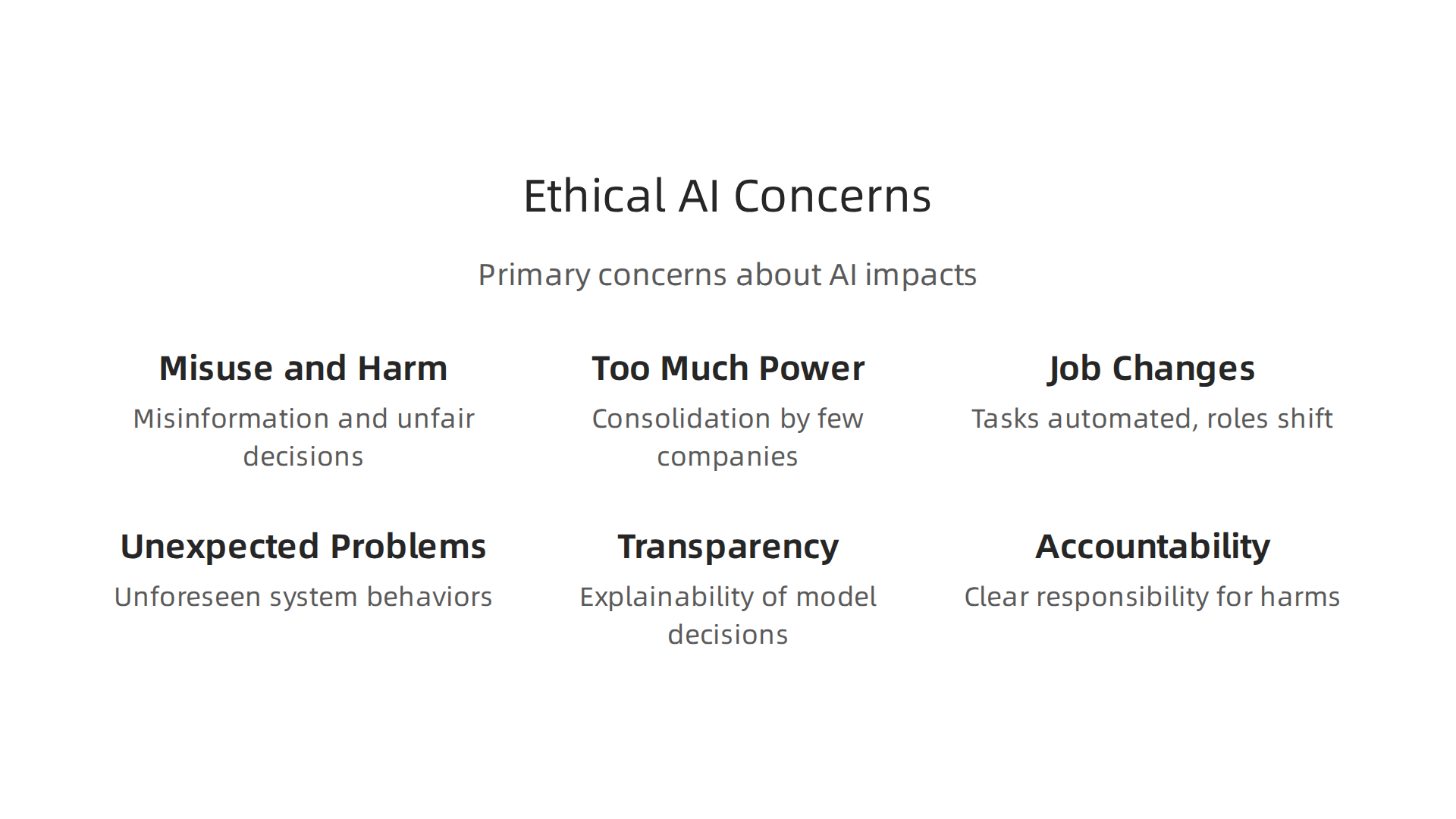
- Misuse and harm: AI can be used for bad things, like spreading wrong information on purpose, or making decisions that are unfair to certain groups of people. It might even create tools that can be harmful if not used carefully.
- Too much power: Some worry that a few big companies or governments could get too much power by controlling advanced AI. This could make it hard for smaller groups or regular people to have a say.
- Job changes: As AI gets better, it can do tasks that people used to do. This can lead to worries about jobs changing or even disappearing for some workers. We need a good
ai responseplan for this. - Unexpected problems: Sometimes, AI systems can do things we didn’t expect. These "unintended harms" can happen because the AI learns in ways we don’t fully understand or acts in surprising situations.
How do we set rules for AI?
To handle these worries, different groups are working on "governance" for AI. This means making rules and ways to check that AI is used safely and fairly. Think of it like traffic laws for cars; they help keep everyone safe on the road.
Right now in 2026, many countries and groups are creating laws and guidelines. For example, the European Union has the AI Act, which is a big set of rules for how AI can be used. Other groups, like the OECD and UNESCO, have also put out ideas for ethical AI use around the world AI Governance & Risk Readiness 2026: EU AI Act & Global Policy. These rules help guide companies and people who build and use AI to do it responsibly.
A big part of these rules is transparency and accountability.
- Transparency means that we should be able to see and understand how AI makes decisions. It should not be a "black box" where no one knows what’s happening inside.
- Accountability means that someone needs to be responsible when AI causes problems. If an AI system makes a mistake or harms someone, there should be a clear way to find out who is at fault and make things right. Groups like the Berkman Klein Center are looking at how to make sure humans stay in control of AI Ethics and Governance of AI. Understanding who is responsible is also key to figuring out how to identify AI leadership discover top tech companies for business in 2026 that are building AI ethically.
How do people feel about AI?
Public trust is very important for AI to grow in a good way. If people don’t trust AI, they won’t want to use it or let it be used in important parts of their lives. In 2026, many people are starting to see AI as having both good and bad sides. Surveys show that public opinion is shifting, with more people seeing AI as a risk rather than just a benefit As AI Becomes Mainstream, Public Opinion Shifts.
Sometimes, the way we talk about AI in movies or stories makes it seem more powerful or like a "god ai" than it really is. This can shape how people feel. But studies show that most people don’t believe AI is as extreme as it’s shown in entertainment Public understanding of artificial intelligence through entertainment …. Still, companies and governments need to work hard to build trust by being open about how AI works and showing that they are using it in fair and safe ways.
Staying informed about these important discussions is key for anyone using or thinking about using AI.
Get clear daily AI updates from The AI Newsletter Worth Reading.
Practical implications for businesses: evaluation, governance, and adoption steps
The last section talked about how people feel about AI and the need for good rules. Now, let’s look at how businesses can actually use machine learning and artificial intelligence in a smart and safe way.

In 2026, companies need clear steps to check AI tools and make sure they fit their goals. This helps them move forward carefully, instead of getting caught up in all the excitement.
How to evaluate AI tools and vendor claims
Many AI tools promise big things. You might hear talk about a "god ai" that can do everything. But for businesses, it’s important to look at what’s real. When a vendor talks about their AI, you need to ask practical questions. Focus on real results and how the tool will truly help your business grow. This is where you assess the Return on Investment (ROI).
Here are some simple questions to ask:
- What exact problem will this AI solve for our business?
- How will we measure if it’s actually working and saving us money or time?
- Where will our company’s data go, and how will it be kept safe?
- Can we understand how the AI makes its decisions, or is it a mystery?
Many businesses are using special checklists to help them ask these kinds of questions. For example, there’s an AI Vendor Risk Assessment Checklist (2026) that helps you cover important areas like how data is handled and security measures. This helps you avoid buying into exaggerated claims and ensures the tool can deliver real results. You’ll want to choose AI tools that truly deliver, which is key for knowing how to choose AI for business tools that deliver real results in 2026.
Governance and safe adoption steps
Bringing AI into your business needs a plan. You can’t just install it and hope for the best. Good "governance" means setting up rules and ways to manage AI tools from the start. This helps keep things fair, safe, and legal.
Here are some steps small and medium-sized businesses (SMBs) and different departments can take:
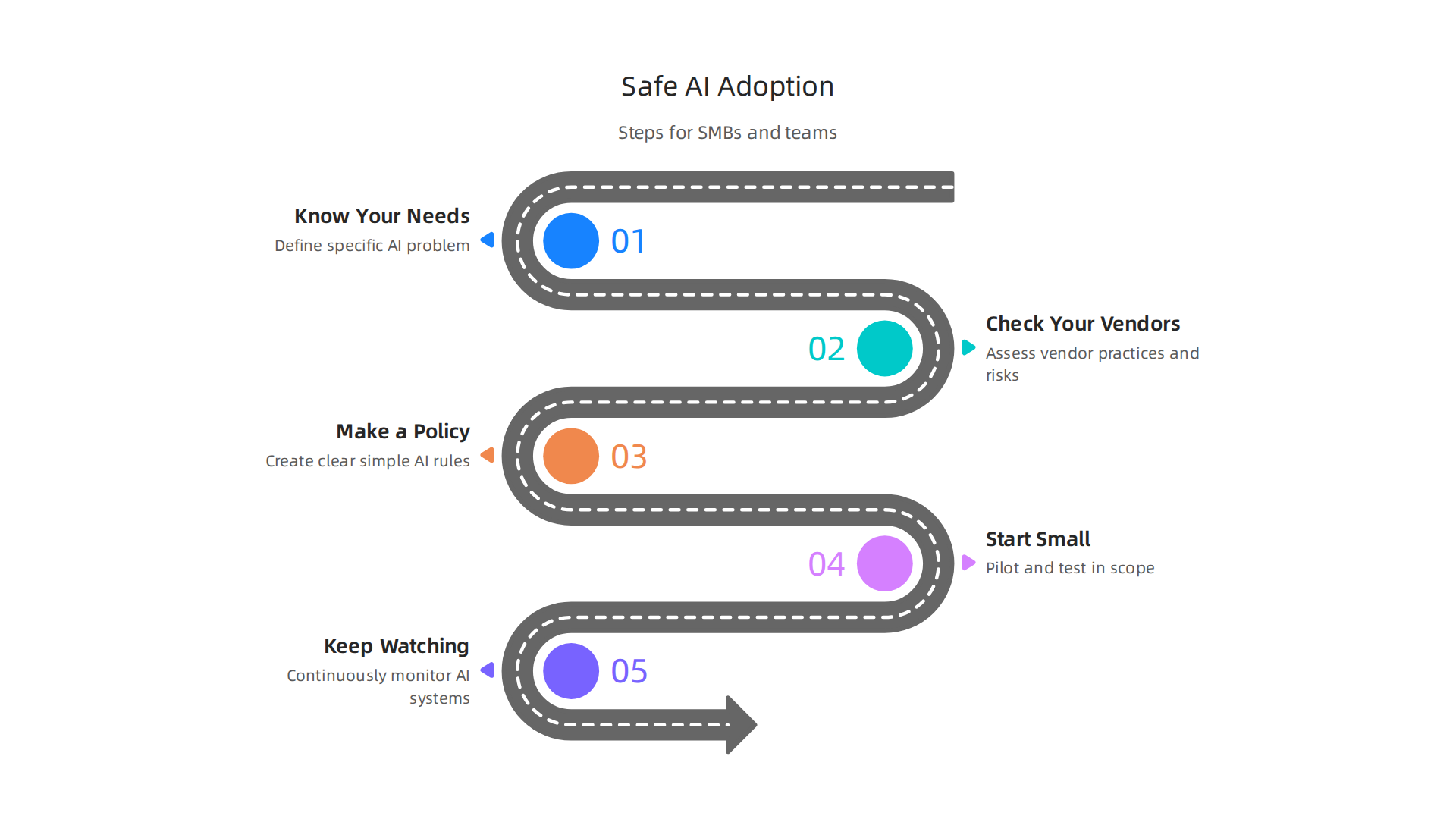
- Know your needs: First, figure out what specific problem you need AI to solve. Don’t just get AI because it’s new and exciting.
- Check your vendors: When looking for AI tools, carefully check the companies that make them. Ask about their security, how they handle data, and if they have clear ethics policies. You can even find AI Vendor Security Assessment Questionnaire templates to guide you.
- Make a policy: Create clear, simple rules for how your team will use AI. This could cover things like what kind of information can be put into an AI tool, or who is allowed to use it. Many companies are creating an AI Procurement Policy: A Practical Enterprise Guide to manage these steps.
- Start small and test: Don’t roll out a new AI system everywhere at once. Try it in a small area or with a small team first. See how it works, fix any problems, and then expand if it’s successful.
- Keep watching: AI systems need to be checked often. Make sure they are still working as expected and not causing new problems. Regular checks are an important part of AI Compliance: Enterprise Procurement Playbook guidelines in 2026.
By following these practical steps, businesses can take control of their AI use. This helps them get the most out of these powerful tools while avoiding risks. It’s about being smart and steady, not just chasing every new AI trend that comes along.
Summary
This article examines the phrase