
Introduction: Navigating the AI Information Landscape
If you feel like you are drowning in AI news every day, you are not alone. The numbers alone tell a big story. The global artificial intelligence market is expected to reach over $539 billion in 2026, and it shows no signs of slowing down. According to the latest Artificial Intelligence Market Size & Share Report, 2026-2033, the market is projected to exceed $3.4 trillion by 2033. That is massive growth, and it brings a huge wave of new tools, models, and updates every single week.
This fast pace is exciting, but it creates a real problem. How do you separate the signal from the noise? Finding a single, reliable tech source that cuts through the hype is harder than ever.

Business professionals need trusted tech hubs to discover, evaluate, and implement AI tools that actually solve real problems. Without a clear strategy, it is easy to waste time and money on solutions that do not deliver. The State of AI 2026 report highlights that while AI investments are at record highs, the biggest challenges remain finding the right tools and the right expertise to use them well.
That is exactly why this guide exists. We built a curated roadmap of the best industry resources, practical evaluation frameworks, and simple implementation strategies that work in the 2026 landscape. We have already done the hard work of finding the top AI websites professionals trust for real news and tools. Whether you are evaluating enterprise-grade infrastructure from providers like Rackspace Technology or exploring the latest generative AI applications, having a clear framework saves time and money. We also offer a comprehensive guide to identifying AI leadership and top tech companies to help you benchmark what excellence looks like.
We cover everything from understanding what makes a good synonym for tech in today’s business environment to mastering advanced technology trends that actually drive results. For daily updates that cut through the clutter without overwhelming your inbox, you can get started with The AI Newsletter Worth Reading. It delivers clear, practical AI insights straight to you. Let us cut through the clutter together and find the signals that matter most for your work.
The State of AI in 2026: Key Trends and Market Data
The numbers coming out of 2026 are clear. AI is not a trend anymore. It is the backbone of modern business. The pace of change this year is staggering, and the data from multiple sources paints a detailed picture of where things stand right now.
According to the global AI market report from Fortune Business Insights, the global artificial intelligence market reached $375.93 billion in 2026 and is projected to grow to nearly $2.5 trillion by 2034. That is a compound annual growth rate of 26.6%. Meanwhile, NVIDIA’s State of AI report for 2026 gives another perspective. It cites Gartner estimates that total worldwide AI spending will exceed $2 trillion in 2026, with companies pouring money into infrastructure, software, and talent at record levels.
Three major trends define the 2026 AI landscape.
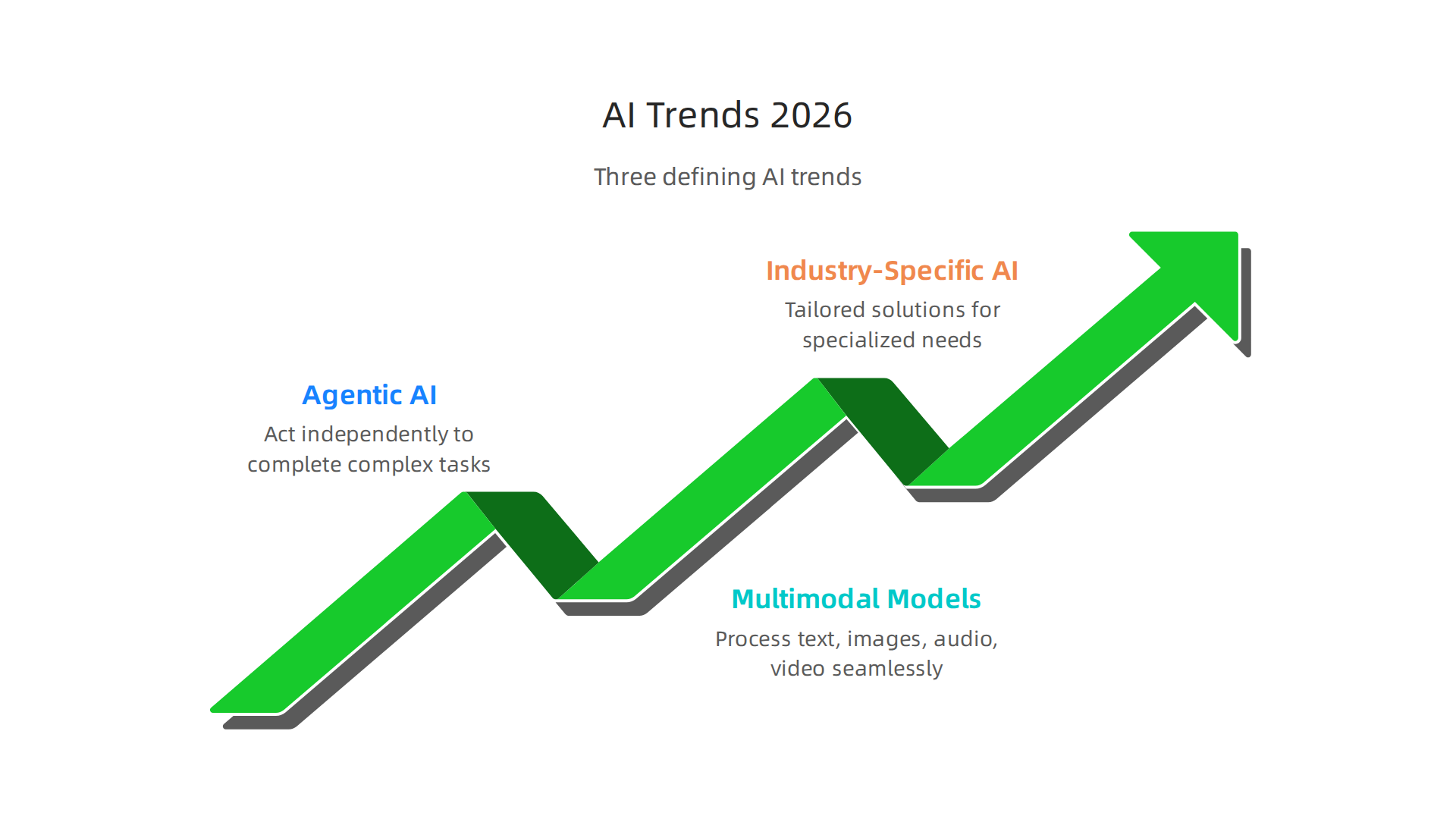
First, agentic AI is rising fast. These are AI systems that can act independently to complete complex, multi-step tasks. The NVIDIA report shows that telecommunications leads agentic AI adoption at 48%, followed closely by retail and consumer packaged goods at 47%. Second, multimodal models that process text, images, audio, and video are becoming the standard. Organizations now expect their AI tools to handle multiple types of input seamlessly. Third, companies are shifting toward industry-specific AI solutions rather than generic, one-size-fits-all tools. Banking, healthcare, manufacturing, and retail all have specialized needs, and vendors are delivering on that.
Adoption rates are climbing across every sector. The Deloitte State of AI in the Enterprise 2026 report reveals that worker access to AI grew by 50% in 2025. It also finds that 58% of companies now use physical AI in at least a limited way, a number expected to reach 80% within two years. On the generative AI front, the Stanford HAI 2026 AI Index Report shows organizational adoption hitting 88%. North America leads globally, with 70% of organizations actively using AI. Across all industries, 86% of companies report that their AI budgets will increase in 2026, and 62% cite data analytics as their top AI workload.
What does all of this mean for you? With so much activity, having a clear strategy for selecting the right tools and partners is more critical than ever. One way to stay ahead is to understand how top companies are deploying AI in real-world scenarios. For more insights, check out our look at AI and human creativity in 2026 and what the data says about collaboration.
The state of AI in 2026 is one of rapid growth and concrete impact. Knowing these trends and data points helps you make smarter decisions about where to focus your time and investment. The next step is learning how to evaluate the tools that are flooding the market.
Top Tech Sources for AI Tool Discovery: Curated Platforms and Repositories
With thousands of new AI tools launching every month, finding the right one for your needs can feel like looking for a needle in a haystack.

You need a reliable tech source to cut through the noise. The good news? Several well-structured platforms already do the hard work for you. Knowing where to look saves hours of random searching and helps you focus on tools that actually deliver value.
Curated Platforms That Save Time
General review sites like G2 and Capterra are great starting points for any software purchase. They offer user ratings, feature comparisons, and real feedback from people who have used the tools. But for AI-specific discovery, specialized directories are even faster. According to the top AI directories for 2026 roundup, the most effective platforms include Product Hunt for launch-day buzz, There’s An AI For That (TAAFT) for long-term organic discovery, and Futurepedia for niche categorization. These tech hubs organize thousands of tools by use case, pricing, and popularity so you can compare options side by side without clicking through dozens of tabs.
Another comprehensive resource is the RankmyAI tools directory ranking, which lists the top 100 AI directories based on overall performance. If you want a broader view, directories like AI Tools Directory and AI Tools Haven catalog over 1,200 human-tested tools across 34 categories. Using these platforms as your primary discovery method dramatically reduces the time it takes to find a viable solution.
Community-Driven Repositories Offer Real-World Insights
Curated directories are polished, but they can miss the unfiltered truth. That is where community-driven sources shine. Reddit threads, especially in subreddits like r/ChatGPTPro, are filled with honest discussions about what works and what does not. One popular Reddit thread from 2026 breaks down the best AI tools by category, covering AI agents, writing assistants, coding tools, and more. These recommendations come from real users who share their daily workflows, including the frustrations and workarounds that reviews often leave out.
GitHub awesome lists are another goldmine. A quick search for "awesome AI tools" on GitHub reveals curated repositories maintained by the developer community. These lists are updated frequently and often include links to source code, documentation, and community ratings. They are especially valuable if you want to explore open-source alternatives or see how tools are built under the hood.
Building Your Scanning Routine
The most efficient approach combines both curated and community sources. Here is a simple routine you can start today:
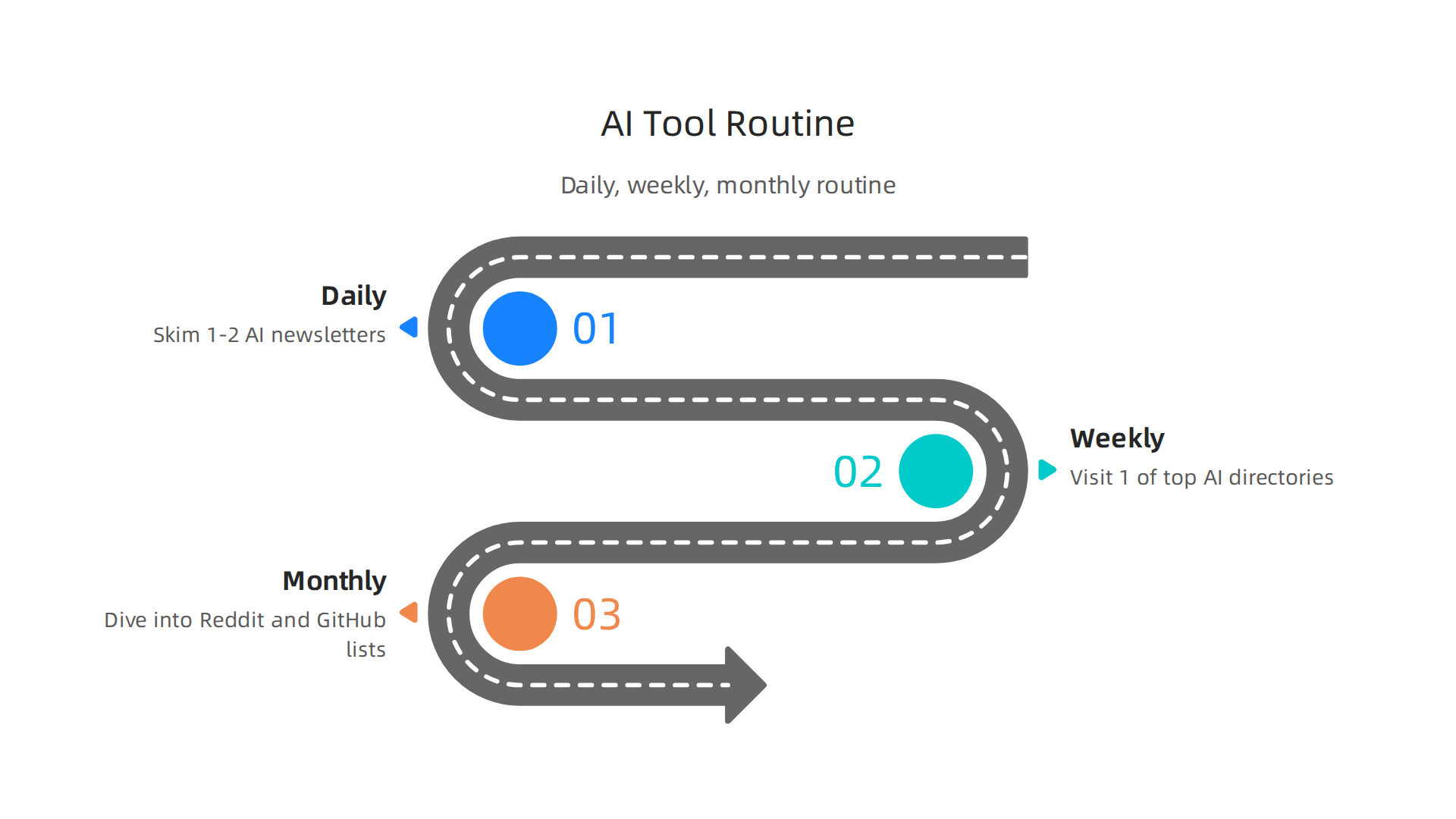
- Daily (5 minutes): Skim one or two AI newsletters that summarize the biggest launches and trends. This keeps you informed without information overload. Consider subscribing to The AI Newsletter Worth Reading for clear daily AI updates.
- Weekly (15 minutes): Visit one of the top AI directories like TAAFT or Futurepedia. Browse new listings in your area of interest. Filter by recent additions or highest rated.
- Monthly (30 minutes): Dive into Reddit threads and GitHub awesome lists. Read user experiences and test a couple of tools yourself.
For a more structured overview of the best websites to follow, check out our guide to the 10 top AI websites professionals trust for real news and tools. It rounds up the most trusted sources across different categories.
Building a reliable scanning routine gives you a competitive edge. You stop chasing every shiny new launch and start focusing on tools that actually solve your problems. The platforms and communities above are your most effective tech source for staying ahead in the fast-moving AI landscape.
How to Evaluate AI Tools: Criteria for Business Fit and ROI
Finding a shiny new AI tool is exciting. But getting real value from it? That takes more than gut feeling. You need a clear way to judge whether a tool fits your business and actually delivers a return on investment. Without a structured approach, you risk wasting time and money on a tech source that looks good in demos but fails in practice.
The Five Pillars of Smart AI Evaluation
There are five core areas to check before you commit to any AI tool.
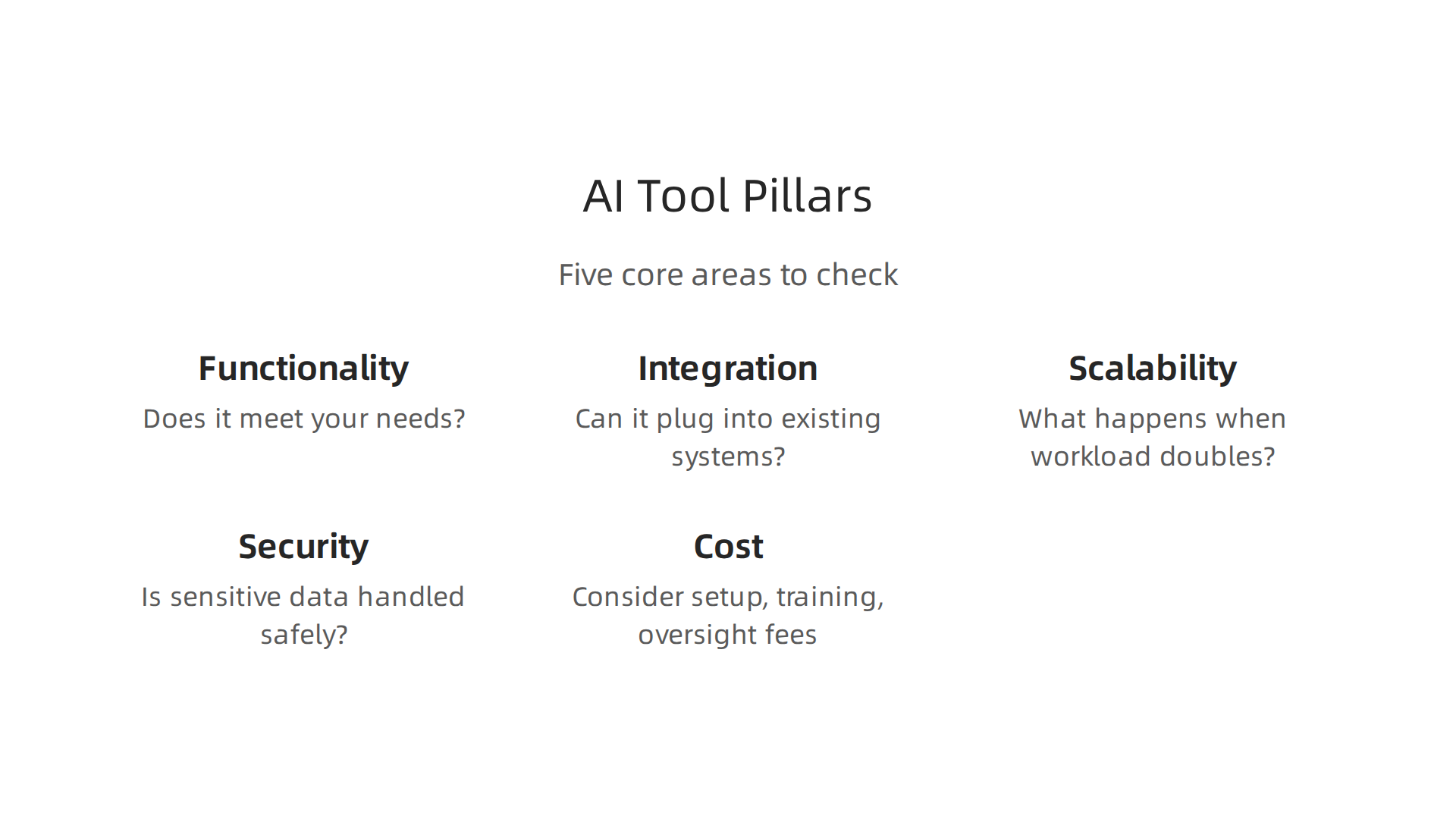
Think of them as your evaluation checklist.
Functionality: Does the tool do what you actually need? Test it on your real tasks, not just the demo examples. Look for accuracy, speed, and consistency. Many enterprise AI evaluation platforms help you score outputs against quality dimensions like faithfulness and relevance. According to the Enterprise AI Platform Guide: The Best of 2026, business users should prioritize platforms that handle complex unstructured data with high accuracy and provide visibility into how decisions are made.
Integration: Can this tool plug into the systems you already use? If it cannot connect to your CRM, database, or document storage, you will create more work, not less. Good tools offer pre-built connectors and support open standards like MCP (Model Context Protocol). The best enterprise AI platforms make it easy to access both structured data in databases and unstructured data in documents without custom development.
Scalability: What happens when your workload doubles or triples? Some tools work fine for a single user but slow down under team use. Check uptime guarantees, pricing tiers, and how the platform handles growth. Tools that offer consumption-based pricing give you flexibility as demand changes.
Security: If you handle customer data or sensitive business information, security is non-negotiable. Look for SOC 2, ISO 27001, HIPAA, or GDPR compliance. Ask about data residency and whether you can run the tool inside your own virtual private cloud. Enterprise-grade governance features let you monitor agent behavior and audit decisions.
Cost: Price is more than the subscription fee. Consider setup time, training costs, and how much human oversight you will still need. A cheap tool that requires constant babysitting is often more expensive than a premium one that runs reliably. Track AI usage across departments to spot underused subscriptions and allocate costs fairly to the teams that benefit.
Build a Simple Scoring Rubric
A scoring rubric helps you compare tools side by side without bias. Here is a straightforward way to build one.
| Criterion | Weight (1–5) | Score per tool (1–5) | Weighted Score |
|---|---|---|---|
| Functionality | 5 | ? | ? |
| Integration | 4 | ? | ? |
| Scalability | 3 | ? | ? |
| Security | 5 | ? | ? |
| Cost | 3 | ? | ? |
| Total | 20 | ? / 100 |
Assign a weight to each criterion based on what matters most for your business. For example, a healthcare startup might set security at 5 and cost at 2. A bootstrapped solo founder might flip that. Then score each tool from 1 to 5 in every category. Multiply the score by the weight to get the weighted score. Add them all up for a total out of 100. This simple table takes the emotion out of the decision.
Real-World Success Factors
One real-world example comes from Microsoft’s open-source framework called ASSERT (Adaptive Spec-driven Scoring for Evaluation and Regression Testing). It lets teams turn written requirements into executable tests. Instead of guessing whether an AI agent is performing well, your business team can define what "good" looks like in plain language, and the system checks automatically. This approach removes guesswork and ties evaluation directly to business outcomes.
Another key factor is the enterprise AI maturity gap. Many organizations treat AI as a collection of experiments. High-maturity organizations reverse that. They define two to five enterprise-level AI objectives, like margin improvement or cycle-time reduction, and map every AI initiative directly to measurable KPIs. This ensures every tool you evaluate connects back to a real business goal.
Your Next Step
Once you have your rubric and your list of potential tools, you are ready to make a smart choice. But evaluation does not stop at purchase. Keep checking performance over time and adjust your scoring as your needs shift.
For a deeper look at getting real value from AI investments, check out our guide on how to get real ROI from AI marketing cloud in 2026. It walks through practical examples of tracking returns and avoiding common pitfalls.
When you evaluate AI tools the right way, every decision becomes clearer. You stop crossing your fingers and start investing in tech sources that truly move your business forward.
Implementing AI Solutions: Strategies for Smooth Integration
Once you have selected the right tech source for your needs, the real work begins. Dropping a new tool into your daily operations without a plan is a recipe for confusion and wasted time. Smart integration happens through careful steps
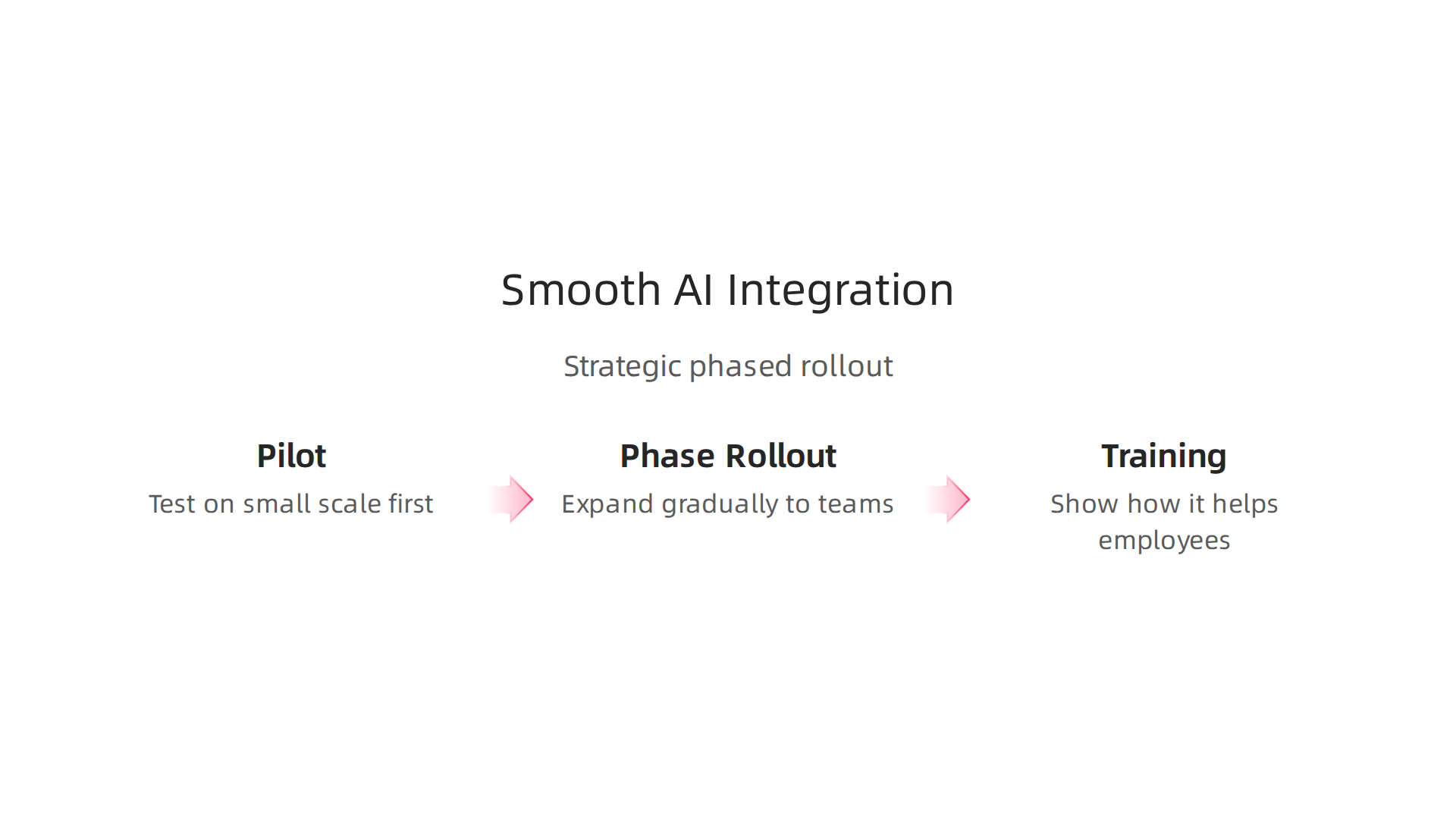
that protect your team and your budget.

Start with a Pilot, Not a Full Rollout
The most successful organizations test new AI tools on a small scale before committing to a company-wide launch. Pick one specific workflow where the tool can prove its value. Set a clear timeline, usually 90 days, and measure results against a baseline. This approach keeps disruption low and gives you real data before you invest more.
According to the SMB AI Adoption Guide: Use Cases, Costs, Roadmap, companies should select one high-impact, low-risk pilot and establish clear baseline metrics before expanding. This phased method helps you catch problems early and build confidence with your team.
Phase Your Rollout Strategically
After a successful pilot, roll out the tool in stages. Start with one department or team that handles the chosen workflow. Let them use the tech source for a few weeks. Gather feedback. Fix any issues. Then expand to the next group.
This gradual approach prevents the chaos of a big bang launch. It also lets you adjust the tool based on real user experience before it reaches everyone. You can refine training materials, update permissions, and fix integration gaps one step at a time.
Invest in Change Management and Training
The best advanced technology in the world fails if people do not use it. Your team needs to understand why the new tool matters and how it helps them personally. Make training short and role-based. Focus on practical examples that relate to each person’s daily tasks.
Show employees how the tool can save them time on tedious work. Let them discover wins on their own when possible. A good rule is to treat training as part of the integration budget, not an afterthought. When people see how the tech source makes their job easier, adoption happens naturally.
If you are looking into AI assistants for your team, you can read more about practical applications in our guide on AI virtual assistants for businesses.
Watch Out for Common Pitfalls
Two big traps catch many businesses during AI integration: data silos and vendor lock-in.
Data silos happen when the new tool cannot talk to your existing systems. Customer data in one platform, sales numbers in another, and AI outputs in a third create a mess. Fix this by checking integration options before you commit. Confirm connectors for your CRM, finance tools, and document storage. Test permissions end to end during the pilot.
Vendor lock-in means you become so dependent on one provider that switching becomes painful. Avoid this by choosing tools that support open standards like MCP. Keep your data portable. And always have a plan B for critical workflows.
Another common mistake is over-automating too fast. Start with assistive use, meaning the AI helps your team complete tasks. Only move to full automation after you trust the outputs completely.
Keep Improving Over Time
Integration is not a one-and-done task. Review performance and cost each month. Listen to what your team says about the tool. Update your scoring rubric as your needs change. The best tech source for your business today might not be the best one next year.
Staying on top of AI trends and best practices helps you make smarter decisions. A daily dose of curated updates can save you hours of research time. Check out The AI Newsletter Worth Reading for clear daily AI updates that keep you informed without the noise.
When you approach integration with patience and structure, your AI investment pays off. You avoid costly mistakes and build a foundation that grows with your business.
Staying Ahead: Communities, Newsletters, and Continuous Learning
The world of advanced technology moves fast. The tools you choose today could be outdated in a year. That is why staying ahead is not a one-time task. It is a habit. The best way to keep your skills sharp and your decisions smart is to plug into the right communities, read the right newsletters, and never stop learning.

Join AI-Focused Communities
Learning from others who use the same advanced technology daily is one of the fastest ways to get better. Communities like Hugging Face and AI subreddits are full of people sharing real experiences. They post what worked, what broke, and what they wish they had known.
These spaces are also great for asking specific questions about your tech source. When you run into a problem, someone has probably solved it before. Engaging in these communities helps you avoid mistakes and find shortcuts you would never discover alone.
According to the 2026 Small Business AI Outlook Report, many successful teams encourage employees to try AI tools for personal tasks first. That builds confidence. Communities take this further by letting people share those wins and lessons openly.
Subscribe to Curated Newsletters
With so much information flying around, you need a filter. Curated newsletters save you hours of research time by sending only the most important updates to your inbox. The best ones are edited by people who know what matters for business users.
A great example is the list of top newsletters highlighted in the Top 12 AI Newsletters to Follow in 2026 guide. Newsletters like TLDR AI and The Batch from DeepLearning.AI deliver daily or weekly digests that cut through the noise. They cover new releases, research breakthroughs, and practical tips you can use right away.
For a focused selection of newsletters that help you track the latest in AI tools and trends, check out our roundup of top interactive AI newsletters to follow in 2026. It lists the best options by role and reading style.
Invest in Certifications and Online Courses
Reading updates is helpful, but structured learning takes your knowledge deeper. Certifications and online courses give you a foundation that makes every newsletter and community post more useful.
The SMB AI Revolution guide emphasizes that establishing a solid data foundation comes before any AI pilot. Courses on data governance, prompt engineering, or AI security help you build that foundation. Many platforms offer free or low-cost certifications that fit around your schedule.
Set aside a small amount of time each week for learning. Watch a course module. Earn a certificate. Read one deep-dive article. Over time, these small actions compound into real expertise.
When you combine community engagement, curated newsletters, and continuous learning, you turn your tech source investment into lasting knowledge. You stop reacting to changes and start staying ahead of them. That is how smart businesses keep their edge in 2026.
Future Outlook: What’s Next for AI in Business
Looking ahead, the path for AI in business is clear. The numbers tell a dramatic story. The global artificial intelligence market is projected to grow from about $375.93 billion in 2026 to around $2,480.05 billion by 2034, according to the Artificial Intelligence Market Global Report 2034. That is a compound annual growth rate of over 26%. This is not a slow trend. It is a wave.
What Technologies Are Coming Next
The most exciting shift in 2026 is the rise of autonomous agents. These are AI systems that do not just answer questions. They take action. They can book meetings, manage workflows, and run entire processes without constant human input. The State of AI in the Enterprise 2026 report from Deloitte shows that agentic AI usage is set to rise sharply in the next two years. Some industries like telecommunications already have 48% adoption of agentic AI.
Real-time multimodal AI is another big leap. This means AI that can see, hear, and understand video, images, and text all at once. For your tech source strategy, this will change how you interact with customers, analyze data, and automate tasks.
How Regulation Will Shape Things
Rules are catching up to the technology. The EU AI Act is already changing which tools are available in Europe. The United States is developing its own guidelines. These regulations will affect what your business can do with AI and how you deploy it. The 2026 AI Index Report from Stanford HAI highlights that governance platforms are now a top strategic technology priority for companies. That means staying informed about compliance is just as important as picking the right tool.
How to Prepare Your Business
The smartest move you can make is to build a flexible foundation. Choose a tech source that can adapt to new regulations and new capabilities. Start small with pilot projects using autonomous agents. Watch how multimodal AI changes your industry. And keep learning.
The future will not wait for businesses that hesitate. The companies that succeed will be the ones that integrate AI into their core operations today. If you want to get a head start on understanding how AI virtual assistants can transform your daily workflows, explore our guide on AI virtual assistants for businesses.
For daily insights on these fast-moving trends, consider subscribing to The AI Newsletter Worth Reading. It delivers clear updates straight to your inbox so you never miss a shift.
Summary
This guide helps busy professionals cut through the noise of a rapidly expanding AI market by offering a curated roadmap for discovery, evaluation, and implementation. It explains where to find reliable AI tools—combining curated directories and community repositories—and gives a practical scanning routine you can use daily, weekly, and monthly. The article lays out a five‑pillar evaluation framework (functionality, integration, scalability, security, cost) and a simple scoring rubric to compare options objectively. It also describes how to run 90‑day pilots, phase rollouts, and invest in role‑based training to boost adoption while avoiding data silos and vendor lock‑in. The guide highlights the importance of ongoing learning via communities and newsletters and previews near‑term shifts like agentic and multimodal AI. After reading, you’ll know where to look for tools, how to score them against business goals, and how to integrate AI in a way that delivers measurable value.