Tag: ai tools

  • Unlock Growth: How to Strategically Choose Top Software Companies and AI

    Unlock Growth: How to Strategically Choose Top Software Companies and AI

    Why leaders need to rethink strategy around top software companies and AI

    It’s 2026, and the world of business is buzzing with talk about Artificial Intelligence, or AI. Every day, it feels like there’s a new AI tool or update being released. This can be exciting, but also a bit much. For many business leaders, it creates a big problem: information overload. It’s really hard to tell what’s truly helpful and what’s just noise when everyone is talking about AI.

    With so many top software companies now offering AI features, how do you pick the right ones for your business? How do you know which tools will really make a difference and help you grow? This question is more important than ever. The global market for enterprise AI was huge in 2025 and is set to grow even more by 2030, showing just how fast things are moving along Enterprise AI Adoption Trends 2026. Companies are quickly adopting AI, with many already seeing it in action across their operations The State of AI in the Enterprise – 2026 AI report.

    This rapid change means that leaders can’t just stick to old ways of thinking. They need a fresh approach to how they look at top software companies and their AI offerings.

    A leader contemplates new strategies in the rapidly evolving AI landscape.

    If you’re in charge of making big decisions, whether for b2b marketing, running a company like Zensar Technologies, or leading any marketing firms, you know it’s a challenge to keep up. You have to sort through countless options, figure out which ones fit your needs, and then put them into action.

    That’s why we’re here. This article will give you a clear, simple way to think about and choose AI software. We will provide a practical framework to help you make smart choices about strategy, buying new tools, and putting them to use. Our goal is to cut through the confusion and help you understand how to pick AI tools for business that deliver real results in 2026.

    If you want to stay updated with clear, daily insights on AI and technology, consider subscribing.
    Get clear daily AI updates from The AI Newsletter Worth Reading.

    1) Market landscape: Who counts as a ‘top software company’ for enterprise AI?

    To truly pick the right AI tools for your business in 2026, you first need to understand who the main players are. What does "top software company" even mean when we talk about AI for businesses? It’s not just about the biggest names you know. It’s about how they help companies like yours use AI in smart ways.

    We can look at a few important things to decide if a company is a top player in enterprise AI:

    • Scale: Can they handle a lot of data and many users? Top companies offer solutions that work for both small businesses and very large ones.
    • Product Breadth: Do they offer many different AI tools, or just one specific thing? A wide range of products means they can help with different business needs.
    • Vertical Reach: Do their AI tools work well for specific industries, like healthcare, finance, or b2b marketing? Some companies are leaders in certain areas.
    • Integration Ecosystem: Can their AI tools easily connect with other software you already use? This is super important. No one wants a tool that can’t talk to their existing systems.
    • Enterprise Trust: Do businesses trust them with important data and tasks? A company’s track record and how secure their tools are really matter.

    In fact, many organizations today, about 40% of them, choose to buy ready-made AI solutions instead of building their own from scratch The multi-year AI advantage. This shows how important it is for leaders to know which providers are truly reliable.

    Different Kinds of AI Software Vendors

    The world of AI software is big, but we can group the vendors into a few main types.
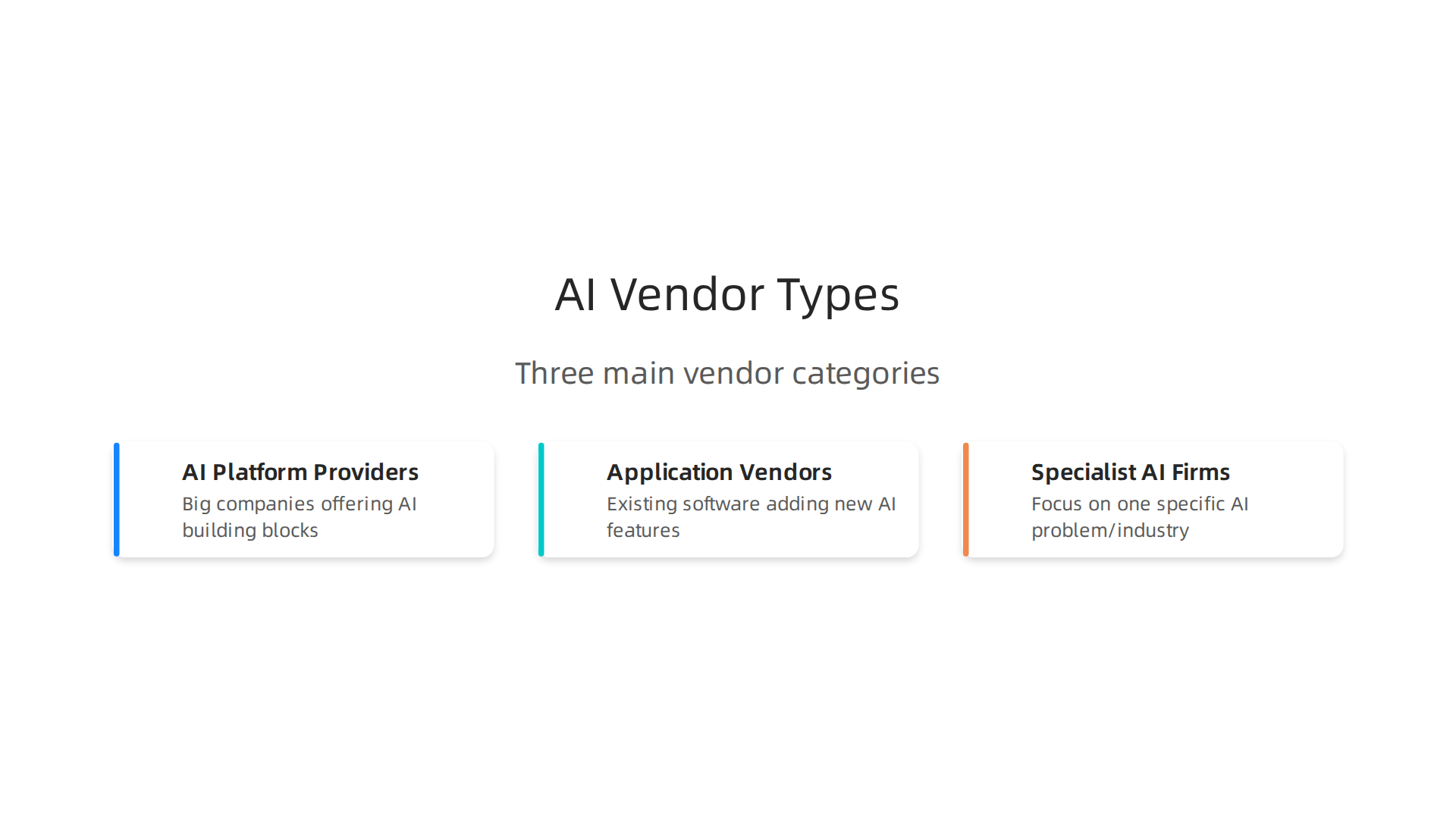
    Understanding the three main categories of AI software vendors helps in strategic tool selection.

    Knowing these groups helps you think about your strategy for buying new AI tools.

    1. AI Platform Providers: These are the really big companies, often called "hyperscalers." Think about the huge cloud providers that offer many AI building blocks. They give you the basic tools and power to create your own AI solutions. They are great if you have a team that can build custom tools. For example, if you need a strong base to run complex AI models or manage a lot of data, these platforms are key.
    2. Application Vendors with AI: These are companies that already make software you might use every day. Now, they are adding AI features right into their existing products. For instance, a company offering customer relationship management (CRM) software might add AI to help sales teams write better emails or predict customer needs. Companies like Zensar Technologies, or other marketing firms, often add AI to improve their services. This is helpful because the AI is already part of a tool you know, making it easier to use. If you are looking for ways to improve specific tasks, this type of vendor can offer powerful, ready-to-use solutions. You can learn more about how to choose effective tools in our guide on how to pick AI tools for business to drive growth in 2026.
    3. Specialist AI Firms: These are often smaller companies that focus on one very specific AI problem or industry. They might have a super smart AI tool for making videos, analyzing legal documents, or improving medical diagnoses. They are experts in their niche. If you have a very particular problem that common software doesn’t solve, a specialist firm might have the perfect AI solution.

    Understanding these different types of top software companies helps you look for the right kind of AI tool. It makes it easier to figure out if you need a broad platform, an AI add-on to your existing software, or a special tool for a unique challenge. This helps you narrow down your choices and avoid getting lost in the sea of new AI releases every day. For a deeper look at evaluating AI companies, check out how to evaluate AI companies to unlock business growth in 2026.

    After you have a good idea of what kind of AI vendor you need, the next important step is to look closely at their products.

    A business team closely examining product specifications and features during an evaluation meeting.

    This means checking if their AI tools actually fit your business needs. You want to make sure the software can do what you need it to do, works well with your other systems, and will keep getting better in the future.

    Here are the main things to check when looking at AI products from top software companies:

    Core Capabilities and Features

    First, think about what the AI tool is built to do. What are its main skills? For example, if you need an AI for customer service, does it understand customer questions well? Can it give helpful answers? If you need it for writing marketing materials, how good is the quality of its writing?

    You should compare different platforms based on what they can actually do. Some AI platforms, like Microsoft Azure AI Foundry or Google Vertex AI, offer many different features. They can handle things like understanding different types of information or working across many systems Enterprise AI Vendor Comparison 2026: Top 15 Platforms for …. It’s important to match these skills to your specific tasks. Think about your goals, whether it’s for b2b marketing efforts or streamlining other business operations.

    How Well They Connect: APIs, Extensibility, and Data

    One of the most important things for any new AI tool is how well it can work with your existing systems.
    Essential considerations for how AI tools connect with existing business systems.

    No one wants an AI that works alone.

    • APIs (Application Programming Interfaces): Think of APIs as special doorways that allow different software programs to talk to each other. If an AI tool has good APIs, it means you can easily connect it to your current customer relationship management (CRM) software, your sales tools, or your accounting programs. This makes sure all your systems can share information.
    • Extensibility: This means how much you can change or add to the AI tool. Can you customize it for your special needs? Can you build new features on top of it? For example, if you’re a marketing firm, can you extend the AI’s capabilities to handle specific types of campaigns unique to your brand? Some platforms are very flexible, letting you build custom solutions Top Enterprise AI Platforms 2026: 8 Compared.
    • Data and Connectivity: How does the AI tool handle your business’s data? Can it easily connect to where your data lives, whether that’s in the cloud or on your own servers? Look for tools that can work smoothly with your data setup to make sure the AI has all the information it needs to be helpful. Some top software companies focus on strong data connections, like Databricks Mosaic AI for lakehouse-centric AI Top 10 Enterprise AI Platforms in 2026 (Ranked).

    Reading the Roadmap and Engineering Signals

    Choosing an AI tool isn’t just about what it can do today. It’s also about what it will be able to do tomorrow. The world of AI changes very fast in 2026. This is where looking at a company’s product roadmap and engineering signals becomes useful.

    • Product Roadmap: This is like a plan that shows what new features and improvements a company intends to add to their software in the future. A clear roadmap tells you if the company is focused on the things that matter to your business. Does it show plans for better integrations? More advanced AI capabilities?
    • Engineering Signals: These are clues about how a company builds and updates its software. Do they release updates often? Do they listen to customer feedback? Are they pushing the boundaries with new AI technologies? Companies that invest heavily in research and development usually have stronger engineering signals. This can tell you a lot about their long-term vision and reliability. IBM watsonx, for example, is known for its focus on regulated industries and strong governance Every Major Enterprise AI Platform Benchmarked (2026). This shows a clear signal about their engineering priorities.

    By carefully checking these points, you can make a better choice about which AI tools will truly help your business grow. For more detailed insights on how to pick the right AI solutions, explore our guide on Enterprise AI platforms 2026: top providers and how to choose the right one.

    Keeping up with the latest AI trends is a big job. If you want to stay smart about new AI tools and features without getting lost in all the noise, there’s a great resource.
    Get clear daily AI updates from The AI Newsletter Worth Reading.

    Picking the right AI tools from all the top software companies is just the start. The next big step is making them work smoothly with everything else you do every day.

    A team works collaboratively to ensure smooth integration and deployment of AI systems.

    This is where real-world integration and deployment come in. It’s about getting the AI system up and running and making sure it stays useful and secure for your business, whether it’s for b2b marketing efforts or other important tasks.

    Common Integration Challenges

    When you bring a new AI tool into your company, it’s a bit like adding a new player to a team. Everyone needs to work together. Here are some common problems you might face:
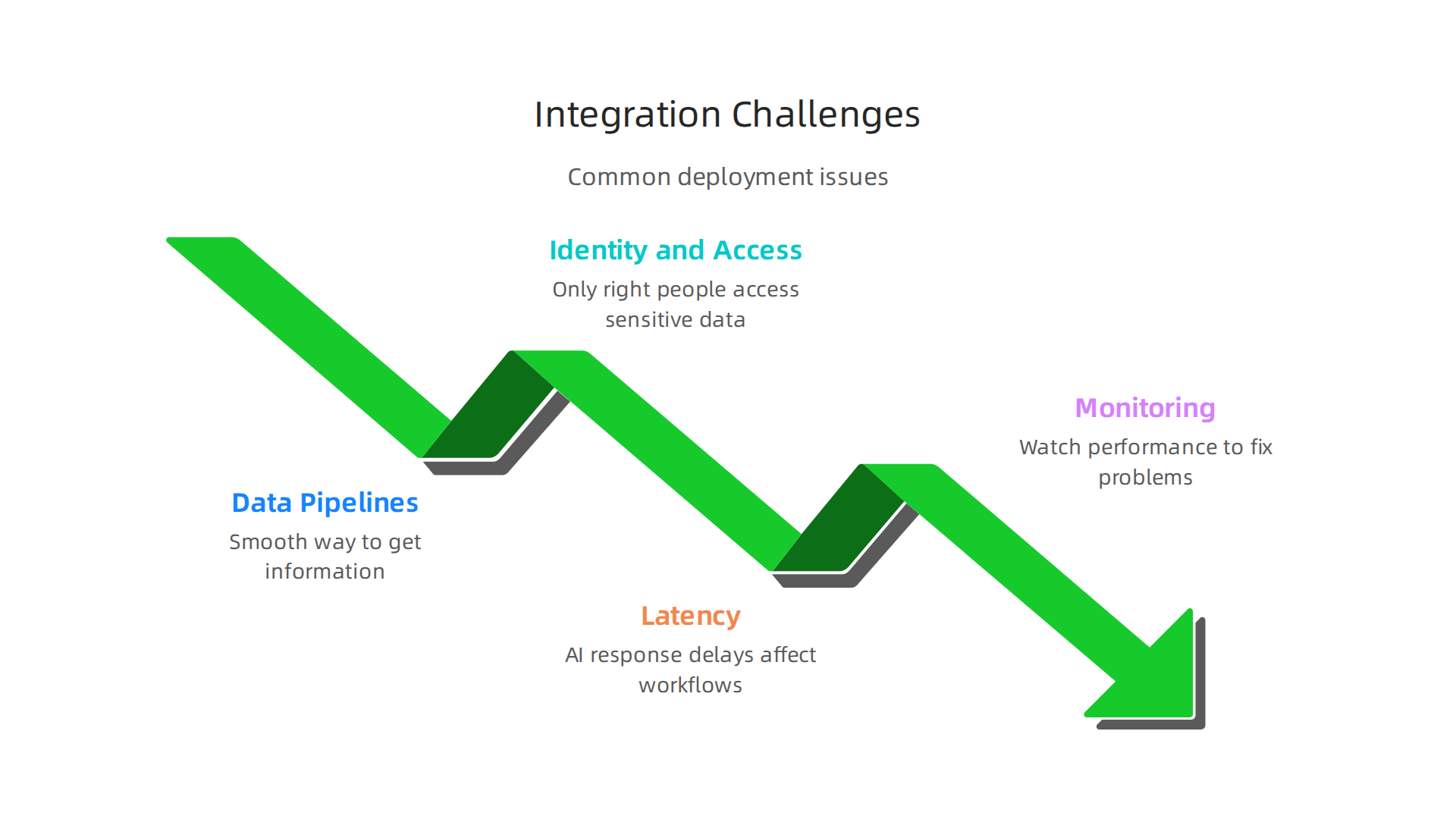
    Key challenges businesses encounter when integrating new AI tools into their operations.

    • Data Pipelines: AI needs lots of data. You need a smooth way to get your company’s information to the AI tool. This is called a data pipeline. If this pipeline isn’t set up right, the AI won’t have the facts it needs to do its job. It’s like trying to cook without all your ingredients.
    • Identity and Access: Who gets to use the AI tool? How do they log in? It’s really important that only the right people can access sensitive AI tools and data. Many top software companies offer ways to connect their AI tools to your existing security systems, like Single Sign-On (SSO) and Multi-Factor Authentication (MFA). This makes sure everyone logs in safely, as highlighted in one Enterprise AI Onboarding Checklist: 30 IT Must-Checks.
    • Latency: This is just a fancy word for delay. If your AI takes too long to respond, it can slow down your whole team. For example, if a marketing firm’s AI takes ages to draft an email, it’s not very helpful. You want quick answers from your AI.
    • Monitoring: Once an AI is working, you need to watch it closely. Is it doing what it’s supposed to? Is it making mistakes? Good monitoring tools help you see how the AI is performing in real time so you can fix problems quickly. This includes setting up dashboards to track performance, as detailed in an Ultimate Enterprise AI Integration Guide for 2026.

    Operational Readiness: Keeping AI Running Smoothly

    Beyond just getting the AI to work, you need to make sure your business is ready to keep it running well every day. This is about being "operationally ready."

    • Site Reliability Engineering (SRE) and Observability: These are about making sure the AI system is always available and working correctly. SRE teams focus on keeping things reliable. Observability means you can "see" what’s happening inside the AI system at all times, so you know if something is going wrong.
    • Compliance and Governance: In 2026, rules about how AI uses data are very important. Your AI tools must follow laws and company rules. This includes managing approvals, audits, and who can access the AI model, which are key parts of Enterprise AI in 2026: Use Cases, Governance, and Rollout. You need clear plans for how data is used and stored.
    • Vendor Support Models: Even the best AI tools from top software companies will sometimes need help. What kind of support does the vendor offer? Do they have a team you can call if there’s a problem? How quickly do they respond? Good support means less worry for your team.

    Making sure your business is ready for these challenges is vital for successful AI adoption. To learn more about how to pick the right tools for your business, check out our guide on how to choose AI for business tools that deliver real results. It’s all about thoughtful planning and choosing tools that fit your company’s specific needs and readiness. Getting this right helps your business grow and makes sure your AI investment pays off.

    Getting your AI tools up and running is one thing. Paying for them and knowing if they are truly helping your business grow is another big part of the picture. This is where we look at how to buy AI, what different pricing plans look like, and how to measure if you’re getting your money’s worth.

    Common Pricing Approaches from Top Software Companies

    When you decide to bring AI into your business, you’ll find that different top software companies offer various ways to pay for their services. Understanding these helps you budget wisely:

    • Subscription Plans: Many AI tools work like other software you might use, with a monthly or yearly fee. This gives you access to a set of features, and sometimes a certain amount of usage. It’s often the simplest way to budget.
    • Consumption-Based Pricing: With AI, you often pay for what you actually use. This might mean paying for each "token" processed, each AI "query" made, or the amount of data the AI handles. For instance, a marketing firm using AI to generate ad copy might pay per copy created. This model helps align costs with how much value you’re getting, as explained in one AI pricing guide for founders.
    • Outcome-Based Pricing: Some advanced AI solutions are priced based on the results they deliver. For example, a tool that helps reduce customer service calls might charge based on the number of calls prevented. This type of pricing ties the cost directly to the benefits your business receives.

    It’s important to know these different models so you can pick the one that best fits your company’s needs and how you plan to use the AI.

    Measuring ROI and Value from AI Initiatives

    Once you start paying for AI, the big question is: Is it worth it? This is about figuring out your Return on Investment, or ROI. It means checking if the money, time, and effort you put into AI are bringing back good results for your business.

    To truly understand if your AI investment is paying off, you need a clear plan. In 2026, many businesses are focusing on how to measure this impact. This includes:

    • Defining Clear Goals: Before you even start, know what you want the AI to achieve. Is it to save money, make things faster, or help your b2b marketing team create better campaigns? The CIO’s Playbook for Enterprise AI Strategy in 2026 suggests defining clear outcomes and baselines.
    • Tracking Key Metrics: You need to watch certain numbers to see if the AI is making a difference. For example, for a marketing firm, this could be how much faster content is produced, how many more leads are generated, or how much less is spent on repetitive tasks. For more on this, check out our guide on how to get real ROI from AI marketing cloud.
    • Calculating Time-to-Value: This means how quickly you start seeing real benefits from the AI. For AI in procurement, for example, many companies see a payback period of 9 to 18 months.
    • Considering Total Cost of Ownership (TCO): Don’t just look at the price tag. TCO includes all costs over time, like setting up the AI, training your team, ongoing maintenance, and any special infrastructure needs. A good business case for AI procurement needs to factor in this three-year total cost. Companies like Zensar Technologies understand the importance of comprehensive planning for AI solutions.

    By carefully tracking these factors, businesses can make sure their AI tools are not just fancy additions, but powerful engines for growth and efficiency.

    Want to stay ahead of the curve and get daily insights on the latest AI trends and tools?

    The AI Newsletter Worth Reading

    After looking at pricing and how to measure if your AI tools are helping, there’s another very important step: making sure you pick a trusted partner. This is about understanding the risks involved with AI vendors and what you need to check before you agree to anything.

    Vendor risk, trust, and compliance: what to check before signing

    Bringing AI into your business means you’re putting a lot of trust in the top software companies providing these tools. But not all companies are the same, and some choices can lead to big problems if you’re not careful. It’s smart to think about different kinds of risks before you sign any agreements.

    Here are some important risk areas to consider:
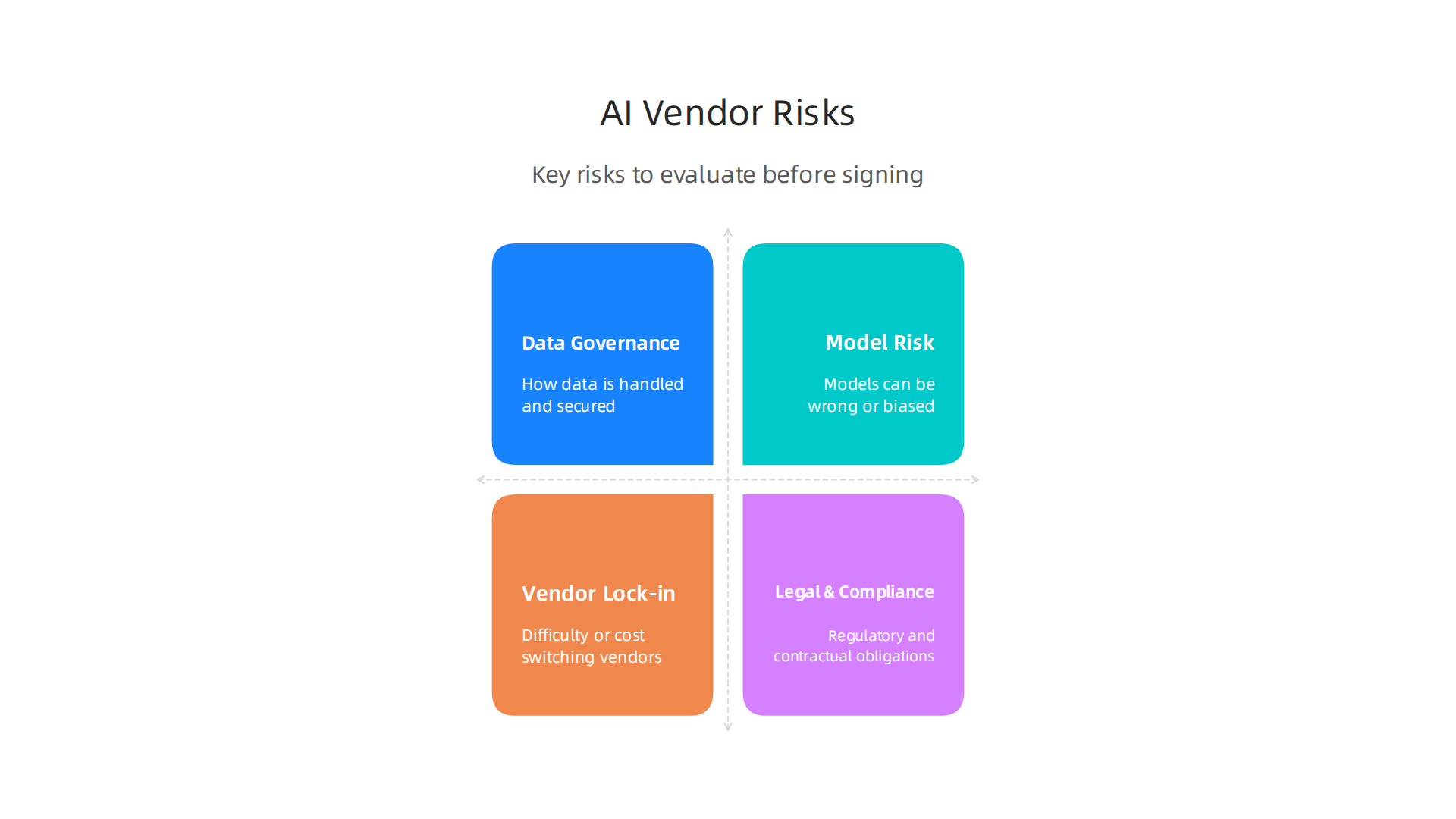
    Key risks associated with AI vendors that businesses must evaluate before committing.

    • Data Governance: This means how your data is handled. Who owns it? How is it kept safe? Will the AI vendor use your company’s data to train their models, possibly mixing it with others’ data? You need clear answers to make sure your important information stays private and secure. One expert suggests asking how training data is handled and if customer data is used for model training to avoid issues like vendor lock-in and to ensure trust with enterprise AI solutions in 2026.
    • Model Risk: AI models can sometimes be wrong, unfair, or biased. This is called model risk. If the AI makes bad decisions, it can hurt your business. For example, a b2b marketing tool that targets the wrong customers could waste a lot of money. You need to know how accurate the AI is and what steps the vendor takes to make sure it works fairly.
    • Vendor Lock-in: Imagine if it becomes very hard or costly to switch to a different AI tool later. That’s vendor lock-in. It happens when you depend too much on one vendor’s special way of doing things. You want to keep your options open, especially as AI technology keeps changing quickly in 2026.
    • Legal and Compliance Exposure: There are growing rules and laws about how AI can be used, especially with customer data. If your AI vendor doesn’t follow these rules, it could put your business in legal trouble. Understanding these legal risks is part of being ready for AI. To learn more about managing these hidden dangers, check out our guide on Stealth AI A Business Guide to Hidden AI Risks Opportunities and Management in 2026.

    Your AI Vendor Due Diligence Checklist

    To avoid these risks, you need to do your homework. This is called "due diligence." It means carefully checking out each potential AI vendor. Many top software companies offer great tools, but you need to make sure they’re the right fit for your business, not just today, but for the future.

    Here’s what to look for:

    • Security Certifications: Does the vendor have proof that their systems are secure? Look for known security badges or reports from independent auditors. This shows they take security seriously. A good AI Vendor Selection Framework suggests data governance and security are very important, weighing in at 25% of the evaluation.
    • Audit Practices: Ask how often they check their AI systems for problems or unfairness. Do they have a plan for fixing issues quickly? Good audit practices show they are responsible.
    • Contract Clauses to Negotiate: The contract isn’t just a formality. It’s your chance to protect your business. Make sure you understand clauses about data ownership, how the AI makes decisions, and what happens if something goes wrong. Don’t be afraid to ask for changes that make you feel safer. When choosing an AI vendor, a detailed AI Vendor Selection Criteria guide highlights that the technical depth and track record are critical, along with IP and data terms. For more guidance on choosing the right partners, read our article on how to Evaluate AI Companies to Unlock Business Growth in 2026.

    By taking these steps, you can build trust with your AI partners and ensure that their solutions truly benefit your operations, whether you’re a small business or a large enterprise like Zensar Technologies. Remember, careful selection is key to successful AI adoption.

    Moving from careful selection to a forward-looking plan is the next step for any business wanting to truly make AI work.

    A diverse team collaboratively outlining a long-term strategic roadmap for AI adoption.

    It means thinking ahead, not just for today or tomorrow, but for the next one to three years. This long-term view helps you pick partners who can grow with you and tools that stay useful as AI changes quickly.

    Strategic roadmap: selecting vendors and planning for 12–36 months

    To truly get the most out of AI, you need a smart plan that stretches out over time. This plan should help you pick the best AI vendors and prepare for how fast AI technology changes. It’s like setting a course for a long journey.

    A Repeatable Vendor Selection Framework

    Picking the right AI tools isn’t a one-time thing. You need a clear process you can use again and again. This is called a repeatable vendor selection framework. It helps you find the top software companies that fit your business goals.

    Here’s how to build one:

    • Set Clear Goals: Before looking at any tool, know what you want to achieve. Do you want to save money, make your customers happier, or help your marketing teams with b2b marketing efforts? For example, some businesses like Zensar Technologies might aim for better operational efficiency or new ways to grow income. Knowing your goals helps you measure success later.
    • Create an Evaluation Rubric: This is a checklist or scorecard to judge each vendor fairly. You’ll score them on things like their technical skills, how well their tools work, and their history of success. One guide suggests weighing technical depth and their track record heavily, giving them 30% and 20% of the score, respectively, when choosing an AI vendor in 2026. This also includes looking at how innovative they are and if they offer solutions that fit your whole business needs, not just one small part.
    • Pilot Program: Before fully committing, test the AI tool with a small group or project. This "pilot" lets you see how it works in real life without big risks. You can find out if the tool truly helps, if your team understands it, and if it meets your initial goals.
    • Define Scale Criteria: After a successful pilot, how do you decide if the AI is ready for your whole company? You need clear rules. This might include hitting certain performance numbers, showing good returns on investment (ROI), or being easy enough for many employees to use.

    Scenario Planning: Creating a Flexible Roadmap

    The world of AI is always moving forward. New tools and models come out all the time. This means your plan needs to be flexible. You can’t just pick one vendor and expect them to be the best choice forever.

    • Prepare for Change: Imagine different futures. What if your main AI vendor gets bought out? What if a new, much better AI model comes along? By thinking about these "scenarios," you can build a roadmap that can bend without breaking.
    • Don’t Get Locked In: It’s important not to rely too much on one vendor’s unique way of doing things. This is called vendor lock-in, and it can make it hard to switch later. Businesses in 2026 must be careful not to let how a vendor is growing decide their main AI plan. Experts suggest that a key decision for technology leaders is how to manage their entire software setup to avoid being stuck with one vendor.
    • Stay Updated on the AI Stack: The "AI stack" refers to all the different parts that make up an AI system, from the basic models to the tools you use every day. Make sure any vendor you choose fits well with your existing systems and how your company works. This helps prevent problems down the road. For many marketing firms, understanding how different AI tools integrate is crucial for seamless operations.

    By having a flexible roadmap and a clear way to pick vendors, you can make sure your business stays ahead in the fast-paced AI world. It’s about being ready for what comes next.

    If you want to stay updated on the latest AI trends and how they impact businesses like yours, consider subscribing to our daily insights.
    The AI Newsletter Worth Reading

    Summary

    This article helps business leaders cut through the noise of 2026’s fast-moving AI market by giving a practical framework for choosing and working with top software companies. It explains who counts as a leading enterprise AI vendor—platform providers, application vendors adding AI, and specialist firms—and shows what to evaluate in their products, from core capabilities to APIs and roadmaps. The piece covers real deployment challenges like data pipelines, identity, latency, monitoring, and operational readiness (SRE and observability), plus the compliance and governance steps needed to reduce legal and model risks. It also breaks down typical pricing approaches, how to measure ROI and time-to-value, and what to include in vendor due diligence. Finally, it offers a repeatable vendor selection process, scenario planning to avoid lock-in, and a 12–36 month roadmap to pilot, scale, and keep AI investments aligned with business goals.


  • Mastering AI For Marketing Services In 2026

    Mastering AI For Marketing Services In 2026

    In 2026, artificial intelligence (AI) is changing everything, especially in the world of marketing. What started as a new trend is now a must-have tool for any business offering marketing services. It’s no longer enough to just be curious about AI. Now, marketing teams need a clear plan to use AI wisely.

    Businesses need to move from just looking at AI to having a real strategy for it.

    A marketing team collaborates to outline a clear AI strategy, moving beyond simple curiosity to defined goals.

    Without a good plan, companies might miss out on big chances to grow or make things better. Experts agree that business leaders need smart ways to find new opportunities, pick the best ideas for using AI, test them out carefully, see what works, and then use those good ideas on a larger scale. This helps turn early tries with AI into real wins for the business From AI pilots to performance: 3 things leaders need to unlock.

    This guide is here to help you get a handle on AI for your marketing services. We will give you easy-to-understand ways to think about AI. You’ll learn about how to pick the right AI tools and how to measure if they are truly helping your business. We will show you real examples of how AI can help with many tasks. This includes making better content, putting together impressive AI for presentations, and even having an intelligent AI virtual assistants for businesses to support your team.

    You’ll find practical ways to test new AI tools, checklists to help you choose the best options, and tips on how to see if your AI efforts are really paying off. Our goal is to make sure you can use AI to make your marketing smarter, faster, and more effective.

    To stay on top of the latest AI trends and how they impact business, consider subscribing:
    The AI Newsletter Worth Reading

    Before you pick any AI tools for your team, it’s super important to have a clear plan. Think of it like going on a trip. You wouldn’t just grab a map and start driving without knowing where you want to go, right? The same goes for using AI in your marketing services. In 2026, simply getting AI tools isn’t enough. You need a smart way to use them to reach your business goals.

    Your AI plan should directly match what your marketing services are trying to do. For example, if you want to get more new customers (called lead generation), AI could help find people who are most likely to buy from you. If your goal is to keep current customers happy and loyal (retention), AI might help you send them special messages they will love. Or, if you need to make lots of new ads or content quickly, AI can help scale your creative output. Having a clear vision like this is a key step to building a good AI strategy for marketing, as experts say you need to define the main results you want to achieve How do I build an AI strategy for marketing?.

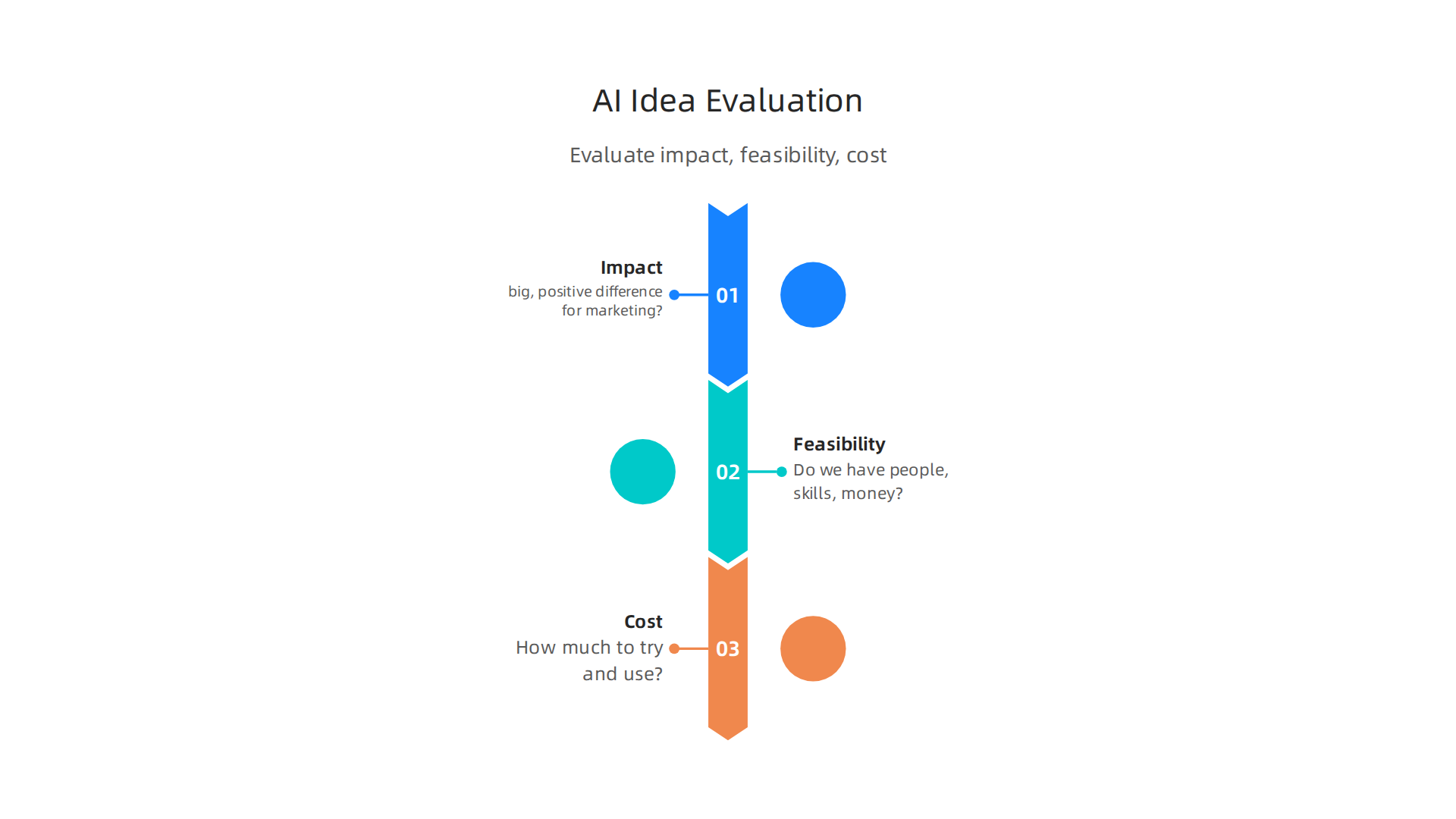
    To figure out which AI ideas to try first, you can use a simple plan. Ask yourself three things about each AI idea:

    Evaluate potential AI initiatives by considering their impact, feasibility, and cost.

    • Impact: Will this AI idea truly make a big, positive difference for our marketing services?
    • Feasibility: Can we actually do this right now? Do we have the people, skills, and money needed to make it happen?
    • Cost: How much will it cost to try out and use this AI tool?
      By thinking about these three points, you can choose the best projects that will bring the most value without costing too much or being too hard to set up. To learn more about selecting the right technology, consider reading our guide on how to pick AI tools for business to drive growth in 2026.

    A big mistake many teams make is picking AI tools before they know what they want to achieve. This is like buying a fancy hammer without knowing if you need to build a house or fix a leaky faucet. When you choose tools first, you might end up with expensive software that doesn’t really help your marketing services goals. This can lead to wasted money and time. Reports from 2026 show that while many businesses are using AI, a lot of them aren’t truly seeing big improvements in their work because they lack a clear plan State of Marketing in an AI-Driven World: 2026 Adobe Report. In fact, one report found that only 41% of marketers can clearly show how AI is helping them make more money Report: The State of AI in Marketing 2026. By setting your strategy first, you make sure that every AI tool you choose works towards your real business needs.
    Now that you have a clear plan for what you want your marketing services to achieve, the next step is to look closely at your current ways of doing things. This helps you find the best spots where AI can make a real difference. Think of it as looking under the hood of your marketing car to see which parts could run better with a little AI tune-up.

    To do this, you need to audit your marketing processes. This means checking out everything your team does, from making ads to talking with customers. Where are the tasks that take a lot of time? Where do you wish you had more help or better insights? These are often the places where AI can fit in perfectly.

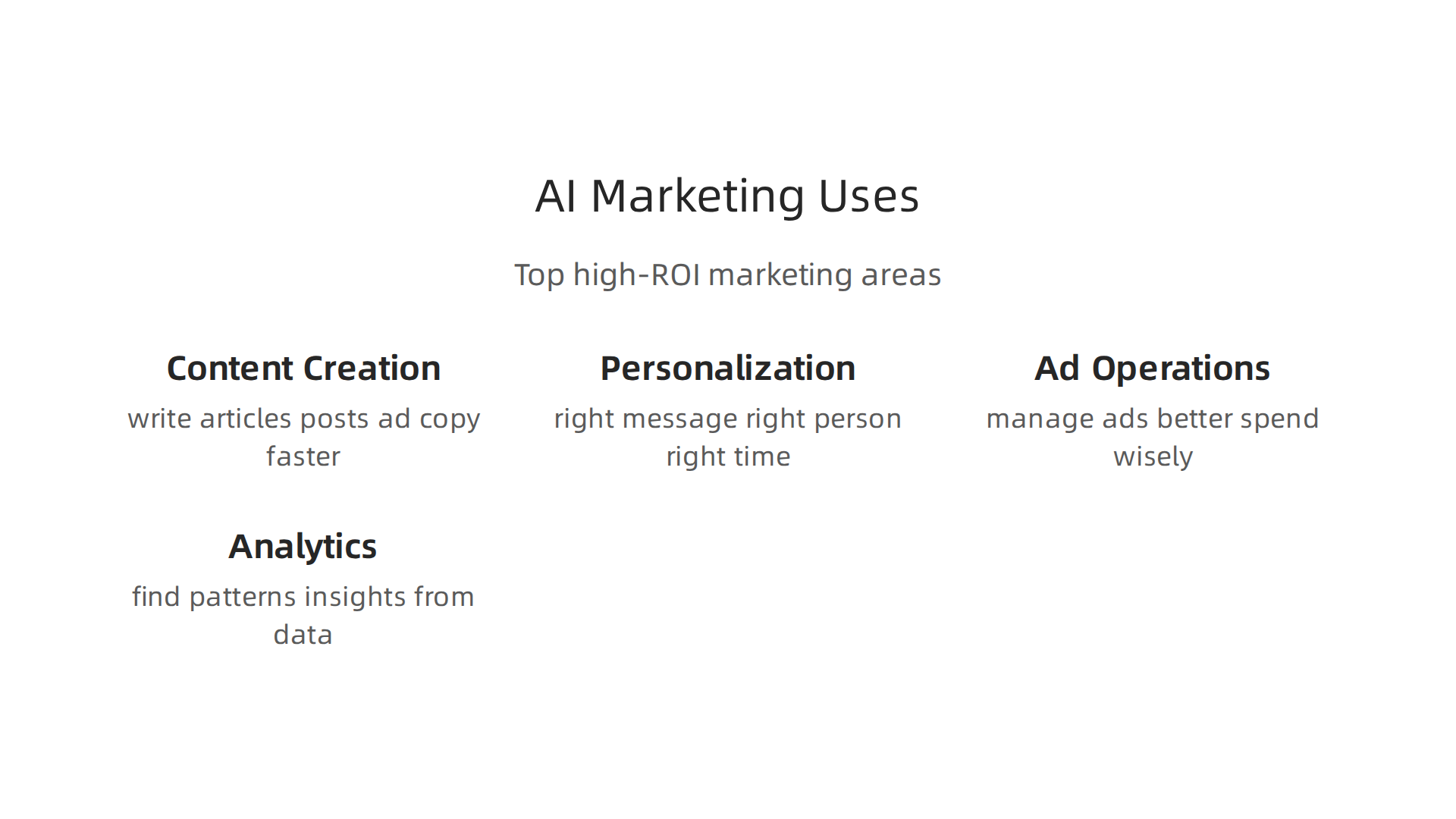
    Many marketing teams in 2026 are finding big wins with AI in a few key areas:

    Explore the top areas where AI is delivering significant value for marketing teams.

    • Content Creation: This is still the top use case for AI. AI can help write articles, social media posts, or ad copy much faster. This means your team can create more content without getting swamped. Reports show that content creation is used by 78% of teams, making it the most common way to use AI in marketing State of AI Marketing 2026 | Enterprise AI Adoption Report.
    • Personalization: AI can help you send the right message to the right person at the right time. This makes customers feel special and more likely to buy.
    • Ad Operations (Ad Ops): AI can manage your ads better by figuring out who to show them to and when, which helps you spend your ad money wisely.
    • Analytics: AI can look at huge amounts of data and find patterns or insights that humans might miss. This helps you understand what’s working and what’s not in your marketing campaigns. It’s like having a super-smart marketing assistant.

    When you’re looking at different ideas for using AI, you should score each one based on three things:

    • Potential Impact (ROI): How much positive change or money will this AI idea bring in? Will it truly help your marketing services grow or save costs? Teams focused on ROI see much better results from their AI efforts, with 83% of marketing teams reporting clear gains from generative AI AI Marketing Stats for 2026: ROI & Benchmarks.
    • Data Readiness: Do you have the right kind of data that the AI tool needs to work well? If not, how hard will it be to get that data ready?
    • Integration Complexity: How easy or hard will it be to connect this new AI tool with the other tools and systems you already use?

    Sometimes it’s better to start with a "narrow pilot." This means trying out an AI tool for a small, specific task with a small team. For example, you might use AI to just help with writing headlines for your emails. If that works well, then you can think about a "platform-wide rollout," which means using AI across many different tasks and teams in your marketing services. Starting small helps you learn and fix problems before doing something big.

    To learn more about how marketing pros choose AI tools for their work, check out our guide on how marketing specialists choose AI tools for marketing and drive ROI.

    For daily updates on how AI is changing marketing and business, you’ll want to stay informed.
    Get clear daily AI updates from The AI Newsletter Worth Reading.

    Choosing the right AI tools for your marketing services is a big step after you know where AI can help most.

    A professional carefully evaluates different AI tools and vendors to make an informed decision.

    It’s like picking the best helper for your team. You want to make sure the tool can actually do the job well. To do this, you need a good checklist.

    What to Look For in AI Tools

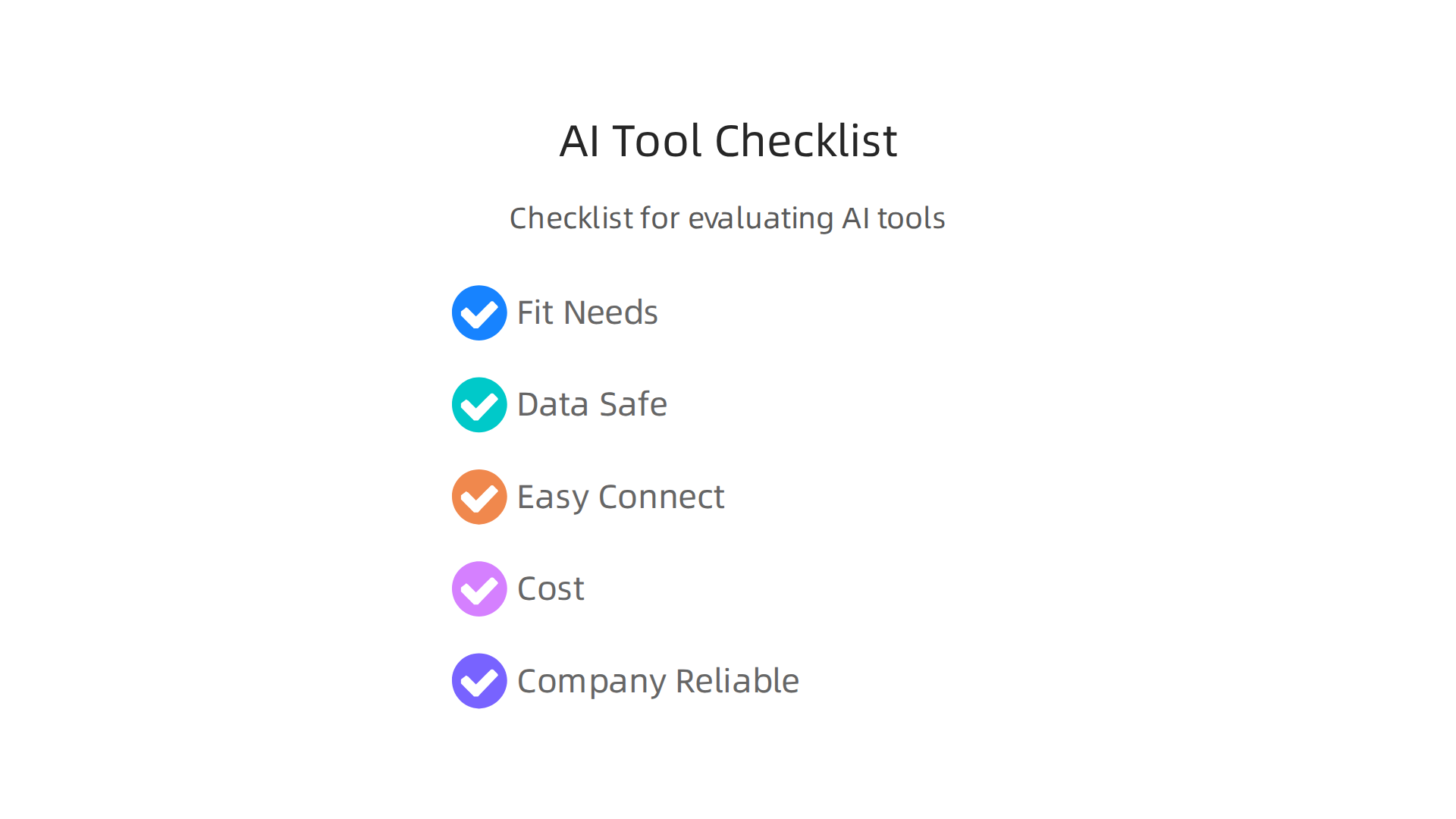
    When you’re looking at different AI tools, keep these things in mind:

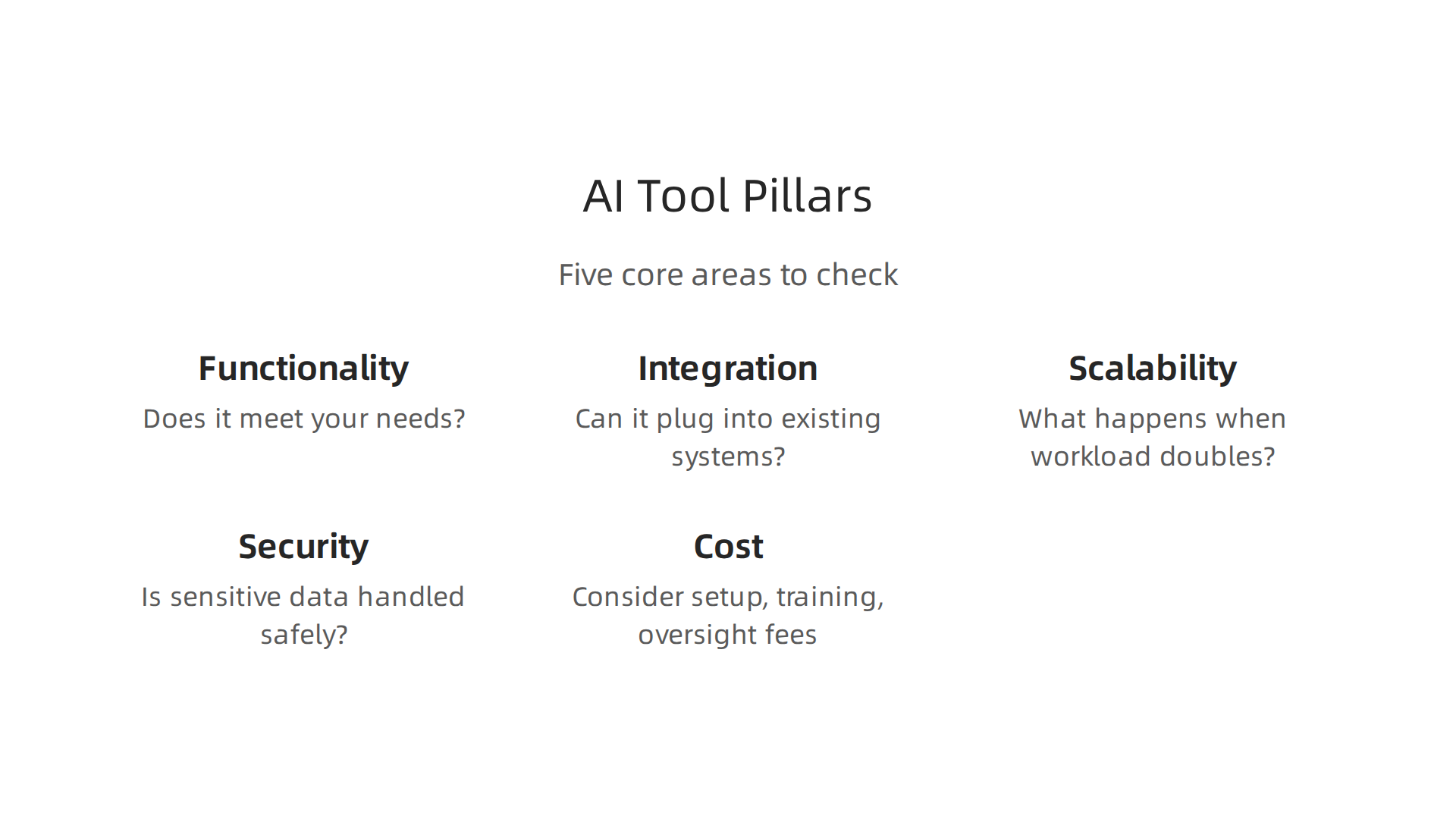
    Checklist for evaluating AI tools, focusing on needs fit, data safety, integration, cost, and company reliability.

    • Does it fit your needs? The AI tool must be able to do the specific tasks you need. If you want AI to help write social media posts, the tool should be good at that. Don’t pick a tool that does many things poorly when you need one thing done perfectly. You want a tool that truly boosts your marketing services.
    • Is your data safe? AI tools often need to use your company’s data. You must be sure that the tool and the company that made it will keep your information private and secure. This is very important for trust and legal reasons.
    • How easy is it to connect? Think about your current marketing tools. Will the new AI tool easily work with them? Or will it be a headache to link everything up? An AI tool that connects smoothly with your existing setup makes life much easier.
    • What does it cost? Understand how the AI tool charges you. Is it a monthly fee, or do you pay based on how much you use it? Make sure the cost makes sense for your budget and the value you expect to get. Tools that offer clear pricing help you manage your money better.
    • Is the company reliable? Look at the company behind the AI tool. Have they been around for a while? Do they update their tools often? A strong, reliable company means you’ll get good support and that the tool will keep getting better. A template for evaluating technology vendors can help you score different options to ensure they meet your business needs and values R E S P O N S I B L E A I T E M P L A T E.

    Testing AI Tools in Real Life

    Once you have a few tools in mind, it’s a good idea to test them. This is called a "Proof of Concept" (POC) or a "pilot."

    • Try them side-by-side: Don’t just pick one tool. Try out two or three tools at the same time for the same small task. For example, have Tool A and Tool B both write headlines for your next email campaign. See which one does better. This helps you compare them fairly.
    • Focus on how they work, not just features: It’s not just about what a tool can do, but how well it actually works for your team every day. Does it save time? Is it easy to use? Does it fit into your team’s workflow without causing problems? This helps you find the best fit for your marketing services. A good way to compare is by using a scorecard for different criteria, making sure you look at things like how deep the AI’s capabilities are and how well it fits your specific marketing needs How to Evaluate B2B AI Marketing Vendors: 12 Questions … – Tofu HQ.

    By carefully checking these things, you can choose AI tools that truly help your marketing efforts grow. If you want a more general guide on how to make smart choices for your business, you can read more about how to pick AI tools for business to drive growth in 2026. This careful process makes sure you’re getting a real marketing assistant, not just a fancy gadget.

    After testing AI tools with a small "Proof of Concept," the next big step is to make them a regular part of your marketing services. This means moving from a small test to full "production." It’s like moving from trying out a recipe to cooking it for all your customers every day. You need a clear plan to do this right.

    Getting AI Tools Ready for Daily Marketing

    Putting AI into your daily work for your marketing services needs careful steps.

    • Set up the Data Flow: Your AI tools need good data to work. Think about how your company’s information will safely get to the AI tool. This involves setting up "data pipelines," which are like highways for your data. You also need to make sure the data is clean and correct. If the data is bad, the AI’s results will be bad too. For marketing leaders, a good approach to data governance is key when using AI systems Snowflake’s Agentic Enterprise Framework Puts Data ….
    • Keep Testing and Improving: Even after a pilot program, you should keep testing the AI. As your marketing needs change, the AI tools might need to learn new things or be adjusted. This helps ensure the AI continues to perform its best for your team.
    • Rollout Slowly: Don’t just give the AI tool to everyone at once. Start with a small group, get their feedback, and then slowly bring more people on board. This "rollout cadence" helps everyone get used to the new tools without too much stress. It also lets you fix small problems before they become big ones.

    Teamwork and Rules for AI Success

    Making AI a permanent part of your marketing services means more than just turning on a new tool. It needs good teamwork and clear rules.

    • Assign Clear Roles: While marketing teams often lead the charge in adopting AI, they need help from others. Your IT team can help with security, your legal team can make sure you follow privacy rules, and data experts can check for fairness. Having everyone work together helps make sure the AI is used responsibly. In fact, setting up strong governance that includes different departments is important for using AI in a way that truly helps the business What governance structures support responsible AI?.
    • Create AI Rules (Governance): Just like you have rules for how your team works, you need rules for how your AI works. This is called "AI governance." It helps make sure the AI tools are used fairly, correctly, and ethically. For example, the European Data Protection Board updated its rules in 2026 to make sure AI agents follow data privacy principles at every step AI Agents and Data Privacy: A 2026 Compliance Guide – MTM Blog.
    • Watch for Bias and Protect Privacy: AI tools learn from data, and sometimes that data can have unfair patterns, or "bias." You need to look for this bias and work to fix it, perhaps by using fair data generation techniques Mitigating bias in artificial intelligence: Fair data generation via …. Also, always make sure the AI tool handles customer data with the highest privacy standards, especially in 2026, when data privacy rules are stricter than ever. Staying up-to-date on compliance is a must.

    By taking these steps, you make sure your AI tools don’t just work in a test, but truly become a strong marketing assistant for your business. This careful planning helps your marketing services grow and adapt for the future.

    If you want to keep learning about how AI impacts your business and marketing, you’ll find helpful insights in "The AI Newsletter Worth Reading." Get clear daily AI updates from The Deep View Newsletter.

    5) Measure What Matters: KPIs, Attribution, and ROI for AI-Driven Marketing

    Once AI tools are part of your daily marketing services, it’s super important to know if they are actually helping.

    A professional focuses intently on data and reports, measuring the impact of marketing initiatives.

    You need to measure their success. This means looking at certain numbers, understanding how AI causes good changes, and checking if you are getting a good return on your money.

    Picking the Right Numbers to Watch

    Before you even start using AI for your marketing, you need to know what you want to improve. These are called Key Performance Indicators, or KPIs. They are like scores that show how well your marketing is doing. For AI-driven marketing, you might look at things like:

    • How many new customers you get.
    • How many people click on your ads.
    • How much money each customer spends over time (this is called customer lifetime value, or LTV).
    • How much it costs to get a new customer (this is called customer acquisition cost, or CAC).

    It’s a good idea to know what these numbers were before you used AI. This way, you can see if the AI is making them better. Experts say you should set clear goals and measure your starting point before adding AI to your marketing efforts How do I measure the ROI of AI marketing investments?. This helps you tell a real story about how AI helps your marketing services.

    Knowing What Changes Are Due to AI

    When you use AI, many things might change. How do you know for sure that AI is the reason for a boost in sales or leads? This is where "attribution" and "experimentation" come in.

    • Attribution means figuring out which part of your marketing efforts gets credit for a result. With AI, you want to give the AI the right amount of credit.
    • Experimentation is like running a science test. You can split your audience into two groups: one that gets the AI-powered marketing (the "test" group) and one that doesn’t (the "control" group). By comparing these groups, you can see the true extra help, or "incremental lift," that AI brings. Methods like A/B tests help you find the real impact of your AI tools 2026 Marketing Playbook: Proven AI & Attribution Strategies. Companies that use smart attribution methods can see much better returns on their marketing money Marketing Attribution Statistics (2026): 54+ Data Points on ….

    To really dive deep into how AI can boost your sales and leads, learning about these measurement methods is key. You can find more helpful advice on how marketing specialists choose AI tools to drive ROI.

    Figuring Out Your Return on Investment (ROI)

    ROI means how much money you get back for the money you spent. For AI in marketing, it’s about seeing if the AI tools are worth their cost. A simple way to think about it is:

    ROI = (Extra Money Made + Money Saved − Total Cost of AI) ÷ Total Cost of AI

    Measuring AI’s ROI in marketing is not just a single number; it’s a process of setting a baseline, running tests, and then seeing the extra lift AI provides How Directors Measure AI ROI in Ad Campaigns | Pixis. Many companies are already seeing great results. In fact, about 60% of companies that have changed how they measure AI are getting two to three times their money back, or even more Report: The State of AI in Marketing 2026 – Jasper. This shows that with careful planning and measurement, AI can be a powerful marketing assistant.

    When you measure what matters, you make sure your AI investments are truly helping your marketing services grow and succeed. For further reading on this topic, consider learning more about how to get real ROI from AI marketing cloud.

    6) Data Governance, Privacy, and Ethical Considerations for Marketing Services

    After seeing how artificial intelligence (AI) can help your marketing services grow and succeed, it’s just as important to talk about how to use it wisely and fairly.

    Key ethical considerations for AI in marketing: data safety, fairness, and transparency.

    This means looking closely at how you handle data, respect people’s privacy, and make sure your AI systems are ethical. It’s not just about making money; it’s about building trust and following the rules in 2026.

    Keeping Data Safe and Private with AI

    When you use AI for marketing services, you’re often dealing with lots of customer information. "Data governance" is like having a clear set of rules for how you collect, store, and use this data. It makes sure your data is correct, kept safe, and used in a way that follows the law. Experts agree that your AI plan and your data rules must go hand-in-hand Snowflake’s Agentic Enterprise Framework Puts Data Governance at the Center of Marketing.

    In 2026, privacy is a big deal. New guidelines, like those from the European Data Protection Board, tell us that when AI agents process personal information, we must only collect the data we truly need and only use it for the reasons we said we would AI Agents and Data Privacy: A 2026 Compliance Guide. This is called "data minimization" and "purpose limitation." To help with this, you should do special checks, sometimes called "privacy impact assessments," before using AI systems that handle personal data. These assessments help ensure you’re using AI responsibly and protecting people’s privacy Privacy as the Foundation of Responsible AI Governance. It’s a key part of the larger topic of mastering the AI future standard 2026.

    Making AI Fair and Unbiased

    AI learns from the data it’s given. If that data has unfair patterns or gaps, the AI can learn those same biases and make unfair decisions. For instance, an AI for marketing services might unfairly target certain groups or miss others, just because of old data.

    To make sure your AI is fair, you need to:

    • Find Bias: Look closely at the data you feed your AI and the results it gives. You want to spot any unfair patterns. Learning to understand how an AI model works is important for finding these biases Systematic literature review on bias mitigation in generative AI.
    • Fix Bias: Take steps to reduce any bias you find. This can mean changing the data, adjusting the AI’s learning process, or fixing the results it gives. These steps can happen before, during, or after the AI does its work Bias mitigation in generative AI.

    It’s about making sure your AI acts like a fair and helpful marketing assistant, not one that carries old prejudices.

    Being Clear and Keeping Records

    For ethical AI, it’s also important to be clear about how your AI makes decisions. This is called "transparency." It means you should be able to explain, in simple terms, why your AI chose one thing over another.

    You also need good records. Keeping detailed notes about your AI systems helps you show how they work, what data they use, and why they make certain choices. This is very helpful if you ever need to have an audit or review. Having different teams involved, like marketing, legal, and IT, can help ensure everyone is on the same page and that your AI systems are both effective and responsible. This kind of teamwork is vital for a good strategic guide to marketing AI agents and their ethical deployment.

    Staying informed about the newest AI practices, including ethical guidelines, is important for any business leader.

    Get clear daily AI updates and stay ahead of the curve. The AI Newsletter Worth Reading will keep you in the know.

    Summary

    This article explains how marketing teams should move from experimenting with AI to running a clear, business-focused AI strategy that drives measurable results. It covers how to set goals that align AI initiatives with marketing KPIs, how to audit current processes to find high-impact use cases (content, personalization, ad ops, analytics), and a simple prioritization framework based on impact, feasibility, and cost. You’ll learn how to run narrow pilots, evaluate and compare tools with a vendor checklist, and prepare data pipelines and rollout plans for production. The guide also details governance needs—privacy, bias mitigation, and cross-functional roles—and shows how to measure AI success through attribution, experimentation, and ROI calculations. After reading, you’ll be able to pick the right pilot projects, test tools sensibly, and scale AI in marketing while protecting data and proving value.

  • Strategic Guide to Marketing AI Agents: Deployment, ROI, and Growth in 2026

    Strategic Guide to Marketing AI Agents: Deployment, ROI, and Growth in 2026

    Artificial intelligence (AI) has changed a lot in marketing over the past few years. We’ve seen many smart tools pop up, but something new and exciting is happening in 2026: the rise of marketing AI agents.

    Leaders envision a future transformed by advanced AI agents in marketing.

    These are not just simple tools that do one task, like writing an email or creating a picture. Think of them as smart helpers that can handle many steps of a marketing job all by themselves.

    What are Marketing AI Agents?

    A marketing AI agent is like a digital team member that can understand goals, make a plan, and then take action to reach those goals, even over many steps. It has a "brain" powered by advanced language models, a "memory" to learn from past actions, and the ability to use other "tools" or software to complete tasks. For example, an autonomous marketing agent might create a full social media campaign, from writing posts to scheduling them and even adjusting content based on how people react online [PDF] (https://www.alvarezandmarsal.com/sites/default/files/2026-03/The%20Agent-First%20Marketing%20Function_0.pdf).

    This is different from older, single-purpose AI tools. A basic AI tool might help you write a blog post, but it won’t plan your whole content calendar or figure out which posts work best. Marketing AI agents, on the other hand, can do all that and more. They can even work together as "multi-agent" systems to tackle big, complex marketing plans, as explained in recent research about AI Agent Systems: Architectures, Applications, and Evaluation. In 2026, experts are creating ways to sort these agents into groups to better understand their different uses and parts, helping us see how they fit into a bigger picture AI Agent Architecture Decoded: The 9-Dimension Taxonomy Every ….

    Big Benefits of Using Marketing AI Agents

    These smart agents bring huge advantages to businesses:

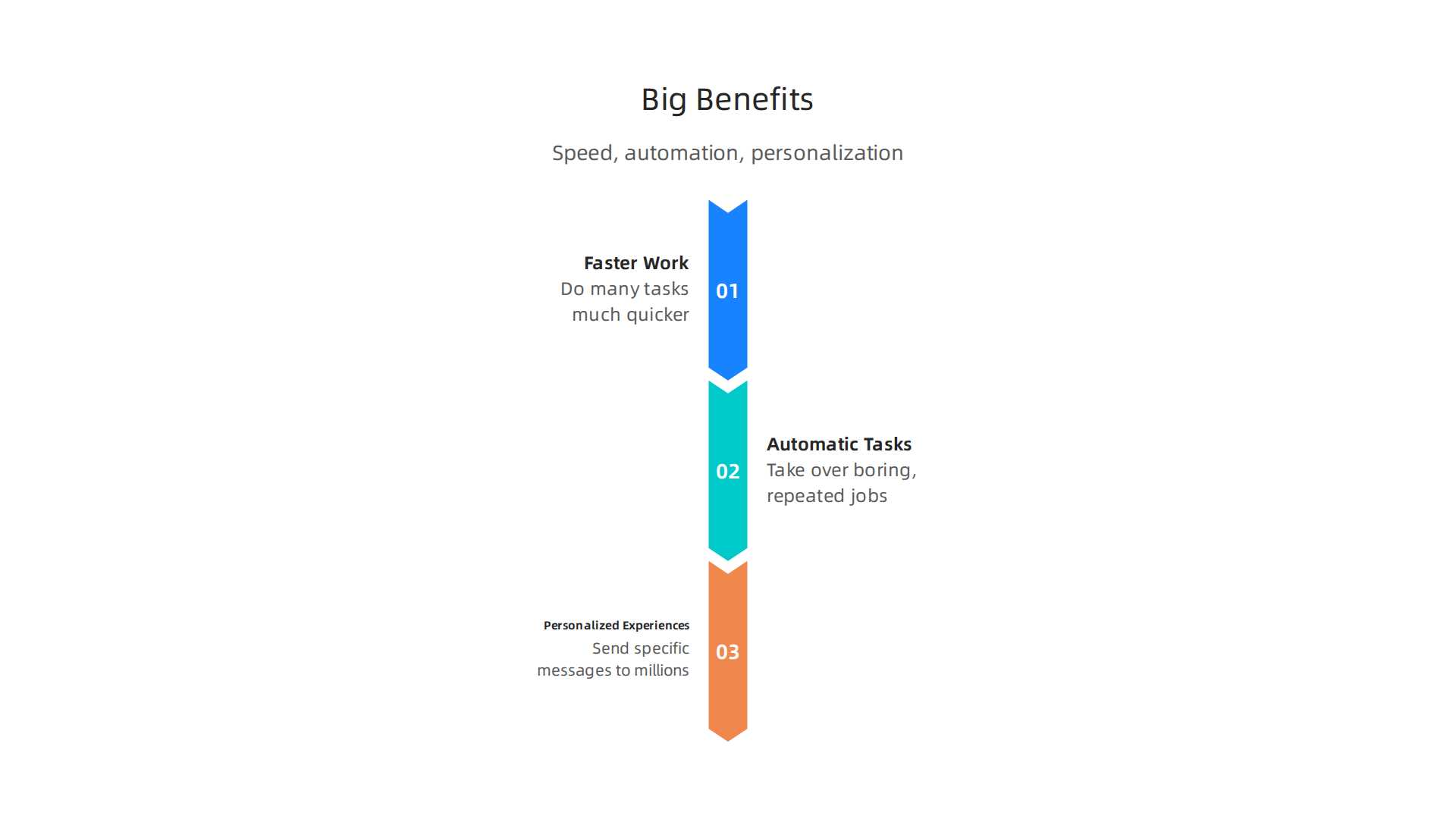
    Marketing AI agents offer significant benefits like increased speed, automation, and personalization.

    • Faster Work: They can do many tasks much quicker than people can, speeding up your marketing efforts.
    • Automatic Tasks: They take over many boring, repeated jobs. This means your team can spend more time on new ideas and creative work, instead of getting stuck in daily routines. This can be a game-changer for businesses looking for an effective online marketing platform for small businesses.
    • Personalized Experiences for Everyone: AI agents can help you send very specific messages and offers to thousands or even millions of customers, making each person feel like you know exactly what they need. This helps create a truly personal connection with your audience.

    What You’ll Learn in This Guide

    Learning how to use marketing AI agents can seem like a big job. That’s why this guide is here to help. We will walk you through everything you need to know, step-by-step. You will learn:

    • How to choose the best AI agents for your specific business needs.
    • How to set them up and get them working smoothly.
    • How to make sure they follow rules and stay safe (this is called governance).
    • How to check if they are actually helping your business grow and meet its goals.
    Whether you’re looking for a simple marketing plan example or want to dive deep into using AI, this guide will give you practical steps to succeed.

    Stay ahead with smart insights. Get clear daily AI updates from The Deep View Newsletter.

    Now that you know what marketing AI agents are in a general sense, let’s look closer at their different types, what they are made of, and how they work in real marketing jobs. These smart helpers come in various forms, each designed for specific levels of work.

    Types of Marketing AI Agents

    Not all marketing AI agents are exactly the same. They can be grouped by how complex their tasks are and how much they work on their own.

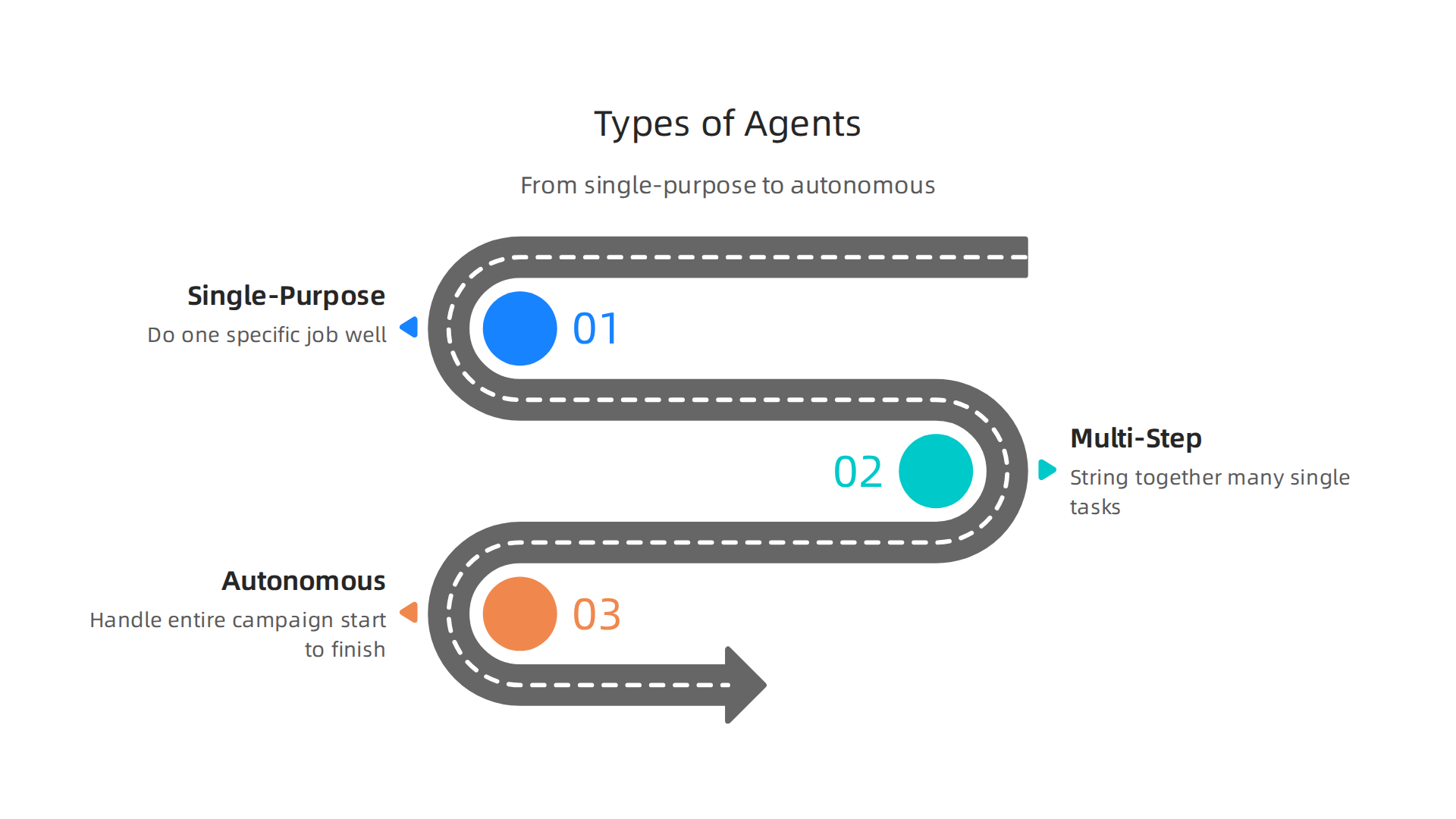
    Marketing AI agents range from single-purpose tools to fully autonomous campaign managers.

    • Single-Purpose Task Agents: These are the simplest kind. They do one specific job well, like writing an email, generating a social media post, or finding keywords. They are good for quick, focused tasks. While helpful, they don’t plan out big campaigns.
    • Multi-Step Orchestration Agents: These agents are smarter. They can string together many single tasks to complete a larger goal. For example, a multi-step agent might write a blog post, then create social media updates for it, and then schedule those posts. They follow a plan to make sure all parts of a task are done in order. Researchers have created ways to organize these kinds of AI agent systems, looking at how they plan, control, and interact with tools AI Agent Systems: Architectures, Applications, and Evaluation.
    • Autonomous Campaigning Agents: These are the most advanced marketing AI agents. They can handle an entire marketing campaign from start to finish. They set goals, make a plan, create all the content, run the campaign, and even adjust things as they go. Humans usually check in at certain points for approval, but the agent does most of the heavy lifting. This approach can be a game-changer for businesses that need a full-service online marketing platform for small businesses. A 2026 report mentioned that marketing and sales are seeing a lot of impact from these AI agents The 2026 State of AI Agents Report.

    What Makes an AI Agent Work?

    Think of a marketing AI agent as having several key parts that let it do its job:

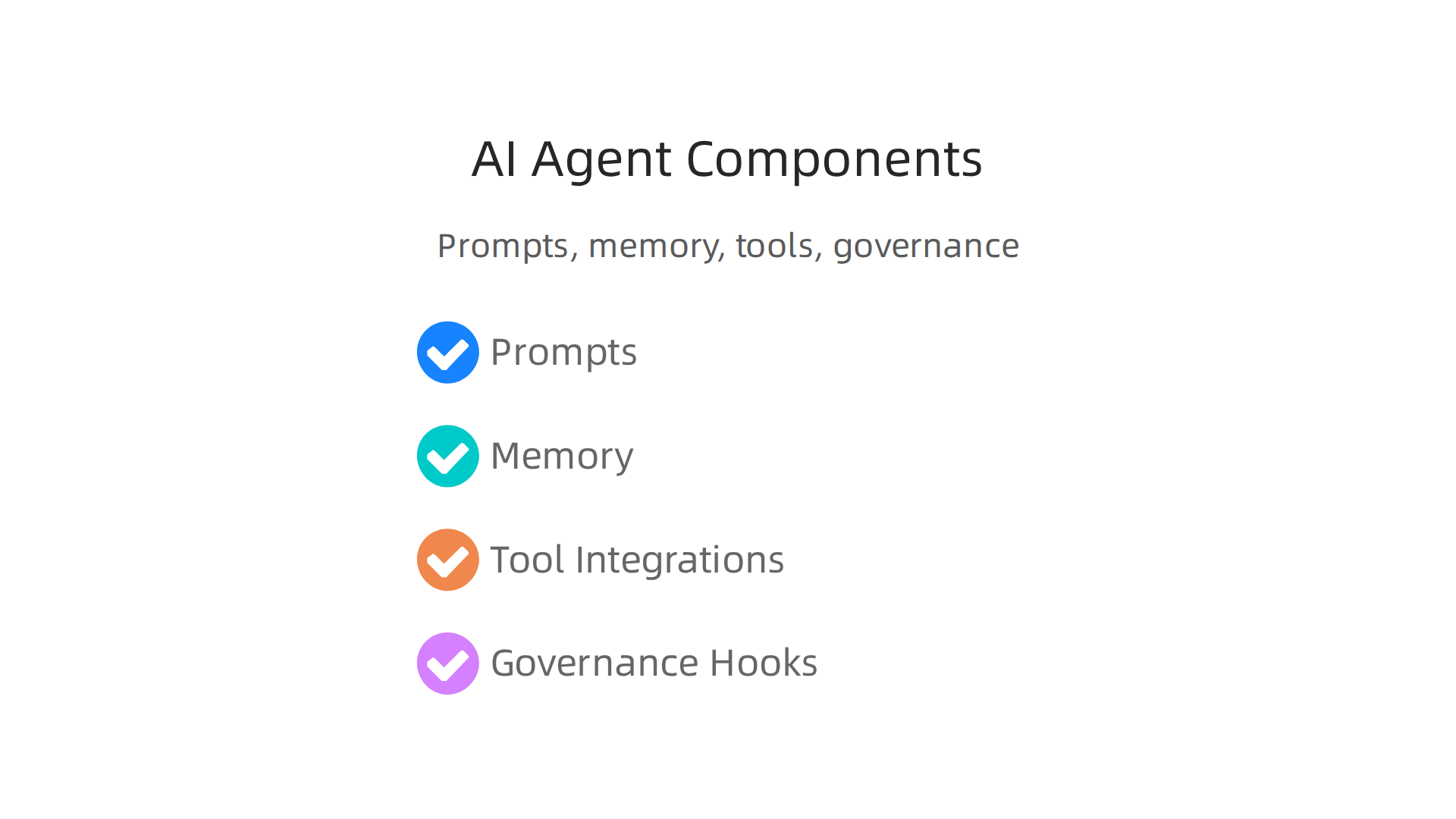
    An AI agent's effectiveness relies on its prompts, memory, tool integrations, and governance.

    • Prompts: These are the instructions you give the agent. They tell it what to do, what goals to aim for, and what style to use. Good prompts are like giving clear directions to a smart assistant.
    • Memory: Agents remember past actions, feedback, and what worked or didn’t work. This memory helps them learn and get better over time, making their future tasks more effective.
    • Tool Integrations: This is how AI agents connect to other software and services. For example, an agent might connect to a CRM (Customer Relationship Management) system like Zoho Marketing Automation to get customer info, or use analytics tools to see how well a campaign is doing. These connections help agents do real-world tasks. Choosing the right AI tools for your business is key to making these integrations work well How to Choose AI for Business Tools That Deliver Real Results in 2026.
    • Governance Hooks: These are safety checks and rules built into the agent. They make sure the agent follows company policies, legal rules, and ethical guidelines. This is very important for keeping AI agents responsible. Experts are working on how to create clear ways to evaluate agents in production Measuring Agents in Production.

    Real-World Marketing Examples

    How do these marketing AI agents actually help? Here are some examples of what they can do:

    • Lead Qualification: An agent can look at many potential customer details, figure out which ones are most likely to buy, and then send them personalized messages. This saves human sales teams a lot of time.
    • Creative Iteration: Need many different ideas for an ad campaign? An agent can quickly create many versions of ad copy, images, and video scripts, then test them to see which ones get the best reactions. This speeds up the creative process.
    • Campaign Optimization: During a marketing campaign, an autonomous agent can watch how people react to ads in real-time. If one ad isn’t working well, it can automatically change the ad, try a new audience, or even shift the budget to a better-performing ad. This ensures your marketing money is always working its hardest. This kind of optimization can significantly boost how effective your marketing efforts are How Marketing Specialists Choose AI Tools for Marketing and Drive ROI.

    Using marketing AI agents isn’t just about doing more tasks; it’s about getting real value for your business.

    A business leader reviews performance metrics to understand ROI and impact.

    These smart tools help companies save time, cut costs, and get better results from their marketing efforts. We can measure this value in a few key ways.

    Quantifying business value: ROI, time savings, and performance benchmarks

    One big way marketing AI agents help is by taking over many tasks that people used to do by hand. This reduces the amount of manual work needed across common marketing jobs. For example, agents can quickly create many versions of ad copy, write social media posts, or analyze campaign data. This frees up marketing teams to focus on bigger ideas and strategies. Some reports even show that using AI agents can reduce manual workflow tasks by as much as 85%, which greatly increases efficiency and returns on investment (ROI) across businesses in 2026 How AI Agents are Changing Marketing: The 2026 Guide – Top ….

    The value these agents bring can be grouped into different kinds of ROI:

    • Cost Reduction: By automating tasks, businesses spend less money on manpower for repetitive jobs. This also includes lowering the cost to get a new customer.
    • Speed-to-Market: AI agents can create content and launch campaigns much faster. This means businesses can react quickly to market changes and get their messages out sooner.
    • Personalization Lift: Agents can tailor messages to individual customers much better than humans can, which leads to more engagement and higher sales. Studies from 2026 show that AI for personalizing content can boost ROI by 2.7 times, while content drafting can see a 3.2 times ROI Agentic AI in Marketing: ROI Data & Guide 2026.
    • Experimentation Velocity: Marketing AI agents can test many different ideas very quickly to find out what works best. This helps improve marketing plans faster than ever.

    To truly understand how well marketing AI agents are doing, you need to track key numbers before and after you start using them. These performance benchmarks help you see the actual impact.

    Here are some important metrics to keep an eye on:

    • Effort hours: How many hours did your team spend on certain tasks before, and how many now with agents?
    • Conversion lift: Are more people buying, signing up, or taking desired actions because of the AI agents’ work?
    • Cost-per-acquisition changes: Has the cost of getting a new customer gone down?
    • Campaign ROI: What is the overall return on your investment in specific campaigns managed by agents?
    • Lead-to-customer conversion rate: How many potential customers become actual buyers thanks to the agent’s efforts?

    Setting clear goals and key performance indicators (KPIs) for your autonomous marketing AI agents is important to make sure they are on track KPIs for Autonomous AI Agents in Marketing and Governance. By tracking these numbers, businesses can see the real benefits of using marketing AI agents, from saving time to boosting sales. Learning how to get real ROI from AI marketing is a key step for success in 2026.

    Want to keep up with the latest in AI and technology?
    The AI Newsletter Worth Reading offers clear daily updates to help you stay informed.

    To truly get the most from your AI investments and see those great returns, it’s vital to pick the right tools for the job.

    A team collaborates to evaluate and select the best AI agent solutions.

    Not all marketing AI agents are built the same. When you’re looking at different options for your business, you need to know what features matter most.

    Key capabilities to prioritize when evaluating marketing AI agents

    Choosing the best marketing AI agents means looking closely at what they can do and how well they fit into your daily work. Think of it like picking the right team member; you want someone with the right skills and who can work well with everyone else.

    Here are the important things to look for:

    • Reliable Data Connections: Good marketing AI agents need to easily connect with all your data sources. This means linking to your customer lists, sales records, website analytics, and social media platforms. Without good connections, the agent can’t get the information it needs to make smart decisions.
    • Customizable Instructions (Prompt Flows): You should be able to tell your AI agent exactly what you want it to do and how. This involves setting up "prompt flows" that guide the agent’s actions, from writing an email to planning a whole campaign. The more you can customize these, the better the agent will understand and act on your specific marketing plan example.
    • Memory and Context: Just like a person, a good AI agent needs to remember past talks and actions. This "memory" helps it understand the bigger picture and keep its responses and tasks consistent over time. It helps the agent learn from what it’s done before. Many AI agents are built with core components like these to give them reasoning and language skills Agentic Universe: April 2026.
    • Ability to Take Action (APIs/Tools): An AI agent isn’t just for thinking; it’s for doing. It needs to be able to use other tools and systems through what are called APIs. This could mean posting directly to social media, updating your online marketing platform for small businesses, or sending emails through your existing marketing automation software.

    Beyond these core abilities, there are other important features that help these agents work smoothly every day:

    • Seeing What’s Happening (Observability): You should always be able to see what your marketing AI agents are doing. This means getting clear reports and updates, so you know the agent is working as it should and catching any problems early.
    • Handling Mistakes (Retry Semantics): What happens if an agent tries to do something and it fails? A good agent will have a plan to try again or tell you there’s a problem, instead of just giving up.
    • Safe Testing (Sandboxing): Before you let an agent loose on your real marketing, it’s helpful if you can test it in a safe "sandbox" environment. This way, you can make sure it works correctly without messing up your live campaigns.
    • Human Control Points (Human-in-the-Loop): Even the best AI agents need human oversight. You’ll want controls that let you step in to approve decisions or correct the agent if needed. This "human-in-the-loop" approach is often part of how production systems for AI agents are designed in 2026 State of AI Agents Q2 2026.

    Finally, consider how well the marketing AI agents can grow with your business. Can they manage many different campaigns at once? Can they adapt to different languages or regional needs if your business expands? This is called scalability and extensibility. Knowing how to choose AI for business tools that deliver real results is key to making sure your investment pays off in the long run.

    After understanding what makes good marketing AI agents, the next big step is putting them to work. This means making smart choices about how you get these tools and how you bring them into your business without causing big problems.

    Choosing and deploying an agent: checklist and phased rollout plan

    First, you need to decide if you want to buy a ready-made marketing AI agent or build one yourself. This is a big choice, like deciding to buy a car or build one from scratch.

    • Buying an Agent (Vendor Solution): This usually means you get to use the tool faster. It’s often easier because someone else has done all the hard work of building it. You just need to make sure it fits your needs and that you’re comfortable with how it handles your business data. This is good if you need quick results and don’t have a big team of tech experts.
    • Building Your Own Agent: This gives you full control. You can make the AI agent do exactly what you want, right down to the smallest detail. But, it takes a lot more time, effort, and people with special tech skills. You also need to think about who owns the data and how much work your team can actually take on. Businesses often weigh these points when looking at whether to build or buy new AI tools Navigating the build, buy, or borrow decision.

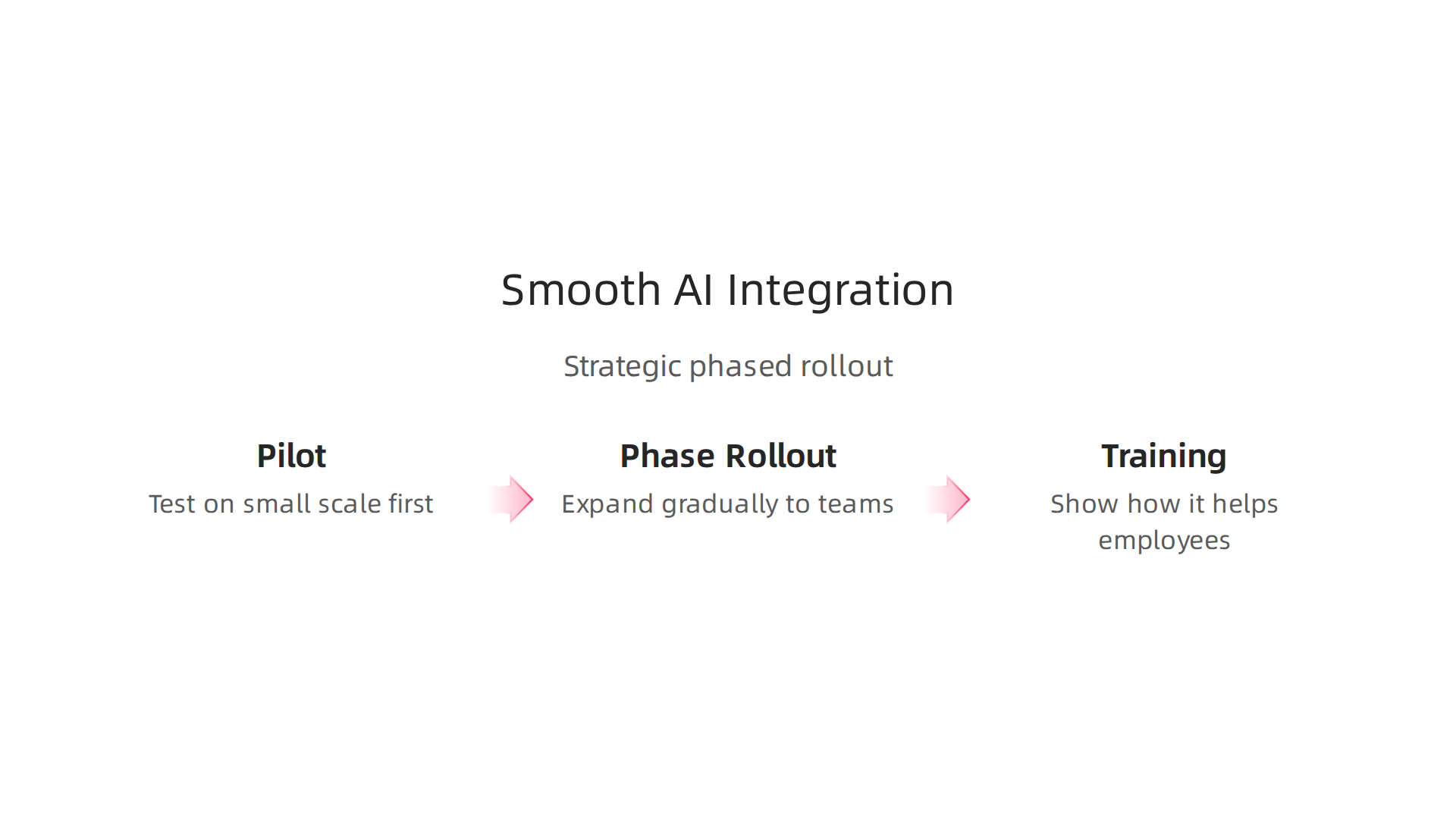
    Once you decide how to get your marketing AI agents, it’s time to put them into action. A good way to do this is with a step-by-step plan.

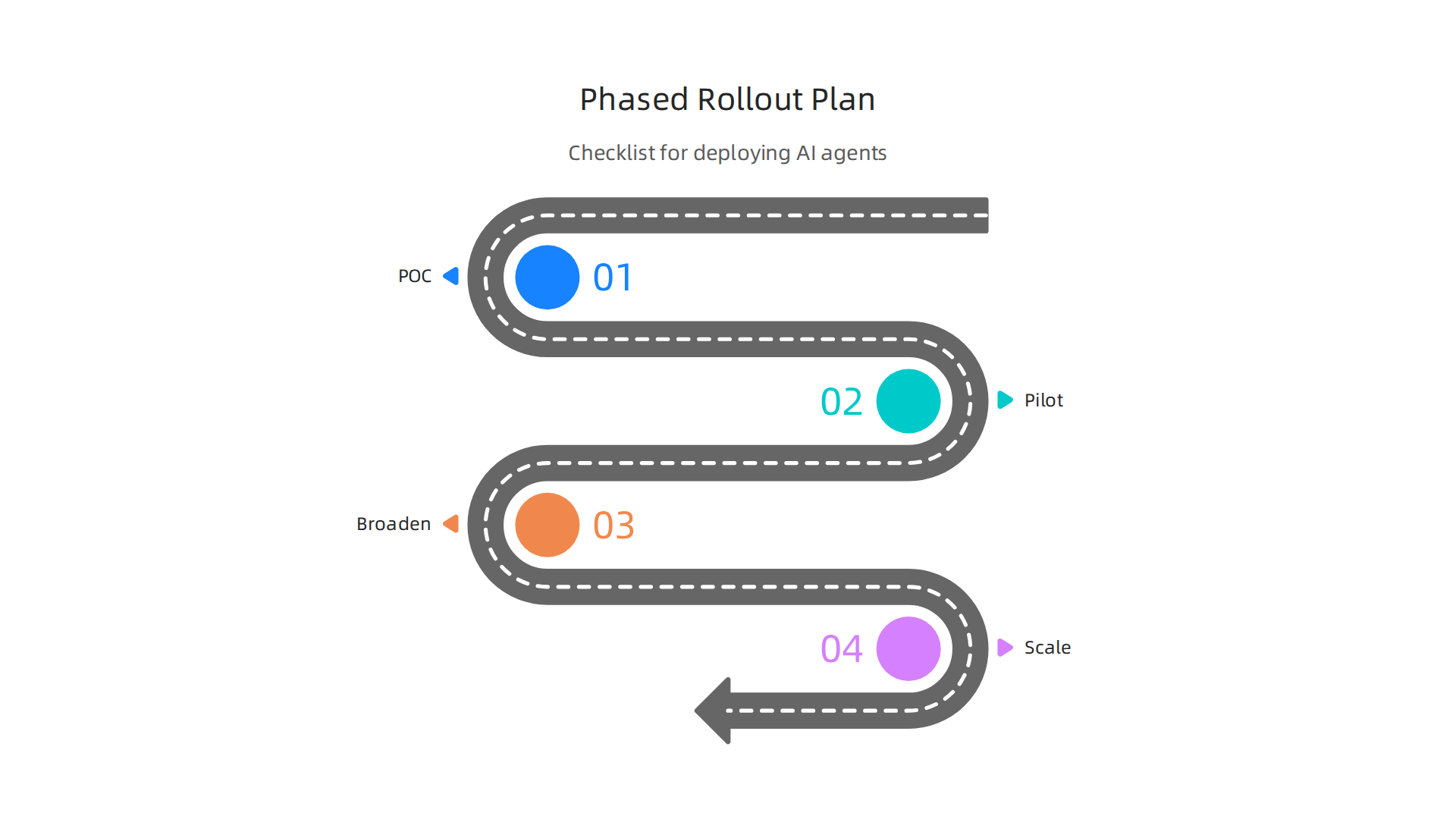
    A strategic phased rollout ensures smooth integration and scaling of AI agents.

    This helps you start small and grow safely.

    A Phased Rollout Plan

    1. Proof of Concept (POC): This is like a small test drive. You pick one simple task that the AI agent can do and see if it works.
      • Success Criteria: Does the agent complete the task? Does it save time or money for that one task? For example, you might test it writing a few social media posts for a specific marketing plan example. It’s smart to start with workflows that have low risk but high potential impact Using AI Agents for Marketing Agencies: 2026 Implementation Guide.
    2. Pilot: If the POC goes well, you expand the test to a small group of users or a small part of your business.
      • Success Criteria: Does it work well for this small group? Are there any unexpected problems? Are the people using it happy with it? During this stage, you should manually check every output for at least two weeks and use any errors to make the agent smarter How to Use an AI Agent for Marketing: The 2026 Playbook ….
    3. Broaden: Now, you slowly let more people or more parts of your business use the marketing AI agents.
      • Success Criteria: Is the agent still working well as more people use it? Is it helping more of your marketing team? This is where you might connect it with your online marketing platform for small businesses or a specific campaign.
    4. Scale: If all goes well, you make the AI agent a regular part of your marketing efforts across the whole company.
      • Success Criteria: Is it making a real difference to your business goals? Is it able to handle everything you throw at it? Are you seeing clear returns on your investment in these new tools?

    Practical Checklist for Deployment

    Before you fully unleash your marketing AI agents, here’s a checklist to make sure you’re ready:

    • Data Readiness: Make sure your business data is clean and ready for the AI. This means having good customer information and historical data. AI agents need connected, clean data to work effectively AI-Driven Marketing Strategies to Implement in 2026 – Aprimo. You’ll need things like real-time customer profiles and good data about how past campaigns performed AI Marketing Agents: 2026 Complete Guide. Having at least 12 months of clean historical data is a good rule of thumb AI Marketing Agent: 11 Best Tools & Guide (2026) – Improvado.
    • Integration Points: Think about how the AI agent will connect with your existing tools. This includes your CRM, email programs, and analytics tools like Zoho Marketing Automation. Make sure they can all "talk" to each other AI Marketing Agents: Complete 2026 Automation Guide. You want to link apps your team already uses daily, such as Slack, Gmail, or HubSpot 2026 Marketer’s Guide to AI Agents for Marketing Operations.
    • Service Level Agreements (SLAs): If you’re buying an agent, understand what kind of support you’ll get from the company selling it. How fast will they fix problems?
    • Monitoring: Set up ways to watch how your marketing AI agents are doing. This helps you catch any issues quickly and ensure they’re working as they should.
    • Change Management: Get your team ready for these new tools. Provide training, maybe even some free marketing courses on AI, and make sure everyone understands how the agents will help them. Before you start, write down the exact workflow you want the AI to handle, define what success looks like, and think about who owns the project AI Agents for Marketing: 15 Use Cases, ROI, and 2026 Guide.

    By following these steps, you can bring marketing AI agents into your business smoothly and make sure they truly help you reach your goals.
    For more deep dives into the latest AI tools and trends, make sure you’re subscribed.
    The AI Newsletter Worth Reading

    After you have a plan to put your marketing AI agents into action, the next big step is figuring out how these smart tools will talk to all your other business systems. This is like making sure all the different parts of a team can share information and work together smoothly. When your marketing AI agents link up with your customer relationship management (CRM), ad platforms, and analytics tools, they can do amazing things for your marketing plan.

    Integration patterns: linking agents to CRMs, ad platforms, and analytics

    Connecting your marketing AI agents with your existing tools is key for them to be truly helpful. It means that customer information, ad campaign results, and website visitor data can all be shared. This allows the AI agents to make smarter choices and take actions that fit your goals.

    There are a few common ways these connections work:

    • Data Sync (Data Sharing): This is like having two notebooks and making sure they both have the same information. Your marketing AI agents might regularly pull customer details from your CRM, or send updated customer scores back to it. This makes sure all your systems have the most current data. Businesses need clean, linked data for AI agents to work well, often including real-time customer profiles and historical campaign data to train models effectively AI Marketing Agents: 2026 Complete Guide.
    • Event-Driven Triggers (Action Starters): Imagine if one action automatically started another. For example, if a customer fills out a form on your website (an "event"), it could trigger your marketing AI agent to send a personalized email right away. Or if an ad campaign performs poorly, it could alert the agent to suggest changes.
    • API-Based Actioning (Direct Commands): APIs are like special language rules that allow different software programs to talk to each other and ask for things to be done. Your AI agent can use APIs to directly create new ads on an ad platform or update details in your CRM. This lets the agent not just suggest things, but actually do them.
    • Streaming Analytics (Constant Flow of Information): This means data is always flowing, like a river, instead of coming in big batches. For marketing AI agents, this is super important because it lets them see what’s happening right now. If a product suddenly becomes popular, the agent can adjust your online marketing platform for small businesses campaigns in real time. This constant data flow helps AI agents react quickly to changes [How AI agents will reshape every part of marketing in 2026](https://martech.org/how-ai-agents-will-reshape-every-part-of-marketing-in 2026/).

    Handling Data Across Systems

    When many systems work together, we need to be careful about how data is managed:

    • Idempotency (No Double Actions): This is a fancy word that means doing the same action multiple times has the same result as doing it once. For example, if your AI agent tries to send an email twice by mistake, idempotency ensures the customer only receives one email. It prevents double billing or duplicate entries.
    • Reconciliation (Making Data Match): With many systems, data can sometimes get out of sync. Reconciliation is checking that the information in your CRM, ad platform, and analytics tools all match up. This is vital for accurate reporting and making good decisions. For example, ad platform data should feed back into the AI agent’s information to match up with CRM records AI Agents for Agencies: Connect Client Data Safely.
    • Data Governance (Keeping Data Safe and Proper): This is about setting rules for how your data is collected, stored, and used. It makes sure your marketing AI agents respect privacy laws and company policies. Good data governance also means your data is high quality, which is super important for AI to learn from.

    Architectural Choices: Real-time vs. Batch and Coupled vs. Loosely Coupled

    When building these connections, businesses make some important choices:

    • Real-time vs. Batch: Do you need information to update instantly (real-time), or is it okay for updates to happen once a day or once an hour (batch)? Real-time updates are great for fast-moving campaigns, while batch updates can be simpler for less urgent tasks.
    • Coupled vs. Loosely Coupled Integrations:
      • Coupled: Systems are tightly linked. If one system changes, the other might need to change too. This can be faster for small setups.
      • Loosely Coupled: Systems work more independently. They connect through standard ways, so if one changes, it’s less likely to break the other. This makes your whole setup more flexible as you grow.

    Choosing the right integration patterns and making smart architectural choices helps your marketing AI agents truly shine. It makes sure they are not just useful tools, but fully integrated team members that boost your marketing efforts.

    If you’re looking to enhance your understanding of marketing technology, exploring options for how to choose marketing automation software in 2026 can provide further insights into optimizing your operations.

    After linking up your marketing AI agents with your existing systems, a very important next step is to set up clear rules and make sure everything runs safely and properly. This is called governance, compliance, and risk management. It’s like having a good rulebook and safety checks in place so your smart tools work in a way that is fair, legal, and keeps your brand safe.

    Professionals collaborate to establish and review safety protocols for AI systems.

    Data Privacy and Consent

    When marketing AI agents access customer information, it’s super important to respect people’s privacy. These agents often look at user data to make marketing campaigns better. So, you need to make sure you have permission, or "consent," from customers to use their data. Laws like GDPR in Europe and others around the world mean businesses must be very careful about how they gather, store, and use personal information. For example, people must clearly agree to how their data is used for personalized ads, not just have a pre-checked box AI Compliance in Marketing: The Complete Guide 2026.

    This also means that your marketing AI agents should only get access to the information they absolutely need to do their job. Businesses must document how their marketing agents handle personal data to comply with regulations Snowflake’s Agentic Enterprise Framework Puts Data …. Without proper consent management, using marketing AI agents can lead to big problems.

    Bias, Brand Safety, and Content Review

    Marketing AI agents can create ads, emails, and other content very quickly. But sometimes, AI can pick up unfair ideas or "bias" from the data it learns from. This could lead to content that is not fair or doesn’t fit your brand’s values. To stop this, you need:

    • Human-in-the-loop governance: This means people regularly check what the AI agents are doing and creating. For new AI agents, you should manually review every output for a few weeks to catch any errors How to Use an AI Agent for Marketing: The 2026 Playbook ….
    • Brand guidelines: Give your marketing AI agents clear rules about your brand’s voice and what kind of content is okay. This helps them create messages that always sound like your company.
    • Safety controls: Set up ways for the AI to flag or stop content that might be offensive, wrong, or goes against your rules. This helps ensure brand safety.

    Having these controls in place is key for any marketing plan example that uses AI.

    Security and Access Controls

    Finally, keeping your AI systems and the data they use safe is super important. Think about these things for your marketing AI agents:

    • Least privilege: This means your AI agents should only have the minimum access rights needed to do their specific tasks. They shouldn’t be able to see or change data they don’t need. This helps prevent unwanted access AI Regulation 2026: Current Laws, Compliance Requirements, and ….
    • Audit trails: You need a record of everything your marketing AI agents do. This is like a logbook that shows who accessed what, when, and what actions were taken. If something goes wrong, an audit trail helps you figure out what happened.
    • Incident response planning: Have a plan for what to do if there’s a security problem, like a data breach or an AI agent acting strangely. Knowing what steps to take beforehand can save a lot of trouble.

    As you adopt new smart tools, understanding potential problems and how to deal with them is part of having a good Stealth AI: A Business Guide to Hidden AI Risks, Opportunities, and Management in 2026. Keeping these governance, compliance, and risk management ideas in mind will help your marketing AI agents be both powerful and trustworthy tools for your business.

    After making sure your marketing AI agents follow all the rules and keep data safe, the next big step is to see how well they are actually doing. This means measuring, making them better, and growing their use over time. You want to make sure these smart tools are truly helping your business grow.

    Testing How Well Agents Perform

    To know if your marketing AI agents are working, you need to test them. A great way to do this is through something called A/B testing. This is like trying out two different ideas to see which one works better. For example, you can have your AI agent create one type of ad, and then have your regular marketing team or a different AI strategy create another. You then show both to similar groups of people to see which ad gets more clicks or sales.

    By doing these tests, you can compare what your marketing AI agents do versus your usual ways of working. Studies in 2026 show that successful AI agents can bring in 4.1 to 5.3 times more return on investment for the tasks they automate [Agentic AI in Marketing: ROI Data & Guide 2026]. This helps you see the real value of these smart tools for your marketing plan example. If you want to dive deeper into getting great returns, learn about how marketing specialists choose AI tools for marketing and drive ROI.

    What to Watch: Key Numbers and Dashboards

    To keep track of your marketing AI agents, you need to set up clear ways to measure their success. Think of this like a dashboard in a car, showing you all the important things at a glance. For AI agents, you should watch for:

    • Speed (latency): How quickly do your agents act or respond? Faster is usually better.
    • Success rate: How often do they do their job correctly, like sending the right email or suggesting the right product?
    • Conversion attribution: This means figuring out how much credit your marketing AI agents deserve for bringing in leads or making sales.
    • Cost per action: How much does it cost for an agent to complete a task, like getting a customer to sign up or click a link?

    It’s important to set up these special goals, or Key Performance Indicators (KPIs), for your autonomous AI agents. These help you track their operational health and how they impact your business goals, like making more money or getting more customers KPIs for Autonomous AI Agents in Marketing and Governance. Platforms for online marketing, such as Zoho Marketing Automation, often have features to help you track these metrics.

    Always Getting Better: Continuous Improvement

    Using marketing AI agents isn’t a "set it and forget it" task. For them to stay useful, you need to make them better over time. This involves a few key steps:

    • Feedback loops: This is where people tell the AI what worked well and what didn’t. Your team can give feedback on the content the agents create or the decisions they make.
    • Retraining triggers: As new information comes in or marketing trends change, your AI agents might need to learn new things. You need to know when it’s time to "retrain" them with fresh data.
    • Lifecycle management: This is about how you keep your marketing AI agents updated and relevant through their whole life, from when you first use them to when they might need big changes.

    By having these plans in place, your marketing AI agents can keep learning and improving. This ensures they continue to bring value to your business year after year. Learning how AI agents get better over time is crucial for long-term success [How Do AI Agents Learn and Improve Over Time?]. For tips on maximizing your investment, check out how to get real ROI from AI marketing cloud in 2026.

    Want to stay informed about all the latest in AI and technology?

    The AI Newsletter Worth Reading

    Summary

    Marketing AI agents are autonomous, multi-step AI systems that plan, act, and learn to run marketing tasks from content creation to campaign optimization. This article explains the different agent types—from single-purpose tools to fully autonomous campaigning agents—what technical parts make them work (prompts, memory, tool integrations), and the real-world use cases such as lead qualification, creative iteration, and live campaign optimization. You’ll get a practical checklist for choosing whether to buy or build, a phased rollout plan (POC → pilot → broaden → scale), and concrete integration patterns for CRMs, ad platforms, and streaming analytics. The guide also covers governance: consent, bias checks, least-privilege access, and audit trails, plus the metrics you must track (effort hours, conversion lift, cost-per-acquisition, campaign ROI). Finally, it shows how to test agents, set KPIs, and create feedback loops so agents improve over time, helping teams save time, cut costs, and boost marketing performance.

  • Rad AI The Business User’s Guide to Radiology Reporting Software

    Rad AI The Business User’s Guide to Radiology Reporting Software

    Why a focused deep dive on Rad AI matters for business users in 2026

    The world of Artificial Intelligence (AI) is growing super fast in 2026. Every day, new AI tech tools pop up, promising to make our work easier and smarter. For marketers, founders, and people who run businesses, it can be tough to know which tools are truly helpful. We hear about big names like deepsearch ai, hebbia ai, and manas ai, but what about more specialized AI? This is where rad ai comes in.

    You might think rad ai is just for doctors or hospitals. Actually, it started there, helping radiologists with their work.

    Explore the official website of Rad AI, showcasing its specialized solutions for the healthcare industry.

    For example, some hospitals have used Rad AI Impressions to make radiologists more productive and get reports done faster Case Studies. Also, it has recently partnered with big systems like Yale New Haven Health System to improve reporting Rad AI, Yale Reporting System.

    But here’s the thing: understanding how specialized AI like rad ai works and brings real value can teach us a lot. It shows us how AI can be very specific and still make a big difference. This article will help you see past the buzzwords. We will look closely at rad ai to understand how specific AI tech tools can solve real-world business problems.

    Our goal is to help you decide if a focused, specialized AI approach, much like what rad ai offers in its field, could be right for your business too.

    A business professional thoughtfully evaluating strategic options, symbolizing the careful choice of AI solutions.

    You will learn how to pick the right AI tools that actually work for you in 2026. This means choosing solutions that deliver real results, not just fancy promises. To learn more about selecting the best AI tools, check out our guide on how to choose AI for business tools that deliver real results in 2026.

    Staying updated on all the new AI tools and trends is a big job. If you want clear, daily updates about AI and technology, there’s a newsletter designed to help business users like you.

    The AI Newsletter Worth Reading

    Now that we understand why specialized AI matters, let’s look closer at rad ai itself. This company makes special AI tech tools mainly for the medical field, especially for doctors who read X-rays and other medical images. Think of rad ai as a smart helper that makes their work faster and more accurate.

    Core Capabilities and Product Modules

    Rad AI has a few main parts that work together to help medical staff. Its main goal is to make reports easier and quicker to write for radiologists. They do this through smart reporting tools and a special speech recognition system.

    One key tool is called Rad AI Reporting. This uses advanced AI, like generative AI, to help draft reports. It helps doctors write their findings much faster. The system can reduce the time doctors spend talking into their microphones by up to 90%. It also helps create clear, structured reports Report: Rad AI Business Breakdown & Founding Story.

    Another important part of rad ai is its next-generation speech recognition technology. This helps doctors speak naturally, and the AI understands what they are saying very well. This makes diagnostic reporting much quicker and more exact Rad AI Launches Next-Generation Speech Recognition …. For example, doctors can just talk freely, and the AI will put their words into the right parts of the report template, so they don’t have to click around manually From the Inside: FAQ with Engineering. This is a big help because it means less typing and more focus on patients.

    Primary Target Users and Typical Buyer Personas

    So, who are these rad ai tech tools for?
    The main users of rad ai are:

    Rad AI focuses on two primary user groups, tailoring its AI solutions to their specific needs in radiology.

    • Radiologists: These are the doctors who look at medical images like X-rays, CT scans, and MRIs. Rad AI helps them write their reports quickly and correctly.
    • Hospitals and Imaging Centers: These are the places where medical images are taken and read. Rad AI helps these places run more smoothly by making their reporting process very efficient.

    Basically, rad ai is best for large hospitals and imaging centers that need to be very efficient Top 10 AI Radiology Analysis Tools in 2026.

    A look at DevOpsSchool, a resource for AI and tech insights, relevant for researching AI tools.

    It’s built for healthcare professionals who deal with many images every day and need to turn around reports quickly without losing accuracy.

    While other AI tools like deepsearch ai, hebbia ai, or manas ai might help in different business areas, rad ai stands out because it focuses deeply on one specific area: making radiology reporting better. This shows how specialized AI can solve real problems for certain groups of users. For businesses looking to find and use the best new AI solutions, understanding how rad ai serves its niche can be a great lesson in smart ai tool discovery AI Tool Discovery 2026 How to Find Trusted Tech Sources That Deliver Real Business Results.
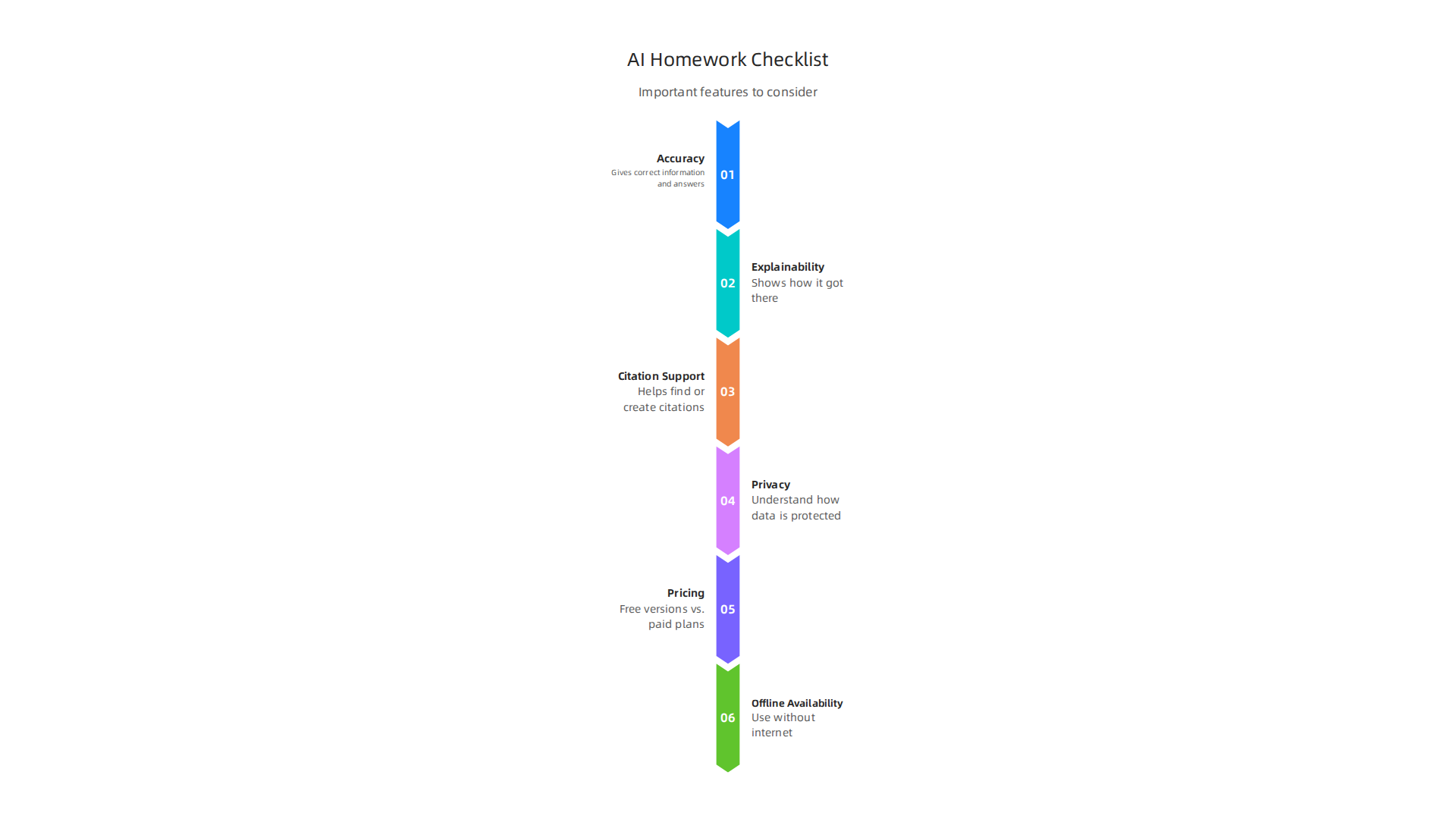
    Now, let’s look closer at the clever parts inside rad ai and what makes its tech tools special. Knowing these details helps you see how it can really change how doctors work.

    Key Features and Technical Strengths to Evaluate

    At its heart, rad ai uses smart computer brains, known as AI models, to do its job. It combines different kinds of AI to help radiologists. The main idea is to automate many steps in writing reports. This means doctors spend less time on paperwork and more time helping patients.

    One big strength is how rad ai uses advanced AI to learn from many, many medical reports. This helps it understand what doctors usually say and how reports are put together. When a radiologist speaks, the system instantly turns their words into a clear report. It even places the right words into the right parts of the report, so doctors don’t need to click around a lot. This kind of hands-free working makes the daily tasks much smoother and quicker, boosting how much work can be done. It truly improves the accuracy and speed of diagnostic reporting Rad AI’s New Tool Aims to Improve Accuracy, Quality of Diagnostic Reporting.

    The way rad ai works is all about making things easy for the user. It has a friendly way of working (this is sometimes called good UI/UX) so doctors can use it without much fuss. They can simply talk, and the AI does the heavy lifting of writing the report. This smart automation is a big help for busy hospitals and imaging centers.

    When thinking about rad ai compared to other tech tools like deepsearch ai, hebbia ai, or manas ai, its main difference is its very specific focus. While those other tools might help with different business problems, rad ai is made just for radiology. This deep focus means it can solve problems in this one area very well. This makes it a strong choice for hospitals looking for specialized AI help. For those evaluating different smart solutions for their business, it’s helpful to learn how to pick the right ones that really deliver good results.

    When you’re looking at rad ai or any new AI tool, it’s also smart to think about a few things:

    Before adopting any new AI tool, businesses should evaluate its compatibility, ease of setup, and user-friendliness.

    • How it fits in: Will it work well with the computer systems you already have?
    • How easy it is to set up: Will it take a lot of effort to get started?
    • The people using it: Will doctors and staff find it simple to learn and use every day?

    These questions are important for any new technology. Choosing the right AI solutions for your business means looking at both its great features and how it will work in your real-world setting.

    Professionals in a meeting setting, actively discussing and evaluating various solutions for their business needs.

    You can learn more about how to choose the right AI tools for your business in 2026.

    If you want to stay up to date on all the latest developments in AI and technology, consider subscribing to a reliable source. Get clear daily AI updates from The AI Newsletter Worth Reading.

    When picking the right AI tech tools for your business, knowing how much they cost is very important. It’s not just the first price tag you see. For rad ai, like many advanced AI solutions, you won’t find a simple price list online.

    Common Pricing Tiers

    Rad ai often uses what’s called "enterprise pricing" Rad AI Review 2026 — Pricing, Features & Alternatives. This means the price is made just for your hospital or clinic. You need to talk to their sales team to get a custom quote Rad AI review (2026): pricing, features, alternatives. This way of pricing is common because every hospital has different needs and sizes, so the cost can change based on how much you use it and how many people will be using it. Sometimes, tools might even offer a free trial to let you try it out first RAD AI.

    Overview of Rad AI's listing on SaaSworthy, indicating enterprise pricing models and potential free trials.

    These custom plans can be set up in different ways:

    • Per-seat pricing: This means you pay for each doctor or staff member who gets to use the rad ai system. If you have 10 doctors, you pay for 10 "seats." This helps keep costs clear for a known number of users.
    • Usage-based pricing: With this model, you pay for how much you actually use the tool. For example, you might pay per medical report that rad ai helps create. This can be helpful if your clinic’s workload changes a lot, so you only pay for what you need.

    Hidden Costs and Total Cost of Ownership (TCO)

    When looking at rad ai or any new tech tools, it’s smart to think about the "total cost of ownership," or TCO.

    Understanding the total cost of ownership involves considering setup, training, and ongoing maintenance.

    This means all the money you spend on the tool over time, not just the first price.

    Here are some other costs to consider:

    • Setting it up: Getting rad ai to work smoothly with your hospital’s current computer systems can take time and money. This process is called "integration," and it makes sure all your different programs can talk to each other.
    • Learning how to use it: Your doctors and staff will need training to learn how to use the new rad ai system well. This training might cost money or take time away from other tasks.
    • Keeping it running: Like any computer program, rad ai might need updates or support from time to time. These are ongoing costs that keep the system working its best.

    Thinking about all these parts helps you truly understand how much rad ai will cost your business in the long run. It’s about finding tech tools that not only work great but also fit your budget over time. You can learn more about how to choose AI for business tools that deliver real results in 2026.

    When you think about bringing new tech tools like rad ai into your clinic, simply knowing the price isn’t enough. You also need to think about how these tools will connect with what you already have. This process is called integration, and it’s a big part of the "setting it up" cost we talked about earlier.

    How Rad AI Fits into Your Existing Systems

    For rad ai to work its magic, it needs to talk to your hospital’s other computer programs. This is like teaching different languages to computers so they can share information. There are a few common ways this happens:

    • APIs (Application Programming Interfaces): Think of an API as a special messenger that allows different computer programs to send requests and get information from each other. For example, rad ai might use an API to pull patient records from your electronic health system or send its findings back into your reporting system Integrating AI APIs in 2026. Many AI tools, not just rad ai, use APIs to connect and work together smoothly in 2026.
    • SDKs (Software Development Kits): An SDK is like a toolbox that developers use to build features or connect software. Rad ai might offer an SDK that helps your IT team quickly add rad ai‘s functions into your existing applications. This makes it easier for your systems to "understand" and use rad ai‘s capabilities What Is AI API Integration? A 2026 Enterprise Guide.
    • Platform Connectors: Sometimes, rad ai may have ready-made "connectors" for popular healthcare platforms. These are like pre-built bridges that make it simple to link rad ai with your specific medical software, cutting down on custom work.

    The goal is to make sure rad ai works hand-in-hand with your other tech tools without causing problems. This includes everything from simple scheduling software to more complex AI tools like deepsearch ai or hebbia ai.

    What to Expect During Implementation

    Bringing a new system like rad ai online usually follows a few steps:

    1. Planning and Setup: First, you’ll work with the rad ai team to plan how it will fit into your hospital. This involves looking at your current systems and deciding the best way to connect them. Setting up the necessary computer hardware and software can take time. An AI radiology diagnostic platform, for instance, needs strong GPU infrastructure and fast data storage How to Build an AI Radiology Diagnostic Platform in 2026.
    2. Testing: Once connected, your team will test rad ai to make sure it’s working correctly and safely. This is a very important step to catch any issues early.
    3. Training: Your doctors and staff will need training to learn how to use rad ai effectively. This helps everyone feel comfortable and confident with the new tool. Engaging healthcare professionals from the start is key to successful implementation AI in Healthcare: Bridging Ideas to Implementation.

    The total time for implementation can change a lot. It depends on how big your clinic is, how many systems need to be connected, and how complex those connections are. You’ll need your IT team to work closely with the rad ai experts.

    A team collaborating around a table, symbolizing the joint effort required for successful AI integration and implementation.

    Common Roadblocks

    Even with good planning, you might run into some bumps in the road:

    • Data Security: Keeping patient information safe is super important. Ensuring rad ai meets all privacy rules can sometimes be tricky.
    • Compatibility Issues: Older computer systems might not easily "talk" to new rad ai software. Sometimes, updates to your existing tech tools are needed.
    • Getting Staff On Board: People are naturally used to how they do things now. Getting everyone to happily use a new system like rad ai takes good training and support.

    Thinking about these things beforehand helps you prepare and makes the process much smoother. Choosing the right enterprise AI platforms can also simplify this process significantly. You can learn more about how to do that by exploring Enterprise AI Platforms 2026: Top Providers and How to Choose the Right One.

    Staying updated on the latest AI advancements, including integration best practices, is crucial for any business using tech tools.

    Get clear daily AI updates from The AI Newsletter Worth Reading.

    Choosing the right tech tools for your clinic means also looking at what else is out there. Rad AI is a very good tool, but it’s important to know how it stands against other helpful AI systems. This helps you pick the best fit for what your hospital needs.

    Where Rad AI Stands Out

    Rad AI is special because it uses smart AI to help write radiology reports quickly. It focuses on making draft reports, adding notes, and setting up patient follow-ups. This helps doctors spend less time typing and more time with patients. It’s one of the first tools to use this type of generative AI for radiology reporting Report: Rad AI Business Breakdown & Founding Story.

    Other AI tools in radiology often focus on different things. Many are great at looking at medical images to find problems like diseases. For example, some might be really good at detecting specific issues in X-rays or CT scans.

    Closest Alternatives and How They Differ

    When you look at other tech tools in the radiology space, you’ll find a variety. Each one has its own strengths:

    • Aidoc is known for finding many different problems in emergency CT scans. It’s great for busy places where speed matters Best AI Radiology Companies in 2026.
    • Viz.ai helps with stroke care by quickly finding issues and getting doctors to work together in real-time.
    • Lunit focuses on helping with cancer screening and looking at images for cancer.
    • Annalise.ai uses AI to help read chest images.
    • Gleamer is good for X-rays.

    Other options like CrelioHealth LIMS, ARIA Oncology Information System, Studycast, MOSAIQ Radiation Oncology, and CARESTREAM Vue RIS are often seen as alternatives, especially when looking at radiology information systems more broadly Top 10 RAD AI Reporting Alternatives & Competitors in 2026. These tools often manage the whole radiology process, from scheduling to reporting.

    Then there are also cloud-based platforms like RamSoft, which offers an all-in-one system for managing images and patient information 7 best radiology software for 2026. These types of solutions can handle different parts of imaging operations.

    Decision Matrix: Choosing the Right AI Tool

    To help you decide, here’s a simple guide comparing Rad AI with other kinds of AI tech tools:

    A decision matrix highlighting the distinct functionalities of Rad AI compared to its key alternatives in radiology.

    Tool Type Best For What it Does
    Rad AI Radiology reports, saving doctor time on typing Creates draft reports, automates notes, helps with patient follow-up
    Aidoc Fast detection in busy emergency rooms Finds many issues in CT scans quickly
    Viz.ai Stroke care and quick team coordination Identifies strokes fast, helps doctors work together
    Lunit Cancer screening and oncology imaging Supports reading images for cancer
    RamSoft Complete cloud-based imaging management Handles image storage, patient info, and overall radiology workflow

    When thinking about other types of AI like deepsearch ai, hebbia ai, or even general AI tools like manas ai, remember they serve different purposes. Deepsearch ai might be about finding hidden information in large datasets, while hebbia ai could focus on document analysis. These are not direct competitors to Rad AI but show how diverse AI tech tools can be. Your choice depends on your specific needs, whether it’s for faster reporting, better image analysis, or broader data insights.

    It’s important to look at what each AI tool does best and see how it fits into your daily work. This way, you can pick the tools that truly make a difference. To learn more about how to make smart choices for your business, check out how to choose AI for business tools that deliver real results in 2026. You can also discover top tech companies for business in 2026 to see who is leading the way in different AI areas.

    After looking at different tech tools and how they compare, let’s see how Rad AI actually helps in real medical places. This means understanding the clear benefits it brings to hospitals and clinics every day, making work better for everyone.

    What Rad AI Does in the Real World

    Rad AI is a special tech tool that directly helps doctors. It makes writing radiology reports much faster. Instead of typing every word, doctors can get a draft report ready almost instantly. This means they spend less time on the computer and more time focusing on patients. This speed boost is a big win for daily operations in a clinic.

    Think about it this way:

    • For Product: The main "product" here is the radiology report. With Rad AI, these reports become more consistent and faster to produce. This improves the overall quality and speed of service the clinic offers.
    • For Operations: Doctors save a lot of typing time. This helps the whole system run smoother, from when a patient gets a scan to when their doctor gets the report. Less time spent on busy work means better use of valuable doctor time. It also helps with making sure patients get their important follow-up notes.
    • For Marketing: When a clinic uses Rad AI, they can tell people they offer quick and highly accurate reports. This can help bring in more patients because they know they will get fast and reliable care. The company itself has shown great growth, raising lots of money because people see its value Rad AI scores $60M, boosting its valuation to $525M.

    How Clinics Measure Success with Rad AI

    When clinics start using Rad AI, they look at certain numbers to see if it’s working well. These numbers help them understand if the AI tech tool is truly making a difference.

    Here are some key things they typically track:

    • Report Turnaround Time: This is how fast a report is finished after a scan. Rad AI often helps cut this time down a lot.
    • Doctor Time Saved: They count how many hours doctors save each week by not having to type full reports from scratch. This leads to better use of resources and can even cut costs without cutting corners in AI operations.
    • Report Accuracy: Even though AI drafts the report, doctors check it. Clinics look to see if the reports are still very accurate and if fewer small mistakes happen.
    • Patient Follow-Up Rates: Rad AI helps with reminders for patient follow-up care. Clinics check to see if more patients are actually getting the care they need because of these timely reminders.
    • Doctor Satisfaction: Happy doctors who spend less time on paperwork and more on important tasks are a big win.

    A doctor confidently reviewing patient information, highlighting the improved efficiency and focus gained from specialized AI tools.

    This can be seen in better morale across the radiology department.

    It’s important to remember that not all tech tools are the same. While Rad AI helps with reports, other tools like deepsearch ai might find hidden information in big sets of data, or hebbia ai might focus on checking documents. Even general AI tools like manas ai have different jobs. Rad AI is very good at its specific job of making radiology reporting better.

    If you want to keep up with the latest in AI and how it can help your business, there’s a great way to do it. Get clear daily AI updates from The Deep View Newsletter.
    The AI Newsletter Worth Reading

    When looking at how Rad AI makes a difference, it helps to see a real example. Imagine a small radiology group, let’s call them "ScanWell Clinic," with just a few doctors. They decided to bring in this tech tool to speed things up.

    Here’s how their first 90 days with Rad AI went:

    • Weeks 1-2: Getting Ready. The clinic first had meetings to learn what Rad AI could do. They planned how to set it up without stopping their daily work. The Rad AI team helped them get the software ready on their computers. Doctors and staff got a first look at how the tech tool would help them write reports.
    • Month 1: Learning the Ropes. Doctors started using Rad AI for some reports. At first, it felt a bit new. They had to get used to letting the AI draft the report and then checking it carefully. Some doctors took a little longer, but they quickly saw how it helped them save typing time. They shared feedback with each other on what worked best.
    • Month 2: Picking Up Speed. By the second month, most doctors were using Rad AI for many of their reports. They felt more comfortable with it. The time it took to finish reports started to drop noticeably. This meant patients got their results faster, which is always a good thing. The clinic found that Rad AI was really helping to make their work flow better.
    • Month 3: Seeing the Big Picture. After 90 days, ScanWell Clinic looked at their numbers. They saw that radiologist productivity had improved, and reports were finished much quicker. This is similar to what other groups have seen, with some clinics boosting productivity and cutting turnaround times significantly by using Rad AI Case Studies. Doctors felt less tired from typing, and they could focus more on understanding the images themselves.

    Good Things They Noticed:

    • Faster Reports: The biggest win was how quickly reports were ready. This was good for patients and for the clinic’s schedule.
    • Doctors Saved Time: Doctors spent less time on the computer doing repetitive tasks. This freed them up to focus on harder cases or to teach junior staff.
    • More Consistent Reports: Rad AI helped make all reports sound more similar and complete, which is important for quality.

    Things That Were a Bit Tricky:

    • Getting Used to New Tech: Any new tech tool takes a little time to learn. Some doctors needed more help at the start.
    • Small Adjustments: Sometimes, the AI needed tiny tweaks to match how a specific doctor liked to phrase things. But these were easy to fix over time.

    Overall, ScanWell Clinic found that bringing in Rad AI was a helpful step for their small team. It showed them how specialized AI tools, unlike more general ones like deepsearch ai or hebbia ai, can really fit into and improve a specific kind of work. Learning how to pick the right tools for your business is key to getting these kinds of results. If you are looking to bring in new digital tools, it’s always wise to learn how to choose AI for business tools that deliver real results in 2026.

    Implementation Checklist: What to Verify Before You Buy

    Choosing tech tools for your business, like a specialized Rad AI system, is a big step. Just like ScanWell Clinic learned, getting good results means you need to think things through before you buy. It’s not enough to just see a cool tool; you need to check if it’s the right fit for your team. Here is a simple checklist to help you make smart choices in 2026.

    1. Technical Checks

    First, let’s talk about the tech side. You want to make sure the new tech tool can talk to your existing computer systems.

    • How will it connect? Many AI tools use special "API" connections or software kits (SDKs) to link up with other programs. You need to know if the Rad AI tool can easily plug into what you already use. This is like making sure a new phone charger fits your phone. Understanding how AI API integration works can help you ask the right questions.
    • What computer power does it need? Some AI tools, even small ones, need a lot of computing power. You might need strong graphics cards (GPUs) or fast storage to handle all the data. Thinking about how to build an AI platform, especially in radiology, can give you clues about these needs How to Build an AI Radiology Diagnostic Platform in 2026. Make sure your current setup can handle the demands or know what upgrades you might need.

    2. Legal and Safety Checks

    Next, think about rules and safety. This is super important, especially with tools like Rad AI that handle sensitive patient information.

    • Data Privacy: Where will your data go? How will the AI keep patient information safe and private? You need to ensure the tech tool follows all the rules about data protection, like HIPAA or GDPR, depending on where you are.
    • Regulations: AI use in healthcare is watched closely. Make sure the Rad AI solution meets all the current laws and standards for medical tools in 2026. This helps avoid problems down the road. It also helps with the bigger picture of AI in Healthcare: Bridging Ideas to Implementation.

    3. Procurement Checks: The Buying Process

    Before you sign on the dotted line, consider these points:

    • Cost: What’s the full price? Is it a one-time cost, or do you pay monthly or yearly? Are there extra costs for setup, training, or support?
    • Support: Who will help you if something goes wrong or you have questions? Good support is key when you’re using new tech tools.
    • Training: Will the company train your staff on how to use the Rad AI tool? Good training helps everyone get comfortable faster.

    4. Defining Goals and Pilot Plans

    Lastly, before you even bring in the tool, know what success looks like.

    • What do you want to fix or improve? Do you want faster reports, happier doctors, or to save money? Write down clear goals.
    • How will you measure success? Think about the numbers. ScanWell Clinic measured how quickly reports were done. What numbers will you track to see if the tech tool is helping?
    • Start Small: Like ScanWell Clinic, it’s smart to start with a test run, or "pilot," before using the tool everywhere. This helps you learn and make adjustments. It’s also important to involve your team from the start, getting their thoughts on the clinical need for any new solution.

    By doing these checks, you can reduce worries and make sure any new tech tool you bring in, whether it’s Rad AI, or something else entirely, will truly help your business grow. If you’re looking to keep up with the latest in AI and how it affects your business, there’s a great resource.

    Get clear daily AI updates from The AI Newsletter Worth Reading.

    Summary

    This article explains why a focused, specialized AI like Rad AI matters for business users in 2026, especially for hospitals and imaging centers that need faster, more accurate radiology reporting. It walks through Rad AI’s core modules—generative reporting and next‑generation speech recognition—who benefits most, and the technical strengths that make it effective in clinical workflows. The piece also covers practical buying considerations: pricing models (enterprise, per‑seat, or usage), hidden costs that affect total cost of ownership, and common integration methods such as APIs, SDKs, and platform connectors. You’ll find an implementation roadmap (planning, testing, training), typical roadblocks (security, compatibility, adoption), and a 90‑day case study showing measurable gains in turnaround time and clinician productivity. Finally, the article gives a clear pre‑purchase checklist so decision makers can evaluate fit, compliance, and ROI before adopting Rad AI or similar specialized tools.

  • How to Use AI-Powered Homework Help Smartly and Ethically

    How to Use AI-Powered Homework Help Smartly and Ethically

    Why ‘AI-powered homework help’ matters now (and what this article will deliver)

    In 2026, many students and even grown-ups at work are looking for ways to get tasks done better and faster. This is where AI-powered homework help comes in. Simply put, these are smart computer programs that use artificial intelligence to help you with schoolwork or tricky tasks at your job. They can do many things, like explain hard ideas, solve math problems step-by-step, or even help you start writing an essay [^1]. Think of them as super-smart helpers that know a lot about many subjects [^2].

    This innovative technology isn’t just for kids anymore. Professionals also use these tools to handle information overload and improve their own learning. For example, an AI homework helper can quickly summarize a long report or help you find specific facts for a presentation. This makes learning and working more efficient, giving you more time for other important things.

    A student engages with learning materials, feeling empowered and confident.

    However, using these tools can be a bit tricky. Many people face some common problems:

    Understanding the key problems users face when adopting AI-powered homework assistants.

    • Too much information: There are so many AI tools out there. How do you know which ones are the best AI platforms for what you need?
    • Picking the right tool: It’s hard to choose the right one when each tool does something a little different.
    • How to use them: Once you have a tool, how do you use it correctly so it really helps you?
    • Getting good results: You want to make sure the time and money you spend on these tools actually helps you learn more or do better work.

    Another big thing to think about is academic honesty. Using AI-powered homework help can be very useful for learning, but it is important to know when it’s okay to use AI and when it’s not. For example, using AI to understand a topic is fine, but having AI write your entire paper and saying it’s your own work is usually seen as cheating [^3]. Always check with your teacher or school rules first [^4].

    This article is here to help you understand all of this. We will give you simple steps and clear advice on how to find and use the right AI tools. We will also talk about how to use them smartly so you get the best results without any problems. You’ll find helpful checklists and tips to make sure you’re using this amazing technology the right way.

    Want to keep up with all the new AI tools and ideas every day?
    The AI Newsletter Worth Reading delivers clear daily AI updates right to your inbox.

    Screenshot of The AI Newsletter Worth Reading signup page, offering daily AI updates to stay informed.

    [^1]: AI Homework Helper for Students: 2026 Field Guide – Lensia
    [^2]: How AI Homework Helpers Are Transforming Education in 2026 – The EduTech Post
    [^3]: Is Using AI for Homework Cheating? The Real Answer (2026)
    [^4]: Academic Integrity and GenAI – Artificial Intelligence (AI): Tools …

    What ‘AI-powered homework help’ actually means: capabilities and taxonomy

    To use AI homework help smartly, it helps to know what these tools can truly do. In 2026, AI-powered homework help isn’t just one type of tool; it’s a whole group of smart programs that can assist you in many ways. These tools use special computer brains called large language models to understand what you need and give you helpful answers Tradeoffs And Tensions.

    Here are the main things these AI-powered homework help tools are good at:

    An overview of what AI-powered homework help tools can do.

    • Making new content: They can help you start writing by giving you ideas or a first draft for an essay. This is called content generation. Remember, this is for help, not for letting the AI do all your work for you.
    • Explaining hard stuff: If a topic is confusing, an AI can break it down into simple parts. It can explain science facts, history events, or tricky ideas until you get it. This is like having a private tutor.
    • Solving problems step-by-step: For math problems or coding tasks, some AI tools can show you how to solve them one step at a time. This way, you learn the method, not just the answer How Students Can Use AI Tools for Homework Assistance. You can even watch videos that show you how to use these tools for step-by-step answers How to Use Question AI to Solve Homework & Get Step-by ….
    • Making learning personal: Some tools can create practice questions or study guides just for you, based on what you need help with. This is called personalization.
    • Finding sources: They can also help you find information and suggest places to look for facts, which can be useful for citing your work.

    Different Types of AI Homework Tools

    Not all AI tools work the same way. We can put them into two main groups:

    1. Assistive Tools: These are like your helpful co-pilot. They don’t create new big chunks of text or teach you from scratch. Instead, they help you make your existing work better. Think of tools that:

    2. Generative Tutors: These are more like teachers that can create new things and talk with you. They are often what people think of when they hear "AI homework help." These tools can:

      • Give detailed explanations and examples.
      • Answer your questions in an interactive chat, just like a real person.
      • Generate new problems for you to practice.

    In 2026, many of the best AI platforms for teachers & schools in 2026 are actually a mix of both types, offering a wide range of help.

    Screenshot of TeachBetter.ai, a platform dedicated to AI tools for teachers and schools.

    How You Get to Use Them

    These innovative technology tools come in different forms:

    • Web Apps: Most often, you’ll use them directly on a website, like a smart chatbot you type to.
    • Plugins: Some can be added right into your school’s online learning system (LMS) or even your web browser.
    • APIs: This is a fancy word for how different computer programs talk to each other. Big learning companies might use APIs to build AI features right into their own tools.

    Understanding these different types and how they work helps you choose the right tools for your needs. If you’re looking to understand more about finding the right tools, you might want to read our guide on AI Tool Discovery 2026.

    Screenshot of aitoolsnewstoday.com, a resource for finding trusted tech sources and AI tools.

    Understanding the different types of AI homework help and how they work helps you choose the right tools for your needs. Now, let’s look at how you can put these innovative technology tools to use in real study and work routines to become more productive.

    AI workflows that boost productivity for study and work

    Using AI tools wisely means fitting them into your daily tasks. It’s about creating "workflows" where AI helps you get things done faster and better. In 2026, many students and professionals are finding smart ways to use AI as a helpful partner.

    Here are some common ways people use AI:

    • Research and Summarization: Imagine you have a lot to read for a project. An AI tool can quickly go through long articles or documents and give you the main ideas. This saves a lot of time and helps you understand complex topics faster. Many students use AI homework help for this kind of quick info gathering AI Homework Helper | Complete Assignments Faster in 2026.
    • Step-by-Step Problem Solving: For tough math problems or science questions, AI can guide you. Instead of just giving the answer, some tools show you each step, helping you learn the process. This makes sure you truly understand how to solve similar problems on your own later.
    • Code Assistance: If you’re learning to code or working on a programming project, AI can be a great assistant. It can help you write small parts of code, find mistakes, or explain tricky programming concepts. This can speed up your learning and make coding less frustrating.
    • Revision and Editing: When you write an essay or report, AI can check your work. It can find grammar errors, suggest better words, and even help you make your writing clearer and more engaging. This is like having a careful editor look over your work before you turn it in Best AI Homework Helper Tools in 2026.

    Combining AI Helpers with Your Own Brain

    The key to using AI-powered homework help and other tools well is not to let them do all the work. Think of AI as a helper, not a replacement for your own thinking. When AI gives you an answer or a draft, you should always review it carefully.

    This "human review" is important for two main reasons:

    1. Quality Control: AI tools are smart, but they can still make mistakes or give answers that aren’t quite right for your specific task. Always double-check facts and make sure the information makes sense.
    2. Learning Retention: If you just copy what the AI says, you won’t learn. By checking, editing, and thinking about the AI’s output, you make sure the knowledge sticks with you.

    An individual thoughtfully reviewing documents and making notes, indicating critical thinking.

    Studies show that AI can improve learning, but working alongside it is crucial Human Support Improves Engagement with AI Tutoring.

    Making AI Part of Your Existing Tools

    The best AI platforms aren’t just standalone apps. Many of these intelligent software applications can connect with the tools you already use.

    • Learning Management Systems (LMS): Schools often use platforms like Canvas or Moodle. Some AI tools can plug right into these systems, making it easy to get help without leaving your online classroom.
    • Integrated Development Environments (IDEs): For coders, AI assistants can be built directly into IDEs, helping you write and debug code as you go.
    • Note Apps: AI features can be added to note-taking apps to help organize your thoughts, summarize lectures, or turn notes into study questions.

    By using AI this way, you create smooth workflows that boost your productivity for both studying and work. This smart use of AI helps you learn more and get more done.

    To stay on top of the latest advancements and practical applications of AI tools, consider subscribing to The AI Newsletter Worth Reading. You’ll get clear, daily updates on how AI is changing the world. You might also want to explore how to build a tech radar to track AI trends and tools in 2026 to find even more helpful innovative technology.

    Now that you know how to use AI tools in your daily study and work, the next step is picking the right ones. With so many choices available in 2026, finding the best AI homework assistant can feel a bit tricky. It’s like choosing the right tool for a specific job: you want one that works well for your needs.

    When you’re looking for ai powered homework help, think about what matters most to you. Not all tools are made the same, and what’s best for one person might not be for another.

    What to Look For in an AI Homework Helper

    Here are the important things to think about when choosing an AI tool:

    A checklist of important features to consider when choosing an AI homework helper.

    • Accuracy: This is super important. You want an AI tool that gives you correct information and answers. Imagine getting a math problem wrong because your AI helper made a mistake. Always check reviews and see what others say about how accurate a tool is. Some tools are very strong in certain subjects, like math or writing Best AI for Homework & Student AI.
    • Explainability: Does the AI just give you an answer, or does it show you how it got there? For learning, tools that give step-by-step explanations are usually better. This helps you understand the topic, not just copy an answer. This is a key feature of many top ai powered homework help tools.
    • Citation Support: When you write papers or do research, you often need to show where your information came from. Some AI tools can help you find or create citations, which is very helpful for avoiding plagiarism. Always double-check these too.
    • Privacy: Since you’ll be putting your questions and sometimes your work into these tools, privacy is a big deal. Read their privacy policies to understand how they use and protect your data. Schools also need to think about student data privacy when adopting innovative technology like AI tools in the classroom AI in Schools: A Classroom Implementation Guide.
    • Pricing: Many AI homework helpers offer a free version, but paid plans often unlock more features or remove limits. Think about your budget and whether the extra features are worth the cost for your study habits. Tools like TutorGPT and NoteGPT often have free plans that are useful for many students 10 Best AI Homework Helper Tools in 2026 (Tested & …).
    • Offline Availability: Can you use the tool even when you don’t have internet? Some apps work offline, which can be super handy if you’re studying on the go or have unreliable Wi-Fi.

    Convenience vs. Learning: The Big Trade-Off

    You’ll notice two main kinds of AI homework help:

    • Convenient Chat-Based Tools: These are like having a smart friend you can just ask questions. They give quick answers to your questions, summarize things, or help you brainstorm ideas. These are great for fast help.
    • Learning-Focused Tools (Scaffolded Learning): These tools are built more like a tutor. They don’t just give answers but guide you through problems, explain concepts deeply, and help you learn step-by-step. They focus on pedagogy, which is a fancy word for how you learn best. For example, tools like Khanmigo are designed for guided math and science tutoring Best AI Homework Helper Tools in 2026 | The Collective.

    The trade-off is often speed versus depth. A quick chat tool is convenient, but a learning-focused tool might help you understand the material better in the long run. Think about whether you need a quick answer or a deep understanding for your task.

    A Practical Comparison Checklist

    To help you choose, you can make a simple checklist. Look at different best ai platforms and compare them based on the factors above.

    Feature Tool A (Example: ChatGPT) Tool B (Example: Photomath) Tool C (Example: Scholarly) Your Rating
    Accuracy High Very High (Math) High
    Explainability Good, but general Excellent (Step-by-step) Excellent (Learn-focused)
    Citation Support Limited Not applicable Good
    Privacy Policy Review carefully Review carefully Review carefully
    Free Plan Available? Yes Yes Yes
    Offline Use? No Yes (some features) No
    Best For General Q&A, Writing Math problems Learning complex material

    This kind of table can help you see clearly what each tool offers. When considering different ai live solutions or other innovative technology, it’s smart to compare them side by side. For more general advice on picking effective AI tools, you might want to read about how to choose AI for business tools that deliver real results. Making an informed choice helps you get the most out of your ai powered homework help.

    Using ai powered homework help tools can make studying easier, but it’s super important to use them the right way. Your school or teacher has rules about what’s okay and what’s not when it comes to using tools like AI. Breaking these rules is called academic dishonesty, or cheating.

    Academic integrity, ethics, and compliance: what to watch for

    Knowing the Difference: Help vs. Cheating

    It can be tricky to tell the difference sometimes. Here’s a simple way to think about it:

    Understanding the line between appropriate AI use and academic dishonesty.

    The most important rule? Always follow your teacher’s or school’s specific rules for each class. These rules can be different from one class to another Academic Integrity and GenAI – Artificial Intelligence (AI): Tools ….

    Screenshot of the MSU Texas LibGuides page on Academic Integrity and Generative AI.

    In 2026, many schools are updating their policies. Some allow AI with a clear note, some integrate it into learning, and some ban it completely AI Academic Integrity in 2026: What Students Need to Know. If you are ever unsure, just ask your teacher.

    Your Privacy with AI Tools

    When you use innovative technology like an AI homework helper, you often type in your questions or even upload parts of your homework. This means you’re sharing your information with the tool. It’s smart to think about privacy:

    • What data is collected? Does the tool save your questions, your answers, or information about you?
    • How is it used? Will your data be used to train the AI, or shared with others?

    Always try to read the privacy policy of any best ai platforms you use. This helps you understand how your personal and school work data is protected.

    How Schools Are Responding

    Schools and teachers are working hard to figure out how to best use AI while keeping things fair. Many are updating their honor codes and policies to include clear rules about AI use Academic Policies on ChatGPT Use and Cheating in 2026: What’s Changing This Year?. They want to make sure students learn properly.

    Teachers are also being asked to set clear guidelines in their class rules (called syllabuses) about when and how AI tools can be used AI & Academic Integrity. This way, everyone knows what to expect. They want students to use AI openly and smartly, like citing your sources when you use information from a book University AI Policy Guide for Students 2026. This transparent use helps everyone learn in a fair way.

    For those interested in how big companies handle AI, learning about how to choose the right enterprise AI platforms for 2026 can give you more insights into data practices. Knowing these rules and using AI tools wisely helps you get the most out of your ai powered homework help without risking your grades or learning.

    Stay ahead with all the latest on AI tools and policies. Get clear daily AI updates from The AI Newsletter Worth Reading.

    Now that we know the rules for using AI homework help, let’s talk about how schools and teams can actually put these tools to good use. It’s about setting things up in a smart way so everyone benefits and no one gets into trouble. This involves careful planning and making sure everyone knows how to use this innovative technology correctly.

    Getting Started: Piloting AI Helpers

    When a school or a team decides to bring in ai powered homework help, it’s best to start small. This is called a pilot program. Think of it like a test run.

    1. Pilot Design: First, pick a small group of teachers and students to try out the AI tools. Decide what you want to achieve, like helping students with math or making writing easier. Research shows that AI tools can really help students improve in areas like math and writing tasks when they have access to them The Evidence Base on AI in K-12: A 2026 Review.
    2. User Training: Everyone needs to learn how to use the best ai platforms. This means showing teachers how to use them in class and how to help students.

    A teacher actively guides and supports students in a classroom setting.

    Students also need to learn what the tools can do and, importantly, what they shouldn’t do. For example, how to use an AI tutor without it being considered cheating.
    3. Quality Checks: During the pilot, it’s vital to check if the AI tools are actually helping. Are students learning more? Are teachers finding them useful? Studies in 2026 have found that AI tutoring can significantly enhance learning outcomes AI tutoring outperforms in-class active learning. Also, make sure the information the AI gives is correct and fair.
    4. Escalation Paths: Have a clear plan for what to do if something goes wrong. Who do students or teachers talk to if they have a problem with the AI tool or if they’re not sure about a rule?

    Starting small helps everyone get comfortable and work out any kinks before rolling out the AI tools to more people. Many schools are using guides to help them bring AI into their classrooms smoothly in 2026 AI in Schools: A Classroom Implementation Guide.

    How AI Tools Connect to School Systems

    For ai powered homework help to work well, it needs to connect with the systems schools already use. This makes it easy for students and teachers to access.

    • LMS Plugins: Many schools use a Learning Management System (LMS) like Canvas or Google Classroom. AI tools can be built as "plugins" that fit right into these systems. This means students can often access AI help from within their usual classroom portal.
    • Browser Extensions: Some AI tools work as small programs you add to your internet browser. They can help with writing or research as you work online, no matter what website you’re on.
    • APIs and Offline Models: For more advanced setups, schools might use APIs (Application Programming Interfaces). This lets different computer programs talk to each other directly. Sometimes, schools might even use "offline models," meaning the AI runs on their own computers without needing to connect to the internet all the time. This is often done for privacy reasons. Choosing the right AI solutions for your organization is key for good results, similar to how businesses choose their tools. You can learn more about how to choose effective AI tools in business by reading about how to Choose AI for Business Tools.

    Making Sure Everyone Uses AI Well (Change Management)

    Bringing new technology like ai live into a school isn’t just about the tools; it’s also about the people. This is where "change management" comes in.

    • Stakeholder Communication: It’s important to talk to everyone involved: students, parents, teachers, and school leaders. Explain why the school is using AI, what the benefits are, and how it will work. Open talks help clear up worries and get everyone on board.
    • Measuring Adoption: Schools need to keep an eye on how much the AI tools are being used. Are students actually logging in? Are teachers using them in their lessons? If not, why? Sometimes, even with great tools, people need a little extra help or encouragement to start using them regularly Human Support Improves Engagement with AI Tutoring.
    • Cost Controls: Using best ai platforms can cost money. Schools need to keep track of how much they are spending and make sure they are getting good value. This means looking at if the tools are truly helping students learn and saving teachers time. Schools should always look for ways to manage costs while getting the most out of new tech. Thinking about how to make sure AI tools offer a good return on investment is useful for anyone. For businesses looking for insights, consider how to Get Real ROI from AI Marketing Cloud.

    By planning carefully, talking openly, and checking how things are going, schools can make sure ai powered homework help truly supports learning and makes life easier for everyone.

    Bringing new technology like AI into a school isn’t just about the tools; it’s also about the people. This is where "change management" comes in. By planning carefully, talking openly, and checking how things are going, schools can make sure ai powered homework help truly supports learning and makes life easier for everyone. But how do we know if these new tools are really making a difference? We need to look at the results.

    Measuring ROI, Learning Outcomes, and Long-Term Retention

    When schools bring in new innovative technology like ai powered homework help, it’s like planting a garden. You don’t just put seeds in the ground and walk away. You need to check if the plants are growing, if they are healthy, and if they produce good fruit. The same idea applies to using best ai platforms in schools. We need to measure if they are truly helping students learn and succeed.

    What to Look For: Important Numbers and Goals

    To know if AI tools are worth the effort, schools should track a few key things:

    • Time Saved: Are teachers spending less time on grading or planning lessons? Are students finishing homework faster because the AI helps them understand better? This shows how much more efficient things are.
    • Assignment Improvement: Are students getting better grades on their homework and tests? Research in 2026 shows that AI tools can lead to big improvements in how well students do in school, with some seeing gains of 15% to 35% in performance, and finishing tasks faster too The Effectiveness of AI-Driven Tools in Improving Student Learning Outcomes.
    • Concept Mastery and Downstream Performance: This means checking if students truly understand what they are learning, not just getting the right answers with the AI’s help. Do they remember the information later? Can they use what they learned in new situations? Studies suggest that AI tutors can make students more likely to solve new problems on their own AI tutoring can safely and effectively support students.
    • Student Engagement: Are students more interested in learning and more active in class because of the ai live tools?

    Balancing Quick Wins with Lasting Learning

    It’s easy to see if students get better grades right away when they use ai powered homework help. That’s a "short-term gain." But the real goal is "long-term retention." This means students remember what they learned long after the test is over. We want them to truly understand concepts so they can build on that knowledge later. Some studies show that while AI helps a lot right away, we still need to see more about how well that learning sticks over time, especially when students are tested without AI help The Evidence Base on AI in K-12: A 2026 Review. Schools need to plan lessons and tests that measure both.

    How to Check the Impact of AI Tools

    Schools can use a few methods to see how well their AI tools are working:

    • Evaluation Experiments: This might involve having one group of students use ai powered homework help and another group learn the traditional way. Then, compare their test scores and how much they learned. This helps schools see the actual benefits. Reports from 2026 point to randomized trials showing clear, though sometimes narrow, gains in subjects like math with AI tutors AI Tutors in K-12: Efficacy Studies, District Bans, and Teacher Training Gaps.
    • Surveys: Ask students and teachers what they think. Are the tools easy to use? Do they feel like they are learning more? Do they like using the AI? This gives a human perspective on how the tools are being received.
    • Analyzing Data: Look at reports from the AI tools themselves. How many questions did students answer? How long did they spend on tasks? Did they revisit difficult topics often? This data can show patterns in how students are learning.
    • Teacher Feedback: Teachers are on the front lines. Their observations about student progress and struggles are very important for understanding the true impact of these tools.

    By carefully watching these metrics and gathering feedback, schools can make smart choices about how to best use ai powered homework help to help every student succeed.

    A group of colleagues celebrates a successful project or achievement with enthusiasm.

    Want to stay on top of all the latest AI trends and insights for education and beyond? Get clear daily AI updates from The AI Newsletter Worth Reading. Staying informed about tools and their impact is key to making the best decisions for any organization. Learn more about how to find trusted tech sources that deliver real business results.

    Summary

    This article explains what

  • Build a Tech Radar to Track AI Trends and Tools in 2026

    Build a Tech Radar to Track AI Trends and Tools in 2026

    Introduction

    The world of artificial intelligence moves at a breathtaking pace. Every week brings a new model, a fresh capability, or a surprising shift in what machines can do. For professionals and business leaders, keeping up feels less like a choice and more like a survival skill.

    Actually, the numbers back that up. According to the 2026 Artificial Intelligence Index Report from Stanford, generative AI reached nearly 53 percent population-level adoption within just three years. That is faster than the personal computer or the internet. The 2026 State of AI Agents Report shows organizations expect AI agents to spread well beyond engineering and IT in the next 12 months. The message is clear. AI is not coming. It is already here.

    Here is the challenge. With so many announcements, product launches, and trend pieces flying around, it is easy to get lost in the noise.

    A person looking thoughtfully at multiple data sources, symbolizing information overload.

    You might feel overwhelmed trying to separate real breakthroughs from hype. That is where the idea of a tech radar comes in.

    A tech radar is a structured way to monitor, filter, and prioritize emerging technologies. Instead of reacting to every headline, you build a system that helps you spot the signals that actually matter for your work. This is especially valuable in 2026, when the gap between early adopters and everyone else keeps growing wider.

    In this article, we will walk through a practical framework for building your own tech radar. You will learn how to cut through the noise, identify the most impactful AI trends, and stay ahead of the curve without burning out. Whether you are exploring the artificial intelligence series for the first time or trying to understand the different types of ai and llm ai models, this guide will give you a clear path forward. For ongoing updates, you might also want to check out our guide on AI tool discovery for 2026, which covers how to find trusted tech sources that deliver real business results. And if you want daily AI insights delivered straight to your inbox, consider The AI Newsletter Worth Reading.

    What is a Tech Radar and Why It Matters

    So what exactly is a tech radar? Think of it like a weather radar for technology. Instead of tracking storms, you track emerging tools, platforms, and practices. A tech radar gives you a clear picture of what matters right now and what might matter next year.

    The idea started with Thoughtworks. Their team created a simple visual tool to help engineers decide which technologies to use, which to try out, and which to set aside. Today, that same approach is used by organizations of all sizes to get a handle on the fast-moving AI landscape. You can explore their latest snapshot on the ThoughtWorks Technology Radar page.

    Most tech radars use a simple layout. Four quadrants group technologies into categories like Tools, Platforms, Techniques, and Languages. Around those quadrants sit four rings that show how ready each technology is. The rings are usually named Adopt, Trial, Assess, and Hold.

    Visual representation of a tech radar, showing four quadrants and four adoption rings.

    This structure helps you see at a glance where each piece of technology fits and what you should do with it. A great overview of this setup is available in the guide on how to create a tech radar from OneUptime.

    Why does this matter so much in 2026? Because the number of AI tools and models keeps exploding. Without a system, you spend hours chasing shiny objects. With a tech radar, you and your team agree on what deserves attention.

    A team of diverse professionals collaborating around a whiteboard, discussing strategy and making decisions.

    You stop wasting energy on tools that do not fit your goals. You focus on the ones that will actually move the needle.

    A tech radar also forces honest conversations. When your team looks at a new LLM or a different type of AI tool, you discuss where it belongs on the radar. Should you adopt it now or just assess it? That discussion alone saves months of wasted effort. For a deeper look at how this framework came to be and how to build one yourself, check out the technology radar definition and guide from ITONICS.

    Here is the bottom line. A tech radar turns noise into clarity. It helps you navigate the artificial intelligence series of updates without drowning in them. And when you couple that clarity with smart tool choices, you stay ahead. If you are still unsure about picking the right tools for your business, take a look at our guide on how to choose AI for business tools that deliver real results.

    Key AI Trends Shaping 2026

    With your tech radar ready, it is time to look at the actual trends you will want to track. The AI world is moving faster than ever, and knowing what is real versus what is just hype makes all the difference. Here are three key shifts defining 2026.

    An overview of the three major AI trends influencing the landscape in 2026.

    Generative AI has grown up. We are past the era of simple text and image generators. Multimodal models that handle text, images, audio, and video all at once are now the standard. The latest data shows generative AI adoption hit nearly 53% of the US population within three years, according to the Stanford AI Index Report 2026. That is faster than personal computers ever were. For your tech radar, this means every tool you evaluate likely includes generative features. The question is no longer if it uses AI, but how well it combines multiple types of input.

    Agentic AI is the next big wave. Instead of just generating content, AI agents can now act on your behalf. These autonomous systems book meetings, write code, manage customer inquiries, and even run parts of a business. The 2026 State of AI Agents Report found that organizations expect these agents to expand beyond IT into research, reporting, and other departments. If you have not yet placed agentic tools on your radar, this is the year to move them from Assess to Trial. For a real world example, check out our look at the Galaxy AI 2026 agentic assistant for business and content creation.

    Edge AI and small language models make AI more accessible. Not every task needs a giant model running in the cloud. Small language models that run on your phone, laptop, or even a sensor are becoming incredibly capable. This shift means AI is no longer just for companies with big budgets and data centers. It works offline, protects privacy, and costs less. The IBM trends overview for 2026 highlights how these compact models are opening up new use cases across industries. For your tech radar, pay attention to tools labeled "small" or "edge." They often deliver 80% of the value at 20% of the cost.

    So where do you start? Your tech radar should have at least one entry in each of these three categories. Keep multimodal generative tools in Adopt if they already work for your team. Put agentic platforms in Trial to test them on a small project. And place edge or small language models in Assess so you understand their limits before committing.

    These trends will shape how you build, buy, and use AI this year. Staying on top of them is not optional if you want to stay competitive. And if you want a steady stream of clear, daily updates on exactly these developments, we recommend you check out The AI Newsletter Worth Reading. It cuts through the noise so you can focus on what actually matters for your business.

    How to Build Your Own AI Tech Radar

    Now that you know the key trends shaping 2026, you need a system to keep track of them all. Building your own AI tech radar gives you a repeatable process for deciding which tools and platforms to adopt, trial, assess, or hold.

    A professional outlining a plan or strategy with notes, demonstrating focus and organization.

    Here is how to do it in three simple steps.

    A step-by-step guide on how to construct a personal AI tech radar.

    Step 1: Define your radar scope. Before you start tracking anything, decide which technology domains actually matter to your business. Are you focused on content creation tools? Automation platforms? Data analytics? Limit your radar to two or three areas. A focused radar beats a scattered one every time. The goal is to avoid information overload, not add to it. When you define your scope clearly, you give yourself permission to ignore the rest. For a deeper understanding of how to set up the framework, read this guide on building a technology radar that walks through scope and purpose.

    Step 2: Curate signals from trusted sources. You cannot track everything, so choose where you get your information carefully. Look for analyst reports, industry newsletters, and active communities where practitioners share what is actually working. Social media is noisy. Stick to sources that prove their value over time. For a practical approach to finding reliable AI sources that deliver real business results, check out our AI tool discovery 2026 guide. Bookmark two or three sources and check them weekly. That is enough to stay current without burning out.

    Step 3: Categorize and update regularly. Once you have a list of technologies, sort them into four rings. Adopt means use it freely for new projects. Trial means test it on a small scale. Assess means study it but do not commit yet. Hold means wait or avoid. The popular framework uses these tech radar Adopt Trial Assess Hold categories to standardize decisions across your team. Update your radar every month. Remove tools that never leave the Assess ring. Move tools from Trial to Adopt when they prove themselves. A stale radar is worthless.

    That is it. Three steps. You can set this up in an afternoon using a simple spreadsheet or a shared document. The hard part is sticking with the process. But once you do, your tech radar becomes your single source of truth for every AI decision you make this year.

    Top AI Tools to Watch in 2026

    Once your tech radar framework is ready, you need to fill it with the right candidates. Here is a look at the top AI tools to watch in 2026, grouped by how businesses are actually using them.

    Text Generation and Coding. The biggest category remains text generation. Tools like ChatGPT, Claude, and Gemini lead the pack for drafting content, brainstorming ideas, and handling customer support. On the coding side, GitHub Copilot and similar assistants have become standard for developers. These tools fall squarely into the Adopt or Trial rings of your radar depending on your team size. For a full list of options, check out this roundup of the Top 14 AI Tools for Businesses in 2026.

    Image, Video, and Data. Image and video generation tools have also matured. Midjourney and Runway ML remain strong choices for creative work. Data analysis tools like HubSpot AI and Salesforce Einstein are helping teams make sense of customer data faster. A good tech radar helps you compare these different types of AI side by side. You can learn more about how HubSpot AI streamlines business operations if marketing and sales tools are in your scope.

    Evaluating for Your Radar. The key is picking tools that offer strong ROI and fit into your existing stack. A tool that requires a massive overhaul of your workflow might belong in the Hold or Assess ring. A tool that plugs in easily and saves time immediately is a candidate for Trial or Adopt. Staying on top of all these new releases is a full time job. That is why we recommend subscribing to a trusted source that curates the best tools for you. The AI Newsletter Worth Reading delivers clear daily updates so you never miss a tool worth adding to your tech radar.

    Populating your radar with strong candidates in each category gives you a clear view of where to invest your time and budget in 2026. Update your list as new tools emerge and old ones fall behind.

    Evaluating AI Tools for Your Business

    So you have a list of promising AI tools. Now comes the harder part: figuring out which ones are worth your time and money.

    A person meticulously examining documents or data, representing careful evaluation and decision-making.

    How do you know if a tool is a good fit for your team? You need a set of clear evaluation criteria.

    Think of it like test-driving a car before you buy it. You would not sign a contract without checking the engine, the comfort, and the price. The same goes for AI tools. Here are the five main criteria to use when scoring each candidate on your tech radar.

    Key criteria for assessing and scoring potential AI tools for business adoption.

    Accuracy. Does the tool give correct results most of the time? For an LLM AI chatbot helping with customer support, you need reliable answers. For a code generator like GitHub Copilot, the code should compile and run without major bugs. Test with real examples from your work.

    Ease of use. Can your team learn the tool quickly? A steep learning curve can kill adoption. Ask a few team members to try it out. If they get frustrated in the first hour, the tool might belong in the Hold ring.

    Integration. Does it play well with your existing software? Tools that connect with your CRM, project management app, or data warehouse save you from manual data entry. Check for pre-built integrations or an API. A tool that requires a custom setup might be too heavy for a quick trial.

    Cost. Look beyond the monthly subscription. Factor in training time, potential productivity dips, and any extra infrastructure you need. Calculate the total cost of ownership. For small to medium businesses, a free tier or reasonable per-seat pricing often makes sense.

    Scalability. Will the tool still work when your team grows or data volume increases? An AI tool that handles 100 users might break at 500. Ask the vendor about performance under load and look for case studies from companies your size.

    Running a formal proof of concept is the best way to test these criteria. Instead of buying a full license upfront, start with a trial period. Give a small team a real project to complete. Measure the time saved, the quality of output, and any friction points. This hands-on approach reveals issues that marketing pages never show.

    A good way to structure this is to follow a step-by-step evaluation process, similar to how companies build a tech radar for technology management. Define your scoring system, test each tool against your real use cases, and then assign it to a ring: Adopt, Trial, Assess, or Hold.

    One common dilemma is choosing between a general-purpose AI tool and a specialized one. General-purpose tools like ChatGPT or Claude handle many tasks but may lack depth. Specialized tools for legal, medical, or design work often deliver higher accuracy in their niche. The trade-off comes down to flexibility versus precision. If you need a tool that does one thing extremely well, go specialized. If you want a Swiss Army knife that your whole team can use, go general. A clear guide to choosing AI for business tools can help you weigh these options.

    Your tech radar is only as useful as the data you put into it. Take the time to evaluate each tool honestly. Update your scores as you learn more. The goal is to make informed decisions that save your business time and money, not to chase every shiny new release.

    The ROI of Early AI Adoption

    So you have placed a few tools on your tech radar. You have run trials, scored them against your criteria, and moved some into the Adopt ring. Now comes the moment of truth: What kind of return can you expect from all this effort?

    The data from 2026 is encouraging. According to The ROI of Gen AI and Agents 2026 report, 92 percent of early adopters report positive returns on their generative AI projects. Senior executives expect up to a 47 percent return on agentic investments within the next 12 months. Those numbers make a strong case for moving forward.

    But ROI is not automatic. It depends on two things: thoughtful integration and change management. If you plug an AI tool into a broken process, you just get a faster broken process. You need to clean up the workflow first. And your team needs time to learn the new tool without pressure. Rush this step, and your returns will suffer.

    Here are the three key metrics to track as you measure your tech radar investments.

    Time saved. This is the easiest win to measure. Pick a task your team does regularly. Time how long it takes before the AI tool, then measure again after adoption. A customer support team using an LLM AI chatbot might cut email response time from three hours to 45 minutes. That time adds up fast across the whole team.

    Revenue impact. Does the AI tool help you sell more or keep customers longer? For sales teams, an assistant that surfaces customer data during calls can boost close rates. For marketers, tools that help publish content faster with better targeting drive more qualified leads. Track the dollar value directly.

    Revenue impact. Does the AI tool help you sell more or keep customers longer? For sales teams, an assistant that surfaces customer data during calls can boost close rates. For marketers, tools that help publish content faster with better targeting drive more qualified leads. Track the dollar value directly.

    Customer satisfaction improvement. Faster responses, fewer errors, and personalized recommendations all improve the customer experience. Happier customers spend more and stay longer. Check your satisfaction scores before and after adoption to see the real difference.

    Your tech radar gives you a framework to track these metrics over time. When the numbers prove a tool is working, you move it deeper into Adopt. When a tool underperforms, you shift it to Hold without second guessing yourself.

    Early adoption carries some risk. But the 2026 numbers show that most businesses come out ahead. The key is to start small, measure everything, and adjust as you go. For a deeper look at applying these metrics in marketing, check out this guide on how to get real ROI from AI marketing cloud in 2026.

    Staying current with AI developments helps you make smarter choices for your tech radar. The AI Newsletter Worth Reading delivers clear daily updates that keep you informed without the noise.

    Common Pitfalls in AI Tool Selection

    Even when you understand the ROI story, picking the right tools off your tech radar can still trip you up. The 2026 data shows ai adoption is moving fast. But speed without caution leads to costly mistakes. Here are three traps that catch even smart teams.

    Information overload leads to analysis paralysis. With hundreds of AI tools launching every month, it is easy to get stuck comparing features that do not matter. You read reviews, watch demos, and subscribe to newsletters until your inbox is full. But you never actually pick one. The 2026 Stanford HAI AI Index Report shows artificial intelligence adoption has hit nearly 53 percent at the population level. That flood of options is real. To avoid paralysis, limit your research window. Give yourself two weeks to explore, then pick the top two candidates for a trial. Your tech radar is meant to speed up decisions, not slow them down.

    Over-reliance on hype without proof of concept. A tool gets buzz on social media. A competitor talks about it in a case study. But buzz is not a business case. The 2026 Virtuous Nonprofit AI Adoption Report found that while 79 percent of organizations saw small to moderate improvements from AI, only 7 percent reported major improvements. High expectations do not always match reality. Before you move any tool into the Adopt ring, run a small pilot. Test it on a real task with your data and your team. Let the results speak louder than the marketing.

    Neglecting data privacy, security, and compliance requirements. This is the one that comes back to bite you. You focus on features and price, but you forget to check where your data goes. Some LLM AI tools send prompts to external servers. Some store your customer information without clear consent. If you work in a regulated industry like healthcare or finance, a quick deployment can turn into a legal headache. Always review the vendor’s data handling policy before you sign. If the tool cannot meet your compliance standards, shift it to Hold no matter how shiny it looks.

    These pitfalls are avoidable. With a clear process and a honest look at your own needs, your tech radar stays useful. For a deeper guide on filtering the noise, check out this walkthrough on how to choose AI for business tools that deliver real results.

    Summary

    This article explains how to create and use an AI tech radar to cut through the noise of rapid AI development and make smarter technology decisions in 2026. It defines the tech radar framework (quadrants and the Adopt/Trial/Assess/Hold rings), highlights three major trends to prioritize—multimodal generative AI, agentic AI, and edge/small models—and offers a three-step process to build your own radar: set scope, curate trusted signals, and categorize/update regularly. You’ll also get practical guidance on evaluating tools with five concrete criteria (accuracy, ease of use, integration, cost, scalability), how to run trials and proofs of concept, and which metrics to track for ROI. The piece covers top tool categories to watch, common selection pitfalls like hype and privacy oversights, and how to turn the radar into a repeatable decision system your team can use month after month. After reading, you’ll know how to populate a focused radar, run meaningful pilots, measure outcomes, and avoid costly mistakes when adopting AI.

  • AI Tool Discovery 2026 How to Find Trusted Tech Sources That Deliver Real Business Results

    AI Tool Discovery 2026 How to Find Trusted Tech Sources That Deliver Real Business Results

    Introduction: Navigating the AI Information Landscape

    If you feel like you are drowning in AI news every day, you are not alone. The numbers alone tell a big story. The global artificial intelligence market is expected to reach over $539 billion in 2026, and it shows no signs of slowing down. According to the latest Artificial Intelligence Market Size & Share Report, 2026-2033, the market is projected to exceed $3.4 trillion by 2033. That is massive growth, and it brings a huge wave of new tools, models, and updates every single week.

    This fast pace is exciting, but it creates a real problem. How do you separate the signal from the noise? Finding a single, reliable tech source that cuts through the hype is harder than ever.

    Amidst the constant influx of AI news, finding a reliable source requires careful navigation and clear strategy.

    Business professionals need trusted tech hubs to discover, evaluate, and implement AI tools that actually solve real problems. Without a clear strategy, it is easy to waste time and money on solutions that do not deliver. The State of AI 2026 report highlights that while AI investments are at record highs, the biggest challenges remain finding the right tools and the right expertise to use them well.

    That is exactly why this guide exists. We built a curated roadmap of the best industry resources, practical evaluation frameworks, and simple implementation strategies that work in the 2026 landscape. We have already done the hard work of finding the top AI websites professionals trust for real news and tools. Whether you are evaluating enterprise-grade infrastructure from providers like Rackspace Technology or exploring the latest generative AI applications, having a clear framework saves time and money. We also offer a comprehensive guide to identifying AI leadership and top tech companies to help you benchmark what excellence looks like.

    We cover everything from understanding what makes a good synonym for tech in today’s business environment to mastering advanced technology trends that actually drive results. For daily updates that cut through the clutter without overwhelming your inbox, you can get started with The AI Newsletter Worth Reading. It delivers clear, practical AI insights straight to you. Let us cut through the clutter together and find the signals that matter most for your work.

    The State of AI in 2026: Key Trends and Market Data

    The numbers coming out of 2026 are clear. AI is not a trend anymore. It is the backbone of modern business. The pace of change this year is staggering, and the data from multiple sources paints a detailed picture of where things stand right now.

    According to the global AI market report from Fortune Business Insights, the global artificial intelligence market reached $375.93 billion in 2026 and is projected to grow to nearly $2.5 trillion by 2034. That is a compound annual growth rate of 26.6%. Meanwhile, NVIDIA’s State of AI report for 2026 gives another perspective. It cites Gartner estimates that total worldwide AI spending will exceed $2 trillion in 2026, with companies pouring money into infrastructure, software, and talent at record levels.

    Three major trends define the 2026 AI landscape.

    Understanding the three defining trends of the 2026 AI landscape is crucial for strategic business decisions.

    First, agentic AI is rising fast. These are AI systems that can act independently to complete complex, multi-step tasks. The NVIDIA report shows that telecommunications leads agentic AI adoption at 48%, followed closely by retail and consumer packaged goods at 47%. Second, multimodal models that process text, images, audio, and video are becoming the standard. Organizations now expect their AI tools to handle multiple types of input seamlessly. Third, companies are shifting toward industry-specific AI solutions rather than generic, one-size-fits-all tools. Banking, healthcare, manufacturing, and retail all have specialized needs, and vendors are delivering on that.

    Adoption rates are climbing across every sector. The Deloitte State of AI in the Enterprise 2026 report reveals that worker access to AI grew by 50% in 2025. It also finds that 58% of companies now use physical AI in at least a limited way, a number expected to reach 80% within two years. On the generative AI front, the Stanford HAI 2026 AI Index Report shows organizational adoption hitting 88%. North America leads globally, with 70% of organizations actively using AI. Across all industries, 86% of companies report that their AI budgets will increase in 2026, and 62% cite data analytics as their top AI workload.

    What does all of this mean for you? With so much activity, having a clear strategy for selecting the right tools and partners is more critical than ever. One way to stay ahead is to understand how top companies are deploying AI in real-world scenarios. For more insights, check out our look at AI and human creativity in 2026 and what the data says about collaboration.

    The state of AI in 2026 is one of rapid growth and concrete impact. Knowing these trends and data points helps you make smarter decisions about where to focus your time and investment. The next step is learning how to evaluate the tools that are flooding the market.

    Top Tech Sources for AI Tool Discovery: Curated Platforms and Repositories

    With thousands of new AI tools launching every month, finding the right one for your needs can feel like looking for a needle in a haystack.

    Discovering the right AI tools efficiently can be challenging, but structured methods simplify the process.

    You need a reliable tech source to cut through the noise. The good news? Several well-structured platforms already do the hard work for you. Knowing where to look saves hours of random searching and helps you focus on tools that actually deliver value.

    Curated Platforms That Save Time

    General review sites like G2 and Capterra are great starting points for any software purchase. They offer user ratings, feature comparisons, and real feedback from people who have used the tools. But for AI-specific discovery, specialized directories are even faster. According to the top AI directories for 2026 roundup, the most effective platforms include Product Hunt for launch-day buzz, There’s An AI For That (TAAFT) for long-term organic discovery, and Futurepedia for niche categorization. These tech hubs organize thousands of tools by use case, pricing, and popularity so you can compare options side by side without clicking through dozens of tabs.

    Another comprehensive resource is the RankmyAI tools directory ranking, which lists the top 100 AI directories based on overall performance. If you want a broader view, directories like AI Tools Directory and AI Tools Haven catalog over 1,200 human-tested tools across 34 categories. Using these platforms as your primary discovery method dramatically reduces the time it takes to find a viable solution.

    Community-Driven Repositories Offer Real-World Insights

    Curated directories are polished, but they can miss the unfiltered truth. That is where community-driven sources shine. Reddit threads, especially in subreddits like r/ChatGPTPro, are filled with honest discussions about what works and what does not. One popular Reddit thread from 2026 breaks down the best AI tools by category, covering AI agents, writing assistants, coding tools, and more. These recommendations come from real users who share their daily workflows, including the frustrations and workarounds that reviews often leave out.

    GitHub awesome lists are another goldmine. A quick search for "awesome AI tools" on GitHub reveals curated repositories maintained by the developer community. These lists are updated frequently and often include links to source code, documentation, and community ratings. They are especially valuable if you want to explore open-source alternatives or see how tools are built under the hood.

    Building Your Scanning Routine

    The most efficient approach combines both curated and community sources. Here is a simple routine you can start today:

    A routine combining newsletters, directories, and community insights helps in efficient AI tool discovery.

    • Daily (5 minutes): Skim one or two AI newsletters that summarize the biggest launches and trends. This keeps you informed without information overload. Consider subscribing to The AI Newsletter Worth Reading for clear daily AI updates.
    • Weekly (15 minutes): Visit one of the top AI directories like TAAFT or Futurepedia. Browse new listings in your area of interest. Filter by recent additions or highest rated.
    • Monthly (30 minutes): Dive into Reddit threads and GitHub awesome lists. Read user experiences and test a couple of tools yourself.

    For a more structured overview of the best websites to follow, check out our guide to the 10 top AI websites professionals trust for real news and tools. It rounds up the most trusted sources across different categories.

    Building a reliable scanning routine gives you a competitive edge. You stop chasing every shiny new launch and start focusing on tools that actually solve your problems. The platforms and communities above are your most effective tech source for staying ahead in the fast-moving AI landscape.

    How to Evaluate AI Tools: Criteria for Business Fit and ROI

    Finding a shiny new AI tool is exciting. But getting real value from it? That takes more than gut feeling. You need a clear way to judge whether a tool fits your business and actually delivers a return on investment. Without a structured approach, you risk wasting time and money on a tech source that looks good in demos but fails in practice.

    The Five Pillars of Smart AI Evaluation

    There are five core areas to check before you commit to any AI tool.

    The five core pillars—Functionality, Integration, Scalability, Security, and Cost—guide smart AI tool evaluation.

    Think of them as your evaluation checklist.

    Functionality: Does the tool do what you actually need? Test it on your real tasks, not just the demo examples. Look for accuracy, speed, and consistency. Many enterprise AI evaluation platforms help you score outputs against quality dimensions like faithfulness and relevance. According to the Enterprise AI Platform Guide: The Best of 2026, business users should prioritize platforms that handle complex unstructured data with high accuracy and provide visibility into how decisions are made.

    Integration: Can this tool plug into the systems you already use? If it cannot connect to your CRM, database, or document storage, you will create more work, not less. Good tools offer pre-built connectors and support open standards like MCP (Model Context Protocol). The best enterprise AI platforms make it easy to access both structured data in databases and unstructured data in documents without custom development.

    Scalability: What happens when your workload doubles or triples? Some tools work fine for a single user but slow down under team use. Check uptime guarantees, pricing tiers, and how the platform handles growth. Tools that offer consumption-based pricing give you flexibility as demand changes.

    Security: If you handle customer data or sensitive business information, security is non-negotiable. Look for SOC 2, ISO 27001, HIPAA, or GDPR compliance. Ask about data residency and whether you can run the tool inside your own virtual private cloud. Enterprise-grade governance features let you monitor agent behavior and audit decisions.

    Cost: Price is more than the subscription fee. Consider setup time, training costs, and how much human oversight you will still need. A cheap tool that requires constant babysitting is often more expensive than a premium one that runs reliably. Track AI usage across departments to spot underused subscriptions and allocate costs fairly to the teams that benefit.

    Build a Simple Scoring Rubric

    A scoring rubric helps you compare tools side by side without bias. Here is a straightforward way to build one.

    Criterion Weight (1–5) Score per tool (1–5) Weighted Score
    Functionality 5 ? ?
    Integration 4 ? ?
    Scalability 3 ? ?
    Security 5 ? ?
    Cost 3 ? ?
    Total 20 ? / 100

    Assign a weight to each criterion based on what matters most for your business. For example, a healthcare startup might set security at 5 and cost at 2. A bootstrapped solo founder might flip that. Then score each tool from 1 to 5 in every category. Multiply the score by the weight to get the weighted score. Add them all up for a total out of 100. This simple table takes the emotion out of the decision.

    Real-World Success Factors

    One real-world example comes from Microsoft’s open-source framework called ASSERT (Adaptive Spec-driven Scoring for Evaluation and Regression Testing). It lets teams turn written requirements into executable tests. Instead of guessing whether an AI agent is performing well, your business team can define what "good" looks like in plain language, and the system checks automatically. This approach removes guesswork and ties evaluation directly to business outcomes.

    Another key factor is the enterprise AI maturity gap. Many organizations treat AI as a collection of experiments. High-maturity organizations reverse that. They define two to five enterprise-level AI objectives, like margin improvement or cycle-time reduction, and map every AI initiative directly to measurable KPIs. This ensures every tool you evaluate connects back to a real business goal.

    Your Next Step

    Once you have your rubric and your list of potential tools, you are ready to make a smart choice. But evaluation does not stop at purchase. Keep checking performance over time and adjust your scoring as your needs shift.

    For a deeper look at getting real value from AI investments, check out our guide on how to get real ROI from AI marketing cloud in 2026. It walks through practical examples of tracking returns and avoiding common pitfalls.

    When you evaluate AI tools the right way, every decision becomes clearer. You stop crossing your fingers and start investing in tech sources that truly move your business forward.

    Implementing AI Solutions: Strategies for Smooth Integration

    Once you have selected the right tech source for your needs, the real work begins. Dropping a new tool into your daily operations without a plan is a recipe for confusion and wasted time. Smart integration happens through careful steps

    Successful AI implementation involves strategic phasing, starting with pilots and investing in change management.

    that protect your team and your budget.

    Successful AI implementation relies on meticulous planning and strong team collaboration during the integration phase.

    Start with a Pilot, Not a Full Rollout

    The most successful organizations test new AI tools on a small scale before committing to a company-wide launch. Pick one specific workflow where the tool can prove its value. Set a clear timeline, usually 90 days, and measure results against a baseline. This approach keeps disruption low and gives you real data before you invest more.

    According to the SMB AI Adoption Guide: Use Cases, Costs, Roadmap, companies should select one high-impact, low-risk pilot and establish clear baseline metrics before expanding. This phased method helps you catch problems early and build confidence with your team.

    Phase Your Rollout Strategically

    After a successful pilot, roll out the tool in stages. Start with one department or team that handles the chosen workflow. Let them use the tech source for a few weeks. Gather feedback. Fix any issues. Then expand to the next group.

    This gradual approach prevents the chaos of a big bang launch. It also lets you adjust the tool based on real user experience before it reaches everyone. You can refine training materials, update permissions, and fix integration gaps one step at a time.

    Invest in Change Management and Training

    The best advanced technology in the world fails if people do not use it. Your team needs to understand why the new tool matters and how it helps them personally. Make training short and role-based. Focus on practical examples that relate to each person’s daily tasks.

    Show employees how the tool can save them time on tedious work. Let them discover wins on their own when possible. A good rule is to treat training as part of the integration budget, not an afterthought. When people see how the tech source makes their job easier, adoption happens naturally.

    If you are looking into AI assistants for your team, you can read more about practical applications in our guide on AI virtual assistants for businesses.

    Watch Out for Common Pitfalls

    Two big traps catch many businesses during AI integration: data silos and vendor lock-in.

    Data silos happen when the new tool cannot talk to your existing systems. Customer data in one platform, sales numbers in another, and AI outputs in a third create a mess. Fix this by checking integration options before you commit. Confirm connectors for your CRM, finance tools, and document storage. Test permissions end to end during the pilot.

    Vendor lock-in means you become so dependent on one provider that switching becomes painful. Avoid this by choosing tools that support open standards like MCP. Keep your data portable. And always have a plan B for critical workflows.

    Another common mistake is over-automating too fast. Start with assistive use, meaning the AI helps your team complete tasks. Only move to full automation after you trust the outputs completely.

    Keep Improving Over Time

    Integration is not a one-and-done task. Review performance and cost each month. Listen to what your team says about the tool. Update your scoring rubric as your needs change. The best tech source for your business today might not be the best one next year.

    Staying on top of AI trends and best practices helps you make smarter decisions. A daily dose of curated updates can save you hours of research time. Check out The AI Newsletter Worth Reading for clear daily AI updates that keep you informed without the noise.

    When you approach integration with patience and structure, your AI investment pays off. You avoid costly mistakes and build a foundation that grows with your business.

    Staying Ahead: Communities, Newsletters, and Continuous Learning

    The world of advanced technology moves fast. The tools you choose today could be outdated in a year. That is why staying ahead is not a one-time task. It is a habit. The best way to keep your skills sharp and your decisions smart is to plug into the right communities, read the right newsletters, and never stop learning.

    Staying updated in the fast-paced AI world demands continuous learning through various resources and communities.

    Join AI-Focused Communities

    Learning from others who use the same advanced technology daily is one of the fastest ways to get better. Communities like Hugging Face and AI subreddits are full of people sharing real experiences. They post what worked, what broke, and what they wish they had known.

    These spaces are also great for asking specific questions about your tech source. When you run into a problem, someone has probably solved it before. Engaging in these communities helps you avoid mistakes and find shortcuts you would never discover alone.

    According to the 2026 Small Business AI Outlook Report, many successful teams encourage employees to try AI tools for personal tasks first. That builds confidence. Communities take this further by letting people share those wins and lessons openly.

    Subscribe to Curated Newsletters

    With so much information flying around, you need a filter. Curated newsletters save you hours of research time by sending only the most important updates to your inbox. The best ones are edited by people who know what matters for business users.

    A great example is the list of top newsletters highlighted in the Top 12 AI Newsletters to Follow in 2026 guide. Newsletters like TLDR AI and The Batch from DeepLearning.AI deliver daily or weekly digests that cut through the noise. They cover new releases, research breakthroughs, and practical tips you can use right away.

    For a focused selection of newsletters that help you track the latest in AI tools and trends, check out our roundup of top interactive AI newsletters to follow in 2026. It lists the best options by role and reading style.

    Invest in Certifications and Online Courses

    Reading updates is helpful, but structured learning takes your knowledge deeper. Certifications and online courses give you a foundation that makes every newsletter and community post more useful.

    The SMB AI Revolution guide emphasizes that establishing a solid data foundation comes before any AI pilot. Courses on data governance, prompt engineering, or AI security help you build that foundation. Many platforms offer free or low-cost certifications that fit around your schedule.

    Set aside a small amount of time each week for learning. Watch a course module. Earn a certificate. Read one deep-dive article. Over time, these small actions compound into real expertise.

    When you combine community engagement, curated newsletters, and continuous learning, you turn your tech source investment into lasting knowledge. You stop reacting to changes and start staying ahead of them. That is how smart businesses keep their edge in 2026.

    Future Outlook: What’s Next for AI in Business

    Looking ahead, the path for AI in business is clear. The numbers tell a dramatic story. The global artificial intelligence market is projected to grow from about $375.93 billion in 2026 to around $2,480.05 billion by 2034, according to the Artificial Intelligence Market Global Report 2034. That is a compound annual growth rate of over 26%. This is not a slow trend. It is a wave.

    What Technologies Are Coming Next

    The most exciting shift in 2026 is the rise of autonomous agents. These are AI systems that do not just answer questions. They take action. They can book meetings, manage workflows, and run entire processes without constant human input. The State of AI in the Enterprise 2026 report from Deloitte shows that agentic AI usage is set to rise sharply in the next two years. Some industries like telecommunications already have 48% adoption of agentic AI.

    Real-time multimodal AI is another big leap. This means AI that can see, hear, and understand video, images, and text all at once. For your tech source strategy, this will change how you interact with customers, analyze data, and automate tasks.

    How Regulation Will Shape Things

    Rules are catching up to the technology. The EU AI Act is already changing which tools are available in Europe. The United States is developing its own guidelines. These regulations will affect what your business can do with AI and how you deploy it. The 2026 AI Index Report from Stanford HAI highlights that governance platforms are now a top strategic technology priority for companies. That means staying informed about compliance is just as important as picking the right tool.

    How to Prepare Your Business

    The smartest move you can make is to build a flexible foundation. Choose a tech source that can adapt to new regulations and new capabilities. Start small with pilot projects using autonomous agents. Watch how multimodal AI changes your industry. And keep learning.

    The future will not wait for businesses that hesitate. The companies that succeed will be the ones that integrate AI into their core operations today. If you want to get a head start on understanding how AI virtual assistants can transform your daily workflows, explore our guide on AI virtual assistants for businesses.

    For daily insights on these fast-moving trends, consider subscribing to The AI Newsletter Worth Reading. It delivers clear updates straight to your inbox so you never miss a shift.

    Summary

    This guide helps busy professionals cut through the noise of a rapidly expanding AI market by offering a curated roadmap for discovery, evaluation, and implementation. It explains where to find reliable AI tools—combining curated directories and community repositories—and gives a practical scanning routine you can use daily, weekly, and monthly. The article lays out a five‑pillar evaluation framework (functionality, integration, scalability, security, cost) and a simple scoring rubric to compare options objectively. It also describes how to run 90‑day pilots, phase rollouts, and invest in role‑based training to boost adoption while avoiding data silos and vendor lock‑in. The guide highlights the importance of ongoing learning via communities and newsletters and previews near‑term shifts like agentic and multimodal AI. After reading, you’ll know where to look for tools, how to score them against business goals, and how to integrate AI in a way that delivers measurable value.

  • Meshy AI Turns Text and Images into 3D Models in Minutes

    Meshy AI Turns Text and Images into 3D Models in Minutes

    Creating 3D models has always been a challenge. You need deep technical skills, expensive software, and hours of manual work just to get one usable asset. That barrier has kept many people from jumping into game development, product design, or virtual reality.

    A diverse team enthusiastically collaborating on creative ideas, symbolizing overcoming technical barriers.

    But everything changed in 2026 with the rise of meshy ai.

    Meshy AI is a breakthrough tool for AI-powered 3D content creation. Instead of wrestling with complex modeling workflows, you can turn simple text descriptions or regular images into detailed 3D models in minutes. A recent announcement highlighted a major step forward: the Meshy AI integration with Formlabs now connects AI generation directly to professional 3D printing, closing the gap between digital creation and physical manufacturing.

    Formlabs' official website, representing their professional 3D printing technology integrating with Meshy AI.

    The platform goes well beyond basic model generation. You can start from a text prompt, upload an image, refine the topology, add textures, rig a character, and even turn the final model into a video – all inside one browser environment. This complete workflow makes it a powerful tool for both newcomers exploring emerging technologies and experienced developers who want to speed up their pipeline.

    In this guide, we will take an in-depth look at what Meshy AI offers, how it actually works, and practical strategies to use it for professional projects. Whether you are a game designer, a product engineer, or just someone curious about 3D creation, this article will give you the knowledge to get started. If you are serious about staying ahead, check out our list of 10 top AI websites professionals trust for real news and tools to keep learning.

    The homepage for AI Tools News Today, a resource for professionals seeking AI industry news and tools.

    And for daily updates on cutting-edge AI tools like Meshy, consider subscribing to The AI Newsletter Worth Reading – it delivers clear daily AI insights straight to your inbox.

    The subscription page for The AI Newsletter Worth Reading, offering daily AI insights.

    What is Meshy AI? An Overview of the Technology

    At its heart, Meshy AI relies on powerful diffusion-based AI models trained on massive datasets of 3D objects. These models learn how shapes, textures, and structures relate to words and images. When you type a prompt like "rusty fantasy sword with a glowing blue handle," the AI interprets every part of that description and builds a 3D mesh from scratch. The same process works from image inputs, where the AI analyzes a flat picture and converts it into a volumetric model with proper geometry.

    The company behind Meshy is a San Diego startup that has quietly become a leader in generative 3D. They have released multiple generations of their AI models (Meshy 1 through 6), each improving the quality of topology, edges, and surface detail. According to a detailed explanation of Meshy AI’s generation pipeline, the system validates prompts, selects the right model version, and runs a generation process that outputs watertight meshes ready for printing or game engines. This focus on practical output is what sets Meshy apart from earlier AI tools.

    You can interact with Meshy AI using three main input methods.

    Overview of the three primary ways users can interact with Meshy AI for 3D model generation.

    The simplest is text prompts, where you describe the object you want. The second is image inputs, where you upload a photo or drawing and the AI creates a matching 3D model. The third method uses voxel controls for more advanced users who want to define the initial shape block by block. These options make Meshy one of the top emerging technologies for 3D creation in 2026.

    For developers looking to adopt Meshy into their pipeline, the platform offers API access and exports directly to Blender, Unreal Engine, and Unity. Whether you are a game designer needing quick assets or a product engineer prototyping new ideas, Meshy AI removes the technical barriers that once made 3D modeling a specialist skill. If you want to learn AI tools that actually save time, this is a great place to start.

    The Meshy AI platform interface, showcasing its intuitive design for 3D content creation.

    Key Features and Capabilities: Text-to-3D, Image-to-3D, and Beyond

    So what can Meshy AI actually do? Let’s walk through the main features that make it so useful in 2026.

    Key features of Meshy AI, from 3D model generation to texturing, rigging, and export options.

    Text-to-3D generation is the flagship feature. You type a prompt like "medieval stone bridge with moss and a wooden gate" and Meshy creates a textured 3D model in about 60 seconds. The AI understands complex instructions and supports over 20 languages. With the Meshy 6 update, you can choose between "Standard" mode for high detail and "Low Poly" mode for game engines. That flexibility matters a lot when you need different levels of quality for different projects. According to a detailed Meshy AI review covering features and pricing, the system even lets you toggle mesh types and adjust polygon counts after generation, giving you real control over the final output.

    Image-to-3D conversion is just as impressive. You upload a single photo, drawing, or sketch and the AI turns it into a full 3D model with proper geometry and textures. This is different from traditional photogrammetry, which needs multiple photos from different angles and a lot of cleanup afterward. Meshy uses multi-view generation to figure out what the back and sides of your object should look like, even from just one image. It works fast, usually within one to two minutes for a finished model.

    Beyond generation, Meshy includes tools that make the models actually usable. The AI Texturing feature lets you apply PBR textures to your own existing models using only text prompts. You get base color, metallic, roughness, and normal maps without any UV unwrapping work. For character creators, the auto-rigging system supports humanoid and quadruped models, and you can apply any of 500+ built-in animation presets like walking, running, or combat moves.

    If you want to explore the latest trends in AI-powered creation, keeping up with these rapid advancements helps you stay ahead in your workflow.

    Export formats cover everything you could need: FBX, GLB, OBJ, STL, 3MF, USDZ, and BLEND. That means your models go straight into Unity, Unreal Engine, Blender, or your slicer without extra conversion steps. For 3D printing users, Meshy includes a Printability Check with a 97% slicer pass rate and one-click integration with Bambu Studio.

    To get clear daily updates on tools like this and other AI breakthroughs, subscribe to The AI Newsletter Worth Reading.

    Meshy AI vs Competitors: How It Stacks Up in 2026

    You might be wondering how Meshy AI compares to other tools out there. Let’s look at the main competitors and see where each one shines.

    Luma AI is probably Meshy’s biggest rival. As a detailed Meshy vs Luma AI comparison explains, Luma AI excels at turning real-world photos and videos into photorealistic 3D models. It uses a technology called NeRF, which creates stunningly realistic scenes from a short video clip. But it has a clear weakness: it struggles with imaginary objects. If you need a magical castle or a sci-fi weapon, Luma isn’t the right choice. Meshy, on the other hand, is built for exactly that. You type a description and get a model in about a minute. Luma takes 5 to 15 minutes per generation. For game developers, Meshy’s built-in auto-rigging and 500+ animation presets are a huge advantage. Luma lacks that pipeline.

    Tripo AI is another popular option, especially for game developers. It focuses on speed and clean topology. In a side-by-side test of five tools, Tripo produced the cleanest meshes for game engines in about 35 seconds. But it falls short on full pipeline support. You get the base model, but you have to handle texturing, rigging, and animation elsewhere. Meshy handles all of those steps in one place.

    When should you choose Meshy? Pick it when you are creating imaginary objects, game assets, or models for 3D printing. It gives you watertight meshes that slice well, as one Reddit user confirmed when they converted a logo to an STL keychain in about six minutes. Meshy also covers the full pipeline from text to rigged, animated character.

    When should you choose another tool? Go with Luma AI if you need to digitize real objects or environments with photorealistic quality. Choose Tripo if raw speed and clean base meshes are your top priority and you can handle the rest of the pipeline yourself. For hyper-realistic human avatars, Rodin AI is the specialist.

    If you want to keep learning about emerging AI tools like these, check out our guide to the 10 top AI websites professionals trust for real news and tools. It’s a great starting point for staying current in 2026.

    Practical Use Cases for Professionals and Creators

    So how are people using Meshy AI in the real world? Here are three common scenarios where it saves serious time.

    Game Development: Rapid Prototyping

    Imagine you are building an open-world game. You need dozens of environment props like rocks, trees, and ruins. With Meshy, you type what you want and get a textured model in about a minute. The detailed comparison of AI 3D tools for game assets confirms that Meshy handles the full pipeline. It creates UV maps, generates PBR textures, and even rigs characters with over 500 animation presets. You can export directly to FBX or GLB and drop the asset into Unity or Unreal Engine. No manual retopology needed for simple props.

    Product Design: Concept Visualization

    Physical product teams use Meshy for early iteration.

    A product designer presenting a visual concept to colleagues, illustrating design iteration.

    A designer working on a new chair can type "ergonomic office chair with mesh back and chrome legs" and see a 3D preview. This helps catch proportion issues before building anything real. Once the concept looks good, you can export an STL for 3D printing or share it with stakeholders. This cuts concept development from days to hours.

    Marketing: 3D Product Renders

    Marketing teams love Meshy for generating product visuals on demand. Need a high-resolution render of a new speaker for an Instagram ad? Generate the model, apply a studio background in Blender, and you have a professional image without hiring a photographer. Meshy gives full commercial rights, so you can use these models in paid ads and e-commerce listings. It is especially useful for small brands that cannot afford expensive photoshoots.

    If you want to see how AI can improve your marketing workflows, check out our guide on how to get real ROI from AI marketing cloud in 2026. And for daily updates on the tools that matter, subscribe to The AI Newsletter Worth Reading. It delivers clear, practical AI news straight to your inbox every day.

    Pricing, Plans, and Value for Money

    Now that you have seen how Meshy works in the real world, let’s talk about what it costs. Meshy offers four plans: Free, Pro, Studio, and Enterprise.

    Comparison of Meshy AI's different pricing plans, outlining credits, features, and target users.

    Each one fits a different type of user. Understanding the pricing helps you decide if Meshy is worth the money for your specific needs.

    Free Plan: $0 per month
    The free tier gives you 100 credits every month. You can run one task at a time with low queue priority. The models you create come with a CC BY 4.0 license. That means you can use them in commercial projects as long as you give credit. This plan is perfect for testing the tool and learning the basics. According to the Meshy AI official pricing page, free plan credits reset each month and do not roll over.

    Pro Plan: $20 per month (or $240 per year)
    For individual creators and indie developers, the Pro plan is the sweet spot. You get 1,000 credits per month, 10 concurrent tasks, and 60 percent faster generation speed. Your assets are private and you own them completely. You also get API access for integrating Meshy into your own workflows. This plan costs about the same as a subscription to a streaming service and saves you hours of manual modeling work.

    Studio Plan: $60 per month (or $576 per year)
    Small teams and studios will like the Studio plan. It bumps credits to 4,000 per month and concurrent tasks to 20. Queue priority is higher and you get team management features. Each task also comes with 8 free retries. This works well if multiple people are generating assets at the same time.

    Enterprise Plan: Custom pricing
    Large teams with high volume needs can contact Meshy for a custom plan. You get 50 or more concurrent tasks, the highest queue priority, unlimited free retries, and a customizable credit balance.

    Is Meshy worth the money?
    For individual creators, the Pro plan at $20 per month gives excellent value. You can generate dozens of textured models each month without breaking the bank. A detailed 3D AI pricing and credits comparison shows that Meshy sits in the middle of the pack when it comes to cost per model, and its speed makes it competitive. For small teams, the Studio plan costs three times as much but gives four times the credits and double the concurrent tasks. That extra capacity can make a big difference when you are working on a deadline.

    If you are a student or educator, Meshy offers discounts. You can apply for the Meshy education plan and get Pro at just $5.99 per month.

    Overall, Meshy gives you a lot of power for the price. Whether you are a solo creator or part of a growing team, there is a plan that fits your budget. And if you want to discover more tools that deliver real results, check out our roundup of the best startup gadgets for 2026.

    Tips for Getting the Best Results with Meshy AI

    You know the pricing and the basics. Now let’s make sure you get the best possible results every time you use Meshy. A little know how goes a long way. Here are three simple tips to help you create better 3D models faster.

    An individual focused on learning and applying new skills, reflecting the pursuit of better results.

    Practical tips for users to maximize the quality and efficiency of their 3D models created with Meshy AI.

    1. Write Better Text Prompts

    The secret to great text-to-3D generation starts with your words. Be specific. Instead of typing "a chair", write "a mid century modern wooden armchair with a woven seat and brass legs". The more detail you give, the better Meshy understands what you want.

    Use style modifiers too. Words like "photorealistic", "low poly", "stylized", or "PBR textured" guide the AI toward the exact look you need. A short but specific prompt works much better than a long, vague one. According to a detailed Meshy AI feature review, the tool handles complex instructions really well and creates textured meshes in about 60 seconds.

    2. Clean Up Your Images First

    If you are using the image-to-3D feature, start with a clear photo. A single picture of an object on a plain white background works best. Avoid busy backgrounds, shadows, or reflections that confuse the AI. The tool is great at guessing the shape and texture from a single image, but it needs a clean starting point. Your final model will have better geometry and fewer strange bumps when you take two minutes to crop or clean your source image first.

    3. Refine Your Model After Generation

    The first pass is often just the start. Meshy gives you built-in tools to clean things up. Use the Remesh tool to lower the polygon count for game engines or raise it for more detail. If you plan to 3D print, run the Printability Check. Meshy’s 3D printing benchmark performance makes it a top pick for makers, but checking for small holes is still a smart habit.

    You can also use the AI Texturing feature to reapply colors and materials if the first try was not quite right. And for characters, the auto-rigging system lets you add animations from hundreds of presets in under a minute.

    If you want to keep learning about the best AI tools for creators and developers in 2026, check out our guide to the top AI websites professionals trust for daily news and practical reviews.

    Staying up to date with emerging technology is a daily habit. The AI Newsletter Worth Reading delivers clear daily AI updates straight to your inbox. It helps you learn AI tools and spot important trends without all the noise.

    Limitations and Considerations

    Even Meshy AI is impressive, it is not perfect. Knowing its limits helps you plan your projects better.

    Geometric Complexity and Organic Shapes

    Meshy does a great job with hard surface objects like furniture, buildings, or tools. But it can struggle with complex organic shapes. Things like detailed human faces, hands, or flowing cloth sometimes come out distorted. A user’s one month Meshy review mentions issues like extra fingers or strange facial features. If your project needs precise character models or intricate mechanical parts, manual 3D modeling is still the better choice.

    Output Resolution and Texture Fidelity

    The textures Meshy creates look good for most uses, but they do not match the quality of hand painted or manually crafted textures. Fine details like tiny text, logos, or subtle color gradients can be blurry. For high end game assets or product renders, you will likely need to refine the textures in another program. Meshy is a great starting point, but professional work often needs extra polish.

    Cloud Dependence and Latency

    Meshy runs on cloud servers. That means you need a stable internet connection to use it. Sometimes during peak hours, you may wait in a queue. The free plan has lower priority, so waits can be longer. If you have a deadline, this can be frustrating. Also, generating complex models takes time. You cannot use it offline, so plan accordingly.

    Understanding these limits helps you decide when to use Meshy and when to stick with traditional tools. For many creators, it saves hours of work. But knowing where human versus AI creativity works best helps you get the most out of both.

    Future Outlook for Meshy AI

    Where is Meshy AI heading next? The signs point to a much bigger role in how we create 3D content.

    Professionals engaging in a discussion about future technological advancements and innovations.

    And the changes are happening fast.

    Better Models, Faster Results

    Meshy is already working on smarter geometry and higher fidelity outputs. The team keeps improving how the AI handles complex shapes and fine textures. Early 2026 reviews show real progress in mesh quality compared to just a year ago. A video analysis of AI mesh generation in 2026 notes the technology is getting closer to production-ready quality for games and films. Speed is improving too. What used to take several minutes now takes less than two for basic models.

    Deeper Game Engine Integration

    This is where things get exciting. At the Game Developers Conference in 2026, Meshy announced a major step forward. The company launched Meshy Labs, an experimental incubator that moves AI beyond just making assets. The Meshy Labs announcement at GDC 2026 showed off a playable game called Black Box: Infinite Arsenal. In it, players type text prompts to create weapons in real time. The AI generates not just the 3D shape but the gameplay logic too. This is a big shift from "AI as a production tool" to "AI as a real time game designer."

    Expect tighter links with Unity, Unreal Engine, and Blender in the coming year. The goal is to let you go from text prompt to playable asset without leaving your game engine.

    Growing Market and Community

    The numbers back up the momentum. Meshy hit a $30 million annual recurring revenue milestone in early 2026. The company also launched a fellowship program that funds 3D AI research around the world. Announcing the 2026 Meshy Fellowship Program recipients shows a commitment to building a community of developers pushing the boundaries of what AI 3D can do.

    For creators who want to stay ahead, tracking these trends matters. The landscape of top AI companies to watch in 2026 keeps shifting fast. Meshy is one to keep an eye on.

    If you want to stay updated on tools like Meshy and other fast moving AI developments, consider subscribing to The AI Newsletter Worth Reading. It delivers clear daily updates so you never miss what matters.

    Workflow Integration and Best Practices

    Getting Meshy AI into your daily workflow takes a little setup. But once you do, it saves hours of manual modeling time.

    Plugins and API for Easy Integration

    Meshy offers an API that lets you connect it directly to your existing tools. You can use it inside game engines like Unity and Unreal Engine or with 3D software like Blender. A 2026 walkthrough shows you can integrate Meshy AI with your platforms using its API to generate models on the fly. That means less switching between apps and more time creating.

    For developers, the API is simple. You send a text prompt, and the AI returns a 3D model ready to import. It works great for prototyping and filling asset libraries fast.

    Best Practices for Managing Assets

    When you generate lots of models, versioning becomes important. Use a clear naming system: include the date, the prompt keywords, and the version number. Save your assets in a shared folder or cloud drive so teammates can find them easily. Also, always clean up the mesh geometry before final use. The AI output is close to production-ready, but a quick sweep with your modeling tool makes a big difference.

    Collaboration Features for Teams

    Meshy supports team accounts where multiple people can work on the same project. You can share generated assets and see who changed what. This makes iterating on designs much smoother. If you want to learn more about fitting AI tools into your pipeline, this guide on how to choose and use an AI-powered research assistant gives helpful tips for picking the right solutions.

    By setting these practices up early, you make Meshy AI a reliable part of your creative process. That is how you get the most out of this emerging technology without losing control over quality.

    Summary

    Meshy AI is a 2026 breakthrough for rapid, browser-based 3D model creation that turns text prompts, single images, or voxel inputs into watertight, textured meshes ready for games, rendering, or 3D printing. The article explains how Meshy’s diffusion-based models generate geometry, the main features (text-to-3D, image-to-3D, AI texturing, auto-rigging and animation presets), and the export formats that make assets drop‑in ready for Unity, Unreal, and Blender. It compares Meshy to competitors like Luma and Tripo to help you pick the right tool, shows practical use cases for game dev, product design and marketing, and walks through pricing tiers from Free to Enterprise. You’ll also get hands-on tips for better prompts, image cleanup, and post-generation refinement, plus the known limitations around organic detail, texture fidelity, and cloud dependence. Finally, the piece covers workflow integration via API/plugins, team best practices, and where Meshy is headed next as the company tightens engine integrations and improves mesh fidelity.

  • Top Interactive AI Newsletters to Follow in 2026

    Top Interactive AI Newsletters to Follow in 2026

    Introduction

    Feeling buried under a mountain of AI news every day? You are not alone.

    A professional grappling with a large volume of information, highlighting the challenge of information overload.

    In 2026, organization-wide AI usage has almost doubled to 40%, up from just 22% the year before, according to the 2026 AI in Professional Services Report from Thomson Reuters. And a Pew Research survey found that 55% of Americans now say they regularly use AI. That is a lot of change happening fast.

    For professionals like you, staying updated on tools, trends, and best practices is critical. But sifting through endless articles, social media posts, and press releases takes serious time. The result? Information overload. You miss important updates or feel overwhelmed by the noise.

    That is where an interactive newsletter changes the game. Unlike a static email blast, an interactive newsletter delivers curated, engaging content that helps you absorb key insights quickly. It might include polls, clickable summaries, or even embedded video. The goal is simple: make learning about AI feel less like homework and more like a conversation.

    Key elements that transform a static email into an engaging, interactive newsletter experience.

    In this article, we break down the top interactive AI newsletters worth your inbox space in 2026. We also explore the features that make them effective, from personalized recommendations to anonymous newsletter options for those who prefer privacy. By the end, you will know exactly which newsletters can help you cut through the clutter and stay ahead.

    Want a head start? Check out our guide to the 10 top AI websites professionals trust for real news and tools for more trusted sources.

    If you are ready to simplify your AI learning even further, grab a daily dose of clear, actionable updates with The AI Newsletter Worth Reading: The Deep View Newsletter. It delivers the most important AI news straight to your inbox, no fluff.

    Why AI Newsletters Are Essential for Professionals in 2026

    The world of AI moves at lightning speed. One week a new model drops. The next week a major tool updates its features. By the time you catch up, something else has already changed. That is why staying informed feels like a full-time job.

    Here is the reality. According to the 2026 AI in Professional Services Report from Thomson Reuters, organization-wide AI usage almost doubled to 40% in just one year. And a Pew Research survey found that 55% of Americans now use AI regularly. With so many people adopting AI, the amount of news and updates is overwhelming.

    A curated interactive newsletter cuts through that clutter. Instead of scrolling through dozens of sources, you get a single email with the most important stories. Good newsletters highlight what matters and skip the noise. They save you time and mental energy.

    What makes them even better is interactivity. Polls, clickable summaries, and embedded video help you engage with the content. That active learning helps you remember more. Plus, some newsletters offer anonymous subscription options for those who value privacy. You can stay informed without sharing personal data.

    For professionals, this is not just convenient. It is essential for staying competitive.

    A person confidently presenting, symbolizing staying ahead and making smart strategic decisions.

    A newsletter that handpicks the best AI updates keeps you ahead of trends, like Apple Intelligence developments and other breakthroughs. You learn faster and make smarter decisions about which tools to adopt.

    If you want to take control of your AI learning, start with a newsletter that delivers real value. The Deep View Newsletter offers a daily dose of clear, actionable updates straight to your inbox. No fluff, just what matters.

    And for a broader set of resources, check out our guide on getting real ROI from your AI tools and subscriptions to make sure your time and money are well spent.

    What Makes a Newsletter ‘Interactive’?

    So what exactly is an interactive newsletter? It is not just a block of text dropped in your inbox. It is a two-way experience. Instead of just reading, you get to participate. Polls let you vote on the next AI trend. Quizzes test your knowledge about the latest tools. Clickable infographics let you explore data at your own pace. And inline feedback buttons let you tell the creator what you liked or hated instantly.

    This shift is a big deal. According to the beehiiv blog on email design trends for 2026, the newsletters growing fastest this year are visually intentional, mobile-native, interactive, and personalized. They are designed to keep you engaged, not just informed. Think of it like a conversation instead of a lecture.

    A small group actively discussing ideas, reflecting the interactive and conversational nature of modern learning.

    What does that look like in practice? A good interactive newsletter might include dynamic content blocks. These blocks change based on your past clicks or interests. For example, if you always read articles about Apple Intelligence, the newsletter might show you more news in that area. It learns from you. You can also find live embedded tools right inside the email. Maybe a simple calculator or a comparison chart that updates as you click.

    Here is the thing. This kind of personalization is no longer optional. The Accio page on trendy newsletter templates for 2026 highlights how AI personalization and mobile-first design now go hand in hand with interactive elements. Readers expect content that feels tailored to them. An interactive newsletter delivers that.

    For professionals, this means you get more value. You do not just passively consume. You engage, remember, and act faster. If you want an anonymous newsletter that still feels personal, interactive features can deliver that without asking for extra data.

    Want to see what an interactive newsletter looks like in action? The Deep View Newsletter brings you daily AI updates with clear, engaging content that is built for active readers. It is a great way to start your day smarter.

    And if you want more ways to stay ahead, check out our guide on the best AI websites professionals trust for real news and tools to build your full information toolkit.

    Top Interactive AI Newsletters to Follow

    Now that you know what makes a newsletter interactive, which ones should you actually subscribe to? A recent video roundup of the 6 best AI newsletters worth your inbox in 2026 highlights several that use polls, quizzes, and dynamic content to keep you engaged.

    One standout is The Deep View Newsletter. It offers daily AI news with a mobile-friendly design and inline feedback buttons. You can let the team know which topics matter most to you, turning reading into a real conversation. Subscribe to The Deep View to get started.

    Others like AI Trends Insider embed live polls so readers can vote on new tools. Toolbox Weekly uses clickable infographics that let you explore data without leaving your inbox. According to the Envato guide on designing interactive newsletters, interactive elements like these boost retention and click-through rates.

    No matter your role, there is an interactive AI newsletter built for your needs. For more ways to learn on your own, check out our guide on how to choose and use an AI powered research assistant to support your learning.

    Newsletter A: Mindstream – Interactive Features Deep Dive

    If you are an operator or founder who needs more than just news, Mindstream is built for you. This interactive newsletter offers weekly polls that let you vote on the latest AI tools and trends. It also includes embedded tools right inside the email, so you can test new features without leaving your inbox. According to the beehiiv blog on top AI newsletters, Mindstream uses interactive features to build a dynamic community around AI topics.

    What makes Mindstream different is that it turns passive reading into active participation. Instead of just skimming headlines, you can vote on which stories matter most. This feedback shapes future issues, so the newsletter gets better over time. That kind of two-way engagement is rare in email, but it helps you stay ahead of the curve.

    For operators and founders, this means actionable insights rather than noise. You get real data on what the community thinks about new tools. And the embedded tools let you experiment quickly. To learn more about turning AI tools into real business results, check out our guide on how to get real ROI from AI marketing cloud in 2026.

    If you prefer a newsletter that lets you give direct feedback on each story, The Deep View Newsletter is another great choice. It offers inline feedback buttons and daily AI updates. Get clear daily AI updates from The Deep View Newsletter.

    Newsletter B: Learn AI – Gamified Learning and Updates

    What if you could turn your daily AI news reading into a skill-building game? That is exactly what the Learn AI newsletter does. It blends the latest AI news with interactive quizzes and progress tracking so you can test your knowledge as you go. According to the GenAI.Works list of top AI newsletters for 2026, Learn AI is a standout pick for professionals who want to combine staying updated with real upskilling.

    Here is how it works. Each issue starts with a short news roundup on topics like new models, funding rounds, and regulatory changes. Then comes the learning part: a quiz that tests your understanding of those same stories.

    How the Learn AI newsletter gamifies learning with news, quizzes, and progress tracking for skill-building.

    You answer multiple-choice questions and get instant feedback. Over time, the newsletter tracks your progress and highlights which AI topics you need to study more. It turns passive scrolling into active memory building.

    For technical professionals, this is gold. Instead of just skimming headlines about Apple Intelligence or the latest AI tool, you actually absorb the details. The quizzes reinforce key concepts, which helps you apply them in your own work. Plus, the progress tracking gives you a sense of accomplishment each week.

    If you want to deepen your learning even further, check out our guide on how to choose and use an AI-powered research assistant in 2026. It pairs perfectly with the skills you build from Learn AI.

    And if you prefer a newsletter that delivers direct daily briefs without the gamification, The Deep View Newsletter gives you clear AI updates every morning. Either way, you will stay ahead of the curve.

    Newsletter C: The Atlas – Personalized AI Briefs

    What if your inbox only showed you the AI news that actually matters to you? That is the exact problem The Atlas solves. Unlike a standard newsletter def where everyone gets the same stories, The Atlas uses AI to tailor content to your specific interests.

    The process starts the moment you subscribe. You complete an interactive newsletter survey about your job role, industry, and the topics you care about most. The AI then curates a daily or weekly brief that filters out irrelevant updates. Marketers might see deep dives on Apple Intelligence changes and ad automation. Consultants often get analysis on new tools and strategic trends. You only see what fits your world.

    This saves time and keeps you focused on what really helps your work. According to the GenAI.Works list of top AI newsletters for 2026, The Atlas is a top pick for busy professionals who value relevance over volume.

    To make the most of these personalized briefs, pair them with a solid research workflow. Our guide on how to choose and use an AI-powered research assistant in 2026 can help you dig deeper into the topics that matter most.

    For a quick daily roundup that complements your Atlas briefs, The Deep View Newsletter delivers clear morning updates with no setup needed. Either way, your inbox works for you, not against you.

    Key Features to Look for in an Interactive AI Newsletter

    So you like the idea of a personalized AI brief. But not all interactive newsletters are built the same. In 2026, the best ones go way beyond just text and images. They actually pull you in. Here are the key features to look for when choosing the right one for you.

    A checklist of crucial features that define a valuable interactive AI newsletter in 2026.

    First, look for real interactivity. We are talking about things like quizzes, polls, calculators, and even embedded tools that let you test ideas right inside the email. For example, a newsletter about marketing AI might include a quick poll asking which tool you use most. Or a newsletter about Apple Intelligence could have a calculator to estimate your productivity gains. These features turn reading into doing. As Envato explains, interactive elements make newsletters more engaging by letting subscribers participate.

    Second, great personalization options are a must. The whole point of an interactive newsletter is that it adapts to you. The best services learn from your actions. If you click more on AI writing tools, the newsletter should show you more of that content. If you skip finance topics, it should stop sending them. This is how a modern newsletter def moves from generic blast to tailored conversation. The Mailjet guide highlights surveys and preference centers as core tools to make this work.

    Third, mobile responsiveness and accessibility are non-negotiable. In 2026, most people read emails on their phones. If a newsletter looks broken on a small screen or is hard to navigate with a screen reader, it is not a good fit. The beehiiv blog notes that the fastest-growing newsletters are "mobile-native, interactive, and visually intentional." You want an experience that works anywhere, on any device, with clear buttons and readable text.

    When you find a newsletter that offers all three of these features, you have found a winner. And if you want a daily interactive AI newsletter that checks these boxes, you can give The Deep View Newsletter a try. It delivers clear, curated AI news straight to your inbox with no setup headache.

    For more tips on building your research workflow around these newsletters, check out our guide on the top AI websites professionals trust in 2026.

    How Interactive Newsletters Enhance Learning and Retention

    So having the right features is great. But does an interactive newsletter actually help you learn better? Yes, and the reason comes down to how your brain works.

    Think about the last time you read a regular email. You probably scanned it and moved on. That is passive reading. Your brain barely stores that information. Active learning is different. It asks you to do something.

    An individual actively engaged in learning, taking notes or participating, representing enhanced retention through interaction.

    When you click a quiz answer inside an email or vote in a poll, you are using active recall. Your brain has to pull up information and make a choice. Research from 2026 confirms that this kind of active participation leads to much stronger learning outcomes than simply reading text. You are not just a reader anymore. You are a participant.

    This shift has a huge effect on how much you remember. Studies show that interactive methods can push retention rates up to 60%. That is a massive jump compared to the low rates of passive reading. You simply hold on to more of what you do.

    This is what the modern newsletter def is all about. It is no longer a one-way broadcast. It is a conversation that adapts to you. Editors can see exactly which interactive elements you complete. They track your clicks and your poll answers. This data makes the newsletter smarter over time. It learns what you care about and shows you more of that.

    For staying updated on fast moving topics like AI, this is a total game changer. You are not just collecting headlines. You are building real knowledge through interaction.

    If you want to take your learning a step further, consider pairing an interactive newsletter with other smart tools. Our guide on choosing an AI powered research assistant shows you how to build a complete research workflow.

    Ready to stop passively scrolling and start actively learning? Give The Deep View Newsletter a try. It delivers interactive AI insights straight to your inbox every day.

    Interactive Newsletter Metrics: Measuring Engagement and Value

    So you are using an interactive newsletter. But is it actually working? You need the right numbers to know for sure. Standard newsletters give you basic data. Interactive ones give you a much clearer picture of real engagement.

    Understanding the metrics that measure true engagement and value in interactive newsletters.

    The Key Metrics to Watch

    Open rate. This tells you how many people open the email. It is a starting point. But it only shows curiosity. It does not show if anyone actually learned something.

    Click-through rate (CTR). This measures link clicks. For standard newsletters, this is the main signal. For interactive ones, it is just one piece of the puzzle.

    Interaction rate. This is where interactive newsletters stand out. It tracks how many readers actually participate in quizzes, polls, and clickable scenarios. Research shows that active participation boosts engagement much more than passive reading.

    Conversion rate. This tracks the final action you want the reader to take. Maybe it is subscribing or downloading a guide. Interactive elements can push this number much higher.

    How Interactive Newsletters Stack Up

    The numbers tell a clear story. Standard newsletters typically see click-through rates around 2% to 5%. Interactive newsletters blow past that. When readers vote in a poll or answer a quiz, they stay engaged longer. Interactive learning platforms create meaningful engagement that standard formats simply cannot match.

    Think about the difference. A standard newsletter is like a poster on a wall. You glance and walk away. An interactive newsletter is like a conversation. You participate. You remember more. This is the true power of the modern newsletter def in 2026. It turns passive readers into active learners.

    Tools to Track and Optimize

    You do not need complex software to start measuring. Most email providers already track open rates and click-through rates. For interaction rates, look for platforms that let you embed polls and quizzes directly in the email. The best tools give you a dashboard showing which elements drive the most engagement.

    To boost your newsletter quality, pair your metrics with smart content creation. Our guide on using undetectable AI for human-sounding content shows you how to write copy that keeps readers clicking and interacting.

    Want to see these metrics in action for yourself? Try the Deep View Newsletter. It uses interactive elements that boost engagement and make learning stick.

    Summary

    The rapid growth of AI means professionals face an overwhelming flood of information daily, making it challenging to stay updated on critical tools and trends. This article introduces interactive AI newsletters as a powerful solution to information overload, transforming passive reading into engaging, active learning. Unlike static email blasts, these newsletters feature elements like polls, quizzes, clickable summaries, and personalized content tailored to individual interests, significantly boosting engagement and knowledge retention. Readers will discover why these curated, dynamic resources are essential for competitive advantage in 2026, learn what makes a newsletter truly interactive, and explore specific top recommendations like The Deep View, Mindstream, Learn AI, and The Atlas. By understanding key features and how to measure engagement, professionals can effectively cut through the noise, learn faster, and make smarter decisions about AI adoption.