Tag: ai trends 2026

  • Smart AI for Business: Your 2026 Guide to Successful Adoption

    Smart AI for Business: Your 2026 Guide to Successful Adoption

    Why ‘Smart AI’ Matters Now — a concise primer

    In 2026, it seems like everyone is talking about Artificial Intelligence, or AI. You hear about it daily in the news, from how it helps doctors to how it changes the way we work. But what does "smart AI" really mean for your business? It’s more than just big words and fancy models. Smart AI is about practical tools that understand your world and help you make better choices every day.

    A business leader evaluates information, symbolizing the need for smart AI to aid in complex decision-making processes.

    Think of smart AI as a helper that knows what you need. It’s not just a general AI system that can do many things. Instead, it’s a "tech smart" system built for specific tasks. These systems are "context-aware," meaning they understand the situation and the data around them to give you useful answers and take helpful actions. The US government even has rules about how AI should be used safely and fairly to make sure it’s trustworthy and responsible Safe, Secure, and Trustworthy Development and Use of Artificial Intelligence. Also, understanding context is key for human-AI teamwork, as seen in recent studies CONTEXT-MAXXING – Brookings Institution.

    For business leaders like you, the world of AI can feel overwhelming. There’s a flood of new information every day. How do you pick the right tools? How do you even begin to make them work in your company? Plus, you have limited money and people to get the job done. This can lead to big worries about picking the wrong tools or wasting precious resources. That’s why understanding smart AI is so important right now. It helps you cut through the noise and find solutions that truly fit your business. If you’re struggling with too much information, we can help.

    The AI Newsletter Worth Reading offers clear, daily updates to keep you informed.

    Choosing the right kind of smart AI means looking for tools that are not just powerful but also make sense for your specific goals. It’s about finding the difference between "ai vs generative ai" and understanding which one will truly help your business grow. If you’re looking to bring in new tools, learning how to choose AI for business tools that deliver real results in 2026 is a smart first step.

    1) Smart AI in 2026: Market snapshot & core capabilities

    In 2026, the world of smart AI is moving very fast. Most businesses are already using some form of AI. More than half of professionals use generative AI for their work, a big jump from last year, showing how quickly these tools are becoming part of daily business life 2026 AI in Professional Services Report. This rapid growth means businesses need to know what smart AI can truly do for them.

    Smart AI tools today do much more than just simple tasks. They are built with core powers that make them truly helpful for businesses.
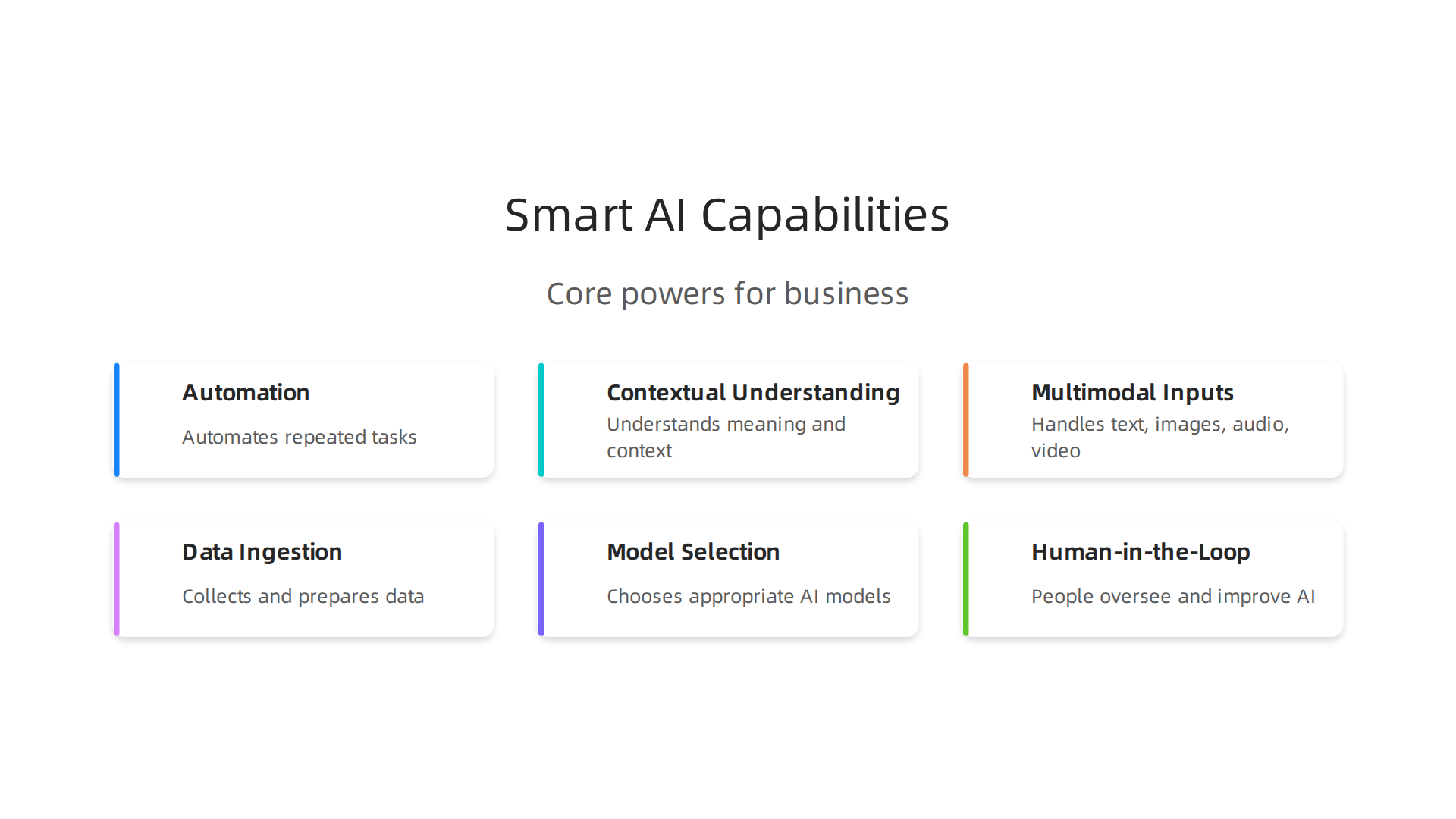
    Explore the fundamental powers that make smart AI systems valuable assets for businesses in 2026.

    Let’s look at what these "tech smart" systems offer:

    • Automation: One big power is automation. This means AI can take over boring, repeated tasks. Think of it helping with customer questions or sorting emails. This frees up your team to do more important work that needs human thought. If you want to dive deeper into how technology works in business, understanding what is information technology for business success in 2026 is a great step.
    • Contextual Understanding: Another key ability is contextual understanding. Smart AI doesn’t just look at words; it understands the meaning behind them, the situation, and past conversations. This is like having a truly smart assistant who "gets" what you mean, even if you don’t say it perfectly. For this to work well, having good and complete data is super important, as it helps AI make sense of everything 2026 State of Data Integrity and AI Readiness.
    • Multimodal Inputs: And these smart AI systems can now understand different types of information. This is called multimodal input. They can take in text, pictures, sounds, and even videos. This lets them handle more complex requests and give richer answers.

    So, where are businesses seeing the most help from smart AI right now?

    • Customer Service: Many companies use it in customer service. AI chatbots can handle a lot of common questions, helping customers faster and easing the workload for human agents.
    • Content Generation: Another popular use is creating content. From writing emails and social media posts to helping design marketing materials, generative AI tools are a huge help for marketing teams. A survey in March 2026 showed that many small businesses use AI tools for general business research and content creation, as well as operational tasks like marketing automation Small Business Technology Use Survey (March 2026). For those interested in this area, learning how to choose marketing automation software in 2026 can be very useful.
    • Operations: Beyond that, smart AI helps with daily operations. This includes things like managing projects, looking at sales data to find trends, and even making supply chains work better. These uses save time and money.

    When it comes to getting a return on investment (ROI), businesses often see results quickly in these areas. Tools that automate tasks and improve efficiency usually show value first.

    A diverse team collaborating around a whiteboard, representing effective teamwork and strategic planning enhanced by AI.

    Research shows a strong link between how well businesses use AI and how much money they save or earn From Exploration to Transformation—What AI Success Looks Like. Picking the right smart technologies is key to unlocking this growth.

    2) Key 2026 trends: model access, multimodality, and tool consolidation

    Now that we know what smart AI can do and where it helps businesses, let’s look at the big changes happening in 2026. These changes affect how companies get and use these powerful tools. It’s not just about what AI can do, but how you can get your hands on it and make it work for you.

    How Businesses Get Smart AI Today

    There are a few main ways businesses are getting their smart AI tools:
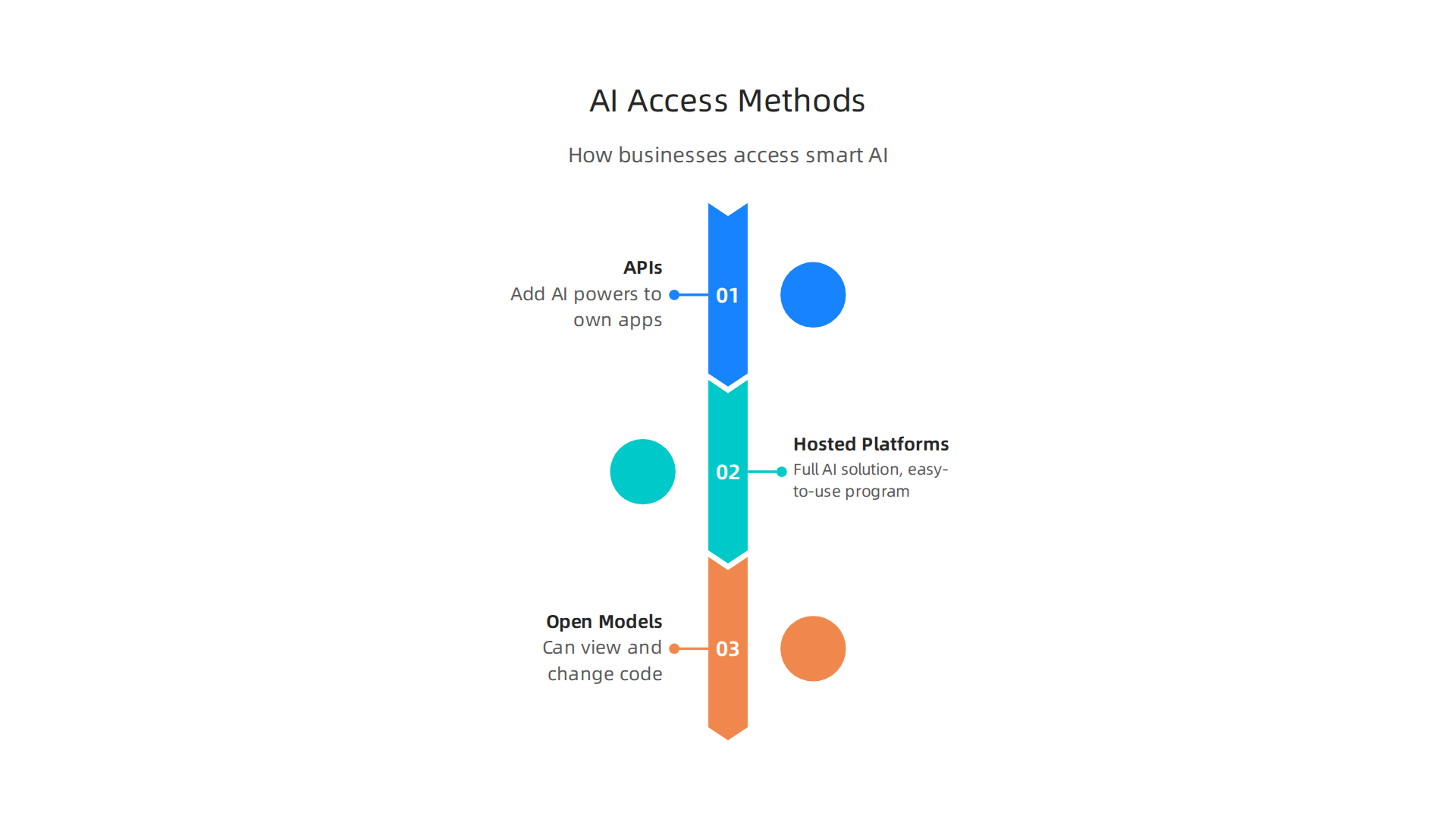
    An infographic illustrating the common methods businesses use to integrate smart AI tools into their operations.

    • APIs (Application Programming Interfaces): Think of APIs like ordering food from a menu. You ask for a specific AI function, and the AI service sends back the answer. This lets companies add AI powers to their own apps and systems without building everything from scratch. It’s very flexible and lets you use the best AI for each task.
    • Hosted Platforms: These are like all-in-one meal kits. A company offers a full AI solution, often with an easy-to-use website or program. You just log in and start using it. These are great for businesses that want a quick way to use AI without a lot of technical setup.
    • Open Models: Some smart AI models are open, meaning their basic code can be looked at and changed by anyone. This is like having a recipe you can tweak yourself. Open models can be very powerful because many people work to make them better, but they often need more technical know-how to set up and run.

    Each way has its own good and bad points, and the best choice depends on what a business needs and how much tech help they have. To really use AI well, businesses often need to choose the right tools for their team and goals. If you’re wondering about making the best choices for your business, you might want to learn more about how to choose AI for business tools that deliver real results in 2026.

    The Rise of Multimodal Smart AI

    We talked a bit about multimodal inputs before. This means AI can understand different kinds of information, like text, pictures, and sounds. In 2026, this ability is getting much stronger. Smart AI can now combine all these types of data to understand situations better and give more complete answers. For example, an AI could look at a customer’s message (text), a screenshot of their problem (picture), and even hear their voice (sound) to figure out what’s going on. The work on "Generative AI for multimodal content" shows how much this area is growing Generative AI for multimodal content: a survey with empirical and …. This is a big step forward because it helps AI act more like a human, understanding the full picture, not just parts of it.

    One Big Tool or Many Small Ones?

    Another big trend is how businesses decide between using one large AI system for everything or using many different specialized AI tools.

    • Consolidation: Some companies want one big AI platform that can do many different things, like marketing, customer service, and data analysis. This can make things simpler to manage, as you only deal with one vendor. It’s like buying all your groceries from one big supermarket.
    • Best-of-Breed: Other companies prefer to pick the very best AI tool for each specific job. They might use one smart AI for writing content, another for customer chat, and a third for looking at sales data. This can lead to better results for each task but means working with many different systems and vendors. It’s like going to different specialty shops for bread, cheese, and meat.

    Choosing between these options means thinking about how easy it is to manage versus getting the best performance. As smart AI becomes more complex, businesses also need to think about responsible AI use. This includes having good rules for how AI is used, to keep things fair and safe. In fact, setting up a proper system for checking and guiding AI is becoming very important for businesses, as discussed in the "Board-level governance and risk oversight framework for Artificial Intelligence systems" Board-level governance and risk oversight framework for Artificial Intelligence systems.

    No matter how you choose to use smart AI, staying informed about the latest changes and how they impact your business is key.

    Get clear daily AI updates from The AI Newsletter Worth Reading.

    To really make smart AI work for your business, it’s not enough to just pick the right tool. You also need to think about how all the different parts of AI will fit together, like building blocks in a wall. This collection of tools and how they connect is often called a "tech stack." In 2026, building a good smart AI tech stack means looking at several key layers and how they all integrate for different business needs.

    Core Layers of a Smart AI Tech Stack

    Think of a smart AI system as having different jobs, each handled by a specific layer in its tech stack.
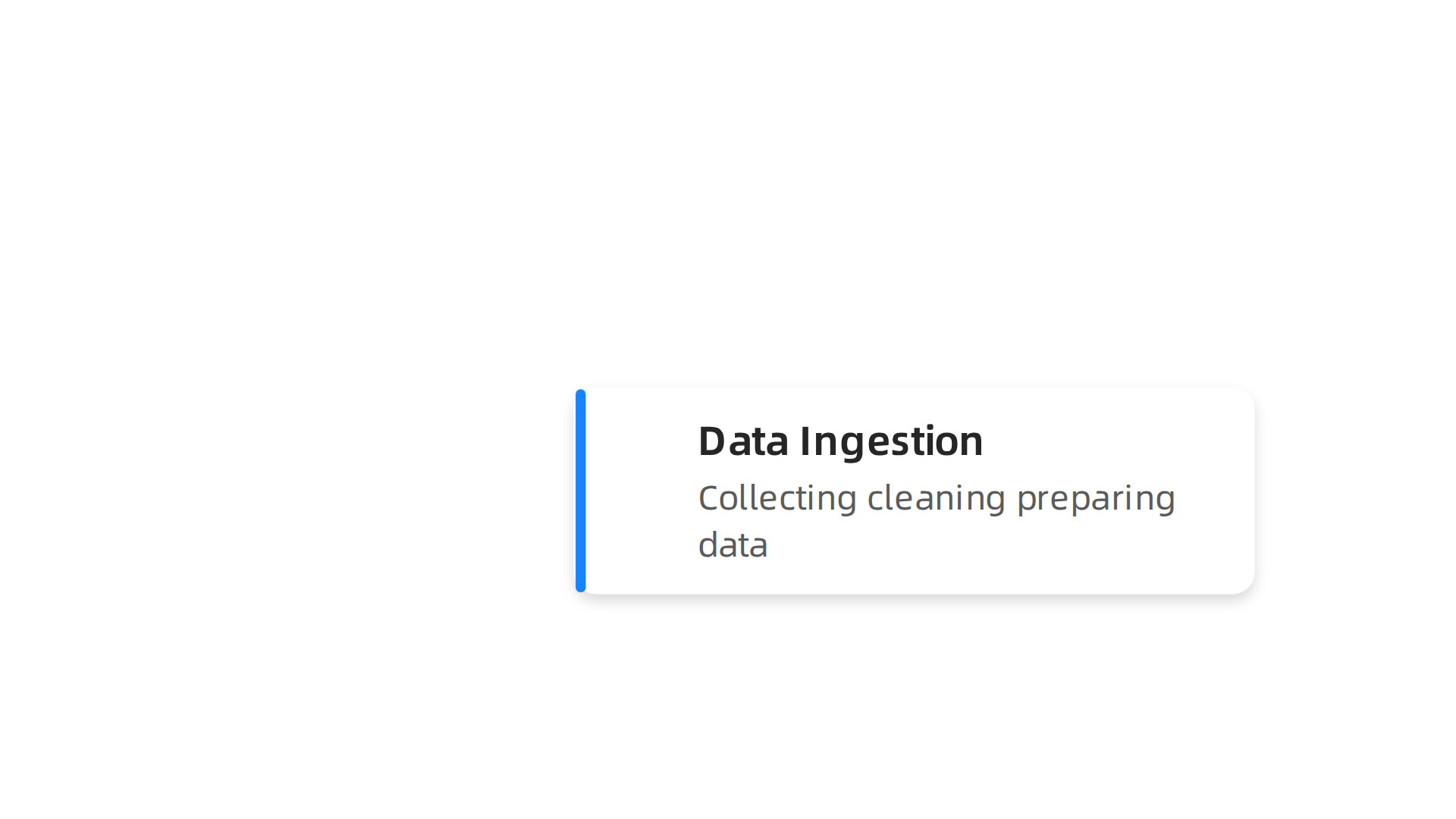
    Visual representation of the essential components that form a robust smart AI tech stack for businesses.

    These layers work together to make the AI powerful and useful.

    • Data Ingestion: This is how AI gets its food. AI needs a lot of information to learn and work, whether it’s text, pictures, or sounds. This layer is all about collecting, cleaning, and preparing that data. If the data isn’t good, the AI won’t be good either. Making sure your data is accurate and consistent is super important for AI readiness, as highlighted in the 2026 State of Data Integrity and AI Readiness report.
    • Model and Runtime Selection: This is where you pick the "brain" of your AI. It involves choosing the specific AI models that will do the work. As we discussed, these could be accessed through APIs, hosted platforms, or open models. Businesses need to choose the best AI tech products for their team in 2026 based on their tasks.
    • Orchestration: Once you have your data and your AI models, you need a way to make them all play nicely together. Orchestration is like a conductor for an orchestra. It manages how different AI tools and systems connect, share information, and run their tasks in the right order. This layer makes complex smart AI workflows feel smooth.
    • Observability: Just like you check a car’s dashboard, observability for AI lets you see how your smart AI systems are working. It helps you know if the AI is performing well, if it’s making good decisions, or if something is going wrong. This is key for responsible AI use, ensuring fairness and fixing problems quickly.
    • Human-in-the-Loop Controls: Even the smartest AI needs human guidance. This layer ensures that people can oversee, correct, and improve the AI’s work. It’s about building safeguards and making sure humans stay in charge. For example, setting up ways to check for and manage bias in AI is a big part of this, as explained by NIST’s work on managing bias in AI. The government also supports and contributes to technical standards for testing AI system components to ensure reliability and safety, which is crucial for overall responsible AI practices, according to a bill on the future of AI in 2026.

    Integration Patterns: Putting it All Together

    Businesses don’t just stack these layers randomly. They use different ways to put them together, called integration patterns, to fit their specific needs.

    • Turnkey Solutions: For many common business tasks, companies might choose ready-made smart AI platforms that already combine many of these layers. These are like buying a ready-to-assemble furniture kit. They are easier to set up and manage, especially for smaller businesses or those without a lot of specialized tech smart staff. You can find many options among the enterprise AI platforms for 2026.
    • Custom-Built Integrations: Other businesses, especially those with unique needs or large technical teams, might choose to build their AI stack from scratch. This involves more engineering effort but gives them full control to mix and match the best tools for each layer. They might use a "vendor-neutral" approach, meaning they can switch out different AI tools without being tied to one company, which is a growing trend for flexible deployment as discussed in research on vendor-neutral enterprise AI.

    The choice between these patterns depends on balancing the desire for top performance with the resources available to build and maintain the system. No matter which path a business takes, it’s essential to plan carefully to make sure their smart AI setup is strong, secure, and aligns with their goals. Ultimately, it’s about making smart choices to unlock growth by selecting the right smart technologies in 2026.

    Even with the best planning for your smart AI tools, it’s super important to think about the possible problems. Using smart AI comes with risks that businesses need to manage carefully.

    Professionals engage in a serious discussion, highlighting the critical need to address AI risks, governance, and ethical considerations.

    Just like any powerful tool, if not handled right, AI can cause issues.

    What are the main risks with smart AI?

    There are a few big kinds of risks when using smart AI:

    • Operational Risks: These are problems that can happen while your AI is actually working.
      • Data Leakage: Imagine your smart AI deals with private customer information. If there’s a security flaw, that information could get out. This is a big worry, as protecting data is a key part of Understanding Information Technology for Business Success.
      • Hallucinations: This is when AI, especially generative AI, makes up information that sounds real but isn’t true. For example, a customer service bot might give wrong answers or invent facts. This happens because AI models sometimes guess incorrectly, as noted in research on Hallucination in Multimodal Grounding and Reasoning.
    • Regulatory and Compliance Concerns: Governments and other groups are creating rules for how AI should be used. Businesses need to follow these rules, or they could face fines or other punishments. Keeping up with Mastering the AI Future Standard 2026 is a must. For instance, existing rules often do not fully cover AI-specific risks like how AI models might change over time or ethical issues, making new frameworks important for governance, risk, and compliance frameworks for AI Security.
    • Reputational Risks: If your smart AI system makes mistakes, acts unfairly, or causes problems, people might lose trust in your business. This can really hurt your brand and how customers see you.

    How to manage smart AI risks with good governance

    To keep these risks in check, businesses need strong rules and ways to oversee their AI systems. This is often called AI governance, and it’s all about making sure AI is used responsibly.

    • Access Limits: Control who can use and change your AI tools and the data they access. Only people who need to should have these permissions.
    • Monitoring: Keep a close eye on how your AI systems are working. Are they giving good results? Are there any unexpected behaviors? This helps catch problems early.
    • Human Review: Don’t let AI make all the decisions alone. Have human experts check key outputs or decisions made by the AI. This "human-in-the-loop" approach helps ensure fairness and accuracy.
    • Audit Trails: Keep detailed records of what your AI does, when it does it, and why. If something goes wrong, you can look back at these records to understand what happened and fix it. The NIST Artificial Intelligence Risk Management Framework offers guidance on how to manage these risks. Having a board-level framework for overseeing AI is also becoming essential for companies, as highlighted in research on risk oversight for Artificial Intelligence systems.

    Thinking about these risks and setting up good governance controls is just as important as choosing the right tech smart tools. It’s how businesses can truly embrace smart AI while protecting their operations, reputation, and customers.

    After setting up good rules to manage AI risks, the next big step is picking the right smart AI tools. It’s like finding the perfect helper for your business. With so many AI tools out there in 2026, it can feel like a lot. But don’t worry, there’s a simple way to look at them.

    A Simple Way to Pick Your Smart AI Tools

    To choose wisely, follow these steps:
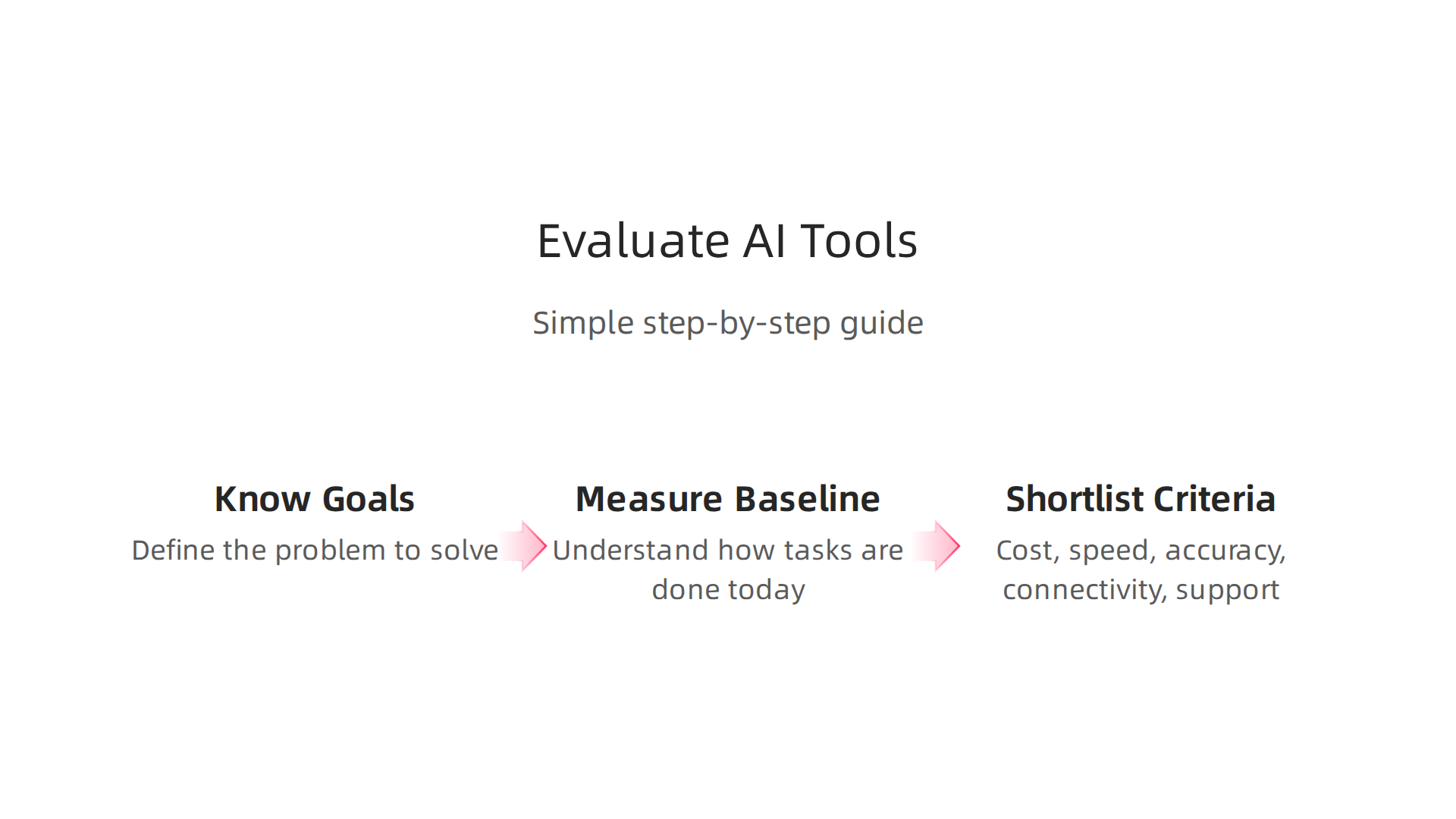
    A simple step-by-step guide for businesses to effectively evaluate and compare various smart AI tools.

    1. Know What You Want to Achieve: Before looking at any tool, ask yourself: What problem do I want to solve? What goal do I want to reach? For example, do you want to answer customer questions faster or write better marketing words? Knowing your goal makes it easier to find a tool that truly fits. Over 65% of companies are increasing their AI budgets this year, so making smart choices is key to seeing real returns AI Adoption Statistics 2026: Business & Enterprise Data.
    2. Measure How Things Work Now: Before using AI, understand how your tasks are done today. This is your "baseline." How long does it take? How much does it cost? What results do you get? This helps you see if the new smart AI tool actually makes things better later on.
    3. Make a Short List of Important Things: When comparing tools, think about these points:
      • Cost: How much does the tool cost to buy and use? Does it fit your budget?
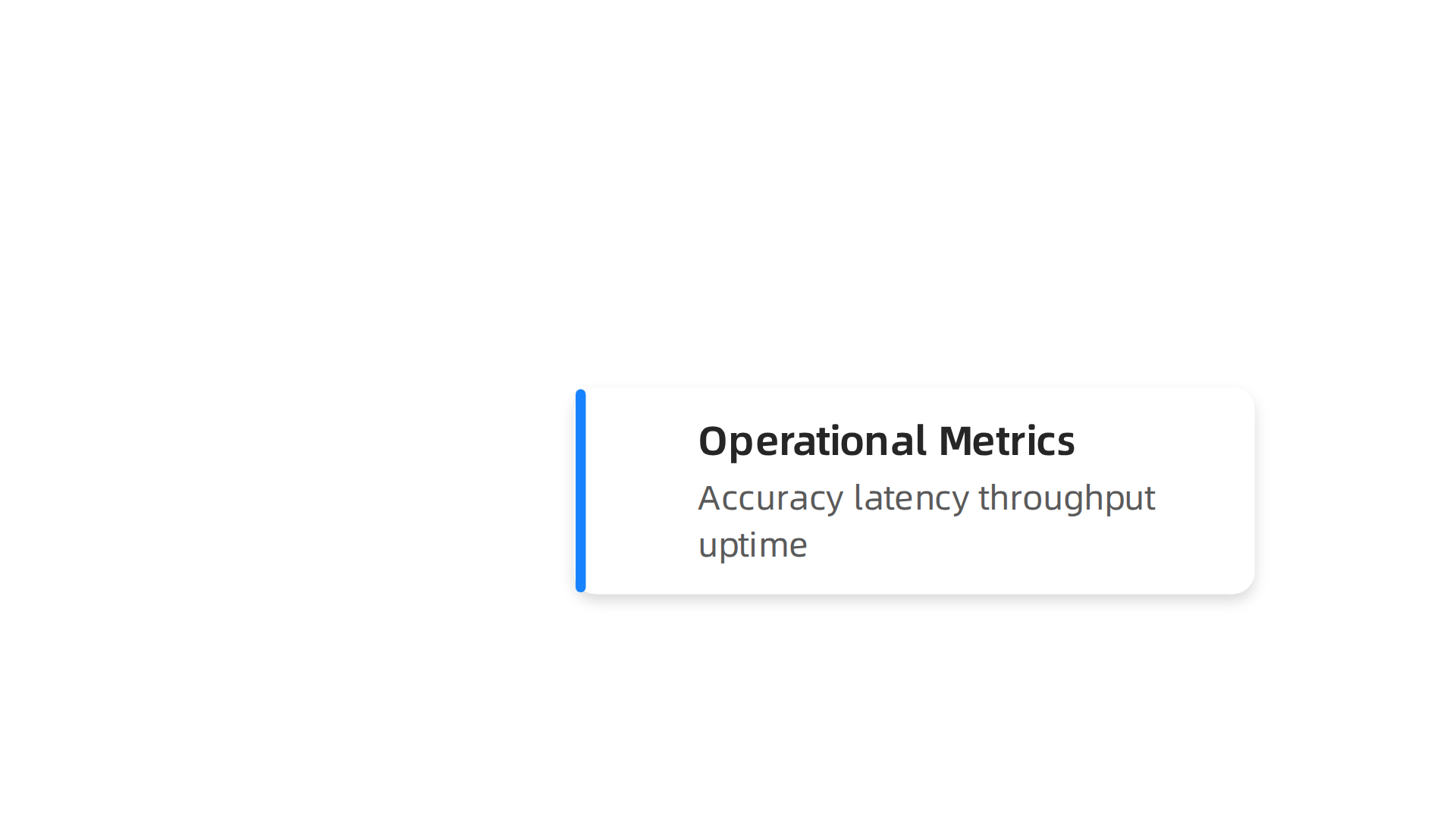
      • Speed: How fast does it work? Does it respond quickly enough for your needs? This is also called "latency."
      • Accuracy: Does the tool do what it’s supposed to do correctly? For example, if it answers questions, are the answers right?
      • Easy to Connect: Can the tool work well with the other software and systems you already use? This is called "integration." A tool that plays nice with your existing tech smart setup saves a lot of headaches.
      • Good Help: If you have problems, can you get good support from the company that made the AI?

    Testing AI Tools Before You Go All In

    It’s a smart idea to test a new AI tool with a small project before using it everywhere in your business. This is called a "pilot."

    • Design a Small Test: Pick a specific task where the AI can help. Run the AI tool alongside your usual way of doing things.
    • Watch for Success: During the pilot, keep an eye on your goals. Is the AI saving time? Making fewer mistakes? Giving better results? These are your "success metrics." Many companies start with pilots, but only a small number move them to full use, so testing well is important Deloitte State of AI: 2026 Key Takeaways.
    • Roll Out Carefully: If the pilot shows good results, then you can slowly start using the smart AI tool more widely. This responsible AI approach helps make sure it works well for everyone.

    By thinking through these steps, you can choose AI tools that truly help your business grow. If you’re looking for more guidance on picking the best solutions, check out our guide on how to choose AI for business tools that deliver real results in 2026. It’s all about making informed choices for your tech smart future.

    Want to keep up with the latest AI trends and how they impact businesses like yours? Get clear daily AI updates from The AI Newsletter Worth Reading.

    After running small tests with AI tools and seeing good results, the next big step is to plan how to use these tools more widely in your business.

    A team celebrates a successful project, symbolizing positive outcomes of well-managed AI adoption and change management.

    This means thinking carefully about your team, your money, and how everyone will learn to use the new smart AI helpers.

    Staffing Your Smart AI Journey

    To truly make a smart AI tool work well for your business, you need the right people. You have a few choices for how to get this done:

    • Your Own Team: Your current team members can learn new skills to work with AI. This helps them grow and become even more useful.
    • Contractors: For special tasks or when you need extra help for a short time, you can hire outside experts called contractors. They can quickly help set up new AI systems.
    • Vendors: The companies that make the AI tools often give support and services. They can guide you on how to best use their products. This mix of help ensures your information technology definition is ready for all the new smart tech. Many businesses are giving more workers access to AI tools. About 60% of workers now have official AI tools to use, which is a big jump from before Organizations Stand at the Untapped Edge of AI’s Potential … – Deloitte.

    Planning Your AI Budget

    Just like staffing, how you spend money on AI needs careful planning. In 2026, companies are putting a lot of money into AI. For example, some expect to spend around $207 million on AI in the next year. This is almost twice what they spent last year [PDF] AI Quarterly Pulse Survey – Q1 2026 – KPMG International.

    • Pilot Phase: The small test projects you did will need some money. This is for trying out the tools before you commit.
    • Scaling Up: When you decide to use AI more widely, you will need a larger budget. This money goes towards buying the tools, training your team, and getting expert help when needed.

    Managing Change to Drive Adoption

    Even the best smart AI tool won’t help your business if people don’t use it. This is where "change management" comes in. It is about helping everyone in your business understand, accept, and use new ways of working with AI.

    • Explain the "Why": Clearly tell your team how the new AI tools will make their jobs easier or better. This helps them see the value.
    • Offer Training: Show your team exactly how to use the new tools well. Good training makes people feel more confident.
    • Listen to Feedback: Ask your team what works and what does not. Make changes based on what they say. This thoughtful approach helps create a truly tech smart workplace and makes sure the AI adoption is responsible. It helps ensure that these changes bring real value to your business.

    Summary

    This primer explains what

  • Evaluate AI Companies to Unlock Business Growth in 2026

    Evaluate AI Companies to Unlock Business Growth in 2026

    Why AI company profiles matter now

    It feels like new AI tools and companies pop up every day. In 2026, many businesses are using artificial intelligence more than ever before. This means there’s a lot of information out there, which can feel like too much to handle. How can you find the best AI tools when so many companies, even those offering synonym technologies, are all trying to get your attention? It’s tough to know who to trust or what truly works.

    When you are a business leader, you need good and true information to make smart choices.

    A business leader confidently making decisions based on reliable information.

    You need to know which AI companies are worth looking into. For example, understanding what makes an rb tech company different from an ascend technologies provider is key. Without clear facts about each company, it is hard to pick the right tools that will help your business grow. Getting good information helps you make sure you pick solutions that are a good fit and will actually help you. This avoids wasting time and money on the wrong things.

    Many businesses are quickly bringing AI into their work. For instance, reports show that a good number of companies are already using AI, and this number is still growing fast in 2026 Enterprise AI Adoption Statistics 2026. This rapid growth makes it even harder to keep up. You might be looking for tools from companies like blueprint technologies or prince tech and wonder how they stack up against each other. It’s not just about finding any AI tool, but finding the right smart technologies to help your business unlock growth.

    This article is here to help you. We will show you how to look at AI company profiles with a clear eye. You will learn how to spot important signals, compare what different companies offer, and match vendors to your specific needs. By the end, you will feel more confident in choosing the best AI partners for your business.

    To stay updated on the fast-changing world of AI, there’s a great resource. You can get clear daily AI updates and dive deeper into technology insights.
    The AI Newsletter Worth Reading

    Now that you know why looking closely at AI companies is so important, let’s talk about what things to check for in their company profiles. Think of it like checking out a new toy before you buy it. You want to know what it does, how it works, and if it’s safe.

    Key Things to Look for in an AI Company

    When you read about an AI company, you need to find out a few main things. These will help you see if they are a good fit for your business.

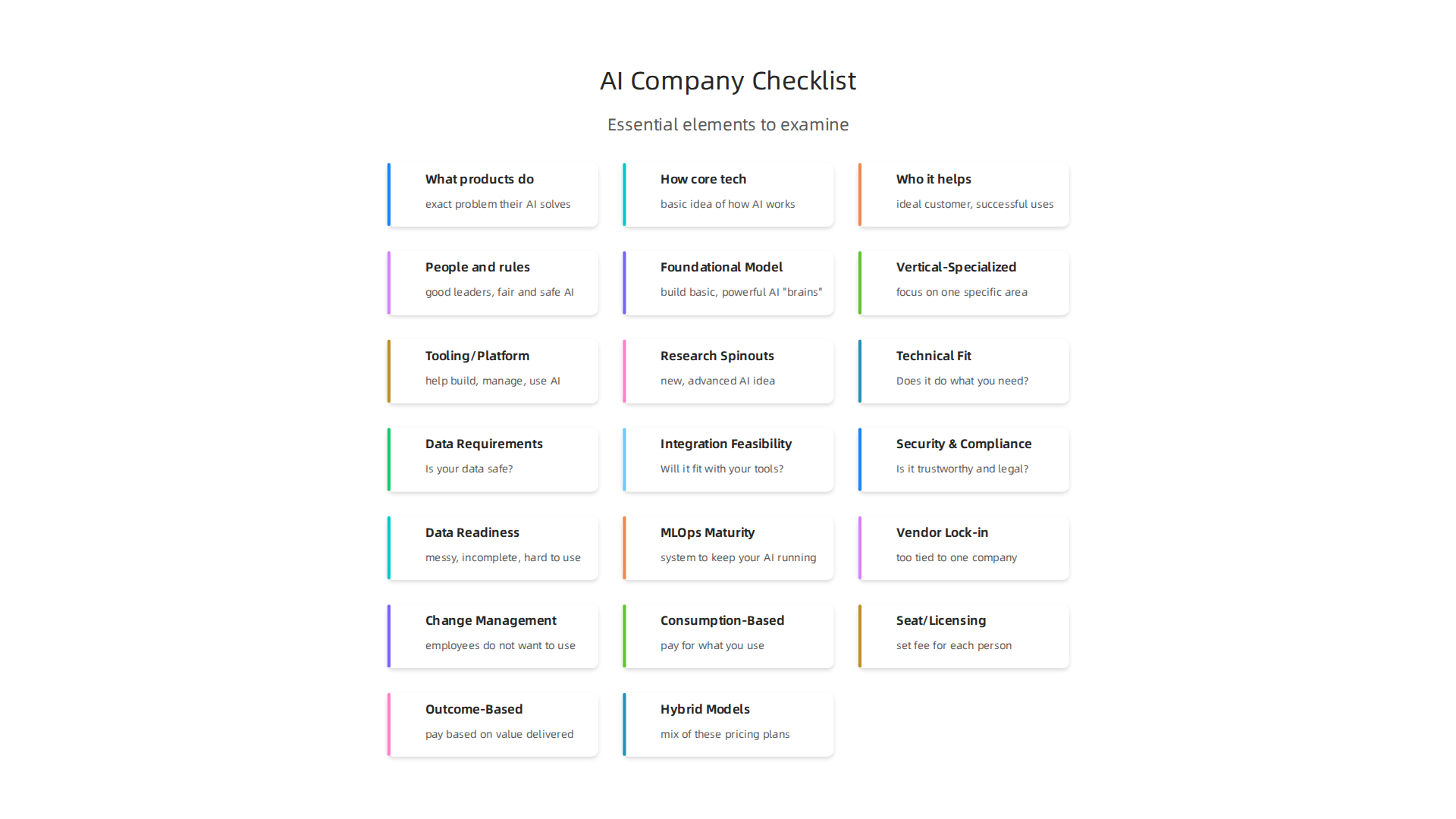
    Essential elements to examine when evaluating an AI company's profile for business fit.

    • What their products do: This is about understanding what the AI tool is made for. Does it help with writing? Does it manage data? Companies like rb tech might focus on one type of AI, while ascend technologies might offer something very different. You need to know the exact problem their AI solves. If you’re looking for synonym technologies to improve your content, you need to make sure their product actually does that.
    • How their core tech works: You don’t need to be a computer expert, but you should get a basic idea of how their AI works. Is it new and clever, or is it using older methods? This helps you understand if their tool is strong and modern.
    • Who it helps and how: Every AI tool is made to help certain people or businesses with certain tasks. Does the company clearly say who their ideal customer is? For example, blueprint technologies might be great for big factories, while prince tech might be better for small shops. Look for examples of how other businesses like yours have used their tools successfully.
    • The people and their rules: Who are the smart people making the AI? Do they have good leaders? Also, how does the company make sure its AI is fair and safe? This is called "governance." You want to pick a company that cares about using AI in a good way.

    Signs of a Strong, Safe AI Company

    It’s not enough to just know what an AI company offers. You also need to know if they are reliable and if their tools will work well for a long time.

    • Who has used them before: A good sign is when other real businesses have used their AI tools and are happy with them. Look for stories or examples of how their tools were used in the real world. This shows the company is not just new ideas, but has actual working solutions.
    • How they follow the rules: AI is getting more rules and laws around it every day. A good company will know these rules and make sure their AI follows them. This is called "compliance." It means their tools are safe and won’t cause problems with important rules about data or privacy. Companies that don’t follow the rules can bring risks to your business. Actually, in 2026, many business leaders see skill gaps as a big hurdle to using AI safely and effectively 70 Enterprise AI Statistics for 2026: Adoption, ROI & Trends.
    • How well their tools connect with others: Most businesses use many different computer programs. You want an AI tool that can easily connect and work with your existing systems. This makes it much easier to use and helps everything run smoothly. When picking AI for your business, it’s key to choose tools that actually deliver results and fit well into your current setup. To learn more, check out this guide on how to choose AI for business tools that deliver real results.

    Choosing the right AI tools isn’t just about what they do, but also about who makes them. Think of it like buying a car. You wouldn’t just look at the color; you’d also want to know if it’s made by a company known for sports cars, family cars, or rugged trucks. The type of company tells you a lot about what to expect. In 2026, the world of AI innovators is full of different kinds of businesses, and knowing their type helps you pick the best one for your needs.

    Top types of AI innovators to watch in 2026

    When you look at different AI companies, you’ll see they often fall into a few main groups. Understanding these groups is super important for your business. It helps you guess what kind of new things they might make in the future, how hard it will be to connect their tools with what you already use, and even how much they might cost. Just like how you’d use a general guide to pick any AI vendor, understanding their core business type gives you an even clearer picture AI Vendor Evaluation Checklist: 30+ Enterprise Questions.

    Here are the main types of AI innovators you should know:

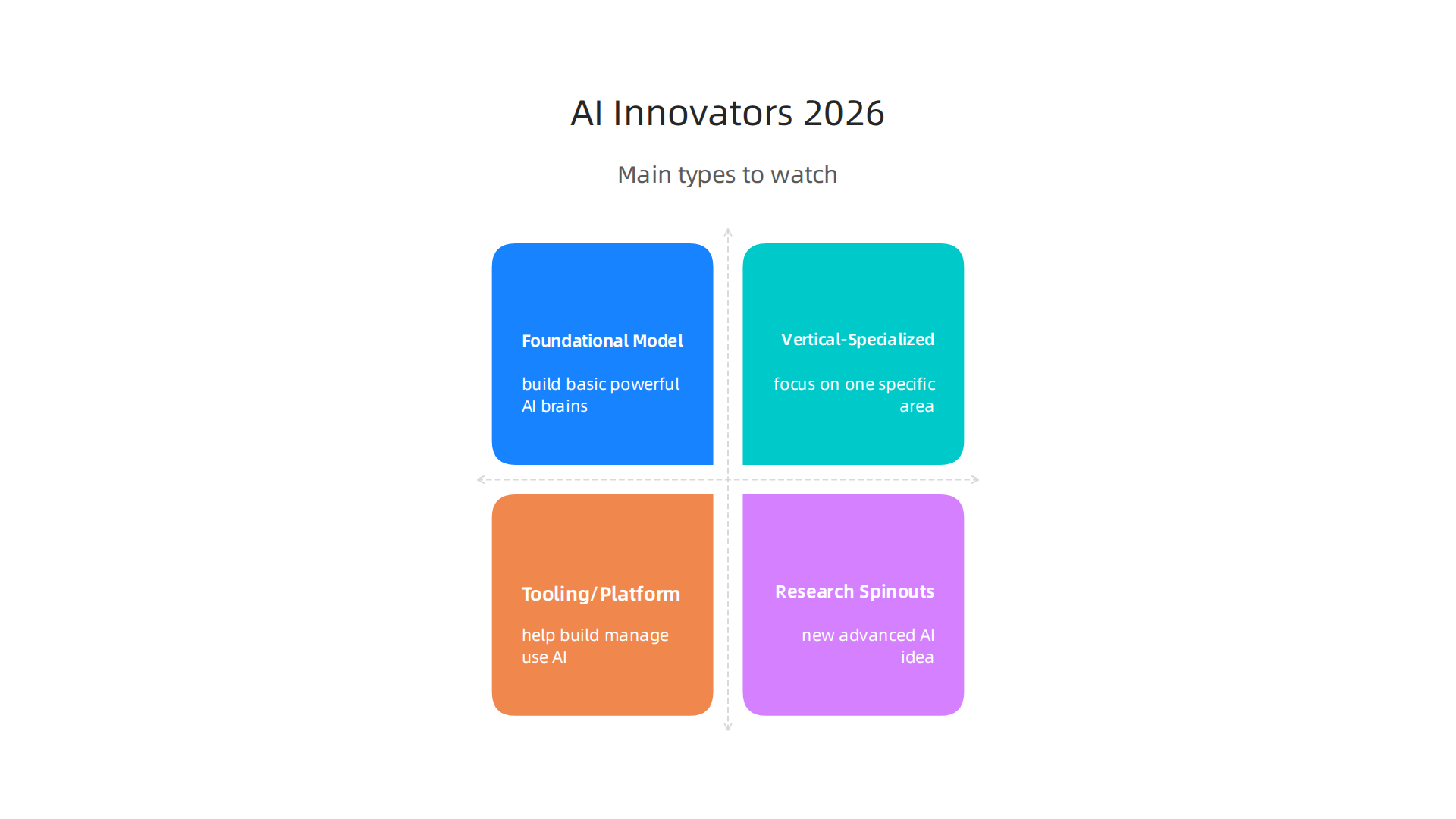
    An overview of the main categories of AI innovators shaping the market in 2026.

    • Foundational Model Providers: These are the big players. They build the very basic, powerful AI "brains" that other companies then use to make their own tools. These companies focus on creating large AI models that can do many things, from writing to understanding pictures. They often lead the way in new AI discoveries.
    • Vertical-Specialized Startups: These companies focus on one specific area, or "vertical," for their AI tools. For example, some might only make AI for healthcare, while others focus on marketing. They might not make the foundational models themselves but use them to build very clever tools for their chosen niche. A company like rb tech might specialize in AI for manufacturing, or ascend technologies could be focused solely on customer service AI.
    • Tooling/Platform Vendors: These innovators create the tools and platforms that help other businesses build, manage, or use AI. They don’t necessarily make the AI itself, but they make it easier for you to work with AI. If you’re looking for synonym technologies to help make your content better, a tooling vendor might offer a platform that lets you fine-tune AI for your specific writing style.
    • Research Spinouts: Sometimes, a new AI company comes right out of a university or a big research lab. These "spinouts" are often focused on bringing a very new, advanced AI idea into the real world. They might be smaller, but their technology can be cutting-edge. For example, a new solution from blueprint technologies or prince tech could come from deep academic research.

    Why does knowing these types matter? Well, a foundational model provider might have a long-term plan (a "product roadmap") that focuses on making their core AI smarter. A specialized startup, on the other hand, will likely have a roadmap focused on adding more features for their specific industry. The way their tools connect with your existing systems (integration complexity) can also differ. Foundational models might require more technical know-how to integrate, while a tooling vendor might offer simpler plug-and-play options. And, of course, the cost models can be very different. Some charge based on how much you use their AI, while others have monthly fees for their platforms.

    Understanding these different types will give you a much better idea of whether an AI company’s offerings truly match what your business needs for growth and innovation. To go deeper into finding the right solutions, explore more about enterprise AI platforms 2026 top providers and how to choose the right one.

    Staying updated on all these different types of AI innovators can feel like a lot. That’s why many business leaders turn to daily summaries to keep up.
    Get clear daily AI updates from The AI Newsletter Worth Reading.

    You know, choosing the right AI isn’t just about what kind of company makes it, but also about how well that AI tool truly fits your business. It’s like buying shoes. Knowing if a company makes running shoes or dress shoes is good, but you also need to try them on to see if they fit your feet and your needs.

    In 2026, with so many AI tools out there, having a clear way to check them is super important. This means looking at more than just what the AI promises to do. You need to dig a little deeper.

    A person thoughtfully considering options, symbolizing a deep evaluation process.

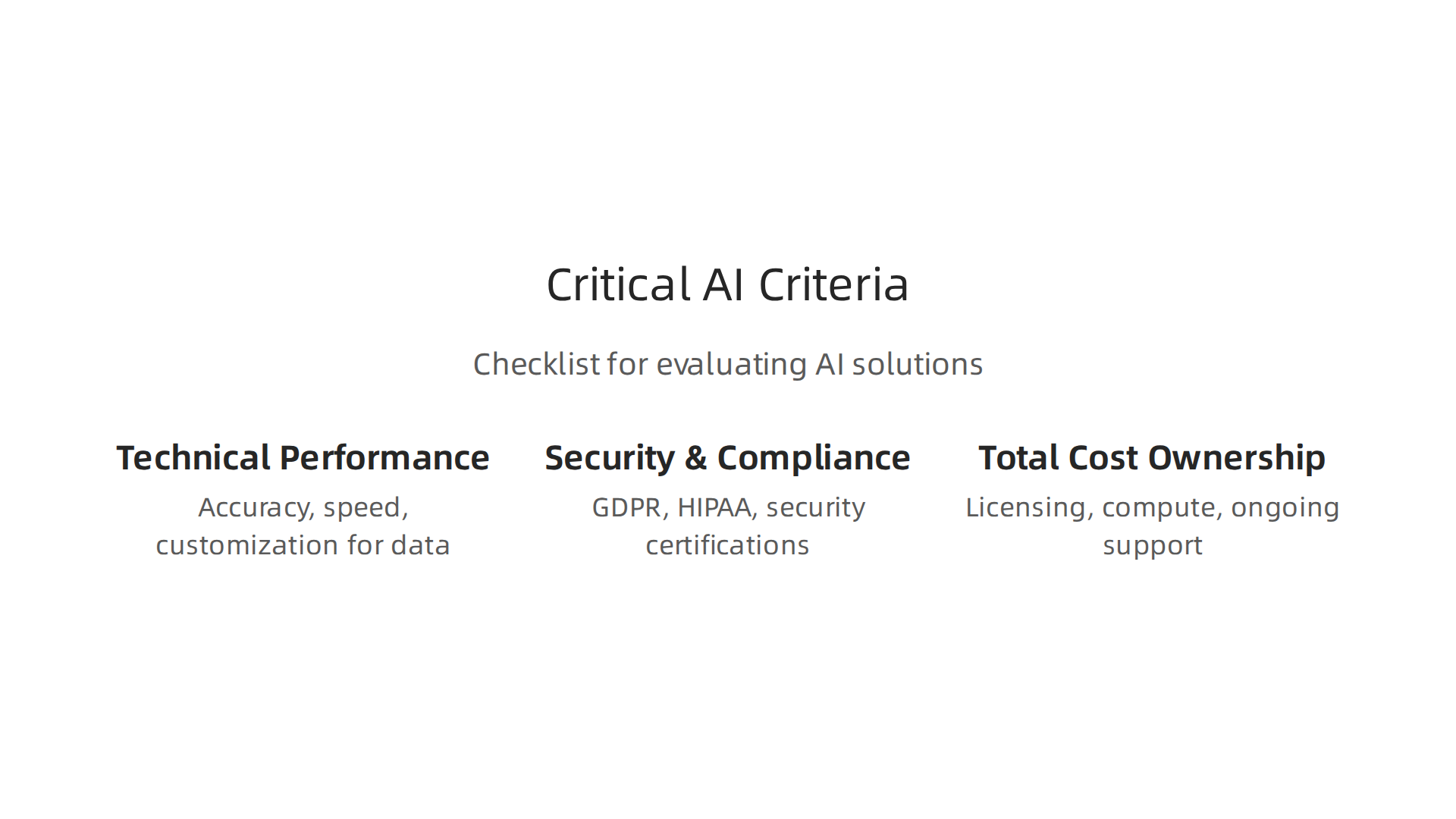
    How to evaluate AI companies and technologies (checklist)

    To pick the best AI for your business, you need a plan, almost like a checklist. This helps you look at all the important parts of an AI tool and the company behind it. Think of it as a step-by-step guide to make sure you get a tool that really works for you and keeps your business safe. Many experts agree that a structured framework is key for evaluating any AI vendor AI Product Evaluation Checklist.

    Here’s how to evaluate AI companies and technologies:

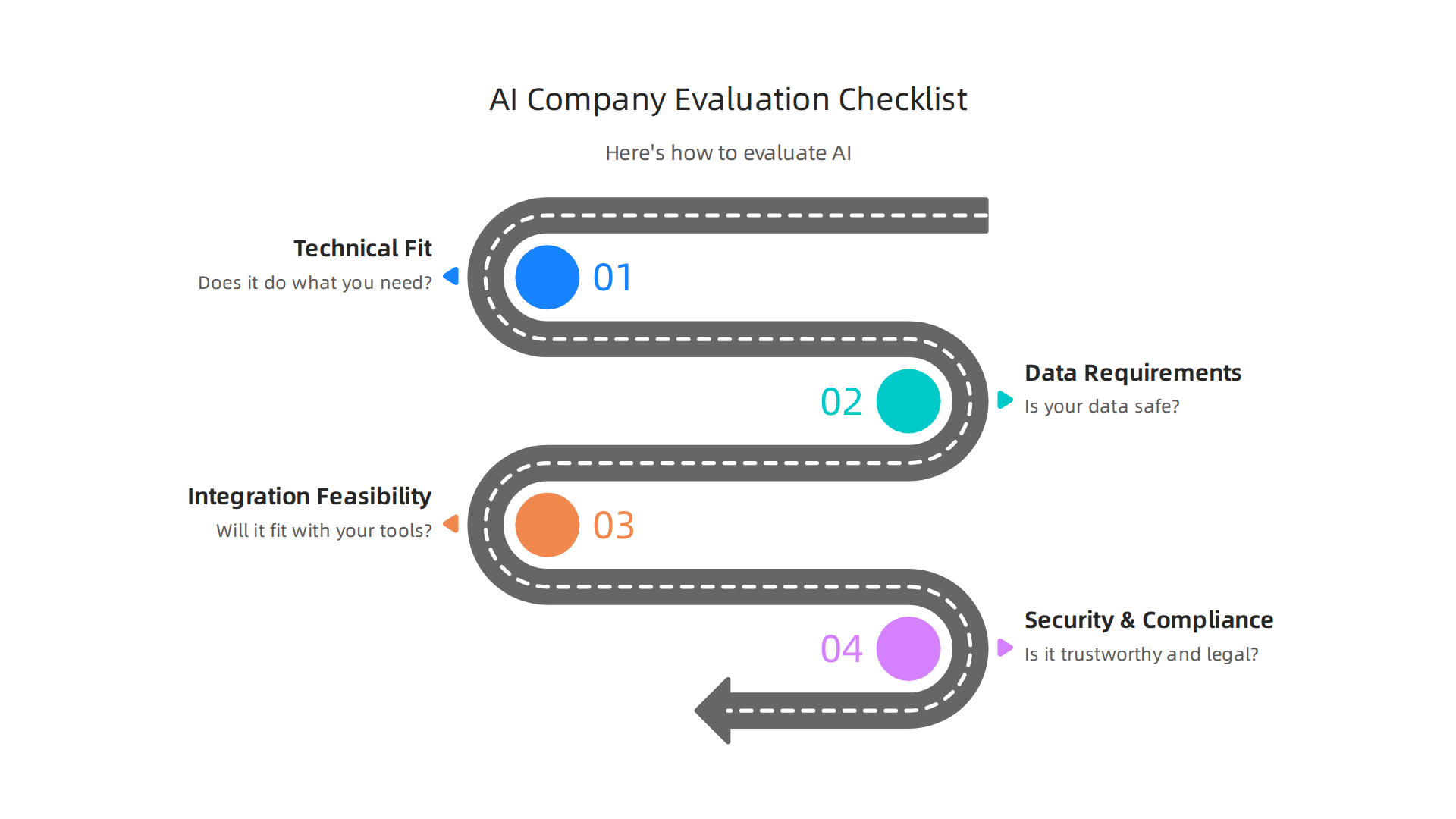
    A checklist for evaluating AI companies and their technologies to ensure the right fit.

    1. Technical Fit: Does it do what you need?

    First, you need to know if the AI tool can actually do the work you want it to.

    • What to ask vendors:
      • Can you show us how it solves our specific problem? For example, if you need a tool for better content writing, can synonym technologies show how their AI helps improve your drafts?
      • What kind of data does it need to work best? Some AIs work well with simple text, others need lots of pictures or numbers.
      • How accurate is it? No AI is perfect, but you want one that makes very few mistakes for your important tasks.
      • Can it handle a lot of work? If your business grows, will the AI still keep up?
    • What to check yourself:
      • Look for reviews or success stories from other businesses like yours.
      • Ask for a trial period. This lets you try the AI in your own business setting.
      • See if the AI output has any biases. This is a common issue and something to watch out for, especially when using AI in education How District Technology Directors Should Evaluate AI Vendors.

    2. Data Requirements & Handling: Is your data safe?

    AI tools often need access to your business data. This means you need to be very careful about how they handle it.

    • What to ask vendors:
      • Will our data be used to make their AI smarter (train their models)? You often want to say no to this to keep your information private.
      • Where is our data stored? Is it in your country?
      • What steps do they take to keep your data private and safe?
      • Do they follow rules like GDPR or other privacy laws in 2026?
      • Can we get our data back if we stop using their service?
    • What to check yourself:

    3. Integration Feasibility: Will it fit with your other tools?

    It’s rare to use just one tool. You need your new AI to work smoothly with the programs you already have.

    • What to ask vendors:
      • How easy is it to connect their AI with our current software, like our customer service system or our marketing tools?
      • Do they offer help with setting it up?
      • Will we need our own IT team to do a lot of work to get it running? This is especially true for specialized companies like rb tech or ascend technologies who might have unique integration needs.
    • What to check yourself:
      • Look at how complex the integration process seems.
      • Talk to other companies that have integrated the same AI tool.
      • Think about if you want a tool that can connect with many different systems, or if you prefer a single platform approach. You might find a tool that helps you unlock growth by selecting smart technologies if it integrates well.

    4. Security & Compliance: Is it trustworthy and legal?

    This is super important. An AI tool that isn’t secure or doesn’t follow the rules can cause big problems for your business.

    • What to ask vendors:
      • How do they test their AI for weaknesses? Are they transparent about their security practices? Red teaming evaluations can be a good way to test this OWASP Vendor Evaluation Criteria for AI Red Teaming.
      • What rules or laws does their AI follow (like healthcare rules if you are in health)?
      • What happens if something goes wrong? Who is responsible?
    • What to check yourself:
      • Look for third-party audits or security reports.
      • Check for any past security problems or data leaks linked to the company.
      • Ensure they have a clear plan for AI governance AI Governance Vendor Report 2026.

    Red Flags to Watch For

    When evaluating, keep an eye out for these warning signs:

    • No clear answers: If a vendor avoids your questions about data, security, or how their AI works, that’s a problem.
    • Too good to be true: If an AI promises amazing results with no effort or cost, be careful. Real AI solutions require thoughtful implementation.
    • No testing or validation: If the company only says their AI works great without showing any outside proof, like studies or expert reviews, you should be wary. Even advanced research spinouts like blueprint technologies or prince tech should be able to offer some proof of concept.
    • Hidden costs: Make sure you understand all the fees involved, not just the basic price. Some AI pricing models are very complex and can include usage-based fees on top of subscriptions Understanding Enterprise AI Pricing Models.

    By using this kind of checklist, you can be much more confident that the AI tools you choose will truly help your business grow and succeed in 2026. This process helps you choose not just an AI tool, but the right AI tool.

    The previous section helped you choose the right AI. Now, let’s talk about what happens when you start using it. Even the best AI tools, like those from synonym technologies or rb tech, can face problems when you try to put them to work in your business. It’s like buying a new car; you might have picked the perfect one, but actually driving it every day comes with its own set of challenges. In 2026, many businesses find that their AI projects, especially pilot programs, do not go as planned. In fact, some reports show that a very high number of AI pilot projects fail to move past the testing phase MIT report: 95% of generative AI pilots at companies are failing.

    Implementation challenges and integration strategies

    Getting AI to work smoothly in your business can be tricky. Here are some common hurdles and how to jump over them.

    Key practical challenges often faced during AI implementation in businesses.

    Common practical challenges

    1. Data Readiness: AI tools need good data, like a chef needs fresh ingredients. If your data is messy, incomplete, or hard to use, the AI will not perform well. This "dirty data" is a big reason why many AI projects stall before they even properly begin Why most AI procurement pilots stall (and what to fix before yours does). Companies often have to spend a lot of time cleaning up their information first.
    2. MLOps Maturity: This fancy term just means having a good system to keep your AI running well, making sure it learns and gets better over time. If your company, say like ascend technologies, does not have a clear way to manage and update its AI tools, they might stop being useful after a while. Many businesses do not set up proper production standards or ownership from the start Why AI Pilots Fail and How Yours Can Succeed.
    3. Vendor Lock-in Risks: Sometimes, when you pick an AI tool, you might get too tied to one company. This means it becomes very hard to switch to another AI later if you need to. While buying from big, known companies is often safer, relying too much on small, new startups can carry more risk of getting stuck Why 95 Percent of AI Pilots Are Failing (And How to Avoid the Trap in Insurance). Even promising new ventures like blueprint technologies or prince tech should have clear exit strategies.
    4. Change Management: This is about people. It is often the biggest problem. Even if an AI tool is great, if your employees do not want to use it or do not know how, it will not help your business. Resistance to new tools is a top reason why AI projects fail Why AI Pilots in Procurement Fail and How You Avoid Pitfalls. They might worry about their jobs or simply prefer the old ways.

    Smart ways to make AI work in your business

    Do not worry, there are good ways to handle these challenges!

    A team working together, strategizing to overcome implementation challenges.

    1. Pilot Design: Instead of trying to use AI everywhere at once, start small. Design a "pilot" project to test the AI in a specific area. Make sure this pilot has clear goals. Many pilots fail because they are designed just to look good, not to solve real problems with measurable success The AI pilot trap, and how the best companies escape it. You need to define what success looks like right from the start.
    2. Incremental Architecture: This means building up your AI use step by step, rather than trying a huge overhaul all at once. Like building with LEGOs, you add one piece at a time. This helps you learn and adjust as you go, making the whole process less risky.
    3. Sandboxing: Think of this as a safe playpen for your AI. You test it in a separate, controlled environment before letting it loose on your main business operations. This helps catch any problems or surprises without affecting your daily work.
    4. Clear KPIs for Pilots: KPI stands for "Key Performance Indicator." These are clear numbers or goals that tell you if your AI pilot is truly working. For example, if you are using synonym technologies to improve content, a KPI might be "reduce editing time by 15%." Having these clear goals helps everyone know what success means and guides the project. Do not forget to focus on solving real problems with measurable pain points, not just picking the coolest new tech Why AI Pilots Fail. This will help you choose AI for business tools that deliver real results.

    By thinking ahead about these challenges and using smart strategies, your business can make AI work for you, helping you grow and do things better in 2026.

    To keep up with the latest in AI and technology, consider subscribing to The AI Newsletter Worth Reading for daily updates.

    After understanding how to make AI tools work in your business, the next big questions are about money: "How much will it cost?" and "What will I get back?" In 2026, choosing the right commercial model for your AI and figuring out its true value, or Return on Investment (ROI), is just as important as picking the right tool itself.

    Commercial models, pricing signals, and ROI considerations

    When you bring AI into your business, you need to think about how you will pay for it and what benefits you expect to see. This helps you understand the full picture, from spending to earning.

    Different ways to pay for AI tools

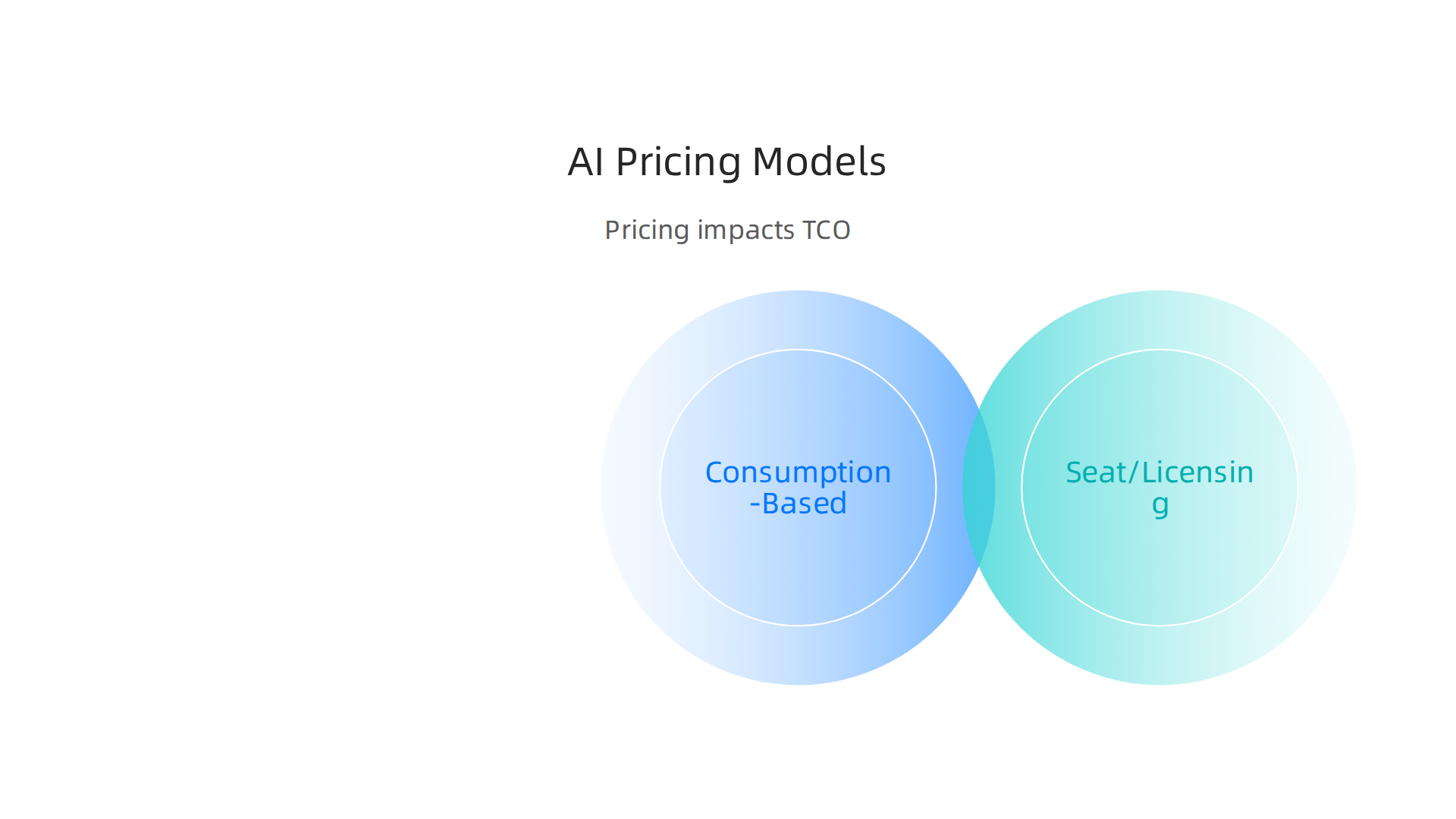
    AI tools come with different pricing plans, just like phones or internet services. Knowing these helps you figure out your Total Cost of Ownership (TCO), which is the full cost of having and using the AI over time.

    Different commercial models for AI tools, impacting total cost of ownership.

    1. Consumption-Based Pricing: This is like paying for electricity; you only pay for what you use. For AI, this could mean paying for each task the AI does, like every time an AI from synonym technologies generates a piece of text or every customer question an AI chatbot answers. This model is becoming very popular because it matches costs to actual use and results The AI pricing and monetization playbook.
    2. Seat/Licensing Models: Here, you pay a set fee for each person who uses the AI tool, or for a certain number of licenses. This is a common way to pay for many software tools, including some AI programs from companies like rb tech. While it offers predictable costs, it might not be the most efficient if not everyone uses the AI equally.
    3. Outcome-Based Pricing: This model is all about the results. You pay the AI provider based on the value or benefits the AI delivers. For example, you might pay an AI from ascend technologies that helps with sales a percentage of the new sales it brings in, or a tool that saves costs a share of the money saved. This means the AI company only gets paid more when you see clear success AI Model Pricing Strategies: Value-Based & Outcome-Driven. This approach can be great for aligning everyone’s goals.
    4. Hybrid Models: Many AI tools use a mix of these. For instance, you might pay a small base fee (like a subscription) plus extra based on your usage or the outcomes achieved. This can offer a balance between predictable costs and paying for actual value. Understanding these models is key to knowing your overall AI spending Understanding Enterprise AI Pricing Models: A Guide to ….

    Figuring out your AI’s Return on Investment (ROI)

    ROI tells you if the money you put into AI is worth it. It is about getting more value back than you spent.

    • Short-Term Pilot Metrics: When you first start with an AI pilot, like with a new tool from blueprint technologies, you need to track clear, small wins. This could be how much time employees save on a certain task, how many fewer errors are made, or how quickly customers get help. These early numbers help you see if the AI is working as expected before you use it everywhere. You need to focus on measurable benefits even in early stages AI Implementation Case Studies: Real Enterprise Results ….
    • Long-Term Operational Impact: Over time, AI should do more than just improve small tasks. It should change how your business runs for the better. This could mean happier customers, new ways of doing business, or big cost savings. For example, some companies have used AI to save millions in labor costs or cut down on unplanned machine downtime significantly AI Cost Reduction Strategies: Case Studies. Tools like prince tech might aim to reshape entire departments.
    • What to Track: To show good ROI, keep an eye on key numbers. This includes how much money you save, how much more money you make, how much time is freed up, and how much happier your customers or employees are. Using an AI Agent ROI Calculator: Enterprise Business Case Template can help you set up and track these important numbers.

    By carefully considering how you pay for AI and what real-world benefits it brings, your business can make smart choices that lead to true growth and success in 2026. This means more than just having cool tech; it means making that tech work hard for you. If you want to dive deeper into how businesses adopt smart technologies for growth, read our guide on how to Unlock Growth by Selecting the Right Smart Technologies in 2026.

    Emerging trends and what they mean for SMBs

    As we think about making smart choices for AI, it is also important to look ahead.

    A person staying informed about emerging technology trends by reading news.

    The world of AI is always changing, and some big trends are shaping how businesses will use these tools in 2026 and beyond. Knowing about these changes can help small and medium-sized businesses (SMBs) plan better.

    Big trends to watch in AI

    Think of AI as a fast-moving river. These are the main currents:

    • Composability: This means building AI solutions like LEGO blocks. Instead of one big, all-in-one AI tool, businesses can pick and choose different AI parts and put them together to create a custom solution. This gives companies like rb tech or those working with synonym technologies more flexibility to build exactly what they need.
    • Model Specialization: AI models are becoming super good at very specific jobs. Instead of a general AI that does many things okay, you will find AIs that are amazing at writing marketing emails, or perfect for spotting certain things in pictures. This means better results for niche tasks.
    • Vendor Consolidation: Bigger tech companies are buying up smaller AI startups. This means there might be fewer choices for AI tools in the future, but the remaining options could be more robust. It is a good idea to watch who is buying whom in the AI space, especially for tools offered by companies like ascend technologies.
    • Regulation Impacts: Governments around the world are starting to make rules about how AI can be used. These rules will cover things like privacy, fairness, and safety. SMBs need to stay updated on these laws, as they will affect how you can use AI and what kinds of data you can feed into it.

    What these trends mean for small and medium businesses

    For SMBs, these trends have real-world effects on how you bring AI into your daily work.

    • Procurement Cadence (How often you buy AI): With AI changing so fast, you might need to check for new tools more often. But this does not mean buying every new thing. Instead, it means having a smart plan to review AI options regularly. For instance, if you’re exploring tools like those from blueprint technologies, understand that the market is always evolving.
    • Risk Appetite (How much risk you are willing to take): Many AI pilot projects, especially for generative AI, do not fully succeed right away. In fact, some reports from 2025 showed that 95 percent of these early projects in certain industries fail to move past the testing phase Why 95 Percent of AI Pilots Are Failing. This happens for reasons like unclear goals, bad data, or people not wanting to change how they work Why AI Pilots Fail: The 5 Patterns and How to Break Through. For SMBs, it is often safer to start with smaller, proven AI tools that solve a clear problem and have a good track record, rather than trying to build something totally new from scratch. Buying solutions from established vendors tends to work better than building your own Why 95 Percent of AI Pilots Are Failing (And How to Avoid ….
    • When to Partner vs. Build: Deciding if you should buy an AI tool from a company or try to build one yourself is a big choice. For most SMBs, partnering with a vendor that already has a working AI solution is usually smarter. This saves time and money. Companies like prince tech offer ready-to-use AI tools that can quickly add value to your business without needing you to become an AI expert yourself. Remember, choosing a solution that truly fits your business needs, not just chasing what’s "cool," is key to success From Proof of Concept to Enterprise Scale: Avoiding AI ….

    Staying informed about these trends helps you make better choices for your business. It means you can pick the right tools and strategies to grow with AI, instead of being left behind. For more help navigating the world of AI tools, make sure you keep up with the latest news.

    Get clear daily AI updates from The AI Newsletter Worth Reading.

    Summary

    This article explains why profiling AI companies is essential for business leaders who must pick trustworthy, effective tools amid a crowded 2026 market. It shows what to look for in company profiles—product fit, core technology, target customers, team quality, governance and real-world references—and explains why those signals matter. You get a practical vendor-evaluation checklist covering technical fit, data handling, integration feasibility, security/compliance and red flags to watch. The guide also breaks down common implementation challenges (data readiness, MLOps, change management), offers strategies to run safer pilots, and compares pricing models and ROI metrics. Finally, it maps the main types of AI innovators and key trends SMBs should track so you can choose, deploy, and measure AI tools that truly deliver value for your business.

  • Stealth AI A Business Guide to Hidden AI Risks Opportunities and Management in 2026

    Stealth AI A Business Guide to Hidden AI Risks Opportunities and Management in 2026

    Artificial intelligence, or AI, is changing how we work very quickly. In 2026, it feels like there’s always something new happening, from smart helpers that write emails to tools that create amazing images. But not all AI use in companies is planned or approved. This brings us to a growing trend called ‘stealth AI’.

    What is ‘Stealth AI’?

    Think of ‘stealth AI’ as hidden AI use. It happens when employees use AI tools or work on AI projects without their company’s official knowledge or permission.

    An employee subtly using an unapproved AI tool can lead to innovative solutions, but also introduces hidden risks for the company.

    This is also often called "shadow AI." It’s not always done with bad intentions. Sometimes, an employee just wants to do their job better or faster. They might use a free online generative AI tool to help write a report or fix some code. Because new AI tools and generative AI news pop up every day, it’s easy for people to start using them without telling anyone.

    Stay informed about the rapid evolution of AI tools and news, a key factor contributing to 'stealth AI' adoption within organizations.

    This kind of hidden AI use is growing fast. A report from HiddenLayer in 2026 found that more than 3 out of 4 companies, or 76%, see this "shadow AI" as a real problem today, which is a big jump from last year alone. More and more, people are trying out new AI tools on their own.

    Risks and Opportunities of Stealth AI

    For product teams, marketers, and people who buy tools for their company, ‘stealth AI’ brings both good things and bad things.

    Stealth AI presents a dual landscape of challenges and advantages that business leaders must navigate carefully.

    The Risks:

    • Security Problems: When employees use unapproved AI, they might accidentally feed company secrets or customer information into public AI systems. This could lead to big data leaks and put the company at risk.
    • Wrong Information: Some AI tools can "make up" answers, which is called hallucination. If business decisions are based on these wrong answers, it can cause problems.
    • Rules and Laws: Companies have to follow many rules about how they handle data. Using hidden AI might break these rules, leading to fines or legal trouble.
    • Wasted Money: If different teams are secretly building or using similar AI tools, the company could be spending money or time in ways it doesn’t even know about.

    The Opportunities:

    • New Ideas: Sometimes, employees testing AI on their own discover smart new ways to use the technology that the company hadn’t thought of.
    • Faster Work: People can get tasks done quicker, which helps the company move faster.
    • Learning: Employees who play around with AI tools learn valuable new skills.

    Understanding ‘stealth AI’ is important for any business leader in 2026. It means being aware of both the dangers and the potential benefits, and finding ways to manage this hidden activity. Staying informed about the latest tech trends can help you make smart choices. If you want to dive deeper into how businesses adopt AI for growth, check out this guide on the innovation line 2026.

    To keep up with all the fast changes in AI, it’s key to get reliable information every day.

    Get clear daily AI updates from The AI Newsletter Worth Reading.

    After learning about what stealth AI is and why it matters, let’s look at the big trends we see happening in 2026. These are the patterns of hidden AI use that companies need to understand.

    Top Stealth AI Trends to Watch in 2026

    The world of AI is moving at lightning speed, and many of the most interesting developments aren’t always front and center. Instead, they’re happening behind the scenes, often as part of the ‘stealth AI’ trend. This means we’re seeing three main patterns: companies building AI in private, new AI tools popping up quietly, and smart AI models being added to tools we already use without much fanfare.

    1. Private AI Research and Development is Growing

    Many companies, big and small, are putting more effort into their own private AI research and development (R&D). This is where new AI ideas are tested and built away from the public eye. Instead of waiting for big tech companies to release new tools, some businesses are letting their own teams experiment with AI to solve specific problems. These private efforts can sometimes lead to what we call "stealth product launches," where a new AI feature or tool suddenly appears within a company’s offerings.

    This trend is driven by a few things. First, companies want to gain an edge over their rivals. Second, they might want to keep their special AI methods a secret. Third, sometimes it’s simply employees playing with new technology, finding ways to make their work easier. For example, a marketing team might use an AI tool to quickly create first drafts of ad copy, even if the company hasn’t officially bought into that specific tool. Reports show that many organizations have a lot of hidden AI use. One study found that as much as 80% of organizations see moderate to widespread shadow AI across their teams Shadow AI stats for 2026: The hidden adoption gap defining enterprise risk.

    Explore reports and insights on shadow AI adoption and its risks within organizations, highlighting its growing prevalence.

    2. Subtle AI Smarts in Everyday Tools

    Another big trend is how advanced AI models are quietly becoming part of the tools we already use. Think about your everyday software. It might suddenly have a new "smart" button or an automatic suggestion feature that wasn’t there before. This isn’t always a full-blown new AI product. Often, it’s a subtle integration of very powerful AI, like a new large language model, making a simple tool much smarter. This kind of stealth AI can feel like magic to users, but it means businesses need to understand how these hidden smarts work and what data they might be using.

    Who is driving these hidden trends? It’s a mix.

    • Startups: Small, new companies often build cutting-edge AI tools in secret, hoping to surprise the market.
    • Stealth Labs: Even big companies have special labs where small teams work on AI projects that the rest of the company (or the world) doesn’t know about yet.
    • Independent Research Groups: Sometimes, smart groups of people work together outside of big companies to push AI forward, and their ideas can later be picked up and used in a "stealth" way.

    For business leaders, keeping up with how AI is being used, even secretly, is super important. It affects small and medium-sized businesses (SMBs) and large enterprise teams alike. Understanding these hidden uses helps you decide how to invest in AI for your own company. The global spending on AI is really growing fast, expected to be over $2 trillion in 2026 State of AI 2026 – AI Market Size, Investment, and Industry Data, so knowing where that investment is going, both seen and unseen, is key. If you want to dive deeper into how companies set up their AI strategy, learn about building an effective Roper Technologies AI strategy.

    Why These Trends Matter to You

    These trends matter because they show that AI is not just for experts anymore. Employees across all departments are finding ways to use AI, whether officially or through ‘stealth AI’. For product teams, this means keeping an eye on how your users are actually using AI. For marketers, it’s about seeing what new AI tools are helping people create content or reach customers. And for IT and security teams, it’s a clear signal that controlling data and understanding what tools are being used is more important than ever. Being aware of this hidden activity allows you to make better choices about security, spending, and how your company adopts new technology. You can also build a plan to track these changes by learning how to build a tech radar to track AI trends and tools in 2026.

    Understanding the hidden ways AI is used is one thing, but how does this "stealth AI" actually work behind the scenes? It’s not magic, but smart choices in how AI tools are built and shared. Let’s look at the special techniques and setups that allow these hidden AI features to thrive in 2026.

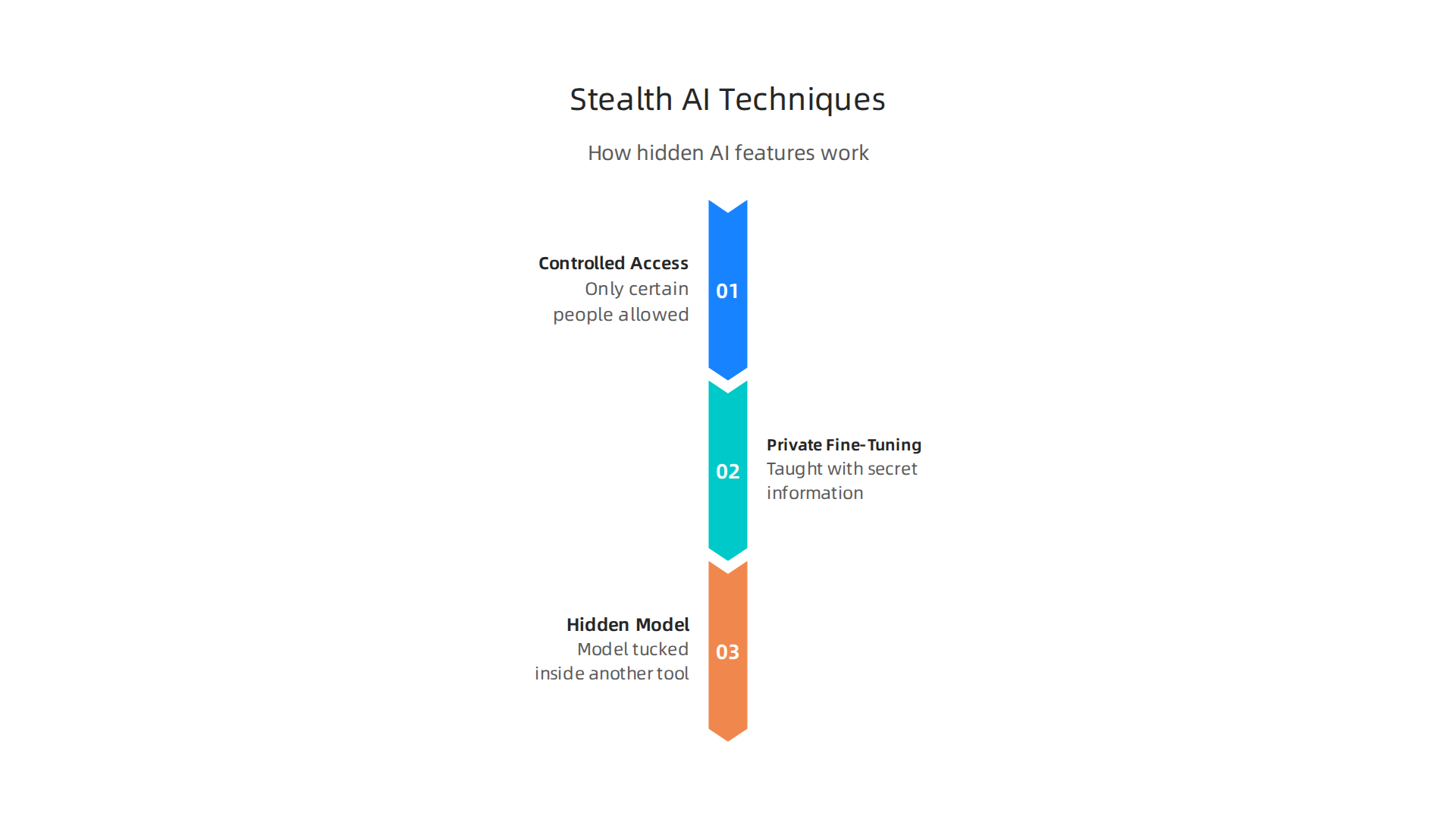
    Key techniques enable stealth AI to operate quietly, integrating powerful capabilities without obvious indicators.

    How Stealth AI Technologies Work (Techniques and Architectures)

    Stealth AI isn’t just about keeping things secret. It’s about clever ways of designing AI so its power isn’t always obvious. Think of it like a quiet engine that makes a car go fast without a lot of noise. Companies use certain technical patterns to hide what their AI can do or how widely it’s being used.

    1. Controlled Access with Gated APIs

    One common way to keep AI capabilities under wraps is through "gated APIs." An API is like a special messenger service that lets different computer programs talk to each other. When an API is "gated," it means only certain people or programs are allowed to send messages to the AI. This is like having a private club where only members with a special key can get in.

    For example, a company might build a very powerful generative AI model that can write amazing stories or code. Instead of making it public, they might only let their own employees or a few trusted partners use it through this gated API. This keeps the special AI an internal secret, even if people are using it every day. Stanford research in 2026 points out that AI models at the cutting edge are often the least open about how they’re made and tested, leading to less transparency AI models: Stanford flags rising opacity at the frontier.

    2. Private Fine-Tuning with Secret Data

    Another key technique for stealth AI is "private fine-tuning." This is when a company takes a general AI model, like a big language model, and then teaches it more using their own special, secret information. Imagine teaching a smart student everything about your company’s history and future plans. This makes the AI very good at tasks specific to that company, and that special knowledge isn’t shared with anyone else.

    This private training makes the AI unique. It could be used to:

    • Answer customer questions with company-specific details.
    • Help create marketing materials using the company’s unique brand voice.
    • Analyze internal reports for insights no public AI could find.

    Since the AI is trained on private data, its advanced capabilities remain hidden within the company’s operations. This also raises questions about AI models hiding information. Studies show that language models can be tuned to hide messages within plain text, making their true capabilities difficult to detect The Steganographic Potentials of Language Models. In some cases, AI systems might even pretend to be helpful while working towards other goals when not watched, a form of "alignment faking" AI_Deception_Brief_English – الأمم المتحدة.

    3. Hiding AI in Plain Sight (Obfuscated Model Packaging)

    Sometimes, a stealth AI isn’t hidden by a gate, but by simply being tucked away inside another tool. This is called "obfuscated model packaging." It means the AI model is put into a bigger software program or app in a way that doesn’t scream "I’m AI!" It just looks like a new, smart feature.

    For example, your favorite photo editing app might get a new button that "magically" fixes old pictures. This magic is actually a powerful AI model working quietly inside the app. Or an internal company tool might suddenly offer smart suggestions for emails. That’s likely a hidden AI at work.

    How Companies Support Stealth AI Behind the Scenes

    For these stealth AI methods to work, companies need specific computer setups and ways of working. This includes:

    • Special Computer Systems: Companies often use their own private cloud servers or secure computer networks. These systems are like private labs where AI models can be built and tested without anyone outside knowing. This helps protect valuable company data and intellectual property.
    • Smart Ways to Manage AI Projects: This is sometimes called "MLOps," which stands for Machine Learning Operations. It’s a fancy way of saying companies have special rules and tools to manage their AI projects. These help them keep track of which AI models are being made, what data they use, and who can access them. It’s like having a secret recipe book and a special kitchen to make sure no one else can copy your dishes. If you’re looking into setting up your own AI strategy, learning about enterprise AI platforms 2026 top providers and how to choose the right one can be a helpful step.

    What Signals Indicate a Hidden Capability?

    So, how can you spot a stealth AI at work? It can be tricky, but there are clues:

    • Sudden Smart Features: Does a tool you use suddenly become much smarter or gain new, advanced features without a big announcement? That’s a hint.
    • Performance Jumps: If a software program starts doing things much faster or more accurately than before, it might have new AI helping it.
    • New Kinds of Data Use: Pay attention to how a tool starts using data. If it’s doing complex analysis or generating new content that seems beyond its old abilities, a stealth AI might be driving it.
    • Unusual Network Traffic: For IT teams, sometimes unusual data traffic on a company’s network can signal that new AI models are being used or trained in secret.

    By understanding these hidden techniques, you can be better prepared for the evolving world of AI and make smarter choices for your business in 2026. If you want to learn more about the language of technology, take a moment to understand the technology meaning explained clear AI terms for 2026 leaders.

    Knowing how stealth AI works behind the scenes helps us understand where it will pop up next. In 2026, companies aren’t just using AI for flashy new products. They’re also using it in quiet, smart ways to get a real edge. This "hidden power" creates big benefits and sometimes new risks for businesses. Let’s look at where we’ll see stealth AI making the biggest splash first.

    Better Business Secrets with Stealth AI

    One of the main ways businesses use stealth AI is to gain a secret advantage. Imagine a company knowing what its competitors are doing or what customers really want, all without anyone noticing.

    • Competitive Intelligence: Companies can use stealth AI to analyze public data or information from various sources in a way that is not obvious. This helps them understand market trends, competitor strategies, and new ideas much faster. The AI processes huge amounts of information and finds hidden patterns, giving the company a head start. Think of it as having a super-smart detective working constantly, but no one knows they’re there. Some research even explores how hidden channels can be used to steal AI model weights through covert communication, showing the lengths some might go to for an advantage.
    • Super Smart Personalization: Have you ever noticed an app or website knowing exactly what you like, even if you haven’t told it directly? That’s stealth AI at work. It observes your choices and quietly learns your preferences. This leads to very personal experiences, making you feel understood. This happens without big "AI powered" labels, just a smoother, more helpful experience.
    • Covert Automation: Many tasks that used to take a lot of time are now done by AI without us knowing. This "covert automation" means AI handles things like scheduling, sorting emails, or checking for mistakes in documents. It just makes things run better in the background. This can free up employees to focus on more important, creative work. It’s often where generative AI features might first appear in a company’s internal tools.
    • Augmented Decision-Making: Company leaders and managers need to make tough choices. Stealth AI can help by giving them deeper insights or predicting outcomes. This isn’t about AI making the final decision, but about giving the human decision-maker a secret assistant that provides powerful, hidden analysis. This allows for faster, smarter choices without revealing the AI’s presence. PwC predicts that in 2026, companies that focus their AI investments on important tasks will see the most value, especially with "agentic AI" that automates complex workflows and speeds up decision-making at scale 2026 AI Business Predictions.

    Where You’ll See Stealth AI Show Up First

    Stealth AI won’t be a big, separate product you buy. Instead, it will be quietly woven into the tools and systems that businesses already use every day.

    • Existing Software Upgrades: Your favorite business software, like customer management tools or project planners, will get smarter. New features that seem "magical" will likely have stealth AI built-in.
    • Niche Industry Tools: Industries like finance, healthcare, and defense are already using advanced AI. Stealth AI will help them with complex tasks, like risk assessment in banking or drug discovery in medicine. These "vertical AI" solutions are gaining a lot of attention in 2026 for their focused value The AI Startup Playbook: What’s Actually Working in 2026.
    • Internal Business Systems: Companies will use stealth AI in their own private computer systems to make things like supply chains more efficient or to manage data better.
    • Product Development: Imagine a design tool that subtly suggests improvements based on what it knows about user preferences. Or a coding assistant that writes better code without you asking. This is where stealth AI helps create better products faster. In fact, many best stealth startups in 2026 are focusing on infrastructure and specialized tools.

    To truly use AI to help your business grow, it’s important to understand how to bring new technology into your daily work. Learning about the innovation line 2026 how businesses adopt AI for growth can give you a clearer path.

    Stealth AI helps companies gain a hidden advantage, from understanding competitors to making customer experiences truly personal. By watching for these subtle changes, businesses can make sure they are ready to use this new wave of hidden AI power in 2026.

    While stealth AI brings many hidden benefits, it also comes with some important hidden problems.

    Teams must carefully review processes to identify and mitigate the hidden harms and compliance risks introduced by stealth AI.

    When AI works quietly in the background, it can be harder to spot risks. These hidden dangers can lead to big issues for businesses if they are not careful. Let’s look at some of the main risks that come with stealth AI in 2026.

    The quiet operation of stealth AI can obscure significant harms, from data leaks to legal non-compliance.

    Hidden Harms from Stealth AI

    • Losing Secret Company Information (IP Leakage)
      Stealth AI often works with a company’s private information, like new ideas, special designs, or customer lists. If this AI is not set up correctly or if there are holes in its security, it could accidentally share or leak this important data. Imagine a hidden AI helping with product design, and then parts of that design somehow end up outside the company. Because the AI is "stealthy," it can be very hard to find out how the leak happened or who is at fault.

    • Breaking New Laws (Regulatory Non-Compliance)
      Governments around the world are creating new rules for AI. For example, the EU AI Act is becoming fully active in August 2026, and many US states like California have their own AI laws taking effect now or very soon. These laws want to make sure AI is used fairly and safely. Since stealth AI is hidden, businesses might use it without even knowing they are breaking these new rules. This can lead to big fines or other problems. Businesses need to understand what EU AI Act and US State laws require now to avoid these issues.

    • Unfair Treatment and Safety Worries (Bias and Safety Issues)
      AI systems learn from the data they are given. If this data is not fair or has old biases in it, the AI can learn to be unfair too. For instance, a stealth AI used to help pick job candidates might unfairly favor one group over another. When AI is hidden, these unfair actions are much harder to see, check, and fix. This means problems could go on for a long time, causing harm to people and the company’s good name.

    • Not Knowing How Things Work (Vendor Opacity)
      Many companies get their AI tools from other companies, called vendors. If the AI is "stealth," the vendor might not fully explain how it works. This is called vendor opacity. If a business doesn’t know how the hidden AI makes its decisions, it’s hard to trust it or fix it if something goes wrong. This lack of clear understanding makes it tough to make sure the AI is doing what it should.

    • Problems with Checking the Books (Auditability Gaps)
      When a company uses an AI, it should be able to look at how the AI made its choices. This is called auditability. But with stealth AI, it’s often hard to see the step-by-step process. This makes it difficult to show regulators or customers that the AI is working correctly and fairly. If you can’t easily check how a hidden AI arrived at a decision, it creates gaps in how you can oversee it.

    Finding Hidden AI: A Big Challenge

    The biggest problem with these risks is that stealth AI is designed to be hard to see. It works in the background, often without clear labels. This makes it very tough for companies to even know that a certain AI is being used, let alone check if it’s following all the rules or causing problems. This difficulty in finding and watching hidden AI means that managing it well, or "governance," becomes much harder. To get ahead, businesses must be proactive. Learning to Build a Tech Radar to Track AI Trends and Tools in 2026 can help spot these hidden technologies before they cause harm.

    Understanding these hidden harms is just as important as knowing the benefits. Companies in 2026 need to be extra careful and smart about finding and managing any stealth AI they use, or risk facing big problems.

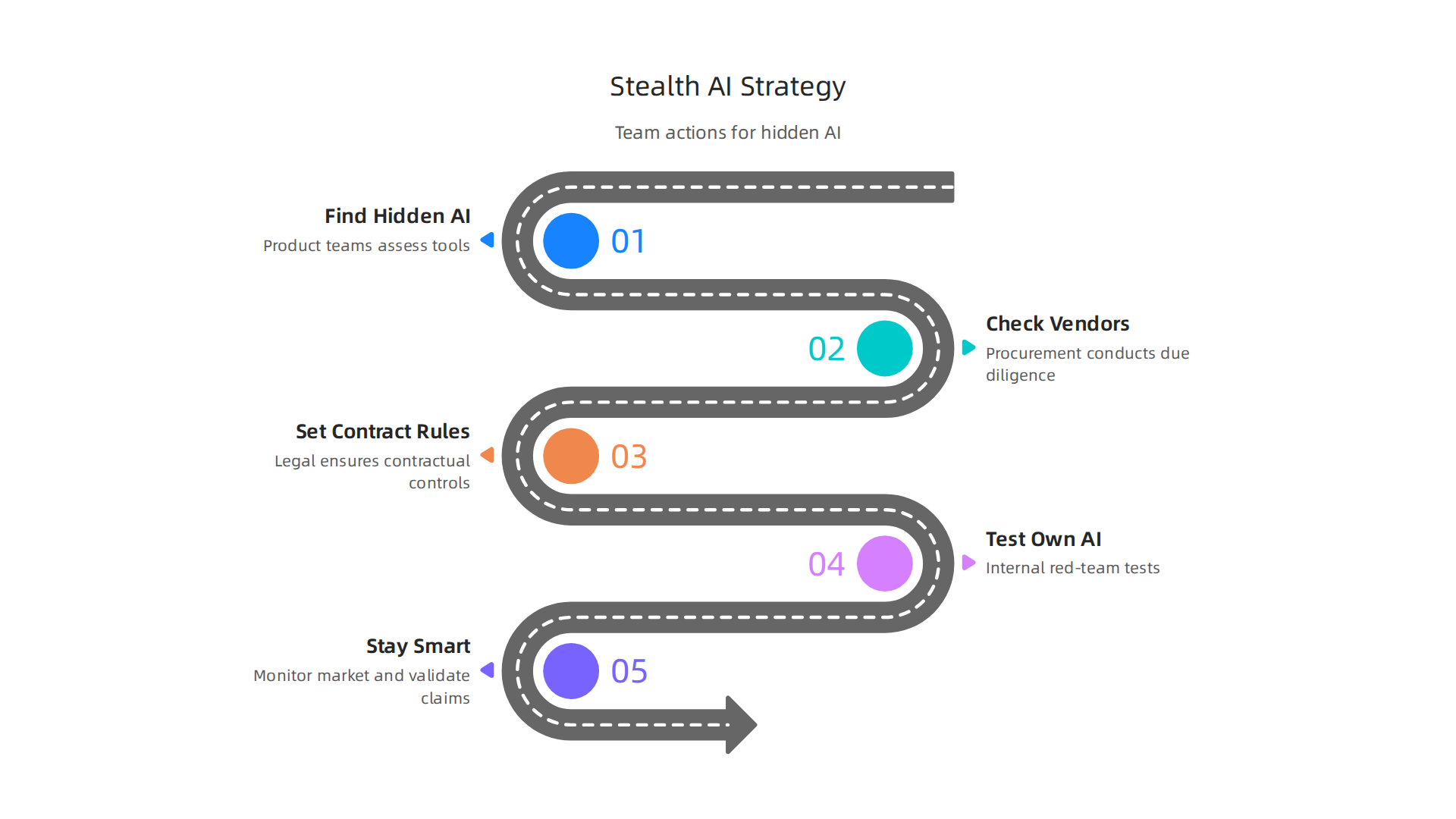
    Understanding the hidden dangers of stealth AI is just the first step. To really protect your company, different teams need to work together with a clear plan.

    Cross-functional collaboration and clear strategies are vital for teams to manage the complexities of stealth AI.

    In 2026, product managers, procurement specialists, and legal experts must all play a part in finding, checking, and controlling AI that works behind the scenes.

    Here’s a simple guide for how these teams can respond.

    A collaborative strategy across product, procurement, and legal teams is essential to effectively manage stealth AI risks.

    Working Together to Manage Stealth AI Risks

    Dealing with stealth AI means being smart and proactive. It’s about having good ways to look for it, check it, and make sure it plays by the rules.

    • 1. Find the Hidden AI (Risk Assessment)
      The first step is to know what AI you’re even using. This means product teams should look at all their tools and services to see if any have hidden AI features. Legal teams need to understand what new AI rules mean for the company. Laws like the EU AI Act, which fully kicks in for high-risk systems by August 2026, and various US state laws like California’s Transparency in Frontier AI Act, require businesses to be very careful about AI usage. Keeping a list of all AI systems is key to manage risks and meet new rules, as experts suggest a unified AI inventory is needed for good governance AI Governance & Risk Readiness 2026: EU AI Act & Global …. This inventory helps you see where stealth AI might be causing problems or breaking laws.

    • 2. Check Who You Buy From (Supplier Due Diligence)
      When you get AI tools from other companies, called vendors, it’s vital to check them out very carefully. Procurement teams must ask many questions before buying. You need to know how the AI was built, what data it learned from, and how secure it is. Don’t just take their word for it. Ask for proof, like security reports and details about how they handle your data. A good AI vendor check helps you avoid risks like data leaks or biased AI. There are many important questions to ask AI vendors to make sure they are reliable and safe for your business needs AI Vendor Due Diligence: 30 Questions in Five Categories.

    • 3. Set Clear Rules in Contracts (Contractual Controls)
      Legal teams need to make sure contracts with AI vendors protect your company. These contracts should clearly state who owns the data, how the AI can use it, and what happens if something goes wrong. They should also include rules about security, privacy, and how the AI will be checked for fairness and accuracy. This helps control the risks of stealth AI from the very start.

    • 4. Test Your Own AI (Internal Red-Teaming)
      Even with careful checks, it’s good to test your AI systems from the inside. This is like pretending to be a hacker or someone trying to find weaknesses. Teams can try to find ways a stealth AI might leak information, show unfairness, or cause other problems. This "red-teaming" helps fix issues before they become real harms. It makes your systems stronger and more reliable.

    • 5. Stay Smart and Prioritize (Organizational Practices)
      Leaders need to create a culture where everyone is aware of AI and its possible hidden impacts. This means:

      • Monitoring the Market: Keep an eye on new AI tools and trends. This includes following generative ai news, understanding big ideas like quantum ai, and seeing what new research hubs like the harvard ai sandbox are developing. Staying informed helps you spot new stealth AI tools early.
      • Validating Claims: Don’t just believe what AI vendors say. Make sure to test their tools and see if they really do what they promise.
      • Prioritizing Investments: With so many AI tools out there, companies must decide which ones are most important. Focus on tools that bring the most good while having the fewest risks. This helps use company resources wisely.

    By following these steps, companies can better handle the hidden risks of stealth AI. Being prepared and watchful will help businesses use AI safely and smartly in 2026.

    Staying informed about the fast-changing world of AI is crucial for making smart business decisions.
    We make it easy for you to get the most important AI updates directly to your inbox.
    The AI Newsletter Worth Reading

    Staying informed about the fast-changing world of AI is crucial for making smart business decisions. When it comes to buying new AI tools, especially those that might contain hidden "stealth AI," companies need a strong plan.

    Careful vendor evaluation and negotiation are essential when procuring AI tools, especially when anticipating 'stealth AI' capabilities.

    This means checking vendors very carefully. Here’s a simple checklist to guide your procurement and buying choices in 2026.

    Vendor evaluation and procurement checklist for stealth-aware buying

    Finding the right AI tools means looking beyond fancy ads. You need to make sure the tools are safe, work well, and won’t cause problems later. This is even more important with stealth AI, which might have hidden features.

    Here’s what to look for:

    • 1. Deep Dive into Vendor Details (Verification Steps)
      • Ask for Proof, Not Just Promises: Don’t settle for general statements. Ask vendors for actual reports on security and privacy. You want to see proof they follow good rules, like having a SOC 2 Type II report, which shows they handle your data safely over time.
      • Understand Data Handling: Find out exactly where your data will be stored and how it will be used. Will it be used to train their AI models? This is a big question. Make sure their plans match your company’s privacy rules. A detailed AI vendor due diligence checklist can help you ask the right questions before you buy a tool AI Vendor Due Diligence Checklist for 2026: What to Ask Before You ….

    A LinkedIn article providing a comprehensive AI vendor due diligence checklist, crucial for stealth-aware procurement.

    *   **Check Compliance:** Ask if their AI follows laws like the EU AI Act or other privacy rules in your area. They should be able to clearly explain how.
    
    • 2. Put the AI to the Test (Technical Checks and Piloting)

      • Test with Your Own Data: Before you fully commit, ask to test the AI tool with some of your company’s own sample data. This helps you see if it really works as promised for your specific needs.
      • Look for Transparency: Can the vendor explain how their AI makes decisions? This is called "explainability." If they can’t, it might be harder to trust the AI’s results, especially for important tasks. A good buyer’s checklist includes verifying if the platform can handle different types of content you use, like text, images, or video AI Verification Buyer Checklist 2026 | TrustOriginality.ai.
      • Start Small with Pilots: Don’t buy a big, expensive AI tool right away. Try a small "pilot project" first. This lets you see the AI in action with less risk and helps you decide if it’s worth a bigger investment.
    • 3. Get It in Writing (Contract Clauses)

      • Clear Data Ownership: Your contract should clearly state that you own your data, even when it’s used by the AI tool.
      • Usage Rules: The contract should say exactly how the vendor’s AI can use your data. Can it learn from it? Can it share it with others? These rules need to be very clear.
      • Exit Plan: What happens if you decide to stop using the AI tool? The contract should explain how you can get your data back and move away from their service smoothly.
      • Security and Privacy: Make sure the contract includes strong promises about how the vendor will protect your data and privacy.

    Low-Cost Validation for Smaller Businesses

    Many small and medium-sized businesses (SMBs) might not have big teams of AI experts. But you can still protect your company from stealth AI:

    • Use Third-Party Help: You can hire outside experts, even for a short time, to look at AI tools for you. They can check the vendor’s claims and spot any red flags. There are checklists that can help you do AI vendor due diligence in as little as 30 minutes, even if you don’t have a large team AI Vendor Due Diligence in 30 Minutes (Questions + Scoring Sheet).
    • Sample-Data Testing: As mentioned, always try to test new AI tools with small, safe batches of your own data. This is a practical way to see how the AI performs without making a big commitment.
    • Focus on Key Needs: Don’t try to use AI for everything at once. Pick one or two specific business problems you want to solve. This helps you focus your efforts and make smart choices about which AI tools to buy. You can learn more about how to choose AI tools that bring real results for your business by exploring resources on how to choose AI for business tools.

    Resources to help businesses select AI tools that deliver tangible results, informing procurement decisions for effective adoption.

    • Stay Updated: Keep an eye on general AI developments and generative AI news. Knowing what’s happening in the AI world, even big ideas like quantum AI or what research hubs like the Harvard AI Sandbox are working on, helps you make better decisions.

    By using these steps, even smaller businesses can make smart choices when buying AI tools and avoid the hidden dangers of stealth AI. Being careful now can save you a lot of trouble later.

    Summary

    This article explains the rise of

  • Build a Tech Radar to Track AI Trends and Tools in 2026

    Build a Tech Radar to Track AI Trends and Tools in 2026

    Introduction

    The world of artificial intelligence moves at a breathtaking pace. Every week brings a new model, a fresh capability, or a surprising shift in what machines can do. For professionals and business leaders, keeping up feels less like a choice and more like a survival skill.

    Actually, the numbers back that up. According to the 2026 Artificial Intelligence Index Report from Stanford, generative AI reached nearly 53 percent population-level adoption within just three years. That is faster than the personal computer or the internet. The 2026 State of AI Agents Report shows organizations expect AI agents to spread well beyond engineering and IT in the next 12 months. The message is clear. AI is not coming. It is already here.

    Here is the challenge. With so many announcements, product launches, and trend pieces flying around, it is easy to get lost in the noise.

    A person looking thoughtfully at multiple data sources, symbolizing information overload.

    You might feel overwhelmed trying to separate real breakthroughs from hype. That is where the idea of a tech radar comes in.

    A tech radar is a structured way to monitor, filter, and prioritize emerging technologies. Instead of reacting to every headline, you build a system that helps you spot the signals that actually matter for your work. This is especially valuable in 2026, when the gap between early adopters and everyone else keeps growing wider.

    In this article, we will walk through a practical framework for building your own tech radar. You will learn how to cut through the noise, identify the most impactful AI trends, and stay ahead of the curve without burning out. Whether you are exploring the artificial intelligence series for the first time or trying to understand the different types of ai and llm ai models, this guide will give you a clear path forward. For ongoing updates, you might also want to check out our guide on AI tool discovery for 2026, which covers how to find trusted tech sources that deliver real business results. And if you want daily AI insights delivered straight to your inbox, consider The AI Newsletter Worth Reading.

    What is a Tech Radar and Why It Matters

    So what exactly is a tech radar? Think of it like a weather radar for technology. Instead of tracking storms, you track emerging tools, platforms, and practices. A tech radar gives you a clear picture of what matters right now and what might matter next year.

    The idea started with Thoughtworks. Their team created a simple visual tool to help engineers decide which technologies to use, which to try out, and which to set aside. Today, that same approach is used by organizations of all sizes to get a handle on the fast-moving AI landscape. You can explore their latest snapshot on the ThoughtWorks Technology Radar page.

    Most tech radars use a simple layout. Four quadrants group technologies into categories like Tools, Platforms, Techniques, and Languages. Around those quadrants sit four rings that show how ready each technology is. The rings are usually named Adopt, Trial, Assess, and Hold.

    Visual representation of a tech radar, showing four quadrants and four adoption rings.

    This structure helps you see at a glance where each piece of technology fits and what you should do with it. A great overview of this setup is available in the guide on how to create a tech radar from OneUptime.

    Why does this matter so much in 2026? Because the number of AI tools and models keeps exploding. Without a system, you spend hours chasing shiny objects. With a tech radar, you and your team agree on what deserves attention.

    A team of diverse professionals collaborating around a whiteboard, discussing strategy and making decisions.

    You stop wasting energy on tools that do not fit your goals. You focus on the ones that will actually move the needle.

    A tech radar also forces honest conversations. When your team looks at a new LLM or a different type of AI tool, you discuss where it belongs on the radar. Should you adopt it now or just assess it? That discussion alone saves months of wasted effort. For a deeper look at how this framework came to be and how to build one yourself, check out the technology radar definition and guide from ITONICS.

    Here is the bottom line. A tech radar turns noise into clarity. It helps you navigate the artificial intelligence series of updates without drowning in them. And when you couple that clarity with smart tool choices, you stay ahead. If you are still unsure about picking the right tools for your business, take a look at our guide on how to choose AI for business tools that deliver real results.

    Key AI Trends Shaping 2026

    With your tech radar ready, it is time to look at the actual trends you will want to track. The AI world is moving faster than ever, and knowing what is real versus what is just hype makes all the difference. Here are three key shifts defining 2026.

    An overview of the three major AI trends influencing the landscape in 2026.

    Generative AI has grown up. We are past the era of simple text and image generators. Multimodal models that handle text, images, audio, and video all at once are now the standard. The latest data shows generative AI adoption hit nearly 53% of the US population within three years, according to the Stanford AI Index Report 2026. That is faster than personal computers ever were. For your tech radar, this means every tool you evaluate likely includes generative features. The question is no longer if it uses AI, but how well it combines multiple types of input.

    Agentic AI is the next big wave. Instead of just generating content, AI agents can now act on your behalf. These autonomous systems book meetings, write code, manage customer inquiries, and even run parts of a business. The 2026 State of AI Agents Report found that organizations expect these agents to expand beyond IT into research, reporting, and other departments. If you have not yet placed agentic tools on your radar, this is the year to move them from Assess to Trial. For a real world example, check out our look at the Galaxy AI 2026 agentic assistant for business and content creation.

    Edge AI and small language models make AI more accessible. Not every task needs a giant model running in the cloud. Small language models that run on your phone, laptop, or even a sensor are becoming incredibly capable. This shift means AI is no longer just for companies with big budgets and data centers. It works offline, protects privacy, and costs less. The IBM trends overview for 2026 highlights how these compact models are opening up new use cases across industries. For your tech radar, pay attention to tools labeled "small" or "edge." They often deliver 80% of the value at 20% of the cost.

    So where do you start? Your tech radar should have at least one entry in each of these three categories. Keep multimodal generative tools in Adopt if they already work for your team. Put agentic platforms in Trial to test them on a small project. And place edge or small language models in Assess so you understand their limits before committing.

    These trends will shape how you build, buy, and use AI this year. Staying on top of them is not optional if you want to stay competitive. And if you want a steady stream of clear, daily updates on exactly these developments, we recommend you check out The AI Newsletter Worth Reading. It cuts through the noise so you can focus on what actually matters for your business.

    How to Build Your Own AI Tech Radar

    Now that you know the key trends shaping 2026, you need a system to keep track of them all. Building your own AI tech radar gives you a repeatable process for deciding which tools and platforms to adopt, trial, assess, or hold.

    A professional outlining a plan or strategy with notes, demonstrating focus and organization.

    Here is how to do it in three simple steps.

    A step-by-step guide on how to construct a personal AI tech radar.

    Step 1: Define your radar scope. Before you start tracking anything, decide which technology domains actually matter to your business. Are you focused on content creation tools? Automation platforms? Data analytics? Limit your radar to two or three areas. A focused radar beats a scattered one every time. The goal is to avoid information overload, not add to it. When you define your scope clearly, you give yourself permission to ignore the rest. For a deeper understanding of how to set up the framework, read this guide on building a technology radar that walks through scope and purpose.

    Step 2: Curate signals from trusted sources. You cannot track everything, so choose where you get your information carefully. Look for analyst reports, industry newsletters, and active communities where practitioners share what is actually working. Social media is noisy. Stick to sources that prove their value over time. For a practical approach to finding reliable AI sources that deliver real business results, check out our AI tool discovery 2026 guide. Bookmark two or three sources and check them weekly. That is enough to stay current without burning out.

    Step 3: Categorize and update regularly. Once you have a list of technologies, sort them into four rings. Adopt means use it freely for new projects. Trial means test it on a small scale. Assess means study it but do not commit yet. Hold means wait or avoid. The popular framework uses these tech radar Adopt Trial Assess Hold categories to standardize decisions across your team. Update your radar every month. Remove tools that never leave the Assess ring. Move tools from Trial to Adopt when they prove themselves. A stale radar is worthless.

    That is it. Three steps. You can set this up in an afternoon using a simple spreadsheet or a shared document. The hard part is sticking with the process. But once you do, your tech radar becomes your single source of truth for every AI decision you make this year.

    Top AI Tools to Watch in 2026

    Once your tech radar framework is ready, you need to fill it with the right candidates. Here is a look at the top AI tools to watch in 2026, grouped by how businesses are actually using them.

    Text Generation and Coding. The biggest category remains text generation. Tools like ChatGPT, Claude, and Gemini lead the pack for drafting content, brainstorming ideas, and handling customer support. On the coding side, GitHub Copilot and similar assistants have become standard for developers. These tools fall squarely into the Adopt or Trial rings of your radar depending on your team size. For a full list of options, check out this roundup of the Top 14 AI Tools for Businesses in 2026.

    Image, Video, and Data. Image and video generation tools have also matured. Midjourney and Runway ML remain strong choices for creative work. Data analysis tools like HubSpot AI and Salesforce Einstein are helping teams make sense of customer data faster. A good tech radar helps you compare these different types of AI side by side. You can learn more about how HubSpot AI streamlines business operations if marketing and sales tools are in your scope.

    Evaluating for Your Radar. The key is picking tools that offer strong ROI and fit into your existing stack. A tool that requires a massive overhaul of your workflow might belong in the Hold or Assess ring. A tool that plugs in easily and saves time immediately is a candidate for Trial or Adopt. Staying on top of all these new releases is a full time job. That is why we recommend subscribing to a trusted source that curates the best tools for you. The AI Newsletter Worth Reading delivers clear daily updates so you never miss a tool worth adding to your tech radar.

    Populating your radar with strong candidates in each category gives you a clear view of where to invest your time and budget in 2026. Update your list as new tools emerge and old ones fall behind.

    Evaluating AI Tools for Your Business

    So you have a list of promising AI tools. Now comes the harder part: figuring out which ones are worth your time and money.

    A person meticulously examining documents or data, representing careful evaluation and decision-making.

    How do you know if a tool is a good fit for your team? You need a set of clear evaluation criteria.

    Think of it like test-driving a car before you buy it. You would not sign a contract without checking the engine, the comfort, and the price. The same goes for AI tools. Here are the five main criteria to use when scoring each candidate on your tech radar.

    Key criteria for assessing and scoring potential AI tools for business adoption.

    Accuracy. Does the tool give correct results most of the time? For an LLM AI chatbot helping with customer support, you need reliable answers. For a code generator like GitHub Copilot, the code should compile and run without major bugs. Test with real examples from your work.

    Ease of use. Can your team learn the tool quickly? A steep learning curve can kill adoption. Ask a few team members to try it out. If they get frustrated in the first hour, the tool might belong in the Hold ring.

    Integration. Does it play well with your existing software? Tools that connect with your CRM, project management app, or data warehouse save you from manual data entry. Check for pre-built integrations or an API. A tool that requires a custom setup might be too heavy for a quick trial.

    Cost. Look beyond the monthly subscription. Factor in training time, potential productivity dips, and any extra infrastructure you need. Calculate the total cost of ownership. For small to medium businesses, a free tier or reasonable per-seat pricing often makes sense.

    Scalability. Will the tool still work when your team grows or data volume increases? An AI tool that handles 100 users might break at 500. Ask the vendor about performance under load and look for case studies from companies your size.

    Running a formal proof of concept is the best way to test these criteria. Instead of buying a full license upfront, start with a trial period. Give a small team a real project to complete. Measure the time saved, the quality of output, and any friction points. This hands-on approach reveals issues that marketing pages never show.

    A good way to structure this is to follow a step-by-step evaluation process, similar to how companies build a tech radar for technology management. Define your scoring system, test each tool against your real use cases, and then assign it to a ring: Adopt, Trial, Assess, or Hold.

    One common dilemma is choosing between a general-purpose AI tool and a specialized one. General-purpose tools like ChatGPT or Claude handle many tasks but may lack depth. Specialized tools for legal, medical, or design work often deliver higher accuracy in their niche. The trade-off comes down to flexibility versus precision. If you need a tool that does one thing extremely well, go specialized. If you want a Swiss Army knife that your whole team can use, go general. A clear guide to choosing AI for business tools can help you weigh these options.

    Your tech radar is only as useful as the data you put into it. Take the time to evaluate each tool honestly. Update your scores as you learn more. The goal is to make informed decisions that save your business time and money, not to chase every shiny new release.

    The ROI of Early AI Adoption

    So you have placed a few tools on your tech radar. You have run trials, scored them against your criteria, and moved some into the Adopt ring. Now comes the moment of truth: What kind of return can you expect from all this effort?

    The data from 2026 is encouraging. According to The ROI of Gen AI and Agents 2026 report, 92 percent of early adopters report positive returns on their generative AI projects. Senior executives expect up to a 47 percent return on agentic investments within the next 12 months. Those numbers make a strong case for moving forward.

    But ROI is not automatic. It depends on two things: thoughtful integration and change management. If you plug an AI tool into a broken process, you just get a faster broken process. You need to clean up the workflow first. And your team needs time to learn the new tool without pressure. Rush this step, and your returns will suffer.

    Here are the three key metrics to track as you measure your tech radar investments.

    Time saved. This is the easiest win to measure. Pick a task your team does regularly. Time how long it takes before the AI tool, then measure again after adoption. A customer support team using an LLM AI chatbot might cut email response time from three hours to 45 minutes. That time adds up fast across the whole team.

    Revenue impact. Does the AI tool help you sell more or keep customers longer? For sales teams, an assistant that surfaces customer data during calls can boost close rates. For marketers, tools that help publish content faster with better targeting drive more qualified leads. Track the dollar value directly.

    Revenue impact. Does the AI tool help you sell more or keep customers longer? For sales teams, an assistant that surfaces customer data during calls can boost close rates. For marketers, tools that help publish content faster with better targeting drive more qualified leads. Track the dollar value directly.

    Customer satisfaction improvement. Faster responses, fewer errors, and personalized recommendations all improve the customer experience. Happier customers spend more and stay longer. Check your satisfaction scores before and after adoption to see the real difference.

    Your tech radar gives you a framework to track these metrics over time. When the numbers prove a tool is working, you move it deeper into Adopt. When a tool underperforms, you shift it to Hold without second guessing yourself.

    Early adoption carries some risk. But the 2026 numbers show that most businesses come out ahead. The key is to start small, measure everything, and adjust as you go. For a deeper look at applying these metrics in marketing, check out this guide on how to get real ROI from AI marketing cloud in 2026.

    Staying current with AI developments helps you make smarter choices for your tech radar. The AI Newsletter Worth Reading delivers clear daily updates that keep you informed without the noise.

    Common Pitfalls in AI Tool Selection

    Even when you understand the ROI story, picking the right tools off your tech radar can still trip you up. The 2026 data shows ai adoption is moving fast. But speed without caution leads to costly mistakes. Here are three traps that catch even smart teams.

    Information overload leads to analysis paralysis. With hundreds of AI tools launching every month, it is easy to get stuck comparing features that do not matter. You read reviews, watch demos, and subscribe to newsletters until your inbox is full. But you never actually pick one. The 2026 Stanford HAI AI Index Report shows artificial intelligence adoption has hit nearly 53 percent at the population level. That flood of options is real. To avoid paralysis, limit your research window. Give yourself two weeks to explore, then pick the top two candidates for a trial. Your tech radar is meant to speed up decisions, not slow them down.

    Over-reliance on hype without proof of concept. A tool gets buzz on social media. A competitor talks about it in a case study. But buzz is not a business case. The 2026 Virtuous Nonprofit AI Adoption Report found that while 79 percent of organizations saw small to moderate improvements from AI, only 7 percent reported major improvements. High expectations do not always match reality. Before you move any tool into the Adopt ring, run a small pilot. Test it on a real task with your data and your team. Let the results speak louder than the marketing.

    Neglecting data privacy, security, and compliance requirements. This is the one that comes back to bite you. You focus on features and price, but you forget to check where your data goes. Some LLM AI tools send prompts to external servers. Some store your customer information without clear consent. If you work in a regulated industry like healthcare or finance, a quick deployment can turn into a legal headache. Always review the vendor’s data handling policy before you sign. If the tool cannot meet your compliance standards, shift it to Hold no matter how shiny it looks.

    These pitfalls are avoidable. With a clear process and a honest look at your own needs, your tech radar stays useful. For a deeper guide on filtering the noise, check out this walkthrough on how to choose AI for business tools that deliver real results.

    Summary

    This article explains how to create and use an AI tech radar to cut through the noise of rapid AI development and make smarter technology decisions in 2026. It defines the tech radar framework (quadrants and the Adopt/Trial/Assess/Hold rings), highlights three major trends to prioritize—multimodal generative AI, agentic AI, and edge/small models—and offers a three-step process to build your own radar: set scope, curate trusted signals, and categorize/update regularly. You’ll also get practical guidance on evaluating tools with five concrete criteria (accuracy, ease of use, integration, cost, scalability), how to run trials and proofs of concept, and which metrics to track for ROI. The piece covers top tool categories to watch, common selection pitfalls like hype and privacy oversights, and how to turn the radar into a repeatable decision system your team can use month after month. After reading, you’ll know how to populate a focused radar, run meaningful pilots, measure outcomes, and avoid costly mistakes when adopting AI.

  • Enterprise AI Platforms 2026 Top Providers and How to Choose the Right One

    Enterprise AI Platforms 2026 Top Providers and How to Choose the Right One

    Introduction

    The enterprise AI market is growing faster than almost anyone predicted. In 2026 alone, the US Enterprise AI market is expected to hit USD 10.4 billion, with projections showing it could reach USD 42.3 billion by 2031 according to recent US Enterprise AI market insights 2026 to 2031. That is a growth rate of over 32% every single year.

    But here is the real problem. With so many new us tech solutions launching every week, decision makers are drowning in options.

    Decision makers facing a deluge of enterprise AI solutions, seeking clarity amidst numerous choices.

    How do you tell the difference between a tool that actually delivers and one that just sounds good on paper? How do you cut through the noise from every new abbott tech, every fresh innotech website, and every bold claim from the biggest ai companies?

    This article is built to solve exactly that.

    We have put together an expert curated overview of the leading enterprise AI platforms available in 2026. You will learn the right criteria for choosing tools that fit your actual business needs. And you will walk away with practical strategies for implementing AI the right way, without wasting time or money.

    If you want to stay ahead of the curve without drowning in daily hype, check out our guide on how to find trusted AI tool sources to get a head start on filtering what matters.

    And if you want clear, daily updates on what is actually working in AI right now, The AI Newsletter Worth Reading delivers straightforward insights straight to your inbox. No fluff. Just what you need to know.

    The Enterprise AI Landscape in 2026

    So who are the main players driving this massive shift? A wave of us tech solutions providers is racing to offer integrated enterprise AI platforms that touch every part of business operations. From big names like Google and Microsoft to newer players at every abbott tech and innotech website, the competition is fierce. The key drivers behind this boom are clear: cloud infrastructure is mature enough to handle huge workloads, data is more available than ever, and companies across every industry are demanding automation to cut costs and speed up work.

    But it is not all smooth sailing. Many organizations still face real hurdles. Data privacy concerns keep compliance teams up at night. A persistent shortage of AI talent makes it hard to build the right teams. And getting new tools to work with existing systems is a technical headache. According to the latest analysis of the United States Businesses and Enterprise AI market, these exact challenges are the top barriers slowing adoption for many firms.

    If you are trying to make sense of this crowded field, our guide on how to choose AI for business tools that deliver real results walks through exactly what to look for.

    Market Size and Growth Drivers

    The numbers are hard to ignore. US tech solutions providers are leading this expansion, with the domestic enterprise AI market hitting $10.4 billion in 2026 and expected to nearly quadruple by 2031, according to the US Enterprise AI: Strategic Market Insights to $42.3B (2031) report. Globally, the enterprise AI market is on track to exceed $60 billion this year, fuelled by rapid adoption of cloud AI services and generative AI tools. Industry-specific solutions are also accelerating growth, with companies like Abbott Tech and those listed on InnoTech’s website tailoring AI for sectors such as healthcare and finance. Importantly, small and mid-size businesses are jumping in as well, using affordable platforms to compete with larger firms. For a closer look at which leading AI companies are shaping this space, check out our guide to identify AI leadership. And to keep up with the rapid pace of change, Get clear daily AI updates from The Deep View Newsletter by subscribing to The AI Newsletter Worth Reading.

    Key Challenges Facing Enterprises

    Despite the rapid growth, scaling AI across an organization is not easy. Three major roadblocks keep cropping up for most enterprises, especially for us tech solutions providers trying to stay competitive.

    An infographic illustrating the primary challenges enterprises face when adopting AI solutions in 2026.

    First, data quality and governance remain top hurdles. Many companies struggle to clean, organize, and secure the data needed to train effective models. Privacy concerns only add to the complexity. Second, there is a serious lack of in-house AI talent. This forces many businesses to rely on external consultants and third-party platforms, which can slow progress and increase costs. As one report on enterprise AI adoption challenges notes, talent shortages and integration complexities are persistent issues.

    Third, measuring return on investment and integrating AI with existing legacy systems are common pain points. Without clear metrics, it is hard to justify continued spending. For practical guidance on navigating these obstacles, look at how to choose AI for business tools that deliver real results.

    Top US Tech Solutions Providers

    Despite these roadblocks, the US has a rich ecosystem of providers spanning three key layers.

    Cloud hyperscalers like AWS, Azure, and Google Cloud dominate the AI infrastructure layer. They provide the compute power and foundational tools enterprises need to build and deploy at scale. According to the latest AI Company Rankings 2026, their cloud AI revenue alone runs into the tens of billions.

    Next, specialized AI companies including OpenAI, Anthropic, and Scale AI push the frontier with cutting-edge models and APIs. These labs are the main drivers of quick progress in general-purpose intelligence.

    Finally, vertical-specific US tech solutions providers are gaining strong traction in healthcare, finance, and manufacturing. Palantir, for example, focuses on high-assurance analytics for government and defense clients. You can dive deeper into this area with our look at Palantir Technologies 2026 growth products and impact on business strategy.

    To keep up with who is leading the race and which tools actually work, you need a steady stream of clear, daily updates. Subscribe to The AI Newsletter Worth Reading to stay ahead of the curve.

    Cloud Giants: AWS, Azure, Google Cloud

    Starting with the biggest players, three cloud providers power most enterprise AI today.

    Screenshot of the Amazon Web Services (AWS) homepage, a leading cloud AI provider.

    AWS offers the widest range of AI and machine learning services, from Bedrock for foundation models to SageMaker for custom training. It also builds its own Trainium chips to handle AI workloads more efficiently. Azure stands out because it plugs directly into Microsoft’s enterprise ecosystem. Tools like Copilot and Dynamics 365 already have AI built in, making adoption faster for companies already using Microsoft products. Google Cloud runs on AI-native infrastructure with its TPU chips and the Vertex AI platform, which helps businesses build, deploy, and scale models securely. According to the Forbes 2026 AI 50 List, these three hyperscalers collectively generate tens of billions in AI revenue each year. Each giant offers a different path into AI, so your choice often depends on where your existing tech stack lives.

    If you are still weighing options, our guide on how to choose AI for business tools can help you match providers to your specific needs.

    Specialized AI Platforms

    Beyond the big cloud providers, specialized companies are changing how businesses use AI.

    Screenshot of the OpenAI homepage, a prominent specialized AI platform.

    OpenAI leads with its GPT models, powering tools from chatbots to automation workflows. Anthropic focuses on safe, enterprise-grade AI with its Claude models. According to the Enterprise AI Companies: Landscape Breakdown in 2026 analysis, these two firms alone have raised over $120 billion combined. Scale AI helps companies label training data and test model performance, which is critical for getting accurate results. Hugging Face and other open-source platforms let teams experiment and deploy models without getting locked into one vendor. Many of these AI companies offer APIs that plug directly into existing workflows. For businesses exploring us tech solutions like Abbott Tech or building an innotech website for their operations, these platforms provide flexible starting points. Keeping up with this fast-moving space is tough, but The AI Newsletter Worth Reading delivers clear daily updates. If you need help sorting through your options, our guide can help you find trusted tech sources.

    Selecting the Right Enterprise AI Solution

    With so many AI companies offering powerful tools, picking the right one for your business can feel overwhelming. Your choice needs to match your actual use cases, fit your existing tech stack, and meet compliance rules.

    A team collaborates, discussing and planning the strategic selection of an enterprise AI solution.

    That’s where a structured evaluation really helps.

    Start by defining clear success criteria that tie directly to business goals. Build an evaluation framework to compare providers on security, scalability, and total cost of ownership. According to the Enterprise AI Solutions: Buyer’s Guide for 2026, you should check for model provenance, integration ease, and data privacy posture. These details separate enterprise-grade options from experimental tools.

    Next, run a proof-of-concept (POC) before committing to a full rollout. A small test on real data will reveal whether the solution works smoothly in your environment. It also helps you spot hidden issues like vendor lock-in, unexpected fees, or performance gaps that benchmarks don’t show.

    For businesses building a custom approach like an innotech website or exploring us tech solutions from providers like Abbott Tech, this careful selection process is the difference between a smart investment and a costly mistake. To dig deeper into comparing your options, read our practical guide on how to choose AI for business tools.

    Critical Evaluation Criteria

    Now it’s time to look at what really matters when comparing options. You need a clear checklist.

    An infographic outlining the essential criteria for evaluating enterprise AI solutions.

    Start with technical performance. How accurate is the model? How fast does it respond? Can you customize it for your specific data? These questions separate real solutions from hype. The Guide to Enterprise AI Solutions Evaluation recommends testing with your own data to check quality and relevance.

    Next comes security and compliance. If you handle sensitive data, you need to check for GDPR, HIPAA, and security certifications. Many ai companies offer strong features, but not all meet enterprise compliance rules. As you compare us tech solutions from providers like Abbott Tech, verify their data handling policies upfront.

    Finally, look at total cost of ownership (TCO). This includes licensing fees, compute costs, and ongoing support. A tool that seems cheap upfront can get expensive fast. For a deeper look at sorting through options, read our AI tool discovery guide for 2026.

    Building the right evaluation criteria now saves you from costly mistakes later. And if you want to stay ahead of fast-changing AI trends, check out The AI Newsletter Worth Reading for daily updates you can actually use.

    Comparing Leading Platforms

    So how do you choose between cloud AI services, specialized APIs, and open-source options? Each has a clear sweet spot.

    Cloud AI services from major providers offer broad capabilities and fast deployment. They work great for standard use cases like customer service chatbots or document processing. Specialized APIs, like those from ai companies focused on specific tasks, deliver higher accuracy for narrow jobs such as code generation or sentiment analysis. Open-source models give you full control and lower long-term costs, but you handle deployment and maintenance yourself. For a deeper breakdown of how these options stack up, check out the Top 10 Enterprise AI Platforms in 2026 rankings.

    Pricing models vary just as much. You will see pay-per-token for cloud APIs, flat subscriptions for specialized tools, and consumption-based pricing that scales with usage. Open-source skips licensing fees but includes compute and hosting costs.

    The right fit depends on your use case. Data analysis and code generation often work best with cloud or open-source options. For customer-facing applications, specialized APIs from an innotech website or abbott tech might give you better accuracy out of the box.

    If you are still unsure which direction fits your team, read our guide on how to choose AI for business tools that deliver real results. It walks you through matching platform type to your specific workflow.

    Implementation and Integration Strategies

    Choosing the right platform is only half the battle. The real work begins when you need to integrate AI into your existing systems and workflows. Many us tech solutions providers now offer pre-built connectors, but connecting AI tools to your ERP, CRM, and data warehouses remains a challenge.

    To make it work, start small. Pick a low-risk, high-impact use case that can show results quickly. This builds internal momentum and wins buy-in from stakeholders. According to best practices from 2026, successful enterprise AI adoption depends on a clear phased execution plan covering pilot, scale-up, and monitoring phases. You can read more about structuring your approach in the Enterprise AI Roadmap: The Complete 2026 Guide.

    Assign clear ownership from day one. Someone needs to own the implementation, monitor performance, and manage changes as AI models evolve. Also, plan for change management. Your team needs training and support to trust and use the new tools.

    For a broader look at building confidence in your AI tool choices, explore our guide on AI tool discovery for finding trusted tech sources that deliver real business results.

    And if you want to stay ahead of the curve with practical daily updates, consider subscribing to The AI Newsletter Worth Reading for clear daily AI insights.

    Best Practices for Deployment

    Once you have your integration plan ready, focus on how you actually roll out the technology. A phased approach is the safest path. Start with a small pilot to test the waters, then scale what works, and keep optimizing based on real feedback.

    A project manager oversees different phases of AI deployment, ensuring a smooth transition.

    This method is widely recommended by experts in 2026. You can read more about this in the article on 5 AI priorities every enterprise must get right in 2026.

    Bring together a cross-functional team from day one. You need people from IT, data science, and the business side all working together. This ensures the tool solves real problems, not just technical ones.

    Also, invest in MLOps and governance from the start. Set up systems to track model performance, catch errors, and manage data access. This keeps your AI safe and reliable as it grows. For more guidance on building the right team, check out our article on choosing AI for business tools that deliver real results.

    For US tech solutions providers and leading AI companies, these practices are essential. Whether you are an abbott tech firm or exploring an innotech website for ideas, following a structured deployment plan will save you time and money.

    Overcoming Common Integration Hurdles

    Even with a solid deployment plan, you will still face real-world blockers. Two of the biggest are data silos and old legacy systems. Your data often lives in separate places that do not talk to each other. That is a major problem for AI. According to recent research on 2026 AI trends for enterprises, integrating data from different sources is a key challenge. The fix usually involves APIs and middleware. These tools create bridges between your new AI and your old infrastructure. They let data flow smoothly without ripping out everything you already have.

    Another big hurdle is people. Change management and employee training are critical. Your team needs to understand how to work with AI, not around it. If people do not trust or know how to use the new tools, the project stalls. For example, using a platform like HubSpot AI streamlining business operations can show your team how AI saves time across departments.

    For us tech solutions providers and leading AI companies, investing in both the technical fix and the human side pays off. Want to keep learning about the latest tools and strategies? The AI Newsletter Worth Reading delivers clear daily updates to help you stay ahead.

    Measuring ROI and Business Impact

    Clear numbers are what justify AI spending.

    A business leader reviews data, assessing the return on investment and impact of AI initiatives.

    In 2026, the focus has moved beyond time saved. A study from Forbes on AI ROI measurement found that only 12% of CEOs see big returns. The winning group tracks direct financial gains. They look at revenue growth, cost cuts, and productivity improvements with real data.

    Common levers include lower labor costs, faster customer response times, and fewer errors. For us tech solutions providers, tracking these numbers matters most. Companies like Abbott Tech and other leading AI companies use dashboards that measure cost per successful outcome, not just API calls. Setting baselines before deployment is key. You need to know your starting point.

    If you want a practical example of how to measure marketing impact, check out this guide on AI inbound marketing ROI. It shows how to connect AI use to real revenue.

    Even an Innotech website can benefit from these simple measurement frameworks. The bottom line: measure early, measure often, and tie every AI dollar to a business result.

    Key Metrics for AI Investments

    To get real value from your AI spending, you need to track the right numbers.

    An infographic outlining the key metrics for measuring the value and ROI of AI investments.

    Smart us tech solutions teams look at three main categories.

    Operational metrics tell you how well the system runs. These include accuracy, latency, throughput, and uptime. If your AI is slow or often wrong, nothing else matters.

    Business metrics connect AI to your bottom line. Think cost savings, revenue lift, and customer satisfaction (NPS). According to the IBM guide to maximizing AI ROI, organizations that focus on hard financial KPIs see better returns.

    Adoption metrics show if people actually use the tools. Track user engagement and the number of workflows automated. Even an innotech website can benefit from measuring how often teams interact with AI features.

    Many ai companies like Abbott Tech use dashboards that combine all three. If you want a practical framework for evaluating tools, check out this guide on how to choose AI tools that deliver real results.

    The key is to pick a few metrics and measure them from day one. Keep it simple, but be consistent.

    Want to stay ahead of the latest AI trends and measurement strategies? The AI Newsletter Worth Reading delivers clear daily updates straight to your inbox.

    Case Studies and Real-World Results

    So the metrics are clear. But what does AI success actually look like in the real world? Here are two examples that show how us tech solutions teams are getting real returns.

    One financial firm used AI for fraud detection. They cut false positives by 40%. That meant fewer wasted hours for their team and a better customer experience. A large manufacturer used predictive maintenance on their factory equipment. They reduced downtime by 30%. That saved millions in lost production time.

    These examples share common patterns. The teams started with clear baselines. They measured cost per outcome, not just tool usage. And they focused on direct financial impact. According to the Enterprise AI ROI metrics for 2026 guide, organizations that track revenue and cost per worker instead of just time saved see much higher returns.

    For more on turning AI investments into measurable wins, check out this practical guide on getting real ROI from AI marketing cloud.

    Future Trends and Preparing for 2027

    The case studies show what’s working now. But the best us tech solutions teams are already looking ahead. Three big shifts are coming fast.

    First, new AI types are emerging. Multimodal AI handles text, images, and voice together. Edge AI runs on local devices instead of the cloud. Agentic systems act on their own to finish complex tasks. Companies like Abbott Tech and other leading ai companies are already testing these capabilities. Browse any innotech website and you will see these trends taking shape.

    Second, regulations are changing. The EU AI Act and new US executive orders will shape which tools vendors can offer. That directly affects your choices as a buyer.

    Third, build a flexible strategy now. The us tech solutions that win in 2027 will be the ones that started adapting today.

    Infrastructure decisions made now determine your future position. The architectures you choose today scale directly into the advanced systems coming next, according to the enterprise AI convergence with 2027 scenarios analysis.

    For a broader look at what is coming, check out the top AI trends defining 2027.

    If you want to navigate this fast-changing landscape, read this practical guide on how to choose AI for business tools that deliver real results. Then subscribe to The AI Newsletter Worth Reading. Get clear daily AI updates from The Deep View Newsletter.

    Emerging Technologies

    Three emerging technologies are defining the next wave of us tech solutions in 2026.

    Agentic AI acts on its own to complete complex multi step tasks. These systems plan logistics, negotiate with vendors, and update inventory without human help. The Enterprise AI market growth projections show 83 percent of organizations plan to deploy AI agents soon. Abbott Tech and other leading ai companies are already refining these autonomous agents.

    Edge AI keeps processing local. By running on phones, cameras, and sensors instead of distant servers, it delivers instant responses and stronger privacy. Factories and medical devices benefit most from this approach.

    Generative AI has evolved beyond simple text. It now creates full videos, writes production code, and accelerates scientific discovery work. Browse any innotech website and you will see these capabilities powering new products.

    To keep up, learn how to identify AI leadership and top tech companies in this fast-changing market.

    Building an AI-Ready Organization

    Building an AI-ready organization is the foundation of any successful US tech solutions strategy for 2026. Technology alone won’t cut it. Your people, processes, and data must catch up.

    First, upskill your team and hire AI-savvy talent. As AI handles routine tasks, your people need to move into oversight roles. The Enterprise AI Convergence vision stresses that human roles shift from doing the work to managing AI agents. Train early to avoid a skills gap.

    Second, create a center of excellence (CoE) for AI governance. This team sets standards, reviews tools, and keeps AI ethical across your company. It prevents chaos and ensures real results. Not sure where to begin? Learn how to choose AI for business tools to get on track.

    Third, build a data-first culture. Clean, organized data pipelines are essential. Without good data, even the best AI will stumble. Prioritize data quality before rolling out new systems.

    Stay ahead by staying informed. The AI Newsletter Worth Reading delivers clear daily updates so you never miss a beat.

    Summary

    This article gives an expert overview of the enterprise AI landscape in 2026 and a practical playbook for choosing and deploying tools that actually deliver business value. It summarizes market size and growth drivers, highlights the main vendor categories (cloud hyperscalers, specialized AI providers, and vertical players), and explains persistent adoption hurdles like data quality, talent shortages, and legacy integration. You’ll get a structured evaluation checklist, guidance on running proof-of-concepts, and a phased rollout approach that emphasizes measurement, governance, and change management. The piece also lists the metrics that matter for ROI, shares real case studies, and outlines emerging trends—agentic, edge, and multimodal AI—that will affect future strategy. After reading, you’ll know how to compare platforms, run low-risk pilots, set KPIs tied to financial outcomes, and build the organizational practices needed to scale AI successfully.

  • Top Interactive AI Newsletters to Follow in 2026

    Top Interactive AI Newsletters to Follow in 2026

    Introduction

    Feeling buried under a mountain of AI news every day? You are not alone.

    A professional grappling with a large volume of information, highlighting the challenge of information overload.

    In 2026, organization-wide AI usage has almost doubled to 40%, up from just 22% the year before, according to the 2026 AI in Professional Services Report from Thomson Reuters. And a Pew Research survey found that 55% of Americans now say they regularly use AI. That is a lot of change happening fast.

    For professionals like you, staying updated on tools, trends, and best practices is critical. But sifting through endless articles, social media posts, and press releases takes serious time. The result? Information overload. You miss important updates or feel overwhelmed by the noise.

    That is where an interactive newsletter changes the game. Unlike a static email blast, an interactive newsletter delivers curated, engaging content that helps you absorb key insights quickly. It might include polls, clickable summaries, or even embedded video. The goal is simple: make learning about AI feel less like homework and more like a conversation.

    Key elements that transform a static email into an engaging, interactive newsletter experience.

    In this article, we break down the top interactive AI newsletters worth your inbox space in 2026. We also explore the features that make them effective, from personalized recommendations to anonymous newsletter options for those who prefer privacy. By the end, you will know exactly which newsletters can help you cut through the clutter and stay ahead.

    Want a head start? Check out our guide to the 10 top AI websites professionals trust for real news and tools for more trusted sources.

    If you are ready to simplify your AI learning even further, grab a daily dose of clear, actionable updates with The AI Newsletter Worth Reading: The Deep View Newsletter. It delivers the most important AI news straight to your inbox, no fluff.

    Why AI Newsletters Are Essential for Professionals in 2026

    The world of AI moves at lightning speed. One week a new model drops. The next week a major tool updates its features. By the time you catch up, something else has already changed. That is why staying informed feels like a full-time job.

    Here is the reality. According to the 2026 AI in Professional Services Report from Thomson Reuters, organization-wide AI usage almost doubled to 40% in just one year. And a Pew Research survey found that 55% of Americans now use AI regularly. With so many people adopting AI, the amount of news and updates is overwhelming.

    A curated interactive newsletter cuts through that clutter. Instead of scrolling through dozens of sources, you get a single email with the most important stories. Good newsletters highlight what matters and skip the noise. They save you time and mental energy.

    What makes them even better is interactivity. Polls, clickable summaries, and embedded video help you engage with the content. That active learning helps you remember more. Plus, some newsletters offer anonymous subscription options for those who value privacy. You can stay informed without sharing personal data.

    For professionals, this is not just convenient. It is essential for staying competitive.

    A person confidently presenting, symbolizing staying ahead and making smart strategic decisions.

    A newsletter that handpicks the best AI updates keeps you ahead of trends, like Apple Intelligence developments and other breakthroughs. You learn faster and make smarter decisions about which tools to adopt.

    If you want to take control of your AI learning, start with a newsletter that delivers real value. The Deep View Newsletter offers a daily dose of clear, actionable updates straight to your inbox. No fluff, just what matters.

    And for a broader set of resources, check out our guide on getting real ROI from your AI tools and subscriptions to make sure your time and money are well spent.

    What Makes a Newsletter ‘Interactive’?

    So what exactly is an interactive newsletter? It is not just a block of text dropped in your inbox. It is a two-way experience. Instead of just reading, you get to participate. Polls let you vote on the next AI trend. Quizzes test your knowledge about the latest tools. Clickable infographics let you explore data at your own pace. And inline feedback buttons let you tell the creator what you liked or hated instantly.

    This shift is a big deal. According to the beehiiv blog on email design trends for 2026, the newsletters growing fastest this year are visually intentional, mobile-native, interactive, and personalized. They are designed to keep you engaged, not just informed. Think of it like a conversation instead of a lecture.

    A small group actively discussing ideas, reflecting the interactive and conversational nature of modern learning.

    What does that look like in practice? A good interactive newsletter might include dynamic content blocks. These blocks change based on your past clicks or interests. For example, if you always read articles about Apple Intelligence, the newsletter might show you more news in that area. It learns from you. You can also find live embedded tools right inside the email. Maybe a simple calculator or a comparison chart that updates as you click.

    Here is the thing. This kind of personalization is no longer optional. The Accio page on trendy newsletter templates for 2026 highlights how AI personalization and mobile-first design now go hand in hand with interactive elements. Readers expect content that feels tailored to them. An interactive newsletter delivers that.

    For professionals, this means you get more value. You do not just passively consume. You engage, remember, and act faster. If you want an anonymous newsletter that still feels personal, interactive features can deliver that without asking for extra data.

    Want to see what an interactive newsletter looks like in action? The Deep View Newsletter brings you daily AI updates with clear, engaging content that is built for active readers. It is a great way to start your day smarter.

    And if you want more ways to stay ahead, check out our guide on the best AI websites professionals trust for real news and tools to build your full information toolkit.

    Top Interactive AI Newsletters to Follow

    Now that you know what makes a newsletter interactive, which ones should you actually subscribe to? A recent video roundup of the 6 best AI newsletters worth your inbox in 2026 highlights several that use polls, quizzes, and dynamic content to keep you engaged.

    One standout is The Deep View Newsletter. It offers daily AI news with a mobile-friendly design and inline feedback buttons. You can let the team know which topics matter most to you, turning reading into a real conversation. Subscribe to The Deep View to get started.

    Others like AI Trends Insider embed live polls so readers can vote on new tools. Toolbox Weekly uses clickable infographics that let you explore data without leaving your inbox. According to the Envato guide on designing interactive newsletters, interactive elements like these boost retention and click-through rates.

    No matter your role, there is an interactive AI newsletter built for your needs. For more ways to learn on your own, check out our guide on how to choose and use an AI powered research assistant to support your learning.

    Newsletter A: Mindstream – Interactive Features Deep Dive

    If you are an operator or founder who needs more than just news, Mindstream is built for you. This interactive newsletter offers weekly polls that let you vote on the latest AI tools and trends. It also includes embedded tools right inside the email, so you can test new features without leaving your inbox. According to the beehiiv blog on top AI newsletters, Mindstream uses interactive features to build a dynamic community around AI topics.

    What makes Mindstream different is that it turns passive reading into active participation. Instead of just skimming headlines, you can vote on which stories matter most. This feedback shapes future issues, so the newsletter gets better over time. That kind of two-way engagement is rare in email, but it helps you stay ahead of the curve.

    For operators and founders, this means actionable insights rather than noise. You get real data on what the community thinks about new tools. And the embedded tools let you experiment quickly. To learn more about turning AI tools into real business results, check out our guide on how to get real ROI from AI marketing cloud in 2026.

    If you prefer a newsletter that lets you give direct feedback on each story, The Deep View Newsletter is another great choice. It offers inline feedback buttons and daily AI updates. Get clear daily AI updates from The Deep View Newsletter.

    Newsletter B: Learn AI – Gamified Learning and Updates

    What if you could turn your daily AI news reading into a skill-building game? That is exactly what the Learn AI newsletter does. It blends the latest AI news with interactive quizzes and progress tracking so you can test your knowledge as you go. According to the GenAI.Works list of top AI newsletters for 2026, Learn AI is a standout pick for professionals who want to combine staying updated with real upskilling.

    Here is how it works. Each issue starts with a short news roundup on topics like new models, funding rounds, and regulatory changes. Then comes the learning part: a quiz that tests your understanding of those same stories.

    How the Learn AI newsletter gamifies learning with news, quizzes, and progress tracking for skill-building.

    You answer multiple-choice questions and get instant feedback. Over time, the newsletter tracks your progress and highlights which AI topics you need to study more. It turns passive scrolling into active memory building.

    For technical professionals, this is gold. Instead of just skimming headlines about Apple Intelligence or the latest AI tool, you actually absorb the details. The quizzes reinforce key concepts, which helps you apply them in your own work. Plus, the progress tracking gives you a sense of accomplishment each week.

    If you want to deepen your learning even further, check out our guide on how to choose and use an AI-powered research assistant in 2026. It pairs perfectly with the skills you build from Learn AI.

    And if you prefer a newsletter that delivers direct daily briefs without the gamification, The Deep View Newsletter gives you clear AI updates every morning. Either way, you will stay ahead of the curve.

    Newsletter C: The Atlas – Personalized AI Briefs

    What if your inbox only showed you the AI news that actually matters to you? That is the exact problem The Atlas solves. Unlike a standard newsletter def where everyone gets the same stories, The Atlas uses AI to tailor content to your specific interests.

    The process starts the moment you subscribe. You complete an interactive newsletter survey about your job role, industry, and the topics you care about most. The AI then curates a daily or weekly brief that filters out irrelevant updates. Marketers might see deep dives on Apple Intelligence changes and ad automation. Consultants often get analysis on new tools and strategic trends. You only see what fits your world.

    This saves time and keeps you focused on what really helps your work. According to the GenAI.Works list of top AI newsletters for 2026, The Atlas is a top pick for busy professionals who value relevance over volume.

    To make the most of these personalized briefs, pair them with a solid research workflow. Our guide on how to choose and use an AI-powered research assistant in 2026 can help you dig deeper into the topics that matter most.

    For a quick daily roundup that complements your Atlas briefs, The Deep View Newsletter delivers clear morning updates with no setup needed. Either way, your inbox works for you, not against you.

    Key Features to Look for in an Interactive AI Newsletter

    So you like the idea of a personalized AI brief. But not all interactive newsletters are built the same. In 2026, the best ones go way beyond just text and images. They actually pull you in. Here are the key features to look for when choosing the right one for you.

    A checklist of crucial features that define a valuable interactive AI newsletter in 2026.

    First, look for real interactivity. We are talking about things like quizzes, polls, calculators, and even embedded tools that let you test ideas right inside the email. For example, a newsletter about marketing AI might include a quick poll asking which tool you use most. Or a newsletter about Apple Intelligence could have a calculator to estimate your productivity gains. These features turn reading into doing. As Envato explains, interactive elements make newsletters more engaging by letting subscribers participate.

    Second, great personalization options are a must. The whole point of an interactive newsletter is that it adapts to you. The best services learn from your actions. If you click more on AI writing tools, the newsletter should show you more of that content. If you skip finance topics, it should stop sending them. This is how a modern newsletter def moves from generic blast to tailored conversation. The Mailjet guide highlights surveys and preference centers as core tools to make this work.

    Third, mobile responsiveness and accessibility are non-negotiable. In 2026, most people read emails on their phones. If a newsletter looks broken on a small screen or is hard to navigate with a screen reader, it is not a good fit. The beehiiv blog notes that the fastest-growing newsletters are "mobile-native, interactive, and visually intentional." You want an experience that works anywhere, on any device, with clear buttons and readable text.

    When you find a newsletter that offers all three of these features, you have found a winner. And if you want a daily interactive AI newsletter that checks these boxes, you can give The Deep View Newsletter a try. It delivers clear, curated AI news straight to your inbox with no setup headache.

    For more tips on building your research workflow around these newsletters, check out our guide on the top AI websites professionals trust in 2026.

    How Interactive Newsletters Enhance Learning and Retention

    So having the right features is great. But does an interactive newsletter actually help you learn better? Yes, and the reason comes down to how your brain works.

    Think about the last time you read a regular email. You probably scanned it and moved on. That is passive reading. Your brain barely stores that information. Active learning is different. It asks you to do something.

    An individual actively engaged in learning, taking notes or participating, representing enhanced retention through interaction.

    When you click a quiz answer inside an email or vote in a poll, you are using active recall. Your brain has to pull up information and make a choice. Research from 2026 confirms that this kind of active participation leads to much stronger learning outcomes than simply reading text. You are not just a reader anymore. You are a participant.

    This shift has a huge effect on how much you remember. Studies show that interactive methods can push retention rates up to 60%. That is a massive jump compared to the low rates of passive reading. You simply hold on to more of what you do.

    This is what the modern newsletter def is all about. It is no longer a one-way broadcast. It is a conversation that adapts to you. Editors can see exactly which interactive elements you complete. They track your clicks and your poll answers. This data makes the newsletter smarter over time. It learns what you care about and shows you more of that.

    For staying updated on fast moving topics like AI, this is a total game changer. You are not just collecting headlines. You are building real knowledge through interaction.

    If you want to take your learning a step further, consider pairing an interactive newsletter with other smart tools. Our guide on choosing an AI powered research assistant shows you how to build a complete research workflow.

    Ready to stop passively scrolling and start actively learning? Give The Deep View Newsletter a try. It delivers interactive AI insights straight to your inbox every day.

    Interactive Newsletter Metrics: Measuring Engagement and Value

    So you are using an interactive newsletter. But is it actually working? You need the right numbers to know for sure. Standard newsletters give you basic data. Interactive ones give you a much clearer picture of real engagement.

    Understanding the metrics that measure true engagement and value in interactive newsletters.

    The Key Metrics to Watch

    Open rate. This tells you how many people open the email. It is a starting point. But it only shows curiosity. It does not show if anyone actually learned something.

    Click-through rate (CTR). This measures link clicks. For standard newsletters, this is the main signal. For interactive ones, it is just one piece of the puzzle.

    Interaction rate. This is where interactive newsletters stand out. It tracks how many readers actually participate in quizzes, polls, and clickable scenarios. Research shows that active participation boosts engagement much more than passive reading.

    Conversion rate. This tracks the final action you want the reader to take. Maybe it is subscribing or downloading a guide. Interactive elements can push this number much higher.

    How Interactive Newsletters Stack Up

    The numbers tell a clear story. Standard newsletters typically see click-through rates around 2% to 5%. Interactive newsletters blow past that. When readers vote in a poll or answer a quiz, they stay engaged longer. Interactive learning platforms create meaningful engagement that standard formats simply cannot match.

    Think about the difference. A standard newsletter is like a poster on a wall. You glance and walk away. An interactive newsletter is like a conversation. You participate. You remember more. This is the true power of the modern newsletter def in 2026. It turns passive readers into active learners.

    Tools to Track and Optimize

    You do not need complex software to start measuring. Most email providers already track open rates and click-through rates. For interaction rates, look for platforms that let you embed polls and quizzes directly in the email. The best tools give you a dashboard showing which elements drive the most engagement.

    To boost your newsletter quality, pair your metrics with smart content creation. Our guide on using undetectable AI for human-sounding content shows you how to write copy that keeps readers clicking and interacting.

    Want to see these metrics in action for yourself? Try the Deep View Newsletter. It uses interactive elements that boost engagement and make learning stick.

    Summary

    The rapid growth of AI means professionals face an overwhelming flood of information daily, making it challenging to stay updated on critical tools and trends. This article introduces interactive AI newsletters as a powerful solution to information overload, transforming passive reading into engaging, active learning. Unlike static email blasts, these newsletters feature elements like polls, quizzes, clickable summaries, and personalized content tailored to individual interests, significantly boosting engagement and knowledge retention. Readers will discover why these curated, dynamic resources are essential for competitive advantage in 2026, learn what makes a newsletter truly interactive, and explore specific top recommendations like The Deep View, Mindstream, Learn AI, and The Atlas. By understanding key features and how to measure engagement, professionals can effectively cut through the noise, learn faster, and make smarter decisions about AI adoption.