
Introduction
You have probably heard of 1 Infinite Loop. That address in Cupertino, California is not just a street name. It is a symbol of one of the most remarkable business turnarounds in modern history.
Apple started in a garage. In 2026, it stands as the world’s most valuable company. The story of that journey is written into the spaces where its people worked and innovated. The campus known as Apple Headquarters History, From Infinite Loop to Today served as Apple’s corporate headquarters from 1993 until 2017. During those years, the company went from struggling to thriving. Products like the iPod and iPhone were born inside those six buildings arranged around a grassy courtyard.
The name Infinite Loop comes from a programming term. It refers to code that repeats endlessly. That name turned out to be fitting. The apple infinite loop campus witnessed cycles of struggle, reinvention, and breakthrough after breakthrough.
In this article, we look at what made Apple’s rise possible. We explore the history behind its famous headquarters. We examine the business model that turned a computer company into a global brand. We also look at partnerships that helped Apple grow, including companies like Rackspace Technology and Perry Tech. And we discuss tools like Apple Business Essentials that keep modern businesses running smoothly.
The apple infinite loop is more than a nostalgic landmark. It is a case study in leadership, design thinking, and strategic growth. To better understand what separates the great from the good in technology, studying how the industry’s top tech companies for business in 2026 built their foundations offers valuable perspective.
Apple’s story from a garage to 1 Infinite Loop to Apple Park is proof that focus and great design win in the end.

For daily insights on the companies and technologies shaping our future, you can get clear daily AI updates from The AI Newsletter Worth Reading.
Let’s start at the beginning.
The Story Behind Apple Infinite Loop
The land where Apple built its famous campus was not empty. It used to belong to Four Phase Systems. That company was later bought by Motorola. In the early 1990s, Apple purchased the site and started construction. The new campus was finished in 1993, according to the Apple Infinite Loop Campus history from Clio.
The campus had six buildings arranged in a ring. A grassy courtyard sat in the middle. The design felt like a college campus, not a typical office park. Apple named the street Infinite Loop after a computer programming term. It means code that runs over and over without stopping. That name was a perfect fit.
For the first four years, the buildings were used only for research and development. Then Steve Jobs came back to Apple in 1997. He moved the company’s headquarters to 1 Infinite Loop. Jobs was not a fan of the campus at first. He had not helped design it. But he quickly made it his own. He often held walking meetings in the courtyard. The address grew into a symbol of the company’s identity.
The most important years of Apple’s comeback happened inside those walls. The iPod launched in 2001. The iPhone changed the world in 2007. The App Store followed. All of these products were created at the apple infinite loop campus. It was the birthplace of modern Apple. The campus even had its own pizza oven and a busy gift shop that sold merchandise with the iconic address.
In 2017, Apple moved to Apple Park. The new spaceship-shaped campus is only a mile away. But Infinite Loop did not shut down. Apple still uses it for offices and labs. The Apple Store there closed in January 2024, but the buildings remain active for employees working on new projects.
For anyone using Apple hardware for creative or professional work in 2026, the choices have never been better. If you are thinking about a new laptop for AI tools or design work, take a look at our guide on picking the best MacBooks for AI to find the right model for your needs.
From Garage to Corporate Headquarters
Every big company starts small. For Apple, that starting point was a garage in Los Altos, California. In 1976, Steve Jobs and Steve Wozniak built the first Apple computers in that tiny space. There was no office, no fancy address, just two friends working on a workbench.
Growth came fast. Apple quickly moved into a small rented office, then another. Soon, the team had spread across multiple buildings in Cupertino. Managing a growing company with people in different locations was a challenge. Apple needed a unified campus where everyone could work together.
That need drove the decision to build the apple infinite loop campus. The ring shape was not a random choice. It was a smart design that promoted teamwork.

In a circle, no department feels isolated. People from different teams bump into each other naturally. This was a new idea in the 1990s, long before open floor plans became popular. Apple was ahead of its time.
The campus was finished in 1993. It started as a research and development space, as noted in a review of Apple Park’s architectural significance. It later became the company’s headquarters and stayed at the heart of Apple for more than two decades. For a look at how businesses manage technology growth today, check out this guide on enterprise AI platforms for 2026.
Apple Park: The Next Chapter
By 2017, Apple had outgrown the space that once felt so forward-thinking. The apple infinite loop campus was no longer big enough for the company’s needs. More than 12,000 employees needed a home, and Apple Park was ready to welcome them.
The new headquarters sits on 175 acres in Cupertino. Its centerpiece is a four-story ring-shaped building that media quickly nicknamed "the spaceship." The structure is wrapped in curved glass panels that are the largest in the world. Inside, open floor plans and glass walls encourage collaboration between teams.
But Apple Park is not just about looks. It is one of the most energy-efficient buildings ever built. The building uses natural ventilation and requires no heating or air conditioning for nine months of the year. According to the AppleInsider article on Apple Park’s design, the solar panels on the roof generate enough power to meet 75 percent of the campus needs during peak daytime hours. That is a huge step forward from Infinite Loop.
The circular shape also promotes teamwork. Light-filled atriums connect eight building segments. Employees from different departments naturally bump into each other in the garden courtyard or along the walking paths. This was the same idea behind Infinite Loop, but Apple Park takes it to a whole new level.
Apple Park officially replaced Infinite Loop as the main headquarters in 2017. Yet Infinite Loop remains an important piece of Apple history. Just as Apple upgraded its physical space, businesses today can upgrade their digital tools. For practical tips on scaling smartly, check out this guide on how to choose AI for business in 2026.
Apple’s Business Essentials: Revenue, Market Cap, and Strategy
Apple’s move from the apple infinite loop campus to Apple Park wasn’t just about a nicer workspace. It also signaled a new era of financial dominance.

By 2023, Apple became the first company ever to reach a $3 trillion market cap. That title comes from years of smart decisions and a loyal customer base.
So where does all that money come from? A big chunk still comes from the iPhone. In fact, iPhone sales made up about half of Apple’s total revenue in 2025. That year, according to the latest data from Apple’s Q4 2025 earnings report, the company posted $416.2 billion in annual revenue. That’s a 6% jump from the year before.
But there’s a shift happening. Services like the App Store, Apple Music, iCloud, and Apple Pay are growing fast. In 2025, Services brought in $109.2 billion — over 26% of total revenue. That part of the business has higher profit margins, which makes Apple’s bottom line even stronger. Net income hit a record $112 billion that year.
What about strategy? Apple sticks to what works. It sells premium products at higher prices and locks users into its ecosystem. Once you own an iPhone, an Apple Watch, and a Mac, switching to another brand gets harder. That’s the lock-in effect. Apple also invests heavily in its own chips, like the M5 series, to control performance and costs.
For businesses that want to build similar smart strategies, staying on top of technology trends matters. That’s why The AI Newsletter Worth Reading delivers clear daily updates on AI tools and market shifts. It’s a simple way to keep your own strategy sharp. And if you’re looking for a place to start with enterprise tools, check out this guide on enterprise AI platforms for 2026.
Financial Milestones and Market Dominance
Apple didn’t just grow steadily. It smashed milestone after milestone. In 2018, Apple became the first publicly traded company to hit a $1 trillion market cap. Two years later, it crossed $2 trillion. Then in 2023, it became the first company ever to reach $3 trillion. That kind of growth comes from selling products people love and keeping them inside the Apple ecosystem.
The iPhone still leads the charge. In 2025, iPhone sales brought in $209.6 billion, making up about half of Apple’s total revenue. But the real star is Services. Apple’s services business grew 14% in 2025 to hit a record $109.2 billion. That includes the App Store, Apple Music, iCloud, and Apple Pay. Services now account for over 26% of total revenue, and they carry much higher profit margins than hardware.
Profit margins are a big reason Apple stays on top. The company runs some of the fattest margins in consumer electronics. In 2025, Apple’s net income hit $112 billion, up 19.5% from the year before. That kind of profit lets Apple invest in custom chips like the M5 series and keep improving its products.
Apple business essentials like high-margin services, ecosystem lock-in, and premium pricing are what make this machine run. If you want to understand how other tech giants build similar strategies, take a look at this breakdown of Palantir Technologies 2026 growth, products, and impact on business strategy. It shows how another company uses data and AI to dominate its own market.
The Apple Business Model: Hardware, Software, and Services
Apple’s real strength is how hardware, software, and services work together.
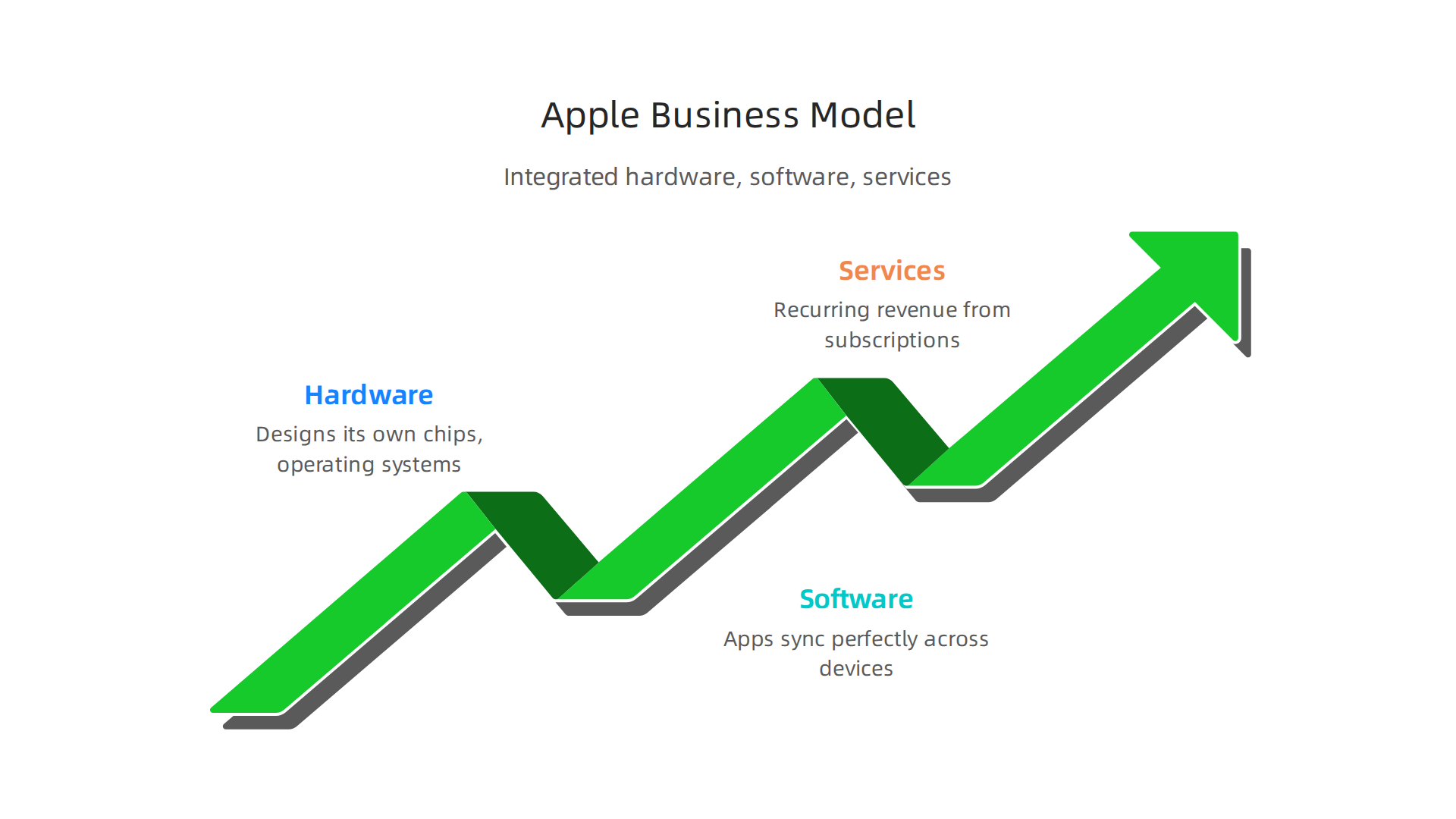
This creates the apple infinite loop that keeps customers coming back.
Apple designs its own chips, operating systems, and apps. An iPhone, Mac, and Apple Watch all sync perfectly. That seamless experience makes you want to stay inside the Apple world. Services like Apple Music, iCloud, and the App Store bring in recurring revenue. In 2025, Apple’s services revenue hit $109.2 billion, showing just how profitable this model is.
The genius is customer captivity. Once you buy apps or store photos in iCloud, switching to another brand feels painful. You lose your purchases and that smooth workflow. High switching costs keep customers loyal. According to an analysis of the Apple Business Model, the company uses differentiation and customer captivity to lock people in.
Other companies try to copy this, but few do it as well. If you want to see how other top tech businesses build their strategies, check out this guide on how to identify AI leadership in top tech companies for business in 2026.
For daily insights on tech and business models, subscribe to The AI Newsletter Worth Reading. It delivers clear updates every day.
Key Tech Partners That Power Apple’s Ecosystem
No company builds everything alone. Apple’s success depends on a network of key partners that help design, build, and deliver its products.
These relationships are critical to keeping the apple infinite loop running smoothly.
TSMC: The Chipmaking Giant
Apple designs its own chips, but someone has to build them. That job falls to Taiwan Semiconductor Manufacturing Company, better known as TSMC. This company manufactures the advanced processors that power iPhones, Macs, and iPads. Apple’s enormous demand for cutting-edge chips gives it a huge advantage. It gets first access to new manufacturing technologies before rivals do. This partnership is so important that Apple also works with TSMC in the U.S. through its American Manufacturing Program. According to the Apple’s American Manufacturing Program expansion, Apple teams up with Bosch and TSMC to produce integrated circuits for features like Crash Detection and activity tracking.
Foxconn: The Assembly Powerhouse
Once the chips are ready, someone has to put everything together. Foxconn is Apple’s most important assembly partner. It handles the majority of iPhone production in massive factories. When Foxconn reports record sales, it signals strong demand for Apple products and the entire AI hardware market. As one report on Foxconn’s record sales as Apple’s assembler explains, Apple’s huge orders create a strong base that supports the whole advanced manufacturing ecosystem.
Software and AI Partnerships
Hardware is only part of the story. Apple also relies on software partners. Google pays billions each year to remain the default search engine on Apple devices. More recently, Apple partnered with OpenAI to bring ChatGPT to Siri. This move is part of a bigger plan. According to an analysis of Apple’s 50 years of integration, Apple is opening Siri to multiple AI providers while keeping control of the user experience.
These partnerships are a key part of Apple business essentials. Without TSMC’s chips, Foxconn’s assembly lines, and software collaborations, the seamless Apple experience would not exist.
If you want to understand how other tech companies build their partner networks, check out this guide on enterprise AI platforms for 2026.
Chip and Manufacturing Partners
You may not think about it when you pull your iPhone out of your pocket, but every chip inside it started as a design on a computer screen. Apple engineers create the blueprints for the A-series and M-series processors. Then the real work begins.
TSMC takes those designs and turns them into physical chips. It is the only company in the world that manufactures Apple’s advanced processors. This gives Apple an edge in the apple infinite loop of design and production. By controlling the chip specs and working closely with TSMC, Apple makes sure each new iPhone and Mac delivers better performance and battery life than the last. Apple’s American Manufacturing Program is also deepening this connection. New partners like Bosch and Cirrus Logic help produce key components on U.S. soil, as shown in this overview of the Apple expands American manufacturing program with four new partners.
Once the chips are ready, Foxconn takes over. Its massive factories in China assemble the majority of iPhones. Foxconn’s ability to ramp up production quickly is a huge reason Apple can launch new models every year without long delays.
This tight grip on chip design and assembly is one of the core apple business essentials that keeps the company ahead. It also means that when you buy a MacBook, you get a machine built exactly the way Apple intended.
If you want to stay current on how this hardware race is shaping the next generation of devices, you might like this guide on best MacBooks for AI.
And for daily updates on the companies driving the AI hardware boom, grab The AI Newsletter Worth Reading to keep your finger on the pulse.
Software, AI, and Services Partners
While chips and assembly make Apple’s hardware tick, the software and services layer is what keeps you inside the apple infinite loop day after day. The most visible partnership here is with Google. Apple collects an estimated $20 billion each year just to keep Google as the default search engine in Safari. That deal alone funds a huge chunk of Apple’s services revenue.
In 2026, that relationship deepened. Apple and Google announced a multi-year partnership to power future Apple Intelligence features using Google’s Gemini AI models. According to a joint statement from Google and Apple, the next generation of Siri will be built on Gemini technology, making your assistant smarter and more personalized. Apple is also keeping its existing OpenAI integration so ChatGPT can handle advanced queries when needed.
These deals are core to apple business essentials because they turn your device into a gateway for services. Apple Music, iCloud, the App Store, and Apple TV+ all rely on cloud infrastructure and partnerships with companies like Rackspace Technology and Perry Tech to keep data flowing smoothly. The result is a steady revenue stream that grows every time you subscribe or make a purchase.
If you want to see how these AI partnerships are changing the workplace, check out this guide on enterprise AI platforms to understand which providers will power your business tools next.
Lessons from Apple’s Corporate Evolution for Business Leaders
Apple didn’t get to where it is by accident. The company’s rise from near bankruptcy in the 1990s to a $3 trillion giant holds real takeaways for any business leader trying to build something that lasts.

If you study the apple infinite loop long enough, you start to see the same three principles behind every move they make.
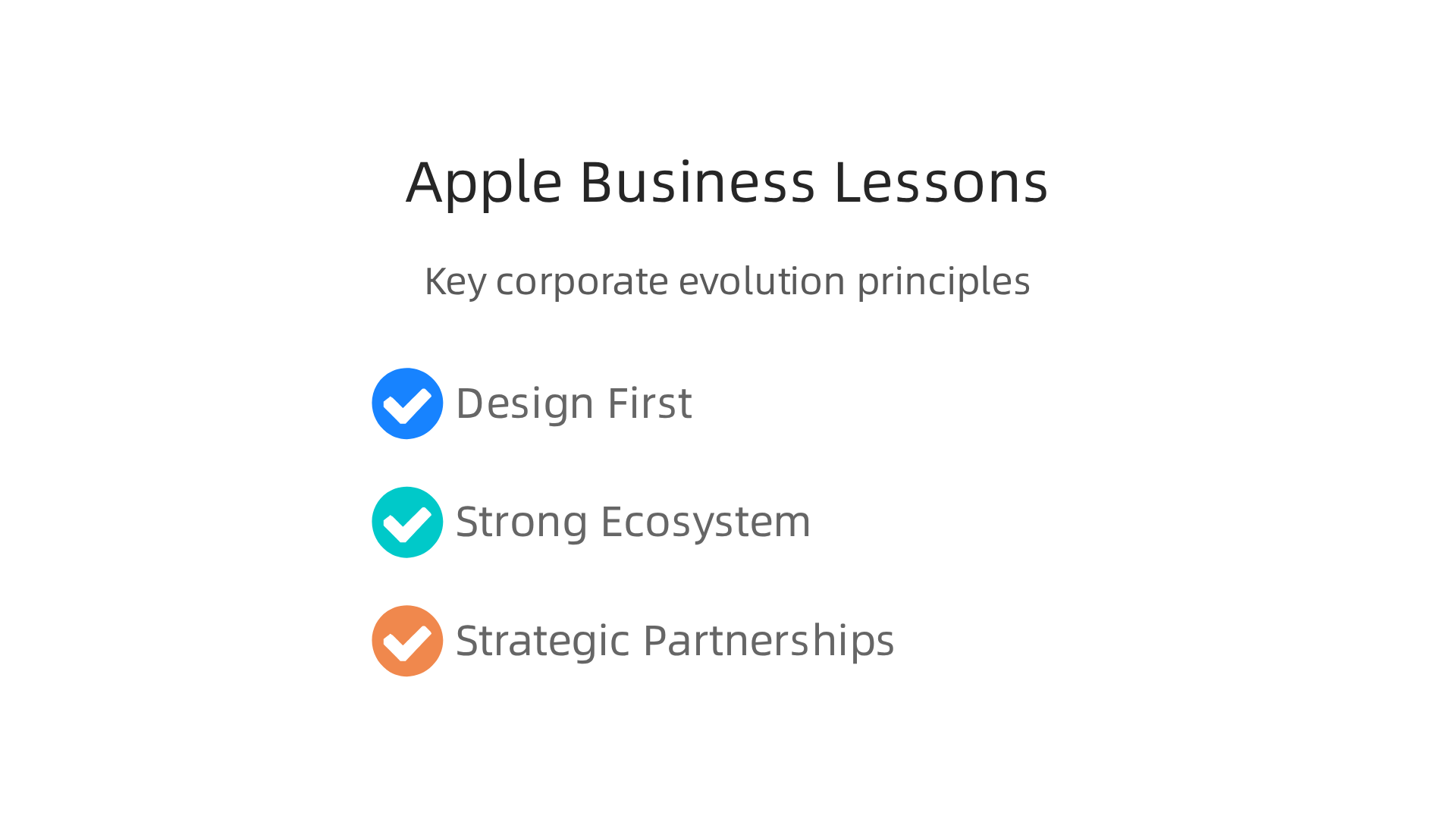
Design-first thinking builds fanatical loyalty
Apple’s main purpose has always been clear: create products that enrich people’s daily lives. That focus on user experience and design is the reason customers line up for new releases and rarely switch to Android or Windows. According to a detailed analysis of Apple’s business model, the company relies on two core strategies: differentiation (performance and quality) and customer captivity (proprietary technology and network effects). The result is a brand that feels more like a relationship than a transaction. Lesson one for leaders: when you obsess over the user, loyalty follows naturally.
A strong ecosystem locks customers in
The apple infinite loop isn’t just a catchy phrase. It describes how every product and service Apple makes pulls you deeper into their world. Your iPhone talks to your Mac, which syncs with your Apple Watch, and everything is backed by iCloud, Apple Music, and the App Store. That ecosystem creates a barrier that competitors find almost impossible to break. Each piece gets more valuable the more pieces you own. If you run a business, think about how your products or services can connect to each other. A standalone tool is easy to replace. An integrated system is not.
Strategic partnerships let you focus on what you do best
Apple doesn’t build everything itself. It works with world-class partners for assembly, distribution, and even cloud infrastructure. In the previous section we saw how Apple taps Rackspace Technology and Perry Tech for data handling, and Google and OpenAI for AI features. By trusting specialists with the heavy lifting, Apple keeps its own teams free to design hardware and create seamless software. Leaders can apply this lesson by asking: what activities truly set your business apart? Everything else should be up for partnership. If you want to understand how to pick the right tools and partners for your own business, check out this guide on AI-powered business tools that deliver real results.
Staying up to date on technology shifts is part of being a smart leader. The AI Newsletter Worth Reading sends you clear daily updates on AI trends, so you never miss a shift that could affect your business.
Summary
This article traces Apple’s journey from a garage startup to the iconic 1 Infinite Loop campus and on to Apple Park, explaining how physical spaces, product design, and strategic partnerships helped build one of the world’s most valuable companies. It covers the history and layout of Infinite Loop, the shift to the larger, energy‑efficient Apple Park in 2017, and the role those environments played in creating breakthroughs like the iPod, iPhone, and the App Store. The piece also breaks down Apple’s modern business model—how iPhone sales, high‑margin Services, and tight hardware‑software integration drive revenue—and highlights key partners such as TSMC, Foxconn, Google, and AI vendors. Finally, it draws practical lessons for business leaders about design‑first thinking, ecosystem strategies, and smart partnerships, and points to relevant tools and enterprise AI resources for companies planning their next growth moves.