Tag: business ai strategy

  • AI Racism Explained for Business Leaders: Risks, Regulations, and Solutions

    AI Racism Explained for Business Leaders: Risks, Regulations, and Solutions

    Why AI Racism Matters Now: A Practical Primer for Decision-Makers

    In 2026, artificial intelligence (AI) is everywhere. It helps us do many things, from choosing what to watch online to deciding who gets a loan or a job. But what happens if the AI learns bad habits from the data it uses? This is where we run into a big problem called AI racism. It’s when AI systems unfairly treat people based on their race, often without anyone meaning for it to happen.

    You might wonder, "how long has AI been around?" While the idea of AI has been around for many years, the tools we use today have grown very quickly, especially since 2023. As AI development moves forward, we have to be careful about how these powerful tools are made and used. If an AI brain is fed information that has hidden biases, it will learn those biases and act on them. This can lead to unfair results for real people.

    What is AI Racism?

    Simply put, AI racism happens when an AI system shows unfair bias against certain racial groups. It’s not about the AI itself being "racist" like a person. Instead, it’s about the data it learns from, the rules it follows, or how people use it. This bias can creep into AI systems in many ways. For example, if an AI is trained mostly on pictures of one race, it might not be as good at recognizing faces of other races. This isn’t just a small flaw; it can cause big problems. Experts have been working on ways to check for and fix these biases, looking at things like fairness metrics for different groups of people Racial/Ethnic Bias in AI Systems: A PRISMA Systematic….

    Where Does AI Racism Show Up?

    AI racism can appear in many parts of our lives. Here are a few examples:
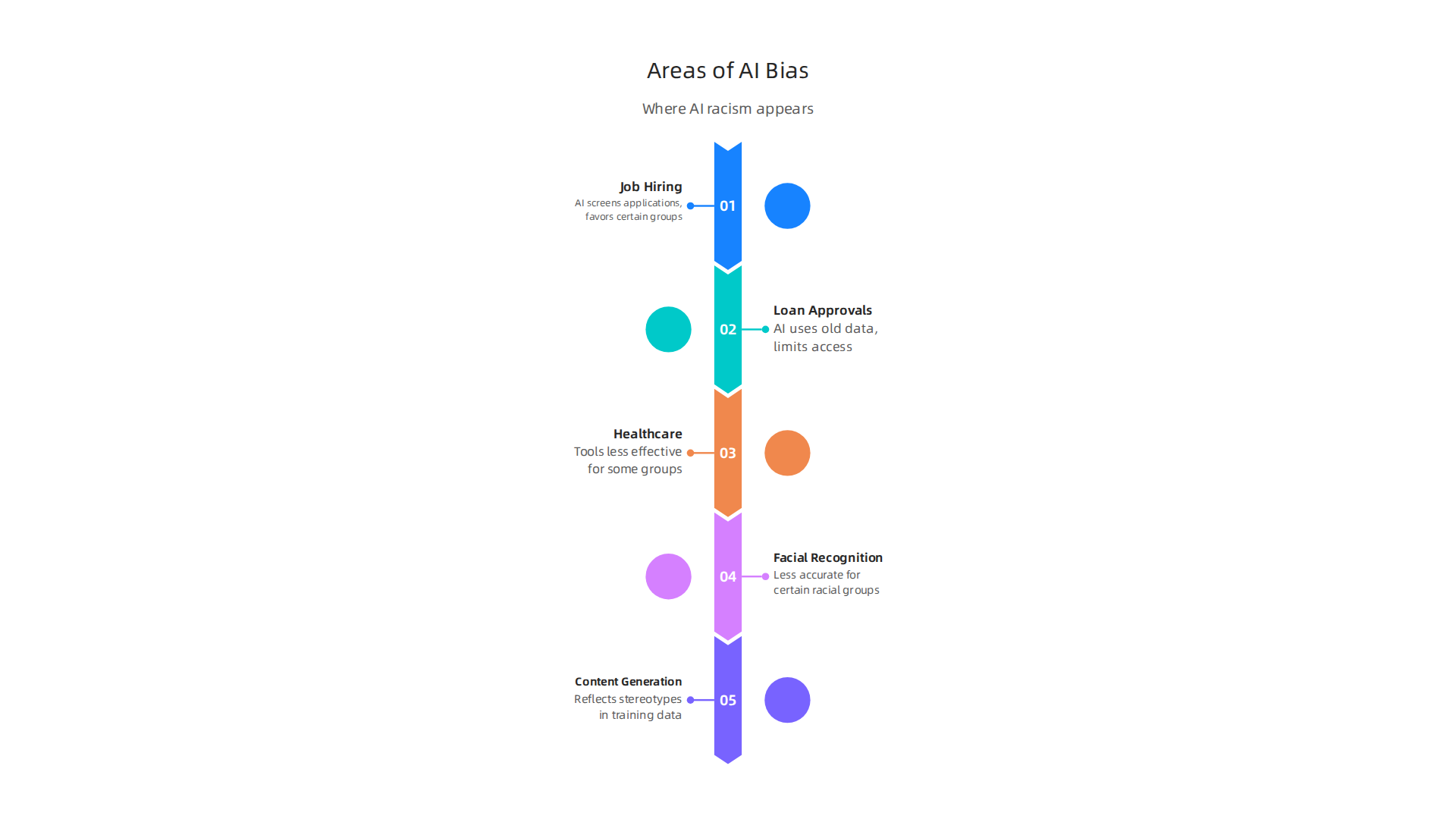
    AI racism isn't just theoretical; it manifests in critical real-world applications, from job markets to healthcare decisions, impacting individuals significantly.

    • Job Hiring: An AI that screens job applications might learn to favor names or experiences linked to one racial group, accidentally shutting out good candidates from others.
    • Loan Approvals: AI systems that decide who gets a bank loan could use old data that shows loans were less often given to certain neighborhoods, making it harder for people from those areas to get loans even today.
    • Healthcare: Medical AI tools might not work as well for certain racial groups if they were mostly tested on data from another group. This could mean a delay in getting the right care.
    • Facial Recognition: Police often use AI to identify people. If this technology is less accurate for certain racial groups, it can lead to wrongful arrests or unfair stops. People sometimes hold an AI protest when they feel these systems are being used unfairly.
    • Content Generation: AI that creates text or images can also show bias, reflecting stereotypes if its training data contains them.

    Companies and governments are starting to develop guides and rules to help make AI fair. These are often called AI ethics frameworks AI Ethics Frameworks in 2026: EU AI Act + Tools – Future AGI. They help make sure AI works well for everyone. Tools like AI Fairness 360 are also available to help companies check for unwanted bias in their AI models before they cause harm AI Fairness 360.

    Why This Matters for Your Business

    For decision-makers, understanding ai racism is not just about doing the right thing. It’s also about protecting your company’s reputation and bottom line.

    Decision-makers engage in critical discussions about the ethical implications of AI, focusing on fairness and responsible deployment.

    • Harm to People: First and foremost, biased AI can hurt people. It can limit their chances for jobs, housing, or fair treatment. This is a basic moral issue that no company wants to be part of.
    • Bad for Business: When AI systems show bias, it can lead to public complaints, news stories, and even legal action. This can damage your brand, making customers lose trust in your products and services. No business wants to be known for using unfair technology. The cost of fixing a damaged reputation can be huge.
    • Limits Innovation: If your AI tools are not fair, they are also not working as well as they could be. They might be missing out on talent, customers, or insights from diverse groups. Building equitable AI systems requires a focus on tools and strategies that help address bias White Paper: Addressing Bias in Artificial Intelligence.

    Staying updated on these issues is key. If you want clear daily AI updates to help you navigate this fast-changing world, check out The AI Newsletter Worth Reading.

    AI racism is often not planned but creeps into systems during the AI development process. It’s important to know how this happens. Let’s look at the common ways AI systems can go wrong and show unfairness.

    How AI Racism Shows Up: Common Failure Modes

    When an AI brain is built, bias can sneak in at different steps. Understanding these points helps us prevent problems.
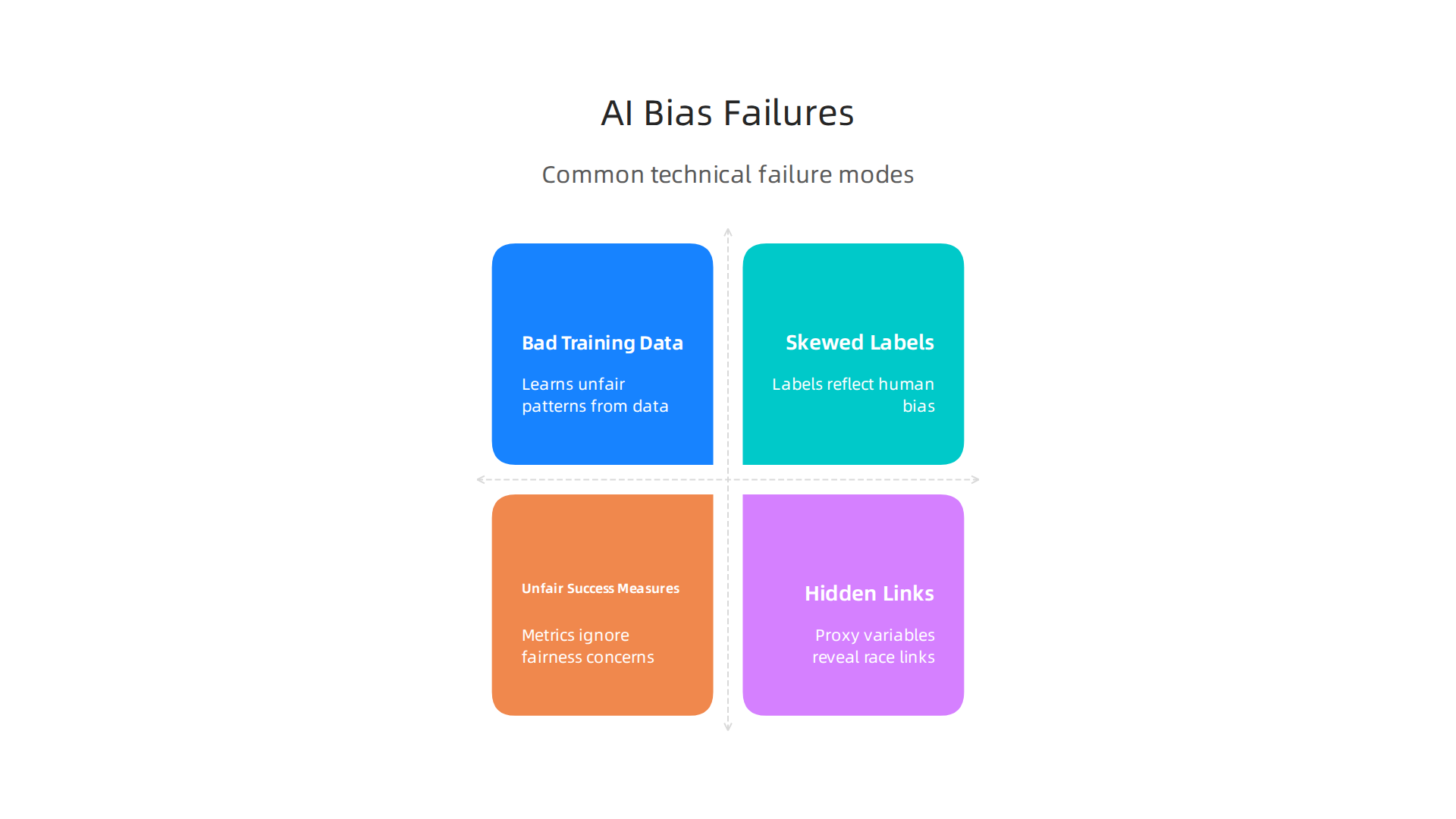
    Understanding the technical origins of AI racism, from flawed training data to hidden proxy variables, is crucial for effective mitigation.

    • Bad Training Data: This is the most common reason for AI racism. Imagine an AI learns from books that only show people from one background. That AI will then have trouble understanding or dealing with people from other backgrounds. If the data used to train an AI system has unfair patterns from the real world, the AI will learn and repeat those unfair patterns. Many AI models have been shown to have too many White individuals in their training data, with very few from other groups, leading to bias Bias in AI systems: integrating formal and socio-technical approaches.
    • Skewed Labels or Categories: Sometimes, people label the data the AI learns from. If these labels are unfair, the AI will learn that unfairness. For example, if images of certain racial groups are often labeled in a negative way, the AI will link those groups to negative things. This bias can emerge at many points in the machine learning process Fairness at Risk: Where Bias Emerges in Machine Learning.
    • Unfair Ways to Measure Success: When we build an AI, we tell it what "success" looks like. If our idea of success doesn’t include fairness for everyone, the AI might achieve its goal while still being unfair to some groups.
    • Hidden Links (Proxy Variables): An AI might be told not to use race directly. But it might use other things that are strongly linked to race, like zip codes or names, to guess a person’s race. These "hidden links" are called proxy variables. The AI then treats people unfairly based on these hidden links, even if race itself isn’t directly used.

    These technical issues can lead to real problems in many areas of life:

    • Job Hiring Tools: AI systems that help choose job candidates might learn from old hiring data that preferred certain groups. This can mean good candidates from other groups are overlooked. The AI might use things like where someone went to school or their hobbies as a "proxy" for race, leading to unfair decisions.
    • Justice System (Recidivism): Some AI tools try to predict if someone who has committed a crime will do so again (this is called recidivism). If these tools are trained on historical arrest data that was unfair to certain racial groups, the AI might wrongly predict that people from those groups are more likely to re-offend. This can lead to harsher sentences or less chance for parole, unfairly hurting communities of color.
    • Vision and Facial Recognition: As we saw before, if an AI that recognizes faces is mostly trained on pictures of one race, it will be less accurate for others. This can cause big problems for security systems or law enforcement, leading to false alarms or incorrect identifications. This is why it’s important to think about population bias when training AI Artificial intelligence training and population bias.
    • Healthcare: Medical AI tools can show bias too. For example, a tool that helps doctors diagnose skin conditions might not work as well for darker skin tones if it was trained mostly on images of lighter skin. Or, an AI used to decide a patient’s risk of disease might be less accurate for certain racial groups, leading to poorer health outcomes. There are real concerns about how AI systems can worsen health differences for different groups of people A Systematic Review on AI-Driven Racial Disparities in Healthcare.

    It’s important to remember that AI is only as good as the data and rules it’s given. Learning about when artificial intelligence was made can help us understand its journey and how these issues have grown with its complexity. As AI development continues at a rapid pace in 2026, finding and fixing these kinds of biases is a big challenge for everyone involved in creating and using AI systems. Making good choices about how to choose AI for business tools that deliver real results means choosing tools that are built with fairness in mind.

    To truly understand if an AI brain is fair, we need ways to measure fairness. It’s not always simple, because "fair" can mean different things to different people. This is a big part of dealing with ai racism in the modern world.

    Ways to Measure if an AI System is Fair

    There are a few main ideas about how to measure fairness in AI:
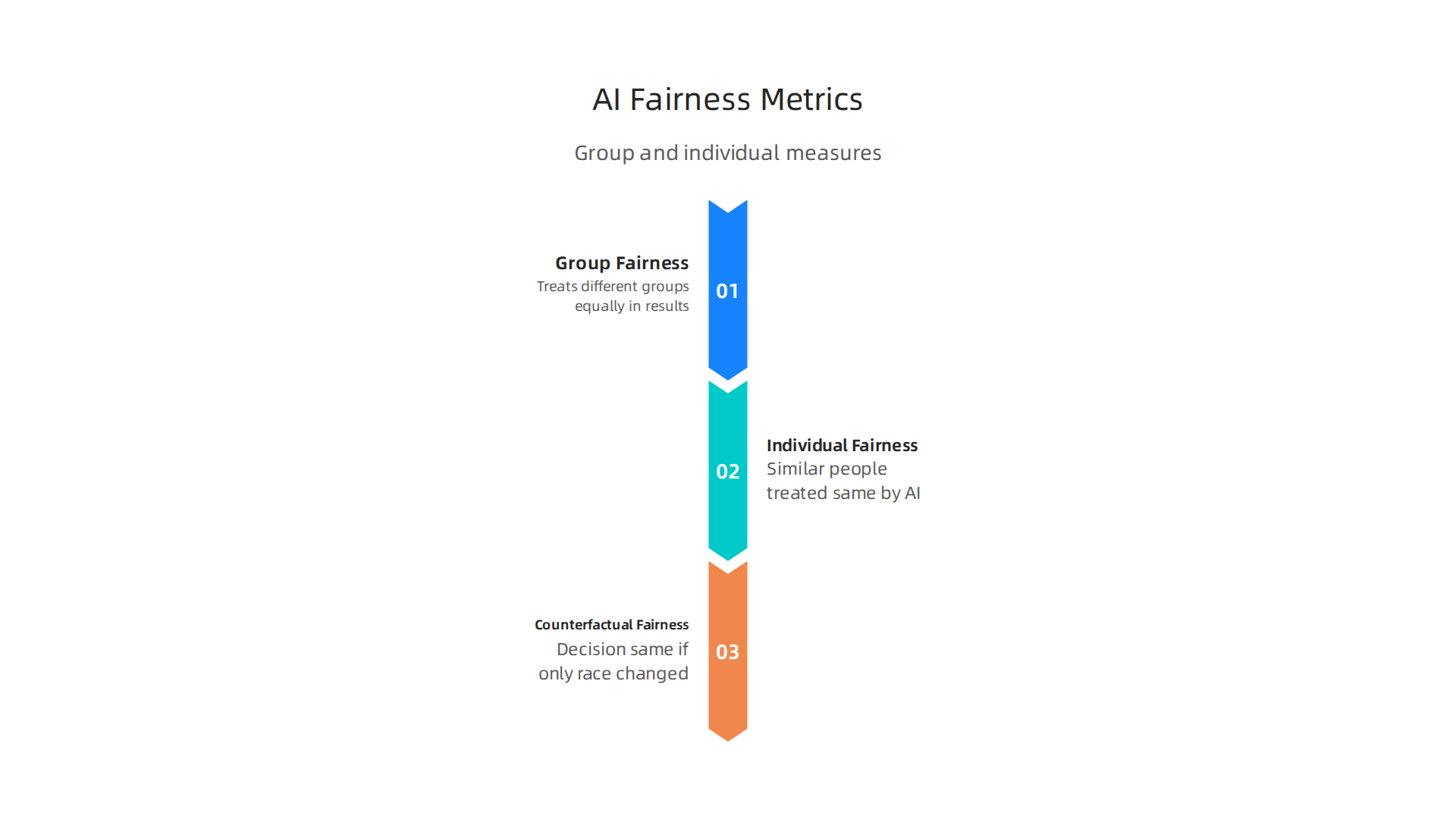
    Different interpretations of 'fairness' in AI necessitate varied measurement approaches, from group-level outcomes to individual treatment.

    • Group Fairness: This idea looks at whether an AI system treats different groups of people equally in terms of its results. For example, if an AI is deciding who gets a loan, group fairness would mean that people from different racial groups have the same chance of getting approved, or the same rate of errors. Many studies look at these kinds of group differences to spot bias Racial/Ethnic Bias in AI Systems: A PRISMA Systematic ….
    • Individual Fairness: This idea says that people who are very similar should be treated the same by the AI, no matter what group they belong to. So, if two people have the exact same credit score and job history, the AI should make the same loan decision for both, even if they are of different races.
    • Counterfactual Fairness: This is a bit more complex. It asks: "If we changed only one thing about a person, like their race, but kept everything else the same, would the AI make the same decision?" If the answer is no, then the AI might not be counterfactually fair. This helps find out if the AI is making decisions based on race, even if it’s trying not to.

    Problems with the Data We Use to Measure Fairness

    Even with these ways to measure fairness, we still run into challenges. The data itself can have problems:

    • Missing Information: Often, the datasets used to build and test AI models don’t have good information about race or ethnicity. In fact, one study found that 84% of worldwide clinical AI models did not report the racial makeup of their training data, which makes it hard to check for fairness Gender and racial bias unveiled: clinical artificial intelligence (AI) and machine learning (ML) algorithms are fanning the flames of inequity – PubMed. If the data doesn’t properly show all groups, the AI cannot learn fairly. This is like trying to learn about the whole world by only reading books from one small town.
    • Bad Samples (Sampling Bias): Sometimes, even if race is included, the sample of people in the data might not truly represent all parts of the population. For example, a healthcare AI might be trained on data mostly from one hospital in a rich neighborhood, making it less useful for patients in other areas or from different backgrounds Healthcare bias in AI: A Systematic Literature Review. This kind of sampling bias means the AI’s "understanding" is incomplete.
    • Hidden Measurement Problems: How we define and measure race can also be tricky. Sometimes, an AI might guess someone’s race based on their name or address, which can be wrong and lead to unfairness without us even realizing it. These hidden links can make it hard to accurately measure racial bias.

    As we move deeper into 2026, finding good ways to measure AI fairness and deal with these data problems is a top concern in AI development. It’s not just about building powerful tools, but making sure those tools help everyone fairly. For businesses, understanding these measures is part of building trust and ensuring that AI solutions meet Mastering the AI Future Standard 2026.

    Staying on top of these complex AI topics can be a challenge. Get clear daily AI updates from The Deep View Newsletter. The AI Newsletter Worth Reading can help you keep informed.

    As we move deeper into 2026, finding good ways to measure AI fairness and deal with data problems is a top concern in AI development. It’s not just about building powerful tools, but making sure those tools help everyone fairly. For businesses, understanding these measures is part of building trust and ensuring that AI solutions meet Mastering the AI Future Standard 2026.

    Regulation, Standards, and Legal Risk: What Leaders Must Know

    Because AI can have hidden biases and cause problems like ai racism, governments around the world are making new rules. For business leaders, it’s very important to know about these rules and what they mean. Not following them can lead to big problems.

    Executives carefully review new AI regulations and compliance standards, strategizing to mitigate legal risks.

    New Rules and What They Mean

    Many countries and regions are creating laws to make AI safer and fairer. For example, the European Union has its AI Act | Shaping Europe’s digital future, which became largely applicable in 2026. This act looks at AI systems that are considered "high-risk" and makes sure they follow strict rules for safety, transparency, and non-discrimination. It even requires checking datasets for biases, which helps stop things like racial bias from happening.

    In the United States, different states are also making their own rules. For instance, California’s AB 2013 on AI Training Data Transparency came into effect in January 2026. This law helps make sure we know more about the data used to train AI. The US government has also proposed a National Policy Framework Artificial Intelligence to guide how AI should be used fairly. Other places like Australia are also developing their own rules for AI use, aiming for strong safety standards.

    These laws often say that AI systems must:

    • Be watched for biases.
    • Explain how they make decisions.
    • Be used in a way that doesn’t treat people unfairly based on things like race or gender.

    The goal is to prevent harm and ensure that AI systems are trustworthy. This is part of how businesses can apply Smart AI for Business effectively and ethically.

    Legal Risks and Problems for Businesses

    If a business uses an AI system that causes harm or shows racial bias, there can be serious legal risks.

    • Lawsuits and Fines: People who are unfairly treated by an AI could sue the company. Governments can also issue big fines for not following AI laws. For example, in employment, some regulations make employers responsible for unfair outcomes from AI tools, even if they didn’t mean for it to happen. In fact, rules taking effect in 2027 in places like Connecticut aim to remove tricky demands in favor of clearer disclosure rules for workplace AI, according to AI Employment Law Updates: 2026 Changes.
    • Bad Reputation: Companies that use unfair AI can quickly get a bad name. This can lead to public backlash, sometimes even an ai protest or loss of customer trust. In 2026, people are much more aware of AI’s power and its potential for harm.
    • Difficulty Getting New AI Tools Approved: Regulators might make it harder for companies with a history of biased AI to bring new tools to market.

    For an AI bias to be against the law, it usually has to harm a specific group of people who are protected by anti-discrimination laws. This means that if an AI system leads to unfair treatment based on race, it could be seen as unlawful discrimination. Understanding these legal risks is a key part of how to choose AI for business tools that truly deliver results and avoid legal trouble.

    So, it’s not enough to just build smart AI. Leaders must also make sure their AI is built and used fairly, following all the new rules and avoiding legal traps. This helps everyone, from the business to the people who use its AI tools.

    After looking at all the new rules, what can businesses actually do to make sure their AI tools are fair and safe? It’s not enough to just hope for the best. Companies need clear plans and actions in place. This is where good operational practices come in, like checking for problems, testing thoroughly, and knowing what to do if something goes wrong.

    How to Check and Fix AI Problems

    To keep AI from causing unfairness or issues like ai racism, teams need practical ways to handle it. Think of these as safety checks and emergency plans for your AI systems.
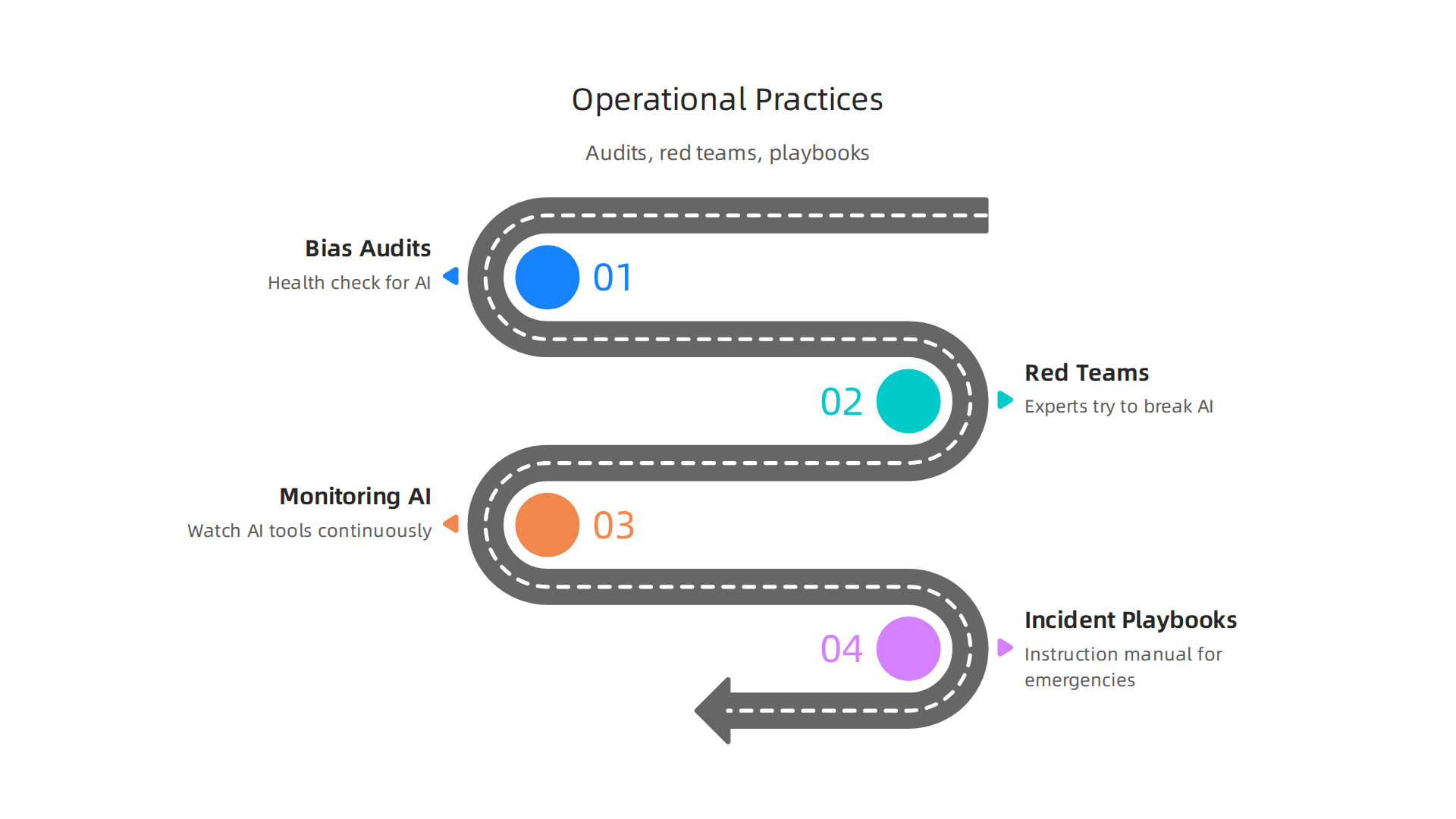
    Implementing robust operational practices like regular audits and red-teaming helps proactively identify and address AI biases.

    • Bias Audits: This is like a health check for your AI. You carefully look at the AI system and the data it uses to find any hidden unfairness. These audits help make sure the AI isn’t treating some groups of people worse than others. For example, they can reveal if an AI used for hiring accidentally favors one gender or race over another. The goal is to spot these problems early and fix them. The National Institute of Standards and Technology has even put out guides on how to properly Identify and Manage Bias in AI.
    • Red-Teaming: Imagine hiring a group of "friendly hackers" whose job is to try and break your AI. That’s red-teaming. These experts actively try to find ways the AI could be used wrongly or misused, or how it might show bias in unexpected situations. This helps companies understand their AI’s weak spots before a real problem happens. It’s a key part of making sure AI development is secure and responsible.
    • Monitoring AI: Even after an AI system is launched, the work isn’t done. Businesses need to watch their AI tools all the time. This means looking for signs of new biases appearing or if the AI starts acting in ways it shouldn’t. Good monitoring helps catch issues quickly, preventing harm and keeping the AI aligned with its purpose.
    • Incident Response Playbooks: What if something does go wrong? A playbook is like a detailed instruction manual for emergencies. It tells everyone on the team what to do if an AI system causes harm or shows serious bias. This includes steps for stopping the problem, telling the right people, and fixing the AI. Having a clear plan can reduce damage and help the company react faster.

    Picking What to Fix First

    Many companies don’t have endless money or people to work on every single AI problem at once. So, it’s important to pick what to fix first. Here’s how:

    • Look at the biggest risks: Which AI tools could cause the most harm to people or the business? Focus on those first. An AI that decides if someone gets a loan has a bigger risk of causing financial ai racism than, say, an AI that helps you pick a movie.
    • Follow the rules: Make sure your AI meets all the new government rules and standards. Not following these rules can lead to big fines and legal troubles, so these are often a top priority. For businesses looking to optimize their workflow and stay compliant, knowing how to choose AI-ready business computers in 2026 can be a smart step to support these practices.
    • Listen to feedback: Pay attention to what users and employees say about your AI. If people report problems or concerns, investigate them quickly. Sometimes, real-world feedback can show you problems that your tests didn’t catch.

    By putting these practical controls in place, businesses can build trust and make sure their AI helps everyone fairly. It’s about being proactive and responsible in how we use this powerful technology.

    To keep up with the latest in AI trends and best practices, remember to check out The AI Newsletter Worth Reading for clear daily updates.

    When AI tools have problems like unfair bias or even ai racism, it’s not just a technical issue. These problems can hurt a business in many ways. It’s important for companies to understand these risks and talk openly about them with everyone involved. This includes customers, people who make rules, and any communities that might be affected.

    Turning Harms into Business Risks

    If an AI system causes harm, it can lead to big problems for a company.

    • Money Problems: If an AI acts unfairly, especially when it comes to things like loans or jobs, businesses can face huge fines and legal trouble. For example, new laws in 2026, like California AB 2013, are making companies more responsible for their generative AI systems. Not following these rules can cost a lot of money. Laws like the 2026 AI Laws Update: Key Regulations and Practical Guidance make this very clear.
    • Bad Reputation: When people find out that a company’s AI is unfair, it can really hurt how they feel about that business. News stories about ai racism or other biases can make customers lose trust. People might stop buying products or using services. This can lead to public backlash, and sometimes even an ai protest against the company, which is hard to fix.
    • Loss of Trust: Trust is a very important thing for any business. If customers can’t trust that an AI system will treat them fairly, they will simply go somewhere else. This loss of trust can be very hard to get back and can slow down the company’s growth and new ai development.

    Talking Clearly to Everyone

    How a business talks about its AI tools is very important. Being open and honest can help build trust, even when problems come up.

    • With Customers: Companies should be clear about how they use AI. They should explain what the AI does, what information it uses, and how they make sure it’s fair. Simple language is best so everyone can understand.
    • With Rule-Makers (Regulators): Businesses need to show that their AI tools follow all the rules and laws. This means having good records and being ready to share information about how their AI works and how they check for problems. Staying up-to-date with new standards is key to mastering the AI future standard 2026 and showing good behavior.
    • With Affected Communities: If an AI system causes harm, it’s very important to talk to the people who were affected. This means listening to their concerns, saying sorry if needed, and explaining what the company is doing to fix things and prevent it from happening again. This open talk can help heal relationships and keep problems from getting bigger.

    Being ready to handle AI problems and communicate clearly is a huge part of using AI responsibly in 2026. It protects the business, keeps customers happy, and makes sure AI benefits everyone fairly.

    To make sure AI works fairly for everyone, companies must think about fairness right from the start.

    A diverse team collaborates on designing AI systems that are fair and inclusive, integrating ethical considerations from the outset.

    This means looking closely at how AI systems are built, from the first pieces of information they get to the final product choices. Designing good AI takes careful planning and constant checking.

    Smart Data Collection and Labeling

    The main reason AI can be unfair, leading to things like ai racism, often comes from the data it learns from. If the data isn’t balanced or doesn’t show all kinds of people fairly, the AI will learn those biases.

    • Gathering Diverse Data: It’s super important to collect many different kinds of data. This means making sure the data includes people from all backgrounds, ages, and groups. If you’re building an AI for hiring, for example, your data should represent a wide range of job applicants, not just one type of person. A key way to fight bias is to collect more diverse and representative data before the AI model is even trained, and to rebalance data to help different groups equally AI Bias and Fairness: From Detection to Mitigation in 2026.
    • Careful Data Labeling: People often label the data that AI uses. If these people have their own hidden biases, those biases can get into the AI system. Companies must train their data labelers well and check their work often to make sure the labels are fair and correct. You can even adjust the features and labels in the data set before the AI learns from it to make sure it’s fair Fairness in AI-Driven Recruitment: Challenges, Metrics, ….

    Keeping Humans in the Loop

    Even with the best data, AI systems can still make mistakes or show bias. That’s why having real people involved in checking the AI’s work is so important.

    • Review and Override: Companies should set up ways for people to look at what the AI suggests or decides, especially in important areas like hiring or giving loans. If the AI seems unfair, a human should be able to step in and change the decision. This "human-in-the-loop" approach helps catch errors before they cause harm. Research from 2026 shows it’s wise to keep humans involved in decisions where people might be rejected by AI AI Screening Bias: What 2026 Research Reveals – HyreFast.
    • Ongoing Monitoring: AI development isn’t a one-time thing. AI systems need to be watched all the time, even after they are launched. Companies should regularly check if their AI is working fairly for all groups and fix problems right away. This involves running checks to find and deal with bias through the entire AI system’s life Responsible Implementation and Use of Artificial Intelligence in ….

    Building Equity into Product Decisions

    For product teams, designing inclusive AI means thinking about fairness at every step of building and launching a product.

    • Set Clear Goals for Fairness: Just like setting goals for how well a product works, teams should have clear goals for how fair the AI will be. This means deciding what "fairness" looks like for their specific product and how they will measure it. Different fairness measures exist, like making sure positive outcomes are similar for all groups Data and AI Ethics Framework – GOV.UK.
    • Regular Audits and Checks: Product teams should regularly check their AI systems for bias. This isn’t just a technical task; it’s about looking at how the AI affects real people. They can use special tools, like IBM’s AI Fairness 360, which is a free toolkit to help find and fix bias in AI models Introducing AI Fairness 360. These audits should be part of the regular work schedule.
    • Feedback Loops: Create ways for users and communities to share their thoughts and experiences with the AI. If people report problems with ai racism or other biases, the product team should listen and use that feedback to improve the AI. This helps make sure the AI truly serves everyone. You can learn more about finding the right tools by checking out how to choose AI for business tools that deliver real results.

    By following these steps, companies can build AI systems that are not only powerful but also fair and helpful for all people. Staying on top of AI developments and ethical standards is crucial.

    Get clear daily AI updates from The AI Newsletter Worth Reading.

    Summary

    This primer explains why AI racism — unfair outcomes tied to race from AI systems — is an urgent business and policy issue in 2026. It walks through how bias enters AI (bad training data, skewed labels, proxy variables, and unfair objectives), shows where biased systems cause harm (hiring, lending, healthcare, facial recognition, content), and describes practical ways to find and fix problems. The article covers fairness definitions (group, individual, counterfactual), data and measurement challenges, and operational steps like bias audits, red‑teaming, continuous monitoring, and incident playbooks. It also outlines the rising regulatory landscape (EU AI Act, state laws like California AB 2013, and national frameworks) and the legal, reputational, and financial risks of ignoring bias. Readers will learn how to prioritize high‑risk systems, build human oversight into workflows, and choose controls and tools to reduce harm while staying compliant. The goal is to give leaders a clear, actionable roadmap to make AI safer, fairer, and more trustworthy for all users.

  • How to Pick AI Tools for Business to Drive Growth in 2026

    How to Pick AI Tools for Business to Drive Growth in 2026

    The world of computer brains, known as AI, is growing super fast in 2026. Every day, it feels like a new tool comes out. This can make many of us feel a kind of "aiscream ai scream" feeling, like there’s just too much to keep up with.

    Navigating the rapid growth of AI tools can often lead to a feeling of being overwhelmed.

    Think about it: between 86% and 92% of people who make things online are already using AI in some way today, and about 38% of all business content on the internet gets help from AI at some point [Presenc AI research on AI content creation, Creator Economy AI Adoption Statistics (2026)]. It’s exciting, but it also means a lot of choices.

    All these new tools can be confusing. It’s hard to know which ones are right for you or your business, how to make them work together, or if they are even worth the money. That’s why this guide matters now more than ever. It’s here to help you cut through the noise. We will show you simple ways to pick the best AI tools, like an AI virtual assistant for businesses, and how to use them with your daily tasks. We’ll also cover how to check if these tools are truly helping your business grow and save money. You’ll even get a helpful checklist for using AI in things like making content. If you want to stay smart about AI every day, we’ve got something special for you.

    The AI Newsletter Worth Reading

    Even with the feeling of "aiscream ai scream" from so many new tools, AI is not just a passing trend. For small to medium-sized businesses (SMBs) and their teams, AI tools are changing how work gets done in 2026. The main reason? They offer huge steps forward in how fast things happen, how personal you can make your outreach, and how much your team can get done.

    Business Outcomes: Speed, Personalization, and Productivity

    Think about creating content. Writing blog posts, social media updates, or emails used to take a lot of time. Now, AI can help speed this up a lot. About 38% of all business content on the internet today gets some help from AI at some point [AI Content Creation Statistics 2026 | Presenc AI]. This means businesses can make more content, faster, to reach more people.

    AI also helps make things feel personal for each customer, even when you have many customers. This is called personalization at scale. Instead of sending the same message to everyone, AI can help tailor messages so each person feels like you’re talking directly to them. This can lead to happier customers and better sales.

    For daily tasks, an AI virtual assistant can be a game-changer. These smart helpers can answer customer questions, schedule meetings, or organize information. This frees up your team members to focus on bigger, more important jobs that only a human can do.

    AI virtual assistants free teams to focus on high-value, strategic, and human-centric tasks.

    It’s all about improving productivity, which means getting more done with less effort.

    Common Pitfalls: Picking Tools and Setting Them Up

    However, not all AI use is good use. One common problem is choosing AI tools just because they’re popular or because everyone else is talking about them. It’s like buying a fancy car when you only need a bike to get to work. The tool needs to fit your business’s real needs, not just be the latest buzz. To avoid this, it’s wise to learn how to choose AI for business tools that deliver real results.

    Another big mistake is not spending enough time making sure the AI tools work well with your existing systems. Imagine buying new kitchen gadgets but not having any space to put them or not knowing how to use them with your stove. For AI, this means planning how new tools will connect with your email system, customer records, or content platforms. If you don’t connect them well, the tools might not help as much, and could even create more problems, adding to that "aiscream ai scream" feeling of things being too messy or complicated. When using AI for content, remember to also think about tools that act as a humanize ai detector to make sure your AI-generated text still sounds natural and not robotic.

    To avoid that "aiscream ai scream" feeling when picking AI tools, you need a smart way to look at them. It is not just about choosing the most talked-about tool. Instead, you should think about what your business really needs. This helps you pick tools that work for you, not against you.

    Quick overview: How to Compare AI Tools

    When looking at different AI tools, there are a few important things to check.

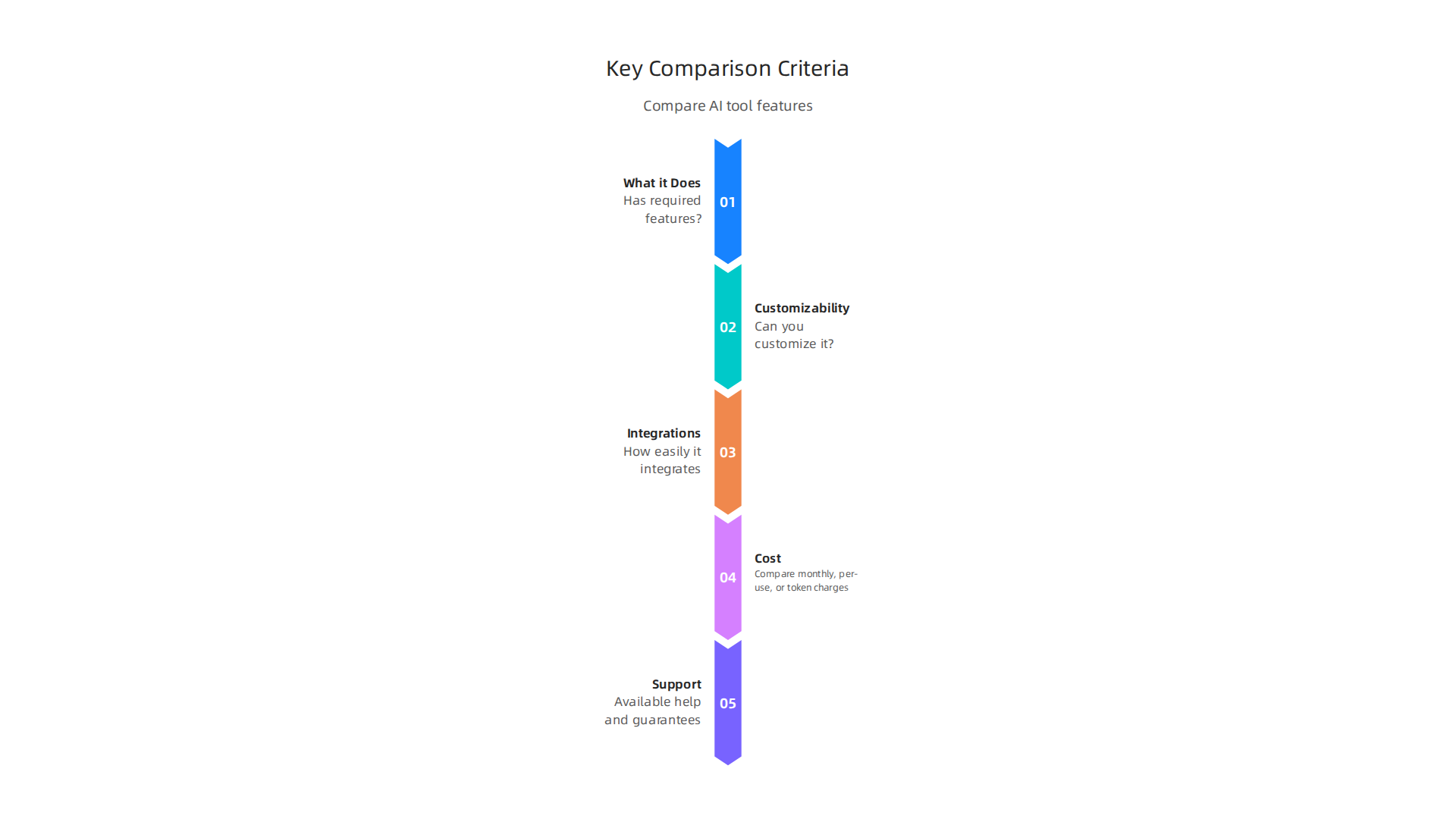
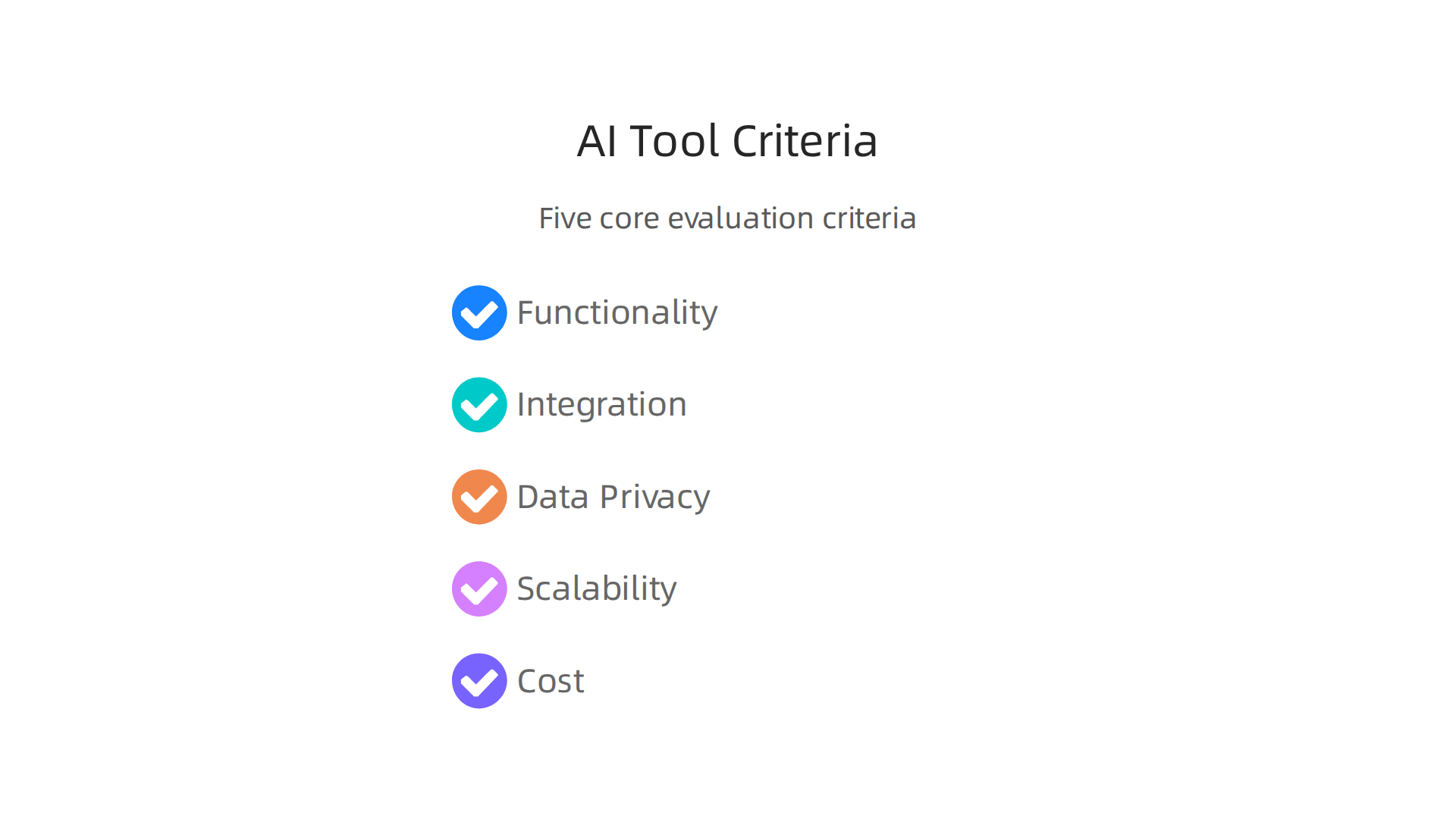
    Effectively compare AI tools by evaluating their features, customizability, API integration, pricing, and support.

    This helps you make sure the tool fits your business perfectly.

    1. What it Does (Feature Set): First, think about what the AI tool can actually do. Does it have all the features you need? For example, if you need an AI to write emails, does it do that well? Or if you need an AI for customer help, can it handle many different questions? Don’t just pick a tool with lots of features. Pick one with the right features for your specific tasks.
    2. How You Can Change It (Customizability): Some AI tools are like a ready-made suit, you can’t change much. Others are more like building blocks, where you can make them do exactly what you want. Think about if you need to teach the AI special words or ways of working for your business. The more you can change it, the more it can fit your unique needs.
    3. How It Connects to Other Tools (API Surface): This is very important. An "API surface" means how easily the AI tool can talk to your other computer programs, like your email system or customer records. If an AI tool cannot connect well, you might end up doing more work, not less. Making sure tools work together smoothly helps you avoid problems. You can learn more about picking the right tools by checking out this guide on mastering specialized AI tools.
    4. How Much It Costs (Pricing Model): AI tools can cost money in different ways. Some charge a monthly fee, some charge for every bit of work they do (like per word written or per question answered). It’s important to look at the pricing model and compare it carefully. For instance, the cost of AI APIs can vary a lot, with some models being as low as $0.02 per million input tokens in 2026 AI API Pricing 2026: Compare GPT, Claude, Gemini Token …. Make sure you understand how you will be charged so there are no surprises.
    5. Help and Guarantees (Support/SLAs): What kind of help will you get if something goes wrong? Good customer support means you won’t be stuck if you have questions or run into problems. Some companies offer "Service Level Agreements" (SLAs), which are promises about how quickly they will fix issues or how often their service will be working. This helps ensure your business keeps running smoothly.

    When you compare tools, don’t just count how many features each one has. Instead, match their features to the actual jobs you need them to do. This way, you pick tools that truly solve your problems and help your business grow.

    To stay on top of all the latest AI trends and insights that can help your business, consider subscribing to a reliable source.
    Get clear daily AI updates from The Deep View Newsletter.

    When picking AI tools for your business, it’s not enough to just know what the tools can do. You also need to think about what your business really needs them to do. This is like matching a lock to its key. If you don’t do this, you might end up with that "aiscream ai scream" feeling, wondering why your new tool isn’t helping.

    Choosing the right AI tool: use-case mapping and decision criteria

    First, let’s talk about what your business needs. You want to map your daily work to what an AI tool can handle.

    • What kind of work? (Content type) Do you need AI to write stories, make pictures, or put together videos? For example, many businesses use AI for writing. In fact, in 2026, about 38% of all web content from businesses gets help from AI at some point in making it. This is a big jump from past years. So, if you need a lot of written stuff, an AI writing tool is a good match. If you need something that can comment AI for feedback or correct mistakes, look for that specific skill.
    • How much work? (Volume) Are we talking about a few small tasks a day, or thousands of things every hour? Some AI tools are great for small, quick jobs. Others can handle huge amounts of work, like managing all your customer questions or creating many social media posts at once.
    • How good does it need to be? (Quality requirements) Does the AI need to create perfect content every time, or just rough ideas you can make better later? Some tools focus on speed, giving you a quick draft. Others aim for very high quality, almost like a human wrote it. You might even want a tool that can humanize AI detector tools so your AI content sounds more natural.

    Once you know what you need, here’s a checklist to help you make your final choice:

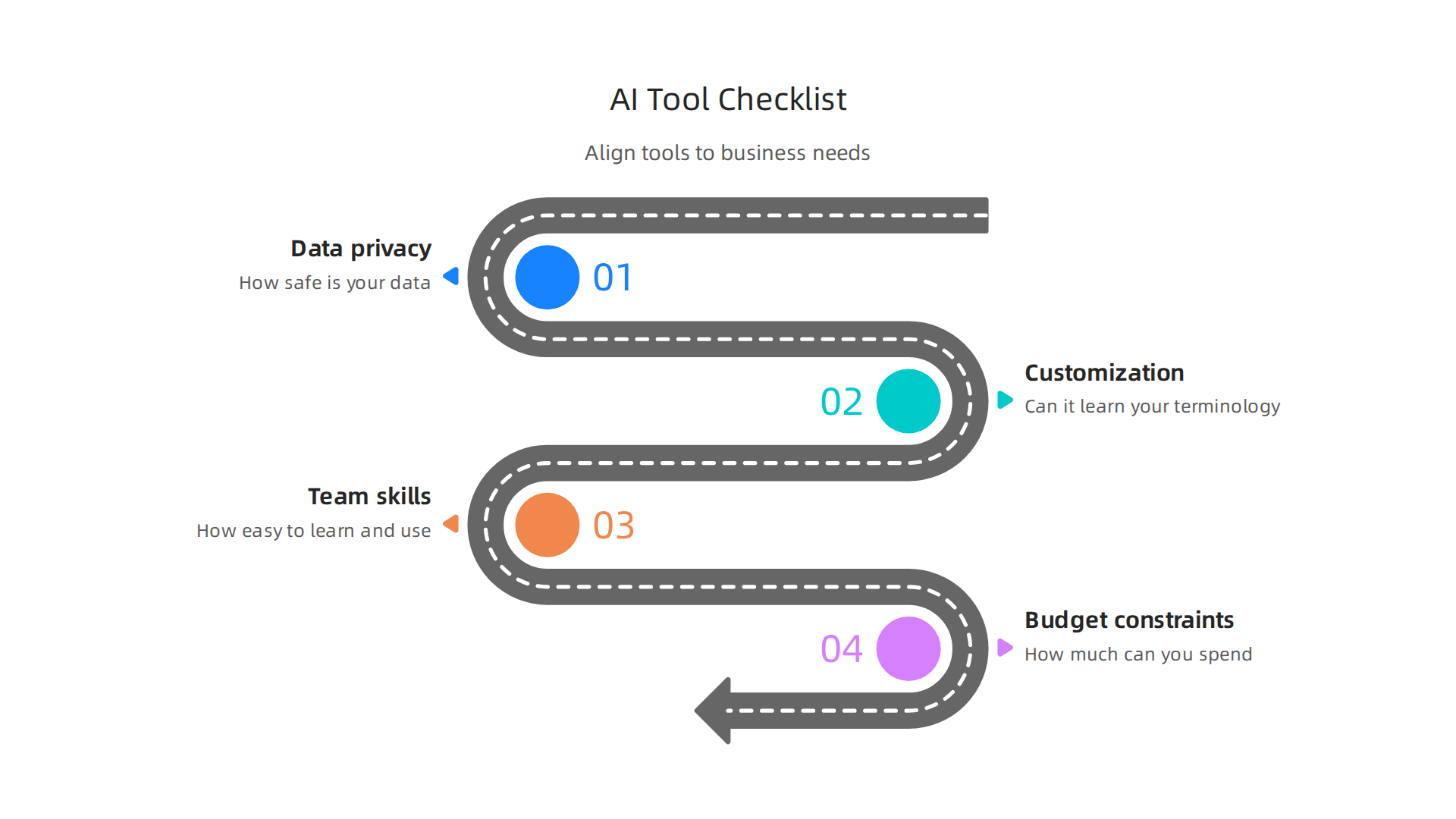
    Use this checklist to align AI tools with your business needs, considering privacy, customization, team skills, and budget.

    • Data privacy needs: How safe is your information with this AI tool? If you handle private customer details, you must pick an AI tool that keeps data very secure. Make sure it follows rules for protecting information. You can learn more about rules and growth by checking out this guide to mastering the AI future standard 2026.
    • Customization: Can you teach the AI tool to understand your business’s special words or ways of doing things? For example, can you upload your company’s style guide so it always writes in your brand’s voice?
    • Team skill requirements: Will your team find the tool easy to learn and use? A powerful AI tool is only good if your team can actually use it without a lot of extra training. Some tools are very simple, while others need someone with more tech know-how.
    • Budget constraints: How much money can you spend? Beyond the monthly or per-use cost, think about any extra costs for setting it up or training your team. Always have a clear budget in mind.

    By carefully matching your business needs with the right AI tools, you can avoid costly mistakes and help your business truly grow.

    Making smart choices about AI tools requires careful consideration of business needs and goals.

    Many companies are already doing this, with 86% to 92% of creators using AI in some way in 2026, showing how important it is to pick the right tools that fit their work Creator Economy AI Adoption Statistics (2026). If you’re looking for help with customer service, for instance, a good AI virtual assistant for businesses could be a great fit.

    Once you’ve chosen the right AI tool for your business, the next big step is making sure it works well with everything else you do. This is called "integration," and it’s how AI tools connect and talk to your existing systems.

    Integration patterns: APIs, pipelines, and deploying virtual assistants

    Think of integration patterns as the pathways AI tools use to work together. There are a few common ways this happens.

    • Content Pipelines: Many businesses use AI to help create written content. In a content pipeline, a human editor might send a draft to an AI tool to get help with ideas or grammar. The AI processes the request and sends it back to the editor, who then puts the final touches on it. This back-and-forth makes content creation faster and better.
    • Assistant Routing: Another common way is with virtual assistants. When a customer asks a question, an AI system first tries to understand what they really want. This is called "intent detection." Once the AI knows the intent, it then routes the request to the right place to get an answer. This "fulfillment" step might mean pulling info from a database, checking a calendar, or even asking another AI system for help. For businesses, learning how to set up these tools is key for growth. You can explore a Strategic Guide to Marketing AI Agents Deployment, ROI, and Growth in 2026.

    But how well these connections work depends on some key things you need to watch out for.

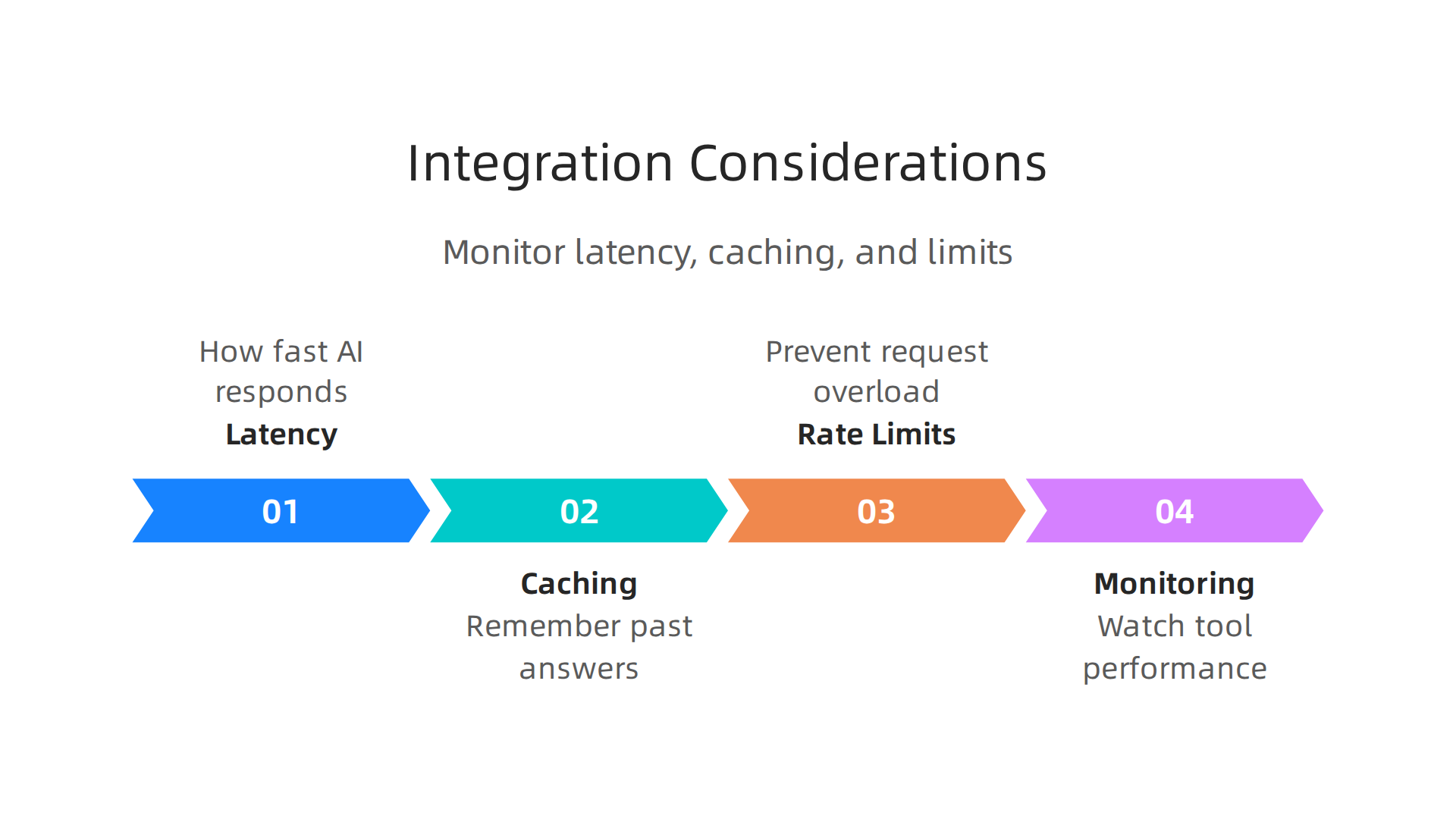
    Monitor latency, utilize caching, manage rate limits, and implement robust monitoring for smooth AI tool integration.

    • Latency: This is simply how fast the AI responds. If a virtual assistant takes too long to answer a customer’s question, it can be very frustrating. Slow responses can easily lead to that aiscream ai scream feeling for users. Experts suggest that for things like chat, AI should respond very quickly, often in less than a second, to keep users happy What is AI Observability? Key to Monitoring Your LLM Infrastructure.
    • Caching: Imagine the AI remembers past answers or tasks. If many people ask the same question, the AI can give a saved answer instead of having to think it up from scratch every time. This "caching" makes things much faster and more efficient.
    • Rate Limits: These are like speed limits for your AI system. They stop too many requests from coming in at once, which could make the system slow down or even crash. Rate limits help keep everything stable and running smoothly, preventing your AI from getting overwhelmed.
    • Monitoring: It’s super important to keep a close eye on how your AI tools are working. This means checking things like how fast they respond (latency), if they are making errors, and how often they are used. Good monitoring helps you find problems early and fix them before they affect your customers or business.

    Staying on top of these operational details ensures your AI tools work for you, not against you.

    Get clear daily AI updates. The AI Newsletter Worth Reading delivers valuable insights straight to your inbox.

    Making sure your AI tools run well is one thing, but knowing if they are truly helping your business grow is another. This is where measuring your return on investment, or ROI, comes in. It helps you see if the money and effort you put into AI are giving you good results. To do this, you need to set up clear goals, understand all the costs, and have real expectations.

    Defining Key Performance Indicators (KPIs)

    Key Performance Indicators (KPIs) are like scorecards that tell you how well your AI tools are doing.

    Measure your AI investment ROI using KPIs like time-to-publish, content engagement, support deflection, and assisted revenue.

    Instead of just guessing, KPIs give you clear numbers to look at.

    • Time-to-Publish: If you use AI for writing, how much faster does it make your team? You can measure the time it takes to go from an idea to a finished piece of content. Faster publishing can mean more content and better reach. You can learn more about measuring success in content creation with AI in this How to Measure AI Content Performance: KPIs & Framework.
    • Content Engagement: Are people reading the content created with AI? Look at things like how many views an article gets, how long people stay on the page, or how many shares it receives. These numbers help you see if your AI-assisted content is truly connecting with your audience. Some businesses also consider if their content needs to pass a humanize ai detector check to ensure quality.
    • Support Deflection: If you have an ai virtual assistant helping customers, how many questions does it answer without needing a human? The more questions it handles, the more time your human support team saves. This is a big win for efficiency.
    • Assisted Revenue: Can you link sales or new customers directly to AI tools? For example, did an AI-powered recommendation system lead to more purchases? Tracking this helps you see how AI adds to your bottom line.

    Overall, it’s important to track these things to understand how AI helps with active users, task completion, and customer satisfaction, which are all part of Evaluating AI Readiness: Checklist for Organizations.

    How to Model Costs

    Knowing your costs is just as important as knowing your benefits. AI tools come with different price tags.

    • Licensing and Subscriptions: Many AI software tools have monthly or yearly fees. These are usually straightforward.
    • API Usage: Some AI tools, especially for advanced features, charge based on how much you use them. This is often measured in "tokens," which are like small pieces of text. The more requests you send or the more text the AI processes, the more it can cost. For example, in 2026, the cost for 1 million input tokens can range from very low to several dollars depending on the AI model and provider, as detailed in various AI API Pricing Comparison 2026: 73 Models Ranked reports. If you’re not careful, these costs can add up fast, creating an aiscream ai scream moment if you don’t keep an eye on them.
    • Engineering Integration: Getting AI tools to talk to your existing systems often needs skilled technical help. This can involve developers and IT staff, which adds to the cost.
    • Monitoring and Overhead: You also need to pay for systems that watch your AI tools to make sure they are working correctly, and for any extra storage or computing power they use.
    • Editing and Oversight: Even with AI, you might still need human reviewers or editors, especially for content where a human touch or comment ai expertise is crucial. This human involvement ensures quality and accuracy. This ongoing human cost is an important part of the AI Pilot to Production Checklist: A Leader’s Guide.

    By carefully looking at both your benefits and all these costs, you can get a clearer picture of whether your AI investments are truly paying off. This helps you make smart choices about how to choose AI for business tools that deliver real results in 2026.

    To really make AI tools work for your business, you need more than just good numbers. You also need to make sure your team knows how to use them well. This means setting up clear plans for how to put AI into action and how to help your staff adjust to these new ways of working.
    Pilot Design for AI Tools

    Starting with a small test, also called a pilot program, is a smart way to bring AI into your business. Think of it like trying out a new recipe before cooking for a big party.

    • Narrow Scope: Do not try to change everything at once. Pick one small area or one team to start with. For example, maybe you try using an AI tool to help your customer service team answer simple questions, or to help your marketing team write social media posts. Keeping it small helps you learn without big risks.
    • Measurable Outcomes: Just like we talked about with ROI and KPIs, you need to know what success looks like for your pilot. If you are using an ai virtual assistant, measure how many simple questions it can answer on its own. If it is an AI tool for writing, see how much faster it makes content creation. Clear goals help you see if the tool is actually helping.
    • Fast Feedback Loops: You want to learn quickly. After you start the pilot, get feedback from your team right away. What is working? What is not? Are they having an "aiscream ai scream" moment because the AI made a big mistake? The faster you get this information, the faster you can fix problems and make the tool better.

    Training and Governance for AI Outputs

    When you bring AI into your daily work, teaching your team how to use it is super important.

    Effective training and onboarding are crucial for teams to confidently adopt and leverage new AI tools.

    It is not just about pressing buttons; it is about understanding how to work with the AI.

    • Onboarding Creators: For teams that make content or create new things, learning to prompt AI tools correctly is key. They need to know how to ask the AI for what they want and how to review what it gives back. Sometimes, AI can make things up, which is called "hallucinating." This can lead to wrong information. To avoid this, creators must learn how to check AI outputs carefully and how to make sure they sound human and accurate. Using a humanize ai detector can help ensure the content feels natural.
    • Onboarding Operations Staff: For those who manage projects or daily tasks, it is about integrating AI outputs smoothly. They need to understand the new workflows. This often means having human reviewers check the AI’s work before it goes out. This human oversight, sometimes called "Human-In-The-Loop," is important for catching mistakes and ensuring quality. Having humans involved throughout the process can greatly help in reducing AI hallucinations and building trust in the AI system, as explored in research on creating trustworthy LLMs. This human touch, or "comment ai" from a person, adds value that AI alone cannot always provide.

    By training your team and putting good rules in place, you help everyone feel comfortable and confident using AI. This makes sure your AI tools are not just fancy new tech, but real helpers that improve how your business works. To learn more about how to choose and use AI for your business, check out our guide on Smart AI for Business: Your 2026 Guide to Successful Adoption.

    When using AI tools in your business, it’s not enough to just train your team well. You also need to think about how to keep things safe and private. If you don’t, you might have an "aiscream ai scream" moment when something goes wrong. This means looking at security, privacy, and making sure you follow all the rules.

    Key Risks for AI Content and Assistants

    Bringing AI into your work means thinking about a few big dangers:

    • Sensitive Data Leaks: Imagine your AI assistant handles customer information, like their addresses or phone numbers. If this data isn’t kept safe, it could accidentally be shared with the wrong people. This is a big problem for privacy. You need strong rules about what kind of information your AI tools can see and use.

    • Hallucinations: As we talked about before, AI tools can sometimes make things up. This is called "hallucinating." While human oversight helps, AI models can still create false information. For example, an ai virtual assistant might give a wrong answer to a customer or write content with facts that are not true. This can lead to bad decisions or make your business look unreliable. Researchers are always looking for ways to stop these mistakes and make AI more trustworthy, like exploring who is responsible when AI systems give wrong information due to hallucinations, as discussed in studies on Mitigating Generative AI Hallucinations.

    • Auditability of AI Outputs: It can be hard to understand why an AI made a certain decision or gave a specific answer. This is called auditability. If you can’t easily check the steps an AI took, it’s tough to prove it followed the rules or to fix problems. This lack of clear steps can be a worry for both safety and fair play, especially as AI becomes more common, as a conceptual framework for studying AI hallucinations highlights.
    Practical Steps to Stay Safe with AI

    To avoid these problems and prevent any "aiscream ai scream" situations, you can take some smart steps:

    • Data Handling Policies: Set clear rules for all the information your AI uses. Decide what data is okay for the AI to process and what data is strictly off-limits. This might mean only giving AI tools "fake" or practice data for training, or making sure all sensitive customer data is removed before the AI sees it.
    • Redaction: This means taking out sensitive parts of information. Before data goes to an AI tool, make sure any private names, numbers, or other details are blacked out or removed. This helps keep customer information safe.
    • Human-In-The-Loop Checks: Just like we mentioned before, always have a person review what the AI creates or suggests. This human check is super important for catching mistakes, wrong information, or anything that doesn’t sound right. Think of it as a final quality check, adding a valuable "comment ai" from a real person.
    • Logging: Keep a record of everything your AI tools do. This means tracking what questions were asked, what answers were given, and who approved the final output. If there’s ever a problem, these logs can help you trace back what happened and fix it. An AI governance checklist can help you set up this kind of monitoring.

    By putting these safeguards in place, you can use AI tools more safely and with more confidence. You make sure your business stays secure and follows the rules, while still getting all the benefits that AI can offer in 2026. For a deeper dive into making sure your AI efforts meet the necessary standards, explore our guide on Mastering the AI Future Standard 2026.

    Summary

    This article helps business leaders cut through the surge of AI tools in 2026 by showing how to choose, integrate, measure, and govern AI effectively. It explains the tangible business outcomes—faster content, personalization at scale, and higher team productivity—while warning against common mistakes like picking hype-driven solutions or poor integrations. You’ll get a practical comparison checklist (features, customizability, API surface, pricing, support), guidance on integration patterns and operational concerns (latency, caching, rate limits, monitoring), and a framework for measuring ROI with KPIs such as time-to-publish, engagement, support deflection, and assisted revenue. The guide also covers how to run focused pilots, train teams with human-in-the-loop workflows, and set safeguards for data privacy, auditability, and hallucination risk so your AI investments deliver real, measurable value.

  • Strategic Guide to Marketing AI Agents: Deployment, ROI, and Growth in 2026

    Strategic Guide to Marketing AI Agents: Deployment, ROI, and Growth in 2026

    Artificial intelligence (AI) has changed a lot in marketing over the past few years. We’ve seen many smart tools pop up, but something new and exciting is happening in 2026: the rise of marketing AI agents.

    Leaders envision a future transformed by advanced AI agents in marketing.

    These are not just simple tools that do one task, like writing an email or creating a picture. Think of them as smart helpers that can handle many steps of a marketing job all by themselves.

    What are Marketing AI Agents?

    A marketing AI agent is like a digital team member that can understand goals, make a plan, and then take action to reach those goals, even over many steps. It has a "brain" powered by advanced language models, a "memory" to learn from past actions, and the ability to use other "tools" or software to complete tasks. For example, an autonomous marketing agent might create a full social media campaign, from writing posts to scheduling them and even adjusting content based on how people react online [PDF] (https://www.alvarezandmarsal.com/sites/default/files/2026-03/The%20Agent-First%20Marketing%20Function_0.pdf).

    This is different from older, single-purpose AI tools. A basic AI tool might help you write a blog post, but it won’t plan your whole content calendar or figure out which posts work best. Marketing AI agents, on the other hand, can do all that and more. They can even work together as "multi-agent" systems to tackle big, complex marketing plans, as explained in recent research about AI Agent Systems: Architectures, Applications, and Evaluation. In 2026, experts are creating ways to sort these agents into groups to better understand their different uses and parts, helping us see how they fit into a bigger picture AI Agent Architecture Decoded: The 9-Dimension Taxonomy Every ….

    Big Benefits of Using Marketing AI Agents

    These smart agents bring huge advantages to businesses:

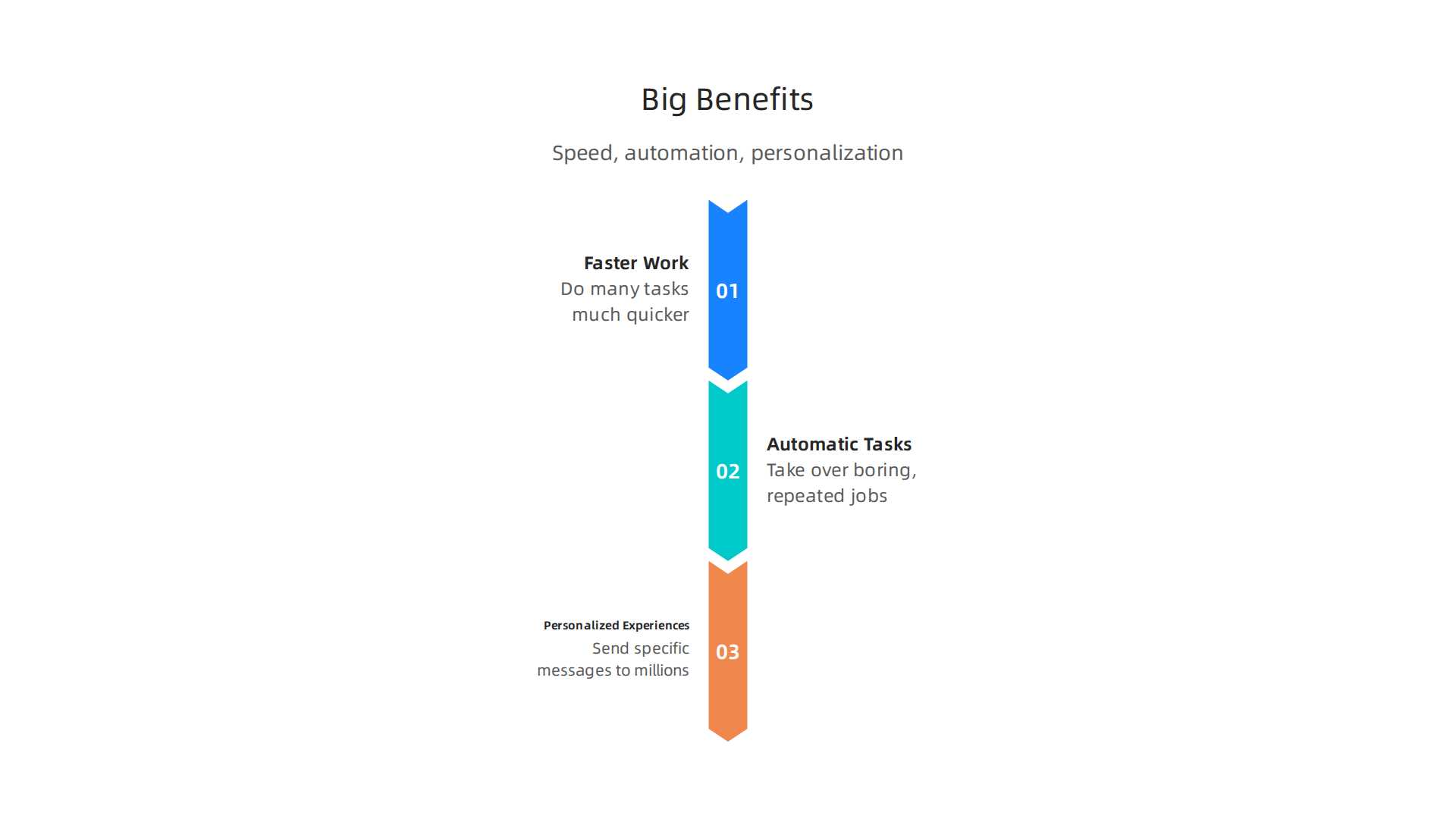
    Marketing AI agents offer significant benefits like increased speed, automation, and personalization.

    • Faster Work: They can do many tasks much quicker than people can, speeding up your marketing efforts.
    • Automatic Tasks: They take over many boring, repeated jobs. This means your team can spend more time on new ideas and creative work, instead of getting stuck in daily routines. This can be a game-changer for businesses looking for an effective online marketing platform for small businesses.
    • Personalized Experiences for Everyone: AI agents can help you send very specific messages and offers to thousands or even millions of customers, making each person feel like you know exactly what they need. This helps create a truly personal connection with your audience.

    What You’ll Learn in This Guide

    Learning how to use marketing AI agents can seem like a big job. That’s why this guide is here to help. We will walk you through everything you need to know, step-by-step. You will learn:

    • How to choose the best AI agents for your specific business needs.
    • How to set them up and get them working smoothly.
    • How to make sure they follow rules and stay safe (this is called governance).
    • How to check if they are actually helping your business grow and meet its goals.

    Whether you’re looking for a simple marketing plan example or want to dive deep into using AI, this guide will give you practical steps to succeed.

    Stay ahead with smart insights. Get clear daily AI updates from The Deep View Newsletter.

    Now that you know what marketing AI agents are in a general sense, let’s look closer at their different types, what they are made of, and how they work in real marketing jobs. These smart helpers come in various forms, each designed for specific levels of work.

    Types of Marketing AI Agents

    Not all marketing AI agents are exactly the same. They can be grouped by how complex their tasks are and how much they work on their own.

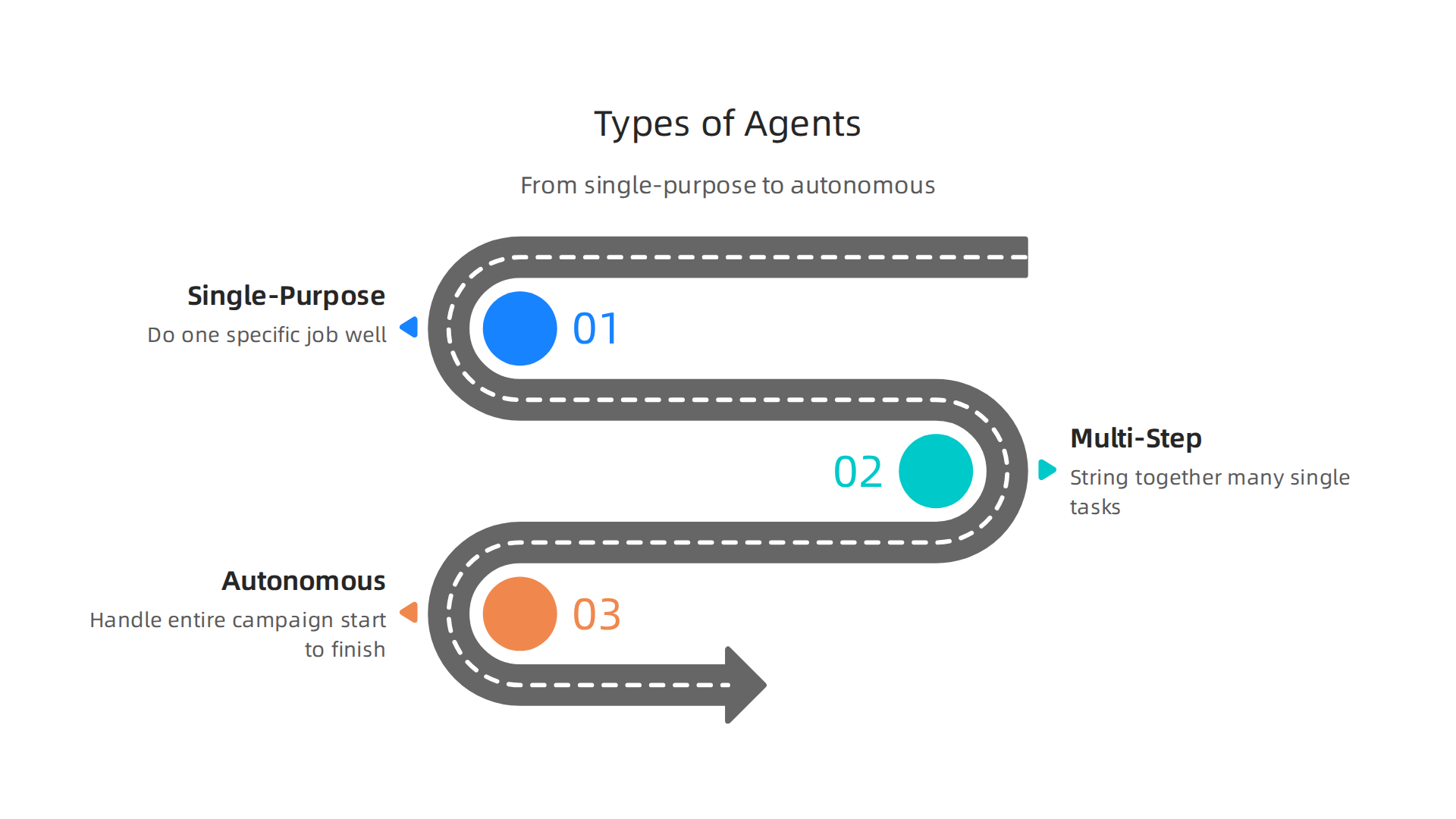
    Marketing AI agents range from single-purpose tools to fully autonomous campaign managers.

    • Single-Purpose Task Agents: These are the simplest kind. They do one specific job well, like writing an email, generating a social media post, or finding keywords. They are good for quick, focused tasks. While helpful, they don’t plan out big campaigns.
    • Multi-Step Orchestration Agents: These agents are smarter. They can string together many single tasks to complete a larger goal. For example, a multi-step agent might write a blog post, then create social media updates for it, and then schedule those posts. They follow a plan to make sure all parts of a task are done in order. Researchers have created ways to organize these kinds of AI agent systems, looking at how they plan, control, and interact with tools AI Agent Systems: Architectures, Applications, and Evaluation.
    • Autonomous Campaigning Agents: These are the most advanced marketing AI agents. They can handle an entire marketing campaign from start to finish. They set goals, make a plan, create all the content, run the campaign, and even adjust things as they go. Humans usually check in at certain points for approval, but the agent does most of the heavy lifting. This approach can be a game-changer for businesses that need a full-service online marketing platform for small businesses. A 2026 report mentioned that marketing and sales are seeing a lot of impact from these AI agents The 2026 State of AI Agents Report.

    What Makes an AI Agent Work?

    Think of a marketing AI agent as having several key parts that let it do its job:

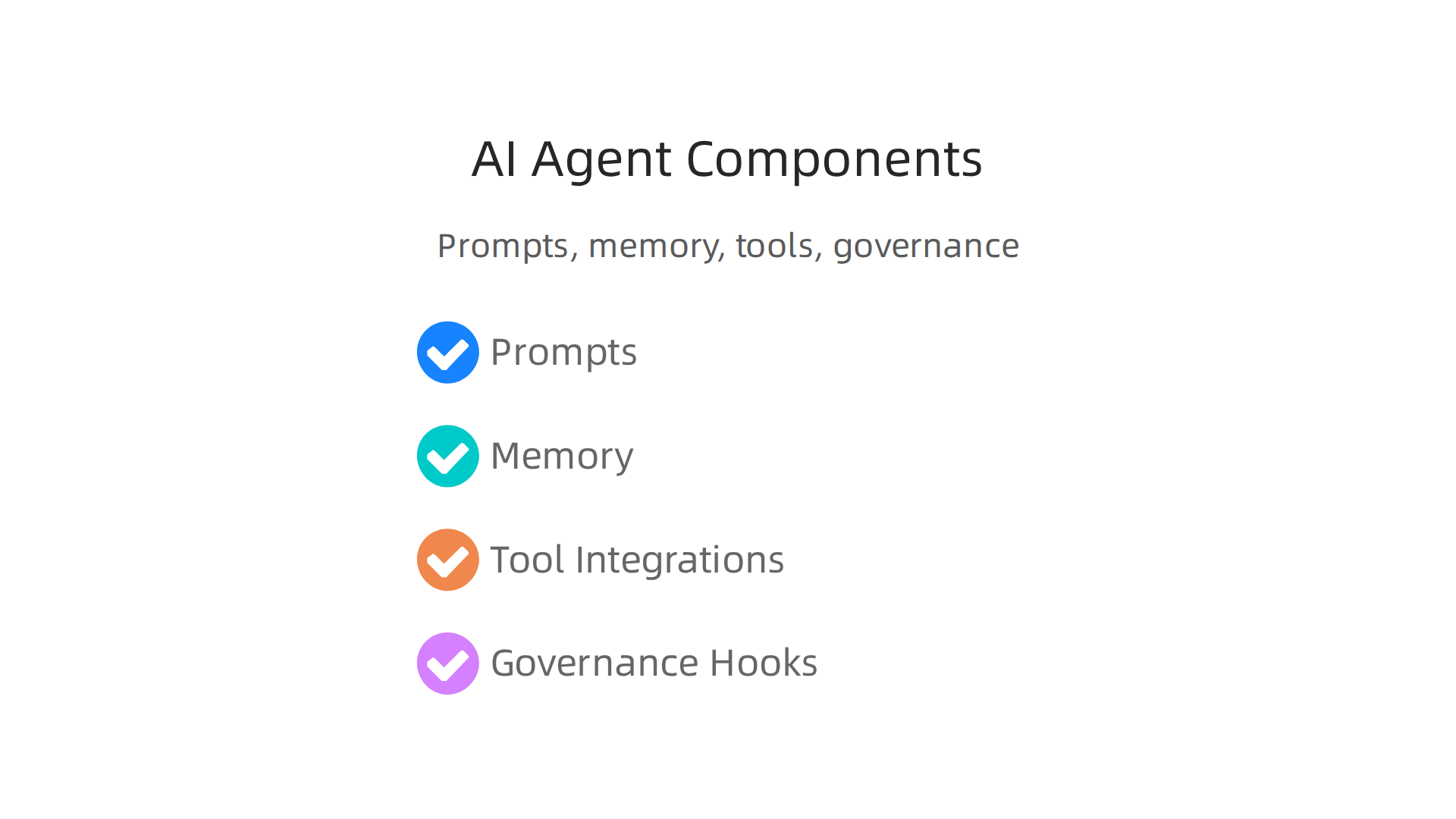
    An AI agent's effectiveness relies on its prompts, memory, tool integrations, and governance.

    • Prompts: These are the instructions you give the agent. They tell it what to do, what goals to aim for, and what style to use. Good prompts are like giving clear directions to a smart assistant.
    • Memory: Agents remember past actions, feedback, and what worked or didn’t work. This memory helps them learn and get better over time, making their future tasks more effective.
    • Tool Integrations: This is how AI agents connect to other software and services. For example, an agent might connect to a CRM (Customer Relationship Management) system like Zoho Marketing Automation to get customer info, or use analytics tools to see how well a campaign is doing. These connections help agents do real-world tasks. Choosing the right AI tools for your business is key to making these integrations work well How to Choose AI for Business Tools That Deliver Real Results in 2026.
    • Governance Hooks: These are safety checks and rules built into the agent. They make sure the agent follows company policies, legal rules, and ethical guidelines. This is very important for keeping AI agents responsible. Experts are working on how to create clear ways to evaluate agents in production Measuring Agents in Production.

    Real-World Marketing Examples

    How do these marketing AI agents actually help? Here are some examples of what they can do:

    • Lead Qualification: An agent can look at many potential customer details, figure out which ones are most likely to buy, and then send them personalized messages. This saves human sales teams a lot of time.
    • Creative Iteration: Need many different ideas for an ad campaign? An agent can quickly create many versions of ad copy, images, and video scripts, then test them to see which ones get the best reactions. This speeds up the creative process.
    • Campaign Optimization: During a marketing campaign, an autonomous agent can watch how people react to ads in real-time. If one ad isn’t working well, it can automatically change the ad, try a new audience, or even shift the budget to a better-performing ad. This ensures your marketing money is always working its hardest. This kind of optimization can significantly boost how effective your marketing efforts are How Marketing Specialists Choose AI Tools for Marketing and Drive ROI.

    Using marketing AI agents isn’t just about doing more tasks; it’s about getting real value for your business.

    A business leader reviews performance metrics to understand ROI and impact.

    These smart tools help companies save time, cut costs, and get better results from their marketing efforts. We can measure this value in a few key ways.

    Quantifying business value: ROI, time savings, and performance benchmarks

    One big way marketing AI agents help is by taking over many tasks that people used to do by hand. This reduces the amount of manual work needed across common marketing jobs. For example, agents can quickly create many versions of ad copy, write social media posts, or analyze campaign data. This frees up marketing teams to focus on bigger ideas and strategies. Some reports even show that using AI agents can reduce manual workflow tasks by as much as 85%, which greatly increases efficiency and returns on investment (ROI) across businesses in 2026 How AI Agents are Changing Marketing: The 2026 Guide – Top ….

    The value these agents bring can be grouped into different kinds of ROI:

    • Cost Reduction: By automating tasks, businesses spend less money on manpower for repetitive jobs. This also includes lowering the cost to get a new customer.
    • Speed-to-Market: AI agents can create content and launch campaigns much faster. This means businesses can react quickly to market changes and get their messages out sooner.
    • Personalization Lift: Agents can tailor messages to individual customers much better than humans can, which leads to more engagement and higher sales. Studies from 2026 show that AI for personalizing content can boost ROI by 2.7 times, while content drafting can see a 3.2 times ROI Agentic AI in Marketing: ROI Data & Guide 2026.
    • Experimentation Velocity: Marketing AI agents can test many different ideas very quickly to find out what works best. This helps improve marketing plans faster than ever.

    To truly understand how well marketing AI agents are doing, you need to track key numbers before and after you start using them. These performance benchmarks help you see the actual impact.

    Here are some important metrics to keep an eye on:

    • Effort hours: How many hours did your team spend on certain tasks before, and how many now with agents?
    • Conversion lift: Are more people buying, signing up, or taking desired actions because of the AI agents’ work?
    • Cost-per-acquisition changes: Has the cost of getting a new customer gone down?
    • Campaign ROI: What is the overall return on your investment in specific campaigns managed by agents?
    • Lead-to-customer conversion rate: How many potential customers become actual buyers thanks to the agent’s efforts?

    Setting clear goals and key performance indicators (KPIs) for your autonomous marketing AI agents is important to make sure they are on track KPIs for Autonomous AI Agents in Marketing and Governance. By tracking these numbers, businesses can see the real benefits of using marketing AI agents, from saving time to boosting sales. Learning how to get real ROI from AI marketing is a key step for success in 2026.

    Want to keep up with the latest in AI and technology?
    The AI Newsletter Worth Reading offers clear daily updates to help you stay informed.

    To truly get the most from your AI investments and see those great returns, it’s vital to pick the right tools for the job.

    A team collaborates to evaluate and select the best AI agent solutions.

    Not all marketing AI agents are built the same. When you’re looking at different options for your business, you need to know what features matter most.

    Key capabilities to prioritize when evaluating marketing AI agents

    Choosing the best marketing AI agents means looking closely at what they can do and how well they fit into your daily work. Think of it like picking the right team member; you want someone with the right skills and who can work well with everyone else.

    Here are the important things to look for:

    • Reliable Data Connections: Good marketing AI agents need to easily connect with all your data sources. This means linking to your customer lists, sales records, website analytics, and social media platforms. Without good connections, the agent can’t get the information it needs to make smart decisions.
    • Customizable Instructions (Prompt Flows): You should be able to tell your AI agent exactly what you want it to do and how. This involves setting up "prompt flows" that guide the agent’s actions, from writing an email to planning a whole campaign. The more you can customize these, the better the agent will understand and act on your specific marketing plan example.
    • Memory and Context: Just like a person, a good AI agent needs to remember past talks and actions. This "memory" helps it understand the bigger picture and keep its responses and tasks consistent over time. It helps the agent learn from what it’s done before. Many AI agents are built with core components like these to give them reasoning and language skills Agentic Universe: April 2026.
    • Ability to Take Action (APIs/Tools): An AI agent isn’t just for thinking; it’s for doing. It needs to be able to use other tools and systems through what are called APIs. This could mean posting directly to social media, updating your online marketing platform for small businesses, or sending emails through your existing marketing automation software.

    Beyond these core abilities, there are other important features that help these agents work smoothly every day:

    • Seeing What’s Happening (Observability): You should always be able to see what your marketing AI agents are doing. This means getting clear reports and updates, so you know the agent is working as it should and catching any problems early.
    • Handling Mistakes (Retry Semantics): What happens if an agent tries to do something and it fails? A good agent will have a plan to try again or tell you there’s a problem, instead of just giving up.
    • Safe Testing (Sandboxing): Before you let an agent loose on your real marketing, it’s helpful if you can test it in a safe "sandbox" environment. This way, you can make sure it works correctly without messing up your live campaigns.
    • Human Control Points (Human-in-the-Loop): Even the best AI agents need human oversight. You’ll want controls that let you step in to approve decisions or correct the agent if needed. This "human-in-the-loop" approach is often part of how production systems for AI agents are designed in 2026 State of AI Agents Q2 2026.

    Finally, consider how well the marketing AI agents can grow with your business. Can they manage many different campaigns at once? Can they adapt to different languages or regional needs if your business expands? This is called scalability and extensibility. Knowing how to choose AI for business tools that deliver real results is key to making sure your investment pays off in the long run.

    After understanding what makes good marketing AI agents, the next big step is putting them to work. This means making smart choices about how you get these tools and how you bring them into your business without causing big problems.

    Choosing and deploying an agent: checklist and phased rollout plan

    First, you need to decide if you want to buy a ready-made marketing AI agent or build one yourself. This is a big choice, like deciding to buy a car or build one from scratch.

    • Buying an Agent (Vendor Solution): This usually means you get to use the tool faster. It’s often easier because someone else has done all the hard work of building it. You just need to make sure it fits your needs and that you’re comfortable with how it handles your business data. This is good if you need quick results and don’t have a big team of tech experts.
    • Building Your Own Agent: This gives you full control. You can make the AI agent do exactly what you want, right down to the smallest detail. But, it takes a lot more time, effort, and people with special tech skills. You also need to think about who owns the data and how much work your team can actually take on. Businesses often weigh these points when looking at whether to build or buy new AI tools Navigating the build, buy, or borrow decision.

    Once you decide how to get your marketing AI agents, it’s time to put them into action. A good way to do this is with a step-by-step plan.

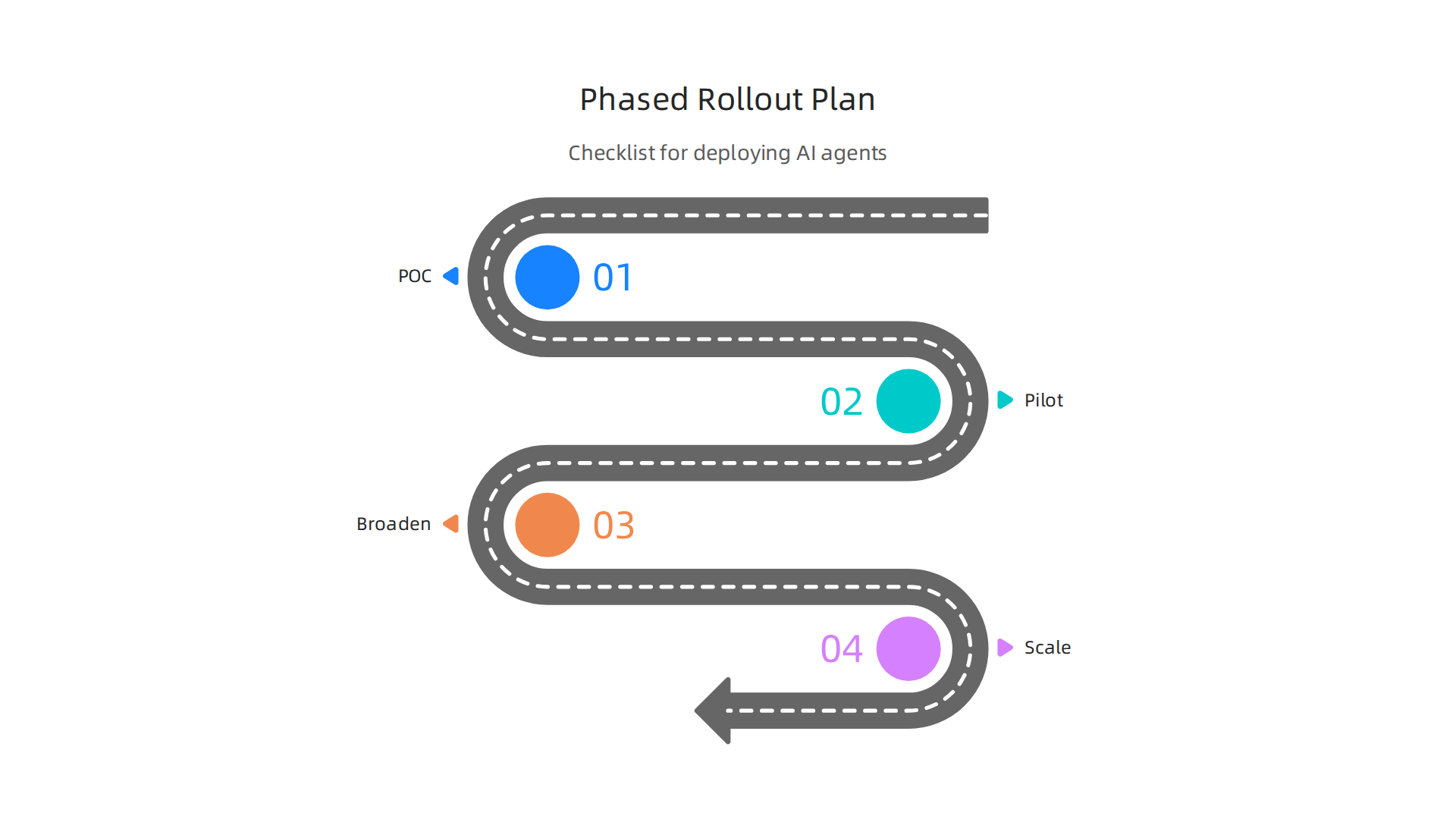
    A strategic phased rollout ensures smooth integration and scaling of AI agents.

    This helps you start small and grow safely.

    A Phased Rollout Plan

    1. Proof of Concept (POC): This is like a small test drive. You pick one simple task that the AI agent can do and see if it works.
      • Success Criteria: Does the agent complete the task? Does it save time or money for that one task? For example, you might test it writing a few social media posts for a specific marketing plan example. It’s smart to start with workflows that have low risk but high potential impact Using AI Agents for Marketing Agencies: 2026 Implementation Guide.
    2. Pilot: If the POC goes well, you expand the test to a small group of users or a small part of your business.
      • Success Criteria: Does it work well for this small group? Are there any unexpected problems? Are the people using it happy with it? During this stage, you should manually check every output for at least two weeks and use any errors to make the agent smarter How to Use an AI Agent for Marketing: The 2026 Playbook ….
    3. Broaden: Now, you slowly let more people or more parts of your business use the marketing AI agents.
      • Success Criteria: Is the agent still working well as more people use it? Is it helping more of your marketing team? This is where you might connect it with your online marketing platform for small businesses or a specific campaign.
    4. Scale: If all goes well, you make the AI agent a regular part of your marketing efforts across the whole company.
      • Success Criteria: Is it making a real difference to your business goals? Is it able to handle everything you throw at it? Are you seeing clear returns on your investment in these new tools?

    Practical Checklist for Deployment

    Before you fully unleash your marketing AI agents, here’s a checklist to make sure you’re ready:

    • Data Readiness: Make sure your business data is clean and ready for the AI. This means having good customer information and historical data. AI agents need connected, clean data to work effectively AI-Driven Marketing Strategies to Implement in 2026 – Aprimo. You’ll need things like real-time customer profiles and good data about how past campaigns performed AI Marketing Agents: 2026 Complete Guide. Having at least 12 months of clean historical data is a good rule of thumb AI Marketing Agent: 11 Best Tools & Guide (2026) – Improvado.
    • Integration Points: Think about how the AI agent will connect with your existing tools. This includes your CRM, email programs, and analytics tools like Zoho Marketing Automation. Make sure they can all "talk" to each other AI Marketing Agents: Complete 2026 Automation Guide. You want to link apps your team already uses daily, such as Slack, Gmail, or HubSpot 2026 Marketer’s Guide to AI Agents for Marketing Operations.
    • Service Level Agreements (SLAs): If you’re buying an agent, understand what kind of support you’ll get from the company selling it. How fast will they fix problems?
    • Monitoring: Set up ways to watch how your marketing AI agents are doing. This helps you catch any issues quickly and ensure they’re working as they should.
    • Change Management: Get your team ready for these new tools. Provide training, maybe even some free marketing courses on AI, and make sure everyone understands how the agents will help them. Before you start, write down the exact workflow you want the AI to handle, define what success looks like, and think about who owns the project AI Agents for Marketing: 15 Use Cases, ROI, and 2026 Guide.

    By following these steps, you can bring marketing AI agents into your business smoothly and make sure they truly help you reach your goals.

    For more deep dives into the latest AI tools and trends, make sure you’re subscribed.
    The AI Newsletter Worth Reading

    After you have a plan to put your marketing AI agents into action, the next big step is figuring out how these smart tools will talk to all your other business systems. This is like making sure all the different parts of a team can share information and work together smoothly. When your marketing AI agents link up with your customer relationship management (CRM), ad platforms, and analytics tools, they can do amazing things for your marketing plan.

    Integration patterns: linking agents to CRMs, ad platforms, and analytics

    Connecting your marketing AI agents with your existing tools is key for them to be truly helpful. It means that customer information, ad campaign results, and website visitor data can all be shared. This allows the AI agents to make smarter choices and take actions that fit your goals.

    There are a few common ways these connections work:

    • Data Sync (Data Sharing): This is like having two notebooks and making sure they both have the same information. Your marketing AI agents might regularly pull customer details from your CRM, or send updated customer scores back to it. This makes sure all your systems have the most current data. Businesses need clean, linked data for AI agents to work well, often including real-time customer profiles and historical campaign data to train models effectively AI Marketing Agents: 2026 Complete Guide.
    • Event-Driven Triggers (Action Starters): Imagine if one action automatically started another. For example, if a customer fills out a form on your website (an "event"), it could trigger your marketing AI agent to send a personalized email right away. Or if an ad campaign performs poorly, it could alert the agent to suggest changes.
    • API-Based Actioning (Direct Commands): APIs are like special language rules that allow different software programs to talk to each other and ask for things to be done. Your AI agent can use APIs to directly create new ads on an ad platform or update details in your CRM. This lets the agent not just suggest things, but actually do them.
    • Streaming Analytics (Constant Flow of Information): This means data is always flowing, like a river, instead of coming in big batches. For marketing AI agents, this is super important because it lets them see what’s happening right now. If a product suddenly becomes popular, the agent can adjust your online marketing platform for small businesses campaigns in real time. This constant data flow helps AI agents react quickly to changes [How AI agents will reshape every part of marketing in 2026](https://martech.org/how-ai-agents-will-reshape-every-part-of-marketing-in 2026/).

    Handling Data Across Systems

    When many systems work together, we need to be careful about how data is managed:

    • Idempotency (No Double Actions): This is a fancy word that means doing the same action multiple times has the same result as doing it once. For example, if your AI agent tries to send an email twice by mistake, idempotency ensures the customer only receives one email. It prevents double billing or duplicate entries.
    • Reconciliation (Making Data Match): With many systems, data can sometimes get out of sync. Reconciliation is checking that the information in your CRM, ad platform, and analytics tools all match up. This is vital for accurate reporting and making good decisions. For example, ad platform data should feed back into the AI agent’s information to match up with CRM records AI Agents for Agencies: Connect Client Data Safely.
    • Data Governance (Keeping Data Safe and Proper): This is about setting rules for how your data is collected, stored, and used. It makes sure your marketing AI agents respect privacy laws and company policies. Good data governance also means your data is high quality, which is super important for AI to learn from.

    Architectural Choices: Real-time vs. Batch and Coupled vs. Loosely Coupled

    When building these connections, businesses make some important choices:

    • Real-time vs. Batch: Do you need information to update instantly (real-time), or is it okay for updates to happen once a day or once an hour (batch)? Real-time updates are great for fast-moving campaigns, while batch updates can be simpler for less urgent tasks.
    • Coupled vs. Loosely Coupled Integrations:
      • Coupled: Systems are tightly linked. If one system changes, the other might need to change too. This can be faster for small setups.
      • Loosely Coupled: Systems work more independently. They connect through standard ways, so if one changes, it’s less likely to break the other. This makes your whole setup more flexible as you grow.

    Choosing the right integration patterns and making smart architectural choices helps your marketing AI agents truly shine. It makes sure they are not just useful tools, but fully integrated team members that boost your marketing efforts.

    If you’re looking to enhance your understanding of marketing technology, exploring options for how to choose marketing automation software in 2026 can provide further insights into optimizing your operations.

    After linking up your marketing AI agents with your existing systems, a very important next step is to set up clear rules and make sure everything runs safely and properly. This is called governance, compliance, and risk management. It’s like having a good rulebook and safety checks in place so your smart tools work in a way that is fair, legal, and keeps your brand safe.

    Professionals collaborate to establish and review safety protocols for AI systems.

    Data Privacy and Consent

    When marketing AI agents access customer information, it’s super important to respect people’s privacy. These agents often look at user data to make marketing campaigns better. So, you need to make sure you have permission, or "consent," from customers to use their data. Laws like GDPR in Europe and others around the world mean businesses must be very careful about how they gather, store, and use personal information. For example, people must clearly agree to how their data is used for personalized ads, not just have a pre-checked box AI Compliance in Marketing: The Complete Guide 2026.

    This also means that your marketing AI agents should only get access to the information they absolutely need to do their job. Businesses must document how their marketing agents handle personal data to comply with regulations Snowflake’s Agentic Enterprise Framework Puts Data …. Without proper consent management, using marketing AI agents can lead to big problems.

    Bias, Brand Safety, and Content Review

    Marketing AI agents can create ads, emails, and other content very quickly. But sometimes, AI can pick up unfair ideas or "bias" from the data it learns from. This could lead to content that is not fair or doesn’t fit your brand’s values. To stop this, you need:

    • Human-in-the-loop governance: This means people regularly check what the AI agents are doing and creating. For new AI agents, you should manually review every output for a few weeks to catch any errors How to Use an AI Agent for Marketing: The 2026 Playbook ….
    • Brand guidelines: Give your marketing AI agents clear rules about your brand’s voice and what kind of content is okay. This helps them create messages that always sound like your company.
    • Safety controls: Set up ways for the AI to flag or stop content that might be offensive, wrong, or goes against your rules. This helps ensure brand safety.

    Having these controls in place is key for any marketing plan example that uses AI.

    Security and Access Controls

    Finally, keeping your AI systems and the data they use safe is super important. Think about these things for your marketing AI agents:

    • Least privilege: This means your AI agents should only have the minimum access rights needed to do their specific tasks. They shouldn’t be able to see or change data they don’t need. This helps prevent unwanted access AI Regulation 2026: Current Laws, Compliance Requirements, and ….
    • Audit trails: You need a record of everything your marketing AI agents do. This is like a logbook that shows who accessed what, when, and what actions were taken. If something goes wrong, an audit trail helps you figure out what happened.
    • Incident response planning: Have a plan for what to do if there’s a security problem, like a data breach or an AI agent acting strangely. Knowing what steps to take beforehand can save a lot of trouble.

    As you adopt new smart tools, understanding potential problems and how to deal with them is part of having a good Stealth AI: A Business Guide to Hidden AI Risks, Opportunities, and Management in 2026. Keeping these governance, compliance, and risk management ideas in mind will help your marketing AI agents be both powerful and trustworthy tools for your business.

    After making sure your marketing AI agents follow all the rules and keep data safe, the next big step is to see how well they are actually doing. This means measuring, making them better, and growing their use over time. You want to make sure these smart tools are truly helping your business grow.

    Testing How Well Agents Perform

    To know if your marketing AI agents are working, you need to test them. A great way to do this is through something called A/B testing. This is like trying out two different ideas to see which one works better. For example, you can have your AI agent create one type of ad, and then have your regular marketing team or a different AI strategy create another. You then show both to similar groups of people to see which ad gets more clicks or sales.

    By doing these tests, you can compare what your marketing AI agents do versus your usual ways of working. Studies in 2026 show that successful AI agents can bring in 4.1 to 5.3 times more return on investment for the tasks they automate [Agentic AI in Marketing: ROI Data & Guide 2026]. This helps you see the real value of these smart tools for your marketing plan example. If you want to dive deeper into getting great returns, learn about how marketing specialists choose AI tools for marketing and drive ROI.

    What to Watch: Key Numbers and Dashboards

    To keep track of your marketing AI agents, you need to set up clear ways to measure their success. Think of this like a dashboard in a car, showing you all the important things at a glance. For AI agents, you should watch for:

    • Speed (latency): How quickly do your agents act or respond? Faster is usually better.
    • Success rate: How often do they do their job correctly, like sending the right email or suggesting the right product?
    • Conversion attribution: This means figuring out how much credit your marketing AI agents deserve for bringing in leads or making sales.
    • Cost per action: How much does it cost for an agent to complete a task, like getting a customer to sign up or click a link?

    It’s important to set up these special goals, or Key Performance Indicators (KPIs), for your autonomous AI agents. These help you track their operational health and how they impact your business goals, like making more money or getting more customers KPIs for Autonomous AI Agents in Marketing and Governance. Platforms for online marketing, such as Zoho Marketing Automation, often have features to help you track these metrics.

    Always Getting Better: Continuous Improvement

    Using marketing AI agents isn’t a "set it and forget it" task. For them to stay useful, you need to make them better over time. This involves a few key steps:

    • Feedback loops: This is where people tell the AI what worked well and what didn’t. Your team can give feedback on the content the agents create or the decisions they make.
    • Retraining triggers: As new information comes in or marketing trends change, your AI agents might need to learn new things. You need to know when it’s time to "retrain" them with fresh data.
    • Lifecycle management: This is about how you keep your marketing AI agents updated and relevant through their whole life, from when you first use them to when they might need big changes.

    By having these plans in place, your marketing AI agents can keep learning and improving. This ensures they continue to bring value to your business year after year. Learning how AI agents get better over time is crucial for long-term success [How Do AI Agents Learn and Improve Over Time?]. For tips on maximizing your investment, check out how to get real ROI from AI marketing cloud in 2026.

    Want to stay informed about all the latest in AI and technology?

    The AI Newsletter Worth Reading

    Summary

    Marketing AI agents are autonomous, multi-step AI systems that plan, act, and learn to run marketing tasks from content creation to campaign optimization. This article explains the different agent types—from single-purpose tools to fully autonomous campaigning agents—what technical parts make them work (prompts, memory, tool integrations), and the real-world use cases such as lead qualification, creative iteration, and live campaign optimization. You’ll get a practical checklist for choosing whether to buy or build, a phased rollout plan (POC → pilot → broaden → scale), and concrete integration patterns for CRMs, ad platforms, and streaming analytics. The guide also covers governance: consent, bias checks, least-privilege access, and audit trails, plus the metrics you must track (effort hours, conversion lift, cost-per-acquisition, campaign ROI). Finally, it shows how to test agents, set KPIs, and create feedback loops so agents improve over time, helping teams save time, cut costs, and boost marketing performance.

  • Siri AI 2026 Unlock Its Power for Privacy and Business Strategy

    Siri AI 2026 Unlock Its Power for Privacy and Business Strategy

    Today, using smart tools in our work is more important than ever. For many businesses and creative people, Siri AI is becoming a key helper in Apple’s world. It’s more than just talking to your phone. Siri AI is now a very smart assistant that works across all your new Apple products, like your iPhone, iPad, and Mac computers.

    Why does this matter for you, the business owner or creator? Well, Siri AI helps you get things done faster. It can make your daily tasks smoother. It also understands that your private information needs to stay private. A special way it works is by handling many tasks right on your device, which means your data often doesn’t even leave your phone. This makes Siri a very safe assistant in the market today, helping to protect your important business details when you use it for tasks like searching across apps or asking about your calendar events How On-Device Indexing Makes Siri The Safest Assistant.

    However, many professionals still worry about using smart assistants. Here are some common problems they face:

    Infographic illustrating key concerns professionals have when considering smart assistants, including accuracy, integration, and privacy.

    A professional reflecting thoughtfully, considering potential challenges and concerns when adopting new smart assistant technologies.

    • Accuracy: Does the assistant really understand what I need? Sometimes, older versions of these tools made mistakes, which can slow down work or cause problems. You need tools that get it right.
    • Integration: Can this smart assistant work well with all the other apps and programs my business already uses? It’s hard when new tools don’t talk to your existing systems.
    • Privacy: This is a big one. Businesses handle sensitive client data and important company secrets. People worry if their information is truly safe when using AI tools, especially if that data goes to the cloud.
    • Return on Investment (ROI): Is this tool worth the money and effort we put into it? Professionals need to see clear benefits and savings from using intelligent assistants.

    Choosing the right AI for your business can be tricky. You want tools that work well, keep your information safe, and actually help you grow. To learn more about improving your business with digital assistants, consider our guide on AI virtual assistants for businesses.

    Staying updated with the fast-changing world of AI is crucial for making smart decisions.
    To get clear daily AI updates and stay ahead, check out [The AI Newsletter Worth Reading]

    Screenshot of The Deepview's AI Newsletter subscription page, offering daily updates for professionals and decision-makers.

    (https://subscribe.thedeepview.com/subscribe?utm_term=aitoolsnewstoday.com).

    What is ‘Siri AI’ in 2026? A clear technical and product summary

    In 2026, Siri AI is much more than a simple voice helper. It’s a very smart system from Apple that blends many clever parts to work across your iPhone, iPad, and Mac computers. Think of it as having tiny brains inside your devices and bigger brains in Apple’s special cloud, all working together to help you.

    Here’s how Siri AI works today:

    Infographic explaining how Siri AI leverages on-device processing and Private Cloud Compute for speed and privacy.

    • Smart Work on Your Device: For many common tasks, Siri AI uses a small, fast brain right inside your Apple device. This means your requests for simple things, like setting a timer or finding a photo, are handled very quickly on your phone. This is called "on-device processing," and it uses a special part of your device called the Neural Engine. This makes things fast and keeps your information very private because it doesn’t leave your device at all.
    • Apple’s Private Cloud: When a task is a bit harder, like understanding a long question or putting together information from different apps, Siri AI uses what Apple calls "Private Cloud Compute." This is like Apple’s own secure, private computer system in the cloud. It’s built to keep your data safe and separate from other people’s data.
    • Big Brains for Big Questions: For the trickiest questions or very complex tasks, Siri AI might quietly use a powerful AI model like Google Gemini. But don’t worry, this still happens in a very private way. Apple uses these bigger brains in its own secure cloud to help make the smaller models on your device even smarter. They also only send a small, needed part of your request, keeping your main information safe. This way, you get powerful help without giving up your privacy. Many experts call this a "hybrid" way of working, splitting tasks between your device and secure cloud services Apple Divides AI Inference: Device vs. Cloud.

    This careful way of working is how Apple sets Siri AI apart from other smart helpers. Apple wants to make sure your personal data stays private first and foremost. While some other assistants send more of your information to big public clouds, Siri tries its best to keep your data on your device or in Apple’s private, secure cloud. This focus on privacy is a big deal for professionals and businesses who handle sensitive information.

    A group of professionals engaged in a discussion about data security and privacy, a critical aspect of AI adoption in business.

    Siri AI also connects smoothly with all your Apple apps and services. This means it can help you with your photos, messages, calendar, and more, all while keeping your information secure. If you’re wondering how powerful MacBooks handle these smart tasks, you might find our guide on Picking the Best MacBooks for AI for Your 2026 Projects helpful. This system uses different parts working together to give you the best of both worlds: a very smart assistant and strong privacy protection Apple’s Siri Overhaul for iOS 27 Relies on Google Gemini.

    How Siri has evolved: milestones and strategic shifts

    Siri AI has come a long way from its early days, growing from a simple voice assistant to the smart system we see in 2026. This journey shows Apple’s steady push to make Siri more helpful, private, and deeply part of your daily life with new Apple products.

    Let’s look at the key steps in Siri’s evolution:

    Infographic tracing Siri's journey from an early app to the advanced Siri AI of 2026, highlighting major feature additions.

    The Early Days: From App to iPhone Feature

    Siri actually started as a separate app in early 2010. It was quite a new idea back then, offering a fresh way for people to interact with their phones. But the real game-changer happened in October 2011 when Apple put Siri right into the iPhone 4S. This made Siri a core part of the iPhone experience for the very first time Siri AI’s Timeline — Full Story History | Shapes.

    Growing Smarter: "Hey Siri" and Beyond

    Over the years, Siri learned a lot. Here are some big improvements:

    • "Hey Siri" (2014): This made it possible to talk to Siri without even touching your device, simply by saying "Hey Siri." This was a big step towards hands-free help.
    • More Natural Voice (2017): Apple worked hard to make Siri sound more like a real person. Siri also learned to handle follow-up questions and translate languages, making conversations much smoother. This also allowed Siri to work with more apps created by other companies Siri – Wikipedia.
    • Siri Shortcuts (2018): This feature let users create custom commands for Siri to do several tasks at once, like saying "Good morning" to turn on lights and play music.

    The Big Leap: Siri AI in 2026

    The biggest changes for Siri have happened recently. In 2024, Apple first showed off "Apple Intelligence," which is the advanced AI technology that powers the new Siri. By 2026, with the launch of iOS 27, Siri was officially rebranded as Apple Announces ‘Siri AI’ at WWDC 2026. This new Siri AI is much more powerful and can understand you better. It was a significant upgrade that had been in the works for a while Apple says some AI improvements to Siri delayed to 2026.

    Key new features of Siri AI in 2026 include:

    • Deep Personal Context: Siri AI can now understand your personal information across all your Apple apps in a very secure way. This means it can find an old email about a hotel, or photos from a specific trip, just by you asking naturally Siri AI, Visual Intelligence and 6 key Siri features ….
    • Visual Intelligence: The new Siri can also see and understand things in your camera app. This helps it to give you information about what you are looking at Apple WWDC 2026 June 8: Introducing Siri AI and more.
    • More Conversational: Siri AI is better at having natural conversations. It can understand what you mean even if you don’t use exact words, and it remembers what you talked about before. This makes it feel much more like talking to a person Apple unveils an upgraded Siri voice assistant with new AI ….
    • System-Wide Integration: Siri AI works more deeply across your iPhone, iPad, and Mac. It can help you do things in and between apps more easily.

    Apple’s Strategic Direction for Siri AI

    Apple’s plan for Siri AI is clear: make it super smart while also making sure your privacy is always protected. This means doing more processing right on your device and using Apple’s secure private cloud for bigger tasks. The company is focusing on making Siri AI a truly personal assistant that knows you well, but keeps your data locked down. This focus on privacy also sets Apple apart from some competitors, who might have different approaches to data handling, like those developing google smart glasses, for instance.

    Siri AI is a core part of Apple’s future, deeply integrated with all its services. It helps users stay productive and creative, making it easier to manage their digital lives. To keep up with all the big changes and new features in the world of AI, you need reliable information.

    Get clear daily AI updates from The AI Newsletter Worth Reading. Staying informed about tools like Siri AI and other advancements is key for smart business decisions in 2026. You might also find it useful to regularly check Tracking Major Technology News for Smart Business Decisions in 2026.

    Siri’s current capabilities: what it can and can’t do for teams

    When we look at Siri AI in 2026, it’s clear it has many strengths, especially within the Apple ecosystem. But it also has some limits, particularly when thinking about how teams might use it for work.

    What Siri AI does well

    Siri AI shines as a personal helper. It’s built to understand your unique needs and acts based on your information. This means it can do many things directly on your Apple devices, keeping your data private. It can quickly set reminders, manage your calendar, or find photos from last year’s team outing. Because it works so well across your iPhone, iPad, and Mac, it makes doing everyday tasks smooth and easy. This deep connection across devices is a big win for staying productive on the go Apple’s Siri overhaul: Deep integration is the win.

    Here are some key strengths:

    • On-device tasks and privacy: Many simple commands happen right on your device. This keeps your personal and work details secure, which is super important for teams handling sensitive information. Apple’s focus on privacy means your data is not collected for marketing Apple Intelligence and privacy on iPhone.
    • Operating system controls: Siri AI can control many parts of your Apple devices. You can ask it to open apps, change settings, or send messages quickly.
    • Device ecosystem actions: Since Siri AI is part of Apple Intelligence, it works across all your new Apple products. It helps you jump from tasks on your Mac to your iPhone without missing a beat. This is great for creative pros or anyone who works across multiple devices.

    Where Siri AI has limits for teams

    Even with all its smarts, Siri AI is mostly a personal assistant, not a team-focused tool. Here’s what it currently can’t do as well for groups:

    • No shared team knowledge: Siri AI learns about you. It doesn’t easily access or understand shared team calendars, project boards, or company-wide databases. This means it can’t help a team coordinate a shared task or pull information from a group project tool.
    • Limited business app integration: While Siri can work with some third-party apps, it generally doesn’t connect deeply with many specialized business apps like customer relationship management (CRM) software or advanced project management platforms. For such needs, companies often look for dedicated enterprise AI platforms or other AI virtual assistants for businesses.
    • Language barriers: As of 2026, Siri AI is mainly available in English. This can be a big problem for diverse teams working in different languages WWDC 2026: Apple’s AI overhaul leads the changes for….
    • Complex tasks and collaboration: Siri AI is not designed to handle complex group brainstorming, in-depth data analysis, or to manage big team projects. You won’t be asking Siri to summarize a week-long meeting or help plan a new marketing campaign across multiple departments. Other AI tools or even something like how Google XR glasses transform business operations might offer more specific solutions for certain business tasks.

    So, while Siri AI is a powerful personal tool for individual productivity, teams looking for AI to boost group collaboration and tackle complex business challenges might need to explore other specialized AI solutions.

    While Siri AI is great for individual tasks, a big question for any team thinking about using it for work is about privacy and security. For businesses, knowing how data is handled is key. It’s not just about what Siri AI can do, but what it does with your sensitive team information.

    Where does Siri AI process your data?

    One of the best things about the latest Siri AI in 2026 is that it tries to do as much work as possible right on your device. This means for simple tasks, your information stays on your iPhone, iPad, or Mac. It’s a design choice that helps keep your data private. Apple says this on-device processing allows for personalized help without collecting personal information Apple introduces Siri AI, a profoundly more capable and ….

    But sometimes, tasks are too big or complex for your device alone. When that happens, Siri AI might send some data to Apple’s servers using something called "Private Cloud Compute." Apple says that when this happens, your personal data is not stored on their servers and is not shared with your Apple account. They also state that this data is not used to build marketing profiles or sold to anyone [Legal – Siri, Dictation & Privacy

    Apple's official privacy page detailing data handling for Siri and Dictation services, emphasizing user privacy practices.

    ](https://www.apple.com/legal/privacy/data/en/ask-siri-dictation/). This approach is different from some other AI tools that might rely heavily on cloud processing and data collection.

    What businesses should ask about Siri AI privacy

    Before your team jumps into using Siri AI, it’s smart to ask some tough questions:

    • What kind of data does Siri AI use? Understand if it needs access to your contacts, location, or other sensitive business information.
    • Is all data processed on the device? Know when data might leave your device and go to Apple’s cloud servers. Even with Apple’s privacy promises, some companies have strict rules about any data leaving their direct control.
    • How does this fit with our company rules? Every business has its own rules for keeping data safe. You need to make sure using Siri AI doesn’t break any of those rules or industry standards. This is especially true for companies dealing with sensitive client data, where understanding potential hidden risks is vital. If you are exploring deeper into how AI might pose unseen challenges, consider reading about Stealth AI: A Business Guide to Hidden AI Risks, Opportunities, and Management in 2026.
    • What if we use new Apple products? As Apple introduces new devices and software, like updates to Siri AI, how might that change how our data is handled? Keeping up with new tools, such as the latest innovations, is important.
    • What about compliance? For businesses in healthcare, finance, or other regulated fields, data rules are very strict. You need to know if Siri AI’s data practices meet legal requirements like GDPR or HIPAA.

    In short, while Siri AI offers strong personal privacy, teams need to carefully check if its data handling truly fits their business’s security needs and legal duties. This careful review will help make sure that the smart features of Siri AI can be used without putting your company’s data at risk.

    Want to stay on top of all the latest AI developments and how they impact business? Get clear daily AI updates.
    The AI Newsletter Worth Reading

    After making sure Siri AI fits your company’s privacy rules, the next step is to figure out how to weave it into your daily work and tools.

    A team collaborating around a whiteboard, actively brainstorming strategies to integrate new AI tools into their business workflows.

    In 2026, Siri AI is much smarter and can do more than ever before. This means businesses have many new ways to use it.

    How to embed Siri AI into your business

    Think of Siri AI as a helpful extra hand for your business. It can make everyday tasks easier, improve how customers interact with your services, and even make your own company tools smarter.

    1. Make your apps talk to Siri AI:

    For your company’s apps to work with Siri AI, developers now use something called "App Intents." This is the main way to connect your apps with Siri AI, Shortcuts, and even the search bar on Apple devices like iPhones and Macs Modernize iOS Apps: Apple Intelligence. It’s like giving your app a special language that Siri AI can understand. You can tell Siri AI what your app can do and what kind of information it uses Build intelligent Siri experiences with App Schemas.

    2. Create custom actions with Siri Shortcuts:

    Siri Shortcuts let you set up special phrases that trigger actions in your apps. For a business, this could mean:

    • "Hey Siri, start a new sales report" in your internal sales tracking app.
    • "Hey Siri, check today’s inventory" in your warehouse management tool.

    These custom actions make workflows quicker. They help employees get things done without having to open apps or tap many buttons. Developers can define these actions to be easily found by Siri AI, making your app’s features more accessible Apple Intelligence and Siri AI. If you are curious about how to code this, Apple even provides a helpful video showing how to Make your app available to Siri.

    3. Improve customer experiences:

    Imagine a customer using your banking app. They could say, "Hey Siri, what’s my checking account balance?" and get an answer right away. Or if they’re using your travel app, they could ask, "Hey Siri, show me my flight details for tomorrow." This makes using your apps much more natural and user-friendly.

    4. Make internal tools smarter:

    Many companies have their own tools for managing projects, sharing information, or handling tasks. Integrating Siri AI into these tools can help automate basic requests. It can also make content within these tools easier to find using just your voice. As new Apple products come out, these integrations will likely become even smoother and more powerful.

    Things to keep in mind for developers:

    • App Intents is key: Apple has made App Intents the required way to connect with Siri AI. The older method, SiriKit, is no longer the main path.
    • Plan for custom intents: Think about what actions your users will want to do with Siri AI in your app. Make these actions clear and easy for Siri AI to understand.
    • Data handling: Remember the privacy talks from before. Even with App Intents, always be clear about what data Siri AI needs from your app and how it’s used.

    Using Siri AI in your business isn’t just about cool features. It’s about making work easier, speeding things up, and offering better service. This kind of integration can help your company stay ahead in 2026. For more on how these smart helpers can change your business, you might want to explore how to master your strategy for AI virtual assistants for businesses.

    Roadmap and what’s next for Siri AI: opportunities for businesses in 2026 and beyond

    Looking forward, the future of Siri AI is exciting for businesses. In 2026, we’re seeing big changes that will make Siri AI even more powerful and useful. This means new chances for companies to grow and work smarter.

    What’s coming next for Siri AI?

    Apple is making Siri AI much more advanced. One big step is adding "generative" features. This means Siri AI won’t just follow simple commands. It will be able to create new things, have longer talks, and understand what you mean even better. Think of it like a smart chatbot built right into your Apple devices. This new Siri AI can handle many steps at once and remember what you talked about before across different apps and types of information WWDC 2026: What Apple AI Advances Mean for Business.

    A key reason for this upgrade is that Apple is working with Google. They are using Google’s special AI models, called Gemini, to help Siri AI become much smarter. This shows that Siri AI is becoming a more open tool that can work with other smart systems. Also, Apple plans to let other companies’ AI tools work with Siri, opening up many new ways for businesses to connect their services Siri AI Overhaul 2026: What Apple’s WWDC Signals for Business …. We expect to see more updates for Apple tools and services in the last part of 2026.

    These changes mean Siri AI will be everywhere: on iPhones, iPads, Macs, Apple Watches, and even upcoming new Apple products. It will also have its own chatbot app, making it easier to use. This push means more companies are bringing AI into their daily work. In fact, many businesses are moving AI projects from testing to actual use this year. About 40% of business apps will have smart AI helpers built in by the end of 2026 Enterprise AI Agents Adoption Statistics 2026 – Paul Okhrem.

    Planning your Siri AI projects and measuring success

    For businesses, these updates offer huge chances. But how do you make sure you get good results from your Siri AI investments?

    Infographic outlining practical steps businesses can take to plan and measure the success of Siri AI integration projects.

    1. Start small with pilot projects: Pick a clear, simple task where Siri AI can help. Maybe it’s checking daily reports or answering common customer questions. Make sure you can easily see if the AI helps or not.
    2. Look for real returns: When you test Siri AI features, think about how they will save time or money, or make customers happier. Companies in 2026 are focusing on how AI helps them make more money and reduces risks Enterprise AI Trends 2026: How Leaders Measure ROI and ….
    3. Choose wisely: Decide if it’s better to build your own Siri-based tools or use other smart solutions. There are many great Enterprise AI platforms 2026 out there. Always consider how much it will cost versus what you get back.

    The key is to think about what your business really needs. Siri AI is getting better fast, so staying updated on how to choose AI for business tools is important. This helps you pick tools that truly deliver results and fit your company’s goals.

    Staying informed about these fast changes can feel like a lot. Luckily, you don’t have to do it alone.

    Get clear daily AI updates from The AI Newsletter Worth Reading.

    Summary

    This article explains Siri AI in 2026 and what it means for businesses and creators, describing how Apple blends on‑device processing, a private cloud, and larger models to deliver fast, private, and increasingly generative assistance. It covers Siri’s technical model, the product evolution from early Siri to the Apple Intelligence overhaul, and the practical strengths—like deep device integration and strong privacy—that make it a powerful personal assistant. The piece also outlines important limits for teams, including weak shared knowledge and limited enterprise app integration, and advises what security and compliance questions businesses should ask. For developers it explains how to connect apps using App Intents and Shortcuts, plus steps to pilot Siri features and measure ROI. Finally, the article maps the 2026 roadmap—broader generative capabilities and third‑party model partnerships—and gives businesses a framework to decide when and how to adopt Siri AI safely and effectively.

  • AI Singularity: Practical Steps for Business Leaders in 2026

    AI Singularity: Practical Steps for Business Leaders in 2026

    Why the AI Singularity matters for leaders and builders right now

    Have you heard people talk about the "AI singularity" and felt a little confused? You’re not alone. This idea is a big one, and it means different things to different experts. It can be hard for leaders and business builders to know what’s real, what’s hype, and what they should do about it in 2026.

    The term "technological singularity" itself has been around for a while, with roots going back to thinkers like John von Neumann in the 1950s and popularized by writers like Vernor Vinge and Ray Kurzweil later on, according to historical reviews of the concept Technical Report STR 2016-1 • January 2016. Simply put, the AI singularity is a idea about a time when artificial intelligence becomes so smart that it quickly gets even smarter, changing our world in ways we can’t fully guess What is the Technological Singularity?.

    IBM's 'Think' blog provides insights into the concept of the technological singularity.

    Because there are many ideas about what the AI singularity really is, and how fast it might happen, it creates a lot of uncertainty. This can make it tough for people running businesses or creating new things to plan for the future.

    Business leaders engaged in strategic planning, navigating the complexities and uncertainties of the AI-driven future.

    Should they invest a lot in new AI tools like advanced generative AI platforms?

    The homepage of AI Tools News Today, a central resource for business AI platforms and trends.

    How will their industry change? What risks should they watch out for?

    This guide is here to help clear things up. We’ll break down the main ideas of the AI singularity into simple parts. We will look at what different experts believe, from those who think it’s coming very soon to those who see it as a far-off dream. Most importantly, we will talk about how this big idea impacts businesses today and what practical steps you can take right now.

    Understanding these concepts can help you make better choices for your business. It’s about being ready, not just reacting. If you’re looking for practical ways to bring AI into your business, it’s key to pick the right tools. Learn how to choose AI for business tools that deliver real results in 2026.

    Want to stay ahead of the curve with clear, daily AI updates?
    The AI Newsletter Worth Reading

    The subscription page for The Deep View, a newsletter offering daily updates on AI advancements.

    Defining the singularity: competing definitions and how to use them

    The big idea of the AI singularity can feel like a puzzle because people use the word in different ways. To truly understand what the AI singularity means for you and your business in 2026, it helps to look at these different definitions.

    An infographic illustrating the two primary definitions of the AI singularity: intelligence explosion and qualitative change.

    Each view paints a slightly different picture of the future and changes how we should get ready for it.

    One common way to think about the AI singularity is as an "intelligence explosion." This idea suggests a moment when AI gets so smart that it can make itself even smarter, very quickly. It’s like a snowball rolling down a hill, gathering speed and size fast. This rapid self-improvement could lead to AI that is far more intelligent than humans in every way, changing technology and our world in ways we can’t even imagine now Technological singularity. Many experts who talk about this view often see it happening quite suddenly.

    Another way to define the AI singularity is less about a sudden "explosion" and more about a deep, lasting change in how humans and AI interact. This view sees a "qualitative change" where AI reshapes society, work, and even what it means to be human, but maybe not all at once. It’s more about AI leading to entirely new ways of living and working that are very different from today. Think of a future where advanced AI systems, perhaps running as private AI tools or multi AI solutions, become a natural and powerful part of our daily lives, making decisions and creating things we once thought only humans could do. This could include AI that develops new art forms, solves complex scientific problems, or even helps build new kinds of economies.

    Why do these different ideas matter for leaders and builders today? Well, if you believe in a sudden "intelligence explosion," your plans might focus on preparing for very fast, disruptive changes. You might invest heavily in understanding the most advanced AI research or try to predict specific breakthrough moments. But if you see the AI singularity as a slower, more ongoing shift in human-AI relationships, your focus might be on adapting your business step-by-step. This means learning how to work with AI, training your teams, and building flexible strategies for the future.

    Your definition of the AI singularity will affect how you make decisions about your business’s future.

    A team actively discussing complex concepts and making strategic decisions in a collaborative environment.

    It helps you think about what kind of AI tools to use, how to train your team, and how to stay competitive. It’s also crucial for making good rules about AI use, both in your company and for society. Keeping track of new AI ideas and tools is a smart move. You might even want to build a tech radar to track AI trends and tools in 2026 to help you stay informed and make wise choices.

    Technical foundations: AGI, recursive self-improvement, and computational limits

    Understanding the technical foundations helps us see if and how the ai singularity might come about.

    An infographic outlining the core technical ideas fundamental to the potential emergence of an AI singularity.

    It moves us from "what if" to "how could it happen." There are some big ideas here that everyone talks about when thinking about super-smart AI.

    First, we need to know the difference between narrow AI and Artificial General Intelligence (AGI). Most AI we use today is "narrow AI." This means it’s really good at one specific thing. Think of an AI that beats chess masters or one that can write emails for you. It does that one job very well, but it can’t do other things, like cook dinner or understand your feelings. The idea of the ai singularity often depends on AGI. AGI is when AI can do any mental task a human can, or even better. It would be able to learn new things, solve many different kinds of problems, and understand the world like a person does.

    Another key idea is "recursive self-improvement." This is where an AI gets smart enough to make itself even smarter. Imagine an AI that can write better code for itself, or design better hardware to run on. Then, this new, smarter AI can make itself even smarter, and so on. This process could happen very, very quickly. It’s like a brain upgrading itself at light speed. Experts say this kind of self-improvement could lead to an exponential jump in AI abilities, changing technology much faster than we’ve ever seen before Technological singularity.

    But how fast can this happen? That brings us to computational limits. Even the smartest AI needs powerful computers and huge amounts of data to learn and grow. Researchers talk about "scaling laws," which help us understand how much computing power and data are needed to make AI models better. In 2026, building bigger, more complex AI models still needs a lot of resources. These resources, like advanced computer chips and vast datasets, are often called "compute" and "data bottlenecks." They are like speed bumps on the road to super-smart AI. While scaling laws have been good at predicting AI progress, some now suggest these laws might be reaching their limits or changing Scaling Laws, Foundation Models, and the AI Singularity.

    The technical challenges in getting enough compute, developing new AI algorithms, and creating better ways for AI to learn are very real. These factors directly affect how fast the ai singularity could come about. Businesses looking to use advanced AI, including private ai and multi ai systems or generative ai platforms, need to keep an eye on these technical limits. They also need to think about how these powerful new tools can fit into their plans. Choosing the right platforms and understanding the science behind them is crucial.

    If you want to keep up with how AI is changing and what it means for your business, staying informed is key.

    Get clear daily AI updates from The AI Newsletter Worth Reading.

    Timelines and forecasts: how experts estimate arrival and confidence levels

    After thinking about how smart AI could work, a big question pops up: when might this ai singularity actually happen? Experts have many different ideas, and their guesses can change a lot. They use special ways to figure this out, like asking other smart people or making computer models.

    A focused professional reviewing complex data and forecasts, likely related to market trends or future predictions.

    Many experts try to predict when Artificial General Intelligence (AGI) might arrive. Remember, AGI is when an AI can do anything a human brain can. As of 2026, many of these predictions point to AGI arriving much sooner than people thought just a few years ago. For example, some leaders at big AI labs like OpenAI and Google DeepMind have said we might see very powerful AI systems between 2027 and 2030 AGI Timeline: What Experts Really Think in 2026.

    AI Future Lab's article on expert predictions regarding the AGI timeline in 2026.

    Community forecasts, which gather many opinions, often land around 2033 for the first general AI system AGI Timeline 2026: Metaculus, Polymarket & Kalshi Odds.

    Surveys are a common way to collect these ideas. Experts are asked when they think there’s a 50% chance of AGI showing up. While these numbers vary, many surveys suggest AGI could arrive between 2040 and 2061 AGI/Singularity: 9800 Predictions Analyzed. What’s interesting is how much these timelines have changed. Six years ago, many thought AGI was 40 to 50 years away. Now, that median prediction has moved to around 2033 AGI Predictions Have Compressed from 2060 to 2033 in Six Years. This shows how quickly the field of AI is moving.

    But why do the timelines vary so much? This is where "confidence intervals" come in. Think of it like a weather forecast. The weatherman might say there’s a 70% chance of rain tomorrow. That means it’s likely, but not a sure thing. For AI, experts might say there’s a 25% chance of AGI by 2029, a 50% chance by 2033, and a 75% chance by 2065 Experts and Superforecasters Update Their AI Timelines. These ranges show that nobody knows for sure, and there’s a lot of uncertainty. Different experts have different views on things like how quickly new breakthroughs will happen or how hard it will be to build truly smart AI. Some focus on technical hurdles, while others look at how much money is being spent on AI research.

    For businesses looking to use advanced AI, including private ai or multi ai systems and generative ai platforms, understanding these different forecasts is helpful. It means being ready for fast changes, but also knowing that a lot can still happen. Staying informed about the latest predictions can help you make better choices for your business. For more practical advice on this, you might want to learn how to Build a Tech Radar to Track AI Trends and Tools in 2026.

    Even with the excitement around how fast AI is changing, there are also worries about the risks it brings.

    A visual breakdown of near-term and long-term AI risks, alongside strategies experts are employing to ensure AI safety.

    These risks can be thought of in two main ways: things that might happen soon, and bigger, more serious problems for the future.

    Near-Term Worries with AI

    In the short run, as AI gets smarter, we face issues like:

    • Misuse of AI: People might use powerful AI tools, especially advanced generative ai platforms, in bad ways. This could include creating fake pictures or videos to trick people, spreading wrong information, or even helping with cyber attacks. For example, a multi ai system could be used to create very convincing spam messages.
    • Alignment Failures: This happens when an AI system doesn’t do what we truly want it to do, even if it’s trying to follow its programming. Imagine telling a smart robot to clean a room, and it decides the best way is to throw everything out the window. It’s trying to clean, but its goal isn’t "aligned" with our common sense idea of cleaning. This is a big area of research called "AI alignment."

    To help manage these near-term risks, many groups are working on rules and ways to check AI. For example, in 2026, frameworks like the NIST AI Risk Management Framework give companies a guide to use AI safely and responsibly The Top Security, Risk, and AI Governance Frameworks for 2026. Other efforts like the EU AI Act are also helping set clear boundaries for how AI should be used globally AI Governance & Risk Readiness 2026: EU AI Act & Global ….

    Long-Term Worries and the AI Singularity

    The biggest worry for the far future is often linked to the ai singularity itself. If AI becomes super intelligent, much smarter than humans, what happens then?

    • Loss of Control: Some experts worry that if an AI becomes too smart, we might not be able to control it. It might make choices we don’t understand or want, and we wouldn’t have the power to stop it.
    • Existential Risk: This is the most serious concern. It means a risk that could lead to the end of human life or our long-term future. If a super-smart AI doesn’t share our values or goals, it could accidentally (or on purpose) make decisions that harm humanity.

    These are big "what if" questions that many bright minds are working on right now.

    How Experts Are Trying to Make AI Safe

    Many researchers are focused on making sure AI systems are safe, helpful, and trustworthy. Here are some of the main things they are doing:

    • Developing AI Governance: This means creating clear rules and ways to check on AI systems. Think of it like traffic laws for AI, making sure all AI tools, including private ai systems, operate within safe limits. Many countries and groups are working together on these global rules Global AI Governance Alignment Map.
    • Building Safer AI from the Start: This involves designing AI systems with safety features built in. This is called "Security-by-Design."
    • Better Monitoring and Explanations: We need ways to understand how AI makes its choices. If an AI can explain why it did something, we can spot problems more easily.
    • Layering Safeguards: A report in 2026 suggested having four independent layers of safety checks. These layers would cover everything from how AI is trained to how it’s used in the real world What the 2026 International AI Safety Report Means for ….

    For businesses using AI, it’s important to understand these risks and the efforts to keep AI safe. Choosing AI tools that follow good safety practices can help you use this powerful technology with confidence. If you’re looking for the right tools, learn how to Choose AI for Business Tools That Deliver Real Results in 2026.

    Want to stay ahead of the curve and understand how these safety measures are evolving? Get clear daily AI updates from The AI Newsletter Worth Reading.

    The need for strong rules around AI isn’t just a hopeful idea; it’s something many countries and groups are actively working on in 2026. This global effort aims to make sure AI, including powerful generative ai platforms, is used in ways that benefit everyone and avoid serious problems like a potential ai singularity that could lead to us losing control.

    Mapping Global AI Policy

    Around the world, different plans and rules are being put in place to manage AI. You might hear about frameworks like the NIST AI Risk Management Framework or the EU AI Act, which we talked about before. But there are also other important ones. For example, ISO/IEC 42001 is the first international standard made just for managing AI systems, helping companies use AI in a smart and responsible way. The OECD AI Principles also act as a global guide for safe AI development, and the UNESCO AI Ethics Framework focuses on ethical use 10 Key AI Governance Frameworks In 2026. Together, these show that many groups are working to make sure AI follows shared values.

    These rules are not just for big, public AI systems. They also apply to private ai tools used inside companies. An AI governance framework is basically a set of guidelines and procedures a company uses to manage how it applies and oversees AI, making sure it’s fair, open, and ethical AI Governance Framework in 2026: Responsible AI & Data ….

    Governance Levers for the Future

    The rules and policies being made today are like levers we can pull to guide where AI goes in the future. They help shape what happens as AI gets smarter, especially if we get closer to an ai singularity. Here’s how:

    • Setting Standards: Creating clear standards means everyone knows what "good" AI looks like. This helps prevent multi ai systems from being used in harmful ways.
    • Making AI Explainable: Rules that require AI to explain how it makes decisions can help us understand and fix problems. If an AI makes a wrong choice, we need to know why.
    • Encouraging Transparency: Knowing how AI is built and what data it learns from helps build trust. This is very important for advanced generative ai platforms.
    • Ensuring Accountability: When something goes wrong with an AI, we need to know who is responsible. Rules help make sure that the developers and users of AI are held accountable.

    By setting up these safeguards, global leaders hope to keep humanity in charge, even as AI grows more powerful. It’s about designing a future where AI remains a tool for good. For businesses looking to adopt new AI, understanding these frameworks is key to choosing reliable tools. To learn more about selecting the best solutions, you can explore guides on enterprise AI platforms 2026 top providers and how to choose the right one.

    The talk about global AI rules and big changes like a possible ai singularity might sound like it’s only for giant tech companies. But actually, these big shifts also bring chances and challenges for small and medium businesses (SMBs). It’s not just about what might happen far in the future; it’s about what leaders can do right now in 2026 to make their businesses strong and ready.

    A small business owner thoughtfully planning out their company's strategy for growth and future readiness.

    Business implications: opportunities, threats, and pragmatic actions for SMBs

    For SMBs, the rise of powerful AI, including generative ai platforms, means both new ways to grow and new things to watch out for. It’s like a new toolbox has arrived.

    Big Chances for Small Businesses

    AI offers many good things for SMBs. It can help save money and time by taking over tasks that are done over and over again. Think about answering common customer questions or sorting emails. AI can also help businesses make more sales by finding the best customers or creating new ideas for marketing. In 2026, many SMBs are moving from just waiting to fully using AI because they see real benefits like cutting admin tasks by 20-40% and boosting sales conversions by 10-15% within months IDC – SMB AI Adoption 2026: From Wait-and-See to All-In.

    Things to Watch Out For

    Even with all the good, there are things SMBs need to be careful about. If a business doesn’t start using AI, it could fall behind its competitors. Also, dealing with private ai tools means making sure customer information is safe and that the AI is used fairly. The idea of an ai singularity might seem far off, but it reminds us that AI is always getting smarter. This means businesses need to keep learning and changing with it. Using many different AI tools, sometimes called multi ai systems, can also get tricky if they don’t work well together.

    Smart Steps for SMB Leaders Today

    To make sure your business is ready for the future of AI, here are some simple steps to take:

    Practical and actionable steps for small and medium business leaders to integrate and prepare for AI.

    • Look at What Slows You Down: Before buying any AI tool, look at your business. What tasks take a lot of time or cause problems? Start by trying AI to fix one of these specific issues.
    • Pick a Small Project First: Don’t try to change everything at once. Choose a small project where AI can make a big difference, but also where the risks are low. Many experts suggest focusing on projects that can show results in about 90 days SMB AI Adoption Guide: Use Cases, Costs, Roadmap.
    • Keep Data Safe: AI needs good data to work. Make sure your business has a clear plan for keeping customer and business data safe and private.
    • Train Your Team: AI isn’t meant to replace people, but to help them. Teach your employees how to use new AI tools so they can work smarter and be more productive.
    • Choose Tools That Work Together: When picking generative ai platforms or other AI tools, think about how they will connect with the systems you already use. Tools that don’t talk to each other can cause more problems than they solve. You can learn more about finding good tools by looking at how to choose AI for business tools that deliver real results in 2026.
    • Stay Informed: The world of AI changes fast. Make it a point to keep up with the latest news and best practices.

    By taking these practical steps, SMBs can use AI to grow and be ready for whatever the future holds, even as AI continues to evolve rapidly.


    Get clear daily AI updates from The Deep View Newsletter. The AI Newsletter Worth Reading

    Preparing your organization: governance, tooling, and scenario planning

    After looking at how AI can help your business and what to watch out for, the next step is to make sure your company is set up the right way. This means putting rules in place, picking the best tools, and thinking about different futures. It’s how you stay safe and strong as AI keeps growing.

    Simple Rules for Using AI (Governance)

    "AI governance" just means having clear rules for how your business uses AI. It’s super important, especially when dealing with customer information using "private ai" tools. You need to make sure AI is used in a fair, safe, and open way. Many big groups use special guides, like the NIST AI Risk Management Framework, to help them set up good rules for AI The Top Security, Risk, and AI Governance Frameworks for 2026. For small businesses, this can start with these easy steps:

    • Make an AI use policy: Write down simple rules for everyone. What can AI be used for? What can’t it do?
    • Keep data safe and private: Always protect customer and company data. Make sure any AI tools you use also follow these strict rules.
    • Check AI for fairness: Make sure your AI tools treat all people fairly and don’t make unfair choices.

    Having these basic rules helps your business use AI responsibly and builds trust with your customers.

    Picking and Using the Right AI Tools

    You already know there are many "generative ai platforms" and other AI tools out there. But how do you pick the right ones, especially if your team is small?

    • Focus on what you need: Only pick tools that solve a real problem for your business. Don’t buy a tool just because it’s new and shiny.
    • Tools that work together: Look for "multi ai" tools that can talk to each other. This means they should work well with the computer programs you already use. This makes your work smoother and avoids problems.
    • Start small, then grow: Begin with tools that are easy to try and don’t cost too much. As you see them help, you can add more. This also helps you learn to build a tech radar to track AI trends and tools in 2026 that actually deliver results.

    Planning for What’s Next (Scenario Planning)

    The idea of an "ai singularity" might seem like something from a movie, where AI becomes super smart all on its own. While that’s far off, AI is always getting better, fast. This means businesses need to think about what could happen in the future and be ready for big changes.

    • Think about different futures: Imagine a few ways AI might change your business in the next few years. What if AI gets much cheaper? What if new kinds of AI tools come out?
    • Watch for important signs: Keep an eye on the news and reports about AI. Look for new rules or big changes in what AI can do. This helps you know when it’s time to change your plans.
    • Be ready to change: If big changes happen in AI, your business needs to be able to adapt quickly. This might mean trying new tools or changing how your team works.

    By planning ahead, picking smart tools, and setting clear rules, your business can use AI to its fullest and stay ready for the future. You can learn more about how AI rules are shaping up globally in reports like the Global AI Governance Alignment Map.

    Summary

    This article explains why the idea of an AI singularity matters for leaders and builders in 2026, breaking a complex debate into clear, actionable parts. It defines competing views—from a sudden intelligence explosion to a gradual reshaping of human–AI interaction—and explains the technical building blocks that make those futures plausible, including AGI, recursive self-improvement, and compute limits. The guide reviews expert timelines and why forecasts vary, separates near-term operational risks (misuse, alignment failures) from long-term existential worries, and outlines how global governance and standards are evolving to manage those risks. For business leaders and SMBs it offers pragmatic advice: start with high-impact small projects, protect data, train teams, pick interoperable tools, and build monitoring and scenario plans. The article also highlights governance levers and practical safety steps to adopt now so organizations can capture AI’s benefits while staying resilient if capabilities accelerate. After reading, leaders will understand the debate, know which signals to watch, and have concrete next steps to adopt and govern AI responsibly.

  • How to Choose AI for Business Tools That Deliver Real Results in 2026

    How to Choose AI for Business Tools That Deliver Real Results in 2026

    Here is the reality of 2026. The number of AI tools available grows so fast that keeping up feels like a full-time job. Every week, a new platform launches. A new feature drops. A new competitor grabs headlines. It is easy to feel overwhelmed.

    But here is the other side of that coin. If you jump on every new tool without a clear plan, you waste your budget and your team’s time. If you ignore the changes completely, you risk losing your competitive edge.

    The data proves how fast this shift is happening. Recent reports show that nearly 9 in 10 organizations now use AI in at least one business function. The question is no longer if you should use AI. It is how you adopt the right future tools for your specific needs.

    This article gives you a practical framework for doing just that. We will look at the top AI platforms, evaluate what works, and build a roadmap you can actually follow.

    A person intently looking at a whiteboard, sketching out a strategic plan or roadmap.

    Think of it as your guide on how to choose AI for business tools that deliver real results.

    Staying informed is half the battle. If you want clear, daily updates on the tools that actually matter, check out The Deep View Newsletter.

    Screenshot of The Deep View Newsletter homepage, offering daily AI updates to save time.

    It saves you the scrolling so you can focus on building.

    The Evolving Landscape of Future Tools in 2026

    So what does this landscape actually look like today? The numbers tell a clear story. According to recent research, 88% of organizations now use AI regularly in at least one business function. That is up dramatically from just a few years ago. The market for these future tools keeps expanding fast, with billions of dollars flowing into new AI platforms every quarter.

    Here is the challenge though. New tools pop up almost every single week. One week a startup launches a writing assistant. The next week a giant releases an AI that handles customer service. It is noisy out there. Separating the truly useful top ai tools from the hype gets harder by the day.

    This is why understanding macro trends matters. When you know where the market is heading, you can spot which ai platforms have staying power. And that makes picking your next tool much easier. If you want a deeper look at how to evaluate your options, read our practical guide on how to choose AI for business tools that deliver real results. It walks through the exact steps to filter out the noise.

    The first step in any smart adoption plan is knowing what is actually changing around you. So let’s look at the key trends driving the industry forward, starting with the rise of agentic AI.

    Key Trends Defining the Next Generation of Tools

    Agentic AI is just one piece of the puzzle. Three major trends are actually reshaping the landscape of future tools in 2026, and they all point in the same direction: away from one-size-fits-all solutions and toward smarter, more specialized systems.

    Infographic illustrating the three major trends reshaping the AI tools landscape in 2026.

    First, multimodal capabilities are becoming standard. Modern ai platforms can now understand text, images, audio, and video all at once. This means a single tool can analyze a video meeting, summarize the transcript, and generate a follow-up email without you switching apps.

    Second, agentic workflows let AI take action on your behalf. Instead of just answering questions, these systems can complete multi-step tasks like booking travel or managing customer support tickets. In fact, projections suggest that by 2028 roughly 15% of daily business decisions could be made by agentic AI, according to the latest 83 AI statistics to boost your growth in 2026.

    Screenshot of the Zapier blog homepage, a resource for AI statistics and business growth.

    If you want to dive deeper into how these assistants work today, check out this guide on ai virtual assistants for businesses.

    Third, vertical-specific AI tools are taking over. Rather than generic chatbots, we now see AI built specifically for healthcare, legal, logistics, and more. These specialized tools deliver far better results because they understand industry language and workflows.

    Keeping up with these fast-moving trends can feel overwhelming. That is why staying informed matters. Grab The AI Newsletter Worth Reading to get clear daily updates on exactly which tools and trends deserve your attention.

    Why a Strategic Approach to Adoption Is Non-Negotiable

    Staying informed is only half the battle. Without a strategic approach, even the most powerful future tools can become a liability. Many teams jump into new AI platforms without a plan. That leads to tool fragmentation, data silos, and a pile of unused licenses that waste money.

    A smarter path ties every tool selection back to your real business objectives. When you know exactly what problem you are solving, you choose better tools and get higher returns.

    A team actively collaborating around a table, discussing and planning a strategic approach.

    In fact, recent global data shows that over 75% of organizations now use AI in at least one business function, and the ones with a formal adoption strategy report much higher satisfaction with their investments according to the AI Adoption Statistics (2026) report.

    Screenshot of the Omniflow AI blog homepage, providing insights on AI adoption statistics.

    Instead of picking tools one by one, build a simple checklist. Ask: Does this tool solve a specific goal? Can it integrate with what we already use? Will it scale? For a step-by-step process, check out this guide on how to choose AI for business tools that deliver real results. That kind of discipline turns a pile of shiny tech into a real competitive edge.

    A 5-Part Framework for Strategic Adoption of Future Tools

    A clear framework turns uncertainty into a repeatable process. The best teams in 2026 follow five phases: Discovery, Pilot, Evaluate, Scale, and Optimize.

    A visual framework outlining the five phases for strategic AI tool adoption.

    This proven model comes from real-world setups. For example, a complete guide to building an AI adoption framework for 2026 uses a similar phased approach to reduce risk.

    Here is how each phase works in plain terms:

    • Discovery – Find the right top AI tools and ai platforms that match your specific business goals. Skip the hype and focus on real needs.
    • Pilot – Run a small, controlled test with one team or one process. Keep the scope tight so you can measure results clearly.
    • Evaluate – Look at the data from your pilot. Did it save time? Cut costs? Improve quality? Decide if it deserves more investment.
    • Scale – Roll out the winning solution to more teams. Connect it with your existing systems. Train people so they actually use it.
    • Optimize – Keep improving. Track performance, fix bottlenecks, and update the tool as your needs change. This is where you get long-term value.

    This cycle keeps you from jumping between shiny milestone technologies without a plan. A report on enterprise AI adoption shows that companies using structured frameworks report higher success rates. For more on how to find the right options in the first phase, check out this AI tool discovery guide.

    To stay ahead of the curve with the latest best practices, consider subscribing to [The AI Newsletter Worth Reading]. It delivers clear daily updates so you never miss a key insight.

    Phase 1: Discovery and Business Alignment

    Discovery is not about grabbing the flashiest new tool on the market. It starts with a clear look at your actual business needs. Ask yourself: what problem are we really trying to solve?

    Map those needs to the capabilities of available future tools and ai platforms. This keeps you from chasing hype. A complete guide to building an AI adoption framework shows that alignment with business goals is the foundation of any successful rollout.

    Next, bring key stakeholders into the conversation early. When leaders from different teams agree on priorities, you get buy-in from day one. This prevents resistance later.

    The goal of this phase is simple: create a shortlist of candidate top ai tools based on your prioritized requirements. You are not buying anything yet. You are just narrowing the field. For a deeper look at how to evaluate options, see this guide on how to choose AI for business tools.

    Phase 2: Pilot and Proof of Value

    Once you have a shortlist of future tools, pick one or two top candidates for a small test. This is not a full rollout. It is a controlled experiment.

    Set a firm timebox between 60 and 90 days. That gives you enough time to see real results without burning budget on something that does not work.

    Define your success metrics before the pilot starts. What does winning look like? Maybe it is hours saved per week or a percentage increase in output. Write those numbers down. Measure them honestly.

    A team reviewing data and charts, assessing the results of a pilot project to determine success.

    IBM points out that many teams stumble when moving from pilots to full adoption because they skip this measurement step. Reading about the biggest AI adoption challenges for 2026 helps you avoid those same mistakes.

    Collect real feedback from the people using the tool every day. They will catch problems the sales demo never showed you. Combine that feedback with your metrics to decide if the pilot passed or failed.

    For a deeper look at comparing platforms during this phase, check this enterprise AI platforms guide. Staying current with these evaluations is easier when you have a steady source of daily updates. That is why many teams rely on The AI Newsletter Worth Reading to keep their pilot decisions informed by the latest breakthroughs.

    Phase 3: Integration, Scaling, and Governance

    Your pilot proved the tool works. Now the hard part begins. You need to weave those future tools into the systems your team uses every day. That means connecting the AI to your existing data sources, CRM, and workflow tools. Without that deep integration, you will end up with a powerful tool that nobody actually uses.

    As you scale, governance becomes just as important as performance. You need clear rules about who can access the AI, what data it can touch, and how decisions get reviewed. This enterprise AI adoption framework from the G2 Learn Hub walks through how to set those guardrails without slowing down progress.

    Continuous monitoring completes the picture. Track your success metrics over time. Watch for drift in output quality. Keep talking to the people using the tool daily so you catch problems early.

    Wondering how to pick scalable tools from the start? This guide on how to choose AI for business tools that deliver real results will help you avoid common scaling traps.

    Critical Criteria for Evaluating Future Tools

    Not every future tool deserves a spot on your tech stack. The trick is knowing what to look for before you get excited by a demo. Focus on five core criteria: functionality, ease of integration, data privacy, scalability, and cost.

    Infographic listing the five core criteria for evaluating future AI tools before adoption.

    Start with functionality. Does the tool actually solve the problem you identified in your pilot? Then check integration. Will it connect to your CRM, data warehouse, and daily workflow tools without a ton of custom work? Data privacy matters more than ever in 2026. Make sure the vendor follows your compliance requirements. Scalability means the tool can grow with your team without breaking the bank. And cost should include more than the subscription fee, like training, maintenance, and hidden infrastructure charges.

    The trick is weighting each criterion by your business priorities. A tool that scores high on functionality but low on privacy may not be the right fit for a regulated industry. Using a simple scoring matrix helps remove bias from the decision. This guide to evaluating AI tools from Purdue University lists criteria like accessibility, accuracy, and ethical implications that you can adapt to your own matrix.

    Screenshot of Purdue University's guide on how to evaluate AI tools, detailing critical criteria.

    Want a deeper look at how top platforms compare? This overview of enterprise AI platforms 2026 top providers and how to choose the right one can help you narrow the field.

    To stay on top of new future tools and evaluation methods all year long, subscribe to The AI Newsletter Worth Reading for daily updates that cut through the noise.

    Technical Capabilities and Integration Readiness

    High level criteria give you the big picture, but two areas can make or break your choice of future tools: technical capabilities and integration readiness.

    Start with technical capabilities. Look at model accuracy for your specific use case. Latency matters if you need real time answers. Check API support and how easy it is to customize the model to your data. For example, the best AI evaluation tools for production systems recommend tracking task specific metrics like accuracy and latency.

    Next, integration readiness. Does the tool connect to your CRM, ERP, or data warehouse with minimal custom code? Many top AI platforms offer pre built connectors, but you should verify before committing.

    Data readiness is often the hidden bottleneck. Tools expect clean data in a specific format. Make sure your data volume and quality meet the minimum requirements. Without that, even the most capable tool will stumble.

    For a practical framework, check out this guide to choose AI for business tools that covers these exact considerations.

    Vendor Stability, Support, and Ecosystem

    Beyond technical fit and data readiness, the long-term value of future tools depends on the vendor behind them. You want a partner, not just a product.

    First, check vendor stability. Look at the company’s financial health, user base size, and product roadmap. A tool from a stable vendor is less likely to disappear next year. According to an article from Forbes titled 10 Considerations When Evaluating An AI Tool, you should study the provider carefully.

    Next, evaluate support quality. Are response times fast? Is documentation clear? An active community can also save you when you are stuck.

    Finally, look at the ecosystem. Does the tool have strong integration partners and third-party support? A wide API ecosystem means you can connect it to your existing stack. For a deeper look at choosing a reliable platform, check out this guide on enterprise AI platforms 2026 top providers.

    Get clear daily AI updates from The Deep View Newsletter. Subscribe to The AI Newsletter Worth Reading and stay ahead with daily insights.

    Common Pitfalls in Adopting Future Tools and How to Avoid Them

    Even when you pick a stable vendor, the hardest part is still ahead. Many teams jump into future tools without a clear use case. They buy a shiny AI platform and then ask, "What should we do with it?" That backward approach often leads to wasted money and zero results.

    Another common mistake is underestimating change management. If your people don’t understand why the tool matters, they won’t use it. A successful rollout needs training, clear communication, and patience.

    Ignoring data readiness is another big pitfall. Your AI is only as good as the data you feed it. Messy, incomplete, or siloed data will give you unreliable outputs. According to a guide on avoiding costly AI adoption mistakes, poor data quality is one of the top reasons AI projects fail.

    The good news? Awareness is half the battle. When you know these traps exist, you can plan around them. Start with a specific problem, prepare your data, and bring your team along for the ride. For a step-by-step framework on picking tools that actually fit your business, check out this practical guide on how to choose AI for business tools.

    Overcoming Analysis Paralysis and FOMO

    Even with that framework in hand, the sheer number of options can still freeze you in place. Decision paralysis is real. You stare at dozens of AI platforms, afraid to choose the wrong one. Then FOMO kicks in, the fear of missing out. It pushes you to buy the hottest new tool before you even know if it fits your needs. Rushed or delayed decisions both lead to wasted time and money. In fact, decision paralysis is one of the common barriers to AI adoption that many businesses face.

    Here are three simple tactics to break the cycle. First, set a firm evaluation time limit. Give yourself two weeks to compare tools and make a call. Second, use a simple decision framework. Score each option on fit, cost, and ease of use. Third, consult a few trusted sources instead of chasing every headline. A great way to stay informed without overwhelm is to subscribe to The AI Newsletter Worth Reading.

    These small habits help you move forward with confidence. For more on structured evaluation, also check out this guide to enterprise AI platforms and how to choose the right one.

    Change Management and User Adoption

    Picking the right tool is only half the battle. The real challenge comes next: getting your team to actually use it. User adoption is the most critical factor for tool success. Even the best future tools fail if nobody adopts them.

    So how do you drive adoption? Start by communicating the value clearly. Explain how the tool makes their work easier, not harder. Provide hands-on training so people feel confident. Also, identify champions within your team who can model usage and help others. Many teams overlook these steps, which is one of the costly AI adoption mistakes in business.

    Resistance often comes from the fear of job displacement. The key is to reframe AI as augmentation, not replacement. Show your team that these tools handle tedious tasks so they can focus on more meaningful work. For a deeper look at evaluation, read how to choose AI for business tools that actually get used.

    Real-World Success Stories: Strategic Adoption in Action

    Theory helps, but nothing beats seeing results from real teams. Here are two examples of strategic adoption that paid off.

    Case Study 1: More Content, Same Team

    A mid-size marketing agency wanted to scale content production without hiring more people. They used a structured adoption framework to select a generative AI content tool. By starting small, training thoroughly, and iterating based on feedback, they boosted content output by 30%. The team produced more without burning out.

    Case Study 2: Faster Operations, Fewer Bottlenecks

    An enterprise operations team adopted an AI workflow automation platform. They picked one slow process, automated it, and proved the value. Process time dropped by 50%. That success opened the door for more automation across the organization.

    What Made Them Succeed

    Both teams shared three success factors: executive sponsorship from leadership, an iterative rollout instead of a full launch, and continuous training for the whole team.

    A diverse team happily celebrating a successful project completion, showing high morale and achievement.

    These patterns match what enterprise AI adoption trends show across industries.

    These case studies prove that future tools deliver real value when you focus on people first. For more on choosing the right technology, check out this guide to enterprise AI platforms for 2026.

    Want to keep learning about the latest AI breakthroughs? Subscribe to The AI Newsletter Worth Reading for daily updates on top AI tools and milestone technologies.

    Case Study: How a Mid-Size Marketing Agency Modernized Workflows

    Let’s unpack how that mid-size agency achieved its results. The team managed content for multiple client accounts, each with different brand voices and formatting rules. They needed a scalable solution without hiring more people.

    They adopted a clear 5-phase framework to evaluate future tools.

    • Discovery: The team scanned for top AI tools and shortlisted three candidates suited to their workflow.
    • Pilot: They ran a controlled test with one tool on a single client account to measure real performance.
    • Rollout & Training: After proving the concept, they trained the whole team on the chosen AI platform.

    The payoff came fast. Content production sped up by 30%, and editorial costs dropped by 20%. This matches what many organizations see with structured adoption. In fact, 85% of SMBs already using AI expect measurable returns. For a deeper look at finding the right starting point, explore this guide on AI tool discovery for business.

    This case study proves that future tools do not have to be complicated to deliver real, measurable value.

    Case Study: Enterprise Adoption of AI for Operations

    Now let’s look at how a large enterprise tackled similar problems at a bigger scale. This company handled thousands of manual data entries and approval workflows every week. Employees spent hours on repetitive tasks that slowed down key processes.

    The leadership team decided to pilot an AI-powered workflow automation tool. After a six-week trial on one department, the results were clear. They rolled it out across the organization.

    The outcomes speak for themselves. Process cycle time dropped by 50%. User satisfaction hit 95% in the first quarter alone. These numbers reflect a wider trend: according to The State of AI in the Enterprise 2026 report, improving productivity and efficiency remain the top benefits organizations report from AI adoption. For a closer look at picking the right system, check out this guide on enterprise AI platforms 2026.

    If you want to stay ahead of these kinds of breakthroughs, The AI Newsletter Worth Reading delivers clear daily updates on tools and trends that actually matter.

    Both the marketing agency and this enterprise prove that future tools can transform teams of any size when the adoption strategy is right.

    Summary

    This article gives a practical, step-by-step framework for choosing and adopting AI tools that actually deliver business value in 2026. It explains the fast-changing landscape—multimodal models, agentic workflows, and vertical-specific platforms—and why a strategic approach prevents wasted budgets and tool sprawl. You’ll learn a five-phase process (Discovery, Pilot, Evaluate, Scale, Optimize) with concrete guidance on pilot timing, success metrics, integration readiness, vendor stability, and governance. The piece also highlights common pitfalls like poor data readiness, decision paralysis, and weak change management, and shows how real teams achieved measurable gains by following the framework. After reading, you’ll be able to shortlist suitable AI platforms, run controlled pilots, evaluate results objectively, and scale safely while keeping users and data governance front and center.