Tag: business growth

  • What Is SEO Marketing A Modern Business Guide to Online Growth

    What Is SEO Marketing A Modern Business Guide to Online Growth

    Introduction — Why SEO marketing matters for modern businesses

    Imagine you have a fantastic store or service, but it’s hidden down a quiet street. How will people find you? In today’s digital world, search engines like Google are the main roads people use to find what they need. This is where what is SEO marketing comes in. SEO stands for Search Engine Optimization, and it’s all about making your website easy for search engines to find and show to people who are looking for products or services like yours.

    Simply put, SEO marketing helps your business appear higher in search results without paying for ads. This means more people see your website, click on it, and learn about what you offer. For any modern business in 2026, being found online is not just nice to have; it’s a must. It builds trust, brings in new customers, and helps your business grow naturally.

    A team celebrating successful business growth and customer acquisition.

    This process involves many moving parts, like making sure your website has the right words and pictures (called on-page SEO), getting other good websites to point to yours (off-page SEO), and making sure your website works well behind the scenes for search engines (technical SEO) [^1].

    However, for many business leaders, including a chief marketing officer, figuring out the best way to do SEO can feel like a big challenge. There’s so much information out there, a seemingly endless list of tools to pick from, and making it all work together can be confusing. Many worry about the time and money spent, asking "Is this really going to help my business make more sales?" This can sometimes lead to what’s known as "marketing myopia," where businesses focus too much on quick, short-term gains instead of building a strong, lasting online presence.

    To succeed with SEO, it’s helpful to clearly understand your audience and what they search for. This often ties into good marketing practices, like those found in marketing science for AI professionals, which helps you measure what truly works. By thoughtfully applying principles like STP marketing (segmenting your audience, targeting the right groups, and positioning your brand), businesses can make their SEO efforts much more effective and truly connect with potential customers. Staying up-to-date with the latest trends and tools is crucial to cut through the noise and ensure your marketing efforts lead to real results.

    [^1]: Types of SEO: on-page, off-page, and technical SEO

    What is SEO marketing? Core concepts and terminology

    Now that we know why being found online is super important, let’s really dig into what is SEO marketing. At its heart, SEO marketing is a set of practices used to help your website show up higher in search engine results when people look for things related to your business. It’s about making your site as friendly as possible for search engines like Google, so they understand what your website is about and see it as a good source of information for users.

    It’s helpful to know that SEO marketing is different from some other online activities you might hear about.

    • SEO vs. SEM: SEO (Search Engine Optimization) focuses on getting free, or "organic," traffic by improving your ranking naturally. SEM (Search Engine Marketing), on the other hand, uses paid advertising to show up at the top of search results. Think of SEO as earning your spot, and SEM as buying a billboard at the top of the search page [^1].
    • SEO vs. Content Marketing: Content marketing is about creating useful and interesting information (like blog posts, videos, or guides) to attract and keep customers. SEO helps make sure that good content actually gets seen by optimizing it for search engines. They work best together, like a team.

    To truly understand what is SEO marketing, we often talk about its three main parts:
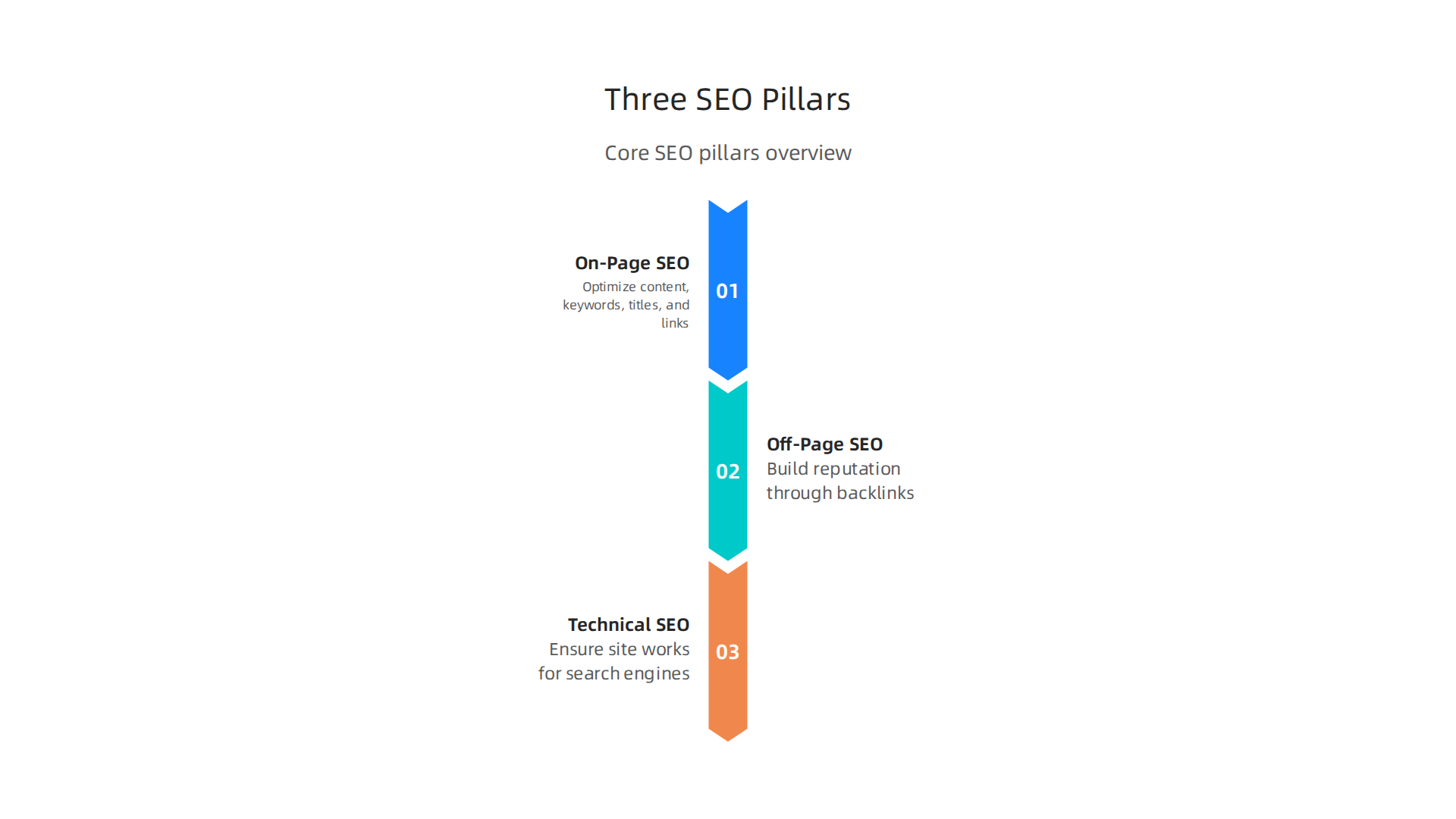
    Understanding the three core pillars—On-Page, Off-Page, and Technical SEO—is fundamental to a comprehensive SEO strategy.

    1. On-Page SEO

    This refers to all the things you can do directly on your website pages to help them rank better. It’s like decorating your store and making sure your products are clearly labeled. It includes things like:

    • Words you use: Picking the right keywords that people search for and using them naturally in your text.
    • Titles and Headings: Making sure your page titles and headings clearly tell both readers and search engines what the page is about.
    • Pictures and Videos: Making sure your images and videos are named and described in a way that search engines can understand.
    • Internal Links: Connecting your different website pages to each other so visitors and search engines can easily find more related content on your site.

    These efforts help each page match what people are searching for and clearly show its importance [^2].

    2. Off-Page SEO

    This part of SEO marketing involves actions taken outside your website to improve its standing. Think of it as building your reputation in the wider community. The most important part of off-page SEO is getting other trusted websites to link to yours. These are called "backlinks." When many good websites link to your site, it tells search engines that your website is important, trustworthy, and has valuable information. This builds your website’s authority and trust.

    3. Technical SEO

    This is about how well your website works behind the scenes for search engines. It’s like making sure your store’s foundation is strong and the lights always work. Technical SEO makes sure that search engines can easily find, read, and understand all the pages on your website. This includes checking things like:

    • Website Speed: How fast your pages load.
    • Mobile-Friendliness: If your website looks good and works well on phones and tablets.
    • Site Structure: How your website is put together so search engines can crawl it easily.

    For any chief marketing officer or business owner in 2026, understanding these pillars is key to building a strong online presence.

    A business leader making thoughtful decisions for their online strategy.

    It helps avoid "marketing myopia" by focusing on long-term growth instead of just quick wins. Learning how different marketing tools work together can help you decide how to make smart choices for your business. To dive deeper into making informed decisions, consider exploring resources on how marketing specialists choose AI tools for marketing and drive ROI.

    Want to stay ahead in the fast-changing world of AI and marketing?
    Get clear daily AI updates from The Deep View Newsletter.


    [^1]: SEO vs. SEM vs. Content Marketing
    [^2]: Technical vs On-Page vs Off-Page SEO: Key Differences

    Now that you know the three main parts of what is SEO marketing, let’s look at how search engines actually use them to figure out which websites to show. Imagine a search engine like a very smart librarian who wants to give you the best book for your question. It looks at three main things to pick the right "books" (websites):

    1. Relevance: How well does your website’s content match what someone is searching for?
    2. Authority: How much does your website prove it’s a trustworthy and important source of information?
    3. Accessibility: Can the search engine easily find, read, and understand your website?

    Let’s break down how on-page, off-page, and technical SEO help with these three points.

    On-Page SEO: Showing Relevance

    On-page SEO helps your website be truly relevant to what people are looking up. It’s about making sure the words, pictures, and overall message on your pages are clear and helpful for both people and search engines.

    • Content and Keywords: When you use the right words and phrases (keywords) that your customers type into search engines, it tells the "librarian" exactly what your page is about. But it’s not just about using keywords. It’s about writing truly good, useful content that answers questions and solves problems.
    • HTML Elements: This sounds fancy, but it just means things like your page titles, headings, and descriptions. These elements act like clear labels for your content. They help search engines quickly understand the main topic of your page and how it relates to search queries.

    By getting your on-page SEO right, you make it much easier for search engines to see that your content is a perfect match for certain searches.

    Off-Page SEO: Building Authority

    Off-page SEO is how your website earns trust and importance from other websites. Think of it as getting good reviews and recommendations from reliable friends.

    • Backlinks: The biggest part of off-page SEO is getting other good, trusted websites to link to your site. Each link is like a vote of confidence. When many important websites link to yours, search engines see your site as more trustworthy and authoritative. This makes your site more likely to show up high in search results. It shows that your website is a valuable place for information, not just a random site.

    Technical SEO: Ensuring Accessibility

    Technical SEO makes sure your website’s hidden parts work well so search engines can easily visit and understand it. It’s like making sure the doors to your library are open, the lights are on, and all the books are neatly organized.

    • Crawlability and Indexing: Search engines use little programs called "crawlers" to visit and read your website’s pages. If your site has technical problems, these crawlers might miss important pages or struggle to understand what they find. This means your valuable content might not even show up in search results. Common issues in 2026 can include important pages being accidentally blocked or problems with how pages are connected Technical SEO Checklist for 2026.
    • Site Performance: How fast your pages load is super important. Nobody likes a slow website, not people, and not search engines. Google measures things like "Core Web Vitals" which check how quickly a page loads and becomes usable. Websites that load slowly often rank lower. For example, a good Largest Contentful Paint (LCP) should be under 2.5 seconds in 2026 Technical SEO in 2026.
    • Mobile-Friendliness: Most people use their phones to browse the internet in 2026. Your website needs to look good and work perfectly on all screen sizes, from big computers to small smartphones.
    • Site Structure: This is about how your website’s pages are organized. A clear structure helps search engines understand what’s most important and how different parts of your site relate to each other. Keeping your site’s technical setup healthy is a continuous job. It involves checking for things like broken links or duplicate content that can confuse search engines Free Technical SEO Guide 2026.

    Understanding these three areas is key to mastering what is SEO marketing. They all work together to help search engines find your site, trust your content, and show it to the right people. For business leaders looking to stay on top of all the behind-the-scenes magic, it’s wise to keep an eye on how these elements contribute to your overall online presence and digital strategy. It’s a part of what makes a futuristic website 2026 stand out.

    The previous section explained what is SEO marketing and its different parts. Now, let’s look at how SEO fits into the bigger world of online marketing. Often, people talk about SEO, SEM, and content marketing as if they are the same, but they are different tools. Knowing when to use each one helps a chief marketing officer or any business leader make smart choices about where to put their marketing money.

    A team collaboratively discussing where to allocate marketing investments across different strategies.

    It helps avoid something called marketing myopia, where you only see a small part of the marketing world.

    SEO vs. SEM vs. content marketing: where to invest

    When you want to bring people to your website, you have a few main ways to do it. SEO, SEM, and content marketing all aim to get more eyes on your business online, but they work in different ways and give results at different speeds.

    1. Search Engine Optimization (SEO)
    As we’ve seen, SEO is about making your website naturally show up higher in search results without paying for clicks. It’s like building a strong, well-known store in a good location that people find on their own. SEO takes time to build up, often many months, but the results can last a long time. It gives you "organic" traffic, which means people find you because your content is truly helpful and relevant to their search [SEO vs. SEM vs. Content Marketing]. This is a great choice for long-term growth and building trust with your audience.

    2. Search Engine Marketing (SEM)
    SEM is often called paid search. This is when you pay search engines like Google to show your ads at the very top of search results. Think of it like buying a billboard right on the busiest highway. You pay each time someone clicks on your ad (this is called Pay-Per-Click, or PPC). SEM can give you fast results. You can set up an ad campaign and start seeing visitors within hours or days. It’s great for quickly getting traffic for specific keywords or promoting new products. For business leaders wondering how to choose AI for business tools that deliver real results, understanding the quick-turnaround of SEM can be key. However, when you stop paying, the traffic stops too.

    3. Content Marketing
    Content marketing is about creating helpful and valuable stuff for your audience, like blog posts, videos, guides, or infographics. The goal isn’t always to sell something right away. Instead, it’s about giving people useful information that builds trust and shows you are an expert. This helps your brand become known and liked. Good content can also help your SEO by giving search engines more relevant pages to show. Content marketing is a longer game, but it creates a lasting connection with customers. For example, a good chief marketing officer knows that understanding your customer’s journey is crucial, which ties into effective STP marketing (segmentation, targeting, and positioning).

    When to Invest in Each

    Choosing where to put your money depends on what you want to achieve:

    • If you need quick results or want to test a new product right away: SEM is your best friend. It offers fast traffic and quick feedback.
    • If you want to build long-term trust, steady traffic, and a strong brand: SEO and content marketing are key. They take time, but the payoff can be huge and last for years.
    • For a new business or product launch: A smart plan often involves using SEM for an immediate boost while slowly building up your SEO and content marketing efforts. This gives you both quick wins and long-term stability.

    All these strategies can work together to create a powerful online presence. It’s not about choosing just one, but finding the right mix for your business goals and budget. Staying updated on these marketing shifts is vital for any business.

    Get clear daily AI updates from The AI Newsletter Worth Reading.

    To truly make SEO work for you, it’s not enough to know what it is; you also need a smart plan. Think of it like building a house. You wouldn’t just start nailing boards together. You’d have a blueprint. The same goes for SEO. A smart business leader, like a chief marketing officer, needs a clear plan to make sure SEO helps reach overall business goals. This way, you avoid "marketing myopia" and see the bigger picture.

    Strategic SEO planning: aligning SEO with business goals

    A good SEO plan connects what your business wants to achieve with what your SEO efforts will do.
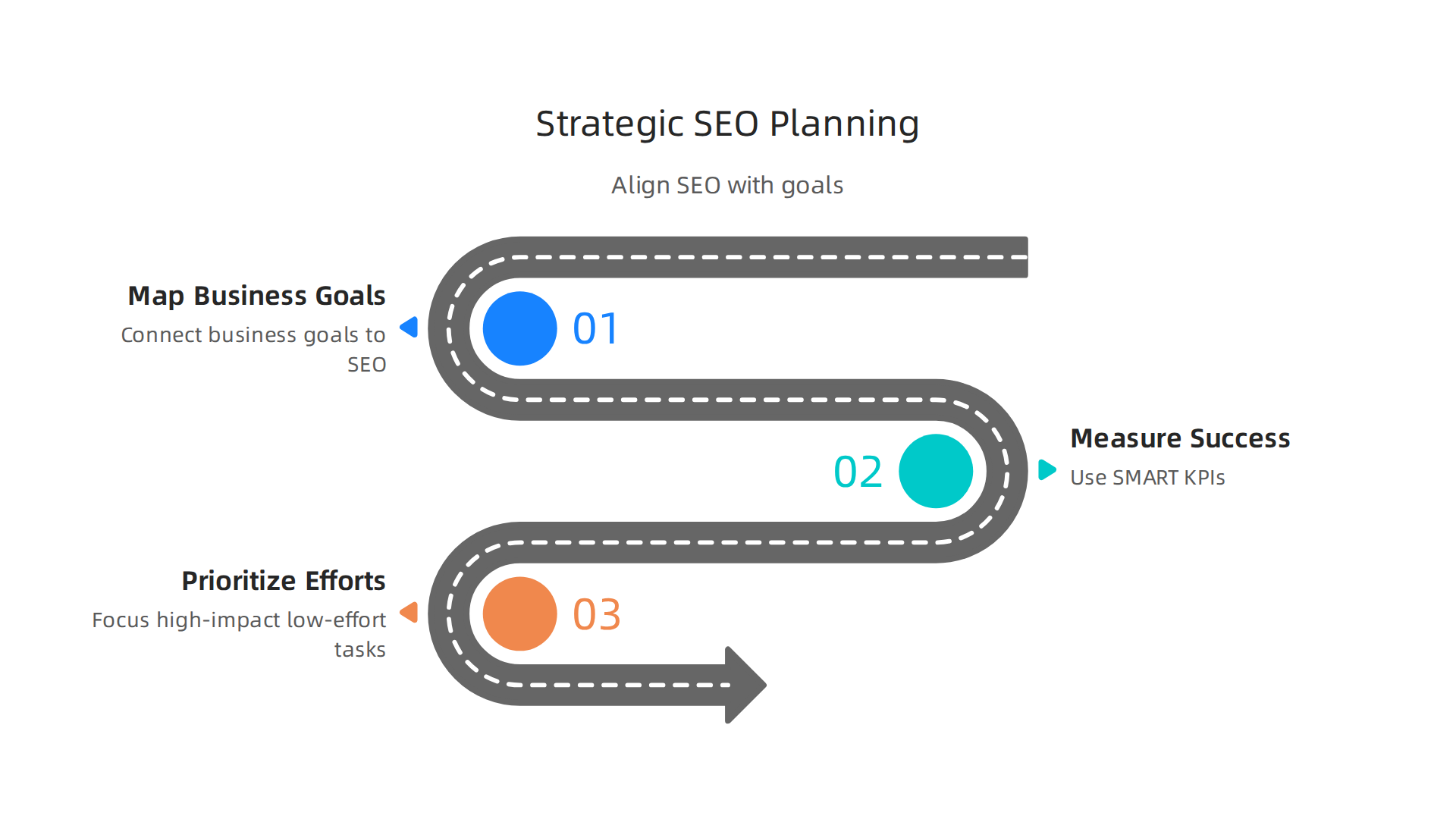
    Strategic SEO planning involves mapping goals, measuring success with KPIs, and prioritizing efforts for maximum impact.

    It’s like drawing a straight line from your big business dreams to the small steps you take each day on your website.

    1. Map Your Business Goals to SEO Goals
    First, think about your main business goals. Do you want to:

    • Sell more products online?
    • Get more people to sign up for your service?
    • Make your brand more famous?

    Once you know your business goal, you can set a clear SEO goal. For example:

    • Business Goal: "Increase online sales by 15% this year."
    • SEO Goal: "Rank higher for keywords related to our products to get more organic traffic to product pages."

    Many companies use templates to map out these goals and track them, helping them see clearly what they need to do SEO Roadmap Template.

    2. Measure Your Success with KPIs
    After setting goals, you need to know if you’re actually reaching them. This is where Key Performance Indicators (KPIs) come in. KPIs are like scorecards for your SEO efforts.

    • If your SEO goal is to get more organic traffic, a KPI might be "Number of visitors from Google search."
    • If your goal is more sales, a KPI could be "Revenue from organic search."

    Make sure your KPIs are SMART: Specific, Measurable, Achievable, Relevant, and Time-bound. This helps you track what is SEO marketing really doing for your bottom line. Learning about Marketing Science for AI Professionals can help you set these up.

    3. Prioritize Your Efforts
    Most businesses don’t have endless money, time, or people. This means you have to choose which SEO tasks to do first. To do this, you can look at two things:

    • Impact: How much will this task help your business goals?
    • Effort: How hard or long will this task take?

    Leaders often score each task to see which ones offer the biggest win for the least amount of work. This helps them decide what to tackle first, especially when resources are limited How do leaders prioritize SEO efforts in limited-resource. By carefully planning and prioritizing, you ensure that every SEO step you take brings you closer to your business’s overall success.

    Keyword Research, Content Strategy, and User Intent

    Once you know your SEO goals and what success looks like, the next step is to figure out exactly what people are searching for. This is where keyword research comes in. It’s like listening to your customers and finding out what questions they are asking, or what problems they need help with. This helps you understand "what is SEO marketing" really about from a user’s viewpoint.

    Finding High-Value Topics with User Intent

    Good keyword research isn’t just about finding popular words. It’s about understanding "user intent." This means figuring out why someone is typing a certain phrase into a search engine. Do they want to buy something? Learn something? Or find a specific website? For example, if someone searches "best running shoes," their intent is likely to buy. If they search "how to tie running shoes," their intent is to learn.

    By finding keywords that match what your ideal customers want, you can create content that truly helps them. Many businesses in 2026 use special AI tools to do this. These tools can help you find keywords, group them by what people mean when they search, and even compare them to what your competitors are doing. This is called AI-Powered Keyword Research and it makes finding valuable topics much easier. Choosing the right AI for business tools is key to making this process smooth.

    Building Your Content Strategy

    After you know what topics and keywords your audience cares about, you can build your content strategy. This means deciding what kinds of content you’ll make and how it fits into your overall marketing plan.

    • Awareness: For people just learning about a topic, you might create blog posts or guides.
    • Consideration: For those weighing their options, you could offer comparison articles or detailed product reviews.
    • Decision: For customers ready to buy, you’d have product pages, pricing info, or case studies.

    Your content should be useful and guide people through their journey, no matter where they are in their search.

    A Simple Content Workflow

    To keep your content creation running smoothly, follow a clear workflow.
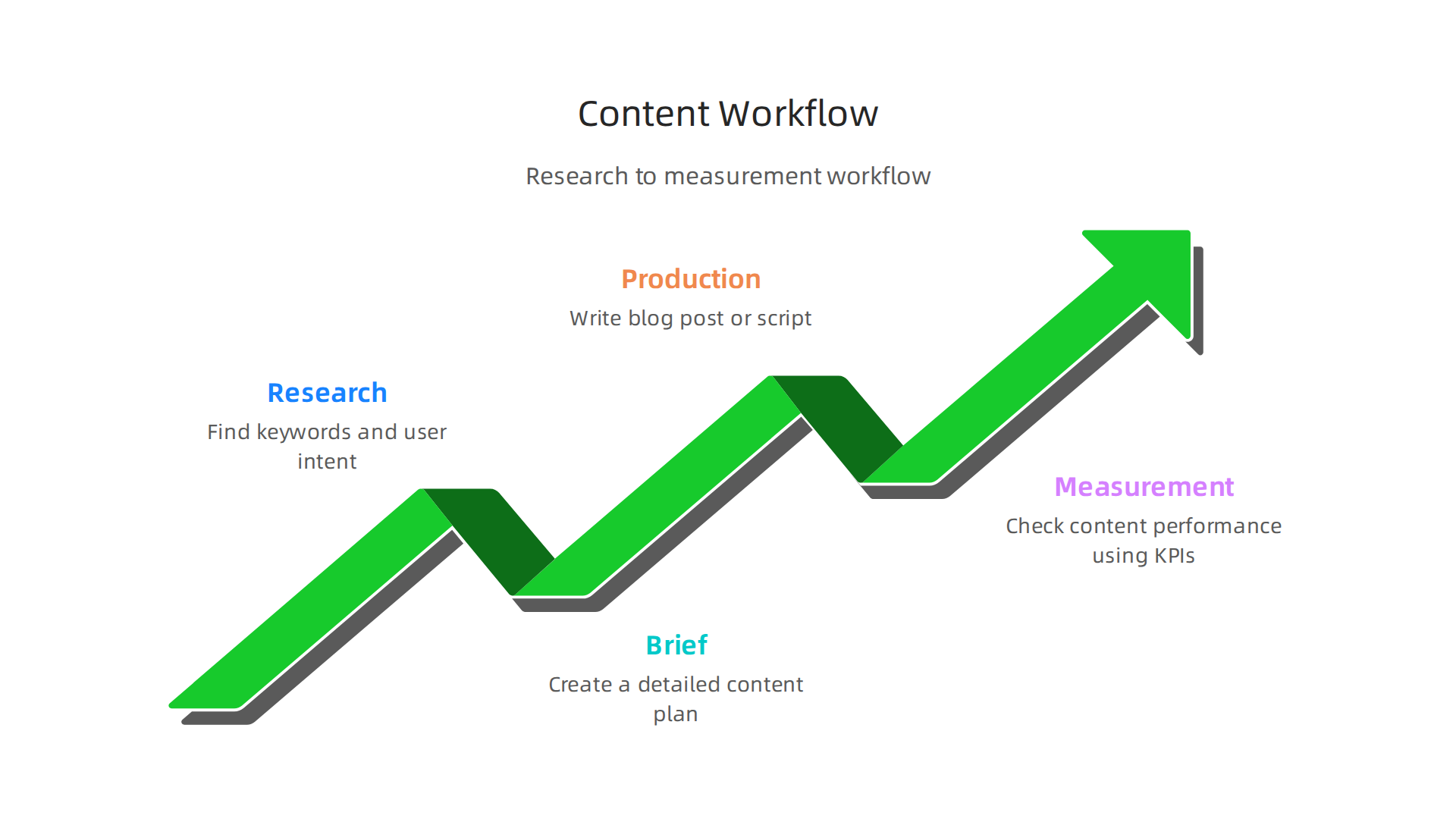
    A structured content workflow from research to measurement ensures effective content delivery and optimization.

    Many companies use a step-by-step process, often with the help of AI tools, to make sure nothing is missed.

    1. Research: Find keywords and understand user intent, like we talked about above.
    2. Brief: Create a detailed plan for each piece of content. This includes the main topic, keywords to use, and what points to cover.
    3. Production: Write the content. This could be a blog post, a video script, or a product description. Some modern tools can help automate content workflows from start to finish.
    4. Measurement: Check how well your content is doing using your KPIs. Are people reading it? Is it bringing in new customers? This helps you learn and make your next pieces even better.

    By putting these steps into action, you’ll have a strong content plan that truly supports what your business wants to achieve with SEO.

    Staying on top of the latest AI tools that power these workflows is a must for any business leader. Get clear daily AI updates from The AI Newsletter Worth Reading.

    After you have a great content plan, it’s time to make sure your website is built in a way that search engines can easily understand. This part of "what is SEO marketing" is called technical SEO. It’s like making sure the foundation and roads of your house are strong and clear so visitors can find their way without trouble.

    Technical SEO deals with how search engines like Google look at, understand, and show your website pages. If there are problems here, even the best content might not get seen. In 2026, keeping your site technically sound is more important than ever.

    Important Technical Checks for Your Website

    Many common issues can stop your website from doing well in search results. Here are some key areas to watch out for:

    • Can Search Engines Find Your Pages?
      Search engines use special bots, like tiny explorers, to visit your website and find new pages. This is called "crawling." Then, they "index" these pages, which means they add them to their big library of websites. Sometimes, a website might accidentally block these bots or tell them not to index important pages. This can happen with wrong settings in files like robots.txt or through special "noindex" tags on pages that should be seen Technical SEO Guide 2026: Crawl & Indexing. It’s also important to have a clean sitemap that helps bots find all your good pages Technical SEO Checklist for 2026: What Actually Matters.

    • How Fast and Easy Is Your Website to Use?
      People like fast websites. Search engines also like them. Google uses something called Core Web Vitals to measure how quickly your page loads and how smooth it feels to use. These include things like Largest Contentful Paint (LCP), which is how fast the main content shows up, and Interaction to Next Paint (INP), which is how quickly your page reacts when someone clicks or taps something. If these are slow, it can hurt your ranking Technical SEO Checklist for 2026: Improve Core Web Vitals …. Making sure your images are small and your website code is neat helps a lot with this. You can also work on your overall website architecture, speed & crawlability to boost performance.

    • Is Your Site Organized Well?
      Think of your website like a book. Internal links are like the table of contents and page numbers that help readers move from one chapter to another. If pages are "orphan pages" with no links pointing to them, search engines might not find them easily Technical SEO Checklist for 2026: 34 Critical Fixes for Crawlability …. Also, having many pages with the exact same content, called "duplicate content," can confuse search engines about which page to show.

    • Is Your Website Safe?
      Having a secure website (using HTTPS) is a must in 2026. This means your website has an SSL certificate, which protects information shared between your site and its visitors. Google sees this as a sign of trust and safety Technical SEO: Get Your Site Crawled, Indexed, and Ranked.

    Working Together for Technical SEO Success

    Making these technical fixes happen is often a team effort.

    • SEO specialists are like the architects. They identify problems and figure out the best ways to fix them to help with search rankings. They provide detailed lists of what needs to change.
    • Engineers are the builders. They take the plans from the SEO specialists and put them into action, fixing code, speeding up the site, or changing how pages are linked. A good chief marketing officer will make sure these teams work together well.
    • Product owners or business leaders help decide which technical fixes are most important for the business and make sure these changes fit into the overall product roadmap. They ensure that technical improvements align with user experience and business goals.

    By making sure everyone works together, businesses can create a strong technical foundation that helps their content shine and improves their standing in search results. Investing in this area is a smart move for any business looking to grow online.

    After making sure your website is technically sound, the next big step in understanding what is SEO marketing is to show how all that hard work actually helps the business grow. This means looking at the numbers and connecting your SEO efforts to real money or new customers.

    An individual diligently analyzing reports to connect SEO performance with actual business revenue.

    It’s not enough to just rank higher; you need to know what those rankings do for the company.

    Measuring SEO ROI: KPIs, Attribution, and Connecting to Business Outcomes

    To truly show the value of SEO, you need to measure it. This involves using Key Performance Indicators (KPIs) to track success and carefully figuring out which sales or leads came from SEO.

    Key Metrics for SEO Performance

    When we talk about SEO performance, we often start with traffic, but in 2026, the focus is much more on how that traffic turns into business success. Here are some important things to track:

    • Organic Revenue and Conversion Value: These are the most direct ways to show how much money SEO is bringing in. It’s about seeing how many sales or valuable actions (like signing up for a service) happen because someone found you through search engines. You also track the actual dollar amount of those sales or actions How to Measure SEO ROI: Complete UAE Guide (2026).
    • Newer KPIs for AI Search: In today’s world, it’s also important to look at things like "citation frequency" and "generative share of voice." This means how often AI answers (like those from ChatGPT or Google’s AI Overviews) mention your brand or content. Also, "branded search volume" can tell you how many people search directly for your company after learning about you through other searches Measuring SEO: KPIs, Attribution & Reporting (2026).

    Figuring Out Where Credit Is Due: Attribution Challenges

    One of the trickiest parts of showing SEO’s value is something called "attribution." This is about giving the right credit to the right marketing efforts. Often, people only look at the "last click," meaning they give all the credit to the very last thing someone clicked before buying. But SEO rarely works that way.

    Imagine someone searches for a product, finds your blog post (SEO), reads it, then a week later gets an email about that product, clicks the email, and buys. If you only look at the last click, the email gets all the credit. This is why SEO often looks like it’s not doing much if you only use a "last-click" view.

    To get a better picture, we use:

    • Assisted Conversions: This shows when SEO helped someone along their journey, even if it wasn’t the very last step. For example, if your blog post was the first thing they saw, it "assisted" the sale SEO Analytics Guide (2026): 15 Diagnostic Scenarios.
    • Multi-Touch Attribution Models: These are smarter ways to give credit to all the different steps a customer takes before buying. Instead of just the last click, models like "data-driven" (often used in Google Analytics 4) spread the credit across many touchpoints. There are also models like "time decay" (more credit to steps closer to buying) or "position-based" (credit to both the first and last steps) Marketing Attribution for SEO | Models, Tracking, Reporting. Using a few different models can give you a clearer view of SEO’s true impact.

    Connecting this data to your business’s sales records (often called a CRM) is key to truly understanding the full picture of how organic search influences your company’s success. For more on how to precisely measure these impacts, consider exploring marketing science for AI professionals measure real impact and ROI.

    Demonstrating SEO-Driven Value to Leaders

    The ultimate goal is to show the "Return on Investment" (ROI) for SEO. This means comparing the money you make from SEO to the money you spent on it (tools, content, people). A good chief marketing officer needs to see how SEO fits into the bigger picture and helps meet business goals. By looking at actual revenue, leads, and conversion values, and using smarter attribution models, you can clearly show that SEO is a powerful driver of growth. To stay on top of daily AI and technology insights that can help sharpen your marketing strategies, you might enjoy The AI Newsletter Worth Reading.

    Summary

    This article explains what SEO marketing is and why it matters for modern businesses, showing how on-page, off-page, and technical SEO work together to make your site discoverable, trusted, and accessible. It walks through the core concepts—relevance, authority, accessibility—then details practical steps like keyword research, content workflows, and strategic planning that align SEO with business goals. The guide also compares SEO to SEM and content marketing so you can choose the right mix for short- and long-term growth, and it highlights important technical checks (speed, mobile, crawlability) to avoid losing visibility. Finally, it covers measurement: which KPIs to track, how to handle attribution, and how to prove SEO ROI to leaders, so you can prioritize repairs and investments with confidence.


  • Unlock Growth: How to Strategically Choose Top Software Companies and AI

    Unlock Growth: How to Strategically Choose Top Software Companies and AI

    Why leaders need to rethink strategy around top software companies and AI

    It’s 2026, and the world of business is buzzing with talk about Artificial Intelligence, or AI. Every day, it feels like there’s a new AI tool or update being released. This can be exciting, but also a bit much. For many business leaders, it creates a big problem: information overload. It’s really hard to tell what’s truly helpful and what’s just noise when everyone is talking about AI.

    With so many top software companies now offering AI features, how do you pick the right ones for your business? How do you know which tools will really make a difference and help you grow? This question is more important than ever. The global market for enterprise AI was huge in 2025 and is set to grow even more by 2030, showing just how fast things are moving along Enterprise AI Adoption Trends 2026. Companies are quickly adopting AI, with many already seeing it in action across their operations The State of AI in the Enterprise – 2026 AI report.

    This rapid change means that leaders can’t just stick to old ways of thinking. They need a fresh approach to how they look at top software companies and their AI offerings.

    A leader contemplates new strategies in the rapidly evolving AI landscape.

    If you’re in charge of making big decisions, whether for b2b marketing, running a company like Zensar Technologies, or leading any marketing firms, you know it’s a challenge to keep up. You have to sort through countless options, figure out which ones fit your needs, and then put them into action.

    That’s why we’re here. This article will give you a clear, simple way to think about and choose AI software. We will provide a practical framework to help you make smart choices about strategy, buying new tools, and putting them to use. Our goal is to cut through the confusion and help you understand how to pick AI tools for business that deliver real results in 2026.

    If you want to stay updated with clear, daily insights on AI and technology, consider subscribing.
    Get clear daily AI updates from The AI Newsletter Worth Reading.

    1) Market landscape: Who counts as a ‘top software company’ for enterprise AI?

    To truly pick the right AI tools for your business in 2026, you first need to understand who the main players are. What does "top software company" even mean when we talk about AI for businesses? It’s not just about the biggest names you know. It’s about how they help companies like yours use AI in smart ways.

    We can look at a few important things to decide if a company is a top player in enterprise AI:

    • Scale: Can they handle a lot of data and many users? Top companies offer solutions that work for both small businesses and very large ones.
    • Product Breadth: Do they offer many different AI tools, or just one specific thing? A wide range of products means they can help with different business needs.
    • Vertical Reach: Do their AI tools work well for specific industries, like healthcare, finance, or b2b marketing? Some companies are leaders in certain areas.
    • Integration Ecosystem: Can their AI tools easily connect with other software you already use? This is super important. No one wants a tool that can’t talk to their existing systems.
    • Enterprise Trust: Do businesses trust them with important data and tasks? A company’s track record and how secure their tools are really matter.

    In fact, many organizations today, about 40% of them, choose to buy ready-made AI solutions instead of building their own from scratch The multi-year AI advantage. This shows how important it is for leaders to know which providers are truly reliable.

    Different Kinds of AI Software Vendors

    The world of AI software is big, but we can group the vendors into a few main types.

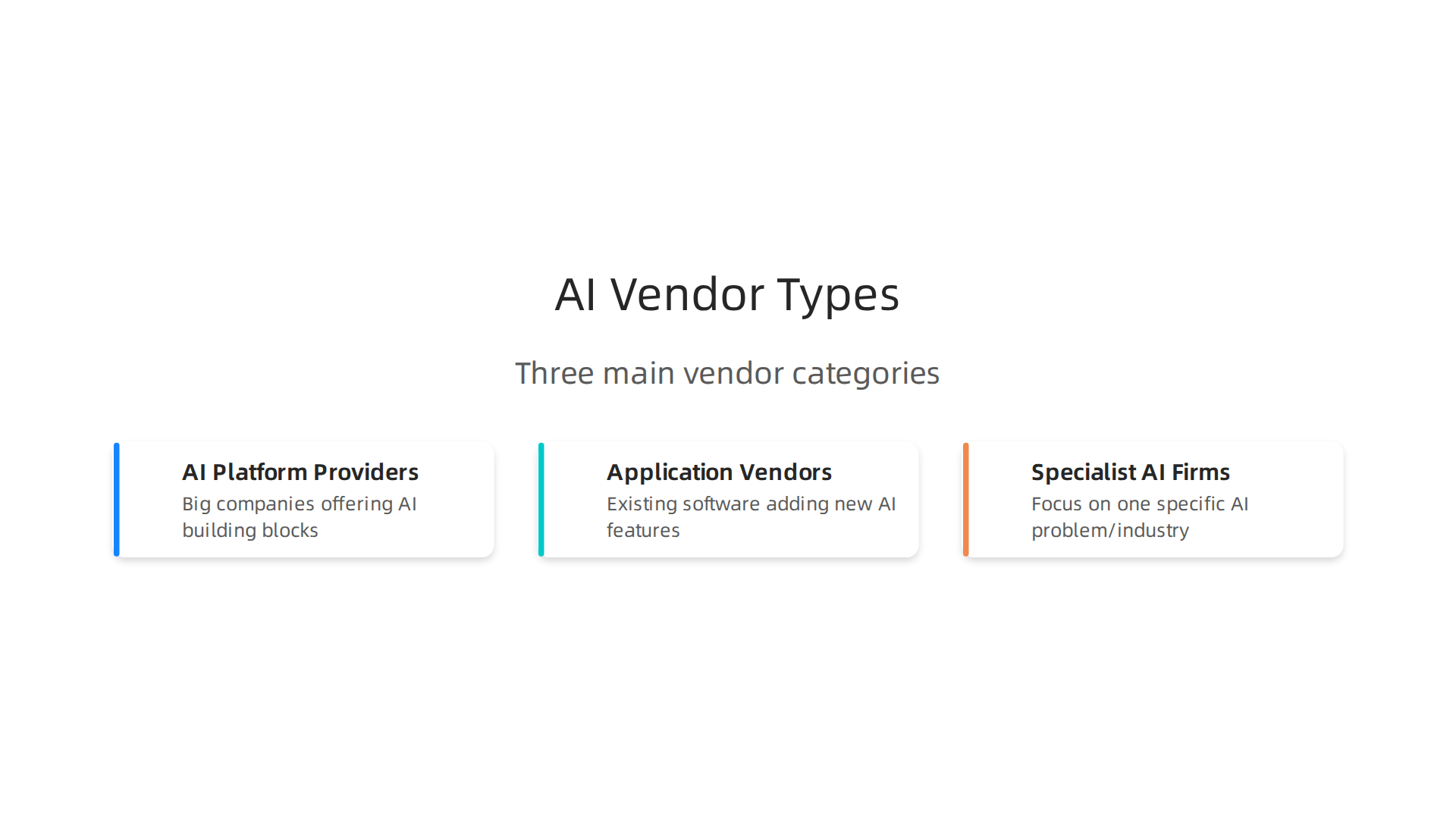
    Understanding the three main categories of AI software vendors helps in strategic tool selection.

    Knowing these groups helps you think about your strategy for buying new AI tools.

    1. AI Platform Providers: These are the really big companies, often called "hyperscalers." Think about the huge cloud providers that offer many AI building blocks. They give you the basic tools and power to create your own AI solutions. They are great if you have a team that can build custom tools. For example, if you need a strong base to run complex AI models or manage a lot of data, these platforms are key.
    2. Application Vendors with AI: These are companies that already make software you might use every day. Now, they are adding AI features right into their existing products. For instance, a company offering customer relationship management (CRM) software might add AI to help sales teams write better emails or predict customer needs. Companies like Zensar Technologies, or other marketing firms, often add AI to improve their services. This is helpful because the AI is already part of a tool you know, making it easier to use. If you are looking for ways to improve specific tasks, this type of vendor can offer powerful, ready-to-use solutions. You can learn more about how to choose effective tools in our guide on how to pick AI tools for business to drive growth in 2026.
    3. Specialist AI Firms: These are often smaller companies that focus on one very specific AI problem or industry. They might have a super smart AI tool for making videos, analyzing legal documents, or improving medical diagnoses. They are experts in their niche. If you have a very particular problem that common software doesn’t solve, a specialist firm might have the perfect AI solution.

    Understanding these different types of top software companies helps you look for the right kind of AI tool. It makes it easier to figure out if you need a broad platform, an AI add-on to your existing software, or a special tool for a unique challenge. This helps you narrow down your choices and avoid getting lost in the sea of new AI releases every day. For a deeper look at evaluating AI companies, check out how to evaluate AI companies to unlock business growth in 2026.

    After you have a good idea of what kind of AI vendor you need, the next important step is to look closely at their products.

    A business team closely examining product specifications and features during an evaluation meeting.

    This means checking if their AI tools actually fit your business needs. You want to make sure the software can do what you need it to do, works well with your other systems, and will keep getting better in the future.

    Here are the main things to check when looking at AI products from top software companies:

    Core Capabilities and Features

    First, think about what the AI tool is built to do. What are its main skills? For example, if you need an AI for customer service, does it understand customer questions well? Can it give helpful answers? If you need it for writing marketing materials, how good is the quality of its writing?

    You should compare different platforms based on what they can actually do. Some AI platforms, like Microsoft Azure AI Foundry or Google Vertex AI, offer many different features. They can handle things like understanding different types of information or working across many systems Enterprise AI Vendor Comparison 2026: Top 15 Platforms for …. It’s important to match these skills to your specific tasks. Think about your goals, whether it’s for b2b marketing efforts or streamlining other business operations.

    How Well They Connect: APIs, Extensibility, and Data

    One of the most important things for any new AI tool is how well it can work with your existing systems.

    Essential considerations for how AI tools connect with existing business systems.

    No one wants an AI that works alone.

    • APIs (Application Programming Interfaces): Think of APIs as special doorways that allow different software programs to talk to each other. If an AI tool has good APIs, it means you can easily connect it to your current customer relationship management (CRM) software, your sales tools, or your accounting programs. This makes sure all your systems can share information.
    • Extensibility: This means how much you can change or add to the AI tool. Can you customize it for your special needs? Can you build new features on top of it? For example, if you’re a marketing firm, can you extend the AI’s capabilities to handle specific types of campaigns unique to your brand? Some platforms are very flexible, letting you build custom solutions Top Enterprise AI Platforms 2026: 8 Compared.
    • Data and Connectivity: How does the AI tool handle your business’s data? Can it easily connect to where your data lives, whether that’s in the cloud or on your own servers? Look for tools that can work smoothly with your data setup to make sure the AI has all the information it needs to be helpful. Some top software companies focus on strong data connections, like Databricks Mosaic AI for lakehouse-centric AI Top 10 Enterprise AI Platforms in 2026 (Ranked).

    Reading the Roadmap and Engineering Signals

    Choosing an AI tool isn’t just about what it can do today. It’s also about what it will be able to do tomorrow. The world of AI changes very fast in 2026. This is where looking at a company’s product roadmap and engineering signals becomes useful.

    • Product Roadmap: This is like a plan that shows what new features and improvements a company intends to add to their software in the future. A clear roadmap tells you if the company is focused on the things that matter to your business. Does it show plans for better integrations? More advanced AI capabilities?
    • Engineering Signals: These are clues about how a company builds and updates its software. Do they release updates often? Do they listen to customer feedback? Are they pushing the boundaries with new AI technologies? Companies that invest heavily in research and development usually have stronger engineering signals. This can tell you a lot about their long-term vision and reliability. IBM watsonx, for example, is known for its focus on regulated industries and strong governance Every Major Enterprise AI Platform Benchmarked (2026). This shows a clear signal about their engineering priorities.

    By carefully checking these points, you can make a better choice about which AI tools will truly help your business grow. For more detailed insights on how to pick the right AI solutions, explore our guide on Enterprise AI platforms 2026: top providers and how to choose the right one.

    Keeping up with the latest AI trends is a big job. If you want to stay smart about new AI tools and features without getting lost in all the noise, there’s a great resource.
    Get clear daily AI updates from The AI Newsletter Worth Reading.

    Picking the right AI tools from all the top software companies is just the start. The next big step is making them work smoothly with everything else you do every day.

    A team works collaboratively to ensure smooth integration and deployment of AI systems.

    This is where real-world integration and deployment come in. It’s about getting the AI system up and running and making sure it stays useful and secure for your business, whether it’s for b2b marketing efforts or other important tasks.

    Common Integration Challenges

    When you bring a new AI tool into your company, it’s a bit like adding a new player to a team. Everyone needs to work together. Here are some common problems you might face:

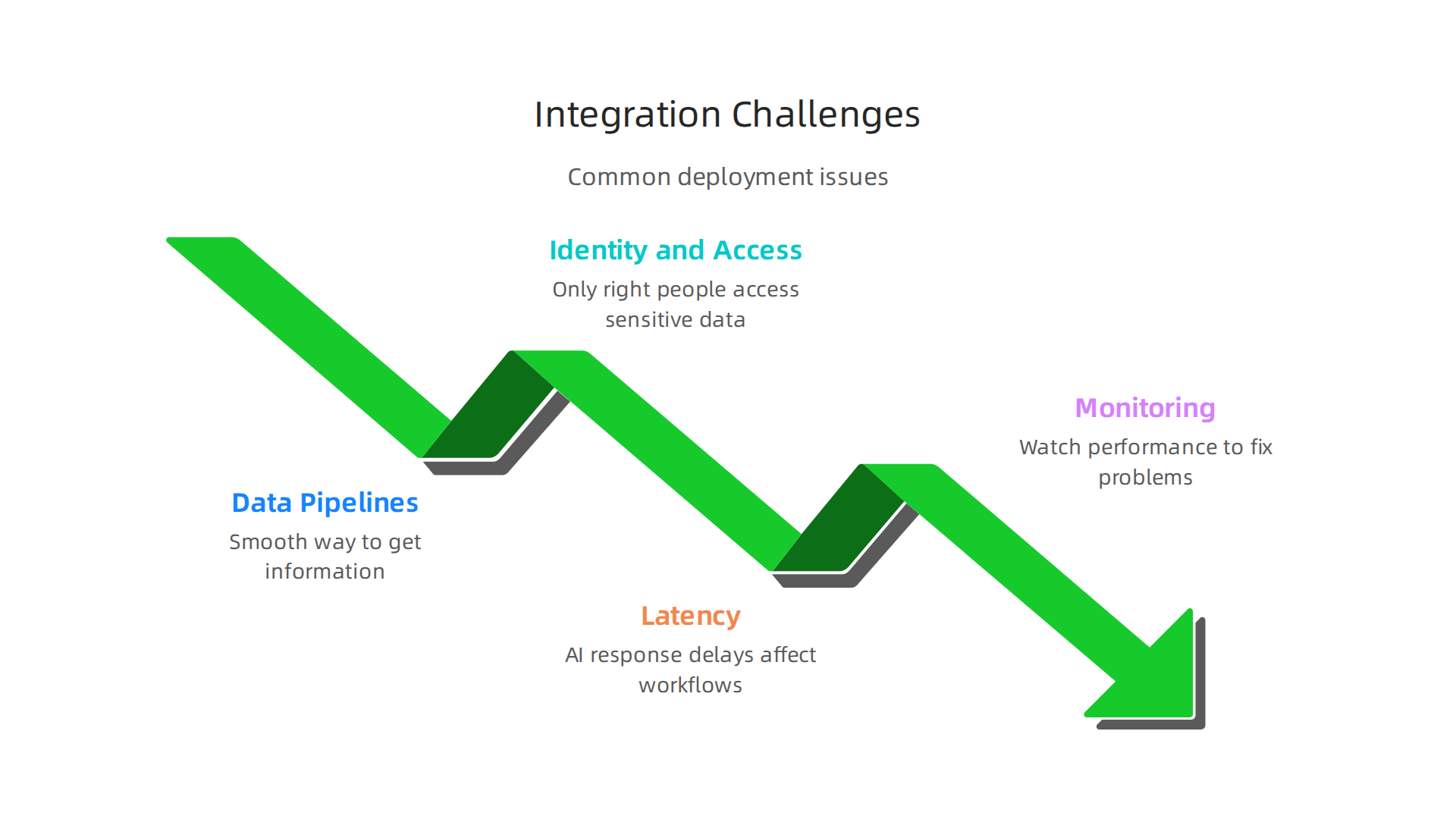
    Key challenges businesses encounter when integrating new AI tools into their operations.

    • Data Pipelines: AI needs lots of data. You need a smooth way to get your company’s information to the AI tool. This is called a data pipeline. If this pipeline isn’t set up right, the AI won’t have the facts it needs to do its job. It’s like trying to cook without all your ingredients.
    • Identity and Access: Who gets to use the AI tool? How do they log in? It’s really important that only the right people can access sensitive AI tools and data. Many top software companies offer ways to connect their AI tools to your existing security systems, like Single Sign-On (SSO) and Multi-Factor Authentication (MFA). This makes sure everyone logs in safely, as highlighted in one Enterprise AI Onboarding Checklist: 30 IT Must-Checks.
    • Latency: This is just a fancy word for delay. If your AI takes too long to respond, it can slow down your whole team. For example, if a marketing firm’s AI takes ages to draft an email, it’s not very helpful. You want quick answers from your AI.
    • Monitoring: Once an AI is working, you need to watch it closely. Is it doing what it’s supposed to? Is it making mistakes? Good monitoring tools help you see how the AI is performing in real time so you can fix problems quickly. This includes setting up dashboards to track performance, as detailed in an Ultimate Enterprise AI Integration Guide for 2026.

    Operational Readiness: Keeping AI Running Smoothly

    Beyond just getting the AI to work, you need to make sure your business is ready to keep it running well every day. This is about being "operationally ready."

    • Site Reliability Engineering (SRE) and Observability: These are about making sure the AI system is always available and working correctly. SRE teams focus on keeping things reliable. Observability means you can "see" what’s happening inside the AI system at all times, so you know if something is going wrong.
    • Compliance and Governance: In 2026, rules about how AI uses data are very important. Your AI tools must follow laws and company rules. This includes managing approvals, audits, and who can access the AI model, which are key parts of Enterprise AI in 2026: Use Cases, Governance, and Rollout. You need clear plans for how data is used and stored.
    • Vendor Support Models: Even the best AI tools from top software companies will sometimes need help. What kind of support does the vendor offer? Do they have a team you can call if there’s a problem? How quickly do they respond? Good support means less worry for your team.

    Making sure your business is ready for these challenges is vital for successful AI adoption. To learn more about how to pick the right tools for your business, check out our guide on how to choose AI for business tools that deliver real results. It’s all about thoughtful planning and choosing tools that fit your company’s specific needs and readiness. Getting this right helps your business grow and makes sure your AI investment pays off.

    Getting your AI tools up and running is one thing. Paying for them and knowing if they are truly helping your business grow is another big part of the picture. This is where we look at how to buy AI, what different pricing plans look like, and how to measure if you’re getting your money’s worth.

    Common Pricing Approaches from Top Software Companies

    When you decide to bring AI into your business, you’ll find that different top software companies offer various ways to pay for their services. Understanding these helps you budget wisely:

    • Subscription Plans: Many AI tools work like other software you might use, with a monthly or yearly fee. This gives you access to a set of features, and sometimes a certain amount of usage. It’s often the simplest way to budget.
    • Consumption-Based Pricing: With AI, you often pay for what you actually use. This might mean paying for each "token" processed, each AI "query" made, or the amount of data the AI handles. For instance, a marketing firm using AI to generate ad copy might pay per copy created. This model helps align costs with how much value you’re getting, as explained in one AI pricing guide for founders.
    • Outcome-Based Pricing: Some advanced AI solutions are priced based on the results they deliver. For example, a tool that helps reduce customer service calls might charge based on the number of calls prevented. This type of pricing ties the cost directly to the benefits your business receives.

    It’s important to know these different models so you can pick the one that best fits your company’s needs and how you plan to use the AI.

    Measuring ROI and Value from AI Initiatives

    Once you start paying for AI, the big question is: Is it worth it? This is about figuring out your Return on Investment, or ROI. It means checking if the money, time, and effort you put into AI are bringing back good results for your business.

    To truly understand if your AI investment is paying off, you need a clear plan. In 2026, many businesses are focusing on how to measure this impact. This includes:

    • Defining Clear Goals: Before you even start, know what you want the AI to achieve. Is it to save money, make things faster, or help your b2b marketing team create better campaigns? The CIO’s Playbook for Enterprise AI Strategy in 2026 suggests defining clear outcomes and baselines.
    • Tracking Key Metrics: You need to watch certain numbers to see if the AI is making a difference. For example, for a marketing firm, this could be how much faster content is produced, how many more leads are generated, or how much less is spent on repetitive tasks. For more on this, check out our guide on how to get real ROI from AI marketing cloud.
    • Calculating Time-to-Value: This means how quickly you start seeing real benefits from the AI. For AI in procurement, for example, many companies see a payback period of 9 to 18 months.
    • Considering Total Cost of Ownership (TCO): Don’t just look at the price tag. TCO includes all costs over time, like setting up the AI, training your team, ongoing maintenance, and any special infrastructure needs. A good business case for AI procurement needs to factor in this three-year total cost. Companies like Zensar Technologies understand the importance of comprehensive planning for AI solutions.

    By carefully tracking these factors, businesses can make sure their AI tools are not just fancy additions, but powerful engines for growth and efficiency.

    Want to stay ahead of the curve and get daily insights on the latest AI trends and tools?

    The AI Newsletter Worth Reading

    After looking at pricing and how to measure if your AI tools are helping, there’s another very important step: making sure you pick a trusted partner. This is about understanding the risks involved with AI vendors and what you need to check before you agree to anything.

    Vendor risk, trust, and compliance: what to check before signing

    Bringing AI into your business means you’re putting a lot of trust in the top software companies providing these tools. But not all companies are the same, and some choices can lead to big problems if you’re not careful. It’s smart to think about different kinds of risks before you sign any agreements.

    Here are some important risk areas to consider:

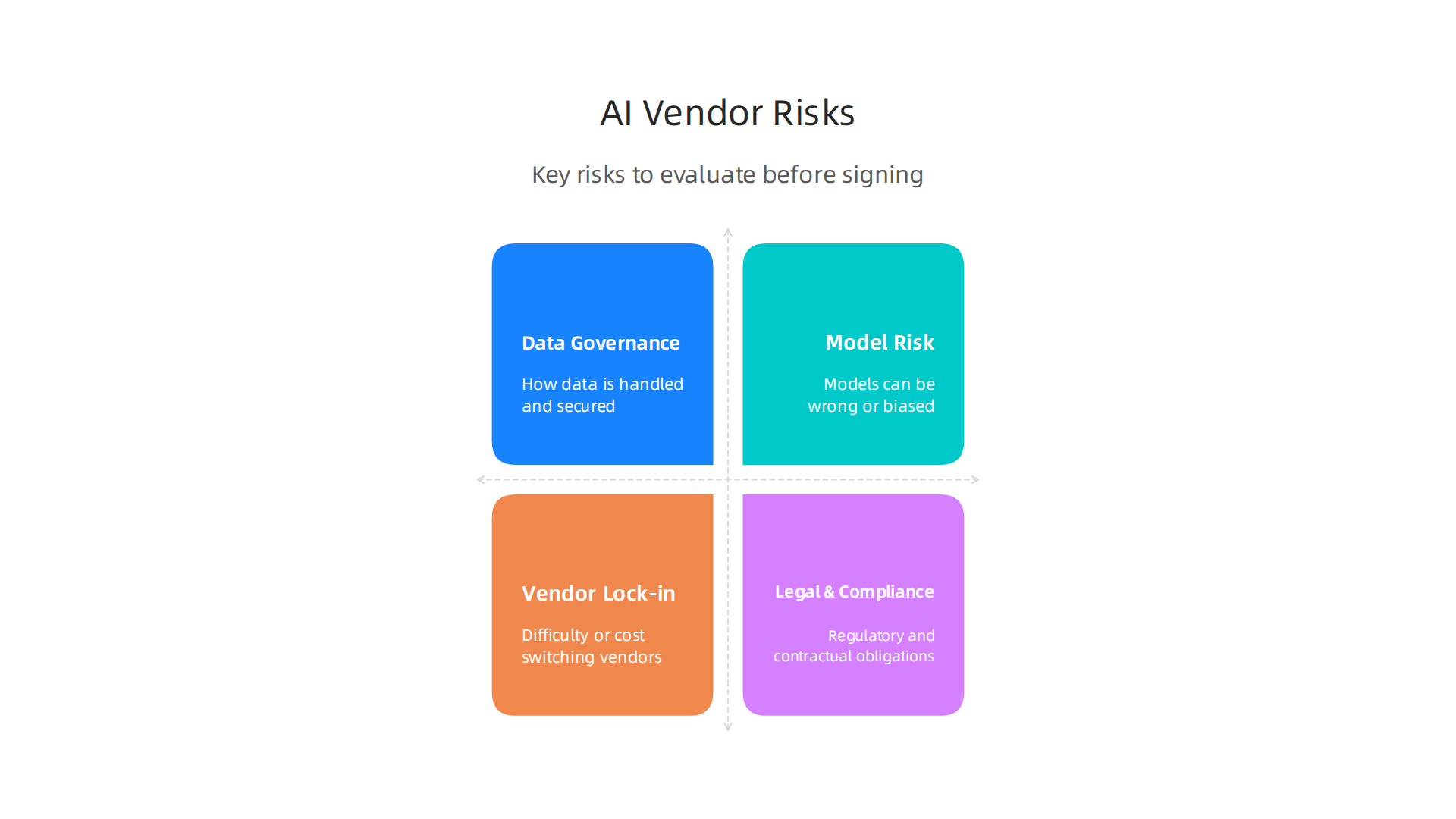
    Key risks associated with AI vendors that businesses must evaluate before committing.

    • Data Governance: This means how your data is handled. Who owns it? How is it kept safe? Will the AI vendor use your company’s data to train their models, possibly mixing it with others’ data? You need clear answers to make sure your important information stays private and secure. One expert suggests asking how training data is handled and if customer data is used for model training to avoid issues like vendor lock-in and to ensure trust with enterprise AI solutions in 2026.
    • Model Risk: AI models can sometimes be wrong, unfair, or biased. This is called model risk. If the AI makes bad decisions, it can hurt your business. For example, a b2b marketing tool that targets the wrong customers could waste a lot of money. You need to know how accurate the AI is and what steps the vendor takes to make sure it works fairly.
    • Vendor Lock-in: Imagine if it becomes very hard or costly to switch to a different AI tool later. That’s vendor lock-in. It happens when you depend too much on one vendor’s special way of doing things. You want to keep your options open, especially as AI technology keeps changing quickly in 2026.
    • Legal and Compliance Exposure: There are growing rules and laws about how AI can be used, especially with customer data. If your AI vendor doesn’t follow these rules, it could put your business in legal trouble. Understanding these legal risks is part of being ready for AI. To learn more about managing these hidden dangers, check out our guide on Stealth AI A Business Guide to Hidden AI Risks Opportunities and Management in 2026.

    Your AI Vendor Due Diligence Checklist

    To avoid these risks, you need to do your homework. This is called "due diligence." It means carefully checking out each potential AI vendor. Many top software companies offer great tools, but you need to make sure they’re the right fit for your business, not just today, but for the future.

    Here’s what to look for:

    • Security Certifications: Does the vendor have proof that their systems are secure? Look for known security badges or reports from independent auditors. This shows they take security seriously. A good AI Vendor Selection Framework suggests data governance and security are very important, weighing in at 25% of the evaluation.
    • Audit Practices: Ask how often they check their AI systems for problems or unfairness. Do they have a plan for fixing issues quickly? Good audit practices show they are responsible.
    • Contract Clauses to Negotiate: The contract isn’t just a formality. It’s your chance to protect your business. Make sure you understand clauses about data ownership, how the AI makes decisions, and what happens if something goes wrong. Don’t be afraid to ask for changes that make you feel safer. When choosing an AI vendor, a detailed AI Vendor Selection Criteria guide highlights that the technical depth and track record are critical, along with IP and data terms. For more guidance on choosing the right partners, read our article on how to Evaluate AI Companies to Unlock Business Growth in 2026.

    By taking these steps, you can build trust with your AI partners and ensure that their solutions truly benefit your operations, whether you’re a small business or a large enterprise like Zensar Technologies. Remember, careful selection is key to successful AI adoption.

    Moving from careful selection to a forward-looking plan is the next step for any business wanting to truly make AI work.

    A diverse team collaboratively outlining a long-term strategic roadmap for AI adoption.

    It means thinking ahead, not just for today or tomorrow, but for the next one to three years. This long-term view helps you pick partners who can grow with you and tools that stay useful as AI changes quickly.

    Strategic roadmap: selecting vendors and planning for 12–36 months

    To truly get the most out of AI, you need a smart plan that stretches out over time. This plan should help you pick the best AI vendors and prepare for how fast AI technology changes. It’s like setting a course for a long journey.

    A Repeatable Vendor Selection Framework

    Picking the right AI tools isn’t a one-time thing. You need a clear process you can use again and again. This is called a repeatable vendor selection framework. It helps you find the top software companies that fit your business goals.

    Here’s how to build one:

    • Set Clear Goals: Before looking at any tool, know what you want to achieve. Do you want to save money, make your customers happier, or help your marketing teams with b2b marketing efforts? For example, some businesses like Zensar Technologies might aim for better operational efficiency or new ways to grow income. Knowing your goals helps you measure success later.
    • Create an Evaluation Rubric: This is a checklist or scorecard to judge each vendor fairly. You’ll score them on things like their technical skills, how well their tools work, and their history of success. One guide suggests weighing technical depth and their track record heavily, giving them 30% and 20% of the score, respectively, when choosing an AI vendor in 2026. This also includes looking at how innovative they are and if they offer solutions that fit your whole business needs, not just one small part.
    • Pilot Program: Before fully committing, test the AI tool with a small group or project. This "pilot" lets you see how it works in real life without big risks. You can find out if the tool truly helps, if your team understands it, and if it meets your initial goals.
    • Define Scale Criteria: After a successful pilot, how do you decide if the AI is ready for your whole company? You need clear rules. This might include hitting certain performance numbers, showing good returns on investment (ROI), or being easy enough for many employees to use.

    Scenario Planning: Creating a Flexible Roadmap

    The world of AI is always moving forward. New tools and models come out all the time. This means your plan needs to be flexible. You can’t just pick one vendor and expect them to be the best choice forever.

    • Prepare for Change: Imagine different futures. What if your main AI vendor gets bought out? What if a new, much better AI model comes along? By thinking about these "scenarios," you can build a roadmap that can bend without breaking.
    • Don’t Get Locked In: It’s important not to rely too much on one vendor’s unique way of doing things. This is called vendor lock-in, and it can make it hard to switch later. Businesses in 2026 must be careful not to let how a vendor is growing decide their main AI plan. Experts suggest that a key decision for technology leaders is how to manage their entire software setup to avoid being stuck with one vendor.
    • Stay Updated on the AI Stack: The "AI stack" refers to all the different parts that make up an AI system, from the basic models to the tools you use every day. Make sure any vendor you choose fits well with your existing systems and how your company works. This helps prevent problems down the road. For many marketing firms, understanding how different AI tools integrate is crucial for seamless operations.

    By having a flexible roadmap and a clear way to pick vendors, you can make sure your business stays ahead in the fast-paced AI world. It’s about being ready for what comes next.

    If you want to stay updated on the latest AI trends and how they impact businesses like yours, consider subscribing to our daily insights.
    The AI Newsletter Worth Reading

    Summary

    This article helps business leaders cut through the noise of 2026’s fast-moving AI market by giving a practical framework for choosing and working with top software companies. It explains who counts as a leading enterprise AI vendor—platform providers, application vendors adding AI, and specialist firms—and shows what to evaluate in their products, from core capabilities to APIs and roadmaps. The piece covers real deployment challenges like data pipelines, identity, latency, monitoring, and operational readiness (SRE and observability), plus the compliance and governance steps needed to reduce legal and model risks. It also breaks down typical pricing approaches, how to measure ROI and time-to-value, and what to include in vendor due diligence. Finally, it offers a repeatable vendor selection process, scenario planning to avoid lock-in, and a 12–36 month roadmap to pilot, scale, and keep AI investments aligned with business goals.

  • Mastering AI For Marketing Services In 2026

    Mastering AI For Marketing Services In 2026

    In 2026, artificial intelligence (AI) is changing everything, especially in the world of marketing. What started as a new trend is now a must-have tool for any business offering marketing services. It’s no longer enough to just be curious about AI. Now, marketing teams need a clear plan to use AI wisely.

    Businesses need to move from just looking at AI to having a real strategy for it.

    A marketing team collaborates to outline a clear AI strategy, moving beyond simple curiosity to defined goals.

    Without a good plan, companies might miss out on big chances to grow or make things better. Experts agree that business leaders need smart ways to find new opportunities, pick the best ideas for using AI, test them out carefully, see what works, and then use those good ideas on a larger scale. This helps turn early tries with AI into real wins for the business From AI pilots to performance: 3 things leaders need to unlock.

    This guide is here to help you get a handle on AI for your marketing services. We will give you easy-to-understand ways to think about AI. You’ll learn about how to pick the right AI tools and how to measure if they are truly helping your business. We will show you real examples of how AI can help with many tasks. This includes making better content, putting together impressive AI for presentations, and even having an intelligent AI virtual assistants for businesses to support your team.

    You’ll find practical ways to test new AI tools, checklists to help you choose the best options, and tips on how to see if your AI efforts are really paying off. Our goal is to make sure you can use AI to make your marketing smarter, faster, and more effective.

    To stay on top of the latest AI trends and how they impact business, consider subscribing:
    The AI Newsletter Worth Reading

    Before you pick any AI tools for your team, it’s super important to have a clear plan. Think of it like going on a trip. You wouldn’t just grab a map and start driving without knowing where you want to go, right? The same goes for using AI in your marketing services. In 2026, simply getting AI tools isn’t enough. You need a smart way to use them to reach your business goals.

    Your AI plan should directly match what your marketing services are trying to do. For example, if you want to get more new customers (called lead generation), AI could help find people who are most likely to buy from you. If your goal is to keep current customers happy and loyal (retention), AI might help you send them special messages they will love. Or, if you need to make lots of new ads or content quickly, AI can help scale your creative output. Having a clear vision like this is a key step to building a good AI strategy for marketing, as experts say you need to define the main results you want to achieve How do I build an AI strategy for marketing?.

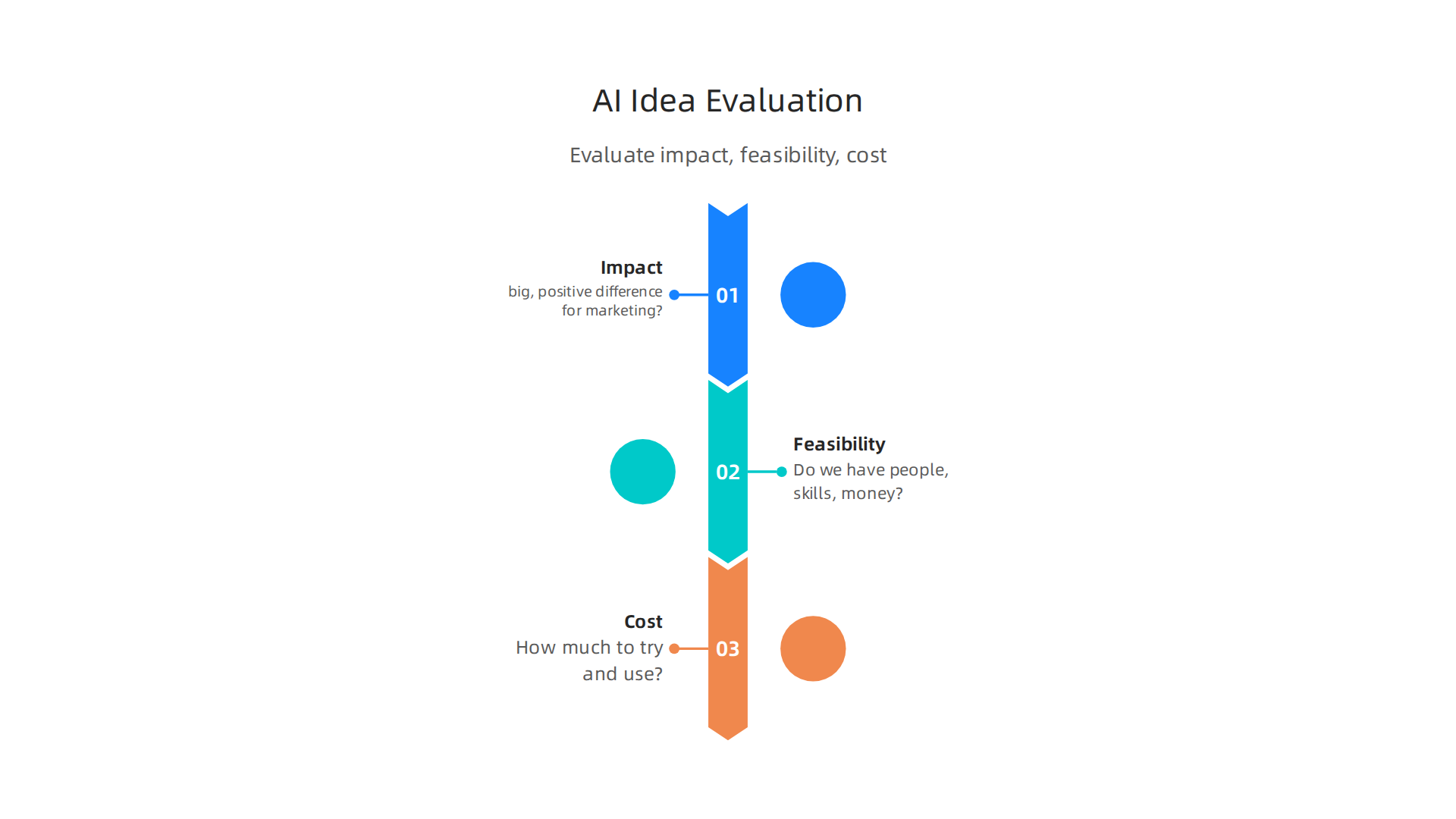
    To figure out which AI ideas to try first, you can use a simple plan. Ask yourself three things about each AI idea:

    Evaluate potential AI initiatives by considering their impact, feasibility, and cost.

    • Impact: Will this AI idea truly make a big, positive difference for our marketing services?
    • Feasibility: Can we actually do this right now? Do we have the people, skills, and money needed to make it happen?
    • Cost: How much will it cost to try out and use this AI tool?
      By thinking about these three points, you can choose the best projects that will bring the most value without costing too much or being too hard to set up. To learn more about selecting the right technology, consider reading our guide on how to pick AI tools for business to drive growth in 2026.

    A big mistake many teams make is picking AI tools before they know what they want to achieve. This is like buying a fancy hammer without knowing if you need to build a house or fix a leaky faucet. When you choose tools first, you might end up with expensive software that doesn’t really help your marketing services goals. This can lead to wasted money and time. Reports from 2026 show that while many businesses are using AI, a lot of them aren’t truly seeing big improvements in their work because they lack a clear plan State of Marketing in an AI-Driven World: 2026 Adobe Report. In fact, one report found that only 41% of marketers can clearly show how AI is helping them make more money Report: The State of AI in Marketing 2026. By setting your strategy first, you make sure that every AI tool you choose works towards your real business needs.

    Now that you have a clear plan for what you want your marketing services to achieve, the next step is to look closely at your current ways of doing things. This helps you find the best spots where AI can make a real difference. Think of it as looking under the hood of your marketing car to see which parts could run better with a little AI tune-up.

    To do this, you need to audit your marketing processes. This means checking out everything your team does, from making ads to talking with customers. Where are the tasks that take a lot of time? Where do you wish you had more help or better insights? These are often the places where AI can fit in perfectly.

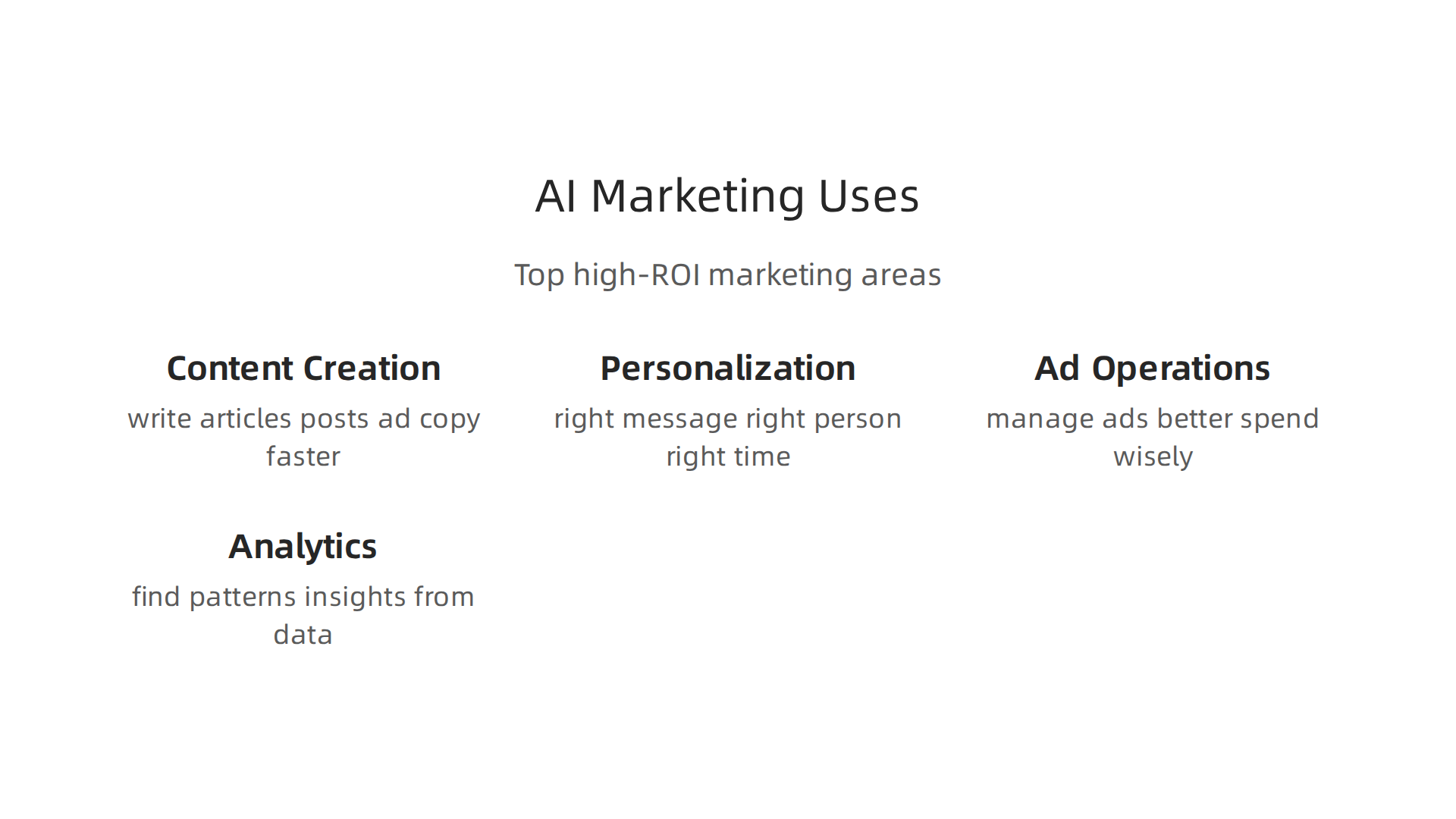
    Many marketing teams in 2026 are finding big wins with AI in a few key areas:

    Explore the top areas where AI is delivering significant value for marketing teams.

    • Content Creation: This is still the top use case for AI. AI can help write articles, social media posts, or ad copy much faster. This means your team can create more content without getting swamped. Reports show that content creation is used by 78% of teams, making it the most common way to use AI in marketing State of AI Marketing 2026 | Enterprise AI Adoption Report.
    • Personalization: AI can help you send the right message to the right person at the right time. This makes customers feel special and more likely to buy.
    • Ad Operations (Ad Ops): AI can manage your ads better by figuring out who to show them to and when, which helps you spend your ad money wisely.
    • Analytics: AI can look at huge amounts of data and find patterns or insights that humans might miss. This helps you understand what’s working and what’s not in your marketing campaigns. It’s like having a super-smart marketing assistant.

    When you’re looking at different ideas for using AI, you should score each one based on three things:

    • Potential Impact (ROI): How much positive change or money will this AI idea bring in? Will it truly help your marketing services grow or save costs? Teams focused on ROI see much better results from their AI efforts, with 83% of marketing teams reporting clear gains from generative AI AI Marketing Stats for 2026: ROI & Benchmarks.
    • Data Readiness: Do you have the right kind of data that the AI tool needs to work well? If not, how hard will it be to get that data ready?
    • Integration Complexity: How easy or hard will it be to connect this new AI tool with the other tools and systems you already use?

    Sometimes it’s better to start with a "narrow pilot." This means trying out an AI tool for a small, specific task with a small team. For example, you might use AI to just help with writing headlines for your emails. If that works well, then you can think about a "platform-wide rollout," which means using AI across many different tasks and teams in your marketing services. Starting small helps you learn and fix problems before doing something big.

    To learn more about how marketing pros choose AI tools for their work, check out our guide on how marketing specialists choose AI tools for marketing and drive ROI.

    For daily updates on how AI is changing marketing and business, you’ll want to stay informed.
    Get clear daily AI updates from The AI Newsletter Worth Reading.

    Choosing the right AI tools for your marketing services is a big step after you know where AI can help most.

    A professional carefully evaluates different AI tools and vendors to make an informed decision.

    It’s like picking the best helper for your team. You want to make sure the tool can actually do the job well. To do this, you need a good checklist.

    What to Look For in AI Tools

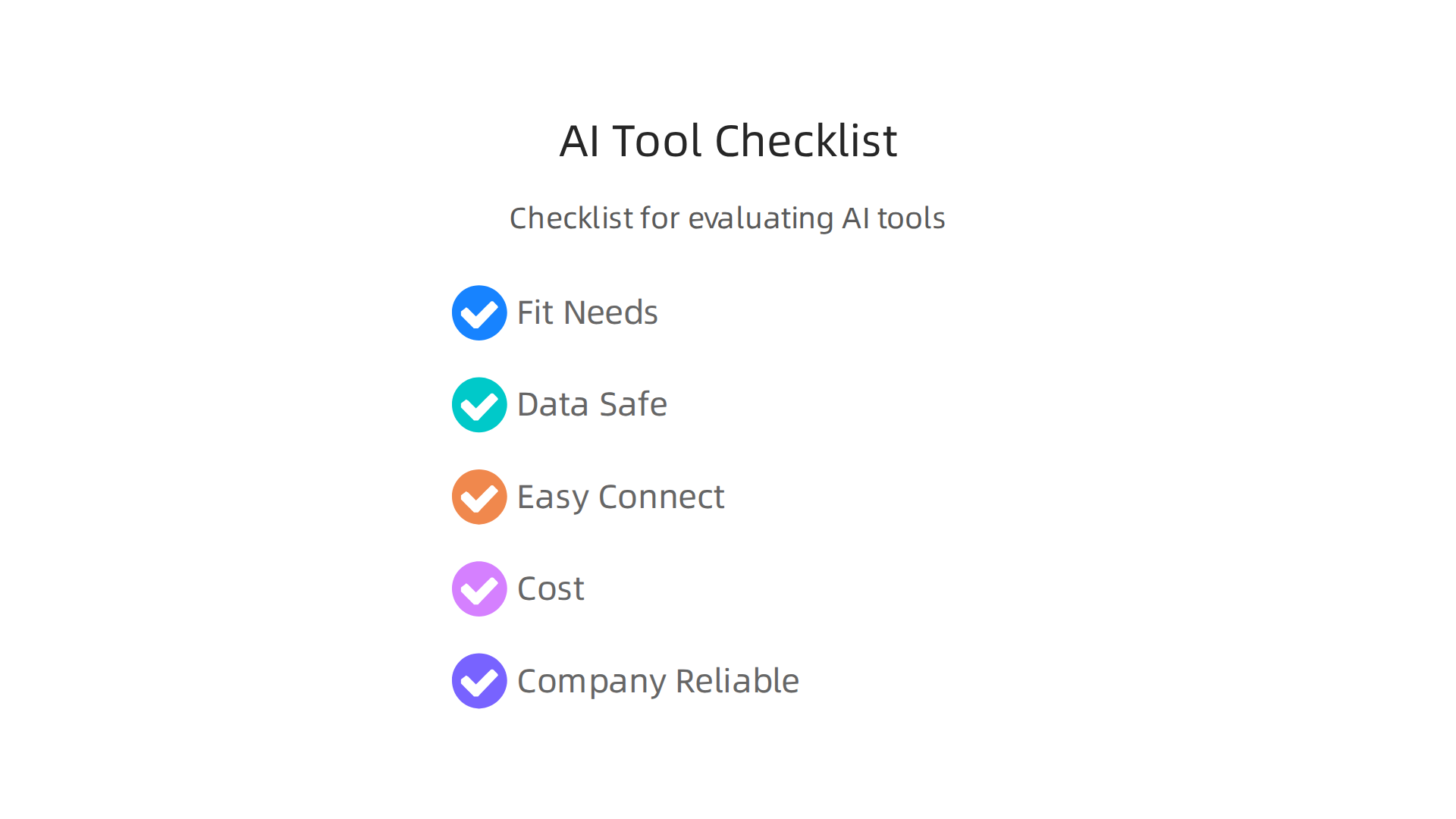
    When you’re looking at different AI tools, keep these things in mind:

    Checklist for evaluating AI tools, focusing on needs fit, data safety, integration, cost, and company reliability.

    • Does it fit your needs? The AI tool must be able to do the specific tasks you need. If you want AI to help write social media posts, the tool should be good at that. Don’t pick a tool that does many things poorly when you need one thing done perfectly. You want a tool that truly boosts your marketing services.
    • Is your data safe? AI tools often need to use your company’s data. You must be sure that the tool and the company that made it will keep your information private and secure. This is very important for trust and legal reasons.
    • How easy is it to connect? Think about your current marketing tools. Will the new AI tool easily work with them? Or will it be a headache to link everything up? An AI tool that connects smoothly with your existing setup makes life much easier.
    • What does it cost? Understand how the AI tool charges you. Is it a monthly fee, or do you pay based on how much you use it? Make sure the cost makes sense for your budget and the value you expect to get. Tools that offer clear pricing help you manage your money better.
    • Is the company reliable? Look at the company behind the AI tool. Have they been around for a while? Do they update their tools often? A strong, reliable company means you’ll get good support and that the tool will keep getting better. A template for evaluating technology vendors can help you score different options to ensure they meet your business needs and values R E S P O N S I B L E A I T E M P L A T E.

    Testing AI Tools in Real Life

    Once you have a few tools in mind, it’s a good idea to test them. This is called a "Proof of Concept" (POC) or a "pilot."

    • Try them side-by-side: Don’t just pick one tool. Try out two or three tools at the same time for the same small task. For example, have Tool A and Tool B both write headlines for your next email campaign. See which one does better. This helps you compare them fairly.
    • Focus on how they work, not just features: It’s not just about what a tool can do, but how well it actually works for your team every day. Does it save time? Is it easy to use? Does it fit into your team’s workflow without causing problems? This helps you find the best fit for your marketing services. A good way to compare is by using a scorecard for different criteria, making sure you look at things like how deep the AI’s capabilities are and how well it fits your specific marketing needs How to Evaluate B2B AI Marketing Vendors: 12 Questions … – Tofu HQ.

    By carefully checking these things, you can choose AI tools that truly help your marketing efforts grow. If you want a more general guide on how to make smart choices for your business, you can read more about how to pick AI tools for business to drive growth in 2026. This careful process makes sure you’re getting a real marketing assistant, not just a fancy gadget.

    After testing AI tools with a small "Proof of Concept," the next big step is to make them a regular part of your marketing services. This means moving from a small test to full "production." It’s like moving from trying out a recipe to cooking it for all your customers every day. You need a clear plan to do this right.

    Getting AI Tools Ready for Daily Marketing

    Putting AI into your daily work for your marketing services needs careful steps.

    • Set up the Data Flow: Your AI tools need good data to work. Think about how your company’s information will safely get to the AI tool. This involves setting up "data pipelines," which are like highways for your data. You also need to make sure the data is clean and correct. If the data is bad, the AI’s results will be bad too. For marketing leaders, a good approach to data governance is key when using AI systems Snowflake’s Agentic Enterprise Framework Puts Data ….
    • Keep Testing and Improving: Even after a pilot program, you should keep testing the AI. As your marketing needs change, the AI tools might need to learn new things or be adjusted. This helps ensure the AI continues to perform its best for your team.
    • Rollout Slowly: Don’t just give the AI tool to everyone at once. Start with a small group, get their feedback, and then slowly bring more people on board. This "rollout cadence" helps everyone get used to the new tools without too much stress. It also lets you fix small problems before they become big ones.

    Teamwork and Rules for AI Success

    Making AI a permanent part of your marketing services means more than just turning on a new tool. It needs good teamwork and clear rules.

    • Assign Clear Roles: While marketing teams often lead the charge in adopting AI, they need help from others. Your IT team can help with security, your legal team can make sure you follow privacy rules, and data experts can check for fairness. Having everyone work together helps make sure the AI is used responsibly. In fact, setting up strong governance that includes different departments is important for using AI in a way that truly helps the business What governance structures support responsible AI?.
    • Create AI Rules (Governance): Just like you have rules for how your team works, you need rules for how your AI works. This is called "AI governance." It helps make sure the AI tools are used fairly, correctly, and ethically. For example, the European Data Protection Board updated its rules in 2026 to make sure AI agents follow data privacy principles at every step AI Agents and Data Privacy: A 2026 Compliance Guide – MTM Blog.
    • Watch for Bias and Protect Privacy: AI tools learn from data, and sometimes that data can have unfair patterns, or "bias." You need to look for this bias and work to fix it, perhaps by using fair data generation techniques Mitigating bias in artificial intelligence: Fair data generation via …. Also, always make sure the AI tool handles customer data with the highest privacy standards, especially in 2026, when data privacy rules are stricter than ever. Staying up-to-date on compliance is a must.

    By taking these steps, you make sure your AI tools don’t just work in a test, but truly become a strong marketing assistant for your business. This careful planning helps your marketing services grow and adapt for the future.

    If you want to keep learning about how AI impacts your business and marketing, you’ll find helpful insights in "The AI Newsletter Worth Reading." Get clear daily AI updates from The Deep View Newsletter.

    5) Measure What Matters: KPIs, Attribution, and ROI for AI-Driven Marketing

    Once AI tools are part of your daily marketing services, it’s super important to know if they are actually helping.

    A professional focuses intently on data and reports, measuring the impact of marketing initiatives.

    You need to measure their success. This means looking at certain numbers, understanding how AI causes good changes, and checking if you are getting a good return on your money.

    Picking the Right Numbers to Watch

    Before you even start using AI for your marketing, you need to know what you want to improve. These are called Key Performance Indicators, or KPIs. They are like scores that show how well your marketing is doing. For AI-driven marketing, you might look at things like:

    • How many new customers you get.
    • How many people click on your ads.
    • How much money each customer spends over time (this is called customer lifetime value, or LTV).
    • How much it costs to get a new customer (this is called customer acquisition cost, or CAC).

    It’s a good idea to know what these numbers were before you used AI. This way, you can see if the AI is making them better. Experts say you should set clear goals and measure your starting point before adding AI to your marketing efforts How do I measure the ROI of AI marketing investments?. This helps you tell a real story about how AI helps your marketing services.

    Knowing What Changes Are Due to AI

    When you use AI, many things might change. How do you know for sure that AI is the reason for a boost in sales or leads? This is where "attribution" and "experimentation" come in.

    • Attribution means figuring out which part of your marketing efforts gets credit for a result. With AI, you want to give the AI the right amount of credit.
    • Experimentation is like running a science test. You can split your audience into two groups: one that gets the AI-powered marketing (the "test" group) and one that doesn’t (the "control" group). By comparing these groups, you can see the true extra help, or "incremental lift," that AI brings. Methods like A/B tests help you find the real impact of your AI tools 2026 Marketing Playbook: Proven AI & Attribution Strategies. Companies that use smart attribution methods can see much better returns on their marketing money Marketing Attribution Statistics (2026): 54+ Data Points on ….

    To really dive deep into how AI can boost your sales and leads, learning about these measurement methods is key. You can find more helpful advice on how marketing specialists choose AI tools to drive ROI.

    Figuring Out Your Return on Investment (ROI)

    ROI means how much money you get back for the money you spent. For AI in marketing, it’s about seeing if the AI tools are worth their cost. A simple way to think about it is:

    ROI = (Extra Money Made + Money Saved − Total Cost of AI) ÷ Total Cost of AI

    Measuring AI’s ROI in marketing is not just a single number; it’s a process of setting a baseline, running tests, and then seeing the extra lift AI provides How Directors Measure AI ROI in Ad Campaigns | Pixis. Many companies are already seeing great results. In fact, about 60% of companies that have changed how they measure AI are getting two to three times their money back, or even more Report: The State of AI in Marketing 2026 – Jasper. This shows that with careful planning and measurement, AI can be a powerful marketing assistant.

    When you measure what matters, you make sure your AI investments are truly helping your marketing services grow and succeed. For further reading on this topic, consider learning more about how to get real ROI from AI marketing cloud.

    6) Data Governance, Privacy, and Ethical Considerations for Marketing Services

    After seeing how artificial intelligence (AI) can help your marketing services grow and succeed, it’s just as important to talk about how to use it wisely and fairly.

    Key ethical considerations for AI in marketing: data safety, fairness, and transparency.

    This means looking closely at how you handle data, respect people’s privacy, and make sure your AI systems are ethical. It’s not just about making money; it’s about building trust and following the rules in 2026.

    Keeping Data Safe and Private with AI

    When you use AI for marketing services, you’re often dealing with lots of customer information. "Data governance" is like having a clear set of rules for how you collect, store, and use this data. It makes sure your data is correct, kept safe, and used in a way that follows the law. Experts agree that your AI plan and your data rules must go hand-in-hand Snowflake’s Agentic Enterprise Framework Puts Data Governance at the Center of Marketing.

    In 2026, privacy is a big deal. New guidelines, like those from the European Data Protection Board, tell us that when AI agents process personal information, we must only collect the data we truly need and only use it for the reasons we said we would AI Agents and Data Privacy: A 2026 Compliance Guide. This is called "data minimization" and "purpose limitation." To help with this, you should do special checks, sometimes called "privacy impact assessments," before using AI systems that handle personal data. These assessments help ensure you’re using AI responsibly and protecting people’s privacy Privacy as the Foundation of Responsible AI Governance. It’s a key part of the larger topic of mastering the AI future standard 2026.

    Making AI Fair and Unbiased

    AI learns from the data it’s given. If that data has unfair patterns or gaps, the AI can learn those same biases and make unfair decisions. For instance, an AI for marketing services might unfairly target certain groups or miss others, just because of old data.

    To make sure your AI is fair, you need to:

    • Find Bias: Look closely at the data you feed your AI and the results it gives. You want to spot any unfair patterns. Learning to understand how an AI model works is important for finding these biases Systematic literature review on bias mitigation in generative AI.
    • Fix Bias: Take steps to reduce any bias you find. This can mean changing the data, adjusting the AI’s learning process, or fixing the results it gives. These steps can happen before, during, or after the AI does its work Bias mitigation in generative AI.

    It’s about making sure your AI acts like a fair and helpful marketing assistant, not one that carries old prejudices.

    Being Clear and Keeping Records

    For ethical AI, it’s also important to be clear about how your AI makes decisions. This is called "transparency." It means you should be able to explain, in simple terms, why your AI chose one thing over another.

    You also need good records. Keeping detailed notes about your AI systems helps you show how they work, what data they use, and why they make certain choices. This is very helpful if you ever need to have an audit or review. Having different teams involved, like marketing, legal, and IT, can help ensure everyone is on the same page and that your AI systems are both effective and responsible. This kind of teamwork is vital for a good strategic guide to marketing AI agents and their ethical deployment.

    Staying informed about the newest AI practices, including ethical guidelines, is important for any business leader.

    Get clear daily AI updates and stay ahead of the curve. The AI Newsletter Worth Reading will keep you in the know.

    Summary

    This article explains how marketing teams should move from experimenting with AI to running a clear, business-focused AI strategy that drives measurable results. It covers how to set goals that align AI initiatives with marketing KPIs, how to audit current processes to find high-impact use cases (content, personalization, ad ops, analytics), and a simple prioritization framework based on impact, feasibility, and cost. You’ll learn how to run narrow pilots, evaluate and compare tools with a vendor checklist, and prepare data pipelines and rollout plans for production. The guide also details governance needs—privacy, bias mitigation, and cross-functional roles—and shows how to measure AI success through attribution, experimentation, and ROI calculations. After reading, you’ll be able to pick the right pilot projects, test tools sensibly, and scale AI in marketing while protecting data and proving value.

  • Roper Technologies AI Strategy Practical Roadmap for Business

    Roper Technologies AI Strategy Practical Roadmap for Business

    Why Roper Technologies’ AI strategy matters for product teams, operators, and buyers

    In today’s fast-moving world, understanding how big tech companies use new ideas like Artificial Intelligence (AI) is very important. One company that stands out is Roper Technologies. Unlike many other tech companies that focus on just one kind of product, Roper Technologies owns many different businesses. These businesses make all sorts of software and tools for many industries, like healthcare, education, and water management.

    Roper Technologies isn’t just about owning many businesses; it’s about making them better. In 2026, Roper has been putting a lot of effort into using AI across all its parts. This approach has led to new AI-powered products and helped the company grow its earnings significantly. For example, they’ve shared how their businesses are shipping AI products and speeding up how they use AI. They also talked about how they are committed to Embracing AI for Growth. This makes their way of handling AI very important to study.

    Because Roper Technologies works in so many different areas, its AI strategy can teach us a lot. It shows how AI can be used to improve many kinds of products and services. If you are part of a product team, run a business, or buy technology, you will gain valuable knowledge from seeing how Roper builds and uses AI.

    A professional leads a discussion, helping a team understand complex AI strategies.

    This article will help you understand:

    Key insights from this article: real-world AI uses, integration methods, and tool selection guidance.

    • Real-world uses for AI: We will look at how Roper’s many businesses are actually putting AI to work every day. You’ll see different examples of AI in action.
    • How to add AI to your own work: We will explore how different parts of Roper’s businesses bring AI into their systems. This can help you think about how to add AI to your own company’s products, whether you are looking at tools like those from Infineon Technologies or iRhythm Technologies.
    • How to pick the best AI tools: It’s hard to know which AI solutions are right for your business. We will share ideas on how to pick the best AI tools that truly help you, just like if you were thinking about using something like Pathway AI. You can also learn more about How to Choose AI for Business Tools That Deliver Real Results in 2026.

    By looking closely at Roper’s steps in AI, we hope to give you clear ideas and tips you can use right away.

    To stay on top of the latest AI trends and how they impact businesses, make sure you’re reading the best information.

    The AI Newsletter Worth Reading

    Roper Technologies is a unique kind of company. It’s not just one big business, but rather a family of many smaller, specialized tech companies. These businesses create special software and products for very specific industries. Think about areas like healthcare systems, education tools, water meters, and even software for managing freight. Each of these smaller businesses is a leader in its own field.

    In 2026, Roper Technologies shared that its revenue went up by 11% to $2.10 billion in the first quarter, showing strong growth across its many parts. The company’s unique structure is important for understanding how it uses AI. Roper grows by buying other successful companies. Once a company joins Roper, it usually keeps running mostly on its own. This is called a "decentralized" model. This way, each business can focus on what it does best.

    This decentralized approach means that how quickly and easily AI is added depends on each separate business within Roper. For example, a software company that handles a lot of data, like those in logistics, might adopt AI very fast. We have seen how Roper’s businesses are already "shipping AI products" and speeding up how they use AI across their wide range of offerings, according to their first quarter financial results Roper Technologies announces first quarter financial results.

    Because Roper Technologies lets its businesses run largely on their own, the AI efforts might look different from one unit to another. Management has made it clear that Roper’s strategy is built on smart acquisitions and improving AI abilities across the board Management says Roper Technologies (ROP) Strategy …. This helps ensure that AI solutions are tailored to the specific needs of each product or service. So, whether a business is making tools similar to Infineon Technologies or iRhythm Technologies, or even an advanced analytics solution like Pathway AI, the goal is to make sure AI truly fits and improves their specific work. This flexible way of adopting AI helps these many businesses grow and adapt to new changes, making the overall innovation line 2026 how businesses adopt AI for growth easier to manage.

    Roper Technologies isn’t just letting its businesses figure out AI on their own. The company has a clear plan to add AI through smart purchases and by making its products better. This shows how serious Roper Technologies is about using AI to grow.

    One big step was when Roper Technologies agreed to buy CentralReach for about $1.65 billion in 2025. CentralReach makes software for businesses that help people with special needs. By bringing such a company into the Roper family, Roper helps it keep growing and improve its software with new technologies. Another important move was the plan to acquire Subsplash, an AI engagement platform, also in 2025. This shows Roper is directly bringing in companies that specialize in AI.

    Beyond buying new companies, Roper also helps its existing businesses add AI to their products. For example, DAT Freight & Analytics, one of Roper’s businesses, has rolled out new AI tools. Its DAT One mobile app now has AI-powered Load Recommendations. This helps truck drivers and logistics companies make better choices. These kinds of updates show that the different parts of Roper Technologies are really putting AI to work in practical ways.

    In fact, the CEO of Roper Technologies, Neil Hunn, said in 2026 that the company’s businesses were already "shipping AI products." He also noted that Roper’s AI abilities have grown, and they are moving faster to use AI in their offerings Roper Technologies raises 2026 profit forecast as AI demand boosts software sales. This means they are not just talking about AI, but actually making it a part of what they do every day. This ongoing effort helps Roper’s many different tech companies deliver better services and products to their customers.

    Mini-case: a recent Roper acquisition and its AI implications

    Roper Technologies made a big move in 2025 by buying CentralReach for about $1.65 billion. This company makes special software that helps businesses support people with special needs Roper Technologies signs agreement to acquire CentralReach for $1.65bn. This purchase is important for Roper Technologies because it shows how they plan to add AI to their products.

    For CentralReach, AI can make a huge difference. Imagine AI helping therapists make even better, more personal plans for each person. Or, AI could help by looking at lots of data to find new and faster ways to give support. This means CentralReach’s software will become smarter and more helpful, fitting right into Roper’s bigger plan to boost all its tech companies with AI. Adding AI can help these services innovate and grow their offerings how businesses adopt AI for growth. Roper sees its businesses like CentralReach as key places to keep shipping out those new AI products, as mentioned by the company’s management in 2026 Management says Roper Technologies (ROP) Strategy ….

    Roper Technologies isn’t just looking at AI for one company like CentralReach. They see many ways AI can help all their different businesses. Imagine AI making machines run better or helping with office work. Here are some clear examples of how AI can add real value across Roper’s portfolio.

    AI brings significant value to Roper's diverse businesses through predictive maintenance, document automation, and pricing optimization.

    A team collaborates, brainstorming innovative solutions to challenges on a whiteboard.

    Practical use cases: where AI can add value across Roper’s portfolio

    One big area where AI can help is called predictive maintenance. This means using AI to watch machines closely and guess when they might break down. Instead of waiting for a machine to stop working or fixing it on a set schedule, AI tells you exactly when it needs attention. For Roper’s industrial tech companies, like those making sensors or controls, this is a huge deal. By using predictive maintenance, businesses can cut down on unexpected machine stops by 30% to 50% and save a lot on repair costs Industrial AI Statistics 2026: ROI, Adoption & Downtime Data. This can lead to a big return on investment, sometimes 300% or more, according to what we’re seeing in 2026 20 AI Use Cases in Manufacturing With Real ROI (2026). The main goal here is to keep things running smoothly, measure how much downtime is saved, and track how much less money is spent on maintenance.

    Another useful area for AI is making office work easier, often called document automation or data analysis. Many of Roper’s software businesses, including those in healthcare or information technology, deal with lots of papers and data. AI can read these documents, understand what’s important, and even help write new ones. This means less manual work and fewer mistakes. For example, AI can help CentralReach process client information faster or help other tech companies in Roper’s family quickly sort through customer feedback. Businesses using AI for things like support automation or legal review are seeing clear returns, making tasks quicker and more accurate Generative AI Enterprise ROI 2026: Use Cases & Numbers. The main goal is to speed up tasks and reduce errors, using numbers like processing time and error rates to show success. When you want to find the right AI tools to help your business, it’s good to know how to choose AI for business tools that deliver real results in 2026.

    AI can also help with pricing. For many of Roper’s software and service businesses, figuring out the best price for products or services can be tricky. AI can look at tons of data like past sales, what competitors are doing, and how customers react. Then, it can suggest the best prices to make more sales and earn more money. This is called pricing optimization. The goal is to boost how much money the company makes and improve its profit margins. By using AI in these smart ways, Roper Technologies can help its different companies grow and become even stronger. Staying updated on these trends is key.

    Get clear daily AI updates from The AI Newsletter Worth Reading.

    Now, let’s talk about how Roper Technologies can set up these smart AI systems for its many businesses. It’s like building different kinds of houses for different needs. These ways of setting things up are called "architectures" and "integration patterns." They decide where the AI lives and how it connects to other tools.

    Technical pathways: architectures and integration patterns Roper teams might use

    When thinking about where AI will run, there are three main types of places:

    1. On-premise: This means the AI tools and data stay right on the company’s own computers and servers, inside their own buildings. It’s like keeping all your important files in your own house. This is good for very private information or when speed is super important and the data shouldn’t travel far.
    2. Cloud: This means the AI tools and data live on big computers owned by another company, like Google or Amazon, that you access over the internet. It’s like renting storage space in a huge, shared building. This is great for handling lots of data and tasks that grow or shrink often, because it’s flexible and can be cheaper for big jobs.
    3. Hybrid: This is a mix of both on-premise and cloud. Some AI runs on the company’s own machines, and some runs in the cloud. Many companies, especially big tech companies like Roper Technologies, use a hybrid approach in 2026. This is because some information is too sensitive to leave the company’s own computers, while other tasks need the power and flexibility of the cloud Hybrid AI Architecture: 6-Criterion Decision Matrix (2026). For example, very important customer data might stay on-premise, while AI that helps with general market research might run in the cloud. Experts say that a hybrid setup is often the best choice for many organizations to run AI Best US Cloud Providers 2026: AI First, Hybrid, and Edge Compute.

    The reason for choosing a hybrid model is clear in 2026: most smart AI products need to run in different places. The cloud can handle big bursts of computer work, while on-premise systems keep very private data safe. Smaller, quick tasks can even run on devices right where the action happens, sometimes called "edge" computing The Strategic Guide to Cloud, On-Prem, and Edge …. This mix helps Roper’s various tech companies, from those dealing with sensitive health data to others handling factory sensors, use AI in the best way.

    Next, let’s look at how AI fits into what’s already there. This is called "integration patterns." Roper’s companies already have many software programs and systems. They don’t want to throw everything out. Instead, they want to add AI to what they already use.

    • Embedding Models: This means putting the AI directly inside existing software. For example, the AI that predicts when a machine might break down can be built right into the software that controls the machine. This makes the existing software smarter without needing a whole new system.
    • APIs (Application Programming Interfaces): Think of APIs as special doorways that allow different computer programs to talk to each other. An AI program might have an API that lets Roper’s older systems ask it questions and get answers. This is a common way to connect new AI features to older systems without a lot of trouble. Using "microservices architectures" is a popular way to make these connections strong and flexible in 2026 Top Enterprise AI Integration Solutions for 2026 – What is Antelope 7?.

    These ways of setting up and connecting AI are important for Roper Technologies. They help make sure that each of their businesses, whether it’s a software company or an industrial tech firm, can use AI effectively to solve its unique problems. It’s about finding the right technical pathways for each situation to make sure AI adds real value. Learning more about how identify AI leadership discover top tech companies for business in 2026 can offer more insights into how different companies manage these complex technical decisions.

    Putting new AI tools into a company like Roper Technologies is not just about choosing the right setup. It’s also about being very careful. Just like building a strong house, you need to think about rules, safety, and making sure everything works right. For companies like Roper that are quickly bringing in new AI tools across their many businesses, these concerns are even bigger. For example, Roper Technologies saw a big jump in AI innovation across its various parts in early 2026, which makes good rules even more important Roper Technologies investor relations material.

    Risks, compliance, and governance: what buyers and partners should watch for

    When any business, big or small, buys or partners with AI tools, they must think about three main things: risks, following rules (compliance), and how they manage everything (governance).

    Executives discuss important regulations and compliance issues in a formal meeting.

    Following the Rules (Compliance and Regulations)

    Different types of businesses have different rules. For example, a Roper company that works with health information must follow strict rules about keeping patient data private. This is called data privacy. If AI systems handle this data, they must also follow these rules. In other industries, like making factory tools, the AI might need to be extra safe to avoid accidents. This means thinking about how the AI could make mistakes and hurt people or cause damage.

    As more tech companies use AI, governments are making new rules about how AI should be used fairly and openly. Roper’s many businesses, including those like Infineon Technologies or iRhythm Technologies, need to keep up with these changes to avoid problems.

    Watching Over AI (Vendor Governance and Model Risk Management)

    When Roper Technologies uses AI tools from other companies, they need to check on those companies very carefully. This is called "vendor governance." It means asking:

    • Is the AI provider trustworthy?
    • Do they keep data safe?
    • How do they ensure their AI is fair and doesn’t make bad decisions?

    This also includes "model risk management." This is about making sure the AI models themselves work as they should. Sometimes, an AI might seem to work well, but it could have hidden problems that show up later. It’s important to test these models over and over.

    Being Able to Check (Auditability)

    Lastly, it’s very important that companies can "audit" their AI. This means being able to look back and see how an AI made a certain decision. If an AI gives advice or takes action, you should be able to understand why. For example, if an AI in a hospital helps a doctor, the doctor needs to know how the AI came to its conclusion. This helps build trust and fix problems if the AI makes a mistake.

    For any business, picking the right AI solutions also means picking partners who understand these important points. Learning how to choose the right enterprise AI platforms 2026 and trusted tools can help companies like Roper make smart decisions. This makes sure that AI brings good results without causing new problems.

    Checklist: Key Questions to Include in RFPs for AI-Enabled Features

    To make smart choices about AI, companies need to ask the right questions upfront. This is often done through a "Request for Proposal" or RFP. An RFP is like a detailed questionnaire sent to different AI providers to see how well they can meet a company’s needs. It helps businesses like Roper Technologies pick the best partners. Think of it as a playbook for buying AI, especially in 2026, when so many new tools are coming out The 2026 Enterprise AI Procurement Playbook: RFPs, Vendors ….

    Here are some important questions to include in an RFP:

    How the AI Thinks (Explainability)

    It’s important to know how an AI makes its decisions. If an AI suggests something, you should understand why. For example, if an AI helps a doctor, the doctor needs to know how the AI got its answer. This means asking:

    • "Can you show us how your AI comes up with its answers?"
    • "If the AI makes a mistake, how can we trace back what happened?"
    • "How often do you test your AI to make sure it’s fair and accurate?"

    Keeping Data Safe (Data Handling)

    Data privacy is a big deal, especially for companies working with sensitive information, like iRhythm Technologies in healthcare. When you use an AI tool, you give it your company’s data. So, you must ask:

    • "Where will our data be stored?"
    • "Will our data be used to train your AI for other customers?" (Many companies want a "zero-training" promise for their data AI Agent Procurement Checklist 2026: 60 Questions Before You).
    • "Who will have access to our data?"
    • "What steps do you take to protect our data from hackers?"

    How Well It Works (Service Level Agreements, or SLAs)

    You need to know that the AI will work reliably. SLAs are like promises about how good the service will be. For tech companies like Infineon Technologies that rely on precision, these details are key. Ask about:

    • "How often might the AI system be down for maintenance?"
    • "If the AI breaks, how quickly will you fix it?"
    • "How fast will the AI give us answers or perform tasks?"

    Prioritizing Your Questions

    Not all questions are equally important for every business. Companies like Roper Technologies should think about what matters most to their specific operations. For a company handling patient data, data privacy questions will be at the top of the list. For a business like Pathway AI using AI in manufacturing, questions about uptime and performance might be more critical. The goal is to focus on questions that deal with the biggest risks and have the largest impact on your business. Learning how to choose AI for business tools that deliver real results in 2026 helps ensure that you focus on what truly matters.

    How to evaluate Roper (or a Roper-backed solution) for your use case: a step-by-step framework

    After asking the right questions with an RFP, the next big step is to properly evaluate the AI solutions you are considering. This is especially true if you are looking at tools from large tech companies like Roper Technologies, or solutions backed by them. To make sure you pick the best fit for your business in 2026, here is a simple plan.

    A four-step framework for evaluating AI solutions: readiness check, small test, integration costs, and ROI estimation.

    1. Check Your Company’s Readiness

    Before bringing in any new AI, you need to know if your company is ready.

    A person diligently reviews documents, possibly evaluating proposals or reports.

    This means looking at a few things:

    • Data: Do you have enough good data for the AI to learn from? Is it clean and easy to use?
    • People: Do your employees have the skills to work with AI tools? Do they understand how AI will help them?
    • Systems: Can the new AI easily connect with your existing computer systems?

    Companies like iRhythm Technologies, which handle lots of sensitive patient data, must ensure their systems are ready for secure data sharing with new AI tools.

    2. Run a Small Test (Proof-of-Concept)

    Don’t buy a big AI system right away. Instead, try it out on a small scale. This is called a proof-of-concept or pilot project.

    • Pick a small problem: Choose one clear problem the AI can help solve. For instance, Pathway AI in manufacturing might test AI to predict when one machine will break down.
    • Use templates: Many vendors offer templates for these pilots. These help you set up the test, figure out what to measure, and understand how the AI will work.
    • Watch closely: During the test, check how well the AI performs. Does it save time? Does it make things more accurate? This helps you understand its real value.

    3. Figure Out Integration Costs

    Connecting a new AI tool to your current systems can sometimes cost a lot. You need to know:

    • Setup fees: What does it cost to get the AI up and running?
    • Compatibility: Will the AI work smoothly with your other software? Modern AI solutions often use a mix of cloud and on-premise setups to fit different company needs, especially for regulated data The Strategic Guide to Cloud, On-Prem, and Edge …. Many solutions today use what’s called a hybrid architecture, combining different types of computing environments to make sure everything works together well and securely Hybrid Cloud and AI: The New Enterprise Architecture.

    4. Estimate How Much Money You’ll Make or Save (ROI)

    Return on Investment (ROI) is about whether the AI will pay for itself and then some. For Infineon Technologies, this means looking at how AI can cut costs or improve products.

    • Focus on high-value tasks: AI works best for things like predicting when machines need fixing (called predictive maintenance) or checking product quality with computer vision. These often show big returns. For example, AI-driven predictive maintenance can lead to a 30% to 50% drop in machine downtime and a 300% to 500% ROI in manufacturing AI in Manufacturing: Use Cases, Benefits, and ROI (2026 …).
    • Set clear goals: Before you start, decide what success looks like. Will it be fewer broken machines, faster work, or happier customers? Identifying high-impact use cases where AI can quickly deliver measurable wins is crucial for scaling AI in manufacturing Scale and grow with AI for manufacturing.
    • Measure everything: Keep track of the improvements. This will show you the true value of the AI solution.

    Learning how to choose AI for business tools that deliver real results will guide you to the right solutions for your company.

    To stay on top of all the latest AI developments and make the best decisions for your business, consider getting regular updates. Get clear daily AI updates from The AI Newsletter Worth Reading.

    Procurement and vendor strategy: negotiating contracts, SLAs, and support for AI features

    After you have learned how to choose AI for business tools that deliver real results, the next big step is getting the right deal. This means talking to vendors, like large tech companies such as Roper Technologies, about contracts. A good contract protects your business and makes sure the AI solution works well for a long time. Here are the important parts to think about:

    1. Who Owns the Data?
    When you use AI, it often needs a lot of your company’s data. You need to be very clear in the contract about who owns this data. Will the AI vendor use your data to make their AI better for other customers? For companies like iRhythm Technologies that deal with very private patient information, this is super important. Make sure your data stays yours and is handled safely.

    2. How Will the AI Model Be Updated?
    AI models are always changing and getting better. You need to know how often the vendor will update the AI you are using. Will they fix problems quickly? Will new features be added for free, or will you pay extra? This is key for staying competitive, especially if you rely on AI for core tasks like Infineon Technologies might for product quality checks.

    3. What Are the Performance Guarantees (SLAs)?
    Service Level Agreements, or SLAs, are promises about how well the AI will work. This includes things like:

    • Uptime: How often will the AI be available and not broken?
    • Speed: How fast will it give you answers or results?
    • Accuracy: How correct will its predictions or actions be?

    Make sure these promises are in writing. For a company using Pathway AI for critical tasks like predicting machine failures, clear performance rules are a must.

    4. What Support and Training Will You Get?
    Bringing in new AI means your team might need help learning how to use it. Ask about:

    • Training: Will the vendor teach your employees how to use the AI tools?
    • Technical Support: What happens if something goes wrong? Who do you call, and how fast will they help?
    • Ongoing Help: Will they offer advice on how to use the AI for new problems down the road?

    A strong support plan ensures your investment in AI keeps paying off. When picking an AI vendor, remember that many solutions today use a mix of cloud, on-premise, and edge setups to fit different company needs, creating a complex The Enterprise AI Stack in 2026: The Reference Architecture that requires careful consideration in contracting. Also, look for vendors that offer robust integration support, as smooth connection with your existing systems is vital for success in 2026 Top Enterprise AI Integration Solutions for 2026 – What is Antelope 7?.

    These points help you set up good agreements with tech companies for your AI needs. Understanding these parts of the contract is just as important as choosing the right AI platform itself. For deeper insights into selecting powerful AI solutions, learn more about Enterprise AI Platforms 2026: Top Providers and How to Choose the Right One.

    Summary

    This article explains why Roper Technologies’ 2026 push into AI matters for product teams, operators, and buyers by showing how a decentralized portfolio company can adopt and scale AI in practical ways. It covers Roper’s acquisition-driven strategy, examples of shipped AI features (like DAT’s Load Recommendations), and a recent CentralReach purchase that illustrates domain-specific AI opportunities. You’ll learn common high-value use cases—predictive maintenance, document automation, and pricing optimization—plus the technical choices (on‑premise, cloud, hybrid) and integration patterns (embedded models, APIs) that work best. The piece also outlines procurement tactics: RFP questions, pilot testing, SLA and contract priorities, and how to estimate ROI. Finally, it highlights governance, auditability, and compliance risks buyers must manage when selecting vendor AI solutions. After reading, you’ll have a clear checklist and evaluation framework to test, buy, and govern AI for your own products or purchasing decisions.