
The New Era of Online Market Research Surveys: How AI Delivers Better Insights
You have a great product idea. You want to know if customers will buy it. So you build a survey. You send it out. And then you wait. And wait. Maybe you get a handful of replies, but the data feels thin. By the time you have something useful, your competitors have already moved on.
Sound familiar?
Traditional online market research surveys have real problems. Low response rates. Biased answers from people who rush through the questions. Days or weeks of manual analysis before you see the results. These old pain points have frustrated business owners and marketers for years.
But 2026 is different.
This year marks a real turning point. The market for survey software has grown to USD 5.12 billion and is climbing fast. According to industry forecasts, the survey software market is expected to reach USD 9.6 billion by 2031, growing at a compound rate of over 13 percent. That growth is being driven by something big: artificial intelligence.
AI changes everything about how we do market research survey online. It automates the boring parts. It personalizes questions for each respondent. It delivers real-time analytics that show you what matters while your campaign is still running. Instead of waiting weeks for results, you get insights in hours.
The best part? AI survey tools are no longer just for big companies with huge budgets. In 2026, small and medium businesses can access the same smart technology that enterprise teams use. Tools powered by AI are now affordable, easy to use, and built for people who are not tech experts.
This shift matters because better insights mean better decisions. When you understand your customers faster, you build better products and stronger connections.

That is what we call vibe marketing getting inside the emotional pulse of your audience and responding in real time.
In this article, we will explore how online market research surveys are evolving, which AI tools deliver the best results, and how you can apply ai to your own research process starting today. You will also learn how to create a marketing plan template that blends traditional strategy with cutting edge technology.
To stay ahead of these changes, many professionals turn to daily updates on the latest AI developments. The AI Newsletter Worth Reading delivers clear daily insights straight to your inbox so you never miss a breakthrough that could help your business.

Let us dive into the new era of smarter surveys and faster insights.
Why Traditional Surveys Need an AI Upgrade
If you have ever sent out a survey and watched the response rate crawl to a stop, you know the sinking feeling. Maybe you offered a reward. Maybe you shortened the questions. Still, people dropped off. And the few who finished seemed to rush through it, clicking random answers just to get it done.
That is survey fatigue. It is real, and it is hurting your data.
Traditional online market research surveys ask every respondent the same questions in the same order. That feels impersonal. It also wastes time. People who already told you they do not own a pet do not need to answer five more questions about pet food preferences. But old school tools cannot adjust in real time.
Then there is the analysis problem. Once the responses finally trickle in, someone has to read through hundreds or thousands of open-ended answers. That takes days. It is boring. And humans bring their own biases to the table without even realizing it.
AI changes all of that.
Modern AI survey tools adapt on the fly. If a respondent says they love hiking, the next question might ask about their favorite trails.

That keeps people engaged and improves completion rates. The same technology cleans your data automatically, catching nonsense answers or duplicate entries before they pollute your results.
And the analysis? AI handles sentiment analysis in minutes. It reads between the lines, spotting trends and emotional tones that a human might miss. This is not just faster. It is often more accurate.
According to a detailed comparison of tools, AI-powered survey systems use advanced algorithms to identify patterns and reduce human error. That is a big step forward for anyone running online market research surveys.
If you are ready to upgrade your approach, you might want to start by choosing the right AI research assistant for your needs. Having the right setup makes all the difference.
The shift from manual to AI surveys is happening fast. To keep up with the best new tools and methods, many professionals rely on daily updates. The AI Newsletter Worth Reading delivers clear daily AI updates right to your inbox, so you never miss a breakthrough that could improve your market research survey online.
Core AI Capabilities Transforming Online Market Research Surveys
So what does AI actually do inside a survey tool? Three core capabilities make the biggest difference for anyone running online market research surveys today.
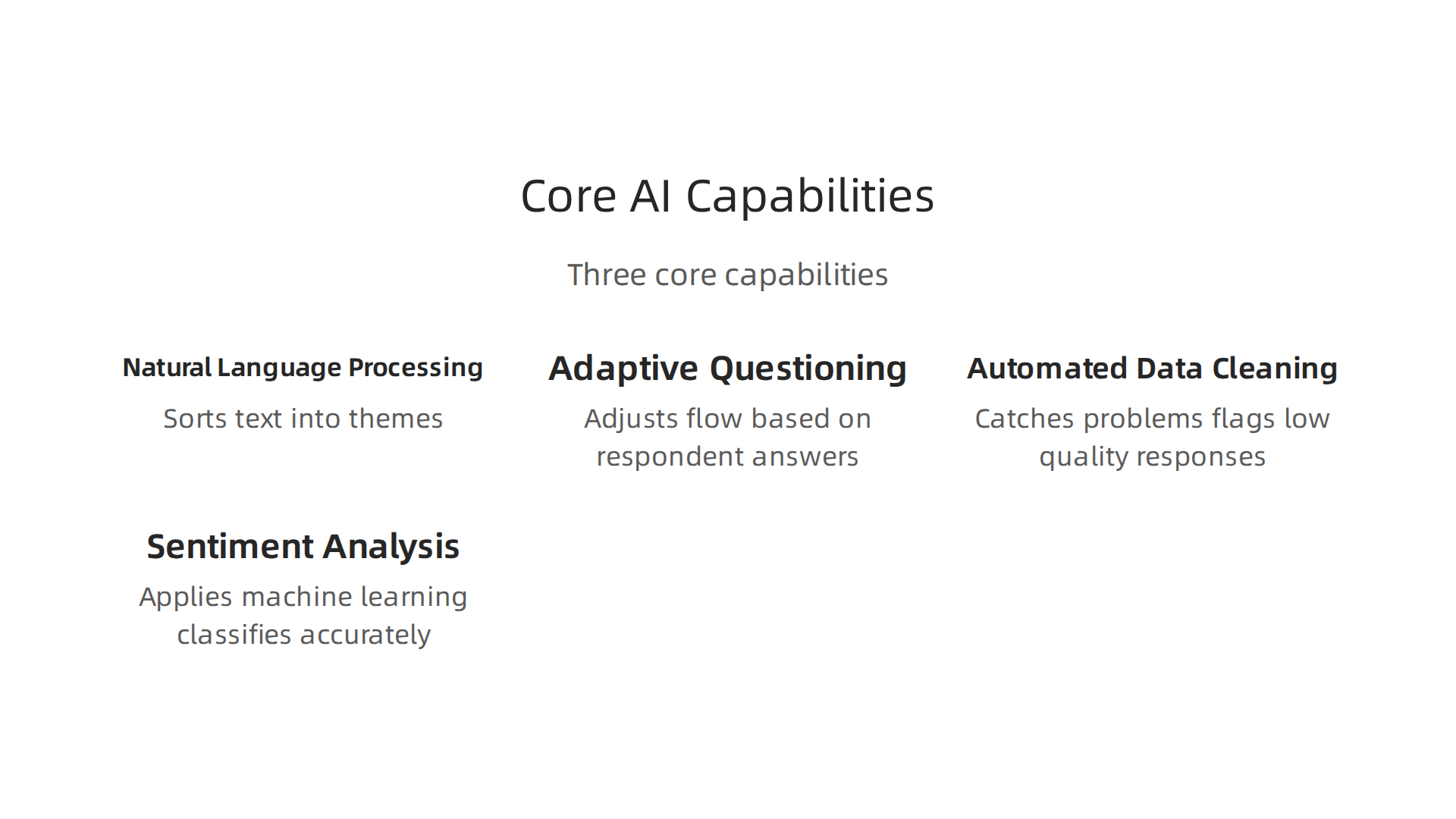
Natural Language Processing reads the hidden story in open-ended answers.
Open-ended questions contain the real gold. People share feelings, frustrations, and ideas that numbers alone never capture. But reading hundreds of those responses by hand takes forever and introduces human bias. NLP changes that completely. It automatically sorts text into themes, detects emotional tone, and groups similar comments together. According to a detailed comparison of the best AI tools for survey analysis, tools now use AI to pull out patterns, sentiment, and themes from open-ended responses automatically. That means you do not have to read every single comment to understand what your audience is really saying.
Adaptive questioning keeps each respondent engaged.
Old surveys treat everyone the same. That feels cold and wastes time. Modern AI tools adjust the flow of questions based on the answers people give. If someone says they never use your product, the survey skips the next five questions about product features. The experience feels shorter and more relevant. Reviews of the best AI survey makers show that platforms now include adaptive survey logic and real-time sentiment analysis. This means the survey responds to each person individually, which boosts completion rates and produces richer data.
Automated data cleaning and sentiment analysis save hours of manual work.
Bad data ruins good research. Speedy respondents, duplicate entries, and random answers can completely mislead your conclusions. AI catches these problems instantly. It flags low quality responses before they pollute your dataset. Sentiment analysis also happens automatically. Instead of guessing whether a comment sounds happy or frustrated, the tool applies machine learning to classify it accurately. Many platforms now offer data quality checks that detect potentially fraudulent or duplicate submissions. That level of protection alone makes the switch worthwhile.
If you are comparing which platforms to trust for your market research survey online, learning how to find reliable technology partners helps you avoid tools that overpromise and underdeliver. Having a solid process for identifying trusted AI tool sources that deliver real business results will save you time and frustration as you build your research stack.
How to Choose and Implement the Best AI Survey Tool for Your Business
Choosing the right AI survey tool for your online market research surveys can feel overwhelming. Dozens of platforms claim to be "AI-powered," but their actual capabilities vary wildly. Some just add a chatbot. Others transform how you collect, clean, and interpret data. Here is a simple framework to cut through the noise.
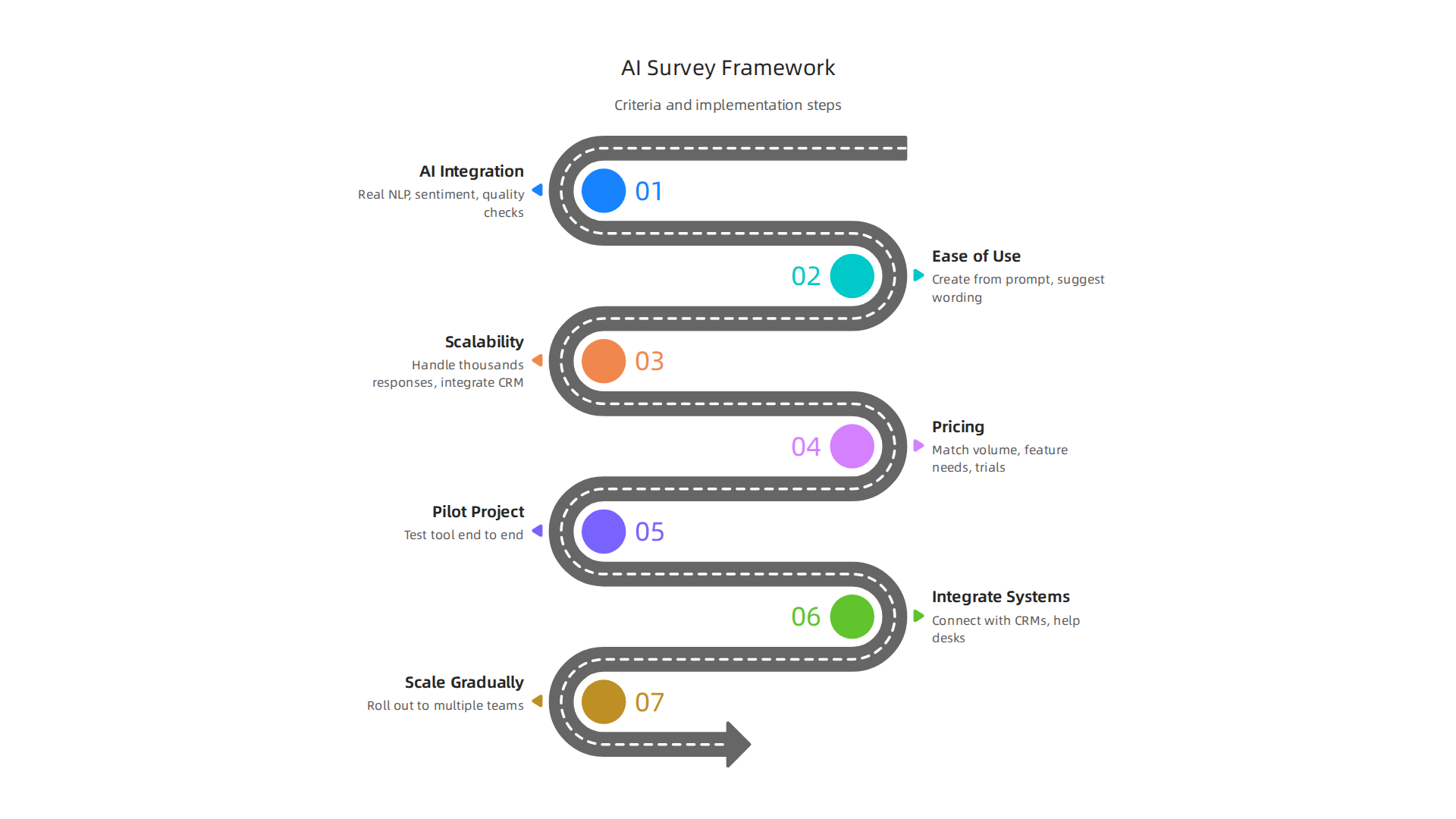
Key Evaluation Criteria
Depth of AI integration matters most. Look beyond marketing phrases. Does the tool offer real natural language processing for open-ended responses? Does it automatically detect sentiment and group themes? Can it flag data quality issues before they poison your results? A 2026 roundup of survey software tools tested across multiple platforms shows that AI features like automated question suggestions, sentiment analysis, and response quality checks are no longer optional – they are becoming table stakes. The best tools are the ones where AI is woven into every step, not just added as a separate module.
Ease of use is the second pillar. The tool should let you create a survey from a short prompt, suggest better question wording, and preview completion rates. If you need a data scientist to run the analysis, the tool is too complex for most business users.
Scalability matters as your research grows. Can the tool handle thousands of responses without slowing down? Does it integrate with your CRM, email platform, or analytics stack? A tool that works for a 50-person pilot may break when you survey 5,000 customers.
Pricing should match your volume and feature needs. Some platforms charge per response, others per seat. Many offer free tiers or trials. Test before committing.
Implementation Steps
Start with a focused pilot project. Pick one research question – maybe customer satisfaction after a product update – and run it through the tool end to end.
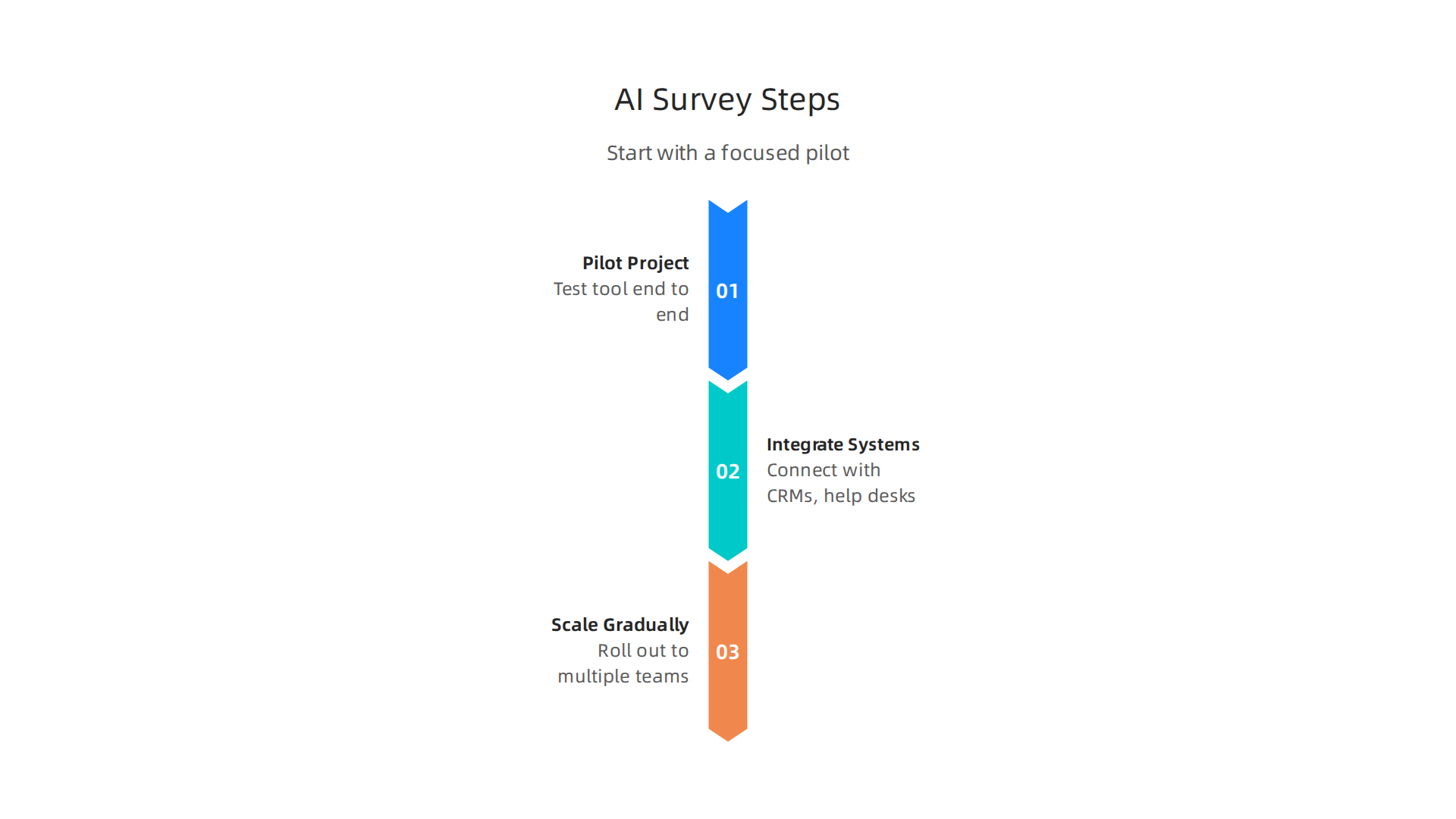
Use the AI to generate the initial survey, review its suggestions, and test with a small group. This lets you validate the tool’s performance before scaling.
Next, integrate the tool with your existing systems. Most modern platforms connect with CRMs like HubSpot, help desks like Zendesk, and collaboration tools like Slack.


This allows you to push survey data directly into your workflow. A step-by-step guide to designing high-quality surveys emphasizes the importance of testing logic, screeners, and multi-device compatibility before going live.
Finally, scale gradually. Run a second survey on a different topic, then roll out to multiple teams. Monitor data quality and respondent engagement. Give your team time to learn the tool’s AI features.
Common Pitfalls to Avoid
Over-reliance on black-box models is dangerous. If the AI gives you a summary of open-ended responses but you cannot see how it grouped comments or detected sentiment, you lose context. Always look for tools that let you inspect the underlying themes and supporting quotes. A guide on choosing the right AI survey tool in 2026 recommends platforms that provide explainable AI features, such as topic clustering with example responses you can review.
Under-investing in data quality is another trap. AI can clean data, but it cannot fix a survey full of biased questions or careless respondents. Always include attention checks, screening questions, and open-ended validation. Monitor response patterns in real time to catch fraud or straight-lining.
Before you start comparing platforms, it helps to have a reliable source for identifying which AI tools truly deliver. Learning how to find trusted tech sources that produce real business results will save you hours of trial and error.
The world of AI survey tools changes fast. To stay ahead without drowning in noise, consider subscribing to a newsletter that curates the most practical updates. The AI Newsletter Worth Reading delivers clear daily AI insights straight to your inbox, helping you make smarter choices about the tools you adopt for your market research survey online needs.
Overcoming Privacy, Bias, and Integration Hurdles
Running online market research surveys with AI tools brings big benefits, but it also adds new challenges. You cannot just turn on the AI and hope everything works. You need to plan for privacy, watch out for bias, and connect your tools the right way.
Privacy and Compliance Come First
Privacy laws are growing fast. In 2026, twenty U.S. states now have consumer privacy laws, and the EU AI Act is starting to apply across borders. If you collect personal data through your market research survey online, you must follow rules like the CCPA, GDPR, and new state laws that control automated decision making. California’s AB 2013 now requires companies to disclose what data they used to train their AI systems. A strong compliance program starts with mapping your data flows and documenting how you handle sensitive information. The foundation of responsible AI governance in 2026 includes privacy impact assessments, clear consent forms, and transparency about how AI makes decisions. Skipping these steps can lead to fines and loss of trust.
Watch for Hidden Bias
AI tools are trained on data, and if that data has bias, your survey results will too. For online market research surveys, bias can sneak in during question generation, response coding, or data analysis. For example, an AI might suggest wording that favors one group over another. Or it might group open-ended responses in ways that miss important voices. To fight bias, always review AI suggestions yourself. Use human oversight when the AI codes themes or detects sentiment. Include attention checks and balanced question formats. Many experts recommend blinded screening questions so respondents do not alter their answers to fit a profile. Taking these steps helps you get fair, accurate data.
Plan Your Tech Integration
Integrating your AI survey tool with your existing CRM and analytics platforms takes forethought. You need to decide how data flows between systems, who owns it, and how to keep it clean. API connections let you push survey responses straight into your customer database or analytics dashboard. But you also need data governance rules. Decide which fields map to which records, set up access controls, and test the integration before going live. Many businesses find that AI tools work best when they connect directly to their sales and marketing platforms. For example, you can sync survey insights with a CRM to trigger follow-up actions automatically. This saves time and turns feedback into action. Tools that offer streamlined business operations with HubSpot AI make this kind of connection easier to set up and maintain.
Moving Forward with Confidence
Addressing privacy, bias, and integration early makes your survey program stronger. You build trust with respondents, get better data, and avoid costly mistakes. A well planned approach lets you focus on the insights that matter for your business.
Measuring Success and Future Trends in AI Market Research
You have set up your privacy checks, reduced bias, and connected your tools. Now the real question: How do you know your online market research surveys are actually working? And what comes next in this fast-moving space? Let us look at the metrics that matter and the trends shaping 2026.
Key Metrics That Matter
Tracking the right numbers helps you improve your surveys over time. Here are the big ones to watch:
- Response rate: This tells you how many people actually take your survey after seeing it. A low rate might mean your invitation or timing is off.
- Completion rate: This shows how many people finish the survey once they start. If it drops, your survey might be too long or confusing.
- Speed of insight generation: How fast can you go from launching a survey to getting useful answers? In 2026, AI tools can cut this from weeks to hours. According to Gartner, spending on generative AI models is expected to grow 80.8% in 2026, and market research is a big part of that investment. A concept test that once cost $15,000 and took three weeks can now be done in three hours on a modern AI research platform.
- Return on investment (ROI): Compare the cost of running your surveys against the value of the insights you get. Better data leads to smarter decisions.
These four metrics give you a clear picture of how your online market research surveys perform. Check them regularly and adjust.
Emerging Trends to Watch in 2026
The world of market research survey online is changing fast. Here are three trends that will shape the rest of 2026 and beyond:
Real-time feedback loops
Instead of running a survey, waiting weeks, and then acting, you can now get feedback in real time. AI tools let you ask questions, analyze answers, and adjust your strategy within days or even hours. The future of market research with AI in 2026 is about making research an always-on operation, not a one-time project. The median time from question to decision has dropped from over six weeks to just over two days for AI-moderated studies.
Multimodal surveys
Surveys are no longer just text on a screen. Voice and video answers give you richer data. People can record their thoughts instead of typing them. AI can analyze tone, facial expressions, and word choice to find deeper meaning. This trend makes your market research survey online feel more natural and engaging for respondents.
Predictive insights
AI does not just summarize what people said. It can predict what they will do next. By spotting patterns in your survey data, AI tools help you forecast customer behavior, product demand, and market shifts. This turns your surveys from a rearview mirror into a forward-looking tool.
How to Future-Proof Your Strategy
These trends mean you cannot stand still. To keep your online market research surveys effective, stay agile. Test new AI capabilities as they come out. Try multimodal questions in your next survey. Set up real-time dashboards that show results as they come in.
A great way to stay ahead is to keep learning about what works. For daily updates on AI tools and market research trends, you can subscribe to the AI Newsletter Worth Reading. It gives you clear, practical insights so you do not have to chase every headline.
Also, check out how to choose and use an AI-powered research assistant in 2026. That guide helps you pick the right tools for your specific needs.
The businesses that win in 2026 are the ones that measure their results, embrace new formats, and keep experimenting. Your online market research surveys can become a powerful engine for growth if you track the right numbers and ride the trends.

Summary
This article explains how artificial intelligence is transforming online market research surveys by solving long-standing problems like low response rates, biased answers, slow analysis, and poor data quality. It covers the core AI capabilities—natural language processing, adaptive questioning, and automated data cleaning—that boost engagement and deliver faster, more accurate insights. You’ll find a practical framework for choosing and implementing the right AI survey tool, including evaluation criteria, pilot steps, and common pitfalls to avoid. The piece also walks through privacy and bias risks, integration best practices with CRMs and analytics, and the metrics to track success. Finally, it highlights emerging trends such as real-time feedback loops, multimodal responses, and predictive insights so you can future-proof your research program and turn survey data into action.