Tag: content creation ai

  • How to Choose AI for Business Tools That Deliver Real Results

    How to Choose AI for Business Tools That Deliver Real Results

    Introduction: Cutting Through the AI Noise for Real Business Impact

    Let’s be honest. In 2026, the number of new AI tools hitting the market is dizzying. Every week there’s a fresh chatbot, a new writing assistant, another automation platform. It all sounds great. But when you’re trying to run a business, you don’t have time to test every shiny new gadget. You need what actually works.

    Here’s the thing: the hype is real, but so is the chaos. According to recent data on small business AI statistics for 2026, AI use among small businesses jumped from 40% to 58% in just one year. And 91% of those using AI report revenue gains. That’s huge. But it doesn’t mean every tool is worth your money. Nearly 40% of businesses say they haven’t seen measurable results from their AI experiments. The gap between potential and payoff comes down to one thing: knowing where to focus.

    That’s exactly what this article is for. We’re going to give you a simple, evidence-based framework to cut through the noise. You’ll learn how to identify the right AI for your specific business needs, evaluate tools based on real ROI, and implement solutions that actually move the needle. Whether you are a digital marketing specialist trying to streamline content, a business owner exploring social media marketing services, or someone building a content marketing strategy from scratch, there is a smart path forward.

    For a deeper look at how to find technology you can trust, check out our guide on trusted AI tool discovery sources.

    And if you want to stay ahead without drowning in new tool announcements every day, you might appreciate getting clear daily updates straight to your inbox. The AI Newsletter Worth Reading delivers practical, no-hype AI news so you can focus on what matters: results.

    Assess Your Business Needs Before You Evaluate Tools

    It is easy to fall in love with a slick demo. A tool shows up, promises to write your emails, analyze your spreadsheets, and schedule your social posts all at once. You feel the urge to buy. But here is the thing: most businesses that see poor AI results made the same mistake. They chose the tool before they defined the problem.

    Nearly 40% of businesses report they have not seen measurable results from their AI experiments. That number comes straight from the AI Readiness Report for SMBs. The reason is almost always the same: no clear problem to solve. You cannot pick the right solution until you know exactly what you are trying to fix.

    So before you open a single pricing page, take a step back and map your needs into four simple buckets:
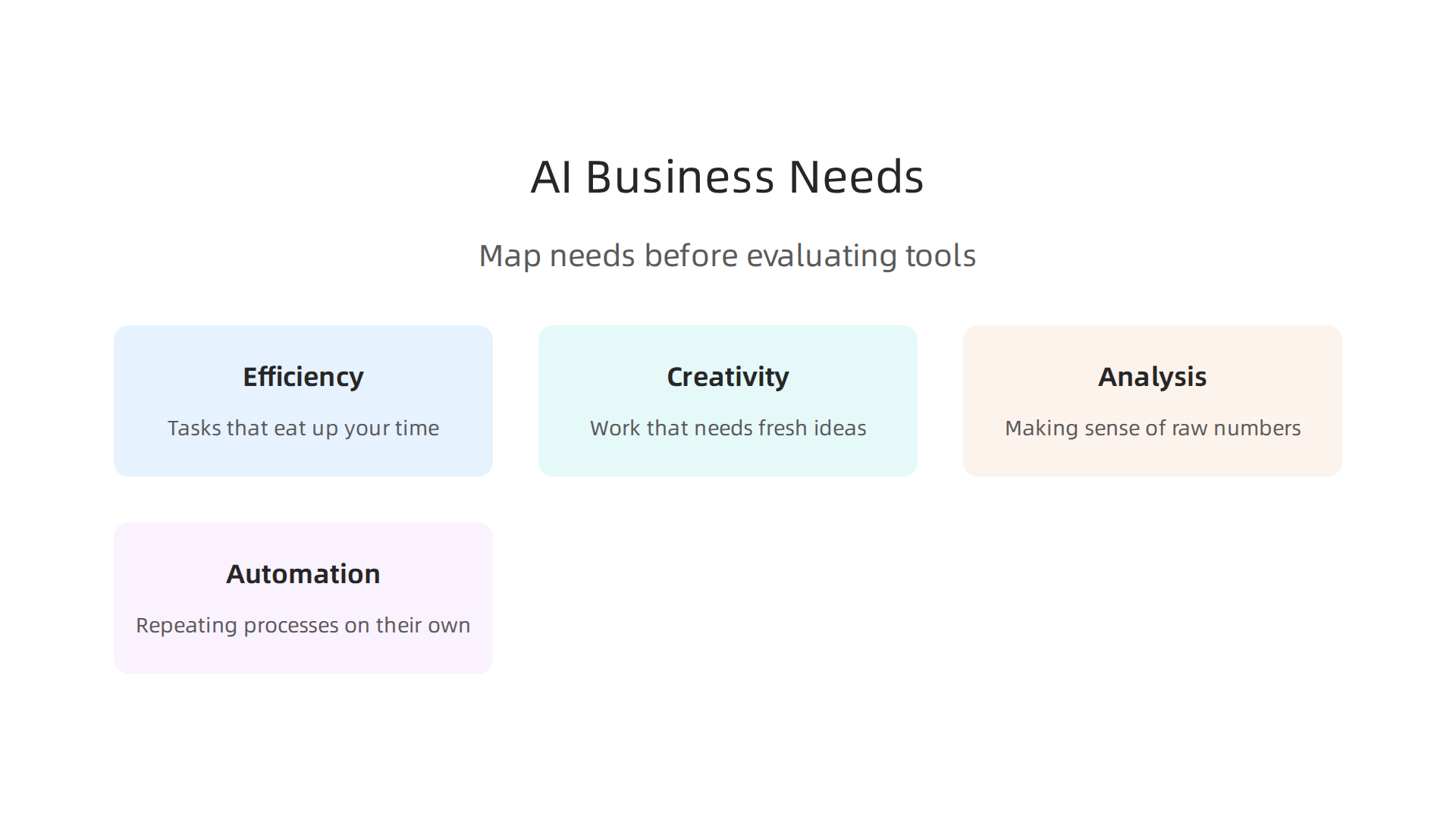

    An infographic illustrating the four core business needs that AI tools can address: Efficiency, Creativity, Analysis, and Automation.

    A diverse team actively collaborating around a whiteboard, mapping out their business challenges and needs.

    • Efficiency – Tasks that eat up your time but require little thinking. Things like scheduling, data entry, or sorting emails.
    • Creativity – Work that needs fresh ideas, writing, images, or video. This is where a digital marketing specialist might use AI to draft social posts or brainstorm campaign angles.
    • Analysis – Making sense of raw numbers, spotting trends, or pulling insights from customer data. A solid content marketing strategy depends on understanding what your audience actually wants.
    • Automation – Repeating processes that run on their own once you set them. Think lead follow-ups, invoice reminders, or social media posting for your social media marketing services.

    Write down which bucket hurts the most right now. That is where you start. Trying to fix all four at once is the fastest way to get nothing done.

    If you want to see how a specific AI tool can fit into your daily operations, check out this guide on AI that streamlines business operations across marketing, sales, and service. It shows exactly how matching needs to features leads to real results.

    Building a Requirements Checklist for Your AI Stack

    Now that you know which problem to solve, it is time to build a simple checklist. This keeps you from buying a tool that looks good but does not actually work for your team. Focus on four must-haves.

    Integration capability comes first. The tool needs to work with the software you already use. If it does not connect to your CRM, email, or project management system, you will end up with a siloed mess that nobody adopts. Data security is a close second. Before you try anything, confirm where your data lives and whether the vendor meets industry standards like GDPR or HIPAA. A good place to start is this guide on choosing the right AI tool for your business, which walks through the exact criteria.

    Scalability matters too. The tool should grow with you without a big price jump or performance drop. And vendor support can save you when something breaks. Ask about response times and training resources upfront.

    For cost, build a simple spreadsheet. List the monthly fee, setup costs, and any hidden charges for extra users or features. Then test your top two picks with free trials. Get three people from different roles to use them for a week and share honest feedback. If they hate it, move on.

    If you want more ways to spot the right tools, check out this article on AI tool discovery for trusted tech sources in 2026. It covers how to filter the noise.

    And to stay ahead of the curve, grab The AI Newsletter Worth Reading for clear daily updates on the best tools hitting the market.

    Top AI Tools for Content Creation and Marketing in 2026

    Now that you have a checklist, it is time to look at the actual tools that pass those tests. 2026 offers a rich lineup of AI tools built for content creation and marketing. The key is matching each tool to the task.

    For copywriting and long‑form content, Jasper remains a standout. It goes beyond simple text generation. It learns your brand voice and keeps it consistent across every blog post, email, and ad. For marketers who need multilingual support, Jasper also handles translations pretty well. You can start with the Creator plan at $39 per month. Another strong option is Copy.ai, which is great for social media copy and sales workflows. According to the 12 Best AI Content Creation Tools ranking, Jasper works best for blog writing while Copy.ai shines in social copywriting.

    For image generation, Canva AI is the top pick for non‑designers. You describe what you want, and it creates on‑brand visuals in seconds. It integrates directly with your social media scheduling and analytics tools. That means you can design a graphic and schedule it without leaving the platform. Canva Pro costs $14.99 per month and includes every Studio feature.

    For social media management, tools like Flick and Buffer offer AI‑driven scheduling and content suggestions. They help you plan posts, find the best times to publish, and track engagement across platforms. They connect easily with your CRM and email tools, so your whole marketing team stays in sync.

    When choosing any of these tools, go back to your checklist. Does it integrate with your current CRM? Does it keep your brand voice consistent? Can it grow with your team? If the answer is yes, it belongs in your stack.

    For a deeper look at how AI tools connect with your full marketing system, check out this guide on HubSpot AI streamlines your business operations across marketing, sales, and service. It shows how one platform can tie everything together.

    Finally, remember that the best tool is the one your team will actually use. Pick two from this list, test them with your checklist, and see which one feels right.

    Side-by-Side: Leading Content AI Platforms

    Here is a side by side look at the leading content AI platforms to help you compare.
    A side-by-side comparison infographic of leading AI platforms designed for content creation and marketing.

    Platform Best For Starting Price Difference Maker
    Jasper Branded marketing copy $39/month Brand voice memory
    Copy.ai Sales & social workflows $24/month GTM automation templates
    Writesonic SEO & GEO content $39/month AI search visibility tracking
    Canva AI On-brand visuals $14.99/month Prompt to publish design

    A digital marketing specialist might pair Writesonic for blog posts with Canva for social graphics. An in-house team often runs Jasper across departments to keep the brand voice consistent.

    The smartest move is to A/B test. Run the same campaign through Jasper and Copy.ai. Compare the outcomes side by side. According to a detailed comparison guide to AI content tools, matching the tool to the channel gives the best results.

    For teams managing these tests, the main challenge is tracking value. That is where getting real ROI from AI marketing tools comes into play.

    Staying current on which platform leads each category is tough. Get clear daily AI updates from The Deep View Newsletter so you always know which tool fits your next campaign.

    AI-Powered Analytics: Turning Data into Decisions

    Running campaigns without clear data is like driving with foggy windows. You might move, but you have no idea where you are going. That is where AI powered analytics changes the game for any ai for business strategy.

    Instead of staring at spreadsheets for hours, AI tools now handle the heavy lifting.

    A professional confidently reviewing a report, demonstrating how AI-powered analytics transforms raw data into clear, actionable decisions.

    They automatically pull data from your sources, spot patterns, and serve up insights in easy to read dashboards. A digital marketing specialist can see which channel drives the best return without digging through rows of numbers.

    What these tools do well

    • Customer sentiment analysis AI scans reviews, social comments, and support tickets to tell you how people really feel about your brand. No more guessing.
    • Predictive analytics It looks at past behavior to forecast what happens next. Which customers might churn? Which product will sell out next month? The tool gives you a heads up.
    • Anomaly detection When something unusual happens like a sudden drop in traffic or a spike in refunds the system flags it instantly.

    Integrations that matter

    The best analytics tools connect directly to the platforms you already use. They pull data from Google Analytics, your CRM, and even data warehouses. This means one dashboard shows your full picture. Some tools even include features like Writesonic’s AI visibility tracking that monitors how your content performs across both search engines and AI answer engines.

    When you tie analytics into your content marketing strategy and social media marketing services, you stop guessing and start acting on real signals. It turns raw data into a clear next move.

    To see how this works inside a complete business platform, check out how HubSpot AI streamlines your business operations across marketing, sales, and service. It gives you one place to track everything.

    Metrics That Matter: Measuring AI Tool Impact on Business KPIs

    You have the analytics dashboard running, but how do you know your AI tools are truly paying off? The answer is tracking the right KPIs before and after you adopt each tool.
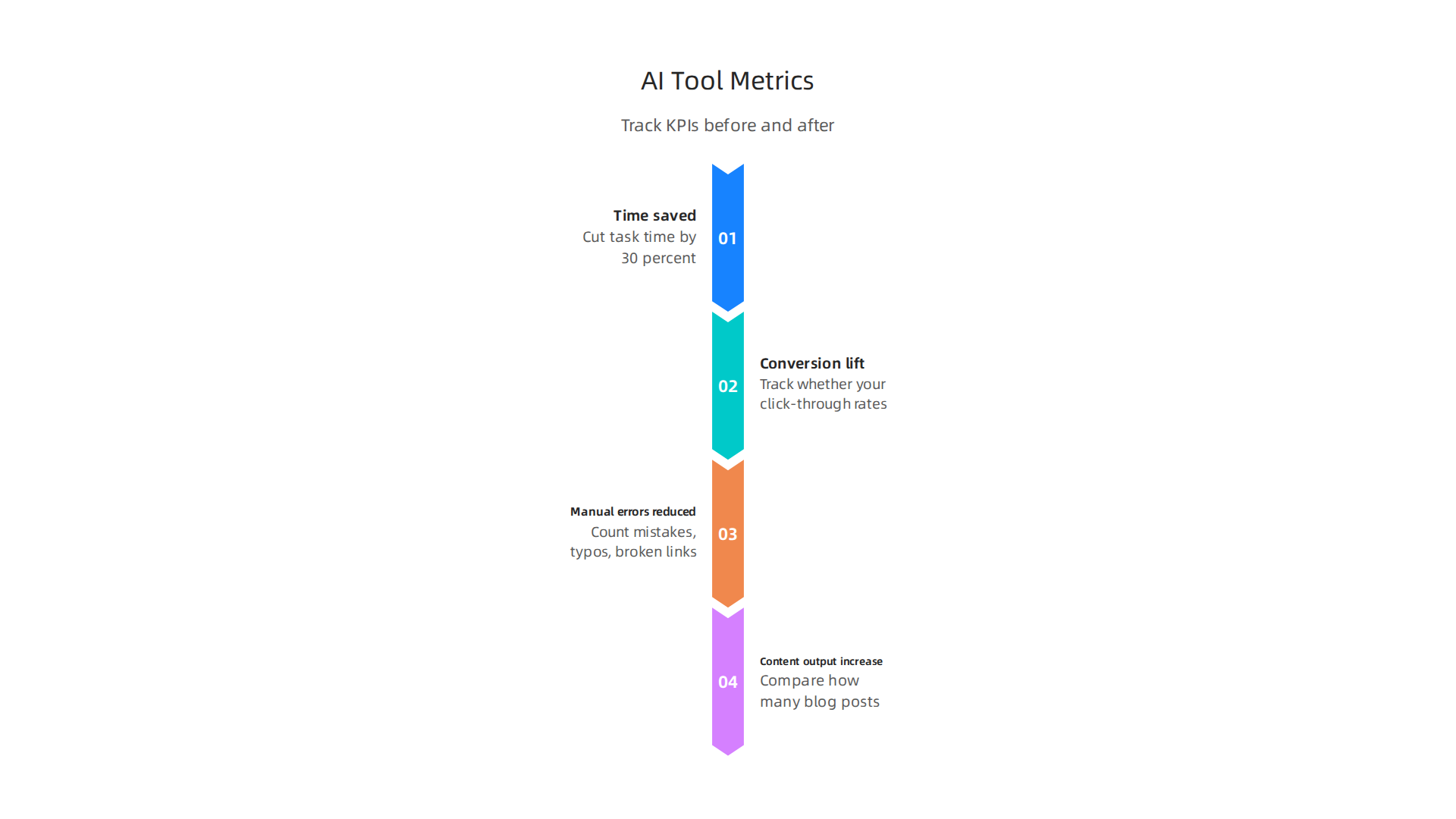
    An infographic detailing the essential metrics to track for measuring the true impact of AI tools on business Key Performance Indicators.

    The essential metrics to watch

    • Time saved – Measure how many hours your team spends on tasks like writing, editing, or reporting. A good AI tool should cut that time by at least 30 percent.
    • Conversion lift – Track whether your click-through rates or sales go up after using AI generated content.
    • Manual errors reduced – Count mistakes like typos, broken links, or data entry errors. Fewer errors mean higher quality work.
    • Content output increase – Compare how many blog posts, social posts, or emails your team produces per week before and after tool adoption.

    A simple spreadsheet works great for this. Create one column for each metric, record your baseline numbers for a week or two, then measure again after your team starts using the tool. The difference shows your real impact.

    Expert tip – Never deploy a tool without first measuring your baseline. Without knowing where you started, you cannot prove improvement. For deeper guidance on tracking ROI across your whole stack, check out how to get real ROI from AI marketing cloud in 2026.

    To stay current on the latest measurements and trends, subscribe to The AI Newsletter Worth Reading from The Deep View for clear daily updates.

    Workflow Automation: AI That Saves Time Every Day

    Once you have your metrics in place, the next big step is putting AI to work on the tasks that eat up your day. Workflow automation is where many businesses see their first real time savings. The idea is simple — let AI handle the boring, repetitive work so your team can focus on things that actually matter.

    What can you automate? A lot. Think about scheduling meetings, sorting emails, entering data into spreadsheets, or pulling together weekly reports. These tasks add up fast. A digital marketing specialist, for example, might spend hours every week just scheduling social media posts or copying data between tools. That is time they could spend on creative strategy or client work.

    The best part? You do not need to be a developer to set this up. No-code automation platforms let you connect your favorite apps with a few clicks. Tools like Zapier and its newer AI-powered alternatives let you build workflows that run on autopilot. You can set rules like: "When a new lead fills out a form, add them to my CRM and send a welcome email." It all happens in seconds.

    The real productivity gains are huge. According to recent analysis, small businesses using AI for repeatable tasks typically see a 3-4x return on investment by cutting down manual labor. One study found that AI agents in sales can save teams 8–12 hours per week by handling data entry and pipeline management. That is basically an extra day of work back each week.

    And it is not just about speed. Automation also reduces errors. Machines do not get tired or make typos when copying data. That means higher quality work with less rework.

    To make the most of workflow automation, start small. Pick one annoying task that happens every week and automate that first. Prove it works, then build from there. If you want to explore how AI can take over more of your routine, check out this guide on AI virtual assistants for business to see what else is possible.

    For a deeper look at how successful teams are shifting from basic prompts to full workflow design, this article on AI agents transforming workflows in 2026 offers a practical playbook you can follow.

    Pitfalls to Avoid When Automating Business Processes

    But before you automate everything, it helps to know where things can go wrong. Many teams rush into automation and end up with more problems than solutions.

    One common mistake is automating a broken process. If your workflow has unclear steps or weak logic, automation just repeats those flaws faster and at scale. Another trap is building too many workflows at once. That creates a tangled system where nobody knows what each part does. Ignoring error handling is equally dangerous. Every workflow will eventually hit an unexpected input or a failed connection. Without a backup plan, things break silently. For a full look at these and other errors, see this analysis of common pitfalls in small business automation projects.

    The fix is simple. Start with one small, high-frequency task. Automate it, measure the results, and only then scale up. Keep human oversight in the loop until the workflow proves stable over several runs. Security is critical too. When giving AI access to sensitive processes, begin with read-only permissions. Add write access only after you have tested thoroughly. If you need a streamlined platform to start with, explore how HubSpot AI streamlines business operations across marketing, sales, and service.

    To stay informed on best practices and avoid these traps as you adopt AI for business, Get clear daily AI updates from The AI Newsletter Worth Reading.

    A Decision Framework for Selecting the Right AI Tool

    With so many options out there, picking the right AI for your business can feel overwhelming. But you don’t need to guess. A simple step-by-step framework helps you choose with confidence.
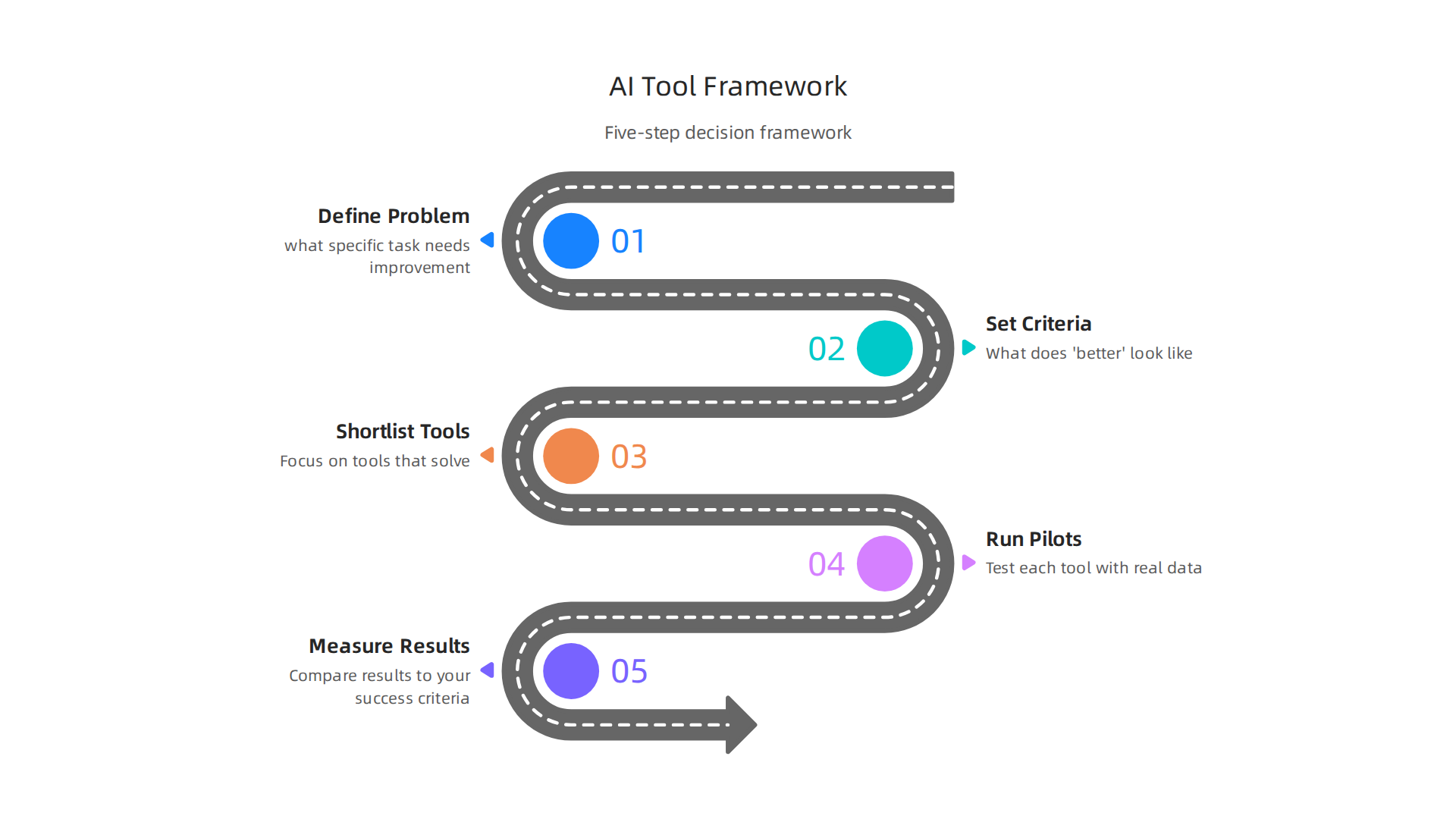
    An infographic outlining a clear, five-step decision framework to confidently select the most appropriate AI tool for your business needs.

    Step 1: Define the problem clearly. Ask yourself what specific task needs improvement. Maybe you are a digital marketing specialist who wants to speed up content creation. Or you need a better content marketing strategy that uses AI to find trends. Perhaps you want to automate social media marketing services. Write down the exact pain point.

    Step 2: Set success criteria. What does "better" look like? Save 10 hours a week? Cut response time by half? Increase engagement by 20%? Define measurable goals before you look at any tool.

    Step 3: Shortlist 3 to 5 tools. Focus on tools that solve your specific problem. For example, a simple audio tool like Lalal AI free version might help a content creator separate vocals. But for a full marketing workflow, you need a platform that integrates with your CRM. Create a shortlist based on core capabilities.

    Step 4: Run structured pilots. Test each tool with real data and real users on your team. Don’t just watch a demo. Ask your team to try it on an actual task. Collect feedback on ease of use, speed, and accuracy. For a deeper look at what to check, see this AI tool selection framework from research resources.

    Step 5: Measure against your baseline. Compare results to your success criteria. Did the tool meet your goals? How did it handle errors? Was the support helpful? Use a simple scoring matrix to compare tools side by side.

    Here is a basic scoring matrix you can copy:

    Criterion Weight Tool A Tool B Tool C
    Ease of use 20% 4/5 3/5 5/5
    Integration with current tools 25% 5/5 2/5 4/5
    Security and compliance 25% 5/5 5/5 3/5
    Cost and ROI 20% 3/5 4/5 4/5
    Scalability 10% 4/5 3/5 5/5

    Don’t forget vendor evaluation. Check their security certifications (like SOC 2), support quality, and product roadmap. Also get buy-in from key stakeholders early. If your IT team or legal department has concerns, address them before you purchase. For more on how to find trusted tools, read this guide on AI tool discovery for real business results.

    Finally, stay informed as new tools appear every week. Get clear daily AI updates from The AI Newsletter Worth Reading to keep your framework sharp.

    Vendor Evaluation Checklist and Security Standards

    Once you have your shortlist, the real work begins. You need to check security and compliance before you sign anything.

    Ask for these certifications:

    • SOC 2 Type II – Third-party proof of strong security controls.
    • GDPR compliance – Required for data from EU residents.
    • HIPAA compliance – Needed for health data.
    • PCI-DSS Level 1 – For handling payment card data.

    Many enterprises require a fintech vendor security review process. Also ask about data residency: where is your data stored? Ensure it matches your legal requirements.

    Questions for sales teams:

    • What integration APIs are available? Can they connect to your existing tools?
    • What uptime SLA do you guarantee?
    • What is your exit strategy? Can you export data easily if you leave?

    Finally, insist on a trial with real data, not just a sandbox. Test with an actual task your team does. That is the only way to know if the tool truly works for your business. For more on evaluating tool performance, check this guide on getting real ROI from AI marketing cloud.

    Future-Proofing Your AI Toolkit: Trends to Watch in 2026

    You just finished choosing your AI tools. But the tech world does not stand still. In 2026, several big trends will reshape what AI can do for your business.

    First, AI agents are becoming a real thing. These are systems where multiple AI agents work together on complex tasks. Instead of one tool doing everything, you get a team of specialists. Gartner calls this a top strategic trend. You can read more about these AI-driven technology advancements.

    Second, multimodal models are growing fast. These AIs can understand text, images, audio, and video all at once. That means smarter search, better content creation, and richer customer experiences.

    Third, vertical‑specific AI is on the rise. Instead of a general chatbot, you get AI built for healthcare, legal, or finance. These tools understand your industry’s language and rules.

    Fourth, open‑source models are leveling the playing field. You no longer need a giant budget to run your own AI. Open‑source options give you control, privacy, and lower costs.

    To future‑proof your toolkit, choose platforms with flexible architectures. Look for modular designs. You want to swap out a model or add a new capability without rebuilding everything.

    Continuous learning is also vital. The field changes weekly. One easy way to stay ahead is to follow top interactive AI newsletters that curate the best updates. Even better, subscribe to The AI Newsletter Worth Reading for clear daily AI updates delivered right to your inbox.

    By keeping an eye on these trends and staying informed, your ai for business strategy will stay effective for years to come.

    Building a Culture of AI Literacy in Your Organization

    Picking the right ai for business tools is only half the battle. The real challenge is getting your team comfortable using them every day. Without AI literacy, even the best software sits unused. A digital marketing specialist who understands AI can double their output. That is why upskilling your team is just as important as buying new tools.

    A group of professionals engaged in a learning or training session, building AI literacy and enhancing their understanding of new technologies.

    You do not need a big training budget to start. Low-cost methods work great. Host internal demos where team members show off a tool they tried. Run lunch-and-learn sessions with free online courses. Encourage your content marketing strategy team to experiment with AI for drafting posts or analyzing social media marketing services data.

    The best way to learn is by doing. Set up a sandbox environment where people can test AI tools without risk. Let them try different features before your company buys a license. Gartner’s top tech trends for 2026 highlight that multiagent systems and domain-specific models are coming fast. Your team needs hands-on practice to keep up.

    To see how human skills and AI can work together, check out this data on human AI collaboration. It proves that teams who learn together outperform those who just buy tools.

    By building AI literacy now, you turn your whole organization into a learning engine for ai for business success.

    Summary

    This article gives a practical, no‑hype framework to choose and implement AI tools that actually deliver business results. It starts by helping you map your biggest needs into four buckets—efficiency, creativity, analysis, and automation—then shows how to build a requirements checklist (integration, security, scalability, support) and run structured pilots. You’ll find recommended tools for copy, images, social, and analytics plus a side‑by‑side comparison and guidance on A/B testing. The guide also explains how to measure ROI with specific KPIs, automate repeatable workflows safely, evaluate vendors for compliance, and keep your stack future‑proof while building team AI literacy. After reading, you’ll know how to shortlist, test, and measure AI so your investments move the needle.


  • Picking the Best MacBooks for AI for Your 2026 Projects

    Picking the Best MacBooks for AI for Your 2026 Projects

    Why this guide on MacBooks for sale matters in 2026

    Buying a new MacBook in 2026 can feel a bit tricky, especially if you need it for serious work like Artificial Intelligence (AI).

    A professional contemplates options, considering the best MacBook for their AI work needs.

    With Apple releasing powerful new chips like the M5, M5 Pro, and M5 Max in their latest models, it’s tough to know which one is best for you and your team. You might be wondering, "Do I need the very latest M5 MacBook Pro, or is an M1-level performance still acceptable in 2026?"

    Screenshot of the 9to5Mac homepage, a resource for Apple news and reviews.

    Many professionals and teams are looking for macbooks for sale that can handle their AI projects, big data, or creative tasks without breaking the bank. It’s a real challenge to figure out the right specs and where to find the best deals. You also need to think about how these powerful new MacBooks fit into your workflow, especially if you’re exploring tools like AI virtual assistants for businesses or other advanced AI solutions.

    Screenshot of the AIToolsNewsToday homepage, a source for AI tools and strategy.

    That’s why this guide is here. We want to help you cut through the confusion. We’ll show you which MacBook models are best for different kinds of AI work and everyday tasks. We’ll explain the important specs like memory and processing power, and how they impact performance for things like running four new MacBooks in 2026 for private AI. Plus, we’ll give you clear advice on where to find macbooks for sale with confidence. By the end, you’ll know exactly what to look for and where to buy your next Apple laptop.

    If you’re interested in staying on top of the latest in AI and tech, make sure you get clear daily AI updates from The AI Newsletter Worth Reading.

    Screenshot of The Deep View's newsletter subscription page for AI updates.

    The truth is, Apple’s macOS ecosystem brings some big advantages for anyone doing AI work in 2026.

    A team collaborates seamlessly, benefiting from an efficient Apple ecosystem for AI projects.

    Whether you’re a creative person, a data expert, or a developer, MacBooks offer a smooth and powerful experience. The special chips like the M5, M5 Pro, and M5 Max are built to handle tough tasks, especially with their Neural Engine parts that are perfect for machine learning and AI processes. This means your MacBook can learn and think faster when running AI tools.

    For creators, MacBooks are known for handling big video projects and detailed graphics work easily. For data analysts, the speed and memory bandwidth of Apple Silicon chips help with crunching large numbers and running complex models. Developers also love how easy it is to set up and run their code for AI projects, with many useful apps available in the macOS environment. In fact, many people find that Apple devices are great for improving how they work with AI and for daily tasks, as outlined in guides about which AI productivity workflows actually deliver ROI in 2026.

    When you’re looking for macbooks for sale, it’s also important to think about things beyond just raw power. MacBooks are famous for their excellent battery life, letting you work on AI projects for hours without needing to plug in. They are also very portable, making it easy to take your work anywhere. Another big plus is how well Apple devices work together. Your MacBook can connect seamlessly with other Apple products. For example, future developments like apple ar glasses or other AI powered smart glasses could potentially integrate smoothly with your MacBook for an even bigger workflow. This close integration might even extend to advanced wearables like the Viture Pro XR/AR glasses, making your digital workspace truly unified.

    Of course, no system is perfect. While MacBooks are great for many AI tasks, some super specialized AI work might still need powerful desktop computers. But for most professionals and teams, the balance of power, battery, portability, and integration makes MacBooks a very strong choice for AI workflows in 2026.

    Choosing the right MacBook for your AI work means looking at what you need to do and how much you want to spend.

    An individual plans their tech purchase, balancing desired features with budget constraints.

    It’s not just about finding macbooks for sale; it’s about finding the right one for you. Apple offers a few main lines: the MacBook Air and the MacBook Pro. Each has different features that make them better for certain kinds of AI tasks.

    Matching MacBook Models to Your AI Tasks

    Think about what kind of AI work you’ll be doing most often:

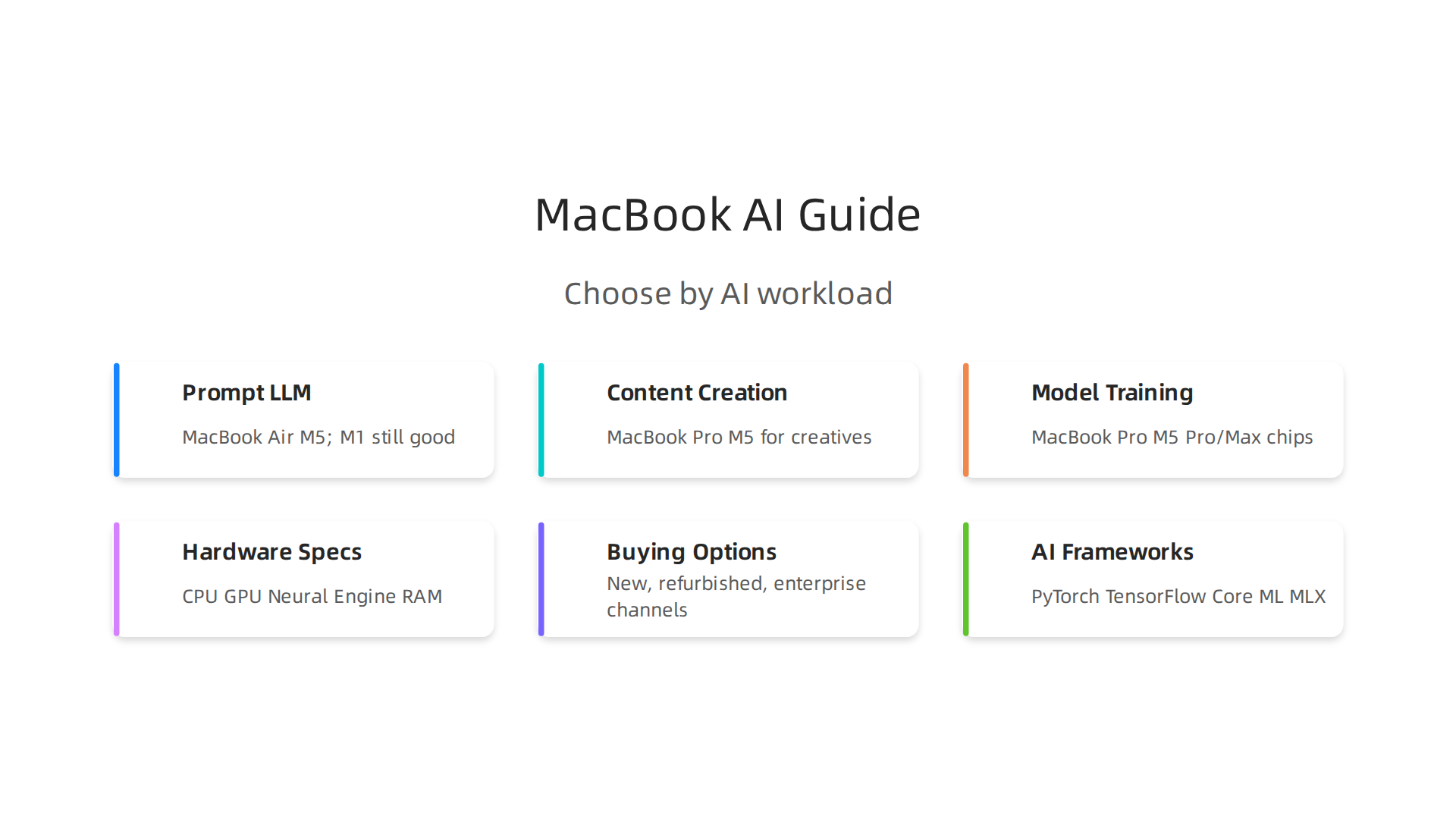
    This infographic breaks down the ideal MacBook models for various AI workloads, from light LLM interaction to heavy model training.

    • Prompt-Heavy LLM Work and Light AI Tasks: If your main work involves using AI tools that respond to text prompts, like large language models (LLMs), or running smaller AI tasks, a MacBook Air with an M5 chip is often a great choice. It’s powerful enough for everyday AI use and very portable. Many M1-level MacBooks from older years are still good for these types of tasks in 2026, showing how capable even the base models are. In fact, one report says that M1-level performance still acceptable in 2026 for many users. The M5 MacBook Air offers even more speed and efficiency.
    • Content Creation with AI, Basic Model Inference: For creative tasks like editing photos or videos with AI help, or running AI models that have already been trained (this is called inference), the MacBook Pro with an M5 chip is a solid step up. It has more power and can handle more demanding apps.
    • Medium Model Training and Complex AI Development: If you’re training your own AI models, working with larger datasets, or doing heavy development, you’ll want the MacBook Pro models with the M5 Pro or M5 Max chips. These chips have more computing cores and much more memory, which are key for faster AI processing. They are built to handle the most demanding jobs, as Apple announced when they introduced MacBook Pro with all-new M5 Pro and M5 Max. The Neural Engine in these chips is also much faster, speeding up AI-specific tasks.

    Budget vs. Performance for Different Users

    When looking at macbooks for sale, your budget plays a big role.

    • Individual Professionals and Consultants: If you’re working for yourself or in a small team and need a balance of power and price, the MacBook Air M5 or a base MacBook Pro M5 is likely your sweet spot. They offer strong performance for most AI productivity tools without the highest price tag. You might also find good deals on slightly older M3 or M4 models that still perform well.
    • Small to Medium Businesses (SMBs): For SMBs, it’s often about getting enough power for your team without breaking the bank. A mix of MacBook Air M5s for lighter tasks and MacBook Pro M5s or M5 Pros for those doing more intensive AI work can be a good strategy. This helps you manage costs while ensuring everyone has the tools they need. Checking out guides on how to choose and use an AI powered research assistant in 2026 can help you decide which models will best support your team’s AI research needs.
    • High-End Developers and Researchers: For those who push AI to its limits, the MacBook Pro with the M5 Max chip is the way to go. While it costs more, the increased performance and memory can save you a lot of time on complex projects. These powerful chips can offer huge gains in AI performance.

    No matter which MacBook you choose, remember that staying informed about the latest AI tools and trends is crucial for making the most of your technology. Get clear daily AI updates from The AI Newsletter Worth Reading.

    When you are looking at macbooks for sale for AI tasks, it’s really important to understand what’s inside. The different parts of a MacBook work together, but some are more key for AI work than others. Let’s break down the main hardware pieces you should think about:

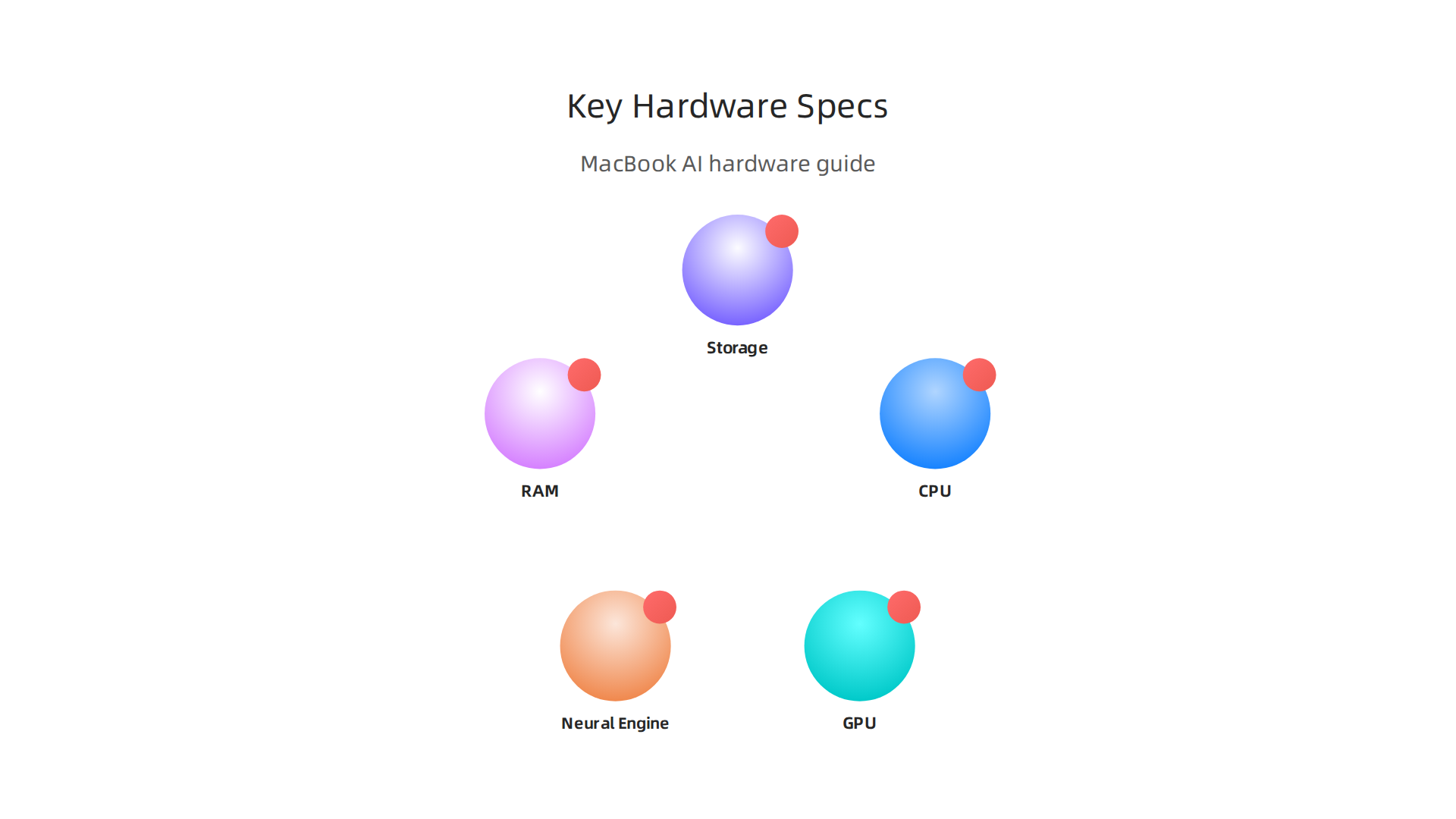
    A visual guide to essential MacBook hardware components and their roles in optimizing AI performance.

    CPU, GPU, Neural Engine, RAM, and Storage Explained

    • CPU (Central Processing Unit): Think of the CPU as the brain that handles most of the general tasks on your computer. For AI, it’s good for running programs and managing data flow. But for heavy AI math, it’s not the main worker. Apple’s M-series chips combine many parts, and the CPU is one powerful piece of that. You can see how Apple’s CPUs compare from M1 through M5 Max.
    • GPU (Graphics Processing Unit): The GPU is super important for AI. It’s built to do many calculations at the same time, which is exactly what training AI models and running complex AI processes need. The more cores your GPU has, the faster it can crunch numbers. MacBook Pro models with M5 Pro and M5 Max chips have much more powerful GPUs, which is why they’re better for demanding AI tasks.
    • Neural Engine: This is Apple’s special part made just for AI and machine learning. It makes AI tasks run really fast and efficiently. The Neural Engine in the M5 chip is much faster than older versions, offering a big boost for AI performance, according to Apple’s announcement about the M5 chip’s leap in AI performance. When you use AI tools built for Apple’s system, the Neural Engine is key to making them snappy.
    • RAM (Random Access Memory): RAM is like your computer’s short-term memory. For AI, it holds the models and the data they are working on. Apple’s "unified memory" is a special thing where the CPU, GPU, and Neural Engine all share the same pool of memory. This makes everything very fast. If you’re working with large AI models or big datasets, you’ll want as much RAM as possible. More RAM means your MacBook can handle bigger AI problems without slowing down.
    • Storage (SSD): This is where your files, programs, and AI models live permanently. Fast SSD storage means your computer can load and save huge AI datasets and trained models quickly. For AI work, storage speed is often more important than just having a lot of space, though capacity is also needed for large projects.

    Trade-offs: What to Consider

    Choosing your MacBook for AI also means thinking about some trade-offs:

    • More RAM vs. External Compute: Having a lot of RAM lets you run many AI tasks right on your MacBook, which can be faster and more private. But if your tasks are too big, you might need to use cloud computing services. These services offer almost unlimited power but can cost more over time.
    • Storage Speed vs. Capacity: For AI, quick access to data is vital. A super-fast SSD will make loading and saving models much smoother. You’ll need enough space for your projects, but a slower, larger drive won’t help if your daily work needs speed.
    • Thermal Constraints: Powerful chips make heat. MacBook Pro models usually have better cooling systems than MacBook Airs, which means they can keep working hard on tough AI tasks for longer without getting too hot and slowing down. If you plan on long AI training sessions, a MacBook Pro’s cooling is a big plus.

    Understanding these hardware pieces helps you pick the best MacBook for your specific AI work. To stay on top of the rapidly changing world of AI tools, make sure you know where to find reliable information. Discover trusted sources by checking out 10 Top AI Websites Professionals Trust.

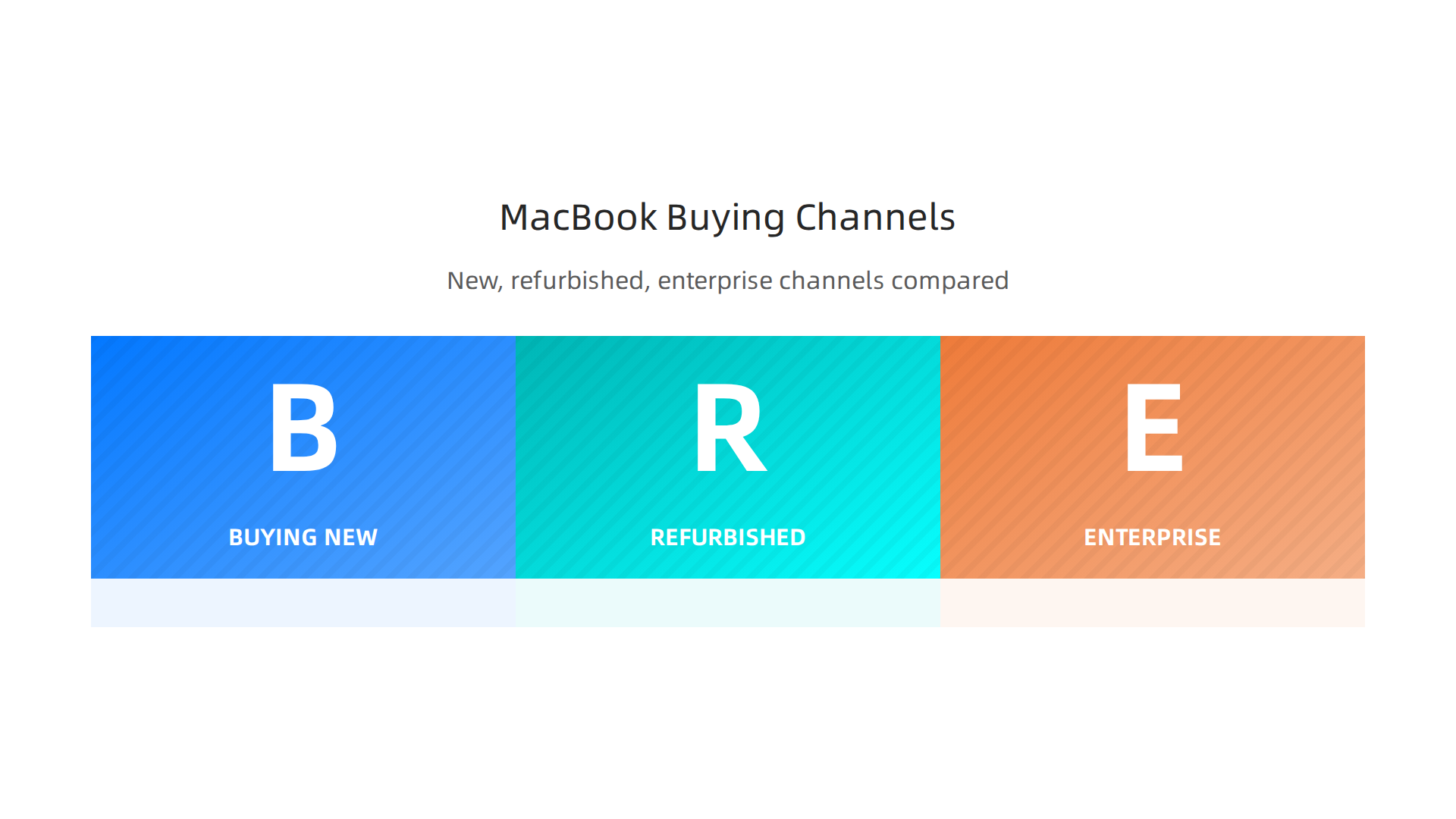
    Now that you know what’s inside a MacBook for AI work, you might be wondering where to get one. Finding the right macbooks for sale means looking at a few different places. You can buy them new, refurbished, or through special business channels.

    Explore the pros and cons of purchasing MacBooks through new, refurbished, or enterprise channels.

    Each way has its own good and bad points.

    Buying New MacBooks

    When you buy a new MacBook, you get the latest technology, like the super-fast M5 chips with their advanced Neural Engine. This is great because it means your computer will be powerful and ready for AI tasks for many years. New MacBooks come with a full warranty directly from Apple, giving you peace of mind if something goes wrong. The downside is the price; new MacBooks are the most expensive option. But for serious AI professionals, getting the most cutting-edge performance can be worth the cost.

    Looking at Refurbished MacBooks

    Refurbished MacBooks are computers that have been returned, fixed up, and then sold again. They often cost much less than new ones, sometimes 15% to 30% less, which can save you a lot of money Is it Worth Buying a Refurbished Mac? Pros and Cons. When you buy a refurbished MacBook from a trusted seller, it usually comes with a warranty and has been checked to make sure it works well. In 2026, many places offer refurbished Macs, and they can be a smart choice if you want good value.

    There are a few things to think about with refurbished MacBooks:

    • Cost Savings: You can get a very capable MacBook for less money.
    • Quality: Reputable sellers, including Apple’s own Certified Refurbished store, thoroughly check and repair these machines. Sometimes, they even put new batteries and outer shells on them. This means you can get a machine that feels almost new The Ultimate Guide to Buying a Refurbished Mac in 2026.
    • Older Models: You might not always find the absolute newest M5 chip models right away in the refurbished market. But you can often find powerful M4 or M3 models that are still excellent for AI work.

    Choosing a reputable seller is key for refurbished macbooks for sale. Always check their return policy and what kind of warranty they offer.

    Enterprise and Business Purchases

    For businesses and larger teams, buying MacBooks often happens through enterprise channels. This can mean getting special pricing for bulk orders or having dedicated support from Apple or authorized resellers. These channels can help make sure all your team’s devices are set up the same way and make managing them easier. When buying for a business, warranties, quick repairs, and good customer support are very important to keep work flowing smoothly.

    Important Considerations: Warranties, Returns, and Support

    No matter where you buy your MacBook, always look into the warranty, return policy, and available support.

    • Warranties: A good warranty protects your investment. New MacBooks come with Apple’s standard warranty, and you can usually buy extra coverage like AppleCare. For refurbished models, check what the seller offers. Some give a full year, while others might offer less.
    • Return Windows: Make sure you have enough time to return the MacBook if it doesn’t meet your needs. This is extra important for AI tasks, as you’ll want to test its performance with your specific workflows.
    • Support: Knowing you can get help if you have a problem is important. Apple’s support is generally strong, but for enterprise buyers, dedicated account managers or specialized tech support can be a huge benefit.

    Finding the right macbooks for sale involves more than just picking a model; it’s also about choosing the best purchase path for your needs. If you want to keep up with how AI is changing and how these tools can help your business, it’s smart to stay informed.

    Want to make sure you’re always getting the freshest news and tips in the fast-moving world of AI? Get clear daily AI updates from The AI Newsletter Worth Reading.

    After picking out the right MacBook for your AI tasks, the next important step is making sure you have the right software. What good is a powerful machine without the tools to use it? Luckily, macOS is a great place for AI work because many important AI programs run well on Apple’s special M-series chips.

    AI Frameworks and Tools Made for macOS

    Apple has worked hard to make its M-series chips, like the M5, M5 Pro, and M5 Max, very good for AI. These chips have something called a Neural Engine, which is designed specifically for machine learning tasks, making AI operations super fast. The M5 chip has an improved 16-core Neural Engine that boosts AI performance significantly Apple Unleashes M5, The Next Big Leap in AI Performance For Apple Silicon.

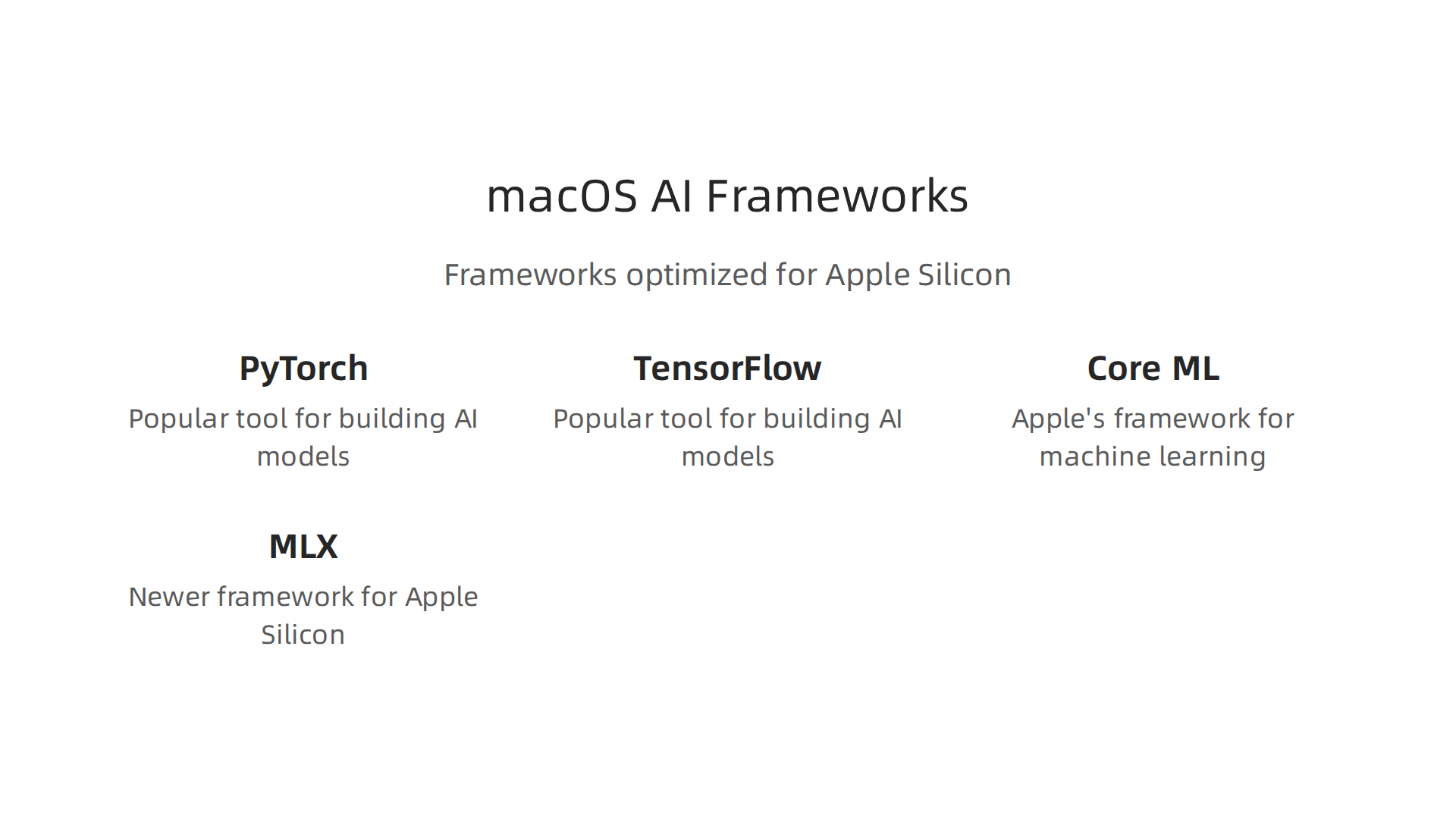
    Because of this, many big AI frameworks now run directly on macOS with great speed.

    An overview of major AI frameworks and tools optimized for Apple's macOS ecosystem and M-series chips.

    • PyTorch and TensorFlow: These are two of the most popular tools for building AI models. In 2026, they work very well on Apple Silicon, taking advantage of the Metal framework for fast calculations on the GPU and Neural Engine Train Your Machine Learning and AI Models on Apple GPUs. This means you can train and run complex AI models right on your MacBook without needing expensive cloud computers as much. Many developers compare PyTorch vs TensorFlow for different tasks, and both are strong contenders on Mac.
    • Core ML: This is Apple’s own framework for bringing machine learning into apps. It’s built to get the best performance from Apple hardware, including the Neural Engine. Core ML can handle advanced AI models, including those for creating new content Core ML – Machine Learning – Apple Developer.
    • MLX: This is a newer framework from Apple designed specifically for the unique architecture of Apple Silicon. It makes it easier for researchers and developers to create custom AI solutions that run very efficiently on Macs.

    Most modern AI development can happen natively on Apple Silicon. While some very specialized or older tools might still need a workaround like a virtual machine, these cases are becoming rarer.

    Top macOS Apps for AI Work in 2026

    Beyond the core frameworks, a lot of user-friendly apps are making AI more accessible on MacBooks. These apps help with everything from crafting the best questions for an AI to creating new content.

    • Prompt Engineering Tools: With generative AI becoming so common, writing good "prompts" (the instructions you give to an AI) is a skill. There are many macOS apps now that help you store, organize, and test your AI prompts to get better results.
    • Local Inference Apps: These apps let you run AI models directly on your MacBook. This is great for privacy, speed, and saving money on cloud services. With an M5 chip, you can run powerful language models or image generators locally, making your MacBook a personal AI powerhouse.
    • AI-Powered Content Generation: From writing assistants that help you brainstorm ideas and draft emails to tools that generate images or even video clips, macOS has a growing number of apps that use AI to boost creativity. Programs that help you quickly make videos with AI avatars are becoming very popular. You can even find great options for best AI avatar tools for video content in 2026.
    • Productivity Apps with AI: Many everyday apps are adding AI features. For example, Apple’s Shortcuts app lets you build complex workflows that can use AI to automate tasks Apple Will Let You Build Workflows Using AI in Its New Shortcuts App. Other tools, like those for note-taking or task management, often include AI to summarize information or suggest next steps, making your work faster and smarter Best Mac Productivity Apps in 2026. These AI tools can really help you get more done and see a good return on your investment in time and effort Which AI Productivity Workflows Actually Deliver ROI in 2026?.

    Having the right software on your MacBook means you can unlock its full potential for AI, making it a truly powerful tool for your work.

    Now that you know which software tools can make your MacBook shine for AI tasks, let’s talk about how to set up your Mac itself. Getting the most out of your powerful machine means making a few smart choices about settings, adding helpful accessories, and knowing when to use extra computing power.

    Practical Tweaks for macOS and Your MacBook

    Even the best MacBooks for sale need a little tuning to perform their best for demanding AI work. Here are some simple ways to make your Mac even better:

    • Adjust Energy Settings: For big AI tasks, you want your MacBook to use its full power. Go to System Settings > Battery and choose "High Power Mode" if your model has it. This tells your Mac to use more battery and run hotter to get tasks done faster. For lighter work, "Low Power Mode" helps save battery.
    • Keep Your Software Updated: Always make sure your macOS and all your AI tools are the latest versions. Apple often releases updates that make its chips work even better for AI. These updates can bring speed boosts and new features, so don’t skip them.
    • Manage Heat: Heavy AI tasks make your MacBook work hard, which means it can get warm. Make sure your Mac is on a flat, hard surface so air can flow around it. You might also consider a laptop stand to help with cooling. A cooler Mac usually runs faster and lasts longer.
    • Optimize Storage: AI models and data can take up a lot of space. Keep your MacBook’s storage tidy. Delete old files you don’t need and use external hard drives for big datasets. This helps your Mac run smoothly. You can find many tips for setting up your Mac for better work, like those in this helpful video on How to set up your mac for maximum productivity in 2026.

    Most AI tasks can run right on your Apple Silicon MacBook without needing special workarounds. Apple has made huge strides, but sometimes, for very old tools or specific research needs, you might still hear about virtualization. This is less common now, but good to know for the few older tools that might not run directly on macOS.

    When to Use External Power

    Even with a super-fast M5 chip, some AI projects are just too big for any single laptop. This is where external compute comes in handy:

    • External GPUs (eGPUs): While Apple’s M-series chips have powerful built-in graphics, for extremely graphics-heavy AI training, an external GPU might offer a boost. However, with Apple’s continuous improvements to their integrated chips, the need for eGPUs is less common in 2026 than it used to be. It’s usually only for highly specialized tasks.
    • Cloud Computing (Cloud Bursting): For very large AI models or intense training that takes many hours, using cloud services is often the best choice. This is like "renting" super powerful computers over the internet. You can develop your AI models on your MacBook and then send the really big jobs to the cloud. This saves your MacBook from overheating and frees it up for other tasks.

    By smartly managing your MacBook’s settings and knowing when to tap into external power, you can tackle almost any AI challenge. To dive deeper into making the most of your AI tools, consider reading about how to choose and use an AI powered research assistant in 2026 to streamline your work.

    By smartly managing your MacBook’s settings and knowing when to tap into external power, you can tackle almost any AI challenge. But before you even start looking at new "macbooks for sale," it’s super important to know exactly what you need.

    A professional reviews a checklist, ensuring all considerations are met before a significant tech investment.

    Thinking ahead can save you money and make sure you get the best tool for your AI work.

    Buying Checklist and ROI Considerations Before You Search ‘Macbooks for Sale’

    Before you buy a new MacBook, take a moment to think about a few key things. This little checklist helps you make a smart choice and get good value for your money.

    What Do You Need Your MacBook to Do?

    • Performance: Think about the AI tasks you’ll be doing. Are they small, quick jobs, or big, complex projects that need a lot of power? For heavy AI work, you’ll want a MacBook with a powerful M-series chip (like an M3 or M4 Pro/Max), lots of RAM (memory), and plenty of storage. More power means your AI models will train faster.
    • Software: Make sure your favorite AI tools and programs will work smoothly on macOS and Apple’s own chips. Most popular AI software works great, but it’s always good to double-check.
    • Budget: How much can you spend? MacBooks can be a big investment. Think about the total cost, not just the sticker price. This might include accessories, extra storage, or even subscriptions to cloud computing services for bigger tasks.

    Thinking About What You Get Back (ROI)

    ROI stands for Return on Investment. It’s about figuring out if what you spend on a MacBook will help you or your business earn more or save time.

    • For Yourself: If you’re buying a MacBook for your own AI projects, how much faster will it help you finish tasks? Will it let you take on bigger, more exciting projects? A faster machine can mean more finished work, which is a great return on your money.
    • For a Team or Business: If you’re buying MacBooks for a whole team, the ROI can be even bigger. Faster machines for everyone means the team can be more productive, develop AI solutions quicker, and bring new ideas to life. This can really help your business grow. To better understand how AI can help your business grow, you might want to learn about AI virtual assistants for businesses master your 2026 strategy.
    • Consider Refurbished Options: Don’t forget that "macbooks for sale" doesn’t always mean brand new. You can often find refurbished MacBooks that work just like new ones but cost a lot less. Buying a refurbished Mac can save you anywhere from 15% to 30% of the price of a brand new one, according to experts. These often come with warranties and have been checked thoroughly, so any serious problems are already fixed. Many people find refurbished Macs to be a good deal because they offer lower prices and often still let you get full AppleCare coverage, as discussed in the Apple Communities. You can read more about if it’s worth buying a refurbished Mac pros and cons and check out a helpful guide on the ultimate guide to buying a refurbished Mac in 2026.

    By doing a little homework before you buy, you can make sure your investment in a MacBook helps you or your team achieve great things with AI. Stay updated with the latest in AI to make the best purchasing decisions.
    The AI Newsletter Worth Reading

    Summary

    This guide helps professionals and teams choose the right MacBook for AI work in 2026 by explaining the new M5 family (M5, M5 Pro, M5 Max), how different models match specific workflows, and what hardware specs actually matter. It walks you through which machines suit prompt-heavy tasks, content creation, or heavy model training, and explains key components—CPU, GPU, Neural Engine, RAM, and SSD—plus the trade-offs between portability, battery life, and cooling. The article also covers where to buy (new, refurbished, or enterprise channels), what macOS-native AI tools and frameworks run best on Apple Silicon, and practical setup tweaks to boost performance. You’ll learn when local inference is viable versus when to offload to cloud compute, how much memory and storage to target, and a pre-purchase checklist to maximize ROI for individuals or teams. By reading this, you’ll be able to pick the right MacBook model, find trustworthy buying options, and configure your Mac to handle real-world AI workflows efficiently.