Tag: digital marketing

  • What Is SEO Marketing A Modern Business Guide to Online Growth

    What Is SEO Marketing A Modern Business Guide to Online Growth

    Introduction — Why SEO marketing matters for modern businesses

    Imagine you have a fantastic store or service, but it’s hidden down a quiet street. How will people find you? In today’s digital world, search engines like Google are the main roads people use to find what they need. This is where what is SEO marketing comes in. SEO stands for Search Engine Optimization, and it’s all about making your website easy for search engines to find and show to people who are looking for products or services like yours.

    Simply put, SEO marketing helps your business appear higher in search results without paying for ads. This means more people see your website, click on it, and learn about what you offer. For any modern business in 2026, being found online is not just nice to have; it’s a must. It builds trust, brings in new customers, and helps your business grow naturally.

    A team celebrating successful business growth and customer acquisition.

    This process involves many moving parts, like making sure your website has the right words and pictures (called on-page SEO), getting other good websites to point to yours (off-page SEO), and making sure your website works well behind the scenes for search engines (technical SEO) [^1].

    However, for many business leaders, including a chief marketing officer, figuring out the best way to do SEO can feel like a big challenge. There’s so much information out there, a seemingly endless list of tools to pick from, and making it all work together can be confusing. Many worry about the time and money spent, asking "Is this really going to help my business make more sales?" This can sometimes lead to what’s known as "marketing myopia," where businesses focus too much on quick, short-term gains instead of building a strong, lasting online presence.

    To succeed with SEO, it’s helpful to clearly understand your audience and what they search for. This often ties into good marketing practices, like those found in marketing science for AI professionals, which helps you measure what truly works. By thoughtfully applying principles like STP marketing (segmenting your audience, targeting the right groups, and positioning your brand), businesses can make their SEO efforts much more effective and truly connect with potential customers. Staying up-to-date with the latest trends and tools is crucial to cut through the noise and ensure your marketing efforts lead to real results.

    [^1]: Types of SEO: on-page, off-page, and technical SEO

    What is SEO marketing? Core concepts and terminology

    Now that we know why being found online is super important, let’s really dig into what is SEO marketing. At its heart, SEO marketing is a set of practices used to help your website show up higher in search engine results when people look for things related to your business. It’s about making your site as friendly as possible for search engines like Google, so they understand what your website is about and see it as a good source of information for users.

    It’s helpful to know that SEO marketing is different from some other online activities you might hear about.

    • SEO vs. SEM: SEO (Search Engine Optimization) focuses on getting free, or "organic," traffic by improving your ranking naturally. SEM (Search Engine Marketing), on the other hand, uses paid advertising to show up at the top of search results. Think of SEO as earning your spot, and SEM as buying a billboard at the top of the search page [^1].
    • SEO vs. Content Marketing: Content marketing is about creating useful and interesting information (like blog posts, videos, or guides) to attract and keep customers. SEO helps make sure that good content actually gets seen by optimizing it for search engines. They work best together, like a team.

    To truly understand what is SEO marketing, we often talk about its three main parts:
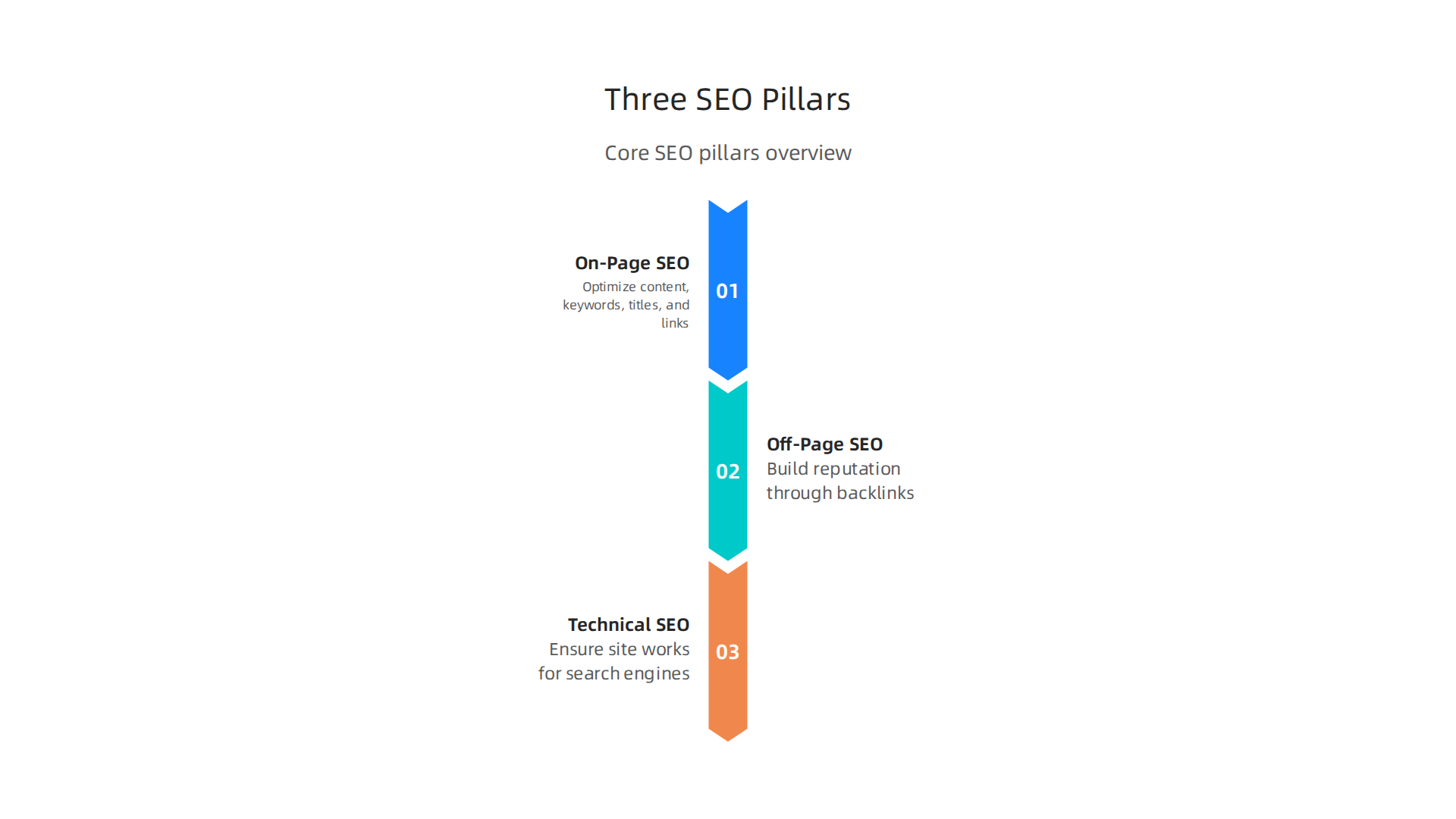
    Understanding the three core pillars—On-Page, Off-Page, and Technical SEO—is fundamental to a comprehensive SEO strategy.

    1. On-Page SEO

    This refers to all the things you can do directly on your website pages to help them rank better. It’s like decorating your store and making sure your products are clearly labeled. It includes things like:

    • Words you use: Picking the right keywords that people search for and using them naturally in your text.
    • Titles and Headings: Making sure your page titles and headings clearly tell both readers and search engines what the page is about.
    • Pictures and Videos: Making sure your images and videos are named and described in a way that search engines can understand.
    • Internal Links: Connecting your different website pages to each other so visitors and search engines can easily find more related content on your site.

    These efforts help each page match what people are searching for and clearly show its importance [^2].

    2. Off-Page SEO

    This part of SEO marketing involves actions taken outside your website to improve its standing. Think of it as building your reputation in the wider community. The most important part of off-page SEO is getting other trusted websites to link to yours. These are called "backlinks." When many good websites link to your site, it tells search engines that your website is important, trustworthy, and has valuable information. This builds your website’s authority and trust.

    3. Technical SEO

    This is about how well your website works behind the scenes for search engines. It’s like making sure your store’s foundation is strong and the lights always work. Technical SEO makes sure that search engines can easily find, read, and understand all the pages on your website. This includes checking things like:

    • Website Speed: How fast your pages load.
    • Mobile-Friendliness: If your website looks good and works well on phones and tablets.
    • Site Structure: How your website is put together so search engines can crawl it easily.

    For any chief marketing officer or business owner in 2026, understanding these pillars is key to building a strong online presence.

    A business leader making thoughtful decisions for their online strategy.

    It helps avoid "marketing myopia" by focusing on long-term growth instead of just quick wins. Learning how different marketing tools work together can help you decide how to make smart choices for your business. To dive deeper into making informed decisions, consider exploring resources on how marketing specialists choose AI tools for marketing and drive ROI.

    Want to stay ahead in the fast-changing world of AI and marketing?
    Get clear daily AI updates from The Deep View Newsletter.


    [^1]: SEO vs. SEM vs. Content Marketing
    [^2]: Technical vs On-Page vs Off-Page SEO: Key Differences

    Now that you know the three main parts of what is SEO marketing, let’s look at how search engines actually use them to figure out which websites to show. Imagine a search engine like a very smart librarian who wants to give you the best book for your question. It looks at three main things to pick the right "books" (websites):

    1. Relevance: How well does your website’s content match what someone is searching for?
    2. Authority: How much does your website prove it’s a trustworthy and important source of information?
    3. Accessibility: Can the search engine easily find, read, and understand your website?

    Let’s break down how on-page, off-page, and technical SEO help with these three points.

    On-Page SEO: Showing Relevance

    On-page SEO helps your website be truly relevant to what people are looking up. It’s about making sure the words, pictures, and overall message on your pages are clear and helpful for both people and search engines.

    • Content and Keywords: When you use the right words and phrases (keywords) that your customers type into search engines, it tells the "librarian" exactly what your page is about. But it’s not just about using keywords. It’s about writing truly good, useful content that answers questions and solves problems.
    • HTML Elements: This sounds fancy, but it just means things like your page titles, headings, and descriptions. These elements act like clear labels for your content. They help search engines quickly understand the main topic of your page and how it relates to search queries.

    By getting your on-page SEO right, you make it much easier for search engines to see that your content is a perfect match for certain searches.

    Off-Page SEO: Building Authority

    Off-page SEO is how your website earns trust and importance from other websites. Think of it as getting good reviews and recommendations from reliable friends.

    • Backlinks: The biggest part of off-page SEO is getting other good, trusted websites to link to your site. Each link is like a vote of confidence. When many important websites link to yours, search engines see your site as more trustworthy and authoritative. This makes your site more likely to show up high in search results. It shows that your website is a valuable place for information, not just a random site.

    Technical SEO: Ensuring Accessibility

    Technical SEO makes sure your website’s hidden parts work well so search engines can easily visit and understand it. It’s like making sure the doors to your library are open, the lights are on, and all the books are neatly organized.

    • Crawlability and Indexing: Search engines use little programs called "crawlers" to visit and read your website’s pages. If your site has technical problems, these crawlers might miss important pages or struggle to understand what they find. This means your valuable content might not even show up in search results. Common issues in 2026 can include important pages being accidentally blocked or problems with how pages are connected Technical SEO Checklist for 2026.
    • Site Performance: How fast your pages load is super important. Nobody likes a slow website, not people, and not search engines. Google measures things like "Core Web Vitals" which check how quickly a page loads and becomes usable. Websites that load slowly often rank lower. For example, a good Largest Contentful Paint (LCP) should be under 2.5 seconds in 2026 Technical SEO in 2026.
    • Mobile-Friendliness: Most people use their phones to browse the internet in 2026. Your website needs to look good and work perfectly on all screen sizes, from big computers to small smartphones.
    • Site Structure: This is about how your website’s pages are organized. A clear structure helps search engines understand what’s most important and how different parts of your site relate to each other. Keeping your site’s technical setup healthy is a continuous job. It involves checking for things like broken links or duplicate content that can confuse search engines Free Technical SEO Guide 2026.

    Understanding these three areas is key to mastering what is SEO marketing. They all work together to help search engines find your site, trust your content, and show it to the right people. For business leaders looking to stay on top of all the behind-the-scenes magic, it’s wise to keep an eye on how these elements contribute to your overall online presence and digital strategy. It’s a part of what makes a futuristic website 2026 stand out.

    The previous section explained what is SEO marketing and its different parts. Now, let’s look at how SEO fits into the bigger world of online marketing. Often, people talk about SEO, SEM, and content marketing as if they are the same, but they are different tools. Knowing when to use each one helps a chief marketing officer or any business leader make smart choices about where to put their marketing money.

    A team collaboratively discussing where to allocate marketing investments across different strategies.

    It helps avoid something called marketing myopia, where you only see a small part of the marketing world.

    SEO vs. SEM vs. content marketing: where to invest

    When you want to bring people to your website, you have a few main ways to do it. SEO, SEM, and content marketing all aim to get more eyes on your business online, but they work in different ways and give results at different speeds.

    1. Search Engine Optimization (SEO)
    As we’ve seen, SEO is about making your website naturally show up higher in search results without paying for clicks. It’s like building a strong, well-known store in a good location that people find on their own. SEO takes time to build up, often many months, but the results can last a long time. It gives you "organic" traffic, which means people find you because your content is truly helpful and relevant to their search [SEO vs. SEM vs. Content Marketing]. This is a great choice for long-term growth and building trust with your audience.

    2. Search Engine Marketing (SEM)
    SEM is often called paid search. This is when you pay search engines like Google to show your ads at the very top of search results. Think of it like buying a billboard right on the busiest highway. You pay each time someone clicks on your ad (this is called Pay-Per-Click, or PPC). SEM can give you fast results. You can set up an ad campaign and start seeing visitors within hours or days. It’s great for quickly getting traffic for specific keywords or promoting new products. For business leaders wondering how to choose AI for business tools that deliver real results, understanding the quick-turnaround of SEM can be key. However, when you stop paying, the traffic stops too.

    3. Content Marketing
    Content marketing is about creating helpful and valuable stuff for your audience, like blog posts, videos, guides, or infographics. The goal isn’t always to sell something right away. Instead, it’s about giving people useful information that builds trust and shows you are an expert. This helps your brand become known and liked. Good content can also help your SEO by giving search engines more relevant pages to show. Content marketing is a longer game, but it creates a lasting connection with customers. For example, a good chief marketing officer knows that understanding your customer’s journey is crucial, which ties into effective STP marketing (segmentation, targeting, and positioning).

    When to Invest in Each

    Choosing where to put your money depends on what you want to achieve:

    • If you need quick results or want to test a new product right away: SEM is your best friend. It offers fast traffic and quick feedback.
    • If you want to build long-term trust, steady traffic, and a strong brand: SEO and content marketing are key. They take time, but the payoff can be huge and last for years.
    • For a new business or product launch: A smart plan often involves using SEM for an immediate boost while slowly building up your SEO and content marketing efforts. This gives you both quick wins and long-term stability.

    All these strategies can work together to create a powerful online presence. It’s not about choosing just one, but finding the right mix for your business goals and budget. Staying updated on these marketing shifts is vital for any business.

    Get clear daily AI updates from The AI Newsletter Worth Reading.

    To truly make SEO work for you, it’s not enough to know what it is; you also need a smart plan. Think of it like building a house. You wouldn’t just start nailing boards together. You’d have a blueprint. The same goes for SEO. A smart business leader, like a chief marketing officer, needs a clear plan to make sure SEO helps reach overall business goals. This way, you avoid "marketing myopia" and see the bigger picture.

    Strategic SEO planning: aligning SEO with business goals

    A good SEO plan connects what your business wants to achieve with what your SEO efforts will do.
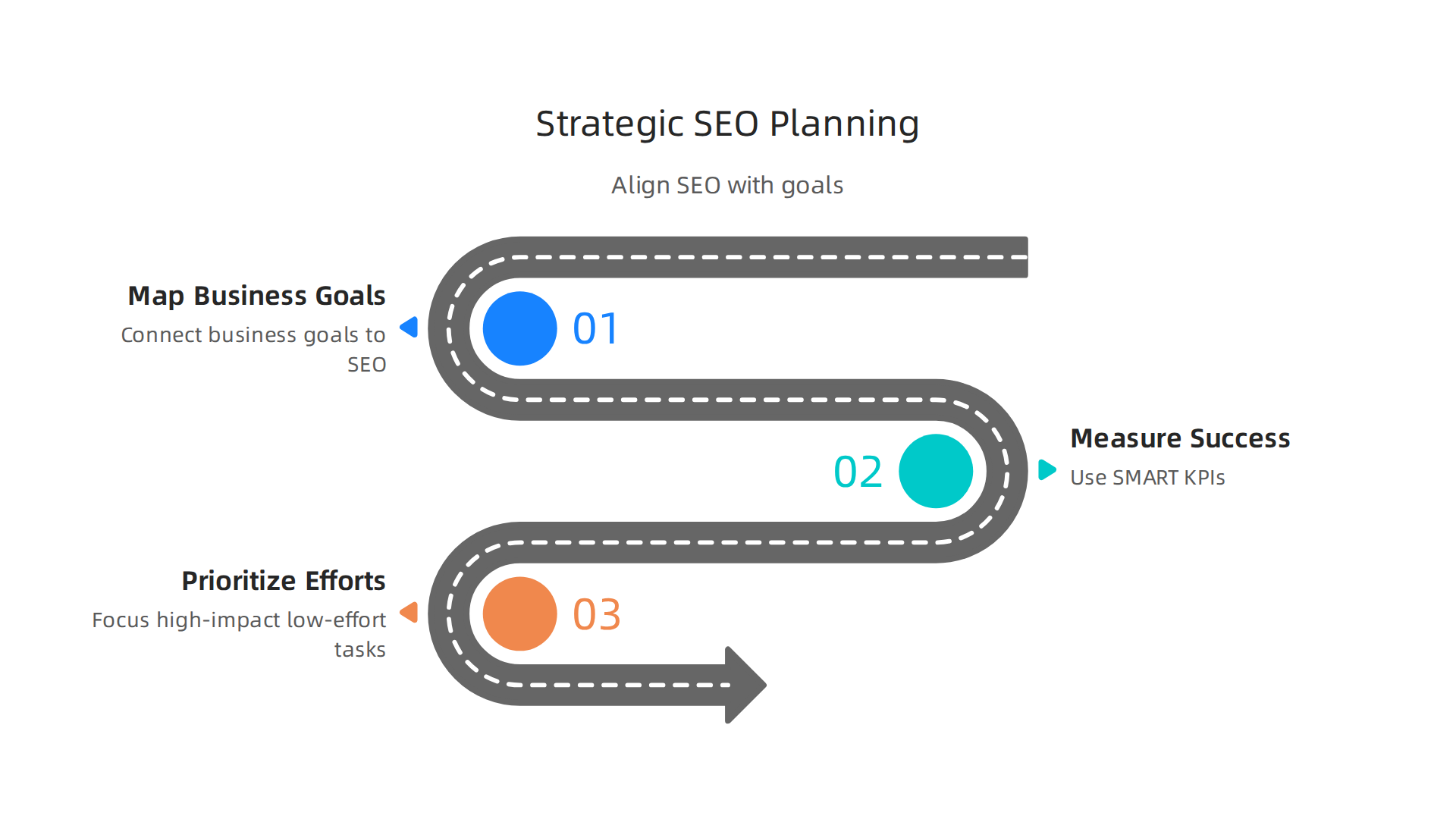
    Strategic SEO planning involves mapping goals, measuring success with KPIs, and prioritizing efforts for maximum impact.

    It’s like drawing a straight line from your big business dreams to the small steps you take each day on your website.

    1. Map Your Business Goals to SEO Goals
    First, think about your main business goals. Do you want to:

    • Sell more products online?
    • Get more people to sign up for your service?
    • Make your brand more famous?

    Once you know your business goal, you can set a clear SEO goal. For example:

    • Business Goal: "Increase online sales by 15% this year."
    • SEO Goal: "Rank higher for keywords related to our products to get more organic traffic to product pages."

    Many companies use templates to map out these goals and track them, helping them see clearly what they need to do SEO Roadmap Template.

    2. Measure Your Success with KPIs
    After setting goals, you need to know if you’re actually reaching them. This is where Key Performance Indicators (KPIs) come in. KPIs are like scorecards for your SEO efforts.

    • If your SEO goal is to get more organic traffic, a KPI might be "Number of visitors from Google search."
    • If your goal is more sales, a KPI could be "Revenue from organic search."

    Make sure your KPIs are SMART: Specific, Measurable, Achievable, Relevant, and Time-bound. This helps you track what is SEO marketing really doing for your bottom line. Learning about Marketing Science for AI Professionals can help you set these up.

    3. Prioritize Your Efforts
    Most businesses don’t have endless money, time, or people. This means you have to choose which SEO tasks to do first. To do this, you can look at two things:

    • Impact: How much will this task help your business goals?
    • Effort: How hard or long will this task take?

    Leaders often score each task to see which ones offer the biggest win for the least amount of work. This helps them decide what to tackle first, especially when resources are limited How do leaders prioritize SEO efforts in limited-resource. By carefully planning and prioritizing, you ensure that every SEO step you take brings you closer to your business’s overall success.

    Keyword Research, Content Strategy, and User Intent

    Once you know your SEO goals and what success looks like, the next step is to figure out exactly what people are searching for. This is where keyword research comes in. It’s like listening to your customers and finding out what questions they are asking, or what problems they need help with. This helps you understand "what is SEO marketing" really about from a user’s viewpoint.

    Finding High-Value Topics with User Intent

    Good keyword research isn’t just about finding popular words. It’s about understanding "user intent." This means figuring out why someone is typing a certain phrase into a search engine. Do they want to buy something? Learn something? Or find a specific website? For example, if someone searches "best running shoes," their intent is likely to buy. If they search "how to tie running shoes," their intent is to learn.

    By finding keywords that match what your ideal customers want, you can create content that truly helps them. Many businesses in 2026 use special AI tools to do this. These tools can help you find keywords, group them by what people mean when they search, and even compare them to what your competitors are doing. This is called AI-Powered Keyword Research and it makes finding valuable topics much easier. Choosing the right AI for business tools is key to making this process smooth.

    Building Your Content Strategy

    After you know what topics and keywords your audience cares about, you can build your content strategy. This means deciding what kinds of content you’ll make and how it fits into your overall marketing plan.

    • Awareness: For people just learning about a topic, you might create blog posts or guides.
    • Consideration: For those weighing their options, you could offer comparison articles or detailed product reviews.
    • Decision: For customers ready to buy, you’d have product pages, pricing info, or case studies.

    Your content should be useful and guide people through their journey, no matter where they are in their search.

    A Simple Content Workflow

    To keep your content creation running smoothly, follow a clear workflow.
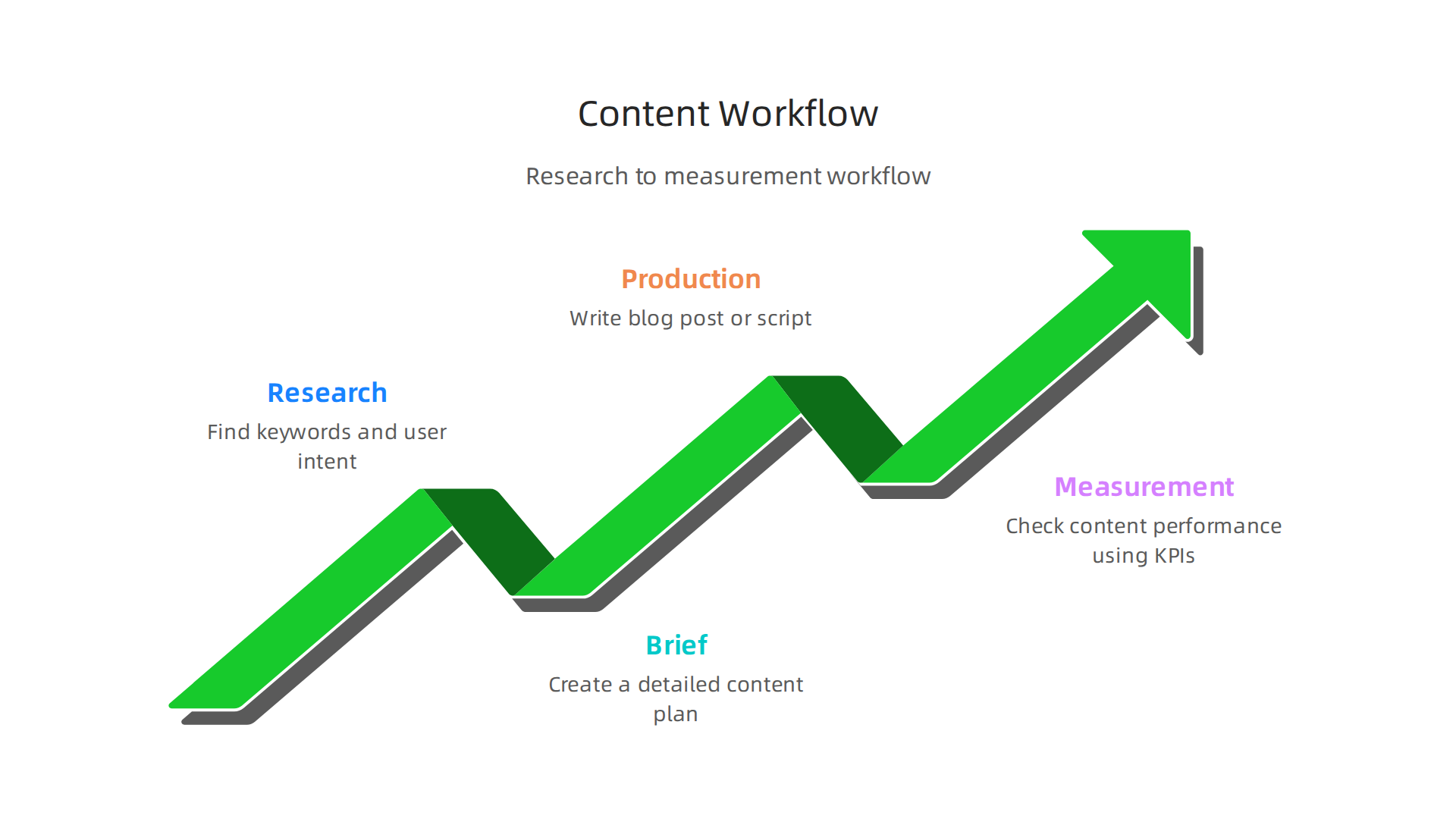
    A structured content workflow from research to measurement ensures effective content delivery and optimization.

    Many companies use a step-by-step process, often with the help of AI tools, to make sure nothing is missed.

    1. Research: Find keywords and understand user intent, like we talked about above.
    2. Brief: Create a detailed plan for each piece of content. This includes the main topic, keywords to use, and what points to cover.
    3. Production: Write the content. This could be a blog post, a video script, or a product description. Some modern tools can help automate content workflows from start to finish.
    4. Measurement: Check how well your content is doing using your KPIs. Are people reading it? Is it bringing in new customers? This helps you learn and make your next pieces even better.

    By putting these steps into action, you’ll have a strong content plan that truly supports what your business wants to achieve with SEO.

    Staying on top of the latest AI tools that power these workflows is a must for any business leader. Get clear daily AI updates from The AI Newsletter Worth Reading.

    After you have a great content plan, it’s time to make sure your website is built in a way that search engines can easily understand. This part of "what is SEO marketing" is called technical SEO. It’s like making sure the foundation and roads of your house are strong and clear so visitors can find their way without trouble.

    Technical SEO deals with how search engines like Google look at, understand, and show your website pages. If there are problems here, even the best content might not get seen. In 2026, keeping your site technically sound is more important than ever.

    Important Technical Checks for Your Website

    Many common issues can stop your website from doing well in search results. Here are some key areas to watch out for:

    • Can Search Engines Find Your Pages?
      Search engines use special bots, like tiny explorers, to visit your website and find new pages. This is called "crawling." Then, they "index" these pages, which means they add them to their big library of websites. Sometimes, a website might accidentally block these bots or tell them not to index important pages. This can happen with wrong settings in files like robots.txt or through special "noindex" tags on pages that should be seen Technical SEO Guide 2026: Crawl & Indexing. It’s also important to have a clean sitemap that helps bots find all your good pages Technical SEO Checklist for 2026: What Actually Matters.

    • How Fast and Easy Is Your Website to Use?
      People like fast websites. Search engines also like them. Google uses something called Core Web Vitals to measure how quickly your page loads and how smooth it feels to use. These include things like Largest Contentful Paint (LCP), which is how fast the main content shows up, and Interaction to Next Paint (INP), which is how quickly your page reacts when someone clicks or taps something. If these are slow, it can hurt your ranking Technical SEO Checklist for 2026: Improve Core Web Vitals …. Making sure your images are small and your website code is neat helps a lot with this. You can also work on your overall website architecture, speed & crawlability to boost performance.

    • Is Your Site Organized Well?
      Think of your website like a book. Internal links are like the table of contents and page numbers that help readers move from one chapter to another. If pages are "orphan pages" with no links pointing to them, search engines might not find them easily Technical SEO Checklist for 2026: 34 Critical Fixes for Crawlability …. Also, having many pages with the exact same content, called "duplicate content," can confuse search engines about which page to show.

    • Is Your Website Safe?
      Having a secure website (using HTTPS) is a must in 2026. This means your website has an SSL certificate, which protects information shared between your site and its visitors. Google sees this as a sign of trust and safety Technical SEO: Get Your Site Crawled, Indexed, and Ranked.

    Working Together for Technical SEO Success

    Making these technical fixes happen is often a team effort.

    • SEO specialists are like the architects. They identify problems and figure out the best ways to fix them to help with search rankings. They provide detailed lists of what needs to change.
    • Engineers are the builders. They take the plans from the SEO specialists and put them into action, fixing code, speeding up the site, or changing how pages are linked. A good chief marketing officer will make sure these teams work together well.
    • Product owners or business leaders help decide which technical fixes are most important for the business and make sure these changes fit into the overall product roadmap. They ensure that technical improvements align with user experience and business goals.

    By making sure everyone works together, businesses can create a strong technical foundation that helps their content shine and improves their standing in search results. Investing in this area is a smart move for any business looking to grow online.

    After making sure your website is technically sound, the next big step in understanding what is SEO marketing is to show how all that hard work actually helps the business grow. This means looking at the numbers and connecting your SEO efforts to real money or new customers.

    An individual diligently analyzing reports to connect SEO performance with actual business revenue.

    It’s not enough to just rank higher; you need to know what those rankings do for the company.

    Measuring SEO ROI: KPIs, Attribution, and Connecting to Business Outcomes

    To truly show the value of SEO, you need to measure it. This involves using Key Performance Indicators (KPIs) to track success and carefully figuring out which sales or leads came from SEO.

    Key Metrics for SEO Performance

    When we talk about SEO performance, we often start with traffic, but in 2026, the focus is much more on how that traffic turns into business success. Here are some important things to track:

    • Organic Revenue and Conversion Value: These are the most direct ways to show how much money SEO is bringing in. It’s about seeing how many sales or valuable actions (like signing up for a service) happen because someone found you through search engines. You also track the actual dollar amount of those sales or actions How to Measure SEO ROI: Complete UAE Guide (2026).
    • Newer KPIs for AI Search: In today’s world, it’s also important to look at things like "citation frequency" and "generative share of voice." This means how often AI answers (like those from ChatGPT or Google’s AI Overviews) mention your brand or content. Also, "branded search volume" can tell you how many people search directly for your company after learning about you through other searches Measuring SEO: KPIs, Attribution & Reporting (2026).

    Figuring Out Where Credit Is Due: Attribution Challenges

    One of the trickiest parts of showing SEO’s value is something called "attribution." This is about giving the right credit to the right marketing efforts. Often, people only look at the "last click," meaning they give all the credit to the very last thing someone clicked before buying. But SEO rarely works that way.

    Imagine someone searches for a product, finds your blog post (SEO), reads it, then a week later gets an email about that product, clicks the email, and buys. If you only look at the last click, the email gets all the credit. This is why SEO often looks like it’s not doing much if you only use a "last-click" view.

    To get a better picture, we use:

    • Assisted Conversions: This shows when SEO helped someone along their journey, even if it wasn’t the very last step. For example, if your blog post was the first thing they saw, it "assisted" the sale SEO Analytics Guide (2026): 15 Diagnostic Scenarios.
    • Multi-Touch Attribution Models: These are smarter ways to give credit to all the different steps a customer takes before buying. Instead of just the last click, models like "data-driven" (often used in Google Analytics 4) spread the credit across many touchpoints. There are also models like "time decay" (more credit to steps closer to buying) or "position-based" (credit to both the first and last steps) Marketing Attribution for SEO | Models, Tracking, Reporting. Using a few different models can give you a clearer view of SEO’s true impact.

    Connecting this data to your business’s sales records (often called a CRM) is key to truly understanding the full picture of how organic search influences your company’s success. For more on how to precisely measure these impacts, consider exploring marketing science for AI professionals measure real impact and ROI.

    Demonstrating SEO-Driven Value to Leaders

    The ultimate goal is to show the "Return on Investment" (ROI) for SEO. This means comparing the money you make from SEO to the money you spent on it (tools, content, people). A good chief marketing officer needs to see how SEO fits into the bigger picture and helps meet business goals. By looking at actual revenue, leads, and conversion values, and using smarter attribution models, you can clearly show that SEO is a powerful driver of growth. To stay on top of daily AI and technology insights that can help sharpen your marketing strategies, you might enjoy The AI Newsletter Worth Reading.

    Summary

    This article explains what SEO marketing is and why it matters for modern businesses, showing how on-page, off-page, and technical SEO work together to make your site discoverable, trusted, and accessible. It walks through the core concepts—relevance, authority, accessibility—then details practical steps like keyword research, content workflows, and strategic planning that align SEO with business goals. The guide also compares SEO to SEM and content marketing so you can choose the right mix for short- and long-term growth, and it highlights important technical checks (speed, mobile, crawlability) to avoid losing visibility. Finally, it covers measurement: which KPIs to track, how to handle attribution, and how to prove SEO ROI to leaders, so you can prioritize repairs and investments with confidence.


  • Strategic Guide to Marketing AI Agents: Deployment, ROI, and Growth in 2026

    Strategic Guide to Marketing AI Agents: Deployment, ROI, and Growth in 2026

    Artificial intelligence (AI) has changed a lot in marketing over the past few years. We’ve seen many smart tools pop up, but something new and exciting is happening in 2026: the rise of marketing AI agents.

    Leaders envision a future transformed by advanced AI agents in marketing.

    These are not just simple tools that do one task, like writing an email or creating a picture. Think of them as smart helpers that can handle many steps of a marketing job all by themselves.

    What are Marketing AI Agents?

    A marketing AI agent is like a digital team member that can understand goals, make a plan, and then take action to reach those goals, even over many steps. It has a "brain" powered by advanced language models, a "memory" to learn from past actions, and the ability to use other "tools" or software to complete tasks. For example, an autonomous marketing agent might create a full social media campaign, from writing posts to scheduling them and even adjusting content based on how people react online [PDF] (https://www.alvarezandmarsal.com/sites/default/files/2026-03/The%20Agent-First%20Marketing%20Function_0.pdf).

    This is different from older, single-purpose AI tools. A basic AI tool might help you write a blog post, but it won’t plan your whole content calendar or figure out which posts work best. Marketing AI agents, on the other hand, can do all that and more. They can even work together as "multi-agent" systems to tackle big, complex marketing plans, as explained in recent research about AI Agent Systems: Architectures, Applications, and Evaluation. In 2026, experts are creating ways to sort these agents into groups to better understand their different uses and parts, helping us see how they fit into a bigger picture AI Agent Architecture Decoded: The 9-Dimension Taxonomy Every ….

    Big Benefits of Using Marketing AI Agents

    These smart agents bring huge advantages to businesses:

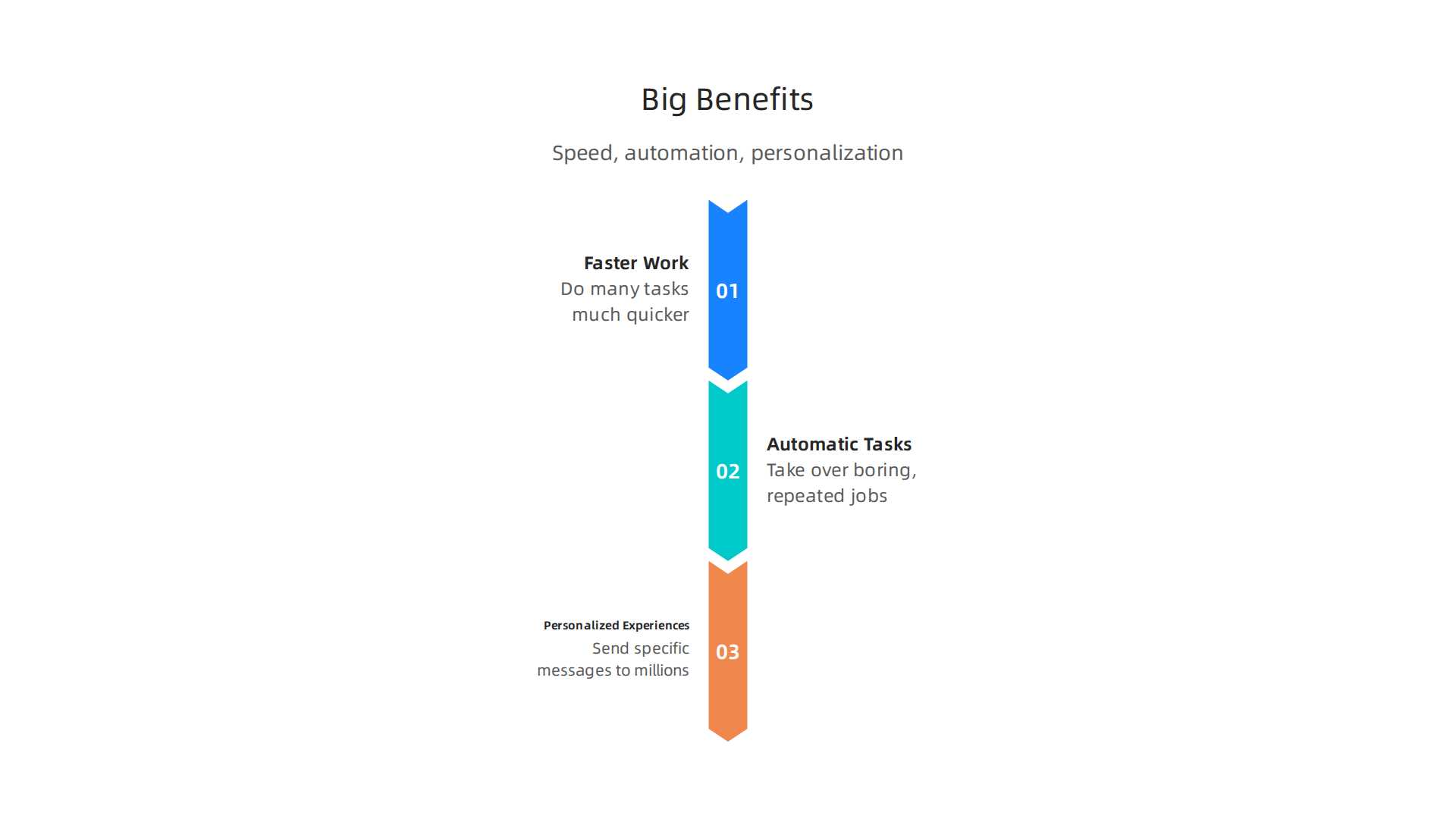
    Marketing AI agents offer significant benefits like increased speed, automation, and personalization.

    • Faster Work: They can do many tasks much quicker than people can, speeding up your marketing efforts.
    • Automatic Tasks: They take over many boring, repeated jobs. This means your team can spend more time on new ideas and creative work, instead of getting stuck in daily routines. This can be a game-changer for businesses looking for an effective online marketing platform for small businesses.
    • Personalized Experiences for Everyone: AI agents can help you send very specific messages and offers to thousands or even millions of customers, making each person feel like you know exactly what they need. This helps create a truly personal connection with your audience.

    What You’ll Learn in This Guide

    Learning how to use marketing AI agents can seem like a big job. That’s why this guide is here to help. We will walk you through everything you need to know, step-by-step. You will learn:

    • How to choose the best AI agents for your specific business needs.
    • How to set them up and get them working smoothly.
    • How to make sure they follow rules and stay safe (this is called governance).
    • How to check if they are actually helping your business grow and meet its goals.

    Whether you’re looking for a simple marketing plan example or want to dive deep into using AI, this guide will give you practical steps to succeed.

    Stay ahead with smart insights. Get clear daily AI updates from The Deep View Newsletter.

    Now that you know what marketing AI agents are in a general sense, let’s look closer at their different types, what they are made of, and how they work in real marketing jobs. These smart helpers come in various forms, each designed for specific levels of work.

    Types of Marketing AI Agents

    Not all marketing AI agents are exactly the same. They can be grouped by how complex their tasks are and how much they work on their own.

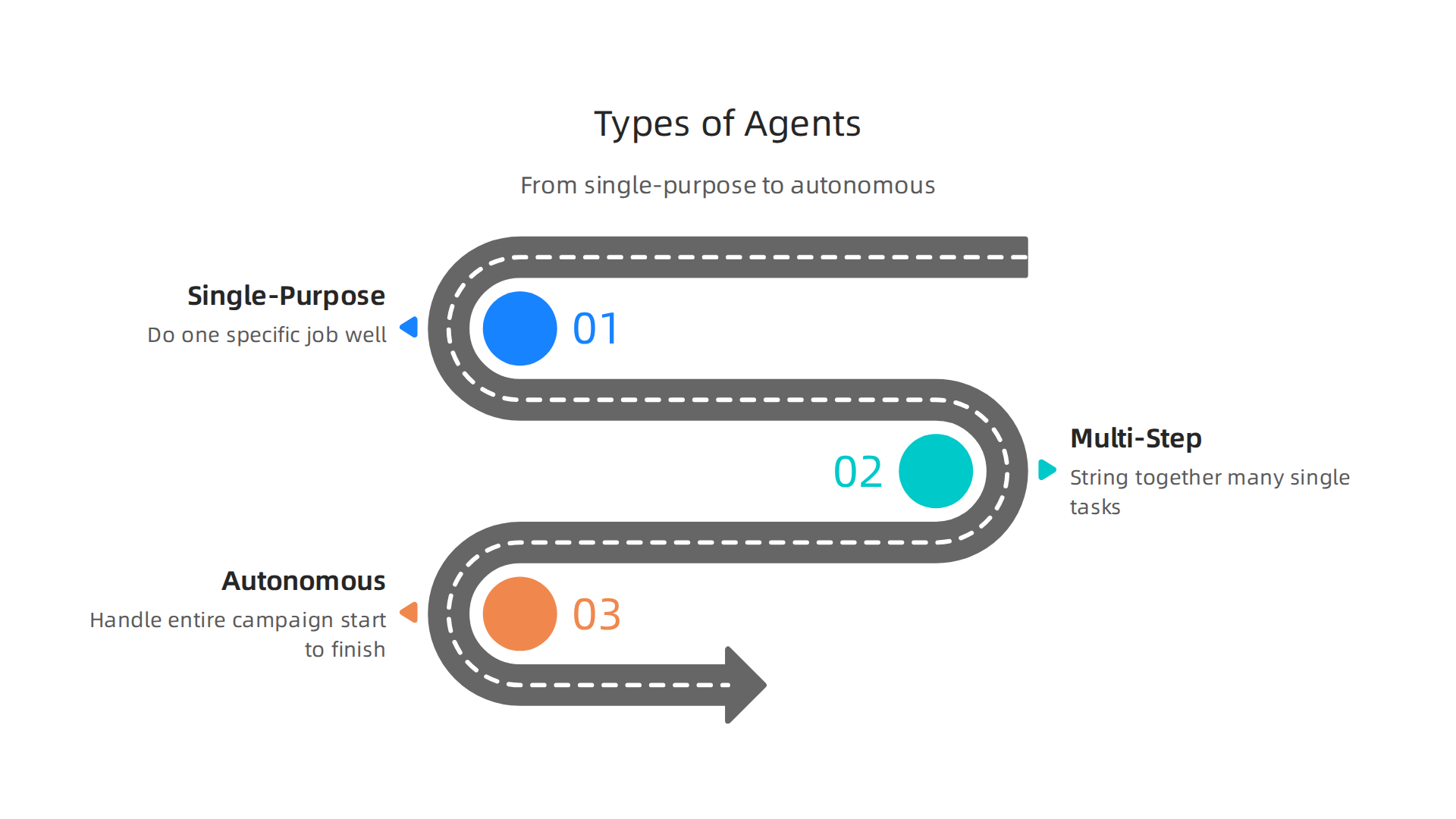
    Marketing AI agents range from single-purpose tools to fully autonomous campaign managers.

    • Single-Purpose Task Agents: These are the simplest kind. They do one specific job well, like writing an email, generating a social media post, or finding keywords. They are good for quick, focused tasks. While helpful, they don’t plan out big campaigns.
    • Multi-Step Orchestration Agents: These agents are smarter. They can string together many single tasks to complete a larger goal. For example, a multi-step agent might write a blog post, then create social media updates for it, and then schedule those posts. They follow a plan to make sure all parts of a task are done in order. Researchers have created ways to organize these kinds of AI agent systems, looking at how they plan, control, and interact with tools AI Agent Systems: Architectures, Applications, and Evaluation.
    • Autonomous Campaigning Agents: These are the most advanced marketing AI agents. They can handle an entire marketing campaign from start to finish. They set goals, make a plan, create all the content, run the campaign, and even adjust things as they go. Humans usually check in at certain points for approval, but the agent does most of the heavy lifting. This approach can be a game-changer for businesses that need a full-service online marketing platform for small businesses. A 2026 report mentioned that marketing and sales are seeing a lot of impact from these AI agents The 2026 State of AI Agents Report.

    What Makes an AI Agent Work?

    Think of a marketing AI agent as having several key parts that let it do its job:

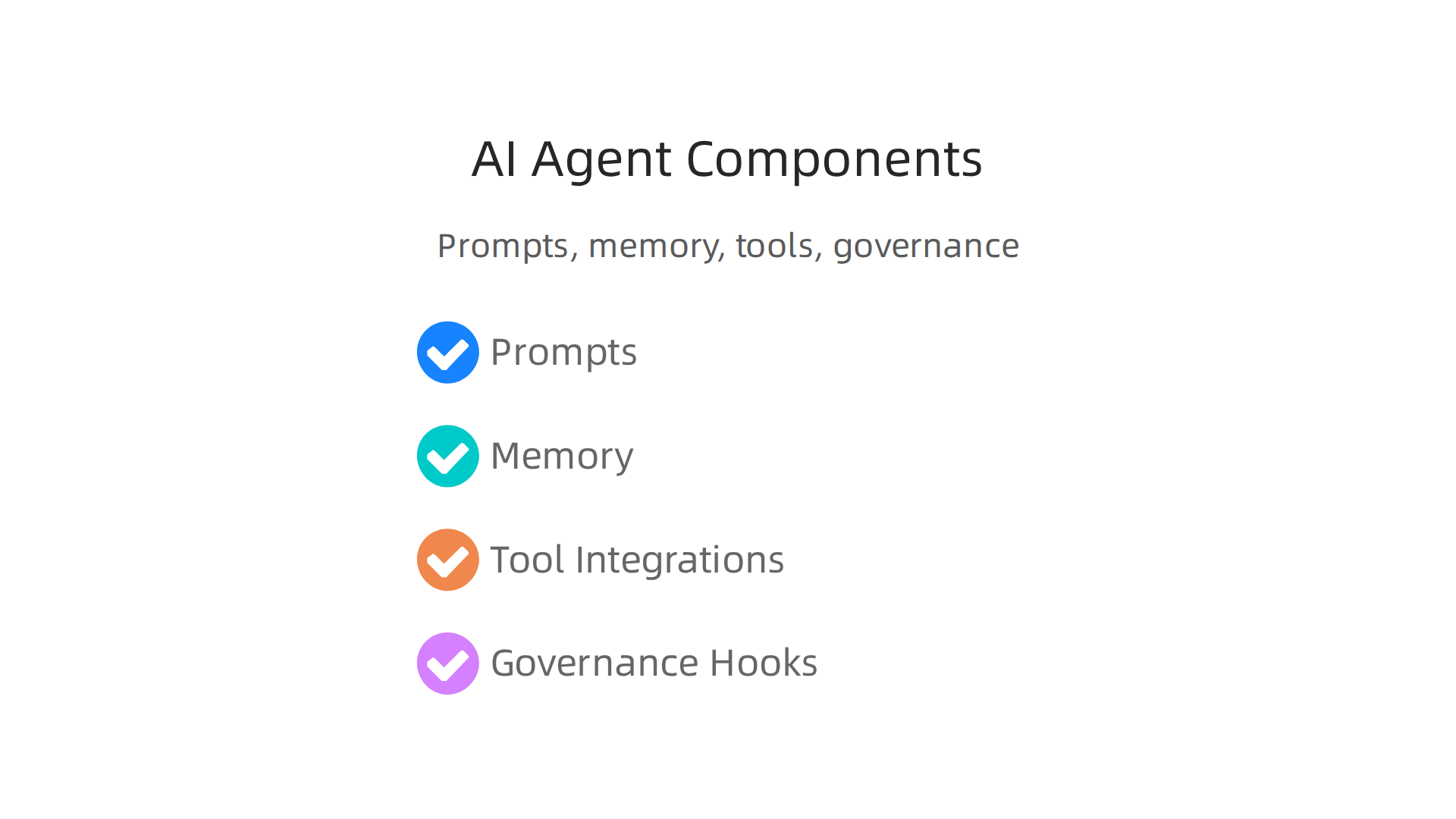
    An AI agent's effectiveness relies on its prompts, memory, tool integrations, and governance.

    • Prompts: These are the instructions you give the agent. They tell it what to do, what goals to aim for, and what style to use. Good prompts are like giving clear directions to a smart assistant.
    • Memory: Agents remember past actions, feedback, and what worked or didn’t work. This memory helps them learn and get better over time, making their future tasks more effective.
    • Tool Integrations: This is how AI agents connect to other software and services. For example, an agent might connect to a CRM (Customer Relationship Management) system like Zoho Marketing Automation to get customer info, or use analytics tools to see how well a campaign is doing. These connections help agents do real-world tasks. Choosing the right AI tools for your business is key to making these integrations work well How to Choose AI for Business Tools That Deliver Real Results in 2026.
    • Governance Hooks: These are safety checks and rules built into the agent. They make sure the agent follows company policies, legal rules, and ethical guidelines. This is very important for keeping AI agents responsible. Experts are working on how to create clear ways to evaluate agents in production Measuring Agents in Production.

    Real-World Marketing Examples

    How do these marketing AI agents actually help? Here are some examples of what they can do:

    • Lead Qualification: An agent can look at many potential customer details, figure out which ones are most likely to buy, and then send them personalized messages. This saves human sales teams a lot of time.
    • Creative Iteration: Need many different ideas for an ad campaign? An agent can quickly create many versions of ad copy, images, and video scripts, then test them to see which ones get the best reactions. This speeds up the creative process.
    • Campaign Optimization: During a marketing campaign, an autonomous agent can watch how people react to ads in real-time. If one ad isn’t working well, it can automatically change the ad, try a new audience, or even shift the budget to a better-performing ad. This ensures your marketing money is always working its hardest. This kind of optimization can significantly boost how effective your marketing efforts are How Marketing Specialists Choose AI Tools for Marketing and Drive ROI.

    Using marketing AI agents isn’t just about doing more tasks; it’s about getting real value for your business.

    A business leader reviews performance metrics to understand ROI and impact.

    These smart tools help companies save time, cut costs, and get better results from their marketing efforts. We can measure this value in a few key ways.

    Quantifying business value: ROI, time savings, and performance benchmarks

    One big way marketing AI agents help is by taking over many tasks that people used to do by hand. This reduces the amount of manual work needed across common marketing jobs. For example, agents can quickly create many versions of ad copy, write social media posts, or analyze campaign data. This frees up marketing teams to focus on bigger ideas and strategies. Some reports even show that using AI agents can reduce manual workflow tasks by as much as 85%, which greatly increases efficiency and returns on investment (ROI) across businesses in 2026 How AI Agents are Changing Marketing: The 2026 Guide – Top ….

    The value these agents bring can be grouped into different kinds of ROI:

    • Cost Reduction: By automating tasks, businesses spend less money on manpower for repetitive jobs. This also includes lowering the cost to get a new customer.
    • Speed-to-Market: AI agents can create content and launch campaigns much faster. This means businesses can react quickly to market changes and get their messages out sooner.
    • Personalization Lift: Agents can tailor messages to individual customers much better than humans can, which leads to more engagement and higher sales. Studies from 2026 show that AI for personalizing content can boost ROI by 2.7 times, while content drafting can see a 3.2 times ROI Agentic AI in Marketing: ROI Data & Guide 2026.
    • Experimentation Velocity: Marketing AI agents can test many different ideas very quickly to find out what works best. This helps improve marketing plans faster than ever.

    To truly understand how well marketing AI agents are doing, you need to track key numbers before and after you start using them. These performance benchmarks help you see the actual impact.

    Here are some important metrics to keep an eye on:

    • Effort hours: How many hours did your team spend on certain tasks before, and how many now with agents?
    • Conversion lift: Are more people buying, signing up, or taking desired actions because of the AI agents’ work?
    • Cost-per-acquisition changes: Has the cost of getting a new customer gone down?
    • Campaign ROI: What is the overall return on your investment in specific campaigns managed by agents?
    • Lead-to-customer conversion rate: How many potential customers become actual buyers thanks to the agent’s efforts?

    Setting clear goals and key performance indicators (KPIs) for your autonomous marketing AI agents is important to make sure they are on track KPIs for Autonomous AI Agents in Marketing and Governance. By tracking these numbers, businesses can see the real benefits of using marketing AI agents, from saving time to boosting sales. Learning how to get real ROI from AI marketing is a key step for success in 2026.

    Want to keep up with the latest in AI and technology?
    The AI Newsletter Worth Reading offers clear daily updates to help you stay informed.

    To truly get the most from your AI investments and see those great returns, it’s vital to pick the right tools for the job.

    A team collaborates to evaluate and select the best AI agent solutions.

    Not all marketing AI agents are built the same. When you’re looking at different options for your business, you need to know what features matter most.

    Key capabilities to prioritize when evaluating marketing AI agents

    Choosing the best marketing AI agents means looking closely at what they can do and how well they fit into your daily work. Think of it like picking the right team member; you want someone with the right skills and who can work well with everyone else.

    Here are the important things to look for:

    • Reliable Data Connections: Good marketing AI agents need to easily connect with all your data sources. This means linking to your customer lists, sales records, website analytics, and social media platforms. Without good connections, the agent can’t get the information it needs to make smart decisions.
    • Customizable Instructions (Prompt Flows): You should be able to tell your AI agent exactly what you want it to do and how. This involves setting up "prompt flows" that guide the agent’s actions, from writing an email to planning a whole campaign. The more you can customize these, the better the agent will understand and act on your specific marketing plan example.
    • Memory and Context: Just like a person, a good AI agent needs to remember past talks and actions. This "memory" helps it understand the bigger picture and keep its responses and tasks consistent over time. It helps the agent learn from what it’s done before. Many AI agents are built with core components like these to give them reasoning and language skills Agentic Universe: April 2026.
    • Ability to Take Action (APIs/Tools): An AI agent isn’t just for thinking; it’s for doing. It needs to be able to use other tools and systems through what are called APIs. This could mean posting directly to social media, updating your online marketing platform for small businesses, or sending emails through your existing marketing automation software.

    Beyond these core abilities, there are other important features that help these agents work smoothly every day:

    • Seeing What’s Happening (Observability): You should always be able to see what your marketing AI agents are doing. This means getting clear reports and updates, so you know the agent is working as it should and catching any problems early.
    • Handling Mistakes (Retry Semantics): What happens if an agent tries to do something and it fails? A good agent will have a plan to try again or tell you there’s a problem, instead of just giving up.
    • Safe Testing (Sandboxing): Before you let an agent loose on your real marketing, it’s helpful if you can test it in a safe "sandbox" environment. This way, you can make sure it works correctly without messing up your live campaigns.
    • Human Control Points (Human-in-the-Loop): Even the best AI agents need human oversight. You’ll want controls that let you step in to approve decisions or correct the agent if needed. This "human-in-the-loop" approach is often part of how production systems for AI agents are designed in 2026 State of AI Agents Q2 2026.

    Finally, consider how well the marketing AI agents can grow with your business. Can they manage many different campaigns at once? Can they adapt to different languages or regional needs if your business expands? This is called scalability and extensibility. Knowing how to choose AI for business tools that deliver real results is key to making sure your investment pays off in the long run.

    After understanding what makes good marketing AI agents, the next big step is putting them to work. This means making smart choices about how you get these tools and how you bring them into your business without causing big problems.

    Choosing and deploying an agent: checklist and phased rollout plan

    First, you need to decide if you want to buy a ready-made marketing AI agent or build one yourself. This is a big choice, like deciding to buy a car or build one from scratch.

    • Buying an Agent (Vendor Solution): This usually means you get to use the tool faster. It’s often easier because someone else has done all the hard work of building it. You just need to make sure it fits your needs and that you’re comfortable with how it handles your business data. This is good if you need quick results and don’t have a big team of tech experts.
    • Building Your Own Agent: This gives you full control. You can make the AI agent do exactly what you want, right down to the smallest detail. But, it takes a lot more time, effort, and people with special tech skills. You also need to think about who owns the data and how much work your team can actually take on. Businesses often weigh these points when looking at whether to build or buy new AI tools Navigating the build, buy, or borrow decision.

    Once you decide how to get your marketing AI agents, it’s time to put them into action. A good way to do this is with a step-by-step plan.

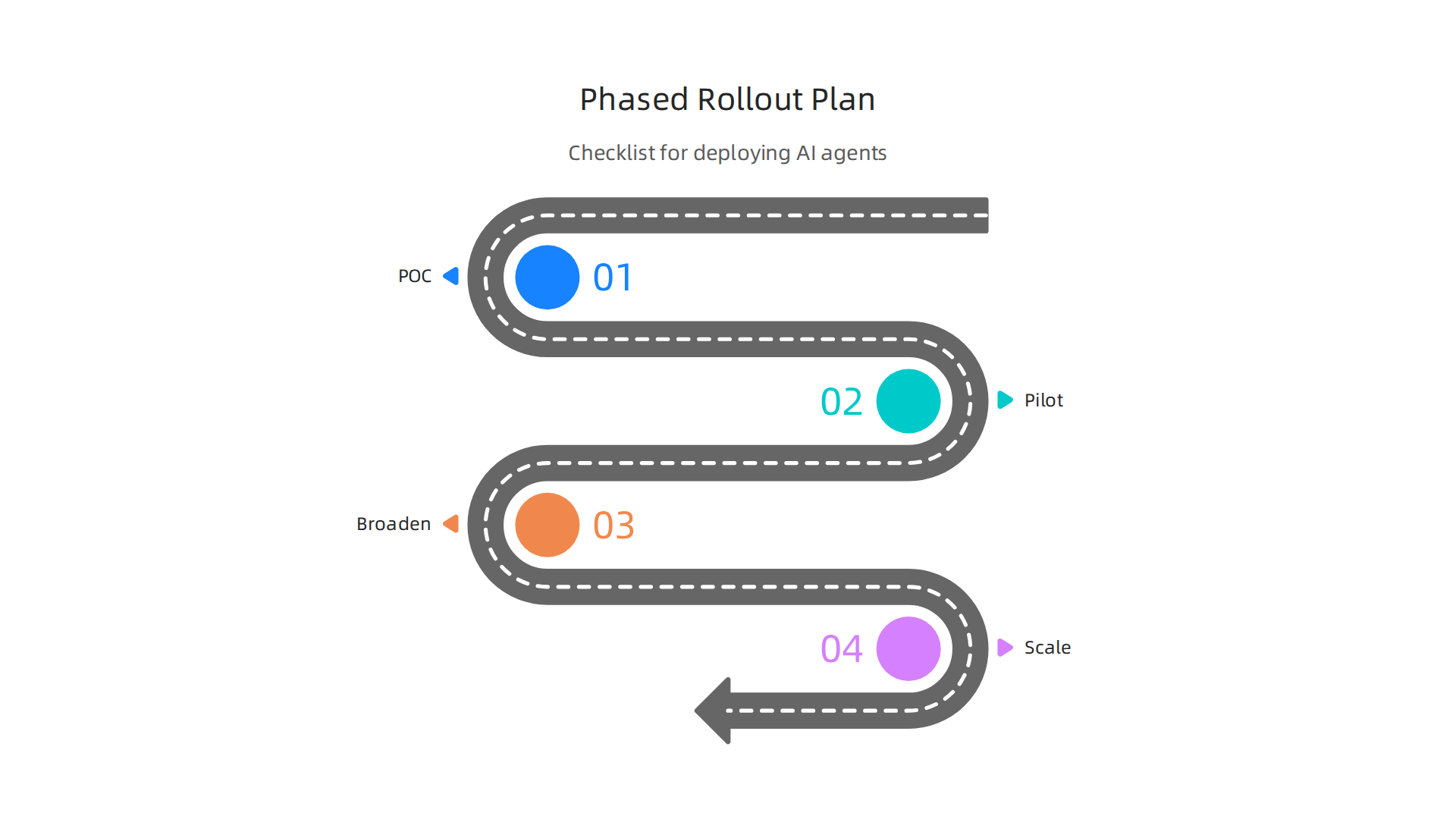
    A strategic phased rollout ensures smooth integration and scaling of AI agents.

    This helps you start small and grow safely.

    A Phased Rollout Plan

    1. Proof of Concept (POC): This is like a small test drive. You pick one simple task that the AI agent can do and see if it works.
      • Success Criteria: Does the agent complete the task? Does it save time or money for that one task? For example, you might test it writing a few social media posts for a specific marketing plan example. It’s smart to start with workflows that have low risk but high potential impact Using AI Agents for Marketing Agencies: 2026 Implementation Guide.
    2. Pilot: If the POC goes well, you expand the test to a small group of users or a small part of your business.
      • Success Criteria: Does it work well for this small group? Are there any unexpected problems? Are the people using it happy with it? During this stage, you should manually check every output for at least two weeks and use any errors to make the agent smarter How to Use an AI Agent for Marketing: The 2026 Playbook ….
    3. Broaden: Now, you slowly let more people or more parts of your business use the marketing AI agents.
      • Success Criteria: Is the agent still working well as more people use it? Is it helping more of your marketing team? This is where you might connect it with your online marketing platform for small businesses or a specific campaign.
    4. Scale: If all goes well, you make the AI agent a regular part of your marketing efforts across the whole company.
      • Success Criteria: Is it making a real difference to your business goals? Is it able to handle everything you throw at it? Are you seeing clear returns on your investment in these new tools?

    Practical Checklist for Deployment

    Before you fully unleash your marketing AI agents, here’s a checklist to make sure you’re ready:

    • Data Readiness: Make sure your business data is clean and ready for the AI. This means having good customer information and historical data. AI agents need connected, clean data to work effectively AI-Driven Marketing Strategies to Implement in 2026 – Aprimo. You’ll need things like real-time customer profiles and good data about how past campaigns performed AI Marketing Agents: 2026 Complete Guide. Having at least 12 months of clean historical data is a good rule of thumb AI Marketing Agent: 11 Best Tools & Guide (2026) – Improvado.
    • Integration Points: Think about how the AI agent will connect with your existing tools. This includes your CRM, email programs, and analytics tools like Zoho Marketing Automation. Make sure they can all "talk" to each other AI Marketing Agents: Complete 2026 Automation Guide. You want to link apps your team already uses daily, such as Slack, Gmail, or HubSpot 2026 Marketer’s Guide to AI Agents for Marketing Operations.
    • Service Level Agreements (SLAs): If you’re buying an agent, understand what kind of support you’ll get from the company selling it. How fast will they fix problems?
    • Monitoring: Set up ways to watch how your marketing AI agents are doing. This helps you catch any issues quickly and ensure they’re working as they should.
    • Change Management: Get your team ready for these new tools. Provide training, maybe even some free marketing courses on AI, and make sure everyone understands how the agents will help them. Before you start, write down the exact workflow you want the AI to handle, define what success looks like, and think about who owns the project AI Agents for Marketing: 15 Use Cases, ROI, and 2026 Guide.

    By following these steps, you can bring marketing AI agents into your business smoothly and make sure they truly help you reach your goals.

    For more deep dives into the latest AI tools and trends, make sure you’re subscribed.
    The AI Newsletter Worth Reading

    After you have a plan to put your marketing AI agents into action, the next big step is figuring out how these smart tools will talk to all your other business systems. This is like making sure all the different parts of a team can share information and work together smoothly. When your marketing AI agents link up with your customer relationship management (CRM), ad platforms, and analytics tools, they can do amazing things for your marketing plan.

    Integration patterns: linking agents to CRMs, ad platforms, and analytics

    Connecting your marketing AI agents with your existing tools is key for them to be truly helpful. It means that customer information, ad campaign results, and website visitor data can all be shared. This allows the AI agents to make smarter choices and take actions that fit your goals.

    There are a few common ways these connections work:

    • Data Sync (Data Sharing): This is like having two notebooks and making sure they both have the same information. Your marketing AI agents might regularly pull customer details from your CRM, or send updated customer scores back to it. This makes sure all your systems have the most current data. Businesses need clean, linked data for AI agents to work well, often including real-time customer profiles and historical campaign data to train models effectively AI Marketing Agents: 2026 Complete Guide.
    • Event-Driven Triggers (Action Starters): Imagine if one action automatically started another. For example, if a customer fills out a form on your website (an "event"), it could trigger your marketing AI agent to send a personalized email right away. Or if an ad campaign performs poorly, it could alert the agent to suggest changes.
    • API-Based Actioning (Direct Commands): APIs are like special language rules that allow different software programs to talk to each other and ask for things to be done. Your AI agent can use APIs to directly create new ads on an ad platform or update details in your CRM. This lets the agent not just suggest things, but actually do them.
    • Streaming Analytics (Constant Flow of Information): This means data is always flowing, like a river, instead of coming in big batches. For marketing AI agents, this is super important because it lets them see what’s happening right now. If a product suddenly becomes popular, the agent can adjust your online marketing platform for small businesses campaigns in real time. This constant data flow helps AI agents react quickly to changes [How AI agents will reshape every part of marketing in 2026](https://martech.org/how-ai-agents-will-reshape-every-part-of-marketing-in 2026/).

    Handling Data Across Systems

    When many systems work together, we need to be careful about how data is managed:

    • Idempotency (No Double Actions): This is a fancy word that means doing the same action multiple times has the same result as doing it once. For example, if your AI agent tries to send an email twice by mistake, idempotency ensures the customer only receives one email. It prevents double billing or duplicate entries.
    • Reconciliation (Making Data Match): With many systems, data can sometimes get out of sync. Reconciliation is checking that the information in your CRM, ad platform, and analytics tools all match up. This is vital for accurate reporting and making good decisions. For example, ad platform data should feed back into the AI agent’s information to match up with CRM records AI Agents for Agencies: Connect Client Data Safely.
    • Data Governance (Keeping Data Safe and Proper): This is about setting rules for how your data is collected, stored, and used. It makes sure your marketing AI agents respect privacy laws and company policies. Good data governance also means your data is high quality, which is super important for AI to learn from.

    Architectural Choices: Real-time vs. Batch and Coupled vs. Loosely Coupled

    When building these connections, businesses make some important choices:

    • Real-time vs. Batch: Do you need information to update instantly (real-time), or is it okay for updates to happen once a day or once an hour (batch)? Real-time updates are great for fast-moving campaigns, while batch updates can be simpler for less urgent tasks.
    • Coupled vs. Loosely Coupled Integrations:
      • Coupled: Systems are tightly linked. If one system changes, the other might need to change too. This can be faster for small setups.
      • Loosely Coupled: Systems work more independently. They connect through standard ways, so if one changes, it’s less likely to break the other. This makes your whole setup more flexible as you grow.

    Choosing the right integration patterns and making smart architectural choices helps your marketing AI agents truly shine. It makes sure they are not just useful tools, but fully integrated team members that boost your marketing efforts.

    If you’re looking to enhance your understanding of marketing technology, exploring options for how to choose marketing automation software in 2026 can provide further insights into optimizing your operations.

    After linking up your marketing AI agents with your existing systems, a very important next step is to set up clear rules and make sure everything runs safely and properly. This is called governance, compliance, and risk management. It’s like having a good rulebook and safety checks in place so your smart tools work in a way that is fair, legal, and keeps your brand safe.

    Professionals collaborate to establish and review safety protocols for AI systems.

    Data Privacy and Consent

    When marketing AI agents access customer information, it’s super important to respect people’s privacy. These agents often look at user data to make marketing campaigns better. So, you need to make sure you have permission, or "consent," from customers to use their data. Laws like GDPR in Europe and others around the world mean businesses must be very careful about how they gather, store, and use personal information. For example, people must clearly agree to how their data is used for personalized ads, not just have a pre-checked box AI Compliance in Marketing: The Complete Guide 2026.

    This also means that your marketing AI agents should only get access to the information they absolutely need to do their job. Businesses must document how their marketing agents handle personal data to comply with regulations Snowflake’s Agentic Enterprise Framework Puts Data …. Without proper consent management, using marketing AI agents can lead to big problems.

    Bias, Brand Safety, and Content Review

    Marketing AI agents can create ads, emails, and other content very quickly. But sometimes, AI can pick up unfair ideas or "bias" from the data it learns from. This could lead to content that is not fair or doesn’t fit your brand’s values. To stop this, you need:

    • Human-in-the-loop governance: This means people regularly check what the AI agents are doing and creating. For new AI agents, you should manually review every output for a few weeks to catch any errors How to Use an AI Agent for Marketing: The 2026 Playbook ….
    • Brand guidelines: Give your marketing AI agents clear rules about your brand’s voice and what kind of content is okay. This helps them create messages that always sound like your company.
    • Safety controls: Set up ways for the AI to flag or stop content that might be offensive, wrong, or goes against your rules. This helps ensure brand safety.

    Having these controls in place is key for any marketing plan example that uses AI.

    Security and Access Controls

    Finally, keeping your AI systems and the data they use safe is super important. Think about these things for your marketing AI agents:

    • Least privilege: This means your AI agents should only have the minimum access rights needed to do their specific tasks. They shouldn’t be able to see or change data they don’t need. This helps prevent unwanted access AI Regulation 2026: Current Laws, Compliance Requirements, and ….
    • Audit trails: You need a record of everything your marketing AI agents do. This is like a logbook that shows who accessed what, when, and what actions were taken. If something goes wrong, an audit trail helps you figure out what happened.
    • Incident response planning: Have a plan for what to do if there’s a security problem, like a data breach or an AI agent acting strangely. Knowing what steps to take beforehand can save a lot of trouble.

    As you adopt new smart tools, understanding potential problems and how to deal with them is part of having a good Stealth AI: A Business Guide to Hidden AI Risks, Opportunities, and Management in 2026. Keeping these governance, compliance, and risk management ideas in mind will help your marketing AI agents be both powerful and trustworthy tools for your business.

    After making sure your marketing AI agents follow all the rules and keep data safe, the next big step is to see how well they are actually doing. This means measuring, making them better, and growing their use over time. You want to make sure these smart tools are truly helping your business grow.

    Testing How Well Agents Perform

    To know if your marketing AI agents are working, you need to test them. A great way to do this is through something called A/B testing. This is like trying out two different ideas to see which one works better. For example, you can have your AI agent create one type of ad, and then have your regular marketing team or a different AI strategy create another. You then show both to similar groups of people to see which ad gets more clicks or sales.

    By doing these tests, you can compare what your marketing AI agents do versus your usual ways of working. Studies in 2026 show that successful AI agents can bring in 4.1 to 5.3 times more return on investment for the tasks they automate [Agentic AI in Marketing: ROI Data & Guide 2026]. This helps you see the real value of these smart tools for your marketing plan example. If you want to dive deeper into getting great returns, learn about how marketing specialists choose AI tools for marketing and drive ROI.

    What to Watch: Key Numbers and Dashboards

    To keep track of your marketing AI agents, you need to set up clear ways to measure their success. Think of this like a dashboard in a car, showing you all the important things at a glance. For AI agents, you should watch for:

    • Speed (latency): How quickly do your agents act or respond? Faster is usually better.
    • Success rate: How often do they do their job correctly, like sending the right email or suggesting the right product?
    • Conversion attribution: This means figuring out how much credit your marketing AI agents deserve for bringing in leads or making sales.
    • Cost per action: How much does it cost for an agent to complete a task, like getting a customer to sign up or click a link?

    It’s important to set up these special goals, or Key Performance Indicators (KPIs), for your autonomous AI agents. These help you track their operational health and how they impact your business goals, like making more money or getting more customers KPIs for Autonomous AI Agents in Marketing and Governance. Platforms for online marketing, such as Zoho Marketing Automation, often have features to help you track these metrics.

    Always Getting Better: Continuous Improvement

    Using marketing AI agents isn’t a "set it and forget it" task. For them to stay useful, you need to make them better over time. This involves a few key steps:

    • Feedback loops: This is where people tell the AI what worked well and what didn’t. Your team can give feedback on the content the agents create or the decisions they make.
    • Retraining triggers: As new information comes in or marketing trends change, your AI agents might need to learn new things. You need to know when it’s time to "retrain" them with fresh data.
    • Lifecycle management: This is about how you keep your marketing AI agents updated and relevant through their whole life, from when you first use them to when they might need big changes.

    By having these plans in place, your marketing AI agents can keep learning and improving. This ensures they continue to bring value to your business year after year. Learning how AI agents get better over time is crucial for long-term success [How Do AI Agents Learn and Improve Over Time?]. For tips on maximizing your investment, check out how to get real ROI from AI marketing cloud in 2026.

    Want to stay informed about all the latest in AI and technology?

    The AI Newsletter Worth Reading

    Summary

    Marketing AI agents are autonomous, multi-step AI systems that plan, act, and learn to run marketing tasks from content creation to campaign optimization. This article explains the different agent types—from single-purpose tools to fully autonomous campaigning agents—what technical parts make them work (prompts, memory, tool integrations), and the real-world use cases such as lead qualification, creative iteration, and live campaign optimization. You’ll get a practical checklist for choosing whether to buy or build, a phased rollout plan (POC → pilot → broaden → scale), and concrete integration patterns for CRMs, ad platforms, and streaming analytics. The guide also covers governance: consent, bias checks, least-privilege access, and audit trails, plus the metrics you must track (effort hours, conversion lift, cost-per-acquisition, campaign ROI). Finally, it shows how to test agents, set KPIs, and create feedback loops so agents improve over time, helping teams save time, cut costs, and boost marketing performance.