Tag: digital transformation

  • Top 10 Technology Trends Business Leaders Must Adopt in 2026

    Top 10 Technology Trends Business Leaders Must Adopt in 2026

    Why the ‘Top 10 Technology Trends’ Matter for Business Leaders in 2026

    It feels like every day brings news of a new tool or breakthrough. For business leaders in 2026, keeping up with all these changes can be a real headache.

    A business leader thoughtfully considering future strategies amidst rapid technological changes.

    You hear about so many new things, it’s hard to know what’s truly important for your business and what’s just hype. This flood of information makes it tough to decide where to put your time and money. It’s especially tricky with how fast technology moves these days, constantly reshaping our future.

    Think about Artificial Intelligence (AI). Just a short time ago, it was a new idea for many businesses. Now, in 2026, AI is a big part of how many companies work. For example, about 72% of large businesses are already using AI in some way, running at least one AI program in their daily work routines.
    A platform tracking the state of AI adoption across industries and company sizes.

    This shows how quickly things can change, and how important it is to keep an eye on the State of AI Adoption 2026: Rates by Industry & Company Size.

    This speedy tech adoption curve means leaders need to be smart about picking which innovations to focus on. It’s not just about knowing what the top 10 technology trends are, but also understanding why they matter to your specific business and how to use them well. Trying to figure this out alone, sifting through endless articles and reports about AI startups and other new technologies, can feel like a full-time job.

    This guide is here to help. We’ll cut through the noise to show you the most important top 10 technology trends for businesses in 2026. You’ll get clear, easy-to-understand explanations, real-world examples of how these trends can help your company, and simple steps to start using them. Our goal is to make sure you have the knowledge to make smart choices, stay ahead of the game, and build a smart future for your business.

    To stay on top of daily updates without feeling overwhelmed, consider subscribing to The AI Newsletter Worth Reading.

    Generative AI and LLMs: Practical Use Cases and Implementation Steps

    One of the most exciting parts of the current tech adoption curve is Generative AI and Large Language Models, often called LLMs. These are computer programs that can create new things, like text, images, or even computer code. Think of them as very smart assistants that can understand what you ask for and then make something completely new based on your request. In 2026, many businesses are already seeing big benefits from using them.

    Actually, about 79% of organizations now use Generative AI in some way, showing how quickly this tech has grown since 2024 Generative AI Adoption Statistics 2026: Enterprise Data. This makes Generative AI one of the most important top 10 technology trends for business leaders today.

    Here are some ways businesses are using Generative AI right now:
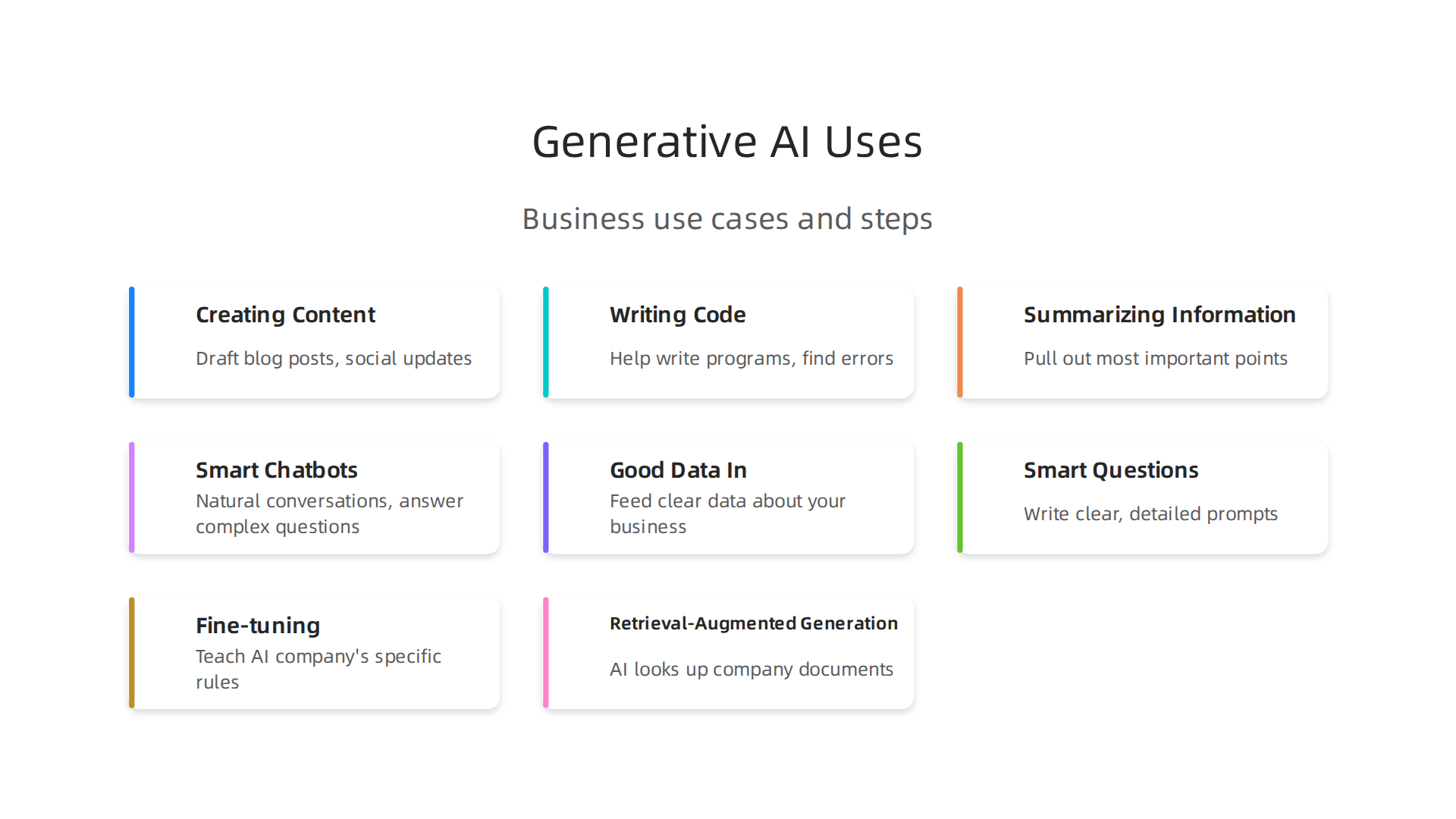
    Key ways businesses are applying Generative AI today for content, code, and customer service.

    • Creating Content: Need a blog post, social media update, or even ideas for an ad? Generative AI can quickly draft these things, saving a lot of time for marketing teams. This helps businesses keep up with the constant need for new content.
    • Writing Code: For software developers, AI can help write parts of programs or find errors. This makes coding faster and easier, speeding up how quickly new tools and apps can be made.
    • Summarizing Information: Imagine having to read long reports or many customer reviews. Generative AI can quickly go through tons of text and pull out the most important points. This helps leaders make faster decisions without getting lost in details.
    • Smart Chatbots: These aren’t like the old, simple chatbots. Today’s AI chatbots can have more natural conversations with customers, answer complex questions, and even help solve problems. This improves customer service and can save money on support staff.

    The quickest way businesses see money back (ROI) from Generative AI is by making daily tasks faster and reducing costs. For example, using AI to write first drafts of content or answer common customer questions can free up your team to focus on bigger, more complex jobs.

    How to Use Generative AI in Your Business

    Bringing Generative AI into your company doesn’t have to be hard, but there are a few things to keep in mind:
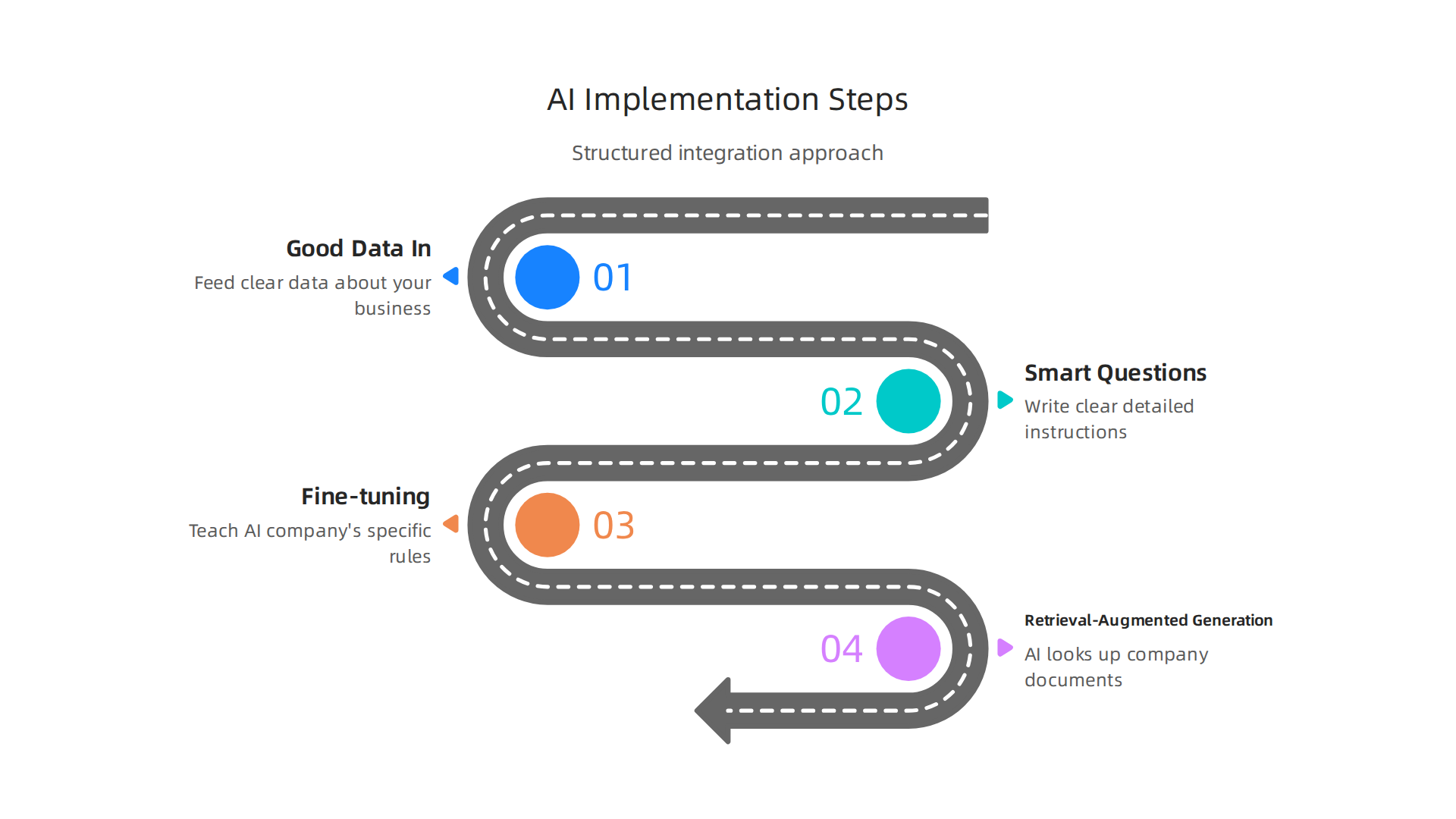
    A structured approach to successfully integrate Generative AI into business operations.

    1. Good Data In: The AI learns from information. If you feed it good, clear data about your business, it will give you better results. Think about the kind of text or examples you want it to learn from.
    2. Smart Questions (Prompts): How you ask the AI to do something is very important. Writing clear, detailed instructions, called "prompts," helps the AI understand exactly what you want it to create.
    3. Making it Smarter:
      • Fine-tuning: This is like teaching the AI about your company’s specific way of speaking or special rules. You give it more examples that are just like your business, so it learns to sound like you.
      • Retrieval-Augmented Generation (RAG): This is a fancy way of saying the AI can look up information from your own company documents before answering. So, when a customer asks a question, the AI can check your company’s knowledge base to give the most accurate, up-to-date answer. This helps it not "make things up" and use your real business data.

    By focusing on these steps, businesses can start using Generative AI to build a smart future. If you’re looking for the right tools, it’s wise to learn how to choose AI for business tools that deliver real results in 2026.

    The world of Generative AI is always moving forward. Beyond making content or code, some AI models are built to be very flexible and smart, forming the base for many different uses. These are called Foundation Models.

    Foundation Models: The Smart Base

    Think of a Foundation Model as a giant, all-purpose brain. It’s trained on a huge amount of different information, like text, images, and code from the internet. This makes it good at many tasks right out of the box. Instead of building a new AI for every little job, businesses can take one of these powerful base models and teach it a few more things specific to their needs. This helps companies, including ai startups, quickly adapt AI for their unique goals. These models are a big reason why AI is one of the top 10 technology trends in 2026. You can even find market research reports that go deep into Foundation AI Models Market Research Report 2026.

    Multimodal AI: Understanding More Than Just Words

    While many AI models mainly work with text, Multimodal AI can understand and create using many types of data at once. This includes text, pictures, sounds, and even videos. For example, a multimodal AI could look at a picture, listen to a description of it, and then write a story about what it sees and hears. This makes AI much more helpful and natural to interact with A Survey on Multimodal Foundation Models: Architectures, Training Paradigms, and Emerging Applications. It’s a huge step in the tech adoption curve because it means AI can handle more real-world situations.

    Personalization at Scale

    One of the biggest uses for these advanced AIs is making things personal for everyone.

    A person experiencing a highly personalized interaction, enabled by advanced AI models.

    Imagine an online store that knows exactly what you like, or a learning app that customizes lessons just for you. This is "personalization at scale," meaning it can be done for millions of people.

    Here’s how these models help make experiences truly personal:

    • Fine-tuning: Like we talked about before, fine-tuning teaches a general AI model your company’s special way of doing things. For personalization, you’d fine-tune it with data about your customers’ preferences, so it learns to serve them better.
    • Adapters: These are like small, extra layers added to a Foundation Model. They let you tweak the model for specific tasks or users without having to retrain the whole giant model. It’s faster and uses less computing power.
    • Embeddings: This is a smart trick where all kinds of data (text, images, user actions) are turned into simple lists of numbers. When two lists of numbers are close, it means the data they represent is similar. So, if a user’s "embedding" is close to an item’s "embedding," the AI knows that user will likely enjoy that item. This helps recommend things, search for information, and personalize experiences very quickly.

    Being Smart About Privacy and Pitfalls

    When making things personal, businesses must be very careful with customer information. Protecting privacy and using data ethically is key. It’s also important to make sure the AI doesn’t create unfair experiences because of how it was trained. Careful data handling and constant checks help avoid these common problems as we move towards a smart future.

    Want to stay ahead of these rapid changes in AI? Get the latest insights directly in your inbox.

    The AI Newsletter Worth Reading

    Learning about these new ways AI can personalize experiences is crucial for businesses. It’s all about making sure the new technology works well for everyone. To see how these tools can transform your online presence, explore how to build a futuristic website 2026 AI personalization offers.

    Moving from making things personal for each person, AI is also changing how businesses get work done. It’s not just about tailoring experiences; it’s about making whole work processes faster and smarter. This is where AI-augmented automation and hyperautomation come in.

    AI-Augmented Automation and Hyperautomation: From RPA to End-to-End Process Intelligence

    In the past, many businesses used something called Robotic Process Automation, or RPA. Think of RPA as a simple robot that does the same easy tasks over and over again, like copying data from one spreadsheet to another. It was good for basic, repeatable work.

    But now, AI has changed the game. We’re seeing a shift from simple RPA to much smarter systems. This is called "hyperautomation." With hyperautomation, AI doesn’t just do tasks; it also helps decide what tasks need doing and how best to do them. It uses AI to learn from how work is done, find problems, and even suggest better ways. This big change makes it possible for businesses to automate many more parts of their work, not just small, easy steps. In fact, AI can automate up to 70% of everyday work tasks in 2026, marking a big leap forward in how we get things done How 2026 AI Could Automate Up to 70% of Everyday Work.

    This idea of AI looking at whole workflows is called "end-to-end process intelligence." It means AI can see the big picture of how a company works, from start to finish. It helps find bottlenecks or slow spots and makes the entire process smoother. This is one of the top 10 technology trends because it helps businesses save time and money. For example, AI can help with customer support by answering common questions or with handling invoices by checking all the details quickly. Businesses are using AI in many ways, from finance to customer service, to make things work better AI Automation Use Cases 2026: 40 Proven Business.

    To figure out where AI automation can help your business, you need a plan. Here’s a simple roadmap:
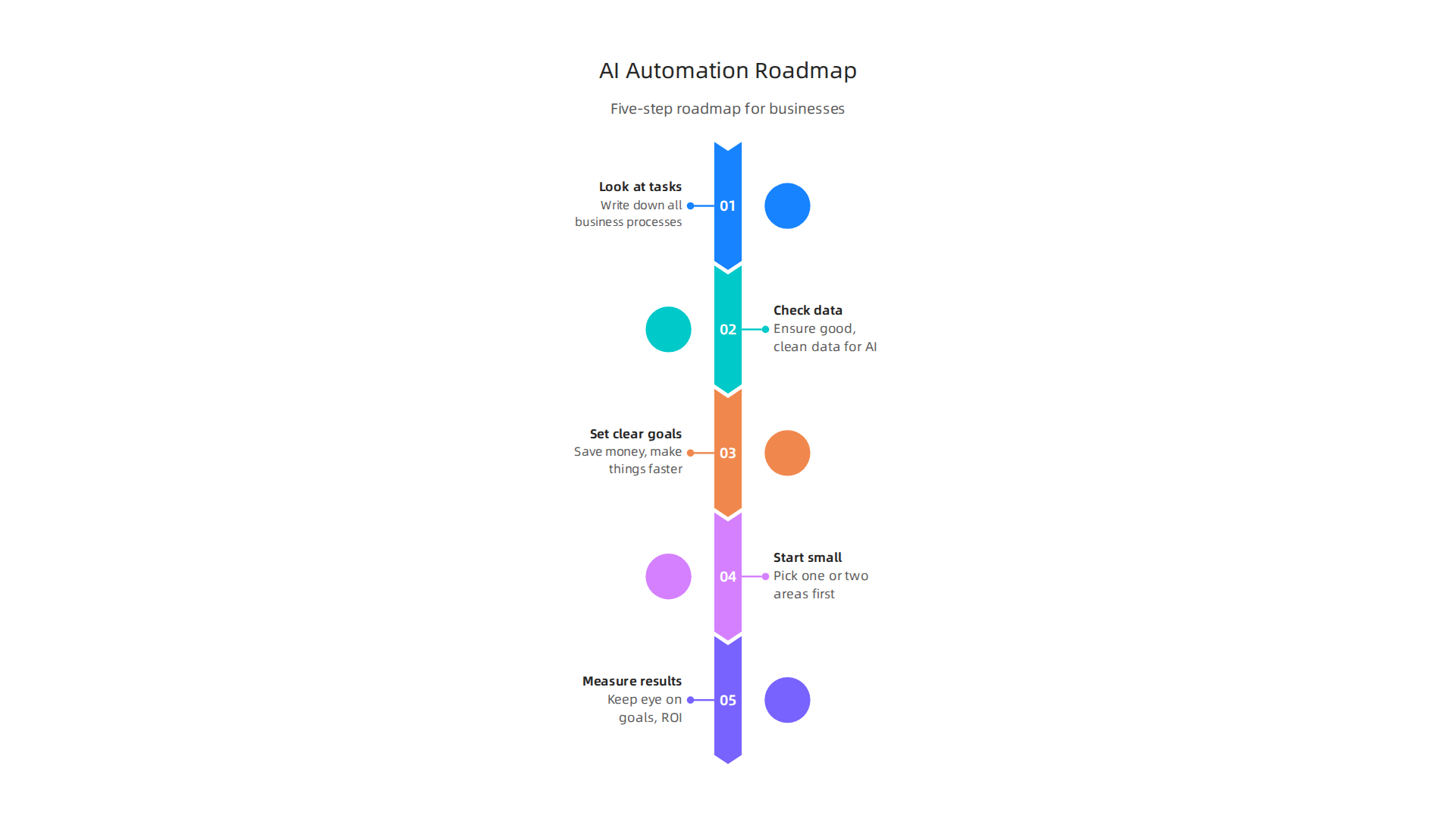
    A five-step roadmap for businesses to effectively implement AI automation.

    1. Look at your tasks: First, write down all the steps in your business processes. What jobs take a lot of time? Which ones are repetitive?
    2. Check your data: AI learns from data. Make sure you have good, clean data for the AI to use.
    3. Set clear goals: What do you want to achieve? Do you want to save money, make things faster, or improve how customers feel?
    4. Start small: Pick one or two areas to automate first. See how it works before doing more.
    5. Measure results: Keep an eye on your goals. Is the AI actually saving you money or time? Many companies are finding good returns on their AI investments Guide to Artificial Intelligence Automation Solutions 2026.

    Choosing the right tools for this kind of automation is also key. To learn more about software that can help, check out our guide on how to choose marketing automation software in 2026. You might also want to explore different Enterprise AI Platforms 2026 to find the best fit for your company.

    Moving from making things personal for each person, AI is also changing how businesses get work done. It’s not just about tailoring experiences; it’s about making whole work processes faster and smarter. This is where AI-augmented automation and hyperautomation come in.

    In the past, many businesses used something called Robotic Process Automation, or RPA. Think of RPA as a simple robot that does the same easy tasks over and over again, like copying data from one spreadsheet to another. It was good for basic, repeatable work.

    But now, AI has changed the game. We’re seeing a shift from simple RPA to much smarter systems. This is called "hyperautomation." With hyperautomation, AI doesn’t just do tasks; it also helps decide what tasks need doing and how best to do them. It uses AI to learn from how work is done, find problems, and even suggest better ways. This big change makes it possible for businesses to automate many more parts of their work, not just small, easy steps. In fact, AI can automate up to 70% of everyday work tasks in 2026, marking a big leap forward in how we get things done How 2026 AI Could Automate Up to 70% of Everyday Work.

    This idea of AI looking at whole workflows is called "end-to-end process intelligence." It means AI can see the big picture of how a company works, from start to finish. It helps find bottlenecks or slow spots and makes the entire process smoother. This is one of the top 10 technology trends because it helps businesses save time and money. For example, AI can help with customer support by answering common questions or with handling invoices by checking all the details quickly. Businesses are using AI in many ways, from finance to customer service, to make things work better AI Automation Use Cases 2026: 40 Proven Business.

    To figure out where AI automation can help your business, you need a plan. Here’s a simple roadmap:

    1. Look at your tasks: First, write down all the steps in your business processes. What jobs take a lot of time? Which ones are repetitive?
    2. Check your data: AI learns from data. Make sure you have good, clean data for the AI to use.
    3. Set clear goals: What do you want to achieve? Do you want to save money, make things faster, or improve how customers feel?
    4. Start small: Pick one or two areas to automate first. See how it works before doing more.
    5. Measure results: Keep an eye on your goals. Is the AI actually saving you money or time? Many companies are finding good returns on their AI investments Guide to Artificial Intelligence Automation Solutions 2026.

    Choosing the right tools for this kind of automation is also key. To learn more about software that can help, check out our guide on how to choose marketing automation software in 2026. You might also want to explore different Enterprise AI Platforms 2026 to find the best fit for your company.

    Edge AI and IoT: Real-Time Inference and Distributed Intelligence

    Now, let’s look at another important shift in the world of AI: Edge AI. While big cloud computers do amazing things, sometimes you need AI to work right where the action is. This is where Edge AI comes in, putting smart tech directly into devices and machines. It’s a huge step in the tech adoption curve for many companies.

    Edge AI means that AI calculations happen on the device itself, or very close to it, instead of sending all the data to a faraway cloud server. Think of a smart camera in a factory that can spot a problem instantly, or a sensor in a store that understands what’s happening without sending videos to a central hub. This is sometimes called "distributed intelligence" because the smarts are spread out.

    Why is this a big deal?

    • Speed (Low Latency): When data doesn’t have to travel far, AI can make decisions super fast. This "real-time inference" is critical for things like self-driving cars or quickly sorting items on an assembly line. Processing data locally means responses can be nearly instant, sometimes under 50 milliseconds
    A learning hub explaining the concept and benefits of Edge AI for real-time processing.

    What is Edge AI? | Azion.

    • Privacy: Keeping data on the device or local network means sensitive information doesn’t need to be sent over the internet to a cloud server. This is a big plus for privacy in places like retail stores or hospitals Edge AI Explained 2026: Running ML Models on Tiny Devices.
    • Cost: Sending lots of data to the cloud can be expensive. Edge AI reduces this cost by only sending small pieces of information or summaries, saving money on bandwidth.
    • Works Anywhere: Edge AI can even work when there’s no internet connection, which is great for remote locations or times when the network is down.

    This technology is a game-changer for industries like manufacturing, where machines need to react instantly to changes, or in logistics, for tracking goods efficiently. In retail, Edge AI helps with things like managing inventory or understanding customer flows in real-time. For a truly smart future, we’ll see more ai startups focusing on these on-device solutions.

    To get started with Edge AI, businesses need to think about suitable hardware, like special chips that can run AI models directly on devices. They also need to balance how much power these devices use with how well they perform. This approach is one of the top 10 technology trends that will define how we interact with technology in 2026.

    If you want to keep up with these kinds of daily changes in AI and technology, you’ll love The AI Newsletter Worth Reading.

    AI for Security, Privacy, and Trust: Defending Models and Data

    As AI gets smarter and works closer to us, like with Edge AI devices, we also need to think about keeping it safe and trustworthy. This is a big challenge and one of the top 10 technology trends for 2026. Just like you’d lock your front door, businesses must protect their AI systems and the data they use. Failing to do so can cause serious problems, from data leaks to incorrect decisions by the AI.

    One major worry is "model security." This means making sure the AI itself isn’t tricked or broken.

    • Poisoning Attacks: Imagine someone feeding bad or false information to an AI while it’s learning. This "poisoning" can make the AI learn wrong things, leading to bad decisions later.
    • Prompt Injection: This is like giving a smart AI a tricky question to make it do something it shouldn’t, like share private information or follow wrong instructions.

    These kinds of attacks are real. In fact, many companies have already faced issues. A report found that 65% of organizations had at least one cybersecurity problem in the past year because of AI agents on their networks. Also, about one in four harmful computer breaches are now caused by AI, costing companies a lot of money on average [IBM Study: One in Four Malicious Breaches are AI-Enabled …].

    Then there’s "data privacy." AI needs lots of data to work, but much of that data can be private or sensitive. Businesses need to make sure this information stays safe. Studies show that data leaks are the most common problem with AI security incidents. For example, 61% of problems involving AI agents meant sensitive data was exposed [AI Agent Security Incidents Hit 65% of Firms in 2026]. This is why protecting sensitive data is so important. Also, "Shadow AI," which is when employees use AI tools without company approval, has caused data leaks in nearly 9 out of 10 organizations in the past year [Artificial Intelligence Report 2026]. This highlights a big concern about businesses not knowing about or controlling all the AI tools being used.

    To build a truly smart future with AI, businesses need to put secure practices first. Here’s a simple checklist to help keep AI models and data safe:

    • Understand your AI: Know exactly what data your AI uses and how it makes decisions.
    • Protect your data: Make sure all data used by AI is secured with strong passwords and other safety measures. Use methods to hide or scramble sensitive data whenever possible to boost privacy [Key AI Data Privacy Statistics to Know in 2026].
    • Watch for sneaky attacks: Keep an eye out for odd behavior that might signal prompt injection or model poisoning attempts.
    • Control AI use: Make sure employees only use approved AI tools and understand the rules. Many AI security incidents are linked to using AI without proper checks [2026 AI Data Crisis: Protect Your Sensitive Information Now].
    • Regular checks: Just like checking your car’s oil, regularly review your AI systems for weaknesses.
    • Have a plan: Know what to do if an AI security problem happens, so you can fix it quickly.
    • Stay updated: The world of AI changes fast. Keep learning about new risks and ways to protect your systems.

    Making sure AI is secure, private, and trustworthy is a key part of the tech adoption curve for any company hoping to succeed with AI in 2026. This focus on safety helps build trust and makes sure AI works for us in good ways. Businesses can also get help by looking at guides for mastering the AI future standard.

    After we talk about keeping AI safe from attacks and protecting private data, the next big step is to make sure we use AI in a good, fair, and responsible way. This is called "Responsible AI and Governance." It’s one of the top 10 technology trends for 2026 because it helps businesses manage the risks of AI and follow the rules.

    Think of AI governance as setting up a clear set of guidelines for how your company uses AI. It’s about having policies in place, understanding the risks of your AI models, and making sure you follow all the necessary laws. This helps build a smart future where AI can be trusted.

    What is AI Governance?

    AI governance means putting rules in place to oversee your AI systems.

    A diverse team discussing and establishing guidelines for responsible AI governance and compliance.

    It helps you keep track of what AI you’re using, how risky it is, and if it’s doing what it’s supposed to.

    • Model Inventories: This is like a list or a map of all the AI tools your company uses. It helps you know exactly what AI is running, where it is, and what it does. This way, no AI is used without anyone knowing, which can help prevent problems like those from "Shadow AI" mentioned earlier.
    • Risk Tiers: Not all AI is equally risky. An AI that helps you choose music is very different from an AI that helps doctors make health choices. Risk tiers help you rate each AI tool based on how much harm it could cause if it goes wrong. This helps you put more attention on the most important ones.
    • Audit Trails: These are like a detailed diary of your AI’s actions. They record how and why an AI made a certain decision. If something goes wrong, an audit trail helps you understand what happened, much like tracking steps in a recipe.

    These governance structures should grow with your business and how many rules or laws you need to follow. For instance, a big company in healthcare will need much stricter rules than a small local shop. Actually, when businesses don’t have good AI governance, it can lead to bigger problems and costs, as shown by some reports [IBM 2026 Breach Report: AI Governance Failures Drive …].

    Simple Steps for Small Teams and AI Startups

    You might think that AI governance is only for big companies, but even ai startups and small teams need to start somewhere. You don’t need a huge budget or a lot of staff to begin. Here are some easy steps:

    • Start Small: Don’t try to build a perfect system all at once. Pick one or two AI tools you use often and focus on them first.
    • List Your AI Tools: Make a simple list of all the AI applications your team uses. Write down what each tool does and who is in charge of it. This is your basic model inventory. If you want to dive deeper into tracking tools, you can learn how to build a tech radar to track AI trends and tools in 2026.
    • Think About the Risks: For each tool, ask simple questions. What could go wrong if this AI makes a mistake? Could it accidentally share private info? The answers help you understand its risk level.
    • Keep Simple Records: For important AI decisions, jot down why the AI was used, what it did, and if the outcome was good or bad. This creates a basic audit trail.
    • Stay Informed: The world of AI is changing fast, and new rules for AI are coming out all the time. Keeping up with the latest trends helps you adjust your own rules. This is key to staying ahead on the tech adoption curve.

    By taking these steps, even small teams can make sure their AI use is responsible and trustworthy. It’s about being smart and thoughtful with these powerful tools.


    Get clear daily AI updates directly in your inbox.
    The AI Newsletter Worth Reading

    After putting rules in place for AI, the next step for businesses is to pick the right AI tools and plan how to use them. This means thinking about which AI products to buy or even build yourself, which is a big part of the top 10 technology trends for 2026. It’s about choosing tools that help you create a smart future for your company.

    AI-Native Product Strategies and Vendor Evaluation: Choosing the Right Tools

    When you’re ready to bring AI into your business, you need a smart plan. You’ll either buy AI tools from other companies (vendors) or create your own.

    Two business professionals engaged in a deep discussion to make strategic decisions about AI tool adoption.

    This choice depends on a few important things.

    Deciding to Build or Buy AI Tools

    • Cost: Making your own AI tools can be very expensive at first because you need to hire experts and buy special equipment. Buying ready-made tools often costs less to start.
    • Data Gravity: Think about where your important company data lives. If your data needs to stay super private or respond very quickly, you might want AI that works "at the edge." This means the AI processes data right where it is, like on your own devices or in your local office, instead of sending it all to the cloud. This helps with privacy and speed. For example, edge AI can offer much stronger privacy because data doesn’t leave your local network [The Edge AI Breakthrough: How Local Processing Is …]. It also leads to very low delays, or "latency," meaning decisions happen super fast [Edge AI Explained 2026: Running ML Models on Tiny Devices].
    • Extensibility: This is about how easily an AI tool can connect and work with other tools you already use. If you buy a tool, make sure it can talk to your existing systems. If you build it, make sure it can grow and link up with new things in the future.

    For many companies, especially ai startups, buying a ready-made solution is often the easier first step. You can always grow into building custom tools later as your needs change and you climb the tech adoption curve. To help you make these choices, it’s wise to explore how to choose AI for business tools that deliver real results in 2026.

    Testing and Growing Your AI Use

    Once you pick an AI tool, you don’t just use it everywhere all at once. You test it first.

    • Pilots: This is like a small trial run. You use the AI tool in a tiny part of your business to see how it works.
    • Proof-of-Value: After the pilot, you look at the results. Did the AI really help? Did it save time or money? Did it make things better for customers? You need clear ways to measure if the AI is actually useful.
    • Scaling to Production: If the pilot goes well and shows real value, then you can slowly start using the AI tool more widely across your company. This means putting it into "production." You’ll want to keep an eye on how well it’s working by using clear measurements, often called Key Performance Indicators (KPIs), to make sure it keeps helping your business grow. If you’re looking for broader strategies, learning how to evaluate AI companies to unlock business growth in 2026 can guide your choices.

    Summary

    This article explains why the top technology trends of 2026 matter for business leaders and how to turn them into practical advantage. It walks through Generative AI and LLM use cases, foundation and multimodal models, personalization at scale, AI-augmented automation and hyperautomation, and Edge AI for low-latency, private inference. The guide also covers critical risks—model poisoning, prompt injection, data leaks—and gives a simple security and governance checklist to manage those risks. Readers learn how to decide whether to buy or build AI tools, how to run pilots, and how to measure value so adoption scales safely. By the end you’ll have clear steps to prioritize trends, protect data, choose vendors or in-house paths, and start delivering measurable ROI from AI initiatives.


  • Unlock Growth by Selecting the Right Smart Technologies in 2026

    Unlock Growth by Selecting the Right Smart Technologies in 2026

    In 2026, the world of technology is moving faster than ever before. New smart technologies and AI tools are popping up all the time. This rapid change brings many new chances for businesses and people to do things better. But it also means there’s a lot of information to sort through. For leaders trying to make smart choices, it can feel like too much.

    A leader contemplates complex choices amidst a rapidly evolving technological landscape, striving to make informed decisions for their business.

    It’s tough to know which new tool is truly helpful and which is just a passing trend. How can you tell what will really make your business stronger or help your team be more fit for the future? This challenge is often called "information overload." You might feel lost trying to find the best new apps, smart devices, or ways to use augment AI. For example, over half of homes in the U.S. now use smart devices in 2026, showing how quickly these tools are becoming part of daily life [The State of Smart Home]. Also, about half of adults in the U.S. are now using AI chatbots [Americans and AI 2026: Chatbots, Smart Devices and Views on Impact]. This fast growth means everyone needs clear guidance.

    This guide is here to help you cut through the noise. We will give you simple plans and the newest facts to help you pick the best smart technologies. We’ll show you tactics to understand, choose, and use these tools well. Our goal is to help you improve your organizational tech fitness. This means your business will be strong and ready to use technology in the best way possible. By doing this, you can make sure your choices about wearable technology and other smart tools lead to real success. Staying updated on new tech can be a big job, so it helps to have reliable insights. If you want to keep up with daily changes, you should The AI Newsletter Worth Reading.

    Screenshot of The Deep View's newsletter subscription page, offering insights into AI and technology trends.

    We will show you how to truly thrive with technology, not just keep up. Understanding and using new technology well is key for any business today. This means Tracking Major Technology News for Smart Business Decisions in 2026 is more important than ever.

    The homepage of AI Tools News Today, a resource for tracking major technology news relevant to smart business decisions.

    Understanding and using new technology well is indeed key for any business today. But it’s not just about keeping up. It’s about seeing how these new tools can truly help your business grow and stay ahead. This is where smart technologies really shine, offering big benefits for your money and giving you an edge over others.

    Business impact: Why smart technologies matter for ROI and competitive edge

    Smart technologies are changing how businesses work in 2026. They help companies do things faster, better, and in ways that make customers happier. The main idea here is getting a good return on your investment (ROI) and staying competitive.

    Let’s look at some key benefits:

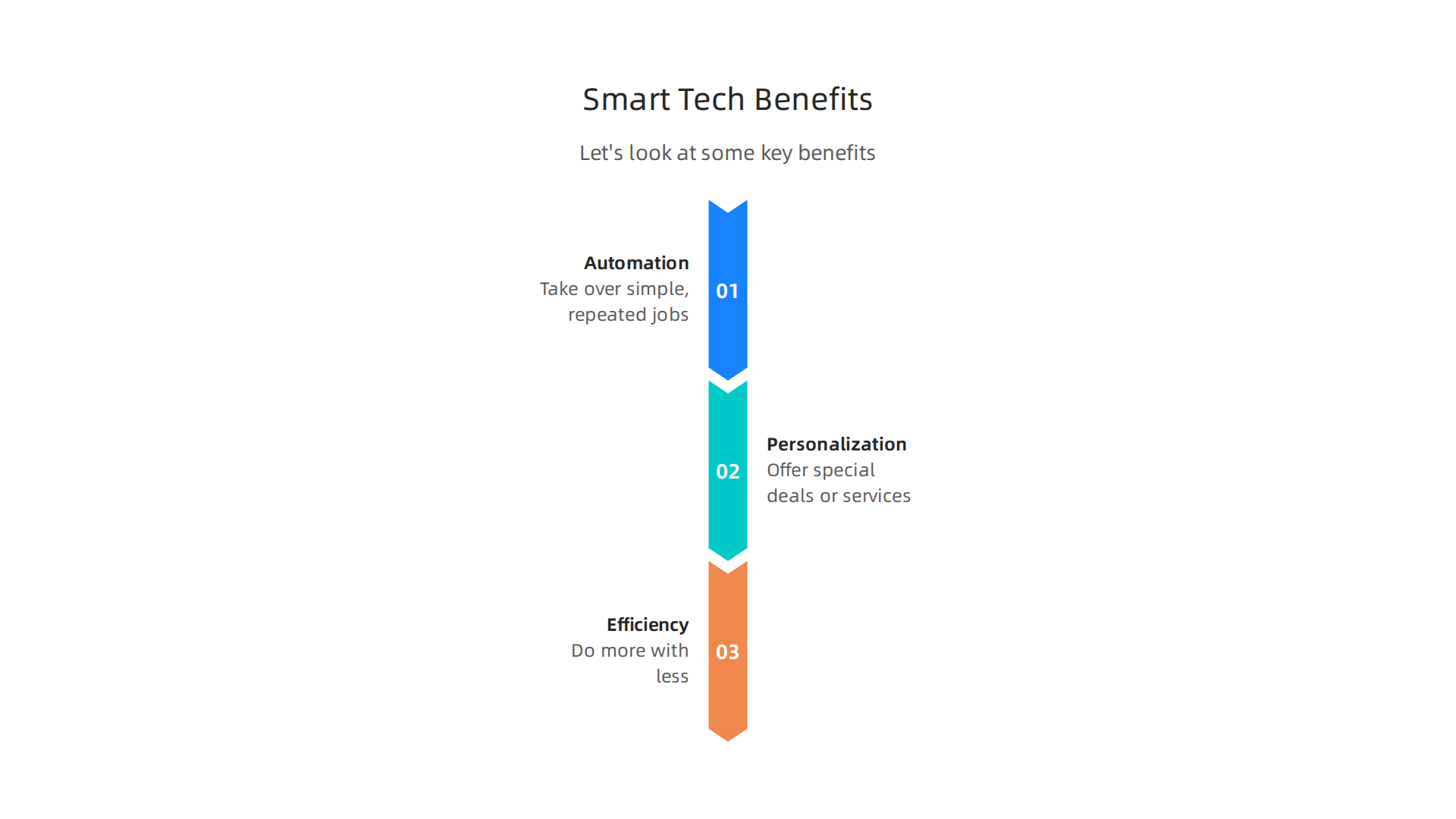
    Smart technologies like AI and automation can revolutionize business operations, enhancing efficiency, personalization, and overall productivity.

    • Automation: Smart tools can take over simple, repeated jobs. Think of a robot doing easy tasks in a factory, or software that answers common customer questions. This frees up your team to focus on bigger, more creative work. It saves time and money. About 72% of large businesses have put at least one AI system into use, showing how much companies rely on this for efficiency [67 AI Adoption Statistics for 2026 — Enterprise & SMB Data].
    • Personalization: Imagine if every customer felt like your business knew exactly what they wanted. Smart technologies, like those that use augment AI, can help with this. They can learn what customers like and offer them special deals or services. This makes customers happier and more likely to stick with your business.
    • Efficiency: When you use smart tools, your business can often do more with less. They can help you find problems faster, plan better, and use your resources wisely. This means you get more done in less time, making your business stronger and more able to handle new challenges. For example, using AI can help cut costs without cutting important services, leading to greater overall efficiency and profit for companies aiming for Tech For Less: AI Operations Cut Costs Without Cutting Corners in 2026.

    These benefits help your business save money and make more money. They also help you stand out. When you use the newest smart technologies wisely, you can offer better products or services, work faster than your rivals, and build stronger bonds with your customers. This is what gives you a real competitive edge.

    A team celebrates a significant business achievement, illustrating the positive outcomes of strategically adopting smart technologies for a competitive edge.

    However, bringing in new smart technologies isn’t always easy. Businesses often face hurdles like:

    • Skills: Your team might not know how to use these new tools. It takes time and training to learn.
    • Integration: New technologies need to work well with your old systems. Sometimes, they don’t talk to each other easily, which can cause problems.
    • Cost: Buying and setting up new systems can be expensive. Businesses worry if the money they spend will really pay off. For instance, concerns about data privacy, trust, and security are still top worries for many people adopting new tech in 2026 [Tech Use and Adoption Keeps Surging Among Older Adults]. High costs and system complexity are also often cited as barriers to adopting new technology [Survey: Older Adults Adopt Tech at Steady Pace].

    This is where being "tech fit" comes in. Just like being physically fit helps you handle life’s challenges, being tech fit helps your business handle new technology. It means your company is ready to learn, adapt, and make smart choices about technology. This reduces friction when bringing in new systems, makes it easier to train your team, and helps you pick the right tools that truly add value. For businesses, learning how to select the best smart technologies that align with your goals is vital, which is why it’s important to know How to Choose AI for Business Tools That Deliver Real Results in 2026.

    By focusing on tech fitness, companies can better understand the true worth of new tools, including things like wearable technology for tracking data or augment AI for decision making. This helps them move past the common problems and use technology to their full advantage, creating a path for constant growth and innovation.

    Becoming "tech fit" means more than just knowing about smart tools. It also means understanding the special kinds of new technology that are changing how businesses work in 2026. Let’s look at some key innovations and what they mean for your business.

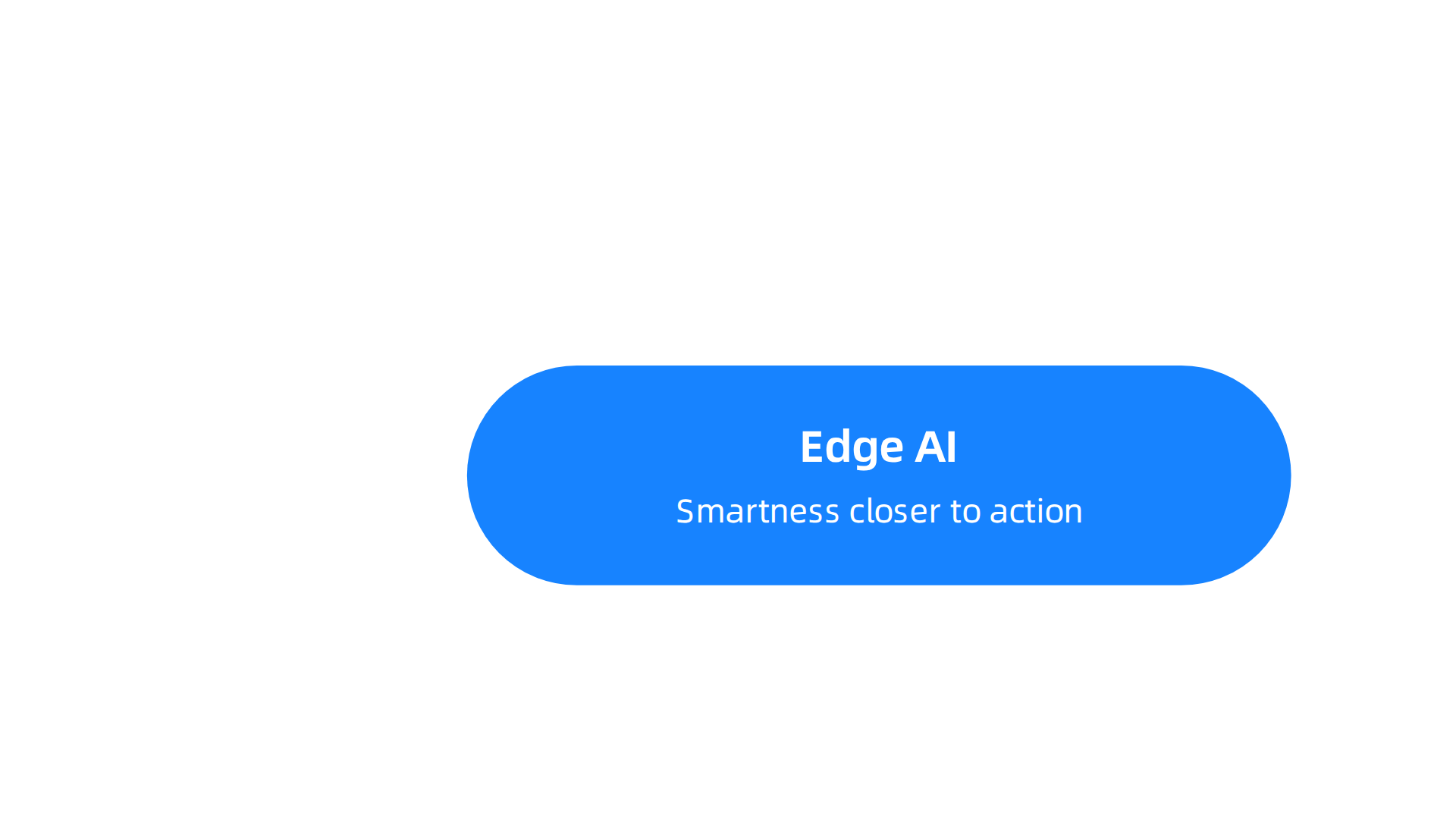
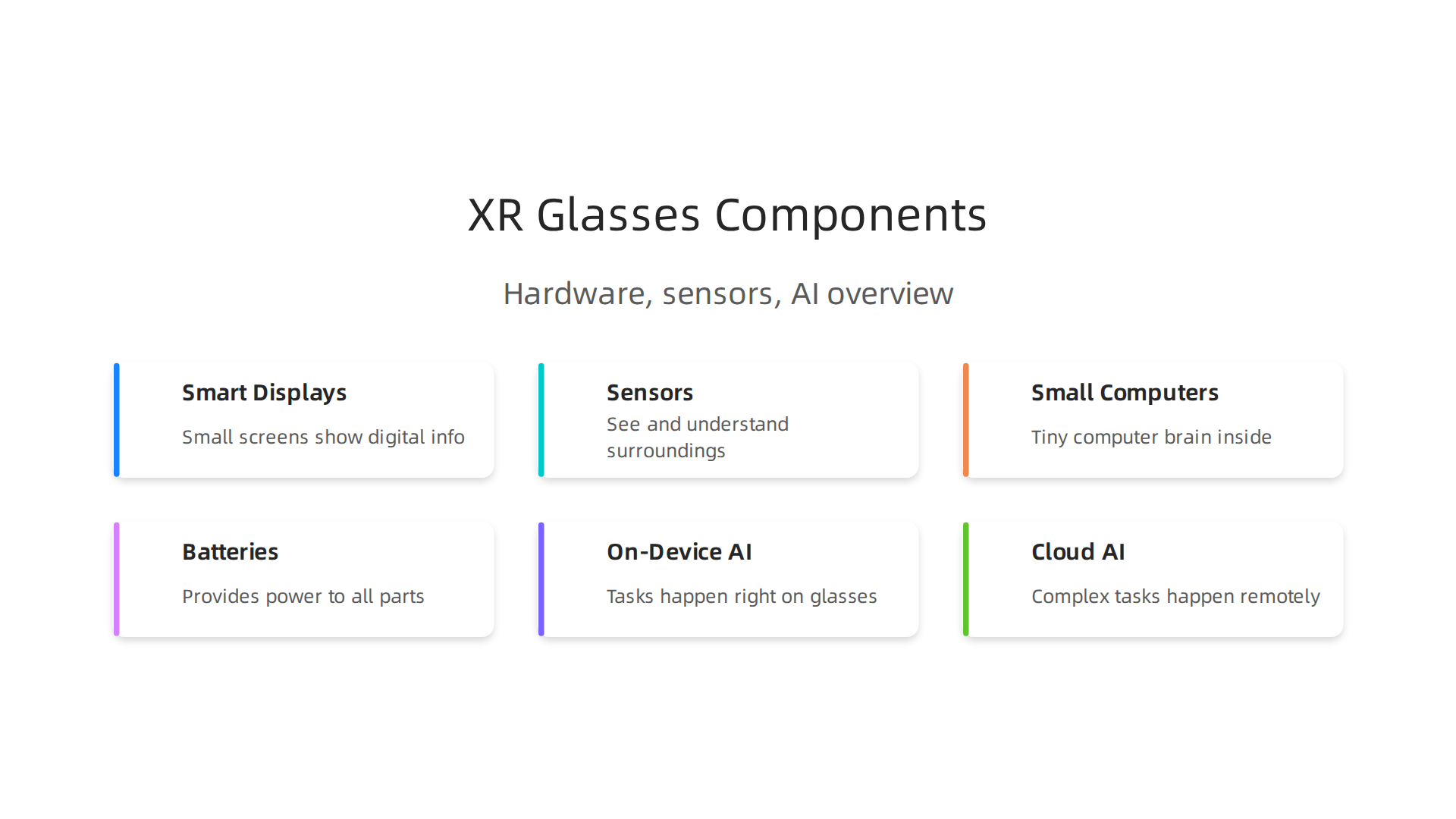
    Explore the foundational smart technologies shaping business in 2026: Edge AI, TinyML, and Ambient Computing.

    Key technical innovations: Edge AI, TinyML, ambient computing and sensors

    These new developments in smart technologies are making things possible that were once just ideas. They help businesses get better at what they do, often in ways that save money and make customers happier.

    Edge AI: Smartness on the spot

    Edge AI is about bringing artificial intelligence closer to where the action happens. Instead of sending all data to a big cloud server far away for thinking, Edge AI lets smart devices do their own thinking right there. Imagine a security camera that can tell the difference between a person and an animal instantly, without needing to ask a distant computer. This is Edge AI at work.

    This kind of smart technology offers big benefits. It makes decisions much faster because data doesn’t have to travel far. It also helps with privacy, as less sensitive information leaves the device. Plus, it can save on internet costs and power. For product teams, this means creating devices that are quicker and more private. Operations teams need to make sure these devices are secure and work well together. Edge AI is quite mature now, with many solutions ready for use, making it a top choice for those looking for Best Edge AI Solutions: Top 11 in 2026.

    Screenshot of Cloudian's website, a provider of resources and solutions related to AI infrastructure and Edge AI.

    It also helps cut down on sending too much data to the cloud, saving money and boosting speed, as processing happens locally on devices like cameras and IoT systems according to experts discussing the difference between Edge AI vs Cloud AI.

    TinyML: AI for tiny devices

    TinyML is like Edge AI’s little cousin. It’s about putting smart thinking (machine learning) into very small, low-power devices. Think of the kind of chip that might go into a smart button or a simple wearable technology device. These tiny chips can still learn and make simple decisions, even though they use very little power.

    This is super helpful for things that need to run for a long time on a small battery, like health trackers or small sensors in factories. TinyML makes it possible to add smart features to almost anything. While newer than Edge AI, TinyML is quickly gaining ground, showing strong real-world use especially when internet service is limited and quick responses are needed Tiny Machine Learning and On-Device Inference: A Survey of Applications, Challenges, and Future Directions. Companies are even working on how to properly test these systems to compare their performance, using tools like MLPerf® Tiny MLPerf Tiny: Benchmarking AI at the Edge.

    The homepage of MLCommons, an open engineering consortium focused on accelerating machine learning innovation, including benchmarking tools like MLPerf Tiny.

    For product and operations teams, working with TinyML means learning new ways to build and manage very efficient systems that can run AI right on the device TinyML for On-Device and Edge Analytics in Wireless Networks.

    Ambient computing and sensors: Making our world smart

    Ambient computing means that technology is always around us, working in the background to make our lives easier. It’s often invisible, just like the air we breathe. Sensors are the key parts of this. They are like the eyes and ears of these smart environments. These tiny parts collect information about everything from temperature and light to movement and sound.

    Together, ambient computing and sensors create smart spaces like connected homes, clever offices, and efficient factories. For example, smart lights that turn on when you enter a room or a factory machine that signals when it needs repair are thanks to these smart technologies. Product and operations teams must think about how these sensors collect data and how it’s used safely and effectively. They also need to make sure these systems fit well with existing tools, a key part of maintaining good tech fitness. Understanding these types of new technology can help businesses innovate and grow, fitting into the larger strategy of Mastering Behavioral Tech for Business Growth and Impact.

    We just talked about how cool new smart technologies like Edge AI and TinyML are changing things. But how does a business know if it’s ready to use these new tools well? This is where "tech fitness" comes in.

    Measuring and improving tech fitness: people, process, platform

    Think of tech fitness like being ready for a big race. It’s not just about having the latest running shoes (the smart technologies); it’s also about having strong legs, a good plan, and the right food. For a business, tech fitness is how well it can look at, bring in, and keep running smart technologies in a dependable way. It means being able to change and grow with new tech without big problems.

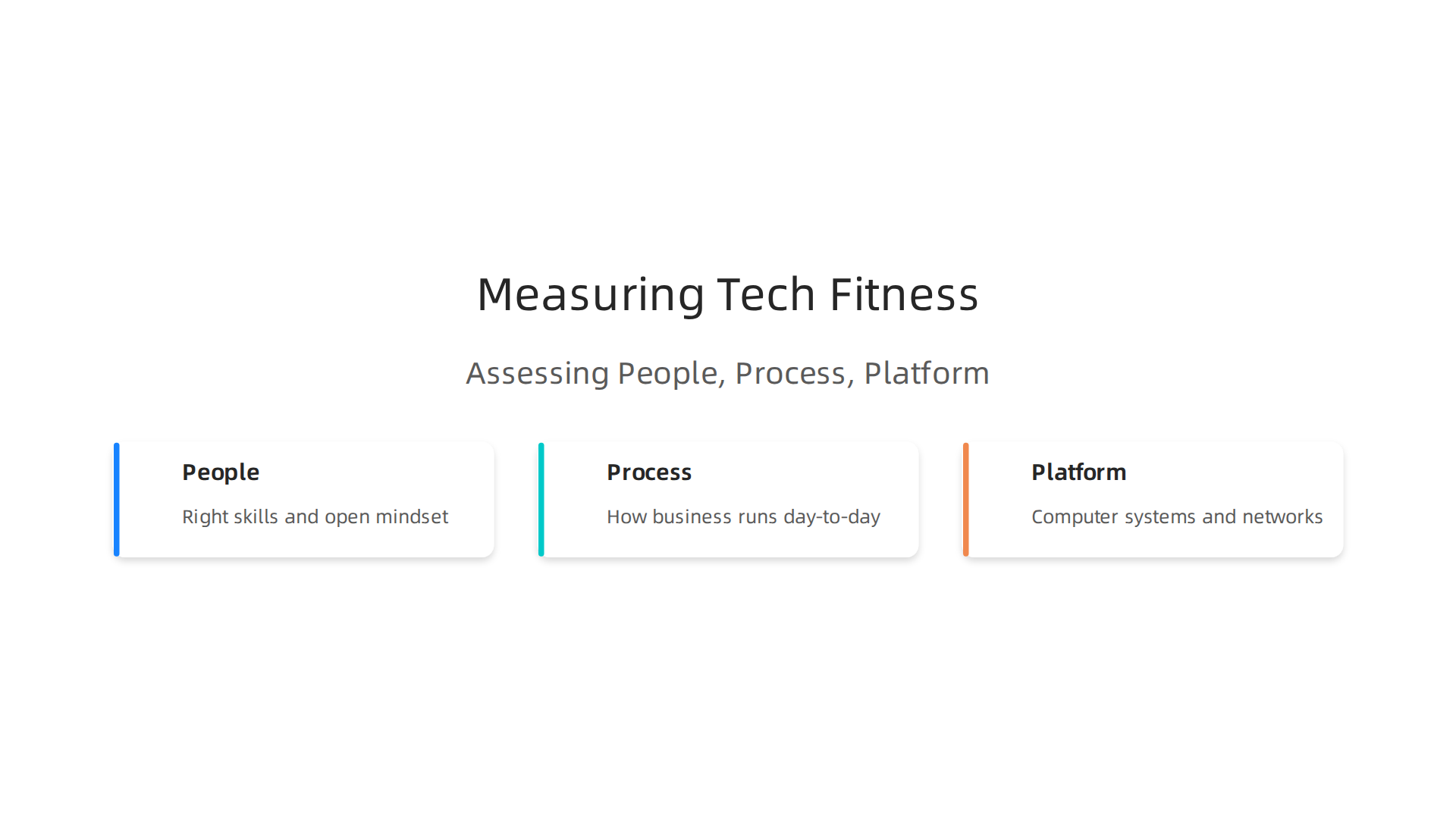
    To truly use smart technologies well, businesses in 2026 need to check three main areas: their people, their processes, and their platforms.

    Assessing a business's 'tech fitness' involves evaluating its People, Processes, and Platforms to ensure readiness for new smart technologies.

    A group of professionals reviews documents and discusses strategies, symbolizing the assessment of a company's readiness for new technologies.

    The people part: Do we have the right skills?

    First, think about the people who work for the business. Do they understand new smart technologies? Are they excited to learn new things? This is about having the right skills and a mindset that’s open to change. If your team doesn’t know how to use an AI tool, or how a new piece of wearable technology works, the business won’t get the full benefit. It’s like having a fancy car but no one knows how to drive it. Checking if your people are ready for change is a big step for success, as experts discuss how to assess Organizational Readiness Assessment: Your 2026 Success. Building this readiness involves clear steps to help everyone get on board with new ideas.

    The process part: How do we do things?

    Next, look at how the business runs day-to-day. This means its "processes."

    • Data Readiness: Smart technologies need good information to work. Is your business good at collecting, storing, and using data? If your data is messy or hard to find, even the smartest AI tool will struggle.
    • Rules and Safety: When using new tech, especially those that collect lots of data, you need clear rules. How will you keep information safe? Who gets to see what? Having strong rules and plans for new technology helps avoid problems and build trust. This is sometimes called "governance." Learning Understanding What is Information Technology for Business Success in 2026 is key to setting up these processes.

    The platform part: Are our systems strong?

    Finally, think about the "platforms." These are the computer systems, tools, and networks the business already uses.

    • Making New and Old Tech Work Together: Can new smart technologies easily connect with your existing systems? If they can’t, it will be hard to make them useful.
    • Staying Strong and Secure: Can your current systems handle the extra work that new tech might bring? Are they safe from hackers? Keeping systems strong and reliable is very important, especially with the rise of complex smart technologies. Having a good plan for technology and organization goes hand-in-hand to ensure success, as noted in a Planning and Readiness Framework for Organisational.

    By regularly checking these three areas, businesses can keep improving their tech fitness. It helps them choose the right tools and make sure they get real results from their investments in smart technologies.

    Measuring how ready your business is for new tech, or its "tech fitness," helps you see if you can use smart tools well. The next step is picking the right smart technologies for your business goals. It’s like picking the best tool for a job. You wouldn’t use a hammer to cut wood, right? You need to carefully look at what each new smart technology offers.

    Selecting the right smart technologies: an evaluation framework

    Choosing new smart technologies is a big deal for any business in 2026. You want to make sure the money you spend brings good results. To do this, it helps to have a clear way to check and compare different tools. Think of it as a checklist to help you make smart choices.

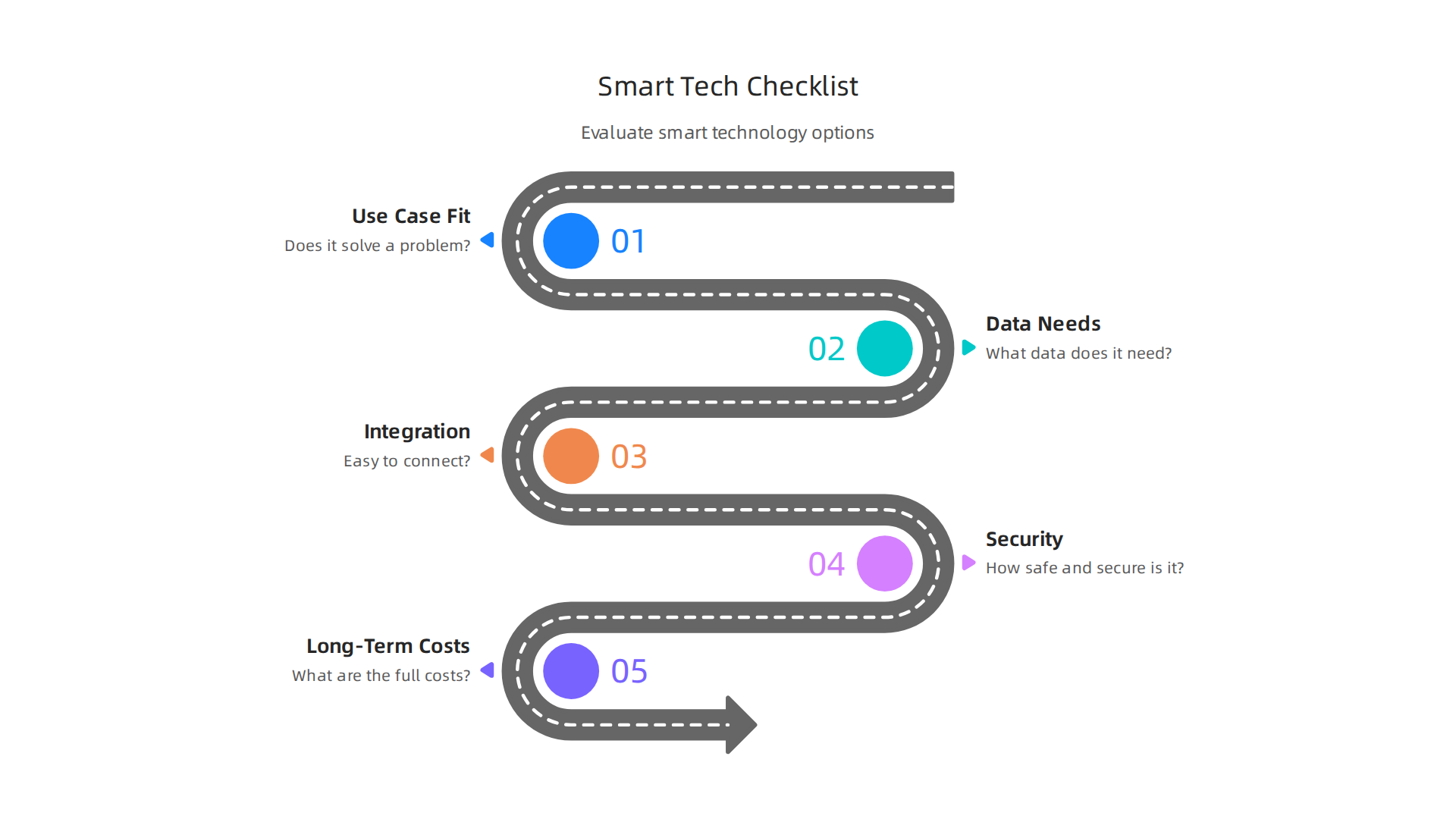
    A step-by-step framework to evaluate new smart technologies, ensuring they align with business needs and deliver value.

    1. Does it fit what you need? (Use Case Fit)

    The first thing to ask is: does this smart technology actually solve a problem for us? Or does it help us do something better? For example, if you want to track how healthy your workers are, a wearable technology that counts steps or monitors sleep might be a good fit. If you want to make a factory run smoother, an Edge AI system that watches machines could be helpful. You need to be very clear about the job you want the technology to do.

    2. What kind of data does it need? (Data Needs)

    Many smart technologies, especially those that use augment AI, need a lot of information to work. Ask yourself:

    • What data does this tool need to get started?
    • Where will that data come from?
    • How will we keep that data safe?
      If your business doesn’t have the right data, or if it’s messy, even the best smart technology won’t help much.

    3. How easy is it to connect? (Integration Complexity)

    New smart technologies usually need to work with your existing computer systems. If a new tool can’t easily connect with what you already use, it can cause a lot of headaches. It’s like trying to plug a new device into an old outlet that doesn’t fit. You want solutions that fit together smoothly without needing a lot of extra work. This helps keep things running without big interruptions.

    4. How safe and secure is it? (Security)

    When you bring in new smart technologies, you’re often dealing with important information. It’s super important to make sure this information stays safe from bad guys or accidents. Look into how the technology protects your data. What plans does the company selling the tech have to keep things secure? Security should always be a top concern.

    5. What are the full costs over time? (Long-Term Costs)

    The price you see upfront is not the only cost. You need to think about the "total cost of ownership." This includes things like:

    • Monthly or yearly fees
    • Costs to set it up
    • Costs to train your people
    • Money for ongoing support and updates
    • Hidden fees
      Making sure you understand all these costs helps you avoid surprises later on. Good IT Procurement Best Practices 2026 help businesses look at all these expenses.

    Try a small test first: Run rapid, low-cost pilots

    Before you spend a lot of money on a new smart technology, it’s a smart idea to try it out in a small way. This is called a "pilot program."

    A team collaborates around a whiteboard, sketching out plans for a new initiative, representing the careful planning of a pilot program for new technology.

    You pick a small part of your business, try the new tech there, and see how it works.

    • Start small: Don’t change everything at once. Test the technology on a small project or with a few team members.
    • Watch closely: See if it actually solves the problem you identified. Is it easy for your team to use?
    • Measure results: Did it save time? Did it save money? Did it make customers happier?

    This helps you learn if the technology is a good fit without making a huge investment. For example, testing TinyML systems often involves benchmarking their performance to see how well they work on small devices before wider use, as shown by MLPerf Tiny: Benchmarking AI at the Edge.

    By using this step-by-step checklist and trying out new tools in a small way first, your business can choose the right smart technologies and make sure they truly help you grow.

    Ready to dive deeper into the world of AI tools and how they can shape your business decisions? Stay informed and ahead of the curve.
    The AI Newsletter Worth Reading
    For more advice on finding the best solutions, explore how to choose AI for business tools that deliver real results in 2026.

    After picking the best smart technologies through careful checking, the next big step is putting them to work. This is called implementation. It sounds simple, but it can have its own set of tricky parts. Knowing these problems beforehand helps your business avoid them and make sure your new tools truly help you grow.

    Implementation strategies and common pitfalls to avoid

    Even after you pick the right smart technologies for your business in 2026, getting them up and running smoothly can be a challenge. It’s like buying a new car; you still need to learn how to drive it well and keep it maintained. Many businesses face common problems when they roll out new tech.

    What can go wrong during rollout?

    1. Data Changes (Data Drift): Smart technologies, especially those that use augment AI, learn from data. If the data changes over time, or if the way you collect it shifts, the technology might start making wrong guesses. This is like a smart system being trained on old information that no longer matches how things are now. You need to keep an eye on the quality of your data.
    2. Not Watching Closely Enough (Poor Monitoring): Once a new system is in place, it’s easy to just let it run. But you need to watch how it’s working. Is it saving time? Is it making things easier for your team? Without checking regularly, you might not notice problems until they’re big. This ongoing watch is key to making sure the tech stays helpful.
    3. People Problems (Staff Change Management): People don’t always like new things. Your team might be used to doing things a certain way. Bringing in new smart technologies can make them feel worried or confused. A study on what works and what doesn’t in technology adoption highlights the need to get people on board for success. If your staff isn’t ready or doesn’t want to use the new tools, even the best technology won’t work well. This kind of problem has been seen in cases like integrating smart tech in facility management, where employee buy-in was crucial Case Study: Successful Integration of Smart Technologies in Facility Management.

    How to make implementation smoother (Best Practices)

    To avoid these common pitfalls, follow a simple playbook:

    • Talk about it a lot: Explain why the new smart technologies are needed and how they will help everyone. Be clear about the benefits for your team, not just the business.
    • Train your team well: Provide good training so everyone knows how to use the new tools. Make sure there’s help available when they have questions. Proper training helps build confidence.
    • Roll it out slowly: Remember the "pilot program" idea from before? Don’t switch everything at once. Bring in the new tech step by step, testing and learning as you go. This helps find and fix small problems before they become big ones. Businesses often learn valuable lessons from digital transformation case studies Digital Transformation Case Studies: Lessons from Global ….
    • Listen to feedback: Ask your team what’s working and what’s not. Their ideas can help you make the smart technologies even better. This feedback loop is very important for continuous improvement.
    • Keep an eye on results: Just like with monitoring, always check if the technology is meeting your goals. If not, figure out why and make changes. This helps your business stay flexible and adapt.

    Implementing smart technologies is an ongoing journey, not a one-time event. By being prepared for challenges and following these steps, your business can successfully use new tools to keep growing in 2026 and beyond. Staying updated on the many ways businesses adopt AI for growth can also help. Check out The Innovation Line 2026 How Businesses Adopt AI For Growth for more ideas.

    Making smart technology work well is also about money. It’s important to know all the costs involved, how much good the technology will do, and how to pick the right company to buy it from. This helps your business make smart choices and see real benefits.

    Cost, ROI, and vendor considerations for smart tech investments

    When you think about bringing new smart technologies into your business, it’s not just the sticker price that matters. You need to look at the "total cost of ownership," or TCO. This means all the money you’ll spend from the start to long after you’ve bought the tech.

    Understanding the full cost of smart tech

    Think of TCO as the complete price tag. It includes a few main parts:

    • Buying the stuff (Hardware and Software): This is the upfront cost. It’s for things like new sensors, smart devices, and the software that makes them run. For example, if you’re getting wearable technology for your team, the cost of the devices themselves is part of this.
    • Making it all work together (Integration): New smart technologies often need to connect with your old systems. This can take extra work and special tools, which costs money. It’s like making sure all your new smart appliances can talk to each other.
    • Keeping data flowing (Data Operations): Smart technologies use a lot of data. You’ll need ways to store it, keep it safe, and make sure it’s always ready for use. Managing this data is an ongoing cost.
    • Fixing and updating things (Maintenance and Support): Like any tool, smart tech needs care. There will be costs for fixing problems, updating software, and getting help when things go wrong. For example, using augment AI tools means you might need experts to tune them over time.

    Experts suggest that when figuring out the total cost, you should include these main items: subscription fees, setting it up, ongoing support, and even training your team. A clear procurement guide from 2026 also points to these factors as key parts of IT procurement best practices IT Procurement Best Practices 2026.

    Getting money back (Return on Investment or ROI)

    ROI is about seeing if the money you spend brings more money or savings back. For smart technologies, this might not happen right away. You need to be realistic about how long it will take.

    To figure out your ROI for smart technologies:

    • Set clear goals: What do you want the tech to do? Save time? Make customers happier? Boost sales?
    • Measure before and after: Keep track of your goals before you put the tech in, and then see how much things improve afterward.
    • Think long-term: The real benefits of smart technologies and augment AI often show up over time, not just in the first few months. You can look at resources that explain how to get real ROI from AI Marketing Cloud in 2026 to better understand this.

    Picking the right company (Vendor Considerations)

    Choosing the right company to buy your smart technologies from is very important. It’s not just about the price they offer. You need to look at who you’re partnering with.

    Here’s a checklist for comparing vendors:

    • Service Agreements (SLAs): These are promises about how well the tech will work and how fast they’ll fix problems. Make sure they are clear.
    • Support: How easy is it to get help when you need it? Do they offer training? Good support is a must for new smart technologies.
    • Future plans (Roadmap Alignment): Does the vendor have a clear plan for making their tech better? Do their future plans match what your business needs? This is especially important for fast-changing areas like augment AI.
    • Their own stability: Is the company strong and reliable? You want a partner that will be around for a long time.

    Using a careful process to check vendors means looking at many things, not just the cost. It helps you find partners that truly fit your business goals Key Supplier Selection Criteria Every ….

    To stay on top of the latest AI and tech insights that can help your business make smart investment decisions, consider subscribing to The AI Newsletter Worth Reading. Get clear daily AI updates from The Deep View Newsletter.

    Summary

    This guide explains how businesses in 2026 can cut through technology noise and choose smart tools that actually deliver value. It describes why smart technologies—like Edge AI, TinyML, ambient computing, and wearables—matter for efficiency, personalization, and competitive advantage, while also highlighting common adoption barriers such as skills gaps, integration headaches, and hidden costs. The article lays out a practical framework to measure "tech fitness" across people, processes, and platforms, and offers a step-by-step evaluation checklist covering use-case fit, data needs, integration complexity, security, and long-term costs. It recommends running rapid pilots, monitoring for data drift, and following best practices for rollout and change management to ensure adoption. Finally, the guide covers how to calculate total cost of ownership, estimate ROI over time, and pick vendors with the right SLAs and roadmaps so your investments scale and continue to pay off.

  • Mastering Behavioral Tech for Business Growth and Impact

    Mastering Behavioral Tech for Business Growth and Impact

    Why behavioral tech matters now – and what this guide will help you do

    Think about how much technology helps us every day. From the apps on your phone to the websites you visit, these tools are often designed to understand how you act and what you like. This is what we call behavioral tech. It’s not just about tracking what you do, but also about using that information to make things better or even guide choices.

    In 2026, behavioral tech has grown a lot, especially with the rise of smart AI. It uses ideas from how people learn and behave, often called "behavioral science," and mixes them with modern digital tools like apps and software. Experts see it as a way to use technology to help people change habits or reach goals, like being healthier or making smarter buying choices [^1]. It brings together computer science, psychology, and even brain science to really get how humans and animals act [^2].

    This is why leaders like CTOs, marketing managers, founders, and business consultants need to pay close attention.

    A group of business leaders in a meeting, actively discussing and making strategic decisions for their company's future.

    With AI making these tools even more powerful, behavioral tech helps businesses truly understand their customers. It lets them create better products, build more effective online marketing platforms, and connect with people in a more personal way, often using tools similar to those that manage many HubSpot marketing contacts. Companies like Eightfold AI also show how AI helps understand people better in the workplace.

    This guide will help you understand this important area. You will learn about:

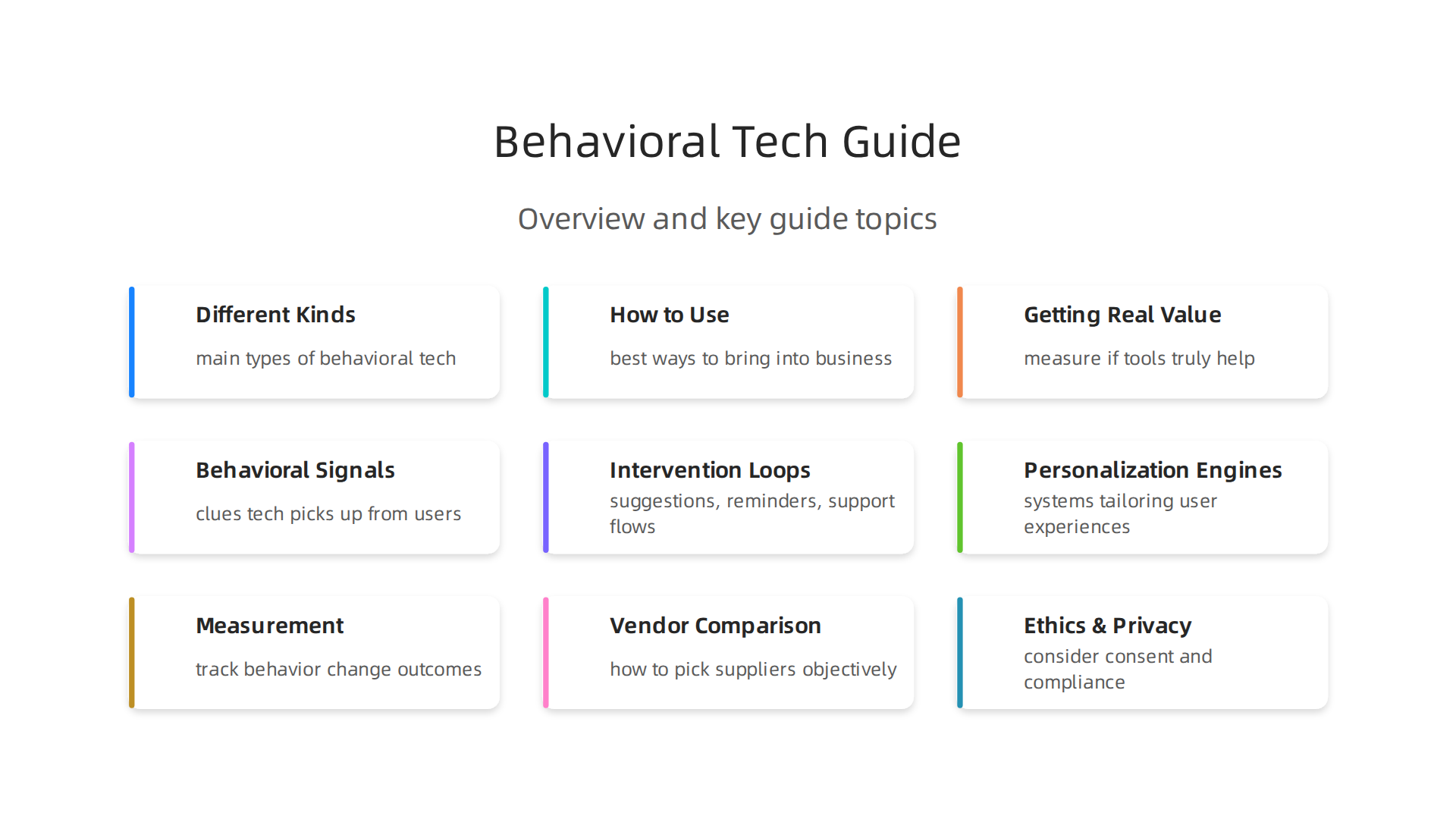
    An overview of what this guide covers regarding behavioral technology, from tool types to value measurement.

    • Different Kinds of Tools: We’ll look at the main types of behavioral tech out there.
    • How to Use Them: You’ll discover the best ways to bring these tools into your business.
    • Getting Real Value: We’ll explain how to measure if these tools are truly helping your company grow and make money.

    Our goal is to give you clear, easy-to-understand advice so you can make smart choices about using behavioral tech to help your business thrive. Staying updated on these fast changes is key.

    Get clear daily AI updates from The AI Newsletter Worth Reading.

    [^1]: What Is Behavioral Change Technology? ABA & BCT Tools
    [^2]: BEHAVIORAL TECHNOLOGY Definition in Psychology# Why behavioral tech matters now – and what this guide will help you do

    Think about how much technology helps us every day. From the apps on your phone to the websites you visit, these tools are often designed to understand how you act and what you like. This is what we call behavioral tech. It’s not just about tracking what you do, but also about using that information to make things better or even guide choices.

    In 2026, behavioral tech has grown a lot, especially with the rise of smart AI. It uses ideas from how people learn and behave, often called "behavioral science," and mixes them with modern digital tools like apps and software. Experts see it as a way to use technology to help people change habits or reach goals, like being healthier or making smarter buying choices. These digital tools, apps, and software are designed to intentionally shape or modify human behavior, offering new ways to collect data and extend support beyond traditional settings

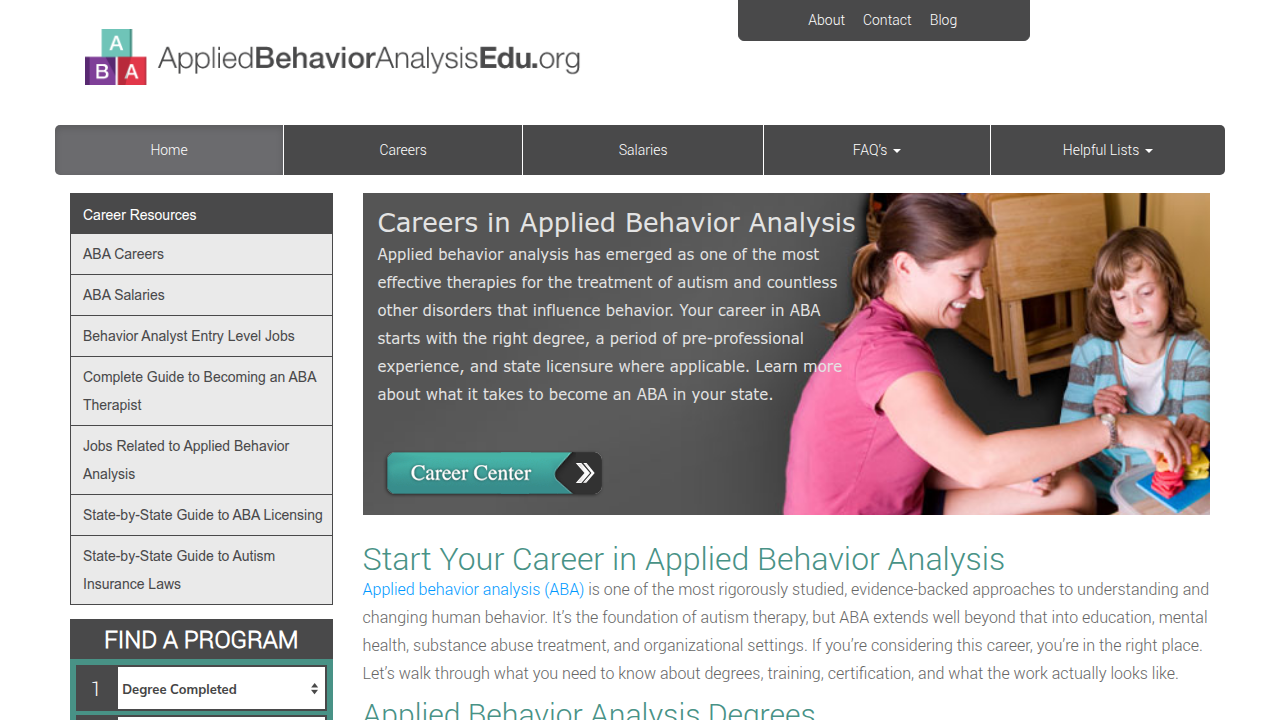
    Screenshot of the Applied Behavior Analysis Education website, a resource explaining behavioral change technology and its applications.

    What Is Behavioral Change Technology? ABA & BCT Tools. It brings together computer science, psychology, and even brain science to really get how humans and animals act BEHAVIORAL TECHNOLOGY Definition in Psychology.

    This is why leaders like CTOs, marketing managers, founders, and business consultants need to pay close attention. With AI making these tools even more powerful, behavioral tech helps businesses truly understand their customers. It lets them create better products, build more effective online marketing platforms, and connect with people in a more personal way, often using tools similar to those that manage many HubSpot marketing contacts. AI platforms like Eightfold AI also show how AI helps understand people better in the workplace.

    This guide will help you understand this important area. You will learn about:

    • Different Kinds of Tools: We’ll look at the main types of behavioral tech out there.
    • How to Use Them: You’ll discover the best ways to bring these tools into your business.
    • Getting Real Value: We’ll explain how to measure if these tools are truly helping your company grow and make money.

    Our goal is to give you clear, easy-to-understand advice so you can make smart choices about using behavioral tech to help your business thrive. Staying updated on these fast changes is key.

    Get clear daily AI updates from The AI Newsletter Worth Reading.

    1) What exactly is ‘behavioral tech’ – core concepts and components

    Let’s dive deeper into what behavioral tech truly is. It’s more than just regular software. It’s about building tools that understand and gently guide human actions. Think of it as mixing what we know about how people act with smart technology. In 2026, this field is all about making technology work for us in ways that feel natural and helpful.

    Behavioral tech works using a few main ideas:

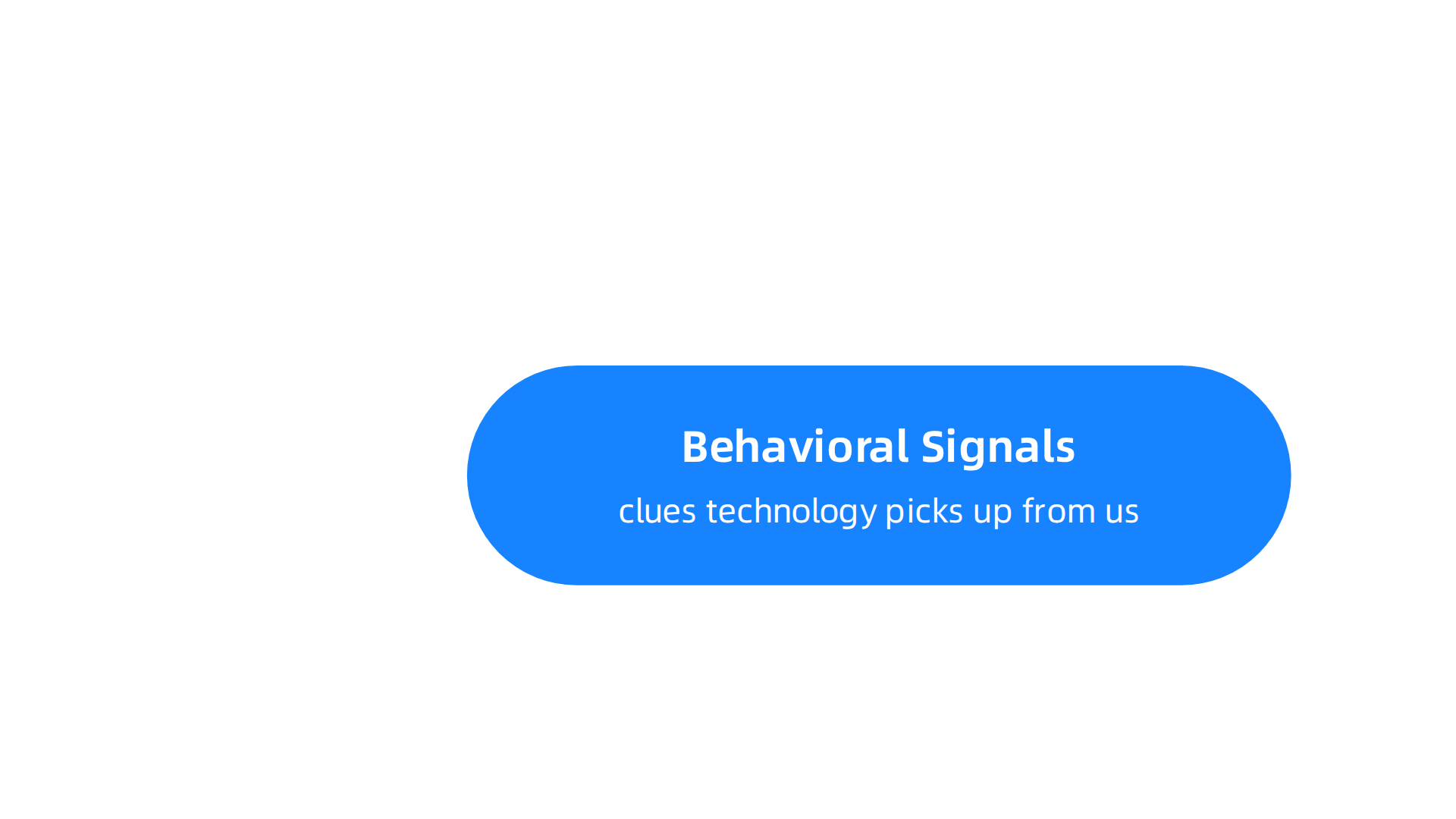
    Visualizing the fundamental ideas behind behavioral technology, including how it collects signals and personalizes experiences.

    • Behavioral Signals: These are the clues technology picks up from us. It could be how long you look at a certain product online, what articles you read, or even how often you use a fitness app. These signals give businesses a clear picture of what you like and what you might do next. Tools for understanding these signals are key for businesses, letting them see how customers move and where a little help might change things for the better

    Screenshot of the Saras Analytics homepage, a platform offering customer behavior analysis tools to help businesses understand user actions.

    10 Best Customer Behavior Analysis Tools to use in 2026. This data helps create better online marketing platforms.

    • Intervention Loops: This is where the tech steps in. Based on your signals, the technology might offer a suggestion, send a reminder, or show you new information. For example, a healthy eating app might remind you to drink water or suggest a recipe. It’s a continuous cycle of observing, nudging, and seeing what happens next.
    • Personalization Engines: These are the smart brains of behavioral tech. They take all the signals and decide what is most useful or interesting for you. It’s how an app knows to recommend certain movies or how an online store shows you products you might actually want to buy. This makes your experience unique, often using AI to create a futuristic website with personalization.
    • Measurement: To know if behavioral tech is really working, we need to measure its effects. This means tracking if people actually changed their habits or if a business goal was met. For instance, did more people complete a task after getting a digital nudge? This step helps improve the tools over time.

    These ideas work together to form what experts call "Behavioral Intervention Technologies," which are digital tools that aim to improve health behaviors and well-being The Behavioral Intervention Technology Model.

    How is behavioral tech different from other tech fields?

    It’s easy to mix up behavioral tech with other similar areas, but there are important differences:

    • Compared to regular analytics: Basic analytics just tells you what happened. For example, "1,000 people visited this page." Behavioral tech goes further by asking, "How can we get those 1,000 people to do this specific thing?" It aims to influence action, not just report on it.
    • Compared to classical personalization: Old-school personalization might put your name in an email. Behavioral tech looks at your deep behaviors and patterns to offer truly relevant experiences. It’s not just about addressing you by name; it’s about understanding your needs.
    • Compared to predictive AI: Predictive AI tries to guess what will happen in the future, like if a customer will leave. Behavioral tech uses those predictions to act and prevent that outcome. For example, if AI predicts someone might quit their job, tools similar to those used by Eightfold AI can then step in with helpful resources to make them stay. It’s about guiding outcomes, not just predicting them. To truly grasp these concepts, it helps to understand the technology meaning explained in clear AI terms.

    In short, behavioral tech is about actively shaping behavior using smart, data-driven tools, offering a powerful way for businesses to connect and grow with their customers.

    2) Market landscape: who builds behavioral tech and who buys it

    Now that we know what behavioral tech is, let’s look at who makes these smart tools and who uses them. In 2026, the world of behavioral technology is buzzing with different kinds of companies, from big names to small, specialized firms. Behavioral technology is an area that brings together computer science, psychology, and other fields to help understand and improve human actions BEHAVIORAL TECHNOLOGY Definition in Psychology.

    Who builds behavioral tech?

    We can sort the companies that build behavioral tech into a few groups:

    • Platform Providers: These are the big players offering wide-ranging tools. Think of companies that provide customer relationship management (CRM) systems or all-in-one marketing tools. They often add behavioral tech features to help businesses connect better with their customers. For example, platforms like HubSpot use AI to help streamline business operations across marketing, sales, and service, making it easier to manage customer interactions and use behavioral data for better results. These platforms handle things like managing online marketing platforms and tracking HubSpot marketing contacts.
    • Niche Vertical Vendors: These companies focus on one special area. For instance, there are behavioral tech tools just for health apps, helping people stick to fitness goals, or for financial apps, guiding users to save money. They are experts in their specific field.
    • Analytics + Action Toolchains: These firms offer tools that first gather lots of data about how people behave, then give businesses ways to act on that data. This means they not only show you what customers are doing but also help you nudge them toward a desired action.
    • Consultancies: These are expert teams that don’t build the tools themselves. Instead, they help other businesses figure out which behavioral tech tools to use and how to make them work best for their specific needs. They offer advice and help with setting things up.
    Who buys behavioral tech?

    The buyers of behavioral tech also come in different shapes and sizes:

    • Small to Medium Businesses (SMBs): These businesses often look for simpler, ready-to-use behavioral tech solutions. They want tools that are easy to set up and start showing results quickly. Their main goal might be to get more customers, improve sales, or make their customer service better without needing a huge technical team. They often look for practical tools that deliver real results.
    • Enterprises: Big companies have different needs. They might want custom behavioral tech solutions that fit perfectly with their existing complex systems. For example, a large company might use advanced AI tools like those from Eightfold AI for human resources, to better understand employee behavior and help with career development or retention. Enterprises have bigger budgets and look for deep integrations and powerful features to solve large-scale problems or drive strategic goals. When choosing tools, it’s important for these large businesses to carefully consider how to choose AI for business tools that deliver real results in 2026.

    Staying informed about this fast-changing market can be tricky.
    If you’re interested in keeping up with the latest in AI and technology, consider subscribing to The AI Newsletter Worth Reading for clear daily updates.

    3) High-impact use cases: personalization, risk detection, behavior change, and more

    But knowing about the market is just the first step. To really use behavioral tech well, we need to look at what it can actually do for businesses and people. In 2026, behavioral tech is helping in many ways, from making things more personal to spotting problems before they get big.

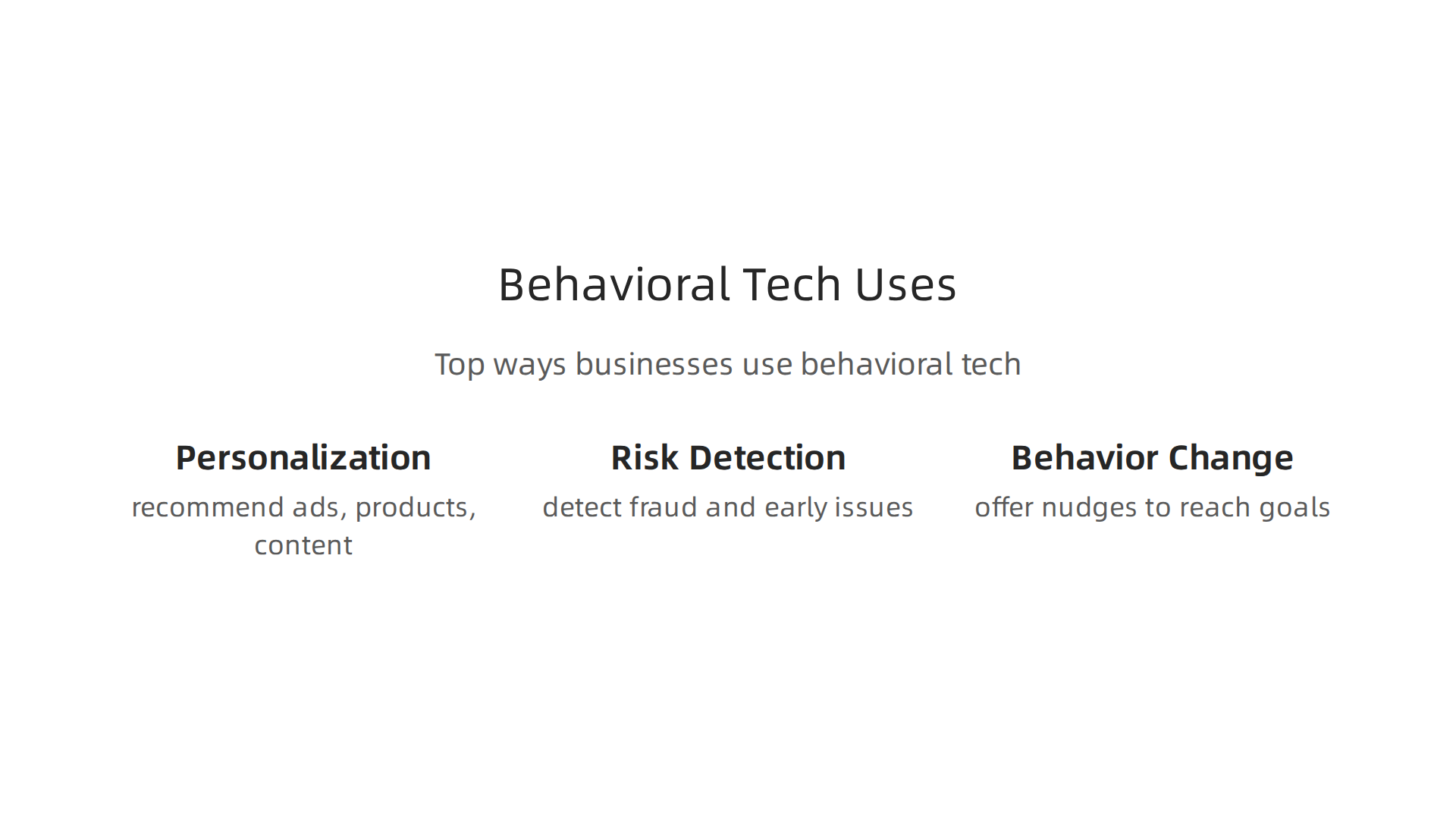
    Here are some top ways businesses use behavioral tech today:

    Illustrating key applications of behavioral technology across personalization, risk detection, and behavior change.

    • Making things Personal (Personalization)
      Have you ever noticed how websites or apps seem to know what you like? This is a big use of behavioral tech. Companies watch how you click, what you buy, and what you look at. Then, they use this information to show you ads, products, or content that you might be interested in. This helps them connect better with customers and make more sales. For example, businesses use special tools to understand how customers act online and tie that behavior to purchases and loyalty 10 Best Customer Behavior Analysis Tools to use in 2026. This often involves using advanced methods in AI Inbound Marketing: Better Personas, Content, ROI. It’s all about making your experience feel unique, especially across different online marketing platforms.


    • Spotting Risks (Risk Detection)
      Behavioral tech can also help find problems early. This might mean:

      • Fraud detection: Banks can use tech to notice unusual spending patterns that might mean someone is trying to steal money.
      • Employee problems: Companies can use tools like eightfold AI to predict if an employee might leave, helping them keep valuable team members. This is part of a larger trend in "people analytics" which helps predict outcomes like employee departures.
      • Health alerts: In mental health, AI can look at how someone is communicating to detect signs of distress, which can help in getting them help faster Top 21 AI & Emerging Tech Use Cases for Behavioral Health. For businesses, it’s also important to be aware of hidden dangers. Learn more about Stealth AI: Hidden AI Risks and Opportunities.
    • Helping with Change (Behavior Change)
      Sometimes, we want to change a habit, like eating healthier or saving more money. Behavioral tech can offer nudges and support to help us reach these goals. Health apps might remind you to drink water, or financial apps might suggest ways to cut down on spending. These tools are designed to encourage positive actions over time and are enhancing behavioral health with technology.

    When choosing a behavioral tech tool, businesses need to think about a few things. First, what kind of data do you need? Personalization needs customer behavior data, while risk detection might need financial or communication data. Second, how will you protect people’s privacy? This is very important. And third, how will you measure if the tool is actually working? For example, with personalization, you might track how many hubspot marketing contacts become paying customers. Each use case needs its own careful plan to make sure the tech helps in the best way possible.

    When you understand what behavioral tech can do, the next big step is picking the right tools and partners.

    A professional carefully reviewing documents, perhaps comparing different behavioral tech solutions or vendor proposals.

    It’s like choosing the best team for a big project. In 2026, many companies offer behavioral tech solutions, so knowing how to compare them is super important. You want to make sure the tools you pick actually help your business grow and solve problems.

    Here are the main things to look at when comparing behavioral tech vendors:

    Data Needs and Handling

    First, think about the data.

    • What kind of data does the tool need? Does it need customer clicks, employee feedback, or health information? Make sure the tool can use the data you have.
    • How does it keep data safe? Protecting people’s information is a must. Ask about their security plans and how they follow privacy rules.

    AI Models and How They Work

    Behavioral tech uses smart computer programs, called AI models, to learn from data.

    • How well does the AI work? Ask for proof that the AI is good at what it does, like predicting customer actions or spotting risks.
    • Can you understand its choices? This is called "explainability." Sometimes, AI can be like a black box. It’s better if the vendor can explain why the AI made a certain suggestion. This helps you trust the tool more.

    How it Connects to Other Systems

    A new behavioral tech tool should play nice with your existing tools.

    • Does it link easily? Check if the tool can connect with your other systems, like your customer management software (CRM) or your online marketing platforms. Good connections mean your data flows smoothly. For example, if you use HubSpot for your marketing contacts, you’ll want a behavioral tech tool that can integrate well.
    • What are the "integration surfaces"? This just means how the tools talk to each other, often through special connectors called APIs.

    Service Guarantees (SLAs)

    It’s important to know what you can expect from a vendor after you buy their tool.

    • What promises do they make? Look for Service Level Agreements (SLAs). These are like contracts that say how much of the time the tool will be working, how fast they will fix problems, and what kind of support you will get. Knowing these details helps you plan better and avoid surprises. A strong vendor will have clear SLAs covering reliability and support The Essential IT Vendor Selection Criteria Checklist.

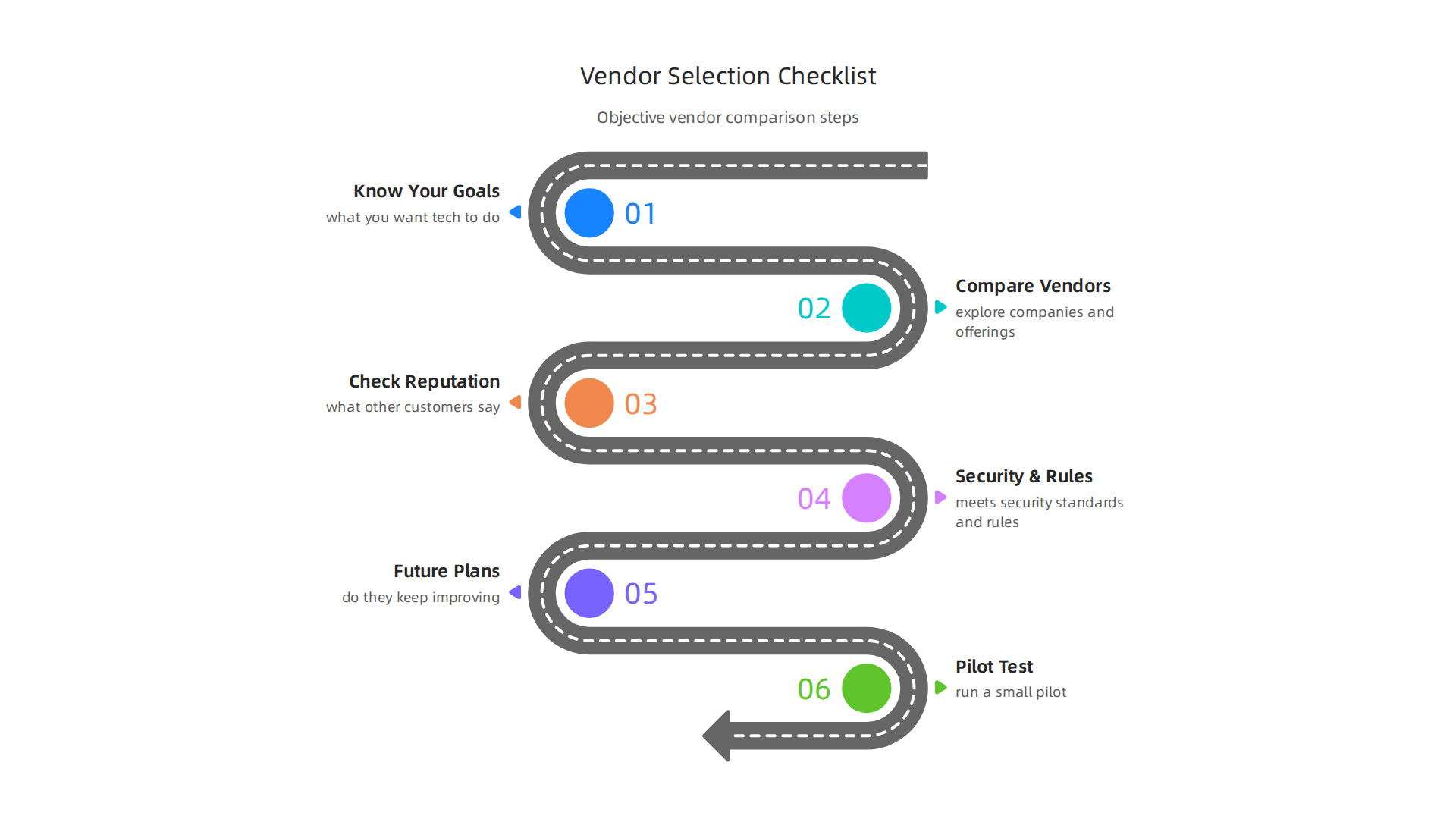
    A Simple Checklist for Choosing Vendors

    To make sure you pick the best behavioral tech for your business, follow these steps:

    A clear checklist to guide businesses in objectively comparing and selecting behavioral tech vendors.

    1. Know Your Goals: Before you even look at tools, write down exactly what you want the behavioral tech to do for you. Do you want to increase sales, reduce employee turnover with tools like eightfold AI, or improve customer satisfaction?
    2. Look at Many Options: Don’t just pick the first tool you see. Explore different companies and their offerings.
    3. Check Their Reputation: How long have they been around? What do other customers say about them? Reading reviews and asking for references can help a lot.
    4. Security and Rules: Make sure the vendor meets high security standards and follows all important rules for your industry. This might include certifications like SOC 2 or ISO 27001 Vendor Evaluation Criteria Checklist for Procurement Teams.
    5. Future Plans: Ask about their future plans for the tool. Do they keep making it better? You want a partner that will grow with you.
    6. Try It Out: If possible, do a small test or "pilot" project with the tool. This lets you see how it works in your own company before you commit fully.

    Picking the right behavioral tech can feel like a big decision, but with a clear plan, you can find the best fit for your business. For more help on finding great tools, you might want to read our guide on how to choose AI for business tools that deliver real results in 2026.

    Stay informed about the fast-changing world of AI and behavioral tech.
    Get clear daily AI updates from The AI Newsletter Worth Reading.

    Once you have picked the best behavioral tech tool for your business, the next big step is putting it to work. This means making sure it connects smoothly with all your other systems. Think of it like building a new road in a busy city: you need to make sure it links up well with existing roads and that traffic flows easily.

    How Behavioral Tech Fits Into Your Systems

    There are different ways to connect behavioral tech with your business operations. These are often called "integration patterns."

    • In-app SDKs: If you have a mobile app or a website, an SDK (Software Development Kit) is a common way to add behavioral tech. It’s like a small toolkit you drop into your app. This toolkit helps gather information directly from how users interact with your app or site. The behavioral tech can then send back suggestions, like showing a special offer to a customer based on what they just clicked.
    • Server-side Inference: Sometimes, the smart work of behavioral tech happens on your company’s own computer servers or in a special cloud service. This is called "server-side inference." Your systems send data to the behavioral tech, it processes the information and makes predictions (the "inference"), and then sends the results back. This approach is good for handling lots of data and making complex decisions. Designing these kinds of systems needs a good plan for how data moves, often called a data pipeline architecture, which helps to collect, move, and change data for analysis Data Pipeline Architecture: Key Patterns and Best Practices.
    • Edge vs. Cloud Computing: Where the behavioral tech does its thinking matters.
      • Cloud computing means the smart programs run on powerful computers far away, like Google’s or Amazon’s servers. This is flexible and can handle huge amounts of data.
      • Edge computing means the smart programs run closer to where the data is collected, like on a smart device or a local server. This can be faster for instant decisions, like for a security camera using AI to spot something unusual right away.
    • Orchestration Layers: These are like traffic cops for your data and different tech tools. An orchestration layer makes sure all your systems and the behavioral tech talk to each other correctly. It manages the "data flows" and ensures everything happens in the right order. This is especially important when you have many tools, like eightfold AI for HR or various online marketing platforms, all needing to share information.

    Common Problems When Implementing Behavioral Tech

    Even with a great plan, challenges can pop up when you put behavioral tech into action. Knowing about them helps you avoid them.

    • Data Flow Hiccups: The biggest problem is often making sure data moves freely and correctly. If data doesn’t get to the behavioral tech tool, or if the results don’t get back to your team, the whole system breaks down. This can delay small test projects, known as pilots, or stop the tool from being used widely. Good planning for how data flows is key to avoid this.
    • Not Having Clear Goals: If your team isn’t sure what the behavioral tech is supposed to achieve, it’s hard to make it work right. Goals like "increase customer engagement by 15%" are much better than "just use some AI."
    • People Problems: Sometimes, the issue isn’t the tech itself, but getting everyone in the company to understand and use it. People might not trust the AI or might not want to change how they work. Getting everyone on board from the start is very important. To ensure your business leaders are ready for new technologies, consider reading about Qualcomms 2026 Innovations Reshape Business for Future Leaders.

    Successfully using behavioral tech means thinking about how it fits into your daily work, not just what it can do. It’s about designing a system where data can move easily and everyone understands their part.

    After putting behavioral tech into action, the next big question is: how do we know it is actually helping? This is where measuring its impact comes in. You need to look at certain numbers and run tests to make sure your new tools are truly making a difference and giving you good value for your money.

    Which Numbers to Watch (KPIs)

    To see if your behavioral tech is working, you need to track key performance indicators, or KPIs. These are like scorecards that tell you how well your business is doing in certain areas. For behavioral tech, some important KPIs include:

    • Lift Metrics: This shows how much better things are compared to before you used the behavioral tech. For example, if sales went up by 10% because of personalized offers, that 10% is your "lift." Other lifts could be more people clicking on emails or spending more time on your website.
    • Behavior-Based Retention: This KPI looks at whether customers stick around longer because of the behavioral tech. Are they buying more often? Are they staying subscribed to your service? Behavioral tech often aims to make customers happier and more loyal, so seeing them stay is a big win.
    • Cost-to-Serve: Sometimes, behavioral tech can help you save money. For example, if it automates responses to common customer questions, your support team spends less time on those tasks. This lowers your "cost-to-serve" each customer, which means more profit for your business.

    To track these numbers well, you need good systems to collect and process data. Designing how your data moves, from where it’s gathered to where it’s analyzed, is called Data Pipeline Architecture. Having a smart setup helps you instrument these KPIs effectively.

    Running Tests to See What Works

    Just like a scientist, you need to run tests to be sure that any good changes you see are actually from the behavioral tech and not something else.

    • Designing Pilots: A "pilot" is a small test run. You might try the new behavioral tech with a small group of customers or in just one part of your business first. This helps you see if it works as expected before rolling it out to everyone. It also helps you spot any problems early.
    • A/B Tests: This is a very common way to test. You show two different versions of something to similar groups of people. For example, one group sees the regular website (Group A), and another group sees a version with behavioral tech features (Group B). Then, you compare how Group A and Group B act. If Group B buys more or stays longer, you know the behavioral tech is making an incremental value.

    By carefully planning these tests, you can truly understand if your behavioral tech is delivering results. It helps prove that your investment is worthwhile. Tools like HubSpot AI streamlines your business operations can help track these results, especially for online marketing platforms and managing customer contacts.

    Staying on top of these trends and understanding the best ways to measure AI’s impact can be tricky in 2026. For clear daily AI updates, consider subscribing to The AI Newsletter Worth Reading.

    The last section talked about measuring if behavioral tech is working. Now, let’s talk about how to use these tools in a fair and safe way. This means thinking about ethics, privacy, and following the rules.

    Two professionals engaged in a serious discussion, likely about ethical implications and compliance for new technologies.

    Key Privacy and Compliance Questions

    Using behavioral tech can be very helpful for businesses, especially for online marketing platforms or managing customer contacts. But it also means you are dealing with people’s personal information. This brings up big questions about fairness and privacy.

    First, transparency is key. People need to know when and how their data is being used. Businesses should be clear about what kind of information they collect and why. It’s like telling someone you’re taking their picture and why you need it.

    Next is consent. This means getting a clear "yes" from people before you use their data to understand or change their behavior. In 2026, new rules are making this even more important. For example, some laws now require a very clear Online Privacy Act of 2026 to Provide Personal Information … before systems try to influence behavior or filter content. Simply being "aware" is not enough; businesses need actual permission to make predictions about people’s behavior New US State Privacy Laws in 2026: What Rights Do You Have Now?. Regulators are closely watching how companies ask for consent, looking for any tricky ways to get a "yes"

    Screenshot of Secure Privacy AI's homepage, a platform focused on compliance with privacy laws and ethical data handling.

    Privacy Laws 2026: Global Changes, Enforcement & ….

    Then there’s fairness. Behavioral tech should not lead to unfair treatment or bias. For example, if you use AI to help with hiring, like with tools similar to Eightfold AI, you need to make sure it treats all candidates fairly and does not accidentally favor one group over another. This is an important risk to understand, as covered in a guide to Hidden AI Risks, Opportunities, and Management in 2026.

    Finally, cross-border data flows are a big deal. This refers to sending personal data from one country to another. In 2026, governments are putting new rules in place to control how "sensitive personal data" from the U.S. can be sent to certain countries Data Privacy, Cybersecurity, AI developments shaping 2026. This means businesses need to be careful about where their data goes and if those places have strong enough privacy laws.

    How to Operationalize Ethics

    It’s not enough to just know about these rules; businesses need to put them into practice every day. This is called "operationalizing ethics."

    • Governance: This means setting up clear rules and policies within your company for how behavioral tech should be used. Who is in charge of making sure data is handled correctly? What steps need to be taken before a new behavioral system goes live? Many businesses are building strong privacy, cybersecurity, and AI programs to help with compliance Privacy and AI Heatmap for 2026: What Device & Drug ….
    • Documentation: Keep good records of everything. This includes how you got consent, how your AI systems make decisions, and what steps you take to protect data. Good documentation helps show that you are following the rules and thinking about ethics.
    • Vendor Obligations: When you use tools or services from other companies for your behavioral tech, you need to make sure they also follow ethical and privacy rules. For instance, if you’re using a third-party platform for your online marketing or to manage hubspot marketing contacts, ensure they meet your standards. You should have clear agreements with these vendors about data protection. Ethical use of AI is also important for students, like knowing how to Use AI-Powered Homework Help Smartly and Ethically.

    By putting these practices in place, businesses can use behavioral tech in a way that helps customers and keeps their trust, while also staying on the right side of the law in 2026.

    Summary

    This guide explains why behavioral technology matters in 2026 and how businesses can use it to understand and influence user behavior. It defines core concepts—behavioral signals, intervention loops, personalization engines—and contrasts behavioral tech with analytics and predictive AI. The article maps the market (platforms, niche vendors, consultancies), shows high-impact use cases like personalization, fraud and health risk detection, and behavior change, and gives practical vendor-selection criteria and a simple checklist. It also covers integration patterns (SDKs, server-side inference, edge vs cloud), common implementation challenges, and how to run pilots and A/B tests to prove value. Finally, it outlines the KPIs to track and the privacy, consent and fairness practices needed to deploy behavioral tech ethically and compliantly. After reading, leaders will know how to evaluate, test, measure, and govern behavioral tech so it delivers real business and user benefits.

  • How Google XR Glasses Transform Business Operations

    How Google XR Glasses Transform Business Operations

    The world is changing fast, and new technology is here to help businesses work smarter.

    A business leader confidently embraces new technology for smarter operations.

    We are now in a time of "spatial computing" and "wearable AI." This simply means that computers are no longer stuck on your desk or in your pocket. Instead, they are becoming part of the world around you, and you can wear them. This is where Google XR Glasses come in, offering a big chance for businesses to do things better.

    Think about how much easier tasks could be if you had smart help right in front of your eyes. Google XR Glasses are a new kind of device that mixes the real world with helpful computer information. They let you see digital things like instructions or data layered onto your actual view. This means you can get instant help for complex jobs, train staff in new ways, or connect with co-workers without missing a beat. These best smart glasses are quickly becoming important for how businesses operate. In fact, shipments of AI smart glasses are expected to go past 10 million units in 2026 alone, showing how fast this area is growing Technology – 2026 Outlook.

    Explore insights and market analysis on technology trends relevant to business growth.

    This guide will show business leaders like you how Google XR Glasses can make a real difference. We will look at what these glasses can actually do for your company and how they improve daily workflows with smooth flow tech. We’ll also cover important things to think about when choosing vendors and the steps you need to take to bring these new tools into your business. You might be wondering how gaming glasses compare, but our focus here is on practical business uses, not just entertainment. Staying updated on these new tools is key for smart business decisions in 2026. For more ways to keep up with important tech trends, consider tracking major technology news for smart business decisions in 2026.

    Stay informed with the latest news and guides on AI tools and their business applications.

    This article will help you understand all the ins and outs, so you can make good choices about bringing this exciting technology into your operations.


    Get clear daily AI updates from The AI Newsletter Worth Reading.

    To really understand how Google XR Glasses can help your business, it’s good to know a little about what’s inside them. These best smart glasses are packed with clever parts that work together to bring digital information right into your view.

    What’s Inside Google XR Glasses

    Think of these glasses as tiny, powerful computers that you wear. They have a few main parts that make them special:

    An overview of the key hardware and software components powering Google XR Glasses.

    • Smart Displays: These are the small screens that sit in front of your eyes. They show you digital info, like directions or data, right over what you see in the real world. For example, some new Android XR glasses, like XREAL AURA, offer a wide 70-degree field of view, making the digital picture feel very big and clear.

    Discover the newest gadgets and technology reviews shaping the consumer and business markets.

    This kind of display helps you get useful information without looking away from your task.

    • Sensors that See and Understand: Google XR glasses have many tiny sensors. Cameras are like eyes, taking in what’s around you. Other sensors, called IMUs, track how your head moves. Depth sensors help the glasses understand distances and shapes in the real world. This mix of sensors allows the glasses to know where you are, what you’re looking at, and how to place digital items correctly. Some new models even have powerful cameras, like a 12-megapixel Sony IMX sensor, to get a very clear picture of your surroundings.
    • Small Computers and Batteries: Each pair of google xr glasses has a tiny computer brain inside. This brain often uses powerful chips, like those from Snapdragon, to run apps and make everything work smoothly. For example, Project Aura, designed for Android XR, uses a Snapdragon chip to power its features Google I/O 2026: The Smart Glasses Reveals Everyone’s …. All these parts need power, so there’s also a small battery. Some glasses might even need to be connected by a wire to a power pack in your pocket to work for a long time, as seen with some early Android XR glasses in 2026 XREAL’s Android XR glasses can only be used wired, 2026 launch.

    Keep up with daily news, rumors, and reviews related to Google and Android products.

    AI: On the Glasses or in the Cloud?

    A big part of what makes google xr glasses smart is their Artificial Intelligence (AI). AI helps the glasses understand what you’re doing and give you the right information at the right time. There are two main ways this AI works:

    • On-Device AI (AI on the glasses): Some AI tasks happen right on the glasses themselves. This is good for things that need to be super fast, like understanding a quick hand gesture or recognizing a simple object right in front of you. It also keeps your information more private because it doesn’t need to leave the glasses. Google’s Gemini AI is built into these glasses to help with such tasks, letting them understand what they see in real-time Google to launch Gemini AI smart glasses in 2026. This is great for smooth flow tech where you need instant responses.
    • Cloud AI (AI on the internet): Other, more complex AI tasks might happen in the "cloud," which means on big computers far away that you connect to through the internet. This is needed for things like translating a whole conversation, doing very detailed searches, or running complicated programs. Using cloud AI means the glasses can be lighter and use less battery, but they need a good internet connection to work fully. Google’s Android XR platform supports this by connecting to powerful cloud services. For those interested in how different AI tools compare, learning about general enterprise AI platforms 2026 can be helpful.

    The choice between on-device and cloud AI affects how fast the glasses respond, how much privacy you have, and if you always need Wi-Fi. Google is starting with an "AI-first" plan, meaning the glasses are designed to be smart even without a constant cloud connection Google’s Android XR Plan Makes 2026 the Turning Point. This means a lot of smart functions happen right there on your face, making the glasses more useful in more places. Unlike simple gaming glasses, these tools are built for serious work, combining powerful hardware with smart AI to create truly helpful business tools. If you’re looking for advanced processing power in other devices, you might also find our guide on Macbook Air M2 Chip real world performance interesting.

    As we saw, Google is putting AI right at the heart of its google xr glasses, whether the smarts are built-in or linked to the cloud. This "AI-first" thinking means these best smart glasses aren’t just fancy screens. They are tools designed to understand and help you in many ways, offering powerful features for everyone, especially those who build new apps.

    Core AI Features and Developer Platform: What Developers Can Build

    Google XR Glasses and the Android XR platform come with many smart features that help them blend digital info with the real world. Think of them as having a deep understanding of what’s around you, all thanks to advanced AI.

    • Seeing and Understanding the World (Spatial Mapping and Computer Vision): These glasses are really good at mapping out your space in 3D. They know where walls, tables, and other objects are. This "spatial mapping" helps digital items look like they truly belong in your real world. Plus, with "real-time computer vision," the glasses can instantly recognize objects, faces, and even gestures. This is powered by systems like Google’s Gemini AI, letting the glasses understand what they see as it happens, which is key for smooth flow tech interactions.
    • Bringing Digital to Life (AR/VR Rendering): Developers can use the platform to create amazing visual experiences. This includes Augmented Reality (AR), where digital pictures are laid over your real view, and Virtual Reality (VR), where you are fully immersed in a digital world. The tools make it easy to show clear, detailed graphics that react to your movements and the environment.
    • Talking and Listening (Voice and Contextual AI): Google XR glasses don’t just see; they listen and understand. Voice AI allows you to speak commands naturally, and the glasses can understand what you mean based on your surroundings and what you’re doing. This "contextual AI" means the glasses can give you helpful information without you even asking, anticipating your needs in different situations.

    Building New Worlds: The Developer Ecosystem

    Google wants many people to create new and useful apps for these glasses. That’s why they’ve built a strong set of tools for developers.

    A team of developers collaborates, brainstorming new applications for XR technology.

    • Easy-to-Use Tools (SDKs and APIs): Google offers the Android XR SDK (Software Development Kit) and various APIs (Application Programming Interfaces). These are like instruction manuals and toolboxes that let app makers create software that runs on the google xr glasses. In 2026, the Developer Preview 4 of the Android XR SDK is available, which helps developers get started quickly with building for these devices and other XR platforms 2026. This platform is designed to be open and well-documented for every developer Android XR for developers: SDK, app model & distribution (2026).
    • Support for Popular Engines: To make it easier for developers who already build games or interactive experiences, Android XR officially supports popular game engines like Unreal Engine and Godot, alongside Unity Android XR SDK Developer Preview 4 Adds Unreal, Godot …. This means many existing apps can be brought over to the new glasses, or new ones can be built using familiar tools.
    • Smart AI Tools for the Glasses (Edge ML Toolchains): Developers can also use special tools that help them make AI programs run directly on the glasses. This is important for tasks that need very fast responses and more privacy. For businesses, this means creating powerful google xr glasses apps that can connect with existing systems, offering new ways to work and get things done. If you are looking to bring AI tools into your business, it’s essential to understand How to Choose AI for Business Tools That Deliver Real Results.

    With these features and tools, google xr glasses are much more than just gaming glasses. They are a powerful platform for innovation, allowing businesses to create solutions that make work faster, smarter, and more connected. Staying informed about these developments is key.

    If you want to keep up with the latest in AI and tech, you should consider getting The AI Newsletter Worth Reading. It provides clear daily AI updates from The Deep View Newsletter.

    Privacy, Security, and Regulatory Considerations for Wearable AI

    While Google XR Glasses promise many exciting new ways to work and play, it’s also very important to think about privacy and security. Because these google xr glasses are always on and always looking at your world, they bring new kinds of challenges. For businesses especially, understanding these risks and the rules that come with them is key.

    Understanding the Privacy and Security Risks

    When you wear smart glasses, they gather a lot of personal information. This can create some big risks:

    Key privacy and security risks associated with the use of wearable AI devices like Google XR Glasses.

    • Always-On Sensors: Imagine glasses with cameras and microphones that are always working. They can record everything you see and hear. This means private conversations or sensitive moments could be captured without anyone knowing. It raises questions about who sees and hears what you do.
    • Biometric Data: Your google xr glasses might collect data about you, like how your eyes move, your face, or even your heartbeat. This type of information is called biometric data, and it’s very personal. There’s a big need to protect this kind of sensitive data, and some experts are calling for broader legal frameworks for mental privacy beyond just neural data Beyond Neural Data: Cognitive Biometrics and Mental Privacy. Companies should also commit to erasing this body-based data when it is no longer needed Reality Check: How to Protect Human Rights in the 3D Immersive Web.
    • Location and Image Capture: These best smart glasses know exactly where you are and can take pictures or videos of your surroundings. If this location data or visual information falls into the wrong hands, it could be used in ways you don’t want.
    • Corporate Data Flows: For companies using google xr glasses in the workplace, the glasses could collect important business secrets or employee information. Making sure this data stays safe and private is a huge task. Businesses need to understand the hidden risks and how to manage them, a topic covered well in a guide to Stealth AI: A Business Guide to Hidden AI Risks, Opportunities, and Management in 2026.

    Rules and Regulations for Wearable AI

    In 2026, the world is still catching up with how quickly AI and wearable tech like google xr glasses are changing. There aren’t many specific rules just for smart glasses yet Smart Glasses: Potential Legal Pitfalls of an Up-and-Coming ….

    For companies looking to use google xr glasses, it’s very important to stay informed about these changing rules. Making smart choices about privacy and security now will help avoid problems later and build trust with employees and customers.

    After learning about the important privacy and security parts of google xr glasses, let’s now look at all the exciting ways businesses can use these smart devices. These aren’t just for fun; they are powerful tools that can change how work gets done in many different fields. In 2026, many companies are already seeing big benefits.

    The market for smart glasses and other XR technology is growing fast. Reports show that the global XR market was already a big $20.43 billion in 2025 and is expected to grow to over $85 billion by 2030 XR & Smart Glasses Market Statistics Report (2026). This shows just how much value these tools bring to businesses.

    High-Value Business Uses for Google XR Glasses

    These best smart glasses can help businesses in many practical ways:

    Practical applications of Google XR Glasses across various industries and business functions.

    • Field Service: Imagine a repair person out in the field. With google xr glasses, they can see diagrams or repair steps right in front of their eyes.

    A field service technician receives remote assistance and visual instructions through smart glasses.

    This leaves their hands free to do the actual work. They can even get live help from an expert back at the office, who can see what they see. This makes repairs faster and more accurate.

    • Remote Assistance: Experts can guide workers anywhere in the world. For example, a doctor could help a nurse perform a complex procedure in a distant clinic by seeing through the nurse’s best smart glasses and giving real-time instructions.
    • Hands-Free Workflows: Many jobs need workers to use their hands a lot, like in factories or warehouses. Google XR Glasses allow these workers to get information, check lists, or even control machines using just their voice or a glance. This improves efficiency and makes work flow smoothly, much like "flow tech" helps systems run better.
    • Spatial Analytics: Businesses can use the glasses to gather information about physical spaces. For example, in a retail store, managers could see how customers move around the store or where they spend the most time. This helps them arrange products better or improve store layouts.
    • Training and Learning: New employees can learn skills faster and more safely with interactive training. Instead of just reading a manual, they can experience a task in a simulated environment, getting step-by-step guidance right through their smart glasses.

    How Businesses Integrate Google XR Glasses

    Bringing google xr glasses into a business needs smart planning. Here are some ways companies are connecting this new technology:

    • Edge-Cloud Hybrid Processing: This is a fancy way of saying some tasks are handled right on the glasses (at the "edge"), while bigger, more complex tasks are sent to powerful computers in the cloud. This makes sure the glasses work fast when needed, but still have access to lots of data and processing power. Companies can build custom apps using the Android XR SDK, which offers tools for development.
    • Identity and Access Management: It’s super important to control who can use the google xr glasses and what data they can see or record. Businesses need good systems to make sure only authorized people have access, keeping information safe and private. If you’re looking for guidance on using AI tools in your business, understanding how to choose the right ones is key, as discussed in our guide on how to choose AI for business tools that deliver real results in 2026.
    • Data Pipelines: When best smart glasses collect information, it needs to flow smoothly into a company’s existing systems, like databases or project management tools. Setting up these "data pipelines" helps businesses use the information gathered by the glasses to make better decisions. For larger-scale AI integration, you might want to explore Enterprise AI Platforms 2026: Top Providers and How to Choose the Right One.

    By carefully planning these integrations, businesses can get the most out of google xr glasses, making their work easier, faster, and smarter.

    Want to stay informed about the latest AI trends and how they impact business?
    The AI Newsletter Worth Reading
    Get clear daily AI updates from The Deep View Newsletter.

    By carefully planning these integrations, businesses can get the most out of google xr glasses, making their work easier, faster, and smarter. But bringing in new technology always has its challenges. Businesses need to think about how to pay for these devices and make sure they actually help the company grow.

    Adoption, Pricing, and Calculating ROI for XR Deployments

    Even though google xr glasses offer many benefits, companies often face some hurdles when bringing them into their daily work. It is not just about buying the devices; there are bigger steps to consider.

    Common Hurdles for Adopting Google XR Glasses

    • The Cost: The first thing many businesses look at is the price tag. Smart glasses can be a big investment, especially if a company needs many units for its employees. For example, some advanced XR glasses can cost around $549, as seen with models like the VR Beast in 2026 Is This the Best XR glasses in 2026. This initial cost can be a barrier for some businesses.
    • Getting People on Board: Workers might not be used to wearing best smart glasses or using new tools. It takes time and effort to train staff and help them feel comfortable with the new way of working. Studies have shown that even though people like the idea of smart glasses, companies need to address concerns about how easy they are to use before putting them into practice Applications and User Perceptions of Smart Glasses in Emergency.
    • Comfort and Feeling: Some people might find wearing smart glasses for a long time uncomfortable. Issues like visual tiredness, muscle strain, or even feeling too much mental load can happen Long-Term Experiences From Working with Extended Reality. Making sure the glasses are comfortable and well-designed is key for workers to actually want to use them every day. The look and feel of the glasses, along with how much they cost, are very important for people to choose to adopt them AR and smart glasses become more prominent.
    • Finding the Right Developers: Creating special apps for google xr glasses needs skilled people. Not all businesses have these experts ready to go. This means they might need to hire new staff or work with outside companies, which adds to the overall effort and cost.
    • Connecting Everything Together: As mentioned before, connecting the glasses to a company’s existing computer systems can be tricky. This "integration overhead" means making sure data flows correctly and securely, which takes planning and technical work. Businesses can learn more about how other companies successfully adopt new tech by reading about the innovation line for business growth.

    How to Calculate the Return on Investment (ROI) for XR Tools

    For any big investment, businesses want to know if they will get more back than they put in. This is called Return on Investment, or ROI. Here is how companies can figure out if google xr glasses are a good deal:

    • Start Small and Measure: Don’t try to change everything at once. Pick one small project or team to try out the best smart glasses. For example, measure how much faster repairs are or how many fewer mistakes happen during training. Businesses that succeed with smart glasses often start with clear goals and focus on measuring small steps Why You Need AR Smart Glasses in 2026: The Business Case.
    • Look at the Total Cost: Think beyond just the price of the glasses. Include costs for:
      • The devices themselves
      • Software licenses or custom app development
      • Training for employees
      • Ongoing support and maintenance
      • Any needed upgrades to Wi-Fi or other infrastructure
        This "Total Cost of Ownership" (TCO) gives a full picture of the investment.
    • Understand When You Will See Results: Real change takes time. Some benefits, like faster training, might show up quickly. Others, like better decision-making from spatial analytics, might take longer to really make a difference. It’s important to set realistic timelines for when you expect to see the value from your google xr glasses investment. Exploring how to reduce overall tech spending can also help manage the financial impact of new tools. You can find useful tips on how to cut costs without cutting corners.

    By facing these challenges head-on and carefully measuring the benefits, businesses can make smart choices about using google xr glasses to improve their work and bottom line.

    Bringing new technology like google xr glasses into a business is exciting, but it also needs careful planning. After looking at the costs and how to measure if it’s a good investment, the next big step is to set up a clear plan for putting these devices into action. This plan helps make sure everything goes smoothly for both the IT team and the people using the glasses every day.

    Deployment Checklist and Best Practices for IT and Operations

    Getting google xr glasses ready for your team involves more than just unboxing them. It requires a thoughtful approach to make sure they work well with your current systems and that your employees are happy to use them.

    Starting Your Google XR Glasses Journey

    Here’s a checklist for IT and operations teams to follow:

    A checklist for IT and operations teams to ensure smooth deployment of Google XR Glasses.

    • Pilot Goals: Begin with a small test project. Pick a specific task or team and set clear goals. For example, aim to reduce training time by 20% or improve task accuracy by 15%. This helps you learn what works best before a bigger rollout.
    • Network Ready: Google XR glasses need a strong and fast Wi-Fi connection to work their best. Make sure your network can handle many devices sending and receiving data at the same time. Think about upgrading your Wi-Fi if needed to ensure a smooth "flow tech" experience.
    • Security First: These best smart glasses collect a lot of information, from what users see to how they move. Keeping this data safe is super important. Businesses need to set up strong security rules to protect user information and company secrets. There are many steps to take for securing XR systems, including making sure privacy policies are followed and user data is protected Ensuring Privacy Policy Compliance of Wearables with IoT …. It’s also wise to think about the bigger picture of privacy in extended reality to avoid issues Extended Privacy for Extended Reality: Xr Technology has 99 Problems and Privacy is Several of Them. Learning about potential hidden risks of AI in tech can help you better manage these new tools safely. You can find out more in this guide on Stealth AI: A Business Guide to Hidden AI Risks, Opportunities, and Management in 2026.
    • Device Control: If you have many pairs of google xr glasses, you will need a system to manage them. This includes updating software, checking battery levels, and making sure the glasses are working correctly.
    • IT Support Plan: Decide how your IT team will help users when they have questions or problems with their smart glasses. Having a clear support plan helps users feel confident and reduces frustration. For a deeper understanding of IT operations, consider this resource: Understanding What Is Information Technology for Business Success in 2026.

    Helping Your Team Adopt New Smart Glasses

    Even the best google xr glasses won’t help if people don’t want to use them. Change management and good training are key.

    • Training Made Easy: Keep training simple and hands-on. Let employees try out the glasses themselves in a relaxed setting. Show them how the new smart glasses can make their jobs easier, rather than just telling them.

    Employees engage in hands-on training, familiarizing themselves with new smart glasses technology.

    • Show, Don’t Just Tell: Find champions within your company who are excited about the new technology. Let them show others how the google xr glasses improve tasks or solve problems. Seeing is believing, and this can inspire others to give the tech a real try.
    • Get Feedback: Ask your team what they like and don’t like about the glasses. Use their ideas to make things better. When people feel heard, they are more likely to accept new tools.
    • Choose the Right Tools: With many choices for best smart glasses and development platforms like Android XR, picking the right solutions is important for success. Knowing how to pick the right tools that truly benefit your business is a skill. Get insights into this process by exploring How to Choose AI for Business Tools That Deliver Real Results in 2026.

    By following these steps, businesses can smoothly bring google xr glasses into their daily work, making sure both the technology and the people thrive.

    Want to stay on top of the latest tech trends and make informed decisions for your business? Get clear daily AI updates from The AI Newsletter Worth Reading.

    Summary

    This article explains how Google XR Glasses and Android XR turn wearable AI into a practical business tool by blending digital information with the real world. It walks through the hardware—displays, cameras, sensors, chips and batteries—and shows how AI can run either on the device for instant, private responses or in the cloud for heavier tasks. You’ll learn what developers can build using Android XR SDKs, supported engines, and edge ML toolchains, plus the high-value business uses such as field service, remote assistance, hands-free workflows, spatial analytics and training. The guide also covers the new privacy and security risks these always-on devices introduce, relevant regulatory gaps, and recommended safeguards. For leaders evaluating adoption, it outlines common hurdles, TCO items to include, ROI measurement tips, and practical deployment steps for IT and operations. After reading, you’ll have a clear sense of what to ask vendors, how to pilot XR projects, and how to integrate smart glasses into secure, measurable workflows.

  • Identify AI Leadership Discover Top Tech Companies for Business in 2026

    Identify AI Leadership Discover Top Tech Companies for Business in 2026

    Why tracking AI leadership among tech companies matters for businesses in 2026

    In 2026, it seems like everyone is talking about Artificial Intelligence, or AI.

    Business leaders navigate the complex landscape of AI innovation to make informed strategic decisions for 2026.

    It’s everywhere you look, from new tools to big promises. But here’s the thing: with so much happening, how do business leaders really know which companies are leading the way? It’s easy to get lost in all the news and updates. Decision-makers often face a huge amount of information, making it tough to figure out who is truly shaping the future of AI.

    This is a real challenge for businesses. Choosing the right AI partners and vendors is super important for staying ahead. You need to know if you’re working with a company that truly understands and builds powerful AI tools, or one that’s just riding the trend. Ignoring this means you might miss out on big chances or make bad choices. Experts say that AI and other new technologies are redefining how we invest and do business in ways we are just starting to see 2026 Long-Term Capital Market Assumptions.

    That’s where this guide comes in. We will help you cut through the noise. This article will show you the key players in the AI world. We’ll look at their main focus areas in AI and give you clear signs to help you pick the best vendors and partners. Whether you’re interested in a well-known name like Palantir or smaller, growing firms, understanding AI leadership is key. For example, knowing about companies like Palantir Technologies 2026 growth products and impact on business strategy can give you ideas for your own business.

    We will map out the landscape, from companies known as "moore tech" to emerging "gateway tech" firms, and even specific "california tech companies" making waves in the innovation center scene. This includes a deep dive into firms like headlands technologies and others. By the end, you’ll have a much clearer picture of who’s leading AI and why it matters for your business.

    To make sure you’re always on top of these fast changes, it helps to have reliable information delivered right to you. Get clear daily AI updates from The Deep View Newsletter.

    The subscription page for The Deep View Newsletter, offering clear daily AI updates.

    The AI Newsletter Worth Reading

    Now that you know why it’s so important to find true AI leaders, let’s talk about how to spot them. It’s like looking for clues to find a treasure. You don’t want to just trust a company because they say they use AI. You need to look for real signs that show they are actually building great AI. These signs are in their research, the smart people they hire, and how they use AI in their products.

    Research and Development (R&D)

    Think of R&D as the engine of an AI company. Companies that lead in AI are always working on new ideas and making discoveries.

    Leading AI companies demonstrate innovation through patents for new methods, published research papers, and collaborations with universities or research groups.

    They’re not just buying tools off the shelf; they’re making their own. Here’s what to look for:

    • New Inventions: Do they have patents for new AI methods or tools? This shows they are creating unique solutions.
    • Smart Papers: Do their scientists publish research papers? This means they are sharing new knowledge with the world, which is a big sign of true innovation.
    • School Friends: Do they work with universities or other research groups? This often leads to new breakthroughs.

    For example, a company deeply involved in "moore tech" might be constantly pushing the boundaries of what AI can do, just like how computing power used to grow by a lot every couple of years. Such companies are not just using AI, but improving it. The healthcare and life sciences fields, for instance, are seeing huge investments and innovations in 2026, often driven by deep R&D in AI 2026 Healthcare and Life Sciences Investment Outlook.

    Top Talent

    A company is only as good as its people, especially in AI. Leaders in AI have very smart teams. How can you tell?

    • Who They Hire: Look at their job openings. Are they looking for top AI researchers, machine learning engineers, or data scientists? Companies like headlands technologies in the "california tech companies" scene, often found in an "innovation center," are always on the lookout for the best minds.
    • What Their People Do: Check out who works there on sites like LinkedIn. Do they have people who’ve led big AI projects before? This shows they invest in human smarts.

    These talent patterns tell you a lot about a company’s real commitment to AI.

    Product Footprints

    This is where the rubber meets the road. All the R&D and smart people don’t mean much if it doesn’t show up in their products.

    True AI leaders embed AI deeply into their products, demonstrate real-world use with case studies, and provide constant updates to stay ahead.

    • Core AI Features: Is AI a small add-on or a main part of what they sell? True AI leaders embed AI deeply into their products, making them much smarter and more useful.
    • Real-World Use: Look for case studies or examples of how their AI products help real businesses. A "gateway tech" company, for instance, might offer AI tools that simplify complex tasks for many different industries.
    • Constant Updates: Are they always improving their AI tools? This shows they are staying ahead in the fast-changing AI world. Keeping up with changes is key, just as "trendspotting" is essential for businesses in 2026 Trendspotting: Embracing AI, DEI Changes, Restrategizing Research Sites.

    When you are checking out different AI tools or partners, always ask yourself: "Where are the AI signals?" By looking closely at a company’s research, the talent they hire, and how they use AI in their products, you can find the real leaders. This careful checking helps you find AI tools that will truly help your business grow. If you’re looking for help with specific applications, understanding these signals can guide you to the right solution, such as finding a great AI virtual assistants for businesses.

    Moving from general ideas about finding AI leaders, let’s look at a specific company, Headlands Technologies. This company is a good example of how some "california tech companies" are big players in the world of research and innovation. They might not sell AI products directly to everyone, but they are very important behind the scenes, especially in gathering information and finding smart people.

    Headlands Technologies is known for its wide network of research sites. Think of them like a big "innovation center" that brings together smart minds to study important topics.

    Researchers collaboratively analyze complex data, highlighting the foundational work in AI that drives cutting-edge solutions.

    In 2026, their network has grown a lot, now covering 21 places across the U.S. and Canada. This shows how much they invest in doing real-world research [Healthcare Services M&A Review].

    What Headlands Technologies Does

    Headlands Technologies focuses on collecting data and doing studies. While the specific details of their AI tools aren’t always public, we know they hire top AI talent. This means they are using smart computer programs to help with their research. For example:

    • Finding New Answers: They might use AI to quickly look at lots of data from their research studies. This helps them find new answers faster than people could alone.
    • Better Research: AI can help them plan studies better or find patterns in information that are hard to see. This makes their research even stronger.
    • Partnerships: Because they have many research sites and smart people, other companies might work with Headlands Technologies to gather important information for their own projects. This makes them a key partner in many fields.

    Why This Matters for You

    If you are looking for AI solutions for your business, understanding companies like Headlands Technologies is important. They show how AI isn’t just about selling a finished product. It’s also about the deep work of research and collecting good data, which AI helps a lot with.

    • For Businesses Needing Data: If your business needs a lot of real-world information for your own AI projects, partnering with a research network like Headlands Technologies could be a good idea. They can help you get the right data.
    • For Understanding Trends: Companies like this help shape how AI is used in different fields by doing foundational research. Keeping an eye on their work helps you see where AI is going next.
    • For Smart Tools: The research they do can sometimes lead to new methods or ideas that eventually become part of the AI tools you might use. For example, if you’re thinking about how to get the most out of smart helpers, you might want to learn about How to choose and use an AI-powered research assistant.

    By focusing on deep research and top talent, Headlands Technologies plays a quiet but very important role in the bigger AI picture, especially for businesses looking for strong, data-driven insights.

    To stay on top of all the exciting changes in AI, it helps to have reliable information.
    The AI Newsletter Worth Reading offers clear daily updates.

    Knowing that Headlands Technologies is a big player in AI research and data collection helps us understand one part of the AI world. But the AI landscape is huge. Many other AI leaders, including various "california tech companies", do different things. To make smart choices for your business, it’s good to compare what different types of AI companies offer.

    Comparing Headlands Technologies with other AI leaders: strengths and trade-offs

    When we look at different AI companies, we can think about a few key things:

    • What kind of tech they build: Do they make special tools, offer services, or focus on research like an "innovation center"?
    • How you get their AI: Do you buy a product, hire them for a project, or use their data?
    • How they charge: Is it a one-time fee, a monthly subscription, or something else?
    • Are they ready for big businesses?: Can they handle the needs of a large company?

    Headlands Technologies is very strong in collecting data and research. They build the foundation for AI, which is like growing the food that other AI systems eat. But other companies might make the actual dishes you can buy and use every day.

    For example, some companies, like Palantir Technologies, focus on specific software platforms for big data analysis, which businesses can use directly for their operations and strategy. You can learn more about how a company like that operates by looking at Palantir Technologies 2026 growth products and impact on business strategy. Other companies focus on making tools for general use, while some specialize in advice and setup.

    Here’s a simple way to see how different AI leaders can compare:

    A comparative view of different AI leadership models, highlighting their main focus, how AI is accessed, charging structures, and readiness for big businesses.

    Feature Headlands Technologies AI Product Developers AI Consulting Firms
    Main Focus Deep research, data collection, talent Building ready-to-use AI software/tools Giving advice, custom setup, training
    How you get their AI Partnerships, research data Buy software, use a platform Hire for projects, get expert help
    How they charge Project fees, data access Subscriptions, licenses, one-time buy Hourly rates, project fees, retainers
    Ready for big business? Yes, for foundational data/research Yes, for specific software solutions Yes, for strategy and custom integration

    As you can see, companies like Headlands Technologies are crucial for the big picture of AI by providing the raw materials and understanding. They help shape how AI is understood and used, especially in fields where deep study is needed. This is key because many organizations want to grow with AI, but only a few are actually doing so effectively today. Many are still trying to figure out the best ways to adopt AI into their daily work [The Enterprise AI Playbook – Stanford Digital Economy Lab].

    Understanding these differences helps you decide which kind of AI partner is best for your own needs in 2026. Whether you need deep research, a ready-made tool, or expert advice, the AI world has many kinds of leaders.

    Real-world implementations: common use cases and integration patterns

    Now that we know about different kinds of AI companies and what they offer, let’s talk about how businesses actually use AI every day. In 2026, many companies, from small ones to big ones, are using AI to solve real problems and grow. Some are still learning the best ways to bring AI into their work [The Enterprise AI Playbook – Stanford Digital Economy Lab].

    Common ways businesses use AI

    AI can help businesses in many ways. Here are some of the most common things companies are doing with AI right now:

    Businesses leverage AI to enhance customer experience, automate tasks, gain insights from data, improve products, and bolster security measures.

    • Making customers happy: AI chatbots can answer questions 24/7, helping customers faster. AI tools can also guess what a customer might want next.
    • Automating everyday tasks: AI can handle boring, repeated jobs like putting data into a computer or sorting emails. This lets people focus on more important work.
    • Understanding big piles of data: Businesses collect a lot of information. AI can look through it quickly to find important trends or problems, helping leaders make smarter choices.
    • Improving products and services: AI can suggest new features for products or make services better by learning what users like.
    • Keeping things safe: AI helps spot bad things like fraud or security threats much faster than humans can.

    Companies like Headlands Technologies, with their focus on deep research and data, might help build the core smarts behind these tools. For example, their work could lead to better ways to understand spoken language for a customer service bot, or more accurate ways to process large datasets for business insights. Other companies, including many well-known california tech companies, might then take that foundational knowledge and build user-friendly applications.

    How AI tools fit into a business

    When a business decides to use AI, they need to figure out how to connect it to their existing computer systems. This is called integration.

    A team brainstorms and solves problems using a whiteboard, illustrating collaborative AI integration planning within a business.

    There are a few main ways this happens:

    • Using AI from the cloud: Many companies use AI services that live on the internet, like those offered by big tech companies. This is often the easiest way to start because you don’t need special computers. You just connect your existing software to the AI service.
    • Building AI right into your systems: Some businesses, especially larger ones or an "innovation center" with a lot of resources, might build AI tools directly into their own computers and software. This gives them more control but takes more effort.
    • A mix of both: Most companies use a bit of both. They might use cloud services for some AI tasks and keep other sensitive AI operations on their own secure networks.

    A key part of making AI work is making sure it can talk to all the other software a company uses. This often means using special links called APIs. These APIs act like translators, letting different computer programs share information with each other. Planning for how AI will fit in is a big step for businesses [AI Deployment Strategy: A Framework for Enterprises].

    What to watch out for with AI projects

    While AI is amazing, it’s not always smooth sailing. Here are some things businesses need to be careful about:

    • Bad data in, bad data out: AI learns from data. If the data is wrong, old, or unfair, the AI will also be wrong or unfair.
    • Connecting old with new: Sometimes, older computer systems don’t play well with new AI tech. This can cause problems and delays.
    • Keeping things secure: AI systems need to be protected from hackers, just like any other computer system.
    • Cost: Running powerful AI can sometimes be expensive, so businesses need to plan their budgets carefully.
    • Fairness: It’s important to make sure AI doesn’t treat people differently because of their background.

    Even with these challenges, many companies are finding great success with AI. A 2026 report shows how important it is for businesses to have a clear plan for using AI to get the best results [Enterprise AI Adoption: A Practical Framework for 2026].

    Staying up-to-date with the latest AI advancements and strategies is important for any business leader.

    Get clear daily AI updates from The AI Newsletter Worth Reading.

    Evaluating ROI and adoption friction: budgets, teams, and time-to-value

    Staying up-to-date with the latest AI advancements and strategies is important for any business leader. But it’s also key to understand the real costs and benefits of bringing AI into your business. In 2026, many companies are spending more on AI. A report from ServiceNow shows that AI spending is up 110% this year, and leaders are feeling more sure about it [servicenow Enterprise AI Maturity Index 2026]. However, turning that spending into real value can be tricky. This is where we talk about budget, having the right team, and how long it takes to see results.

    An executive reviews financial reports, symbolizing the careful evaluation of AI investment ROI and potential adoption friction.

    Common things that make AI adoption hard

    When businesses want to use AI, they often run into some roadblocks. These are called "adoption friction."

    • Budget: AI tools and the systems they need can be expensive. Not just the software itself, but also the costs for special computer power, data storage, and experts to set it up. Companies need to think about the total cost over time, not just the starting price.
    • Internal Expertise: Does your team know enough about AI to use it well? Or do you need to hire new people, train your current staff, or get help from outside experts? Some businesses have their own innovation center to tackle new tech, but many rely on external partners.
    • Data Readiness: AI needs good data to learn from. If your company’s data is messy, old, or incomplete, the AI won’t work correctly. Getting data ready for AI often takes a lot of time and effort, which adds to the cost and can slow things down.

    These things often decide which AI vendor a company picks. For example, a small business with a tight budget might choose simpler, ready-to-use AI solutions from a company like moore tech that doesn’t need much setup. A larger company might work with a research-heavy firm like headlands technologies to build custom AI, especially if they have a strong internal team or partners like other california tech companies to help.

    How to estimate how much value AI will bring (and when)

    Before putting a lot of money into AI, it’s smart to have a plan for how you’ll measure if it’s working. This means looking at "Return on Investment" (ROI) and "time-to-value." Here’s a simple checklist to help you think about it:

    • What problem are we trying to solve? Be very clear about the goal. Is it to answer customer questions faster? Or to sort emails better?
    • How quickly will we see the first small win? Can we start with a small AI project that shows good results in just a few weeks or months? This helps build confidence.
    • How will AI save money or make more money? Try to put numbers on it. Will it cut labor costs? Increase sales? Improve efficiency? Getting real ROI from AI solutions is a main goal for many businesses. You can learn more about how to get real results from your efforts in AI by reading about how to get real ROI from AI Marketing Cloud in 2026.
    • What will our team need to do? How much training will they need? How much time will they spend integrating the new AI with old systems?
    • Is our data ready for the AI? Do we need to spend time cleaning it up first?
    • Can this AI grow with our company? As our business gets bigger or changes, can the AI adapt too?

    Ease of use and strong leadership support are also important factors that drive AI adoption, as found in a 2026 McKinsey survey [The State of Organizations 2026 | McKinsey]. Thinking about these points helps businesses make smart choices about their AI projects, whether they’re working with a big provider like gateway tech or a smaller, specialized firm.

    Thinking about how much value AI can bring is just one part of the puzzle. It’s also super important to look at the hidden risks that come with using new technology. Before you decide to buy any AI tool, you need to make sure it’s safe, fair, and follows all the rules. This is what we call "governance" and "compliance." In 2026, there are more rules for AI than ever before, and companies must check these things carefully.

    What to check before you get an AI tool

    Before your business decides to work with an AI vendor, like a big firm such as gateway tech or a specialized one like headlands technologies, you need to ask some key questions. These questions help protect your business and your customers.

    Here are the main things procurement teams should look into:

    • Data Security: How will the AI company keep your important information safe from bad actors? You need to know their plans for protecting data.
    • Privacy Rules: Does the AI system handle personal information correctly? There are many laws about protecting people’s privacy, and your chosen AI must follow them.
    • Fairness and Bias: Is the AI fair to everyone? Sometimes, AI can learn bad habits from the data it’s trained on, leading to unfair results. Businesses should look for AI that follows "Unbiased AI Principles" to ensure it treats all people equally Increasing Public Trust in Artificial Intelligence Through Unbiased AI ….
    • Transparency: Can you understand how the AI makes its decisions? It’s important to know how an AI works, not just what it does. This helps you trust the system. The government is even making rules for federal contractors to disclose all AI systems they use New Disclosure and Use-Rights Requirements for Federal Contractors.
    • Following the Law: Are there specific government rules or industry standards that the AI must meet? For example, in 2026, both federal agencies and states like California have new rules for how they buy and use AI Executive Order N-5-26 – Governor of California. It’s also important to consider what happens if the AI makes a mistake and causes regulatory fines, as modern contracts are now addressing this Re-Engineering Vendor Contracts for Algorithmic Risk.
    • Documentation and Auditing: Can you easily check how the AI was built and how it’s working? Good AI vendors, whether it’s moore tech or one of the many california tech companies, should provide clear documents and let you audit their systems. This means you can see the trail of its decisions, which is helpful if something goes wrong.

    Looking for trustworthy AI vendors

    When choosing an AI vendor, you want to see signals that they take these risks seriously. Look for companies that are open about their processes and ready to share how their AI works. They should have clear policies for data security, privacy, and making sure their AI is fair.

    For more updates on the fast-changing world of AI and what it means for your business, you might find it helpful to stay informed.

    Get clear daily AI updates from The AI Newsletter Worth Reading.

    Summary

    This article explains why tracking AI leadership among technology companies matters for business leaders in 2026 and shows how to separate genuine innovators from marketing claims. It walks you through practical signals of leadership — research and patents, top talent, and real product footprints — and uses Headlands Technologies as an example of a research-focused player that supplies foundational data and expertise. You’ll learn how to compare different vendor types (research firms, product developers, consultants), common business use cases, integration patterns (cloud vs on‑prem vs hybrid), and the main adoption frictions like budget, data readiness, and talent. The guide also covers how to estimate ROI and time-to-value, plus the governance and compliance checks procurement teams must require before buying AI. After reading, you’ll be able to ask the right questions of vendors, choose partners that match your needs, and plan realistic pilots that reduce risk while delivering measurable value.