Tag: marketing automation

  • Strategic Guide to Marketing AI Agents: Deployment, ROI, and Growth in 2026

    Strategic Guide to Marketing AI Agents: Deployment, ROI, and Growth in 2026

    Artificial intelligence (AI) has changed a lot in marketing over the past few years. We’ve seen many smart tools pop up, but something new and exciting is happening in 2026: the rise of marketing AI agents.

    Leaders envision a future transformed by advanced AI agents in marketing.

    These are not just simple tools that do one task, like writing an email or creating a picture. Think of them as smart helpers that can handle many steps of a marketing job all by themselves.

    What are Marketing AI Agents?

    A marketing AI agent is like a digital team member that can understand goals, make a plan, and then take action to reach those goals, even over many steps. It has a "brain" powered by advanced language models, a "memory" to learn from past actions, and the ability to use other "tools" or software to complete tasks. For example, an autonomous marketing agent might create a full social media campaign, from writing posts to scheduling them and even adjusting content based on how people react online [PDF] (https://www.alvarezandmarsal.com/sites/default/files/2026-03/The%20Agent-First%20Marketing%20Function_0.pdf).

    This is different from older, single-purpose AI tools. A basic AI tool might help you write a blog post, but it won’t plan your whole content calendar or figure out which posts work best. Marketing AI agents, on the other hand, can do all that and more. They can even work together as "multi-agent" systems to tackle big, complex marketing plans, as explained in recent research about AI Agent Systems: Architectures, Applications, and Evaluation. In 2026, experts are creating ways to sort these agents into groups to better understand their different uses and parts, helping us see how they fit into a bigger picture AI Agent Architecture Decoded: The 9-Dimension Taxonomy Every ….

    Big Benefits of Using Marketing AI Agents

    These smart agents bring huge advantages to businesses:
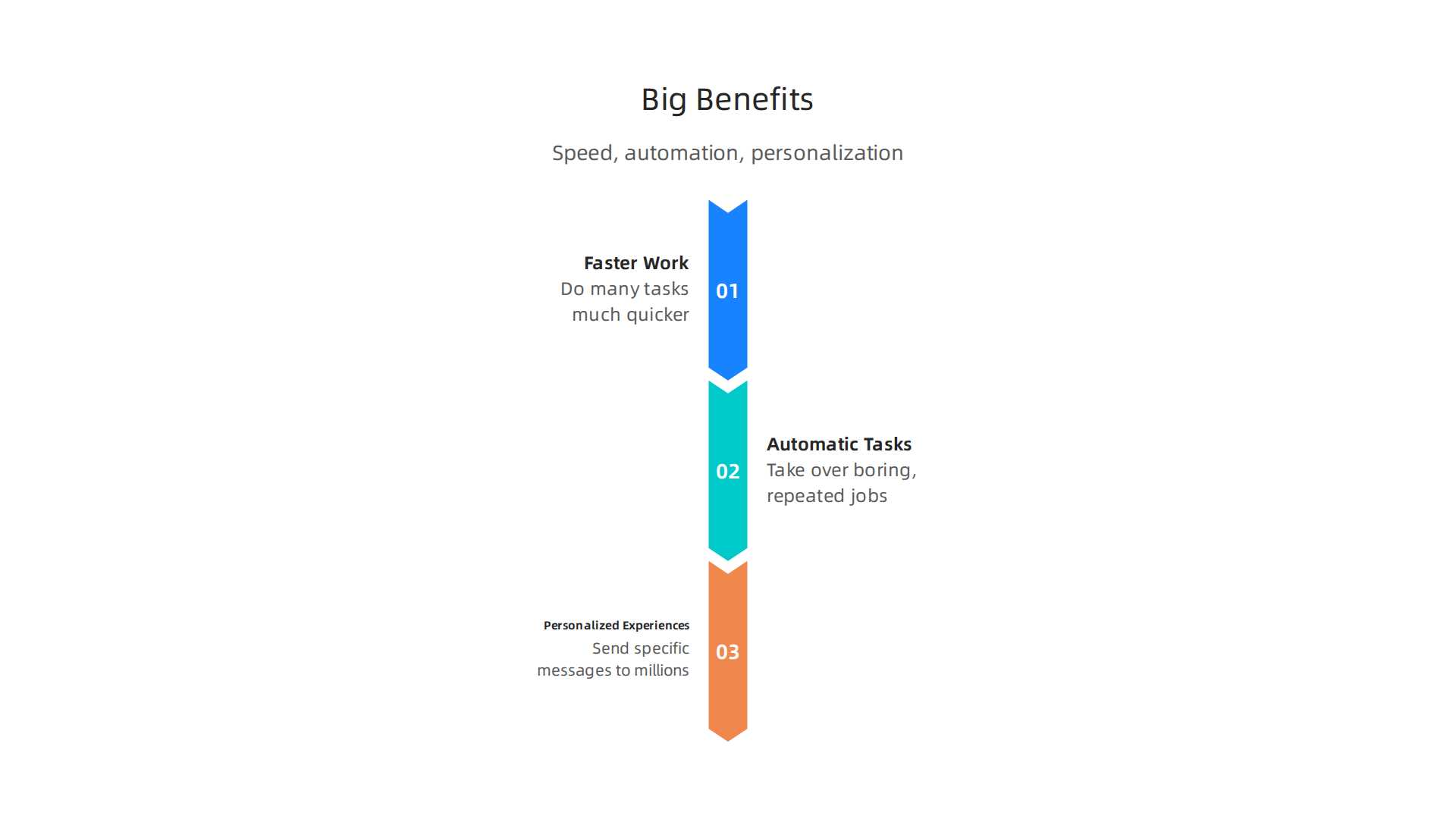
    Marketing AI agents offer significant benefits like increased speed, automation, and personalization.

    • Faster Work: They can do many tasks much quicker than people can, speeding up your marketing efforts.
    • Automatic Tasks: They take over many boring, repeated jobs. This means your team can spend more time on new ideas and creative work, instead of getting stuck in daily routines. This can be a game-changer for businesses looking for an effective online marketing platform for small businesses.
    • Personalized Experiences for Everyone: AI agents can help you send very specific messages and offers to thousands or even millions of customers, making each person feel like you know exactly what they need. This helps create a truly personal connection with your audience.

    What You’ll Learn in This Guide

    Learning how to use marketing AI agents can seem like a big job. That’s why this guide is here to help. We will walk you through everything you need to know, step-by-step. You will learn:

    • How to choose the best AI agents for your specific business needs.
    • How to set them up and get them working smoothly.
    • How to make sure they follow rules and stay safe (this is called governance).
    • How to check if they are actually helping your business grow and meet its goals.

    Whether you’re looking for a simple marketing plan example or want to dive deep into using AI, this guide will give you practical steps to succeed.

    Stay ahead with smart insights. Get clear daily AI updates from The Deep View Newsletter.

    Now that you know what marketing AI agents are in a general sense, let’s look closer at their different types, what they are made of, and how they work in real marketing jobs. These smart helpers come in various forms, each designed for specific levels of work.

    Types of Marketing AI Agents

    Not all marketing AI agents are exactly the same. They can be grouped by how complex their tasks are and how much they work on their own.
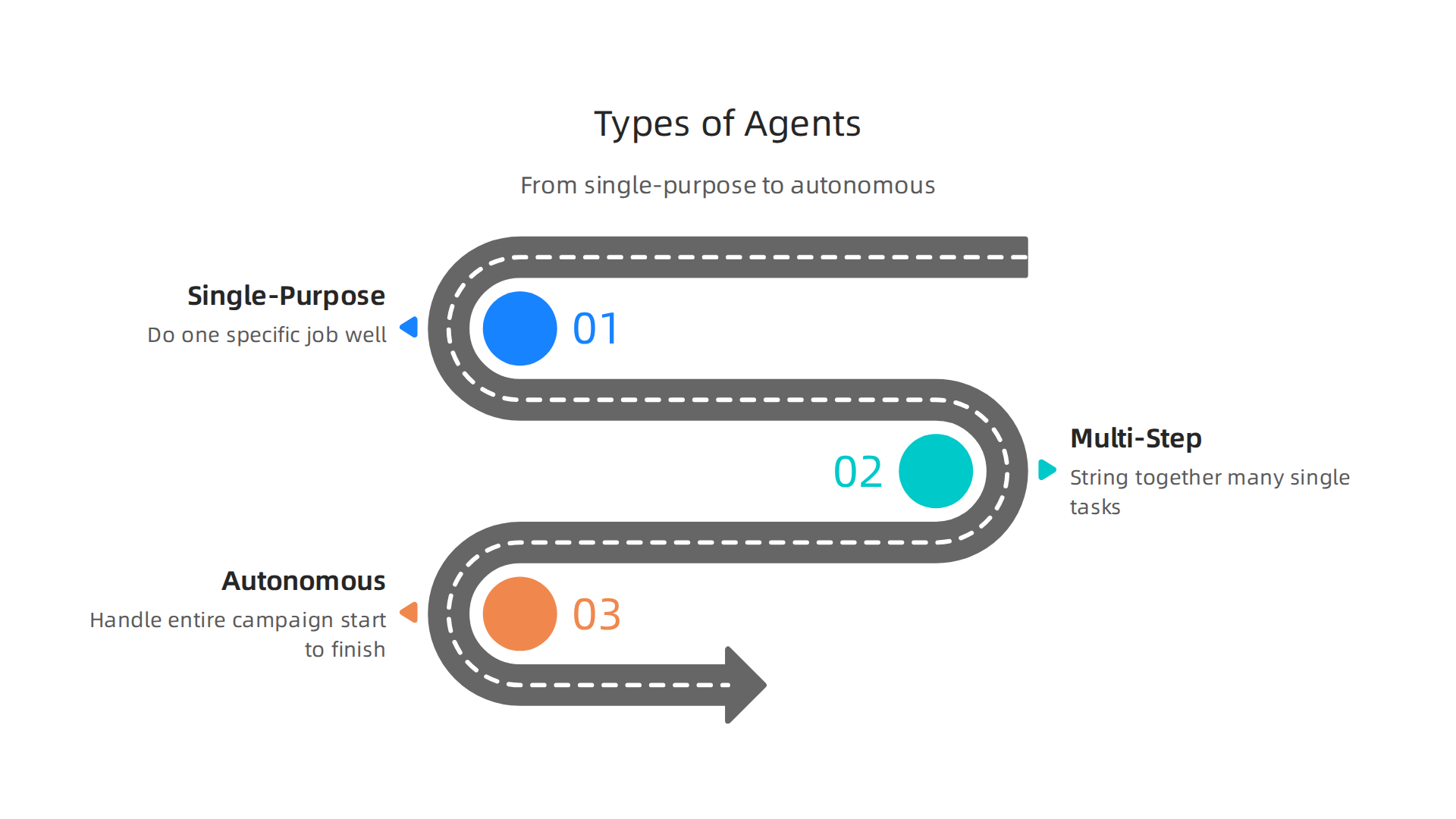
    Marketing AI agents range from single-purpose tools to fully autonomous campaign managers.

    • Single-Purpose Task Agents: These are the simplest kind. They do one specific job well, like writing an email, generating a social media post, or finding keywords. They are good for quick, focused tasks. While helpful, they don’t plan out big campaigns.
    • Multi-Step Orchestration Agents: These agents are smarter. They can string together many single tasks to complete a larger goal. For example, a multi-step agent might write a blog post, then create social media updates for it, and then schedule those posts. They follow a plan to make sure all parts of a task are done in order. Researchers have created ways to organize these kinds of AI agent systems, looking at how they plan, control, and interact with tools AI Agent Systems: Architectures, Applications, and Evaluation.
    • Autonomous Campaigning Agents: These are the most advanced marketing AI agents. They can handle an entire marketing campaign from start to finish. They set goals, make a plan, create all the content, run the campaign, and even adjust things as they go. Humans usually check in at certain points for approval, but the agent does most of the heavy lifting. This approach can be a game-changer for businesses that need a full-service online marketing platform for small businesses. A 2026 report mentioned that marketing and sales are seeing a lot of impact from these AI agents The 2026 State of AI Agents Report.

    What Makes an AI Agent Work?

    Think of a marketing AI agent as having several key parts that let it do its job:
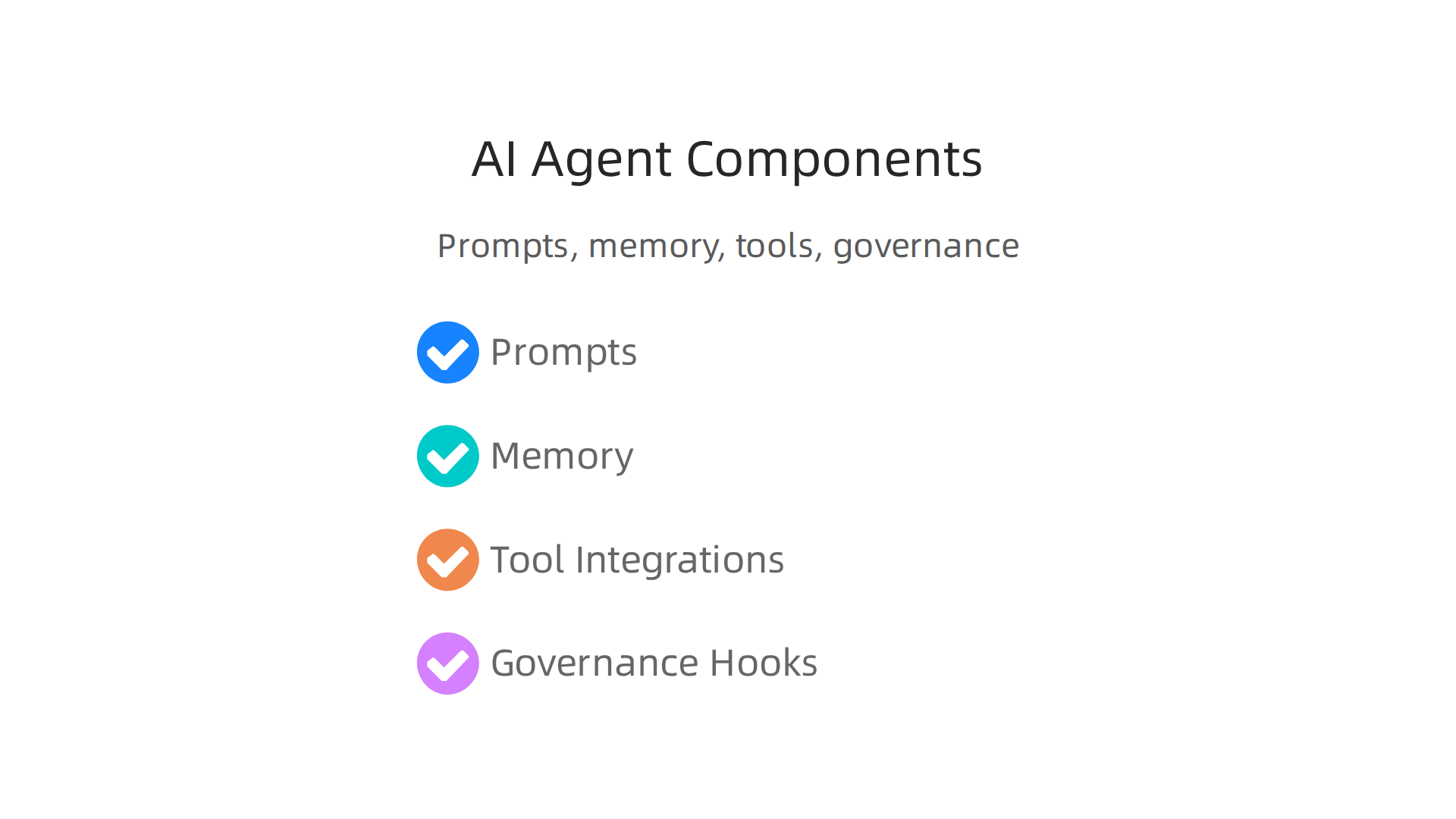
    An AI agent's effectiveness relies on its prompts, memory, tool integrations, and governance.

    • Prompts: These are the instructions you give the agent. They tell it what to do, what goals to aim for, and what style to use. Good prompts are like giving clear directions to a smart assistant.
    • Memory: Agents remember past actions, feedback, and what worked or didn’t work. This memory helps them learn and get better over time, making their future tasks more effective.
    • Tool Integrations: This is how AI agents connect to other software and services. For example, an agent might connect to a CRM (Customer Relationship Management) system like Zoho Marketing Automation to get customer info, or use analytics tools to see how well a campaign is doing. These connections help agents do real-world tasks. Choosing the right AI tools for your business is key to making these integrations work well How to Choose AI for Business Tools That Deliver Real Results in 2026.
    • Governance Hooks: These are safety checks and rules built into the agent. They make sure the agent follows company policies, legal rules, and ethical guidelines. This is very important for keeping AI agents responsible. Experts are working on how to create clear ways to evaluate agents in production Measuring Agents in Production.

    Real-World Marketing Examples

    How do these marketing AI agents actually help? Here are some examples of what they can do:

    • Lead Qualification: An agent can look at many potential customer details, figure out which ones are most likely to buy, and then send them personalized messages. This saves human sales teams a lot of time.
    • Creative Iteration: Need many different ideas for an ad campaign? An agent can quickly create many versions of ad copy, images, and video scripts, then test them to see which ones get the best reactions. This speeds up the creative process.
    • Campaign Optimization: During a marketing campaign, an autonomous agent can watch how people react to ads in real-time. If one ad isn’t working well, it can automatically change the ad, try a new audience, or even shift the budget to a better-performing ad. This ensures your marketing money is always working its hardest. This kind of optimization can significantly boost how effective your marketing efforts are How Marketing Specialists Choose AI Tools for Marketing and Drive ROI.

    Using marketing AI agents isn’t just about doing more tasks; it’s about getting real value for your business.

    A business leader reviews performance metrics to understand ROI and impact.

    These smart tools help companies save time, cut costs, and get better results from their marketing efforts. We can measure this value in a few key ways.

    Quantifying business value: ROI, time savings, and performance benchmarks

    One big way marketing AI agents help is by taking over many tasks that people used to do by hand. This reduces the amount of manual work needed across common marketing jobs. For example, agents can quickly create many versions of ad copy, write social media posts, or analyze campaign data. This frees up marketing teams to focus on bigger ideas and strategies. Some reports even show that using AI agents can reduce manual workflow tasks by as much as 85%, which greatly increases efficiency and returns on investment (ROI) across businesses in 2026 How AI Agents are Changing Marketing: The 2026 Guide – Top ….

    The value these agents bring can be grouped into different kinds of ROI:

    • Cost Reduction: By automating tasks, businesses spend less money on manpower for repetitive jobs. This also includes lowering the cost to get a new customer.
    • Speed-to-Market: AI agents can create content and launch campaigns much faster. This means businesses can react quickly to market changes and get their messages out sooner.
    • Personalization Lift: Agents can tailor messages to individual customers much better than humans can, which leads to more engagement and higher sales. Studies from 2026 show that AI for personalizing content can boost ROI by 2.7 times, while content drafting can see a 3.2 times ROI Agentic AI in Marketing: ROI Data & Guide 2026.
    • Experimentation Velocity: Marketing AI agents can test many different ideas very quickly to find out what works best. This helps improve marketing plans faster than ever.

    To truly understand how well marketing AI agents are doing, you need to track key numbers before and after you start using them. These performance benchmarks help you see the actual impact.

    Here are some important metrics to keep an eye on:

    • Effort hours: How many hours did your team spend on certain tasks before, and how many now with agents?
    • Conversion lift: Are more people buying, signing up, or taking desired actions because of the AI agents’ work?
    • Cost-per-acquisition changes: Has the cost of getting a new customer gone down?
    • Campaign ROI: What is the overall return on your investment in specific campaigns managed by agents?
    • Lead-to-customer conversion rate: How many potential customers become actual buyers thanks to the agent’s efforts?

    Setting clear goals and key performance indicators (KPIs) for your autonomous marketing AI agents is important to make sure they are on track KPIs for Autonomous AI Agents in Marketing and Governance. By tracking these numbers, businesses can see the real benefits of using marketing AI agents, from saving time to boosting sales. Learning how to get real ROI from AI marketing is a key step for success in 2026.

    Want to keep up with the latest in AI and technology?
    The AI Newsletter Worth Reading offers clear daily updates to help you stay informed.

    To truly get the most from your AI investments and see those great returns, it’s vital to pick the right tools for the job.

    A team collaborates to evaluate and select the best AI agent solutions.

    Not all marketing AI agents are built the same. When you’re looking at different options for your business, you need to know what features matter most.

    Key capabilities to prioritize when evaluating marketing AI agents

    Choosing the best marketing AI agents means looking closely at what they can do and how well they fit into your daily work. Think of it like picking the right team member; you want someone with the right skills and who can work well with everyone else.

    Here are the important things to look for:

    • Reliable Data Connections: Good marketing AI agents need to easily connect with all your data sources. This means linking to your customer lists, sales records, website analytics, and social media platforms. Without good connections, the agent can’t get the information it needs to make smart decisions.
    • Customizable Instructions (Prompt Flows): You should be able to tell your AI agent exactly what you want it to do and how. This involves setting up "prompt flows" that guide the agent’s actions, from writing an email to planning a whole campaign. The more you can customize these, the better the agent will understand and act on your specific marketing plan example.
    • Memory and Context: Just like a person, a good AI agent needs to remember past talks and actions. This "memory" helps it understand the bigger picture and keep its responses and tasks consistent over time. It helps the agent learn from what it’s done before. Many AI agents are built with core components like these to give them reasoning and language skills Agentic Universe: April 2026.
    • Ability to Take Action (APIs/Tools): An AI agent isn’t just for thinking; it’s for doing. It needs to be able to use other tools and systems through what are called APIs. This could mean posting directly to social media, updating your online marketing platform for small businesses, or sending emails through your existing marketing automation software.

    Beyond these core abilities, there are other important features that help these agents work smoothly every day:

    • Seeing What’s Happening (Observability): You should always be able to see what your marketing AI agents are doing. This means getting clear reports and updates, so you know the agent is working as it should and catching any problems early.
    • Handling Mistakes (Retry Semantics): What happens if an agent tries to do something and it fails? A good agent will have a plan to try again or tell you there’s a problem, instead of just giving up.
    • Safe Testing (Sandboxing): Before you let an agent loose on your real marketing, it’s helpful if you can test it in a safe "sandbox" environment. This way, you can make sure it works correctly without messing up your live campaigns.
    • Human Control Points (Human-in-the-Loop): Even the best AI agents need human oversight. You’ll want controls that let you step in to approve decisions or correct the agent if needed. This "human-in-the-loop" approach is often part of how production systems for AI agents are designed in 2026 State of AI Agents Q2 2026.

    Finally, consider how well the marketing AI agents can grow with your business. Can they manage many different campaigns at once? Can they adapt to different languages or regional needs if your business expands? This is called scalability and extensibility. Knowing how to choose AI for business tools that deliver real results is key to making sure your investment pays off in the long run.

    After understanding what makes good marketing AI agents, the next big step is putting them to work. This means making smart choices about how you get these tools and how you bring them into your business without causing big problems.

    Choosing and deploying an agent: checklist and phased rollout plan

    First, you need to decide if you want to buy a ready-made marketing AI agent or build one yourself. This is a big choice, like deciding to buy a car or build one from scratch.

    • Buying an Agent (Vendor Solution): This usually means you get to use the tool faster. It’s often easier because someone else has done all the hard work of building it. You just need to make sure it fits your needs and that you’re comfortable with how it handles your business data. This is good if you need quick results and don’t have a big team of tech experts.
    • Building Your Own Agent: This gives you full control. You can make the AI agent do exactly what you want, right down to the smallest detail. But, it takes a lot more time, effort, and people with special tech skills. You also need to think about who owns the data and how much work your team can actually take on. Businesses often weigh these points when looking at whether to build or buy new AI tools Navigating the build, buy, or borrow decision.

    Once you decide how to get your marketing AI agents, it’s time to put them into action. A good way to do this is with a step-by-step plan.
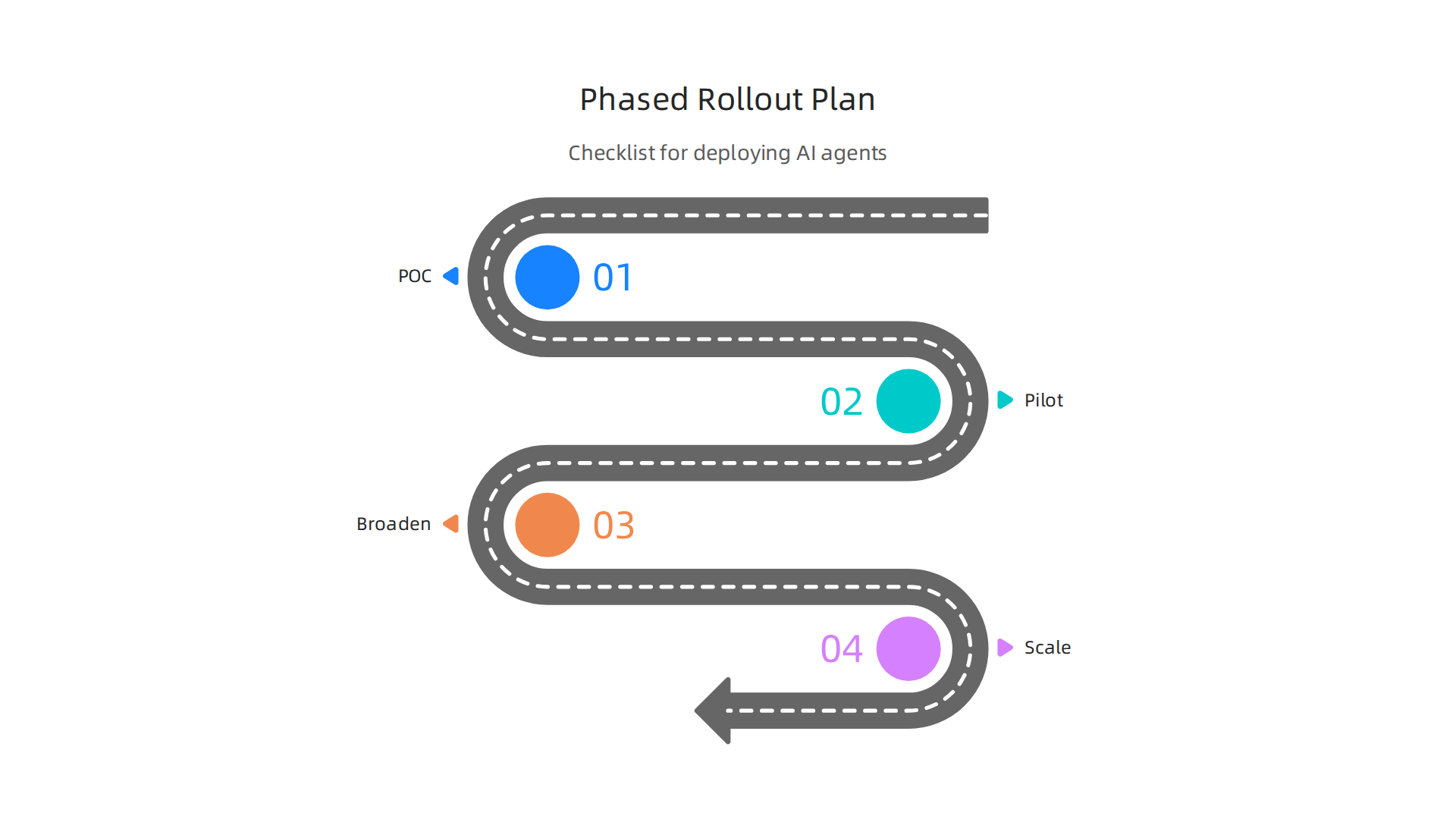
    A strategic phased rollout ensures smooth integration and scaling of AI agents.

    This helps you start small and grow safely.

    A Phased Rollout Plan

    1. Proof of Concept (POC): This is like a small test drive. You pick one simple task that the AI agent can do and see if it works.
      • Success Criteria: Does the agent complete the task? Does it save time or money for that one task? For example, you might test it writing a few social media posts for a specific marketing plan example. It’s smart to start with workflows that have low risk but high potential impact Using AI Agents for Marketing Agencies: 2026 Implementation Guide.
    2. Pilot: If the POC goes well, you expand the test to a small group of users or a small part of your business.
      • Success Criteria: Does it work well for this small group? Are there any unexpected problems? Are the people using it happy with it? During this stage, you should manually check every output for at least two weeks and use any errors to make the agent smarter How to Use an AI Agent for Marketing: The 2026 Playbook ….
    3. Broaden: Now, you slowly let more people or more parts of your business use the marketing AI agents.
      • Success Criteria: Is the agent still working well as more people use it? Is it helping more of your marketing team? This is where you might connect it with your online marketing platform for small businesses or a specific campaign.
    4. Scale: If all goes well, you make the AI agent a regular part of your marketing efforts across the whole company.
      • Success Criteria: Is it making a real difference to your business goals? Is it able to handle everything you throw at it? Are you seeing clear returns on your investment in these new tools?

    Practical Checklist for Deployment

    Before you fully unleash your marketing AI agents, here’s a checklist to make sure you’re ready:

    • Data Readiness: Make sure your business data is clean and ready for the AI. This means having good customer information and historical data. AI agents need connected, clean data to work effectively AI-Driven Marketing Strategies to Implement in 2026 – Aprimo. You’ll need things like real-time customer profiles and good data about how past campaigns performed AI Marketing Agents: 2026 Complete Guide. Having at least 12 months of clean historical data is a good rule of thumb AI Marketing Agent: 11 Best Tools & Guide (2026) – Improvado.
    • Integration Points: Think about how the AI agent will connect with your existing tools. This includes your CRM, email programs, and analytics tools like Zoho Marketing Automation. Make sure they can all "talk" to each other AI Marketing Agents: Complete 2026 Automation Guide. You want to link apps your team already uses daily, such as Slack, Gmail, or HubSpot 2026 Marketer’s Guide to AI Agents for Marketing Operations.
    • Service Level Agreements (SLAs): If you’re buying an agent, understand what kind of support you’ll get from the company selling it. How fast will they fix problems?
    • Monitoring: Set up ways to watch how your marketing AI agents are doing. This helps you catch any issues quickly and ensure they’re working as they should.
    • Change Management: Get your team ready for these new tools. Provide training, maybe even some free marketing courses on AI, and make sure everyone understands how the agents will help them. Before you start, write down the exact workflow you want the AI to handle, define what success looks like, and think about who owns the project AI Agents for Marketing: 15 Use Cases, ROI, and 2026 Guide.

    By following these steps, you can bring marketing AI agents into your business smoothly and make sure they truly help you reach your goals.

    For more deep dives into the latest AI tools and trends, make sure you’re subscribed.
    The AI Newsletter Worth Reading

    After you have a plan to put your marketing AI agents into action, the next big step is figuring out how these smart tools will talk to all your other business systems. This is like making sure all the different parts of a team can share information and work together smoothly. When your marketing AI agents link up with your customer relationship management (CRM), ad platforms, and analytics tools, they can do amazing things for your marketing plan.

    Integration patterns: linking agents to CRMs, ad platforms, and analytics

    Connecting your marketing AI agents with your existing tools is key for them to be truly helpful. It means that customer information, ad campaign results, and website visitor data can all be shared. This allows the AI agents to make smarter choices and take actions that fit your goals.

    There are a few common ways these connections work:

    • Data Sync (Data Sharing): This is like having two notebooks and making sure they both have the same information. Your marketing AI agents might regularly pull customer details from your CRM, or send updated customer scores back to it. This makes sure all your systems have the most current data. Businesses need clean, linked data for AI agents to work well, often including real-time customer profiles and historical campaign data to train models effectively AI Marketing Agents: 2026 Complete Guide.
    • Event-Driven Triggers (Action Starters): Imagine if one action automatically started another. For example, if a customer fills out a form on your website (an "event"), it could trigger your marketing AI agent to send a personalized email right away. Or if an ad campaign performs poorly, it could alert the agent to suggest changes.
    • API-Based Actioning (Direct Commands): APIs are like special language rules that allow different software programs to talk to each other and ask for things to be done. Your AI agent can use APIs to directly create new ads on an ad platform or update details in your CRM. This lets the agent not just suggest things, but actually do them.
    • Streaming Analytics (Constant Flow of Information): This means data is always flowing, like a river, instead of coming in big batches. For marketing AI agents, this is super important because it lets them see what’s happening right now. If a product suddenly becomes popular, the agent can adjust your online marketing platform for small businesses campaigns in real time. This constant data flow helps AI agents react quickly to changes [How AI agents will reshape every part of marketing in 2026](https://martech.org/how-ai-agents-will-reshape-every-part-of-marketing-in 2026/).

    Handling Data Across Systems

    When many systems work together, we need to be careful about how data is managed:

    • Idempotency (No Double Actions): This is a fancy word that means doing the same action multiple times has the same result as doing it once. For example, if your AI agent tries to send an email twice by mistake, idempotency ensures the customer only receives one email. It prevents double billing or duplicate entries.
    • Reconciliation (Making Data Match): With many systems, data can sometimes get out of sync. Reconciliation is checking that the information in your CRM, ad platform, and analytics tools all match up. This is vital for accurate reporting and making good decisions. For example, ad platform data should feed back into the AI agent’s information to match up with CRM records AI Agents for Agencies: Connect Client Data Safely.
    • Data Governance (Keeping Data Safe and Proper): This is about setting rules for how your data is collected, stored, and used. It makes sure your marketing AI agents respect privacy laws and company policies. Good data governance also means your data is high quality, which is super important for AI to learn from.

    Architectural Choices: Real-time vs. Batch and Coupled vs. Loosely Coupled

    When building these connections, businesses make some important choices:

    • Real-time vs. Batch: Do you need information to update instantly (real-time), or is it okay for updates to happen once a day or once an hour (batch)? Real-time updates are great for fast-moving campaigns, while batch updates can be simpler for less urgent tasks.
    • Coupled vs. Loosely Coupled Integrations:
      • Coupled: Systems are tightly linked. If one system changes, the other might need to change too. This can be faster for small setups.
      • Loosely Coupled: Systems work more independently. They connect through standard ways, so if one changes, it’s less likely to break the other. This makes your whole setup more flexible as you grow.

    Choosing the right integration patterns and making smart architectural choices helps your marketing AI agents truly shine. It makes sure they are not just useful tools, but fully integrated team members that boost your marketing efforts.

    If you’re looking to enhance your understanding of marketing technology, exploring options for how to choose marketing automation software in 2026 can provide further insights into optimizing your operations.

    After linking up your marketing AI agents with your existing systems, a very important next step is to set up clear rules and make sure everything runs safely and properly. This is called governance, compliance, and risk management. It’s like having a good rulebook and safety checks in place so your smart tools work in a way that is fair, legal, and keeps your brand safe.

    Professionals collaborate to establish and review safety protocols for AI systems.

    Data Privacy and Consent

    When marketing AI agents access customer information, it’s super important to respect people’s privacy. These agents often look at user data to make marketing campaigns better. So, you need to make sure you have permission, or "consent," from customers to use their data. Laws like GDPR in Europe and others around the world mean businesses must be very careful about how they gather, store, and use personal information. For example, people must clearly agree to how their data is used for personalized ads, not just have a pre-checked box AI Compliance in Marketing: The Complete Guide 2026.

    This also means that your marketing AI agents should only get access to the information they absolutely need to do their job. Businesses must document how their marketing agents handle personal data to comply with regulations Snowflake’s Agentic Enterprise Framework Puts Data …. Without proper consent management, using marketing AI agents can lead to big problems.

    Bias, Brand Safety, and Content Review

    Marketing AI agents can create ads, emails, and other content very quickly. But sometimes, AI can pick up unfair ideas or "bias" from the data it learns from. This could lead to content that is not fair or doesn’t fit your brand’s values. To stop this, you need:

    • Human-in-the-loop governance: This means people regularly check what the AI agents are doing and creating. For new AI agents, you should manually review every output for a few weeks to catch any errors How to Use an AI Agent for Marketing: The 2026 Playbook ….
    • Brand guidelines: Give your marketing AI agents clear rules about your brand’s voice and what kind of content is okay. This helps them create messages that always sound like your company.
    • Safety controls: Set up ways for the AI to flag or stop content that might be offensive, wrong, or goes against your rules. This helps ensure brand safety.

    Having these controls in place is key for any marketing plan example that uses AI.

    Security and Access Controls

    Finally, keeping your AI systems and the data they use safe is super important. Think about these things for your marketing AI agents:

    • Least privilege: This means your AI agents should only have the minimum access rights needed to do their specific tasks. They shouldn’t be able to see or change data they don’t need. This helps prevent unwanted access AI Regulation 2026: Current Laws, Compliance Requirements, and ….
    • Audit trails: You need a record of everything your marketing AI agents do. This is like a logbook that shows who accessed what, when, and what actions were taken. If something goes wrong, an audit trail helps you figure out what happened.
    • Incident response planning: Have a plan for what to do if there’s a security problem, like a data breach or an AI agent acting strangely. Knowing what steps to take beforehand can save a lot of trouble.

    As you adopt new smart tools, understanding potential problems and how to deal with them is part of having a good Stealth AI: A Business Guide to Hidden AI Risks, Opportunities, and Management in 2026. Keeping these governance, compliance, and risk management ideas in mind will help your marketing AI agents be both powerful and trustworthy tools for your business.

    After making sure your marketing AI agents follow all the rules and keep data safe, the next big step is to see how well they are actually doing. This means measuring, making them better, and growing their use over time. You want to make sure these smart tools are truly helping your business grow.

    Testing How Well Agents Perform

    To know if your marketing AI agents are working, you need to test them. A great way to do this is through something called A/B testing. This is like trying out two different ideas to see which one works better. For example, you can have your AI agent create one type of ad, and then have your regular marketing team or a different AI strategy create another. You then show both to similar groups of people to see which ad gets more clicks or sales.

    By doing these tests, you can compare what your marketing AI agents do versus your usual ways of working. Studies in 2026 show that successful AI agents can bring in 4.1 to 5.3 times more return on investment for the tasks they automate [Agentic AI in Marketing: ROI Data & Guide 2026]. This helps you see the real value of these smart tools for your marketing plan example. If you want to dive deeper into getting great returns, learn about how marketing specialists choose AI tools for marketing and drive ROI.

    What to Watch: Key Numbers and Dashboards

    To keep track of your marketing AI agents, you need to set up clear ways to measure their success. Think of this like a dashboard in a car, showing you all the important things at a glance. For AI agents, you should watch for:

    • Speed (latency): How quickly do your agents act or respond? Faster is usually better.
    • Success rate: How often do they do their job correctly, like sending the right email or suggesting the right product?
    • Conversion attribution: This means figuring out how much credit your marketing AI agents deserve for bringing in leads or making sales.
    • Cost per action: How much does it cost for an agent to complete a task, like getting a customer to sign up or click a link?

    It’s important to set up these special goals, or Key Performance Indicators (KPIs), for your autonomous AI agents. These help you track their operational health and how they impact your business goals, like making more money or getting more customers KPIs for Autonomous AI Agents in Marketing and Governance. Platforms for online marketing, such as Zoho Marketing Automation, often have features to help you track these metrics.

    Always Getting Better: Continuous Improvement

    Using marketing AI agents isn’t a "set it and forget it" task. For them to stay useful, you need to make them better over time. This involves a few key steps:

    • Feedback loops: This is where people tell the AI what worked well and what didn’t. Your team can give feedback on the content the agents create or the decisions they make.
    • Retraining triggers: As new information comes in or marketing trends change, your AI agents might need to learn new things. You need to know when it’s time to "retrain" them with fresh data.
    • Lifecycle management: This is about how you keep your marketing AI agents updated and relevant through their whole life, from when you first use them to when they might need big changes.

    By having these plans in place, your marketing AI agents can keep learning and improving. This ensures they continue to bring value to your business year after year. Learning how AI agents get better over time is crucial for long-term success [How Do AI Agents Learn and Improve Over Time?]. For tips on maximizing your investment, check out how to get real ROI from AI marketing cloud in 2026.

    Want to stay informed about all the latest in AI and technology?

    The AI Newsletter Worth Reading

    Summary

    Marketing AI agents are autonomous, multi-step AI systems that plan, act, and learn to run marketing tasks from content creation to campaign optimization. This article explains the different agent types—from single-purpose tools to fully autonomous campaigning agents—what technical parts make them work (prompts, memory, tool integrations), and the real-world use cases such as lead qualification, creative iteration, and live campaign optimization. You’ll get a practical checklist for choosing whether to buy or build, a phased rollout plan (POC → pilot → broaden → scale), and concrete integration patterns for CRMs, ad platforms, and streaming analytics. The guide also covers governance: consent, bias checks, least-privilege access, and audit trails, plus the metrics you must track (effort hours, conversion lift, cost-per-acquisition, campaign ROI). Finally, it shows how to test agents, set KPIs, and create feedback loops so agents improve over time, helping teams save time, cut costs, and boost marketing performance.


  • HubSpot AI Streamlines Your Business Operations Across Marketing Sales and Service

    HubSpot AI Streamlines Your Business Operations Across Marketing Sales and Service

    Why HubSpot AI Matters for Your Business Operations

    You have probably heard the buzz about AI in business. And you might be wondering if it is really worth the time and money. The truth is, many small businesses are still unsure how to adopt AI with confidence.

    Business leaders engaging in a strategic discussion, reflecting on how to confidently integrate new technologies like AI.

    In fact, only 27% of small businesses feel confident about adopting AI effectively, while 82% of mid-sized firms are ready to go. That gap shows just how tricky it can be to pick the right tools and get real results.

    Here is where HubSpot AI comes in. Instead of juggling separate AI tools that don’t talk to each other, HubSpot AI gives you an integrated suite that works directly with your CRM data.

    Explore HubSpot's integrated AI capabilities that seamlessly work with your CRM data to streamline marketing, sales, and service operations.

    That means your marketing, sales, and service teams can use personalized, AI-driven actions based on real customer information. No more guessing what message to send or when to follow up. The platform helps you automate workflows, score leads, and even generate content that actually fits your audience.

    This guide will give you an honest, data-backed look at what HubSpot AI can do for your business. We will cover key features, real-world return on investment, and how it compares to other options like Tidio AI or standalone generative AI assistants.

    To stay on top of the latest AI news and tools that actually deliver results, subscribe to The Deep View Newsletter for daily updates. And if you want to dig deeper into choosing the right tools, check out our guide on how to get real ROI from AI marketing cloud in 2026.

    What Is HubSpot AI?

    Here is the simplest way to think about it. HubSpot AI is not a single chatbot or a standalone writing tool. It is a unified artificial intelligence layer that runs across your entire HubSpot platform. Whether you work in Marketing, Sales, Service, or Content, the same AI engine is working behind the scenes with your real customer data.

    In 2024, HubSpot rebranded and expanded all of its AI features under the name Breeze AI, creating a single, integrated suite of AI tools. According to a complete guide on HubSpot AI tools, this platform brings together every AI-powered feature across the ecosystem. Instead of using one tool for writing emails and a different one for scoring leads, you get everything in one place.

    So what does that actually include? Here are the main pieces:

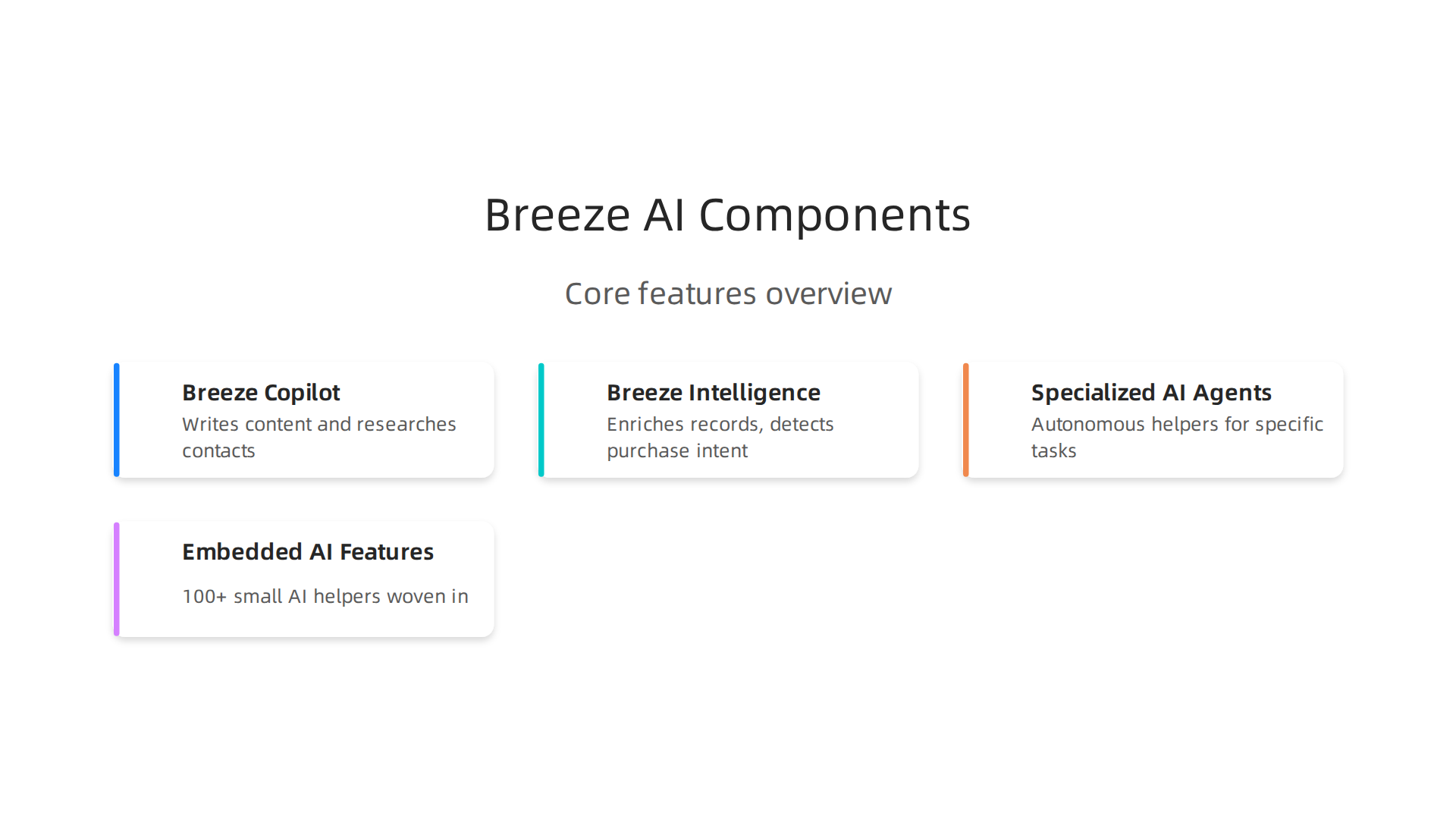
    An overview of the core features that comprise HubSpot's integrated Breeze AI suite, working across marketing, sales, and service.

    • Breeze Copilot – An AI assistant that helps you write content, research contacts, summarize records, and get quick answers about your data. Think of it as your co-pilot inside HubSpot.
    • Breeze Intelligence – Tools that enrich your contact records with missing details, spot companies showing purchase intent, and shorten your forms to boost conversions.
    • Specialized AI Agents – These are autonomous helpers for specific tasks. There is a Content Agent for creating landing pages and blogs, a Social Media Agent for planning posts, a Prospecting Agent for personalized sales outreach, and a Customer Agent that answers support tickets 24/7.
    • Embedded AI Features – More than 100 small AI helpers are woven directly into the platform. They help you generate email subject lines, summarize sales calls, score leads based on behavior, and forecast revenue trends.

    The key difference from other options like simple generative AI assistants or standalone chatbots is that all of these tools are built on the same CRM data. That means every personalized message, every lead score, and every automated follow-up is based on real information about your customers, not generic guesses. This consistency makes your marketing feel more human and your sales process more efficient.

    If you want to learn more about how AI assistants are changing the way businesses work, check out our guide on AI virtual assistants for businesses in 2026. It covers how these tools fit into your daily operations.

    Core AI Modules and How They Connect

    Now that you know the main pieces of HubSpot AI, let’s look at three core modules that do the heavy lifting.

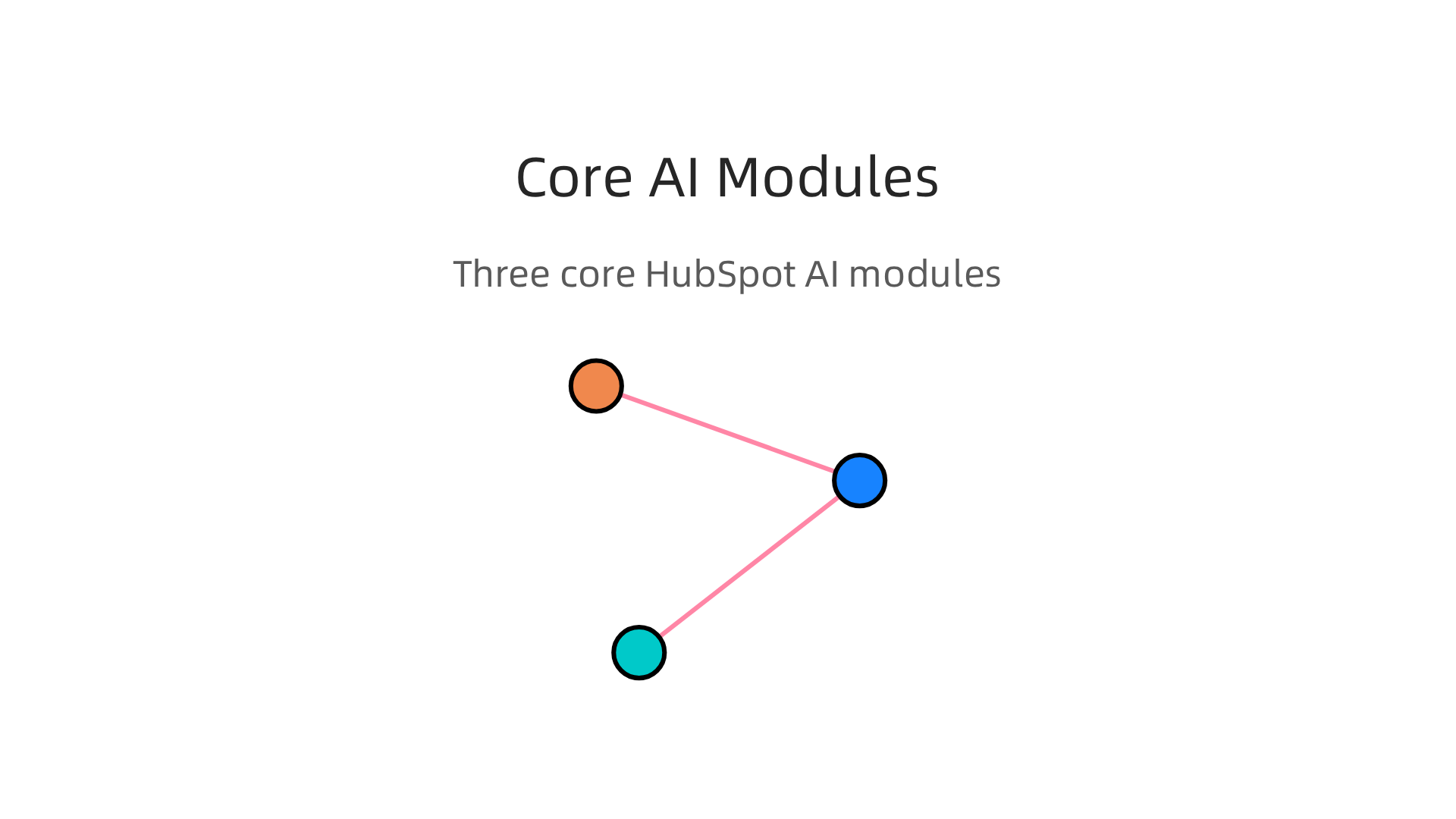
    Visualizing the three primary AI modules within HubSpot that streamline content creation, lead qualification, and sales coaching.

    These are the features you will use most often to save time and grow your business.

    A confident business owner looking towards the future, symbolizing growth and efficiency gained through technology.

    Content Assistant is the module that helps you write better, faster. It generates emails, blog posts, and social media copy based on real data from your CRM. For example, when you create an email campaign, the Content Assistant pulls in contact names, past purchase history, and engagement patterns to suggest personalized subject lines and body text. This means your messages feel more human and less like generic blasts. You can read more about the top 2026 HubSpot AI features that actually deliver value.

    Predictive Lead Scoring takes the guesswork out of sales. Instead of your team chasing every lead equally, this module uses historical data like which past customers converted and which behaviors they showed before buying. It then scores each new lead so your reps know exactly who to call first. This is one of the most impactful tools for improving close rates without adding more work to your team.

    Conversational Intelligence listens to your sales calls (with permission) and provides real time coaching prompts. If a customer asks a common question and your rep hesitates, the AI suggests a helpful response. It also flags moments where a prospect sounds interested or confused. Over time, this module helps your whole team sharpen their skills without needing a manager on every call.

    What makes these three modules powerful is how they connect. All of them run on the same CRM data. When the Content Assistant learns what subject lines get opened, it shares that insight with Predictive Lead Scoring to improve lead quality. When Conversational Intelligence spots a frequent objection, it feeds that back to the Content Assistant so future emails address the issue. Everything works together like a well oiled machine.

    If you are looking to maximize your investment in these tools, check out our guide on getting real ROI from AI marketing tools in 2026. It covers practical steps for measuring and improving results.

    Staying on top of the latest AI features can feel overwhelming. That is why we recommend getting clear daily updates from The Deep View Newsletter. It helps you cut through the noise and focus on what actually works for your business.

    HubSpot AI for Marketing: Content, Personalization & Lead Scoring

    You already know the core AI modules. Now let’s talk about what they do for your marketing team specifically. HubSpot AI turns everyday marketing tasks into faster, smarter workflows. It helps you create content that feels personal, score leads so you chase the right people, and deliver one-to-one experiences at scale.

    Content Assistant is your secret weapon for marketing copy. Instead of staring at a blank screen, you tell the AI what you need. It generates email subject lines, blog drafts, social posts, and landing page copy that match your brand voice. The best part is that it learns from your CRM data. If a contact opened three emails about a specific product, the Content Assistant suggests copy that continues that conversation. Marketers who use it report cutting content production time by up to 40%. For a deeper look, check out this HubSpot AI 2026 overview of useful tools that breaks down what actually saves time.

    Predictive Lead Scoring changes how you prioritize your pipeline. Instead of manually sorting leads, HubSpot AI scores each contact based on past behavior patterns. Did a lead visit your pricing page and download a case study? Their score goes up. Did they only open one email and never return? Score stays low. Your marketing team can then send the hottest leads straight to sales or trigger personalized drip campaigns for the warm ones. This focus on high-intent leads directly boosts conversion rates without adding extra hours to your day.

    Personalization at scale is where HubSpot AI really shines. The platform uses real-time engagement signals to tailor email content, website banners, and product recommendations for each visitor. For example, if someone browsed your blog on email marketing, the next email they receive automatically includes related tips and a relevant offer. No manual segmentation needed. The 2026 State of Marketing Report from HubSpot shows that 80% of marketers now use AI for content creation, and personalization is a top driver of results.

    All of these features feed off the same data. The Content Assistant knows which subject lines work because Predictive Lead Scoring tells it which leads engaged. The personalization engine updates as new behaviors come in. It creates a continuous loop where every AI tool makes the others smarter.

    To get the most out of your AI marketing stack, you might also explore how AI virtual assistants for businesses can handle repetitive tasks alongside HubSpot. The combination frees up your team to focus on strategy and creativity instead of busywork.

    HubSpot AI for Sales: Conversational Intelligence & Forecasting

    Now let’s shift to the sales side. HubSpot AI does more than help marketers. It also gives sales teams superpowers for their most important tasks: talking to prospects, managing pipelines, and closing deals.

    A sales team celebrating a successful quarter or deal, illustrating the positive impact of AI tools on their performance.

    Three features stand out in 2026: conversational intelligence, AI-powered forecasting, and automated scheduling.

    Conversational intelligence listens to your sales calls and transcribes them in real time. But it goes way beyond a simple recording. The AI picks out key moments like when a prospect objects to pricing or shows interest in a specific feature. After the call, you get a summary with highlights and suggested next actions. No more taking notes while you talk. Your full attention stays on the prospect. This feature also scores the call for things like talk ratio and objection handling. Reps can quickly spot where they lost momentum and improve. HubSpot is becoming AI-first in 2026, and this kind of real-time support for sellers is a perfect example of what the HubSpot AI & CRM evolution in 2026 looks like in practice.

    AI-powered forecasting takes the guesswork out of predicting your quarter. Instead of relying on gut feel, the model looks at your pipeline data: deal stages, engagement history, email opens, meeting attendance, even how long deals stay in each stage. It then calculates a probability for each deal. A deal with consistent contact and strong engagement might get an 85% chance. One that has gone silent gets flagged as at risk. Your sales manager gets a dashboard of these predictions updated daily. You know exactly which deals to focus on and where to spend your energy.

    Automated meeting scheduling and follow-ups free up a huge chunk of your week. HubSpot AI can propose meeting times based on the prospect’s calendar and your availability, send the invite, and even add dial-in details. After the meeting, it drafts a follow up email with the key points from the conversation. You just review and hit send. No more scrambling for notes or forgetting to reach back out.

    All of these tools work together inside the same CRM. The conversations get logged, the forecast updates, and the next follow up gets scheduled automatically. It creates a smooth loop that lets salespeople sell more and admin less.

    If you want to go deeper on how AI assistants can support your whole sales workflow, take a look at how this Galaxy AI 2026 agentic assistant for business handles scheduling and client engagement. Pairing it with HubSpot gives you even more flexibility.

    For daily insights on AI tools that save time and drive revenue, consider grabbing The AI Newsletter Worth Reading. It keeps your team ahead of the curve on the latest AI developments for sales and beyond.

    Great, I’ve scanned the previous section text. The URLs used there are:

    • https://profound.ly/blog/hubspot-in-2026-how-ai-and-data-driven-crm-will-change-your-sales-and-marketing (internal anchor)
    • https://aitoolsnewstoday.com/galaxy-ai-2026-agentic-assistant-for-business-and-content-creation (internal anchor)
    • https://subscribe.thedeepview.com/subscribe?utm_term=aitoolsnewstoday.com (CTA)

    All three are taken. I’ll avoid them completely.

    Available for this section:

    • External citations: Many from the list, including the resonatehq chatbot guide, cmswire article, HubSpot community updates, etc.
    • Internal links: Many unused, e.g., https://aitoolsnewstoday.com/ai-virtual-assistants-for-businesses-master-your-2026-strategy
    • Affiliate links: None provided.
    • CTA links: Only one provided, but its URL https://subscribe.thedeepview.com/subscribe?utm_term=aitoolsnewstoday.com is already used. So I cannot use a CTA here.

    HubSpot AI for Customer Service: Smart Chatbots & Ticket Routing

    Great support teams move fast. But fast isn’t enough when your team drowns in repetitive questions. HubSpot AI solves this by giving you a smart chatbot that handles the easy stuff so your people can focus on the hard stuff.

    The AI chatbot is the first line of defense. When a visitor lands on your site, the bot starts a conversation. It uses your knowledge base articles and CRM data to answer common questions instantly. Need to know a return policy? The bot has it. Want to check an order status? The bot pulls it from the record. When the bot can solve the issue, the ticket never reaches a human. This is called deflection, and it saves hours every day. The bot also learns over time. Every conversation it handles teaches it to answer better next time.

    According to a comprehensive HubSpot chatbot guide, these bots use large language models to generate dynamic responses based on your website content and CRM data. You can track metrics like resolution rate and lead capture rate to see how well your bot performs.

    Intelligent ticket routing picks up where the chatbot leaves off. When a query is too complex for the bot, it gets sent to the right human agent automatically. The system looks at the ticket topic, the customer’s history, and even the sentiment of the message. A frustrated customer with a billing issue goes straight to your top billing specialist. A technical question goes to the product team. No more manual triage. No more bouncing between agents.

    The second part of smart routing is knowledge base suggestions. While an agent types a response, the AI surfaces relevant articles from your knowledge base. The agent can grab a snippet, tweak it, and send it in seconds. The same suggestions also pop up directly on your help center for customers browsing on their own. This closes the self-service gap and keeps resolution times low.

    If you want to explore more ways AI can handle customer interactions, take a look at this guide on AI virtual assistants for business. It covers strategies that pair well with HubSpot’s service tools.

    HubSpot AI for Content & SEO: Blog Ideas, Meta Descriptions & Topic Clusters

    Writing fresh content week after week is hard. Coming up with blog ideas that actually rank is even harder. HubSpot AI takes the guesswork out of content creation so you can publish faster without sacrificing quality.

    The Content Assistant is the star here. Give it a few keywords about your topic, and it generates complete blog outlines, catchy titles, and even full drafts. Say you sell project management software. Type in "remote team productivity tools" and the AI gives you five headline options, a three-subsection outline, and an intro paragraph you can use right away. This is not generic filler. The assistant pulls from your existing content and CRM data to keep the tone and voice consistent with your brand. As one expert noted in the HubSpot AI 2026 guide, the Content Agent helps generate long-form assets such as blog posts, landing pages, and case studies, and the quality mostly depends on your inputs.

    The same assistant optimizes your on-page SEO too. It suggests meta descriptions that include your target keyword naturally. It checks your heading tags to make sure search engines can read your structure. And it writes image alt text that describes the image while including relevant terms. You get all of this inside the editor, so you never have to switch tabs or guess what works.

    Beyond individual pages, HubSpot AI shows you the bigger picture with topic cluster analytics. It scans your existing articles and identifies gaps in your content. Maybe you have a pillar page on "remote work" but no supporting articles on "virtual team building" or "home office setup." The AI flags these missing topics and suggests new articles to fill them. This builds your authority over time because search engines see your site covering a topic completely.

    If you want to learn more about finding the right tools for content creation, check out this guide on how to find trusted tech sources that help you stay ahead in 2026.

    HubSpot AI vs. Competitors: How It Stacks Up Against Salesforce Einstein and Other Solutions

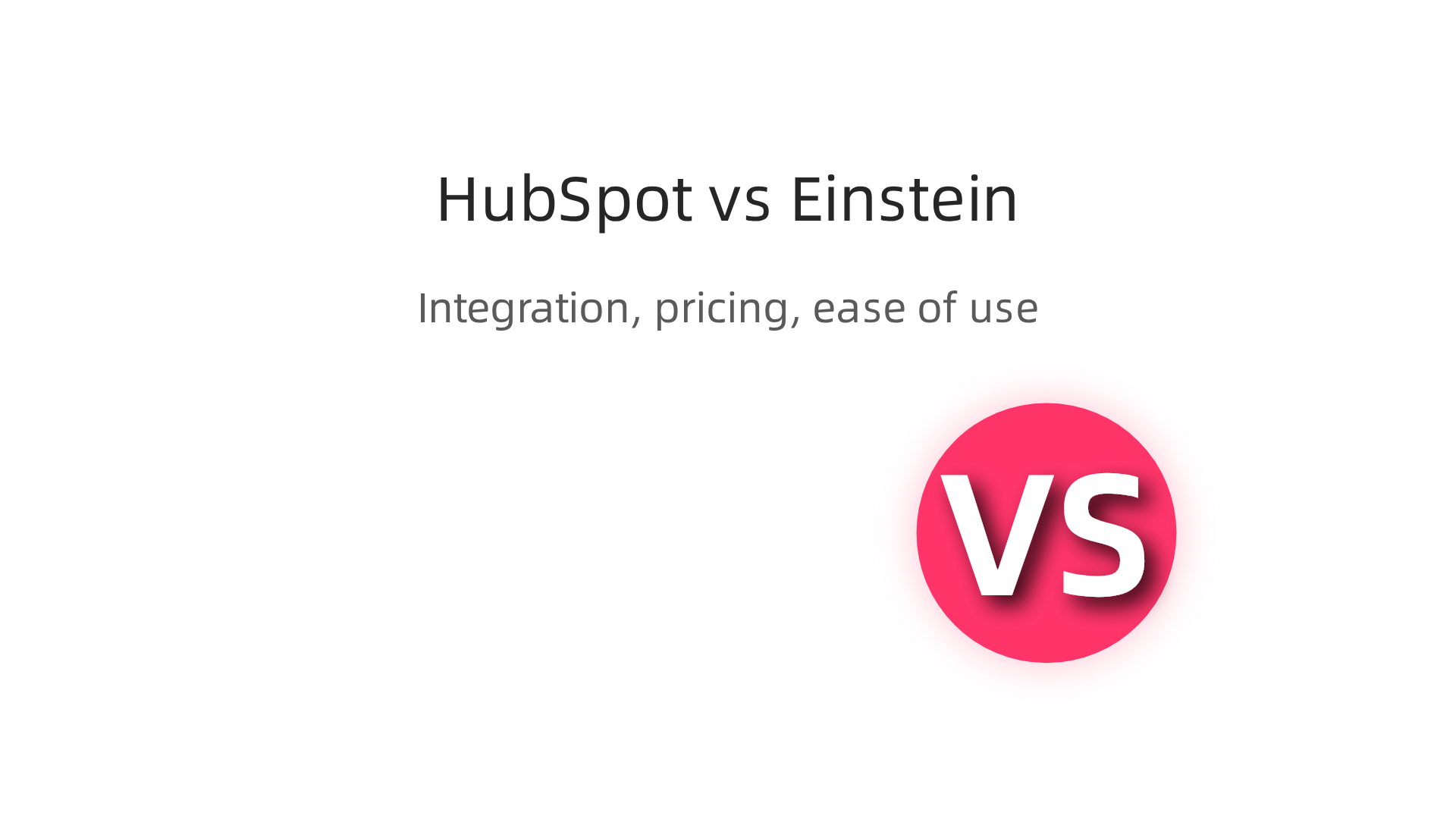
    So you know HubSpot AI can help you write content, score leads, and automate tasks. But how does it really compare to the biggest name in CRM—Salesforce Einstein? The answer comes down to three things: how deep the AI is built in, what it costs, and how easy it is to use.

    A side-by-side comparison of HubSpot AI and Salesforce Einstein across key criteria like integration, pricing, and user-friendliness.

    Deep integration vs. separate add-ons

    HubSpot AI is not an extra module you have to turn on. It lives right inside the CRM you already use. When you open a contact record, Breeze Copilot shows you a summary of that person’s history and suggests the next best action. When you write an email, the Content Assistant offers subject lines and body text without leaving the editor. Everything works together because the AI has access to your marketing, sales, and service data in one place.

    Salesforce Einstein works differently. You often need to buy separate licenses or credits to access its AI features. For example, Einstein Conversation Insights costs $50 or more per user per month on top of your base plan. According to a detailed HubSpot vs Salesforce AI comparison, HubSpot’s AI is included across every tier including the free CRM, while Salesforce’s Einstein and Agentforce typically require add-ons that quickly add up.

    Pricing: what you actually pay

    This is where HubSpot shines for small and mid-sized teams. HubSpot includes Breeze AI in its Starter, Professional, and Enterprise tiers at no extra cost. You pay per seat and that’s it. Salesforce, on the other hand, charges for AI separately. Their top Agentforce tier runs $500 per user per month, and you may also need Data Cloud for another $50 to $150 per user per month. A 2026 pricing breakdown from Digital Applied shows that HubSpot’s Enterprise plan is around $150 per user per month with AI included, while Salesforce’s comparable tier is $150 per user per month plus AI add-ons that push costs much higher.

    Ease of use: who can actually use it

    HubSpot AI is built for people who are not data scientists. Its low-code and no-code tools let you set up lead scoring, create workflows, and generate content without writing a single line of code. Salesforce Einstein gives you more control, but you usually need a dedicated admin or training to get the most out of it. The Zapier comparison between HubSpot and Salesforce rates HubSpot 95 percent satisfaction for ease of use, while Salesforce has a steeper learning curve.

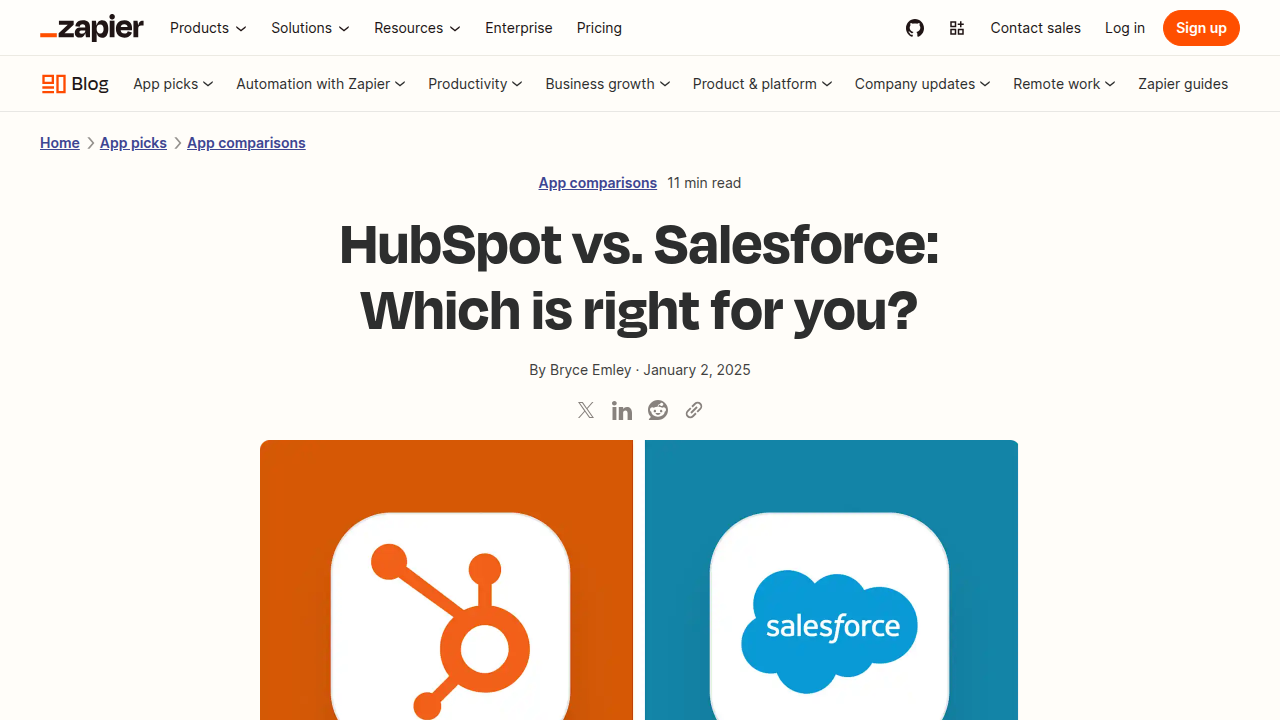
    A direct comparison by Zapier, evaluating HubSpot AI and Salesforce Einstein on factors like ease of use and overall satisfaction.

    Which one should you pick? If you have a small to mid-sized team and want fast results with less overhead, HubSpot AI is the stronger choice. If you need deep customization for thousands of leads and have a team to manage it, Salesforce might fit better. For a practical next step, check out this guide on AI virtual assistants for businesses to see how AI agents can handle everyday tasks.

    And if you want to stay on top of the latest AI tools and updates without the noise, the The AI Newsletter Worth Reading delivers clear daily insights straight to your inbox.

    Implementation & ROI: Best Practices and Real‑World Results

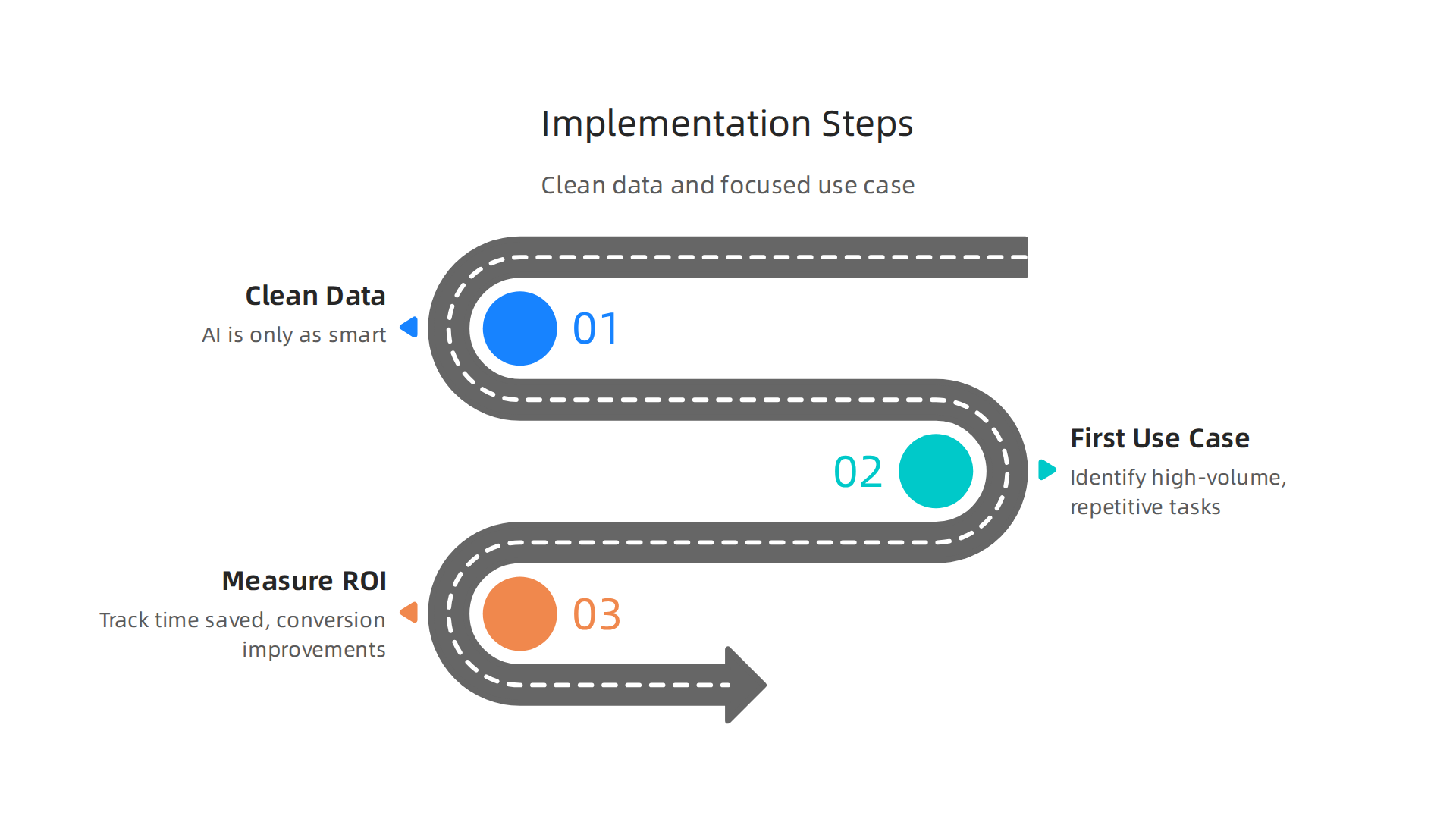
    Getting real value from HubSpot AI starts before you even open a single AI tool. Two things matter most: clean data and a focused first use case.

    Key steps for successful HubSpot AI adoption, emphasizing data quality and strategic use case selection for measurable ROI.

    Start with clean data

    Your AI is only as smart as the data it works with. Duplicate contacts, out of date pipeline info, and messy property fields will lead the AI to make poor suggestions. Before you turn on Breeze scoring or set up an AI agent, take time to clean your CRM. The SalesHive team reported that FPT Software boosted data quality by 90% by aligning their data strategy with HubSpot AI deployment. When your data is clean, the AI can actually find real patterns. Use HubSpot’s built in data quality tools or run a quick import cleanup before activating any AI features.

    Pick the right first use case

    Do not try to enable everything at once. Identify the high-volume, repetitive tasks that your team does every day. For sales teams, that often means lead scoring. For service teams, it means deflecting common support tickets with an AI agent. Focus on one of these areas first. Companies that follow this approach often see a 20‑30% improvement in lead conversion and a 25% reduction in ticket resolution time within the first quarter. The key is to pick something that gives you quick feedback so you can prove value to your team and get buy in for bigger projects.

    Measure ROI within three months

    HubSpot AI runs on either included features (in Professional and Enterprise tiers) or on low cost credits. You do not need a huge investment to start. Track simple metrics: time saved per rep, response time changes, and conversion rate improvements. Many teams see clear positive ROI within 90 days when they focus on a single high-volume task. For example, a Breeze Customer Agent costs $0.50 per resolved conversation. If your team handles 200 repetitive tickets per month, that is only $100, while freeing up hours of human time.

    If you want a deeper look at how to measure and maximize your return, check out this step-by-step guide to measuring AI marketing ROI. It walks through the numbers and the metrics that matter.

    Once you see the first results, you can graduate to more advanced use cases like multi-step workflows and prospecting agents. The key is to start small, measure carefully, and let the data guide your next move.

    Summary

    This article explains why HubSpot AI (rebranded as Breeze AI) matters for business operations by showing how an integrated AI layer improves marketing, sales, service, and content workflows. It walks through the main components—Breeze Copilot, Breeze Intelligence, specialized AI agents, and embedded helpers—and explains how they share CRM data to personalize communications, score leads, automate tasks, and surface insights. You’ll see concrete use cases for marketing (personalized emails, predictive lead scoring), sales (conversational intelligence, AI forecasting), and support (chatbots, intelligent ticket routing), plus how AI aids content creation and SEO planning. The guide compares HubSpot’s integrated approach to competitors, outlines pricing and ease-of-use differences, and gives practical rollout advice: clean your data, pick one high-value use case, and measure results within 90 days. By the end you’ll understand what HubSpot AI can do, how to prioritize features, and how to track ROI so your team can get faster, measurable value from AI.

  • How to Get Real ROI from AI Marketing Cloud in 2026

    How to Get Real ROI from AI Marketing Cloud in 2026

    Introduction

    Feeling lost in the flood of marketing cloud options in 2026? You are not alone.

    A person feeling overwhelmed by complex choices, reflecting the challenge of selecting marketing cloud options.

    The marketing cloud platform market is growing fast, with estimates showing it could hit $32.88 billion by 2033 Grand View Research. At the same time, AI is reshaping the game entirely. The AI-in-marketing market is already around $47 billion in 2026 Soku.ai. And major players like Salesforce are rebuilding their marketing cloud for the age of AI SalesforceBen.

    SalesforceBen offers insights and news on Salesforce products, including their AI-powered marketing cloud.

    But here is the thing. Most marketers struggle to cut through all the hype. You hear buzzwords like “agentic” and “predictive intelligence,” but what actually works? A recent survey found that 63% of marketers are already using generative AI Salesforce Marketing Statistics. Yet many still feel unsure about which platform will deliver real results for their business.

    That is where this guide comes in. We will give you a simple, structured framework to evaluate, implement, and get the most out of an AI-powered marketing cloud. No fluff. Just practical steps that help you make smart choices.

    Staying on top of these changes is tough. That is why we recommend the The Deep View Newsletter for clear daily AI updates that keep you informed without the noise. And if you are still figuring out where to find reliable tech news, check out our list of 10 top AI websites professionals trust for real insights.

    Let us start by looking at what a marketing cloud really is and why it matters in 2026.

    What Is a Marketing Cloud? The AI-Enhanced Foundation

    Let me paint a picture. You wake up, check your email campaign stats in one tool, jump to social media scheduling in another, then open your ad manager for PPC data, and finally pull up Google Analytics for web traffic. By the time you have connected all the dots, it is lunchtime.

    That is the old way. A marketing cloud changes everything by pulling email, social, ads, analytics, customer data, and more into a single unified platform. Instead of jumping between dashboards, you see the full picture in one place.

    What makes a marketing cloud different in 2026?

    The global marketing cloud platform market was worth $15.86 billion in 2025 and is expected to reach $32.88 billion by 2033 Grand View Research. At the same time, the AI in marketing market sits around $47 billion in 2026 and keeps climbing Soku.ai. Those numbers tell you one thing: marketing clouds are not just getting bigger. They are getting smarter.

    Today, a modern marketing cloud uses AI to orchestrate customer journeys across every channel. It learns from behavior, predicts what someone will do next, and personalizes messages at scale. Major players like Salesforce are rebuilding their marketing cloud around agentic AI, meaning the platform can act on its own to trigger the right message at the perfect moment SalesforceBen. That is a huge leap from the old batch-and-blast email days.

    How this helps small businesses and teams

    If you run a small business, a good marketing cloud acts as your digital marketing platform for small businesses. It handles everything from email nurture sequences to ad retargeting, all without needing a room full of specialists. And if you are involved in affiliate programs, many platforms now include affiliate tracking and management right inside the cloud. So you can run what is affiliate marketing campaigns alongside your other channels without extra software.

    But here is the challenge: how do you pick the right one? You need the right tech choice tools to compare features, pricing, and AI capabilities. That is where having a trusted source for AI updates really helps. For a no-nonsense daily digest on all the tech tools shaping marketing, we recommend the The Deep View Newsletter.

    The Deep View Newsletter provides daily AI updates for marketing professionals.

    It cuts through the noise and gives you practical insights you can use.

    And if you want to see how the biggest players compare, check out our roundup of 10 top AI websites professionals trust for real news and tools to sharpen your research.

    Now that you understand the AI-enhanced foundation of a marketing cloud, let us walk through the exact criteria you should use to evaluate and choose the best platform for your business.

    How AI Is Reshaping Marketing Cloud Capabilities in 2026

    So now you know what a marketing cloud is and why it matters. But the old marketing cloud from a few years ago? It is almost nothing like what you see today. AI has completely changed the game. In 2026, a modern marketing cloud is less of a tool you control and more of a smart system that works alongside you.

    A team collaborating, symbolizing the partnership between marketers and AI-powered systems.

    Predictive segmentation and real-time personalization

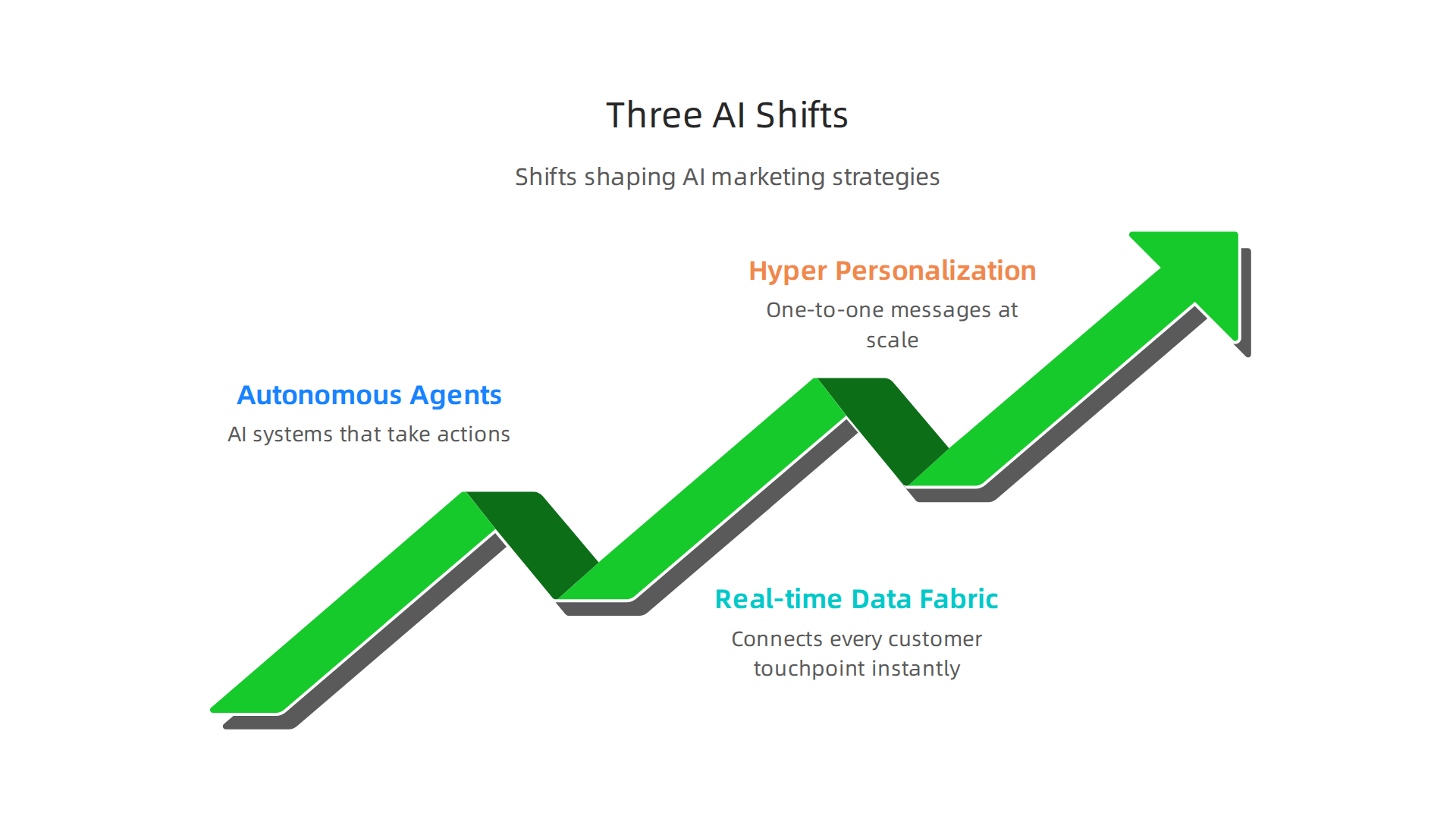
    One of the biggest upgrades is how AI handles customer data. Instead of manually building segments based on simple rules like "opened email last week," AI looks at thousands of data points. It predicts who is most likely to buy, who is about to churn, and what message will work best for each person. This is what Salesforce calls using AI to unify and analyze your data so you learn more about customer preferences Salesforce.

    Salesforce is a leading CRM provider, integrating AI into its marketing cloud solutions.

    That predictive power lets you send the right offer at the exact right moment, without guessing.

    Real-time personalization is another leap. As someone visits your site, the marketing cloud can adjust the next email, ad, or push notification based on what they just did. It is not batch processing anymore. It is instant. According to the Perficient team, Salesforce Marketing Cloud now uses AI tools to deliver real-time personalization and even autonomous agents that boost marketing ROI Perficient. That means less manual work and better results.

    Automated content generation and embedded AI

    AI also writes content now. Leading marketing clouds use natural language processing to generate subject lines, email body copy, social posts, and even ad headlines. You give it a few keywords and a tone, and the platform drafts multiple variations for you to test. Some platforms also include computer vision, so they can analyze images and suggest which visuals will perform best.

    These features are now built right into the core platform. For example, Salesforce Marketing Cloud includes tools like interactive email forms and data extensions, but the real magic in 2026 is how AI powers every step of the journey igmGuru. You do not need separate AI tools plugged in. It is already there.

    The big 2026 trend: agentic AI workflows

    Here is where things get really interesting. In 2026, the biggest shift is toward agentic AI. That means the marketing cloud does not just suggest actions. It takes them on its own. Campaigns can adjust themselves without you touching a thing. If a certain email subject line is underperforming, the AI swaps it for a better one. If a customer is stuck in a journey step, the system triggers a new path.

    Salesforce calls this Agentforce Marketing. The whole ecosystem is being rebuilt around this idea. As the SalesforceBen team explains, the platform follows an agentic path where AI acts independently to deliver the best experience SalesforceBen. Deloitte also notes that Salesforce’s 2026 evolution enhances core CRM with AI-driven automation and real-time data intelligence, creating unified agentic workflows Deloitte Digital. That is a huge time saver for small teams.

    If you want to stay on top of these rapid changes, getting a clear daily briefing helps. Many marketers turn to a newsletter that cuts through the hype and delivers practical AI updates. You can start with something like the The Deep View Newsletter to get actionable insights on AI tools and trends every morning.

    Now that you see how AI is reshaping marketing clouds, the next step is figuring out which platform fits your needs. We will walk through that next.

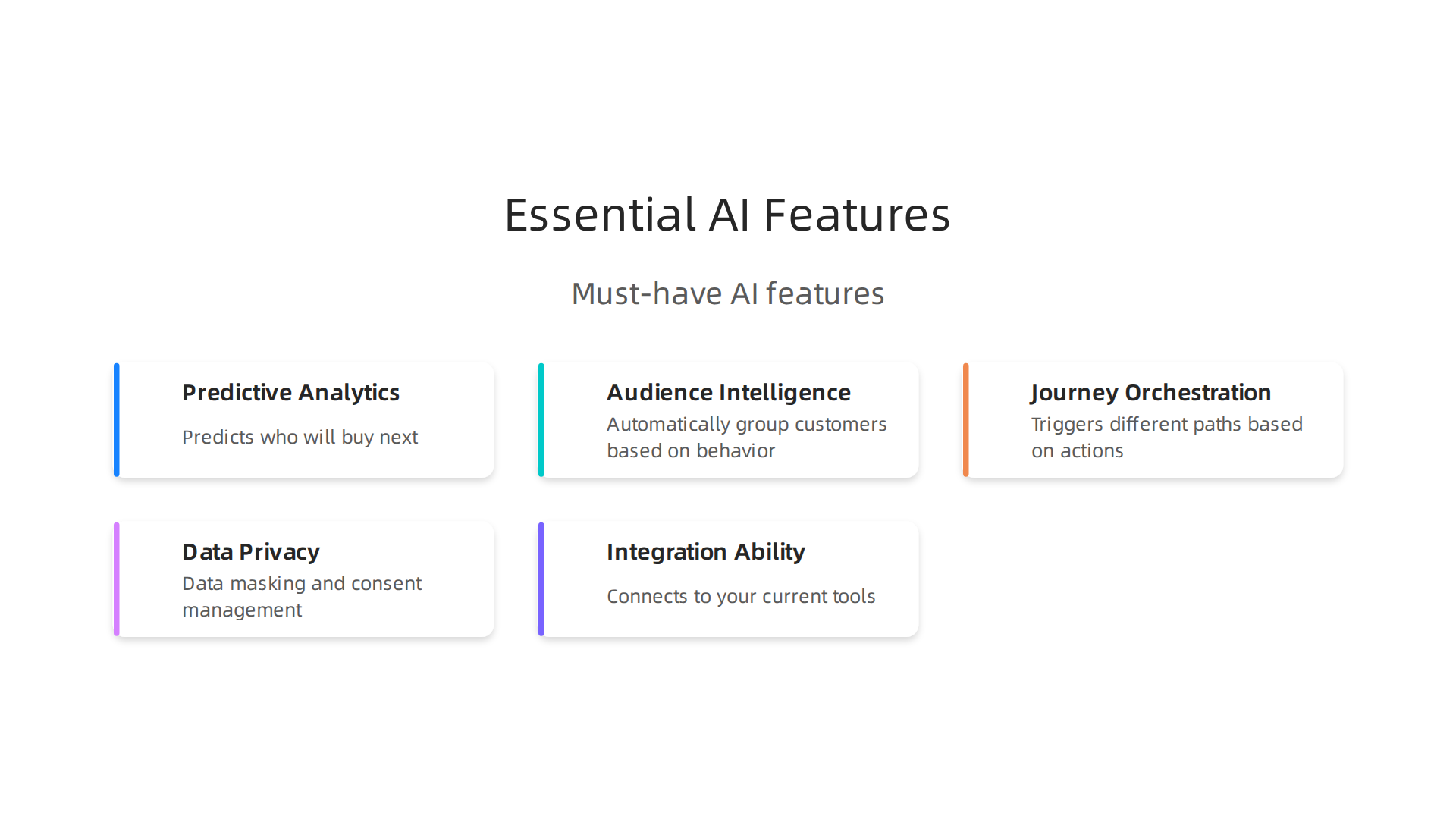
    Essential AI Features to Look for in a Marketing Cloud Platform

    So which platform is right for you? Not all marketing cloud platforms are built the same in 2026. Some are just fancy email senders. Others are smart systems that work like a co-pilot. Before you pick one, check for these three must-have features.

    Key AI capabilities that distinguish modern marketing cloud platforms in 2026.

    Predictive analytics, audience intelligence, and journey orchestration

    First, look for predictive analytics. The best platforms use AI to study your customer data and spot patterns you might miss. They predict who will buy next, who might leave, and what offer they need to see. This is what Salesforce calls using AI to unify and analyze your data so you learn more about customer preferences Salesforce. Without this, you are just guessing.

    Second, audience intelligence matters. The platform should automatically group your customers based on behavior, not just basic rules. It should tag people in real time as they browse, click, or ignore your messages.

    Third, journey orchestration. Do not settle for a tool that only builds simple email flows. You need a platform that triggers different paths based on what each person does. If someone stops engaging, the AI should switch to a new message or offer without you doing anything. That is where agentic AI truly shines. As the SalesforceBen team explains, the platform now follows an agentic path where AI acts independently to deliver the best experience SalesforceBen.

    Data privacy and compliance are non-negotiable

    In 2026, you cannot ignore privacy. Every marketing cloud you consider must include data masking and consent management features. That means the system automatically hides sensitive data and respects each customer’s opt-in choices. If a platform struggles with this, skip it. You do not want legal trouble down the road.

    Integration ability with your existing tech stack

    Finally, check how well the platform connects to your current tools. Does it work with your CRM, your ecommerce store, and your analytics software? A marketing cloud is only useful if it talks to everything else you use. If it requires a ton of custom coding to connect, that is a red flag. Choose a platform that plays nice with your stack.

    Comparing features across many tools can feel overwhelming. To help you stay informed and spot the best options, many professionals turn to reliable sources. For a great starting point, check out this list of 10 top AI websites professionals trust for real news and tools. It will point you to the right resources.

    And if you want a daily briefing that cuts through all the noise, the The Deep View Newsletter delivers practical AI updates every morning. It is a simple way to stay sharp while you shop for your next platform.

    Comparing Top Marketing Cloud Providers: AI Edition

    Now you know what to look for. But how do the big players actually compare in 2026? Here is a quick breakdown of the three main options and who they work best for.

    A comparison of top marketing cloud providers, highlighting their AI strengths and ideal use cases.

    The quick comparison table

    Provider AI Strength Best For Pricing Range
    Salesforce Marketing Cloud Agentic journey orchestration, predictive scoring Large enterprises with complex funnels High, but scalable
    Adobe Experience Cloud Deep personalization across web, email, ads Brands that need consistent multi-channel experiences High, with enterprise licensing
    HubSpot Simple AI tools for small teams, low learning curve Small to mid-size businesses that want all-in-one Mid-range, free tier available

    Salesforce Marketing Cloud: The AI power player

    Salesforce continues to lead the enterprise space. Their agentic AI features mean the system can act on its own, adjusting journeys without waiting for your team. Predictive analytics, real-time segmentation, and deep CRM integration make it a strong choice if you already use Salesforce. But the cost is high, and you often need help from a certified partner. In fact, many businesses turn to top Salesforce Marketing Cloud partners for implementation and support Cyntexa. If you have the budget and the team, this is the most advanced option.

    Adobe Experience Cloud: Personalization at scale

    Adobe is the best fit if you care about delivering the right content across every touchpoint. Its AI engine analyzes customer behavior across email, web, social, and ads. Then it personalizes everything in real time. Adobe works well for companies that already use its other products like Adobe Analytics or Adobe Commerce. But be warned: setup is complex, and pricing is not transparent. Smaller businesses might find it too much.

    HubSpot: Simple and affordable

    HubSpot is the go-to for small to mid-size businesses. Its AI features are not as deep as Salesforce or Adobe, but they are much easier to use. You get predictive lead scoring, smart email sends, and basic journey automation right out of the box. HubSpot integrates with hundreds of tools, so you do not need a developer to connect everything. For a digital marketing platform for small businesses, it is often the smartest starting point. And if you later outgrow it, you can migrate to a bigger system.

    How to pick the right one for you

    Think about these three things:

    • Your team size: Small teams love HubSpot. Big teams need Salesforce or Adobe.
    • Your budget: HubSpot has a free tier and clear plans. The other two require a bigger investment.
    • Your existing tech: If you already use Salesforce CRM or Adobe products, stick with that family.

    The best marketing cloud is the one you can actually use. Do not buy a Ferrari if you only need a reliable sedan. And do not settle for a bicycle if you are trying to win a race.

    Still unsure which tool fits your use case? Many professionals start by exploring curated lists of tech choice tools to understand what others in their industry use. For example, this guide to top AI marketing tools in 2026 breaks down real pricing and honest limitations Marketing Mary.

    And for a visual walkthrough, you can watch a comparison of top marketing automation systems on YouTube YouTube.

    One more thing: do not forget to check how each platform handles privacy. Compliance features like data masking and consent management vary a lot between these providers. Make sure yours matches your local laws.

    The quickest way to stay ahead in this fast-changing space is to keep learning. If you want a daily dose of practical AI updates delivered each morning, the The Deep View Newsletter gives you fresh insights without the noise. It is one of the best ways to keep your tech choices sharp in 2026.

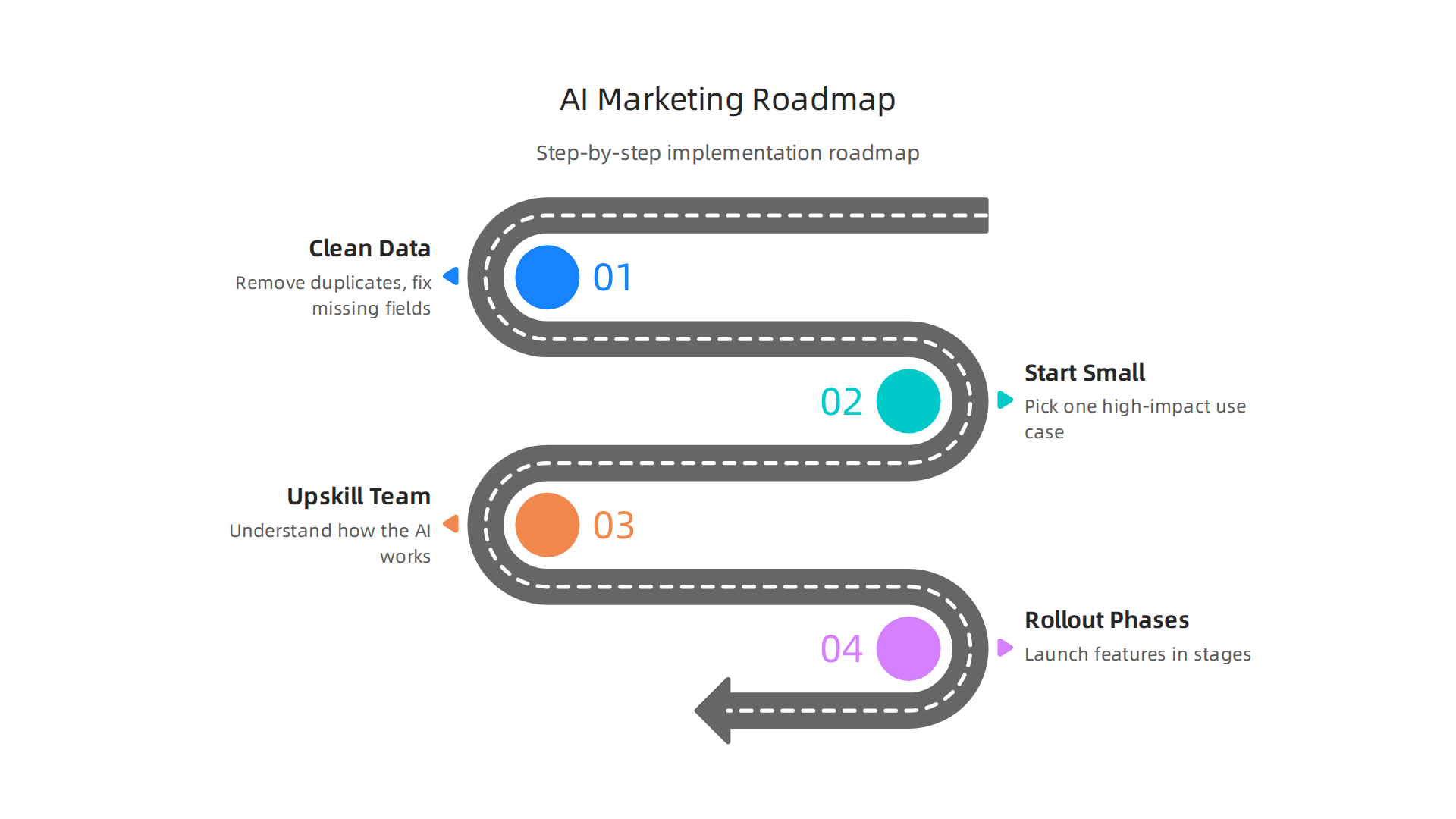
    Implementing AI in Your Marketing Cloud: A Step-by-Step Roadmap

    You picked your marketing cloud. Good. But here is the thing. Choosing the platform is only half the battle. Actually making AI work inside it is where most people get stuck. If you skip the setup steps, your fancy new tool will just sit there. Or worse, it will give you bad results.

    So let us walk through a simple roadmap that works in 2026.

    A step-by-step roadmap for successfully implementing AI features in your marketing cloud platform.

    Follow these steps, and you will avoid the common traps that waste time and money.

    Step 1: Clean your data first

    AI is only as smart as the data you give it. Garbage in, garbage out. Before you turn on any AI feature, you need to clean your customer data. Remove duplicates. Fix missing fields. Standardize how you record names, emails, and purchase history. This is boring work, but it is the most important step. Many cloud providers like DigitalOcean emphasize data readiness as a foundation for AI success DigitalOcean. If your data is messy, your AI will make wrong predictions.

    Step 2: Start with one high-impact use case

    Do not try to automate everything at once. Pick one thing that will give you a quick win. Predictive lead scoring is a great start. It helps your sales team focus on the people most likely to buy. Your marketing cloud already has this feature built in. Turn it on for one audience segment. See how it performs. Then expand. The best AI marketing tools in 2026 all suggest starting small and scaling up The Smarketers. If you try to do too much too fast, you will overwhelm your team and your system.

    Step 3: Upskill your team

    Your people need to understand how the AI works and what it can do. Run training sessions. Show them real examples. Let them play in a sandbox environment. A common mistake is buying a powerful tool and assuming everyone will figure it out on their own. That never works. If you use Salesforce, many businesses hire certified partners early on to guide the team through the learning curve Cyntexa. But even without a partner, you can start with free courses and tutorials. The key is to build confidence before pushing new features live. For ongoing learning, our curated list of top AI websites professionals trust is a great starting point for your team.

    Step 4: Roll out in phases

    Launch your AI features in stages. For example, start with email personalization for one segment. Once that runs smoothly, add behavior-based triggers. Then add predictive scoring. Then add full journey automation. Each phase gives you a chance to fix issues without breaking everything. Over-customization is a real trap. Some teams try to configure every possible setting and end up with a system nobody can manage. Keep it simple at first. You can always add complexity later.

    Common pitfalls to avoid

    Change management matters. Your team might resist new AI tools if they feel threatened or confused. Explain how AI helps them work better, not replaces them. Also, watch out for over-customization. Stick to the core features before building custom integrations. And never skip the data cleanup. It will come back to haunt you.

    Keep learning as you go

    The AI landscape shifts fast. The tools you use today might look different next year. That is why staying informed matters. A daily newsletter like The Deep View gives you clear updates without the hype. It is a simple way to keep your skills sharp and your tech choices smart. If you want to stay ahead in 2026, make learning a habit The Deep View Newsletter.

    Implementation takes time. But if you follow this roadmap, you will get real results from your marketing cloud. And you will avoid the frustration that comes with rushing in.

    Measuring ROI of AI-Powered Marketing Cloud Investments

    So you followed the roadmap. Your marketing cloud is live with AI features. Good. Now comes the question everyone asks but few answer well. Is it actually working?

    A person reviewing charts and data, focused on measuring the success and ROI of initiatives.

    Here is the thing. Most businesses spend big on AI but never track whether it pays off. A 2026 study found that only 19% of content marketers track AI-specific KPIs Digital Applied. That means 81% are flying blind. Do not be one of them.

    Track the right metrics

    Measuring ROI from your marketing cloud comes down to three main numbers. First, look at your conversion rate lift. Is your AI helping more people buy? Second, watch your cost per acquisition or CPA. Good AI should lower this over time. Third, track time saved across your team. When AI handles personalization and segmentation, your people can focus on bigger strategy work The Hovi.

    Attribution is more than just sales

    Do not only look at direct revenue. AI also creates operational efficiencies. Your attribution model should capture both hard savings like lower ad spend and soft gains like faster reporting and better audience insights Kanerika. When you add those up, the real ROI is often much higher than it first appears.

    Use benchmarks to check yourself

    What is a good click rate or conversion rate? It depends on your industry. But you can use public benchmarks to set realistic goals for your digital marketing platform for small businesses or enterprise. For example, AI product recommendations lift email click rates to an average of 3.75%. Top performers see even higher numbers Klaviyo. Compare your results to these standards. If you fall short, adjust your strategy.

    Keep learning and improving

    ROI tracking is not a one-time task. The tools and benchmarks shift every few months. That is why it helps to stay connected to trustworthy sources for updates on tech choice tools and industry shifts. Our curated list of AI websites professionals trust is a solid starting point.

    For daily updates on the specific metrics that drive real ROI, without all the hype, many professionals rely on The Deep View Newsletter. It cuts through the noise so you can focus on what actually moves the needle for your business.

    Data Privacy and Compliance in AI Marketing Clouds

    Professionals discussing data security, highlighting the importance of privacy and compliance.

    All that data your marketing cloud collects? It comes with serious rules. And those rules are getting stricter every year.

    In 2026, you have to juggle regulations like the GDPR in Europe, the CCPA in California, and a growing list of AI-specific laws popping up worldwide. These laws set hard limits on how you can collect, store, and use customer data.

    Here is the challenge. Your AI marketing cloud needs data to work. But it also needs permission to use that data. That is where built-in privacy controls come in.

    A good digital marketing platform for small businesses now includes features like consent tokens and data anonymization. Consent tokens track who said yes to what. Data anonymization strips away personal details so you can still analyze patterns without risking someone’s privacy.

    Look for tech choice tools inside your marketing cloud that handle these tasks automatically. You do not want to be the person manually checking if every email address has permission.

    The real cost of ignoring compliance

    Non-compliance is not just a legal headache. It can destroy your business.

    Fines from regulators can run into the millions. But the hidden cost is worse. When customers find out you mishandled their data, they leave. Trust is hard to build and easy to lose.

    That is why staying on top of the latest regulations matters so much. The rules change fast. One of the smartest things you can do is follow reliable sources that track these shifts for you.

    For a solid starting point, check out this list of AI websites professionals trust for real updates on tech tools and compliance news.

    And if you want daily summaries on the privacy and compliance changes that actually affect your marketing cloud, many business owners rely on The Deep View Newsletter. It helps you stay informed without drowning in noise.

    Compliance is not exciting. But it keeps your business running. Build it into your AI marketing cloud from day one and you will save yourself a world of pain later.

    Future-Proofing Your Marketing Strategy with AI and Marketing Cloud

    Getting compliance right is your foundation. But a strong foundation only matters if you build something lasting on top of it. The real question is this. Is your marketing cloud ready for what is coming next?

    The pace of change in 2026 is faster than ever. Gartner predicts that by 2027, a huge 80% of enterprise marketers will use generative AI every single day. But here is the catch. Only those who keep a close eye on strategy and oversight will actually see a good return on that investment.

    So what is coming next?

    The three major shifts defining the future of AI-powered marketing cloud strategies.

    The big three shifts on the horizon

    First, we have autonomous agents. These are AI systems that do not just suggest actions. They take actions. Imagine an AI in your marketing cloud that spots a drop in email engagement, automatically adjusts the send time, rewrites the subject line, and triggers a new test campaign without you lifting a finger. Google Cloud’s latest AI agent trends report for 2026 shows this is moving from experimental to essential for businesses that want to scale.

    Second is the real-time data fabric. Your digital marketing platform for small businesses should not have to wait hours or days to process data. A data fabric connects every customer touchpoint instantly. It gives you a complete picture of your audience the moment they act, which makes your campaigns faster and more relevant.

    Third is hyper-personalization. We are past the era of just "Hi {{first_name}}." AI now studies past behavior, current context, and predicted future needs to create one-to-one messages at scale. The 2026 AI marketing trends analysis from Improvado confirms that personalization depth is now the top driver of customer loyalty.

    Why flexibility and learning matter most

    Here is the thing. No one knows exactly what the next big breakthrough will be. That is why locking yourself into a rigid stack is dangerous. You need a marketing cloud that works with modern tech choice tools and adapts as new platforms emerge.

    Building a culture of continuous learning matters just as much. The teams that win are the ones that experiment early. If you are curious about what an AI agent actually looks like in practice, check out our review of the Galaxy AI 2026 agentic assistant for business and content creation. And if you want to see how blending human intuition with machine speed creates better results, take a look at our breakdown of human or AI creativity.

    Early adopters are pulling ahead

    The data is clear on this one. Companies testing agentic workflows today are building a serious lead. According to Salesforce trends for 2026 and the Dotdigital marketing predictions, the brands that treat AI as a core team member rather than just a tool are seeing faster campaign launches and higher customer satisfaction.

    According to WSI World’s marketing predictions, "Search Everywhere" optimization and privacy-first data strategies are becoming non-negotiable for staying visible.

    How to stay ahead without burnout

    The hardest part of future-proofing is simply keeping up. Trends shift fast. New tools launch every week. You do not have time to chase every single headline.

    Want to stop guessing and start knowing what is next? The Deep View Newsletter delivers the day’s most important AI and tech updates straight to your inbox. It is the easiest way to stay ahead of the curve without the noise.

    The future of marketing belongs to the curious. Stay flexible. Keep learning. And let your marketing cloud do the heavy lifting.

    Summary

    This guide explains how AI has transformed marketing clouds in 2026 and gives a practical framework for choosing, implementing, and measuring an AI-powered marketing platform. It starts by defining a modern marketing cloud and highlights key AI capabilities—predictive segmentation, real-time personalization, automated content generation, and agentic workflows—that make platforms smarter and more autonomous. The article lays out the essential features to vet (predictive analytics, audience intelligence, journey orchestration, privacy controls, and integration ability), compares major vendors (Salesforce, Adobe, HubSpot) by use case and budget, and provides a step-by-step rollout plan focused on data cleanup, single high-impact pilots, team upskilling, and phased launches. It also shows how to track ROI with the right metrics, why compliance must be built in, and what trends (autonomous agents, real-time data fabric, hyper-personalization) will shape the next wave. Readers finish with concrete actions: what to check before buying, how to get quick wins, how to measure impact, and where to keep learning to avoid costly mistakes.