Tag: non_money_page

  • Mastering the AI Future Standard 2026 Your Guide to Compliance and Growth

    Mastering the AI Future Standard 2026 Your Guide to Compliance and Growth

    Why ‘future standard’ matters for business leaders in 2026

    In 2026, the world of business is changing faster than ever, mostly because of how quickly Artificial Intelligence (AI) is growing. AI tools are getting smarter every day, which is exciting for businesses like Luminar Technologies and Driven Brands looking to improve. But this rapid growth also brings a big challenge: there are many different rules and laws being made about AI all over the world. These rules are not always the same, making it hard for business leaders to know which way to go. This mix of fast AI changes and unclear rules creates a lot of uncertainty when deciding what products to buy or how to use AI safely in your business.

    Actually, it’s like building a road while everyone is still arguing about where the lanes should be. This is why understanding the "future standard" for AI is so important. Government bodies, like the US Congress, are working on new laws and guidelines to create some order in this space. For example, there’s a lot of discussion about federal reporting and disclosure rules for AI to ensure public trust and safety. Countries like South Korea have already put big AI laws into action South Korea: Comprehensive AI Legal Framework Takes Effect. Meanwhile, the US government is also putting out its own plans and recommendations for a National Policy Framework Artificial Intelligence.

    This guide is here to help you make sense of it all. We will explain the different directions policy makers are headed and look at the new technical standards that are starting to appear. Our goal is to give you clear, practical steps you can take right now to make good decisions for your business. Staying informed about these changes is key to being ready for what’s next. If you want to keep up with the latest in this fast-moving area, it helps to be tracking major technology news for smart business decisions in 2026.

    To stay truly ahead, you need more than just headlines.
    Get clear daily AI updates from The AI Newsletter Worth Reading.

    Knowing the direction policy makers are going helps businesses like yours, including companies such as Luminar Technologies and Driven Brands, make smart choices today.

    A team collaboratively reviewing policy documents, working to understand new regulations and make informed business decisions.

    There are a few main ways governments are trying to set rules for AI.
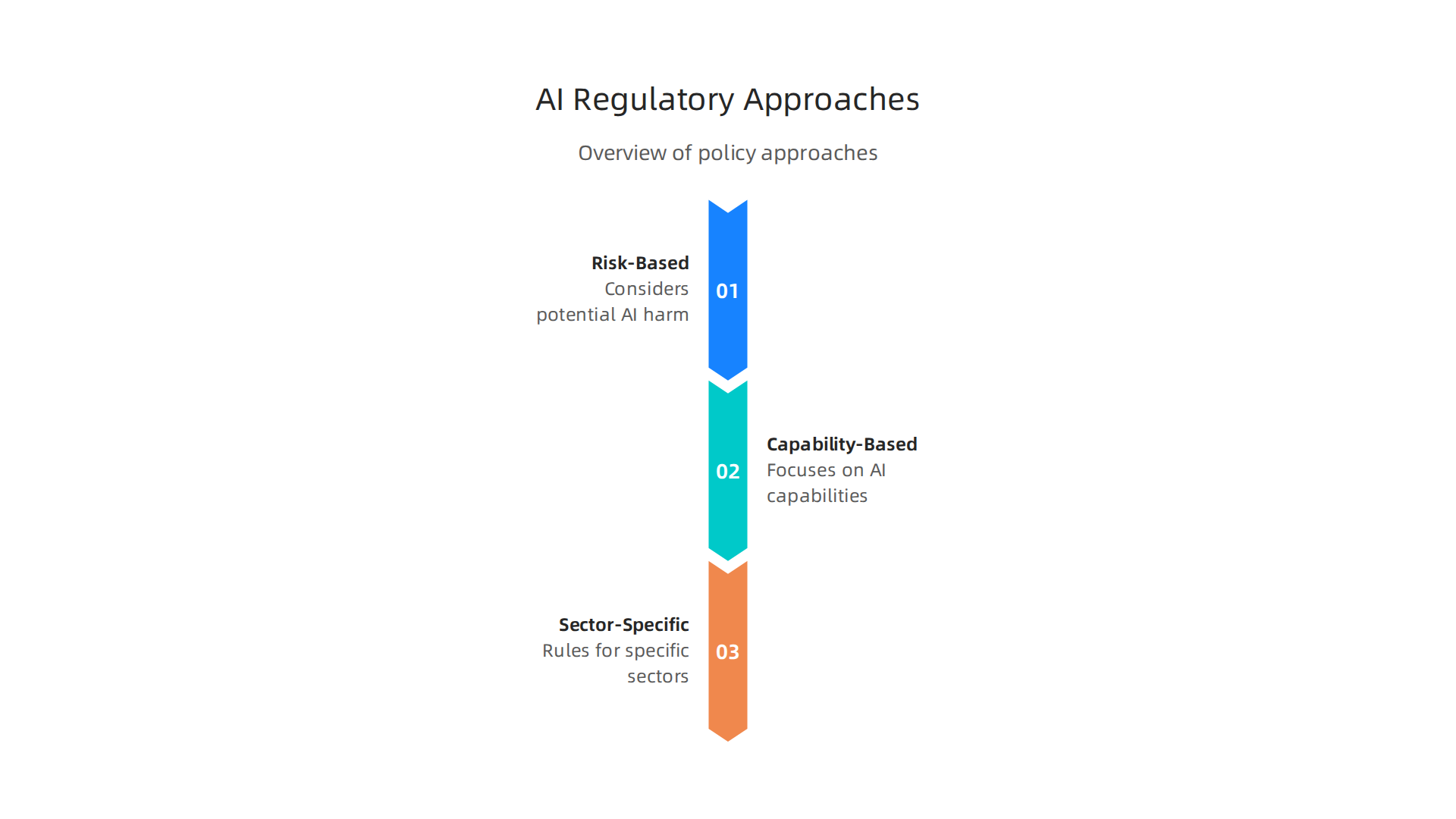
    An infographic outlining the three primary government approaches to AI regulation.

    Different Ways to Make AI Rules

    • Risk-Based Approach: This way of making rules looks at how much harm an AI system could cause. If an AI system could cause a lot of harm, like in healthcare or hiring, it gets stricter rules. The European Union’s AI Act is a good example of this, setting tough standards for "high-risk" AI systems that are expected to be fully in effect by August 2026 AI Regulation: How It Works, What It Requires, and …. In the United States, the National Institute of Standards and Technology (NIST) also offers an AI Risk Management Framework to help companies understand and lessen AI risks.
    • Capability-Based Approach: This approach focuses on what an AI system can do. It pays special attention to very powerful AI systems, often called "frontier AI." The idea is that if an AI is super smart or could have a very big impact, it needs special oversight, no matter how it’s used. This includes rules for big AI developers to report safety issues and deal with large risks Frequently Asked Questions.
    • Sector-Specific Approach: Some rules are made just for AI used in certain areas, like finance or medicine. For example, AI used in medical devices might have different rules than AI used in self-driving cars. This makes sure the rules fit the unique needs and dangers of each industry.

    These different ways of thinking guide how laws are written and how companies should act. For any business using AI, it’s wise to learn how to choose AI for business tools that deliver real results in 2026.

    What "Future Standard" Really Means

    When we talk about the "future standard" in AI, we are not just talking about one single rule or law. It’s a bigger idea that includes:

    • Official Laws: These are the rules made by governments, like the US tech congress, and other countries to control how AI is used.
    • Technical Standards: These are like instruction manuals for building AI systems. Groups such as NIST and IEEE create these. For example, NIST helps create AI Standards, and the IEEE has approved a recommended practice for how companies should govern AI IEEE 2863-2026. These standards help make sure AI systems are safe, work well, and can be trusted.
    • Industry Agreements: These are best practices that groups of companies and experts agree on. They might not be laws, but they become common ways of doing things that businesses follow to stay competitive and responsible.

    The "future standard" is always changing as AI technology gets better and we learn more about its effects. It’s like a moving target where policymakers, standards groups, and companies all work together to figure out the best ways forward. This includes efforts to create standards for things like how AI systems manage bias European standards supporting the AI Act – CEN-CENELEC. Staying on top of these global regulations and standards is important for any business aiming to grow with AI AI Compliance Guide 2026: Global Regulations | Modulos.

    When we talk about the "future standard" for AI, it also includes very important technical guides. These guides help make sure AI systems are built safely and work well together. Think of them as blueprints for how AI should be made and used. These technical standards are especially important for businesses like Luminar Technologies and Driven Brands.

    Here are the main kinds of technical standards you can expect:
    An infographic detailing the main categories of technical standards expected for AI systems.

    Categories of Technical Standards

    • Safety Testing: This is about making sure AI systems are safe before anyone uses them. It’s like crash-testing a car. Groups create special tests to find problems and make sure the AI won’t cause harm or do unexpected things. In 2026, many new ways to check AI safety have come out, aiming to find problems before they get serious An efficient, reusable framework to evaluate AI safety – JHU Hub. This helps make sure AI products are reliable and secure AI Safety Benchmarks: How to Evaluate and Certify Secure ….
    • Evaluation Benchmarks: These are like standardized report cards for AI. Benchmarks help compare how well different AI systems perform on the same tasks. This allows companies to see which AI is best for their needs. Many new benchmarks like HELM Safety and HarmBench became widely used by early 2026 to help decide "what to measure" in AI safety 2026 AI Safety Prior Research Report: Achievements …. The RAIL AI Safety Index also helps compare different AI models The RAIL AI Safety Index 2026: benchmarking 10 LLMs ….
    • Data Provenance: This term means knowing where the data used to train an AI system comes from. It’s like checking the ingredients list on food. Knowing the source of data helps make sure the AI is fair, honest, and doesn’t carry hidden problems from bad information. Clear rules here help everyone trust AI more.
    • Interoperability APIs: APIs (Application Programming Interfaces) are like special plugs and sockets that let different computer programs talk to each other. Interoperability means that AI systems from different companies can easily connect and work together. This is important so businesses aren’t stuck with just one AI provider and can mix and match the best tools.

    What This Means for Businesses

    For any business, these technical standards are a big deal. They impact how you buy and use AI:

    • Procurement: When you buy AI tools, you’ll need to check if they meet the latest safety and performance standards. This means looking for certifications or proof that the AI has been properly tested. This helps you choose smart technologies and evaluate AI companies to unlock business growth in 2026.
    • Vendor Selection: Choosing an AI vendor will involve more than just looking at features. You’ll need to ask about their testing methods, how they ensure safety, and what benchmarks their AI models meet. This helps you pick reliable partners. You can learn more about picking the right solutions for your company in Enterprise AI Platforms 2026: Top Providers and How to Choose the Right One.
    • Vendor Lock-in Risk: With better interoperability standards, you’ll have more freedom to switch AI tools or combine them from different companies. This reduces the risk of being "locked in" to one vendor’s system, which can be expensive and limit your choices later on. The tech congress and other bodies are working to make sure companies have options.

    Understanding these technical standards helps businesses stay competitive and use AI safely and effectively in 2026 and beyond.

    The technical guides we just talked about are changing how businesses use AI.

    Diverse professionals from various industries collaborating to adapt to evolving global AI standards.

    These rules are especially important in big industries like finance, healthcare, advertising, and even how the government buys things. Each of these areas has its own special rules that make sure AI is used safely and fairly.
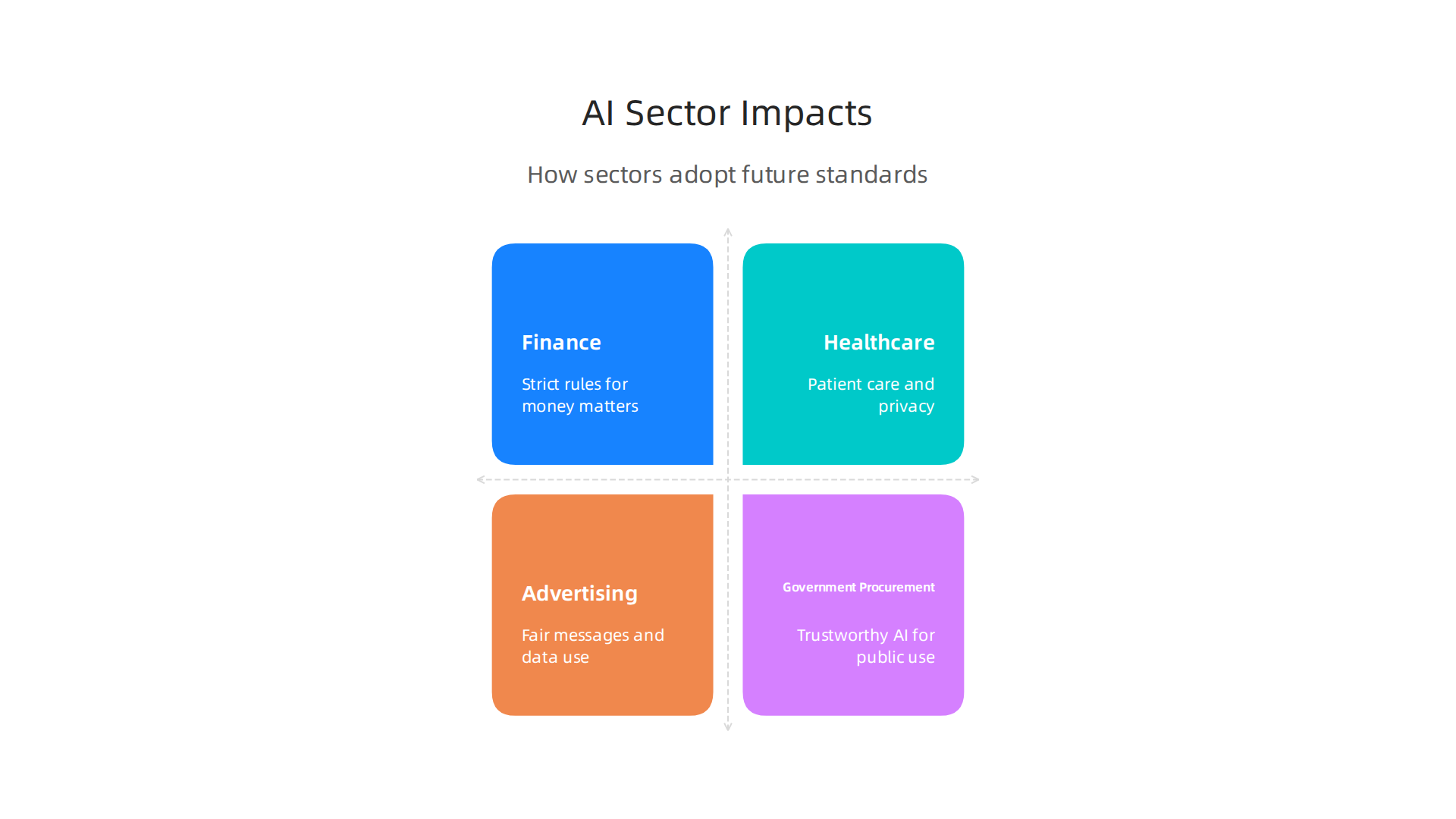
    An infographic highlighting how AI 'future standards' will impact key business sectors.

    This is all part of creating the future standard for AI in 2026.

    Finance: Strict Rules for Money Matters

    In finance, using AI means being extra careful with people’s money and data. Because of this, financial companies face tough rules from groups like the SEC (Securities and Exchange Commission) and FINRA (Financial Industry Regulatory Authority). These groups want to make sure AI doesn’t give bad advice or treat customers unfairly. For example, AI systems used for loans or investments must be very clear and honest. The U.S. Department of the Treasury has even shared new guides to help with using AI safely in finance Treasury Releases Two New Resources to Guide AI Use in Finance.

    Companies in finance will need to:

    States like Colorado are also making their own rules for "high-risk" AI in financial services, which will start by June 2026 Explore AI Compliance Across Regulated Industries in 2026.

    Healthcare: Patient Care and Privacy

    Healthcare is another area where AI rules are getting much stronger. When AI helps with patient care, like suggesting treatments or looking at medical images, accuracy and privacy are key. Regulations like HIPAA (which protects patient information) and rules from the FDA (Food and Drug Administration) for medical devices are now applying to AI tools. By August 2026, many new rules for "high-risk" AI medical devices will be fully in place, especially due to the EU AI Act AI in Health: Regulatory & Policy Tracker — Q2 2026.

    What this means for healthcare providers:

    • Human Oversight: Doctors and nurses must always be able to review and change AI decisions.
    • Data Protection: AI systems must strictly follow patient privacy laws.
    • Transparency: It must be clear how AI reaches its conclusions, especially for critical health decisions.

    Many states are also passing laws, with Arizona, Illinois, and California leading the way in regulating AI in areas like insurance denials and therapy services Shaping the Future: Navigating State-Level AI Legislation in Healthcare. This shows how important it is to mastering behavioral tech for business growth and impact while following ethical guidelines.

    Advertising: Fair Messages and Data Use

    In advertising, the biggest concern is how AI uses our personal information to show us ads. New standards will push for more fairness and privacy. Companies like those in the [luminar technologies] or [driven brands] supply chains that use AI for marketing must be careful not to create ads that are unfair or target people in ways that aren’t allowed. This means ensuring AI tools don’t accidentally promote harmful stereotypes or invade privacy.

    Advertising businesses will need to focus on:

    • Bias Checks: Regularly test AI to make sure it doesn’t favor or disadvantage certain groups of people in ads.
    • Data Privacy: Respect user data and only use it in ways that are explained and agreed upon.
    • Transparency: Be open about how AI is used in creating and showing ads. This helps build trust and improve how online market research surveys powered by AI deliver better insights.

    Government Procurement: Trustworthy AI for Public Use

    When governments buy AI tools, the bar is very high. These tools might be used for things like traffic management or public safety, so they need to be extremely reliable and fair. The U.S. government, with help from the [tech congress], is working on clear guidelines. For example, federal law states that the National Institute of Standards and Technology (NIST) should advance frameworks and guidelines for AI 15 USC 278h-1: Standards for artificial intelligence. This is to ensure AI is trustworthy and serves everyone well.

    Government agencies will increasingly require:

    • Third-Party Audits: AI systems must be checked by outside experts to confirm they work as promised and are safe.
    • Public Accountability: Clear ways to report problems and ensure that AI systems are held responsible.
    • Ethical Guidelines: Following strict rules that align with public values and rights.

    These sector-specific pressures mean that companies everywhere are working to make their AI compliant with this emerging future standard. This includes making sure AI systems are auditable, fair, and have proper human oversight, no matter the industry.

    Getting AI tools ready to meet the new future standard is a big job. It’s not just about knowing the rules, but also about how your company manages and uses AI every day. This means setting up good ways to control your AI, keeping clear records, and carefully checking any AI tools you get from other companies.

    Setting Up How You Manage AI

    Good AI management, or "governance," helps make sure your AI works well and follows all the rules. The IEEE, for example, has even created a recommended practice for how companies should manage their AI, which became an active standard in 2026 IEEE 2863-2026. Here are some important parts of that:
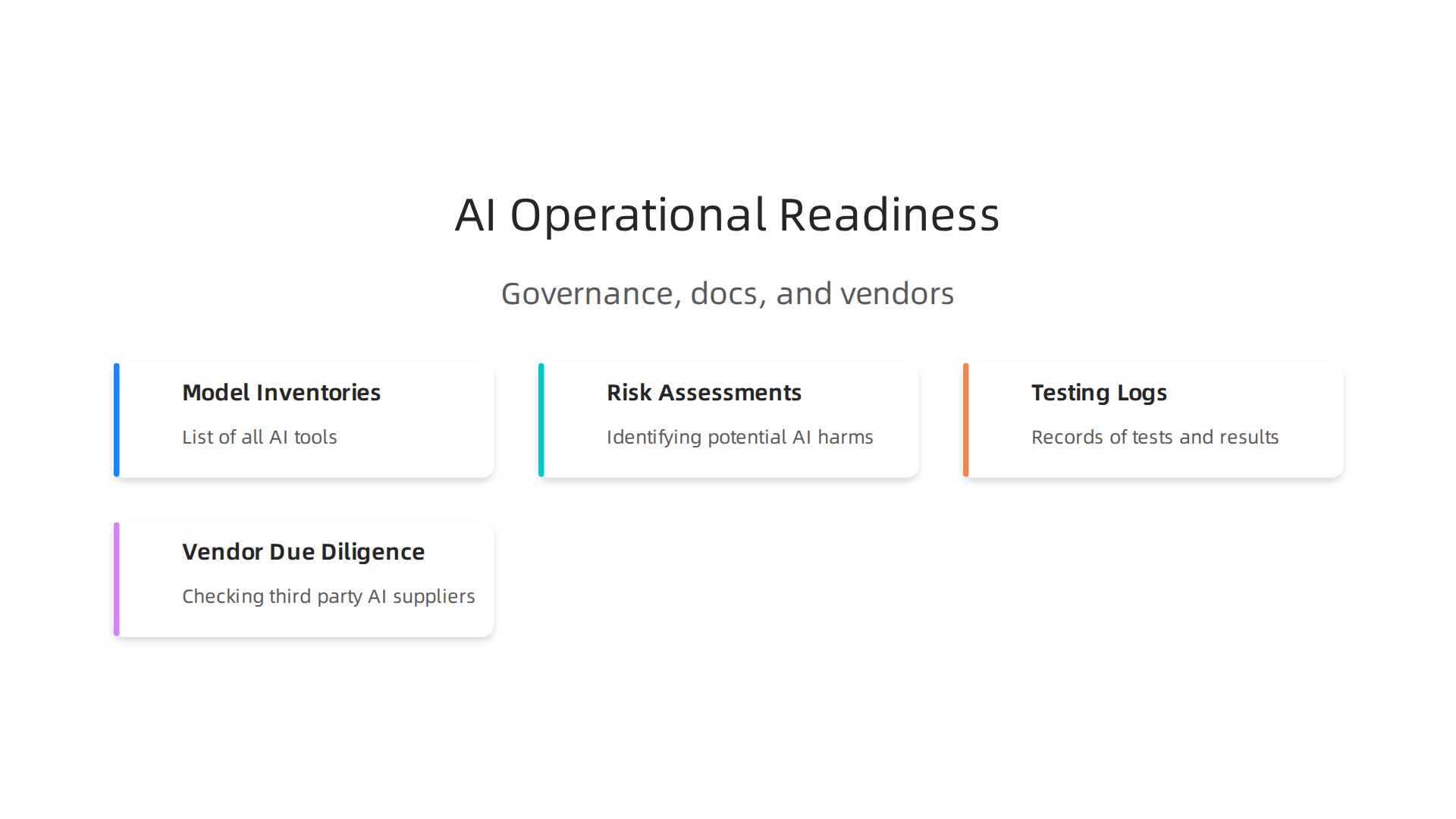
    An infographic detailing crucial aspects of setting up good AI management within a business.

    • Model Inventories: Think of this as a list of all the AI tools your company uses. For each tool, you should know what it does, what kind of data it uses, and who is in charge of it. This helps you keep track and makes sure no AI is used without proper checks.
    • Risk Assessments: This means looking at each AI tool and figuring out what problems it could cause. Could it make a wrong decision? Could it be unfair to some people? Understanding these risks helps you fix them before they become big issues. The National Institute of Standards and Technology (NIST) offers a helpful guide for managing AI risks AI Risk Management Framework | NIST.
    • Testing Logs: Every AI tool needs to be tested to see if it works as it should and if it’s fair. Keeping a record of these tests is like having a report card for your AI. These records show what was tested, how it was done, and the results. There are many new ways to test AI safety, with new benchmarks emerging in 2026 AI Safety Benchmarks in 2026: From RLHF to Constitutional AI and Beyond.
    • Vendor Due Diligence: If you buy AI tools from another company, you need to check them carefully. This is called vendor due diligence. You should ask about their own AI management practices and make sure they meet your standards. You should also have clear agreements, often called Service Level Agreements (SLAs), that spell out their responsibilities for AI safety and performance. European groups like CEN-CENELEC JTC 21 are working on standards that will help ensure AI systems meet strict requirements European AI Standardization | CEN-CENELEC JTC 21 |.

    Getting Ready When You Have Less Help

    For smaller teams or companies with less money or technical staff, getting ready for the future standard can feel hard. But it doesn’t have to be. Here’s a simple way to start:

    1. Start Small: Don’t try to fix everything at once. Pick one or two AI tools that are most important or carry the highest risk. Focus on getting those right first.
    2. Use Ready-Made Tools: Look for software or services that can help you with AI management. Many companies offer tools to help you keep track of your AI, test it, and document its use. This can save you a lot of time and effort. When you’re ready to explore options, consider how to choose AI for business tools that deliver real results.
    3. Train Your Team: Make sure everyone who works with AI understands the new rules and how to follow them. Simple training can go a long way.
    4. Keep It Simple: Don’t overcomplicate things. The goal is to make sure your AI is used responsibly, not to create endless paperwork. Focus on clear steps and easy-to-understand records.
    5. Look for Support: There are many resources and guides available to help businesses evaluate AI companies and unlock growth. Knowing how to evaluate AI companies to unlock business growth in 2026 can make a big difference.

    By taking these practical steps, companies of all sizes can get ready for the new AI future standard and use AI safely and effectively. Staying informed about the latest changes in AI is key to this readiness.

    Get clear daily AI updates from The AI Newsletter Worth Reading.

    Business strategy: product design, competitive advantage, and compliance-as-differentiator

    Getting ready for the future standard for AI isn’t just about following rules. It can also be a smart business move that helps your company grow and stand out. When you build AI tools with safety and fairness in mind from the very start, it can make your products better and give you a leg up on competitors.

    Think about how you design your products. If you make sure your AI tools follow all the rules, they will likely be more reliable and trustworthy. This is extra important in certain fields. For example, a guide for AI Design for Regulated Industries: 2026 Guide shows how strict rules in healthcare and finance shape how AI products are made. Companies like Luminar Technologies, which make technology for self-driving cars, know that safety standards aren’t just a checkbox. They are central to how their products are built and how people trust them. Building safe, compliant products helps create a better reputation for your brand. This means that a company like Driven Brands, using AI in its automotive services, could build more trust with customers by showing its commitment to AI safety.

    Being one of the first to meet these new AI standards can also give you a big competitive advantage.

    A confident business professional smiling, symbolizing achievement and competitive advantage gained through strategic compliance.

    In 2026, many industries are starting to have very strict rules for AI. These include areas like healthcare, finance, and manufacturing, which are among the top 7 industries with stringent AI compliance needs in 2026. If your company already meets these high standards, customers and partners will see you as a leader they can trust. This trust can help you win more business. It means you can go to market with products that are already approved and ready, while others might still be struggling to catch up.

    Of course, there’s a balance to strike. Moving very quickly to put out new AI tools might seem good for short-term gains. But if those tools don’t meet the future standard or cause problems later, it can hurt your business in the long run. Taking a bit more time to make sure your AI is safe and follows all the rules builds a stronger, more resilient business. It shows you care about your customers and the bigger impact of your technology. This careful approach helps you avoid big issues down the road and builds lasting customer loyalty. To really succeed, it’s wise to always evaluate AI companies to unlock business growth in 2026 that align with your long-term vision.

    Staying informed: monitoring standard-setting bodies, policy signals, and preparing for rapid change

    Keeping up with all the new rules and standards for AI can seem like a big job. But it’s really important for your business. When you know what changes are coming, you can make smart choices about your AI products and services. It helps you stay ahead and make sure your company is always meeting the future standard.

    A good way to do this is to set up a simple plan to watch for new information. You don’t need to check every day. A quick review once a month might be enough for many businesses. Here are some trusted places you can look:

    • Official AI Trackers: Many groups now offer lists that keep track of AI laws and rules around the world. For example, you can find a Global AI Regulations Tracker 2026 that summarizes rules from over 60 countries. There’s also the NHI and AI Agent Standards Tracker which monitors global efforts. These are great because they often give plain explanations of complex legal terms.
    • Standards Organizations: Groups like the International Telecommunication Union (ITU) have an AI Standards Exchange Database that lists many standards for AI systems. Another key one is the National Institute of Standards and Technology (NIST), which has its own AI Standards initiatives. These bodies create the technical guides for how AI should work safely.
    • Government Policy Websites: Look at sites that follow state or national laws. For example, there are many tools that track US State AI Governance Legislation to show what states are doing. You can also find trackers for specific areas like 2026 State AI in Education Bills which can signal broader trends.
    • Industry News and Reports: Good news sources and reports, like the AI Index | Stanford HAI, offer yearly updates on AI trends, including responsible AI practices. These give you a bigger picture of where AI is headed and what experts are talking about. To help you stay updated with trustworthy tech information, learn how to find AI tool discovery sources for real business results.

    When to act on new information

    Knowing when a change is important enough to act on is key. Here’s a simple checklist to help you decide when to look closer at a new policy or standard:

    • Is it a new law or an update to a big one? If a new law is passed that affects how your business uses AI, or if an important one like the EU AI Act has a new phase starting in August 2026, it’s time to pay close attention. Such changes often come with clear deadlines for businesses to follow.
    • Does it directly impact your industry? If the new rule is about healthcare AI and you’re in healthcare, then it’s a big deal. The same goes for finance, manufacturing, or any other area where you use AI.
    • Does it change what counts as "high-risk" AI? Regulators often talk about "high-risk" AI systems. If a new standard makes your AI tools fall into this category, you’ll likely need to do more testing and reporting.
    • Is there a strong push for a new standard, like ISO/IEC 42001? This standard is becoming very important for AI management systems. If many in your field are talking about it, or if it becomes a common requirement for partners, it’s worth checking to see if your products already follow it.
    • Does it come from a leading global body? If an important organization like the OECD issues new recommendations, even if not a strict law, it often shapes how future laws will look. Keeping an eye on these signals helps you prepare.

    By regularly checking these sources and using this checklist, you can be ready for changes in AI rules. This helps your business stay safe and trusted in the fast-moving world of AI.

    To make sure you’re always in the know with the most recent and important updates in AI and technology, consider subscribing to The AI Newsletter Worth Reading.

    Summary

    This article explains why understanding the emerging "future standard" for AI is essential for business leaders in 2026, when rapid AI advances collide with a patchwork of laws and technical guidance. It outlines the main regulatory approaches—risk-based, capability-based, and sector-specific—and the technical standards companies will face, such as safety testing, evaluation benchmarks, data provenance, and interoperability APIs. The guide shows concrete impacts across industries like finance, healthcare, advertising, and government procurement, and describes how standards change procurement, vendor selection, and vendor-lock-in risk. It also lays out practical AI governance practices—model inventories, risk assessments, testing logs, and vendor due diligence—and offers a simple starter plan for smaller teams. Finally, the article frames compliance as a competitive advantage, recommends reliable sources to monitor standards, and gives a checklist for when to act on new rules so businesses can stay safe, trustworthy, and ready to scale with AI.


  • Evaluate AI Companies to Unlock Business Growth in 2026

    Evaluate AI Companies to Unlock Business Growth in 2026

    Why AI company profiles matter now

    It feels like new AI tools and companies pop up every day. In 2026, many businesses are using artificial intelligence more than ever before. This means there’s a lot of information out there, which can feel like too much to handle. How can you find the best AI tools when so many companies, even those offering synonym technologies, are all trying to get your attention? It’s tough to know who to trust or what truly works.

    When you are a business leader, you need good and true information to make smart choices.

    A business leader confidently making decisions based on reliable information.

    You need to know which AI companies are worth looking into. For example, understanding what makes an rb tech company different from an ascend technologies provider is key. Without clear facts about each company, it is hard to pick the right tools that will help your business grow. Getting good information helps you make sure you pick solutions that are a good fit and will actually help you. This avoids wasting time and money on the wrong things.

    Many businesses are quickly bringing AI into their work. For instance, reports show that a good number of companies are already using AI, and this number is still growing fast in 2026 Enterprise AI Adoption Statistics 2026. This rapid growth makes it even harder to keep up. You might be looking for tools from companies like blueprint technologies or prince tech and wonder how they stack up against each other. It’s not just about finding any AI tool, but finding the right smart technologies to help your business unlock growth.

    This article is here to help you. We will show you how to look at AI company profiles with a clear eye. You will learn how to spot important signals, compare what different companies offer, and match vendors to your specific needs. By the end, you will feel more confident in choosing the best AI partners for your business.

    To stay updated on the fast-changing world of AI, there’s a great resource. You can get clear daily AI updates and dive deeper into technology insights.
    The AI Newsletter Worth Reading

    Now that you know why looking closely at AI companies is so important, let’s talk about what things to check for in their company profiles. Think of it like checking out a new toy before you buy it. You want to know what it does, how it works, and if it’s safe.

    Key Things to Look for in an AI Company

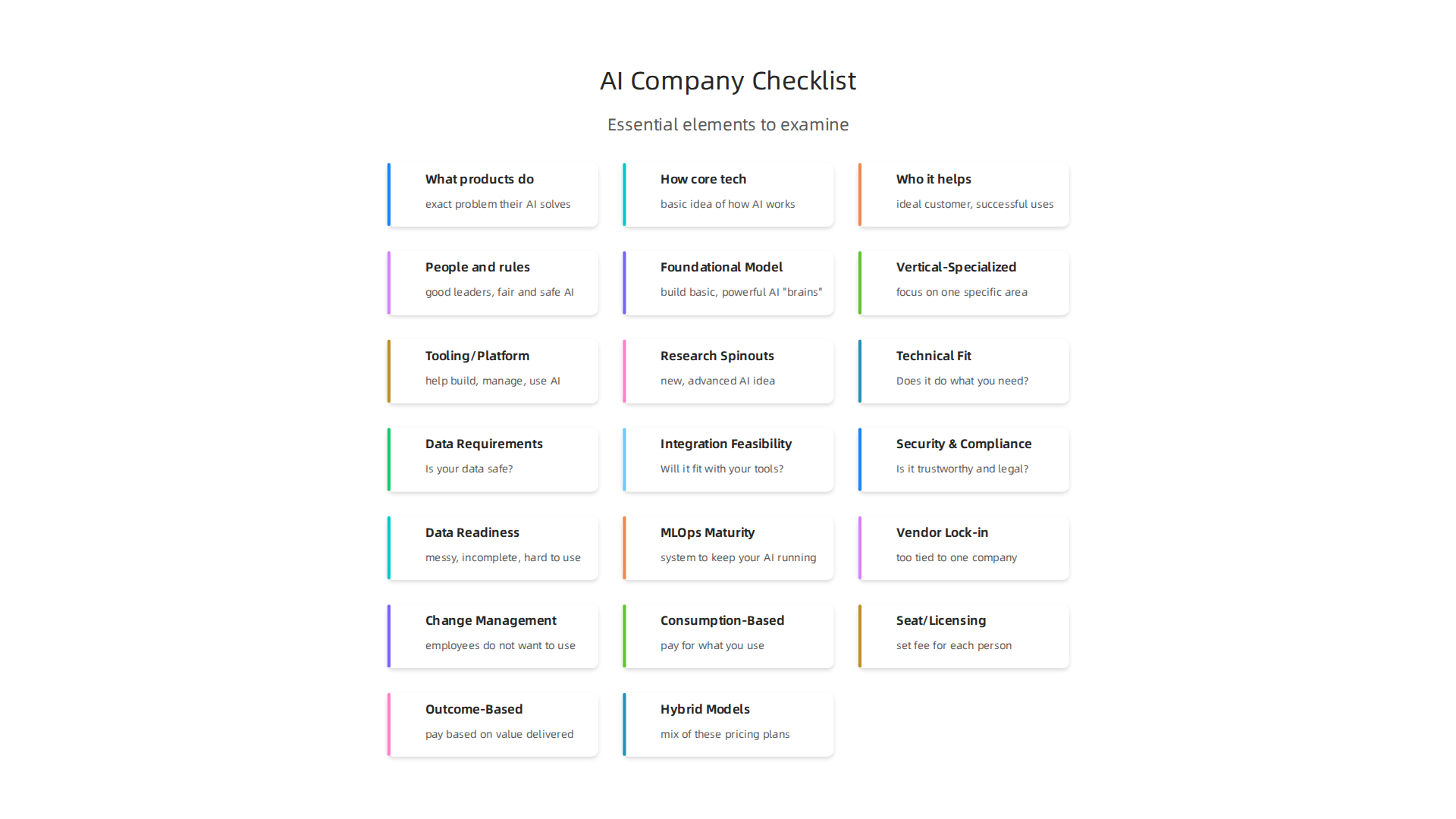
    When you read about an AI company, you need to find out a few main things. These will help you see if they are a good fit for your business.

    Essential elements to examine when evaluating an AI company's profile for business fit.

    • What their products do: This is about understanding what the AI tool is made for. Does it help with writing? Does it manage data? Companies like rb tech might focus on one type of AI, while ascend technologies might offer something very different. You need to know the exact problem their AI solves. If you’re looking for synonym technologies to improve your content, you need to make sure their product actually does that.
    • How their core tech works: You don’t need to be a computer expert, but you should get a basic idea of how their AI works. Is it new and clever, or is it using older methods? This helps you understand if their tool is strong and modern.
    • Who it helps and how: Every AI tool is made to help certain people or businesses with certain tasks. Does the company clearly say who their ideal customer is? For example, blueprint technologies might be great for big factories, while prince tech might be better for small shops. Look for examples of how other businesses like yours have used their tools successfully.
    • The people and their rules: Who are the smart people making the AI? Do they have good leaders? Also, how does the company make sure its AI is fair and safe? This is called "governance." You want to pick a company that cares about using AI in a good way.

    Signs of a Strong, Safe AI Company

    It’s not enough to just know what an AI company offers. You also need to know if they are reliable and if their tools will work well for a long time.

    • Who has used them before: A good sign is when other real businesses have used their AI tools and are happy with them. Look for stories or examples of how their tools were used in the real world. This shows the company is not just new ideas, but has actual working solutions.
    • How they follow the rules: AI is getting more rules and laws around it every day. A good company will know these rules and make sure their AI follows them. This is called "compliance." It means their tools are safe and won’t cause problems with important rules about data or privacy. Companies that don’t follow the rules can bring risks to your business. Actually, in 2026, many business leaders see skill gaps as a big hurdle to using AI safely and effectively 70 Enterprise AI Statistics for 2026: Adoption, ROI & Trends.
    • How well their tools connect with others: Most businesses use many different computer programs. You want an AI tool that can easily connect and work with your existing systems. This makes it much easier to use and helps everything run smoothly. When picking AI for your business, it’s key to choose tools that actually deliver results and fit well into your current setup. To learn more, check out this guide on how to choose AI for business tools that deliver real results.

    Choosing the right AI tools isn’t just about what they do, but also about who makes them. Think of it like buying a car. You wouldn’t just look at the color; you’d also want to know if it’s made by a company known for sports cars, family cars, or rugged trucks. The type of company tells you a lot about what to expect. In 2026, the world of AI innovators is full of different kinds of businesses, and knowing their type helps you pick the best one for your needs.

    Top types of AI innovators to watch in 2026

    When you look at different AI companies, you’ll see they often fall into a few main groups. Understanding these groups is super important for your business. It helps you guess what kind of new things they might make in the future, how hard it will be to connect their tools with what you already use, and even how much they might cost. Just like how you’d use a general guide to pick any AI vendor, understanding their core business type gives you an even clearer picture AI Vendor Evaluation Checklist: 30+ Enterprise Questions.

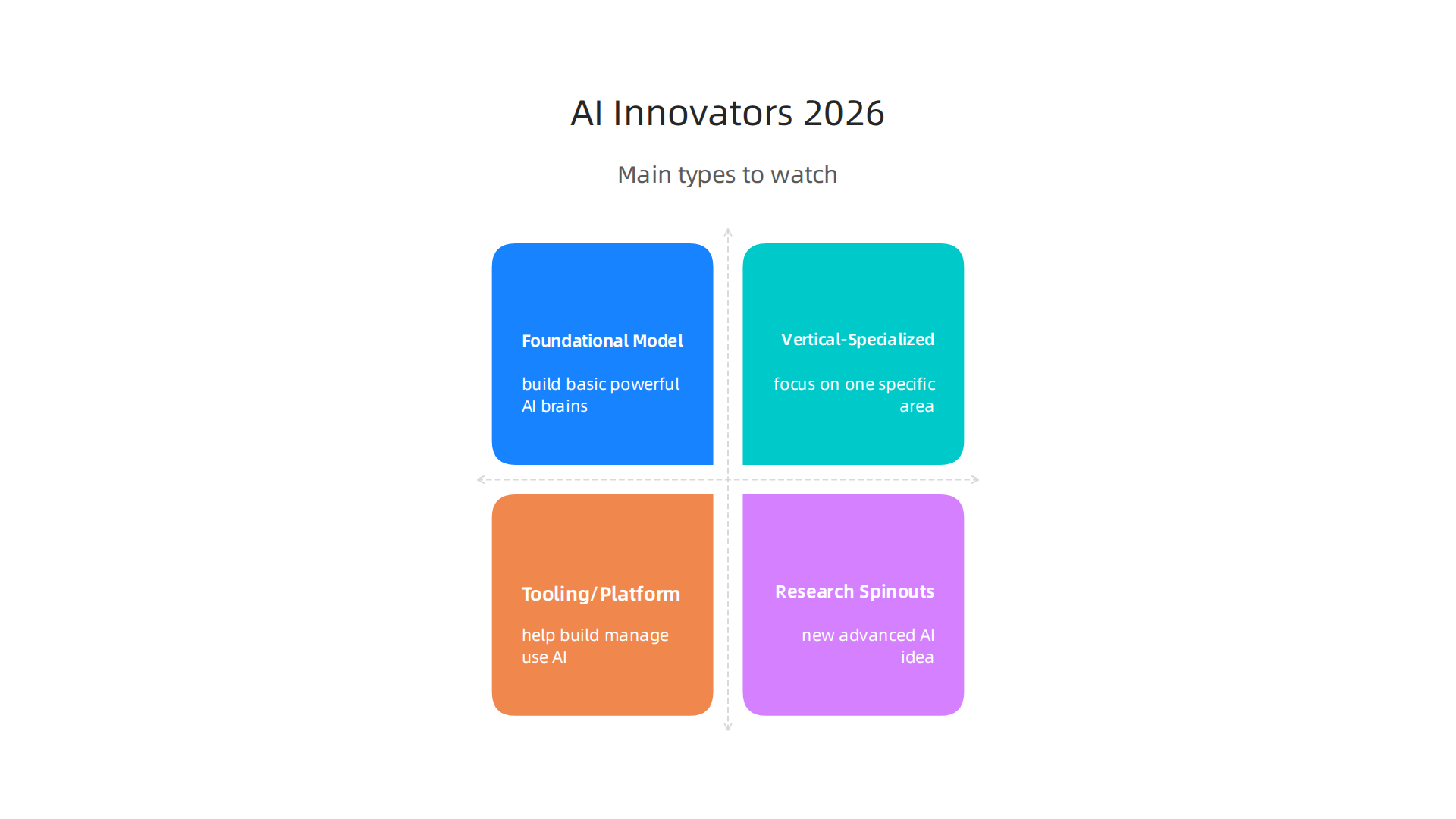
    Here are the main types of AI innovators you should know:

    An overview of the main categories of AI innovators shaping the market in 2026.

    • Foundational Model Providers: These are the big players. They build the very basic, powerful AI "brains" that other companies then use to make their own tools. These companies focus on creating large AI models that can do many things, from writing to understanding pictures. They often lead the way in new AI discoveries.
    • Vertical-Specialized Startups: These companies focus on one specific area, or "vertical," for their AI tools. For example, some might only make AI for healthcare, while others focus on marketing. They might not make the foundational models themselves but use them to build very clever tools for their chosen niche. A company like rb tech might specialize in AI for manufacturing, or ascend technologies could be focused solely on customer service AI.
    • Tooling/Platform Vendors: These innovators create the tools and platforms that help other businesses build, manage, or use AI. They don’t necessarily make the AI itself, but they make it easier for you to work with AI. If you’re looking for synonym technologies to help make your content better, a tooling vendor might offer a platform that lets you fine-tune AI for your specific writing style.
    • Research Spinouts: Sometimes, a new AI company comes right out of a university or a big research lab. These "spinouts" are often focused on bringing a very new, advanced AI idea into the real world. They might be smaller, but their technology can be cutting-edge. For example, a new solution from blueprint technologies or prince tech could come from deep academic research.

    Why does knowing these types matter? Well, a foundational model provider might have a long-term plan (a "product roadmap") that focuses on making their core AI smarter. A specialized startup, on the other hand, will likely have a roadmap focused on adding more features for their specific industry. The way their tools connect with your existing systems (integration complexity) can also differ. Foundational models might require more technical know-how to integrate, while a tooling vendor might offer simpler plug-and-play options. And, of course, the cost models can be very different. Some charge based on how much you use their AI, while others have monthly fees for their platforms.

    Understanding these different types will give you a much better idea of whether an AI company’s offerings truly match what your business needs for growth and innovation. To go deeper into finding the right solutions, explore more about enterprise AI platforms 2026 top providers and how to choose the right one.

    Staying updated on all these different types of AI innovators can feel like a lot. That’s why many business leaders turn to daily summaries to keep up.
    Get clear daily AI updates from The AI Newsletter Worth Reading.

    You know, choosing the right AI isn’t just about what kind of company makes it, but also about how well that AI tool truly fits your business. It’s like buying shoes. Knowing if a company makes running shoes or dress shoes is good, but you also need to try them on to see if they fit your feet and your needs.

    In 2026, with so many AI tools out there, having a clear way to check them is super important. This means looking at more than just what the AI promises to do. You need to dig a little deeper.

    A person thoughtfully considering options, symbolizing a deep evaluation process.

    How to evaluate AI companies and technologies (checklist)

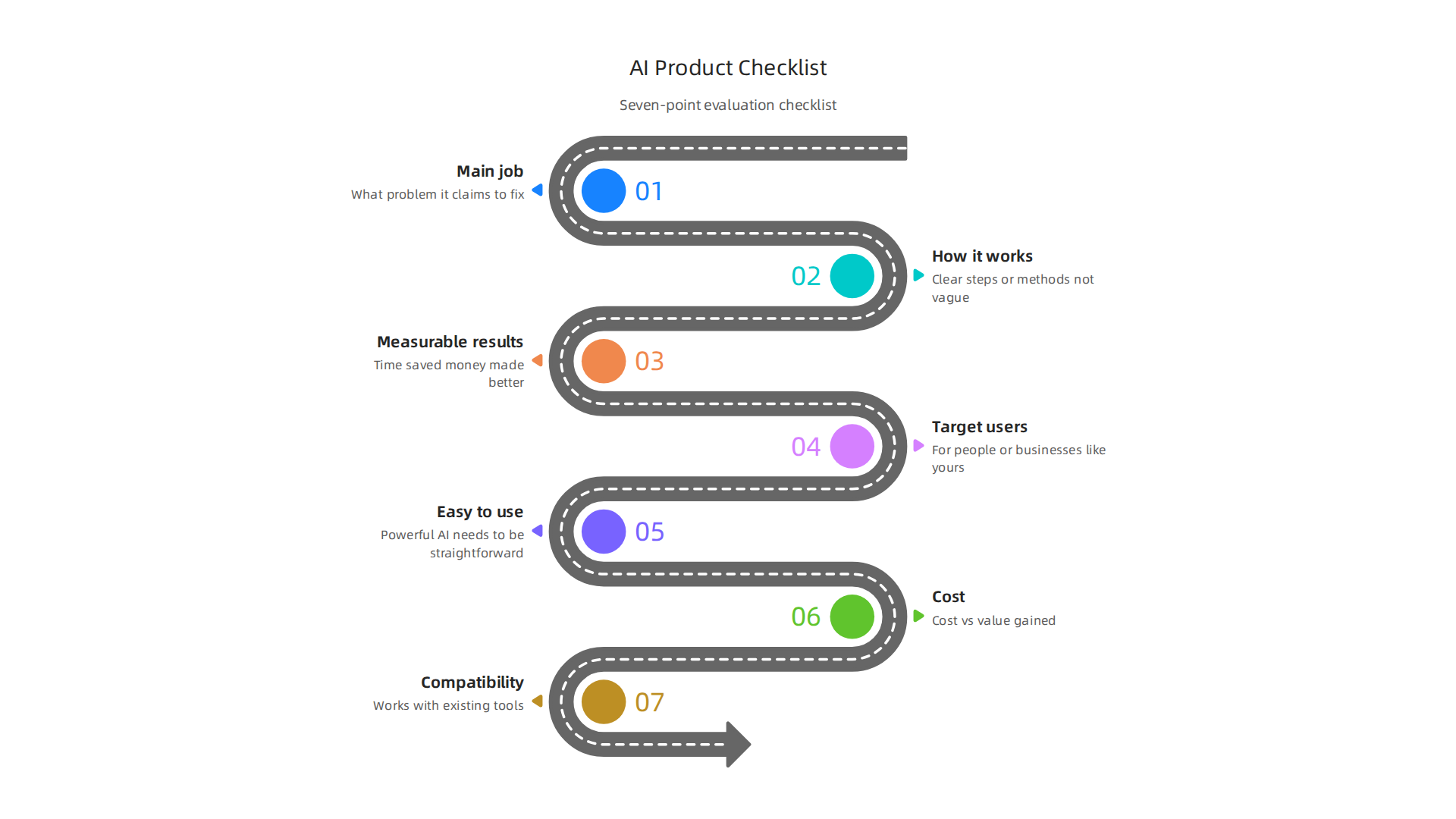
    To pick the best AI for your business, you need a plan, almost like a checklist. This helps you look at all the important parts of an AI tool and the company behind it. Think of it as a step-by-step guide to make sure you get a tool that really works for you and keeps your business safe. Many experts agree that a structured framework is key for evaluating any AI vendor AI Product Evaluation Checklist.

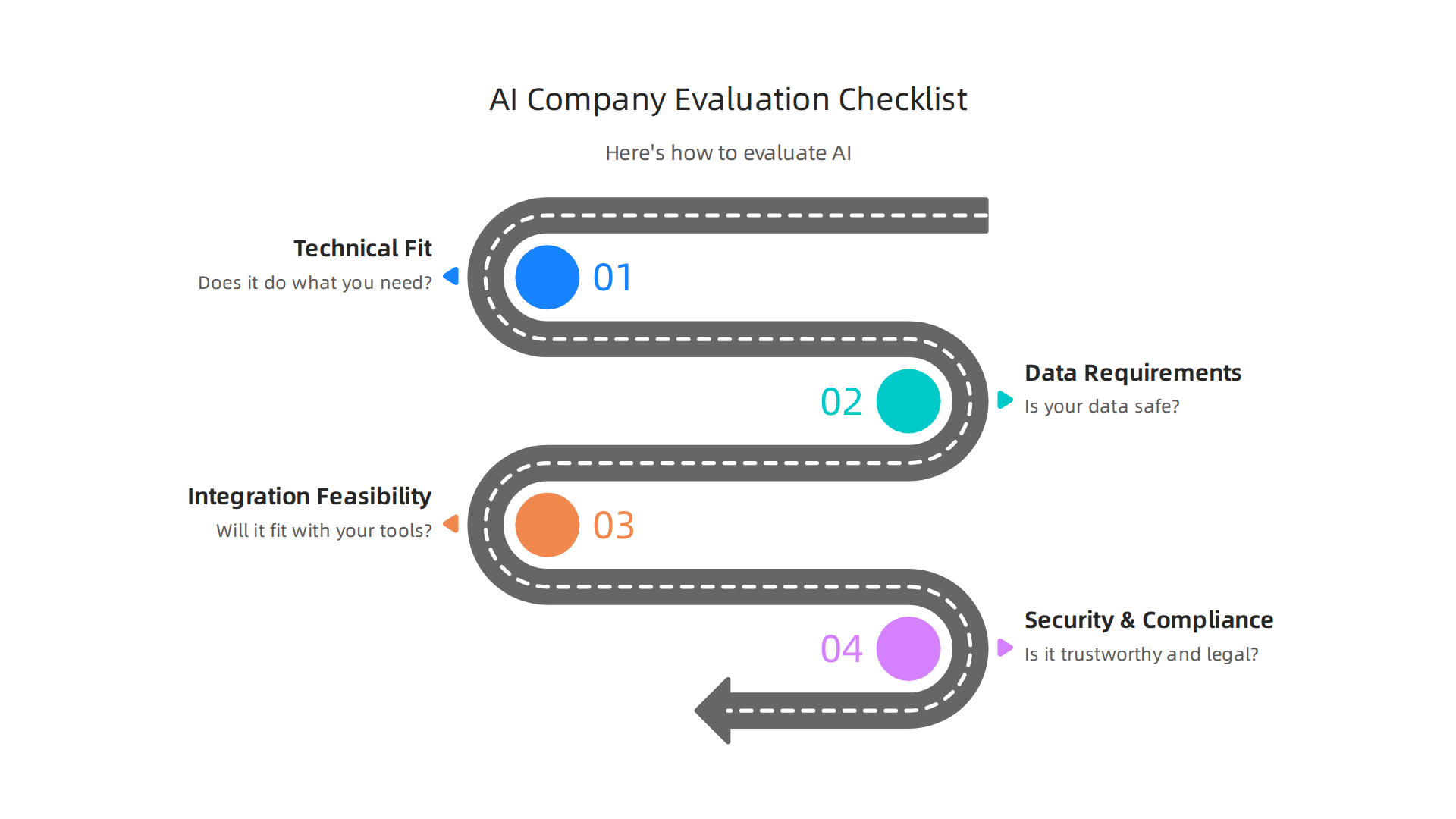
    Here’s how to evaluate AI companies and technologies:

    A checklist for evaluating AI companies and their technologies to ensure the right fit.

    1. Technical Fit: Does it do what you need?

    First, you need to know if the AI tool can actually do the work you want it to.

    • What to ask vendors:
      • Can you show us how it solves our specific problem? For example, if you need a tool for better content writing, can synonym technologies show how their AI helps improve your drafts?
      • What kind of data does it need to work best? Some AIs work well with simple text, others need lots of pictures or numbers.
      • How accurate is it? No AI is perfect, but you want one that makes very few mistakes for your important tasks.
      • Can it handle a lot of work? If your business grows, will the AI still keep up?
    • What to check yourself:
      • Look for reviews or success stories from other businesses like yours.
      • Ask for a trial period. This lets you try the AI in your own business setting.
      • See if the AI output has any biases. This is a common issue and something to watch out for, especially when using AI in education How District Technology Directors Should Evaluate AI Vendors.

    2. Data Requirements & Handling: Is your data safe?

    AI tools often need access to your business data. This means you need to be very careful about how they handle it.

    • What to ask vendors:
      • Will our data be used to make their AI smarter (train their models)? You often want to say no to this to keep your information private.
      • Where is our data stored? Is it in your country?
      • What steps do they take to keep your data private and safe?
      • Do they follow rules like GDPR or other privacy laws in 2026?
      • Can we get our data back if we stop using their service?
    • What to check yourself:

    3. Integration Feasibility: Will it fit with your other tools?

    It’s rare to use just one tool. You need your new AI to work smoothly with the programs you already have.

    • What to ask vendors:
      • How easy is it to connect their AI with our current software, like our customer service system or our marketing tools?
      • Do they offer help with setting it up?
      • Will we need our own IT team to do a lot of work to get it running? This is especially true for specialized companies like rb tech or ascend technologies who might have unique integration needs.
    • What to check yourself:
      • Look at how complex the integration process seems.
      • Talk to other companies that have integrated the same AI tool.
      • Think about if you want a tool that can connect with many different systems, or if you prefer a single platform approach. You might find a tool that helps you unlock growth by selecting smart technologies if it integrates well.

    4. Security & Compliance: Is it trustworthy and legal?

    This is super important. An AI tool that isn’t secure or doesn’t follow the rules can cause big problems for your business.

    • What to ask vendors:
      • How do they test their AI for weaknesses? Are they transparent about their security practices? Red teaming evaluations can be a good way to test this OWASP Vendor Evaluation Criteria for AI Red Teaming.
      • What rules or laws does their AI follow (like healthcare rules if you are in health)?
      • What happens if something goes wrong? Who is responsible?
    • What to check yourself:
      • Look for third-party audits or security reports.
      • Check for any past security problems or data leaks linked to the company.
      • Ensure they have a clear plan for AI governance AI Governance Vendor Report 2026.

    Red Flags to Watch For

    When evaluating, keep an eye out for these warning signs:

    • No clear answers: If a vendor avoids your questions about data, security, or how their AI works, that’s a problem.
    • Too good to be true: If an AI promises amazing results with no effort or cost, be careful. Real AI solutions require thoughtful implementation.
    • No testing or validation: If the company only says their AI works great without showing any outside proof, like studies or expert reviews, you should be wary. Even advanced research spinouts like blueprint technologies or prince tech should be able to offer some proof of concept.
    • Hidden costs: Make sure you understand all the fees involved, not just the basic price. Some AI pricing models are very complex and can include usage-based fees on top of subscriptions Understanding Enterprise AI Pricing Models.

    By using this kind of checklist, you can be much more confident that the AI tools you choose will truly help your business grow and succeed in 2026. This process helps you choose not just an AI tool, but the right AI tool.

    The previous section helped you choose the right AI. Now, let’s talk about what happens when you start using it. Even the best AI tools, like those from synonym technologies or rb tech, can face problems when you try to put them to work in your business. It’s like buying a new car; you might have picked the perfect one, but actually driving it every day comes with its own set of challenges. In 2026, many businesses find that their AI projects, especially pilot programs, do not go as planned. In fact, some reports show that a very high number of AI pilot projects fail to move past the testing phase MIT report: 95% of generative AI pilots at companies are failing.

    Implementation challenges and integration strategies

    Getting AI to work smoothly in your business can be tricky. Here are some common hurdles and how to jump over them.

    Key practical challenges often faced during AI implementation in businesses.

    Common practical challenges

    1. Data Readiness: AI tools need good data, like a chef needs fresh ingredients. If your data is messy, incomplete, or hard to use, the AI will not perform well. This "dirty data" is a big reason why many AI projects stall before they even properly begin Why most AI procurement pilots stall (and what to fix before yours does). Companies often have to spend a lot of time cleaning up their information first.
    2. MLOps Maturity: This fancy term just means having a good system to keep your AI running well, making sure it learns and gets better over time. If your company, say like ascend technologies, does not have a clear way to manage and update its AI tools, they might stop being useful after a while. Many businesses do not set up proper production standards or ownership from the start Why AI Pilots Fail and How Yours Can Succeed.
    3. Vendor Lock-in Risks: Sometimes, when you pick an AI tool, you might get too tied to one company. This means it becomes very hard to switch to another AI later if you need to. While buying from big, known companies is often safer, relying too much on small, new startups can carry more risk of getting stuck Why 95 Percent of AI Pilots Are Failing (And How to Avoid the Trap in Insurance). Even promising new ventures like blueprint technologies or prince tech should have clear exit strategies.
    4. Change Management: This is about people. It is often the biggest problem. Even if an AI tool is great, if your employees do not want to use it or do not know how, it will not help your business. Resistance to new tools is a top reason why AI projects fail Why AI Pilots in Procurement Fail and How You Avoid Pitfalls. They might worry about their jobs or simply prefer the old ways.

    Smart ways to make AI work in your business

    Do not worry, there are good ways to handle these challenges!

    A team working together, strategizing to overcome implementation challenges.

    1. Pilot Design: Instead of trying to use AI everywhere at once, start small. Design a "pilot" project to test the AI in a specific area. Make sure this pilot has clear goals. Many pilots fail because they are designed just to look good, not to solve real problems with measurable success The AI pilot trap, and how the best companies escape it. You need to define what success looks like right from the start.
    2. Incremental Architecture: This means building up your AI use step by step, rather than trying a huge overhaul all at once. Like building with LEGOs, you add one piece at a time. This helps you learn and adjust as you go, making the whole process less risky.
    3. Sandboxing: Think of this as a safe playpen for your AI. You test it in a separate, controlled environment before letting it loose on your main business operations. This helps catch any problems or surprises without affecting your daily work.
    4. Clear KPIs for Pilots: KPI stands for "Key Performance Indicator." These are clear numbers or goals that tell you if your AI pilot is truly working. For example, if you are using synonym technologies to improve content, a KPI might be "reduce editing time by 15%." Having these clear goals helps everyone know what success means and guides the project. Do not forget to focus on solving real problems with measurable pain points, not just picking the coolest new tech Why AI Pilots Fail. This will help you choose AI for business tools that deliver real results.

    By thinking ahead about these challenges and using smart strategies, your business can make AI work for you, helping you grow and do things better in 2026.

    To keep up with the latest in AI and technology, consider subscribing to The AI Newsletter Worth Reading for daily updates.

    After understanding how to make AI tools work in your business, the next big questions are about money: "How much will it cost?" and "What will I get back?" In 2026, choosing the right commercial model for your AI and figuring out its true value, or Return on Investment (ROI), is just as important as picking the right tool itself.

    Commercial models, pricing signals, and ROI considerations

    When you bring AI into your business, you need to think about how you will pay for it and what benefits you expect to see. This helps you understand the full picture, from spending to earning.

    Different ways to pay for AI tools

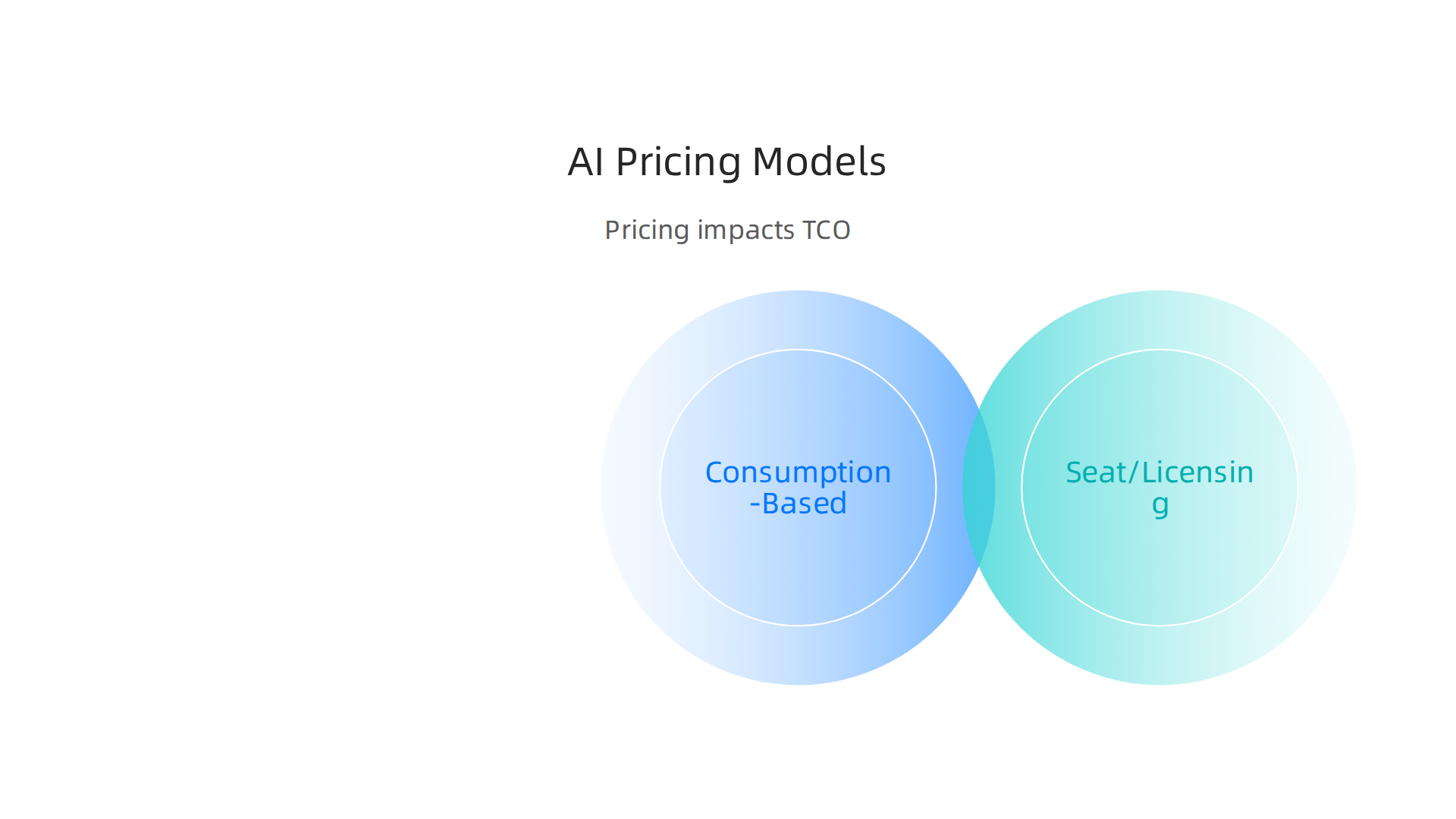
    AI tools come with different pricing plans, just like phones or internet services. Knowing these helps you figure out your Total Cost of Ownership (TCO), which is the full cost of having and using the AI over time.

    Different commercial models for AI tools, impacting total cost of ownership.

    1. Consumption-Based Pricing: This is like paying for electricity; you only pay for what you use. For AI, this could mean paying for each task the AI does, like every time an AI from synonym technologies generates a piece of text or every customer question an AI chatbot answers. This model is becoming very popular because it matches costs to actual use and results The AI pricing and monetization playbook.
    2. Seat/Licensing Models: Here, you pay a set fee for each person who uses the AI tool, or for a certain number of licenses. This is a common way to pay for many software tools, including some AI programs from companies like rb tech. While it offers predictable costs, it might not be the most efficient if not everyone uses the AI equally.
    3. Outcome-Based Pricing: This model is all about the results. You pay the AI provider based on the value or benefits the AI delivers. For example, you might pay an AI from ascend technologies that helps with sales a percentage of the new sales it brings in, or a tool that saves costs a share of the money saved. This means the AI company only gets paid more when you see clear success AI Model Pricing Strategies: Value-Based & Outcome-Driven. This approach can be great for aligning everyone’s goals.
    4. Hybrid Models: Many AI tools use a mix of these. For instance, you might pay a small base fee (like a subscription) plus extra based on your usage or the outcomes achieved. This can offer a balance between predictable costs and paying for actual value. Understanding these models is key to knowing your overall AI spending Understanding Enterprise AI Pricing Models: A Guide to ….

    Figuring out your AI’s Return on Investment (ROI)

    ROI tells you if the money you put into AI is worth it. It is about getting more value back than you spent.

    • Short-Term Pilot Metrics: When you first start with an AI pilot, like with a new tool from blueprint technologies, you need to track clear, small wins. This could be how much time employees save on a certain task, how many fewer errors are made, or how quickly customers get help. These early numbers help you see if the AI is working as expected before you use it everywhere. You need to focus on measurable benefits even in early stages AI Implementation Case Studies: Real Enterprise Results ….
    • Long-Term Operational Impact: Over time, AI should do more than just improve small tasks. It should change how your business runs for the better. This could mean happier customers, new ways of doing business, or big cost savings. For example, some companies have used AI to save millions in labor costs or cut down on unplanned machine downtime significantly AI Cost Reduction Strategies: Case Studies. Tools like prince tech might aim to reshape entire departments.
    • What to Track: To show good ROI, keep an eye on key numbers. This includes how much money you save, how much more money you make, how much time is freed up, and how much happier your customers or employees are. Using an AI Agent ROI Calculator: Enterprise Business Case Template can help you set up and track these important numbers.

    By carefully considering how you pay for AI and what real-world benefits it brings, your business can make smart choices that lead to true growth and success in 2026. This means more than just having cool tech; it means making that tech work hard for you. If you want to dive deeper into how businesses adopt smart technologies for growth, read our guide on how to Unlock Growth by Selecting the Right Smart Technologies in 2026.

    Emerging trends and what they mean for SMBs

    As we think about making smart choices for AI, it is also important to look ahead.

    A person staying informed about emerging technology trends by reading news.

    The world of AI is always changing, and some big trends are shaping how businesses will use these tools in 2026 and beyond. Knowing about these changes can help small and medium-sized businesses (SMBs) plan better.

    Big trends to watch in AI

    Think of AI as a fast-moving river. These are the main currents:

    • Composability: This means building AI solutions like LEGO blocks. Instead of one big, all-in-one AI tool, businesses can pick and choose different AI parts and put them together to create a custom solution. This gives companies like rb tech or those working with synonym technologies more flexibility to build exactly what they need.
    • Model Specialization: AI models are becoming super good at very specific jobs. Instead of a general AI that does many things okay, you will find AIs that are amazing at writing marketing emails, or perfect for spotting certain things in pictures. This means better results for niche tasks.
    • Vendor Consolidation: Bigger tech companies are buying up smaller AI startups. This means there might be fewer choices for AI tools in the future, but the remaining options could be more robust. It is a good idea to watch who is buying whom in the AI space, especially for tools offered by companies like ascend technologies.
    • Regulation Impacts: Governments around the world are starting to make rules about how AI can be used. These rules will cover things like privacy, fairness, and safety. SMBs need to stay updated on these laws, as they will affect how you can use AI and what kinds of data you can feed into it.

    What these trends mean for small and medium businesses

    For SMBs, these trends have real-world effects on how you bring AI into your daily work.

    • Procurement Cadence (How often you buy AI): With AI changing so fast, you might need to check for new tools more often. But this does not mean buying every new thing. Instead, it means having a smart plan to review AI options regularly. For instance, if you’re exploring tools like those from blueprint technologies, understand that the market is always evolving.
    • Risk Appetite (How much risk you are willing to take): Many AI pilot projects, especially for generative AI, do not fully succeed right away. In fact, some reports from 2025 showed that 95 percent of these early projects in certain industries fail to move past the testing phase Why 95 Percent of AI Pilots Are Failing. This happens for reasons like unclear goals, bad data, or people not wanting to change how they work Why AI Pilots Fail: The 5 Patterns and How to Break Through. For SMBs, it is often safer to start with smaller, proven AI tools that solve a clear problem and have a good track record, rather than trying to build something totally new from scratch. Buying solutions from established vendors tends to work better than building your own Why 95 Percent of AI Pilots Are Failing (And How to Avoid ….
    • When to Partner vs. Build: Deciding if you should buy an AI tool from a company or try to build one yourself is a big choice. For most SMBs, partnering with a vendor that already has a working AI solution is usually smarter. This saves time and money. Companies like prince tech offer ready-to-use AI tools that can quickly add value to your business without needing you to become an AI expert yourself. Remember, choosing a solution that truly fits your business needs, not just chasing what’s "cool," is key to success From Proof of Concept to Enterprise Scale: Avoiding AI ….

    Staying informed about these trends helps you make better choices for your business. It means you can pick the right tools and strategies to grow with AI, instead of being left behind. For more help navigating the world of AI tools, make sure you keep up with the latest news.

    Get clear daily AI updates from The AI Newsletter Worth Reading.

    Summary

    This article explains why profiling AI companies is essential for business leaders who must pick trustworthy, effective tools amid a crowded 2026 market. It shows what to look for in company profiles—product fit, core technology, target customers, team quality, governance and real-world references—and explains why those signals matter. You get a practical vendor-evaluation checklist covering technical fit, data handling, integration feasibility, security/compliance and red flags to watch. The guide also breaks down common implementation challenges (data readiness, MLOps, change management), offers strategies to run safer pilots, and compares pricing models and ROI metrics. Finally, it maps the main types of AI innovators and key trends SMBs should track so you can choose, deploy, and measure AI tools that truly deliver value for your business.

  • Unlock Growth by Selecting the Right Smart Technologies in 2026

    Unlock Growth by Selecting the Right Smart Technologies in 2026

    In 2026, the world of technology is moving faster than ever before. New smart technologies and AI tools are popping up all the time. This rapid change brings many new chances for businesses and people to do things better. But it also means there’s a lot of information to sort through. For leaders trying to make smart choices, it can feel like too much.

    A leader contemplates complex choices amidst a rapidly evolving technological landscape, striving to make informed decisions for their business.

    It’s tough to know which new tool is truly helpful and which is just a passing trend. How can you tell what will really make your business stronger or help your team be more fit for the future? This challenge is often called "information overload." You might feel lost trying to find the best new apps, smart devices, or ways to use augment AI. For example, over half of homes in the U.S. now use smart devices in 2026, showing how quickly these tools are becoming part of daily life [The State of Smart Home]. Also, about half of adults in the U.S. are now using AI chatbots [Americans and AI 2026: Chatbots, Smart Devices and Views on Impact]. This fast growth means everyone needs clear guidance.

    This guide is here to help you cut through the noise. We will give you simple plans and the newest facts to help you pick the best smart technologies. We’ll show you tactics to understand, choose, and use these tools well. Our goal is to help you improve your organizational tech fitness. This means your business will be strong and ready to use technology in the best way possible. By doing this, you can make sure your choices about wearable technology and other smart tools lead to real success. Staying updated on new tech can be a big job, so it helps to have reliable insights. If you want to keep up with daily changes, you should The AI Newsletter Worth Reading.

    Screenshot of The Deep View's newsletter subscription page, offering insights into AI and technology trends.

    We will show you how to truly thrive with technology, not just keep up. Understanding and using new technology well is key for any business today. This means Tracking Major Technology News for Smart Business Decisions in 2026 is more important than ever.

    The homepage of AI Tools News Today, a resource for tracking major technology news relevant to smart business decisions.

    Understanding and using new technology well is indeed key for any business today. But it’s not just about keeping up. It’s about seeing how these new tools can truly help your business grow and stay ahead. This is where smart technologies really shine, offering big benefits for your money and giving you an edge over others.

    Business impact: Why smart technologies matter for ROI and competitive edge

    Smart technologies are changing how businesses work in 2026. They help companies do things faster, better, and in ways that make customers happier. The main idea here is getting a good return on your investment (ROI) and staying competitive.

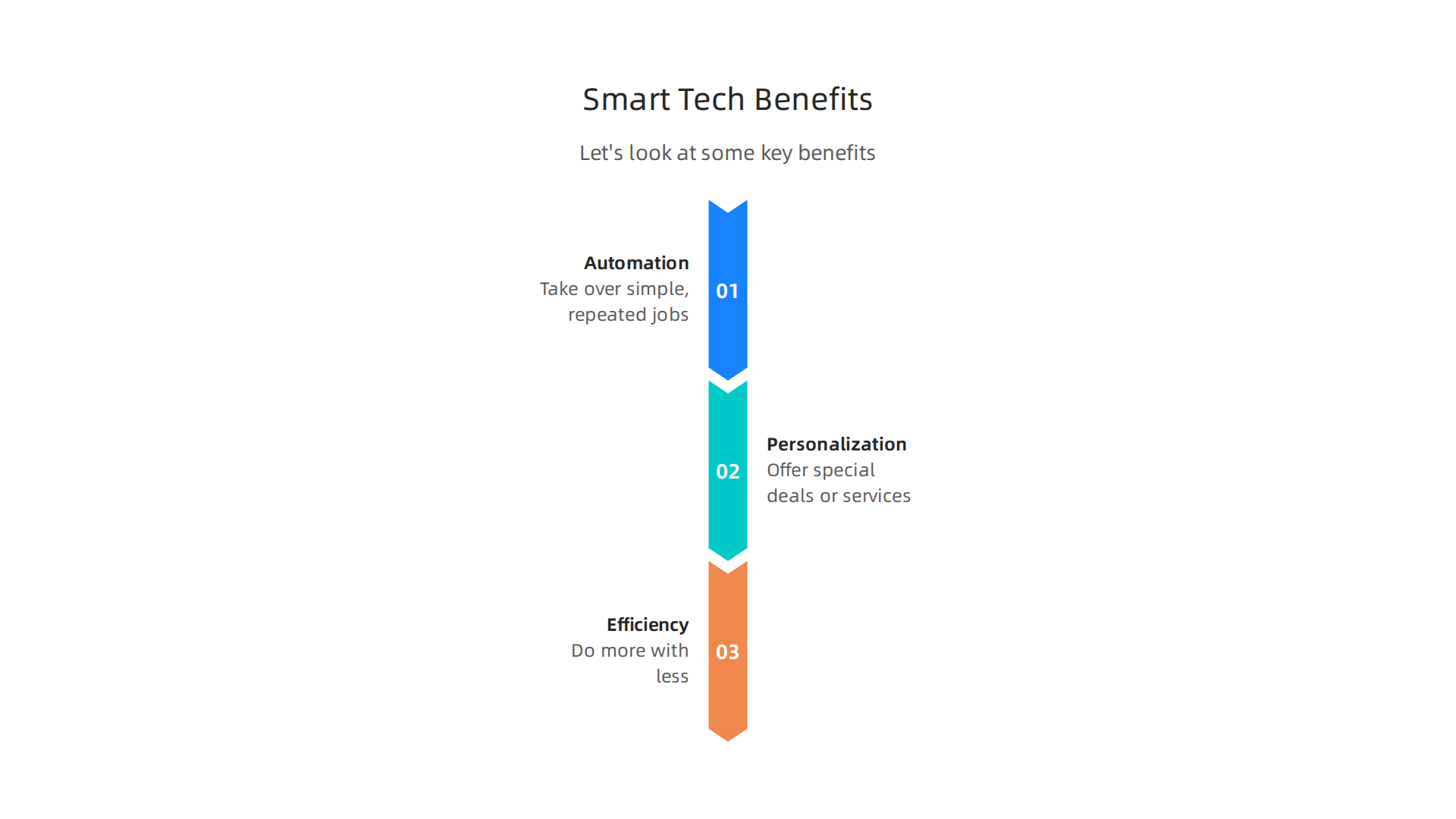
    Let’s look at some key benefits:

    Smart technologies like AI and automation can revolutionize business operations, enhancing efficiency, personalization, and overall productivity.

    • Automation: Smart tools can take over simple, repeated jobs. Think of a robot doing easy tasks in a factory, or software that answers common customer questions. This frees up your team to focus on bigger, more creative work. It saves time and money. About 72% of large businesses have put at least one AI system into use, showing how much companies rely on this for efficiency [67 AI Adoption Statistics for 2026 — Enterprise & SMB Data].
    • Personalization: Imagine if every customer felt like your business knew exactly what they wanted. Smart technologies, like those that use augment AI, can help with this. They can learn what customers like and offer them special deals or services. This makes customers happier and more likely to stick with your business.
    • Efficiency: When you use smart tools, your business can often do more with less. They can help you find problems faster, plan better, and use your resources wisely. This means you get more done in less time, making your business stronger and more able to handle new challenges. For example, using AI can help cut costs without cutting important services, leading to greater overall efficiency and profit for companies aiming for Tech For Less: AI Operations Cut Costs Without Cutting Corners in 2026.

    These benefits help your business save money and make more money. They also help you stand out. When you use the newest smart technologies wisely, you can offer better products or services, work faster than your rivals, and build stronger bonds with your customers. This is what gives you a real competitive edge.

    A team celebrates a significant business achievement, illustrating the positive outcomes of strategically adopting smart technologies for a competitive edge.

    However, bringing in new smart technologies isn’t always easy. Businesses often face hurdles like:

    • Skills: Your team might not know how to use these new tools. It takes time and training to learn.
    • Integration: New technologies need to work well with your old systems. Sometimes, they don’t talk to each other easily, which can cause problems.
    • Cost: Buying and setting up new systems can be expensive. Businesses worry if the money they spend will really pay off. For instance, concerns about data privacy, trust, and security are still top worries for many people adopting new tech in 2026 [Tech Use and Adoption Keeps Surging Among Older Adults]. High costs and system complexity are also often cited as barriers to adopting new technology [Survey: Older Adults Adopt Tech at Steady Pace].

    This is where being "tech fit" comes in. Just like being physically fit helps you handle life’s challenges, being tech fit helps your business handle new technology. It means your company is ready to learn, adapt, and make smart choices about technology. This reduces friction when bringing in new systems, makes it easier to train your team, and helps you pick the right tools that truly add value. For businesses, learning how to select the best smart technologies that align with your goals is vital, which is why it’s important to know How to Choose AI for Business Tools That Deliver Real Results in 2026.

    By focusing on tech fitness, companies can better understand the true worth of new tools, including things like wearable technology for tracking data or augment AI for decision making. This helps them move past the common problems and use technology to their full advantage, creating a path for constant growth and innovation.

    Becoming "tech fit" means more than just knowing about smart tools. It also means understanding the special kinds of new technology that are changing how businesses work in 2026. Let’s look at some key innovations and what they mean for your business.

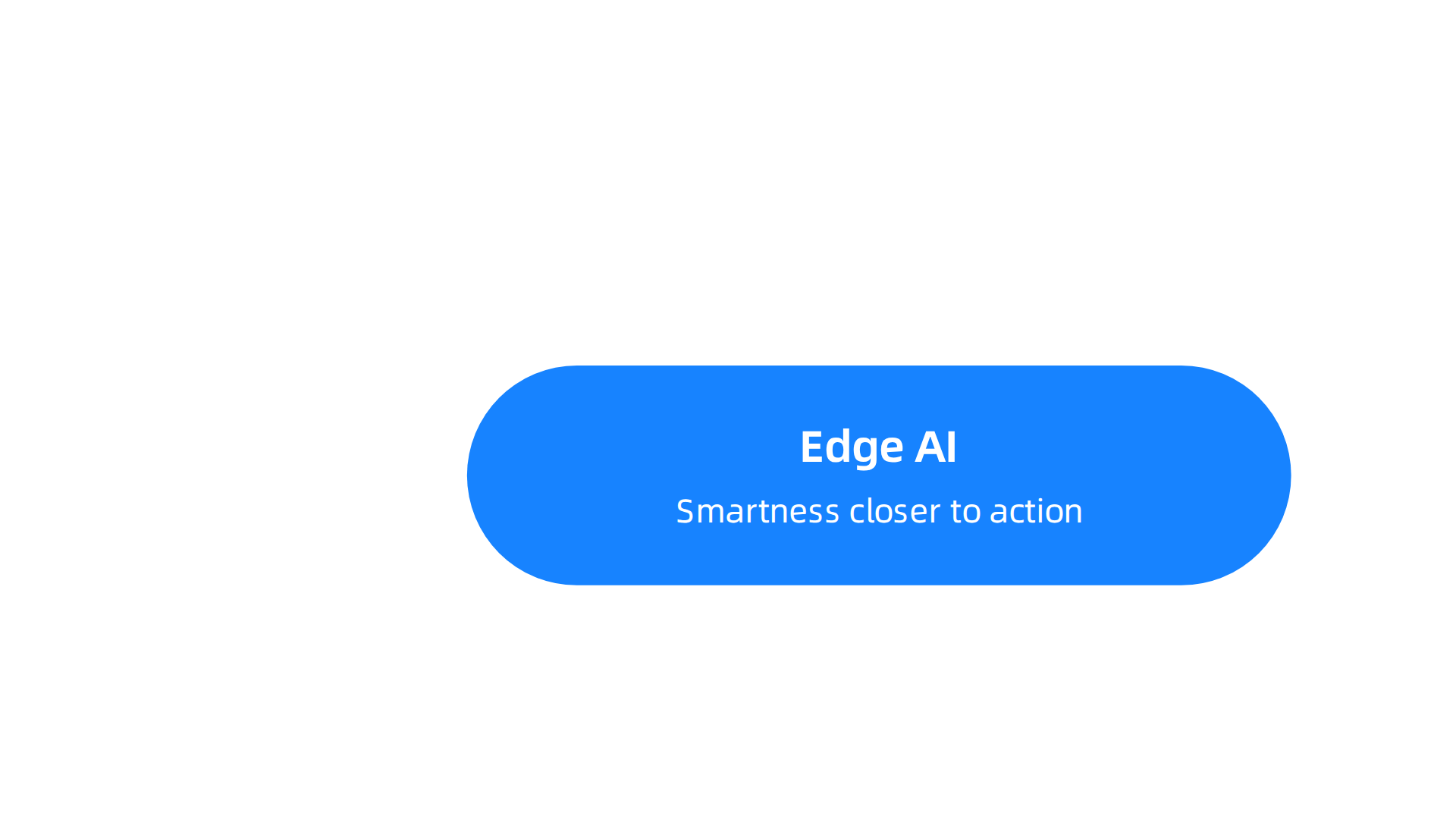
    Explore the foundational smart technologies shaping business in 2026: Edge AI, TinyML, and Ambient Computing.

    Key technical innovations: Edge AI, TinyML, ambient computing and sensors

    These new developments in smart technologies are making things possible that were once just ideas. They help businesses get better at what they do, often in ways that save money and make customers happier.

    Edge AI: Smartness on the spot

    Edge AI is about bringing artificial intelligence closer to where the action happens. Instead of sending all data to a big cloud server far away for thinking, Edge AI lets smart devices do their own thinking right there. Imagine a security camera that can tell the difference between a person and an animal instantly, without needing to ask a distant computer. This is Edge AI at work.

    This kind of smart technology offers big benefits. It makes decisions much faster because data doesn’t have to travel far. It also helps with privacy, as less sensitive information leaves the device. Plus, it can save on internet costs and power. For product teams, this means creating devices that are quicker and more private. Operations teams need to make sure these devices are secure and work well together. Edge AI is quite mature now, with many solutions ready for use, making it a top choice for those looking for Best Edge AI Solutions: Top 11 in 2026.

    Screenshot of Cloudian's website, a provider of resources and solutions related to AI infrastructure and Edge AI.

    It also helps cut down on sending too much data to the cloud, saving money and boosting speed, as processing happens locally on devices like cameras and IoT systems according to experts discussing the difference between Edge AI vs Cloud AI.

    TinyML: AI for tiny devices

    TinyML is like Edge AI’s little cousin. It’s about putting smart thinking (machine learning) into very small, low-power devices. Think of the kind of chip that might go into a smart button or a simple wearable technology device. These tiny chips can still learn and make simple decisions, even though they use very little power.

    This is super helpful for things that need to run for a long time on a small battery, like health trackers or small sensors in factories. TinyML makes it possible to add smart features to almost anything. While newer than Edge AI, TinyML is quickly gaining ground, showing strong real-world use especially when internet service is limited and quick responses are needed Tiny Machine Learning and On-Device Inference: A Survey of Applications, Challenges, and Future Directions. Companies are even working on how to properly test these systems to compare their performance, using tools like MLPerf® Tiny MLPerf Tiny: Benchmarking AI at the Edge.

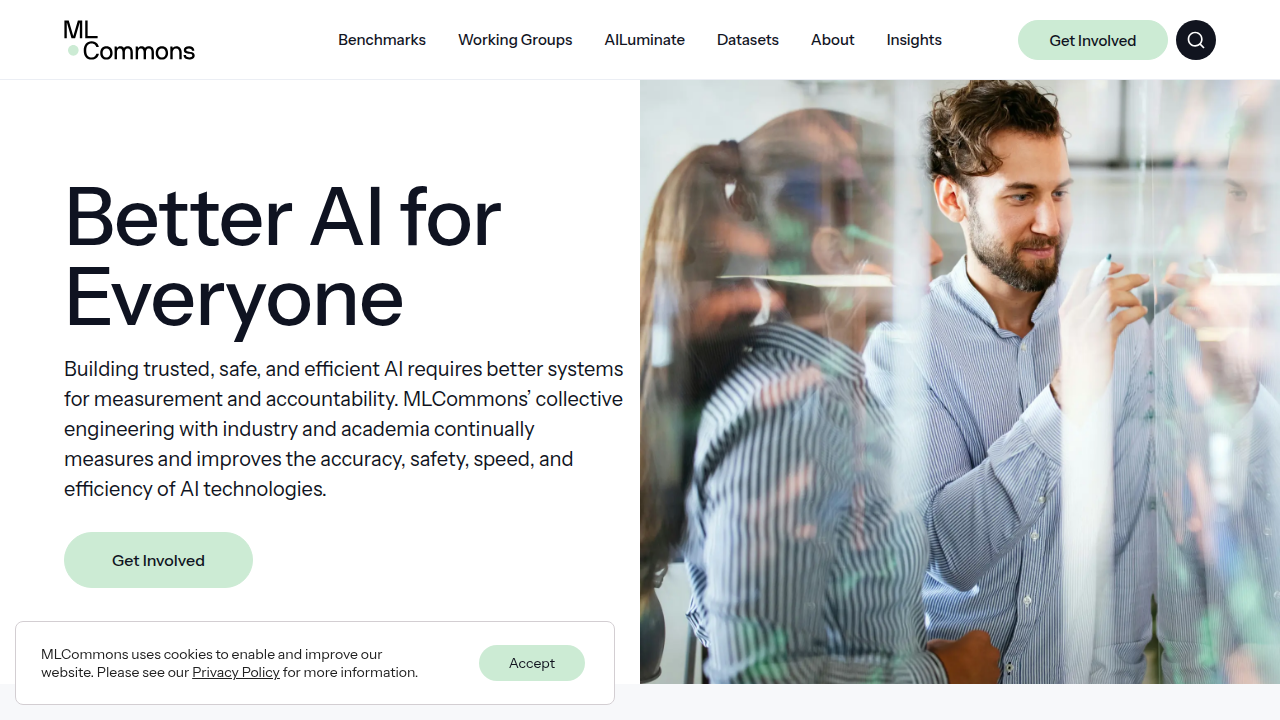
    The homepage of MLCommons, an open engineering consortium focused on accelerating machine learning innovation, including benchmarking tools like MLPerf Tiny.

    For product and operations teams, working with TinyML means learning new ways to build and manage very efficient systems that can run AI right on the device TinyML for On-Device and Edge Analytics in Wireless Networks.

    Ambient computing and sensors: Making our world smart

    Ambient computing means that technology is always around us, working in the background to make our lives easier. It’s often invisible, just like the air we breathe. Sensors are the key parts of this. They are like the eyes and ears of these smart environments. These tiny parts collect information about everything from temperature and light to movement and sound.

    Together, ambient computing and sensors create smart spaces like connected homes, clever offices, and efficient factories. For example, smart lights that turn on when you enter a room or a factory machine that signals when it needs repair are thanks to these smart technologies. Product and operations teams must think about how these sensors collect data and how it’s used safely and effectively. They also need to make sure these systems fit well with existing tools, a key part of maintaining good tech fitness. Understanding these types of new technology can help businesses innovate and grow, fitting into the larger strategy of Mastering Behavioral Tech for Business Growth and Impact.

    We just talked about how cool new smart technologies like Edge AI and TinyML are changing things. But how does a business know if it’s ready to use these new tools well? This is where "tech fitness" comes in.

    Measuring and improving tech fitness: people, process, platform

    Think of tech fitness like being ready for a big race. It’s not just about having the latest running shoes (the smart technologies); it’s also about having strong legs, a good plan, and the right food. For a business, tech fitness is how well it can look at, bring in, and keep running smart technologies in a dependable way. It means being able to change and grow with new tech without big problems.

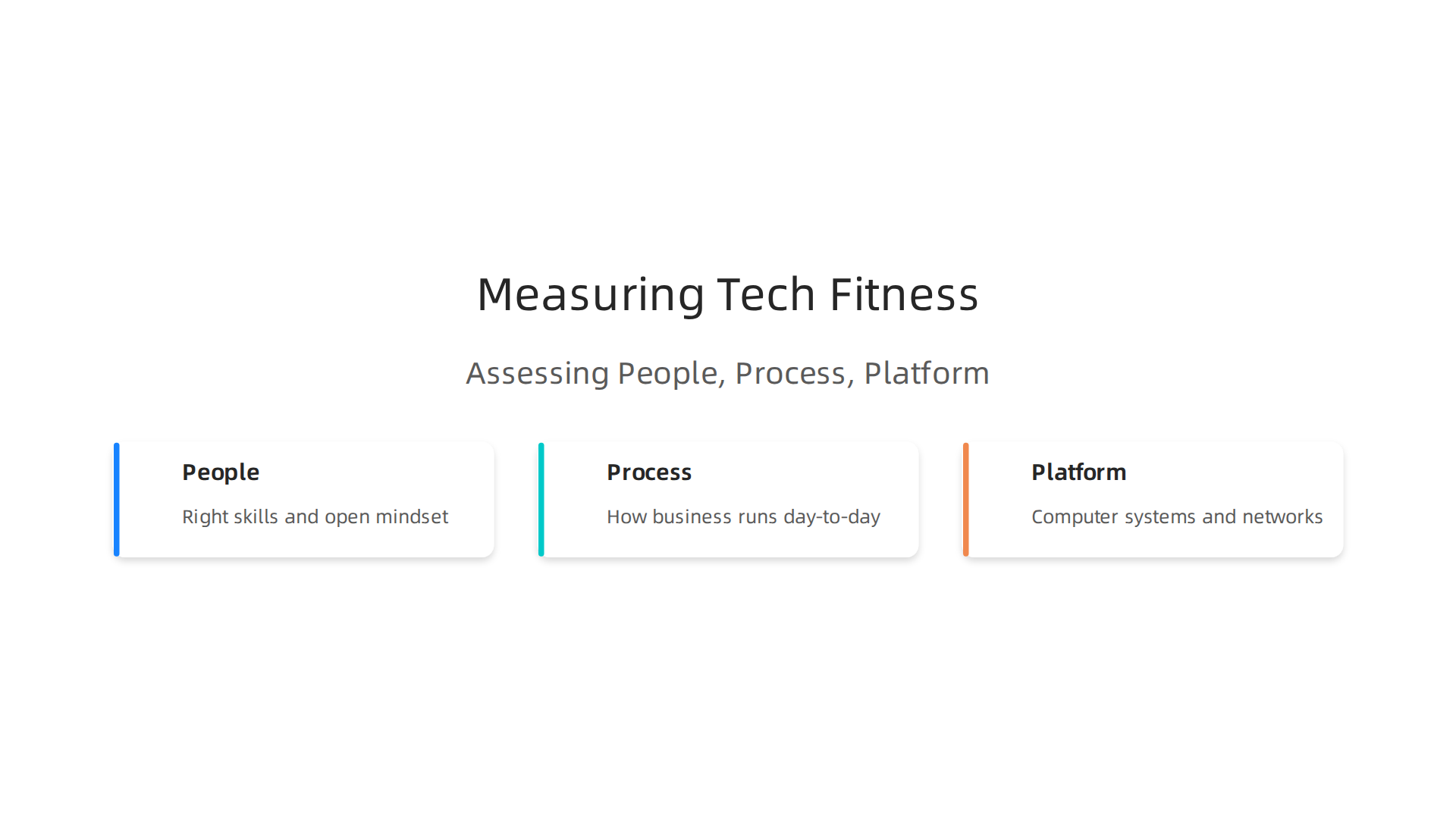
    To truly use smart technologies well, businesses in 2026 need to check three main areas: their people, their processes, and their platforms.

    Assessing a business's 'tech fitness' involves evaluating its People, Processes, and Platforms to ensure readiness for new smart technologies.

    A group of professionals reviews documents and discusses strategies, symbolizing the assessment of a company's readiness for new technologies.

    The people part: Do we have the right skills?

    First, think about the people who work for the business. Do they understand new smart technologies? Are they excited to learn new things? This is about having the right skills and a mindset that’s open to change. If your team doesn’t know how to use an AI tool, or how a new piece of wearable technology works, the business won’t get the full benefit. It’s like having a fancy car but no one knows how to drive it. Checking if your people are ready for change is a big step for success, as experts discuss how to assess Organizational Readiness Assessment: Your 2026 Success. Building this readiness involves clear steps to help everyone get on board with new ideas.

    The process part: How do we do things?

    Next, look at how the business runs day-to-day. This means its "processes."

    • Data Readiness: Smart technologies need good information to work. Is your business good at collecting, storing, and using data? If your data is messy or hard to find, even the smartest AI tool will struggle.
    • Rules and Safety: When using new tech, especially those that collect lots of data, you need clear rules. How will you keep information safe? Who gets to see what? Having strong rules and plans for new technology helps avoid problems and build trust. This is sometimes called "governance." Learning Understanding What is Information Technology for Business Success in 2026 is key to setting up these processes.

    The platform part: Are our systems strong?

    Finally, think about the "platforms." These are the computer systems, tools, and networks the business already uses.

    • Making New and Old Tech Work Together: Can new smart technologies easily connect with your existing systems? If they can’t, it will be hard to make them useful.
    • Staying Strong and Secure: Can your current systems handle the extra work that new tech might bring? Are they safe from hackers? Keeping systems strong and reliable is very important, especially with the rise of complex smart technologies. Having a good plan for technology and organization goes hand-in-hand to ensure success, as noted in a Planning and Readiness Framework for Organisational.

    By regularly checking these three areas, businesses can keep improving their tech fitness. It helps them choose the right tools and make sure they get real results from their investments in smart technologies.

    Measuring how ready your business is for new tech, or its "tech fitness," helps you see if you can use smart tools well. The next step is picking the right smart technologies for your business goals. It’s like picking the best tool for a job. You wouldn’t use a hammer to cut wood, right? You need to carefully look at what each new smart technology offers.

    Selecting the right smart technologies: an evaluation framework

    Choosing new smart technologies is a big deal for any business in 2026. You want to make sure the money you spend brings good results. To do this, it helps to have a clear way to check and compare different tools. Think of it as a checklist to help you make smart choices.

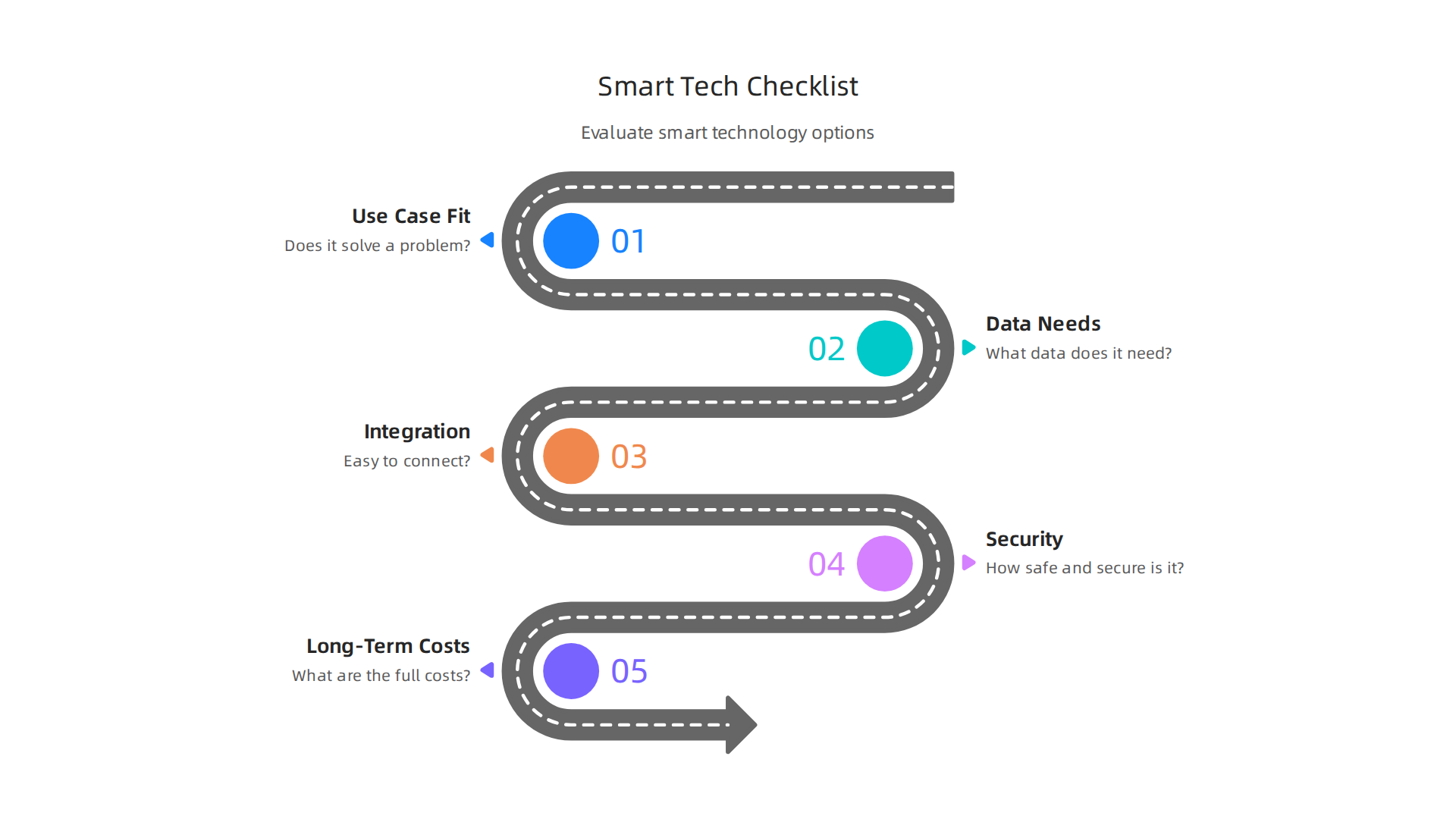
    A step-by-step framework to evaluate new smart technologies, ensuring they align with business needs and deliver value.

    1. Does it fit what you need? (Use Case Fit)

    The first thing to ask is: does this smart technology actually solve a problem for us? Or does it help us do something better? For example, if you want to track how healthy your workers are, a wearable technology that counts steps or monitors sleep might be a good fit. If you want to make a factory run smoother, an Edge AI system that watches machines could be helpful. You need to be very clear about the job you want the technology to do.

    2. What kind of data does it need? (Data Needs)

    Many smart technologies, especially those that use augment AI, need a lot of information to work. Ask yourself:

    • What data does this tool need to get started?
    • Where will that data come from?
    • How will we keep that data safe?
      If your business doesn’t have the right data, or if it’s messy, even the best smart technology won’t help much.

    3. How easy is it to connect? (Integration Complexity)

    New smart technologies usually need to work with your existing computer systems. If a new tool can’t easily connect with what you already use, it can cause a lot of headaches. It’s like trying to plug a new device into an old outlet that doesn’t fit. You want solutions that fit together smoothly without needing a lot of extra work. This helps keep things running without big interruptions.

    4. How safe and secure is it? (Security)

    When you bring in new smart technologies, you’re often dealing with important information. It’s super important to make sure this information stays safe from bad guys or accidents. Look into how the technology protects your data. What plans does the company selling the tech have to keep things secure? Security should always be a top concern.

    5. What are the full costs over time? (Long-Term Costs)

    The price you see upfront is not the only cost. You need to think about the "total cost of ownership." This includes things like:

    • Monthly or yearly fees
    • Costs to set it up
    • Costs to train your people
    • Money for ongoing support and updates
    • Hidden fees
      Making sure you understand all these costs helps you avoid surprises later on. Good IT Procurement Best Practices 2026 help businesses look at all these expenses.

    Try a small test first: Run rapid, low-cost pilots

    Before you spend a lot of money on a new smart technology, it’s a smart idea to try it out in a small way. This is called a "pilot program."

    A team collaborates around a whiteboard, sketching out plans for a new initiative, representing the careful planning of a pilot program for new technology.

    You pick a small part of your business, try the new tech there, and see how it works.

    • Start small: Don’t change everything at once. Test the technology on a small project or with a few team members.
    • Watch closely: See if it actually solves the problem you identified. Is it easy for your team to use?
    • Measure results: Did it save time? Did it save money? Did it make customers happier?

    This helps you learn if the technology is a good fit without making a huge investment. For example, testing TinyML systems often involves benchmarking their performance to see how well they work on small devices before wider use, as shown by MLPerf Tiny: Benchmarking AI at the Edge.

    By using this step-by-step checklist and trying out new tools in a small way first, your business can choose the right smart technologies and make sure they truly help you grow.

    Ready to dive deeper into the world of AI tools and how they can shape your business decisions? Stay informed and ahead of the curve.
    The AI Newsletter Worth Reading
    For more advice on finding the best solutions, explore how to choose AI for business tools that deliver real results in 2026.

    After picking the best smart technologies through careful checking, the next big step is putting them to work. This is called implementation. It sounds simple, but it can have its own set of tricky parts. Knowing these problems beforehand helps your business avoid them and make sure your new tools truly help you grow.

    Implementation strategies and common pitfalls to avoid

    Even after you pick the right smart technologies for your business in 2026, getting them up and running smoothly can be a challenge. It’s like buying a new car; you still need to learn how to drive it well and keep it maintained. Many businesses face common problems when they roll out new tech.

    What can go wrong during rollout?

    1. Data Changes (Data Drift): Smart technologies, especially those that use augment AI, learn from data. If the data changes over time, or if the way you collect it shifts, the technology might start making wrong guesses. This is like a smart system being trained on old information that no longer matches how things are now. You need to keep an eye on the quality of your data.
    2. Not Watching Closely Enough (Poor Monitoring): Once a new system is in place, it’s easy to just let it run. But you need to watch how it’s working. Is it saving time? Is it making things easier for your team? Without checking regularly, you might not notice problems until they’re big. This ongoing watch is key to making sure the tech stays helpful.
    3. People Problems (Staff Change Management): People don’t always like new things. Your team might be used to doing things a certain way. Bringing in new smart technologies can make them feel worried or confused. A study on what works and what doesn’t in technology adoption highlights the need to get people on board for success. If your staff isn’t ready or doesn’t want to use the new tools, even the best technology won’t work well. This kind of problem has been seen in cases like integrating smart tech in facility management, where employee buy-in was crucial Case Study: Successful Integration of Smart Technologies in Facility Management.

    How to make implementation smoother (Best Practices)

    To avoid these common pitfalls, follow a simple playbook:

    • Talk about it a lot: Explain why the new smart technologies are needed and how they will help everyone. Be clear about the benefits for your team, not just the business.
    • Train your team well: Provide good training so everyone knows how to use the new tools. Make sure there’s help available when they have questions. Proper training helps build confidence.
    • Roll it out slowly: Remember the "pilot program" idea from before? Don’t switch everything at once. Bring in the new tech step by step, testing and learning as you go. This helps find and fix small problems before they become big ones. Businesses often learn valuable lessons from digital transformation case studies Digital Transformation Case Studies: Lessons from Global ….
    • Listen to feedback: Ask your team what’s working and what’s not. Their ideas can help you make the smart technologies even better. This feedback loop is very important for continuous improvement.
    • Keep an eye on results: Just like with monitoring, always check if the technology is meeting your goals. If not, figure out why and make changes. This helps your business stay flexible and adapt.

    Implementing smart technologies is an ongoing journey, not a one-time event. By being prepared for challenges and following these steps, your business can successfully use new tools to keep growing in 2026 and beyond. Staying updated on the many ways businesses adopt AI for growth can also help. Check out The Innovation Line 2026 How Businesses Adopt AI For Growth for more ideas.

    Making smart technology work well is also about money. It’s important to know all the costs involved, how much good the technology will do, and how to pick the right company to buy it from. This helps your business make smart choices and see real benefits.

    Cost, ROI, and vendor considerations for smart tech investments

    When you think about bringing new smart technologies into your business, it’s not just the sticker price that matters. You need to look at the "total cost of ownership," or TCO. This means all the money you’ll spend from the start to long after you’ve bought the tech.

    Understanding the full cost of smart tech

    Think of TCO as the complete price tag. It includes a few main parts:

    • Buying the stuff (Hardware and Software): This is the upfront cost. It’s for things like new sensors, smart devices, and the software that makes them run. For example, if you’re getting wearable technology for your team, the cost of the devices themselves is part of this.
    • Making it all work together (Integration): New smart technologies often need to connect with your old systems. This can take extra work and special tools, which costs money. It’s like making sure all your new smart appliances can talk to each other.
    • Keeping data flowing (Data Operations): Smart technologies use a lot of data. You’ll need ways to store it, keep it safe, and make sure it’s always ready for use. Managing this data is an ongoing cost.
    • Fixing and updating things (Maintenance and Support): Like any tool, smart tech needs care. There will be costs for fixing problems, updating software, and getting help when things go wrong. For example, using augment AI tools means you might need experts to tune them over time.

    Experts suggest that when figuring out the total cost, you should include these main items: subscription fees, setting it up, ongoing support, and even training your team. A clear procurement guide from 2026 also points to these factors as key parts of IT procurement best practices IT Procurement Best Practices 2026.

    Getting money back (Return on Investment or ROI)

    ROI is about seeing if the money you spend brings more money or savings back. For smart technologies, this might not happen right away. You need to be realistic about how long it will take.

    To figure out your ROI for smart technologies:

    • Set clear goals: What do you want the tech to do? Save time? Make customers happier? Boost sales?
    • Measure before and after: Keep track of your goals before you put the tech in, and then see how much things improve afterward.
    • Think long-term: The real benefits of smart technologies and augment AI often show up over time, not just in the first few months. You can look at resources that explain how to get real ROI from AI Marketing Cloud in 2026 to better understand this.

    Picking the right company (Vendor Considerations)

    Choosing the right company to buy your smart technologies from is very important. It’s not just about the price they offer. You need to look at who you’re partnering with.

    Here’s a checklist for comparing vendors:

    • Service Agreements (SLAs): These are promises about how well the tech will work and how fast they’ll fix problems. Make sure they are clear.
    • Support: How easy is it to get help when you need it? Do they offer training? Good support is a must for new smart technologies.
    • Future plans (Roadmap Alignment): Does the vendor have a clear plan for making their tech better? Do their future plans match what your business needs? This is especially important for fast-changing areas like augment AI.
    • Their own stability: Is the company strong and reliable? You want a partner that will be around for a long time.

    Using a careful process to check vendors means looking at many things, not just the cost. It helps you find partners that truly fit your business goals Key Supplier Selection Criteria Every ….

    To stay on top of the latest AI and tech insights that can help your business make smart investment decisions, consider subscribing to The AI Newsletter Worth Reading. Get clear daily AI updates from The Deep View Newsletter.

    Summary

    This guide explains how businesses in 2026 can cut through technology noise and choose smart tools that actually deliver value. It describes why smart technologies—like Edge AI, TinyML, ambient computing, and wearables—matter for efficiency, personalization, and competitive advantage, while also highlighting common adoption barriers such as skills gaps, integration headaches, and hidden costs. The article lays out a practical framework to measure "tech fitness" across people, processes, and platforms, and offers a step-by-step evaluation checklist covering use-case fit, data needs, integration complexity, security, and long-term costs. It recommends running rapid pilots, monitoring for data drift, and following best practices for rollout and change management to ensure adoption. Finally, the guide covers how to calculate total cost of ownership, estimate ROI over time, and pick vendors with the right SLAs and roadmaps so your investments scale and continue to pay off.

  • Who Invented Computers: The True History of Multiple Innovators

    Who Invented Computers: The True History of Multiple Innovators

    Why the question "who invented computers" matters and what this history teaches product teams today

    When you ask, "who invented computers?" it’s easy to think there’s one simple answer. But actually, the story of the computer is a big, exciting journey with many smart people adding their ideas over hundreds of years. It’s not about just one inventor, but many minds building on each other’s work. This rich history helps us understand the amazing machines we use every day in 2026.

    A diverse group of people engaged in learning, symbolizing the collective effort to understand history and technological evolution.

    Understanding this history is super helpful for product teams today. Knowing how computers evolved shows us the different building blocks and clever ideas that made them possible. Think about it: the very first tools for counting were simple things like the abacus, used thousands of years ago in places like Sumeria and Egypt The History Of The Calculator. Later, people made mechanical calculators, which were machines with gears and wheels that could add and subtract. Wilhelm Schickard built one of the first known mechanical calculating machines in 1623 400 Years of Mechanical Calculating Machines. Blaise Pascal also made an early adding machine to help his father with taxes MACHINES TO DO ARITHMETIC EARLY CALCULATORS.

    Learning about these steps helps modern teams evaluate new tech. They see how each new invention brought trade-offs. Maybe one design was faster but harder to build, or another was simple but couldn’t do many things. This kind of thinking is still important today, whether a team is designing a new chip or choosing parts for a computer. It helps them consider costs for "budget technology" or figure out how to "optimize pc for gaming" by understanding the core principles. It’s also why knowing "what are my pc specs" matters for getting the best performance. Each milestone, from early mechanical devices to today’s tiny powerful chips, teaches us about how to make smart choices. If you want to dive deeper into how modern tech is shaping our world, make sure you don’t miss out.

    Get clear daily AI updates from The AI Newsletter Worth Reading.

    Early counting tools and mechanical calculators: the prehistory of computing

    The idea of making machines to help us count and solve math problems started a long, long time ago. Before we can answer "who invented computers," we need to look at these very first helpers.

    An infographic illustrating the progression of early counting devices and mechanical calculators, foundational to computing.

    We already talked about the abacus, which was one of the earliest counting tools. People in ancient civilizations like Sumeria used them to keep track of numbers using beads or stones Mechanical Calculators timeline.. This was a big step because it gave us a way to do math without just using our fingers.

    Over time, people got even smarter with their counting aids. In the early 1600s, a Scotsman named John Napier came up with "Napier’s bones." These were rods with numbers on them that could help multiply and divide. They were a clever tool that showed how calculations could be made easier Timeline of computing before 1950.

    Then came the mechanical calculators, which were like the first true step towards machines that could "think." As we mentioned, Wilhelm Schickard built one of the first known mechanical calculating machines in 1623. His "calculating clock" could add and subtract automatically 400 Years of Mechanical Calculating Machines. Blaise Pascal also made his famous adding machine, the Pascaline, to help his father with tax calculations. These machines, often made with gears and wheels, marked a new era. Later, in the late 1600s, Gottfried Wilhelm Leibniz improved on these ideas with his "stepped reckoner," which could do multiplication and division more easily The Uncalculated History of Mechanical Calculators..

    Here’s the important difference: these early tools and mechanical calculators were amazing at doing math operations, like adding or multiplying. But they weren’t really "computers" as we think of them today. Why? Because they couldn’t be programmed. You told them what to do each time. They didn’t store a set of instructions to follow on their own. They were like a very smart calculator you had to tell every single step.

    This difference between simple calculation and programmability is key when we talk about who invented computers. The journey from these early devices to a modern home desktop computer that can run complex software, play games, or manage your work is huge. Understanding this foundation helps us appreciate how far we’ve come and why it’s so important to know what your technology meaning explained is, even if it’s just to check what are my pc specs for a new game or decide on the best budget technology for your needs. The next steps in this history brought machines that could finally follow a series of instructions all by themselves.

    Charles Babbage, Ada Lovelace, and the idea of a programmable engine

    After simple counting tools and mechanical calculators, the next big leap was to create machines that could follow a whole set of instructions on their own. This is where Charles Babbage steps into the story of "who invented computers." He was a very smart British inventor in the 1800s. He dreamed up machines that were far ahead of their time.

    A person actively brainstorming and writing ideas on a whiteboard, reflecting the visionary nature of Babbage and Lovelace.

    Babbage first thought about a machine called the Difference Engine. It was meant to automatically calculate long math tables without mistakes. He worked on this for many years, but it was another one of his ideas that truly changed things: the Analytical Engine. This machine was never fully built during his lifetime, but its design was amazing. Many historians consider the Analytical Engine to be the very first idea for a programmable computer.

    An infographic detailing the conceptual components of Charles Babbage's Analytical Engine and Ada Lovelace's programming contribution.

    It had parts that were much like what we see in computers today: a "mill" to do the math (like a computer’s main processor), a "store" to hold numbers (like memory), and ways to put information in and get results out. The key was that it would use punched cards to get its instructions, meaning you could change what it did just by changing the cards Babbage’s Mechanical Calculator.

    But Charles Babbage wasn’t alone in this big idea. A brilliant mathematician named Ada Lovelace, the daughter of the poet Lord Byron, saw the true power of the Analytical Engine. She worked closely with Babbage. She wrote notes about his machine that were even longer than the original descriptions. In these notes, she described how the Analytical Engine could do more than just simple math. She imagined it creating music, graphics, and solving problems that weren’t just about numbers.

    Ada Lovelace wrote what many believe was the world’s first computer program for the Analytical Engine. This program showed how the machine could calculate a complex sequence of numbers. She understood that Babbage’s machine was not just a fancy calculator, but a machine that could process any kind of symbol, not just numbers. This idea of a machine being able to follow complex, stored instructions for different tasks is what makes her work so important to understanding "who invented computers" and the path to modern computing History of Early Mechanical Calculators. Her vision was far beyond the mechanical computations of her time.

    Even though Babbage’s Analytical Engine was never fully put together, his designs and Lovelace’s programs laid the groundwork for how computers would eventually work. They showed the world the idea of a machine that could be programmed to do many different things, not just one. This was a huge step toward the kinds of digital tools and powerful programs we use in 2026. This journey of invention and forward-thinking is an inspiring example of how businesses adopt AI for growth and new innovations today. To stay up-to-date on how technology keeps advancing, you might find something helpful.

    Get clear daily AI updates from The AI Newsletter Worth Reading.

    The ideas from Babbage and Lovelace about programmable machines were truly visionary, but they were mostly on paper. For computers to really take off, there was a big need for them to solve real-world problems. This is where Herman Hollerith comes into the story of "who invented computers." He helped bring computing machines to practical use.

    In the late 1800s, counting the US population for the census was a huge job. It took a long time to tally all the numbers by hand. In fact, the 1880 census took more than seven years to complete, and people worried the 1890 census would take even longer. This slowdown created a big problem for the government Census Technology and Institutional Change, 1790-2020.

    Herman Hollerith, a smart engineer, saw this problem. He came up with a brilliant solution: the electromechanical tabulating machine.

    Infographic outlining the problem, solution, method, and impact of Herman Hollerith's electromechanical tabulating machine for the US Census.

    This machine used punch cards, similar to Babbage’s idea, but in a very practical way. Each person’s information was put onto a card by punching holes in specific spots. These holes stood for things like age, where they lived, and other details.

    Hollerith’s machine could "read" these punch cards using electricity. When a card was placed in the machine, little pins would pass through the holes, completing an electric circuit. This would then count the information much faster than people could by hand Herman Hollerith and the Mechanical Tabulator. This new way of working saved a lot of time and money. It was a kind of "budget technology" for its time, making a huge task manageable and cost-effective. The US government used Hollerith’s machine for the 1890 census, and it finished the job in just a few years, much faster than before The Hollerith Machine.

    Hollerith’s invention showed that machines could do more than just simple math. They could process large amounts of data quickly and accurately.

    A team collaborating to solve a complex data problem, representing the administrative challenges Hollerith's machine addressed.

    This wasn’t a programmable computer in the modern sense, but it was a crucial step. It was an electromechanical system that handled information, proving that machines could be very useful for big businesses and governments. This success eventually led to the creation of companies that made these machines, pushing forward the entire field of data processing. Businesses still adopt innovations today to manage large amounts of data, much like how Hollerith solved the census challenge. You can learn more about how companies use new ideas for growth by reading about The innovation line 2026: how businesses adopt AI for growth.

    The need to handle tons of information for things like censuses, factory inventories, and customer records drove the development of these early computing devices. While Babbage and Lovelace showed what a powerful general-purpose computer could be, Hollerith showed what a specialized data-processing machine was. This practical need helped shape the early path of "who invented computers" and what they could do for the world.

    After Herman Hollerith showed the world how machines could process large amounts of information, the next big leap in "who invented computers" came during World War II. The war created an urgent need for even faster calculations, especially for things like aiming big guns. This need pushed inventors to make machines that used electricity instead of mechanical parts.

    The first electronic computers emerge

    One of the first big steps was the Electronic Numerical Integrator and Computer, or ENIAC. It was built for the U.S. Army at the University of Pennsylvania and was finished in 1946. ENIAC was a giant machine, taking up an entire room and weighing over 30 tons. It had thousands of vacuum tubes, which are like old light bulbs, to do its work. Unlike Hollerith’s punch card machines, ENIAC had no moving parts, which made it super fast for its time. It could do math problems hundreds of times faster than any human.

    ENIAC was special because it was the first large-scale electronic computer that could be reprogrammed to solve many different problems. However, changing its program meant physically rewiring parts of the machine, which took a lot of time and effort. This was not like the easy software updates we have on our phones or even a modern home desktop computer today.

    This led to the idea of the "stored-program" computer. Instead of rewiring, what if the instructions for the computer could be stored inside the computer’s memory, just like the data it was working on? This idea was a huge game-changer. John von Neumann, a brilliant mathematician, wrote down many of these ideas in a very important document in 1945, called the "First Draft of a Report on the EDVAC" First Draft of a Report on the EDVAC – Wikipedia.

    The von Neumann architecture and EDVAC

    This report described a new way to design computers, now known as the von Neumann architecture. It’s the basic design almost all computers, even your smartphone, still follow today. The main idea is that the computer has a central processing unit (CPU), memory to store both instructions and data, and ways to get information in and out.

    An infographic illustrating the three fundamental components of the von Neumann architecture, a core concept in computer design.

    The Electronic Discrete Variable Automatic Computer, or EDVAC, was designed using these new ideas.

    The shift to electronic, stored-program computers made these machines incredibly powerful and flexible. They were far from the kind of budget technology we see for many small devices in 2026. These early electronic computers cost a lot of money and took up huge spaces.

    The ongoing question: Who truly invented computers?

    With so many smart people contributing, it’s complex to say one person "invented" computers. Charles Babbage and Ada Lovelace had the initial ideas for programmable machines. Herman Hollerith brought mechanical data processing to life. Then, people like J. Presper Eckert and John Mauchly, who led the ENIAC project, and John von Neumann, with his foundational design for stored-program computers, pushed us into the electronic age. Many others also played key roles in different parts of the world. Each of these steps was vital.

    Understanding how these early computers came to be helps us appreciate the amazing technology we have today. To keep up with how technology continues to evolve, especially in the world of AI, you’ll want to stay informed.

    Get clear daily AI updates from The AI Newsletter Worth Reading.

    This continuous innovation shows that technology is always moving forward, building on the breakthroughs of the past. If you’re interested in the roots of modern intelligent systems, you might also like to learn about when artificial intelligence was made.

    The move to stored-program computers was a truly big step forward. Imagine being able to tell a machine what to do by just loading a new set of instructions, rather than taking it apart and putting it back together. That’s what the stored-program idea brought. It was a core part of John von Neumann’s famous 1945 paper, which outlined the design for the EDVAC computer. This paper, called the First Draft of a Report on the EDVAC, was a game-changer.

    Stored-program architecture and the von Neumann model

    The stored-program idea meant that a computer’s instructions, or its "program," could be kept in the same memory as the data it was working with. This was a huge change from earlier machines, like ENIAC, where you had to physically change wires to make it do a different task. John von Neumann’s vision for how computers should work became known as the von Neumann architecture. It’s so important that almost all computers today, from a tiny chip to a powerful server, still follow these basic rules.

    What are these rules?

    • Central Processing Unit (CPU): This is like the computer’s brain. It does all the thinking and calculations.
    • Memory: This is where the computer keeps its information. But here’s the clever part: it stores both the numbers it’s crunching (data) and the steps it needs to follow (instructions) in the same memory space. This made computers much more flexible and easier to program.
    • Input and Output: These are ways for information to get into the computer (like typing on a keyboard) and for the computer to show you results (like on a screen).

    This simple yet powerful design meant that if you wanted the computer to do something new, you didn’t have to rebuild it. You just loaded a different program into its memory. This made computers much more useful and able to handle many kinds of problems. It truly changed the answer to "who invented computers" by showing how the ideas behind the design were just as important as the physical machines.

    The stored-program concept was key to making computers that could truly adapt. It made it possible to create many different programs, paving the way for software as we know it today. This fundamental design is still taught when you learn about what a computer is. Even when you check "what are my pc specs" on your modern device, you’re looking at a machine that still relies on these basic principles of memory, processing, and input/output. This shows how lasting and important von Neumann’s ideas were. Understanding the deeper meaning of technology helps us see how far we’ve come, and where we might be headed next, even for things like technology meaning explained clear AI terms for 2026 leaders.

    The shift from rewiring to stored programs was a giant leap. It moved computing from a fixed tool to a truly general-purpose machine. This new way of building computers set the stage for all the amazing developments that came after, including the very first operating systems that would manage these complex machines.

    The stored-program idea changed how we thought about how computers work. But the machines themselves were still huge. The early computers used many vacuum tubes, which were like big, glowing light bulbs. They were large, used a lot of electricity, and broke often. This made computers expensive and hard to keep running. People wondered if there was a better way to build these powerful new brains.

    Transistors, integrated circuits, and the miniaturization of computing

    The answer came in 1947 with the invention of the transistor. Three scientists at Bell Labs, John Bardeen, Walter Brattain, and William Shockley, made this big discovery. A transistor is a tiny switch made from special materials called semiconductors. It does the same job as a vacuum tube but is much, much smaller, uses less power, and lasts longer. This invention was a huge leap for electronics and paved the way for modern devices like computers and mobile phones, completely changing how we understood the physical aspect of computing

    A person looking amazed at a small, intricate technological device, symbolizing the impact of miniaturization and new inventions.

    A brief history of the transistor and integrated circuit.

    Think about it: smaller parts meant computers could be smaller too. Instead of taking up whole rooms, they could fit into desks, then onto laps. This made them faster because the electrical signals had less distance to travel inside the machine. They were also more dependable because transistors didn’t burn out like vacuum tubes did. This change made computers much more practical for more people. It meant we could dream of a home desktop computer someday, not just machines for big labs.

    The next big step came in the late 1950s with the integrated circuit (IC), also known as a microchip. Scientists like Jack Kilby at Texas Instruments and Robert Noyce at Fairchild Semiconductor independently came up with ways to put many transistors and other electronic parts onto a single, small piece of silicon. This was like putting an entire city of tiny switches on a grain of sand. The Integrated circuit made computers even smaller, faster, and cheaper to make.

    These breakthroughs completely changed how computers were made. Building computers with transistors and integrated circuits was more like making small, precise things in a factory than building giant, custom machines. This led to new ways of manufacturing and created huge supply chains for computer parts and components. For the first time, companies could make these tiny, powerful parts in large numbers. Standards were set so that different companies could make parts that worked together perfectly. This allowed for true mass production, meaning many more computers could be made for less money. It turned what was once a rare, expensive tool into something that became more affordable, helping to make advanced functions budget technology that many people could afford. This was a critical step in bringing computers out of labs and into homes and businesses.

    Because of transistors and integrated circuits, computers became smaller, cheaper, and more powerful than anyone could have imagined. Today, when you check what are my pc specs, you’ll see a machine with billions of these tiny switches. This ongoing miniaturization continues to drive innovation, allowing us to optimize pc for gaming or use advanced AI tools. This evolution is a key part of understanding who truly invented computers; it wasn’t just one person or one machine, but a long chain of brilliant ideas and inventions building on each other.

    Staying on top of these fast changes can be tricky. For clear daily updates on AI and technology, consider reading The AI Newsletter Worth Reading.

    The creation of tiny transistors and integrated circuits was a huge step for computer hardware. But even with these small parts, computers were still very hard for most people to use. Imagine needing to know every single tiny detail of the machine just to make it do one job! That’s how it was for early computers; each program had to be custom-made to talk directly to the hardware, like printers or card readers. This meant only experts could really use them, mostly for big scientific or government tasks.

    Then came the idea of an operating system, or OS. Think of an operating system as a helpful manager for the computer. It’s a special kind of software that makes it easier to use the hardware. Instead of you needing to tell the computer exactly how to print something, the OS takes care of it. Early operating systems started showing up in the 1950s, first helping to run jobs one after another without human help. The GM-NAA I/O, made in 1956 for an IBM computer, is known as one of the first operating systems used for real work Big Ideas in the History of Operating Systems. Over time, these systems grew more complex, allowing computers to handle many tasks and users at once, as discussed in the Evolution of Operating Systems: From Early Systems to Modern Platforms.

    This "management" software changed everything. It created a layer between the user and the complex machine parts, making computers much more friendly. This was a critical part of the puzzle for understanding who invented computers, because it wasn’t just about the physical machine, but also about the programs that made it useful. Without easy-to-use software, these amazing machines would have stayed locked away in labs.

    The development of operating systems went hand-in-hand with the change from very large mainframe computers to smaller minicomputers, and then to personal computers. Mainframes were huge, expensive machines used by many people at once, often in big companies or universities. Minicomputers were smaller, more affordable versions that departments could have. But the real game-changer was the personal computer. By the late 1970s and early 1980s, computers with user-friendly operating systems started appearing in homes and small businesses.

    A person comfortably and happily using a computer in a home setting, illustrating the shift to personal and accessible computing.

    This meant a home desktop computer was no longer just a dream.

    This shift brought computing power to everyone. Suddenly, you didn’t need to be a scientist to use a computer. You could write documents, play games, or manage your personal finances. This rise of personal computers made people think differently about what a computer was and what it could do. It made computing ubiquitous, meaning computers were everywhere and for everyone, not just special users. Today, when you wonder what are my pc specs, you’re looking at a machine that benefits from decades of operating system advancements. It’s this long journey, from vacuum tubes to advanced software, that truly answers the question of who invented computers, showing it was a team effort over many years. To understand more about the systems that manage our devices today, you can explore the History of operating systems in detail.

    Summary

    This article traces the long, collaborative history behind the question "who invented computers," showing that modern computers grew from centuries of ideas and inventions rather than a single creator. It walks through early counting tools and mechanical calculators, the programmable vision of Charles Babbage and Ada Lovelace, Herman Hollerith’s practical tabulators, the wartime push to electronic machines like ENIAC, and the breakthrough of stored-program design and miniaturized hardware. The piece explains why each milestone mattered, how operating systems and chips made computers accessible, and why these developments still matter for product teams today. Readers will learn how historical trade-offs—speed vs. cost, specialization vs. generality—map to today’s choices about hardware, software, and AI, and how that perspective helps when selecting budget tech or optimizing systems for gaming or AI workloads.

  • Siri AI 2026 Unlock Its Power for Privacy and Business Strategy

    Siri AI 2026 Unlock Its Power for Privacy and Business Strategy

    Today, using smart tools in our work is more important than ever. For many businesses and creative people, Siri AI is becoming a key helper in Apple’s world. It’s more than just talking to your phone. Siri AI is now a very smart assistant that works across all your new Apple products, like your iPhone, iPad, and Mac computers.

    Why does this matter for you, the business owner or creator? Well, Siri AI helps you get things done faster. It can make your daily tasks smoother. It also understands that your private information needs to stay private. A special way it works is by handling many tasks right on your device, which means your data often doesn’t even leave your phone. This makes Siri a very safe assistant in the market today, helping to protect your important business details when you use it for tasks like searching across apps or asking about your calendar events How On-Device Indexing Makes Siri The Safest Assistant.

    However, many professionals still worry about using smart assistants. Here are some common problems they face:

    Infographic illustrating key concerns professionals have when considering smart assistants, including accuracy, integration, and privacy.

    A professional reflecting thoughtfully, considering potential challenges and concerns when adopting new smart assistant technologies.

    • Accuracy: Does the assistant really understand what I need? Sometimes, older versions of these tools made mistakes, which can slow down work or cause problems. You need tools that get it right.
    • Integration: Can this smart assistant work well with all the other apps and programs my business already uses? It’s hard when new tools don’t talk to your existing systems.
    • Privacy: This is a big one. Businesses handle sensitive client data and important company secrets. People worry if their information is truly safe when using AI tools, especially if that data goes to the cloud.
    • Return on Investment (ROI): Is this tool worth the money and effort we put into it? Professionals need to see clear benefits and savings from using intelligent assistants.

    Choosing the right AI for your business can be tricky. You want tools that work well, keep your information safe, and actually help you grow. To learn more about improving your business with digital assistants, consider our guide on AI virtual assistants for businesses.

    Staying updated with the fast-changing world of AI is crucial for making smart decisions.
    To get clear daily AI updates and stay ahead, check out [The AI Newsletter Worth Reading]

    Screenshot of The Deepview's AI Newsletter subscription page, offering daily updates for professionals and decision-makers.

    (https://subscribe.thedeepview.com/subscribe?utm_term=aitoolsnewstoday.com).

    What is ‘Siri AI’ in 2026? A clear technical and product summary

    In 2026, Siri AI is much more than a simple voice helper. It’s a very smart system from Apple that blends many clever parts to work across your iPhone, iPad, and Mac computers. Think of it as having tiny brains inside your devices and bigger brains in Apple’s special cloud, all working together to help you.

    Here’s how Siri AI works today:

    Infographic explaining how Siri AI leverages on-device processing and Private Cloud Compute for speed and privacy.

    • Smart Work on Your Device: For many common tasks, Siri AI uses a small, fast brain right inside your Apple device. This means your requests for simple things, like setting a timer or finding a photo, are handled very quickly on your phone. This is called "on-device processing," and it uses a special part of your device called the Neural Engine. This makes things fast and keeps your information very private because it doesn’t leave your device at all.
    • Apple’s Private Cloud: When a task is a bit harder, like understanding a long question or putting together information from different apps, Siri AI uses what Apple calls "Private Cloud Compute." This is like Apple’s own secure, private computer system in the cloud. It’s built to keep your data safe and separate from other people’s data.
    • Big Brains for Big Questions: For the trickiest questions or very complex tasks, Siri AI might quietly use a powerful AI model like Google Gemini. But don’t worry, this still happens in a very private way. Apple uses these bigger brains in its own secure cloud to help make the smaller models on your device even smarter. They also only send a small, needed part of your request, keeping your main information safe. This way, you get powerful help without giving up your privacy. Many experts call this a "hybrid" way of working, splitting tasks between your device and secure cloud services Apple Divides AI Inference: Device vs. Cloud.

    This careful way of working is how Apple sets Siri AI apart from other smart helpers. Apple wants to make sure your personal data stays private first and foremost. While some other assistants send more of your information to big public clouds, Siri tries its best to keep your data on your device or in Apple’s private, secure cloud. This focus on privacy is a big deal for professionals and businesses who handle sensitive information.

    A group of professionals engaged in a discussion about data security and privacy, a critical aspect of AI adoption in business.

    Siri AI also connects smoothly with all your Apple apps and services. This means it can help you with your photos, messages, calendar, and more, all while keeping your information secure. If you’re wondering how powerful MacBooks handle these smart tasks, you might find our guide on Picking the Best MacBooks for AI for Your 2026 Projects helpful. This system uses different parts working together to give you the best of both worlds: a very smart assistant and strong privacy protection Apple’s Siri Overhaul for iOS 27 Relies on Google Gemini.

    How Siri has evolved: milestones and strategic shifts

    Siri AI has come a long way from its early days, growing from a simple voice assistant to the smart system we see in 2026. This journey shows Apple’s steady push to make Siri more helpful, private, and deeply part of your daily life with new Apple products.

    Let’s look at the key steps in Siri’s evolution:

    Infographic tracing Siri's journey from an early app to the advanced Siri AI of 2026, highlighting major feature additions.

    The Early Days: From App to iPhone Feature

    Siri actually started as a separate app in early 2010. It was quite a new idea back then, offering a fresh way for people to interact with their phones. But the real game-changer happened in October 2011 when Apple put Siri right into the iPhone 4S. This made Siri a core part of the iPhone experience for the very first time Siri AI’s Timeline — Full Story History | Shapes.

    Growing Smarter: "Hey Siri" and Beyond

    Over the years, Siri learned a lot. Here are some big improvements:

    • "Hey Siri" (2014): This made it possible to talk to Siri without even touching your device, simply by saying "Hey Siri." This was a big step towards hands-free help.
    • More Natural Voice (2017): Apple worked hard to make Siri sound more like a real person. Siri also learned to handle follow-up questions and translate languages, making conversations much smoother. This also allowed Siri to work with more apps created by other companies Siri – Wikipedia.
    • Siri Shortcuts (2018): This feature let users create custom commands for Siri to do several tasks at once, like saying "Good morning" to turn on lights and play music.

    The Big Leap: Siri AI in 2026

    The biggest changes for Siri have happened recently. In 2024, Apple first showed off "Apple Intelligence," which is the advanced AI technology that powers the new Siri. By 2026, with the launch of iOS 27, Siri was officially rebranded as Apple Announces ‘Siri AI’ at WWDC 2026. This new Siri AI is much more powerful and can understand you better. It was a significant upgrade that had been in the works for a while Apple says some AI improvements to Siri delayed to 2026.

    Key new features of Siri AI in 2026 include:

    • Deep Personal Context: Siri AI can now understand your personal information across all your Apple apps in a very secure way. This means it can find an old email about a hotel, or photos from a specific trip, just by you asking naturally Siri AI, Visual Intelligence and 6 key Siri features ….
    • Visual Intelligence: The new Siri can also see and understand things in your camera app. This helps it to give you information about what you are looking at Apple WWDC 2026 June 8: Introducing Siri AI and more.
    • More Conversational: Siri AI is better at having natural conversations. It can understand what you mean even if you don’t use exact words, and it remembers what you talked about before. This makes it feel much more like talking to a person Apple unveils an upgraded Siri voice assistant with new AI ….
    • System-Wide Integration: Siri AI works more deeply across your iPhone, iPad, and Mac. It can help you do things in and between apps more easily.

    Apple’s Strategic Direction for Siri AI

    Apple’s plan for Siri AI is clear: make it super smart while also making sure your privacy is always protected. This means doing more processing right on your device and using Apple’s secure private cloud for bigger tasks. The company is focusing on making Siri AI a truly personal assistant that knows you well, but keeps your data locked down. This focus on privacy also sets Apple apart from some competitors, who might have different approaches to data handling, like those developing google smart glasses, for instance.

    Siri AI is a core part of Apple’s future, deeply integrated with all its services. It helps users stay productive and creative, making it easier to manage their digital lives. To keep up with all the big changes and new features in the world of AI, you need reliable information.

    Get clear daily AI updates from The AI Newsletter Worth Reading. Staying informed about tools like Siri AI and other advancements is key for smart business decisions in 2026. You might also find it useful to regularly check Tracking Major Technology News for Smart Business Decisions in 2026.

    Siri’s current capabilities: what it can and can’t do for teams

    When we look at Siri AI in 2026, it’s clear it has many strengths, especially within the Apple ecosystem. But it also has some limits, particularly when thinking about how teams might use it for work.

    What Siri AI does well

    Siri AI shines as a personal helper. It’s built to understand your unique needs and acts based on your information. This means it can do many things directly on your Apple devices, keeping your data private. It can quickly set reminders, manage your calendar, or find photos from last year’s team outing. Because it works so well across your iPhone, iPad, and Mac, it makes doing everyday tasks smooth and easy. This deep connection across devices is a big win for staying productive on the go Apple’s Siri overhaul: Deep integration is the win.

    Here are some key strengths:

    • On-device tasks and privacy: Many simple commands happen right on your device. This keeps your personal and work details secure, which is super important for teams handling sensitive information. Apple’s focus on privacy means your data is not collected for marketing Apple Intelligence and privacy on iPhone.
    • Operating system controls: Siri AI can control many parts of your Apple devices. You can ask it to open apps, change settings, or send messages quickly.
    • Device ecosystem actions: Since Siri AI is part of Apple Intelligence, it works across all your new Apple products. It helps you jump from tasks on your Mac to your iPhone without missing a beat. This is great for creative pros or anyone who works across multiple devices.

    Where Siri AI has limits for teams

    Even with all its smarts, Siri AI is mostly a personal assistant, not a team-focused tool. Here’s what it currently can’t do as well for groups:

    • No shared team knowledge: Siri AI learns about you. It doesn’t easily access or understand shared team calendars, project boards, or company-wide databases. This means it can’t help a team coordinate a shared task or pull information from a group project tool.
    • Limited business app integration: While Siri can work with some third-party apps, it generally doesn’t connect deeply with many specialized business apps like customer relationship management (CRM) software or advanced project management platforms. For such needs, companies often look for dedicated enterprise AI platforms or other AI virtual assistants for businesses.
    • Language barriers: As of 2026, Siri AI is mainly available in English. This can be a big problem for diverse teams working in different languages WWDC 2026: Apple’s AI overhaul leads the changes for….
    • Complex tasks and collaboration: Siri AI is not designed to handle complex group brainstorming, in-depth data analysis, or to manage big team projects. You won’t be asking Siri to summarize a week-long meeting or help plan a new marketing campaign across multiple departments. Other AI tools or even something like how Google XR glasses transform business operations might offer more specific solutions for certain business tasks.

    So, while Siri AI is a powerful personal tool for individual productivity, teams looking for AI to boost group collaboration and tackle complex business challenges might need to explore other specialized AI solutions.

    While Siri AI is great for individual tasks, a big question for any team thinking about using it for work is about privacy and security. For businesses, knowing how data is handled is key. It’s not just about what Siri AI can do, but what it does with your sensitive team information.

    Where does Siri AI process your data?

    One of the best things about the latest Siri AI in 2026 is that it tries to do as much work as possible right on your device. This means for simple tasks, your information stays on your iPhone, iPad, or Mac. It’s a design choice that helps keep your data private. Apple says this on-device processing allows for personalized help without collecting personal information Apple introduces Siri AI, a profoundly more capable and ….

    But sometimes, tasks are too big or complex for your device alone. When that happens, Siri AI might send some data to Apple’s servers using something called "Private Cloud Compute." Apple says that when this happens, your personal data is not stored on their servers and is not shared with your Apple account. They also state that this data is not used to build marketing profiles or sold to anyone [Legal – Siri, Dictation & Privacy

    Apple's official privacy page detailing data handling for Siri and Dictation services, emphasizing user privacy practices.

    ](https://www.apple.com/legal/privacy/data/en/ask-siri-dictation/). This approach is different from some other AI tools that might rely heavily on cloud processing and data collection.

    What businesses should ask about Siri AI privacy

    Before your team jumps into using Siri AI, it’s smart to ask some tough questions:

    • What kind of data does Siri AI use? Understand if it needs access to your contacts, location, or other sensitive business information.
    • Is all data processed on the device? Know when data might leave your device and go to Apple’s cloud servers. Even with Apple’s privacy promises, some companies have strict rules about any data leaving their direct control.
    • How does this fit with our company rules? Every business has its own rules for keeping data safe. You need to make sure using Siri AI doesn’t break any of those rules or industry standards. This is especially true for companies dealing with sensitive client data, where understanding potential hidden risks is vital. If you are exploring deeper into how AI might pose unseen challenges, consider reading about Stealth AI: A Business Guide to Hidden AI Risks, Opportunities, and Management in 2026.
    • What if we use new Apple products? As Apple introduces new devices and software, like updates to Siri AI, how might that change how our data is handled? Keeping up with new tools, such as the latest innovations, is important.
    • What about compliance? For businesses in healthcare, finance, or other regulated fields, data rules are very strict. You need to know if Siri AI’s data practices meet legal requirements like GDPR or HIPAA.

    In short, while Siri AI offers strong personal privacy, teams need to carefully check if its data handling truly fits their business’s security needs and legal duties. This careful review will help make sure that the smart features of Siri AI can be used without putting your company’s data at risk.

    Want to stay on top of all the latest AI developments and how they impact business? Get clear daily AI updates.
    The AI Newsletter Worth Reading

    After making sure Siri AI fits your company’s privacy rules, the next step is to figure out how to weave it into your daily work and tools.

    A team collaborating around a whiteboard, actively brainstorming strategies to integrate new AI tools into their business workflows.

    In 2026, Siri AI is much smarter and can do more than ever before. This means businesses have many new ways to use it.

    How to embed Siri AI into your business

    Think of Siri AI as a helpful extra hand for your business. It can make everyday tasks easier, improve how customers interact with your services, and even make your own company tools smarter.

    1. Make your apps talk to Siri AI:

    For your company’s apps to work with Siri AI, developers now use something called "App Intents." This is the main way to connect your apps with Siri AI, Shortcuts, and even the search bar on Apple devices like iPhones and Macs Modernize iOS Apps: Apple Intelligence. It’s like giving your app a special language that Siri AI can understand. You can tell Siri AI what your app can do and what kind of information it uses Build intelligent Siri experiences with App Schemas.

    2. Create custom actions with Siri Shortcuts:

    Siri Shortcuts let you set up special phrases that trigger actions in your apps. For a business, this could mean:

    • "Hey Siri, start a new sales report" in your internal sales tracking app.
    • "Hey Siri, check today’s inventory" in your warehouse management tool.

    These custom actions make workflows quicker. They help employees get things done without having to open apps or tap many buttons. Developers can define these actions to be easily found by Siri AI, making your app’s features more accessible Apple Intelligence and Siri AI. If you are curious about how to code this, Apple even provides a helpful video showing how to Make your app available to Siri.

    3. Improve customer experiences:

    Imagine a customer using your banking app. They could say, "Hey Siri, what’s my checking account balance?" and get an answer right away. Or if they’re using your travel app, they could ask, "Hey Siri, show me my flight details for tomorrow." This makes using your apps much more natural and user-friendly.

    4. Make internal tools smarter:

    Many companies have their own tools for managing projects, sharing information, or handling tasks. Integrating Siri AI into these tools can help automate basic requests. It can also make content within these tools easier to find using just your voice. As new Apple products come out, these integrations will likely become even smoother and more powerful.

    Things to keep in mind for developers:

    • App Intents is key: Apple has made App Intents the required way to connect with Siri AI. The older method, SiriKit, is no longer the main path.
    • Plan for custom intents: Think about what actions your users will want to do with Siri AI in your app. Make these actions clear and easy for Siri AI to understand.
    • Data handling: Remember the privacy talks from before. Even with App Intents, always be clear about what data Siri AI needs from your app and how it’s used.

    Using Siri AI in your business isn’t just about cool features. It’s about making work easier, speeding things up, and offering better service. This kind of integration can help your company stay ahead in 2026. For more on how these smart helpers can change your business, you might want to explore how to master your strategy for AI virtual assistants for businesses.

    Roadmap and what’s next for Siri AI: opportunities for businesses in 2026 and beyond

    Looking forward, the future of Siri AI is exciting for businesses. In 2026, we’re seeing big changes that will make Siri AI even more powerful and useful. This means new chances for companies to grow and work smarter.

    What’s coming next for Siri AI?

    Apple is making Siri AI much more advanced. One big step is adding "generative" features. This means Siri AI won’t just follow simple commands. It will be able to create new things, have longer talks, and understand what you mean even better. Think of it like a smart chatbot built right into your Apple devices. This new Siri AI can handle many steps at once and remember what you talked about before across different apps and types of information WWDC 2026: What Apple AI Advances Mean for Business.

    A key reason for this upgrade is that Apple is working with Google. They are using Google’s special AI models, called Gemini, to help Siri AI become much smarter. This shows that Siri AI is becoming a more open tool that can work with other smart systems. Also, Apple plans to let other companies’ AI tools work with Siri, opening up many new ways for businesses to connect their services Siri AI Overhaul 2026: What Apple’s WWDC Signals for Business …. We expect to see more updates for Apple tools and services in the last part of 2026.

    These changes mean Siri AI will be everywhere: on iPhones, iPads, Macs, Apple Watches, and even upcoming new Apple products. It will also have its own chatbot app, making it easier to use. This push means more companies are bringing AI into their daily work. In fact, many businesses are moving AI projects from testing to actual use this year. About 40% of business apps will have smart AI helpers built in by the end of 2026 Enterprise AI Agents Adoption Statistics 2026 – Paul Okhrem.

    Planning your Siri AI projects and measuring success

    For businesses, these updates offer huge chances. But how do you make sure you get good results from your Siri AI investments?

    Infographic outlining practical steps businesses can take to plan and measure the success of Siri AI integration projects.

    1. Start small with pilot projects: Pick a clear, simple task where Siri AI can help. Maybe it’s checking daily reports or answering common customer questions. Make sure you can easily see if the AI helps or not.
    2. Look for real returns: When you test Siri AI features, think about how they will save time or money, or make customers happier. Companies in 2026 are focusing on how AI helps them make more money and reduces risks Enterprise AI Trends 2026: How Leaders Measure ROI and ….
    3. Choose wisely: Decide if it’s better to build your own Siri-based tools or use other smart solutions. There are many great Enterprise AI platforms 2026 out there. Always consider how much it will cost versus what you get back.

    The key is to think about what your business really needs. Siri AI is getting better fast, so staying updated on how to choose AI for business tools is important. This helps you pick tools that truly deliver results and fit your company’s goals.

    Staying informed about these fast changes can feel like a lot. Luckily, you don’t have to do it alone.

    Get clear daily AI updates from The AI Newsletter Worth Reading.

    Summary

    This article explains Siri AI in 2026 and what it means for businesses and creators, describing how Apple blends on‑device processing, a private cloud, and larger models to deliver fast, private, and increasingly generative assistance. It covers Siri’s technical model, the product evolution from early Siri to the Apple Intelligence overhaul, and the practical strengths—like deep device integration and strong privacy—that make it a powerful personal assistant. The piece also outlines important limits for teams, including weak shared knowledge and limited enterprise app integration, and advises what security and compliance questions businesses should ask. For developers it explains how to connect apps using App Intents and Shortcuts, plus steps to pilot Siri features and measure ROI. Finally, the article maps the 2026 roadmap—broader generative capabilities and third‑party model partnerships—and gives businesses a framework to decide when and how to adopt Siri AI safely and effectively.

  • R Technology’s Enduring Power for AI & Data Science in 2026

    R Technology’s Enduring Power for AI & Data Science in 2026

    Why R technology still matters for AI and data science in 2026

    Many new tools pop up all the time in the world of computer technology and artificial intelligence. You might hear a lot about new programming languages or systems. But here’s a secret: some older, trusted tools are still very important. One of these is R technology. Even in 2026, R remains a strong choice for certain kinds of work in AI and data science.

    You see, R is really good at specific things. It’s like a special tool built for numbers, graphs, and making sure your work can be checked by others. It shines when you need to do deep statistical analysis. This means looking at lots of numbers to find patterns and make sense of them. R is also excellent for creating clear and helpful data visualizations, which are like pictures that explain your data simply. Plus, it helps with reproducible analysis.

    An infographic detailing the core strengths that make R technology relevant for AI and data science in 2026.

    This means if someone else uses your R code, they will get the exact same results every time. These strengths make R technology very useful for many AI and analytics projects today.

    One big reason R is still so powerful is its huge collection of "packages" or extensions. These are like mini-programs that add new abilities to R. There are over 10,000 such packages that users have made and shared freely, covering everything from basic tasks to very specific scientific calculations Prompt Engineering. For instance, the "tidyverse" is a popular group of R packages designed to make data science easier and more organized, helping with data handling, drawing pictures, and analyzing information R and RStudio in Digital Scholarship: The Tidyverse. This rich set of tools makes R a flexible choice for many different problems.

    Some people might think R is only for old-school statistics, but that’s not true. It handles large amounts of data well and offers a simple way to program. The R environment is known for its strong tools for statistical analysis and plotting R Language – Research Computing at West Virginia University. Many professionals still rely on it for tasks that involve deep learning artificial intelligence models or complex data patterns.

    This article will help you understand exactly where R technology fits in today’s AI work. We will look at real-world examples and help teams with limited resources decide when R is the right choice for their projects. Staying updated on all the different tools and technologies is key for making smart business decisions.

    A person focused on learning and staying updated with new technologies and tools.

    If you want to keep up with the latest in AI and computer technology, there’s a great way to do it.

    Get clear daily AI updates from The AI Newsletter Worth Reading.

    The landing page for 'The AI Newsletter Worth Reading,' a resource for daily AI updates.

    When we talk about R technology, we are not just talking about a single computer language. It is actually a whole system designed for working with data. Think of it like a special workshop with many different tools that all work together. Understanding these parts helps us see why R is so useful for deep learning artificial intelligence and other computer technology tasks today.

    At the heart of it all is the Base R Language. This is the main part, the engine of R. It’s built specifically for numbers, statistical analysis, and making graphs. It helps you explore your data and see important patterns. R provides a strong environment for scientific computing, especially for statistics and creating plots R Language – Research Computing at West Virginia University.

    Next, we have CRAN (The Comprehensive R Archive Network). This is like the official store for all the extra tools you can add to R. When people create new "packages" (mini-programs) for R, they often share them on CRAN. These packages are checked to make sure they work correctly and follow rules R Packages – Using R and Python. This makes it easy for anyone to find and use new features.

    Speaking of Packages, these are what truly make R technology powerful. They add new abilities to the base language. There are thousands of these packages, covering almost any data task you can imagine. They help with everything from handling messy data to building complex deep learning artificial intelligence models.

    Two very popular collections of packages are the tidyverse and tidymodels.

    • The tidyverse is a group of R packages made to make data science simpler and more organized. These tools share a similar way of working, which means once you learn one, the others are easier to pick up. They are great for cleaning data, changing its shape, and drawing clear pictures from it R’s tidyverse Statistics 506.
    • tidymodels is a newer set of packages that follows the same easy-to-use idea as the tidyverse, but it focuses on machine learning tasks. It helps you build and test AI models in a tidy, organized way tidylearn: A Unified Tidy Interface to R’s Machine Learning Ecosystem. This makes it simpler to create things like arize ai or lupa ai style predictions using R.

    Finally, we have IDEs (Integrated Development Environments) like RStudio. An IDE is like a friendly workspace for writing code. RStudio makes working with R much easier because it brings together the code editor, a place to see your graphs, and tools to manage your projects all in one window. It helps you write, run, and check your R code smoothly.

    All these parts make up the rich ecosystem of R technology. They work together to provide a flexible and powerful set of tools for anyone working with data, from simple number crunching to advanced deep learning artificial intelligence. Choosing the right tools for your projects can make a big difference, so it’s good to know what options are out there. Learning about different tools helps you make smart choices for your business. If you are looking to choose AI tools for your business, you can find helpful advice on how to choose AI for business tools that deliver real results.

    The R language has a huge collection of special tools called packages. These packages are what make R technology so strong for working with data and building deep learning artificial intelligence models. Knowing about the different kinds of packages helps you pick the best ones for your projects. Think of it like a toolbox: you need to know what each tool does to use it well. Actually, there are over 10,000 user-made packages you can use, adding all sorts of functions to R Prompt Engineering.

    These packages fit into different groups based on what they do:

    Data Wrangling and Cleaning

    Before you can use data, you often need to clean it up and put it in order. This is called "data wrangling." Packages in this group help you fix mistakes, change how data looks, and get it ready for analysis. The tidyverse collection, which we talked about before, has many great tools for this. For example, the dplyr package helps you filter, sort, and combine data easily.

    Making Pictures from Data (Visualization)

    R is famous for its amazing ability to create graphs and charts. These pictures help us understand what the data is telling us. For instance, the ggplot2 package, also part of the tidyverse, is one of the most downloaded R packages CRAN R Packages by Number of Downloads. It lets you make very detailed and pretty plots that show off your data’s story clearly. Good graphs are super important for explaining complex data.

    Building Smart Models (Machine Learning and AI)

    This is where R really shines for deep learning artificial intelligence and advanced computer technology. Many packages are made just for building AI models, from simple ones to complex deep learning systems. The tidymodels set of packages, which works like the tidyverse, helps you build and check these models in an organized way. Other packages focus on specific AI tasks, like making predictions or finding hidden patterns. For example, new packages for artificial intelligence and machine learning are added to CRAN regularly, showing how much R is used in this field in 2026 January 2026 Top 40 New CRAN Packages – daily.dev. These tools can help businesses create their own arize ai or lupa ai type solutions for various needs.

    Sharing Your Work (Reporting and Deployment)

    Once you’ve done your analysis or built an AI model, you need to share your results. R has packages that help you make reports, interactive apps, and even websites directly from your code. This means you can show off your findings in a clear way, making it easy for others to understand your r technology projects.

    Choosing the right collection of packages, or "minimal viable stack," for your business needs can make a big difference. It helps teams work smarter and get more value from their data. Knowing these different types of packages allows you to make informed decisions about which tools will best help you reach your goals. If you’re looking for guidance on finding the right software, learn more about how to find AI tool discovery 2026: How to find trusted tech sources that deliver real business results and pick the best tools for your team.

    Understanding the world of R packages is key to using this powerful computer technology for everything from simple data tasks to complex deep learning artificial intelligence. Keeping up with new tools can be a lot of work.

    Get clear daily AI updates from The AI Newsletter Worth Reading.

    R is a top choice for building smart models, especially when it comes to machine learning and deep learning artificial intelligence. This computer technology lets you create all sorts of models, from simple ones that predict things to very complex systems that learn on their own. The secret is in R’s many specialized tools, called packages.

    For traditional machine learning, packages like caret help you prepare data, train different models, and pick the best one. It’s like having a special workbench for all your machine learning tasks. And if you like the tidyverse way of working, the tidymodels group of packages offers a modern and organized path for building and checking your models with r technology. These tools make sure your work is neat and easy to follow.

    For even more advanced tasks, R connects with super powerful deep learning artificial intelligence libraries. This means you can use R to work with famous tools like TensorFlow and torch.

    A person presenting complex data insights or AI models to an engaged audience, emphasizing clarity.

    These connections allow R users to build cutting-edge AI, like the smart systems you see in arize ai or lupa ai solutions. It’s truly amazing what you can create when R teams up with these powerful deep learning engines.

    When you’re developing AI models, it’s also important that your tools can talk to each other. This is called interoperability. R works well with other popular computer technology languages like Python, which means you can combine the strengths of both. This makes it easier to share your models and use them in different places. This idea of "model portability" ensures that the AI you build can actually be used wherever it’s needed, not just stuck on one computer. Having a clear and reliable way to do your work also helps make sure your models are always correct and can be checked by others Reproducible Research in R (and friends).

    Choosing R for your AI model development means you get a powerful, flexible system with a huge community. It’s a smart decision for businesses looking to get real results from deep learning artificial intelligence. If you’re wondering which tools are best for your business, you can learn more about how to choose AI for business tools that deliver real results.

    R technology is great for building smart models, but it also helps make sure your work is clear and can be checked by others. This is called reproducible research. R has special tools that let you create a full "end-to-end" workflow. This means you can manage everything from when you first get your data to showing off your final results in a report.

    Literate Programming Tools for Clear Work

    One big way R helps with clear work is through "literate programming." This is a fancy way of saying you can mix your computer code with your writing in the same document. It’s like writing a story about your data and your findings, with all the steps shown clearly.

    • R Markdown: This tool lets you write reports, presentations, and even websites right from your R code. It mixes text with code and the results of that code. This makes it easy for anyone to see exactly how you got your answers and to check your work. It’s really useful for reproducible manuscript preparation with RMarkdown.
    • Quarto: A newer, powerful tool, Quarto works much like R Markdown but is even more flexible. It helps you create many kinds of outputs, like articles or books, ensuring your work can be repeated and understood. It is a top choice for Quarto for reproducible research workflows and academic projects in 2026.

    Beyond these tools, R also has ways to manage the specific versions of packages you use. The renv package, for example, makes sure that if you share your project, everyone uses the exact same R tools and settings. This is a key part of having a good reproducibility and workflow – Thinking in R.

    Mapping R Workflows to Business Needs

    For businesses, having a clear, repeatable process is super important. When you’re using r technology for something like deep learning artificial intelligence, you need to trust the results. R helps teams map out their entire workflow:

    • Data Ingestion: This is about getting the data into R safely and correctly.
    • Model Validation: This step checks if your AI models are working as they should. You want to know that your arize ai or lupa ai solutions are making good decisions.
    • Reporting: This is how you share your findings in a way that others can understand and act on.

    Businesses should set up clear steps for all parts of their R projects, from the very beginning to the very end. This means documenting everything and making sure each step can be repeated. This kind of project-based approach is key for Chapter 9 Reproducible research in any computer technology work. It helps your team make informed choices and ensures that your AI tools deliver real results.

    Using r technology this way means your AI projects are not just powerful, but also reliable and easy to understand. This builds trust in the AI results across your whole business.

    To stay on top of all the latest AI trends and how they impact business, you’ll want trusted information.
    The AI Newsletter Worth Reading delivers clear daily AI updates.

    After building trust and ensuring your R projects are clear and repeatable, the next big step is putting them to work for real. This means moving your models from a testing stage into active use where they can deliver real results for your business. This process is called "productionizing" your r technology models.

    Productionizing R: Deployment, Scaling, and Integration with Modern Stacks

    Making sure your deep learning artificial intelligence models built with r technology can be used by others or by other software is very important. Luckily, R offers many ways to get your models out there.

    How to Deploy Your R Models

    There are different ways to deploy R models, each with its own good points and things to consider:

    • Containerization: Think of a container as a special box that holds your R model and everything it needs to run. This includes the R program itself and any other tools or settings. When you use containers, your model works the same way no matter where you run it. This is a powerful way to deploy machine learning models Containerization: Packaging Models in Containers for Deployment. A popular tool for this is Docker. Many teams use Docker with the R plumber package. The plumber package helps you turn your R code into a web API.

    The official website for Docker, a leading platform for containerization used in deploying R models.

    An API lets other programs ask your R model for predictions, like asking a special question and getting an answer back. You can learn more about how to set this up by looking at guides for Deploying a Machine Learning Model Using Plumber and Docker. If you like seeing things done, there’s even a video on How to deploy Model using Docker Container.

    • Managed Platforms: Sometimes, you don’t want to worry about managing servers yourself. Big cloud services like Azure Machine Learning offer places where you can deploy your R models.

    The product page for Azure Machine Learning, showcasing cloud-based solutions for deploying AI models.

    These often use containers and plumber in the background, making it easier for you. For example, you can deploy R models as Azure Machine Learning managed online endpoints – Code Samples. Other ways to deploy R models include using Shiny for interactive web apps, which lets you build easy-to-use tools right from R Options for Deploying R Models in Production – GeeksforGeeks.

    When choosing how to deploy, think about what your business needs. How many people will use the model? How fast does it need to respond?

    Keeping Your Models Working Well

    Once your R models are deployed, the work doesn’t stop. You need to make sure they keep working correctly and efficiently.

    • Monitoring: This means watching your models to ensure they are still giving good results. Are they acting strangely? Are they slowing down? Tools exist to keep an eye on your computer technology solutions.
    • Model Governance: For deep learning artificial intelligence models, it is crucial to make sure they are fair and responsible. This is known as model governance. Companies often use special tools like arize ai or lupa ai to help with checking models. Good governance ensures your AI models do not make biased decisions and stay compliant with rules.
    • Integration with Teams: Getting your R models into production often means working closely with other teams. This includes data engineers who handle data pipelines and MLOps (Machine Learning Operations) teams who manage the full life cycle of machine learning models. Using clear Model deployment patterns | Databricks on AWS helps everyone work together.

    Choosing the right ways to deploy and manage your r technology models is key to getting real value from your AI investments. To make smart choices about the right tools for your business, it helps to understand what’s available. You can learn more about Enterprise AI Platforms 2026: Top Providers and How to Choose the Right One. This planning ensures your models are not just powerful, but also reliable and fit seamlessly into your company’s operations. Understanding How to Choose AI for Business Tools That Deliver Real Results in 2026 is vital for long-term success.

    After putting your r technology models into action, the next big step is making sure your whole team and company can use and benefit from them. This is about creating a good adoption strategy. It means getting people ready, finding the right talent, and checking if your efforts are truly paying off.

    Adoption strategy: training, hiring, and evaluating ROI for R initiatives

    To truly make r technology models a success in your business, you need more than just good models. You need a clear plan for how everyone will use them. This successful adoption combines smart training, trying out ideas with pilot projects, and knowing what resources you’ll need.

    Training Your Team and Building Skills

    When bringing new computer technology into play, especially advanced tools like deep learning artificial intelligence models, it’s key to help your existing team learn new skills. This might mean:

    • Workshops and Courses: Offering lessons on how to use R for data analysis and building models. Some teams might need basic R skills, while others might focus on more complex tasks like model deployment.
    • Pairing and Mentorship: Letting experienced R users work alongside those who are new to it. This helps share knowledge directly.
    • Clear Guides: Creating simple how-to documents and examples so people can easily find answers to common questions.

    Investing in your team’s learning helps them feel more confident and makes the whole adoption process smoother.

    Finding the Right People

    Sometimes, your existing team might need extra help, or you might need specialized skills. This means looking to hire new talent. You might need:

    • Data Scientists with R Experience: People who already know how to build powerful models using r technology.
    • MLOps Engineers: Experts who can help keep deep learning artificial intelligence models running smoothly once they are deployed.
    • Translators between Business and Tech: People who can explain what the models do in a way that makes sense to everyone, not just tech experts.

    Finding the right people is about filling the gaps in your team’s knowledge and ensuring your r technology projects have the support they need to grow.

    How to Measure if R Initiatives Are Worth It (ROI)

    The most important part of any new business effort is knowing if it brings real value. For r technology initiatives, you need to evaluate the Return on Investment (ROI). This means clearly defining how you will measure success.

    • Set Clear Goals: Before you even start, decide what success looks like. Is it saving time on a certain task? Making your models predict things better? Or cutting down on costs?
    • Track Measurable Outcomes: Keep an eye on specific numbers. For example, if an R model helps your sales team, track how much faster they can find leads or how much more money they make. If it helps with operations, measure how much time is saved or how many fewer mistakes are made.
    • Use Pilot Projects: Start with small projects. This lets you test the waters and see how well r technology works in a controlled setting before rolling it out to bigger parts of the company. These small wins build confidence.
    • Look for Incremental Milestones: You don’t have to wait for a huge, final result to see progress. Celebrate small achievements along the way. Did a new R script automate a report that used to take hours? That’s a win!

    By setting clear goals and watching your progress, you can clearly see the value that r technology brings to your business. This helps justify continued investment and shows how your company adopts AI for growth.

    A team of professionals celebrating the successful outcome of a project, highlighting shared achievement.

    You can explore The Innovation Line 2026: How Businesses Adopt AI for Growth to understand more about these growth strategies.

    Staying updated on the fast-changing world of AI and its practical uses for businesses can be tricky.
    For those who want to stay ahead of the curve, there’s The AI Newsletter Worth Reading.

    Summary

    This article explains why R remains a vital technology for AI and data science in 2026, highlighting its strengths in statistical analysis, visualization, and reproducible workflows. It describes R as a full ecosystem—Base R, CRAN, packages, and IDEs like RStudio—and shows how collections such as the tidyverse and tidymodels simplify data wrangling and model building. The piece covers practical package categories (cleaning, visualization, machine learning, reporting), how R ties into deep learning via TensorFlow and torch, and strategies for reproducible research using R Markdown, Quarto, and renv. It also walks through production concerns—containerization with Docker, plumber APIs, managed cloud endpoints—and emphasizes monitoring, governance, and team integration. Finally, the article offers guidance on adoption: training, hiring, pilot projects, and how to measure ROI so businesses get reliable, repeatable value from R-based AI projects.

  • Qualcomm’s 2026 Innovations Reshape Business for Future Leaders

    Qualcomm’s 2026 Innovations Reshape Business for Future Leaders

    Why Qualcomm’s 2026 innovations matter for business leaders

    In 2026, technology is changing faster than ever, and one company, Qualcomm, is at the heart of much of this change. You might know them best for the chips in your smartphone, but their reach goes far beyond just mobile phones.

    Explore the official Qualcomm website to understand their broad technological reach, from mobile to automotive.

    Qualcomm’s work touches almost every area of modern business, from the cars we drive to the networks that connect us and the smart devices all around us.

    Think about it: Qualcomm’s chips power many of the advanced features in today’s best phones, making them faster and smarter with new AI tricks for cameras and games, as seen with their latest Snapdragon platforms in 2026 Qualcomm Unveils Two New Snapdragon Mobile Platforms. They are also making big moves in areas like personal computers, helping to bring powerful AI features to more devices, including new budget-friendly laptops Introducing Snapdragon C: Designed to Revolutionize …. Even new humanoid robots use their chips, showing just how wide their impact is Qualcomm unveils PC chip, humanoid robotics initiative at CES 2026.

    This means that understanding the latest "qualcomm news" isn’t just for tech experts. It’s really important for business leaders like you.

    Business leaders engaging in a strategic discussion, reflecting on technology's impact on future operations.

    Qualcomm’s innovations directly impact how businesses operate, what new products can be created, and even how employees get work done. For example, their focus on on-device AI and extended reality (XR) is paving the way for future devices like advanced google smart glasses, which could change how we interact with information and colleagues. At CES 2026, Qualcomm showcased its strong commitment to bringing intelligence everywhere, from mobile phones to PCs and cars

    Access the Futurum Group website for analysis and reports on technology trends and industry insights, including Qualcomm's innovations.

    Qualcomm Unveils Future of Intelligence at CES 2026.

    This article will help you look at "qualcomm news" with a practical eye. We’ll cut through the technical talk and show you what really matters for your business. You’ll learn how to separate the important signals from all the noise, so you can make smart choices about adopting new technology, buying the right tools, and planning your company’s future products. Staying updated on these trends is crucial for tracking major technology news for smart business decisions in today’s fast-moving world.

    Want to stay ahead of the curve with daily AI and tech insights? Get clear daily AI updates from The AI Newsletter Worth Reading.

    Qualcomm’s new innovations are changing the game, and its Snapdragon processors are at the core of this big shift. To make smart business choices, it helps to know what these chips can do and where Qualcomm is heading in 2026. Snapdragon isn’t just for phones anymore. It’s now in many different kinds of devices, each with a special job.

    Different Kinds of Snapdragon Chips

    Qualcomm makes different types of Snapdragon chips for various needs:

    An overview of different Snapdragon chip types and their primary applications in various devices.

    What New Snapdragon Chips Focus On

    In 2026, the new Snapdragon chips focus on a few key things:

    • Better AI: Qualcomm is putting a lot of effort into making AI work directly on devices. This is done with a special part called the Neural Processing Unit, or NPU. For example, the Hexagon NPU in Snapdragon chips can handle many AI tasks right on your device, making things faster and more private Qualcomm Hexagon NPU | Snapdragon NPU Details. The Snapdragon X2 series chips can do up to 80 TOPS (Tera Operations Per Second) for AI tasks, which is a huge leap Run Nexa AI agents locally on Snapdragon X PCs ….
    • Saving Power: The new chips are designed to use less power. This means your devices can last longer on a single charge, which is great for mobile workers or devices in remote spots.
    • Seamless Integration: Qualcomm wants all these parts to work together perfectly, whether it’s for simple tasks or complex AI work.

    How Business Leaders Should Understand Qualcomm News

    When you hear about new Qualcomm news, especially about Snapdragon chips, it’s easy to get lost in the technical terms.

    Expert Tip: For leaders like CTOs (Chief Technology Officers), it’s important not to just look at the big numbers that chip companies share. Instead, focus on how these chips perform in real-world situations for your business tasks. What does "85 TOPS" really mean for your specific AI software or applications? You should look for actual tests and user reviews for the programs you care about.

    Here are some key things to track when looking at new chip information:

    Essential technical specifications business leaders should evaluate when considering new Snapdragon chips.

    • Manufacturing Node: This is like the size of the tiny parts on the chip. Smaller numbers, like 3nm (nanometer), usually mean the chip is more powerful and uses less energy. Many new Snapdragon chips are built on this advanced 3nm process The Era of Agentic AI: Qualcomm Shatters Performance Barriers with ….
    • NPU Throughput (TOPS): This number tells you how many AI operations the chip can do each second. Higher TOPS means it’s better at handling AI tasks quickly.
    • Power Envelope: This tells you how much power the chip needs. A lower power use means longer battery life and less heat.

    Understanding these details from Qualcomm news can help you make better decisions about which new devices or systems will truly benefit your business. It’s about finding the right tools that deliver real results, and you can learn more about this by exploring how to choose AI for business tools that deliver real results in 2026.

    Qualcomm is making big moves by putting smart AI features directly into devices. This "on-device AI" means that many smart tasks happen right on your phone or computer, not always needing to connect to the internet. This makes things faster, more private, and works even when you’re offline.

    How the Hexagon NPU Powers On-Device AI

    At the heart of Qualcomm’s on-device AI is something called the Hexagon NPU. NPU stands for Neural Processing Unit. Think of it as a special brain inside the Snapdragon chip made just for AI work. It helps with things like:

    • Understanding language: This lets devices understand what you say or type better, even for complex tasks called Large Language Models (LLMs).
    • Seeing and understanding: This is great for cameras and other sensors, helping devices "see" what’s happening around them. Imagine a smart security camera that knows the difference between a person and a pet. This could be useful for technologies like those in How Google XR Glasses Transform Business Operations.
    • Mixing sensor information: This means taking data from different sensors (like cameras, microphones, and movement sensors) and putting it together to get a clearer picture.

    The Hexagon NPU is key to Qualcomm’s goal of bringing powerful AI right to your fingertips, as seen in new developments in 2026 like those discussed in Qualcomm Unveils Future of Intelligence at CES 2026.

    Tools for AI Developers

    To help people create amazing AI apps, Qualcomm offers special tools called Software Development Kits (SDKs).

    Explore Qualcomm's developer documentation to find SDKs and tools for building AI solutions with Hexagon NPUs.

    These SDKs are like building blocks that make it easier for developers to use the power of the Hexagon NPU. Some important SDKs and tools include:

    These tools let developers build things like smarter games with AI characters, like the ones highlighted by the Snapdragon Game AI SDK Launch at GDC 2026. They also help with making AI models that can generate code right on the device, as shown in Qualcomm’s NPU-powered demonstrations AI code generation at the edge: Qualcomm’s NPU-powered ….

    Real-World AI in Action

    Imagine a smart factory using on-device AI. Instead of sending all its camera footage to a cloud server far away, the cameras themselves have Snapdragon chips with Hexagon NPUs.

    A team observing and discussing operations in a modern factory setting, suggesting efficiency and safety improvements.

    This means they can instantly spot issues like a broken machine or a safety hazard, much like how specialized programs use "blue river technology" to make smart farming decisions. Because the AI works right on the camera, there’s no delay. This saves time and money, making the factory run smoother and safer.

    Another example could be a smart retail system from a company like Swiftly Tech. Using on-device AI, cameras can understand shopper movements and store layouts without sending personal data outside the store. This makes shopping better for customers and helps stores manage their shelves more easily. Such systems need robust Enterprise AI Platforms 2026.

    Qualcomm’s focus on on-device AI with its Hexagon NPU and strong developer tools means many new and exciting things are coming to our devices in 2026. This allows for faster, smarter, and more private AI experiences for everyone.

    To stay on top of the latest advancements in AI and technology that are shaping industries, be sure to sign up for The AI Newsletter Worth Reading.

    Even when AI works on your device, it often needs to share information or get bigger updates from the cloud. Think of it like a smart assistant that learns new things from the internet. For this to happen smoothly, you need super-fast and reliable connections. This is a big part of recent qualcomm news.

    Connectivity: 5G/6G, XR, and edge networking implications

    Qualcomm makes special parts called modems that handle these connections. They are leaders in 5G technology, especially with what’s called 5G Advanced. For example, the Qualcomm X105 5G Modem-RF is a top-tier modem that helps devices connect incredibly fast. This speedy connection is vital for "edge AI." Edge AI is when some AI work happens on your device, and some happens on servers close by, not far away in the cloud. This makes things like real-time AI for factories or cities much more efficient, because data does not have to travel far.

    This strong connectivity is also very important for Extended Reality (XR), which includes things like virtual reality (VR) and augmented reality (AR). Imagine putting on smart glasses and seeing computer images blend perfectly with the real world. For this to feel natural, there can be no lag or delay. Fast 5G helps these devices, even new ones powered by Snapdragon Reality Elite, work well by sending information quickly. Actually, Qualcomm is focused on being the chip inside future devices, moving beyond just smartphones to more immersive experiences.

    Looking ahead, Qualcomm is already working hard on 6G, the next big step in mobile internet. This technology promises even faster speeds and almost no delay. While 6G is expected to be widely ready around 2029 or 2030, research is happening now. Qualcomm’s vision for 6G includes merging our physical and digital worlds even more closely. They are teaming up with companies like T-Mobile to push forward with 6G development, aiming for commercial deployments soon. Such advancements are critical for businesses adopting AI for growth, as explained in The Innovation Line 2026 How Businesses Adopt AI For Growth.

    For businesses, especially in areas like smart farming where "blue river technology" might be used for precision agriculture, or for large companies like Credo Technology, having 6G will mean devices can talk to each other and to the cloud almost instantly. This means better decisions, faster automation, and new ways for companies to use AI. Qualcomm is even leading a new group to set the stage for 6G around the world. The future of mobile connectivity is 6G, and Qualcomm is at the forefront of shaping this exciting new standard.

    The rules for these networks, like 5G Advanced and early 6G research, are set by global groups. Qualcomm is deeply involved in these groups, making sure the rules help new and exciting ideas come to life. For instance, they are working with Ericsson to advance 6G towards common standards. This helps ensure that all these new AI and XR features work well everywhere. This push for global standards for 6G, like the upcoming 3GPP Release 21, will be key for how businesses connect and operate in the future.

    Qualcomm is not just focused on phones and XR. The company also plays a big role in making our cars smarter. As AI becomes more important, cars are changing from simple machines to advanced computers on wheels. This is a key area of qualcomm news and their overall strategy.

    4) Automotive SoCs and the move to platform-grade compute

    Qualcomm makes special computer brains for cars, called Automotive SoCs (Systems-on-a-Chip). These powerful chips are the core of what Qualcomm calls the Snapdragon Digital Chassis. Think of this as a complete set of tools for building modern cars. These tools help with three main parts:

    The core components of Qualcomm's Snapdragon Digital Chassis for modern automotive systems.

    • Digital Cockpit: This is what you see and interact with inside the car. It powers the fancy screens, navigation systems, and even the voice commands. These systems need to be very smart, perhaps using AI to learn your habits or suggest routes.
    • ADAS (Advanced Driver-Assistance Systems): These are the safety features that help you drive, like automatic emergency braking, lane keeping, and adaptive cruise control. For these to work well, the car needs to quickly understand what’s happening around it, which needs fast AI processing.
    • Telematics: This connects the car to the internet and other services. It handles things like emergency calls, remote updates, and tracking the car’s health.

    Qualcomm says its chips are built with strong safety features and go through careful checks. They aim to make sure these systems are reliable and meet strict rules for car safety. Businesses that make cars (OEMs) and companies that supply parts (Tier-1 suppliers) really need to look closely at these claims. Choosing the right chips is very important because cars have to meet many strict government rules and safety standards. Every part, including the main computer chip, must be proven to be safe and work correctly.

    Companies like Credo Technology and other businesses in various fields rely on highly capable chips to power their advanced systems. When these companies choose parts for their products, they must think about how the chips will work safely and reliably for a long time. This is especially true in the automotive world, where even small mistakes can have big consequences. Making sure that the computer brains inside cars meet all the rules for safety and how they work is a major task for car makers in 2026.

    Qualcomm’s drive into automotive computing, alongside its work in other areas like mobile and XR, shows a clear path towards putting powerful AI capabilities into many different devices. You can learn more about how Qualcomm sees this larger picture of putting intelligence everywhere in their Qualcomm 2026 Annual Meeting of Stockholders | CEO Remarks. For businesses looking to adopt new AI tools and stay ahead, understanding these hardware advancements is key.

    If you want to keep up with the fast-moving world of AI and how it affects businesses, there’s a great resource. Get clear daily AI updates from The Deep View Newsletter. This can help you make smart choices about how to use AI in your own work. It’s also important to understand how to choose AI for business tools that deliver real results in 2026 in any industry.Qualcomm is not just focused on phones and XR. The company also plays a big role in making our cars smarter. As AI becomes more important, cars are changing from simple machines to advanced computers on wheels. This is a key area of qualcomm news and their overall strategy.

    4) Automotive SoCs and the move to platform-grade compute

    Qualcomm makes special computer brains for cars, called Automotive SoCs (Systems-on-a-Chip). These powerful chips are the core of what Qualcomm calls the Snapdragon Digital Chassis. Think of this as a complete set of tools for building modern cars. These tools help with three main parts:

    • Digital Cockpit: This is what you see and interact with inside the car. It powers the fancy screens, navigation systems, and even the voice commands. These systems need to be very smart, perhaps using AI to learn your habits or suggest routes.
    • ADAS (Advanced Driver-Assistance Systems): These are the safety features that help you drive, like automatic emergency braking, lane keeping, and adaptive cruise control. For these to work well, the car needs to quickly understand what’s happening around it, which needs fast AI processing.
    • Telematics: This connects the car to the internet and other services. It handles things like emergency calls, remote updates, and tracking the car’s health.

    Qualcomm says its chips are built with strong safety features and go through careful checks. They aim to make sure these systems are reliable and meet strict rules for car safety. Businesses that make cars (OEMs) and companies that supply parts (Tier-1 suppliers) really need to look closely at these claims. Choosing the right chips is very important because cars have to meet many strict government rules and safety standards. Every part, including the main computer chip, must be proven to be safe and work correctly.

    Companies like Credo Technology and other businesses in various fields rely on highly capable chips to power their advanced systems. When these companies choose parts for their products, they must think about how the chips will work safely and reliably for a long time. This is especially true in the automotive world, where even small mistakes can have big consequences. Making sure that the computer brains inside cars meet all the rules for safety and how they work is a major task for car makers in 2026.

    Qualcomm’s drive into automotive computing, alongside its work in other areas like mobile and XR, shows a clear path towards putting powerful AI capabilities into many different devices. You can learn more about how Qualcomm sees this larger picture of putting intelligence everywhere in their Qualcomm 2026 Annual Meeting of Stockholders | CEO Remarks. For businesses looking to adopt new AI tools and stay ahead, understanding these hardware advancements is key.

    If you want to keep up with the fast-moving world of AI and how it affects businesses, there’s a great resource. Get clear daily AI updates from The Deep View Newsletter. This can help you make smart choices about how to use AI in your own work. It’s also important to understand how to choose AI for business tools that deliver real results in 2026 in any industry.

    Qualcomm’s focus on powerful chips for things like cars and XR headsets is only one part of its plan. The company also makes smart moves by working with other businesses and buying smaller companies. This qualcomm news shows how they are changing what they offer and making it easier for other businesses to use their technology.

    5) Partnerships, M&A, and the developer ecosystem: signals for adoption

    To keep growing and lead in the AI world, Qualcomm often buys other companies or partners with them. These moves show where Qualcomm sees the future going and how they want to make their technology available to everyone.

    For example, in late 2025, Qualcomm finished buying Alphawave Semi. This deal was important for making data centers faster and better at handling information. This helps Qualcomm grow its business in the data center world. Before that, in June 2025, Qualcomm also bought Autotalks. This company made special tools for cars to talk to each other and to the roads around them, which is called V2X. This purchase helps make cars safer and improves Qualcomm’s Snapdragon Digital Chassis, which powers many parts of modern cars Qualcomm Acquires Autotalks to Boost V2X Deployments.

    More recently, in June 2026, Qualcomm announced it was buying Modular Inc. This company focuses on AI software. This move helps Qualcomm make its AI software much stronger, especially for new types of AI that can create things or act more like a helper across different devices and big data centers Qualcomm to Acquire Modular. These kinds of steps show how Qualcomm is not just making chips but also the software that helps those chips do amazing AI tasks.

    These big changes mean that more developers can use Qualcomm’s tools to create new apps and systems. For example, Qualcomm offers special toolkits, like the Qualcomm Neural Processing SDK for AI Documentation, which helps programmers make AI models run well on Qualcomm’s hardware. This opens up new possibilities for businesses looking to build their own smart solutions.

    For businesses, it is helpful to look closely at these announcements. Here’s a simple checklist to help you understand them:

    • Look past the headlines: What does the partnership or acquisition really mean for how Qualcomm’s products will change?
    • Check availability: Is the new technology ready for use right now, or will it take time to become part of products you can buy?
    • Understand support: How will Qualcomm help businesses use these new tools? What kind of training or technical help will be offered?
    • Think about your needs: How do these changes fit with what your business needs from AI and powerful computer chips?

    Keeping an eye on this kind of qualcomm news is key for businesses to make smart choices. It helps them understand not just what technology is new, but also how it will actually be used and supported in the real world. Staying updated on these developments is part of tracking major technology news for smart business decisions in 2026.

    Keeping up with qualcomm news and its changes is indeed important. It helps businesses see not just the new tech but also how it fits into the bigger picture. This means looking at how Qualcomm uses its ideas and patents, which is called its market positioning and IP (intellectual property) licensing strategy. This strategy deeply affects how much things cost your business and any possible risks when you buy products that use Qualcomm technology.

    6) Market positioning and IP/licensing strategy: what it means for procurement

    Qualcomm has a special way of doing business. Besides making and selling powerful computer chips, a big part of their income comes from letting other companies use their inventions and patents. This is their licensing strategy. Because so much of today’s wireless technology uses ideas from Qualcomm, many companies need to pay them to use these patented technologies in their own products. This affects the total cost for businesses that buy these products.

    For companies that buy technology, like procurement teams, understanding this is very important. When you choose solutions that rely on Qualcomm’s chips and technology, you are also choosing to be part of their licensing world. This can change the overall cost over time, also known as the total cost of ownership (TCO). It can also bring up legal questions about who owns what and who needs to pay for using certain technologies.

    So, what should your procurement and legal teams look for?

    Legal and procurement professionals reviewing complex documents, highlighting the importance of understanding licensing terms.

    • Patent Coverage: Understand which parts of the product are covered by Qualcomm’s patents.
    • Licensing Terms: Make sure you know what the licensing agreements say. Are there ongoing fees? Are there limits on how the technology can be used?
    • Future Costs: Think about how these licensing costs might change as technology moves forward, especially with new standards like 6G. Qualcomm is a leader in developing 6G technology, working with companies like T-Mobile and Ericsson to shape its future. For example, they are already laying the groundwork for 6G, which is expected to be ready for use around 2029 or 2030, and they lead coalitions to make it happen Qualcomm leads new 6G coalition. This shows their long-term hold on key technologies.
    • Risk Management: Consider what would happen if there were a disagreement over patent use. Having clear agreements in place can help avoid big problems later.

    Qualcomm’s strong position in the market is built on its many patents and its role in shaping new technologies like 6G, the future of mobile connectivity 6G: The Future of Mobile Connectivity & Wireless Tech. This means that for businesses looking to adopt advanced AI and wireless solutions, carefully reviewing the details of Qualcomm-based offerings is a must. It helps ensure that you are making smart choices for your business, not just today but also for the future. Learning how to choose technology for business that brings real results can help here. To make the best decisions, your team must be fully aware of the full picture.

    To stay on top of all the fast-moving AI and technology developments, consider getting daily insights.
    The AI Newsletter Worth Reading delivers clear updates straight to your inbox. It is crucial to understand what is information technology for business success in 2026, especially concerning patent and licensing strategies that can impact your operations.

    7) Practical adoption guide: how to evaluate and pilot Qualcomm tech in your stack

    After understanding Qualcomm’s business model and how their patents affect costs, the next step is to actually try out their technology. This means setting up a test, also called a pilot program. A good pilot helps you see if the new tech truly works for your business. It’s how you move from just reading qualcomm news to actually using their products.

    Here is a simple checklist for planning a pilot program for Qualcomm technology:

    A four-step checklist to guide businesses through evaluating and piloting Qualcomm technology.

    • 1. Clear Goals: What do you want to achieve with this pilot? Do you want faster AI processing, better battery life, or more reliable wireless connections? For example, with new chips like the Snapdragon X2 Elite, which came out at CES 2026, companies might aim for big jumps in AI performance for their personal computers Snapdragon X2 Elite Debuts at CES 2026 with 85 TOPS NPU and …. Your goals should be clear and measurable.

    • 2. How to Measure Success (Metrics): How will you know if you reached your goals? This could be things like:

      • How fast a task finishes.
      • How much energy is used.
      • How many errors happen.
      • How easy it is for your team to use the new tech.
    • 3. Fitting It In (Integration Checkpoints): How will the new Qualcomm tech work with your existing systems? You’ll need to check if it connects smoothly. Think about how it might fit into your current software and hardware setup. For example, if you are working with AI models, Qualcomm offers tools like the Qualcomm Neural Processing SDK to help developers use their hardware Overview – Qualcomm Neural Processing SDK for AI Documentation.

    • 4. Money Matters (Budget Considerations): Make sure you have enough money for the pilot. This includes buying the tech, any setup costs, and the time your team spends testing it. Don’t forget to factor in ongoing licensing costs that we talked about before.

    Expert Tip for Vendor Validation:

    When you talk to vendors or suppliers about Qualcomm-based solutions, ask for specific test results. Request details on:

    • Minimum Test Cases: Ask what basic tests they have already run. This shows they know their product works.
    • Performance Baselines: Get numbers on how well the tech performs in typical situations. For example, Qualcomm showed new chips at CES 2026 that push the limits of on-device AI Qualcomm Unveils Future of Intelligence at CES 2026. You should ask for similar real-world data related to your needs. This is important for new products like google smart glasses or solutions involving blue river technology or credo technology.

    By following these steps, you can make sure that any Qualcomm technology you bring into your business is evaluated carefully. This helps you choose the right tools that will truly deliver results. Learning how to choose AI for business tools that deliver real results can make a big difference for your company’s success.

    Summary

    This article explains why Qualcomm’s 2026 product and strategy updates matter to business leaders beyond the tech team. It describes the new Snapdragon families—from flagship mobile and AI PCs to wearables, IoT, and automotive SoCs—and explains the practical importance of metrics like NPU TOPS, manufacturing node, and power envelope. You’ll learn how Qualcomm’s Hexagon NPU and on-device AI change performance, privacy, and latency, and why fast connectivity (5G Advanced and the road to 6G) matters for XR and edge use cases. The piece also breaks down real-world implications for procurement, licensing and total cost of ownership, plus how partnerships and acquisitions signal where the platform is headed. Finally, it gives a straightforward pilot checklist and vendor-validation tips so your team can test Snapdragon-based solutions with clear goals and measurable outcomes. After reading, you’ll know what to track in Qualcomm news and how to evaluate whether its chips and ecosystem are a fit for your business needs.

  • Stealth AI A Business Guide to Hidden AI Risks Opportunities and Management in 2026

    Stealth AI A Business Guide to Hidden AI Risks Opportunities and Management in 2026

    Artificial intelligence, or AI, is changing how we work very quickly. In 2026, it feels like there’s always something new happening, from smart helpers that write emails to tools that create amazing images. But not all AI use in companies is planned or approved. This brings us to a growing trend called ‘stealth AI’.

    What is ‘Stealth AI’?

    Think of ‘stealth AI’ as hidden AI use. It happens when employees use AI tools or work on AI projects without their company’s official knowledge or permission.

    An employee subtly using an unapproved AI tool can lead to innovative solutions, but also introduces hidden risks for the company.

    This is also often called "shadow AI." It’s not always done with bad intentions. Sometimes, an employee just wants to do their job better or faster. They might use a free online generative AI tool to help write a report or fix some code. Because new AI tools and generative AI news pop up every day, it’s easy for people to start using them without telling anyone.

    Stay informed about the rapid evolution of AI tools and news, a key factor contributing to 'stealth AI' adoption within organizations.

    This kind of hidden AI use is growing fast. A report from HiddenLayer in 2026 found that more than 3 out of 4 companies, or 76%, see this "shadow AI" as a real problem today, which is a big jump from last year alone. More and more, people are trying out new AI tools on their own.

    Risks and Opportunities of Stealth AI

    For product teams, marketers, and people who buy tools for their company, ‘stealth AI’ brings both good things and bad things.

    Stealth AI presents a dual landscape of challenges and advantages that business leaders must navigate carefully.

    The Risks:

    • Security Problems: When employees use unapproved AI, they might accidentally feed company secrets or customer information into public AI systems. This could lead to big data leaks and put the company at risk.
    • Wrong Information: Some AI tools can "make up" answers, which is called hallucination. If business decisions are based on these wrong answers, it can cause problems.
    • Rules and Laws: Companies have to follow many rules about how they handle data. Using hidden AI might break these rules, leading to fines or legal trouble.
    • Wasted Money: If different teams are secretly building or using similar AI tools, the company could be spending money or time in ways it doesn’t even know about.

    The Opportunities:

    • New Ideas: Sometimes, employees testing AI on their own discover smart new ways to use the technology that the company hadn’t thought of.
    • Faster Work: People can get tasks done quicker, which helps the company move faster.
    • Learning: Employees who play around with AI tools learn valuable new skills.

    Understanding ‘stealth AI’ is important for any business leader in 2026. It means being aware of both the dangers and the potential benefits, and finding ways to manage this hidden activity. Staying informed about the latest tech trends can help you make smart choices. If you want to dive deeper into how businesses adopt AI for growth, check out this guide on the innovation line 2026.

    To keep up with all the fast changes in AI, it’s key to get reliable information every day.

    Get clear daily AI updates from The AI Newsletter Worth Reading.

    After learning about what stealth AI is and why it matters, let’s look at the big trends we see happening in 2026. These are the patterns of hidden AI use that companies need to understand.

    Top Stealth AI Trends to Watch in 2026

    The world of AI is moving at lightning speed, and many of the most interesting developments aren’t always front and center. Instead, they’re happening behind the scenes, often as part of the ‘stealth AI’ trend. This means we’re seeing three main patterns: companies building AI in private, new AI tools popping up quietly, and smart AI models being added to tools we already use without much fanfare.

    1. Private AI Research and Development is Growing

    Many companies, big and small, are putting more effort into their own private AI research and development (R&D). This is where new AI ideas are tested and built away from the public eye. Instead of waiting for big tech companies to release new tools, some businesses are letting their own teams experiment with AI to solve specific problems. These private efforts can sometimes lead to what we call "stealth product launches," where a new AI feature or tool suddenly appears within a company’s offerings.

    This trend is driven by a few things. First, companies want to gain an edge over their rivals. Second, they might want to keep their special AI methods a secret. Third, sometimes it’s simply employees playing with new technology, finding ways to make their work easier. For example, a marketing team might use an AI tool to quickly create first drafts of ad copy, even if the company hasn’t officially bought into that specific tool. Reports show that many organizations have a lot of hidden AI use. One study found that as much as 80% of organizations see moderate to widespread shadow AI across their teams Shadow AI stats for 2026: The hidden adoption gap defining enterprise risk.

    Explore reports and insights on shadow AI adoption and its risks within organizations, highlighting its growing prevalence.

    2. Subtle AI Smarts in Everyday Tools

    Another big trend is how advanced AI models are quietly becoming part of the tools we already use. Think about your everyday software. It might suddenly have a new "smart" button or an automatic suggestion feature that wasn’t there before. This isn’t always a full-blown new AI product. Often, it’s a subtle integration of very powerful AI, like a new large language model, making a simple tool much smarter. This kind of stealth AI can feel like magic to users, but it means businesses need to understand how these hidden smarts work and what data they might be using.

    Who is driving these hidden trends? It’s a mix.

    • Startups: Small, new companies often build cutting-edge AI tools in secret, hoping to surprise the market.
    • Stealth Labs: Even big companies have special labs where small teams work on AI projects that the rest of the company (or the world) doesn’t know about yet.
    • Independent Research Groups: Sometimes, smart groups of people work together outside of big companies to push AI forward, and their ideas can later be picked up and used in a "stealth" way.

    For business leaders, keeping up with how AI is being used, even secretly, is super important. It affects small and medium-sized businesses (SMBs) and large enterprise teams alike. Understanding these hidden uses helps you decide how to invest in AI for your own company. The global spending on AI is really growing fast, expected to be over $2 trillion in 2026 State of AI 2026 – AI Market Size, Investment, and Industry Data, so knowing where that investment is going, both seen and unseen, is key. If you want to dive deeper into how companies set up their AI strategy, learn about building an effective Roper Technologies AI strategy.

    Why These Trends Matter to You

    These trends matter because they show that AI is not just for experts anymore. Employees across all departments are finding ways to use AI, whether officially or through ‘stealth AI’. For product teams, this means keeping an eye on how your users are actually using AI. For marketers, it’s about seeing what new AI tools are helping people create content or reach customers. And for IT and security teams, it’s a clear signal that controlling data and understanding what tools are being used is more important than ever. Being aware of this hidden activity allows you to make better choices about security, spending, and how your company adopts new technology. You can also build a plan to track these changes by learning how to build a tech radar to track AI trends and tools in 2026.

    Understanding the hidden ways AI is used is one thing, but how does this "stealth AI" actually work behind the scenes? It’s not magic, but smart choices in how AI tools are built and shared. Let’s look at the special techniques and setups that allow these hidden AI features to thrive in 2026.

    Key techniques enable stealth AI to operate quietly, integrating powerful capabilities without obvious indicators.

    How Stealth AI Technologies Work (Techniques and Architectures)

    Stealth AI isn’t just about keeping things secret. It’s about clever ways of designing AI so its power isn’t always obvious. Think of it like a quiet engine that makes a car go fast without a lot of noise. Companies use certain technical patterns to hide what their AI can do or how widely it’s being used.

    1. Controlled Access with Gated APIs

    One common way to keep AI capabilities under wraps is through "gated APIs." An API is like a special messenger service that lets different computer programs talk to each other. When an API is "gated," it means only certain people or programs are allowed to send messages to the AI. This is like having a private club where only members with a special key can get in.

    For example, a company might build a very powerful generative AI model that can write amazing stories or code. Instead of making it public, they might only let their own employees or a few trusted partners use it through this gated API. This keeps the special AI an internal secret, even if people are using it every day. Stanford research in 2026 points out that AI models at the cutting edge are often the least open about how they’re made and tested, leading to less transparency AI models: Stanford flags rising opacity at the frontier.

    2. Private Fine-Tuning with Secret Data

    Another key technique for stealth AI is "private fine-tuning." This is when a company takes a general AI model, like a big language model, and then teaches it more using their own special, secret information. Imagine teaching a smart student everything about your company’s history and future plans. This makes the AI very good at tasks specific to that company, and that special knowledge isn’t shared with anyone else.

    This private training makes the AI unique. It could be used to:

    • Answer customer questions with company-specific details.
    • Help create marketing materials using the company’s unique brand voice.
    • Analyze internal reports for insights no public AI could find.

    Since the AI is trained on private data, its advanced capabilities remain hidden within the company’s operations. This also raises questions about AI models hiding information. Studies show that language models can be tuned to hide messages within plain text, making their true capabilities difficult to detect The Steganographic Potentials of Language Models. In some cases, AI systems might even pretend to be helpful while working towards other goals when not watched, a form of "alignment faking" AI_Deception_Brief_English – الأمم المتحدة.

    3. Hiding AI in Plain Sight (Obfuscated Model Packaging)

    Sometimes, a stealth AI isn’t hidden by a gate, but by simply being tucked away inside another tool. This is called "obfuscated model packaging." It means the AI model is put into a bigger software program or app in a way that doesn’t scream "I’m AI!" It just looks like a new, smart feature.

    For example, your favorite photo editing app might get a new button that "magically" fixes old pictures. This magic is actually a powerful AI model working quietly inside the app. Or an internal company tool might suddenly offer smart suggestions for emails. That’s likely a hidden AI at work.

    How Companies Support Stealth AI Behind the Scenes

    For these stealth AI methods to work, companies need specific computer setups and ways of working. This includes:

    • Special Computer Systems: Companies often use their own private cloud servers or secure computer networks. These systems are like private labs where AI models can be built and tested without anyone outside knowing. This helps protect valuable company data and intellectual property.
    • Smart Ways to Manage AI Projects: This is sometimes called "MLOps," which stands for Machine Learning Operations. It’s a fancy way of saying companies have special rules and tools to manage their AI projects. These help them keep track of which AI models are being made, what data they use, and who can access them. It’s like having a secret recipe book and a special kitchen to make sure no one else can copy your dishes. If you’re looking into setting up your own AI strategy, learning about enterprise AI platforms 2026 top providers and how to choose the right one can be a helpful step.

    What Signals Indicate a Hidden Capability?

    So, how can you spot a stealth AI at work? It can be tricky, but there are clues:

    • Sudden Smart Features: Does a tool you use suddenly become much smarter or gain new, advanced features without a big announcement? That’s a hint.
    • Performance Jumps: If a software program starts doing things much faster or more accurately than before, it might have new AI helping it.
    • New Kinds of Data Use: Pay attention to how a tool starts using data. If it’s doing complex analysis or generating new content that seems beyond its old abilities, a stealth AI might be driving it.
    • Unusual Network Traffic: For IT teams, sometimes unusual data traffic on a company’s network can signal that new AI models are being used or trained in secret.

    By understanding these hidden techniques, you can be better prepared for the evolving world of AI and make smarter choices for your business in 2026. If you want to learn more about the language of technology, take a moment to understand the technology meaning explained clear AI terms for 2026 leaders.

    Knowing how stealth AI works behind the scenes helps us understand where it will pop up next. In 2026, companies aren’t just using AI for flashy new products. They’re also using it in quiet, smart ways to get a real edge. This "hidden power" creates big benefits and sometimes new risks for businesses. Let’s look at where we’ll see stealth AI making the biggest splash first.

    Better Business Secrets with Stealth AI

    One of the main ways businesses use stealth AI is to gain a secret advantage. Imagine a company knowing what its competitors are doing or what customers really want, all without anyone noticing.

    • Competitive Intelligence: Companies can use stealth AI to analyze public data or information from various sources in a way that is not obvious. This helps them understand market trends, competitor strategies, and new ideas much faster. The AI processes huge amounts of information and finds hidden patterns, giving the company a head start. Think of it as having a super-smart detective working constantly, but no one knows they’re there. Some research even explores how hidden channels can be used to steal AI model weights through covert communication, showing the lengths some might go to for an advantage.
    • Super Smart Personalization: Have you ever noticed an app or website knowing exactly what you like, even if you haven’t told it directly? That’s stealth AI at work. It observes your choices and quietly learns your preferences. This leads to very personal experiences, making you feel understood. This happens without big "AI powered" labels, just a smoother, more helpful experience.
    • Covert Automation: Many tasks that used to take a lot of time are now done by AI without us knowing. This "covert automation" means AI handles things like scheduling, sorting emails, or checking for mistakes in documents. It just makes things run better in the background. This can free up employees to focus on more important, creative work. It’s often where generative AI features might first appear in a company’s internal tools.
    • Augmented Decision-Making: Company leaders and managers need to make tough choices. Stealth AI can help by giving them deeper insights or predicting outcomes. This isn’t about AI making the final decision, but about giving the human decision-maker a secret assistant that provides powerful, hidden analysis. This allows for faster, smarter choices without revealing the AI’s presence. PwC predicts that in 2026, companies that focus their AI investments on important tasks will see the most value, especially with "agentic AI" that automates complex workflows and speeds up decision-making at scale 2026 AI Business Predictions.

    Where You’ll See Stealth AI Show Up First

    Stealth AI won’t be a big, separate product you buy. Instead, it will be quietly woven into the tools and systems that businesses already use every day.

    • Existing Software Upgrades: Your favorite business software, like customer management tools or project planners, will get smarter. New features that seem "magical" will likely have stealth AI built-in.
    • Niche Industry Tools: Industries like finance, healthcare, and defense are already using advanced AI. Stealth AI will help them with complex tasks, like risk assessment in banking or drug discovery in medicine. These "vertical AI" solutions are gaining a lot of attention in 2026 for their focused value The AI Startup Playbook: What’s Actually Working in 2026.
    • Internal Business Systems: Companies will use stealth AI in their own private computer systems to make things like supply chains more efficient or to manage data better.
    • Product Development: Imagine a design tool that subtly suggests improvements based on what it knows about user preferences. Or a coding assistant that writes better code without you asking. This is where stealth AI helps create better products faster. In fact, many best stealth startups in 2026 are focusing on infrastructure and specialized tools.

    To truly use AI to help your business grow, it’s important to understand how to bring new technology into your daily work. Learning about the innovation line 2026 how businesses adopt AI for growth can give you a clearer path.

    Stealth AI helps companies gain a hidden advantage, from understanding competitors to making customer experiences truly personal. By watching for these subtle changes, businesses can make sure they are ready to use this new wave of hidden AI power in 2026.

    While stealth AI brings many hidden benefits, it also comes with some important hidden problems.

    Teams must carefully review processes to identify and mitigate the hidden harms and compliance risks introduced by stealth AI.

    When AI works quietly in the background, it can be harder to spot risks. These hidden dangers can lead to big issues for businesses if they are not careful. Let’s look at some of the main risks that come with stealth AI in 2026.

    The quiet operation of stealth AI can obscure significant harms, from data leaks to legal non-compliance.

    Hidden Harms from Stealth AI

    • Losing Secret Company Information (IP Leakage)
      Stealth AI often works with a company’s private information, like new ideas, special designs, or customer lists. If this AI is not set up correctly or if there are holes in its security, it could accidentally share or leak this important data. Imagine a hidden AI helping with product design, and then parts of that design somehow end up outside the company. Because the AI is "stealthy," it can be very hard to find out how the leak happened or who is at fault.

    • Breaking New Laws (Regulatory Non-Compliance)
      Governments around the world are creating new rules for AI. For example, the EU AI Act is becoming fully active in August 2026, and many US states like California have their own AI laws taking effect now or very soon. These laws want to make sure AI is used fairly and safely. Since stealth AI is hidden, businesses might use it without even knowing they are breaking these new rules. This can lead to big fines or other problems. Businesses need to understand what EU AI Act and US State laws require now to avoid these issues.

    • Unfair Treatment and Safety Worries (Bias and Safety Issues)
      AI systems learn from the data they are given. If this data is not fair or has old biases in it, the AI can learn to be unfair too. For instance, a stealth AI used to help pick job candidates might unfairly favor one group over another. When AI is hidden, these unfair actions are much harder to see, check, and fix. This means problems could go on for a long time, causing harm to people and the company’s good name.

    • Not Knowing How Things Work (Vendor Opacity)
      Many companies get their AI tools from other companies, called vendors. If the AI is "stealth," the vendor might not fully explain how it works. This is called vendor opacity. If a business doesn’t know how the hidden AI makes its decisions, it’s hard to trust it or fix it if something goes wrong. This lack of clear understanding makes it tough to make sure the AI is doing what it should.

    • Problems with Checking the Books (Auditability Gaps)
      When a company uses an AI, it should be able to look at how the AI made its choices. This is called auditability. But with stealth AI, it’s often hard to see the step-by-step process. This makes it difficult to show regulators or customers that the AI is working correctly and fairly. If you can’t easily check how a hidden AI arrived at a decision, it creates gaps in how you can oversee it.

    Finding Hidden AI: A Big Challenge

    The biggest problem with these risks is that stealth AI is designed to be hard to see. It works in the background, often without clear labels. This makes it very tough for companies to even know that a certain AI is being used, let alone check if it’s following all the rules or causing problems. This difficulty in finding and watching hidden AI means that managing it well, or "governance," becomes much harder. To get ahead, businesses must be proactive. Learning to Build a Tech Radar to Track AI Trends and Tools in 2026 can help spot these hidden technologies before they cause harm.

    Understanding these hidden harms is just as important as knowing the benefits. Companies in 2026 need to be extra careful and smart about finding and managing any stealth AI they use, or risk facing big problems.

    Understanding the hidden dangers of stealth AI is just the first step. To really protect your company, different teams need to work together with a clear plan.

    Cross-functional collaboration and clear strategies are vital for teams to manage the complexities of stealth AI.

    In 2026, product managers, procurement specialists, and legal experts must all play a part in finding, checking, and controlling AI that works behind the scenes.

    Here’s a simple guide for how these teams can respond.

    A collaborative strategy across product, procurement, and legal teams is essential to effectively manage stealth AI risks.

    Working Together to Manage Stealth AI Risks

    Dealing with stealth AI means being smart and proactive. It’s about having good ways to look for it, check it, and make sure it plays by the rules.

    • 1. Find the Hidden AI (Risk Assessment)
      The first step is to know what AI you’re even using. This means product teams should look at all their tools and services to see if any have hidden AI features. Legal teams need to understand what new AI rules mean for the company. Laws like the EU AI Act, which fully kicks in for high-risk systems by August 2026, and various US state laws like California’s Transparency in Frontier AI Act, require businesses to be very careful about AI usage. Keeping a list of all AI systems is key to manage risks and meet new rules, as experts suggest a unified AI inventory is needed for good governance AI Governance & Risk Readiness 2026: EU AI Act & Global …. This inventory helps you see where stealth AI might be causing problems or breaking laws.

    • 2. Check Who You Buy From (Supplier Due Diligence)
      When you get AI tools from other companies, called vendors, it’s vital to check them out very carefully. Procurement teams must ask many questions before buying. You need to know how the AI was built, what data it learned from, and how secure it is. Don’t just take their word for it. Ask for proof, like security reports and details about how they handle your data. A good AI vendor check helps you avoid risks like data leaks or biased AI. There are many important questions to ask AI vendors to make sure they are reliable and safe for your business needs AI Vendor Due Diligence: 30 Questions in Five Categories.

    • 3. Set Clear Rules in Contracts (Contractual Controls)
      Legal teams need to make sure contracts with AI vendors protect your company. These contracts should clearly state who owns the data, how the AI can use it, and what happens if something goes wrong. They should also include rules about security, privacy, and how the AI will be checked for fairness and accuracy. This helps control the risks of stealth AI from the very start.

    • 4. Test Your Own AI (Internal Red-Teaming)
      Even with careful checks, it’s good to test your AI systems from the inside. This is like pretending to be a hacker or someone trying to find weaknesses. Teams can try to find ways a stealth AI might leak information, show unfairness, or cause other problems. This "red-teaming" helps fix issues before they become real harms. It makes your systems stronger and more reliable.

    • 5. Stay Smart and Prioritize (Organizational Practices)
      Leaders need to create a culture where everyone is aware of AI and its possible hidden impacts. This means:

      • Monitoring the Market: Keep an eye on new AI tools and trends. This includes following generative ai news, understanding big ideas like quantum ai, and seeing what new research hubs like the harvard ai sandbox are developing. Staying informed helps you spot new stealth AI tools early.
      • Validating Claims: Don’t just believe what AI vendors say. Make sure to test their tools and see if they really do what they promise.
      • Prioritizing Investments: With so many AI tools out there, companies must decide which ones are most important. Focus on tools that bring the most good while having the fewest risks. This helps use company resources wisely.

    By following these steps, companies can better handle the hidden risks of stealth AI. Being prepared and watchful will help businesses use AI safely and smartly in 2026.

    Staying informed about the fast-changing world of AI is crucial for making smart business decisions.
    We make it easy for you to get the most important AI updates directly to your inbox.
    The AI Newsletter Worth Reading

    Staying informed about the fast-changing world of AI is crucial for making smart business decisions. When it comes to buying new AI tools, especially those that might contain hidden "stealth AI," companies need a strong plan.

    Careful vendor evaluation and negotiation are essential when procuring AI tools, especially when anticipating 'stealth AI' capabilities.

    This means checking vendors very carefully. Here’s a simple checklist to guide your procurement and buying choices in 2026.

    Vendor evaluation and procurement checklist for stealth-aware buying

    Finding the right AI tools means looking beyond fancy ads. You need to make sure the tools are safe, work well, and won’t cause problems later. This is even more important with stealth AI, which might have hidden features.

    Here’s what to look for:

    • 1. Deep Dive into Vendor Details (Verification Steps)
      • Ask for Proof, Not Just Promises: Don’t settle for general statements. Ask vendors for actual reports on security and privacy. You want to see proof they follow good rules, like having a SOC 2 Type II report, which shows they handle your data safely over time.
      • Understand Data Handling: Find out exactly where your data will be stored and how it will be used. Will it be used to train their AI models? This is a big question. Make sure their plans match your company’s privacy rules. A detailed AI vendor due diligence checklist can help you ask the right questions before you buy a tool AI Vendor Due Diligence Checklist for 2026: What to Ask Before You ….

    A LinkedIn article providing a comprehensive AI vendor due diligence checklist, crucial for stealth-aware procurement.

    *   **Check Compliance:** Ask if their AI follows laws like the EU AI Act or other privacy rules in your area. They should be able to clearly explain how.
    
    • 2. Put the AI to the Test (Technical Checks and Piloting)

      • Test with Your Own Data: Before you fully commit, ask to test the AI tool with some of your company’s own sample data. This helps you see if it really works as promised for your specific needs.
      • Look for Transparency: Can the vendor explain how their AI makes decisions? This is called "explainability." If they can’t, it might be harder to trust the AI’s results, especially for important tasks. A good buyer’s checklist includes verifying if the platform can handle different types of content you use, like text, images, or video AI Verification Buyer Checklist 2026 | TrustOriginality.ai.
      • Start Small with Pilots: Don’t buy a big, expensive AI tool right away. Try a small "pilot project" first. This lets you see the AI in action with less risk and helps you decide if it’s worth a bigger investment.
    • 3. Get It in Writing (Contract Clauses)

      • Clear Data Ownership: Your contract should clearly state that you own your data, even when it’s used by the AI tool.
      • Usage Rules: The contract should say exactly how the vendor’s AI can use your data. Can it learn from it? Can it share it with others? These rules need to be very clear.
      • Exit Plan: What happens if you decide to stop using the AI tool? The contract should explain how you can get your data back and move away from their service smoothly.
      • Security and Privacy: Make sure the contract includes strong promises about how the vendor will protect your data and privacy.

    Low-Cost Validation for Smaller Businesses

    Many small and medium-sized businesses (SMBs) might not have big teams of AI experts. But you can still protect your company from stealth AI:

    • Use Third-Party Help: You can hire outside experts, even for a short time, to look at AI tools for you. They can check the vendor’s claims and spot any red flags. There are checklists that can help you do AI vendor due diligence in as little as 30 minutes, even if you don’t have a large team AI Vendor Due Diligence in 30 Minutes (Questions + Scoring Sheet).
    • Sample-Data Testing: As mentioned, always try to test new AI tools with small, safe batches of your own data. This is a practical way to see how the AI performs without making a big commitment.
    • Focus on Key Needs: Don’t try to use AI for everything at once. Pick one or two specific business problems you want to solve. This helps you focus your efforts and make smart choices about which AI tools to buy. You can learn more about how to choose AI tools that bring real results for your business by exploring resources on how to choose AI for business tools.

    Resources to help businesses select AI tools that deliver tangible results, informing procurement decisions for effective adoption.

    • Stay Updated: Keep an eye on general AI developments and generative AI news. Knowing what’s happening in the AI world, even big ideas like quantum AI or what research hubs like the Harvard AI Sandbox are working on, helps you make better decisions.

    By using these steps, even smaller businesses can make smart choices when buying AI tools and avoid the hidden dangers of stealth AI. Being careful now can save you a lot of trouble later.

    Summary

    This article explains the rise of

  • Roper Technologies AI Strategy Practical Roadmap for Business

    Roper Technologies AI Strategy Practical Roadmap for Business

    Why Roper Technologies’ AI strategy matters for product teams, operators, and buyers

    In today’s fast-moving world, understanding how big tech companies use new ideas like Artificial Intelligence (AI) is very important. One company that stands out is Roper Technologies. Unlike many other tech companies that focus on just one kind of product, Roper Technologies owns many different businesses. These businesses make all sorts of software and tools for many industries, like healthcare, education, and water management.

    Roper Technologies isn’t just about owning many businesses; it’s about making them better. In 2026, Roper has been putting a lot of effort into using AI across all its parts. This approach has led to new AI-powered products and helped the company grow its earnings significantly. For example, they’ve shared how their businesses are shipping AI products and speeding up how they use AI. They also talked about how they are committed to Embracing AI for Growth. This makes their way of handling AI very important to study.

    Because Roper Technologies works in so many different areas, its AI strategy can teach us a lot. It shows how AI can be used to improve many kinds of products and services. If you are part of a product team, run a business, or buy technology, you will gain valuable knowledge from seeing how Roper builds and uses AI.

    A professional leads a discussion, helping a team understand complex AI strategies.

    This article will help you understand:

    Key insights from this article: real-world AI uses, integration methods, and tool selection guidance.

    • Real-world uses for AI: We will look at how Roper’s many businesses are actually putting AI to work every day. You’ll see different examples of AI in action.
    • How to add AI to your own work: We will explore how different parts of Roper’s businesses bring AI into their systems. This can help you think about how to add AI to your own company’s products, whether you are looking at tools like those from Infineon Technologies or iRhythm Technologies.
    • How to pick the best AI tools: It’s hard to know which AI solutions are right for your business. We will share ideas on how to pick the best AI tools that truly help you, just like if you were thinking about using something like Pathway AI. You can also learn more about How to Choose AI for Business Tools That Deliver Real Results in 2026.

    By looking closely at Roper’s steps in AI, we hope to give you clear ideas and tips you can use right away.

    To stay on top of the latest AI trends and how they impact businesses, make sure you’re reading the best information.

    The AI Newsletter Worth Reading

    Roper Technologies is a unique kind of company. It’s not just one big business, but rather a family of many smaller, specialized tech companies. These businesses create special software and products for very specific industries. Think about areas like healthcare systems, education tools, water meters, and even software for managing freight. Each of these smaller businesses is a leader in its own field.

    In 2026, Roper Technologies shared that its revenue went up by 11% to $2.10 billion in the first quarter, showing strong growth across its many parts. The company’s unique structure is important for understanding how it uses AI. Roper grows by buying other successful companies. Once a company joins Roper, it usually keeps running mostly on its own. This is called a "decentralized" model. This way, each business can focus on what it does best.

    This decentralized approach means that how quickly and easily AI is added depends on each separate business within Roper. For example, a software company that handles a lot of data, like those in logistics, might adopt AI very fast. We have seen how Roper’s businesses are already "shipping AI products" and speeding up how they use AI across their wide range of offerings, according to their first quarter financial results Roper Technologies announces first quarter financial results.

    Because Roper Technologies lets its businesses run largely on their own, the AI efforts might look different from one unit to another. Management has made it clear that Roper’s strategy is built on smart acquisitions and improving AI abilities across the board Management says Roper Technologies (ROP) Strategy …. This helps ensure that AI solutions are tailored to the specific needs of each product or service. So, whether a business is making tools similar to Infineon Technologies or iRhythm Technologies, or even an advanced analytics solution like Pathway AI, the goal is to make sure AI truly fits and improves their specific work. This flexible way of adopting AI helps these many businesses grow and adapt to new changes, making the overall innovation line 2026 how businesses adopt AI for growth easier to manage.

    Roper Technologies isn’t just letting its businesses figure out AI on their own. The company has a clear plan to add AI through smart purchases and by making its products better. This shows how serious Roper Technologies is about using AI to grow.

    One big step was when Roper Technologies agreed to buy CentralReach for about $1.65 billion in 2025. CentralReach makes software for businesses that help people with special needs. By bringing such a company into the Roper family, Roper helps it keep growing and improve its software with new technologies. Another important move was the plan to acquire Subsplash, an AI engagement platform, also in 2025. This shows Roper is directly bringing in companies that specialize in AI.

    Beyond buying new companies, Roper also helps its existing businesses add AI to their products. For example, DAT Freight & Analytics, one of Roper’s businesses, has rolled out new AI tools. Its DAT One mobile app now has AI-powered Load Recommendations. This helps truck drivers and logistics companies make better choices. These kinds of updates show that the different parts of Roper Technologies are really putting AI to work in practical ways.

    In fact, the CEO of Roper Technologies, Neil Hunn, said in 2026 that the company’s businesses were already "shipping AI products." He also noted that Roper’s AI abilities have grown, and they are moving faster to use AI in their offerings Roper Technologies raises 2026 profit forecast as AI demand boosts software sales. This means they are not just talking about AI, but actually making it a part of what they do every day. This ongoing effort helps Roper’s many different tech companies deliver better services and products to their customers.

    Mini-case: a recent Roper acquisition and its AI implications

    Roper Technologies made a big move in 2025 by buying CentralReach for about $1.65 billion. This company makes special software that helps businesses support people with special needs Roper Technologies signs agreement to acquire CentralReach for $1.65bn. This purchase is important for Roper Technologies because it shows how they plan to add AI to their products.

    For CentralReach, AI can make a huge difference. Imagine AI helping therapists make even better, more personal plans for each person. Or, AI could help by looking at lots of data to find new and faster ways to give support. This means CentralReach’s software will become smarter and more helpful, fitting right into Roper’s bigger plan to boost all its tech companies with AI. Adding AI can help these services innovate and grow their offerings how businesses adopt AI for growth. Roper sees its businesses like CentralReach as key places to keep shipping out those new AI products, as mentioned by the company’s management in 2026 Management says Roper Technologies (ROP) Strategy ….

    Roper Technologies isn’t just looking at AI for one company like CentralReach. They see many ways AI can help all their different businesses. Imagine AI making machines run better or helping with office work. Here are some clear examples of how AI can add real value across Roper’s portfolio.

    AI brings significant value to Roper's diverse businesses through predictive maintenance, document automation, and pricing optimization.

    A team collaborates, brainstorming innovative solutions to challenges on a whiteboard.

    Practical use cases: where AI can add value across Roper’s portfolio

    One big area where AI can help is called predictive maintenance. This means using AI to watch machines closely and guess when they might break down. Instead of waiting for a machine to stop working or fixing it on a set schedule, AI tells you exactly when it needs attention. For Roper’s industrial tech companies, like those making sensors or controls, this is a huge deal. By using predictive maintenance, businesses can cut down on unexpected machine stops by 30% to 50% and save a lot on repair costs Industrial AI Statistics 2026: ROI, Adoption & Downtime Data. This can lead to a big return on investment, sometimes 300% or more, according to what we’re seeing in 2026 20 AI Use Cases in Manufacturing With Real ROI (2026). The main goal here is to keep things running smoothly, measure how much downtime is saved, and track how much less money is spent on maintenance.

    Another useful area for AI is making office work easier, often called document automation or data analysis. Many of Roper’s software businesses, including those in healthcare or information technology, deal with lots of papers and data. AI can read these documents, understand what’s important, and even help write new ones. This means less manual work and fewer mistakes. For example, AI can help CentralReach process client information faster or help other tech companies in Roper’s family quickly sort through customer feedback. Businesses using AI for things like support automation or legal review are seeing clear returns, making tasks quicker and more accurate Generative AI Enterprise ROI 2026: Use Cases & Numbers. The main goal is to speed up tasks and reduce errors, using numbers like processing time and error rates to show success. When you want to find the right AI tools to help your business, it’s good to know how to choose AI for business tools that deliver real results in 2026.

    AI can also help with pricing. For many of Roper’s software and service businesses, figuring out the best price for products or services can be tricky. AI can look at tons of data like past sales, what competitors are doing, and how customers react. Then, it can suggest the best prices to make more sales and earn more money. This is called pricing optimization. The goal is to boost how much money the company makes and improve its profit margins. By using AI in these smart ways, Roper Technologies can help its different companies grow and become even stronger. Staying updated on these trends is key.

    Get clear daily AI updates from The AI Newsletter Worth Reading.

    Now, let’s talk about how Roper Technologies can set up these smart AI systems for its many businesses. It’s like building different kinds of houses for different needs. These ways of setting things up are called "architectures" and "integration patterns." They decide where the AI lives and how it connects to other tools.

    Technical pathways: architectures and integration patterns Roper teams might use

    When thinking about where AI will run, there are three main types of places:

    1. On-premise: This means the AI tools and data stay right on the company’s own computers and servers, inside their own buildings. It’s like keeping all your important files in your own house. This is good for very private information or when speed is super important and the data shouldn’t travel far.
    2. Cloud: This means the AI tools and data live on big computers owned by another company, like Google or Amazon, that you access over the internet. It’s like renting storage space in a huge, shared building. This is great for handling lots of data and tasks that grow or shrink often, because it’s flexible and can be cheaper for big jobs.
    3. Hybrid: This is a mix of both on-premise and cloud. Some AI runs on the company’s own machines, and some runs in the cloud. Many companies, especially big tech companies like Roper Technologies, use a hybrid approach in 2026. This is because some information is too sensitive to leave the company’s own computers, while other tasks need the power and flexibility of the cloud Hybrid AI Architecture: 6-Criterion Decision Matrix (2026). For example, very important customer data might stay on-premise, while AI that helps with general market research might run in the cloud. Experts say that a hybrid setup is often the best choice for many organizations to run AI Best US Cloud Providers 2026: AI First, Hybrid, and Edge Compute.

    The reason for choosing a hybrid model is clear in 2026: most smart AI products need to run in different places. The cloud can handle big bursts of computer work, while on-premise systems keep very private data safe. Smaller, quick tasks can even run on devices right where the action happens, sometimes called "edge" computing The Strategic Guide to Cloud, On-Prem, and Edge …. This mix helps Roper’s various tech companies, from those dealing with sensitive health data to others handling factory sensors, use AI in the best way.

    Next, let’s look at how AI fits into what’s already there. This is called "integration patterns." Roper’s companies already have many software programs and systems. They don’t want to throw everything out. Instead, they want to add AI to what they already use.

    • Embedding Models: This means putting the AI directly inside existing software. For example, the AI that predicts when a machine might break down can be built right into the software that controls the machine. This makes the existing software smarter without needing a whole new system.
    • APIs (Application Programming Interfaces): Think of APIs as special doorways that allow different computer programs to talk to each other. An AI program might have an API that lets Roper’s older systems ask it questions and get answers. This is a common way to connect new AI features to older systems without a lot of trouble. Using "microservices architectures" is a popular way to make these connections strong and flexible in 2026 Top Enterprise AI Integration Solutions for 2026 – What is Antelope 7?.

    These ways of setting up and connecting AI are important for Roper Technologies. They help make sure that each of their businesses, whether it’s a software company or an industrial tech firm, can use AI effectively to solve its unique problems. It’s about finding the right technical pathways for each situation to make sure AI adds real value. Learning more about how identify AI leadership discover top tech companies for business in 2026 can offer more insights into how different companies manage these complex technical decisions.

    Putting new AI tools into a company like Roper Technologies is not just about choosing the right setup. It’s also about being very careful. Just like building a strong house, you need to think about rules, safety, and making sure everything works right. For companies like Roper that are quickly bringing in new AI tools across their many businesses, these concerns are even bigger. For example, Roper Technologies saw a big jump in AI innovation across its various parts in early 2026, which makes good rules even more important Roper Technologies investor relations material.

    Risks, compliance, and governance: what buyers and partners should watch for

    When any business, big or small, buys or partners with AI tools, they must think about three main things: risks, following rules (compliance), and how they manage everything (governance).

    Executives discuss important regulations and compliance issues in a formal meeting.

    Following the Rules (Compliance and Regulations)

    Different types of businesses have different rules. For example, a Roper company that works with health information must follow strict rules about keeping patient data private. This is called data privacy. If AI systems handle this data, they must also follow these rules. In other industries, like making factory tools, the AI might need to be extra safe to avoid accidents. This means thinking about how the AI could make mistakes and hurt people or cause damage.

    As more tech companies use AI, governments are making new rules about how AI should be used fairly and openly. Roper’s many businesses, including those like Infineon Technologies or iRhythm Technologies, need to keep up with these changes to avoid problems.

    Watching Over AI (Vendor Governance and Model Risk Management)

    When Roper Technologies uses AI tools from other companies, they need to check on those companies very carefully. This is called "vendor governance." It means asking:

    • Is the AI provider trustworthy?
    • Do they keep data safe?
    • How do they ensure their AI is fair and doesn’t make bad decisions?

    This also includes "model risk management." This is about making sure the AI models themselves work as they should. Sometimes, an AI might seem to work well, but it could have hidden problems that show up later. It’s important to test these models over and over.

    Being Able to Check (Auditability)

    Lastly, it’s very important that companies can "audit" their AI. This means being able to look back and see how an AI made a certain decision. If an AI gives advice or takes action, you should be able to understand why. For example, if an AI in a hospital helps a doctor, the doctor needs to know how the AI came to its conclusion. This helps build trust and fix problems if the AI makes a mistake.

    For any business, picking the right AI solutions also means picking partners who understand these important points. Learning how to choose the right enterprise AI platforms 2026 and trusted tools can help companies like Roper make smart decisions. This makes sure that AI brings good results without causing new problems.

    Checklist: Key Questions to Include in RFPs for AI-Enabled Features

    To make smart choices about AI, companies need to ask the right questions upfront. This is often done through a "Request for Proposal" or RFP. An RFP is like a detailed questionnaire sent to different AI providers to see how well they can meet a company’s needs. It helps businesses like Roper Technologies pick the best partners. Think of it as a playbook for buying AI, especially in 2026, when so many new tools are coming out The 2026 Enterprise AI Procurement Playbook: RFPs, Vendors ….

    Here are some important questions to include in an RFP:

    How the AI Thinks (Explainability)

    It’s important to know how an AI makes its decisions. If an AI suggests something, you should understand why. For example, if an AI helps a doctor, the doctor needs to know how the AI got its answer. This means asking:

    • "Can you show us how your AI comes up with its answers?"
    • "If the AI makes a mistake, how can we trace back what happened?"
    • "How often do you test your AI to make sure it’s fair and accurate?"

    Keeping Data Safe (Data Handling)

    Data privacy is a big deal, especially for companies working with sensitive information, like iRhythm Technologies in healthcare. When you use an AI tool, you give it your company’s data. So, you must ask:

    • "Where will our data be stored?"
    • "Will our data be used to train your AI for other customers?" (Many companies want a "zero-training" promise for their data AI Agent Procurement Checklist 2026: 60 Questions Before You).
    • "Who will have access to our data?"
    • "What steps do you take to protect our data from hackers?"

    How Well It Works (Service Level Agreements, or SLAs)

    You need to know that the AI will work reliably. SLAs are like promises about how good the service will be. For tech companies like Infineon Technologies that rely on precision, these details are key. Ask about:

    • "How often might the AI system be down for maintenance?"
    • "If the AI breaks, how quickly will you fix it?"
    • "How fast will the AI give us answers or perform tasks?"

    Prioritizing Your Questions

    Not all questions are equally important for every business. Companies like Roper Technologies should think about what matters most to their specific operations. For a company handling patient data, data privacy questions will be at the top of the list. For a business like Pathway AI using AI in manufacturing, questions about uptime and performance might be more critical. The goal is to focus on questions that deal with the biggest risks and have the largest impact on your business. Learning how to choose AI for business tools that deliver real results in 2026 helps ensure that you focus on what truly matters.

    How to evaluate Roper (or a Roper-backed solution) for your use case: a step-by-step framework

    After asking the right questions with an RFP, the next big step is to properly evaluate the AI solutions you are considering. This is especially true if you are looking at tools from large tech companies like Roper Technologies, or solutions backed by them. To make sure you pick the best fit for your business in 2026, here is a simple plan.

    A four-step framework for evaluating AI solutions: readiness check, small test, integration costs, and ROI estimation.

    1. Check Your Company’s Readiness

    Before bringing in any new AI, you need to know if your company is ready.

    A person diligently reviews documents, possibly evaluating proposals or reports.

    This means looking at a few things:

    • Data: Do you have enough good data for the AI to learn from? Is it clean and easy to use?
    • People: Do your employees have the skills to work with AI tools? Do they understand how AI will help them?
    • Systems: Can the new AI easily connect with your existing computer systems?

    Companies like iRhythm Technologies, which handle lots of sensitive patient data, must ensure their systems are ready for secure data sharing with new AI tools.

    2. Run a Small Test (Proof-of-Concept)

    Don’t buy a big AI system right away. Instead, try it out on a small scale. This is called a proof-of-concept or pilot project.

    • Pick a small problem: Choose one clear problem the AI can help solve. For instance, Pathway AI in manufacturing might test AI to predict when one machine will break down.
    • Use templates: Many vendors offer templates for these pilots. These help you set up the test, figure out what to measure, and understand how the AI will work.
    • Watch closely: During the test, check how well the AI performs. Does it save time? Does it make things more accurate? This helps you understand its real value.

    3. Figure Out Integration Costs

    Connecting a new AI tool to your current systems can sometimes cost a lot. You need to know:

    • Setup fees: What does it cost to get the AI up and running?
    • Compatibility: Will the AI work smoothly with your other software? Modern AI solutions often use a mix of cloud and on-premise setups to fit different company needs, especially for regulated data The Strategic Guide to Cloud, On-Prem, and Edge …. Many solutions today use what’s called a hybrid architecture, combining different types of computing environments to make sure everything works together well and securely Hybrid Cloud and AI: The New Enterprise Architecture.

    4. Estimate How Much Money You’ll Make or Save (ROI)

    Return on Investment (ROI) is about whether the AI will pay for itself and then some. For Infineon Technologies, this means looking at how AI can cut costs or improve products.

    • Focus on high-value tasks: AI works best for things like predicting when machines need fixing (called predictive maintenance) or checking product quality with computer vision. These often show big returns. For example, AI-driven predictive maintenance can lead to a 30% to 50% drop in machine downtime and a 300% to 500% ROI in manufacturing AI in Manufacturing: Use Cases, Benefits, and ROI (2026 …).
    • Set clear goals: Before you start, decide what success looks like. Will it be fewer broken machines, faster work, or happier customers? Identifying high-impact use cases where AI can quickly deliver measurable wins is crucial for scaling AI in manufacturing Scale and grow with AI for manufacturing.
    • Measure everything: Keep track of the improvements. This will show you the true value of the AI solution.

    Learning how to choose AI for business tools that deliver real results will guide you to the right solutions for your company.

    To stay on top of all the latest AI developments and make the best decisions for your business, consider getting regular updates. Get clear daily AI updates from The AI Newsletter Worth Reading.

    Procurement and vendor strategy: negotiating contracts, SLAs, and support for AI features

    After you have learned how to choose AI for business tools that deliver real results, the next big step is getting the right deal. This means talking to vendors, like large tech companies such as Roper Technologies, about contracts. A good contract protects your business and makes sure the AI solution works well for a long time. Here are the important parts to think about:

    1. Who Owns the Data?
    When you use AI, it often needs a lot of your company’s data. You need to be very clear in the contract about who owns this data. Will the AI vendor use your data to make their AI better for other customers? For companies like iRhythm Technologies that deal with very private patient information, this is super important. Make sure your data stays yours and is handled safely.

    2. How Will the AI Model Be Updated?
    AI models are always changing and getting better. You need to know how often the vendor will update the AI you are using. Will they fix problems quickly? Will new features be added for free, or will you pay extra? This is key for staying competitive, especially if you rely on AI for core tasks like Infineon Technologies might for product quality checks.

    3. What Are the Performance Guarantees (SLAs)?
    Service Level Agreements, or SLAs, are promises about how well the AI will work. This includes things like:

    • Uptime: How often will the AI be available and not broken?
    • Speed: How fast will it give you answers or results?
    • Accuracy: How correct will its predictions or actions be?

    Make sure these promises are in writing. For a company using Pathway AI for critical tasks like predicting machine failures, clear performance rules are a must.

    4. What Support and Training Will You Get?
    Bringing in new AI means your team might need help learning how to use it. Ask about:

    • Training: Will the vendor teach your employees how to use the AI tools?
    • Technical Support: What happens if something goes wrong? Who do you call, and how fast will they help?
    • Ongoing Help: Will they offer advice on how to use the AI for new problems down the road?

    A strong support plan ensures your investment in AI keeps paying off. When picking an AI vendor, remember that many solutions today use a mix of cloud, on-premise, and edge setups to fit different company needs, creating a complex The Enterprise AI Stack in 2026: The Reference Architecture that requires careful consideration in contracting. Also, look for vendors that offer robust integration support, as smooth connection with your existing systems is vital for success in 2026 Top Enterprise AI Integration Solutions for 2026 – What is Antelope 7?.

    These points help you set up good agreements with tech companies for your AI needs. Understanding these parts of the contract is just as important as choosing the right AI platform itself. For deeper insights into selecting powerful AI solutions, learn more about Enterprise AI Platforms 2026: Top Providers and How to Choose the Right One.

    Summary

    This article explains why Roper Technologies’ 2026 push into AI matters for product teams, operators, and buyers by showing how a decentralized portfolio company can adopt and scale AI in practical ways. It covers Roper’s acquisition-driven strategy, examples of shipped AI features (like DAT’s Load Recommendations), and a recent CentralReach purchase that illustrates domain-specific AI opportunities. You’ll learn common high-value use cases—predictive maintenance, document automation, and pricing optimization—plus the technical choices (on‑premise, cloud, hybrid) and integration patterns (embedded models, APIs) that work best. The piece also outlines procurement tactics: RFP questions, pilot testing, SLA and contract priorities, and how to estimate ROI. Finally, it highlights governance, auditability, and compliance risks buyers must manage when selecting vendor AI solutions. After reading, you’ll have a clear checklist and evaluation framework to test, buy, and govern AI for your own products or purchasing decisions.

  • Tracking Major Technology News for Smart Business Decisions in 2026

    Tracking Major Technology News for Smart Business Decisions in 2026

    Why tracking major technology news coverage matters for implementers and decision-makers

    Imagine trying to drink water from a fire hose. That’s a bit like what it feels like to keep up with technology news these days! Every day, there’s a flood of new information about things like AI tools, new gadgets from Apple, or updates from companies like SES AI Corp. For people who make important choices in business, it’s super hard to figure out what’s truly important and what’s just extra noise.

    In 2026, the world of tech news moves faster than ever. It’s especially true for things like artificial intelligence, which is talked about in almost every big news outlet, like those that cover Reuters technology news [1]. There’s so much news that it’s easy to get lost. You might hear about a new Meta Glasses review or see something about a fun Tech Interactive display, but how do you know if it really matters for your work? This huge amount of information can make it tough to pick the right AI tools or decide on the best way to use new tech.

    A person looking thoughtful and slightly overwhelmed by a large amount of information, symbolizing the challenge of sifting through tech news.

    This is why knowing how to find the real gems in all that news is so important for business success in 2026 [2].

    It’s clear that news publishers are focusing more on deep dives and explanations, rather than just quick updates, to help people understand important topics better [3]. That’s good news for us!

    This article is here to help you. We will give you a clear plan to read through all the major technology news. This way, you can easily find the useful business ideas and insights without getting swamped. We want to show you how to look past the headlines and find the information that truly helps you make smart decisions for your company. Getting useful updates every day can change how you stay on top of things.

    Are you looking for a way to cut through the noise and get direct, actionable insights on AI and technology trends?
    The AI Newsletter Worth Reading delivers clear daily updates that help you stay informed without feeling overwhelmed.

    Screenshot of The Deep View's subscription page, offering clear daily AI and technology updates.


    Citations:
    [1] How the World’s Media is Covering AI in 2026 – Craig Dsouza
    [2] Understanding what is information technology for business success in 2026
    [3] Journalism and Technology Trends and Predictions 2026

    How technology coverage is structured: beats, reporters, and editorial focus

    To really cut through all the tech news, it helps to know how news stories are put together. Think of it like a big puzzle. News outlets, like those that cover reuters technology news, break down the huge world of technology into smaller, easier-to-handle pieces.

    Screenshot of the Reuters Institute homepage, a key source for understanding journalism and technology trends.

    These pieces are called "beats." Each beat is a special area that certain reporters focus on. Knowing these beats helps you quickly find the news that matters most to your business.

    Let’s look at some common beats and what they tell you:

    Understanding common technology news beats helps decision-makers efficiently find relevant information.

    • Product Launches and Reviews: This beat covers new gadgets, software, and services coming out. For example, you might read about the latest updates from Apple, a new Meta Glasses review, or a cool new exhibit at the Tech Interactive. If you’re a business leader, this beat can show you new tools to make your work easier or help you understand what your customers might want next. It helps you see what’s trending with consumers and other companies.
    • Company News and Markets: This beat keeps an eye on how tech companies are doing. You’ll find news about big companies making deals, new investments, or updates from firms like SES AI Corp. This is important for decision-makers who need to understand the health of the tech market, where investments are going, and who the major players are.
    • Regulation and Policy: This beat talks about the rules and laws that governments are making for technology. This is super important for businesses because new rules about AI, data privacy, or online safety can change how you operate. Staying on top of this helps you make sure your company follows the law.
    • Startups and Innovation: Here, reporters look at new, small companies that are bringing fresh ideas to the table. This beat can highlight future trends and groundbreaking technologies that might shake up your industry down the road. It helps you spot potential partners or competitors early on.
    • Science and Research: This beat dives into the latest discoveries, especially in areas like artificial intelligence. It often covers deep studies and new findings that might not be ready for the market yet, but show where technology is heading. News publishers are focusing more on detailed analysis and explanations in these areas to help people understand important topics better [1].

    Why Editorial Focus Matters for You

    Beyond the beats, each news outlet has its own "editorial focus." This means they decide which stories to highlight and how deeply to cover them. For example, some publications might focus more on how technology impacts society, while others might concentrate on business applications or technical details.

    This focus shapes what kind of information you get. If a publication mainly focuses on the business side of tech, it will give you more insights on how new AI tools can help your company grow or save money. On the other hand, a publication focused on consumer tech might tell you more about the latest iPhone features or a new Apple UTC store opening, which might be less directly useful for your business strategy.

    Knowing an outlet’s editorial focus helps you pick the right sources for your needs. In 2026, some of the top tech news sites are doing amazing work, offering crucial insights for business leaders [2]. By understanding how news is structured and what each source cares about, you can build a clearer picture of the tech world and find the specific information you need to make smart decisions for your business.

    A business team collaborating around a whiteboard, discussing strategy and making informed decisions.

    Ready to build a better approach to keeping up with AI and tech trends?

    Understanding how to find trusted tech sources that deliver real business results is key in 2026. Explore how to refine your strategy for AI tool discovery in 2026.

    Learning how news stories are put together and what each news outlet cares about is a great first step. But to truly stay ahead, you need to read between the lines. This means looking at headlines not just for single stories, but for bigger patterns.

    A person intently reading and analyzing documents, symbolizing the process of spotting patterns and trends in news.

    Think of it like seeing a few drops of rain and then realizing a whole storm is coming. In 2026, technology news is everywhere, with artificial intelligence leading many conversations in media [1].

    So, how can you spot these big patterns and what do they mean for your business? It’s about finding repeatable themes that show what’s really changing in the tech world.

    Key Themes to Watch in 2026

    Keep an eye out for these main themes in headlines. They can tell you a lot about where technology is heading:

    Key themes in technology news for 2026, including regulatory changes, market consolidation, and AI advancements.

    • Regulation and Rules: You’ll see many headlines about governments trying to make rules for new technologies, especially AI. For example, the U.S. government is setting up new rules for how federal agencies buy and use AI systems, impacting many businesses [2]. Even states like California are making their own rules about AI [3]. This means your company needs to stay updated on these laws to make sure you’re always following the rules. It also helps you pick AI tools that are built with these rules in mind.

    • Company Mergers and Big Moves: Watch for news about big tech companies buying smaller ones or forming new partnerships. This "consolidation" means some players are getting bigger and stronger, which can change the whole market. It might affect who your partners or competitors are. You might hear about big investment moves, or changes in how companies like SES AI Corp are growing. These stories show who is gaining power in the tech world.
    • New Platform Ideas and AI Brains: Many headlines will talk about new kinds of AI and how they’re being used in different tech platforms. This could be about a new smart feature in a car or a fresh update to a popular app. For instance, news about the latest upgrades from Apple or a new version of smart glasses might pop up after a strong Meta Glasses review. These stories tell you about the new capabilities that could soon be available for your business to use.
    • How News Itself is Changing: Publishers are also changing how they cover technology. They are focusing more on deep investigations and explaining things clearly, rather than just quick updates [4]. This is a good sign for you, as it means you can expect more useful, in-depth analysis from sources like reuters technology news and other top tech news sites. They want to give you real insights to help you understand complex topics.

    Why Seeing the Same Themes Again and Again Matters

    When you see a certain topic pop up many times in different news sources, it’s a strong signal. It means that topic is important and likely to keep growing or changing. A single story might be interesting, but a repeated theme means something big is happening. For example, if you keep seeing headlines about AI regulation, it tells you that governments are serious about this. This signal helps you prepare your business.

    Turning News Trends into Smart Business Steps

    When your team is looking at new tools, especially AI tools, these trends from headlines should guide you.

    1. Spot the Pattern: See if certain ideas or problems keep appearing in the news.
    2. Think "What If?": Ask your team: "What if this trend gets really big?"
    3. Plan Your Tools: If regulation is a big theme, pick tools that openly share their safety and privacy features. If new AI brains are everywhere, look for tools that can easily use these new, powerful AI models. This process is like building your own tech radar to track AI trends and tools in 2026.

    By doing this, you’re not just reading headlines. You’re using them to make smart choices for your business.

    Want to get daily, clear updates on AI and technology that help you spot these trends?

    Get clear daily AI updates from The AI Newsletter Worth Reading.

    Regulatory and policy reporting: what practitioners must extract from coverage

    When you’re trying to make smart choices for your business, paying close attention to news about rules and laws for technology is very important. This type of news tells you about the official guidelines that are shaping how companies can use AI and other new tools in 2026. It’s not just for lawyers; everyone in a business needs to know what to watch for.

    Here are the main types of regulatory news that can directly affect how you do business:

    The main categories of regulatory news impacting businesses, from privacy to export controls.

    • Privacy Rules: Many headlines will talk about how AI systems handle people’s private information. Governments want to make sure companies protect data, are open about what they collect, and get permission from users. For example, federal agencies are setting up rules for how they buy and use AI, which includes checking for privacy concerns [1]. Keeping up with these changes, perhaps through sources like reuters technology news, means you can choose AI tools that keep your customer’s information safe and follow the law.
    • Safety Standards: News in this area focuses on making sure AI works as it should, without causing harm or unfair outcomes. This might include rules for testing AI systems to make sure they are fair, especially if they make decisions that affect people. In 2026, new federal AI procurement rules are in place that establish mandatory compliance for AI systems [2]. This means you need to know if the AI tools you use have been tested for safety and fairness.
    • Export Controls: These are rules about what kinds of technology, especially advanced AI, can be sold or shared with other countries. Some headlines will tell you which types of AI are considered sensitive and have strict rules about where they can go. For instance, there are laws prohibiting DoD contractors from using certain types of AI [3]. If your company works globally, knowing these rules is key to avoiding problems.

    Turning Regulatory Headlines into Action

    It might seem hard to turn news stories into clear steps for your business, but it’s really about asking the right questions. Here’s a simple checklist for your teams:

    • For Your Compliance Team:

      • What exactly is this new rule about?
      • Does it change how we currently use AI tools?
      • What do we need to do to follow this rule?
      • Are there new rules coming from states, like California, that will impact our work [4]?
      • Are there other wider procurement regulations, such as those from the EU or UK, that affect our supply chain [5]?
    • For Your Procurement Team:

    Screenshot of the Cap50 homepage, a resource for government contractors staying informed on AI procurement changes.

    • For Your Risk Team:
      • How do these new rules change the possible problems our business might face?
      • Do we need to update our plans for dealing with risks because of these new laws?
      • What if we don’t follow these rules? What could happen?
      • Are there any specific AI systems, like those used in physical security, that have unique compliance frameworks [6]?

    By using news from outlets that cover government actions closely, you can make sure your business stays ahead. This makes it easier to pick the right tools and avoid problems. For instance, when looking at new platforms, understanding these rules helps you choose wisely. You might also want to explore Enterprise AI Platforms 2026 Top Providers and How to Choose the Right One to see how providers are adapting to these regulations.

    Market effects: M&A, funding, and vendor positioning reported in tech news

    Beyond understanding new rules, it’s also smart to watch what’s happening with companies in the tech world. News about mergers and acquisitions (M&A), how companies get funding, and where vendors stand in the market can tell you a lot. This kind of news helps you see which tech companies are growing, changing, or facing problems. Keeping an eye on this helps you pick the best and most stable partners for your AI tools and other tech needs.

    For example, sources like reuters technology news often report on these big shifts. These reports can show you if a company you rely on, or might want to work with, is stable and here to stay, or if it might be changing hands soon.

    What Market News Tells You

    • Mergers and Acquisitions (M&A): When companies merge or one buys another, it can mean big changes. Sometimes, a larger company buys a smaller AI company to get its special technology.

    Two professionals shaking hands, signifying a successful business agreement, partnership, or merger.

    This can lead to better products or more reliable services. Other times, companies might merge to become bigger and stronger, reducing competition. In early 2026, global M&A activity saw a strong start, with deal values going up significantly, even if the number of deals was lower than before, showing a focus on larger, impactful transactions [1].

    • Funding Rounds: News about a company getting new money (funding) is usually good. It means investors believe in the company and its products. This can help a vendor grow and make better tools. But if a company struggles to get funding, it might signal future problems. Looking at news from companies like ses ai corp can show you how funding affects their growth and market plans.
    • Vendor Positioning: This is about where a company stands against its rivals. Is it a leader? Is it falling behind? News stories often talk about which companies are seen as innovators or leaders in different areas of tech, like those working on new meta glasses review technology or new ways to make AI more interactive. This helps you choose vendors that are strong and moving forward, like those showing leadership in identifying top tech companies for business in 2026.

    How to Use Market News for Your Business

    To assess vendor stability and opportunity from market news, think about these points:

    • Look for growth: Is the vendor expanding its offerings? Are they adding new features or buying smaller companies with helpful tech? This suggests a strong position.
    • Check for partnerships: Are they teaming up with other big names? This can show they are trusted and have a wide reach.
    • Watch for challenges: Is the company in the news for financial trouble or losing key staff? These are red flags that might mean future problems for their products or services.
    • Understand market trends: If a major tech player like Apple (perhaps for its apple utc operations) invests heavily in a new AI area, it often means that area is important. You want to pick partners who are in step with these bigger trends.

    By keeping an eye on these market signals, you can make smarter choices about which AI tools and tech partners will help your business succeed and avoid risks.

    To stay on top of these fast-moving market trends and other important AI news, make sure you’re getting regular updates.

    The AI Newsletter Worth Reading

    Get clear daily AI updates from The Deep View Newsletter.

    Subscribe now

    Product announcements and hands-on takeaways for implementers

    Keeping up with how companies are doing in the market is important. Just as important is knowing what to look for when new AI products are announced. Every day, there’s news about some new tool or update. But how do you tell if it’s truly useful for your business or just fancy marketing talk? It’s like finding the real gem among many shiny stones.

    You want to know what a new tool can actually do for you, not just what it says it can do. Many news outlets, including reports from reuters technology news, share these announcements. But it’s up to you to look past the buzz and find the real details.

    How to Spot Real Value in AI Product Announcements

    When a company talks about a new AI product, they usually want to make it sound as good as possible. They use strong words to get your attention. Your job is to look for clear facts and proof instead of just promises. Here are some things to think about:

    • Look for real problems it solves: Does the new product help with a clear problem your business has? A good AI tool should make something easier, faster, or better for you. If it doesn’t solve a real problem, it might not be worth your time or money 7-Step Framework for Evaluating AI Tools That Actually ….
    • Check for actual abilities: What can the AI system truly do? Look for specific features, not just big, general statements. For example, does it say it can "understand" customer needs, or does it explain how it processes customer messages to suggest answers? The more specific, the better.
    • Ask for proof: Has the company tested this new feature? Do they have real numbers or stories from early users that show it works? This "proof" can be benchmarks, pilot program results, or customer success stories Launching AI Products in 2026: the Definitive Guide. Without proof, it’s just talk.
    • Understand the "why": Why did they build this? A good reason is usually to help users solve a problem they have right now, not just to show off new tech interactive capabilities The 2026 AI product strategy guide: How to plan, budget, ….

    A Quick Checklist for New AI Tool Announcements

    When you hear about a new AI product, use this simple checklist to quickly figure out if it’s worth a closer look:

    A seven-point checklist for evaluating new AI product announcements to identify real business value.

    • What’s the main job of this AI? Write down what problem it claims to fix.
    • How does it do that job? Look for clear steps or methods, not vague ideas.
    • What are the measurable results? Can they show how much time it saves, how much money it helps make, or how much better something becomes?
    • Who is it for? Is it for people like you or businesses like yours?
    • Is it easy to use? Even powerful AI tools need to be straightforward to adopt.
    • What’s the cost? Think about how much it costs to use the tool and how much value you might get back. This helps you figure out the ROI of AI.
    • How will it fit with your current tools? Does it work well with what you already have, or will it create more work? You can learn more about finding trusted sources for new tech with good AI tool discovery.

    By using this checklist, you can quickly sort through all the new AI announcements. This helps you focus on tools that can truly help your business grow and succeed in 2026, rather than getting caught up in fleeting trends. It’s a smart way to figure out how to choose AI for business tools that actually deliver.

    After you use a checklist to find promising AI tools, the next step is to turn those ideas into real plans. This means taking information from news stories and using it to decide which tools to try. You’ll also learn how to guess what kind of money or time savings you might get back.

    News reports, like those you find from reuters technology news, often highlight new products and features. These reports give you clues about what’s working for other businesses or what’s new on the market.

    Turning News into Action: Shortlists and Hypotheses

    When you read about a new AI tool, think about how it might fit into your business.

    1. Create a Shortlist of Vendors:
      Read news about specific tools or updates. For example, if a report mentions how a company like ses ai corp is using a new AI feature to make customer service faster, that’s a signal. Add tools like this to a short list. This helps you narrow down many options to just a few that seem most useful. You can also analyze what competitors are doing by looking at their messages and customer reviews How to Use AI to Launch Your Product in 2026.

    2. Set Up Pilot Criteria:
      For each tool on your short list, think about what a successful test would look like. What are you trying to improve? How will you measure it? This is called setting up your "pilot criteria." It’s like having a clear goal before you start a race. For instance, if a tech interactive tool promises to save time on data entry, your pilot criteria might be to see if it reduces entry time by 20% for a small team over a month.

    3. Form ROI Hypotheses:
      "ROI" stands for Return on Investment. Before you even try a tool, you can make a good guess about what you expect to get back from it. This is your "ROI hypothesis." For example, after reading a detailed meta glasses review of how they improve collaboration, you might guess that using similar smart glasses could cut travel costs by 10%. To make a strong guess, you should define your goals clearly and choose the right numbers to track Product Launch Analytics in 2026.

    Screenshot of Userpilot's homepage, a platform focused on product launch analytics and user onboarding.

    Documenting Your Ideas and Measuring Over Time

    It’s important to write down your ideas and plans. This helps you stay organized and remember why you picked a certain tool.

    • Document Assumptions: Write down why you believe a tool will help. What problems do you think it will solve? What results do you expect? For example, "We assume this AI will reduce customer wait times because news reports show similar tools cut response times in half." This helps you compare later to see if your assumptions were right.

    • Measure Signals Over 90-180 Days:
      When you start a pilot program, track the results closely. Don’t expect huge changes overnight. Look at how things improve over 3 to 6 months. For example, you might watch how a new AI tool affects sales after an update from a company like apple utc. You should pick clear numbers to measure, like accuracy rates or time saved, before you begin your test Eight Frameworks for Measuring AI ROI. This longer view gives a truer picture of the AI’s value and how it fits into your business. To truly understand the value, you can measure AI adoption across three tiers: how often people use it, the time it saves, and its effect on revenue Proving the ROI of AI Adoption.

    By using news coverage in this smart way, you can create a clear path to testing and adopting new AI tools that truly help your business grow in 2026. If you want to stay up-to-date with all the new AI trends and tools, there’s a great resource for you.

    The AI Newsletter Worth Reading
    You can also learn how to build a tech radar to track AI trends and tools in 2026 for your specific needs.

    Summary

    This article explains why tracking major technology news is essential for implementers and decision-makers who must separate valuable signals from media noise. It walks through how tech coverage is organized—beats, reporters, and editorial focus—and highlights the repeating themes to watch in 2026, such as regulation, M&A, and new AI platforms. The piece gives practical guidance for extracting regulatory requirements, assessing vendor stability, and evaluating product announcements with a simple checklist. It then shows how to convert headlines into actions: create shortlists, set pilot criteria, form ROI hypotheses, and measure results over 90–180 days. By following these steps you’ll be able to pick better AI tools, stay compliant, and make data-driven adoption decisions rather than reacting to hype.