Author: Maya Joshi

  • Marketing Science for AI Professionals Measure Real Impact and ROI

    Marketing Science for AI Professionals Measure Real Impact and ROI

    Introduction: Why marketing science matters for AI professionals

    In 2026, AI is everywhere. Smart people are building amazing AI tools that can do many things. But here’s a secret: for these tools to truly help businesses grow, the people making and using AI need to understand marketing. Many AI teams are experts in technology, but they might not have the right knowledge to connect their powerful models to real business goals. This can make it hard to see how AI helps sell products or get more customers.

    This is where marketing science comes in. It is about using smart, data-driven methods to understand what customers want, predict their actions, and make marketing work better. It uses facts and numbers, not just guesses, to improve how businesses reach people. For example, a marketing director might use these scientific ways to figure out the best price for an ad, which is often called CPM marketing, or how to use the "four Ps of marketing" (product, price, place, promotion) more effectively. Learning about marketing science helps AI pros turn their complex tools into clear wins for a company, like helping a marketing director choose AI tools for marketing and drive ROI.

    Actually, marketing science helps us apply scientific methods and number-based models to truly understand and improve how marketing performs, often using data analysis and testing to see what works best Marketing Science: What is it and how to apply it successfully in 2026?. This guide is here to help you bridge that gap. We will explain the main ideas of marketing science in simple terms. We will also talk about practical steps you can take and show you how to measure if your AI tools are making a real difference. Reports from 2026 show that AI is already changing marketing deeply, making it even more important to understand these links State of Marketing in an AI-Driven World: 2026 Adobe Report.

    This article will give you the tools to help your AI efforts lead to clear business outcomes. You’ll learn how to choose the right AI tools to drive growth and how to use them smartly. For more on making your AI strategies pay off, read our strategic guide to marketing AI agents deployment ROI and growth in 2026.

    To stay on top of all the latest AI developments, including how they impact marketing, make sure to get helpful updates delivered straight to your inbox.
    Get clear daily AI updates from The AI Newsletter Worth Reading.

    1) What is marketing science? Definitions and mindsets

    Building on our introduction, marketing science is a clear way of thinking and working. It means we use scientific tools like math, experiments, and careful study to understand what customers do. We want to predict how they will act and measure how well our marketing efforts work. It is like being a detective for customer behavior, using facts and numbers to make smart choices. This approach moves us away from simply guessing what might work.

    For example, a marketing director might use marketing science to figure out the best price for an online ad, like setting a CPM marketing goal. Or they might apply it to test how changes in the "four Ps of marketing" (product, price, place, promotion) affect sales. The goal is always to get real numbers that show what is truly making a difference. This means we move from just trying things out to carefully testing ideas, just like a scientist would. We form a theory, test it, and then measure the results. This helps us see the true impact of our marketing actions, not just what we hope will happen. This focus on proof is important in today’s fast-moving world, where companies need to make smart choices to grow, as highlighted in The 2026 State of Performance Marketing Report.

    This way of thinking also brings a big change in how marketing teams work. Instead of doing one-off campaigns and hoping for the best, they now focus on specific questions or "hypotheses."

    Team members collaborate on hypotheses and marketing strategies using a whiteboard.

    For instance, they might ask: "Will showing this ad to people aged 25-35 on social media lead to more clicks than showing it to people aged 35-45?" Then, they set up careful tests, gather data, and use AI tools to find the answer. This helps them understand the real cause and effect of their actions, improving how they measure what really works. This kind of careful measurement and experimentation is key to Mastering Marketing Measurement and getting clear results.

    By adopting this mindset, AI professionals can help businesses better understand their customers and make smarter marketing plans. This approach helps choose AI for business tools that deliver real results, ensuring every marketing dollar is well spent. Learning to use data to understand customers is also important, and AI helps us conduct better online market research surveys powered by AI.

    2) Core frameworks every AI professional should know (funnels, A/B, causal models)

    Now that we understand what marketing science is, let’s look at some important frameworks that help us use it. These are like maps that guide an AI professional to understand how customers think and act. They help us see what is truly working in our marketing plans.

    Funnel Models and Conversion Pathways

    One basic idea is the marketing funnel. Think of it like a journey a customer takes, starting from just learning about a product to finally buying it. The funnel shows different stages:
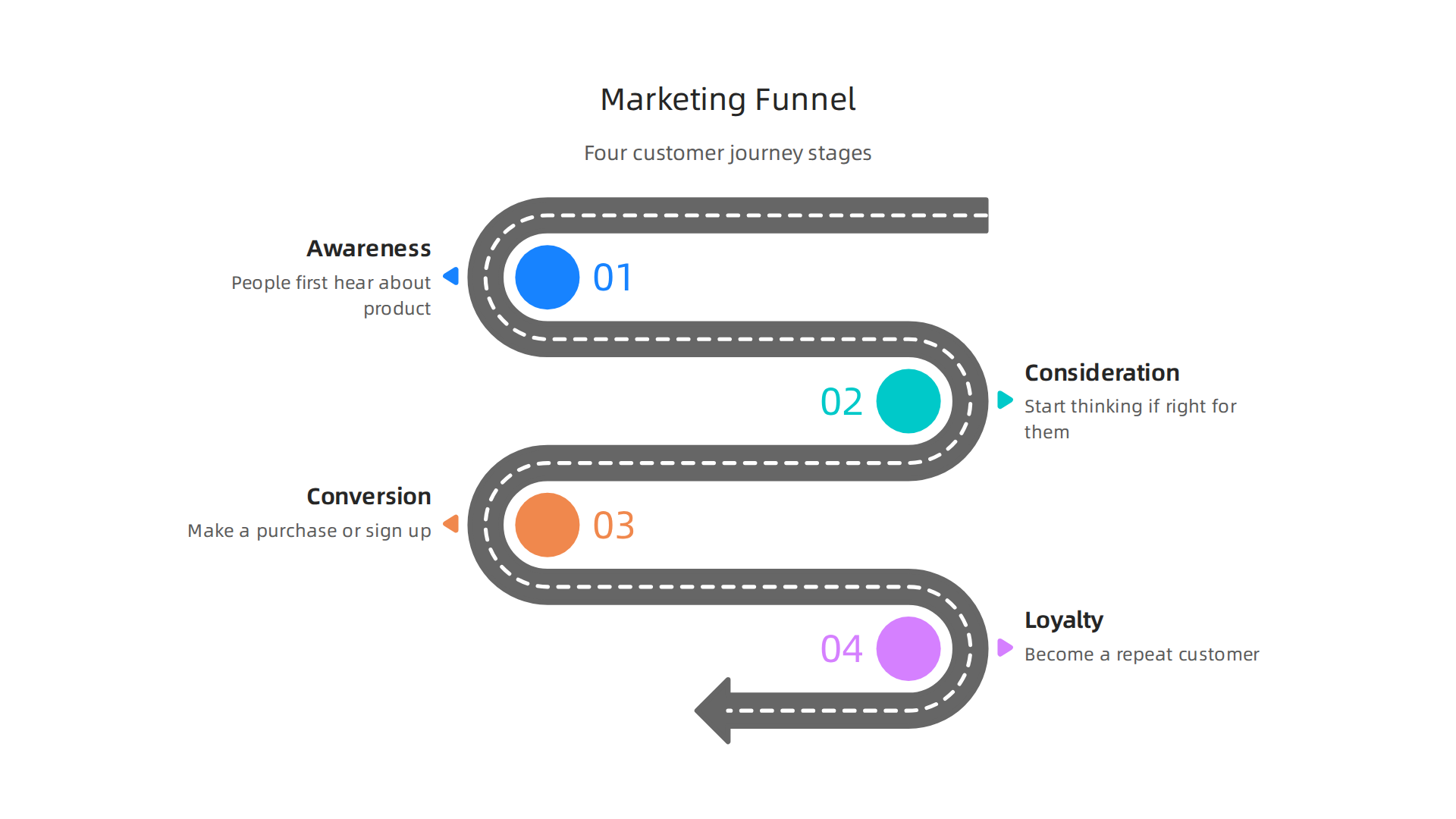
    Understand the four core stages of a customer's journey through the marketing funnel.

    • Awareness: People first hear about your product or service.
    • Consideration: They start thinking if it is right for them.
    • Conversion: They make a purchase or sign up for something.
    • Loyalty: They become a repeat customer.

    Each step in this journey is a "conversion pathway." Our goal in marketing science is to guide more people through each step. AI tools can help predict which customers are most likely to move to the next stage. This makes it easier for a marketing director to see where customers might get stuck and what messages work best to keep them moving. Understanding these customer journeys is vital for mastering AI for marketing services in 2026.

    Attribution and Understanding Impact

    After we send out marketing messages, how do we know which one really made a customer buy? This is called "attribution." It means giving credit to the marketing efforts that led to a sale or other desired action. For example, did an email, a social media ad, or a blog post make the difference?

    Modern marketing science uses tools like Marketing Mix Modeling (MMM) to look at all these different things at once. It helps figure out which marketing channels are working best and how they influence each other. This is especially helpful in 2026, as marketing has many moving parts, as detailed in reports like the 2026 State of Marketing Report. These models help a business know where to put its money to get the most sales. They combine data to show the true impact of different ads and campaigns, as explained in a guide on Marketing mix modeling (MMM) and measurement.

    Experimentation and Causal Models

    The best way to know what truly works is through experiments. This is where causal models come in. They help us understand "cause and effect." Instead of just seeing that more ads led to more sales, causal models try to prove that the ads caused the sales.

    A key tool for this is A/B testing. This is a simple but powerful way to test ideas. You create two versions of something, like an ad or a webpage. Version A is the original, and Version B has one small change. Then, you show Version A to one group of people and Version B to another similar group. By comparing the results, you can see which version performs better. This helps marketers make small, sure improvements. Many experts agree that A/B testing needs a clear plan and steady checks to give reliable results, as highlighted in A/B Testing: The Complete Guide to Split Testing for Marketing (2026).

    AI professionals can use these frameworks to help businesses move beyond guesswork. By running careful tests and using AI to understand the numbers, they can build marketing plans that truly work. This helps companies pick AI for business tools that deliver real results. To stay on top of the latest AI trends and insights that power these advanced marketing strategies, consider subscribing.

    Get clear daily AI updates from The AI Newsletter Worth Reading.

    To make sure marketing plans truly work, AI professionals need special skills and the right tools behind them. This is where marketing science truly shines, by combining smart thinking with strong data systems.

    Essential Skills for Marketing Science

    To truly understand why customers do what they do, people working in marketing science need to be good with numbers and logic.

    A professional meticulously analyzes data, a key skill for marketing science.

    Here are some key skills:

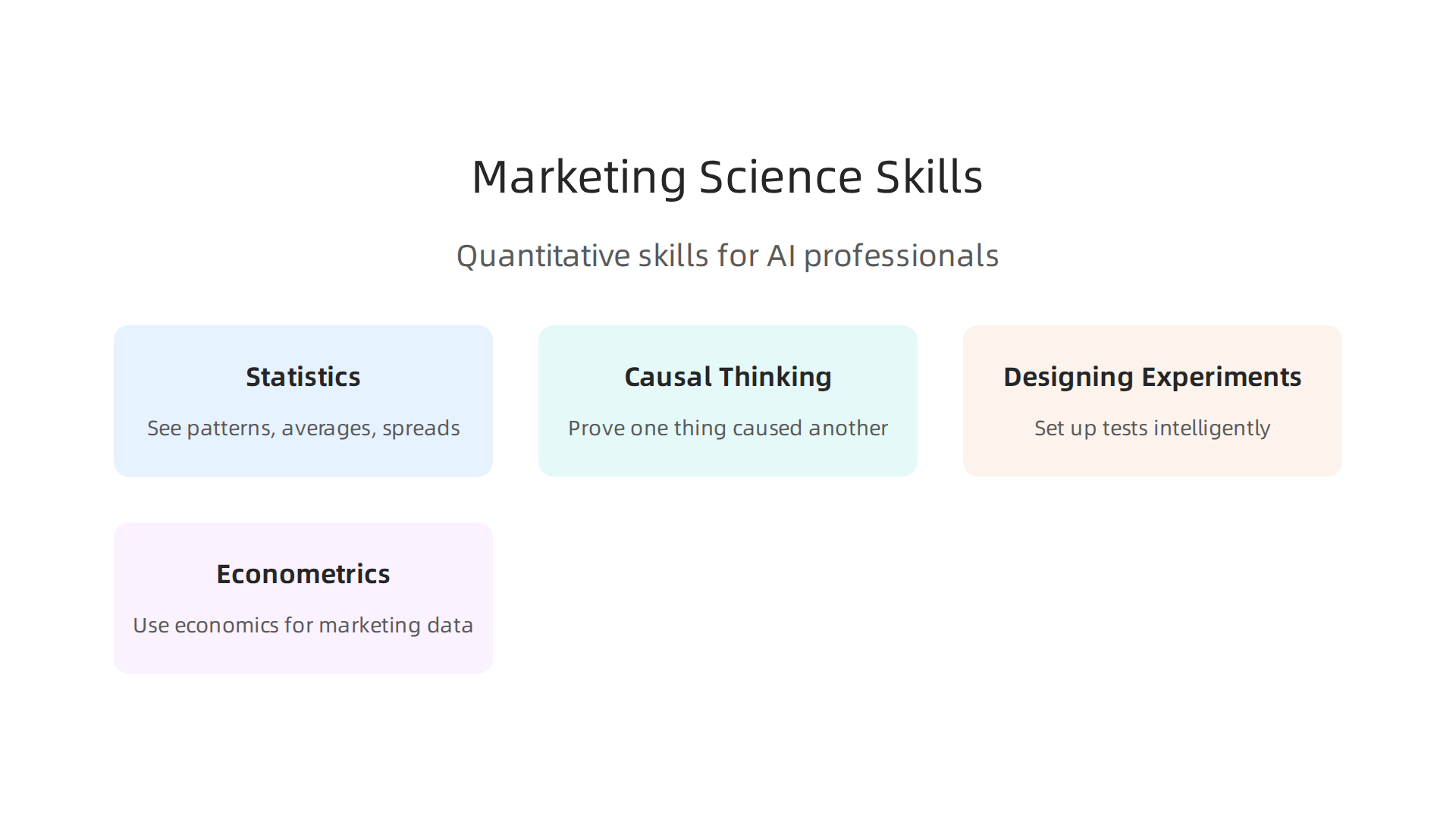
    Quantitative skills crucial for AI professionals in marketing science.

    • Understanding Statistics: This means being able to look at data and see patterns, averages, and how things spread out. It helps us know if a change in marketing really made a difference, or if it was just by chance. Think of it like a weather report: you need to understand the numbers to know if it will rain.
    • Causal Thinking: This is about figuring out "cause and effect." Instead of just seeing that two things happen together, causal thinking helps us prove that one thing made the other happen. For example, did our new ad cause more people to click, or was it something else?
    • Designing Experiments: Just like scientists in a lab, marketing science professionals need to set up tests (like A/B tests) in a smart way. This means making sure the test is fair and the results can be trusted.
    • Basic Econometrics: This skill uses ideas from economics to study marketing data. It helps us build models to predict how changes in price, promotions, or other marketing efforts will affect sales.

    A good marketing director needs team members with these kinds of quantitative skills to make smart choices. Knowing these things helps people in roles like a senior marketing scientist, who often needs a strong background in analytical thinking and statistical fundamentals to generate insights and recommendations, as noted in job requirements for these roles Senior Marketing Scientist, Level 4 – Snap Careers.

    Key Data Infrastructure Needs

    Even with great skills, you can’t do marketing science without good data. Think of data infrastructure as the backbone that collects, stores, and organizes all the information a business needs. In 2026, here are some important parts:

    • Reliable Event Data: This is information about every action a customer takes. Every click, every page visit, every purchase is an "event." It’s super important that this data is collected completely and correctly. Imagine trying to understand customer journeys without knowing every step they took. Businesses need a clear plan for what data to collect and how to label it, so everyone uses the same terms. This helps a lot with things like cpm marketing where you pay for every thousand views, making sure your ad spend is correctly tracked. Collecting this kind of detailed event data is part of a scalable growth setup that normalizes user and revenue signals in a central place Growth Architecture Playbook 2026.
    • Identity Resolution: People use many devices like phones, tablets, and computers. They might visit your website, then open an email on a different device. Identity resolution is the smart process of connecting all these different activities back to one single customer. It’s like putting together pieces of a puzzle to see the full picture of a customer’s journey. This is a crucial step for modern marketing data, not just an extra feature Marketing Data Pipelines in 2026. In fact, identity resolution is a core part of today’s marketing technology, as new trends keep shaping how we connect customer information in 2026 The 5 trends reshaping identity resolution in 2026.
    • Clean KPI Definitions: KPI stands for Key Performance Indicator. These are the main numbers a business watches to know if it’s doing well, like how many sales were made or how many people signed up for a newsletter. For marketing science to work, everyone needs to agree on what these KPIs mean and how they are measured. If the definitions are messy, the insights will be messy too.

    Building and maintaining this data infrastructure is key for any company looking to truly leverage AI in its marketing efforts. For marketing specialists, choosing the right AI tools often depends on how well these tools can work with clean, resolved customer data to drive real business results and understand ROI. Learning more about how marketing specialists choose AI tools can help your business.

    To truly get the most out of clean data and smart AI tools, marketing science needs well-designed experiments. Think of it like this: you have all the ingredients (data) and a fancy new oven (AI tools), but you still need a good recipe (experiment design) to bake a perfect cake. This part is about setting up tests in a way that gives you real, trustworthy answers about what works and what doesn’t.

    Steps to Design Reliable Experiments with AI Tools

    Designing experiments is a key part of marketing science. It helps us find out if our new ideas or AI-powered changes are actually making a difference. Here’s how to do it right:
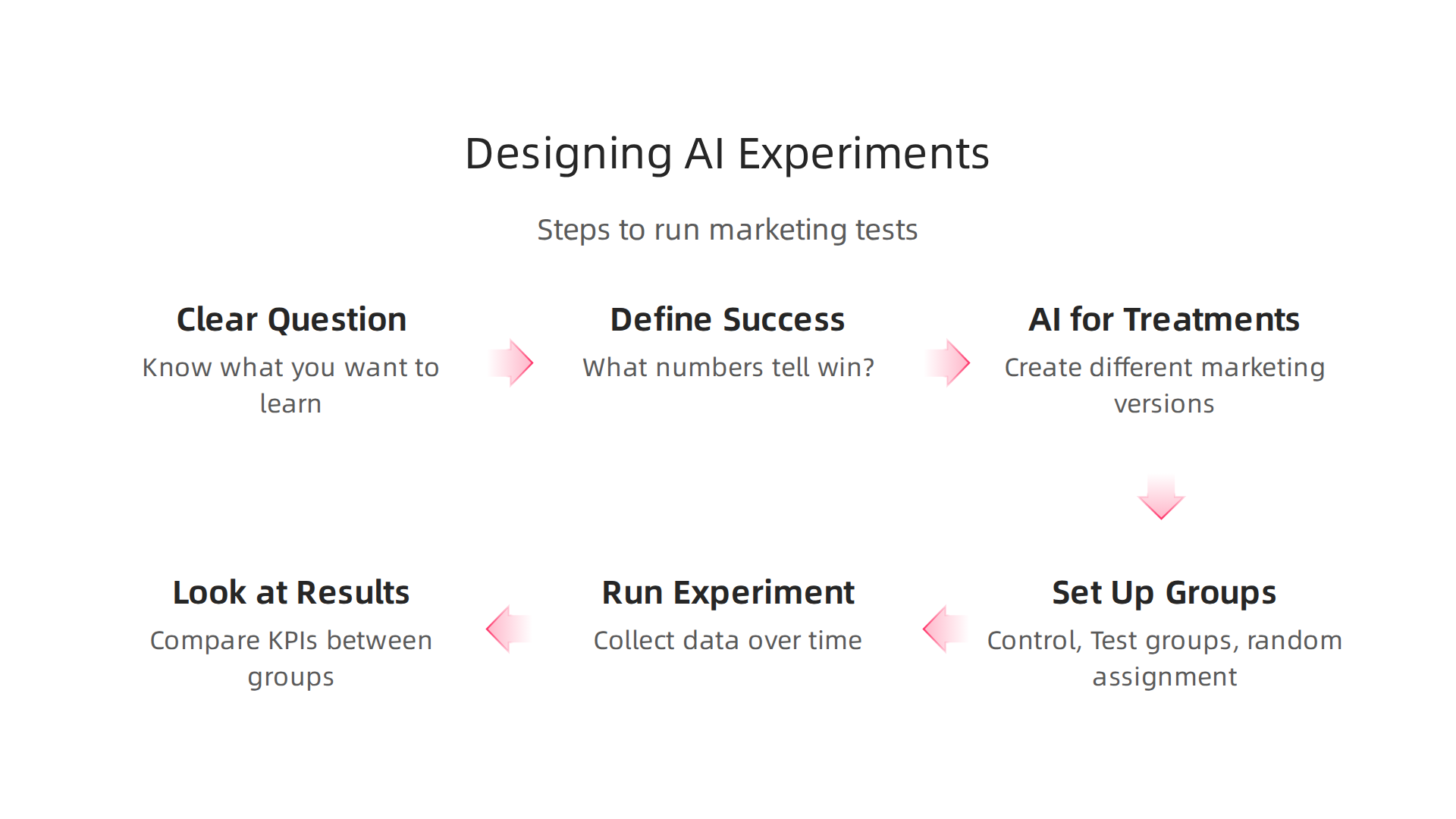
    A step-by-step guide to designing effective marketing experiments using AI.

    1. Ask a Clear Question: Before anything else, know what you want to learn. Do you want to know if a new AI-written email subject line gets more clicks? Or if a personalized ad created by AI leads to more sales? This clear question is your starting point, also called your hypothesis. You need to identify measurable metrics to evaluate your experiment, as highlighted in guides for performance marketing experiments A marketing experiment guide for performance.
    2. Define What Success Looks Like: What numbers will tell you if your experiment was a win? These are your Key Performance Indicators (KPIs). For example, if you’re testing email subject lines, a higher click-through rate might be your KPI. Make sure these are clear to everyone.
    3. Use AI for Treatments: This is where AI tools shine. You can use AI to create different versions of your marketing message, different ad images, or even different customer journeys. These different versions are your "treatments" that you’ll test. For example, one group gets the normal message, and another gets the AI-personalized message.
    4. Set Up Fair Groups: You need at least two groups:
      • Control Group: This group gets the usual marketing message or experience. Nothing changes for them.
      • Test Group(s): These groups get the new AI-powered treatments.
        It’s super important that people are put into these groups randomly. This helps make sure the groups are similar, so any differences you see later are likely due to your new treatment, not something else.
    5. Run the Experiment and Collect Data: Let the experiment run for a set amount of time. During this time, the great data infrastructure we talked about earlier will collect all the information. This includes every click, view, or purchase related to both the control and test groups.
    6. Look at the Results: Once the experiment is done, compare the KPIs between your control and test groups. Did the AI-powered treatment lead to a better outcome?

    Common Pitfalls to Watch Out For

    Even with good planning, experiments can go wrong. Here are some common problems to avoid in marketing science:
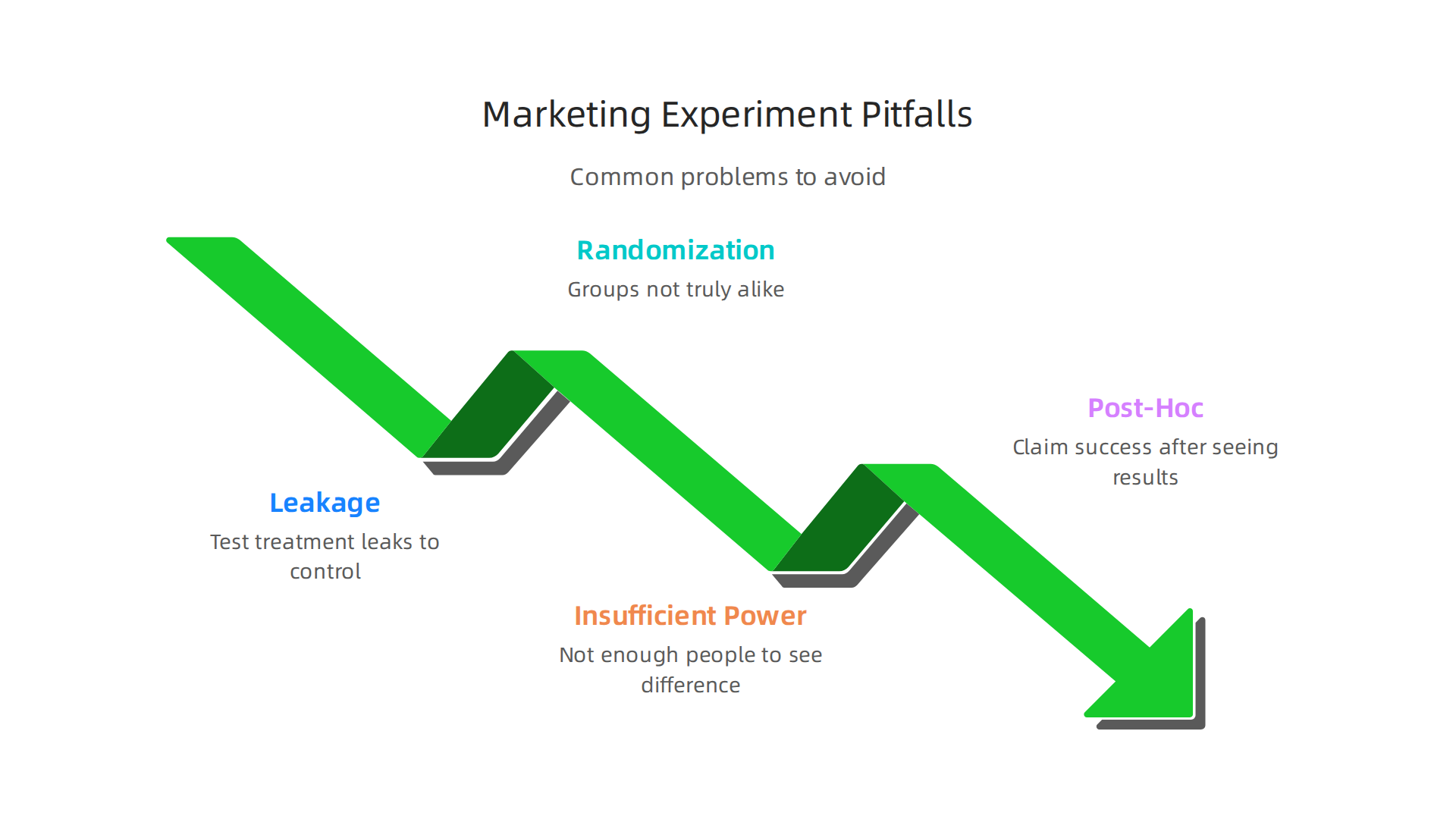
    Key challenges to watch out for when running marketing experiments.

    • Leakage: This happens when your test treatment accidentally "leaks" into your control group. Imagine if someone in your control group somehow saw the AI-powered ad meant only for the test group. This can mess up your results.
    • Improper Randomization: If your groups aren’t truly random, they might not be alike. For instance, if one test group accidentally has all your most loyal customers, it might seem like your new treatment works wonders, but it’s just because those customers were already likely to buy.
    • Insufficient Power: This means you didn’t have enough people in your experiment to see a real difference. If your test group is too small, a small improvement might not be clear enough to say for sure that the AI treatment caused it. It’s like trying to tell if a recipe is better after only one person tastes it.
    • Post-Hoc Comparisons: This is when you run an experiment and then, after seeing the results, you start digging around for any small difference to claim success. It’s like throwing darts at a wall and then drawing the target around where they landed. You should have a clear target (your hypothesis and KPIs) before you start.

    By avoiding these pitfalls, a marketing director can trust the results from their experiments. This allows them to make smart choices, like how to best use AI tools for marketing and drive real return on investment. If you want to dive deeper into how businesses choose and use these tools, check out our guide on how marketing specialists choose AI tools for marketing and drive ROI.

    Staying informed about the latest AI advancements and how they impact marketing science is crucial.

    Get clear daily AI updates from The AI Newsletter Worth Reading.

    Knowing what works and what doesn’t is important. But figuring out why something works is the real challenge in marketing science. After you design your experiments, the next big step is measuring their true impact. This means looking closely at how your marketing efforts lead to actual results, not just things that happen at the same time.

    Different Ways to Measure What Works

    When you run a marketing campaign or test a new AI tool, you want to know which parts of your effort led to a sale or a new customer. This is called "attribution." There are a few ways to think about it:

    • Last-Touch Attribution: This is the simplest. It gives all the credit to the very last thing a customer saw or clicked before they bought something. For example, if they clicked an email then bought, the email gets all the credit.
    • Multi-Touch Attribution: Real life is rarely that simple. Customers usually see many different ads or messages before making a choice. Multi-touch models try to give credit to all the marketing steps along the way. They try to see the whole customer journey.
    • Marketing Mix Modeling (MMM): This is a bigger picture view. It looks at all your marketing spending across different channels like TV, digital ads, and even changes in price. It uses math to guess how much each channel added to your sales over time. This helps a marketing director understand the overall effect of their big campaigns. You can compare this to how causal inference works to see which method best helps you understand marketing effectiveness Causal Inference vs Media Mix Modeling.

    Finding the Real Cause with Causal Inference

    The trick with all these methods is moving from just seeing things happen together (correlation) to truly understanding what caused the result. This is where "causal inference" comes in. It’s about using smart methods, often helped by AI, to prove that your marketing action really did make a difference, instead of just being present when something good happened. For instance, just because sales went up when you ran an ad doesn’t mean the ad caused all those sales; other things could have changed too. Causal inference helps marketing science dig deeper to find the true impact of marketing efforts Causal Inference in Marketing.

    Choosing KPIs that Matter for Long-Term Value

    To properly measure impact, you need the right Key Performance Indicators (KPIs). These are the numbers that tell you if you’re succeeding. It’s easy to focus on short-term numbers like how many people saw your ad (impressions) or how many clicks you got. But for real marketing science, you want KPIs that show long-term value.

    Instead of just clicks, think about:

    • Customer Lifetime Value (CLV): How much money a customer brings to your business over their entire relationship with you. This is much better than just looking at their first purchase.
    • Return on Investment (ROI): How much money you get back for every dollar you spend on marketing. This is key for proving your marketing efforts are worthwhile.

    A good marketing director knows that choosing the right KPIs helps them see the big picture. It helps them understand not just what brought a customer in, but how valuable that customer will be over time. For example, a content marketing institute might track how many leads their articles generate that turn into long-term subscribers, not just how many people read one article. This focus on deeper, more meaningful metrics ensures that marketing decisions truly drive business growth. If you want to learn more about how to make sure your AI marketing efforts truly pay off, check out our guide on how to get real ROI from AI marketing cloud in 2026.

    Putting marketing science into action means making experiments and careful measurement a regular part of how your teams work every day. It’s not enough to just know what to measure; you need to build the right steps and get everyone on board to truly see the benefit.

    How to Make Marketing Science a Daily Habit

    To properly use marketing science, you need good people and clear steps. It’s like setting up a mini-science lab inside your company.

    1. Build the Right Teams: You’ll need people who are good with numbers (analysts), creative thinkers (marketers), and those who understand your products. These teams will work together to design tests and look at the results. A good marketing director makes sure everyone understands their role.
    2. Set Up Clear Processes: Every experiment should follow a plan. This means:
      • Having a good guess: What do you think will happen? This is called a hypothesis.
      • Designing the test: How will you run the experiment? What will you change, and what will you keep the same? For example, you might test different ad messages to see which one performs better, like creating a marketing experiment guide for performance.
      • Collecting data: Gather all the numbers from your test.
      • Looking at results: Did your guess come true? What did the numbers tell you?
      • Learning and doing better: Use what you learned to make your next marketing efforts even stronger. This scientific approach helps prove that your changes actually cause results, not just happen at the same time Optimizing Marketing Spend with Causal Attribution.
    3. Use the Right Tools: In 2026, AI tools can help a lot with marketing science. They can analyze huge amounts of data, predict outcomes, and even help set up experiments. Knowing how marketing specialists choose AI tools for marketing and drive ROI is key for this step.

    Getting Everyone on Board: Leading Change

    Bringing new ways of working, like marketing science, into a company can be tricky. People might be used to doing things a certain way. Here’s how to make it easier:

    • Start Small, Show Big Wins: Pick one small project where you can use marketing science to get clear, positive results quickly. Maybe you test a new email subject line and see a huge jump in people opening it. Share this success widely. When people see that these methods work, they’ll be more open to trying them. For example, some companies create a 90-day playbook to implementing AI in your marketing department, focusing on quick wins in the first month.
    • Teach and Train: Help your teams learn about these new methods. Offer workshops or easy-to-understand guides. The more people understand, the more likely they are to use marketing science in their daily jobs.
    • Make it a Habit: Build these scientific steps into your regular product and marketing workflows. It shouldn’t be a one-time thing but a continuous process of learning and improving. This helps ensure that every marketing decision is backed by solid data.

    A forward-thinking marketing director understands that making marketing science a part of the company culture is vital for staying ahead. It helps teams not only meet their short-term goals but also build long-term value for the business.

    Stay updated on the latest trends and practical applications in AI for marketing.

    Get clear daily AI updates from The AI Newsletter Worth Reading.

    Summary

    This article explains marketing science for AI professionals: a practical, data-first approach that turns AI capabilities into measurable business outcomes. It defines marketing science and the mindset behind it, then walks through core frameworks like funnels, attribution, A/B testing, and causal models so teams can move from guesswork to proven impact. The guide covers essential skills—statistics, causal thinking, experiment design—and the data infrastructure needs such as event tracking, identity resolution, and clear KPI definitions. It gives step-by-step advice on designing fair AI-driven experiments, highlights common pitfalls (leakage, poor randomization, low power), and explains methods for measuring real impact with CLV, ROI, MMM and causal inference. Finally, it shows how to embed these practices into routine workflows, pick the right AI tools, and lead organizational change so marketing science delivers repeatable growth.


  • Mastering AI For Marketing Services In 2026

    Mastering AI For Marketing Services In 2026

    In 2026, artificial intelligence (AI) is changing everything, especially in the world of marketing. What started as a new trend is now a must-have tool for any business offering marketing services. It’s no longer enough to just be curious about AI. Now, marketing teams need a clear plan to use AI wisely.

    Businesses need to move from just looking at AI to having a real strategy for it.

    A marketing team collaborates to outline a clear AI strategy, moving beyond simple curiosity to defined goals.

    Without a good plan, companies might miss out on big chances to grow or make things better. Experts agree that business leaders need smart ways to find new opportunities, pick the best ideas for using AI, test them out carefully, see what works, and then use those good ideas on a larger scale. This helps turn early tries with AI into real wins for the business From AI pilots to performance: 3 things leaders need to unlock.

    This guide is here to help you get a handle on AI for your marketing services. We will give you easy-to-understand ways to think about AI. You’ll learn about how to pick the right AI tools and how to measure if they are truly helping your business. We will show you real examples of how AI can help with many tasks. This includes making better content, putting together impressive AI for presentations, and even having an intelligent AI virtual assistants for businesses to support your team.

    You’ll find practical ways to test new AI tools, checklists to help you choose the best options, and tips on how to see if your AI efforts are really paying off. Our goal is to make sure you can use AI to make your marketing smarter, faster, and more effective.

    To stay on top of the latest AI trends and how they impact business, consider subscribing:
    The AI Newsletter Worth Reading

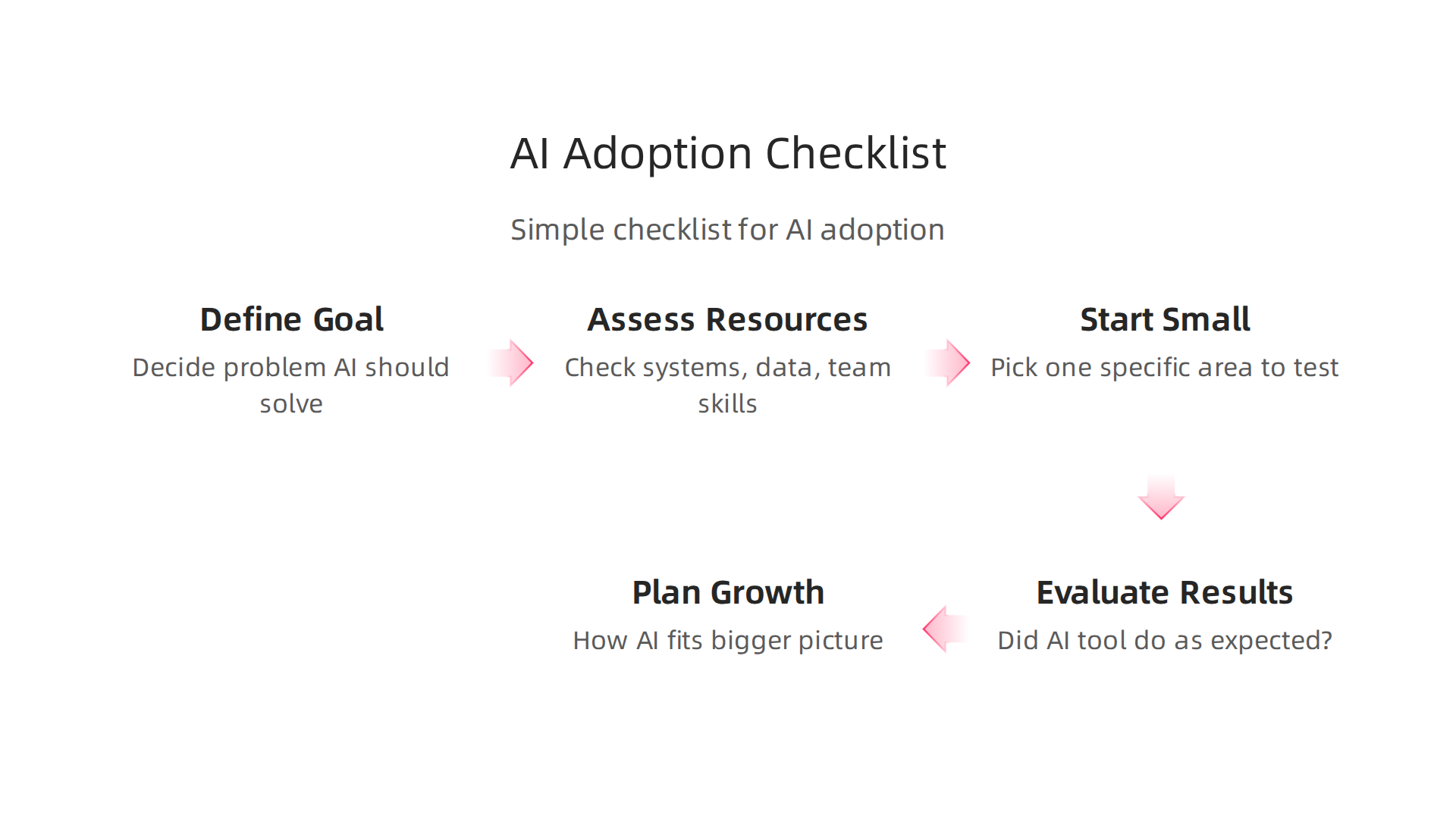
    Before you pick any AI tools for your team, it’s super important to have a clear plan. Think of it like going on a trip. You wouldn’t just grab a map and start driving without knowing where you want to go, right? The same goes for using AI in your marketing services. In 2026, simply getting AI tools isn’t enough. You need a smart way to use them to reach your business goals.

    Your AI plan should directly match what your marketing services are trying to do. For example, if you want to get more new customers (called lead generation), AI could help find people who are most likely to buy from you. If your goal is to keep current customers happy and loyal (retention), AI might help you send them special messages they will love. Or, if you need to make lots of new ads or content quickly, AI can help scale your creative output. Having a clear vision like this is a key step to building a good AI strategy for marketing, as experts say you need to define the main results you want to achieve How do I build an AI strategy for marketing?.

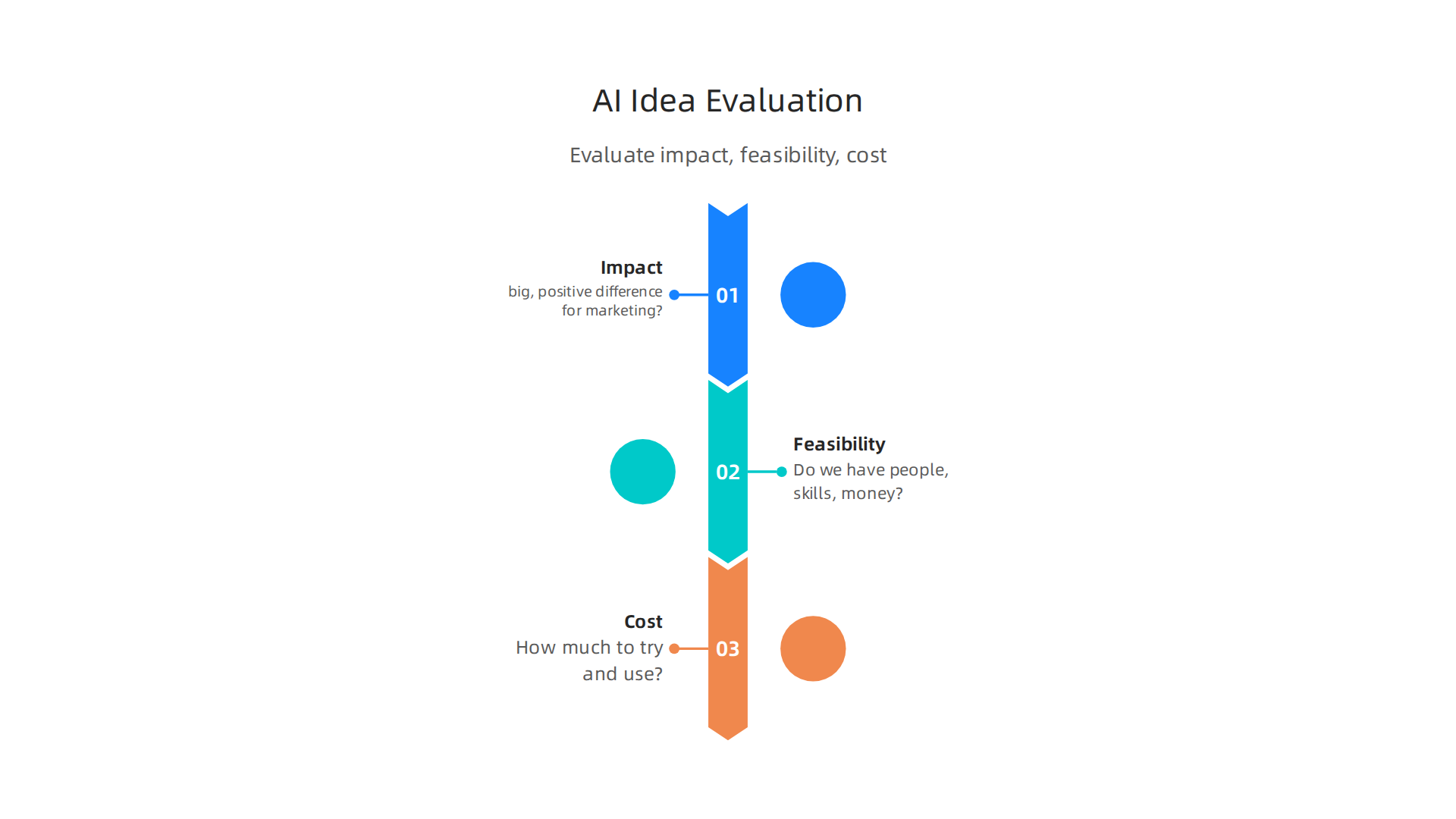
    To figure out which AI ideas to try first, you can use a simple plan. Ask yourself three things about each AI idea:

    Evaluate potential AI initiatives by considering their impact, feasibility, and cost.

    • Impact: Will this AI idea truly make a big, positive difference for our marketing services?
    • Feasibility: Can we actually do this right now? Do we have the people, skills, and money needed to make it happen?
    • Cost: How much will it cost to try out and use this AI tool?
      By thinking about these three points, you can choose the best projects that will bring the most value without costing too much or being too hard to set up. To learn more about selecting the right technology, consider reading our guide on how to pick AI tools for business to drive growth in 2026.

    A big mistake many teams make is picking AI tools before they know what they want to achieve. This is like buying a fancy hammer without knowing if you need to build a house or fix a leaky faucet. When you choose tools first, you might end up with expensive software that doesn’t really help your marketing services goals. This can lead to wasted money and time. Reports from 2026 show that while many businesses are using AI, a lot of them aren’t truly seeing big improvements in their work because they lack a clear plan State of Marketing in an AI-Driven World: 2026 Adobe Report. In fact, one report found that only 41% of marketers can clearly show how AI is helping them make more money Report: The State of AI in Marketing 2026. By setting your strategy first, you make sure that every AI tool you choose works towards your real business needs.

    Now that you have a clear plan for what you want your marketing services to achieve, the next step is to look closely at your current ways of doing things. This helps you find the best spots where AI can make a real difference. Think of it as looking under the hood of your marketing car to see which parts could run better with a little AI tune-up.

    To do this, you need to audit your marketing processes. This means checking out everything your team does, from making ads to talking with customers. Where are the tasks that take a lot of time? Where do you wish you had more help or better insights? These are often the places where AI can fit in perfectly.

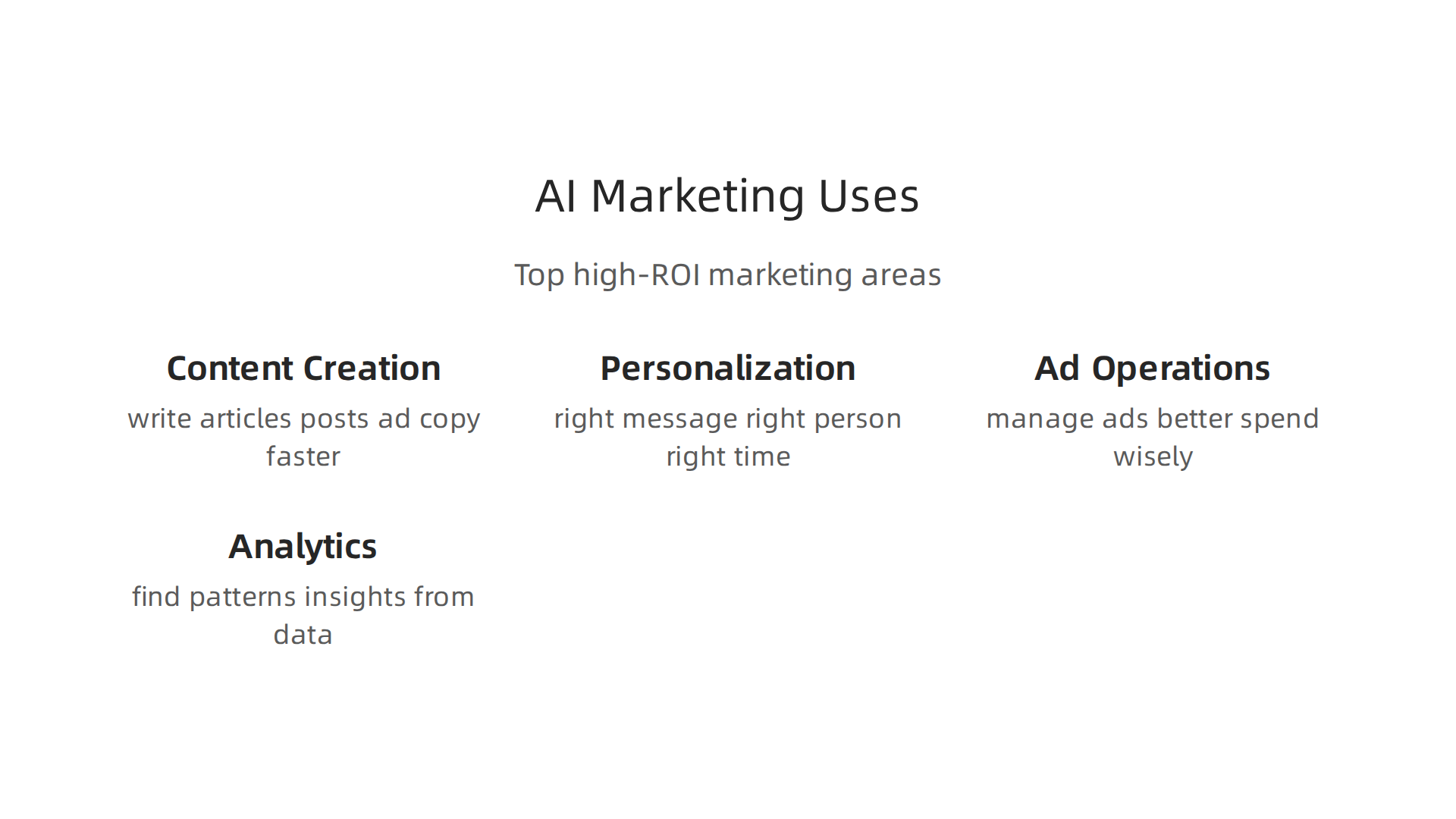
    Many marketing teams in 2026 are finding big wins with AI in a few key areas:

    Explore the top areas where AI is delivering significant value for marketing teams.

    • Content Creation: This is still the top use case for AI. AI can help write articles, social media posts, or ad copy much faster. This means your team can create more content without getting swamped. Reports show that content creation is used by 78% of teams, making it the most common way to use AI in marketing State of AI Marketing 2026 | Enterprise AI Adoption Report.
    • Personalization: AI can help you send the right message to the right person at the right time. This makes customers feel special and more likely to buy.
    • Ad Operations (Ad Ops): AI can manage your ads better by figuring out who to show them to and when, which helps you spend your ad money wisely.
    • Analytics: AI can look at huge amounts of data and find patterns or insights that humans might miss. This helps you understand what’s working and what’s not in your marketing campaigns. It’s like having a super-smart marketing assistant.

    When you’re looking at different ideas for using AI, you should score each one based on three things:

    • Potential Impact (ROI): How much positive change or money will this AI idea bring in? Will it truly help your marketing services grow or save costs? Teams focused on ROI see much better results from their AI efforts, with 83% of marketing teams reporting clear gains from generative AI AI Marketing Stats for 2026: ROI & Benchmarks.
    • Data Readiness: Do you have the right kind of data that the AI tool needs to work well? If not, how hard will it be to get that data ready?
    • Integration Complexity: How easy or hard will it be to connect this new AI tool with the other tools and systems you already use?

    Sometimes it’s better to start with a "narrow pilot." This means trying out an AI tool for a small, specific task with a small team. For example, you might use AI to just help with writing headlines for your emails. If that works well, then you can think about a "platform-wide rollout," which means using AI across many different tasks and teams in your marketing services. Starting small helps you learn and fix problems before doing something big.

    To learn more about how marketing pros choose AI tools for their work, check out our guide on how marketing specialists choose AI tools for marketing and drive ROI.

    For daily updates on how AI is changing marketing and business, you’ll want to stay informed.
    Get clear daily AI updates from The AI Newsletter Worth Reading.

    Choosing the right AI tools for your marketing services is a big step after you know where AI can help most.

    A professional carefully evaluates different AI tools and vendors to make an informed decision.

    It’s like picking the best helper for your team. You want to make sure the tool can actually do the job well. To do this, you need a good checklist.

    What to Look For in AI Tools

    When you’re looking at different AI tools, keep these things in mind:

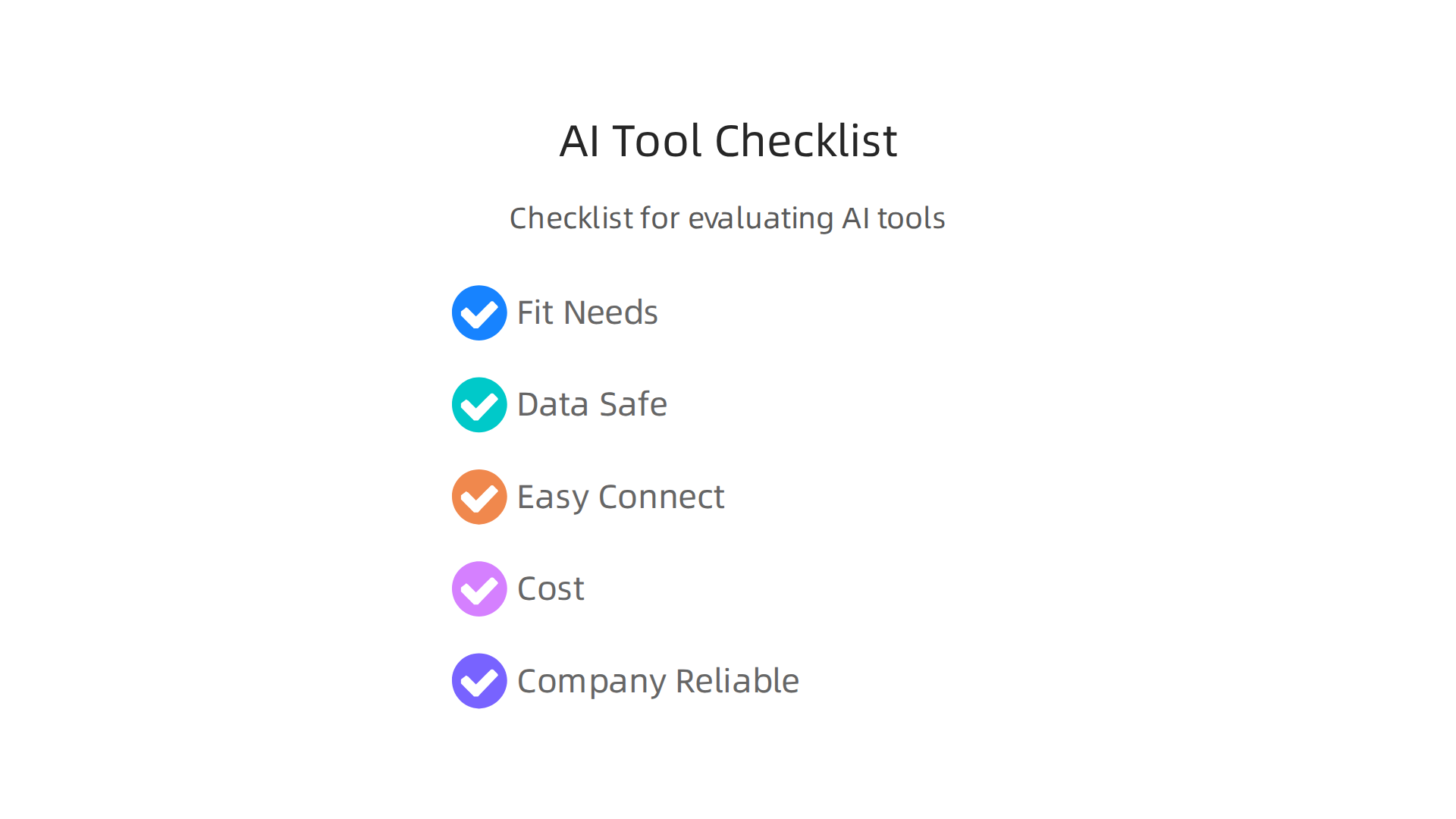
    Checklist for evaluating AI tools, focusing on needs fit, data safety, integration, cost, and company reliability.

    • Does it fit your needs? The AI tool must be able to do the specific tasks you need. If you want AI to help write social media posts, the tool should be good at that. Don’t pick a tool that does many things poorly when you need one thing done perfectly. You want a tool that truly boosts your marketing services.
    • Is your data safe? AI tools often need to use your company’s data. You must be sure that the tool and the company that made it will keep your information private and secure. This is very important for trust and legal reasons.
    • How easy is it to connect? Think about your current marketing tools. Will the new AI tool easily work with them? Or will it be a headache to link everything up? An AI tool that connects smoothly with your existing setup makes life much easier.
    • What does it cost? Understand how the AI tool charges you. Is it a monthly fee, or do you pay based on how much you use it? Make sure the cost makes sense for your budget and the value you expect to get. Tools that offer clear pricing help you manage your money better.
    • Is the company reliable? Look at the company behind the AI tool. Have they been around for a while? Do they update their tools often? A strong, reliable company means you’ll get good support and that the tool will keep getting better. A template for evaluating technology vendors can help you score different options to ensure they meet your business needs and values R E S P O N S I B L E A I T E M P L A T E.

    Testing AI Tools in Real Life

    Once you have a few tools in mind, it’s a good idea to test them. This is called a "Proof of Concept" (POC) or a "pilot."

    • Try them side-by-side: Don’t just pick one tool. Try out two or three tools at the same time for the same small task. For example, have Tool A and Tool B both write headlines for your next email campaign. See which one does better. This helps you compare them fairly.
    • Focus on how they work, not just features: It’s not just about what a tool can do, but how well it actually works for your team every day. Does it save time? Is it easy to use? Does it fit into your team’s workflow without causing problems? This helps you find the best fit for your marketing services. A good way to compare is by using a scorecard for different criteria, making sure you look at things like how deep the AI’s capabilities are and how well it fits your specific marketing needs How to Evaluate B2B AI Marketing Vendors: 12 Questions … – Tofu HQ.

    By carefully checking these things, you can choose AI tools that truly help your marketing efforts grow. If you want a more general guide on how to make smart choices for your business, you can read more about how to pick AI tools for business to drive growth in 2026. This careful process makes sure you’re getting a real marketing assistant, not just a fancy gadget.

    After testing AI tools with a small "Proof of Concept," the next big step is to make them a regular part of your marketing services. This means moving from a small test to full "production." It’s like moving from trying out a recipe to cooking it for all your customers every day. You need a clear plan to do this right.

    Getting AI Tools Ready for Daily Marketing

    Putting AI into your daily work for your marketing services needs careful steps.

    • Set up the Data Flow: Your AI tools need good data to work. Think about how your company’s information will safely get to the AI tool. This involves setting up "data pipelines," which are like highways for your data. You also need to make sure the data is clean and correct. If the data is bad, the AI’s results will be bad too. For marketing leaders, a good approach to data governance is key when using AI systems Snowflake’s Agentic Enterprise Framework Puts Data ….
    • Keep Testing and Improving: Even after a pilot program, you should keep testing the AI. As your marketing needs change, the AI tools might need to learn new things or be adjusted. This helps ensure the AI continues to perform its best for your team.
    • Rollout Slowly: Don’t just give the AI tool to everyone at once. Start with a small group, get their feedback, and then slowly bring more people on board. This "rollout cadence" helps everyone get used to the new tools without too much stress. It also lets you fix small problems before they become big ones.

    Teamwork and Rules for AI Success

    Making AI a permanent part of your marketing services means more than just turning on a new tool. It needs good teamwork and clear rules.

    • Assign Clear Roles: While marketing teams often lead the charge in adopting AI, they need help from others. Your IT team can help with security, your legal team can make sure you follow privacy rules, and data experts can check for fairness. Having everyone work together helps make sure the AI is used responsibly. In fact, setting up strong governance that includes different departments is important for using AI in a way that truly helps the business What governance structures support responsible AI?.
    • Create AI Rules (Governance): Just like you have rules for how your team works, you need rules for how your AI works. This is called "AI governance." It helps make sure the AI tools are used fairly, correctly, and ethically. For example, the European Data Protection Board updated its rules in 2026 to make sure AI agents follow data privacy principles at every step AI Agents and Data Privacy: A 2026 Compliance Guide – MTM Blog.
    • Watch for Bias and Protect Privacy: AI tools learn from data, and sometimes that data can have unfair patterns, or "bias." You need to look for this bias and work to fix it, perhaps by using fair data generation techniques Mitigating bias in artificial intelligence: Fair data generation via …. Also, always make sure the AI tool handles customer data with the highest privacy standards, especially in 2026, when data privacy rules are stricter than ever. Staying up-to-date on compliance is a must.

    By taking these steps, you make sure your AI tools don’t just work in a test, but truly become a strong marketing assistant for your business. This careful planning helps your marketing services grow and adapt for the future.

    If you want to keep learning about how AI impacts your business and marketing, you’ll find helpful insights in "The AI Newsletter Worth Reading." Get clear daily AI updates from The Deep View Newsletter.

    5) Measure What Matters: KPIs, Attribution, and ROI for AI-Driven Marketing

    Once AI tools are part of your daily marketing services, it’s super important to know if they are actually helping.

    A professional focuses intently on data and reports, measuring the impact of marketing initiatives.

    You need to measure their success. This means looking at certain numbers, understanding how AI causes good changes, and checking if you are getting a good return on your money.

    Picking the Right Numbers to Watch

    Before you even start using AI for your marketing, you need to know what you want to improve. These are called Key Performance Indicators, or KPIs. They are like scores that show how well your marketing is doing. For AI-driven marketing, you might look at things like:

    • How many new customers you get.
    • How many people click on your ads.
    • How much money each customer spends over time (this is called customer lifetime value, or LTV).
    • How much it costs to get a new customer (this is called customer acquisition cost, or CAC).

    It’s a good idea to know what these numbers were before you used AI. This way, you can see if the AI is making them better. Experts say you should set clear goals and measure your starting point before adding AI to your marketing efforts How do I measure the ROI of AI marketing investments?. This helps you tell a real story about how AI helps your marketing services.

    Knowing What Changes Are Due to AI

    When you use AI, many things might change. How do you know for sure that AI is the reason for a boost in sales or leads? This is where "attribution" and "experimentation" come in.

    • Attribution means figuring out which part of your marketing efforts gets credit for a result. With AI, you want to give the AI the right amount of credit.
    • Experimentation is like running a science test. You can split your audience into two groups: one that gets the AI-powered marketing (the "test" group) and one that doesn’t (the "control" group). By comparing these groups, you can see the true extra help, or "incremental lift," that AI brings. Methods like A/B tests help you find the real impact of your AI tools 2026 Marketing Playbook: Proven AI & Attribution Strategies. Companies that use smart attribution methods can see much better returns on their marketing money Marketing Attribution Statistics (2026): 54+ Data Points on ….

    To really dive deep into how AI can boost your sales and leads, learning about these measurement methods is key. You can find more helpful advice on how marketing specialists choose AI tools to drive ROI.

    Figuring Out Your Return on Investment (ROI)

    ROI means how much money you get back for the money you spent. For AI in marketing, it’s about seeing if the AI tools are worth their cost. A simple way to think about it is:

    ROI = (Extra Money Made + Money Saved − Total Cost of AI) ÷ Total Cost of AI

    Measuring AI’s ROI in marketing is not just a single number; it’s a process of setting a baseline, running tests, and then seeing the extra lift AI provides How Directors Measure AI ROI in Ad Campaigns | Pixis. Many companies are already seeing great results. In fact, about 60% of companies that have changed how they measure AI are getting two to three times their money back, or even more Report: The State of AI in Marketing 2026 – Jasper. This shows that with careful planning and measurement, AI can be a powerful marketing assistant.

    When you measure what matters, you make sure your AI investments are truly helping your marketing services grow and succeed. For further reading on this topic, consider learning more about how to get real ROI from AI marketing cloud.

    6) Data Governance, Privacy, and Ethical Considerations for Marketing Services

    After seeing how artificial intelligence (AI) can help your marketing services grow and succeed, it’s just as important to talk about how to use it wisely and fairly.

    Key ethical considerations for AI in marketing: data safety, fairness, and transparency.

    This means looking closely at how you handle data, respect people’s privacy, and make sure your AI systems are ethical. It’s not just about making money; it’s about building trust and following the rules in 2026.

    Keeping Data Safe and Private with AI

    When you use AI for marketing services, you’re often dealing with lots of customer information. "Data governance" is like having a clear set of rules for how you collect, store, and use this data. It makes sure your data is correct, kept safe, and used in a way that follows the law. Experts agree that your AI plan and your data rules must go hand-in-hand Snowflake’s Agentic Enterprise Framework Puts Data Governance at the Center of Marketing.

    In 2026, privacy is a big deal. New guidelines, like those from the European Data Protection Board, tell us that when AI agents process personal information, we must only collect the data we truly need and only use it for the reasons we said we would AI Agents and Data Privacy: A 2026 Compliance Guide. This is called "data minimization" and "purpose limitation." To help with this, you should do special checks, sometimes called "privacy impact assessments," before using AI systems that handle personal data. These assessments help ensure you’re using AI responsibly and protecting people’s privacy Privacy as the Foundation of Responsible AI Governance. It’s a key part of the larger topic of mastering the AI future standard 2026.

    Making AI Fair and Unbiased

    AI learns from the data it’s given. If that data has unfair patterns or gaps, the AI can learn those same biases and make unfair decisions. For instance, an AI for marketing services might unfairly target certain groups or miss others, just because of old data.

    To make sure your AI is fair, you need to:

    • Find Bias: Look closely at the data you feed your AI and the results it gives. You want to spot any unfair patterns. Learning to understand how an AI model works is important for finding these biases Systematic literature review on bias mitigation in generative AI.
    • Fix Bias: Take steps to reduce any bias you find. This can mean changing the data, adjusting the AI’s learning process, or fixing the results it gives. These steps can happen before, during, or after the AI does its work Bias mitigation in generative AI.

    It’s about making sure your AI acts like a fair and helpful marketing assistant, not one that carries old prejudices.

    Being Clear and Keeping Records

    For ethical AI, it’s also important to be clear about how your AI makes decisions. This is called "transparency." It means you should be able to explain, in simple terms, why your AI chose one thing over another.

    You also need good records. Keeping detailed notes about your AI systems helps you show how they work, what data they use, and why they make certain choices. This is very helpful if you ever need to have an audit or review. Having different teams involved, like marketing, legal, and IT, can help ensure everyone is on the same page and that your AI systems are both effective and responsible. This kind of teamwork is vital for a good strategic guide to marketing AI agents and their ethical deployment.

    Staying informed about the newest AI practices, including ethical guidelines, is important for any business leader.

    Get clear daily AI updates and stay ahead of the curve. The AI Newsletter Worth Reading will keep you in the know.

    Summary

    This article explains how marketing teams should move from experimenting with AI to running a clear, business-focused AI strategy that drives measurable results. It covers how to set goals that align AI initiatives with marketing KPIs, how to audit current processes to find high-impact use cases (content, personalization, ad ops, analytics), and a simple prioritization framework based on impact, feasibility, and cost. You’ll learn how to run narrow pilots, evaluate and compare tools with a vendor checklist, and prepare data pipelines and rollout plans for production. The guide also details governance needs—privacy, bias mitigation, and cross-functional roles—and shows how to measure AI success through attribution, experimentation, and ROI calculations. After reading, you’ll be able to pick the right pilot projects, test tools sensibly, and scale AI in marketing while protecting data and proving value.

  • How to Pick AI Tools for Business to Drive Growth in 2026

    How to Pick AI Tools for Business to Drive Growth in 2026

    The world of computer brains, known as AI, is growing super fast in 2026. Every day, it feels like a new tool comes out. This can make many of us feel a kind of "aiscream ai scream" feeling, like there’s just too much to keep up with.

    Navigating the rapid growth of AI tools can often lead to a feeling of being overwhelmed.

    Think about it: between 86% and 92% of people who make things online are already using AI in some way today, and about 38% of all business content on the internet gets help from AI at some point [Presenc AI research on AI content creation, Creator Economy AI Adoption Statistics (2026)]. It’s exciting, but it also means a lot of choices.

    All these new tools can be confusing. It’s hard to know which ones are right for you or your business, how to make them work together, or if they are even worth the money. That’s why this guide matters now more than ever. It’s here to help you cut through the noise. We will show you simple ways to pick the best AI tools, like an AI virtual assistant for businesses, and how to use them with your daily tasks. We’ll also cover how to check if these tools are truly helping your business grow and save money. You’ll even get a helpful checklist for using AI in things like making content. If you want to stay smart about AI every day, we’ve got something special for you.

    The AI Newsletter Worth Reading

    Even with the feeling of "aiscream ai scream" from so many new tools, AI is not just a passing trend. For small to medium-sized businesses (SMBs) and their teams, AI tools are changing how work gets done in 2026. The main reason? They offer huge steps forward in how fast things happen, how personal you can make your outreach, and how much your team can get done.

    Business Outcomes: Speed, Personalization, and Productivity

    Think about creating content. Writing blog posts, social media updates, or emails used to take a lot of time. Now, AI can help speed this up a lot. About 38% of all business content on the internet today gets some help from AI at some point [AI Content Creation Statistics 2026 | Presenc AI]. This means businesses can make more content, faster, to reach more people.

    AI also helps make things feel personal for each customer, even when you have many customers. This is called personalization at scale. Instead of sending the same message to everyone, AI can help tailor messages so each person feels like you’re talking directly to them. This can lead to happier customers and better sales.

    For daily tasks, an AI virtual assistant can be a game-changer. These smart helpers can answer customer questions, schedule meetings, or organize information. This frees up your team members to focus on bigger, more important jobs that only a human can do.

    AI virtual assistants free teams to focus on high-value, strategic, and human-centric tasks.

    It’s all about improving productivity, which means getting more done with less effort.

    Common Pitfalls: Picking Tools and Setting Them Up

    However, not all AI use is good use. One common problem is choosing AI tools just because they’re popular or because everyone else is talking about them. It’s like buying a fancy car when you only need a bike to get to work. The tool needs to fit your business’s real needs, not just be the latest buzz. To avoid this, it’s wise to learn how to choose AI for business tools that deliver real results.

    Another big mistake is not spending enough time making sure the AI tools work well with your existing systems. Imagine buying new kitchen gadgets but not having any space to put them or not knowing how to use them with your stove. For AI, this means planning how new tools will connect with your email system, customer records, or content platforms. If you don’t connect them well, the tools might not help as much, and could even create more problems, adding to that "aiscream ai scream" feeling of things being too messy or complicated. When using AI for content, remember to also think about tools that act as a humanize ai detector to make sure your AI-generated text still sounds natural and not robotic.

    To avoid that "aiscream ai scream" feeling when picking AI tools, you need a smart way to look at them. It is not just about choosing the most talked-about tool. Instead, you should think about what your business really needs. This helps you pick tools that work for you, not against you.

    Quick overview: How to Compare AI Tools

    When looking at different AI tools, there are a few important things to check.

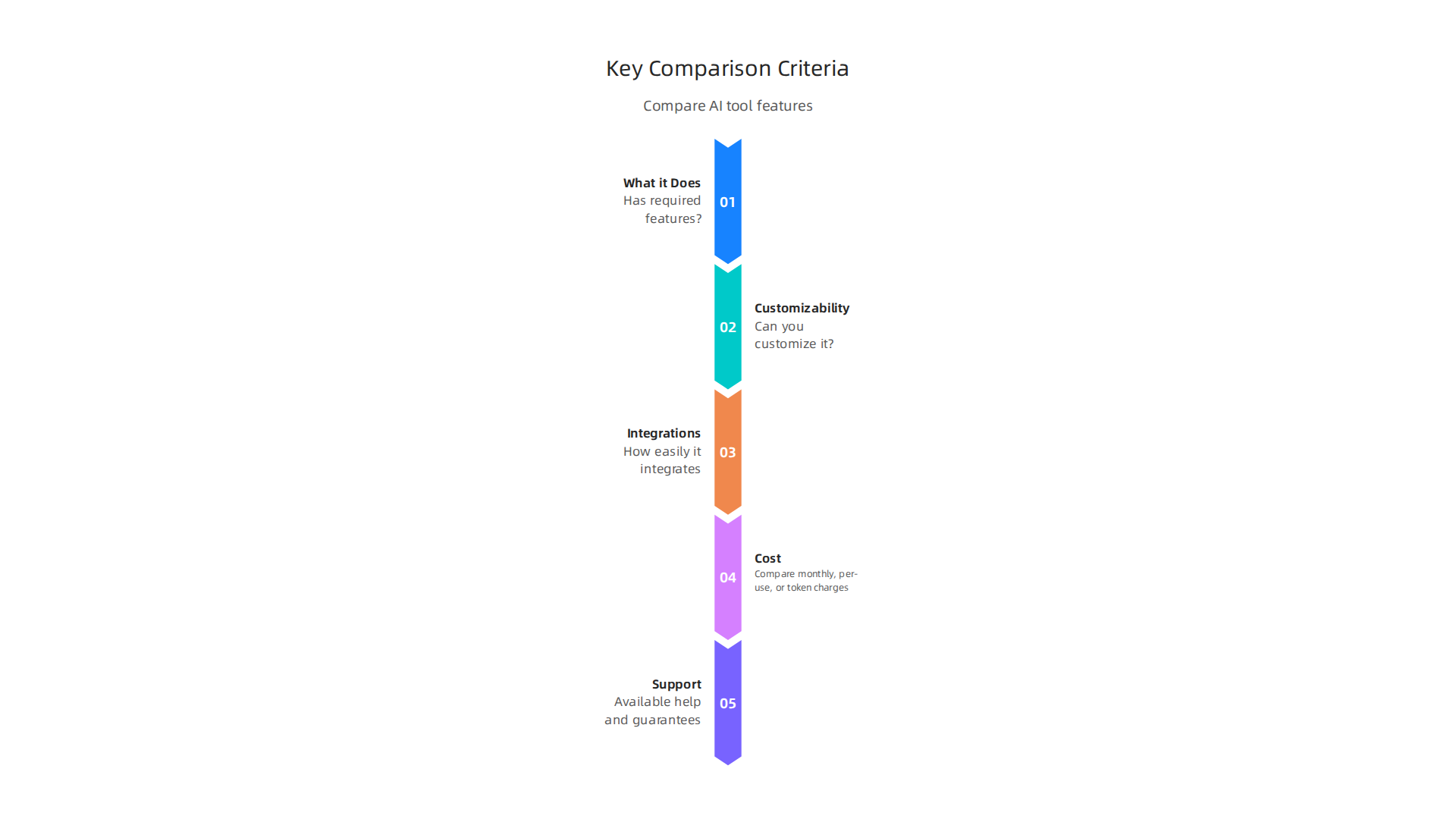
    Effectively compare AI tools by evaluating their features, customizability, API integration, pricing, and support.

    This helps you make sure the tool fits your business perfectly.

    1. What it Does (Feature Set): First, think about what the AI tool can actually do. Does it have all the features you need? For example, if you need an AI to write emails, does it do that well? Or if you need an AI for customer help, can it handle many different questions? Don’t just pick a tool with lots of features. Pick one with the right features for your specific tasks.
    2. How You Can Change It (Customizability): Some AI tools are like a ready-made suit, you can’t change much. Others are more like building blocks, where you can make them do exactly what you want. Think about if you need to teach the AI special words or ways of working for your business. The more you can change it, the more it can fit your unique needs.
    3. How It Connects to Other Tools (API Surface): This is very important. An "API surface" means how easily the AI tool can talk to your other computer programs, like your email system or customer records. If an AI tool cannot connect well, you might end up doing more work, not less. Making sure tools work together smoothly helps you avoid problems. You can learn more about picking the right tools by checking out this guide on mastering specialized AI tools.
    4. How Much It Costs (Pricing Model): AI tools can cost money in different ways. Some charge a monthly fee, some charge for every bit of work they do (like per word written or per question answered). It’s important to look at the pricing model and compare it carefully. For instance, the cost of AI APIs can vary a lot, with some models being as low as $0.02 per million input tokens in 2026 AI API Pricing 2026: Compare GPT, Claude, Gemini Token …. Make sure you understand how you will be charged so there are no surprises.
    5. Help and Guarantees (Support/SLAs): What kind of help will you get if something goes wrong? Good customer support means you won’t be stuck if you have questions or run into problems. Some companies offer "Service Level Agreements" (SLAs), which are promises about how quickly they will fix issues or how often their service will be working. This helps ensure your business keeps running smoothly.

    When you compare tools, don’t just count how many features each one has. Instead, match their features to the actual jobs you need them to do. This way, you pick tools that truly solve your problems and help your business grow.

    To stay on top of all the latest AI trends and insights that can help your business, consider subscribing to a reliable source.
    Get clear daily AI updates from The Deep View Newsletter.

    When picking AI tools for your business, it’s not enough to just know what the tools can do. You also need to think about what your business really needs them to do. This is like matching a lock to its key. If you don’t do this, you might end up with that "aiscream ai scream" feeling, wondering why your new tool isn’t helping.

    Choosing the right AI tool: use-case mapping and decision criteria

    First, let’s talk about what your business needs. You want to map your daily work to what an AI tool can handle.

    • What kind of work? (Content type) Do you need AI to write stories, make pictures, or put together videos? For example, many businesses use AI for writing. In fact, in 2026, about 38% of all web content from businesses gets help from AI at some point in making it. This is a big jump from past years. So, if you need a lot of written stuff, an AI writing tool is a good match. If you need something that can comment AI for feedback or correct mistakes, look for that specific skill.
    • How much work? (Volume) Are we talking about a few small tasks a day, or thousands of things every hour? Some AI tools are great for small, quick jobs. Others can handle huge amounts of work, like managing all your customer questions or creating many social media posts at once.
    • How good does it need to be? (Quality requirements) Does the AI need to create perfect content every time, or just rough ideas you can make better later? Some tools focus on speed, giving you a quick draft. Others aim for very high quality, almost like a human wrote it. You might even want a tool that can humanize AI detector tools so your AI content sounds more natural.

    Once you know what you need, here’s a checklist to help you make your final choice:

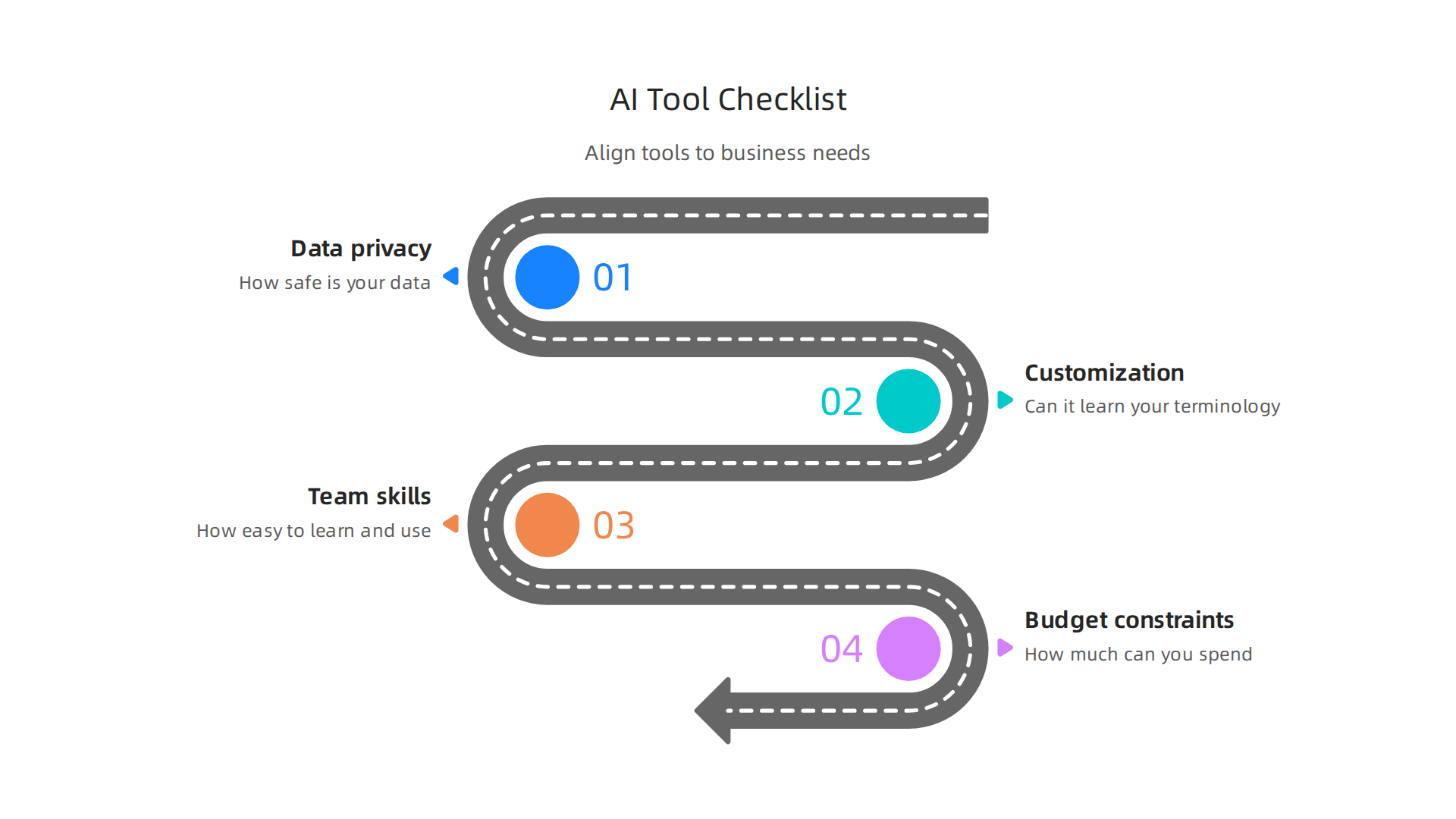
    Use this checklist to align AI tools with your business needs, considering privacy, customization, team skills, and budget.

    • Data privacy needs: How safe is your information with this AI tool? If you handle private customer details, you must pick an AI tool that keeps data very secure. Make sure it follows rules for protecting information. You can learn more about rules and growth by checking out this guide to mastering the AI future standard 2026.
    • Customization: Can you teach the AI tool to understand your business’s special words or ways of doing things? For example, can you upload your company’s style guide so it always writes in your brand’s voice?
    • Team skill requirements: Will your team find the tool easy to learn and use? A powerful AI tool is only good if your team can actually use it without a lot of extra training. Some tools are very simple, while others need someone with more tech know-how.
    • Budget constraints: How much money can you spend? Beyond the monthly or per-use cost, think about any extra costs for setting it up or training your team. Always have a clear budget in mind.

    By carefully matching your business needs with the right AI tools, you can avoid costly mistakes and help your business truly grow.

    Making smart choices about AI tools requires careful consideration of business needs and goals.

    Many companies are already doing this, with 86% to 92% of creators using AI in some way in 2026, showing how important it is to pick the right tools that fit their work Creator Economy AI Adoption Statistics (2026). If you’re looking for help with customer service, for instance, a good AI virtual assistant for businesses could be a great fit.

    Once you’ve chosen the right AI tool for your business, the next big step is making sure it works well with everything else you do. This is called "integration," and it’s how AI tools connect and talk to your existing systems.

    Integration patterns: APIs, pipelines, and deploying virtual assistants

    Think of integration patterns as the pathways AI tools use to work together. There are a few common ways this happens.

    • Content Pipelines: Many businesses use AI to help create written content. In a content pipeline, a human editor might send a draft to an AI tool to get help with ideas or grammar. The AI processes the request and sends it back to the editor, who then puts the final touches on it. This back-and-forth makes content creation faster and better.
    • Assistant Routing: Another common way is with virtual assistants. When a customer asks a question, an AI system first tries to understand what they really want. This is called "intent detection." Once the AI knows the intent, it then routes the request to the right place to get an answer. This "fulfillment" step might mean pulling info from a database, checking a calendar, or even asking another AI system for help. For businesses, learning how to set up these tools is key for growth. You can explore a Strategic Guide to Marketing AI Agents Deployment, ROI, and Growth in 2026.
    But how well these connections work depends on some key things you need to watch out for.

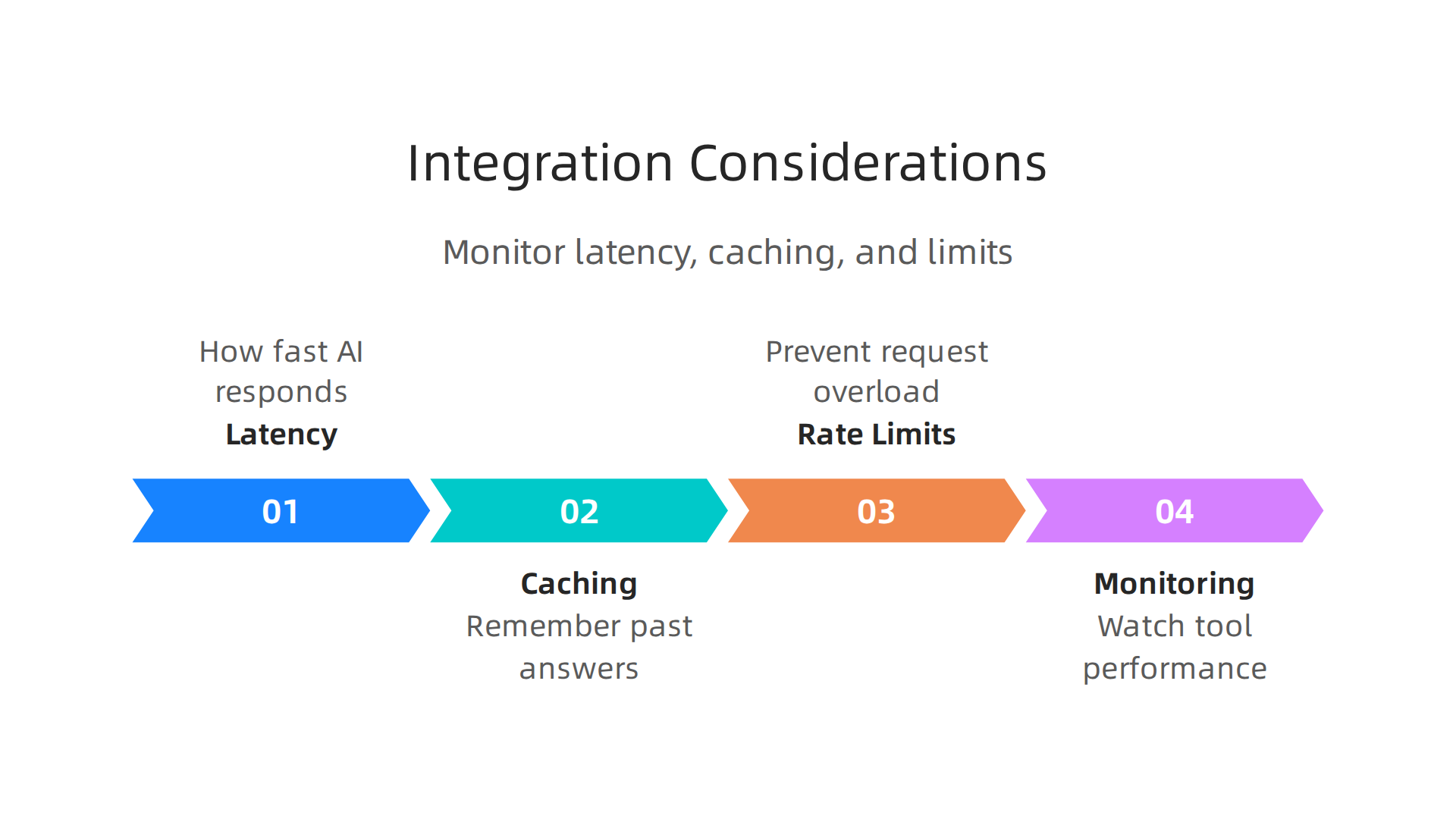
    Monitor latency, utilize caching, manage rate limits, and implement robust monitoring for smooth AI tool integration.

    • Latency: This is simply how fast the AI responds. If a virtual assistant takes too long to answer a customer’s question, it can be very frustrating. Slow responses can easily lead to that aiscream ai scream feeling for users. Experts suggest that for things like chat, AI should respond very quickly, often in less than a second, to keep users happy What is AI Observability? Key to Monitoring Your LLM Infrastructure.
    • Caching: Imagine the AI remembers past answers or tasks. If many people ask the same question, the AI can give a saved answer instead of having to think it up from scratch every time. This "caching" makes things much faster and more efficient.
    • Rate Limits: These are like speed limits for your AI system. They stop too many requests from coming in at once, which could make the system slow down or even crash. Rate limits help keep everything stable and running smoothly, preventing your AI from getting overwhelmed.
    • Monitoring: It’s super important to keep a close eye on how your AI tools are working. This means checking things like how fast they respond (latency), if they are making errors, and how often they are used. Good monitoring helps you find problems early and fix them before they affect your customers or business.

    Staying on top of these operational details ensures your AI tools work for you, not against you.

    Get clear daily AI updates. The AI Newsletter Worth Reading delivers valuable insights straight to your inbox.

    Making sure your AI tools run well is one thing, but knowing if they are truly helping your business grow is another. This is where measuring your return on investment, or ROI, comes in. It helps you see if the money and effort you put into AI are giving you good results. To do this, you need to set up clear goals, understand all the costs, and have real expectations.

    Defining Key Performance Indicators (KPIs)

    Key Performance Indicators (KPIs) are like scorecards that tell you how well your AI tools are doing.

    Measure your AI investment ROI using KPIs like time-to-publish, content engagement, support deflection, and assisted revenue.

    Instead of just guessing, KPIs give you clear numbers to look at.

    • Time-to-Publish: If you use AI for writing, how much faster does it make your team? You can measure the time it takes to go from an idea to a finished piece of content. Faster publishing can mean more content and better reach. You can learn more about measuring success in content creation with AI in this How to Measure AI Content Performance: KPIs & Framework.
    • Content Engagement: Are people reading the content created with AI? Look at things like how many views an article gets, how long people stay on the page, or how many shares it receives. These numbers help you see if your AI-assisted content is truly connecting with your audience. Some businesses also consider if their content needs to pass a humanize ai detector check to ensure quality.
    • Support Deflection: If you have an ai virtual assistant helping customers, how many questions does it answer without needing a human? The more questions it handles, the more time your human support team saves. This is a big win for efficiency.
    • Assisted Revenue: Can you link sales or new customers directly to AI tools? For example, did an AI-powered recommendation system lead to more purchases? Tracking this helps you see how AI adds to your bottom line.

    Overall, it’s important to track these things to understand how AI helps with active users, task completion, and customer satisfaction, which are all part of Evaluating AI Readiness: Checklist for Organizations.

    How to Model Costs

    Knowing your costs is just as important as knowing your benefits. AI tools come with different price tags.

    • Licensing and Subscriptions: Many AI software tools have monthly or yearly fees. These are usually straightforward.
    • API Usage: Some AI tools, especially for advanced features, charge based on how much you use them. This is often measured in "tokens," which are like small pieces of text. The more requests you send or the more text the AI processes, the more it can cost. For example, in 2026, the cost for 1 million input tokens can range from very low to several dollars depending on the AI model and provider, as detailed in various AI API Pricing Comparison 2026: 73 Models Ranked reports. If you’re not careful, these costs can add up fast, creating an aiscream ai scream moment if you don’t keep an eye on them.
    • Engineering Integration: Getting AI tools to talk to your existing systems often needs skilled technical help. This can involve developers and IT staff, which adds to the cost.
    • Monitoring and Overhead: You also need to pay for systems that watch your AI tools to make sure they are working correctly, and for any extra storage or computing power they use.
    • Editing and Oversight: Even with AI, you might still need human reviewers or editors, especially for content where a human touch or comment ai expertise is crucial. This human involvement ensures quality and accuracy. This ongoing human cost is an important part of the AI Pilot to Production Checklist: A Leader’s Guide.

    By carefully looking at both your benefits and all these costs, you can get a clearer picture of whether your AI investments are truly paying off. This helps you make smart choices about how to choose AI for business tools that deliver real results in 2026.

    To really make AI tools work for your business, you need more than just good numbers. You also need to make sure your team knows how to use them well. This means setting up clear plans for how to put AI into action and how to help your staff adjust to these new ways of working.

    Pilot Design for AI Tools

    Starting with a small test, also called a pilot program, is a smart way to bring AI into your business. Think of it like trying out a new recipe before cooking for a big party.

    • Narrow Scope: Do not try to change everything at once. Pick one small area or one team to start with. For example, maybe you try using an AI tool to help your customer service team answer simple questions, or to help your marketing team write social media posts. Keeping it small helps you learn without big risks.
    • Measurable Outcomes: Just like we talked about with ROI and KPIs, you need to know what success looks like for your pilot. If you are using an ai virtual assistant, measure how many simple questions it can answer on its own. If it is an AI tool for writing, see how much faster it makes content creation. Clear goals help you see if the tool is actually helping.
    • Fast Feedback Loops: You want to learn quickly. After you start the pilot, get feedback from your team right away. What is working? What is not? Are they having an "aiscream ai scream" moment because the AI made a big mistake? The faster you get this information, the faster you can fix problems and make the tool better.

    Training and Governance for AI Outputs

    When you bring AI into your daily work, teaching your team how to use it is super important.

    Effective training and onboarding are crucial for teams to confidently adopt and leverage new AI tools.

    It is not just about pressing buttons; it is about understanding how to work with the AI.

    • Onboarding Creators: For teams that make content or create new things, learning to prompt AI tools correctly is key. They need to know how to ask the AI for what they want and how to review what it gives back. Sometimes, AI can make things up, which is called "hallucinating." This can lead to wrong information. To avoid this, creators must learn how to check AI outputs carefully and how to make sure they sound human and accurate. Using a humanize ai detector can help ensure the content feels natural.
    • Onboarding Operations Staff: For those who manage projects or daily tasks, it is about integrating AI outputs smoothly. They need to understand the new workflows. This often means having human reviewers check the AI’s work before it goes out. This human oversight, sometimes called "Human-In-The-Loop," is important for catching mistakes and ensuring quality. Having humans involved throughout the process can greatly help in reducing AI hallucinations and building trust in the AI system, as explored in research on creating trustworthy LLMs. This human touch, or "comment ai" from a person, adds value that AI alone cannot always provide.

    By training your team and putting good rules in place, you help everyone feel comfortable and confident using AI. This makes sure your AI tools are not just fancy new tech, but real helpers that improve how your business works. To learn more about how to choose and use AI for your business, check out our guide on Smart AI for Business: Your 2026 Guide to Successful Adoption.

    When using AI tools in your business, it’s not enough to just train your team well. You also need to think about how to keep things safe and private. If you don’t, you might have an "aiscream ai scream" moment when something goes wrong. This means looking at security, privacy, and making sure you follow all the rules.

    Key Risks for AI Content and Assistants

    Bringing AI into your work means thinking about a few big dangers:

    • Sensitive Data Leaks: Imagine your AI assistant handles customer information, like their addresses or phone numbers. If this data isn’t kept safe, it could accidentally be shared with the wrong people. This is a big problem for privacy. You need strong rules about what kind of information your AI tools can see and use.
    • Hallucinations: As we talked about before, AI tools can sometimes make things up. This is called "hallucinating." While human oversight helps, AI models can still create false information. For example, an ai virtual assistant might give a wrong answer to a customer or write content with facts that are not true. This can lead to bad decisions or make your business look unreliable. Researchers are always looking for ways to stop these mistakes and make AI more trustworthy, like exploring who is responsible when AI systems give wrong information due to hallucinations, as discussed in studies on Mitigating Generative AI Hallucinations.
    • Auditability of AI Outputs: It can be hard to understand why an AI made a certain decision or gave a specific answer. This is called auditability. If you can’t easily check the steps an AI took, it’s tough to prove it followed the rules or to fix problems. This lack of clear steps can be a worry for both safety and fair play, especially as AI becomes more common, as a conceptual framework for studying AI hallucinations highlights.

    Practical Steps to Stay Safe with AI

    To avoid these problems and prevent any "aiscream ai scream" situations, you can take some smart steps:

    • Data Handling Policies: Set clear rules for all the information your AI uses. Decide what data is okay for the AI to process and what data is strictly off-limits. This might mean only giving AI tools "fake" or practice data for training, or making sure all sensitive customer data is removed before the AI sees it.
    • Redaction: This means taking out sensitive parts of information. Before data goes to an AI tool, make sure any private names, numbers, or other details are blacked out or removed. This helps keep customer information safe.
    • Human-In-The-Loop Checks: Just like we mentioned before, always have a person review what the AI creates or suggests. This human check is super important for catching mistakes, wrong information, or anything that doesn’t sound right. Think of it as a final quality check, adding a valuable "comment ai" from a real person.
    • Logging: Keep a record of everything your AI tools do. This means tracking what questions were asked, what answers were given, and who approved the final output. If there’s ever a problem, these logs can help you trace back what happened and fix it. An AI governance checklist can help you set up this kind of monitoring.

    By putting these safeguards in place, you can use AI tools more safely and with more confidence. You make sure your business stays secure and follows the rules, while still getting all the benefits that AI can offer in 2026. For a deeper dive into making sure your AI efforts meet the necessary standards, explore our guide on Mastering the AI Future Standard 2026.

    Summary

    This article helps business leaders cut through the surge of AI tools in 2026 by showing how to choose, integrate, measure, and govern AI effectively. It explains the tangible business outcomes—faster content, personalization at scale, and higher team productivity—while warning against common mistakes like picking hype-driven solutions or poor integrations. You’ll get a practical comparison checklist (features, customizability, API surface, pricing, support), guidance on integration patterns and operational concerns (latency, caching, rate limits, monitoring), and a framework for measuring ROI with KPIs such as time-to-publish, engagement, support deflection, and assisted revenue. The guide also covers how to run focused pilots, train teams with human-in-the-loop workflows, and set safeguards for data privacy, auditability, and hallucination risk so your AI investments deliver real, measurable value.

  • Google Ads Certification Master AI-First Marketing in 2026

    Google Ads Certification Master AI-First Marketing in 2026

    Why marketers and leaders must align Google Ads certification with AI-first marketing

    In 2026, the world of marketing keeps changing super fast. One big reason is the rise of smart AI marketing tools. But even with all these new tools, some basic skills are still very important. A great example is the Google Ads certification. It teaches you the building blocks of how paid ads work on Google.

    Think of it this way: learning to drive a car is still important, even if your new car has self-driving features.

    A professional engaging in continuous learning, symbolizing the need to adapt existing skills to new technologies like AI.

    You still need to know the rules of the road and how to steer. The Google Ads certification is like knowing those basic rules for online advertising. It covers things like setting up ad campaigns, choosing the right keywords, and understanding how Google’s ad system works. This includes knowing about search campaign structure and different keyword types, which are key parts of the exam itself Google Ads Search Certification Study Guide 2026. Other useful marketing certifications, like a HubSpot marketing certification, also provide a strong base for different areas of digital marketing.

    However, things are different now. Many tasks that used to take a lot of time can now be done much faster with AI. This means marketers and business leaders need to know how to use these powerful AI tools with their existing knowledge. This article will show you practical ways to bring together your Google Ads certification knowledge with the best AI for business tools. Our goal is to make your work easier, reduce problems, and get better results from your ad spending. You’ll learn how marketing specialists choose AI tools for marketing and drive ROI in today’s fast-paced world.

    Stay updated on the latest shifts in AI and marketing. The AI Newsletter Worth Reading provides clear, daily AI updates that can help you keep pace.

    What Google Ads certification covers – and what it doesn’t in an AI-first world

    Even in 2026, the basic Google Ads certification helps you understand how online ads work. It teaches you important skills to run search advertising campaigns. Think of it as learning the core rules for advertising on Google. This means knowing about how Google’s ad system is set up, choosing the right keywords, and understanding how bids work.

    The Google Ads certification covers many useful topics. For example, it teaches you how to structure an ad account, set up search campaigns, and pick keywords that match what people are searching for. You also learn about different ways to bid for ads, including "Smart Bidding" strategies, and how to write good ad copy that gets clicks. The certification also covers how to track your campaign results and measure if your ads are doing well Google Ads Certification Study Guide (2026). Knowing about the Google Ads ecosystem, account setup, and how ads are ranked are all part of the study guide too Google Certification Study Guide 2026 — Exam Format, Topics.

    But here’s the thing: while these basics are super important, the certification does not fully cover how much smart ai marketing tools have changed things. AI now handles many tasks that used to take a lot of human effort. This means some parts of the old way of doing things are now mostly done by computers.

    For example, creating ad pictures and text used to be a long process. Now, AI ad creative generation tools can quickly make many different ad versions. Some brands have seen their creative costs drop by 80% thanks to AI AI Advertising Statistics 2026: 30+ Key Facts & Fig…. Also, picking the best price for each ad click, called bidding, is often handled by AI-powered tools today. These tools can manage bids and budgets more efficiently than a person can Best AI Ads Management Software 2026: Complete Guide.

    AI also helps with finding the right people to show ads to, which is called audience modeling. It goes beyond simple targeting and can find very specific groups of people who are likely to be interested in your product. Plus, these best ai for business tools can test many ad ideas at once. AI-driven testing can make your ads work much better, boosting how many people take action by 12-18% compared to older methods AI In The Digital Advertising Industry: 2026 Verified Stats. Because of this, more and more ad money is being managed by AI, with total AI-powered ad spending expected to reach $57 billion in 2026 AI-powered ad spend will hit $57 billion in 2026 as brands go all in.

    Smart AI tools have changed how people work with ads every day. Tasks that used to take a long time are now done by computers.

    One big change is how we make ads. AI tools can create many different pictures, videos, and words for ads very fast. For example, some tools can make new ad designs and even guess which ones will work best before you spend money to show them 9 Best AI Tools for Performance Marketing in 2026 + Pricing. Other tools can help create all parts of an ad for different places online, like Meta and Google Best AI Ad Creative Tools (2026): An In-Depth Comparison. This means you spend less time drawing or writing each ad yourself.

    AI also helps predict how well your ads will do. It can guess how many people might click on your ad or buy something. Also, many tasks now happen automatically. For example, setting prices for ads or handling your budget is often done by smart AI. These tools can change bids very fast to get the best results, often better than a person could do Top 10 End-to-End Ad Optimization Platforms for Performance …. This means you do not have to make tiny changes every day. You can look at the bigger plan instead.

    So, what does this mean if you have a google ads certification? It means your job changes. Instead of doing small, repeated tasks, you now guide the AI.

    A marketing team collaborating, focusing on high-level strategy and guidance, reflecting the shift from manual tasks to AI oversight.

    Think of yourself as a coach for the AI.

    You still need to know how to plan a good ad campaign. This means deciding what you want your ads to do, who should see them, and what your main message will be. AI can help with the small parts, but you need to tell it the main goals and what path to take.

    Another very important skill is knowing how to check if your ads are working well. The google ads certification teaches you how to look at numbers and understand what they mean. Even with AI doing much of the work, you still need to see the results. You have to figure out if the AI is doing a good job and make important choices. Also, you need to find problems if the AI is not working right. These big skills are super important, and learning them helps you choose a digital marketing course for AI skills that really gets you ready for today’s world.

    To keep up with all the new AI tools and changes, staying informed is key.
    The AI Newsletter Worth Reading offers clear daily AI updates to help you stay ahead.

    Keeping up means understanding how your existing skills fit with new tools. If you have a google ads certification, you already know many important things. Now, let’s see how those skills change when you use AI for business. Think of it like a checklist of what you know and how AI helps you do it better.

    Mapping Your Google Ads Certification Skills to AI

    Here is how your Google Ads knowledge fits into today’s world of AI marketing tools:

    Illustrating how traditional Google Ads certification skills adapt and complement AI-assisted marketing workflows.

    What You Learned (Google Ads Certification) How AI Helps Now (AI-Assisted Workflow) What You Still Need to Master (Your Role)
    Campaign Goals & Setup AI suggests campaign ideas, audience targets, and budgets. You set the big goals, tell AI what success looks like, and guide the overall plan.
    Ad Creation & Messaging AI writes many ad copies, creates different images or videos. You review AI’s ideas, pick the best ones, and make sure the message feels right for your brand.
    Bidding Strategies AI changes bids automatically to get the most clicks or sales. You choose the right bidding strategy for AI to follow and check that it’s working towards your goals.
    Audience Targeting AI finds new groups of people who might like your ads. But beware: some old ways, like lookalike audiences, are changing with new privacy rules in 2026 Lookalike Audiences Are Gone…. You learn new privacy rules, understand who you really want to reach, and make ethical choices for targeting.
    Performance Tracking & Reports AI collects all the numbers, spots trends, and makes reports easy to read. You look at the big picture from the reports, understand what the numbers mean, and decide what to do next.
    Data Governance & Compliance AI handles and uses a lot of data, making it faster to work. You make sure all data used by AI is collected and used correctly and legally. This is about making sure your AI efforts follow the rules AI and Data Governance in 2026: The Complete Guide.

    This table shows that while AI does many tasks, your smart human brain is still in charge. You are the conductor of the AI orchestra.

    How Different Roles Should Prioritize Learning

    Not everyone needs to learn the same things at the same speed. Your job helps you decide what parts of this checklist are most important.

    • For Founders/Business Owners: Your focus should be on "Campaign Goals & Setup" and "Performance Tracking & Reports." You need to know what to ask the AI for and how to read the results to make sure your best AI for business is working towards growth. You care about the big picture and return on investment (ROI).

    • For Campaign Managers: This entire checklist is for you. You are the one working closely with the AI marketing tools every day. You need to know how to guide the AI, check its work, and make changes when needed. Mastering "Bidding Strategies" and "Audience Targeting" in the AI world is very important. You might also want to explore a hubspot marketing certification to broaden your marketing automation skills.
    • For Consultants: You need to know everything on this list, and then some! You should understand how to set up, manage, and fix problems with AI-assisted campaigns for many different types of businesses. Staying up to date on all the latest AI trends, laws, and the best AI marketing tools is key. You also need to be good at explaining complex ideas simply.

    The table in the last section showed how your skills, like those gained from a Google Ads certification, are still key when working with AI marketing tools. But being the "conductor" also means you’re responsible for making sure everything is done by the book. This is super important with AI because new rules about data privacy and how we use information are always popping up in 2026.

    As a marketing leader, your main job is to guide your team to success. With AI, this also means staying on top of new laws and making sure your team follows them.

    A marketing leader carefully reviewing documents, symbolizing the critical role of ensuring compliance and data privacy with AI tools.

    Your knowledge from a Google Ads certification gives you a great start, but AI adds new layers to how data is collected and used. For example, some older ways of finding audiences are changing, and there are more rules about being open when AI helps create ads. Not following these rules can lead to big problems and can hurt trust with your customers. It’s why marketing leaders need to understand these 2026 Compliance Risks for Marketing Data Governance more than ever.

    Actually, industry groups are giving out new advice on how to use AI fairly and transparently. For instance, the IAB has updated its guidance, saying you must tell people if AI has made changes to images, videos, or voices in ways that might trick them. This is about being honest and clear with your audience, which is a key part of responsible marketing, as highlighted in new IAB updates AI disclosure guidance.

    A Short Governance Checklist for Marketing Leads Using AI

    To help you keep your AI efforts on track and reduce risks, here’s a simple checklist for how to use your ai marketing tools responsibly in 2026:

    A practical checklist for marketing leaders to ensure responsible and compliant use of AI marketing tools.

    • Know Your AI Tools: Understand exactly how each AI tool collects, uses, and stores data. Make sure they meet privacy standards. You can also explore how to choose a digital marketing course for AI skills to deepen your team’s expertise.
    • Get Clear Consent: Always get permission from people before you collect their personal data. Make it easy for them to say yes or no, and respect their choices. This is a core part of using How to Use AI Responsibly in Digital Advertising.
    • Be Transparent About AI: If AI created or heavily changed your ad content, think about telling your audience. Honesty builds trust.
    • Regularly Check Data Quality: Make sure the data your AI uses is correct and up to date. Bad data can lead to bad marketing choices and can also cause privacy issues.
    • Plan for Problems: Have a plan for what to do if there’s a data breach or an AI tool makes a mistake. Knowing how to react quickly is key to avoiding bigger problems. Setting up a strong strategic guide to marketing AI agents can help prevent many of these issues.
    • Keep Up with Laws: Laws about AI and data privacy are always changing. Stay informed about new rules in your area and the places you market to.

    Staying informed about the fast-moving world of AI is crucial for marketing leads. It helps you keep your business safe and ethical.


    Get clear daily AI updates from The Deep View Newsletter. The AI Newsletter Worth Reading

    Keeping up with laws is one thing, but making sure your team has the right skills to use new AI marketing tools is another. This is where good training comes in. As a marketing leader in 2026, you need to create learning plans that mix official certifications with hands-on practice.

    Training teams: blending certification study with hands-on AI tool labs

    Think of it like this: your team needs to learn the rules of the road (from certifications) and then actually drive the car (using AI tools).

    Putting Together Smart Learning Plans

    The best way to train your team is to create special learning paths. These paths should pair up lessons from things like a Google Ads certification or even a HubSpot marketing certification with real practice sessions. For example, after learning about setting up ad campaigns through a Google Ads certification course, your team members could then jump into "AI labs." Here, they would use actual AI marketing tools to create and manage campaigns in a safe testing space.

    This hands-on approach helps people truly understand how to use these powerful tools. They can try different AI features, see how they affect ad performance, and get comfortable with how the best ai for business works in real life. Google itself offers ways to learn these new skills, including a Google AI Professional Certificate to help build important AI knowledge. These programs help your team get skilled in using ai marketing tools effectively.

    Checking if Training Actually Works

    It’s not enough to just train your team; you also need to check if the training is making a difference. This means looking at your campaign results. Did the training help your team get better at their jobs? Are your ad campaigns performing better because of the new AI skills?

    You can evaluate this by:

    • Looking at Key Numbers: See if important things like how many people click your ads or how many sales you make have gone up. For example, one way to evaluate AI tools is by how they affect your campaigns, not just by what features they have. You can use checklists to audit your ai marketing tools to see if they are worth the cost and effort, as detailed in a Digital Marketing AI Tool Audit: Q2 2026 Checklist.
    • Getting Feedback: Ask your team members what they learned and how they are using the new skills.
    • Checking Performance of AI Tools: Make sure the ai marketing tools they are using are actually helping. You can learn more about how Marketing Specialists Choose AI Tools for Marketing and Drive ROI to ensure your team is using the right ones.

    By combining learning from certifications with hands-on labs and then carefully checking the results, you can make sure your team is ready for anything in 2026. This also helps you guide your business toward Smart AI for Business: Your 2026 Guide to Successful Adoption.

    After training your team, the next important step is picking the right ai marketing tools for them to use. This isn’t just about finding the flashiest new tool. It’s about using what your team learned from their certifications, like a Google Ads certification or a HubSpot marketing certification, to make smart choices. These certifications teach key skills that help you evaluate best ai for business solutions effectively.

    Evaluating AI tools through the lens of certification-driven decision criteria

    When you’re choosing new ai marketing tools, think about what your team learns in their training. This knowledge helps you look at tools in a smarter way. For example, a good 2026 Guide to Ultimate AI Ad Tech Evaluation Strategy shows how to pick tools based on clear rules, not just cool features.

    Here’s how what your team knows can help you pick the best AI tools:

    • How well does it measure? Certifications often teach how to track how well your ads are doing. When looking at AI tools, ask: Does this tool clearly show us if our ads are working? Can it help us understand clicks, sales, and what’s making people buy? You want tools that give you good information, not just guesses.
    • Can it make things better? A big part of any Google Ads certification is learning how to improve campaigns over time. Your AI tools should do this too. Do they suggest ways to get more for your money or reach more of the right people? The best ai marketing tools help your team keep making things better, not just set them up once.
    • Does it follow the rules? Your team learns about rules and good practices in their hubspot marketing certification or other training. AI tools should also follow these rules. Do they keep customer information safe? Are they clear about how they work? An AI tool should be transparent, meaning you can understand how it makes decisions, and allow for proper spend control.

    Thinking About Trade-Offs When Choosing AI Tools

    No AI tool is perfect, so you’ll need to think about what’s most important for your business.

    • Cost: This isn’t just the monthly price. Think about the full cost, including how much time it takes to set up the tool, train your team to use it, and keep it running smoothly. Sometimes a cheaper tool needs more work, making it more expensive in the long run.
    • Can you understand it? Some AI tools are like a "black box," meaning you don’t really know how they make their decisions. It’s often better to pick tools that are more "explainable." This means you can see why the AI made a certain choice, which helps your team learn and trust the tool more. For example, when evaluating AI advertising platforms in 2026, look for transparency and control.
    • How hard is it to connect? New tools need to work with the tools you already use. How much effort will it take to link a new ai marketing tool to your current systems? A tool that connects easily will save you a lot of headaches. You’ll want to choose the right Enterprise AI Platforms 2026 Top Providers and How to Choose the Right One to avoid integration issues.
    • What real impact will it have? Most importantly, will the tool actually help you reach your business goals? Will it save time, make more money, or make your customers happier? Focus on tools that can show clear, measurable results.

    By using the knowledge from google ads certification and other training, you can pick the best ai for business tools that truly help your team and your company grow in 2026.

    Staying ahead in the world of AI means always learning. To get the latest updates and practical insights for business users, there’s The AI Newsletter Worth Reading.

    Even with the best tools picked, bringing new ai marketing tools into your business can be tricky. It’s like having a new car but not knowing how to drive it perfectly. Many companies face bumps in the road when they try to use AI. These challenges can slow things down, but teams with good training are ready to overcome them.

    Here are some common challenges companies face when using AI tools:

    Visualizing common challenges in AI adoption and how certified marketing teams effectively overcome them.

    • Skills Gap: Sometimes, teams simply don’t have the right skills to use new AI tools effectively. They might know how to do their job, but not how to do it with AI. In fact, many marketing teams in 2026 still do not have a clear plan for AI, showing a lack of knowledge in how to move forward with new tech.
    • Budget Worries: Buying AI tools and training your team costs money. Business leaders worry if the tools will really make enough money or save enough time to be worth the cost. Starting a pilot program can help show the value, with some experts suggesting dedicating 20-25% of spend to AI-assisted experiments to see results quickly AI Advertising 2026 Transforms Paid Media for Pros – key-g.com.
    • Hard to Measure Results: It can be tough to see if AI tools are truly helping. How do you know if an ai marketing tool is working better than the old ways? This makes it hard to show that the investment was a good one.
    • Team Not Ready: Some team members might be worried about AI taking their jobs. This can make them less willing to learn or use the new tools The 12-Week Implementation…. This kind of resistance can stop new tools from being used well.
    • Rules and Safety: With new technology comes new rules. Companies need to make sure their AI tools keep customer information safe and follow all the laws. Many companies see legal, governance, and compliance as a big challenge when adopting AI AI GOVERNANCE AND RISK MANAGEMENT PLAYBOOK.

    How Certified Teams Make a Difference

    This is where trained teams truly shine. When your team has a google ads certification or a hubspot marketing certification, they are much better prepared. They know how to handle these common problems:

    • Better Skills: With certifications, your team already has the basic knowledge to understand how best ai for business tools work. This reduces the skills gap because they have learned about data, tracking, and how to improve campaigns. They are ready to explore tools for AI tool discovery 2026 and apply what they’ve learned.
    • Smart Start-Ups: Certified teams know to start with small test runs, called pilot programs. This helps them see what works and what doesn’t without spending too much money at once. It’s about slowly bringing in new tools, which is also known as "staging."
    • Clear Rules: They can help set up clear rules, or "governance," for how AI tools should be used safely and correctly. This includes understanding who is in charge of which part of the AI process and what risks to look out for AI Adoption Strategies: Your 2026 Playbook – AI Academy.
    • Checking Results Often: These teams are also good at setting "ROI checkpoints." This means they regularly check if the AI tools are giving good results and making the company money or saving time. This helps prove the value of the new tools and makes sure they are having a real impact. This also helps reduce concerns about cost.
    • Building Trust: By showing clear results and following rules, certified teams can help everyone feel more comfortable with new AI tools. This reduces team resistance and helps everyone work together better.

    By having a team that understands the challenges and has the right training, your business can smoothly adopt new best ai for business solutions and truly benefit from them in 2026. To learn more about how AI helps businesses grow, check out this guide on How Businesses Adopt AI for Growth.

    Summary

    This article explains why Google Ads certification remains a critical foundation in an AI-first marketing world and shows how to combine that foundational knowledge with modern AI tools. It summarizes what the certification teaches—campaign setup, keyword strategy, bidding, audience targeting, and measurement—and identifies what it doesn’t fully cover now that AI automates creative, bidding, and audience modeling. The piece maps certification skills to AI-assisted workflows, clarifies different learning priorities for founders, campaign managers and consultants, and gives a short governance checklist to reduce legal and ethical risks. It also outlines how to train teams with blended certification + hands-on AI labs, how to evaluate and choose AI marketing tools, and how certified teams can smooth adoption while measuring ROI and managing common barriers. After reading, you’ll have practical checklists, role-based priorities, and evaluation criteria to align your Google Ads knowledge with AI tools responsibly and effectively.

  • Utah Tech Week 2026 Strategy Guide for Business Leaders

    Utah Tech Week 2026 Strategy Guide for Business Leaders

    Why Utah Tech Week matters now — a concise guide for busy decision-makers

    Every year, leaders, thinkers, and new companies come together for Utah Tech Week.

    Professionals from various sectors converge at a technology event, fostering collaboration and knowledge exchange.

    It’s a big event that shows how important technology is in Utah and beyond. Think of it as a central meeting point, a "smorgasbord of experiences and events" put on by many groups, like new businesses, investment firms, and local organizations Utah Tech Week – UtahFounders.org – A Resource Directory for …. In 2026, Utah Tech Week typically runs for several days, such as from February 2nd to February 7th, showcasing a dynamic environment for innovation Utah Tech Week 2026 | Wilson Sonsini.

    This yearly gathering brings together many different groups. You’ll find new companies looking to grow, people who invest money in promising ideas, and big companies searching for fresh ways to innovate. It’s a place where you can see the latest in software technology, discover cutting-edge apex technology, or even learn about advancements in specialized areas like stark tech. The event is well-known for attracting venture capital funds, showing its role in helping new ideas get the money they need to succeed [PDF] Utah Tech Week Requester Information Section 1](https://le.utah.gov/interim/2025/pdf/00001161.pdf).

    If you’re a founder starting a business, a marketer spreading the word, someone running a company, or a big boss making important choices, you probably go to Utah Tech Week for clear reasons. You want to meet new people, learn new things, find money for your projects, or discover smart ways to grow your business. Many attendees are looking for practical insights to help them unlock business growth with US tech solutions and AI in 2026. Others seek to understand how to best choose tech gadgets for business productivity in 2026 that will truly make a difference.

    This article is made just for you. We will give you helpful tips, show you some cool companies, and tell you what to do after Utah Tech Week to keep making progress. Our goal is to make sure you get the most out of what Utah Tech Week has to offer in 2026. Staying on top of new ideas in technology is key. For a simple way to keep learning every day, consider subscribing to The AI Newsletter Worth Reading to get clear daily AI updates.

    What Utah Tech Week is and who attends

    Utah Tech Week is more than just one event. It’s actually many different gatherings happening all across the state, working together to show off Utah’s strong technology scene. Think of it as a week-long festival for all things tech. In 2026, many groups put on their own events, like big meetings, hands-on workshops, and special days where new companies show off their ideas. If you are interested in hosting an event, the official Utah Tech Week website provides details on how you can get involved Host an Event.

    These events cover a wide range of topics. You might find talks about the latest in software technology or learn about advanced areas like apex technology. Some events focus on hard tech, which is often called stark tech, where people build physical products and big systems. Other events highlight innovations that might include areas like trimble tech, showing how diverse the tech community is. The main goal is to bring together smart people and exciting new ideas.

    Many different kinds of people come to Utah Tech Week, and they each have their own goals:

    Utah Tech Week draws a diverse range of participants, each with distinct goals for collaboration and growth.
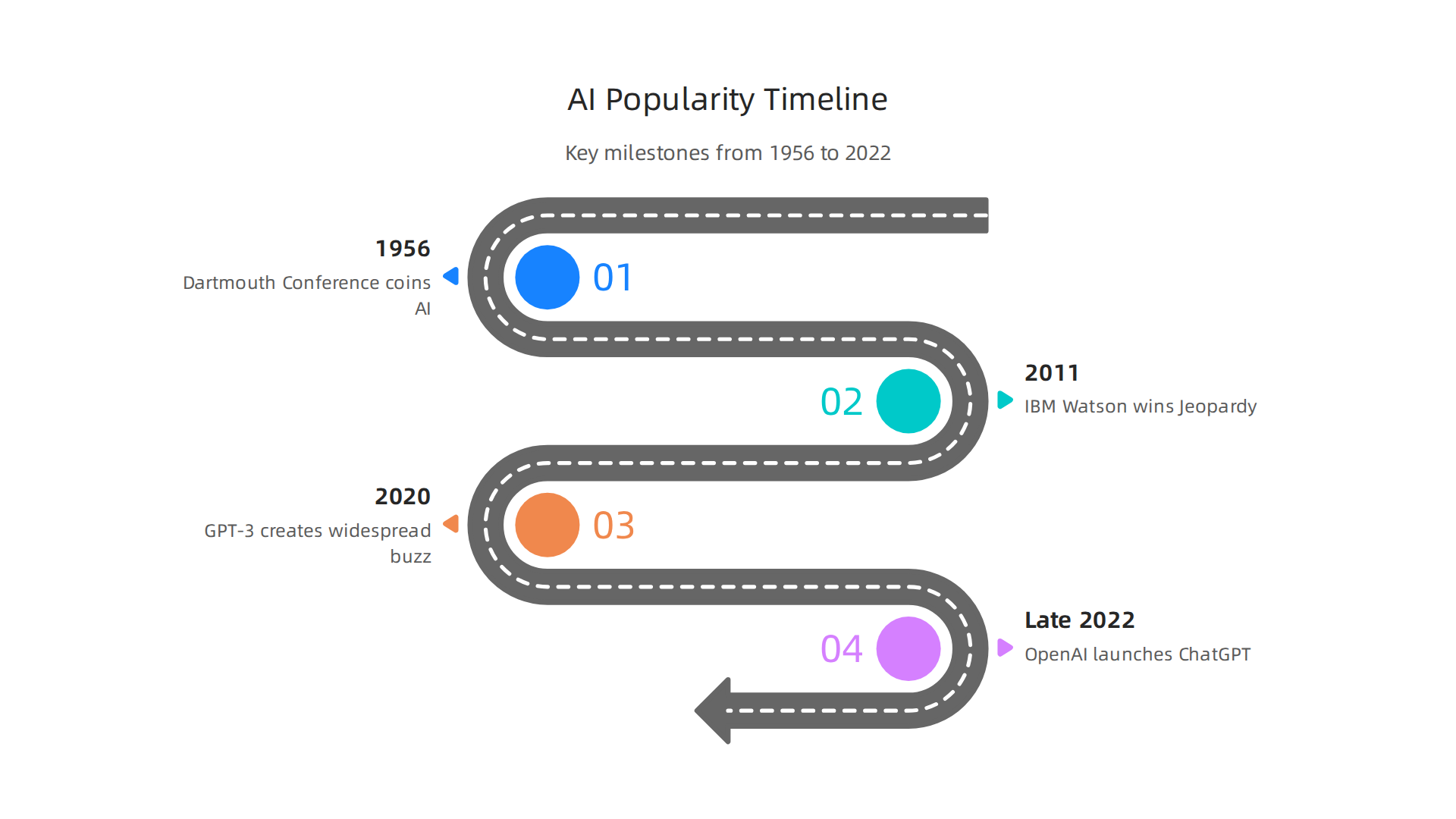
    • Founders are people who start new companies. They come to find money, get advice, and connect with others who can help their business grow. Many attend pitch competitions where they share their ideas with potential funders Pitch.
    • Investors are people or groups who put money into new businesses. They are looking for the next big company or a smart idea to support. They want to find promising startups early.
    • Enterprise Buyers work for larger companies. They come to discover new tools, find innovative software technology inc solutions, and see how new tech can help their businesses run better. They might be looking to choose the best AI tech products for their teams.
    • Recruiters are looking for talented people to hire. They attend to meet skilled workers and find future leaders for tech companies.
    • Students and Professionals come to learn, network, and keep up with the newest trends.

    The rich tech community in Utah plays a big part in shaping Utah Tech Week. Local universities like Utah Tech University are actively involved, often hosting events and showcases Utah Tech University. For instance, the Lassonde Entrepreneur Institute at the University of Utah holds its own Demo Day where student startups present their projects. Other groups, like business accelerators, also help new companies get started and show their progress during the week. This strong support system from schools and businesses makes Utah Tech Week a vibrant place for innovation and growth. It really shows how the local ecosystem helps drive new ideas forward.

    Top themes and tracks to watch in 2026 (AI, fintech, life sciences, and more)

    Utah Tech Week is a big event, and it’s full of many different areas of technology. To make the most of your time there, it’s helpful to know about the main themes and tracks. Think of tracks as special pathways or topics that different events will focus on. In 2026, some of the hottest topics are Artificial Intelligence (AI), financial technology (fintech), and life sciences.

    Finding the right tracks for your goals

    To figure out which tracks are best for you, first think about what your company or your personal goals are. Are you trying to find new software for your team, invest in a cutting-edge startup, or learn about the next big thing in medicine?

    The official Utah Tech Week website is a great place to start. It lists many individual events and helps you see the bigger picture of what’s happening. You can look at the full schedule to find panels, workshops, and demos that match your interests. For example, if your business wants to use AI better, you’d look for events tagged with "AI." Tracking the main themes helps you choose which events to attend and makes sure you don’t miss important new ideas. This way, you can easily shortlist possible partners or companies to work with even before the week begins.

    Hot topics in 2026

    Utah’s tech scene is growing, and this is reflected in the exciting themes at Utah Tech Week 2026.

    Key technological themes shaping discussions and innovations at Utah Tech Week in 2026.

    • Artificial Intelligence (AI): AI is a huge topic. You’ll find many events focused on how AI can help businesses, from making things run smoother to creating new products. For example, there are often talks about AI for Business Performance and ways to use AI to save time and money. Companies like Gede AI, for instance, are showing strong growth in this area. If you’re looking to understand how AI can drive your business forward, you might find valuable insights in sessions about unlock business growth with US tech solutions and AI in 2026.
    • Fintech: This track looks at new technologies changing how we deal with money, like online banking, digital payments, and new ways to invest. The University of Utah often hosts special conferences on AI-Native Banking & Fintech, showing how important this area is.
    • Life Sciences: This covers new ideas in health, medicine, and biology. Many startups in Utah are doing amazing work in this field, from new medical devices to better ways to find cures for diseases. Events often feature pitches from companies like Microvascular Therapeutics, which recently raised money to support its work. BioHive Week 2026 also has events that partner with Utah Tech Week, showcasing innovation in this sector, like the U Startup Launchpad.
    • Hard Tech and Advanced Manufacturing: This track focuses on physical products and big systems, sometimes called stark tech. This could include things like aerospace, defense, and manufacturing. The Zero Gravity Summit is a key event within this track, bringing together leaders in these fields Hard Tech. You might also find discussions on trimble tech, which refers to advanced positioning and modeling technologies.
    • Software and Cloud Solutions: As always, software is a big part of tech week. Many companies, often known as software technology inc firms, will show off new applications, cloud services, and ways to make businesses more efficient. You might see new apex technology solutions designed to streamline operations or improve data management.

    By looking at these themes and what’s happening in them, you can better plan your Utah Tech Week experience. It helps you find the right people and the right ideas to help your business grow and stay ahead. This approach is key to tracking major technology news for smart business decisions in 2026.

    After you know which tech areas, or tracks, like AI or life sciences, are most important for you, the next big step at Utah Tech Week is to look at the many companies and startups showing off their work. This event is a great chance to see new ideas and find possible partners. Knowing how to quickly check out these companies can save you a lot of time.

    How to quickly check out companies and startups

    When you walk around Utah Tech Week, you’ll see many booths and presentations. It’s like a big marketplace of ideas!

    A team actively collaborating, brainstorming, and discussing project ideas in a dynamic setting.

    To decide which companies are worth a closer look, focus on a few key things:

    • Traction: This means how much a company has already achieved. Have they sold a lot of their product? Do they have many users? Did they just get a big investment? For example, seeing that a company like Microvascular Therapeutics raised money for its work shows good traction, especially in the life sciences field Microvascular Therapeutics…. A startup like Hydroblok, which partners with bigger companies like DuPont, also shows strong progress in stark tech solutions for building DuPont Partners With Hydroblok to Modernize Water-Resistant ….
    • The Team: Who is behind the company? Do they have a lot of experience? Are they passionate about their idea? A strong team is a good sign that a company can handle challenges and grow.
    • Demo Readiness: Can they show you how their product or service works right there? A good demonstration helps you understand their solution quickly. Events like "Demo Days" are perfect for this, where startups from places like the Lassonde Entrepreneur Institute show off their work Demo Day | Lassonde Entrepreneur Institute | University of Utah. Also, the Startups Selected to Pitch at the 2026 Wilson Sonsini … is another excellent place to see many companies quickly.

    Looking at these points helps you decide which software technology inc firms or other tech businesses are truly making waves in 2026.

    Using on-site signals for follow-up

    The week itself is busy, so you’ll want to use your time wisely. Pay attention to how companies present themselves. Are their team members friendly and knowledgeable? Is their booth popular, or are people just walking by? These "on-site signals" can tell you a lot.

    If you find a company with exciting apex technology or a great team, don’t just grab a business card and leave. Try to have a quick, meaningful chat. Ask about their biggest challenges or what makes their product special. Then, make a note to follow up after Utah Tech Week is over. This way, you can pick out the most promising leads for future talks or partnerships. Many resources exist to help you evaluate AI companies to unlock business growth in 2026 and find top tech leaders.

    Keeping track of company highlights

    With so many companies at Utah Tech Week, it’s easy to forget who you saw and why you liked them. A simple table can help you keep track. You might even discover some great startup gadgets.

    Company Name Main Sector Key Product/Service Why I Liked It Follow-Up Action
    Gede AI AI Business AI tools Strong growth numbers Send email
    Medicaidsoft Software Healthcare software Solves a big application problem [February Founder Feature Spotlights Startup State Initiative
    (Your favorite) (Their sector) (Their solution) (What stood out to you) (Next step)

    By noting down these details, you’ll have a clear plan for your follow-ups. This makes the most of your time at Utah Tech Week and helps you connect with the right people and ideas. You can find more information about the full event schedule and participating companies on the Utah Tech Week official website.

    Now, after collecting all those company highlights from Utah Tech Week, the real work for decision-makers begins. You need to turn those exciting ideas and promising companies into practical choices for your business. This means moving from quick notes to a serious look at how a vendor can actually help you.

    Turning event insights into smart choices

    Moving from interesting chats to picking a business partner means you need a clear way to evaluate companies. This process is called vendor selection. It’s not just about who has the coolest new apex technology. It’s about finding solutions that truly fit your company’s needs and help you meet your goals. You need to start with what your business aims to achieve, not just a product’s features. This way, you can clearly see if a vendor will truly help you grow AI Evaluation Framework for Vendor Selection Done Right.

    When you’re evaluating a software technology inc or any tech firm from Utah Tech Week, think about both their tech side and their business side. The technical part looks at how well their solution works. The business part looks at things like customer support, how easy it is to use, and how they handle your data. For example, a trimble tech solution might have amazing technical specs, but if their support is bad, it could still be a poor choice. A good vendor selection process includes steps like defining your needs, making a shortlist, and checking contracts Vendor Selection Process: Steps, Criteria & Checklist Guide [2026].

    A quick checklist for vetting tech partners

    When time is short, you need a quick way to check if a potential partner is a good fit. Here’s a simple checklist to help you quickly vet companies you met at Utah Tech Week:

    A practical checklist to evaluate potential tech partners discovered at Utah Tech Week.

    • Does it solve a real problem? Does their stark tech or service directly fix an issue your business has right now?
    • Can it connect easily? Will their solution work well with your existing computer systems and tools? Think about how simple or complex the integration will be.
    • Is it secure? How do they protect your data and privacy? This is super important, especially for any new apex technology you might adopt.
    • What’s their support like? If something goes wrong, can you count on them to help quickly and effectively?
    • Are they stable? Is the company itself strong and likely to be around for a while? This means looking at their team, funding, and past successes.
    • Do they have happy customers? Can they show you examples of other businesses like yours that are happy with their product?

    Thinking through these points helps you decide which companies are worth your deeper attention. It helps you focus on the ones that offer real solutions and strong partnerships. For businesses looking into AI, evaluating vendors means looking at capability, contract terms, integration, and total cost Enterprise AI Vendor Selection Framework 2026 Guide.

    Making the case: simple ROI for pilot projects

    After Utah Tech Week, you might find a company that seems perfect for a small test project, often called a pilot. But to get approval for this, you need to show that it’s a smart business move. This is where "Return on Investment" (ROI) comes in. ROI just means asking: if we spend money on this, what good things will come back to us?

    You don’t need fancy spreadsheets to start. Think about these simple questions:

    • Cost Savings: Will this new tool or service save your company money? For example, will it automate tasks that used to take many hours, reducing labor costs?
    • New Revenue: Could this solution help you make more money? Maybe it attracts new customers, or lets you offer new services.
    • Better Efficiency: Will it make your team work faster or better? Even if it doesn’t directly save money or make new money, being more efficient can lead to other good things. For example, a phased approach with pilot testing helps ensure a new system works well before full use Shodhshauryam, International Scientific Refereed Research Journal.

    When pitching a pilot, focus on these clear benefits. Say something like, "If we try this new software technology inc for three months, we expect to save 10 hours a week on X task, which equals Y dollars." This practical way of thinking about ROI helps make a strong case. Enterprises should connect vendor selection to measurable ROI, not just new tech ideas How Enterprises Should Evaluate AI Vendors in 2026.

    Staying informed about the latest tech insights and practical applications of AI is key to making these decisions.

    Get clear daily AI updates from The AI Newsletter Worth Reading.

    To truly unlock business growth with new technologies, it’s important to understand how to choose and adopt the right solutions. For more on this, check out our guide on how to unlock business growth with US tech solutions and AI in 2026 and learn more about mastering specialized AI tools.

    Networking, Hiring, and Funding Opportunities During the Week

    Utah Tech Week is more than just learning about new apex technology or stark tech. It’s a goldmine for growing your business through new connections. You can find future employees, meet investors, or even connect with partners. But to really make the most of it, you need a smart plan for networking.

    Professionals engage in conversations and exchange ideas in a bustling event environment, making new connections.

    Research shows that startups attending big networking events can boost their funding rounds by a lot, sometimes up to 30% How to Network at Industry Events: A 2026 Guide for Startups & Enterprises.

    Planning Your Networking for Talent and Investors

    Before you even step into the event, do your homework. Look at the speaker list and who else is signed up to attend. Pick five to ten people you really want to talk to and know exactly why you want to speak with them Networking Strategies at Tech Conferences: A Guide. Maybe one is a leader at a software technology inc you admire, or another is a known investor in trimble tech solutions. You can even reach out to them on LinkedIn before the event to say hello Tips for Networking in the Tech Industry.

    When you talk to people, remember these tips for quick, good conversations:

    Essential tips for engaging in effective and memorable conversations during networking events.

    • Introduce yourself simply. Say your name and what you’re building. Explain what your product does in just one sentence.
    • Be clear about what you need. Are you looking for a co-founder, an engineer, or an introduction to someone specific?
    • Ask thoughtful questions. Show you’re interested in what they do.

    Being prepared helps you connect with the right people, whether you’re looking for new talent or hoping to secure funding. It’s all about creating good relationships that can lead to future growth, as good networking helps expand your connections and create new chances Guide to Effective Networking at a Tech Event.

    Signals for Early Funding Interest and Top Candidates

    During your conversations at Utah Tech Week, pay close attention to clues.

    • For investors: If someone asks deep questions about your business model, market size, or your team’s experience, it might signal real interest in funding. They might also mention other companies they’ve invested in or suggest a follow-up meeting.
    • For job candidates: A potential hire might ask about your company culture, career growth, or specific challenges your team faces. They might share their skills and how they could solve those problems.

    It’s about having clear goals for each conversation. Knowing what you want to achieve is key to successful networking 24 Tips for How To Network at a Conference (With Benefits). For example, founders often attend these events to find investors, customers, partners, and talent Best Practices for Networking at an Event.

    Converting Connections into Hires or Investments

    The real magic happens after Utah Tech Week. Follow-up is crucial. Make sure to send a short, personal message within 24 hours of meeting someone How to Network at Tech Events: A Founders Playbook.

    • Be specific: Mention something unique you talked about. This helps them remember you.
    • State your purpose: Remind them if you’re looking for a follow-up call about funding, or if you want to share a job opening.
    • Keep it short and to the point.

    A good follow-up can turn a quick chat into a lasting connection, whether it’s for a new hire or a funding opportunity. Planning your approach before, during, and after the event makes a big difference How to Network at a Conference: Before, During and After. If you’re looking to find the right people for your team, learning how to identify AI leadership can also be very helpful.

    Staying updated with the latest in AI and tech is essential for all business leaders. Discover practical insights every day.

    The AI Newsletter Worth Reading

    Making sure you use Utah Tech Week effectively means thinking about the whole event, not just networking. It’s about how you plan, what you do during the event, and how you follow up with different kinds of connections.

    Planning Your Visit to Utah Tech Week

    A good visit starts long before the event. You need a clear plan to get the most out of your time and money.

    • Set your goals: What do you hope to achieve? Are you looking for new software, learning about specific apex technology trends, or finding partners for your trimble tech project? Write these down.
    • Check the schedule: Utah Tech Week in 2026 often runs in early February, from February 2 to February 7, or in October for certain hard tech events, like October 26-30 Utah Tech Week 2026 | Wilson Sonsini. Look at all the available sessions and make a personal calendar. You can register at the main Utah Tech Week website to get updates and the full schedule Utah Tech Week.
    • Pick your sessions: Don’t try to do everything. Choose the talks, workshops, or panels that directly help your goals. If you’re into stark tech, look for sessions on that.
    • Identify key people: Beyond investors and job seekers, think about who else you might want to meet, like other company founders or experts in software technology inc.

    Making the Most of Demo Days and Office Hours

    Demo days are special events where companies show off their new products or ideas. These are common during Utah Tech Week, with events like BYU Sandbox Demo Day or Lassonde Demo Day happening in the spring BYU Sandbox Demo Day Showcases Cohort Six – TechBuzz News.

    • Prepare your questions: If you’re looking for a solution, know what problems you need solved. Ask specific questions about how their product works, how it helps businesses, and what kind of support they offer.
    • Have your pitch ready: If you’re showcasing your own idea, have a short, clear explanation of what you do.
    • Take good notes: Write down who you talked to, what you discussed, and any important details. This helps you remember later.

    An individual diligently reviews notes, reflecting on key discussions and plans from a recent event.

    You can also record short video notes if allowed.

    Office hours are another great chance to get one-on-one time with experts or company leaders. Come ready with specific questions or challenges you’re facing. This personal attention can be very valuable.

    Turning Vendor Talks into Business Pilots

    After Utah Tech Week, your follow-up with potential vendors is just as important as your follow-up with investors or hires. Instead of just a thank you, think about how to move towards a pilot program. A pilot is a small test of a product or service before you fully commit.

    • Review your notes: Look back at your conversations. Which vendors seem like a good fit for your needs?
    • Send a tailored follow-up: Remind them of your conversation and suggest a next step, like a call to discuss a pilot.
    • Consider a trial: Many companies offer free trials or pilot programs. Ask for one that fits your needs.
    • Evaluate carefully: When choosing a vendor, think about how well their solution fits your business needs, not just cool features. A good evaluation framework looks at things like business outcomes and overall cost, not just technical flash Enterprise AI Vendor Selection Framework 2026 Guide. A phased approach, with testing and refining, is key to making sure a new tool works well before you use it widely Shodhshauryam, International Scientific Refereed Research Journal.

    By carefully planning your attendance, making the most of demo days, and thoughtfully following up with vendors, you can make sure your time at Utah Tech Week truly helps your business grow. To make smart decisions about new tools, learn more about how to choose the best AI tech products for your team in 2026.

    Summary

    This concise guide helps busy decision-makers get maximal value from Utah Tech Week 2026 by explaining what the week is, who shows up, and which themes matter most (AI, fintech, life sciences, hard tech, and software). It walks you through practical pre-event planning—how to pick tracks and sessions—and on-site tactics for quickly vetting startups using traction, team strength, and demo readiness. The article then shows how to convert conversations into measurable vendor pilots, provides a fast vendor-vetting checklist, and outlines networking tactics to hire talent or attract funding. You’ll learn concrete steps for follow-up, making an ROI case for pilots, and building a shortlist of partners so Utah Tech Week becomes a source of repeatable, business-ready outcomes.

  • When Did AI Become Popular The 2023 Breakthrough and Its 2026 Relevance

    When Did AI Become Popular The 2023 Breakthrough and Its 2026 Relevance

    Why the question ‘When did AI become popular?’ still matters in 2026

    Artificial intelligence, or AI, feels like it’s everywhere in 2026, doesn’t it? From helping us write emails to suggesting what movies to watch, AI applications touch so much of our daily lives. You might even hear about powerful tools like Tencent AI changing big businesses. But with all this new tech popping up so fast, many people are asking: when did AI become popular? It’s a simple question, but the answer is a bit tricky, and it still matters a lot for how we think about the future.

    The truth is, AI isn’t really new. The idea of machines thinking for themselves goes way back. The actual term "artificial intelligence" was first used at a special meeting at Dartmouth in 1956.

    An infographic illustrating significant historical milestones in the journey of AI from academic concept to mainstream technology.

    Many people see this Dartmouth Conference as the very beginning of AI as a field of study [1, 2]. So, in a way, AI has been around for a long, long time.

    However, its journey from university labs to everyday use has been anything but a straight line. For many years, AI was mostly for scientists and big companies. It had its ups and downs, with times of great excitement followed by "AI winters" where interest and funding went down [3]. This long history makes it hard to pinpoint exactly when AI shifted from being something only experts knew about to something everyone talks about.

    Actually, the biggest change happened much more recently. While some AI tools started getting noticed in the 2010s, like when IBM’s Watson won on Jeopardy! in 2011 [4, 5], 2023 was a big turning point when AI truly went mainstream for most people [6]. This huge boom was partly thanks to new tools like ChatGPT, which became very popular very quickly in late 2022 [7]. Suddenly, advanced AI was easy for anyone to try.

    This rapid change can be confusing for business leaders, creators, and even everyday users.

    People engaged in an animated discussion, representing the widespread conversation and occasional confusion surrounding new technology like AI.

    It’s hard to keep up! That’s why understanding the full story of AI’s rise is so important. This article will help you make sense of it all. We will look at the major steps AI has taken through history and explain how it has changed society, from discussions about AI policy to worries about AI replacing jobs. We will also highlight practical business applications, showing you how smart use of AI can help your company grow in 2026.

    Staying informed about the fast-moving world of AI is key. If you want clear, daily updates on AI and technology, consider subscribing to The AI Newsletter Worth Reading to get insights straight to your inbox. This kind of knowledge helps you make better choices, whether you’re looking for new tools to boost productivity or thinking about the bigger picture of AI’s impact on our world. You can also explore our guide on how to choose AI for business tools that deliver real results to find solutions for your specific needs.

    Early Origins: Foundational Research and the Pre-Popularity Era

    The idea of machines that can think for themselves might seem very modern, but its true beginnings are much older. To understand when AI became popular, we have to look back at the smart people who first dreamed it up. The year 1956 is often called the official start for artificial intelligence as a field of study. This was when a special meeting, known as the Dartmouth Summer Research Project on Artificial Intelligence, happened. At this important event, key thinkers like John McCarthy, Marvin Minsky, Nathaniel Rochester, and Claude Shannon came together. It was McCarthy who first used the phrase "artificial intelligence," giving the new field its name [1]. This meeting set the stage for all the AI applications we see today.

    Before this big meeting, other important ideas were already brewing. A British mathematician named Alan Turing, for example, thought about machine intelligence as far back as the 1940s. In 1950, he proposed what we now call the Turing Test. This was a way to figure out if a machine could "think" like a human [2]. Such early ideas were like tiny seeds planted for the huge AI tree we have in 2026. If you want to dive deeper into the very start, you can explore more about when was artificial intelligence made.

    For many years after the Dartmouth conference, AI stayed mostly in university labs. It was a specialized topic for scientists and researchers. There were big challenges that kept it from becoming popular with everyone. Things like limited computer power meant that even simple AI programs needed huge machines to run. There wasn’t a lot of data for these programs to learn from, either. Because of these limits, AI work was hard and expensive. It mostly involved solving very specific, small problems. Think of it like building tiny models instead of a full city.

    This meant that even though the ideas were exciting, practical AI applications for everyday people or businesses were still far off. The field went through periods of big excitement followed by times when interest and money dried up. These quiet times are sometimes called "AI winters." During these winters, it wasn’t clear if AI would ever deliver on its big promises. This long, slow journey from an academic idea to a worldwide phenomenon makes the question "when did AI become popular" so interesting and complex.

    Citations:
    [1] AI TURNS FIFTY: REVISITING ITS ORIGINS
    [2] The History of AI: A Timeline of Artificial Intelligence – Coursera

    The first booms and AI winters: cycles of hype and slowdown

    Even with the challenges of early AI, there were times when people got very excited about its possibilities. These were like springtimes for AI, where lots of new money and interest flowed in. They showed glimpses of when AI might become popular.

    One of the first big "booms" happened in the late 1960s and early 1970s. Researchers were making programs that could solve simple math problems or understand some written words. People thought machines would soon be thinking just like humans. Governments and big companies put money into AI research. It felt like anything was possible, and new AI applications were just around the corner.

    However, the computers back then were still very slow and could not hold much information. The smart programs only worked for very specific, small tasks. They could not handle real-world problems that were messy and complex. This led to the first "AI winter" in the mid-1970s. Money for research dried up, and people became disappointed because AI had promised too much too soon. It was a tough time for those working in the field.

    But AI did not disappear. It had another boost in the 1980s, thanks to "expert systems." These were AI programs designed to act like human experts in a very narrow field, such as diagnosing diseases or helping find oil. Companies started to use these smart AI for business to solve practical problems. This renewed excitement made people wonder if this was truly when AI would become popular.

    Sadly, this boom did not last either. Expert systems were very expensive to build and update. They only worked well for their specific tasks and could not learn new things easily. As a result, the second "AI winter" arrived in the late 1980s and early 1990s. Funding for AI projects dropped again, and many companies stopped their AI work. The American Association for Artificial Intelligence (AAAI) even warned about this incoming "AI Winter" where money and interest would decrease significantly What is the history of artificial intelligence (AI)?.

    These cycles of big hopes followed by quiet times taught researchers important lessons. They learned that real progress takes time, and that making big promises before the technology is ready can hurt the field. Each "winter" forced AI scientists to rethink their methods and set more realistic goals, slowly building the foundation for the incredible AI we see in 2026.

    A person looking thoughtful and contemplative, symbolizing the periods of reflection and re-evaluation during AI's 'winters'.

    When AI entered mainstream public consciousness: key inflection points

    The lessons learned during the "AI winters" helped scientists build a stronger foundation. This careful work finally paved the way for artificial intelligence to truly grab the public’s attention and become popular. People started to see how AI could do amazing things, not just in labs but in everyday life. So, when did AI become popular in a big way? It was a journey with some very important stops.

    One of the first big moments that made people sit up and notice was in 2011. This is when IBM’s Watson AI played and won against human champions on the TV show Jeopardy! This was a huge deal because Watson could understand complex questions, dig through lots of information, and give smart answers. It showed the world that AI could handle language and facts in a way never seen before, going beyond simple math problems and truly popularizing data-driven AI The History of Artificial Intelligence.

    Fast forward to the 2020s, and AI started to make even bigger waves. In 2020, GPT-3, a very advanced language model, created a lot of buzz. It showed how AI could write text that seemed very human-like The History of AI: A Timeline of Artificial Intelligence. But the real breakthrough, the moment when AI went truly mainstream, happened in late 2022. This was when OpenAI launched ChatGPT. This clever chatbot could respond to text questions in incredibly human ways, quickly gathering 100 million users in just two months When Did AI Become Popular? A Complete Timeline. This event, along with AI art winning competitions, truly kickstarted the current AI boom and made everyone ask, "When did AI become popular?" The answer, for most people, points to 2023 as the year AI went fully mainstream

    Infographic showing key moments that propelled AI into public awareness, from IBM Watson to ChatGPT.

    When did Artificial Intelligence become Popular?.

    These new, easy-to-use AI applications changed everything. Suddenly, people could interact directly with AI and see its power for themselves. This led to a huge increase in media attention, with news coverage often focusing on new products and breakthroughs UK media coverage of artificial intelligence dominated by industry and industry sources. People began to talk more about topics like how AI applications might change their jobs. Discussions about preparing for what jobs will AI replace became common. Also, big questions about AI policy and ethical use of AI started to fill headlines.

    In 2026, AI is no longer a niche topic for scientists. It is part of our daily conversations, from the latest Tencent AI developments to personal AI assistants. This widespread awareness means more people are looking for clear, daily updates on the rapidly changing AI landscape.

    Get clear daily AI updates from The AI Newsletter Worth Reading.

    Societal impacts: jobs, ethics, and policy responses

    The moment AI became popular also brought about big discussions about its effect on our daily lives. When people started seeing powerful AI applications like ChatGPT in 2022 and 2023, it changed how we think about jobs, fairness, and how governments should make rules for this new technology.

    AI and the Future of Work

    One of the biggest worries many people have is about ai replacing jobs. It’s true that AI can do many tasks that humans used to do. For example, some reports in 2026 suggest that AI could cause about 92 million jobs to change or even disappear by 2030 globally, mainly by automating tasks that are easy to repeat The Multifaceted Impact of Artificial Intelligence on Global Labor. This can make people, especially those with fewer skills, worry about their job security.

    However, it’s not all bad news. While some jobs might change, AI also creates new kinds of jobs. Experts believe that AI-related trends could help create 11 million new jobs The debate on AI and jobs. For example, we need people to build, maintain, and train AI systems, or to create new ai applications that help businesses grow. The World Bank’s 2026 report also highlights the promise of AI for many sectors World Development Report 2026: The Promise of Artificial. So, the talk is less about AI completely taking over and more about how jobs will change and what new skills people will need.

    Ethical Questions and AI Policy

    Beyond jobs, the rise of AI has also brought up important questions about ethics. This means thinking about what is right and wrong when we use AI.

    A diverse group of professionals collaborating in a meeting, discussing ethical considerations and policy responses to technological advancements.

    For example, how do we make sure AI systems are fair and don’t make unfair decisions? How do we protect people’s privacy when AI uses so much data?

    These questions are very important for ai policy. Different countries and even different parts of the same country are looking at ways to create rules for AI. Some want to move fast to make sure AI benefits everyone, while others are more careful, wanting to prevent harm first. These rules can cover things like how AI is built, how it’s used in healthcare, or even in self-driving cars. Companies like Tencent AI and others are already working within these new and changing guidelines. Making these policies is a big challenge because AI changes so quickly.

    The quick pace of change in AI also means that new AI applications are popping up everywhere. Since when did AI become popular in the early 2020s, businesses quickly learned that this technology could do more than just make people worry about jobs or create new AI policy rules. It could actually change how whole industries work. Let’s look at some key areas where AI is making a big difference in 2026.

    Healthcare: A Fast-Changing Field

    Healthcare is one of the fastest areas to adopt AI. We’ve seen a big jump in how much AI is used here, going from 38% in 2024 to 67% in 2026.

    An infographic displaying the adoption rates and key applications of AI across various industries in 2026.

    This big change is thanks to new breakthroughs and clearer rules about how AI can be used in medical care AI Adoption Statistics by Industry 2026.

    AI helps doctors and hospitals in many ways. It helps with making clinical decisions, looking at medical images like X-rays, and even finding new medicines. For example, 61% of medical tech experts use AI for medical imaging, and 57% of drug companies use it to discover new drugs AI Use Cases and Key Statistics and Trends for 2026. These AI applications show a clear return on investment (ROI) by making healthcare better and faster.

    Money Matters: AI in Financial Services

    The finance world is another big user of AI. Banks and insurance companies are using AI a lot, with adoption rates as high as 79% AI Adoption Statistics 2026: Business & Enterprise Data. They use it to spot fraud, decide who gets a loan, and help with trading on the stock market. AI is really good at looking through lots of numbers quickly to find patterns that humans might miss. This helps financial services run more smoothly and keep customers’ money safe. The industry sees high returns from using these smart tools, setting standards for how much AI is used and how well it works 2026 Industry AI Adoption Report: Benchmarks by Sector.

    Building Things: AI in Manufacturing

    Manufacturing is also getting a big boost from AI. While it might have started a bit slower, AI is now very important for making sure factories run well. In 2026, many manufacturers are using AI for things like checking machine parts before they break, which is called predictive maintenance, and making sure products are made perfectly every time. About 77% of manufacturing companies use AI [AI Adoption Rate by Sector Globally 2024-2025 – Inforia — AI]. This helps them avoid costly problems and make better products.

    Marketing and Other Industries

    AI is also changing how businesses talk to their customers. In marketing, AI helps create content, understand what customers want by looking at data, and make sure products are seen by the right people. About 70% of businesses are actively using AI in their daily work, and many see that AI helps them make more money and lower costs How AI Is Driving Revenue, Cutting Costs and Boosting Productivity ….

    Overall, the fast growth of AI since when did AI become popular has shown that these tools can bring real value. Most businesses are now past the "just trying it out" stage and are seeing clear benefits. This means if you’re looking for ways to use smart tools in your business, now is a great time to learn how to choose AI for business tools that deliver real results in 2026.

    If you’re looking to bring smart tools into your business, the next logical step is figuring out how to pick the right ones and put them to use. This isn’t always easy, as many businesses found out since artificial intelligence became popular. It’s not just about buying new software; it’s about changing how you work. That’s why having a good plan to evaluate and adopt AI applications is so important in 2026.

    How Businesses Evaluate and Adopt AI Today: Frameworks and Practical Steps

    Adopting AI needs a clear roadmap, especially for smaller businesses and larger company teams.

    A dynamic business team collaboratively planning strategies on a whiteboard, embodying the structured approach to AI adoption.

    It helps to think of it like building something new: you wouldn’t start without a blueprint, right? A good framework helps you avoid common pitfalls and make sure your AI efforts truly help your business grow. Many companies, including those large businesses using tencent ai, follow certain steps to make sure AI works for them.

    Here’s a simple checklist for bringing AI into your business:

    Infographic outlining practical steps businesses should follow to successfully evaluate and adopt AI tools.

    • 1. Know What You Want to Achieve: Before anything else, decide what problem AI should solve or what goal it should help you reach. Do you want to save money, make customers happier, or create new products? Be very clear about the results you expect, like reducing customer wait times by a certain percentage. This is key for measuring success later on The AI Adoption Playbook: 2026 Edition.
    • 2. Look at What You Have: Check your current systems, data, and the skills of your team. Do you have good quality data for AI to learn from? Can your existing software connect with new AI tools? Do your employees need training? Understanding your starting point helps you pick the right tools and prepare your team.
    • 3. Start Small with a Pilot Project: Don’t try to change everything at once. Pick one specific area to test an AI tool. For example, maybe you start with an AI tool to help answer common customer questions. This lets you see how the AI works in real life and fix any issues without affecting your whole business. Experts suggest starting with internal tasks that can show quick wins The 2026 AI Adoption Playbook for Business Leaders.
    • 4. Check the Results and Learn: After your pilot, look closely at the numbers. Did the AI tool do what you expected? Did it save money or time? What worked well, and what didn’t? Use what you learn to make things better and decide if you should use the AI tool more widely.
    • 5. Plan for Growth and Connections: If the pilot was a success, think about how to use the AI tool in more parts of your business. This often means making sure it works smoothly with all your other systems. Having a plan for how AI will fit into your company’s bigger picture is important for long-term success AI Adoption in Business: Complete 2026 Strategy Guide.

    To dive deeper into making smart AI choices, consider reading our guide on Smart AI for Business: Your 2026 Guide to Successful Adoption.

    Overcoming Common Hurdles in AI Adoption

    Even with a good plan, businesses often run into common problems when adopting AI:

    • Budget Concerns: AI tools can cost money. To deal with this, focus on tools that promise a clear return on investment (ROI). Starting small (as in step 3 above) also helps manage costs.
    • Lack of Skills: Many teams might not have the right skills to work with AI. You can solve this by offering training to your current employees or hiring new people with AI knowledge. It’s also important to think about what jobs will AI replace, and how to help your team learn new skills instead. While some jobs might change, AI often creates new opportunities for skilled workers The debate on AI and jobs – European Parliament.
    • Integration Challenges: Getting new AI systems to talk to your older software can be tricky. Look for AI tools that are made to work with other systems easily.
    • Understanding AI Policy: As AI becomes more common, new rules and guidelines are being set. Businesses need to understand these rules to make sure they use AI safely and ethically. This helps build trust and avoids problems later on.

    By thoughtfully following these steps and addressing potential problems head-on, businesses of all sizes can make the most of AI in 2026.

    Staying informed about these fast-moving changes is critical. Get clear daily AI updates from The AI Newsletter Worth Reading.

    Summary

    This article explains why asking

  • AI Hardware 2026 A Business Leader’s Guide to Growth

    AI Hardware 2026 A Business Leader’s Guide to Growth

    Why AI Hardware Matters for Computer Companies and Business Leaders in 2026

    The world of technology is changing fast, and artificial intelligence (AI) is at the center of it all. In 2026, we are seeing a huge boom in special computer parts made just for AI. This is changing how all computer companies work and what business leaders need to know. No longer are simple, general-purpose computers enough. Now, there are many different types of AI hardware, from powerful chips in big data centers to smarter parts inside a small desktop computer.

    This big change means new chances for computer companies to make exciting products. It also means that businesses can do more amazing things with AI, like making work easier or understanding customers better.

    A business leader reflects on emerging technological opportunities and strategic decisions for company growth.

    The global market for AI hardware is growing very quickly. Experts say it was worth about $103.63 billion in 2026 and will keep getting bigger. This growth shows just how important these new specialized parts are becoming for every kind of business and for the big tech companies that make them, too Global Artificial Intelligence (AI) Hardware Market Size.

    But with all these new tools and fast changes, it can be hard to know what’s best. Business leaders often feel like there’s too much information. It’s tough to figure out which new AI hardware is truly good and which is just hype. Plus, everyone worries about how much things cost. Choosing the wrong hardware can waste money and slow down your business goals. For example, knowing if a simple, powerful desktop or one of the best mini pc options is good enough for your AI tasks can be tricky.

    That’s where this guide comes in. We want to help you understand all the new AI hardware trends that are happening in 2026. We’ll look at what big tech companies are doing and how different computer companies are trying to stand out. Most importantly, we’ll give you clear, easy steps to pick, buy, and use these new AI tools in your business. This way, you can make smart choices that truly help your company grow and do well. To learn more about selecting the right tools, you can explore our guide on how to choose AI-ready business computers in 2026.

    Staying on top of these changes is key for any business. The world of AI moves incredibly fast, and new hardware comes out all the time. Knowing the latest can give your business a real edge.

    Want to keep up with all the daily AI news and tech insights? The AI Newsletter Worth Reading delivers clear updates straight to your inbox.

    State of AI Hardware in 2026: Market Trends Affecting Computer Companies

    In 2026, the world of AI hardware is shaped by a few major trends that all computer companies need to watch. Businesses are thinking carefully about where they run their AI tasks. Do they use big cloud services or do they keep everything in their own offices?

    A team collaborates, discussing critical market trends and strategic choices affecting their business.

    This choice has a big impact on who buys what kind of hardware.

    Many businesses are choosing a "cloud-first" approach. This means they use the computing power of large cloud providers like Amazon, Google, or Microsoft. These providers have huge data centers filled with powerful AI chips. For computer companies, this means a big market to sell their chips and servers to these "big tech" giants. These cloud companies buy a lot of the best AI hardware to rent out to smaller businesses.

    However, some companies still prefer to keep their AI systems "on-premises" in their own buildings. This can be for privacy, special security needs, or simply to have more control over their data. This trend creates chances for traditional computer companies that build and sell high-end servers and workstations directly to businesses. It’s a balance between ease of use (cloud) and full control (on-premises). For those looking to set up their own powerful systems, learning how to build and optimize your AI workstation for peak performance 2026 can be a smart step.

    Another big trend is how special AI chips are being made. Instead of general-purpose chips, we see a rise in chips made just for AI. Companies like NVIDIA are leading the way, holding a very large share of the AI data center chip market in 2026, with AMD also growing its share significantly Cloud Ai Market Share: Aws…. What’s more, some big tech companies are now making their own custom AI chips, called ASICs, for their specific needs. This helps them save money and get exactly the performance they want. This shift means that traditional computer companies now need to think about sourcing these specialized chips or even designing their own.

    Finally, how businesses buy AI hardware is changing. It’s not just about how powerful a chip is anymore. In 2026, companies are also looking at how fast parts connect to each other, how much power they use, and how well they can be cooled down. These are big challenges for hardware makers and drive new ideas in chip design and system building Top 7 AI Chips Priorities Hyperscalers Accelerate for 2026. This means computer companies need to offer more than just raw power; they need to provide full solutions that manage energy and heat efficiently. As businesses look to leverage these advancements, understanding how to identify AI leadership among chip makers and system integrators becomes critical for smart investment.

    Key Hardware Innovations: Chips, Accelerators, and Custom Silicon

    Building on the idea of specialized AI chips from the previous section, let’s look closer at the amazing new parts that make AI work in 2026. Computer companies are always finding new ways to make these parts faster and better. It’s not just about one type of chip anymore; there’s a whole family of them, each good at different tasks.

    At the heart of AI power are different kinds of processors. Most people know about GPUs (Graphics Processing Units), like those from NVIDIA. These chips are great at handling many tasks at once, which is perfect for training big AI models. But now, we also have TPUs (Tensor Processing Units) from Google, NPUs (Neural Processing Units) often found in phones and laptops for on-device AI, and other special chips called IPUs (Intelligence Processing Units). Each one is designed to speed up AI in its own way. Many of these specialized AI accelerators are compared in detail for their performance and features AI Accelerators Beyond GPUs | Introl Blog.

    A big trend in 2026 is that chips are made for very specific jobs. Some chips are best for "training" AI models. This is like teaching a child from scratch, which takes a lot of power and time. Other chips are built for "inference." This is like when the child already knows something and just needs to give a quick answer. Inference tasks need chips that are super fast and use less power, like the ones you’d find in a best mini PC or a smart device. These chips can be up to ten times more power-efficient for tasks like understanding speech or recognizing faces Original Research Paper AI Hardware Accelerators ….

    Also, many "big tech" giants are now making their very own custom AI chips, known as ASICs (Application-Specific Integrated Circuits). These chips are tailor-made for their unique AI programs, helping them save money and get exactly what they need. This means computer companies that make standard hardware must also adapt. They either need to use these custom chips or come up with their own special designs. This change is shaking up how computer companies sell their products, pushing them to offer more complete, AI-ready solutions. For businesses, learning how to choose AI-ready business computers in 2026 is more important than ever.

    Staying on top of these rapid changes can be tough.
    If you’re looking to understand the latest developments in AI hardware and tools, we recommend checking out The AI Newsletter Worth Reading. Get clear daily AI updates from The Deep View Newsletter.

    Staying on top of these rapid changes can be tough. Now, let’s look at how major computer companies are changing their plans and products for the world of AI in 2026.

    Top Computer Companies – Product Strategies and Roadmaps

    The rise of AI has truly shaken up how computer companies create their products. Traditional companies that make PCs and servers, along with the big cloud providers, are all rethinking their strategies. They need to build hardware that can handle the heavy demands of AI, whether it’s for training complex AI models or running everyday AI tasks. According to a 2026 report, the enterprise hardware world is changing fast because of AI’s needs, leading to more AI servers and new data centers 2026 Global Hardware and Consumer Tech Industry Outlook.

    Many big tech companies are making smart moves. For example, NVIDIA is known for its powerful GPUs. Their roadmap for 2026 and beyond includes new generations of GPUs like the "Rubin" R200 and advanced server CPUs, showing a clear path for future AI power Driving Down The AI System Roadmap With Nvidia. AMD is also a major player, with its Instinct MI350 Series GPUs already being used by large cloud providers. They even showed off their "Helios" systems with the MI450 Series GPUs, aiming to deliver top-notch performance for AI AMD Unveils Strategy to Lead the $1 Trillion Compute …. These companies are not just making chips; they are building entire systems, like AMD’s Helios rack system, to make AI easier to use for businesses.

    Then there are companies like Apple and Meta. Apple is pushing its M5 chips to lead the AI PC market in 2026, putting special AI parts directly into devices you use every day Apple’s M5 Roadmap Revealed: The 2026 AI Silicon Offensive to …. Meta is also developing its own custom AI chips, called Meta Training and Inference Accelerator (MTIA), to power its huge data centers Meta outlines roadmap for four new in‑house AI chips to …. This trend of companies making their own chips means other hardware makers must work closely with these giants or create their own unique designs to offer complete AI-ready tools.

    When looking at what these companies plan for the future, called their roadmaps, we see a big focus on making AI systems more energy efficient.

    A professional sketches out a project roadmap on a whiteboard, outlining future strategies and goals.

    For example, AMD expects its 2026 rack-scale AI solutions to be much more efficient than older models AMD claims its 2026 rack-scale AI solution is 4X more …. These signals tell us which computer companies are truly committed to making AI hardware better for the long run. Understanding these shifts is key for any business looking to adopt AI and for anyone interested in future technologies, including iot companies as AI moves into more devices. If you want to dive deeper into selecting the right tools, learn how to Choose the Best AI Tech Products for Your Team.

    Knowing the plans and roadmaps of big computer companies is important. But just as crucial is understanding the real-world challenges of making these powerful AI tools. This means looking at how things are built, how they get from the factory to you, and what they cost.

    Manufacturing, Supply Chains, and Cost Trends for AI Hardware

    Making advanced AI hardware is not always easy. The process involves many steps and relies on a complex network of suppliers. In 2026, we still see challenges like getting enough materials and making sure parts are delivered on time. This is called supply-chain strain.

    Team members collaborate on logistics and supply chain management, addressing challenges in product delivery.

    For example, the global semiconductor industry, which makes the chips for AI, is seeing a big increase in demand, driven by AI. While chipmaking capacity is growing, it’s still a careful balancing act to keep up Global Semiconductor Industry Outlook – GSA. These delays can make it harder for businesses to get the AI-ready computers and systems they need when they want them.

    The actual cost of AI hardware is also a big factor. This cost comes from a few places. First, there’s the price of silicon wafers, which are the basic building blocks for chips. Then, there’s the cost of packaging these tiny, powerful chips so they can work in a computer. Energy efficiency is another key cost driver. The more power an AI system uses, the more expensive it is to run, especially for big data centers. Because of this, computer companies are working hard to make their AI chips use less power. Total Cost of Ownership (TCO) for data centers, which includes electricity, cooling, and maintenance, is a major concern for businesses investing in AI. To manage these expenses and get the most from new technology, businesses need a smart approach, like learning how to Cut Costs Without Cutting Corners in AI Operations.

    Another important trend is being kind to the Earth and following rules. Computer companies and even smaller iot companies are now thinking about how their products affect the environment. This means looking at where materials come from, how much energy factories use, and what happens to products when they are no longer needed. Governments also have a say. For example, the U.S. government has incentives for semiconductor manufacturing, showing how rules can impact where and how chips are made GAO-26-109121, SEMICONDUCTORS. These rules and desires for greener products mean that businesses must think carefully about how they buy and use AI hardware.

    Staying updated on these manufacturing and cost trends is important for anyone wanting to get the most out of AI technology in 2026.


    Get clear daily AI updates.

    The AI Newsletter Worth Reading

    Want to stay ahead in the fast-moving world of AI? The AI Newsletter Worth Reading delivers easy-to-understand daily insights right to your inbox.Knowing the plans and roadmaps of big computer companies is important. But just as crucial is understanding the real-world challenges of making these powerful AI tools. This means looking at how things are built, how they get from the factory to you, and what they cost.

    Manufacturing, Supply Chains, and Cost Trends for AI Hardware

    Making advanced AI hardware is not always easy. The process involves many steps and relies on a complex network of suppliers. In 2026, we still see challenges like getting enough materials and making sure parts are delivered on time. This is called supply-chain strain. For example, the global semiconductor industry, which makes the chips for AI, is seeing a big increase in demand, driven by AI. While chipmaking capacity is growing, it’s still a careful balancing act to keep up Global Semiconductor Industry Outlook – GSA. These delays can make it harder for businesses to get the AI-ready computers and systems they need when they want them.

    The actual cost of AI hardware is also a big factor. This cost comes from a few places. First, there’s the price of silicon wafers, which are the basic building blocks for chips. Then, there’s the cost of packaging these tiny, powerful chips so they can work in a computer. Energy efficiency is another key cost driver. The more power an AI system uses, the more expensive it is to run, especially for big data centers. Because of this, computer companies are working hard to make their AI chips use less power. Total Cost of Ownership (TCO) for data centers, which includes electricity, cooling, and maintenance, is a major concern for businesses investing in AI. To manage these expenses and get the most from new technology, businesses need a smart approach, like learning how to Cut Costs Without Cutting Corners in AI Operations.

    Another important trend is being kind to the Earth and following rules. Computer companies and even smaller iot companies are now thinking about how their products affect the environment. This means looking at where materials come from, how much energy factories use, and what happens to products when they are no longer needed. Governments also have a say. For example, the U.S. government has incentives for semiconductor manufacturing, showing how rules can impact where and how chips are made GAO-26-109121, SEMICONDUCTORS. These rules and desires for greener products mean that businesses must think carefully about how they buy and use AI hardware.

    Staying updated on these manufacturing and cost trends is important for anyone wanting to get the most out of AI technology in 2026.


    Get clear daily AI updates.

    The AI Newsletter Worth Reading

    Want to stay ahead in the fast-moving world of AI? The AI Newsletter Worth Reading delivers easy-to-understand daily insights right to your inbox.

    When picking AI hardware, just knowing the price isn’t enough. You also need to know how well it works and if it’s the right fit for your specific tasks. This means looking at performance benchmarks and understanding what different kinds of AI work need from their hardware.

    Performance Benchmarks and Workload Fit: How to Evaluate Hardware

    To truly know if an AI computer or chip is good, you have to measure its performance. These measurements are called benchmarks. They show how fast and efficient a piece of hardware is at doing AI jobs. When you talk to different computer companies, ask for these numbers. For example, some chips are great at training AI models, which is like teaching the AI new things. Others are better at "inference," which means using the AI model to do its job, like recognizing a picture or answering a question.

    Actually, GPUs (Graphics Processing Units) are often best for training big AI models. But special chips called ASICs (Application-Specific Integrated Circuits) can be much more efficient for inference tasks, sometimes doing the work ten times better for the same power Original Research Paper AI Hardware Accelerators …. This is why knowing your workload is so important.

    Here are some types of AI work and what they usually need:

    • Training: This is when AI models learn from lots of data. It needs powerful hardware that can do many math problems at once. GPUs are a common choice for this.
    • Inference: This is when the AI model is used after it’s been trained. It needs hardware that can quickly give answers or make decisions. Specialized chips like ASICs or even some CPUs can be very good here.
    • Large Language Models (LLMs): These are the AI brains behind chatbots and writing tools. They need hardware that can handle huge amounts of text and quickly process requests. Special benchmarks exist just for LLM inference performance, where different chips are ranked by how fast they can generate text The Best AI Chips Ranked by Inference Performance (2026).
    • Vision and Multimodal AI: These involve AI that "sees" images or videos and sometimes hears sounds too. They need hardware that can process visual and audio data very quickly.

    To make sure you pick the right hardware, it’s a good idea to test it yourself. This is called a "proof-of-concept benchmark."

    Here’s a simple checklist to help you compare AI hardware:

    1. Define Your Work: What specific AI tasks will you run? Training, inference, LLMs, vision, or something else?
    2. Look at Key Numbers: Ask vendors for metrics like TFLOPS (how many math operations per second) for training and TOPS (for inference), memory size, and how much power it uses.
    3. Check for Real-World Tests: Are there independent tests or standard benchmarks like MLPerf that show how the hardware performs with real AI applications?
    4. Do Your Own Test: If you can, try running a small version of your AI task on the hardware.

    A clear checklist outlining practical steps for businesses to evaluate and select the right AI hardware.

    This helps you see how it really works for your needs. A good way to do this is to run the same task many times and see how consistent the results are Cloud to Edge: Benchmarking LLM Inference on Hardware ….

    By doing these checks, you can make a smarter choice for your AI hardware. If you’re looking for help deciding which computers are best for AI, learn more about how to choose the right AI-ready business computers in 2026. This careful planning helps you get the most value for your money.

    Choosing the right AI hardware is more than just looking at how fast it runs or its price tag. You also need to think about how well it will fit into your current systems, how you will use it every day, and its full cost over time. This is called the total cost of ownership.

    Integration, Deployment, and Total Cost of Ownership

    Getting new AI hardware to work properly means more than just plugging it in. You have to think about how it talks to your existing software. This involves things like software stacks, which are all the programs that make your AI work, and drivers, which help the hardware and software communicate. It also includes orchestration, which is like directing all the different parts of your AI system to work together smoothly. If these parts don’t play well, it can cause big headaches. Many computer companies offer tools and support to help with this, but it’s important to ask them about it upfront.

    Also, consider the ecosystem around the hardware. Does it have good support from other developers? Are there many tools that work with it? This maturity of the ecosystem can make a huge difference in how easy it is to use and manage your AI systems. Big tech companies often have wide support for their hardware, but you should still check.

    The price you pay for hardware is just the start. The true cost, or Total Cost of Ownership (TCO), includes many hidden fees. For example, AI hardware can use a lot of power. This means higher electricity bills. It also gets hot, so you might need special cooling systems, which also cost money to buy and run. Don’t forget software licensing fees, which you pay to use the programs that run on your AI hardware. And you’ll need people to set up, manage, and fix these systems, which adds to staff costs. All these things add up over time. Knowing the full picture helps you make smarter choices about which solutions truly save you money. The global semiconductor industry, which makes these chips, is always changing, with updates to supply chains and new reports coming out in 2026 that can affect prices and availability Global Semiconductor Industry Outlook – GSA.

    How you put your AI hardware to use is also key. This is called deployment. There are a few main ways:

    • Edge Deployment: This means putting AI hardware right where the work happens. For example, a smart camera at a factory that checks products instantly. This is great for speed and privacy. Many IoT companies use this method. Sometimes a powerful best mini PC can handle edge AI tasks.
    • Cloud Deployment: This is when you use AI power from big data centers over the internet, like from Google or Amazon. It’s flexible and you only pay for what you use, but it needs a good internet connection.
    • Hybrid and Cloud-Bursting: This mixes the two. You might do most AI work locally, but send big, tough jobs to the cloud when you need extra power. This gives you the best of both worlds.

    Thinking about these different ways of deploying AI helps you choose hardware that fits your business needs, not just today, but in the future too. To learn more about getting your AI systems ready, you might want to explore how to build and optimize your AI workstation for peak performance 2026.

    Keeping up with the fast-changing world of AI and tech can be hard.
    The Deep View Newsletter makes it easy, delivering clear daily AI updates right to your inbox. Stay informed without the info overload.
    The AI Newsletter Worth Reading

    Keeping up with the fast-changing world of AI and tech can be hard, especially when you’re trying to figure out the best way to buy new tools. For small and medium-sized businesses (SMBs) and internal teams, making smart choices about AI hardware needs a clear plan.

    Buying Guidance for SMBs and Teams: Practical Steps and Checklists

    When your team or small business thinks about getting new AI tools, it’s easy to feel lost with all the options. You want solutions that fit your budget and don’t need a tech expert to set up every time. That’s why having a simple guide can make a big difference.

    Staying informed without feeling overwhelmed is key.
    The AI Newsletter Worth Reading delivers clear, daily updates right to your inbox.

    One of the first big decisions is whether to use cloud services, buy your own hardware (on-premise), or mix both. Think of it this way:

    • Cloud capacity is like renting computing power. It’s great if your AI work changes a lot or if you only need extra power sometimes. You pay for what you use, and you don’t have to worry about maintaining the hardware. This can be very cost-effective for tasks that come and go.
    • On-premise hardware means buying and owning the AI computers yourself. This often makes sense if your AI work is constant and heavy. While the upfront cost is higher, it can be cheaper in the long run if your systems are used almost all the time. Actually, for tasks that are used a lot, having your own hardware can pay for itself quickly, sometimes in less than four months according to a 2026 report comparing on-premise versus cloud costs for generative AI On-Premise vs Cloud: Generative AI Total Cost of Ownership (2026 Edition).
    • Hybrid approaches blend these two. You might handle most tasks on your own computers but send very big jobs to the cloud when needed. This gives you flexibility and control.

    To make sure you pick the right tools, here’s a simple checklist:

    • What problem are you solving? Clearly know what you want AI to do for your business.
    • How much money do you have? Set a clear budget for buying and running the AI tools.
    • Who will use it? Make sure the tools are easy enough for your team.
    • What kind of support is offered? Good help from the computer companies who sell the hardware is important for small teams.
    • Can it grow with you? Pick solutions that can handle more work as your business gets bigger.
    • Is it secure? Protect your important information.
    • Does it work with what you already have? New AI tools should fit smoothly into your existing setup.

    A practical checklist designed to guide small and medium-sized businesses in making informed AI hardware purchasing decisions.

    To reduce risks, start small. Try a pilot program with a few users before rolling it out to everyone. Then, do a phased rollout, which means slowly bringing in the new AI tools step by step. Also, always check vendor service level agreements (SLAs). These are like promises from the computer companies about how well their systems will work and the support they will give. Looking at how other successful AI companies make these decisions can also give you ideas. These steps help make sure your new AI tools really help your business grow without too much trouble.

    Summary

    This article explains why specialized AI hardware is a critical strategic issue for computer companies and business leaders in 2026, describing rapid market growth and the rise of purpose‑built chips across cloud, edge, and endpoint devices. It covers major trends—cloud‑first buys versus on‑premises control, custom ASICs from big tech, and a diverse landscape of GPUs, TPUs, NPUs and other accelerators—and why those choices affect performance, cost and sustainability. The guide walks through real operational concerns: supply‑chain strain, energy and cooling costs, vendor roadmaps, and how to read benchmarks and workload fit for training, inference and LLMs. It also explains total cost of ownership, integration challenges, and deployment models (edge, cloud, hybrid), and gives practical buying and pilot steps for SMBs and teams. After reading, leaders will know which questions to ask vendors, how to benchmark hardware for their workloads, and how to build a phased, cost‑aware AI hardware plan that limits risk and scales over time.

  • Tech Councils Drive Professional Growth The Leader’s Guide to Impact and Selection

    Tech Councils Drive Professional Growth The Leader’s Guide to Impact and Selection

    Why tech councils matter for professional growth (and what busy leaders should know)

    In 2026, the world of technology changes super fast. It feels like every day there’s a new AI tool or a fresh idea about how businesses should work. For leaders and busy professionals, it’s a lot to keep up with.

    A busy leader reviewing documents and data, seeking clarity amidst information overload.

    You probably feel swamped by all the emails, news articles, and social media posts trying to tell you what’s new. It can be really hard to find trusted information and learn what really matters for your job and company. You need clear, reliable ways to stay smart about applied innovation and know how to learn AI effectively.

    This is where groups like the Forbes Technology Council come in. They are like special clubs for people who lead in tech. These groups help you cut through all the noise. They offer a safe space to connect with other smart people, learn new things, and grow your career. You can think of them as a guiding light in the busy tech world.

    Joining a good tech council can give you many benefits. For example, some councils focus on helping members connect with other leaders in their field, get smart tips, and even share their own ideas on big platforms, which helps with professional and personal growth [Membership Benefits]. Other councils help you stay current on new tech policies and meet experts or even lawmakers [Technology Council]. Some even offer programs for "peer learning," which means you learn from other members [Learn more at tecna.org]. Investing in your learning like this is key because it helps close skill gaps and makes companies stronger [Professional Development Plan Template and Guide [2026 Edition]].

    This guide will help you understand why these tech councils are so important for your career and how they can help your company grow. We’ll also show you how to pick the right one for your needs, so you can make smart choices about tech elevator programs or howard technology solutions that fit your business.

    To help you stay ahead of the curve in this fast-changing tech world, you also need reliable, daily insights.
    The AI Newsletter Worth Reading offers clear daily AI updates to help you stay informed without feeling overwhelmed. It’s a great way to find trusted tech sources that deliver real business results, helping you choose AI for business tools that deliver real results.

    How tech councils fit into a professional development strategy

    Getting ahead in the tech world means always learning new things. Tech councils are a smart way to help you and your company grow. They fit right into a good plan for professional development because they offer many ways to learn, connect, and become a leader.

    Here are some key ways tech councils help:

    An infographic illustrating the main contributions of tech councils to professional development.

    1. Networking with other leaders

    One big part of joining a tech council is meeting other smart people. You get to talk with top leaders, business owners, and experts.

    Professionals engaging in conversation at a networking event, fostering new connections.

    This helps you build useful connections. These connections can lead to new ideas for applied innovation or even new business chances. Groups like the Innovation & Technology Council Benefits | America’s Credit Unions help members connect to improve things like mobile banking and make businesses work better.

    2. Getting smart insights and content

    Tech councils also give you access to important information and learning materials. They help you stay updated on new ideas, market trends, and even changes in tech rules. For example, some councils offer insights on things like cybersecurity and how to use AI better in your business Tech Council Membership Service Impact Report. This kind of learning is super important if you want to know how to learn AI and use it effectively. By getting this focused content, you can close skill gaps and make your company stronger Member Resources.

    3. Becoming a thought leader

    Another great benefit is the chance to share your own ideas and become known as an expert. Councils often give members platforms to write articles or speak at events. This is called thought leadership. When you share smart ideas, you help others and also boost your own and your company’s image. For example, the Forbes Technology Council | LinkedIn is well-known for offering publishing opportunities for senior tech leaders. In 2026, sharing your thoughts can make a big difference in how people see your expertise, as explained in A 2026 Playbook For Thought Leadership In A Zero-Click World.

    4. Helping your business grow

    Beyond personal learning, tech councils are big helpers for business development. They create places where companies can find new customers, partners, or even funding. Councils often offer special services to help members grow their companies. For instance, the Pittsburgh Technology Council Home helps tech companies with business development, finding talent, and getting noticed. Whether you’re looking for solutions like a tech elevator program to boost startups or aiming to partner with companies like howard technology solutions, these councils can open doors. This direct support can lead to new projects and stronger business results. To make sure you’re picking the right tools, learn how to choose AI for business tools that deliver real results.

    By taking part in these activities, individuals and companies can reach their learning goals and make their leaders more visible in the fast-moving world of technology.

    Taking part in tech councils does not just offer general good feelings. It brings real, measurable benefits that you can track for yourself and your company.

    A team celebrates a successful business outcome, reflecting the tangible results of strategic efforts.

    These benefits show up in many ways, from getting new business to becoming a more trusted voice in the industry.

    Here are some key benefits members often talk about:

    An infographic detailing the tangible benefits reported by tech council members.

    1. New Business Leads and Partnerships

    One of the most direct benefits of joining a tech council is getting new business. By networking with other leaders, you can find new customers, partners, or even investors. Think about Howard Technology Solutions looking for a new partner, or a startup finding its first big client. Councils create a space where these connections can happen easily. Many tech projects, when done well, show a clear return on investment (ROI). For example, data shows that 87.9% of technology projects saw more than 100% ROI, proving that smart tech choices pay off ROI Reality Check: What 128 Case Studies Reveal About ….

    2. Boosted Credibility and Brand Visibility

    Tech councils give you chances to speak at events or write articles. This helps you and your company become known as experts. For instance, being part of the Forbes Technology Council can lead to important publication opportunities on Forbes.com, greatly increasing your visibility and making you a recognized thought leader Membership Benefits. This kind of exposure is priceless for building trust and a strong reputation in the tech world. Sharing your knowledge helps others, and it also boosts your business’s image, making you a go-to source for valuable insights.

    3. Improved Skills and Innovation

    Being a member often means you get access to top-notch training and information. This can help you or your team learn new skills, like how to learn AI better. This learning leads to applied innovation within your company. You can use new ideas to make products better or processes faster. For example, staying informed about policy changes or connecting with experts can help drive innovation and keep you ahead of challenges, as highlighted by some technology councils Technology Council. Growing your skills is a clear path to boosting your company’s strength in today’s tech world.

    You can also improve how your business handles new tech by understanding how to mastering specialized AI tools your 2026 business guide to selection and impact.

    4. Better Decision-Making for Business Outcomes

    With all the insights from a council, you can make smarter choices about your tech investments. This means you pick the right tools and strategies, which can lead to better business results. When you know more about what’s coming, you can prepare better. Knowing how to choose AI for business tools that truly deliver can save money and improve efficiency, directly impacting your bottom line. Research shows that many organizations expect AI to deliver good results, though getting there takes careful planning Crisis is the new normal: Everest Group finds 80% of organizations ….

    Turning Benefits into Measurable Goals

    It is great to feel the benefits, but how do you show them with numbers? You can turn these good things into measurable goals, also called Key Performance Indicators (KPIs).

    • For Leads and Partnerships: Track the number of new leads that came from council events. Count how many new partnerships or deals were made through council connections.
    • For Credibility and Visibility: Keep an eye on how many times your company or a leader is mentioned in the media after a council event. Count how many articles are published or how many speaking invitations are received.
    • For Skills and Innovation: Measure how many employees complete new training programs. Look at how new technologies, like AI tools, are used in projects and what benefits they bring. If you are a startup getting help from a program like Tech Elevator, you can track how fast your business grows.
    • For Business Decisions: Watch for improvements in project timelines, cost savings from better tech choices, or how new tech helps your company make more money.

    By tracking these numbers, you can clearly see the value that tech councils bring to your professional growth and your company’s success.


    Want to stay on top of daily AI and tech insights that can help you measure and drive business outcomes? Get clear daily AI updates from The AI Newsletter Worth Reading.

    Now that you know how valuable joining a tech council can be, you might be wondering: who gets to join? Not everyone can be a member. These groups often have special rules to make sure their members are truly leaders in the tech world. Getting in usually means you meet certain requirements, then you follow a set of application steps, and it takes some time to go through the whole process.

    Who Qualifies: Membership Criteria, Application Steps, and Timeline

    Tech councils want members who can really add to the group. This means they look for people with important jobs and companies that are doing well. For example, to join a group like the Forbes Technology Council, you typically need to be a senior leader in technology. This could mean you are a CEO, President, or a top executive. Your company also needs to make at least $1 million in sales each year, or have received at least $1 million in funding Forbes Technology Council Reviews, Fees and Facts. Other councils have similar strict rules, often requiring you to be a senior-level executive within your organization Global Council.

    Many councils also look at what your company does. For instance, some prefer companies that are actively involved in the tech sector, like software or hardware firms Technology Council of Australia Limited ABN: 19 645 471 058. Others are open to tech companies that develop or provide technology services, or even startups that are just getting started with a new product Membership Application Northern Virginia Technology Council. Sometimes, they want you to have strong knowledge in areas like economic policy or technology trends Join techUK’s Growth Council.

    The Application Process

    Applying to a tech council is usually a clear, step-by-step process. First, you will need to fill out an application form. This form asks about your background, your role, and your company. You might also need to provide people who can speak well of you, called endorsements. After you submit your application, the council will review it carefully. If they think you are a good fit, they might invite you for a chat or an interview. For some expert councils, applications for the 2026-2028 period are open until September 30, 2026, and chosen candidates will have a conversation before being appointed Expert Council Application.

    For the Forbes Technology Council, after you apply and meet the initial qualifications, a team checks your details. If all looks good, they will offer you membership. The whole process is designed to make sure only the most qualified leaders join.

    Time and Resource Commitments

    Once you are accepted, there are expectations for how much time and effort you will put in. During your first year, you are encouraged to get involved right away. This could mean attending online meetings, taking part in discussions, or even helping to write articles. Council memberships often run for a set period, like a two-year term for some expert councils, or on a fixed annual schedule that resets each July Technology Membership Application Maryland Tech Council.

    You will want to make sure you have time to participate in discussions and use the resources available. For example, staying updated on the latest trends and making informed decisions about how your business adopts new technologies is important. Understanding how to track major technology news for smart business decisions in 2026 can help you get the most out of your membership. The goal is to get the most out of your membership by being active and engaged.

    Joining a tech council is only the first step. To truly get value, members need to be active and use the many tools and chances these groups offer. It is like having a gym membership; you need to actually go to get stronger. In 2026, members use several smart ways to grow their business and personal brand through their council memberships.

    How members leverage council membership for growth: practical tactics

    Members of tech councils often use clever ways to get ahead. These ways help them share their ideas, meet important people, and work on new projects. Here are some of the main tactics:

    An infographic outlining effective tactics for members to maximize their tech council involvement.

    1. Share Your Ideas (Content Syndication)

    Many tech councils, like the Forbes Technology Council, let their members publish articles and thought pieces. This is called content syndication. It means your ideas are shared with a much larger group of readers. For example, if you write about new ways for businesses to use applied innovation, the council can help put your article in front of top leaders. This makes you look like an expert and helps your company get noticed.

    To do this, you need to:

    • Create good content: Write about things you know well, like new technologies or business ideas.
    • Work with the council’s team: They will help you make sure your article fits their style and rules.
    • Have a team helper: Someone in your company can help write, edit, and get the article ready.

    Sharing your expertise this way is a key part of becoming a recognized leader. According to a 2026 guide, a "A 2026 Playbook For Thought Leadership In A Zero-Click World" suggests writing for a clean pull, meaning your content should answer questions and provide concrete examples to capture attention.

    2. Speak at Events (Speaking Placements)

    Another great way to grow is by speaking at events. Tech councils often host meetings, webinars, and conferences. They also know about other events where their members can speak. Imagine giving a talk about how to learn ai faster, or new trends in your field. This lets many people see you as a leader and learn from you. It also shines a light on your company.

    What you need to do:

    • Pick a good topic: Choose something you are an expert in that others want to hear about.
    • Prepare your talk: Make it clear and interesting.
    • Connect with the council: Let them know you want to speak and what you can talk about.
    • Your team can help: Someone can assist with slides and getting ready for the event. Staying updated on tracking major technology news for smart business decisions in 2026 can give you great topics.

    3. Meet Important People (Strategic Introductions)

    Tech councils are full of important people. This means you can get introduced to leaders you might not meet otherwise. These strategic introductions can lead to new business deals, finding new partners, or even hiring talented people. For example, if your company, like howard technology solutions, needs a new partner for a big project, the council can connect you. Or if you’re looking to hire bright minds from a program like tech elevator, the council network can be very useful.

    To make the most of this:

    • Know who you want to meet: Think about the kinds of people or companies that could help you.
    • Ask the council staff: They are there to help members connect.
    • Be ready to talk about your business: Have a clear message about what you do and what you are looking for.

    4. Work Together (Collaborative Projects)

    Sometimes, members work together on bigger projects. This could be creating a new report about technology trends, launching a special initiative, or solving a common problem in the industry. For example, the "Australian Tech Leaders Survey 2026" shows how councils gather insights from their members to create valuable reports that benefit everyone. Working with others helps you learn new things, share resources, and show that your company is a team player in the tech world.

    Steps for this include:

    • Find common interests: Look for other members who care about the same things you do.
    • Volunteer: Put your hand up to help with projects.
    • Your team helps here too: Someone might need to do research or manage parts of the project. This is a great way to learn how to choose AI for business tools that deliver real results in 2026 through shared experience.

    By using these tactics, members can turn their council membership into a powerful tool for growth. It is all about being active and using the resources wisely.

    Staying informed is key to making the most of these opportunities. If you want to keep up with the fast-changing world of technology and artificial intelligence, you should check out The AI Newsletter Worth Reading. You’ll get clear, daily AI updates right to your inbox.

    Choosing the right tech council is just as important as being active in it. Before you even join, it makes sense to look closely at what a council offers. Leaders in 2026 know that picking the wrong group can waste time and money. Here is a simple checklist to help you decide if a tech council is right for you and your business.

    How to evaluate a tech council: a decision checklist for leaders

    Picking a tech council is like choosing a good business partner. You want one that helps you grow and reach your goals. Here are the key things to think about before you commit.

    A checklist infographic guiding leaders on how to evaluate potential tech council memberships.

    1. Check their Reputation and Trustworthiness (Credibility)

    First, ask yourself: Is this council well-known and respected? Do they have real leaders as members? A council with a strong name usually offers better chances for you. For example, the Forbes Technology Council is known for its exclusive membership and high-quality content. A good council should also clearly state its mission and how it plans to help its members. Some groups are made just for a common interest, while others are built to help members achieve specific business goals. Knowing this difference can help you pick the right fit, as explained in articles about The Difference Between Community and Association.

    2. Look at What Members Achieve (Member Outcomes)

    What have other members gained from being part of the council? Look for stories of success. Did someone find a key partner, land a big client, or get their ideas published widely? These are signs that the council helps its members grow. A good council should be able to show you how they help people like you get ahead. Think about how their members use applied innovation to solve problems or connect with new ideas.

    3. Compare Money Spent to What You Get (Cost vs. Access)

    How much does it cost to join, and what exactly do you get for that money? Some councils are more expensive but offer direct access to very senior leaders or special events. Others might be cheaper but require you to do more work to find opportunities. Think about if the price matches the benefits, like publishing your ideas or getting speaking slots. This is much like how businesses evaluate the value of new tools and platforms. You need to consider all the Critical Features to Look for in an Association Community before deciding.

    4. Understand the Time Commitment (Time Required)

    Being part of a tech council takes time. You need to attend meetings, network, and perhaps create content or speak at events. How much time do you realistically have? If you join a council like the Forbes Technology Council but never engage, you won’t see much return. Make sure the time you can give matches the effort needed to get value.

    5. Does it Match Your Business Goals? (Fit with Go-to-Market)

    Will this council help your company reach its customers or partners? If your company, say howard technology solutions, aims to connect with specific types of businesses, does the council’s network include them? Does it help you learn how to learn ai skills that are important for your market? The council should align with your bigger business plans. Evaluating platforms for your association often involves creating a scorecard based on your priorities to ensure a good fit, a method also suggested for Choosing the Right Community Platform for Your Association. When choosing partners or platforms, you want to Evaluate AI Companies to Unlock Business Growth in 2026, and the same idea applies to tech councils.

    Try It Out: Pilot or Trial Engagements

    Sometimes, the best way to know if a tech council is right for you is to try it. See if they offer a way to experience some of their benefits before a full commitment. This could be attending a single event, getting a guest pass, or talking to a few current members. A trial can help you see if the council’s community and tools truly fit your needs and if it can help you Unlock Growth by Selecting the Right Smart Technologies in 2026.

    By using this checklist, you can make a smarter choice about which tech council will truly benefit you and your business in 2026.

    Reputation and credential value: how membership affects personal and company brand

    Once you have picked the right tech council using our checklist, you’ll see how being a member can truly lift your personal and company brand. It’s like having a special badge that tells everyone you are a leader in your field. This can open many doors for you and your business in 2026.

    Being part of an exclusive group, like the Forbes Technology Council, shows that you meet high standards.

    A confident professional presenting to an audience, embodying the enhanced credibility from tech council membership.

    For example, to be part of such a community, you often need to be a senior-level tech expert, and your company must have a certain level of yearly earnings or funding Community for Technology Executives. This kind of membership tells people you are serious and successful. It builds trust signals, which are very important in today’s business world. When your name or your company’s name is linked to such a respected council, you’re more likely to get media chances, like speaking at events or writing articles. This helps position you as an expert and builds a strong public image.

    This powerful reputation also helps a lot with finding good employees. When potential hires see that your company is part of a leading tech council, they know you’re at the forefront of applied innovation. For companies like howard technology solutions, this means attracting bright minds, perhaps even graduates from programs like tech elevator, who are eager to work with cutting-edge technology and how to learn ai skills. It shows that your company values growth and is well-connected in the tech world. This kind of credential can make a big difference when competing for the best talent. In fact, understanding how to highlight such connections can be key to Preparing for what jobs will AI replace? Discover resilient roles and new opportunities in 2026.

    You can use these council credentials smartly in your marketing and hiring efforts. Feel free to mention your membership on your company’s website, in press releases, and on your personal LinkedIn profile. For hiring, include it in your job descriptions and recruitment materials. This helps show your commitment to leadership and progress. Always be honest about your involvement, letting your membership speak to your true dedication and expertise. When you do this, you not only boost your own name but also help your business Unlock business growth with US tech solutions and AI in 2026.

    Keeping up with the latest in tech is a big part of maintaining your leadership status.

    Get clear daily AI updates from The AI Newsletter Worth Reading.

    Keeping up with the latest in tech is a big part of maintaining your leadership status. But what if a high-level membership like the Forbes Technology Council doesn’t quite fit your budget or your specific needs in 2026? Actually, there are many other great ways to connect, learn, and grow. These include peer communities, paid associations, and various platform-based networks.

    Peer Communities: Learning from Others Like You

    Peer communities are groups where people with similar jobs or interests come together. These might be online forums, local meet-ups, or even private messaging groups. Unlike exclusive councils, many peer communities are free or low-cost to join. They often focus on sharing practical advice and solving everyday problems. For example, a group of developers might share tips on how to learn ai or discuss new tools for applied innovation.

    The reach of peer communities can be very focused. You might find a group just for CTOs in your city, or one for people working with a specific AI tool. The depth of connection can be very strong because everyone is facing similar challenges. You might not get the big media chances that come with a Forbes Technology Council membership, but you get honest, helpful feedback from others in the trenches. Some of these can even be found among the Top 10 CTO Communities to Join in 2026 (Free & Paid).

    Paid Associations: More Structure, Broader Benefits

    Professional associations are more formal than peer communities. They usually require a membership fee, but they offer a wider range of benefits. Think of them as organized groups for a specific industry or job type, like an association for marketing professionals or software engineers. These associations often provide:

    • Training and Events: Webinars, workshops, and yearly conferences.
    • Resources: Reports, guides, and tools to help you do your job better.
    • Networking: Opportunities to meet many people in your field, not just your direct peers.

    The reach of a paid association is usually broader than a peer community, covering many people across a whole industry. The depth might not be as personal as a small peer group, but it’s deeper than just random online chats. When choosing one, it’s good to look for things like reliable features, a mobile-friendly setup, and strong support Choosing the Right Community Platform for Your Association. Platforms like Higher Logic Thrive and Hivebrite are popular choices for mid-to-large associations in 2026 Best Community Platforms for Associations (2026) – RallyBoard.

    Platform-Based Networks: Digital Hubs for Connection

    These are online spaces designed for people to connect and share. Think of platforms like Circle, Mighty Networks, or Tradewing. They act as digital homes where members can post, discuss, and find resources on their own terms Community Platform vs. Peer Learning Platform: What’s the …. Many of these platforms offer features such as:

    • Discussion forums
    • Interest groups
    • Content libraries
    • Member directories
    • Event listings

    Some, like Circle, are great for scaling a serious community business, offering tools for member transformation and branding 14 Best Community Platforms Compared (2026 Guide). These platforms can be a good fit for companies like howard technology solutions to manage internal communities or customer groups. They can also help individuals stay updated on broad tech trends. Learning how to best use these tools can be part of Smart AI for Business.

    When picking the right mix of these channels, think about your budget and what you want to achieve. Do you need high-level influence, deep peer support, or broad industry updates? By understanding the differences, you can build a strong network that helps you and your business grow, even without exclusive council memberships.

    Summary

    This article explains why tech councils matter for busy technology leaders and how they can accelerate both personal and company growth. It covers the main benefits—networking with senior peers, access to curated insights and training, thought-leadership opportunities, and business-development channels—and shows how those benefits translate into measurable outcomes like leads, media visibility, completed training, and better tech decisions. You’ll learn who typically qualifies for elite councils, what the application and time commitments look like, and practical tactics members use (publishing, speaking, strategic introductions, collaborative projects). The guide also gives a clear decision checklist to evaluate reputation, cost versus access, time required, and alignment with go-to-market goals, plus lower-cost alternatives such as peer communities and platform-based networks. After reading, you’ll be able to decide whether a council fits your goals, pick targeted KPIs to track value, and use membership tactics that drive real business results.

  • Unlock Business Growth with U.S. Tech Solutions and AI in 2026

    Unlock Business Growth with U.S. Tech Solutions and AI in 2026

    Why U.S. tech solutions and AI initiatives matter now

    The world of Artificial Intelligence (AI) is moving very, very fast in 2026. Every day, it seems like there’s a new tool or idea. For businesses in the U.S., this means big chances to grow and do things better. It also means it can be hard to keep up. Reports show that U.S. private AI investment reached $285.9 billion in 2025, showing just how much money is pouring into this area The 2026 AI Index Report | Stanford HAI. Many companies are already using AI, with about 18 percent of firms having adopted it by late 2025 Monitoring AI Adoption in the U.S. Economy.

    This speedy change creates a challenge. There’s so much information out there about new AI tools and us tech solutions that it’s easy to feel lost.

    A business leader feeling overwhelmed by the rapid pace of AI innovation and numerous new tools.

    How do you pick the right tools for your team? How do you know what will actually help your business, instead of just adding more work? It’s a real problem for professionals, creators, and business leaders trying to make smart choices. You want to use these powerful tools, but you need clear steps to follow.

    That’s exactly why this article is here. We want to cut through the noise and give you helpful, simple advice. This guide will help you understand how to pick, use, and grow with AI tools. You’ll learn practical steps to find the best AI for business tools that deliver real results in 2026. We’ll also show you how to choose trusted resources and build confidence in your AI choices.

    In a world full of new information every single day, it can be tough to know what’s truly important. If you want to keep up with the latest in AI and technology without feeling overwhelmed, we have a great resource for you. Get clear daily AI updates from The AI Newsletter Worth Reading.

    1. U.S. market overview: demand, sectors, and spending patterns

    As AI keeps growing faster than ever in 2026, U.S. businesses are eagerly looking for new ways to use this powerful technology. More and more companies understand that AI is not just a passing trend; it’s a key part of how they will work and grow. Reports show that a lot of people in the U.S. are already using AI in their daily lives. Over 60% of adults in the U.S. use AI at least a few times a week, and about 31% use it almost all the time or several times a day Public Opinion. This shows a big demand for good AI tools and us tech solutions.

    This demand isn’t just in a few big cities. AI use is spreading all over the United States, reaching many different areas.

    A diverse team collaborating, symbolizing AI's widespread adoption across various regions and industries.

    This means that businesses in all kinds of places are starting to explore what AI can do for them AI Diffusion in the United States.

    Which industries are spending the most?

    Many types of businesses are putting a lot of money into AI. Some of the top industries that are investing heavily include:

    A visual breakdown of key U.S. industries heavily investing in AI and their primary applications.

    • Finance: Banks and other money-related companies use AI to spot fraud, give better advice, and help customers.
    • Healthcare: Hospitals and clinics use AI to help doctors, make diagnoses, and manage patient care.
    • Manufacturing: Factories use AI to make things more efficiently, check quality, and keep machines running smoothly.

    Companies across the U.S. are planning to spend even more on AI this year. On average, organizations expect to spend around $207 million on AI in the next 12 months. This is almost double what they spent last year AI Quarterly Pulse Survey – Q1 2026 – KPMG International. It’s clear that AI is a big budget item for many businesses.

    How businesses buy AI tools

    The way companies buy AI solutions often depends on their size.

    • Big Companies (Enterprise Teams): These large businesses, like those you might find on a big tech campus, often need very powerful and complex AI systems. They might spend millions of dollars. They look for big AI platforms that can be built into many different parts of their work. They want solutions that offer strong security, can handle huge amounts of data, and connect with all their existing software. For them, finding the right enterprise AI platforms 2026 is a big decision. Many choose to work with specialized AI solution providers in the USA who can build custom tools just for them. These big players are also keen to identify AI leadership in the market.

    • Small and Medium Businesses (SMBs): Smaller companies usually have less money to spend. They look for simpler, more affordable us tech solutions that can solve one or two clear problems quickly. They want tools that are easy to use and show a clear benefit fast. For example, a small marketing agency might look for an [innotech website] tool that helps automate their social media posts. The cost of these tools can vary, but many choose options like ChatGPT Enterprise, which can cost about $60 per user each month AI Software Pricing 2026: 18 Tools Compared (Real Costs). They want practical AI tech products for their team that will help them save time and money without being too complicated.

    The way companies buy AI tools changes depending on their size and what they need. Now, let’s look at the different kinds of leading us tech solutions and the companies that make them. Understanding these categories can help any business pick the right AI tools for their team.

    Different types of AI solution providers

    The world of AI solutions is full of many different kinds of vendors. Each one focuses on a certain part of the AI journey.

    Understanding the diverse landscape of AI solution providers, from platforms to specialized tools.

    • Big AI Platforms: These are like the big stores that sell everything. Companies such as Microsoft, Google, AWS, and IBM offer wide-ranging AI platforms. These platforms provide many tools in one place, from building AI models to running them and keeping them safe. They are usually chosen by larger businesses because they can handle huge tasks and need a lot of setup. For example, some platforms are known for being very safe and meeting important rules How to Evaluate Enterprise AI Platforms for Security and Compliance. These big platforms often aim to offer complete enterprise AI solutions that cover many business needs.

    • Vertical AI Solutions: These are specialized tools made for one specific job or industry. Think of AI that is just for healthcare to help doctors, or AI for marketing to create better ads. These solutions are often easier to use and faster to set up because they are designed for a clear purpose. A small business might find an [innotech website] tool for automating customer service much more useful than a huge, general AI platform. These focused us tech solutions help businesses get quick results for their unique problems.

    • AI Developer Tools: These tools are for people who know how to code and want to build their own custom AI programs. They give developers the building blocks to create new AI features or deeply connect AI with existing software. These tools are important for companies that want something truly unique or need to make AI work in a very specific way.

    • MLOps (Machine Learning Operations): Once an AI model is built, it needs to be managed, updated, and monitored. MLOps tools help with this. They make sure AI models keep working well, learn from new data, and don’t cause problems. These tools are key for companies that use many AI models or rely on AI for critical tasks. An AI implementation roadmap often includes plans for MLOps from pilot to production, showing its importance in making sure AI solutions work in the real world Your AI Implementation Roadmap: Guide for 2026 Success.

    • Data Platforms: AI needs good data to learn and work well. Data platforms help businesses collect, store, clean, and get their data ready for AI. Without clean, organized data, even the best AI tools won’t perform correctly. These platforms are the foundation for any successful AI project.

    How to pick the right AI solution

    Choosing the right AI vendor means looking at what your business needs and what your team can handle.

    • For small and medium businesses (SMBs): If you’re an SMB, you’ll likely want a vertical AI solution or a simpler platform that solves a clear business problem. Look for tools that are easy to use, don’t cost too much, and offer clear benefits, like a tool for improving your website or managing tasks. You might also want to explore solutions that offer clear plans for how to get started with AI quickly, like a 90-day plan for custom AI automation Custom AI Automation Roadmap for SMB Teams (30-60-90 Days). It’s about finding practical [us tech solutions] that fit your budget and don’t require a lot of technical know-how.

    • For larger companies (Enterprise Teams): Big companies need solutions that can handle large amounts of data, work with many existing systems, and offer strong security. They might use a mix of big AI platforms for core tasks and specialized tools for certain departments. They often need help moving their AI ideas from small tests to full use across the company Enterprise AI in 2026: Navigating the Shift from Pilots to …. When looking at bigger projects, companies might even consider academic partnerships, perhaps with a place like Dartmouth AI, to explore new ideas or complex challenges. Finding out how to evaluate AI companies to unlock business growth in 2026 is a critical step for larger organizations.

    No matter your business size, choosing the best AI solutions means carefully looking at your goals, your data, and what your team is ready for. It’s not just about the newest tech, but about finding tools that truly help you work better and grow.

    Stay on top of the latest AI trends and tools.
    Get clear daily AI updates from The AI Newsletter Worth Reading.## 2. Leading U.S. tech solutions and vendor categories to watch

    The way companies buy AI tools changes depending on their size and what they need. Now, let’s look at the different kinds of leading us tech solutions and the companies that make them. Understanding these categories can help any business pick the right AI tools for their team.

    Different types of AI solution providers

    The world of AI solutions is full of many different kinds of vendors. Each one focuses on a certain part of the AI journey.

    • Big AI Platforms: These are like the big stores that sell everything. Companies such as Microsoft, Google, AWS, and IBM offer wide-ranging AI platforms. These platforms provide many tools in one place, from building AI models to running them and keeping them safe. They are usually chosen by larger businesses because they can handle huge tasks and need a lot of setup. For example, some platforms are known for being very safe and meeting important rules How to Evaluate Enterprise AI Platforms for Security and Compliance. These big platforms often aim to offer complete enterprise AI vendor comparison solutions that cover many business needs.

    • Vertical AI Solutions: These are specialized tools made for one specific job or industry. Think of AI that is just for healthcare to help doctors, or AI for marketing to create better ads. These solutions are often easier to use and faster to set up because they are designed for a clear purpose. A small business might find an innotech website tool for automating customer service much more useful than a huge, general AI platform. These focused us tech solutions help businesses get quick results for their unique problems.

    • AI Developer Tools: These tools are for people who know how to code and want to build their own custom AI programs. They give developers the building blocks to create new AI features or deeply connect AI with existing software. These tools are important for companies that want something truly unique or need to make AI work in a very specific way.

    • MLOps (Machine Learning Operations): Once an AI model is built, it needs to be managed, updated, and monitored. MLOps tools help with this. They make sure AI models keep working well, learn from new data, and don’t cause problems. These tools are key for companies that use many AI models or rely on AI for critical tasks. An AI implementation roadmap often includes plans for MLOps from pilot to production, showing its importance in making sure AI solutions work in the real world Your AI Implementation Roadmap: Guide for 2026 Success.

    • Data Platforms: AI needs good data to learn and work well. Data platforms help businesses collect, store, clean, and get their data ready for AI. Without clean, organized data, even the best AI tools won’t perform correctly. These platforms are the foundation for any successful AI project.

    How to pick the right AI solution

    Choosing the right AI vendor means looking at what your business needs and what your team can handle.

    • For small and medium businesses (SMBs): If you’re an SMB, you’ll likely want a vertical AI solution or a simpler platform that solves a clear business problem. Look for tools that are easy to use, don’t cost too much, and offer clear benefits, like a tool for improving your website or managing tasks. You might also want to explore solutions that offer clear plans for how to get started with AI quickly, like a Custom AI Automation Roadmap for SMB Teams (30-60-90 Days). It’s about finding practical [us tech solutions] that fit your budget and don’t require a lot of technical know-how.

    • For larger companies (Enterprise Teams): Big companies need solutions that can handle large amounts of data, work with many existing systems, and offer strong security. They might use a mix of big AI platforms for core tasks and specialized tools for certain departments. They often need help moving their AI ideas from small tests to full use across the company Enterprise AI in 2026: Navigating the Shift from Pilots to …. When looking at bigger projects, companies might even consider academic partnerships, perhaps with a place like Dartmouth AI, to explore new ideas or complex challenges. Finding out how to evaluate AI companies to unlock business growth in 2026 is a critical step for larger organizations.

    No matter your business size, choosing the best AI solutions means carefully looking at your goals, your data, and what your team is ready for. It’s not just about the newest tech, but about finding tools that truly help you work better and grow.

    Stay on top of the latest AI trends and tools.
    Get clear daily AI updates from The AI Newsletter Worth Reading.

    3. Implementation strategies: from pilot to production

    Picking the right AI tools is just the first step. The real challenge is making them work well in your business. This means moving from a small test, called a pilot, to full, everyday use. For any business, especially those with fewer resources, a clear plan is key to putting new us tech solutions into action.

    Starting with a smart pilot project

    When you begin with AI, don’t try to change everything at once. Instead, pick one small, clear problem to solve. This is your pilot project.

    Key steps for initiating a successful AI pilot project within your business.

    • Find a clear problem: Look for a work task that takes a lot of time or has many steps. It should be a task that you can easily track and measure. You need to "identify one high-friction workflow with clear ownership" to make sure it’s manageable.
    • Set clear goals: Before you start, know what success looks like. Instead of just saying "use AI," think about "hours saved" or "errors reduced." These clear goals help you prove the AI is actually helping AI Implementation Strategy: From Pilot to Production in 2026.
    • Test with real data: Use a small amount of your own real information to see how the AI performs. For small to medium businesses (SMBs), testing with "50–200 real examples of your own data" can show if the AI works as expected AI Adoption Roadmap for SMBs: 90 Days (2026). Many businesses find a 90-day plan helpful to get these first steps done Your 90-Day AI Roadmap: How Small Businesses Can Start Smart ….

    Moving from pilot to full use

    Once your pilot shows good results, it’s time to think bigger. Moving AI from a small test to a full part of your business means careful steps.

    A team celebrating a successful project, reflecting the achievement of moving an AI pilot to full production.

    • Plan for changes: This shift means looking at your technology setup (infrastructure), how your data moves (data pipelines), and how you manage the AI tools every day (MLOps). You also need to think about new rules and how your team will work with the AI. This journey needs "organizational change" to really take hold.
    • Roll out slowly: Don’t turn on the AI for everyone at once. You might use methods like "canary deployment," where you first give the AI tool to a small group of users. If it works well, you slowly give it to more people Ai Model Development And…. This helps you catch problems early.
    • Get leadership on board: To make sure AI projects succeed, both business and technology leaders need to support it. This means "securing commitment from both business and IT leadership" and agreeing on what success looks like Enterprise AI in 2026: Navigating the Shift from Pilots to ….

    Key people and working together

    Making AI work is a team effort.

    • Assign owners: Every AI project needs someone to be in charge. This "human owner" makes sure the AI runs smoothly and oversees its steps AI Implementation Roadmap for SMBs: Phasing the Rollout.
    • Train your team: Your employees will be using these new tools, so they need proper training. Providing "structured AI training for leadership and operational teams" helps everyone understand and use the AI effectively The AI Transformation Playbook for UK and European ….
    • Work with partners: Sometimes, you’ll need help from outside experts. Working with vendors who specialize in Mastering Specialized AI Tools can make a big difference. They can offer insights and support to help you deploy your chosen us tech solutions. Knowing how to find trusted sources for AI tool discovery 2026 can also speed up your progress.

    By taking these careful steps, from a small pilot to a full-scale rollout, businesses can successfully bring AI into their daily work. It’s about being smart and planned, rather than just jumping into the newest technology.

    Stay on top of the latest AI trends and tools. Get clear daily AI updates from The AI Newsletter Worth Reading.

    4. How to evaluate and compare AI tools: KPIs, security, and ROI

    After learning how to start with AI, the next big step is picking the right tools. It’s not enough to just pick the newest or most popular option. You need to know how to truly check if an AI tool is a good fit for your business. This means having a clear way to measure its worth, how safe it is, and if it will give you good results for your money.

    Your AI Tool Checklist

    To pick the best us tech solutions, you can use a simple checklist. This helps you compare different tools fairly.

    • How Well Does It Work? (Functionality and KPIs)

      • First, does the AI tool do what you need it to do? For example, if it’s supposed to write emails, how good are those emails?
      • How fast is it? Does it complete tasks quickly or does it make you wait? This is like its speed.
      • How often does it get things right? You want a high "task success rate," which means it achieves the goal most of the time. Experts suggest looking at things like latency, cost, and safety when judging AI agents How to Evaluate AI Agents: Latency, Cost, Safety, ROI.
      • The goal is to choose how to choose AI for business tools that deliver real results for your company.
    • Is It Safe and Private? (Security and Compliance)

      • AI tools often handle important company information. You must ask: "Is my data safe with this tool?"
      • Does the tool follow rules for keeping data private? This is super important, especially if your business has special guidelines to follow. The National Institute of Standards and Technology (NIST) has an AI Risk Management Framework to help make AI trustworthy.
      • Can you see what the AI tool is doing? This is called "auditability." It means you can check its work and make sure it’s doing things correctly and without mistakes. Make sure to check for things like detailed audit logging when looking at different AI platforms How to Evaluate Enterprise AI Platforms for Security and Compliance.
    • What About the Money? (Total Cost of Ownership and ROI)

      • The price tag of an AI tool is just the start. Think about the "Total Cost of Ownership." This includes the first price, how much it costs to set up, and how much you pay to keep it running over time.
      • Will the tool save you money or help you make more money? This is your Return on Investment (ROI). Many businesses look for a good ROI from their AI tools, especially in areas like marketing. You want a tool that gives you more value than what you spend on it.
      • Different platforms have different costs. Some popular ones like Microsoft Azure AI and Google Cloud AI use a "pay-as-you-go" system based on how much you use them Enterprise AI Platforms Guide 2026: Compare Top Solutions. Understanding how to get real ROI from AI marketing cloud or other tools is vital.

    Shortlisting and Testing Vendors

    Once you have your checklist, you can start comparing different AI tools and the companies that make them. Think of it like making a shopping list. You’ll want to evaluate AI companies to unlock business growth in 2026. This is called shortlisting. You can use templates to score each tool against your needs. This helps you figure out which ones are best to try.

    After you’ve shortlisted a few top choices, you can run small pilot projects with them. This is the best way to see how they work in your actual business. It lets you test out a few different us tech solutions, from big names to smaller innovators, before you pick the one that fits just right. Looking at things like "Decision Framework" can help you in this process Decision Framework.

    5. Scaling adoption: change management, governance, and measuring impact

    So, you’ve tried out new AI tools and found some that work well in a small test. That’s great! But the real challenge is making these tools work for everyone in your company. This means rolling them out widely, helping people get used to them, setting clear rules, and checking if they truly help your business grow. Moving from a small test (a pilot) to full use needs careful planning. Experts point out that a big step here is dealing with "organizational change" to make sure everyone is ready for AI Your AI Implementation Roadmap: Guide for 2026 Success.

    Making the Switch Easy for Everyone (Change Management)

    When you bring in new technology like AI, people might feel unsure or even worried. It’s like learning a new way to do things. Helping your team understand why the AI is useful, how it works, and how it will help them do their jobs better is called change management.

    • Talk it Out: Share clear information about the new AI. Explain what it does and what it doesn’t do.
    • Teach Them Well: Provide good training so everyone knows how to use the tools. Make it easy for them to ask questions and get help. Starting with structured training for all teams is a smart move for an AI transformation The AI Transformation Playbook for UK and European ….
    • Show the Benefits: Highlight how the AI will make tasks simpler or save time. This helps people feel excited about the change instead of worried.

    This smooth transition helps your company adopt smart AI for business more successfully.

    Setting the Rules for AI (Governance)

    As AI becomes a bigger part of your business, you need clear rules about how it’s used. This is called governance. It’s about making sure AI is used safely, fairly, and in a way that helps your company reach its goals.

    • Who’s in Charge? Decide who will be responsible for overseeing the AI tools. Who makes sure they are used correctly?
    • Fair Play: Make sure the AI tools are not used in ways that are unfair or that cause problems. This means checking for things like bias in the AI’s decisions.
    • Clear Guidelines: Create simple guidelines for how teams should use AI in their daily work. This helps keep things organized and safe.
    • Operating Model: Think about how your whole company works with AI. This might mean changing how teams talk to each other and how projects get money. Building a new "operating model" helps businesses grow with AI Rewiring the enterprise operating model for AI scale – Deloitte.

    It’s also important to activate good governance when moving from AI pilots to full production Your AI Implementation Roadmap: Guide for 2026 Success.

    Knowing if AI is Really Helping (Measuring Impact)

    After you’ve rolled out AI to more people, you need to keep checking if it’s truly making a difference. This means looking at the numbers and seeing the real impact.

    • Track the Right Things: Don’t just count how many times someone uses an AI tool. Instead, measure things like "hours saved," "mistakes reduced," or "more sales." These are the real signs of success AI Implementation Strategy: From Pilot to Production in 2026.
    • Compare Results: A good way to measure is by testing. You can run "A/B tests" where some people use the AI and others don’t, then compare their results. Or, try a "canary deployment," where you give the AI to a small group first and watch how it performs before giving it to everyone Ai Model Development And….
    • Get More Support: When you can show how much the AI is helping, it’s easier to get more money and support to keep using it and find new ways it can benefit your business. Start small, prove it works, and then grow AI Adoption Roadmap for SMBs: 90 Days (2026). This is how many us tech solutions become central to business operations.

    To stay on top of the latest strategies for AI adoption and impact measurement, consider subscribing to The AI Newsletter Worth Reading for daily updates.

    6. Regulatory and ethical considerations for U.S. deployments

    After setting up rules for how your company uses AI, it’s also important to think about the bigger picture: the laws and guidelines set by the government. In the U.S., these rules are still growing, but they are very important for any business using us tech solutions. They help make sure AI is used in a fair, safe, and private way.

    Key U.S. Guidance Areas to Watch

    As of 2026, there isn’t one big federal law that covers all AI use in the United States. However, many states have already put their own AI laws in place, and companies must follow them today. This means that if your business operates in different states, you need to be aware of various rules State AI Laws Take Hold as Federal Preemption Stalls.

    Here’s what businesses need to keep an eye on:

    Practical Steps for Teams

    To make sure your AI tools are used responsibly and follow all the rules, here are some things your team can do:

    • Understand the Laws: Keep up with new federal and state laws that affect AI, especially those related to data privacy and fairness. An innotech website or specific legal news sources can help you stay current.
    • Use Frameworks: Follow guides like the NIST AI Risk Management Framework. This framework helps you align AI development and use with privacy laws and intellectual property rights Artificial Intelligence Risk Management Framework: Generative ….
    • Check for Bias: Make sure your AI tools are fair and don’t make unfair decisions. This is a big part of ethical AI.
    • Be Clear: If your company uses AI to interact with customers, be open about it. Let people know when they are talking to an AI.
    • Get Training: Teach your team about ethical AI use and how to follow privacy rules. Understanding these details is key to mastering the AI future standard 2026.
    • Review Regularly: The world of AI rules is changing fast. Make sure you check your AI practices often to match new laws and best practices. Even big names like Dartmouth AI researchers keep up with these changes.

    Summary

    This article explains why U.S. tech solutions and AI matter for businesses in 2026 and gives a practical playbook for choosing, testing, and scaling AI. It reviews market demand, sector spending patterns, and how procurement differs for SMBs versus enterprise teams. You’ll get a clear breakdown of vendor types—big platforms, vertical solutions, developer tools, MLOps, and data platforms—and how each fits different needs. The guide shows how to run a focused pilot (50–200 real examples, 90-day plans), move to production with canary rollouts and MLOps, and assign human owners and training. It also offers a checklist to evaluate tools by functionality, security, and total cost of ownership, plus governance and impact-measurement advice. Finally, it covers the evolving U.S. regulatory landscape, ethical safeguards, and practical steps to keep AI deployments compliant and effective.

  • Mastering Specialized AI Tools: Your 2026 Business Guide to Selection and Impact

    Mastering Specialized AI Tools: Your 2026 Business Guide to Selection and Impact

    Why these specialized AI tools matter in 2026 — and how to choose

    It’s 2026, and the world of AI tools is moving super fast. Every day, it seems like there’s a new tool promising to make your work easier or your business better. For small and medium-sized businesses (SMBs) and teams, knowing which tools are truly helpful and which are just hype can be a big headache.

    A person feeling overwhelmed by numerous options, symbolizing the challenge of selecting the right AI tool.

    But here’s the thing: picking the right specialized AI tools can give your business a real boost.

    Tools like lightchain ai, FigJam AI, and Wave AI are great examples of how specialized AI is changing things. Lightchain AI, for instance, mixes artificial intelligence with blockchain technology to help with things like running AI tasks and ensuring everything is fair and secure through its "Proof of Intelligence" system. This means it’s built to make AI computations work better and more trustworthily on a decentralized network Lightchain.ai: Lightchain Protocol AI. Other tools like FigJam AI are about teamwork and creative thinking, while Wave AI often focuses on helping with things like video or sound. These kinds of tools are becoming super important for businesses that want to stay ahead.

    However, choosing the right AI tools brings its own set of problems. You might feel overwhelmed by all the information out there. It’s tough to figure out what each tool actually does and if it fits your specific needs. Then there’s the worry about how hard it will be to set up and start using a new tool. And, of course, every business wants to know if their investment in AI will actually pay off and bring good results. It’s a lot to think about, and it can stop teams from getting the benefits that AI can offer.

    To help you get past these challenges and pick smart, we’ll look at how to sort through the noise and find the AI solutions that really make a difference for your business. If you are struggling with too much information, learn more about AI tool discovery 2026 how to find trusted tech sources that deliver real business results.

    Navigating the rapid advancements in AI can be tricky, but you don’t have to do it alone. Get clear daily AI updates from The AI Newsletter Worth Reading.

    It’s true that picking the right AI tool can feel like a big job. Let’s dig deeper into one of the specialized tools we talked about: Lightchain AI.

    1) Lightchain AI — what it is and the primary business use cases

    Lightchain AI is a new kind of platform that brings together artificial intelligence (AI) and blockchain technology. Think of it as a special network where AI tasks can run in a very secure and clear way. Its main goal is to make AI computations work better and more trustworthily on a decentralized network, meaning it’s not controlled by one single company or group Lightchain Protocol AI.

    At its heart, Lightchain AI uses something called "Proof of Intelligence" (PoI). This is a smart way to make sure that any AI work done on the network is real and useful. It also uses an "Artificial Intelligence Virtual Machine" (AIVM) to help AI tasks run smoothly and fast lightchain-whitepaper.pdf. This mix helps solve problems like making sure AI is fair, open, and not controlled by just a few powerful hands.

    Core Capabilities of Lightchain AI

    Lightchain AI is built to handle many important AI tasks. Here are a few things it can do:

    Visualizing the fundamental tasks Lightchain AI is designed to perform for businesses.

    • AI Inference: This means it can help AI models make quick decisions or predictions based on new information.
    • Workflow Automation: It can help set up steps for AI to follow automatically, making processes smoother.
    • Model Orchestration: This tool helps manage and organize different AI models, making sure they work well together.
    • Developer Tooling: Lightchain AI offers tools for developers to create and test their AI solutions easily, especially those working with popular frameworks like TensorFlow and PyTorch Latest ##lightchainai News, Opinions and Feed Today.

    It’s all about making AI more accessible and reliable for different uses.

    Common Business Use Cases

    Businesses are finding many ways to use Lightchain AI to their advantage. Here are some common examples:

    • Operations Automation: Companies can use it to automate daily tasks, making their operations more efficient and saving time.
    • Developer Tooling: It’s a great platform for developers to build and launch new AI applications that need the security and transparency of blockchain.
    • Data Pipelines: Lightchain AI helps manage and process large amounts of data for AI models, making sure the right data gets to the right place at the right time.
    • Decentralized Finance (DeFi) Integration: Since it uses blockchain, Lightchain AI can help bring AI into the world of DeFi, making financial services smarter and more secure.

    It’s a strong option for any business looking to mix AI smarts with blockchain security. Many in the industry believe it will play a big part in how we use AI in the future Lightchain AI Launch Date: Will the Token Finally Launch in 2025?.

    Key Adoption Factors for Lightchain AI

    If you’re thinking about using Lightchain AI for your business, here are some things to consider:

    • Required Technical Skills: Because Lightchain AI works with both AI and blockchain, your team might need people who understand both areas. However, its tools are designed to make things easier for developers.
    • Typical Integration Points: This tool is made to connect with other systems you might already use, especially if they are part of the Web3 world or involve AI models. You can even explore its dashboard and test network to get a feel for it Dashboard Lightchain Protocol AI.
    • Cost Considerations: Like any new technology, there will be costs involved. These can include setting it up, maintaining it, and the fees for using the network’s AI computations. It’s important to weigh these costs against the benefits of better security, transparency, and efficiency.

    Choosing Lightchain AI means investing in a future where AI is more transparent and powerful. For more on making smart AI choices, check out our guide on Smart AI for Business Your 2026 Guide to Successful Adoption.

    2) FigJam (with AI features) — collaborative design + generative assistance

    The previous section talked about Lightchain AI, a powerful tool for secure AI work. Now, let’s look at another helpful AI tool, FigJam, which focuses on making teamwork and design easier.

    FigJam is like a giant online whiteboard where teams can work together in real-time. It’s great for brainstorming, planning, and creating visual ideas FigJam: The Online Collaborative Whiteboard for Teams – Figma. With its special AI features, FigJam helps teams go from ideas to plans much faster. These FigJam AI tools help with many things, like coming up with ideas, suggesting how to lay out boards, and even making content from simple text ideas.

    How FigJam’s AI Boosts Creativity and Workflow

    The AI in FigJam can do some pretty neat tricks to help your team:

    Key ways FigJam's AI features enhance creative processes and team workflows.

    • Idea Generation: If you’re stuck, FigJam AI can give you fresh ideas based on what you type. It helps start brainstorms, project plans, and more FigJam AI – Figma. It can even generate templates for weekly team meetings.
    • Layout Suggestions: It can turn messy notes into clear groups and even suggest templates for meetings, timelines, or charts Introducing AI to FigJam | Figma Blog. This means less time organizing and more time thinking big. You can quickly sort sticky notes into groups, helping to uncover important ideas.
    • Content Generation: You can use simple text prompts to create meeting boards, diagrams, flow charts, and team project plans. It can even turn your conversations with other AI tools, like Claude, into editable diagrams within FigJam Use AI tools in FigJam – Figma Learn – Help Center and Think Outside of the Box—with Claude and FigJam.

    Who Benefits Most from FigJam AI?

    Product teams, designers, and groups running workshops get a lot out of FigJam AI. It helps them draw out ideas, map out plans, and make sure everyone is on the same page. Designers can use it to quickly turn their thoughts into visual flows and maps. It fits right into how they already work, making tasks like summarizing discussions, sorting sticky notes, and suggesting next steps much simpler Supercharge Collaboration With FigJam AI – Resource. This means creative people can spend less time on busywork and more time on their actual designs. For example, it can make a quick overview of a long meeting or help sort ideas into themes, which is very helpful for moving projects forward.

    Potential Limitations and Governance for Collaborative AI

    While FigJam AI is super helpful, there are things to keep in mind, especially when using any collaborative AI tools like gitmind ai or wave ai. When many people are using AI to create things, we need to think about who owns the ideas, how our private information is used, and if the AI is giving fair results. Businesses need clear rules for using AI, making sure that data is safe and intellectual property is respected AI governance checklist: A basic framework for your business. It’s also important to understand the different privacy policies of generative AI services to know how they collect and share data Generative Artificial Intelligence Technical and Application Guideline. Having a strong AI governance plan is key in 2026 to make sure AI use is ethical and follows rules AI Regulations Around the World: A 2026 Guide. This is part of making smart choices for AI use in 2026.

    If you’re looking for more tips on choosing the right AI tools for your business, consider reading about how to choose AI for business tools that deliver real results.

    To keep up with all the fast changes in AI, getting good information is key. You can Get clear daily AI updates from The Deep View Newsletter to stay informed.

    Now, let’s look at another AI tool called Wave AI. While tools like Lightchain AI help with secure AI tasks and FigJam AI makes team design easy, Wave AI focuses on making content and sounds. It’s a powerful tool for teams who need to create a lot of written material and audio quickly in 2026.

    How Wave AI Helps with Content and Audio

    Wave AI is super useful for marketing and content teams. It has three main ways it helps:

    • Text Generation: Imagine you need blog posts, social media updates, or ad copy. Wave AI can write these things for you, making your work faster. It can help marketing teams draft many different versions of text for campaigns.
    • Audio Synthesis: This means Wave AI can create spoken words from text. You can use it for podcasts, voiceovers for videos, or even quick audio messages. It’s like having a voice actor ready whenever you need one, which is a big help for creating engaging content.
    • Creative Tooling: Beyond just words and sounds, Wave AI helps bring creative ideas to life. It gives content creators tools to fine-tune the generated text and audio, helping them get closer to their vision. This means less time on basic tasks and more time making content unique and special.

    Balancing Quality with Speed

    One important thing to know about Wave AI and other generative AI tools like gitmind ai is the balance between speed and quality. AI can create content very fast, but sometimes it might not be perfect.

    • Speed vs. Fidelity: When you need something quickly, Wave AI is great. But if you need very high-quality content that sounds just right, you might need to spend more time editing. The more natural and perfect you want the output to be, the more you’ll likely need to tweak it yourself.
    • Human Touch Needed: Even with smart AI, a human touch is still super important. This means someone should always check and edit the content Wave AI creates. A person can add feelings, unique ideas, and make sure the message truly connects with people. This "human-in-the-loop" approach makes sure the final product is both fast and good.
    • Editing Workflows: Content teams need good ways to work with AI. This means having clear steps for editing, reviewing, and approving content generated by Wave AI. Making sure everyone knows their role helps keep the quality high.

    Understanding Rules for AI-Generated Content

    When you use Wave AI for your business, especially for things like marketing materials or public content, you need to think about rules for licensing, who owns the ideas, and how you can use the content again.

    • Licensing and Ownership: Who owns the blog post Wave AI wrote? Or the audio clip it made? These questions are important. Businesses should check the terms of service for Wave AI to understand what they can and cannot do with the content. Sometimes, you might need to buy a special license to use AI-generated content for commercial projects.
    • Intellectual Property (IP): This refers to original ideas and creations. When AI makes content, it gets tricky to say who the original creator is. Companies need to have clear policies on how they handle IP for AI-generated works. This prevents problems later on.
    • Reuse and Public Use: If you create something with Wave AI for one campaign, can you use it for another? Or can you share it widely? These decisions often depend on the licensing and IP rules. It’s always best to be clear about these things before using AI content in big projects in 2026.

    Understanding these points helps teams use tools like Wave AI wisely, making the most of their creative power while staying safe and ethical. For more insights on picking effective tools, learn about How Marketing Specialists Choose AI Tools for Marketing and Drive ROI.

    When picking AI tools for your business in 2026, it’s like choosing the right helper for a specific job. You need to look closely at what each tool does best. The previous section talked about understanding the rules for using AI content. Now, let’s dive into how to choose the right tool based on your needs.

    Comparative Checklist: Selecting the Right Tool for Your Use Case

    To make a smart choice, you need a checklist. This helps you compare different AI tools like Lightchain AI, FigJam AI, and Wave AI to find the one that fits just right.

    ![A team actively discussing and compar

    Essential criteria for businesses to consider when evaluating and choosing AI tools.

    ing different AI tools to make an informed decision.](https://aitoolsnewstoday.com/wp-content/uploads/2026/08/weblish-inline-119206.jpg)

    Here are some key things to think about:

    Practical Selection Criteria

    • How it Connects (Integration): Does the AI tool work well with the other software you already use every day? For example, if you use a specific project management tool, can the new AI tool easily plug into it? This makes your work smoother.
    • How Fast it Works (Latency): How quickly does the AI tool give you results? If you need instant answers or content, speed is very important. Some tasks, like real-time data analysis for lightchain ai, need quick responses.
    • How You Can Change It (Customization): Can you change the tool’s settings to match your team’s unique way of working or your company’s brand? Tools that let you customize outputs are often more useful in the long run.
    • Keeping Your Data Safe (Privacy): This is a big one. How does the AI tool protect your company’s secret information and customer data? Always check their privacy rules. It’s important to know how companies handle data when developing and training generative AI models, as rules on data protection are very strict in 2026 and guide the appropriate use of AI tools to avoid issues later on Guidance on privacy and developing and training generative AI models.
    • Knowing the Cost (Pricing Predictability): Can you easily tell how much the AI tool will cost over time? Some tools have hidden fees or costs that change a lot. You want a tool where you can predict your spending. For a full guide on selecting tools, consider checking out resources on how to choose AI for business tools that deliver real results in 2026.

    Weighing Different Features

    Different AI tools are good for different tasks. Think about what your team needs most:

    • For Working Together and Ideas (FigJam AI): If your team brainstorms a lot, needs to design things together, or make diagrams, FigJam AI is a great choice. It’s built for collaboration, helping teams create visual plans and organize ideas with ease FigJam AI – Figma. It speeds up turning messy thoughts into clear plans.
    • For Automation and Big Tasks (Lightchain AI): If your main goal is to automate complex processes, handle secure data tasks, or manage big workflows, then Lightchain AI might be what you need. It helps you set up smart systems that run on their own, making work more efficient and secure.
    • For Creative Content (Wave AI): When you need to create a lot of text or audio, Wave AI shines. It’s perfect for marketing teams writing blog posts or for anyone who needs voiceovers for videos. It helps speed up the creative process, letting you make content faster.

    It’s clear that tools like Lightchain AI, FigJam AI, and Wave AI each serve different purposes. Your choice depends on whether you need to collaborate, automate, or create.

    A Simple Way to Choose AI Tools

    Here’s how non-experts can pick the right AI tools without wasting time:

    1. Know Your Goal: First, what do you want the AI to do? Do you need to save time on writing, make meetings better, or handle data more securely? Be very clear about this one goal.
    2. List Potential Tools: Look for a few AI tools that claim to help with your goal. Use review sites or ask others in your field.
    3. Check the Criteria: Go through the "Practical Selection Criteria" listed above (integration, latency, customization, privacy, pricing). See how each tool measures up.
    4. Read Reviews and Demos: See what other people say about the tools. Many tools offer free trials or demos. This is a great way to see if a tool actually works for you. You can also define success criteria before starting an AI pilot program to ensure the project stays on track and delivers real value Define Success Criteria Before Pilot Start.
    5. Start Small: Don’t try to change everything at once. Pick one tool, try it for a small project, and see how it goes. If it works well, you can use it more. This "pilot" approach helps you test the waters without big risks.

    By following these steps, you can make a good choice and find the AI tools that truly help your business grow in 2026.

    Get clear daily AI updates from The AI Newsletter Worth Reading.

    After choosing the right AI tools for your business, the next big step is putting them to work. It’s not enough to just pick a tool; you need to know how it will fit into your daily tasks and team’s workflow. This means thinking about how AI tools like Lightchain AI, FigJam AI, and Wave AI connect with everything else you do.

    Implementation & Integration Patterns: APIs, Orchestration, and Team Workflows

    When you bring a new AI tool into your business, it needs to talk to your other systems. This "talking" happens in different ways, also known as integration patterns.

    Professionals strategizing how new AI tools will integrate into existing business systems.

    Knowing these helps you set up your AI tools smoothly.

    How AI Tools Connect to Your Business

    There are a few main ways AI tools link up:

    • Direct Connections (APIs): This is like having a direct phone line to the AI tool. Your current software can send a message to the AI and get an answer back fast. This method is great for quick, specific tasks. For example, you might use a direct API call to have Lightchain AI quickly automate a data check. This kind of direct link is often best for tasks needing quick responses or when you have only a few connections to make, though it can require more work to keep safe and updated APIs for AI Agents: The 5 Integration Patterns (2026 Guide).
    • Plug-in Tools: Some AI tools act like add-ons to programs you already use. Think of FigJam AI making your online whiteboard smarter, or GitMind AI adding intelligent features to your mind-mapping software. These tools extend what you can do without leaving your usual workspace.
    • Built-in Systems (Platform-Native): Here, the AI is a natural part of a bigger platform. This means it’s made to work perfectly with all the other parts of that platform.

    Sometimes, you’ll need many AI tools to work together. This is called "orchestration." It’s like a conductor making sure all the instruments in an orchestra play nicely. An AI orchestration platform helps manage these different AI agents, ensuring they work together without issues AI Agent Orchestration Platform: Enterprise Guide 2026. For instance, you might have Wave AI create text, and then another AI tool from Lightchain AI automatically translate it, all managed by an orchestration system.

    Steps to Make AI Adoption Easy

    Bringing AI into your team might seem like a big job, but you can do it step-by-step:

    1. Try it Out Small (Proof-of-Concept): Before going all in, pick a small project to test the AI tool. This helps you see if it truly works for your needs without big risks. For example, run the AI alongside your current human process for a few weeks to compare results Multi-Agent Orchestration 2026: Pilot to Production.
    2. Check How Well it Works (Performance Testing): Does Lightchain AI process your data fast enough? Does Wave AI generate content quickly? Check the speed and accuracy of the AI. Also, keep an eye on costs and how much the tool is being used after you start, and check performance often Ci/cd Pipeline Integration.
    3. Ensure Safety and Rules (Security and Compliance): Double-check that the AI tool keeps your company’s information safe and follows all the necessary privacy rules in 2026.
    4. Slow and Steady Rollout (Staging): Instead of changing everything at once, bring the new AI tool to one team first, then another. This helps everyone get used to it and allows you to fix any small problems along the way.

    To learn more about how to bring AI into your business, check out this smart AI for business guide to successful adoption.

    Making it Easier with Limited Tech Help

    If your team doesn’t have a lot of tech experts, don’t worry. You can still use AI wisely:

    • Start Simple: Pick AI tools that are easy to set up and use. Many tools, especially those that are plug-and-play, don’t need a lot of technical knowledge.
    • Use Existing Connections: Look for tools that already have built-in connectors for the software you use. This saves you from having to build new links from scratch.
    • Focus on One Clear Problem: Don’t try to solve too many things with AI at once. Pick one specific task that causes your team a headache and find an AI tool for just that.
    • Train Your Team: Make sure everyone knows how to use the new AI tool. Simple guides and practice sessions can help a lot.
    • Prioritize Governance: Understanding the standards and rules for AI is important for smooth adoption and long-term success. Get help with mastering the AI future standard 2026.

    By thinking about how AI tools fit into your business and taking careful steps to bring them in, you can make sure they truly help your team work better in 2026.

    Bringing AI tools into your business isn’t just about setting them up. It’s also important to think about how much they cost and what good they will do for your company. This helps you make smart choices and ensures your new AI tools like Lightchain AI truly help your business grow in 2026.

    How Much Do AI Tools Really Cost?

    When you add AI to your business, there are a few main things you’ll spend money on:

    • Buying the Tool (Licensing): This is the price you pay to use the AI software. It can be a monthly fee or a one-time cost. Think about tools like Wave AI for writing or FigJam AI for brainstorming. Their prices can change based on how many people use them or how much you use their features.
    • Computer Power (Compute): AI tools need strong computers to run. Sometimes, you pay for the computing power you use, like when Lightchain AI processes a lot of data. The more complex the tasks, the more power it needs, and this adds to the cost.
    • Connecting the Tools (Integration Labor): Your new AI tool needs to talk to your existing software. Making these connections can take time and effort from tech experts. Simple setups might cost a few thousand dollars, but bigger projects can be much more, with ongoing costs for keeping them linked up and working well Mapping AI Agent Patterns to Integration Platforms: The 2026 … – Truto.
    • Keeping It Running (Ongoing Maintenance): Just like a car, AI tools need regular check-ups and updates. This ensures they keep working correctly and safely. It also covers fixing any problems that pop up. Many AI platforms today let you see what you’re spending on computing power, how many tasks the AI does, and how well different parts of the AI system are working AI Orchestration Platforms 2026 — TCO & Governance | ContentWave. This helps you keep track of costs.

    Also, some AI tools, like those that use APIs for direct connections, might not charge for the API call itself. But you’ll pay for the services they connect to, just like how a payment app might charge a fee per transaction Integration Patterns and API Orchestration | AI Autonomous Agent ….

    How to See if Your AI Investment Pays Off (ROI)

    ROI stands for "Return on Investment." It’s a way to figure out if the money you put into something, like an AI tool, is giving you more value back than you spent.

    To build a simple ROI model for your AI tools:

    1. Know Your Starting Point: Before you bring in AI, measure how long tasks take, how many errors happen, or how much money you spend on certain processes.
    2. Set Clear Goals: What do you want the AI to do? Save time? Reduce mistakes? Make customers happier? For instance, with Lightchain AI, your goal might be to speed up data analysis by 30%.
    3. Track Results During a Pilot: As you test the AI with a small group, watch what happens. Is it faster? Are there fewer errors? Are employees happier because they don’t have to do boring tasks? For example, smart ways to manage AI tasks can help you avoid making extra calls to AI models, which saves money Governance, Risk, And….
    4. Compare After and Before: After a few weeks, look at your new numbers and compare them to your starting point. Did you save money? Did your team get more done?

    Learning how to measure the return on investment from AI is key for your business to grow. You can find more useful ideas in a strategic guide to marketing AI agents deployment ROI and growth in 2026.

    Trying AI Without Spending Too Much

    For small businesses, trying new AI can feel risky because of the cost. But there are ways to experiment without breaking the bank:

    • Sandboxing: This is like a safe play area for AI. You test the tool in a fake environment that doesn’t affect your real business operations. It helps you see how it works before putting it into your main system.
    • Limited-User Pilots: Instead of giving the AI tool to everyone, pick a small team or just a few people to try it first. This keeps costs low and helps you gather feedback easily.
    • Managed Services: You can hire another company to set up and manage your AI tools. This means you don’t need to hire your own tech experts, which can save a lot of money, especially at the start.

    By choosing smart ways to use AI, your business can cut costs without cutting corners. Discover more strategies in our guide on Tech for less AI operations cut costs without cutting corners in 2026.

    It’s all about finding the right balance between how much you spend and how much value you get back from AI. Staying informed about the latest AI trends and cost-saving strategies is crucial for any business looking to thrive in 2026.

    Get clear daily AI updates directly to your inbox with The AI Newsletter Worth Reading.

    To truly thrive with AI in 2026, it’s not enough to just count costs and benefits. You also need to think about how to keep your business safe. This means looking at risks, setting up good rules (governance), and making sure you follow all the laws (compliance). Protecting your brand and your data is super important when using new AI tools.

    Executives or team leaders discussing the ethical and compliance aspects of AI use in their organization.

    Top Worries About AI in Your Business

    When using AI, there are a few big things to watch out for:

    Key risks and challenges businesses face when integrating AI tools.

    • Data Leakage: This happens when private company information or customer data accidentally gets out through an AI tool. Imagine if Lightchain AI was used to process sensitive customer details and somehow that data became public. Companies must set up clear rules to keep sensitive data from going into AI tools that aren’t secure AI Governance: The Complete Enterprise Guide 2026.
    • Who Owns AI-Created Content?: If an AI like Wave AI helps you write an article or FigJam AI helps make a diagram, who owns that work? Is it your company, the AI tool maker, or the AI itself? This is a big question, and laws are still catching up Copyright and Artificial Intelligence | U.S. Copyright Office. It’s key to know what your contracts say.
    • Misuse of Fake Audio or Content: AI can create very real-looking fake images, videos, or voices, sometimes called "deepfakes." This could be used to trick people or spread wrong information. Businesses need to be careful not to create or share such content without clear labels, and they need to know about laws for dealing with fake content Deepfake Law Denmark | Global Law Experts. Marking AI-generated content helps make it transparent Code of Practice on Transparency of AI-generated Content.

    Simple Ways to Stay Safe (Practical Guardrails)

    To keep your business protected while using AI, you can put some simple rules in place:

    • Control Who Can Use What: Make sure only the right people can use certain AI tools, especially those that handle private information. This is like giving keys only to trusted employees.
    • Check AI-Made Content: Don’t just use whatever an AI tool creates. Always have a human look it over to make sure it’s correct, fair, and safe for your brand. This is very important for things like marketing materials or customer replies.
    • Read Vendor Agreements Carefully: Before you sign up for any AI service, check the contract. Does it say who owns the content the AI makes? How will they protect your data? Knowing these things upfront is a must. A good AI governance plan includes setting clear rules for how employees use AI at work and defining approved tools Generative AI Governance Policy Template | Adaptive Security. Building an AI governance framework is vital for any business AI governance checklist: A basic framework for your business.

    Finding the Right Balance: Speed and Safety

    The trick is to use new AI tools and move fast, but not so fast that you put your business at risk. It’s about finding that sweet spot. You want to try new things and gain new benefits from AI, but always with a careful eye on brand safety and legal rules. Staying on top of these things helps your business grow smartly in 2026. If you want to dive deeper into managing hidden AI risks, check out our guide on Stealth AI: A Business Guide to Hidden AI Risks, Opportunities, and Management in 2026. For a broader understanding of new regulations, exploring how to effectively manage new AI standards is a great next step, you can read more in our article about Mastering the AI Future Standard 2026.

    Summary

    This article explains why specialized AI tools matter for SMBs and teams in 2026 and shows how to pick and adopt the right ones. Using examples — Lightchain AI for secure, decentralized inference; FigJam AI for collaborative design and brainstorming; and Wave AI for text and audio creation — the piece compares core capabilities, common business use cases, and adoption factors. It gives a practical selection checklist (integration, latency, customization, privacy, pricing), a simple five-step method for non-experts to choose tools, and a staged approach to pilots and rollout. The guide also covers implementation patterns (APIs, plugins, orchestration), how to estimate costs and model ROI, and concrete governance steps to manage data leakage, IP, and deepfake risks. After reading, you’ll know which tool fits your primary goal, how to test it with minimal risk, and what controls and cost checks to put in place for responsible, value-driven AI adoption.