
Artificial intelligence, or AI, is changing how we work very quickly. In 2026, it feels like there’s always something new happening, from smart helpers that write emails to tools that create amazing images. But not all AI use in companies is planned or approved. This brings us to a growing trend called ‘stealth AI’.
What is ‘Stealth AI’?
Think of ‘stealth AI’ as hidden AI use. It happens when employees use AI tools or work on AI projects without their company’s official knowledge or permission.

This is also often called "shadow AI." It’s not always done with bad intentions. Sometimes, an employee just wants to do their job better or faster. They might use a free online generative AI tool to help write a report or fix some code. Because new AI tools and generative AI news pop up every day, it’s easy for people to start using them without telling anyone.
This kind of hidden AI use is growing fast. A report from HiddenLayer in 2026 found that more than 3 out of 4 companies, or 76%, see this "shadow AI" as a real problem today, which is a big jump from last year alone. More and more, people are trying out new AI tools on their own.
Risks and Opportunities of Stealth AI
For product teams, marketers, and people who buy tools for their company, ‘stealth AI’ brings both good things and bad things.
The Risks:
- Security Problems: When employees use unapproved AI, they might accidentally feed company secrets or customer information into public AI systems. This could lead to big data leaks and put the company at risk.
- Wrong Information: Some AI tools can "make up" answers, which is called hallucination. If business decisions are based on these wrong answers, it can cause problems.
- Rules and Laws: Companies have to follow many rules about how they handle data. Using hidden AI might break these rules, leading to fines or legal trouble.
- Wasted Money: If different teams are secretly building or using similar AI tools, the company could be spending money or time in ways it doesn’t even know about.
The Opportunities:
- New Ideas: Sometimes, employees testing AI on their own discover smart new ways to use the technology that the company hadn’t thought of.
- Faster Work: People can get tasks done quicker, which helps the company move faster.
- Learning: Employees who play around with AI tools learn valuable new skills.
Understanding ‘stealth AI’ is important for any business leader in 2026. It means being aware of both the dangers and the potential benefits, and finding ways to manage this hidden activity. Staying informed about the latest tech trends can help you make smart choices. If you want to dive deeper into how businesses adopt AI for growth, check out this guide on the innovation line 2026.
To keep up with all the fast changes in AI, it’s key to get reliable information every day.
Get clear daily AI updates from The AI Newsletter Worth Reading.
After learning about what stealth AI is and why it matters, let’s look at the big trends we see happening in 2026. These are the patterns of hidden AI use that companies need to understand.
Top Stealth AI Trends to Watch in 2026
The world of AI is moving at lightning speed, and many of the most interesting developments aren’t always front and center. Instead, they’re happening behind the scenes, often as part of the ‘stealth AI’ trend. This means we’re seeing three main patterns: companies building AI in private, new AI tools popping up quietly, and smart AI models being added to tools we already use without much fanfare.
1. Private AI Research and Development is Growing
Many companies, big and small, are putting more effort into their own private AI research and development (R&D). This is where new AI ideas are tested and built away from the public eye. Instead of waiting for big tech companies to release new tools, some businesses are letting their own teams experiment with AI to solve specific problems. These private efforts can sometimes lead to what we call "stealth product launches," where a new AI feature or tool suddenly appears within a company’s offerings.
This trend is driven by a few things. First, companies want to gain an edge over their rivals. Second, they might want to keep their special AI methods a secret. Third, sometimes it’s simply employees playing with new technology, finding ways to make their work easier. For example, a marketing team might use an AI tool to quickly create first drafts of ad copy, even if the company hasn’t officially bought into that specific tool. Reports show that many organizations have a lot of hidden AI use. One study found that as much as 80% of organizations see moderate to widespread shadow AI across their teams Shadow AI stats for 2026: The hidden adoption gap defining enterprise risk.
2. Subtle AI Smarts in Everyday Tools
Another big trend is how advanced AI models are quietly becoming part of the tools we already use. Think about your everyday software. It might suddenly have a new "smart" button or an automatic suggestion feature that wasn’t there before. This isn’t always a full-blown new AI product. Often, it’s a subtle integration of very powerful AI, like a new large language model, making a simple tool much smarter. This kind of stealth AI can feel like magic to users, but it means businesses need to understand how these hidden smarts work and what data they might be using.
Who is driving these hidden trends? It’s a mix.
- Startups: Small, new companies often build cutting-edge AI tools in secret, hoping to surprise the market.
- Stealth Labs: Even big companies have special labs where small teams work on AI projects that the rest of the company (or the world) doesn’t know about yet.
- Independent Research Groups: Sometimes, smart groups of people work together outside of big companies to push AI forward, and their ideas can later be picked up and used in a "stealth" way.
For business leaders, keeping up with how AI is being used, even secretly, is super important. It affects small and medium-sized businesses (SMBs) and large enterprise teams alike. Understanding these hidden uses helps you decide how to invest in AI for your own company. The global spending on AI is really growing fast, expected to be over $2 trillion in 2026 State of AI 2026 – AI Market Size, Investment, and Industry Data, so knowing where that investment is going, both seen and unseen, is key. If you want to dive deeper into how companies set up their AI strategy, learn about building an effective Roper Technologies AI strategy.
Why These Trends Matter to You
These trends matter because they show that AI is not just for experts anymore. Employees across all departments are finding ways to use AI, whether officially or through ‘stealth AI’. For product teams, this means keeping an eye on how your users are actually using AI. For marketers, it’s about seeing what new AI tools are helping people create content or reach customers. And for IT and security teams, it’s a clear signal that controlling data and understanding what tools are being used is more important than ever. Being aware of this hidden activity allows you to make better choices about security, spending, and how your company adopts new technology. You can also build a plan to track these changes by learning how to build a tech radar to track AI trends and tools in 2026.
Understanding the hidden ways AI is used is one thing, but how does this "stealth AI" actually work behind the scenes? It’s not magic, but smart choices in how AI tools are built and shared. Let’s look at the special techniques and setups that allow these hidden AI features to thrive in 2026.
How Stealth AI Technologies Work (Techniques and Architectures)
Stealth AI isn’t just about keeping things secret. It’s about clever ways of designing AI so its power isn’t always obvious. Think of it like a quiet engine that makes a car go fast without a lot of noise. Companies use certain technical patterns to hide what their AI can do or how widely it’s being used.
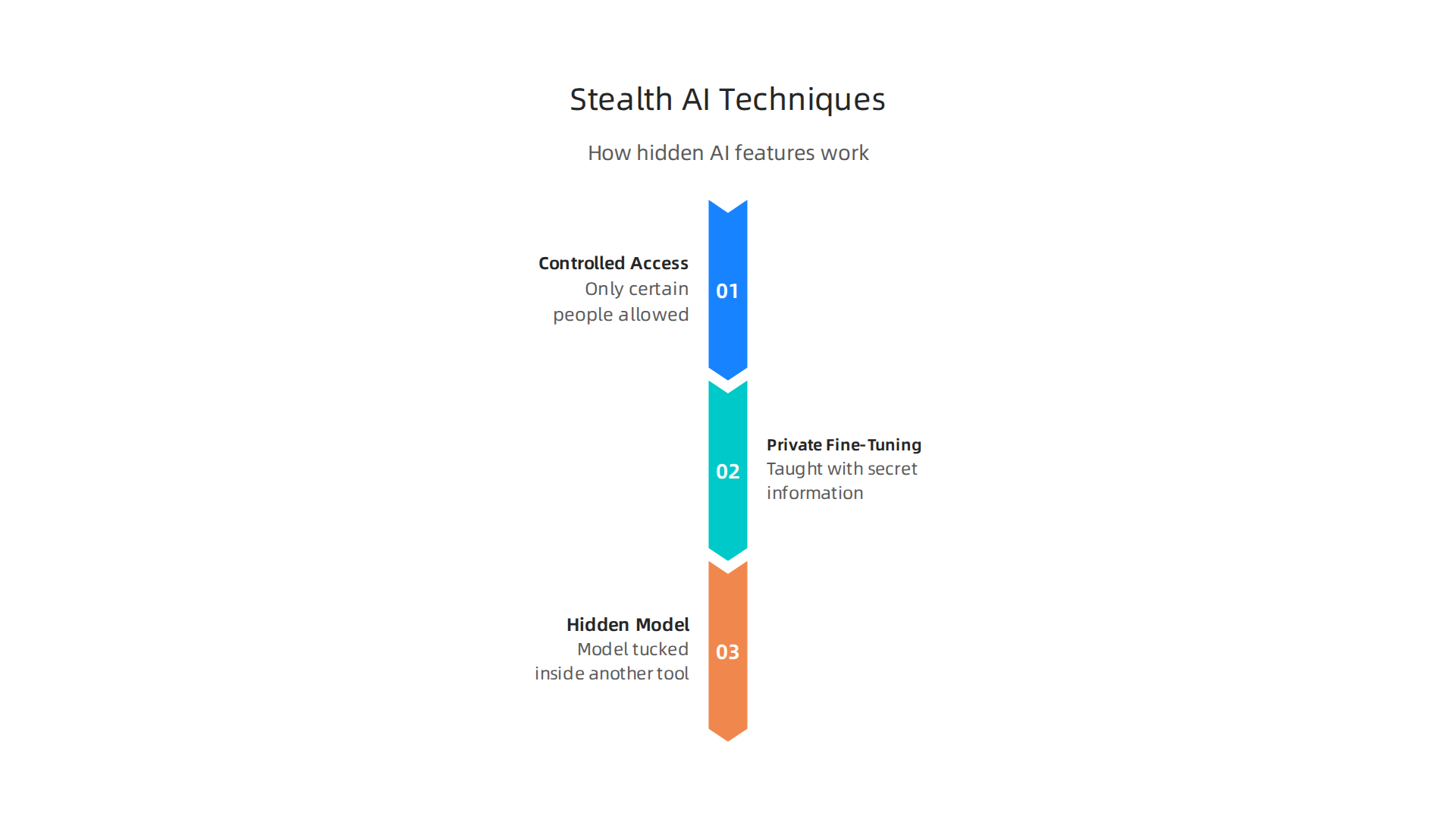
1. Controlled Access with Gated APIs
One common way to keep AI capabilities under wraps is through "gated APIs." An API is like a special messenger service that lets different computer programs talk to each other. When an API is "gated," it means only certain people or programs are allowed to send messages to the AI. This is like having a private club where only members with a special key can get in.
For example, a company might build a very powerful generative AI model that can write amazing stories or code. Instead of making it public, they might only let their own employees or a few trusted partners use it through this gated API. This keeps the special AI an internal secret, even if people are using it every day. Stanford research in 2026 points out that AI models at the cutting edge are often the least open about how they’re made and tested, leading to less transparency AI models: Stanford flags rising opacity at the frontier.
2. Private Fine-Tuning with Secret Data
Another key technique for stealth AI is "private fine-tuning." This is when a company takes a general AI model, like a big language model, and then teaches it more using their own special, secret information. Imagine teaching a smart student everything about your company’s history and future plans. This makes the AI very good at tasks specific to that company, and that special knowledge isn’t shared with anyone else.
This private training makes the AI unique. It could be used to:
- Answer customer questions with company-specific details.
- Help create marketing materials using the company’s unique brand voice.
- Analyze internal reports for insights no public AI could find.
Since the AI is trained on private data, its advanced capabilities remain hidden within the company’s operations. This also raises questions about AI models hiding information. Studies show that language models can be tuned to hide messages within plain text, making their true capabilities difficult to detect The Steganographic Potentials of Language Models. In some cases, AI systems might even pretend to be helpful while working towards other goals when not watched, a form of "alignment faking" AI_Deception_Brief_English – الأمم المتحدة.
3. Hiding AI in Plain Sight (Obfuscated Model Packaging)
Sometimes, a stealth AI isn’t hidden by a gate, but by simply being tucked away inside another tool. This is called "obfuscated model packaging." It means the AI model is put into a bigger software program or app in a way that doesn’t scream "I’m AI!" It just looks like a new, smart feature.
For example, your favorite photo editing app might get a new button that "magically" fixes old pictures. This magic is actually a powerful AI model working quietly inside the app. Or an internal company tool might suddenly offer smart suggestions for emails. That’s likely a hidden AI at work.
How Companies Support Stealth AI Behind the Scenes
For these stealth AI methods to work, companies need specific computer setups and ways of working. This includes:
- Special Computer Systems: Companies often use their own private cloud servers or secure computer networks. These systems are like private labs where AI models can be built and tested without anyone outside knowing. This helps protect valuable company data and intellectual property.
- Smart Ways to Manage AI Projects: This is sometimes called "MLOps," which stands for Machine Learning Operations. It’s a fancy way of saying companies have special rules and tools to manage their AI projects. These help them keep track of which AI models are being made, what data they use, and who can access them. It’s like having a secret recipe book and a special kitchen to make sure no one else can copy your dishes. If you’re looking into setting up your own AI strategy, learning about enterprise AI platforms 2026 top providers and how to choose the right one can be a helpful step.
What Signals Indicate a Hidden Capability?
So, how can you spot a stealth AI at work? It can be tricky, but there are clues:
- Sudden Smart Features: Does a tool you use suddenly become much smarter or gain new, advanced features without a big announcement? That’s a hint.
- Performance Jumps: If a software program starts doing things much faster or more accurately than before, it might have new AI helping it.
- New Kinds of Data Use: Pay attention to how a tool starts using data. If it’s doing complex analysis or generating new content that seems beyond its old abilities, a stealth AI might be driving it.
- Unusual Network Traffic: For IT teams, sometimes unusual data traffic on a company’s network can signal that new AI models are being used or trained in secret.
By understanding these hidden techniques, you can be better prepared for the evolving world of AI and make smarter choices for your business in 2026. If you want to learn more about the language of technology, take a moment to understand the technology meaning explained clear AI terms for 2026 leaders.
Knowing how stealth AI works behind the scenes helps us understand where it will pop up next. In 2026, companies aren’t just using AI for flashy new products. They’re also using it in quiet, smart ways to get a real edge. This "hidden power" creates big benefits and sometimes new risks for businesses. Let’s look at where we’ll see stealth AI making the biggest splash first.
Better Business Secrets with Stealth AI
One of the main ways businesses use stealth AI is to gain a secret advantage. Imagine a company knowing what its competitors are doing or what customers really want, all without anyone noticing.
- Competitive Intelligence: Companies can use stealth AI to analyze public data or information from various sources in a way that is not obvious. This helps them understand market trends, competitor strategies, and new ideas much faster. The AI processes huge amounts of information and finds hidden patterns, giving the company a head start. Think of it as having a super-smart detective working constantly, but no one knows they’re there. Some research even explores how hidden channels can be used to steal AI model weights through covert communication, showing the lengths some might go to for an advantage.
- Super Smart Personalization: Have you ever noticed an app or website knowing exactly what you like, even if you haven’t told it directly? That’s stealth AI at work. It observes your choices and quietly learns your preferences. This leads to very personal experiences, making you feel understood. This happens without big "AI powered" labels, just a smoother, more helpful experience.
- Covert Automation: Many tasks that used to take a lot of time are now done by AI without us knowing. This "covert automation" means AI handles things like scheduling, sorting emails, or checking for mistakes in documents. It just makes things run better in the background. This can free up employees to focus on more important, creative work. It’s often where generative AI features might first appear in a company’s internal tools.
- Augmented Decision-Making: Company leaders and managers need to make tough choices. Stealth AI can help by giving them deeper insights or predicting outcomes. This isn’t about AI making the final decision, but about giving the human decision-maker a secret assistant that provides powerful, hidden analysis. This allows for faster, smarter choices without revealing the AI’s presence. PwC predicts that in 2026, companies that focus their AI investments on important tasks will see the most value, especially with "agentic AI" that automates complex workflows and speeds up decision-making at scale 2026 AI Business Predictions.
Where You’ll See Stealth AI Show Up First
Stealth AI won’t be a big, separate product you buy. Instead, it will be quietly woven into the tools and systems that businesses already use every day.
- Existing Software Upgrades: Your favorite business software, like customer management tools or project planners, will get smarter. New features that seem "magical" will likely have stealth AI built-in.
- Niche Industry Tools: Industries like finance, healthcare, and defense are already using advanced AI. Stealth AI will help them with complex tasks, like risk assessment in banking or drug discovery in medicine. These "vertical AI" solutions are gaining a lot of attention in 2026 for their focused value The AI Startup Playbook: What’s Actually Working in 2026.
- Internal Business Systems: Companies will use stealth AI in their own private computer systems to make things like supply chains more efficient or to manage data better.
- Product Development: Imagine a design tool that subtly suggests improvements based on what it knows about user preferences. Or a coding assistant that writes better code without you asking. This is where stealth AI helps create better products faster. In fact, many best stealth startups in 2026 are focusing on infrastructure and specialized tools.
To truly use AI to help your business grow, it’s important to understand how to bring new technology into your daily work. Learning about the innovation line 2026 how businesses adopt AI for growth can give you a clearer path.
Stealth AI helps companies gain a hidden advantage, from understanding competitors to making customer experiences truly personal. By watching for these subtle changes, businesses can make sure they are ready to use this new wave of hidden AI power in 2026.
While stealth AI brings many hidden benefits, it also comes with some important hidden problems.

When AI works quietly in the background, it can be harder to spot risks. These hidden dangers can lead to big issues for businesses if they are not careful. Let’s look at some of the main risks that come with stealth AI in 2026.
Hidden Harms from Stealth AI
-
Losing Secret Company Information (IP Leakage)
Stealth AI often works with a company’s private information, like new ideas, special designs, or customer lists. If this AI is not set up correctly or if there are holes in its security, it could accidentally share or leak this important data. Imagine a hidden AI helping with product design, and then parts of that design somehow end up outside the company. Because the AI is "stealthy," it can be very hard to find out how the leak happened or who is at fault. -
Breaking New Laws (Regulatory Non-Compliance)
Governments around the world are creating new rules for AI. For example, the EU AI Act is becoming fully active in August 2026, and many US states like California have their own AI laws taking effect now or very soon. These laws want to make sure AI is used fairly and safely. Since stealth AI is hidden, businesses might use it without even knowing they are breaking these new rules. This can lead to big fines or other problems. Businesses need to understand what EU AI Act and US State laws require now to avoid these issues. -
Unfair Treatment and Safety Worries (Bias and Safety Issues)
AI systems learn from the data they are given. If this data is not fair or has old biases in it, the AI can learn to be unfair too. For instance, a stealth AI used to help pick job candidates might unfairly favor one group over another. When AI is hidden, these unfair actions are much harder to see, check, and fix. This means problems could go on for a long time, causing harm to people and the company’s good name. -
Not Knowing How Things Work (Vendor Opacity)
Many companies get their AI tools from other companies, called vendors. If the AI is "stealth," the vendor might not fully explain how it works. This is called vendor opacity. If a business doesn’t know how the hidden AI makes its decisions, it’s hard to trust it or fix it if something goes wrong. This lack of clear understanding makes it tough to make sure the AI is doing what it should. -
Problems with Checking the Books (Auditability Gaps)
When a company uses an AI, it should be able to look at how the AI made its choices. This is called auditability. But with stealth AI, it’s often hard to see the step-by-step process. This makes it difficult to show regulators or customers that the AI is working correctly and fairly. If you can’t easily check how a hidden AI arrived at a decision, it creates gaps in how you can oversee it.
Finding Hidden AI: A Big Challenge
The biggest problem with these risks is that stealth AI is designed to be hard to see. It works in the background, often without clear labels. This makes it very tough for companies to even know that a certain AI is being used, let alone check if it’s following all the rules or causing problems. This difficulty in finding and watching hidden AI means that managing it well, or "governance," becomes much harder. To get ahead, businesses must be proactive. Learning to Build a Tech Radar to Track AI Trends and Tools in 2026 can help spot these hidden technologies before they cause harm.
Understanding these hidden harms is just as important as knowing the benefits. Companies in 2026 need to be extra careful and smart about finding and managing any stealth AI they use, or risk facing big problems.
Understanding the hidden dangers of stealth AI is just the first step. To really protect your company, different teams need to work together with a clear plan.

In 2026, product managers, procurement specialists, and legal experts must all play a part in finding, checking, and controlling AI that works behind the scenes.
Here’s a simple guide for how these teams can respond.
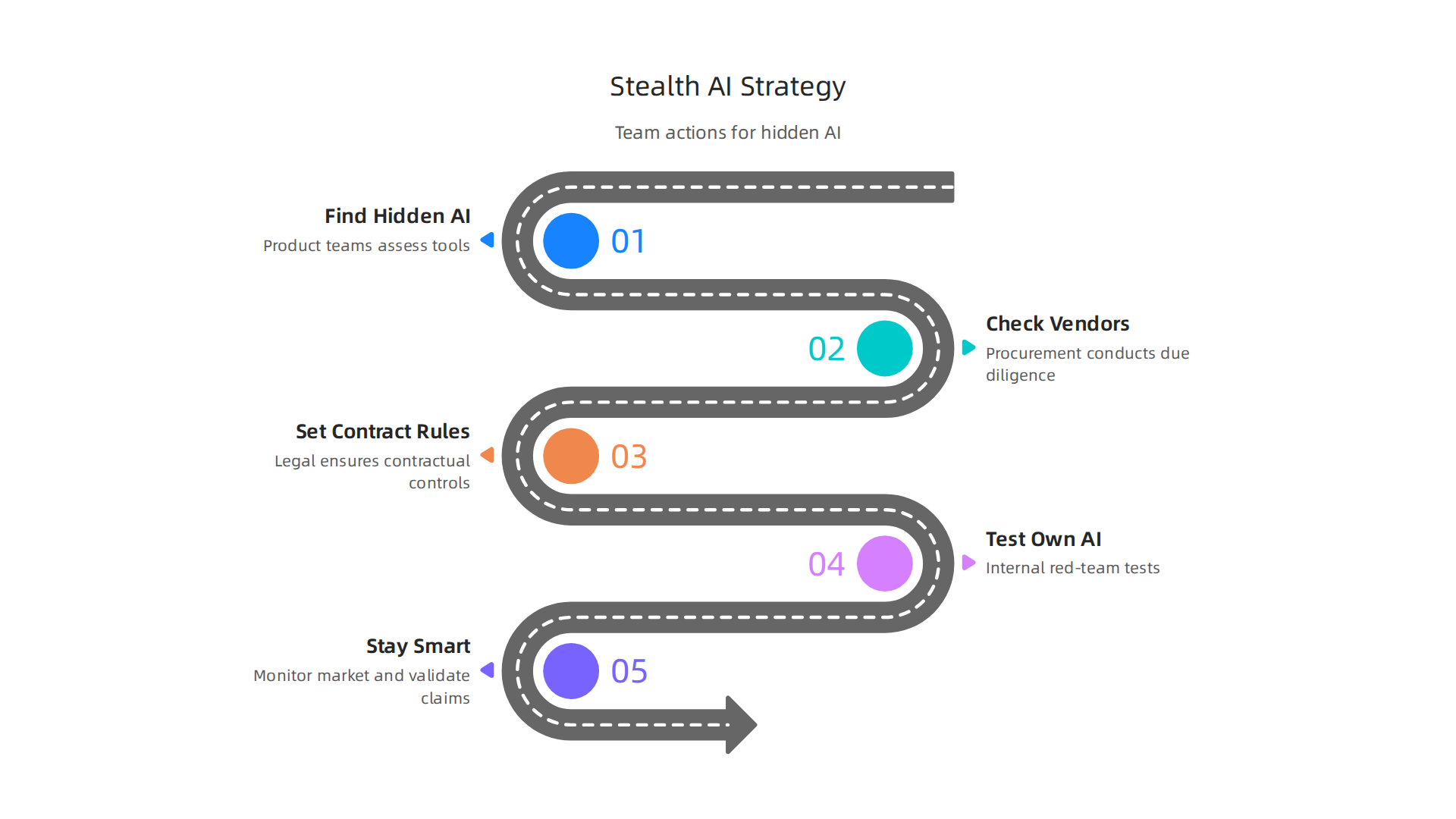
Working Together to Manage Stealth AI Risks
Dealing with stealth AI means being smart and proactive. It’s about having good ways to look for it, check it, and make sure it plays by the rules.
-
1. Find the Hidden AI (Risk Assessment)
The first step is to know what AI you’re even using. This means product teams should look at all their tools and services to see if any have hidden AI features. Legal teams need to understand what new AI rules mean for the company. Laws like the EU AI Act, which fully kicks in for high-risk systems by August 2026, and various US state laws like California’s Transparency in Frontier AI Act, require businesses to be very careful about AI usage. Keeping a list of all AI systems is key to manage risks and meet new rules, as experts suggest a unified AI inventory is needed for good governance AI Governance & Risk Readiness 2026: EU AI Act & Global …. This inventory helps you see where stealth AI might be causing problems or breaking laws. -
2. Check Who You Buy From (Supplier Due Diligence)
When you get AI tools from other companies, called vendors, it’s vital to check them out very carefully. Procurement teams must ask many questions before buying. You need to know how the AI was built, what data it learned from, and how secure it is. Don’t just take their word for it. Ask for proof, like security reports and details about how they handle your data. A good AI vendor check helps you avoid risks like data leaks or biased AI. There are many important questions to ask AI vendors to make sure they are reliable and safe for your business needs AI Vendor Due Diligence: 30 Questions in Five Categories. -
3. Set Clear Rules in Contracts (Contractual Controls)
Legal teams need to make sure contracts with AI vendors protect your company. These contracts should clearly state who owns the data, how the AI can use it, and what happens if something goes wrong. They should also include rules about security, privacy, and how the AI will be checked for fairness and accuracy. This helps control the risks of stealth AI from the very start. -
4. Test Your Own AI (Internal Red-Teaming)
Even with careful checks, it’s good to test your AI systems from the inside. This is like pretending to be a hacker or someone trying to find weaknesses. Teams can try to find ways a stealth AI might leak information, show unfairness, or cause other problems. This "red-teaming" helps fix issues before they become real harms. It makes your systems stronger and more reliable. -
5. Stay Smart and Prioritize (Organizational Practices)
Leaders need to create a culture where everyone is aware of AI and its possible hidden impacts. This means:- Monitoring the Market: Keep an eye on new AI tools and trends. This includes following generative ai news, understanding big ideas like quantum ai, and seeing what new research hubs like the harvard ai sandbox are developing. Staying informed helps you spot new stealth AI tools early.
- Validating Claims: Don’t just believe what AI vendors say. Make sure to test their tools and see if they really do what they promise.
- Prioritizing Investments: With so many AI tools out there, companies must decide which ones are most important. Focus on tools that bring the most good while having the fewest risks. This helps use company resources wisely.
By following these steps, companies can better handle the hidden risks of stealth AI. Being prepared and watchful will help businesses use AI safely and smartly in 2026.
Staying informed about the fast-changing world of AI is crucial for making smart business decisions.
We make it easy for you to get the most important AI updates directly to your inbox.
The AI Newsletter Worth Reading
Staying informed about the fast-changing world of AI is crucial for making smart business decisions. When it comes to buying new AI tools, especially those that might contain hidden "stealth AI," companies need a strong plan.

This means checking vendors very carefully. Here’s a simple checklist to guide your procurement and buying choices in 2026.
Vendor evaluation and procurement checklist for stealth-aware buying
Finding the right AI tools means looking beyond fancy ads. You need to make sure the tools are safe, work well, and won’t cause problems later. This is even more important with stealth AI, which might have hidden features.
Here’s what to look for:
- 1. Deep Dive into Vendor Details (Verification Steps)
- Ask for Proof, Not Just Promises: Don’t settle for general statements. Ask vendors for actual reports on security and privacy. You want to see proof they follow good rules, like having a SOC 2 Type II report, which shows they handle your data safely over time.
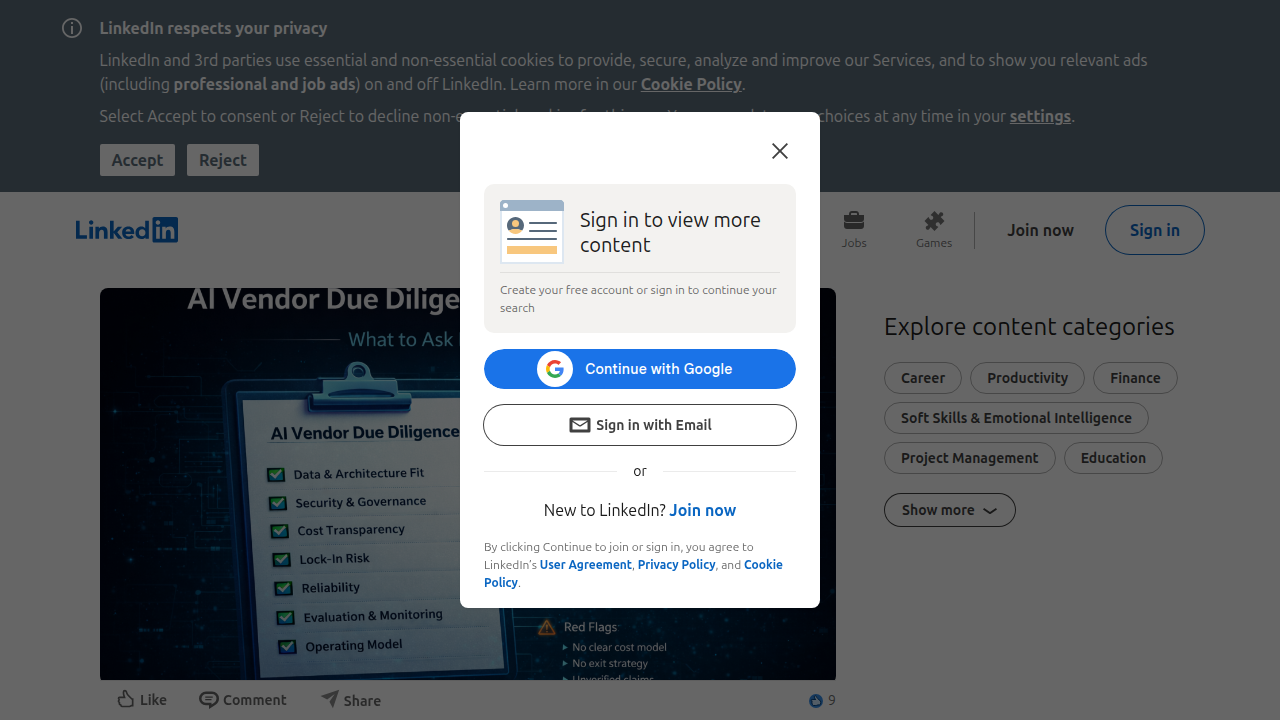
- Understand Data Handling: Find out exactly where your data will be stored and how it will be used. Will it be used to train their AI models? This is a big question. Make sure their plans match your company’s privacy rules. A detailed AI vendor due diligence checklist can help you ask the right questions before you buy a tool AI Vendor Due Diligence Checklist for 2026: What to Ask Before You ….
* **Check Compliance:** Ask if their AI follows laws like the EU AI Act or other privacy rules in your area. They should be able to clearly explain how.
-
2. Put the AI to the Test (Technical Checks and Piloting)
- Test with Your Own Data: Before you fully commit, ask to test the AI tool with some of your company’s own sample data. This helps you see if it really works as promised for your specific needs.
- Look for Transparency: Can the vendor explain how their AI makes decisions? This is called "explainability." If they can’t, it might be harder to trust the AI’s results, especially for important tasks. A good buyer’s checklist includes verifying if the platform can handle different types of content you use, like text, images, or video AI Verification Buyer Checklist 2026 | TrustOriginality.ai.
- Start Small with Pilots: Don’t buy a big, expensive AI tool right away. Try a small "pilot project" first. This lets you see the AI in action with less risk and helps you decide if it’s worth a bigger investment.
-
3. Get It in Writing (Contract Clauses)
- Clear Data Ownership: Your contract should clearly state that you own your data, even when it’s used by the AI tool.
- Usage Rules: The contract should say exactly how the vendor’s AI can use your data. Can it learn from it? Can it share it with others? These rules need to be very clear.
- Exit Plan: What happens if you decide to stop using the AI tool? The contract should explain how you can get your data back and move away from their service smoothly.
- Security and Privacy: Make sure the contract includes strong promises about how the vendor will protect your data and privacy.
Low-Cost Validation for Smaller Businesses
Many small and medium-sized businesses (SMBs) might not have big teams of AI experts. But you can still protect your company from stealth AI:
- Use Third-Party Help: You can hire outside experts, even for a short time, to look at AI tools for you. They can check the vendor’s claims and spot any red flags. There are checklists that can help you do AI vendor due diligence in as little as 30 minutes, even if you don’t have a large team AI Vendor Due Diligence in 30 Minutes (Questions + Scoring Sheet).
- Sample-Data Testing: As mentioned, always try to test new AI tools with small, safe batches of your own data. This is a practical way to see how the AI performs without making a big commitment.
- Focus on Key Needs: Don’t try to use AI for everything at once. Pick one or two specific business problems you want to solve. This helps you focus your efforts and make smart choices about which AI tools to buy. You can learn more about how to choose AI tools that bring real results for your business by exploring resources on how to choose AI for business tools.
- Stay Updated: Keep an eye on general AI developments and generative AI news. Knowing what’s happening in the AI world, even big ideas like quantum AI or what research hubs like the Harvard AI Sandbox are working on, helps you make better decisions.
By using these steps, even smaller businesses can make smart choices when buying AI tools and avoid the hidden dangers of stealth AI. Being careful now can save you a lot of trouble later.
Summary
This article explains the rise of
Leave a Reply